APPENDIX I OF THE PHYSICS OF CREATION
THE PACIFIC OCEAN WHIRLPOOL: ITS HEAT SOURCE MYSTERY?
Copyright Harold Aspden, 2001
In the analysis of the properties of the aether in Part I and Part IV of this book we have
seen that the aether has a mass density but has the curious property of interacting
gravitationally with matter in such a way that it exerts no gravitational force on that matter.
Its interaction with matter is betrayed by its related gravitational potential, a deficit energy
quantity distributed in the aether itself that manifests itself by a thermal vibration, the
energy shed becoming a kinetic energy state of the space medium itself. This, as we have
seen in Part IV accounts for a cosmic background temperature of some 2.7 K in the vicinity
of Earth.
A question also of primary interest is how matter, in moving through the aether, is affected
in an inertial sense by the presence of the aether. Here, as shown in Part III of this book, we
find that matter can drag aether structure so that one might expect its inertia to be affected.
The lattice-like array of nucleons in the atomic nuclei of atoms other than hydrogen has a
form corresponding with the configuration of charge elements forming the cubic structure
of the aether itself. This fact means that such atoms, in their collective motion as part of
material body, will progressively entrain crystalline forms of aether structure that are
carried along with the body. Provided that body is not accelerated or is accelerated only
very slowly, the extent of that aether structure adhering to the atoms will grow, so adding
to the body’s inertia. Eventually, the whole of the local aether lattice coextensive with the
body will share that motion.
However, as we have seen in Part II, there is dependence upon whether the body is moving
linearly or is itself rotating about an axis of spin. For linear motion the transport of aether
lattice is offset by a high speed counter-flow of aether particles through the lattice and this
means that there is no net change of linear momentum that can affect the inertia of the
material body. For rotation, that counter-flow would serve no purpose as there is no build-up of aether particles at collision boundaries. Therefore, one can see the case here for
saying that the body may acquire extra inertia governing its state of spin.
It should then be possible to detect this in the laboratory as a kind of inertial hysteresis
effect when rotors spin up to speed and then slow down but so far as this author is aware
no clear evidence of this is as yet available. Even so it is interesting to draw attention to
some laboratory evidence in this regard and I will here add reference to that in due course.
Note that a sudden change in the speed of a rotor will result in the aether lattice
coextensive with the physical size of an atomic nucleus breaking free from enveloping
aether lattice and itself rotating with the body through the enveloping aether that is left
spinning independently pending its slow down to release heat.
In extreme cases, such as body Earth, the steady rate of Earth rotation has resulted in the
aether lattice coextensive with Earth rotating with the same speed and about the same axis
as Earth, such aether spin extending to the heights of the ionosphere, even though air
molecules at those heights move through the aether at different speeds with very little
aether dragged along by their atomic nuclei.
This scenario is verified by analysis from which we deduce how the combined angular
momentum of aether spin and Earth spin was deployed when the Earth shed its satellite, the
Moon. A full account of this was presented in Chapter 8 of my book Physics Unified,
where it was shown that the dynamics of the Earth-Moon system implied that aether in spin
has a mass density of 248 gm/cc, whereas the Sun-planet system implied a similar such a
mass density of 257 gm/cc. The more rigorous fundamental analysis of the spin properties
of the aether indicated an actual mass density of 288 gm/cc and, with this in mind, we are
here now extending our concern to that 400 km diameter rotating body of sea water that
has been seen in the Pacific.
Regardless of the reason by which that large ocean whirlpool was initiated, the fact that it
has sustained its rotation for several months does suggest that the entrained aether spin has
been fully developed within that volume of water. Now, from the physics of aether spin,
we know that the setting up of an electric field radial from the spin axis will promote
electric displacement of the aether charge system by which energy is stored. This is a
displacement of aether charges which are forced to maintain synchronism with the universal
jitter of the quantum underworld and this action brings in from the enveloping aether an
equal amount of kinetic energy used to power that aether in spin.
Given this state of spin, the point of interest is that, if that radial electric field subsides to
shed its energy, the kinetic energy of that state of spin (the ocean whirlpool) will also be
shed in equal measure. Consider then the following scenario, assuming for the moment that
you can vary in a cyclical manner a magnetic field directed parallel with that spin axis. As
the magnetic field increases, so the whirlpool acts as an electrically conductive rotor, water
being electrically conductive owing to its salt content. By Faraday induction this sets up
that radial electric field drawing the necessary energy from the whirlpool motion. There is
an inflow of an equal amount of aether energy which is deployed into aether spin, thereby
augmenting the whirlpool energy of the combined ocean-aether system. Then, as the
magnetic field decreases, that electric field energy is shed by a kind of motor action which
feeds back into the whirlpool to sustain its rotation. Inevitably, however, and especially as
the cycle of magnetic field change is repeated, there will be a steady inflow of excess aether
energy which has to be dissipated in some way, obviously in generating heat.
We then have two questions to consider. Can we point to some action which might
account for the presence of a cyclically varying electric or magnetic field? Can we show
that the theory just present delivers numerical data which fits with what has been observed
in that Pacific ocean whirlpool?
As to the first question, one needs to understand that the process by which aether spin
induces electric charge displacement and vice versa is a function of the angle between the
space vector which defines the orientation of the axes about which the aether’s quantum
jitter motion defines its spin property.
It is important to keep in mind that there is a common spin vector direction shared by the
motion of all the aether particles within a space domain and, so far as our local space
domain is concerned, this vector is orientated parallel with the spin axis of the sun, that is at
right angles to the ecliptic, the sun’s apparent orbit. Earth spins about an axis that is
inclined at 23.5o to that spin vector, which is why we have our seasonal variations as Earth
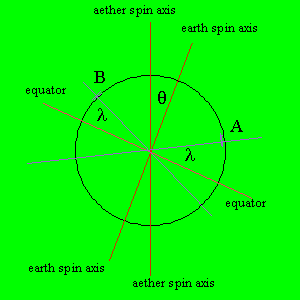
progresses in its annual orbit around the sun. This is depicted in Fig. A1 below, where that
spin vector direction is denoted as the ‘aether spin axis’, and the Earth spin axis is shown
inclined at an angle θ to that axis, this being the angle 23.5o.
Note then that we are considering the effects of a large 400 km diameter whirlpool in the
Pacific ocean 100 km south of Okinawa, that is at a latitude of 26o, which is the angle λ.
Therefore, depending on the time of day, that whirlpool will have itself a spin axis which
changes direction relative to the aether spin axis. It will range from the extreme depicted as
position A to the opposite extreme depicted as position B. As can then be seen from the
figure, the angle between the two vectors will vary between 90o minus λ plus θ and 90o minus θ minus λ. That is between 87.5o and 40.5o.
Note then that the rotation of aether entrained with the whirlpool
means that the aether lattice system is spinning at the steady angular speed of the whirlpool
and so the aether charges that form its lattice structure are subjected to a synchronizing
effect by which they are displaced very slightly radially with respect to the whirlpool spin
axis. However, this displacement is proportional to the cosine of the angle between that
spin axis and the aether spin axis, which means that the energy attributable to the induced
electric field displacement varies in proportion to the square of that cosine. This implies a
variation over a range of 0.00190 and 0.578. In turn, this means that much more than a half of the amount of electric energy stored at the maxima of that displacement condition plus a proportion of an equal amount of kinetic energy will be shed as heat from the aether every day owing to the process we are here discussing.
As to the second question, this is easily answered. Whatever the kinetic energy of the spin
of the whirlpool, the kinetic energy of the coextensive aether spin will be greater by the factor aether mass density divided by the mass density of sea water, that is nearly 300. This latter energy is energy supplied by the aether itself, this being sustained, so long as that whirlpool continues to spin, because the geomagnetic field is effective as a steady influence acting to maintain the related electric displacement. It is the aether kinetic energy of that whirlpool that is the source of the energy increase in the fluctuations in the electric displacement energy, and much of this energy is no doubt shed as heat in the decrease periods. This means that the likely amount of energy shed as heat per day will be 300 times the kinetic energy of that ocean whirlpool.
It was reported that scientists had been observing the phenomenon over a period of 7 months
so one must assume it formed some months earlier. The anomalous heat energy generated
over a period of 9-10 months, say, will, owing to the daily cycle, be nearly 300 times the
anomalous heat produced by one cycle of electric field change and the latter will be some
300 times the kinetic energy of the whirlpool. The latter is reported to have a speed of
0.180 km/h or 50 cm/s. If we estimate this as equivalent to 1,250 ergs of kinetic energy per
gm of water, the total heat energy produced in that 6 month period in the depths of that
large ocean whirlpool will be 300 x 300 x 1,250 ergs per gm of water (11.25 joules or 2.7
calories). This is enough to raise the water temperature by 2-3 degrees, the value reported as being observed.
Now, of course, this discussion of that mystery heating phenomenon in the Pacific Ocean
may seem rather bewildering, given the meagre information we have available, but do keep
in mind that I am in this book trying to relate the forces of creation, which apply to the
universe as a whole and our sun and Earth in particular, with fundamental particle creation
phenomena of the quantum underworld. Intermediate in scale between these extremes we
humans sit wondering whether we will one day be enlightened as to how we can ourselves
contrive to harness those forces of creation in our laboratories in the hope of satisfy our
future energy needs. To be shown, in effect, by Mother Nature herself something that
reveals heat creation as a staged demonstration in the sea of the Pacific Ocean, the source
of that heat being a mystery if it is not shed by the aether, is, to say the least, a wonderful
revelation. It is something we must not ignore and all I can say is that it has inspired me
and been a great encouragement in writing this book.
In summary, one must assume from this that the Pacific Ocean whirlpool heating anomaly is
a phenomenon which demonstrates that the aether can be a source of energy and the theory
just outlined can serve as a guide should we seek to exploit that resource to meet our
future energy needs. Of course, one would expect to discover more practical ways than
ocean heating, as I will outline when I come to write Part VI of this book. However, in the
meantime, given this topical, August 2001, review of what is a newly discovered
phenomenon, I can but convey this message of hope in my efforts to interest the reader in
my aether theory.
H. Aspden
16 August 2001.