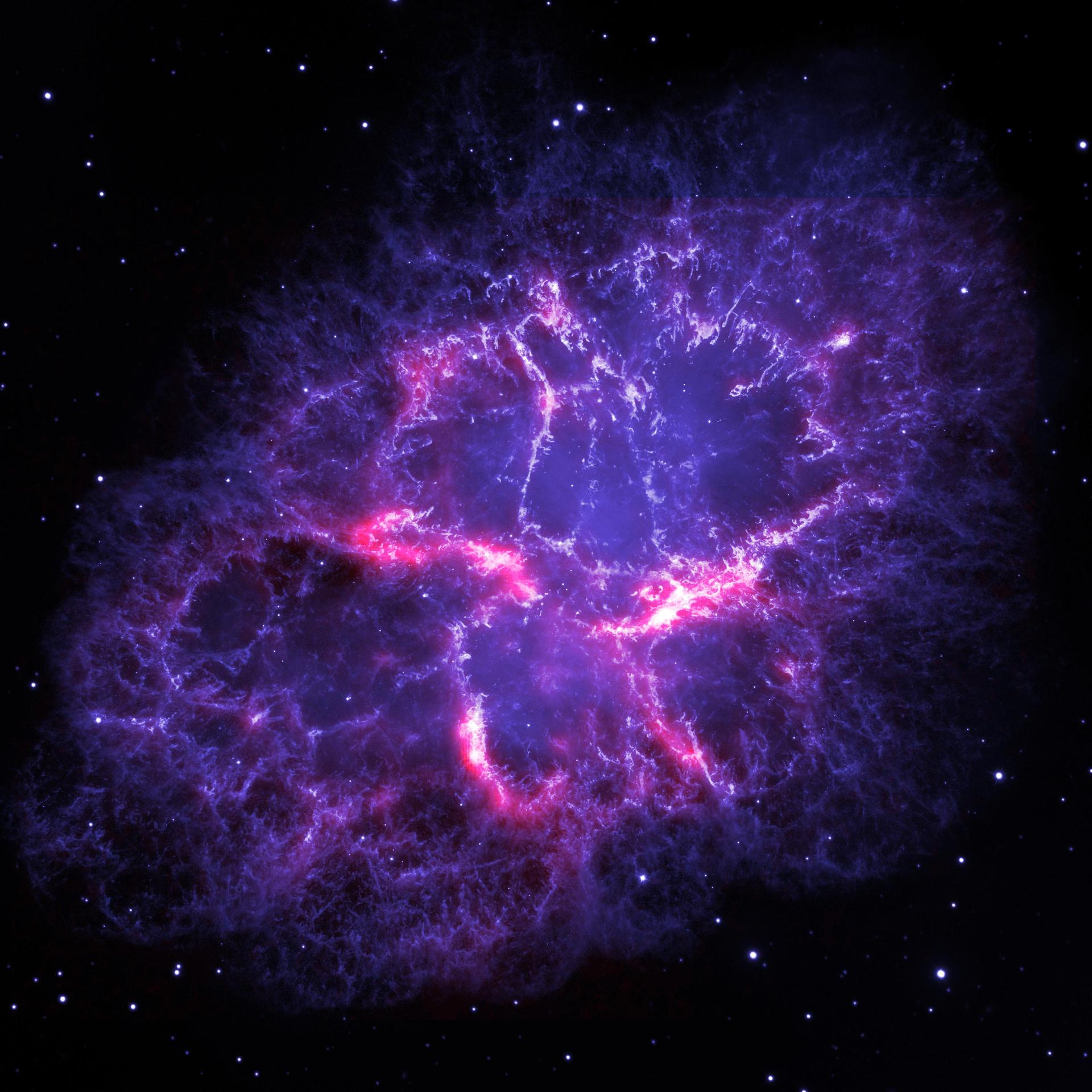
Crab Nebula (M1) — supernova remnant imaged by Herschel and Hubble Space Telescopes

Category: Lectures

Lecture series on aether physics

Crab Nebula (M1), supernova remnant · ESA/Herschel/PACS; NASA, ESA & A. Loll/J. Hester (Arizona State Univ.) · NASA Image Library ↗

  • APPENDIX TO LECTURE NO. 4

    APPENDIX TO LECTURE NO. 4

    SCHUSTER-WILSON HYPOTHESIS: CONTINUATION

    [The quoted text from the 1966 book proceeds below.]

    It is, therefore, suggested that this reaction effect
    presented by Gunn may well reconcile the difficulties with the
    Runcorn experiment. The same effect could also account for the
    variable nature of the solar field and the anomalies arising from
    this.

    However, even if the Runcorn experiment can be overcome,
    there is still the negative result of Blackett’s experiment and
    that of Wilson on the swinging iron bar. This might be dealt
    with if we consider the implication of the hypothesis that there
    exists in close association with any element of matter a negative
    electric charge proportional to its mass. This is really the
    basis of the statement expressed by the above formulation of the
    hypothesis.

    Augenheister [Augenheister, Phys. Zeit., v. 26, p. 307;
    1925] has shown that this assumption gives the correct ratio for
    the magnetic fields of the Sun and the Earth, but he also
    recognized the physical difficulties of assuming the existence
    of real charges of the necessary magnitude and the consequent
    very large electrical fields which must accompany them in an
    electrically conducting material such as the Earth’s core. One
    way out of this difficulty is to argue that in an aggregation of
    matter as with the Earth the negative charges associated with
    mass are cancelled by migrating charge, but that the balance is
    made up by a repulsion of free migrating charge displaced to the
    outer boundaries of the body. For example, in order to establish
    charge balance with the negative-mass charge some electrons might
    be displaced from the atomic structure of the matter involved,
    and these electrons would spread around the Earth in the
    ionosphere. On this model, mass exhibits no charge in laboratory
    experiments and has no apparent magnetic effect detected by the
    Wilson or Blackett experiments. Furthermore, the Augenheister
    problem is overcome. Even the Runcorn experiment is no longer
    applicable because the distributed charge theory does not hold.

    This interpretation of the hypothesis puts the prime source
    of the geomagnetic field outside the Earth, in the ionosphere.
    This has been objected to by Bauer [L.A. Bauer, Terr. Magn., v.
    28, pp. 1-28; 1923] who has shown by spherical harmonic analysis
    that most of the Earth’s field is of internal origin. For
    example, Bauer ascribes as much as 94 per cent of the Earth’s
    field to internal causes. Since the Earth’s ionosphere would
    need to cancel a substantial part of the field arising from the
    distributed charge for Runcorn’s results to be reconciled with
    the Schuster-Wilson Hypothesis, this objection is of paramount
    importance. However, even here it is very important to remember
    that the most general assumption used in spherical harmonic
    analyses of the Earth’s field is that the Earth’s magnetic
    potential is composed of two portions, one due to magnetic matter
    within the Earth’s sphere and the other due to magnetic matter
    outside the Earth’s sphere. The operative words in this
    assumption are ‘magnetic matter’. In this sense a current
    encircling the Earth and seated in the ionosphere does not
    constitute magnetic matter located wholly outside the Earth’s
    surface. For example, a current around the equator at a height
    of 200 km gives rise to two elements of magnetic matter, one
    situated inside the Earth and the other outside the Earth, the
    latter being related to the former in the ratio of the areas
    2(pi)Rx200 and (pi)R2, where R is the Earth’s radius in km.

    Since r is 6,371 km, it is seen that, curiously enough, this
    gives 94 per cent of the magnetic matter ascribable to ionosphere
    currents as seated within the Earth.
    The results of spherical harmonic analysis do not preclude
    magnetic reaction seated in the ionosphere, provided this
    involves charge migration around the whole Earth. For stellar
    bodies, no harmonic analysis data are available and, therefore,
    the closed spiral-type motion of gas ions may supplement the
    reaction effect of any charge migration. The result deduced by
    Bauer is certainly of no relevance to stellar bodies.

    From such consideration, the Schuster-Wilson hypothesis
    could well survive in a modified form. We have introduced a
    charge in the ionosphere which could well be objected to for
    other reasons. Perhaps we can even regard this as compensated
    by charge which does not rotate with or at the same speed as the
    Earth. Perhaps, though, this is stretching the hypothesis too
    far.
    Nevertheless, this gives scope to understand reasons for
    substantial changes in magnetic fields in astronomical bodies
    over short periods of time, and there is now evidence that the
    magnetic poles of many stars even exchange positions in a few
    days. As Runcorn [S. K. Runcorn, The Times (London), April 26,
    1965, p. 11] stated very recently: “This is one of the most
    stimulating challenges of cosmic magnetism”.

    The Schuster-Wilson Hypothesis stands rejected today.
    Instead, the theory of hydromagnetism is applied to account or
    the geomagnetic field. An excellent account of this subject has
    been presented by Elsasser [W.M. Elsasser, American Jour. Phys.,
    v. 23, pp. 590-609; 1955] and [W.M. Elsasser, American Jour.
    Phys., v. 24, pp. 85-110; 1956]. This theory will have great
    difficulty in accounting for the reversal of the magnetic poles,
    though it can be applied to account for the Earth’s secular
    variation of magnetic field. Bullard and others [E.C. Bullard
    et al., Phil. Trans. Roy. Soc., v. 243A, pp. 67-92; 1950] have
    provided an account of he westward drift of the Earth’s magnetic
    field in terms of theory which they state to be consistent with
    other theories of the origin of the main field, provided there
    is a differential rotation within the core. This statement
    recognizes that the prime source of the geomagnetic field might
    well stem from something other than a hydromagnetic effect. The
    great concern for the reversal of the magnetic field in stars
    stimulates a consideration of other possible accounts for cosmic
    magnetism.

    The above discussion of the Schuster-Wilson hypothesis does
    stress the possibility that there might well be some link between
    gravitation and cosmic magnetism. It is therefore of some
    interest that new ideas about gravitation already presented in
    this work are found to be capable of extension to geomagnetism.
    The fact that, in developing equation (6.12) [the above
    formula for magnetic moment MM], the elemental magnetic moment
    is found proportional to X squared [X being a distance from the
    Earth’s centre] shows that the character of the geomagnetic field
    matches that of a uniformly distributed charge over the Earth’s
    volume. The distributed charge theory was found by Runcorn to
    give field gradients opposite to those observed in practice.
    Here, however, it must be remembered that, by the theory
    developed, the geomagnetic field is attributed to a radial
    displacement of charge. The charge is displaced, in effect, to
    the boundary of the rotating aether. Clearly, therefore, if the
    effect of the rotation is to generate an effective uniformly
    distributed charge within the aether, an exactly balancing charge
    of opposite polarity must be established at the boundary. The
    displaced charge is, by its nature, constrained to balance in the
    radial plane. Thus, in considering magnetic moment, it is found
    that the charge displaced to the boundary, in rotating with the
    Earth’s aether, produces exactly double the magnetic moment given
    by (6.12) in the opposite direction. Quantitatively, therefore,
    (6.12) still applies. In considering magnetic field gradients,
    however, by Runcorn’s mine experiments, the component of magnetic
    field attributed to distributed charge is oppositely directed
    with respect to the general magnetic field of the Earth. Thus,
    the result of the Runcorn Experiment actually supports the theory
    developed.

    In considering the dipole nature of the geomagnetic field
    as evidenced by the results of Runcorn’s experiments, it is to
    be noted that a double strength shell containing an opposed
    single strength distributed charge would appear to present a
    field form more like a dipole than does a single strength shell.

    The rotation of Earth has been argued to produce the
    geomagnetic field by an induction effect in an electrical aether
    medium rotating with the Earth. The result of the Blackett
    Experiment imposes upon the analysis the need to regard the
    induced charge within the Earth as compensated locally or
    alternatively the need to regard the lattice as not concentrated
    by local matter. In Blackett’s experiment the magnetic effect
    of a dense body rotating with the Earth was under investigation,
    in contrast with the Wilson experiment where the body under study
    moved in the Earth frame.
    This strengthens the concept that the origin of the
    geomagnetic field is a uniform aether medium rotating with the
    Earth frame. We have to recognize that the aether has some
    uniformity, a lattice charge density, not affected by changes in
    mass density within the Earth.

    We now come to the real problem. The distributed charge and
    the balancing boundary charge of the rotating aether have to be
    cancelled by other charge to balance the electric field effects,
    but this other charge must not cancel the magnetic field effects,
    that is, it must not rotate with the Earth. The solution to this
    problem is amazingly simple.
    As the Earth moves in its orbit, its aether lattice will
    come into collision with surrounding aether lattice. We have
    shown that one constituent of the aether has the form of fluid
    charge and the other constituent is the lattice system of
    particles of charge e of opposite polarity, the aether as a whole
    being electrically neutral. The fluid constituent cannot move
    through itself. A spherical volume of it can rotate about its
    own axis, but it cannot move laterally in the sense that an
    element of the fluid moves laterally. The sphere housing fluid
    which rotates can move laterally, however, provided the rotary
    motion is transferred from fluid left behind by the sphere to new
    fluid coming into the sphere. The particle constituent, on the
    other hand, can move through itself.

    Imagine now the well ordered particle lattice formed within
    the Earth’s aether to move laterally and collide with surrounding
    particles. This lateral movement of the whole particle lattice
    in the Earth’s aether causes a deficiency of particles behind the
    lattice and a surplus in front of it. Thus an electrical field
    is set up along the line of travel of the whole lattice system.
    this field is not strong enough to disrupt the lattice but is
    strong enough to cause some of the particles in front of the
    lattice to migrate through it to fill positions vacated in the
    fluid behind the lattice. In short, the particle lattice can move without undue disturbance through similar surrounding particle
    structure if surrounding particles in collision with it travel through it to fill vacant locations left behind. Thus, if we
    regard the Earth’s aether to behave in this way, we see that
    there is, traveling through the Earth, an abundance of free
    lattice particles which are constrained to move in opposition to
    the Earth’s motion in its orbit. The magnetic effect of these
    particles cancels exactly the magnetic effect of the matrix
    particles in their travel with the Earth in its orbit.
    Consideration shows that there is also balance of linear momentum
    in such a system. However, these free particles do not rotate
    with the Earth. They are free to a limited degree to cancel the
    electrostatic effects of the induced charge, but they do not
    share the Earth’s rotation and therefore no cancellation of the
    geomagnetic field occurs.

    This albeit rather peculiar notion of particles moving in
    formation, with other particles moving at higher speed traveling
    freely in opposed directions and between the ranks of the ordered
    particles, gives a very simple and direct account which overcomes
    the Augenheister problem introduced above.
    It introduces the requirement that the Earth must move
    laterally and not just rotate to obtain this electrostatic
    balance condition. The faster the Earth moves then the greater
    the number of free particles in it to cancel the electrostatic
    charge. Clearly, the particles are likely to fall out of harmony
    with the general system and deploy their velocity in their small
    orbits to travel at this velocity through the matrix. This
    velocity is seemingly constant for all particles. Therefore, the
    ratio of free particles to bound lattice particles in the Earth’s
    aether lattice depends upon the ratio of the Earth’s orbital
    velocity to the velocity of the particle in its small orbit.
    It is suggested that if the Earth were to stop in its orbit,
    then, apart from being drawn into the Sun by gravitation, there
    would be nothing to balance the strong electric field induced by
    its rotation and, since these fields are of the order of many
    millions volts per cm, all matter in the Earth would become
    ionized. The Earth would then lose its magnetic field.
    It is suggested that if the same argument is applied to the
    Sun there is cause, owing to the Sun’s relatively slow motion,
    for understanding why its magnetic field is less constant than
    that of the Earth.

    MAGNETIC MOMENT OF THE SUN

    The expression (6.12) for the magnetic moment can not really
    by tested for other planets until we know their magnetic moments.
    the magnetic moment is proportional to the square of the speed
    of rotation. Thus, the Moon will hardly have any significant
    magnetic field. Using (6.12) it is to be expected that the
    magnetic moment of Mars will be about 3.2×1024 emu.
    We can, however, test (6.12) by applying it to the Sun. The
    Sun rotates once every 25 days and has a radius 108 times that
    of the Earth. Hence its magnetic moment should be
    (108)5/(25)2 that of the Earth, or 1.9×1033 emu.

    Estimates of the solar magnetic moment have to take into
    account the sporadic magnetic fields produced in sunspots. Some
    early estimates may therefore be unreliable. One recent analysis
    by which the dipole moment of the sun has been estimated is that
    of Sakurai [K. Sakurai, J. Geomagn. Geoelect., v. 11, pp. 21-33;
    1959] who observed a value of 5×1032 emu.
    This is somewhat less than that predicted by this theory but
    the data is of the right order and the result adequately supports
    this theory.
    Furthermore, as has been stated, there is evidence that the
    solar magnetic field has been decreasing over the past few years.
    There is also evidence that in some stars the field reverses in
    direction very frequently, in some cases every few days.

    To account for this, let us regard the estimate of
    1.9×1033 emu to be the solar magnetic moment in the absence
    of cancelling charge of the kind developed by ionization. Then,
    considering the Sun to be in motion so as to provide the
    constrained charge carriers able to prevent total magnetic field
    cancellation owing to ionization. The magnetic field will then
    be partially cancelled, perhaps in the ratio of the abundance of
    ions to the abundance of the constrained migrating charge
    carriers. Now, this relative abundance will be a function of the
    speed of the Sun. The faster the Sun moves, the more abundance
    in constrained carriers and the stronger the magnetic field.
    Also, and of great interest to this account, the abundance
    density of the constrained carriers will be uniform throughout
    the Sun but the abundance density of free ions may be greater in
    the outer regions of the Sun than in its core. It is seen,
    therefore, that what will happen as the Sun changes from fast to
    slow speed is that when moving rapidly it will have a fairly
    normal dipole moment induced by its rotation, the constrained
    aether constituent in its inner and outer regions being more
    dense than the ions. Then, at a lower speed the abundance of
    ions in the outer regions outweighs the effect of the unbound
    lattice particle charge, thereby substantially cancelling the
    magnetic action of the outer field-generating shell of displaced
    lattice. The inner core field generation will not be affected in
    such a significant way by the lower speed. As a result the double
    strength magnetic moment of the shell is cancelled and the
    opposed single strength magnetic moment of the core remains
    unchanged. The total effect is a complete reversal of the dipole
    magnetic moment of the Sun. This has not required any change in
    rotational speed of the Sun. It merely requires that the Sun
    should fluctuate in speed in its own orbit. The reversals of its
    magnetic moment should appear in phase with the variation in
    speed.
    We predict, therefore, that the variation of the solar
    magnetic moment must depend upon the motions of Jupiter and
    Saturn.

    There is perhaps insufficient data available at present to
    check this account of the solar field reversals, though it does
    appear that over the past few years the solar field has decreased
    and indeed reversed, whilst the Sun has decreased in speed as
    Jupiter and Saturn have moved into opposition.
    The fact that some stars can reverse magnetic field in only
    a few days indicates that their orbital speed changes at this
    frequency. This is possible if a star has a satellite close to
    it. [It may belong to a binary pair, with both stars orbiting
    around one another every few days, as for DI Herculis mentioned
    in the first of these lectures on cosmological questions.]

    CONSERVED ANGULAR MOMENTUM IN THE SOLAR SYSTEM

    We have seen how the motion of an astronomical body through
    space provides a constrained aether constituent which prevents
    ionization owing to the induced charge caused by aether rotation.
    If a body such as the Sun did not move through space, then, apart
    from any other source of ionization, its rotation alone would
    induce electrical fields and cause ionization.
    Motion at varying speed through space arises from the need
    to be in balance with a satellite planet. Then ionization need
    not occur as a consequence of rotation. If it does occur its
    effects will moderate the induced magnetic field, but this
    moderating effect will be weaker, the faster the Sun moves
    through space.

    The rotation of an astronomical body is accompanied by the
    rotation of the aether it contains. For the planets the aether
    rotation momentum about the centre of the solar system is
    insignificant compared with their material orbital momentum.
    However, for the Sun the contribution of the aether angular
    momentum due to the Sun’s rotation is very substantial in
    relation to the angular momentum of the solar system.
    It has long been a difficult question to account for the
    formation of the solar system in terms of a solar explosion which
    somehow imparted substantial angular momentum to the planets but
    left the sun with a balancing angular momentum of the order of
    1% that imparted to the planets.

    This is no problem in the case of the formation of secondary
    satellite systems, where the satellites are assumed to form from
    a mother planet (see work of Alfven [H. Alfven, Astrophys. Jour.,
    v. 137, pp. 981-990; 1963]). Yet, while it is debatable whether
    the Moon, for example, came from the Earth, it is less debatable
    that the Earth came from the Sun and it is here that angular
    momentum balance presents a baffling problem.
    This theory may help in resolving this anomaly because the
    value of aether lattice density mo/d3 is of the order of 100
    times the Sun’s density, showing that the aether angular momentum
    of the solar system might well be in balance with the material
    angular momentum. [Note that mo denotes the mass of an aether
    particle and that the value of mo and d, the cubic lattice
    spacing of the particles in the aether structure, were
    theoretically determined in the earlier pages of the book from
    which this text is quoted].

    While this hypothesis will not be pursued here, it is of
    interest to mention, in passing, that in discussing the origin
    of the satellites and the planets, Alfven and Wilcox [H. Alfven
    & J. M. Wilcox, Astrophys. Jour., v. 136, pp. 1016-22; 1962] have
    proposed that this has come about from the interaction of a
    neutral gas and a plasma. In contrast, the present theory, which
    is concerned mainly with the magnetic and momentum properties of
    such bodies, regards them to consist in reality of a neutral
    material substance and an all-pervading plasma which we have
    termed the ‘aether’.

    It is appropriate to observe that the aether lattice moving
    with the Earth through aether fluid not only gives us the account
    of terrestrial magnetism presented but explains the experiment
    of Michelson-Morley by confirming the words of Campbell [N.R.
    Campbell, ‘Modern Electrical Theory’, 2nd. Ed., Cambridge
    University Press, pp. 387-388; 1913]:

    “If we speak of ‘aethers’
    and not ‘the aether’ all our experiments prove is that the
    particular aether with which we are concerned in any case is that
    which is at rest relative to the source and may be regarded as
    forming part of it. This is the simple way out of the
    difficulties raised by the Michelson-Morley Experiment. If from
    the beginning we had used a plural instead of a singular word to
    denote the (aether) system….those difficulties would never have
    appeared”.

    Thus, the Earth and the Sun may each have their own
    individual aethers as envisaged here and we need have no
    inconsistency with the observations from the Michelson-Morley
    Experiment.”

    [The above is quoted from a book I wrote in 1966, more
    than 30 years ago. About 10 years on from that time
    I was actually able to derive the quantitative basis
    for a theory explaining how the planets formed from
    the mother body, the Sun. Moreover, I then found that
    the Moon did, in fact, come from body Earth by the
    same process. Without aether theory there is no way of
    deriving this result. That theory appears in my 1980
    book ‘Physics Unified’. I hope, however, to provide a
    section later in these Web pages based on a lecture I
    was once invited to deliver to the students and staff
    of the Physics Department at the University in Cardiff
    in Wales, with diagrams to illustrate my case.]

    To go to that Cardiff lecture press:

  • UPDATE

    UPDATE INFORMATION

    May 9, 1998

    These Web pages were first introduced to this www.energyscience.co.uk site on August 25, 1997. Some were published earlier on the author’s homepages at a different web site.

    Although the Bibliographic section is extensive, many more items need to be added to make the list complete and, as time permits, since many of the abstracts are too brief, they will be expanded so as to be more informative.

    Now added on May 9, 1998:
    LECTURE NO. 19

    THERMOMAGNETIC POWER GENERATION

    Added on May 2, 1998:
    LECTURE NO. 18

    THE EDDY CURRENT LOSS ANOMALY

    Added on April 16, 1998:
    ESSAY NO. 12

    A NEW RESEARCH THEME: ARE YOU SEEKING A THESIS TOPIC?

    Added on April 13, 1998:
    LECTURE NO. 17

    THE MAGIC OF MIRRORS

    Added on April 13, 1998:
    LECTURE NO. 16

    50 YEARS AND ON WE GO

    Added on April 7, 1998:
    COLD FUSION INDEX

    The Cold Fusion Patent Scene & US Patent 5,734,122

    Added on April 1, 1998:
    RESEARCH NOTE 2/98

    Electron Spin? Schism or NIH?

    Added on March 15, 1998:
    ESSAY NO. 7

    G AND PEER REVIEW?

    Added on March 15, 1998:
    UNIVERSITY CHALLENGE

    Test your University Library

    Added on February 28, 1998:
    LECTURE NO. 12

    WHY HAWKING IS WRONG!

    Added on February 28, 1998:
    1983k

    PLANAR BOUNDARIES OF THE SPACE-TIME LATTICE

    Added on February 28, 1998:
    FEEDBACK NOTE No. 2

    ANSWER TO JOHN SHELBURNE

    Added on February 25, 1998:
    LECTURE NO. 11

    THE HUBBLE CONSTANT: ITS ‘FREE ENERGY’ ROLE

    Added on February 24, 1998:
    LECTURE NO. 10

    THE OCEAN OF SPACE

    Added on February 24, 1998:
    LECTURE NO. 10: APPENDIX

    AN ANTENNA WITH ANOMALOUS RADIATION PROPERTIES

    Added on February 24, 1998:
    RESEARCH NOTE 01/98

    RENEWABLE ENERGY: A TOPIC FOR DEBATE

    Added on February 24, 1998:
    1987n

    ABSTRACT: AN ANTENNA WITH ANOMALOUS ENERGY RADIATION PROPERTIES


    You are reminded that the URL of this site is:
    http://www.energyscience.co.uk

  • NUCLEAR CHAIN STRUCTURE

    THE CHAIN STRUCTURE OF THE NUCLEUS

    Being the reproduction of a paper published in 1974 by Sabberton Publications of P.O. Box 35, Southampton, England aimed at interesting readers in the author’s books: Physics without Einstein (1969) and Modern Aether Science (1972)

    Copyright, Harold Aspden, 1974

    ABSTRACT

    The atomic nucleus is shown to have a form
    determined by the quantum structure of a
    Dirac-style vacuum. Nucleons occupy a series
    of holes in the structured vacuum forming a
    shell about a core region of unoccupied holes.
    These nucleons are linked by electron-positron
    chains. The lattice spacing can be related to
    the binding energy of the nucleus in precise
    quantitative terms. The special position of Fe
    56 in the nuclear packing fraction curve is
    explained in terms of the cubic symmetry of the
    lattice system, the optimization of interaction
    energy with the core charge and the energy
    minimization of the chains.

    INTRODUCTION

    This paper has been prompted by recent developments in
    elementary particle research having bearing upon a theory
    published in 1969. Chapter 7 of the author’s work Physics
    without Einstein
    incorporated some new ideas about nuclear
    structure. It was argued that nucleons are located at fixed
    lattice positions in a cubic structure and are linked by chains of
    electron-positron pairs. Each chain had association with what
    are now called partons. The mass deficit due to the negative
    interaction between a proton-sized parton and a pion-sized
    parton was deemed to balance the mass of the chain of electrons
    and positrons. Indeed, it was the energy of combination of
    these two heavy particles to form a nucleon at a nuclear lattice
    position which was the source of energy creating the electron-positron chain.

    These ideas have progressed over the past five years and it
    is appropriate now to publish some of these developments. The
    author is indebted to Dr. D.M. Eagles of the National Standards
    Laboratory, Sydney, Australia for helpful communications and
    encouragement. Dr. Eagles recently drew to the author’s
    attention a paper entitled ‘Parton Chains in the Nucleus’ by
    Wojciech Krolikowski, at p. 2922 of Physical Review D of
    1 November 1973. It is this which has stimulated the publication
    here of some interesting advances of the chain nucleus theory at
    this stage of its development. The theory proposed offers scope
    for very detailed computational analysis of the structure of
    individual atomic nuclei.

    A preliminary note about quark theory is appropriate before
    the structure of the atomic nucleus is analysed. This is
    important because it is the author’s contention that the proton
    does, indeed, comprise three particles as demanded by quark
    theory. Such a structure of the proton was presented in
    Physics without Einstein but in the form of a positive particle
    having the charge of the positron and associated with an electron-positron pair.

    THE QUARKS

    From a study of electron and neutrino scattering from
    protons Feynman writing in Science at p. 601 of the 15 February
    1974 issue has been able to show that protons have structure as
    if they comprise a plurality of particles of more fundamental
    nature, the so-called quarks. His paper entitled ‘Structure of
    the Proton’ has the introduction:

    Protons are not fundamental particles but seem to be made
    of simpler elements called quarks. The evidence for this
    is given. But separated quarks have never been seen. A
    struggle to explain this seeming paradox may be leading us
    to a clearer view of the precise laws of the proton’s
    structure and other phenomena of high energy physics.

    Feynman explains how, on quark theory, there are three
    kinds of quark denoted u, d and s. The s and d quarks have
    charge -1/3 and the u quark charge +2/3 that of the positron.
    The s quark has higher mass than the d and u quarks which
    have the same mass. From this he presents a diagram showing
    how three quarks can combine to produce ten different particles:

    Feyman’s quarks
    Strangeness
    -3 sss
    -2 ssd ssu
    -1 sdd sdu suu
    0 ddd ddu duu uuu
    Charge -1 0 +1 +2

    Now the unsatisfactory feature of quark theory is this
    concept that charge can be quantified in units which are one
    third or two thirds that of the electron or positron. It would
    be so much more satisfactory if Nature gave us a system of basic
    particles based exclusively upon charges which are measured in
    terms of the unit charge of the electron or positron. A little
    speculation shows how this is possible, provided we pay
    attention to some of the ideas presented to us by Dirac. It is
    well known that Dirac has proposed that the vacuum state is an
    aether permeated by quantum states filled by negative mass
    electrons. This implies that the vacuum has states with which
    particles can be associated and in which a negative charge of -1
    electron units will pass undetected, being somehow neutralized
    by the vacuum medium. In these states the vacuum appears to
    add the charge +1. A particle can exist independently and not
    occupy such a state. Then we need add no charge to its own
    charge. On this basis, consider the following diagram:

    Aether but no Quarks
    charge -1 -1 +1 +1
    state 0 +1 0 +1
    net charge -1 0 +1 +2

    Given a combination of three charges, each of which can be -1
    or +1, and recognizing that stability criteria forbid three
    negative charges and three positive charges from combining,
    we must have a net charge of +1 or -1. Also, if we can have a
    free particle or one occupying a vacuum-polarized position,
    effectively adding +1, we see scope for four different charge
    entities. It follows that if the s, d and u quarks have charges
    +1 or -1, but masses as assumed on normal quark theory, we
    can have ten particles satisfying the observed charge system,
    but without recourse to the fractional charge features of quark
    theory.

    It is therefore submitted that, since no experimental
    evidence exists supporting the fractionally-charged quarks but
    since experimental evidence does support other features of
    quark theory, then the alternative is to accept that some features
    of Dirac’s aether theory need scrutiny.

    ATOMIC MASS

    Bernstein writing in Annals of Physics, 69, 1972, p. 19 has
    recently pointed out the need to incorporate ‘holes’ as
    constituents of an atomic nucleus. His reason is coupled with
    the explanation of energy levels and the inadequacies of the existing shell models. The approach we will take here is to
    examine the possibility of substituting nucleons for electrons in
    the Dirac continuum. We will presume a hole structure forms
    around the charge core of the nucleus and that the holes are
    occupied by negatively charged nucleons. This imparts mass
    to the nucleus but the charge of these nucleons is merged into
    the continuum. Interesting quantitative verification of this
    principle is available.

    It is generally believed that an isolated electric charge will
    attract an equal charge of opposite polarity and so one imagines
    that two equal and opposite charges will pair together and form
    a neutral aggregation. Yet, Earnshaw’s theorem denies that
    two equal and opposite electric charges can rest adjacent one
    another in stable equilibrium unless they are immersed in an
    enveloping electrical medium. Dirac’s continuum would, in
    effect, be such a medium. The observed vacuum polarization
    adjacent an atomic nucleus supports the exception also. Therefore charge neutralization should occur. Why then is the atomic
    nucleus itself not a neutral entity?

    The answer is found from classical electrostatic theory.
    Laplace proved that the outward forces due to mutual interaction
    of a surface charge on a conductor are only half the forces
    exerted by the field on similar free charge just outside the
    surface. Thus when an electron is added to the surface of a
    conductor to charge it, a free electron migrates from the atomic
    lattice system of the conductor and joins the added electron.
    Together the electrons form a surface charge just outside an
    inner charge of opposite polarity and half the magnitude. This
    latter is the residual charge left by the ionized lattice. This is
    a displacement phenomenon. The field on each electron is zero
    because the displaced electron has created positive and negative
    influences which cancel. The field away from the conductor is
    that due to the single added electron. In our atomic case,
    however, we have no displacement. Instead, a spherical shell
    of charge can centre upon a core of opposite polarity of half its
    strength and be held stable. A core of Ze charge can and will
    form a stable aggregation with a surrounding shell of -2Ze
    charge. If these added charges are not electrons but are negative nucleons then the atomic mass number A should be 2Z.
    If the nucleons are uniformly distributed over the volume of a
    sphere because they form in a structure of some kind then the
    same principles of Laplace apply except that a charge of -2.5Ze
    can be aggregated and held stable. This tells us to expect the
    ratio A/Z to increase from 2.0 to 2.5 as an atomic nucleus formed
    in shells increases in size.

    In line with Bernstein’s ideas we need to recognize that
    ‘holes’ are part of the nucleus. These cancel the effects of the
    nucleon charge. From another viewpoint we might say that
    space is pervaded by an electrically-neutral continuum which
    nevertheless contains discrete negative charges (electrons or
    the like) in a positively charged background continuum. Heavy
    negatively charged nucleons can occupy holes from which the
    negative charges are displaced. However, these nucleons tend
    to nucleate, if only by stronger gravitational effects, in regions
    immediately surrounding the atomic core charges Ze. Thus the
    atomic nucleus is formed, and it may have structural form
    characteristic of the properties of this pervading medium.

    The analysis relating A and Z just presented has bearing
    upon nuclear stability. Z sets a limit upon the value of A, but
    one may expect the exact relationships to depend upon the
    structural links between the nucleons.

    This concept has already been presented in the author’s
    1972 book ‘Modern Aether Science’. The relevant part of
    chapter 14 of this work is reproduced below.

    The Nuclear Aether

    The physics of the aether is to many minds the physics of the
    nineteenth century. The twentieth century has so far been concerned with the physics of the atom and its quantum behaviour.
    Physics has assumed importance in industry primarily because
    electrical technology in the semiconductor field has become the
    province of the physicist rather than the electrical engineer.
    Also, physics has now an undeniable place of importance because everyone is all too aware of the energy hidden inside the
    atomic nucleus. For this reason the minds of many research
    physicists are technology-orientated. Theoretical physics is
    complicated, the aether is dead and who has the time anyway to
    be concerned with such an antiquated topic! The more open-minded may say that if the aether has a place it is in cosmology;
    it is certainly not in the field of the nucleus. But let us see if we
    can dispel this belief.
    Is there anything about the atomic nucleus we cannot explain?
    The atomic mass does not increment in proportion to the atomic
    charge. It seems that over a range of atoms of low atomic mass
    the number of nucleons is approximately twice that of the
    number of proton charge units in the nucleus. The nucleons
    comprise the protons and neutrons believed to form the
    nucleus. At high mass numbers the ratio of two increases
    roughly to about two and a half. An explanation of this would
    help our understanding of nuclear physics. Does the reader
    already have such an explanation? If not, perhaps the following
    analysis will have some appeal.
    Consider an electric charge surrounded by a concentric
    uniform spherical distribution of discrete charges of opposite
    polarity. Now calculate the electrostatic interaction energy of
    such a system. This quantity will be found to be negative until
    the spherical charge distribution has a charge exactly double the
    magnitude of the central charge. Thereafter we would have
    positive interaction energy signifying instability, because the
    ‘binding’ energy associated with the negative polarity has
    ceased to ‘bind’. We may expect, therefore, an entity to form as
    a stable aggregation in which the central charge acquires an
    enveloping double charge of opposite polarity, assuming the
    spherical distribution. If we consider instead a central charge
    with a uniform spatial charge distribution surrounding it,
    bounded by a sphere, then instability sets in when the surrounding charge is two and a half times that of the core. Between
    these two limiting examples, we could have, say, charge distributed in two concentric shells of unit and double unit
    radius, the charge content being proportional to the area of the
    spherical shell form. This gives a ratio of 2.166 for stability.
    It needs little imagination to recognize the relevance of this to
    our nuclear problem. The atomic mass number is a measure of
    the number of negative nucleons clustered around a central core
    of charge. This charge has negligible mass compared with the
    nucleon mass contribution but the charge is the positive charge
    we regularly associate with the atomic nucleus. We need not
    speak of a combination of neutrons and protons to explain
    qualitatively the numerical difference between atomic number
    and atomic mass number. Somehow the charges of the nucleons
    are not detected, because we well know that the atomic electrons
    only react to the central charge. They ignore the nucleon
    charges just as they ignore charges in the aether medium.
    Indeed, the electrons may see these nucleon charges as they see
    the aether. In fact, the nucleons may be deemed to be arrayed
    in a structure and to have displaced negative aether charge so as
    to substitute themselves in the structured form of the aether
    itself. Their charge is undetected just as the mass of a buoyant
    body goes undetected in a fluid of equal mass density.
    Hence, we need to invoke our aether. Also, we see support for
    the cubic lattice distribution of aether charge. An oxygen
    nucleus can be adequately populated by a single shell of discrete
    charges. There are 26 charges disposed in a regular cubic system
    about a central charge and 16 of these are presumably replaced
    by negative nucleons. The two to one ratio applies, because the
    oxygen atom has a atomic number of 8. Now take chromium,
    for example, which has an atomic number of 24. Here, we might
    expect charge to be distributed over another shell as well. The
    stability condition, calculated for idealized spherical distributions, requires 2.166 times as many nucleons as units of central
    charge. Hence an atomic mass number of 52, as is found.
    Similarly, for heavier atoms we find an appropriate relation
    between the two quantities conforming with this theory.

    It has to be accepted from this that the nucleus consists of a
    central charge surrounded by a cluster of regularly spaced
    nucleons of negative charge. As the author has explained in his
    book Physics without Einstein, the nucleons form into a lattice structure with bonds joining the nucleons and, additionally,
    pions contributing to the energy of the bonds also derive their
    energy from an interaction with the nucleons. These features of
    the nucleus modify the mass and add some complication.
    Different isotopic forms may depend upon alternative structure
    configurations rendered possible by the different bond positions
    available. This is a matter for further analysis. When the above-mentioned book was published the author supposed the
    nucleons to be formed as a system of neutrons and protons, as is
    conventional. The later realization of the stable charge system
    introduced in this chapter, however, has led to a revision of the model. All the nucleons are the same. They are negative particles
    of mass approximating that of the proton.

    Contrary to established theory, the author’s proposal is that
    the enveloping nucleons are neutralized by the occupancy of
    vacuum states. The mass of the atomic nucleus is essentially
    that of these neutralized nucleons and. their related electron-positron chains.

    Some recent experimental evidence from research at the
    Brookhaven National Laboratory was reported by Bugg et al in
    Physical Review Letters, 31, 1973 at p. 475. This research
    indicates an abnormally-high probability that a tenuous halo of
    neutrons may surround the central charge of the atomic nucleus.
    This seems to add support to the role of the vacuum state in
    compensating charge effects due to nucleons and gives strength
    to the author’s ideas concerning a Dirac-style aether. Also
    encouraging is the reported activity of Lee and Wick of Columbia
    University in studying the effects of the properties of the
    vacuum upon the atomic nucleus. This is mentioned in Science
    at p. 51 of the 5 April 1974 issue.

    NUCLEAR RADII

    It is interesting to digress to examine a recent proposal by
    Ross writing in II Nuovo Cimento, 9A, May 1972 at p. 254. Ross interprets the muon as an electron orbited by a massless spin-1
    wave and we will contrast this with a classical electron concept.

    Ross has suggested that a particle might orbit the electron
    at its classical radius. By regarding the particle as having zero
    mass and applying the principles of General Relativity, Ross
    then shows that this orbit would be a null geodesic and is able
    to calculate the energy involved. Though at pains to show that
    the massless particle is not a normal photon, Ross must have
    contemplated this possibility. He derives the quantitative result
    that mμ = me(1+ 3/2α), where α is the fine-structure constant. This gives the muon mass mμ as 206.554 times the electron mass me, in comparison with the observed ratio of 206.767. It is interesting then to note that had we regarded the electron as a mere sphere of electric charge of radius b and presumed a disturbance of some kind to ripple around it at this radius but at velocity c, we would have reason to derive a disturbance frequency of c/2πb. Multiplied by h this could represent energy,
    particularly if we are alive to the possibility that the mechanism
    of the photon may be involved in this model. Such energy, in
    mass terms, when added to the mass of the electron, gives a
    total mass of me(l + e2/αbmec2), since α is 2πe2/hc. Then one
    can see by analogy with Ross’ result that the muon mass could be
    derived with the same quantitative success if the rest mass
    energy of the electron were 2e2/3b. It is interesting then to
    note that this is exactly the rest mass energy found in classical
    works from the study of the electromagnetic properties of the
    electron.

    The purpose of this is to show that we need not appeal to
    General Relativity to derive quantitative results in accord with
    Ross’ discovery. On the other hand Ross has come to his result
    by careful qualitative analysis and has argued that his muon
    should not affect the applicability of quantum electrodynamic
    theory. Our object in this paper is not to treat the problem of
    the muon, but rather to take the classical model of the electron
    and, guided by the quantitative result emerging from this
    analogy with Ross’ speculations, examine how the classical
    model can be tailored to suit larger particle structures,
    particularly the atomic nucleus. We can be encouraged also by a statement made by Dirac in Scientific American in May 1963.
    He wrote:

    I might mention a third picture with which I have been
    dealing lately. It involves departing from the picture of the
    electron as a point and thinking of it as a kind of sphere with
    a finite size …. the muon should be looked on as an excited
    electron. If the electron is a point, picturing how it can be
    excited becomes quite awkward.

    The method of reverting to a physical model of the electron
    also takes strength from observations made by Grandy on the
    classical Lorentz-Dirac theory of electrodynamics. Grandy was
    writing at p. 738 of the February 1970 issue of 11 Nuovo Cimento,
    v. LXV. Referring to the problem of Schott energy (discussed by the author at p. 97 of his book Modern Aether Science), he said
    that an insight into its nature was outside the scope of classical
    electrodynamics and also that “no relief is to be found in quantum
    electrodynamics, either, which is totally unable to account for
    the structure of the electron”. However, Grandy’s comments
    about the impossibility of quantum electrodynamics helping an
    understanding of electron structure prevail, though this does
    not preclude the photon-electron interaction or combination to
    account for elementary particles or atomic nuclei.

    The muon can behave as an atomic nucleus. In muonium a
    positive muon replaces the proton in an ordinary hydrogen atom.
    Also, the muon can replace the electron in normal atoms.
    A study of such so-called exotic atoms is reported at p. 148 in the
    March 1972 issue of Physics Bulletin by Kim who refers to
    evidence of vacuum polarization effects and data showing that the
    charge radii of nuclei are given by R=roA1/3 where ro is approximately 1.2×10⁻¹³ cm and A is mass number. It is standard to relate the radius with the mass number, but since we are referring to charge radii it is very interesting to examine more detailed data and perform a conversion putting R proportional
    to Z1/3, where Z is the charge number. Such data is available
    from Condon and Odishaw’s handbook of Physics, 2nd Ed. at
    p. 9-13. According to these data, the core appears spherical
    and the charge has a root mean square radius R given by the
    formula in ro, where ro ranges between 0.91 and 1.05 in units of 10-13 cm as A varies between 12 and 209. We may instead express R as soZ1/3 to find that s would vary between 1.22 and 1.32 in units of 10-13 cm, a variation of less than 4% about the mean, in contrast with ro which varies more than 7% about the mean.

    These data show that it is better empirically to look for
    dependence upon Z rather than A. This may well be the outcome as better measurement data are forthcoming.

    Nuclear Charge Radii
    A Z A/Z ro so
    12 6 2.00 1.05 1.32
    40 20 2.00 1.02 1.28
    51 23 2.22 0.97 1.26
    115 49 2.35 0.92 1.22
    122 51 2.39 0.93 1.24
    197 79 2.49 0.91 1.27
    209 83 2.51 0.93 1.27

    Numerous writers (eg. Larmor, Phil. Mag., xliv (1897) p. 503 is but a suimple one) have formulated the energy of the electron
    of charge e and radius b as 2e2/3b. In the author’s book
    Physics without Einstein it is shown at p. 209 that this indicates
    a uniform field within the radius b and corresponds to a charge
    density in cgs. units of e/2πxb2 at radius x. The root mean square radius of such a charge distribution is b/21/2. The value of b is calculable from the rest mass energy of the electron 8.2×10⁻⁷ ergs, and with the value of e being 4.8×10⁻¹⁰ esu, gives b as 1.87×10⁻¹³ cm and so its root mean square is 1.32×10⁻¹³ cm and there is a remarkable comparability between this electron radius and so particularly for smaller Z values.

    It seems obvious from this that if we take the classical
    formula given above for the size of the electron and then apply
    this also to the positron we have only to conceive the charged
    core of an atomic nucleus as an aggregation of Z positrons
    occupying the same volume as Z separate positrons and the
    root mean square radius of the resulting core is 1.32Z1/3x10-13 cm. This fits the experimental data quite well.

    One is led to suspect that the hydrogen nucleus will be the
    same size as a positron, which makes Ross’ observations about
    the nature of the muon all the more intriguing. However,
    accepting the empirical implications just presented, there is
    need for caution in interpretation. One may wonder how the
    inner electrons screening the atomic nucleus really escape
    involvement with the measurement of the core radius.
    Collectively the majority of the electrons associated with the
    atomic nucleus happen to exhibit an aggregate volume of just
    the right order to conform with the measurements of core size.

    The interesting feature of the analysis is the applicability of
    the classical formula for the size of an electric charge. Also,
    the table above indicates a relationship between A and Z such
    that as Z increases A/Z varies from 2 to a value close to 2.5.
    This satisfies the theoretical proposal already made.

    NUCLEAR CHAINS

    It is appropriate to reproduce next an extract from the
    author’s Physics without Einstein, noting that some of the
    views expressed are subject to modification below. The text
    preceding this material involved a rigorous analysis of the
    structure of the vacuum and the computation of a lattice
    dimension d, which was found to be 6.37x-13 cm. It is also
    noted that since that work was published, Dr. D.M. Eagles and
    Dr. C.H. Burton have made careful calculations using the
    computation facilities of CSIRO in Australia and the results
    reported in Physics Letters at p. 423 of the 23 October 1972
    issue support the value just given for the lattice dimension d of
    the likely aether structure.

    [image not preserved: chain1.gif]

    Nuclear Bonds

    What is the form of the nuclear bonds? Each of the six nucleons
    in Fig. 7.8, three protons, say, and three neutrons, identified by
    the full bodied circles, has a bond of its own providing one of the
    links. These bonds are the real mystery of the atomic nucleus. We
    will assume that their most logical form is merely a chain of electrons
    and positroins arranged alternately in a straight line. The reason for
    the assumption is that electron-positron pairs are readily formed in
    conjunction with matter, and we have seen how an in-line configuration of alternate positive and negative particles has proved so helpful
    in understanding the deuteron. Stability has to be explained. FirstIy,
    the chain is held together by the mutually attractive forces between
    touching electrons and positrons. Secondly, it will be stable if the
    ends of the chain are held in fixed relationship. This is assured by the
    location of the nucleons which these bonds interconnect. In Fig. 7.9 (below) it is shown how the bonds connect with the basic particles. In the examples shown, the nucleons are positioned with a chain on either
    side and are deemed to be spinning about the axis of the chain.
    Intrinsic spin of the chain elements will not be considered. It cancels
    as far as observation is concerned because each electron in the chain
    is balanced by a positron. In Fig. 7.10 it is shown how, for the
    neutron, for example, the spin can be in a direction different from
    that of the chain. Also, it is shown how another chain may couple at
    right angles with this one including the neutron. Note, that the end
    electron or positron of the chain does not need to link exactly with
    the nucleon. Therefore, it need not interfere with the spin.

    [image not preserved: chain2.gif]

    We will now calculate the energy of a chain of electrons and positrons. For the purpose of the analysis we will define a standard energy unit as e2/3a. This is the conventional electrostatic energy of interaction between two electric charges e of radius a in contact. Since 2e2/3a is mc2, as applied to the electron, this energy unit is 0.75mc2. On this basis , a chain of two particles has a binding energy of -1 unit. if there are three particles the binding energy is the sum of -1, 1/2 and -1, since the two outermost particles are of opposite polarity and their centres are at a spacing of 4a and not 2a.

    [image not preserved: chain3.gif]

    For N particles, with N even, the total interaction energy is:

    (N-1) + (N-2)/2 – (N-3) + …. 2/(N-2) – 1/(N-1)

    which is -Nlog2, if N is large. If N is odd, the last term in the
    above series is positive and the summation, for N large, is 1-Nlog2.
    To find N we need to know how many particles are needed for the
    chain to span a distance d. d can be related to m by eliminating r from
    equations (4.1) and (6.60).

    These are equations in the author’s book Physics without Einstein published in 1969:

    r = h/4πmc …. (4.1)
    hc/2πe2 = 144π(r/d) … (6.60)

    Then d/a is found using 2e2/3a=mc2. It is 54π, so
    N may be, say, 169, 170 or possibly 168, particularly if N has to be
    even and there has to be space for any nucleons. For our analysis we
    will calculate the binding energy of the chain and the actual total
    energy of the chain for all three of these values of N. The data are
    summarized in the following table.

    Chain Energy Calculation
    N 168 169 170
    -Nlog2 -116.45 -117.45 -117.83
    Binding Energy (units) -116.45 -116.14 -117.83
    Binding Energy (mc2) -87.34 -87.11 -88.38
    Add Self Energy (mc2) 168 169 170
    Total Chain Energy 80.66 81.89 81.62
    Ground State Correction 0.61 0.62 0.62
    Corrected Energy (mc2) 81.27 82.51 82.24

    In the above table the binding energy has been set against the self
    energy of the basic particles and a correction has been applied of
    amc2 per pair of particles to adjust for the fact that mass is not referenced on separation to infinity, as was discussed earlier in this
    chapter. The total mass energy of the chain is seen to be about 81
    or 82 electron mass energy units, depending upon its exact length.

    This shows that while the electron-positron chain proposed will
    provide a real bond between nucleons linked together to form an
    atomic nucleus, it will nevertheless add a mass of some 81m per
    nucleon. This seems far too high to apply to the measured binding
    energies. Furthermore, it is positive and the nature of binding energy
    is that it must be negative. This can be explained by introducing the
    π-meson or pion, as it is otherwise termed.

    The Pion

    When an electron becomes attached to a small but heavy particle
    of charge e, the interaction energy is very nearly -e2/a or 1.5 times the energy unit mc2. This means that the mass of the heavy particle is effectively reduced when an electron attaches itself to it and becomes integral with it. If we go further and seek to find the smallest particle which can attach itself to a heavy nucleon to provide enough surplus energy to form one of the above-mentioned electron-positron chains, we can see how this nucleon plus this particle plus this chain
    can have an aggregate mass little different from that of the initial
    nucleon. This can reconcile our difficulties. The fact that an electron
    can release the equivalent of about half its own mass indicates that
    to form the chain of mass 81m we will need a meson-sized particle of
    the order of mass of the muon or pion. To calculate the exact
    requirement we restate the inverse relationship between the mass m
    of a particle of charge e and its radius a:

    2e2/3a = mc2 … (7.8)

    This applies to the electron, but it can also be used for other particles
    such as the meson and the H particle.

    It may then be shown that if two particles of opposite polarity
    charge e are in contact, their binding energy, e2 divided by the sum of their radii, is 3c2/2 times the product of their masses divided by the sum of their masses. Let Mo be the mass of the meson involved and M be the mass of the H particle. The surplus energy is then:

    3MoMc2/2(Mo+M) – Moc2 … (7.9)

    Starting from this basis, we will now seek to improve this
    1969 account. Firstly, a very important advance emerges if we
    take the equation (7.9) from the text and find the solution which
    gives maximum surplus energy. Thus we put the expression
    at a minimum with M set at 1836m and Movariable. Simple
    analysis then shows that for this condition Mo is M(3/2)1/2-M or 0.225 M or 413m. This is higher than the pion mass contemplated above. The energy released is found to be
    (0.225)2M or 93m. Thus subtracting the chain energy of
    about 81m we find that each chain together with the parton pair
    represented by equation (7.9) will contribute mass some 12
    electron units m less than that of the proton.

    If our atomic nucleus comprised simple chain bonds and
    had one per nucleon we should find that the mass of a nucleus
    would be 1824 times the number of nucleons when measured in
    terms of electron mass units. In fact this mass varies. As the
    number of nucleons increases the unit mass rapidly decreases
    through a minimum of about 1820 for iron and then rises
    gradually until it is 1823 for the largest nucleus.

    There is a very interesting explanation for this effect. Note
    that the energy of a chain is proportional to its length. Then ask
    how three nucleons arranged as below can be linked by chains.
    Three configurations are shown in Fig. 1.

    [image not preserved: chain4a.gif]
    Fig. 1(a)
    [image not preserved: chain4b.gif]
    Fig. 1(b)
    [image not preserved: chain4c.gif]
    Fig. 1(c)

    We now assume that the configuration adopted will be that
    of minimum energy, that is minimum total chain length. Simple
    analysis shows that 2x+y can be less than 2d. The minimum
    value is 1.933d when z is approximately 0.2d. This means that
    at the corner of the nuclear lattice the energy of a normal chain
    of length d is effectively reduced to 0.967 of its normal value,
    that is, from 81m to 78m. There is a decrease of three electron
    mass units whenever a chain is able to cut a corner so to speak
    as in Fig.1(b).

    Now consider a nucleus of iron and let us suppose that the
    charge of the nucleus is due to 26 vacancies in the vacuum
    structure, an absence of 26 electron-sized charges which
    normally neutralize the vacuum state. This core will be
    surrounded by nucleons occupying other lattice sites, 56 in
    number. Now note that a 3 by 3 by 3 array of a cubic lattice
    system comprises 27 sites and that there are 6 faces to this cubic
    array each having a 3 by 3 array in adjacent lattice planes.
    This is 54 sites. We thus see how iron can be close to an
    optimum state of symmetry. Also note how most of these 54
    sites are associated with a chain of minimum energy. This is
    evident from Fig. 2.

    [image not preserved: chain5.gif]

    It seems likely that in the iron nucleus of atomic mass
    number 56 there are 6 arrays of 8 nucleons as depicted in Fig. 2
    and that four of these arrays have, as illustrated in Fig. 3,
    central nucleons linked both to a nucleon in an outer lattice
    position and to one of the nucleons at P in Fig. 2.

    [image not preserved: chain6.gif]

    In every respect, therefore, iron with an atomic mass
    number of 56 is the nucleus for which every chain is at the low
    energy. Hence it is not surprising that it appears to be a most
    stable nucleus. Also, our theory has shown the unit mass to
    be three electron rrass units below the extremp- of having all
    chains lie on the lattice lines. Such an arrangement can be
    expected to be more nearly applicable in very large nuclei
    where multiple shells of nucleons exist and we have seen hoiv
    such large nuclei have a unit mass higher by three electron
    masses.

    But it is of interest to ask about the Helium 4 nucleus. This
    appears to have four normal chains in its most natural config-
    uration. The unit mass of the Helium 4 nucleus is about 12.5
    electron mass units below that of the proton. This compares
    with the figure of 12m deduced on the basis of the chain energy
    of 81m.

    CONCLUSION

    From such analysis it is concluded that we are arriving at
    results which encourage rigorous calculation of detailed
    structure. The fact that the value of 80.5m is indicated from
    the Helium nucleus as the mass contribution of a chain of
    standard lattice length checks very well indeed with the data
    given in the reproduced tabulation from the author’s Physics
    without Einstein
    ‘. By analysing the atomic nucleus and the
    dependence of its mass upon its size we can deduce the lattice
    dimensions of the structured vacuum state and check a theory
    which has independently afforded an exact evaluation of
    Planck’s constant, as reference to the above-mentioned paper
    by Eagles will show, and an exact evaluation of the Constant of
    Gravitation. For the latter refer to the full text of Physics
    without Einstein
    or a new work Gravitation due to be
    published by the same author early in 1975.

    The author is, of course, interested in any work which may
    advance the ideas presented above and invites correspondence.

    June 30, 1974

    H. Aspden
    Acres High,
    Hadrian Way,
    Chilworth,
    Southampton,
    SO16 7HZ,
    England.

    Readers interested in this subject should take note that the above was published in 1974, one year before the author collaborated with Dr. D. M. Eagles as co-authors of a paper giving a definitive account of the theoretical evaluation of the proton-electron mass ratio. It appeared in Il Nuovo Cimento, 30A, p. 235 (1975), a scientific periodical published in English by the Italian Institute of Physics. Note that when the author wrote Physics without Einstein he had found by rigorous analysis of a problem concerned with the radiation of field angular momentum that the standard Bohr magneton quantum of h/2π implied a source in which an electron is in orbit around a positive central body having a mass that was 1817.8 times that of the electron. This was seen as a route to calculating theoretically the mass of the proton and the possible factors that could modify this value to bring it up to a little above 1836 were mooted in pages 142-144 of that book. Then, in the later pages 147-149, there was an account of how heavier atoms could form by building what was termed a ‘chain’ structure linking neucleons which form the atomic nucleus. Now, in writing the text of the 1974 paper presented above and written, as already mentioned, to attract attention to Physics without Einstein (1969) and Modern Aether Science (1972), the author saw the potential of the step of assuming energy adjustments based on maximum release of energy. Note that reference to the ‘maximum surplus energy’ derived from equation (7.9) as being 413m. This is exactly double the mass-energy of the mu-meson. Here then was the first glimmer of an insight into how the proton might be formed from a mu-meson foundation. It was to lead to that 1975 paper just mentioned and onward research eventually gave the final theory which accounts for proton creation involving the ever-present virtual muon field that is the primary energy source in the quantum electrodynamic underworld of space. As a final note, the reader might wonder a little about the choice of the word ‘chain’ to describe the electron-positron connecting links. This is deemed preferable terminology to the notion of a ‘string’ (cf. modern string theory) because the electrons and positrons hold together by the forces connecting adjacent elements and, in any event, the author had not heard of ‘string theory’ when that 1974 paper was written.

    ********

    H. Aspden
    February 18, 2001


  • PHYSICS NO. 1

    THE PHYSICS OF CREATION: LECTURE NO. 1

    The Physical Significance of Fermat’s Last Theorem

    Copyright © Harold Aspden, 1998

    Every physicist is familiar with the problem posed by Fermat’s Last Theorem, even though the question of whether or not there is a solution to the equation:

    xn + yn = zn …… (1)

    in which x, y, z and n are whole numbers has contributed nothing to the historical development of physical science.

    The reason is that progress in physics is rooted in devising mathematical formulae which help us to describe physical phenomena and relate the physical properties and behaviour of matter in its mutual interactions with other matter. Physics is not about numerical relationships, unless those relationships say something about the connection of physical properties. Physicists seek to understand and interpret what they observe in their experimental pursuits so that they can formulate a theory using their mathematical skills and then apply such formulations in practical applications which give purpose to their efforts. Other physicists find contentment in theorizing about a realm of science far removed from the realities of the present time, given that there are many of the most fundamental questions that are still outside the scope of accepted theory. Yet even after the passage of some 360 or so years since Fermat introduced the problem posed by his ‘Last Theorem’, and given that every physicist is aware of the unsolved riddle posed by that theorem, none, it seems, has seen what is there to be seen, namely something pertaining to the relationships which govern particle creation.

    Once physicists had discovered that electric charge acts on electric charge to set up an energy potential inversely proportional to charge separation, it was but a small onward step from there to realize that charge acting upon itself is an embodiment of energy in the form of a fundamental electric particle. Thus, if that charge is confined in a sphere of radius a, one can express its energy as proportional to:

    e2/a ………. (2)

    where e represents that charge.

    Now Nature could have allowed charge to exist at even the most fundamental level with random values. If that were the case physical phenomena could well have been so diverse that we would not have been able to formulate laws of physics, owing to the random character of the matter form. Eventually, the discovery of the electron and its the unitary charge feature, Nature’s revelation that e is a universal constant, provided us with the essential clue needed to explore how particles of matter are created.

    The advance of physics is a blend of discovery mixed with hypothesis which can be sustained by onward discovery. One hypothesis that emerges, based on charge having that unitary form e in association with the energy e given by equation (2), is inspired by the procreation of the human life form. Male and female association nucleates the seeds of further life and creates male and female offspring which are nurtured by inflow of energy.

    It was discovered that electric charge exists in complementary forms as ‘positive’ charge or ‘negative’ charge, which attract one another, whereas like polarity charges repel one another. Guided by that analogy with the male and female genders, the action by which the ‘offspring’ charges of positive and negative polarity are created, could be expected to depend upon the coming together of the positive and negative charges belonging to the same family of particles. This is depicted in Fig. 1, where the positive charges are shown as red spheres and the negative charges are shown as green spheres.

    [image not preserved: g969.gif]
    Fig. 1

    The hypothesis which we will now introduce will seem to be arbitrary but there is an underlying physical basis. Suppose that space, meaning the volume of space that is available for occupation by these spherical charges is at a premium and cannot just be provided as necessary as and when pairs of charges choose to merge and engage in the creative process. That hypothesis can be put in mathematical terms by saying that the combined volume of the two charge spheres on the left hand side of the arrow in Fig. 1 is equal to the combined volume of the four charge spheres on the right hand side of the arrow. It can be put in physical terms by saying that the enveloping space is itself a seat of energy having a uniform distribution and, if that space medium is not to shed energy and become involved in the particle creation process, other than by a transient fluctuation, its own volume must be conserved. The corollary to that is that the volume occupied by those charge spheres has to be conserved as well.

    So one can imagine a scenario where the fundamental particles of which matter is composed are charged spheres capable of transformation by processes of charge-pair creation or annihilation, conserving energy if all that happens is that they decay by mutual annihilation and reappear by mutual creation, to fill the mould set by the volume of space vacated. Alternatively if energy can be exchanged as between separate groups of charge pairs then creation of particle pairs of different species becomes a possibility.

    The governing physical criteria involved here are:
    (1) energy conservation,
    (2) space conservation and
    (3) charge parity conservation.

    The governing mathematical criterion set by that space conservation requirement is that:

    a3 = b3 + c3 …. (3)

    where a is the radius of the parent charge form and b and c are the respective radii of the separate charge form of the two species of charge generated by mutual annihilation of the parent charge pair.

    You will now begin to see how Fermat’s Last Theorem may creep into this question of particle creation.

    We could begin to contemplate the question as to whether space itself can be quantized in the sense that there is some very small unit of volume that Nature admits, so endowing the universal expanse of all space, the extent of the ‘void’, something we can express as a whole number. However, we shall instead consider the related question of whether the whole energy content of the universe, including what we call ‘space’ and whatever there is in that ‘space’, is conceivably made up of a whole number of a minute energy quantity.

    In that case, taking the three charge forms, each comprising a pair of charges of opposite polarity, and assigning radii a, b and c to those charge forms, we can, using equation (2), formulate from equation (3), an energy equation:

    (EbEc)3 = (EaEb)3 + (EaEc)3 ……… (4)

    where Ea, for example is the energy value we could assign to that charge e of radius a as represented by equation (2).

    This equation has the form of equation (1), with n equal to 3, and so, if those energies Ea, Eb and Ec were to comprise whole numbers of that primary fundamental energy quantum we have envisaged above, then Fermat’s equation must have an integer solution for n equal to 3.

    From this one can see that, towards the end of the 19th century, when physicists believed in the aether, the discovery of the electron by J J Thomson could have stimulated the above thoughts and aroused interest in Fermat’s Last Theorem for reasons connected with physics. At that time, the aether was seen by some even as a plenum, rather than a void. It somehow contains electrical charge in a neutral composition that eludes detection other than by exhibiting its capacity to store energy and propagate electromagnetic waves. The proof or otherwise of Fermat’s Last Theorem could well have become a task for the theoretical physicist searching for that ultimate fundamental energy unit, if such were to exist.

    In the event another century was to pass before Fermat’s Last Theorem yielded to proof. Fermat bequeathed to the world of mathematicians the greatest conundrum of all time, when he wrote in the margin of a book:

    “I have a truly marvellous demonstration of this proposition which this margin is too narrow to contain.”

    Mathematicians today tend not to believe that Fermat really had the proof he claimed, namely that equation (1) above has no integer solution.

    In this Lecture No. 1, the first I am presenting on this Physics section of my website, I have chosen to discuss a problem that has been around unsolved for some 360 or so years. By that I mean the task of finding that solution to a mathematical conundrum that could well have had some impact on physics and our understanding of particle creation. Professor Andrew Wiles of Princeton has finally brought that problem to a conclusion, though his solution is by no means simple. There are other major problems, physics problems, of very long standing that remain unsolved, at least as seen from the perspective of the orthodox modern day scientist. Notorious amongst these is the question of gravitation and the task of linking G, the constant of gravitation, with electrodynamics. I shall address these problems as I add to these Web pages.

    I will end here by summarizing my case as presented above. If minute standard units of energy were to be assembled to create the particles which comprise our universe, then the existence of particles produced by the transmutations discussed by reference to Fig. 1 is not possible unless Fermat’s equation has an integer solution. Therefore, since we are able to prove Fermat’s Last Theorem, we can infer that Nature does not build fundamental particles from standard units of energy. The onward march of experimental science is therefore unlikely to lead to such a discovery. We must, accordingly, build our picture of matter accepting that electrons are its smallest particle form and that, if there is a smaller charge form that features in the structure of the aether, that cannot bear an integer relationship with the rest-energy of the electron, meaning the energy of the electron at its moment of creation. However, we might well find that the charge volume of such an aether charge is an integer multiple of that of the electron. Such an aether particle cannot be a photon or a neutrino, because, although the aether may seem to be populated by minute energy quanta, which physicists term ‘photons’ and ‘neutrinos’, we should not regard these as being ‘particles’. They have no electric charge and they must only be seen as ‘events’ in which energy is exchanged between aether and matter. Photons, for example, are not quantized, in the sense that their energy is a multiple of a discrete fundamental energy unit. It is the atom which determines the energy shed as a photon event by electrons in their mutual interactions and interaction with the atomic nucleus, so determining the photon frequency. How that frequency is generated and how it determines the constant of action governing photon events, namely Planck’s constant, is one of the many problems to be addressed as we advance in our quest to understand ‘The Physics of Creation’.


    The author’s E-Mail address is:


  • PHYSICS NO. 2

    THE PHYSICS OF CREATION: LECTURE NO. 2

    Gravitation: An Introduction

    Copyright © Harold Aspden, 1998

    Late 19th Century Status

    One of the greatest mysteries of physics bequeathed to us from the 19th century was the problem of explaining what causes gravitation. Since then there has been no discovery, whether by experiment or astronomical observation, providing us with any new facts by which to decipher what attribute of Nature determines G, the Constant of Gravitation. The only hint we have of something new concerning gravitational action is the evidence of a slightly different redshift observed in radiation from certain galactic domains that are very close to one another, a finding which implies that gravitation may have a range of action limited to matter belonging to the same galactic domain.

    My opinion is that the history of the 20th century will show that somewhere in their deliberations those who probed this question of gravitation went adrift and failed to see the pathway that they had to follow. That pathway should have been clear enough to see by those reviewing the position at it stood late in the 19th century.

    At that time it was felt that Newton’s Law of Gravitation provided the necessary formulation of the interaction as between matter. There is a force that varies inversely as the square of separation distance and as the product of the masses of the interacting bodies. The way in which planets interact with one another, in distorting their elliptical orbits around the sun and developing what was observed as a slow but progressive advance or retrograde motion of the perihelion of the planetary orbit, was well understood.

    The advance of perihelion is the progressive slow change in orientation in space of an elliptical planetary orbit as its major axis alters direction very slightly from one planetary cycle to the next. For example, the effect of Jupiter acting upon the orbit of Venus promotes a component of perihelion advance of 656.06924 seconds of arc per century. Saturn has very little effect on Venus, accounting for an advance of some 7.92070 seconds of arc per century. Calculation of such precise values makes one suspicious, as they depend upon knowledge of the relative mass of those planets with respect to the solar mass, and those relative mass values were not known to such a high degree of precision. However, those figures for the perihelion advance rate were duly adopted and recorded, I believe, by G M Clemence, as in Reviews of Modern Physics, v. 19, p. 361 (1947) based on best-fit rounded estimates of those planetary mass ratios.

    From all this one can see why discrepancies between what is observed and what is calculated using Newtonian theory were the subject of intense interest in the 19th century and early 20th century. They provided guidance which helped astronomers to estimate the masses of planets which had no satellites and guidance in encouraging search for other planets that were still to be discovered. Ultimately they were to serve us in looking more closely at the manner in which Newton’s Law of Gravitation, as a ‘force’ law, was being applied.

    However, in the event, the status of gravitation late in the 19th century was that everything was in good order and the onward research into that phenomenon was progressing along a sensible track. Newton’s Law provided the formula for the action of gravity and all that was needed was the discovery of how that law might be linked to the electrodynamic processes of the kind introduced by Maxwell’s interpretation of the electromagnetic properties of the aether.

    However, that planetary perihelion topic became the focus of attention. The above high measure of perihelion advance for Venus is, incidentally, offset by a retrograde motion attributable to the Earth-Moon system of 564.1755 seconds of arc per century, and one of the order of 100 and more seconds of arc per century attributable to planet Mercury. The mass of Mercury, was not known with sufficient precision for the late 19th century cosmologists to see need for concerns that could put Newton’s Law of Force in doubt, but they were attentive to a small anomalous advance of perihelion precession of planet Mercury. Indeed, although Mercury had a mass that was uncertain, that mass did not feature in the theoretical determination of the rate of its perihelion precession and, in being the closest planet to the sun and taking only 88 days per orbit, it provided the best evidence of a perihelion anomaly. This was especially so, as Mercury has a very elliptical orbit, its eccentricity being 30 times that of Venus, the planet next closest to the sun.

    The status close to the end of the 19th century, as relevant to our discussions here concerning gravitation, can be summarized by three quotations of special interest:

  • “To form any notion at all of the flux of gravitational energy, we must first localize the energy.”
        Oliver Heaviside, the inventor of the distortionless telegraph transmission line, author of Electromagnetic Theory, 1893.

  • “It is true that there are a few outstanding discrepancies which cannot yet be said to have been completely accounted for by the principle of gravitation….; and we may suppose that the few difficulties still outstanding will be finally cleared away, as has been the case with so many other seeming discrepancies. But even when these admissions have been made, are we in a position to assert that the law of gravitation is universal throughout the solar system? …. As a whole, the comet is very amenable to gravitation, but what are we to say as to the tails of comets, which certainly do not appear to follow the law of universal gravitation? The tails of comets, so far from being attracted towards the sun, seem actually to be repelled from the sun. Nor is even this an adequate statement of the case. The repulsive force by which the tails of the comets are driven from the sun is sometimes a very much more intense force than the attraction of gravitation. ….. So long as the sun shrinks in dimensions there will be an energy available towards the maintenance of its radiation. The termination of the supply will be reached when the sun has become so far solid that gravitation is no longer effective in reducing its volume at a sufficiently rapid rate.”
        Quotation from pp. 199-200 and p. 373 of In the High Heavens by Sir Robert S. Ball, Cambridge University Professor of Astronomy, published in 1894.

  • “The Space and Time Propagation of Gravitation“, the title of a paper by a German schoolmaster, Paul Gerber, which formulated the rate of perihelion advance of the orbit of planet Mercury, indicating a rate of 43 seconds of arc per century on the assumption that gravitational action propagates at the speed of light. It appeared in Zeitschrift f. Math. u. Phys., vol. 43, p.93 (1898).
  • Physical Science: Cambridge 1897-1904

    As we entered the 20th century, gravitation soon became the exclusive province of the cosmologist, the person who devotes his or her attentions to theorizing about what is observed by astronomers. The more general interests of the physicist were soon to be monopolized by the enormous advances that were emerging as the atom began to lay bare its secrets.

    So those three points concerning gravitation, as just listed, were not seen in their proper context. Sir Edmund Whittaker, in his ‘A History of the Theories of Aether and Electricity’, first published in 1910, a history which embraces also the subject of gravitation, did not even mention Gerber and, though Heaviside was mentioned, that mention was only in the context of electromagnetic energy transfer. As to the motion of comets and that powerful anti-gravitational effect exhibited by their tails, that seems also to be something that was ignored and forgotten.

    The 1897 to 1904 scene is described in W C D Whetham’s ‘The Recent Development of Physical Science’ which appeared in 1904. As was Sir Edmund Whittaker, William Cecil Dampier Whetham was a Fellow of the Royal Society and a Fellow of Trinity College, Cambridge.

    Gerber was not mentioned in Whetham’s book but Heaviside had a mention for his contribution, along with Thomson and Searle, by reference to the calculation of the quantitative value of the inertial effects which electrical action contributes to a moving charge.

    Whetham began by explaining that the great advance in Physical Science of the then-recent years had developed chiefly in two directions. There were two schools of research which, “to some extent, were the expression of opposite tendencies.” One, which concerned the conditions of physical and chemical equilibrium, had emerged chiefly from the great work of the late Willard Gibbs, of Yale University in the United States.” The other was the developing knowledge of the mode by which electricity is conducted through gases, mainly due to the efforts of J J Thomson, Professor of Experimental Physics at Cambridge. Owing to this latter development “students from almost all civilised countries have come to Cambridge as to the centre of this branch of physical research, and many of them are now carrying forward their investigations elsewhere, by methods learnt in the University of Newton, Clerk-Maxwell, and Stokes.”

    So here we have Cambridge becoming the focal point for the advancement of knowledge concerning the ionization of atoms, just a few years after the publication in 1894 of that book ‘In the High Heavens’. In that book Sir Robert S Ball, Cambridge Professor in Astronomy, had discussed why it was that the sun would radiate energy shed by gravitational contraction until one day its contraction would be arrested as it cooled to the point of solidification.

    There was nothing in that book that even hinted that electrical phenomena, such as ionization of the gaseous medium forming the sun, could affect the arrest of the role of gravitation in bringing about the ultimate termination of solar radiation. Thermodynamic equilibrium was the sun’s destiny as it progressively cooled into its ultimate solid form.

    Now, in writing this some one hundred and more years on from the publication of that book, I well know that we need to remember that in the nineteenth century there was much that had yet to be discovered about atoms and electricity. It was in 1827 that a German high-school teacher Georg Ohm discovered the relationship between voltage and current in a metallic conductor and it was in 1833 that Faraday discovered the laws of electrolysis. However, the electrical properties of metal and electrolytic solutions are not evidence of ionization in a gas and the sun was seen as being so hot that it could only be of gaseous constitution. Nevertheless, one would expect Sir Robert Ball to be aware of the discoveries of William Crookes. Crookes had discovered the element thallium in 1861 and while investigating this he noticed the radiometer effect, which in turn led to his work on the discharge of electricity in gases and the discovery of what he called radiant matter. Crookes was knighted for his work in 1897, so one must assume that, contemporary with the writing of Sir Robert Ball’s book, the scientific community had knowledge of ionization in gaseous media.

    Why, one must then wonder, was it not recognized that the sun had to be an ionized medium rather than just a very hot gaseous body pending eventual cooling and solidification? Crookes’ name was not mentioned in the index of that book. Accordingly, one must assume that, in 1894, the students at Cambridge having interest in astronomy were indoctrinated in the belief that the energy of the sun came from its gravitational contraction, which had heated it sufficiently to cause it to radiate energy until one day it would eventually solidify and no longer illuminate and heat our planet.

    Now, my theme here concerns gravitation, and I am all too conscious of the fact that an ionized fluid, whether gaseous or liquid, can pose an interesting question if the free positive ions happen to be heavier than the free negative ions. Newton’s law suffices to tell us that two heavier masses at a given separation distance will act on one another to set up a higher rate of gravitational acceleration than applies as between two lighter masses. It is obvious, therefore, that an ionized fluid, if that is the form of a large astronomical body, will be the seat of an action, as moderated by the collisions of the molecules or atoms forming that fluid, in which the charge polarity of the heavier ion form will tend to concentrate centrally within that body. Long before there is any solidification owing to cooling and eventual deionization, there will be an intermediate equilibrium phase associated with that state of ionization. The equilibrium will arise when the gravitational potential, a negative quantity, is exactly balanced by the resulting electric potential set up by what amounts to a positive charge distribution within the spherical host body, balanced electrically by an enveloping spherical shell of negative charge.

    That is the logical picture of the sun that should have been in the minds of astronomers in the last decade of the 19th century. It implies a fascinating fact, namely that the mass density of the sun has to be uniform throughout virtually its entire form. The reason is that, given that it is hot throughout, the production of ions will be dependent upon contact as between its constituent atoms and, mass density being set by that contact threshold, if too many ions are produced the gravitational attraction will generate an excess of electrical repulsion and, if too few, the gravitational attraction will prevail, thereby assuring equilibrium at a constant mass density.

    Now, to add some weight to that statement, I will now pose two questions which, 100 years on from that 1890 period, warrant answers.

    Firstly, why is it that today’s textbooks on cosmology are silent on this issue of there being a radial electric field set up by the gravitationally-induced radial separation of positive and electric charge in stars?

    Secondly, bearing in mind that prediction of a uniform mass density and the fact that even 100 years ago cosmologists knew that the mass density of the sun is of the order of 1.4 gm/cc, why is it that physicists have failed to see how this tells us something about the atoms which constitute the sun?

    Concerning the latter question, I should say that the optical spectrum of the sun was first studied by the German optician Fraunhofer (1814-15) and quite a lot was known about the chemical constitution of stars by the end of the 19th century. So, bearing in mind that hydrogen is by far the primary gas forming the sun, what does that 1.4 gm/cc value indicate? Well, it says that, if we assign a space cube of side dimension 2r to each such atom, then we can calculate the radius r of the atom if we know the mass of that atom. In that 1904 book ‘Recent Developments in Physical Science’, Whetham estimated the mass of a hydrogen atom as being about 9×10-23 gm, which implies a radius of 4.3×10⁻⁹ cm, if the sun really does have that uniform core density we have predicted. However, our modern data tell us that the mass of the hydrogen atom is 1.6734×10⁻²⁴ gm and this implies an atomic radius of 5.30×10⁻⁹ cm. Now, curious though it may be, the radius of the hydrogen atom, meaning the radius at which its electron is seated, based on Bohr’s theory of the atom, is 5.27×10⁻⁹ cm.

    One can see that this measure of the size of the hydrogen atom, as derived from the acceptance that the sun is currently in a state of gravitational equilibrium with its ionization and as derived from laboratory analysis of the hydrogen atom, are in very close agreement. Here, then, I am suggesting that it needed no more than the knowledge of the late 19th century to infer that that state of ionization and gravitational equilibrium exist in the sun and that it must possess a radial electric field owing to its internal charge distribution.

    Where, however, do you see such a proposal mentioned in the archives of science?

    Well, in truth, it did emerge eventually in the form of a hypothesis connected with efforts to explain why stars exhibit magnetism, as does body Earth, but that opens another story in this account of Creation. We shall here concentrate on that above-quoted 1893 comment by Oliver Heaviside in relation to the 1898 paper by Paul Gerber. As to Sir Robert Ball’s mention of the anti-gravitational properties of comets, that too warrants comment, but that is also a topic to be dealt with later in this account of Creation.

    Gravitational Energy Flow: 1893-1898

    How can we begin to explain how the energy associated with gravitation flows when all we know about gravitation is that it sets up a force between two bodies that are mutually at rest, a force proportional to the product of the masses of those two bodies and inversely proportional to the square of their distance of separation?

    By formulating that force as:

    FG = GM1M2/R2 ……. (1)

    we know that we can assign an energy potential to that gravitational interaction, as given by:

    PG = – GM1M2/R ……. (2)

    and we know that in coming closer together the two bodies will share any decrease in that potential and deploy into kinetic energy the energy shed by gravitation.

    When we consider sun and planet as such a system, we can see that a planet describing a circular orbit around the sun would not alter the way in which energy is shared between the kinetic energies of sun and planet and gravitational potential. If the planet has an elliptical orbit then there will be an ongoing cyclical exchange of energy. Where is that gravitational energy located? What is it? How does it migrate to and from the planets? Which route does it take? How fast does that process occur? How do we begin to answer such questions?

    Oliver Heaviside (1893) said: “To form any notion at all of the flux of gravitational energy, we must first localize the energy” and Paul Gerber (1898) presented theoretical analysis showing that the anomalous motion of the perihelion of planet Mercury was evidence that gravitation propagated between sun and planet at the speed of light.

    Yet modern textbooks at the end of our 20th century do not echo what Heaviside or Gerber had to say on these questions and very few of those who read this and understand what is said in those modern textbooks will be able to offer a coherent set of answers, inasmuch as there is an admission that such answers depend upon their still-to-be-discovered Holy Grail, the ‘unified field theory’.

    Let us therefore keep our minds on the tracks of those early pioneers, Heaviside and Gerber, and picture a pathway for energy flow.

    [image not preserved: g974.gif]
    Fig. 1

    How do we decide where the gravitational energy is located so that we can begin to consider which path it takes to get from sun to planet or vice versa, as the planet moves around the sun in an elliptical orbit?

    One method adopted by some physicists, at least in dealing with the analogous problem in electrodynamics, is to take that energy potential PG and perform some mathematics in formulating ‘retarded potential’. The force is then supposedly moderated according to that formula, as stepped back in time to allow for the propagation over the separation distance, but when one sees such analysis recorded in textbooks it amounts to a lot of formulae with no meaningful results.

    That word ‘potential’, just as the word ‘field’ is merely a notion invented by the physicist. The operative factor is ‘energy’ and the key question is how a unit of energy gets from A to B, coupled with the questions: “Where is A?” and “Where is B?”.

    Now, I wish to stay with the perception of these problems as judged by Heaviside and Gerber in that last decade of the 19th century. Their picture of physics was that of the real world of three space dimensions with the onward march of time being ‘as regular as clockwork’. There are no easy ‘mathematical’ answers that can help us to dodge around the problem, without leading us astray, so we will hold our ground and transact our ‘business’ in physics by involving the notion of energy, as such, and not dealing in its ‘potential’ unless we have some idea where that energy is located. From this point on, therefore, I will develop this discourse on the physics of the problem by following quite closely the case I presented in a scientific paper of mine published by the U.K. Institute of Physics in 1980. It was entitled ‘The Inverse-Square Law of Force and its Spatial Energy Distribution’. It ruffled the feathers of the referees who examined this paper and it took quite an argument to convince them that my case was valid, but I did win through on that, relying on my interpretation of the common sense physics of the late 19th century.

    I note that this paper, reference [1] in the appended list of references, was one of three papers dating from the 1979-1980 period, in which I dealt specifically with the spatial energy distribution of energy in the electric [2], magnetic [3] and gravitational interactions [1], respectively.

    I am not aware of any standard textbook in physics that addresses this topic and so illustrates the fascinating differences as between the energy distributions of these three fundamental forms of ‘field’ energy. Here was the answer to the concern of Oliver Heaviside and it endorsed the conclusion of that 1898 paper by Paul Gerber, albeit it by exposing two self-cancelling errors in Gerber’s analysis, but one could, at last, picture the spatial disposition of that ‘field’ energy in such a way that one could find answers concerning how it might flow.

    My approach to the problem was that, given our basic understanding of the empirical formulae for electric fields and magnetic fields, I would first calculate the distribution of the interaction component of field energy as a function of distance as seen from either of the interacting bodies. That was a fairly easy task for the Coulomb interaction and for the magnetic interaction where the two electric charges move along a common line. It was a quite challenging exercise to calculate the magnetic field energy for a general case, with the two charges moving in different directions. Dr. D M Eagles, who had been my co-author on two of my most basic papers, dating from 1972 and 1975, kindly undertook that challenge and the result was the paper, reference [3].

    I had been captivated by the fact that there was a distinct difference in the features of the two simple cases that I had initially addressed. These were that the Coulomb interaction energy deployed in the electric field, as viewed from either charge but taken collectively as a function of distance, was all located beyond a distance equal to the charge separation distance, but the magnetic interaction energy deployment incremented linearly to a maximum value at that same distance and then reduced progressively in proportion to the Coulomb energy reduction at longer range.

    The Coulomb interaction gave an energy distribution as shown below in Fig. 2.

    [image not preserved: g973.gif]
    Fig. 2

    The magnetic interaction, for the case in which the two charges move parallel but along a common line, gave an energy distribution as shown below in Fig. 3.

    [image not preserved: g972.gif]
    Fig. 3

    Now, both of these results raise quite interesting points. So far as the Coulomb interaction is concerned, one can see that as the two charges move further apart, increasing their separation distance x, the energy at a range beyond x from either charge does not change. There is, overall, no net energy within the range x from either charge, meaning within a spherical volume of space of radius x. Therefore, we can argue that energy deployed from the Coulomb interaction as the charges separate has to travel, on average, the distance x, as the vertical line of demarcation in Fig. 2 moves to the right and so reduces the energy stored by the interaction.

    Fig. 3, on the other hand, poses a serious problem. It has been calculated using standard magnetic field theory, as it has prevailed from the era of development of the theory of electromagnetism, culminating in the work of Clerk Maxwell. Yet we find that two current elements, discrete charges in motion, if moving along a common line, will set up a store of energy in the magnetic field interaction as a function of their relative spacing. That must mean that, in theory, there is a force attributable to electromagnetic action asserted on each charge in the line of its motion. Yet, in theory, as we have come to know it from what we have been taught about the way charge in motion sets up magnetic fields, neither charge sits in the magnetic field of the other.

    A simple calculation searching to understand where magnetic field energy is localized and based on 19th century physics tells us there has to be an electromagnetic force acting between those two charges in their line of motion! Something has to be wrong and this promises to be our first clue for linking gravitation and electromagnetism, because a force of gravity does exist between two bodies, even when they are moving along a common line.

    This would surely have been discovered had Heaviside’s advice in 1893 been followed.

    The conclusion to be drawn is that ‘field’ theory, as such, is suspect, at least so far as it is used to account for electromagnetism. So it was that when I wrote the first of those three papers [1, 2, 3], which was received by the U.K. Institute of Physics on 30 January, 1979, I declared in my introduction:

    “Our object in this paper is to approach the general problem of the dynamic interaction of bodies which are subject to an inverse-square of distance law of mutual interaction, but without adopting any field hypothesis. …. Accordingly, our sole consideration will be the energy we associate with the interaction, taking energy as a scalar quantity and so avoiding the complications of the vector field.”

    I then developed my argument from the force relationship:

    F = K/x2 ……….. (3)

    where x is the separation distance between the two bodies and introduced the energy E of their interaction by the equation:

    F = – dE/dx ………… (4)

    The next step was to suppose that E was deployed amongst spherical shells of radius r and radial thickness dr relative to one of the bodies and this allowed the formulation of:

    [image not preserved: g971.gif]

    The task then confronted was that of determining a general solution of a function f(r) which brings this latter equation into accord with equation (3). It was then argued that E was finite for a finite value of x and that f(r) is a function of both r and x, which meant that f(r) could be represented by a convergent power series in x/r when x is smaller than r and a by convergent power series in r/x when r is greater than x. This applied Maclaurin’s theorem. It followed that f(r) as dE/dr had to be a summation of terms of the form:

    (1/x2)(an)(r/x)n ……… (5)

    where an indicates a numerical coefficient.

    Then it was noted that, with n = 0 or n = -1, we must have the coefficients of the term in (5) equal to zero, otherwise the above integral would be infinite. This applied also over the range of r up to the value of x for n less than -1 and over the range of r beyond x for n greater than zero.

    To that was added the condition that f(r) is invariable with x beyond a certain distance commensurate with x, this being an assertion that the force action between the two bodies is local to the energy in the immediate environment of the two interacting bodies. This was a step in defiance of the Mach principle. Ernst Mach had theorized in the 1870s that inertia may be the result of interaction between bodies – that is, the inertia of a body is somehow due to the presence of other bodies in the universe. It made more sense to assert that inertia was a property local to a body and inherent in its reaction to external influence tending to change its motion and so here I adopted a viewpoint opposite to the Mach doctrine. In my paper I declared that:

    “Our hypothesis is that force in connected solely with the interaction energy local to the two interacting bodies”

    and proceeded to formulate the resulting condition:

    (d/dx)(dE/dr) = 0 …………(6)

    for all r, when r is appreciably greater than x.

    I then had the relationship:

    (d/dx)[(1/x2)sum(an(r/x)n] = – (1/x3)sum(an)(n + 2)(r/x)n = 0 …….(7)

    From this it was evident that n had to be -2 and all other an values applicable for r greater than x had to be zero.

    This said that, over the range beyond the separation distance x from either body, the interaction energy has to diminish at a rate that is in inverse proportion to the square of that range r. Now, local to the two bodies, one must expect the processes by which energy is deployed in surrounding space to exhibit some degree of symmetry in a radial sense, an expectation which implies that the expression f(r) will contain just a single (r/x)n term over a given region of space, as we see applies for r greater than x. Logically, it does not make sense for the physical action to change abruptly at some arbitary distance from a reference body. If the form of f(r) changes, it should be at a distance governed by the parameters of the two-body system and there is only that one distance parameter present, the distance x separating them.

    This leads to two possibile energy distributions which were stated in the paper as: Case(a), for which the interaction energy tends to be as close as possible to either body as reference and, secondly, Case (b), for which the interaction energy tends to be as remote as possible from either body as reference. This was followed by the remark:

    “This is of interest inasmuch as there are two basic inverse-square laws, Newton’s law of gravitation and Coulomb’s law, and there is a physical difference which poses questions. With gravitation like bodies mutually attract and with electric interaction like bodies mutually repel.”

    The conclusion reached from the above analysis is that, where energy has to be as close as possible to the reference body, n must be as low as possible. It is a positive integer and so n is 1, meaning that the rate of change of E with distance r is linear over the range x. Where energy seeks to be as remote as possible there is simply no energy at all within that range of r up to x. That finding was in conformity with expectation for the Coulomb situation as shown in Fig. 2, but the alternative situation implied that the energy deployment in the gravitational interaction had to be of the form shown below in Fig. 4.

    [image not preserved: g970.gif]
    Fig. 4

    Here the picture that had emerged was that, of the gravitational interaction energy, one third was deployed within the range x from either body and two thirds deployed beyond that range. This meant that it was that one third of the total interaction energy that would share in energy transfer as between sun and planet and so it was possible to the explore the theme that had interested Paul Gerber, namely the thought that the propagation of gravitation at the speed of light would explain the anomalous component of perihelion advance of planet Mercury.


    This article continues by pressing Continuation

  • PHYSICS NO. 2A

    THE PHYSICS OF CREATION: LECTURE NO. 2

    Gravitation: An Introduction: Continuation

    Copyright © Harold Aspden, 1998

    Gravitational Energy Flow: 1979-1980

    This Lecture No. 2 continues, now under a heading which is updated to the 1979-1980 period, that of this author’s contribution to the subject.

    Having shown that the energy E of the interaction between two bodies has the distribution illustrated below:
    [image not preserved: g973.gif]
    [image not preserved: g970.gif]

    we can see that in both cases any increase or decrease in E occurs exclusively at the range x from either body.

    Energy shed by the reference body (kinetic energy, for example) and fed to the interaction has, in the Coulomb case, to traverse, on average, a distance x to reach the locality of its deployment and, in the gravitational case, the distance is, on average, 2x/3.

    Now, ignoring the Coulomb interaction for the moment, we will concentrate our attentions upon the gravitational interaction, having the Gerber theme in mind. Recall Fig. 1:

    [image not preserved: g974.gif]

    and ask yourself how energy shed by the sun and by the planet travels into the intervening space and then finds the equilibrium which depends upon the changed distance from sun to planet. It would be foolish to think that it travels along a pencil thin line drawn between sun and planet. We cannot assume that the interaction energy is all deployed into two core regions, one in the sun and one in the planet, because our derivation of the energy distribution pattern tells us otherwise. It must lie at points spread throughout space, where x is a range in all directions centred on either body.

    This invites the suggestion, therefore, that there has to be energy transfer as between sun and planet and via a route that takes the longer journey in space. A small perturbation may deploy some energy from the kinetic energy of the sun, which energy package makes that journey of mean length 2x/3. Its initial destination is not the planet, but rather a multitude of staging points in surrounding space, there being energy then drawn into the planet from those staging points, but having to travel a further mean distance of 2x/3.

    This means that we face the problem of allowing for each energy package to make its journey over a wide range of path lengths, taking different periods of time. We can say that any energy in transit at any instant will not be effective in asserting forces as between sun and planet. This is why we need to know how much energy is actually on the move at any instant, being neither kinetic energy or effective as interaction energy.

    Now there is a formula in Newtonian theory which says that mass falling in a gravitational field travels a distance that is proportional to the square of its time of fall t. If we had to say how long it would take, on average, for a number of such masses to travel with the same acceleration but from different heights, then we would declare that we must take the root mean square of t as it applies to that mass system. We can expect, therefore, that, assuming those energy packages travel at the same speed, which Paul Gerber took as the speed of light, we are interested in the root mean square of the distance energy has to travel in making that double journey over the average range of 2x/3.

    The fact that the gravitational interaction energy is represented by a linear relationship proportional to x means that we need to integrate x2 over that linear range and divide the result by 2x/3 to obtain a relationship:

    (T/2)2 = (x/c)2 ………. (8)

    where T is the root mean square value of the time retardation involved in energy transfer in the overall two-part journey between sun and planet.

    Given this value of T it is then a very easy task to deduce how this affects Newton’s Law of Gravitation.

    As shown in the U.K. Institute of Physics paper in which this theory is recorded, the energy deficit, meaning the amount of energy in transit between sun and planet at any instant is then:

    (GMm/x2)(fT2/2) ………. (9)

    where G is the constant of gravitation, M is the mass of the sun and m is the mass of the planet. The centrifugal acceleration f of the planet is v2/x, where v is the orbital velocity in a circular orbit of radius x. This acceleration acting for the retardation period T gives the measure of the displacement under the central gravitational force corresponding to the deficit energy quantity given by equation (9).

    From equations (8) and (9) that energy deficit becomes:

    (GMm/x)(v/c)2 ………… (10)

    Now the quantity -GMm/x is the gravitational potential energy of the system. Therefore the effect of retardation, if we assume that gravitation involves a law of force conforming with the energy distribution of the magnetic interaction, is to increase G as it applies in Newton’s Law of Gravitation effectively be the factor:

    1 + (v/c)2 ………. (11)

    Note that this is a very simple conclusion from a simple proposition as based on really determining the form of the interaction energy distribution in the space enveloping sun and planet. We have not had to wander through a complicated maze of four-space equations and infer that the mass of the sun distorts space itself. All we are saying is that, if the energy which moderates the motion of the planet about the sun takes time in transit to adjust to the elliptical orbital motion, then that energy cannot also be part of the kinetic energy of the planet. In short, the radial oscillations of the orbit will be slower than the period of revolutionary period of the orbit.

    To translate energy into a force expression we need to remember that the conservation of planetary angular momentum renders v inversely proportional to x, making the v-dependent energy expression in (10), inversely proportional to x3. This means that, upon differentiation of the energy term to get a force term, we find that the factor in (11) converts to:

    1 + 3(v/c)2 ………….. (12)

    Thus in a force equation the value of G needs to be increased by this factor in order to account for retardation effect. This modifies Newton’s Law of gravitation:

    d2u/dr2 + u = GM/h2 …… (13)

    to:

    d2u/dr2 + u = GM/h2 + 3GM(u2/c2) …… (14)

    these being laws of motion expressed in polar coordinates (u,r), where u is 1/x and h is vx.

    Equation (14) is the law of gravitation which emerges from Einstein’s General Theory of Relativity, albeit after a very convoluted passage through mathematics which few scientists can understand, and it is therefore very instructive to see that we can derive the same equation on a more logical basis and so have an explanation that is consistent with the astronomical observations that are relied upon to support Einstein’s explanation of the planetary perihelion phenomenon.

    Discussion

    Having now overtaken Einstein’s contribution to the theory of gravity by showing how we can derive the law of gravitation which does have the refined features pertaining to anomalous planetary perihelion motion, but by an argument which develops the link with electromagnetic theory, we reach the threshold of an major onward advance, one which Einstein could not begin to contemplate.

    Remember that we have exploited the fact that the mutual repulsion of two like electric charges by virtue of their Coulomb interaction is associated with a field energy deployment that tries to get as remote as possible from either charge. In contrast the two in-line like polarity electric charges moving in the same direction indicated an attraction coupled with the magnetic field energy seeking to get as close as possible to either charge. By ‘possible’ here is meant ‘consistent with the overall energy potential complying with the empirical measure of the force action between the two charges’. Note that I was mindful of the need to find a way of linking gravitational attraction and magnetic attraction. That reference to ’empirical measure’ was applicable only to the Coulomb interaction. As to the magnetic interaction I was, at first, indulging in a little wishful thinking. I knew that no one had ever measured the actual forces effective between two isolated charges owing to their electromagnetic interaction. Everything concerning that, as discussed thoroughly in Clerk-Maxwell’s famous work ‘A Treatise on Electricity and Magnetism‘, 1891, had involved hypothesis and assumption coupled with empirical data derived from actions involving a closed current circuit.

    However, long before explaining gravity was on my agenda, I had discovered a method of deriving from first principles the law of electrodynamic force as between two discrete electric charges in general motion. That generic law did tell me how electrodynamic forces of mutual attraction are set up as between two like-polarity electric charges, and, indeed, this was found to be a special case where those charges move in directions that are mutually parallel.

    Eventually my discovery was accepted for publication by a peer reviewed scientific journal. I refer to my 1969 paper ‘The Law of Electrodynamics’ [4]. Here I was treading a pathway in a direction contrary to orthodox teaching, but I knew I was on firm ground. That ground became all the firmer when Dr. Eagles, after seeing my calculations of field energy distribution for the Coulomb interaction, and for the electrodynamic case for the in-line moving charge interaction, then computed the magnetic field energy deployment for the general case [3]. His findings made it clear that what I was saying about interaction energy trying to move as far from the charges as possible, if there was to be mutual attraction, was correct.

    A study of the spatial magnetic field energy distribution in the electromagnetic interaction of two moving charges reveals a horrible pattern which changes illogically as the charges move in different directions. More than this, however, as Dr. Eagles concluded, the orthodox assumption based on the thought that retardation of electric field action accounts for electromagnetic force interaction is erroneous. In his words, put less bluntly as can be seen from the abstract of the paper, reference [3], that assumption “appears to be misleading”.

    The problem with all this, one which beset Einstein’s efforts without him even suspecting that it was a problem, was simply the fact that the Lorentz force law is invalid as applied to the fundamental problem of charge interaction as between discrete charges. With it the orthodox theory of the magnetic field collapses as well, because the field energy can only be correctly determined if the fields considered are set up by electrical charges which are part of a closed circuital flow of current.

    The story I have to tell on this is lengthy and will occupy several later Lectures in these web pages, so I will close this account by a brief further mention of the efforts of Paul Gerber. Look at the reference data below. Gerber’s paper was published in Germany in 1898, one hundred years ago and some 17 or so years before Einstein announced to the world that he had a new law of gravitation which gave explanation for the anomalous perihelion advance of planet Mercury [5].
    Read its title! The English translation is ‘The space and time propagation of gravitation’. Take note that Gerber, arguing speed of light propagation of the gravitational action, derived a result which formulated the term expressing the 43 second of arc of anomalous advance per century. Take further note, if you ever care to compare that formulation with the one presented by Einstein in his seminal paper on the subject, that not only the formula but the algebraic symbols in the formula are identical to those used by Gerber. Yet Einstein did not acknowledge Gerber’s prior contribution!

    Paul Gerber was a schoolmaster, deceased by the time Einstein’s paper appeared, but, well, I will not enlarge on this, save to say that when all this came to light in 1917, within a year or so of the appearance of Einstein’s paper, there was sequel. It is worthy of the attentions of those who write about the history of science. Begin by looking up the contributions by Oppenheim [6] and Seelinger [7, 8] in the same journal that published Einstein’s paper. Yes, you will find that Gerber did make a mistake in his mathematical analysis, but he obtained the correct formula by applying the idea that gravitation transferred between sun and planet at the speed of light. His error, one repeated in electrical analysis by so many of our orthodox physicists, was in imagining that there is a retarded action rather an actual transfer of energy and not then seeing that that energy could not all travel along a pencil-thin line drawn between sun and planet. His critics jumped on an error in his analysis and ignored the substance of his argument. That error should have been corrected in the 1916-1920 period, before Einstein’s theory got the hold it has today. I have shown how it may be corrected, thanks also to encouragement from the words of Oliver Heaviside and Leon Brillouin.

    I could, as I did in the last few words of my Institute of Physics paper [1], point to the related concerns of Moon and Spencer [9]:

    “.. who have contended that relativistic electrodynamics leads us away from accepted magnetic field theory in treating this problem (that is the doubt concerning of our knowledge of the law for interaction between two isolated charges in motion).”

    I concluded that 1980 Institute of Physics paper, which has formed the basis of this Lecture, by referring readers to the discussion chapter of my book ‘Physics Unified’ [10]. It was published in that same year, 1980, and indeed it was written essentially to update my early writings by bringing the substance of that Institute of Physics paper into book form. The book includes the onward analysis of gravitational theory leading to the derivation of G, the constant of gravitation, in terms of the charge/mass ratio of the electron.

    I ask, if you, the reader, are a scientist interested in gravitation. If so, what has been your opinion on my contribution? If you have had no opinion because you have not heard of my work, then why is that? Does publication of a paper such that discussed above not warrant rejection if it is deemed wrong? Scientists of the 1916 Einstein era jumped on their chance to attack Gerber’s paper, which anticipated Einstein’s result, given that they had seen an error in his analysis. Why are they not jumping on my efforts? Or rather, why are they not jumping for glee at my having discovered the route to knowledge concerning G that Einstein missed?

    If you are a student setting out on a career in physics, then try writing an essay explaining and justifying the differences between my explanation of the anomalous perihelion motion of the planet Mercury and that delivered by Einstein. See if that helps you to convince yourself which is right!

    Remember that the key to the unification problem is the major step of abandoning field theory as such and working with energy proper, even though field theory works well for the Coulomb electrostatic interaction. The simple fact is that field theory, whatever its roots and its success, in the teachings of Clerk Maxwell, fails us when we address the problem of how two discrete charge elements interact electromagnetically.

    References

    [1] H Aspden, ‘The inverse square law of force and its spatial energy distribution’, J. Phys. A: Math. Gen, v. 13, pp. 3649-3655 (1980).
    [2] H Aspden, ‘The spatial energy distribution for Coulomb interaction.’, Lett. Nuovo Cimento, v. 25, p. 456 (1979).
    [3] D M Eagles and H Aspden, ‘The spatial distribution of the interaction contribution to the magnetic-field energy associated with two moving charges’, Acta Physica Polonica, v. A57, p. 473 (1980).
    [4] H Aspden, ‘The law of electrodynamics’, Journal of the Franklin Institute, v. 287, p. 179 (1969).
    [5] P Gerber, Z. Math. Phys., v. 43, p. 93 (1898).
    [6] S Oppenheim, Ann. Phys., Lpz., v. 53, p. 163 (1917).
    [7] H Seelinger, Ann. Phys., Lpz., v. 53, p. 31 (1917).
    [8] H Seelinger, Ann. Phys., Lpz., v. 54, p. 38 (1917).
    [9] P Moon and D E Spencer, Journal of the Franklin Institute, v 257, p. 305 (1954)
    [10] H. Aspden, ‘Physics Unified’, Sabberton Publications, P.O. Box 35, Southampton, England.


    Harold Aspden
    September 10, 1998


    At this stage it is recommended that the reader should procure one of the remaining copies of my book Physics Unified, which is still in print or borrow the book from a university library or public library which has it in stock. The book is a stock item at the Stanford University Bookstore in California, USA and can be purchased from the author (see related web page Aspden Publications) or by using an on-line book ordering facility such as is provided by accessing www.waterstones.co.uk or www.bookpages.co.uk and entering the name of the author: Harold Aspden, or the relevant ISBN No. 0 85056 0098 or ISBN 0 85056 0101, for hardback or softback, respectively, as your search query. Note that the softback version will be out-of-print in the very near future.


    Students are recommended to work through the sequence of 10 Tutorial Lessons before moving on to the next Lecture.


  • PHYSICS NO. 3

    THE PHYSICS OF CREATION: LECTURE NO. 3

    The Photon – The State of the Art

    Copyright © Harold Aspden, 1998

    Introduction

    At this early stage in presenting these Physics Lectures I have decided to discuss a specific subject in theoretical physics but in a way that will be instructive to prospective research students in a more general sense.

    I should first clarify that, in common with physicists in academic institutions, I have made my contribution by endeavoring to get my scientific papers published in orthodox scientific journals. However, my efforts have been motivated solely by interest in my subject and not as a means for justifying my position in academia with a view to career advancement. Indeed, though I am professionally qualified in physics, my career in gainful employment has been in industry and has involved me in technology, as such, rather than theoretical physics. That said, I have for 12 of my 15 years at university been involved in research pursuits connected with physics.

    Now, concerning the photon, the point I wish to make concerns what some would call: ‘the state of the art’. Suppose you pose to yourself the question: “Where do I learn about the photon?” Well, you first of all read a physics book if your education from teachers or lecturers in physics has not given you enough of an introduction to the subject. Very probably you will know little more than the fact that a photon is a quantum of energy, a kind of particle having no electric charge, a particle of light that can only move at the speed of light, a particle having no mass, but having a characteristic frequency related to its energy by Planck’s action constant.

    If that is the sum total of your knowledge concerning the photon, then you can get by in physics until you decide to learn more about this enigmatic actor on the physics stage and its relationship with the ubiquitous fine structure constant. The fine structure constant is a dimensionless physical constant , a pure number, which in our decimal system can be expressed by the relationship:

    -1 = hc/2e2 = 137.0359… …(1)

    This constant appears in several theoretical formulations as a small factor of value slightly greater than 0.007297, but its inverted form as a quantity slightly smaller than 137.036 is regarded as a more convenient numerical representation.

    Now where do you find ‘state-of-the art’ information on this subject? Your question is: “What is a photon in reality?” You are not satisfied with just the assertion that it is a quantum of energy, the transporter of light. You can see that Planck’s constant h is set alongside the speed of light c and associated with the electron charge e in that dimensionless number of equation (1). Your question, naturally, is what is it in Nature that determines that number?

    That, then, is my introduction to this Physics Lecture No. 3.

    An Emeritus Professor’s 1998 Verdict

    Professor R C Jennison of the Electronics Laboratory at the University of Canterbury in Kent, England is one of the few physicists who has shown interest in the thunderball phenomenon. He once experienced one floating down the aisle in an aircraft preceded by an air stewardess who was trying to escape from its path! In my opinion, when he witnessed the passage of that glowing object, he was seeing an aetherial phenomenon, as energy was shed from a sphere of spinning aether as it decayed by ionizing molecules of air. Here was energy, pure energy, possessed by something that can penetrate through a stone wall or the aluminium skin of an aircraft and emerge seemingly unaffected, though progressively decaying to vanish after shedding that energy. Here was aether revealing itself, thanks to it having acquired a state of spin, not something that has the form of a mathematical equation symbolizing ‘four space’, whatever that might mean to the relativist. However, in spite of witnessing that airborne thunderball, Professor Jennison has preserved his allegiance with the doctrines of Einstein’s theory, whilst attending the occasional conference at which the Theory of Relativity comes under question.

    Now, in referring to a scientific paper written by Professor Jennison and having regard to a comment I made above, I do not wish to imply that Professor Jennison’s efforts are motivated by anything other than interest in his chosen subject. It would otherwise not be possible to express oneself freely in matters scientific, given that peer review dictates conformity and avoidance of issues that could prove too controversial. Indeed, those who must conform are not to be seen at conferences where sensitive scientific issues come under scrutiny.

    I am therefore attentive to what is of record in the Proceedings of a Conference sponsored by the British Society for the Philosophy of Science held in London on 11-14 September, 1998. The subject of the conference was ‘Physical Interpretations of Relativity Theory’. I did not attend that conference on that occasion but its organizer Dr. M C Duffy kindly set me a copy of the Proceedings, so I am able to comment on the paper which Professor Jennison presented. It is of record at pages 169-180 in those Proceedings. Professor Jennison’s title was: ‘Electromagnetic Waves and Photons Related to the Ubiquitous Fine Structure Constant’.

    I quote now from the opening words of Professor Jennison’s paper:

    “Photons have been shrouded in mystery ever since they were first propounded to account for the spectrum of black body emission and thence the quantized characteristic of radiation. We know that these quanta exist and their behaviour is accounted mathematically in a plethora of contexts, but there has never been a satisfactory model of an isolated photon.”

    I cannot here resist the temptation to mention the fact that, notwithstanding the glorification of Einstein for his Theory of Relativity, the was awarded the Nobel Prize in 1922 for the contribution he made by writing a paper in 1905 on the subject of the photon.

    Even so, that contribution back in 1905 can hardly have conveyed much of an account of the photon, given that Professor Jennison tells you in no uncertain terms that the theoretical physicist knows of no satisfactory model that can represent the photon. Planck’s quantum hypothesis was elaborated by Einstein, who adopted the point of view that if atoms can absorb or emit light only in the form of quanta of energy, then light itself must consist of such quanta of energy. Yet one could argue still that light consists of waves, undulations in the aether, and photons are merely events that register the energy transactions occurring when such waves are emitted or absorbed. The photon, according to standard textbook physics, is therefore an enigma that has, as Professor Jennison says, no satisfactory explanation.

    You then wonder what Professor Jennison is about to reveal and so read on through his paper. He then describes a rather special antenna, a new type of transmitting aerial which he has developed at Canterbury University. It is small by comparison with other conventional antennas in relation to its transmitting power. It involves a ‘trapped’ field. ‘Extensive measurements have confirmed that the loops of displacement current are always phase-closed, irrespective of the emitted flux and the angle of launch’. A deeper study revealed that there were two such loops with centres spaced at half a wavelength. ‘The Poynting vector is in the direction of the line joining the centres of all the loops of the entity. In continuous, coherent radiation each figure of eight pattern is followed by a contiguous repetition of the same phenomenon’.

    As an aside comment here I note that readers who may have already browsed through the TECHNOLOGY section of these web pages and seen the Lecture entitled ‘An Antenna with Anomalous Radiation Properties’ might wonder if there is something here in common with the physics of the Gieskieng antenna.

    Jennison then goes on to compare his conclusions concerning his antenna with the properties of the photon and the result of a calculation of the electrical energy of two opposite-polarity electric charges e separated by half a wavelength at the Compton electron frequency. This then leads to the statement that ‘it appears that we may relate the electrical energy of pair production (meaning the electron-positron pairing) to the total energy by a factor involving the fine structure constant.’ Then comes the next statement: ‘It follows that the majority of the rest energy must reside in the mechanical energy of the particles.’

    A page later we read:

    “The part played by the fine structure constant in this relationship came as a complete surprise, but, in retrospect, makes wonderful sense. I had forgotten the definition and known properties of the fine structure constant but, shortly after discovering the relationship derived in this paper, I asked Dr. D G Ashworth, who I recruited on my staff 35 years ago, if he knew anything about the constant.”

    Professor Jennison then goes on to say that Ashworth reminded him of a Presidential Address that he, Jennison, had delivered to the Institute of Electronics at the College of Science and Technology in Manchester on October 3rd, 1964. It was about the electron and ‘relativistic rotation’, in which the fine structure constant, ‘will be seen to play a remarkable role’. Jennison said that he had completely forgotten that early paper.

    Now, at this point, I can but interject my own observation that the fine structure constant is a factor that features in atomic theory where an electron’s angular momentum quantization is a key property. It is, for example, the ratio of the speed of the electron in its K shell orbit in the hydrogen atom to the speed of light. If that electron is elevated to a higher energy orbit and then falls into that lower K shell orbit from a higher energy state then a photon is emitted. So photons, electrons and the fine structure constant go hand in hand in the world of physics that regulates electromagnetic radiation.

    I cannot see reason for surprise here.

    What I find curious, however, is that Professor Jennison could declare: “There has never been a satisfactory model of an isolated photon”. You see, the physics literature abounds with theoretical ideas and the photon can hardly escape attention in such effort.

    Indeed, if Professor Jennison were to scan the citator references to his own published papers to see if anything had been published in the orthodox scientific literature which (a) concerned the photon, (b) concerned the fine structure constant and (c) made reference to his own paper about electrons including standing wave oscillations, then he would have found one dated 1986 with the following abstract:

    “Recent proposals that an electron might contain an ‘imprisoned’ photon in its field system suggest a wave resonance which allows the QED determination of the electron-factor to be used to establish the precise value of the fine-structure constant, given its approximate value as 1/137. The value of alpha-1 is found to be 137.03599, in precise accord with its measured value.”

    Obviously, if an electron contains an ‘imprisoned photon’, the ‘prison’ cell being bounded by the nodes of a standing wave, then a photon itself, being a prisoner of that standing wave, can be cast as being a model defined by that standing wave ‘cell’. So, in 1998, Professor Jennison was telling his audience at that conference on the ‘Physical Interpretations of Relativity Theory’ that there has never been a satisfactory model of the photon, without, however, explaining why a model already of record and referencing his own paper is not ‘satisfactory’.

    So, where do you look for state of the art knowledge concerning the photon, meaning a description of the physical, as opposed to the mathematical, form of the photon? If you look at conference proceedings and published papers you will, in the main, find that their authors do not review the state of the art but rather present their own snapshot image of something that is often little more than their own brainchild, presenting it in such a way that it stands alone in the contest for recognition.

    The simple truth is that your interest in your quest to understand the state of art knowledge concerning the photon would involve you in a comprehensive research task, one conducted more as a science historian or science journalist, rather that as a constructive research task by which you hope to make your original contribution to the advancement of science.

    There are those in academia who gain satisfaction from the historical pursuit and many a physicist is interested in reading about the history of his or her subject. However, in selecting what should be written about, the historian is also moulding opinion and may miss the gems in the historical records. Such is the ‘state of the art’ and somewhere in all that there is, I believe, the true representation of the photon.

    The conclusions terminating Professor Jennison’s 1998 paper on the subject included the two statements:

    1. In any interaction the photon fleetingly emulates an electron-positron pair spaced apart by half a wavelength.
    2. The fine structure constant is related to the ratio of the electric and mechanical energy of the particles.

    With that in mind, should you, the reader, really wish to scan what is of record on this subject in a university library, then, in my own interests as well as yours, I suggest that you include in your survey the inspection of four of my papers, all published in the periodical Physics Letters. They are:

    ‘Aether Theory and the Fine Structure Constant’, Physics Letters, v 41A, pp. 423-424 (1972).
    ‘Theoretical Evaluation of the Fine Structure Constant’, Physics Letters, v. 110A, pp. 113-115 (1985).
    ‘A Causal Theory for Neutron Diffraction’, Physics Letters, v. 119A, pp. 105-108 (1986).
    ‘Electron Self-Field Interaction and Internal Resonance’, Physics Letters, v. 119A, pp. 109-111 (1986).

    The abstract quoted above is that of the last of these four papers.

    Your survey should also include an enquiry to see if your university library has a copy of the Series B: Physics Vol. 162 book published in the NATO ASI Series under the title: “Quantum Uncertainties” by Plenum Press in 1987 (ISBN 0-0306-42670-6). It had the sub-title ‘Recent and Future Experiments and Interpretations’ and its Editors were W M Honig, D W Kraft and E Panarella.

    See particularly the conference paper in that work at pp. 345-359 entitled ‘The Theoretical Nature of the Photon in a Lattice Vacuum’.

    The Ubiquitous Fine Structure Constant

    You will in your photon survey efforts come to realize that the photon, electron-positron pair activity and the fine structure constant are all somehow interwoven in the physics of the aether, though much of what you come to read will avoid using that word ‘aether’.

    You will further discover that there is little of record to suggest why it is that -1 has a value close to 137.036, other than what has been reported as being of my authorship (Harold Aspden). You may perhaps conclude from this that physicists do not see the theoretical derivation of that number as important, given that the quantity as measured in their experiments suffices for their purposes. What is important, however, is that you reach a conclusion that satisfies you. If you set out to understand the state of the art concerning the photon then do your survey and come to your own conclusion but, if explaining the precise numerical value of a dimensionless physical constant is seen as a waste of time, then ask yourself why it is that so much effort has gone into the theory of quantum-electrodynamics (QED). That theory is resplendent in its use of the symbol , denoting how electron charge e, Planck’s constant h and the speed of light c cooperate in our physical underworld.

    I began that above-abstracted Physics Letters paper with the words:
    “The electron gyromagnetic ratio or g-factor is attributable to a jitter motion of the electron which causes it to interact with its own radiation field and so exhibit an anomalous response in its spin state. This is formulated as:

    g/2 = 1 + (/2) – 0.3284790(/)2 + 1.1765(/)3 – 0.8(/)4 .. “

    This is the formulation developed by the theorists delving into the world of quantum electrodynamics and is their claim to success because that g-factor can be measured to very high precision, as can the value of . The numbers fit together so well that the theory is presumed to be a supreme success. Without the constraints imposed by that ubiquitous fine structure constant the electron would be lost in its meanderings through space. Electron-positron pair creation activity and the consequent involvement with the photon and so with electromagnetic radiation all play their part in quantum electrodynamics but, do not be fooled, they play that part in the all-enveloping aether and not as mathematical symbols printed on paper. Your task in trying to understand the photon is that of understanding the aether and how the aether stores energy in quanta associated with units of angular momentum.

    For my part I have placed emphasis on:
    (a) understanding how energy quanta are transferred to the background aether and stored in association with angular momentum in such a way that the energy can be recovered whilst also exhibiting a wave frequency, and then:
    (b) understanding what it is that determines that dimensionless number of approximately 137.036.

    That is what my writings on the subject are about. However, I shall follow with interest what I read on the subject as presented by others, including Professor Jennison, hoping that some convergence in thought will bring others into tune with my own position.

    I would, however, warn against belief in the writings of those physicists whose arguments and analysis cannot be checked by the reader and in this respect I would say that if verification of the theoretical findings would involve you in a year or so of in-depth study to understand how to work through the details of the calculation, then do not be deceived. Keep an open mind and, tentatively, entertain doubts.

    The Verdict of Another Professor

    To arrive at that quantum-electrodynamic formulation for the anomalous g-factor of the electron in terms of the fine structure constant, theoretical physicists have to break down their mathematical analysis into calculations embracing several thousand Feynman diagrams. Historically this is a theory where, as the experimental value moved to higher degrees of precision, so the physicist had to look for new components in the related particle activity so as to add new terms that could adjust the result to give better agreement. The theory always lagged behind the experimental evaluation. In a sense, this is not surprising, to a point, but it would be more convincing if the theoretical value which could be computed to high precision had led the way and been supported without further change as measurement techniques improved.

    So, in your quest to learn about the photon, you might seek some insight into how QED arrives at that g-factor value. You might then find interest in comparing it with the very simple method of formulating the theoretical value of this physical quantity that you will see in that Physics Letters paper of mine.

    Should you begin to share some of my suspicions concerning the orthodox methods of QED then you might explore the analysis of one of its other acclaimed achievements, namely the theory of the Lamb shift. This is the world of ‘vacuum polarization’ and ‘renormalization’, a world in which one needs to include ‘divergence as part of the electron mass’, a world in which one seeks to avoid difficulties by using ‘relativistically covariant developments’ to enhance the theory. Once you get past all that then you will find that those who understand such things can deduce the value of the fine structure constant from their measurements of the Lamb shifts observed in the spectral hyperfine structure of hydrogen.

    One can but be impressed at the result, which gives endorsement to the methods of QED. However, that impression is based on trust, rather than verification, because we have no reason to doubt what we are told on these matters and it really is hardly worth our while to check every step of the mathematical analysis involved, even if we could find a concise account reporting the procedure.

    For my part, many years ago, when I ventured to suggest a new way, one consistent with my aether theory, of deriving the precise value of the fine structure constant in a paper I had submitted to a learned journal, I was duly told as part of the rejection that I should not waste my time, as the only acceptable way to compute the precise numbers involved was by the orthodox methods of quantum electrodynamics, the Lamb shift being quoted as its crowning glory.

    My methods were based on aether theory, not Feynman diagrams and the problems of ‘renormalizations’, meaning the compensation of infinities to arrive at something finite. I was annoyed at finding the aether outlawed, even though it had a legitimate claim to be the governing power in this realm of physics, whereas the Feynman diagram is just a way of portraying an interaction that, if it occurs at all, has to occur within that outlawed aether.

    This caused me, once I re-entered the academic research world in 1983, following my early retirement from my career pursuits in industry, to attempt to explain the Lamb shift directly in terms of aether theory. I soon saw how this could be done and the result was my paper:

    ‘The Lamb Shift for a Cavity-Resonant Electron’, Lettere al Nuovo Cimento, v. 36, pp. 364-368 (1983)

    This is another paper worth including in your university library survey, and in conjunction with your inspection of that 1986 NATO Conference book: ‘Quantum Uncertainties’. You see, moving on from my account of the nature of the photon at pp. 345-359 of that work, you will find on pp. 407-420 the conference paper by F J Belifante of Purdue University, Lafayette, Indiana. However, do read first the Discussion Note on p. 406 which faces the opening page 407 of Professor Belifante’s paper. It reads:

    ASPDEN. “I would like to comment on the connection between the photon and gravitation. First of all, I do not think that the photon and gravitation have any immediate, direct connection, but there could be an indirect connection. I presented a picture of a lattice in the vacuum. That lattice must have formed from chaos. My picture of how this lattice was formed is analogous to the formation of ferromagnetic structures which come into being upon cooling below a certain temperature. I found these models to be useful when applied to the vacuum to deduce the nature of photon birth. I would suggest that if we find eventually that there is a good explanation for the photon mechanism that relates to a lattice structure for the vacuum, we may infer that at the instant when that chaos in the vacuum turned into order, gravitation appeared. That is, when the Universe cooled below its ‘Curie Temperature’ and formed the lattice, photons and gravitation appeared and all matter in the Universe began to coalesce. I suggest that quantum mechanics, once it is sorted out, might help solve some cosmological problems.”

    At that NATO-sponsored conference about ‘Quantum Uncertainties’ we had discussion sessions each day after each group of speakers had delivered their lectures. My discourse on the photon had the full attention of all participants but it did not come under challenge in those discussions and so I said those words above by way of a reminder.

    The next conference event of record was the paper by Professor Belinfante entitled ‘Does Quantum Electrodynamics Explain the Lamb Shift?’ I was particularly interested, for the reason mentioned above.

    The ‘Introduction’ of that paper tells its own story:

    “While so far the success of relativistic quantum theory for systems with finite numbers of degrees of freedom has been astounding, and relativistic quantum theory of electrons has made predictions about spin and about positrons that have well been confirmed by observations, applications of quantum theory to systems with finite numbers of degrees of freedom suggest that quantum theory in its present form is not yet completely correct. Predictions made by quantum field theory, in particular by quantum electrodynamics, are obtained only by what a mathematician would call ‘swindles’, like treating divergent renormalizations as small corrections. Physicists so far have accepted these swindles, because they consider it reasonable that at very small distances the present theory would yet require corrections, which, they hope, will in the future lead to finite results that would lie close to the results presently obtained by treating logarithmically divergent integrals as finite quantities.

    I could live with this trust in future theory, if I were convinced that in other respects there are no blemishes in the calculations which we are told show beautiful agreement between quantum-electrodynamical predictions and experimental observations. A critical look at the conventional calculation of the Lamb shift by second-order perturbation theory, however, reveals the need for a revision of part of these calculations, in particular of the contribution to the Lamb shift from intermediate states with virtual photons of moderate energies from 0.003mc2 up, where m is the electron mass. …..”

    Professor Belinfante then goes on the explain in detail that there are errors in the theoretical evaluation of the Lamb shift and urges verification and correction. His final words in the paper are:

    “Until all of that work has been completed, nobody has the right to claim that we would know that quantum electrodynamics with renormalizations yields results that agree with observed facts.”

    In the subsequent Discussion period Belinfante was asked to comment on there being a paper of record which claimed agreement between the experimental value of the Lamb shift and the theoretical value to seven or eight digits. Belinfante responded:

    “The fine structure constant is known to six digits, and the calculation is based on the fine structure constant. I don’t trust the seventh and eight digits because to a power comes in.”

    Then came the question:

    “Why have the people who wrote that paper missed all the things you say are wrong?”

    Belinfante answered:

    “Many of those who worked in this field were fascinated by Feynman diagrams which are appropriate for the high energy part of the calculation. This is nice from a mathematical point of view. Essentially, these are higher order calculations and some errors were later found. But in the lowest order, the calculation is nothing more than taking French-Weisskopf and putting it in fancy form so you can understand better why it is covariant.”

    What is a Photon?

    I have sought above to convey the message that for the majority of the physics community the photon, which is so much a part of physics, is really an unsolved mystery. It is sending us a coded message in allowing our experiments to measure that number 137.03599 but physicists in general do not know how to decipher that information. The reason for their ignorance is simply the fact that they are looking into space, where photons abound, but cannot see what is there. They cannot see the aether and so their logic tells them that it does not exist. They can see the mathematical equations that describe Einstein’s Theory and they can see Feynman diagrams by looking at what is written on sheets of paper by those who profess to understand theoretical physics, but yet there is that mystery concerning the photon.

    A person willing to come to terms with the reality of the aether can solve the mystery. All that is necessary is to picture the aether as a silent machine with moving parts, a machine that can store energy and return it, a machine that has a simple harmonic style of motion which accepts energy by setting up a reaction in terms of angular momentum, a machine having structure, the geometry of which determines the fine structure constant. The nearest ‘model’ of an analogous system in the matter form is that used by physicists to explain the Quantum Hall Effect. It concerns the discovery that electrical resistance is quantized. The model is that of a two-dimensional electron gas controlled by a magnetic field where all the electrons move in harmony. The Quantum Hall Effect is used to measure h/e2. Combine this with c, the speed of light, and you have that -1 factor.

    However, as applied to the aether, this is not just a collection of words. After all, the aether is the seat of the activity determining that fine structure constant on a universal scale. Indeed, what I am describing here in this Physics Lecture is a summary of what can be seen and verified by looking elsewhere in these web pages. If you think that I am putting my own story concerning the photon in my web pages because I cannot secure publication in a refereed physics periodical, then take note of those four Physics Letters papers which I listed above. Publication in the orthodox scientific literature is not sufficient, given that the physics community does not want to be led into the sinful ways of believing in the aether, which they see as the realm of the ‘devil’. If Einstein is your God then you must keep your faith and remain wandering in the wilderness in fear of falling into a ‘Black Hole’. However, in that context, to me, Aether is God showing us the way to discover the ultimate truth and Einstein is the devil!

    To summarize my case, I regard the photon as a 3x3x3 cubic lattice array of 27 aether charges in a state of spin. This is all described in the PHYSICS section of my web pages in the TUTORIAL section, see particularly Tutorial No. 8. Keep in mind that all that physics textbooks can tell you about the photon amounts to little more than saying that it is an energy quantum having virtually no mass but travelling at the speed of light, even though it has angular momentum (spin 1) of h/2 and even though experimental evidence concerned with quantum theory seems now to indicate a superluminal speed of communication between photons emitted together but going in opposite directions.

    My photon theory is based on the hypothesis that a photon is not something that moves from A to B, but it is something that can be at A in a state of spin. By virtue of its cubic structure, as a transiently independent unit within the enveloping cubic structure of aether comprising those aether charges, its state of spin nudges surrounding aether four times per revolution and propagates waves which travel at the speed of light. Those waves are intercepted by encounter with matter, typically an electron, at B and this sets up a separate photon spin at B. The spin at B adapts so as to absorb the wave arriving from B and so there is communication at the speed of light between A and B.

    For a photon emission from A setting up a wave which spreads in opposite directions, this means that absorption at C could be affected by what happens at B and vice versa, A being intermediate B and C. Without the aether serving the role of keeping the energy and momentum books in balance one cannot then have a co-ordinated absorption/non-absorption event as between C and B seemingly implying superluminal co-ordination between C and B.

    Now, the key step in developing a photon theory is that of explaining how the frequency is determined in linear proportion to the energy quantum involved in the two transactions between matter and aether at A and B. The constant of proportionality is Planck’s constant h, and you cannot have a photon theory worth the mention if you cannot deduce the value of h from first principles. That means analysis of that cubic structured aether model to determine the dimensionless constant involved. One cannot assume that the Creator of the Universe opted to use the c.g.s. (cm-gm-s) system of units by fixing a definite value of h those units. So the task is one of deriving by pure theory the value of h in terms of the electric charge of each of those aether particles and the speed of light, both being aether properties. I make the assumption that the electric charge is of the same in magnitude as the electron charge, which so far as we know is really universal and really fundamental.

    It is all described in those Tutorial Notes, where I show you how to calculate hc/2e2 to part per million precision that is fully in accord with the measured value.

    The photon is produced at A when energy shed by matter drops into the energy sink of the aether. The aether keeps track of the event in two ways. It sets up waves which propagate signals into surrounding space. The message broadcast says to matter elsewhere: “Here is your chance to tap energy from the aether!” It also imparts linear momentum to the cubic structure of that enveloping aether, the amount of such momentum being E/c, where E is the photon energy quantum and c is the speed of light. The two phenomena work together. The momentum determines direction and the aether keeps track of photon energy that has been pooled with its own reserve of energy. It seeks to preserve its equilibrium and is active in shedding energy as necessary, whether by creating electrons and protons and their antiparticles or in exciting the spin state of photons. The frequency of those waves signals the permissible amount of energy that a photon spin induced by encounter with matter at some point B can take from the aether in absorbing that same momentum quantum and attenuating the waves that are propagating with that frequency.

    What this amounts to is an activity governed by probability, but the energy books are kept in balance by a natural equilibrium plus that momentum. I have not brought into this argument that angular momentum of the spin unit or the specific energy of spin. The reason is that my theory told me that a photon having spin-1 angular momentum has a spin energy equal to the rest-mass energy of the electron. I saw this as meaning that two photon spins at a source position A could be developed by an event involving the demise of an electron-positron pair, a quantum electrodynamic phenomenon occurring in the vacuum as such, but really an aether phenomenon. What this meant was that we should look to the photon mechanism as involving creation and interplay between two compliant photons, with the electromagnetic wave generation not being at the very high Compton electron frequency, the jitter frequency of the aether, but being at the difference frequency as between the nudging frequency of one such photon unit and that Compton electron frequency. This allows a compatible spin state to develop as between the two photons, one spinning at a slightly faster speed and the other spinning at a slightly lower speed than the spin rate of the zero-energy photon. Here I use ‘zero’ to signify a photon combination producing zero frequency waves.

    Now this may all sound very complicated but this picture of the photon situation occurred to me some 30 years ago when I was challenged by someone high in the physics Establishment to show that my aether theory could explain the Schroedinger equation as used in wave mechanics. I say ‘challenged’, but it is more appropriate to say ‘dismissed on the basis that there was no way in which my aether theory for the photon could possibly lead to that Schroedinger Equation’. In the event, I found that I was faced with a fairly straight-forward task given that quantum-electrodynamic activity, meaning photon creation and electron-positron pair creation and annihilation are ongoing in an atom, even one that is excited into a radiating condition. I included the full analysis of this at pages 63-74 of my 1969 book Physics without Einstein (now out-of-print). I had recourse later to bring some aspects of this effort into play in explaining the rather curious properties of single particle wave diffraction, one of the mystery phenomena of quantum theory. See that paper I have already mentioned above ‘A Causal Theory for Neutron Diffraction’, Physics Letters, v. 119A, pp. 105-108 (1986).

    You see, the task of explaining the photon is not just concerned with the wave frequency as related to the energy quantum involved. It concerns also the action where there are no waves propagating into remote space from the photon system but yet there is evidence of wave properties as exhibited by diffraction properties. It is as if a photon system can exist by exchanging energy within its own system and not letting any escape, so that if that whole system is involved in an encounter with matter it surprises us by somehow exposing its internal wave activity.

    Ignorance or Swindle as Factors in Physical Theory

    As will be appreciated I am in this Physics Lecture seeking to bring some balance into the way in which some aspects of theoretical physics are presented to us in our physics education. We are usually told about the mainstream opinion on a certain subject without being given a background survey of alternative possibilities. Yet the mainstream seems so often to flow out into an open sea of turmoil without taking you to the promised land, meaning the solutions to those great mysteries we well know await solution.

    A theory unifying gravitation and electromagnetism, a theory for proton creation, a theory allowing you to calculate the value of the fine structure constant are primary amongst those mysteries. My task has been to reveal to you the aether pathway which takes you to those solutions.

    You must, however, be on the look out for errors whether errors by chance or attributable to ignorance and even the well-intentioned expressions of hope in developing a theory which we have seen Professor Belinfante refer to as ‘swindles’.

    Suppose I say that physics offers you two quite separate ways in which to relate a physical quantity A to a physical quantity B, both being pure numbers in that they are dimensionless physical constants. Discovering such relationships is what ‘unification’ is all about, but what if you are confronted with two different formulae linking A and B?

    Both A and B can be measured to very high precision and, within the prevailing limits of experimental error in measurement, they give equally valid results. Here the task you face, as I see it, is first of all to check every step of the derivation of each of those formulae, looking for error or ‘swindle’, the latter meaning a ‘tentative and perhaps unwarranted assumption that helps to bring the result into agreement’.

    It seems quite illogical for both formulae to be based on sound physical principles. One method must be wrong. However, with the formulae relating the electron g-factor and the fine structure constant in mind, firstly the one quoted by the equation already presented, and secondly the rival equation I derived in that Physics Letters, v. 119A, pp. 109-111 (1986) paper, how can you decide which uses the correct method? That latter equation is:

    g/2 = 1 + /[2(1+31/2/N) – ]

    where N is the nearest prime number to 3/2.

    Since -1 is approximately 137, N is 647 and the two equations can be combined to give:

    -1 = 137.3599
    g/2 = 1.0011596522

    and these happen to be precisely equal to the value of these constants as measured.

    I submit then that you can only decide which theory is correct by looking at the merits and methods of the two theories involved. You could, as is implied by the combination of the equations, suppose that both theories are valid in a physical sense, but if you do that you are saying that those two constants are both determined by these formulae. However, in that case you encounter the same problem again when you find that one or other of the theories, QED or the aether method, can explain without the help of the other theory. My aether theory began by telling me how to derive in such an independent way, the free space value being found to be 137.0359148. That same theory also gave the result that the proton-electron mass ratio is slightly larger than 1836.152, as can be seen from the paper ‘Theoretical Evaluation of the Fine Structure Constant’, Physics Letters, v. 110A, pp. 113-115 (1985).

    In these circumstances how do you think theoretical physics should be advanced? Should physicists hold faith with quantum electrodynamics (QED) with its renormalization problems, or should they embrace my aether theory and its onward introduction to the solution of the unification of gravitation and electromagnetism, with G itself yielding to a pure theoretical evaluation.

    All I can say is that if theory A is your brainchild as a physicist then so far as I can see from the exercise of human nature you will try to suppress interest in theory B, which is my brainchild. When neither theory is of your own creation then, so far as I can judge from experience, you opt to support the theory that your teachers have introduced as part of your physics education, this being the mainstream theory A. If, however, you have read this far in browsing through these web pages on PHYSICS and the TUTORIALS, then I hope you will at least be responsive to the alternative prospect of what theory B has to offer and help me to divert the channel of mainstream opinion.


    Harold Aspden, November 17, 1998


  • PHYSICS NO. 4

    THE PHYSICS OF CREATION: LECTURE NO. 4

    Your Verdict after 30 Years?

    Copyright © Harold Aspden, 1999

    These Web pages outline what I see as the physics governing Nature’s processes of creation. Here in this Lecture I reach a point where I want to ask you, the reader, a question. I ask if, having browsed through what I have disclosed, you are saying to yourself: “Well, what Aspden says is certainly interesting, but if he is only half right in what he is telling us then surely his ideas would have already come to be accepted and have been adopted as standard teaching.” I have now received enough feedback to know that there are many amongst you who really have taken the measure of what I have done and have congratulated me on the effort. However, I seek a verdict from the Establishment body, from those in the corridors of scientific power who feel able to judge what warrants the attention of future generations of physicists and can urge redirection concerning what is taught in universities. So, concerning my question, let me suppose your answer is that you think it is due time that the verdict was forthcoming. What will that verdict be?

    Here scientists will say that the way forward is to write scientific papers which are peer-reviewed by learned journals and so launched into the appropriate forum of opinion. Well, I have done that. It was quite a struggle, conducted in the early years from a non-academic base and in the face of considerable resistance, but I feel that there are enough such papers included in the bibliography of my published work to deserve attention. Press: Aspden’s Papers to see that listing.

    The problem, however, is that what I offer is seemingly outrageous in that my case is founded on physicists having misinterpreted some rather basic scientific phenomena and turned their backs on some rather important unsolved mysteries. One in particular is the mystery of how energy really is stored in space devoid of matter. However, there are so many such questions which will need to be given answers in the textbooks of the forthcoming third millenium.

    I have also tried writing books periodically as my research evolved, but here one encounters the book reviewer who is only too ready to exercise criticism when that reviewer has no personal knowledge or association with the author. Yes, I am saying that, in general, those who review books concerned with promulgating new ideas in physics are not disposed to showing enthusiasm in welcoming such works, especially if they are not authored by a colleague or friend.

    Here I make the observation that in my research I set out to build an appropriate qualitative picture of certain physical processes that occur at the fundamental level, avoiding going too far from what was a common sense position, but my test of what evolved was whether it would deliver quantitative results concerning dimensionless physical constants and duly matching the values measured. I championed my case with the primary focus on the one physical constant which encapsulates three parameters all connected with the property of the underworld of space. These are the speed of light c, the unit of charge e we associate with electricity, namely that possessed by the electron, and Planck’s quantum of action h. The number 137 was, roughly, the value of hc/2e2 in the units then used, namely the cgs system. I saw it as significant that I could derive this number 137 from basic principles. My analysis concerned energy deployment in an aether modelled in some respects on the magnetic domain system prevalent in ferromagnetic crystals.

    Well, I knew I was treading an unwelcome path in using the word ‘aether’ but I had discovered something that had eluded those who confined themselves to the notional four-space world of Einstein. There was more, much more, of value in what I was discovering from my efforts and, having had no joy in getting referee acceptance for papers on that subject over the years running up to 1969, I funded the private publication of a book entitled: ‘Physics without Einstein’.

    I was, by then, a Fellow of the IEE in U.K. and, having had related correspondence published in the Letter to Editor forum of the IEE, it was natural that I should ask for my book to be reviewed by that Institution. They chose as a reviewer one of the key scientists at the National Physical Laboratory, where there was expert knowledge on the measurement of the fundamental physical constants. His name was P. Vigoureux. His review of ‘Physics without Einstein’ (1969 publication) appeared in the May, 1970 issue of Electronics and Power.

    I admit I had mixed feelings after reading the review and I did not quote from it in the onward efforts to sell the work. My main objective in publishing was to get my theory on public record. Now, however, some 30 years on, as I have come across that review in sorting through my old records, I think the review deserves some comment. I admit it is a fair review, but the conclusion infers that my ideas will inevitably not survive the test of time. I ask you to read that review:

    Physics without Einstein
    H. ASPDEN
    Sabberton, 1969. 224pp.

    Life without Einstein can be complicated, but if it leads to the rich harvest Harold Aspden claims to have reaped, the complication is justified. In his view space ‘contains an inertial reference frame and provides an electromagnetic reference frame. Time, as a property of space, could be quantified universally as the relative periodic motion of these two frames. This is the simple, logical proposition on which a new theory of physics can be built. It is hardly hypothesis. Time has to be defined in terms of motion. Motion is relative. Two “something” are needed to have relative motion. Only two features of space are available, the inertial and the
    electromagnetic reference frames’.

    The electromagnetic, or E frame is not, however, sufficient; so Aspden assumes that ‘there is something in space moving about the inertial reference frame in juxtaposition with the E frame and providing centrifugal
    balance’.

    This something he calls a G frame, and he assumes that ‘the E and G frames have, when undisturbed, the same mass density and rotate in the same sized orbits of radius r’.

    This radius is made out to be h/4mc,
    where m is the mass of the electron and h and c have the usual meaning. The E and G frames are assigned a relative velocity c, which makes the orbital velocity of each frame equal to c/2, and the angular velocity of rotation c/2r. One might wish the author had been more explicit about the orbits of
    the frames.

    Electromagnetic-wave propagation is explained by the light charged particles of the E frame, gravitation by the heavy charged particles of the G frame. The E frame has a cubic lattice of side d related to the radius r
    of the orbit, and a density of 144 g/cm3. Aspden calculates r/d by means which, at a first reading, have not seemed convincing to me. The point is important because from that value of r/d he calculates the fine-structure constant as d/144r, and finds it equal to 1/137.038, which he claims is ‘exactly’ the value measured. It very nearly was until, quite recently, Taylor et al changed
    it to 1/137.036. But we must not quibble at a part or two in 100,000. If r/d is indeed obtainable from the first principles of the theory, independently of any knowledge of the values of fundamental constants like e, c or h, the result is remarkable. Remarkable also is the subsequent calculation of the constant of gravitation G in terms of e/m, where e and m are the electronic charge and mass, and of the magnetic moment of the Earth in terms of its radius and angular velocity, and of e and c.

    Innovators who claim such achievements deserve a hearing until their arguments are proved to be fallacious; and as electricity is the foundation of Aspden’s cosmology, some electrical engineers may find it worth while
    to study his work and to decide for themselves whether his claims are justified or not.

    P. VIGOUREUX

    There is an undertone of sarcasm in this review. Note the use of the word ‘quibble’ and the statement that, since electricity underlies the theory proposed it is for ‘electrical engineers’ (not physicists?) to undertake the task of onward verification.

    I will not dwell here on clarifying the few points questioned by Vigoureux in this review, but will say that the number 144 as used in the mass density term and in the formula for the fine-structure constant are justified independently of one another and are not strictly identical. The mass density quantity is somewhat smaller than 144 gm/cc. It is not a quantity we can sense or measure except indirectly by correlating the gravitational potential energy of an aether particle with its thermal energy based on the local cosmic background temperature times the Boltzmann constant. Also involved is the number of such particles per cc, but as they are spaced in a cubic lattice at that distance d mentioned above and r, being h/4mc, we know that number if we know r/d. The 144 used in the formula hc/2e2, as 144(r/d) is based on multiplying 4 by 36 and 36 is derived in units involving d by calculating the moment of inertia of a spinning 3x3x3 cubic lattice array of those aether particles.

    The wonder of this work was the calculation of r/d. Vigoureux acknowledges the result as quite remarkable. He may have expected this not to stand up to scrutiny but at least he could see the merit of the proposition. In the event, it was not an electrical engineer, but a physicist, Dr. D M Eagles, who saw my book ‘Physics without Einstein’ and, working at the Australian equivalent of the U.K. National Physical Laboratory, namely the CSIRO National Measurements Laboratory, he, in conjunction with a computer specialist there named Dr. Burton, did a thorough check on the analysis of the r/d computation. The result which emerged led to the Director of the Laboratory approving submission of the paper entitled ‘Aether Theory and the Fine Structure Constant’ [1972a] to Physics Letters. As you may see from that paper the theory gave a result slightly greater than 137.0359, which was and is still today within one part per million of the value as accepted by those who determine the numerical value of this constant used by physicists generally. I draw your attention particularly to the comment I have added to the bibliographic reference to that paper on the fine-structure constant.

    From there, 1972 onwards, the story is that told in these Web pages. I have shown in Tutorial No. 7 in full detail how you may verify the calculation of the value of r/d, should you wish to check what is claimed. You will surely agree that it truly is remarkable to be able to calculate the precise value of that extremely important fine-structure constant. It confirms the insight into the aether structure on which it is based.

    Now, although Vigoureux in his review expressed equal admiration for my book for the theoretical derivation of the Constant of Gravitation G and the magnetic moment of the Earth, there was a surprise to add to all this. It was the fact that that interest shown in the theory at the National Measurement Laboratory in Australia bore further fruit. Within three years the theory had yielded the precise value of the proton electron-mass ratio, based on the assumption that the proton is produced from aether energy. See [1975a] and Tutorial No. 9. I am indebted to the initiative on the part of Dr. Eagles at the National Measurement Laboratory in Australia which secured publication of another peer-reviewed paper which dared to mention ‘aether’ in its title. Admittedly the result, the derivation of the proton-electron mass ratio to better than part per million precision was something that ‘deserves a hearing’. Here I echo the words of Dr. Vigoureux in that review of my book.

    However, when it comes to my special interest, namely gravity and the unification of gravitation and electromagnetism, I find that there is no evidence of interest from the physics community. Here I am trespassing on Einstein’s territory. Einstein did not offer a theory for the fine stucture constant or the proton. His champion in England, Sir Arthur Eddington, had attempted a little number play in trying to explain those quantities but to no avail. So, all I can say is that the story of my theory is not yet complete. Yes, I did, in 1980, publish a new book ‘Physics Unified’ which was to replace ‘Physics without Einstein’. This time the book did receive a review from the Institute of Physics (see Review) but the book has not attracted any special interest from the section of the physics community that prides itself on understanding cosmology and gravitation.

    In conclusion, may I say that there are many scientists amongst the physics community who strive to learn about Nature’s secrets concerning cosmology and gravitation but yet will not tolerate anything that is based on the belief in the reality of an aether. That intolerance means that what I say in my books and in my Web pages is being ignored by them, but there must be amongst their students some who read what I am putting on this Web site and wonder. In wondering, those students, should they dare to question their professors on this topic, will learn a lot from the replies they receive. What they will learn will tell them something about their professors, even if their professors choose to be silent in their response, save to say that they prefer not to waste time by discussing the work of a heretic who still believes there is an aether.

    By these Web pages I claim a hearing and hope those who have read this far have found my story interesting.

    Harold Aspden
    February 19, 1999


    The author’s E-Mail address is:


  • PHYSICS NO. 5

    LECTURE NO. 5

    TO BE ADDED


  • ELEVEN KEY QUESTIONS: PHYSICS LECTURE NO. 6

    PHYSICS OF CREATION: LECTURE NO. 6

    11 KEY QUESTIONS ABOUT THE UNIVERSE

    Questions posed by the committee on the physics of the universe set up by the National Academy of Sciences

    Copyright, Harold Aspden, 2001

    In their search for answers to what they regard as the most fundamental questions concerning the nature of the universe, a panel of US physicists and astronomers plans to report towards the end of this year 2001 on how they “prioritize the questions” and make recommendations as to the funding needed to guide them in their search for answers. It is here submitted that one of those funding recommendations should be to procure for each panel member a copy of this author’s book “Aether Science Papers” for reasons which are explained below.

    *******************************************

    INTRODUCTION

    On January 18, 2001 the U.K. Institute of Physics alerted their members to a news item bearing the title: ’11 key questions about the universe’. Its internet reference is http://physicsweb.org/article/news/5/1/7. It said that the combined skills of particle physicists and astrophysicists would be needed to answer 11 fundamental questions identified in a report “From quarks to the cosmos” by the committee on the physics of the universe set up by the National Academy of Sciences in USA.

    The 11 questions were stated in the following order:
    * What is dark matter?
    * What are the masses of the neutrinos, and how have they shaped the evolution of the universe?
    * Are there additional spacetime dimensions?
    * What is the nature of the dark energy?
    * Are protons unstable?
    * How did the universe begin?
    * Did Einstein have the last word on gravity?
    * How do cosmic accelerators work and what are they accelerating?
    * Are there new states of matter at exceedingly high density and temperature?
    * Is a new theory of matter and light needed at the highest energies?
    * How were the elements from iron to uranium made?

    It seems that the committee is keen to bring physicists and astronomers together to tackle these questions, given “the enormous leaps in technology – including the exponential growth of computing speed” that have occurred over the last twenty years.

    Now, as someone who has been interested in physics at the fundamental level where it is concerned with the creation of matter and the key regulating features which govern the properties of matter, I find this list of questions rather misleading. Some questions (those concerning ‘dark’ matter and ‘dark’ energy) have no meaning given that other questions in the list remain unanswered. It seems that those compiling this list have chosen to ignore a very important question which they have not even mentioned. This is simply the question as to whether G, the constant of gravitation, is in fact the same on a universal scale, regardless of its range of action or the concentration of mass energy involved in the interaction. Nor do they include that very obvious question which surely warrants attention in their debate: “Is there an aether and, if so, how does it manifest itself?”

    I intend, in this Physics Lecture, to show that what I have already of published record provides specific answers to those questions on the list which really matter and I will deal with these first before commenting on the other questions in the above list of eleven. The first question I will address is the fifth in the list: “Are protons unstable?”.

    ARE PROTONS UNSTABLE?

    Atomic physicists have somehow come to live with the notion that atomic nuclei comprise a composition of protons and neutrons, accepting that all but the heaviest atoms are stable and that neutrons in their free state decay within a mean lifetime of the order of 1,000 seconds. Logically, given that a free proton seems to be stable, it having no measurable decay period, and given that a neutron is only marginally heavier than the proton and that its decay product is essentially a proton partnered by an electron, I interpret this as implying that the free neutron is really a proton having acquired a leptonic entourage. Leptonic forms, whether of the electron-positron variety or whether muons or taons, are part of the hidden underworld of space giving basis for quantum-electrodynamic activity. However, the point here is that the proton is the core constituent of the neutron. Consequently, matter which is wholly composed of atoms is more than 99% proton in form and, generally speaking, matter is stable, as are protons. The neutron does, in my opinion, not exist within the atomic nucleus. It is created only when a proton is forced out of the atomic nucleus along with that leptonic entourage just mentioned. That said, we can now examine the question: ‘Are protons unstable?’.

    Well, the simple answer is: “Yes, but the decay product is in fact the creation of a new proton!”. The reason is equally simple. There is an underlying energy field throughout space which sits in equilibrium with itself to form the sub-quantum underworld that we can only sense by its interplay with matter. The universe, meaning the matter of which it is formed, was created when that equilibrium was disturbed in some way. As just stated, that matter comprises, almost wholly, nothing other than protons and so we can be sure that the energy that was deployed in creating the material universe went into creating protons together with a relatively small amount of that energy being deployed into creating leptons of the electron family. There is then nothing more logical than for an event which somehow destroys the proton to shed the mass energy and so prime the local energy field locally, only to find that the influence which preserves energy equilibrium as between the quantum underworld and matter then recreates the proton and so deludes us into thinking that the proton is stable when, in fact, it is subject to the same decay processes as other elementary particle forms.

    The question must then be recast as: “What is the nature of that decay process?” The answer is of published record and the physics is the same as that involved in the theoretical derivation of the neutron lifetime. Indeed, it is the same physics that applies to the actual process by which the proton is created. That sea of energy in the quantum underworld involves the ongoing creation and annihilation of muon pairs and the probability of these merging in a certain way is what governs the creation of the proton and so its mass. Similarly the probability of this muonic field getting involved with the neutron and its leptonic entourage or with the proton itself determines the action which triggers decay.

    Now, of course, these are mere statements and it needs detailed analysis of the physics involved to give this quantitative support, and that is why one needs to refer to the first of the appended papers in my book “Aether Science Papers”, along with the supporting references. The paper, first published in 1986, is entitled: “The Theoretical Nature of the Neutron and the Deuteron”, but it further shows the theoretical derivation of the proton-electron mass ratio and the lifetime of the neutron, both in remarkable agreement with their experimentally measured values.

    In summary, those concerned with the question as to whether protons are stable should face up to the fact that the answer lies in explaining how the proton is created initially as this can explain why, in decaying, the energy shed is deployed in a regenerative process which creates a new proton virtually at the seat of demise of the original proton, so disguising the decay and leading us into thinking it is a stable particle form.

    HOW DID THE UNIVERSE BEGIN?

    This is the sixth question listed in the Academy of Sciences report. One may now well ask how the learned committee mustered to define and then answer such questions can themselves begin such a task. Certainly I, in spite of all my knowledge of physics, would not know how to set about this quest, given that one really needs to know first and with certainty what existed originally in the space now occupied by the universe we see around us.

    So I will assume that question can be worded rather differently. Remember that physics is about the order of things, compliance with laws of Nature and uniformity of action with an essential underlying connection between all the elements of the universe. In the absence of order there is no language by which one can express an answer to such a fundamental question as “How did the universe begin?”. So the word ‘ordered’ is implicit and the question is better expressed as “How did the ordered universe begin?”, a question which has the equally implicit answer “It came from a state of disorder, a condition in which energy is distributed throughout space, a state of chaos.”

    The answer we seek is that of explaining how order giving basis for the laws of physics was distilled, as it were, from a state of chaos. I cannot imagine how that panel of US physicists and astronomers can sit around a table and debate this problem, unless someone on that committee has already had a flash of inspiration of the kind I experienced in my emergence from my Ph.D. research concerning energy anomalies in ferromagnetism.

    Digressing for a moment, to explain this, take note that in that period, the early part of the 1950s, I did not accept that the conventional explanation of the ferromagnetic state gave a sufficient insight into the phenomenon. My research project was essentially an experimental pursuit and, although it was in no way part of my Ph.D. work, I spent many an evening doing some calculations on assumed atomic structures and the electric and electromagnetic interaction forces between atomic nuclei and electrons in orbit around those nuclei. What eventually emerged from this pursuit was, firstly, an insight into the law of electrodynamics effective between discrete electric charges in motion as opposed to the conventional version of the law which applies where at least one of the charge forms is smeared into an effective closed circuital current flow. Secondly, bear in mind that this electrodynamic law had been used to calculate the forces between iron atoms in the ferromagnetic state in order to establish the value of the mechanical stress condition associated with that ferromagnetic state. The analysis suggested that the criterion for ferromagnetism to exist was whether or not that stress was below the rupture strength of the material and whether or not the associated strain energy density was lower than or exceeded the magnetic energy density of the ferromagnetic state. However, the onward step from that analysis was the portrayal of an ordered system having electrons featuring in a cubic structure and which involved a synchrony of electron motion. From this came the inspiration that heralded a unified field theory.

    If space itself had an analogous form with its Maxwell displacement current properties seated in a cubic structure comprising some fundamental electric charge form, then my analysis had several important implications. These were:

    1. Vast regions of space filled with a chaotic energy system, on cooling through a certain temperature (by analogy the Curie temperature in iron) would develop order and crystallize into a domain pattern (by analogy with magnetic domains in iron).

    2. A state analogous to ferromagnetism would be set up within those domains, a state by which electrodynamic force action sets up forces of mutual attraction between the elements constituting that domain.

    3. The attraction forces set up within this space medium would actually be a manifestation of gravitation, from which one concludes that the onset of order in space as its energy form cooled through a critical temperature would switch the force of gravity on as an event accompanying the transition from disorder to order.

    4. The model developed in dealing with the ferromagnetic problem gave an insight into the structure adopted by the space medium, but for reasons involving energy potential and avoidance of a negative energy potential condition for space itself, the space structure had to be simple cubic rather than body-centred cubic as applies in iron.

    5. The resulting model of space, when analysed for its reaction in storing energy exhibited angular momentum properties with quantum features and gave basis for an understanding of the photon backed by rigorous derivation of the value of Planck’s constant, in its relationship to light speed and unitary electric charge theory. The fine-structure constant, a dimensionless quantity calculable from the geometry of the space structure, emerged and by its comparison with the experimental value provided the convincing validation of this theoretical analysis. I note that over the years which followed this effort of mine in the 1950s others were to outline a vague but somewhat similar scheme for what can only be described as the ‘crystalline aether’. In saying this I refer to a passage included at pp. 58 and 59 of my book ‘Aether Science Papers’ which I reproduce here:

    If you feel that the ‘aether’ is not something one should take seriously and prefer to read about ‘electroweak theory’ then, to ease your thoughts as you begin to read the first of the selected fourteen papers, I quote from the opening three paragraphs of my 1983 paper entitled ‘Planar Boundaries of the Space-Time Lattice’.

    ‘Modern physical theory is tending to regard the vacuum medium as having structure somewhat analogous to that of crystalline materials. Thus we see WEISSKOPF [1] discussing quantum electroweak dynamics and asserting that the Higgs field implies that the vacuum has a certain fixed direction in isospace, namely that of the spinor associated with the Higgs field. WEISSKOPF states that the situation is like that of a ferromagnet, in which the direction in real space is determined as long as the energy transfers are smaller than the Curie energy.

    This, of course, implies an ordered structure of the vacuum medium, a feature discussed at some length by REBBI [2] in an article entitled ‘The lattice theory of quark confinement’. REBBI refers to a 1974 proposal by WILSON that QCD (Quantum Chromodynamics) should be formulated on a cubic lattice, an array that divides space and time into discrete points, but is essentially an approximation to real space-time. The advantage is that this allows calculations to be made that would otherwise be impossible.

    This author, in collaboration with Dr. D. M. Eagles [3], has advocated the analysis of a vacuum structure and shown how a value of the fine-structure constant correct to about one part in a million can be determined by a cubic lattice model of the vacuum. Further research on this model has now shown the essential need for a particular boundary condition imposed upon a physical portrayal of the vacuum state expressed in terms of electrical charge. It is in view of the current interest in lattice theory as applied to the vacuum field system that it seems appropriate to draw attention to what has been, to the author at least, a rather elusive consideration.

    [1] V. C. WEISSKOPF: Physics Today, v. 34-11, p.69 (1981)
    [2] C. REBBI: Scientific American, v.248, p.36 (1983)
    [3] H. ASPDEN and D. M. EAGLES: Physics Letters A, v. 41, p.423 (1972).”

    This paper went on to explain why the storage of electric field energy in the vacuum (the aether) demands the presence of planar lattice boundaries, which implies a domain structure in space somewhat analogous to that found in ferromagnetic materials. The paper was written in 1983, a few weeks after I retired from my executive position with a multinational corporation to engage in a private research venture as a Visiting Senior Research Fellow at my local university.

    The paper reference is Lettere al Nuovo Cimento, 38 243-246 (1983).

    Reverting now to our original question, that of how the Universe began, the answer has emerged, in that the chaos of the prevailing surplus of energy permeating all space experienced a step transition as gravity came into being and caused that energy to cluster by forming stars. Each domain of space would nucleate its own star, owing to the gravity field being local to each such domain and there being domain boundaries with matter sitting on different sides of such boundaries not being subject to mutual gravitational attraction.

    That energy would create protons and electrons, an ionized plasma, and, in coalescing under the action of gravity as resisted by electrostatic forces, this would result in atoms forming an embrionic star in each domain, which star would have initially a positive electric charge. The reason for this is that the proton-proton gravitational attraction is so much stronger than the electron-electron attraction. That residual positive core charge of the star would cause it to spin by sharing angular momentum with the coextensive sphere of structured space. The physics justifying this had emerged from the analysis of the effects of that state of sychrony already mentioned. Then eventually, as the stars evolved from this primordial state and move in relation to the domain boundaries, they could cluster somewhat, with several stars coming to share the same domain, leaving many domains unoccupied. The result is a disjointed chain-like interaction in the mutual gravity pull between stars and the development of galactic groupings with anomalous gravitational properties owing to the range of gravitational action being bounded within each local domain.

    Suffice it, therefore, to say that the creation of the Universe as we know it began by the ‘switching-on’ of gravity and the key to understanding this is the unification of the phenomena of gravitation and electromagnetism, an insight into which comes from probing the mysteries of ferromagnetism.

    SEVEN CURIOUS QUESTIONS!

    Of the remaining questions there are but two that warrant special comment. The other seven are rather devious questions hardly of any significance. Consideration of those two questions will follow the observations now presented in this section.

    The second and the fourth questions, “What is dark matter?” and “What is the nature of the dark energy?” ask for answers to something undefinable. Because astrophysicists think that the force of gravity has no limitation on its range of action at constant G, they interpret certain observations of the motion of remote stellar matter as being attributable to mass they cannot see. Then, instead of posing the question: “What is wrong with our understanding of gravitation?”, they ask one another to explain the invisible that they call ‘dark matter’. Surely they need to put their efforts into solving the mystery of gravitation first by explaining what determines G and so seeing what factors are limiting.

    As I have indicated above the necessary theory exists and is of published record and I submit it is pertinent for me to ask the question: “Why has this theory been ignored?”.

    The ninth and tenth questions, “Are there new states of matter at exceedingly high density and temperature?” and “Is a new theory of matter and light needed at the highest energies?” are also bound up with the same problem concerning gravity. Presumably these questions concern the black hole hypothesis. If the force of gravitational attraction can bring protons so close together that the force transcends their electrostatic force of repulsion, then I can see why the questions are asked. However, I have always assumed that physicists expect one day to understand how electrical action and gravitation can be unified into a common theory, as by gravitation being a special case of the mutual force of attraction we know is effective between two electric charges of the same polarity moving along side-by-side. One abandons hope of discovering a unified field theory if gravitation is assumed to be so dominant a force that it can overwhelm electric action. The notion of the black hole is mere hypothesis based on unwarranted extrapolation of theory unbounded by the experimental limitations on which it is founded. So, again, I say that we must understand gravity and its link with electromagnetism and explain what determines G, as by deducing the value of G as a function of the electromagnetic charge and mass of the electron, before wandering into the field of wild hypothesis and asking if a new theory is needed to explain what cannot be seen inside a fictitous ‘black hole’.

    As to the eighth question: “How do cosmic accelerators work and what are they accelerating?”, well, if we cannot see something that is accelerating in the depths of outer space, there is no reason to pose the first part of this question and if we can see something then that has to be what is accelerating. So one can only assume that there is something to be seen in space that betrays acceleration without there being an obvious cause. Again, therefore, since something out there having mass and presumably radiating energy is moving at an accelerated rate, our attention is directed to gravitational force and induced electrical action.

    In considering this question I would urge that some consideration be given to what I have said above about space comprising domains separated by boundaries that confine normal gravitational interaction to matter sharing a common domain. I offer the thought that adjacent domains could be regions in which matter in one domain sits alongside antimatter in an adjacent domain, meaning a reversal of charge polarity. I base this on matching a pattern of historic reversals of the geomagnetic field with a pattern set by the cosmic motion of the solar system taking body Earth through such a system of space boundaries. Such events leave a geological trace of major upheavals, sometimes with extinctions of living species, the possible consequence of the Earth’s gravity adapting to a few minutes transit through the boundary between two space domains. One may even wonder if there is a kind of antigravitational action between adjacent matter sitting on either side of a space domain boundary.

    If you consider this you will see scope for a rather special circumstance when a star moving at its cosmic speed happens to approach such a space boundary at a very acute angle of incidence. The longer it takes to make the crossing, the greater the intrinsic forces tending to break the star into two. Maybe this is what we really see as a super nova, certainly an event in which cosmic accelerating forces are at work as anomalous gravitational action. Maybe also it is when a star crosses a space boundary that it sheds its planets and is active in creating heavier atoms, as I discuss further below in dealing with the last question.

    The third and seventh questions both pertain to the notions of Albert Einstein: “Are there additional spacetime dimensions?” and “Did Einstein have the last word on gravity?”

    The first of these questions leaves us in doubt in causing us to ask “Additional to what?” The word ‘spacetime’ is itself a presumptuous term if one is intent on engaging in a debate about the physics concerned with the nature of the universe. I am reminded by a conversation I once had at Cambridge with Dr. Sciama, the university don who supervised the Ph.D. research of Stephen Hawking. I was seeking to interest Dr. Sciama in my theory of the aether, stressing its quantum connection by its theoretical evaluation of the fine-structure constant and its relevance to gravitation. Nothing came from that conversation other than a comment which stands in my memory. Dr. Sciama said: “We all believe there is an aether but we never use that word; instead, we call it ‘spacetime’”. I may add that Dr. Sciama and I were both members of Trinity College, Cambridge and were awarded our Ph.D. degrees in the same year, 1954.

    The point I make here is that play on words as between ‘aether’ and ‘spacetime’. To me, the aether, as my name for what exists as the medium permeating all space, has but three mutually orthogonal linear space dimensions and has an intrinsic state of cyclical motion, a universal sychrony, that acts as a clock and so determines time. ‘Spacetime’, on the other hand is a word I associate with Einstein’s theory of relativity, a notion which allows an observer to distort his vision so as to see what he wants to see, namely physical phenomena occurring with the close confines of a laboratory local to that observer and seemingly having no dependence on motion through space.

    Most physicists regard ‘spacetime’ as having four dimensions, all mathematically dependent on length and time, but yet giving no picture by which ‘spacetime’ can be portrayed. So I even question the step from three to four space dimensions, without going beyond that in search of additional spacetime dimensions.

    In answering this third question in the list I see only a “No” and would urge those pondering on whether space has more than three dimensions to take stock of what can be explained by staying in a three-dimensional space, particular the phenomenon of gravitation.

    As to the seventh question as to whether Einstein had the last word on gravity, I suggest that physicists should look more carefully into the question whether gravity is concerned with a law of force or a phenomemon regulated by energy deployment. If a planet were to move in circular orbit about the Sun, keeping its orbital radius constant, then no energy is being exchanged as between gravitational potential and kinetic energy. A force of gravity does exist and it balances the opposed forces that arise inertially from accelerating the interacting bodies in circular orbit.

    However, if the planet describes an elliptical orbit, then in some small measure energy is exchanged cyclically as between kinetic energy and gravitational potential, the latter being a deficit energy state. Now whereas Einstein prescribed constraints by which the mass of the Sun distorted the orbital path which the planet must follow, there is cause to consider how the energy in transit between these two energy forms is accounted for in the analysis.

    Surely, physicists accept that force is not a primary factor in nature. A law of force is an artificial formulation usually related to steady-state conditions, meaning conditions in which energy in a particular form remains constant even though motion is involved. Newton’s law of gravitation is a law of force but the force arises because a certain amount of gravitational potential energy exists as a function of the separation distance between two interacting bodies. Since energy is conserved any change in that separation distance must deploy energy elsewhere, so changing the kinetic energies of the two bodies whilst some energy is in transit between the bodies and the region where that gravitational potential energy is seated. That energy in transit is ignored in deriving Newton’s law and was equally ignored by Einstein who preferred to postulate a force law based on Newton’s law but distorted by his notions of four-dimensional space as opposed to the familiar three dimensions recognized by Newton.

    So, no, Einstein did not have the last word on gravity! Einstein’s error needs correction, whereas Newton’s contribution, being an empirical law, needs adjustment to cater for the observed discrepancies, those of astronomers of the 19th century revealed primarily in the motion of planet Mercury.

    Do keep in mind here that, although light travels at the speed of light, given meaning because we see a source and the path followed by that light, gravitational potential energy has no single source as it comes from space in the near proximity of the interacting bodies. Although it flows to one or other of those bodies its path is by no means a straight track and the speed at which the energy seemingly travels, which no doubt is of the order of the limiting speed of light, will not have a mean value as high as it would if all the gravitational potential energy were sourced in one or other of the bodies and could flow directly between them along a straight line. In fact, the effective speed of the gravitational energy transfer will be somewhat lower than light speed. This must retard the action postulated by Newton’s law of force. Indeed, it will retard the radial oscillation frequency of the planet in orbit relative to the orbital frequency and result in what is observed, a progressive advance of the perihelion of what otherwise would be a simple truly elliptical orbit.

    All this was, of course, known long before Einstein came onto the scene, notably from the work of Paul Gerber [1898], but physicists did not put in the effort to do the calculations properly, given that the spatial distribution of gravitational potential energy has features which present a simple easily calculable energy distribution as a function of distance from either of the interacting bodies. It was left to await my contribution in convincing U.K. Institute of Physics referees that this was possible [1980] before the correction was recorded in a mainstream physics periodical. What emerged, expressed as a modified force law, was identical to that derived from Einstein’s General Theory of Relativity, but none of Einstein’s notions were needed. The problem was a straightforward energy calculation based on the assumption that the energy in transit could not contribute to the gravitational force.

    Note that the reason I used the words ‘seemingly’ and ‘effective’ in the above references to the speed of energy transfer takes account of the process by which an amount of energy released by matter at A is there absorbed into the omnipresent pool of aether energy and although it may appear to travel to a position B at very high speed, all we see is energy shed at B by the aether. An analogy is a drop of water fed into a pool at A followed by a wave ripple which spreads outwards but somehow sends signals by which the same amount of energy is returned to matter at B. The water does not travel at the wave speed, which in our aether energy scenario is the speed of light. The effective speed is further modified if the source A or destination B are not single points but have a field distribution such as applies to gravitational energy potential.

    So I claim that Einstein did not have the last word on gravity and point out further that if ‘last word’ criteria are under consideration, the last word on the subject surely must involve the ultimate unification of theory so long expected by the physics community. Gravity and electromagnetism must be linked by a unified theory and, further, the reason why G, the constant of gravitation, has a certain specific value must be explained and its value derived from pure theory. This is also of published record, one of the many references being the 1989 paper entitled ‘The Theory of the Gravitation Constant’ which is reproduced as the tenth appended paper in my 1996 book ‘Aether Science Papers’.

    The panel of US physicists and astronomers of the National Academy of Sciences in seeking an answer to the question “Did Einstein have the last word on gravity?” will surely find it worthwhile to take the above into account in their onward deliberations.

    At this point this exercise to review the seven lesser questions is complete, and we can now address the remaining two, these being a question concerning neutrinos and one asking how the elements from iron to uranium were made.

    THE ELUSIVE NEUTRINO

    In my opinion the neutrino concept is the work of a relativistic accountant who tries to balance his books by making a fictitous entry. He does not recognize the existence of the aether and so, when accounting for something where an energy transaction involves an energy transfer to or from the aether, he incorporates an entry under the heading ‘neutrinos’.

    That said, I have a mild curiosity when reading the question: “What are the masses of the neutrinos, and how have they shaped the evolution of the universe?”.

    The latter part of this question has already been answered by my references to the role played by the aether in creating protons and electrons which bring the universe as we know it into being. The first part of the question I cannot answer because I cannot compound, as it were, that accounting error by fiddling some numerical subterfuge that purports to be a mass quantity.

    So I leave the subject to await events, noting however, the web link offered by the U.K. Institute of Physics in drawing attention to the eleven questions, the link to ‘Super-Kamiokande finds neutrino mass’.

    If you pursue that link you will see how a few faint flashes of light in a tank containing 50,000 tons of ultrapure water 1000 meters below ground in Japan is said to reveal that the neutrino has a mass of 0.07 electron volts, but that budget cuts prevent completion of the experiments.

    So, you may ask how I react to this claim that 0.07 electron volts is the amount of energy representing the mass of a neutrino that I suspect does not even exist. Well, I can but say that this finding led me to ask what happens if a particle and its antiparticle are annihilated to transfer their energy to the aether and the particle pair is then recreated from aether energy at some other place, the kind of event we associate with quantum-electrodynamics.

    The point of interest to me is the energy 3kT/2 possessed by each particle of matter owing to its thermodynamic equilibrium with other nearby matter. Whatever the physical process which determines the fundamental mass-energy of the particles involved, I just cannot believe that Mother Nature takes account of the local temperature when she decides to reconstitute the particle pair in matter form. I suspect that they are delivered in their ‘birthday suits’, as it were, and have to rely on help from the existing material world to acquire heat and so warm to the ambient temperature T.

    In other words, the event I am discussing will shed an energy quantum 3kT and leave the recovery at particle recreation to a non-quantum process. I will then say no more, other than to point out that 3kT is, given that Boltzmann’s constant has the value 1.38×10⁻²³ joule/oK and that underground water tank used in the neutrino tests can only have a temperature T a little above 273 Kelvin. This gives 1.13×10⁻²⁰ joule, which, since 1 electron-volt is 1.6×10⁻¹⁹ joule, corresponds to 0.07 electron-volts, exactly the value reported by the Japanese tests!

    IRON TO URANIUM?

    The last of the eleven questions is “How were the elements from iron to uranium made?”. The simple answer to this question is to be found by piecing together what I have documented in my earlier writings, but I will present here a summary account. It simply depends upon the creation of matter, whether electrons or positrons or protons or antiprotons within the atoms already created, but as combined with an understanding of why new atomic matter created in this way is stable. The creation stage is a function of chance, a statistical activity spread over eons of time, but the real governing factor is the physics that determines the stability of what is created and it is the latter that poses the intellectual challenge.

    I have stated above that the energy shed from space (or rather the aether) creates protons as it seeks a state of energy equilibrium. The process also involves the creation of electrons and positrons but a residue of electrons survive to combine with those protons to form hydrogen.

    I have also stated that space domain boundaries may be regions here anti-gravitational effects can exist between matter on opposite sides of those boundaries. This is because domains define space regions in which there is a common electrical system, namely one where there are aether charges, all of the same electrical polarity, arrayed in an orderly cubic pattern by their mutual repulsion but set in a uniform continuum of opposite polarity charge. In a domain where those aether charges are of negative polarity, then the matter form comprises protons and electrons. However, in adjacent domains these polarities are reversed. In such domains energy shed by the aether creates antiprotons and positrons. This gives scope for a theory which suggests that a star traversing a domain boundary may become very active in generating heavier atoms as it experiences that transit.

    Note further that a planet such as Earth carried across such a boundary will find that all its electrical charge components reverse their electrical polarity. This being a relative condition, as between all matter on Earth, the physical effects will be the same as before after the transit is complete, except, however, that the Earth’s magnetic field will reverse in direction. This needs a little clarification because the notion that electrical polarities reverse on transit through a space domain boundary should not affect the physics of electrical action within each such domain region. The reason is that electrical polarity has meaning only in a relative sense and the measurement of polarity will involve a reference base which itself has undergone polarity inversion.

    Nevertheless, I claim that there will be a reversal of the Earth’s magnetic field upon transit through a space domain boundary, the reason being that the geomagnetic field derives its direction from the Earth rotating. If the aether coextensive with body Earth rotates in the same direction as the cyclical motion of the aether charges, the field has a certain direction, but if those aether charges spin in an opposite sense in the adjacent domains then a boundary traversal must be accompanied by a reversal of the geomagnetic field. Taken collectively the space domains must have an overall balance of angular momentum and, in electrical character, the space domains and anti-space domains must also balance.

    The principal feature which defines domain structure is, as within a non-polarized ferromagnet, an equality in the domain volumes having opposite orientations. Indeed, the electrical polarity feature can define a system having mutually parallel boundary but not one divided into cuboidal domains. The spin direction of the aether charges is in a sense the magnetic factor which accounts for the domain structure.

    See pp. 22-25 of ‘Aether Science Papers’ for enlightenment on this theme. The theory of how the Sun was created was developed hand-in-hand with the theory of the geomagnetic field in the very early stages of this author’s research and it was very rewarding to find that the Earth’s geomagnetic moment could be calculated by pure theory using the same foundations that were involved in deriving the fine-structure constant.

    In any event one can now see that our interest in how heavy atoms were created might well have to focus on the limited periods when stars make a transit through a space domain boundary. It is then that there is scope for antiprotons to be created and find their way into the stable matter form that we see as a heavy atom. This I need now to explain.

    Ignoring hydrogen and its isotopes deuterium and tritium, suppose that the
    atom comprises a positively charged nucleus plus an entourage of antiprotons. The reason I say this is because these antiprotons displace some of the negative aether charges that form the sub-structure of space of our local domain and so appear electrically neutral, though augmenting the mass of the atom in proton mass units. The positive nucleus is built from Z positrons which merge into a common body of charge Ze having the same charge volume as Z separate positrons. The system stays together as a stable atomic nucleus because there are ‘strings’ or ‘chains’ of electron-positron pairs forming links between charge sites in the space lattice structure and because each such chain includes a positive meson which, owing to its attachment to the antiproton, introduces a negative electric potential energy which more than compensates for the mass-energy of the meson and the rest of the electron-positron chain. This means that there is a bonding action effective because nucleons can combine to form units which have lower mass-energy than that of the two separate nucleons.

    So there is no problem in explaining how, given the existence of hydrogen, atoms can combine to build heavier atoms, at least over an initial range of build-up of Z. However, as Z increases further we find that the mass of that Ze core charge increases non-linearly with Z and, adding this core charge mass to the atomic mass, can overtake the mass reduction due to the binding links. Then the mass per nucleon increases and so gives rise to the question we are considering, namely how atoms of higher mass can form if the mass per nucleon increases. It cannot be by a kind of merger between two atoms. Indeed, for those higher mass atoms to form, that multipositron core charge Ze must build up progressively by the incidence of positron creation inside the space occupied by the nucleating core charge.

    Now, in writing this, I am conscious that here is something I spent a great deal of time researching many years ago, without properly documenting my findings and so I can but ask the reader to heed what I have said above and await my eventual web publication on this subject. It will be a Lecture in this series entitled IRON AND BEYOND: THE CREATION PROCESS. Meanwhile, however, I have, in preparing this Lecture, decided to include in these web pages a copy of a privately published paper of mine dating from 1974. It is very relevant to the subject just discussed. See, THE CHAIN STRUCTURE OF THE NUCLEUS.

    CONCLUSION

    In conclusion it can be said that the efforts of that National Academy of Sciences panel in seeking answers to their eleven questions can be greatly eased if they heed the message of this web page. It needs no major injection of funds to provide the answers they seek, because the task they face is really only an intellectual exercise given the experimental facts already known. Essentially, the task is a deciphering problem aimed at unlocking the code, the genetic code of Nature’s own kind of DNA, the aether, with the solution confirmed by deriving theoretically the specific values of the fundamental dimensionless physical constants. These are the fine-structure constant, the proton-electron mass ratio and the constant of gravitation as expressed as a function of the charge to mass ratio of the electron.

    In reviewing my theory one can work through the deciphering exercise to verify my findings and so become confident in the interpretation of the physics of the Universe that I have outlined above.

    However, human nature being what it is, what will no doubt emerge from the deliberations of that panel of wise US physicists and astronomers will be the promised priority listing of the questions, each coupled with a recommendation for funding a related project in search of the ever-elusive answers.

    I personally can but hope that what I have said here will dent their confidence just a little, enough that if the panel regard my endeavours as ill-founded one of their recommendations might be to commission some of their students to locate errors in my analysis.

    I can say that several years ago when I tried to interest a leading physics journal in publishing my findings concerning the precise theoretical evaluation of one of the basic constants, it was sent to a learned professor as referee, a professor who clearly did not wish to waste his time on a paper that preached heresey concerning the aether and real particles having physical as opposed to a mathematical form. What he did was ask one of his research students to comment on it. The student was interested and astounded and, after spending two days on it, could but confirm the result. It caused the professor in his referee capacity to report this to the Editor of the journal, being careful to avoid lending his authority as support for publication as he could not really spare the time it required, but giving the clear message that, much to his surprise, it could warrant the Editor approving publication. Why else would the Editor have copied me on that referee report? The Editor, however, declined to accept the paper for the reason that it was too far reaching and not presented in the context of mainstream thinking.

    Such is the world of physics!

    Readers interested in purchasing a copy of Aether Science Papers should refer to the publication details: ISBN 0 85056 0152. Readers may see the introductory text of the book, minus the 14 fully reprinted papers forming the appended major section, by using the link to: Aether Science Papers.

    ********

    H. Aspden
    February 12, 2001


    The author’s E-Mail address is: