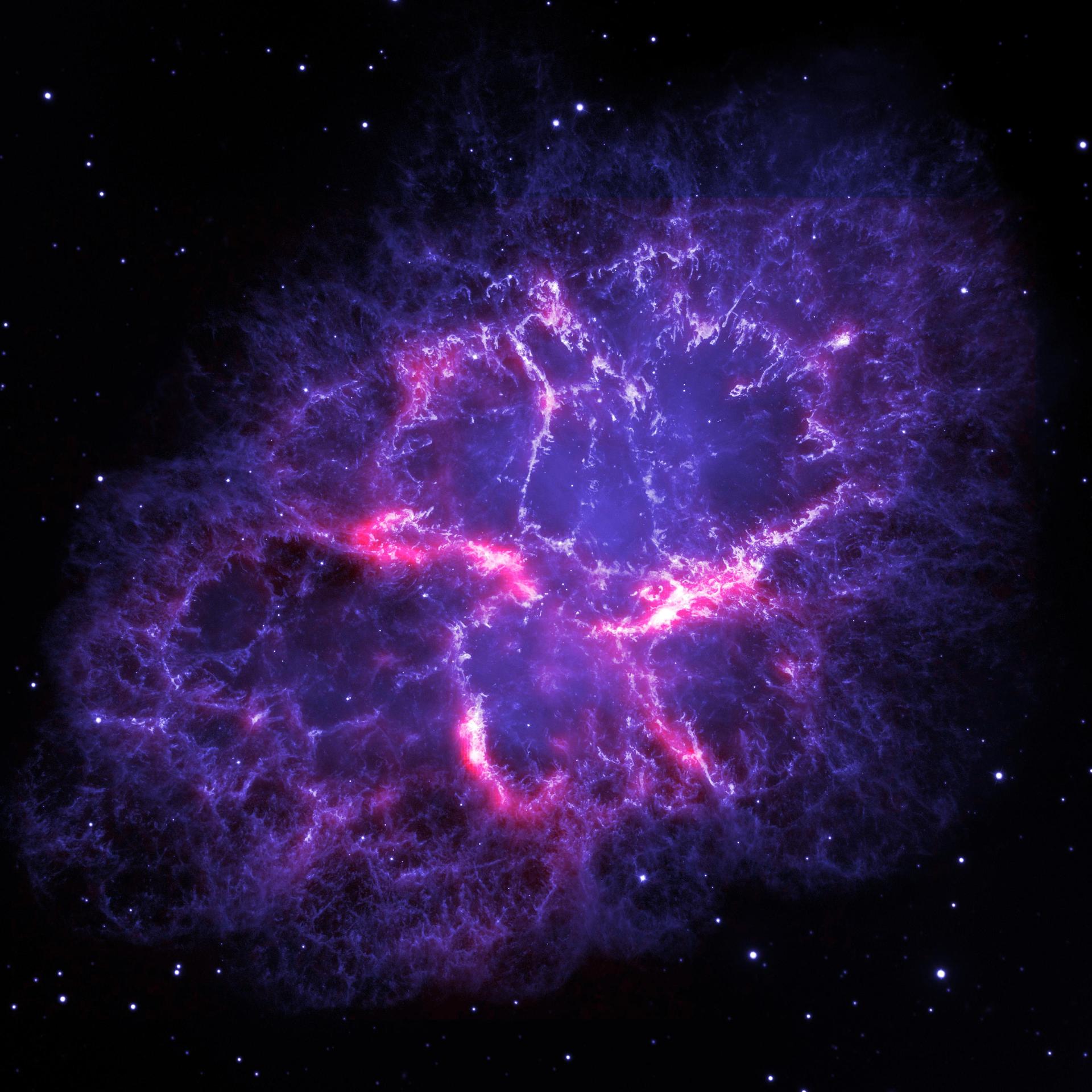
Crab Nebula (M1) — supernova remnant imaged by Herschel and Hubble Space Telescopes

Category: Overview

Overview and introductory articles

Crab Nebula (M1), supernova remnant · ESA/Herschel/PACS; NASA, ESA & A. Loll/J. Hester (Arizona State Univ.) · NASA Image Library ↗

  • OVERVIEW DISCOURSE TOPICS

    OVERVIEW DISCOURSE TOPICS


  • Www Energyscience Org Uk Ov Ov008

    DISCOURSE NO. 8

    Copyright © Harold Aspden, 2001

    WORLD IN PERIL: IMPENDING DOOM

    The U.K. newspaper, THE TIMES, has today, August 29, 2001, alerted readers to the prospect of impending doom.

    The report occupied most of page 7 of this broad sheet publication. Its first words declared:

    “Britain is facing devastation from the largest wave in recorded history if a predicted catastrophic volcanic eruption in the Canary Islands occurs, according to scientific study.”

    One goes on to read:

    “The scale of destruction, however, will be nothing compared with that in the United States, the Caribbean and Brazil. Here, a series of waves measuring up to 165 ft will pound into densely populated regions, virtually wiping out cities such as New York and Miami and inundating an area up to six miles inland. The natural disaster is predicted to be amongst the worst in history, with the total cost running to many trillions of pounds.”

    “A new prediction of the likely effects, by Simon Day of the Benfield Greig Hazard Research Centre at University College London, suggests that this would create a giant tsunami, much larger than those begun by earthquakes, that would sweep the Atlantic with huge destructive power. Details of his research, conducted with Steven Ward of the University of California, are published next month in the journal Geophysical Review Letters“.

    “Within five minutes of the landslide, a dome of water about a mile high would form and then collapse, before the mega-tsunami fans out in every direction, travelling at speeds of up to 500 mph. A 330 ft. wave would strike the western Sahara in less than an hour.”

    Well, now, after reading all this along with the extensive accompanying text, even taking note of the attempt to reassure and avoid arousing panic, by the last paragraph which says: “It is unlikely to happen in the next century”, I see the need to bring this series of OVERVIEW discourses to an end. I will, therefore, in this concluding Discourse No. 8, add a further prophecy of doom by pointing to a phenomenon connected with the aether itself, one that is rooted also in the geological history of past catastrophic events.

    The theory of the aether which I have presented in these web pages and which I urge should be studied by energy-minded physicists, along with geophysicists concerned with hazards on the grand scale, involves what I have called ‘space domains’. These are vast regions of space bounded by planar boundaries which separate what one might term regions of space and regions of anti-space. In physical terminology, the electrical polarities of whatever constitutes the aether and accounts for the Maxwell-type electrical displacement that accompanies electromagnetic wave propagation, are interchanged as between two sides of a domain boundary, meaning that positive charge becomes negative charge and vice versa. If mankind, along with body Earth, moves through space at our cosmic speed of several hundred km/s, then, once in a while these domain boundaries will need to be crossed, as the Earth takes of the order of a minute or so, depending upon the angle of approach, to traverse a boundary.

    What, then, will happen? Well, I believe there will be a reversal of the Earth’s magnetic field, hardly a traumatic event. But you may say that I am merely speculating about the existence of an aether of this domain-structured form and so doubt whether this warrants further interest. However, if you, the reader, are a geologist then perhaps you will be aware that reversals of the geomagnetic field feature as part of the history of record in rock formations at different strata levels. Along with that data there is evidence of upheaval and destruction, with occasional elimination of species of plant and life forms, seemingly coinciding with the geomagnetic reversals. One wonders if the Earth, in its long period galactic orbit, sometimes traverses a space domain boundary at such an acute angle that it takes several minutes to make the crossing. Consider then the consequences, given that the aether-based theory of gravitation that we discuss in these web pages, tells us that the force of gravity has a range confined to interaction between matter sharing the same space domain. You will then see that that geomagnetic reversal is accompanied by gravity between earthly matter switching-off, as it were, for a quite short period. Imagine the earthquakes and immense dust clouds that then result as the Earth’s surface lifts up owing to the consequential loss-of-gravity expansion effects and centrifugal forces produced by Earth rotation.

    The combination of earthquakes and tidal waves will be of indescribable magnitude and no part of the Earth will remain unaffected. One can only pray that the Earth’s path will happen to be square-on (i.e. at right-angles) with respect to the planar form of the domain boundary, so that the transit period is not prolonged, as it will be if the crossing occurs at a low angle of incidence.

    This, I fear, is the sad side of understanding the physics of the aether. It is as if Nature imposes a price for the intellectual enlightenment as to what constitutes the medium we call ‘space’.

    That insight into the future is something the hazard-risk-evaluating geophysicist needs to consider along with the prospect of volcanic disturbance. Exploring the doomsday scenario from this viewpoint has, incidentally, a spin-off benefit in the interim in that it could redeem the physicist’s lost belief in the existence of a real aether. It opens the door on explaining gravity in terms of aether theory along with discovering how the aether with its domain structure built around a kind of fluid-crystal underworld can determine the most basic dimensionless constants of physics. That door, once open, will surely serve us well for some time yet by leading us to a new energy resource, the aether itself, given that its energy is used by Mother Nature to create all matter.

    In ending, I suggest the reader, might like to know a little more about those geomagnetic field reversals and so I invite inspection of pages 168-174 of Chapter 8 of my book Physics Unified.

    This ends this OVERVIEW section of these web pages. I have tried to present these eight DISCOURSES in an easily readable form, avoiding any specialized knowledge or mathematics and hope the reader has found them interesting.


    H. Aspden
    August 29, 2001


  • NUCLEAR FUSION: HOT AND COLD

    DISCOURSE NO. 7

    NUCLEAR FUSION: HOT AND COLD

    Copyright © Harold Aspden, 2001


    Although our scientific fraternity believes that the sun derives its power from the process of nuclear fusion and many billions of dollars have been spent trying to tame the process here on Earth in fusion reactors, the story to date is one of failure. The time has come when we should at least consider what heresy is telling us, namely that maybe the sun’s energy is not sustained by thermonuclear reactions which demand temperatures of 100,000,000 or so degrees.


    INTRODUCTION

    Contemporary with my heretical prophecies, back in the 1950s and 1960s, saying that there is an aether containing a vast sea of energy and that Einstein’s philosophy was wrong, there was a scientist named Charles E R Bruce at the laboratories of E.R.A. (Electrical Research Association) in U.K. who was trying to convince us that cosmic phenomena evolve from enormous electrical discharges. His mind was on the induction of electrical fields in space, of sufficient strength to promote plasma discharges that could account for much of what we see in the activity of stars.

    As can be seen from scrutiny of these Web pages my interest has been the possible analogy between the aether and the formation of magnetic domains in iron, owing to energy deployment in a structured background and the development of the Bohr-quantized states of motion that go with the ferromagnetic state. My thinking is that the aether has a hidden structure and develops its own Bohr-quantized states of motion, so providing the governing quantum-based influence that regulates action in matter. Part of this picture involves the induction of strong electric fields in the aether as transitions occur which bring about order from a state of disorder, the onset of gravitation in the aether being analogous with the onset of ferromagnetism in iron cooled through its Curie temperature. The formation of stars with attendant presence of very strong electric fields has something in common with Bruce’s ideas on cosmological electric discharges.

    So, I was not spellbound at the thought that the power of the sun has to be primarily that of a nuclear fusion reaction. On the other hand, when the electrical manufacturing company I was working for back in the 1950s took an interest in fusion reactor research, I was absorbed by the problem encountered, namely that of stabilizing the electrical discharge that was to trigger fusion in the reactor. This seemed to be a straightforward problem of confining a high current discharge by its self-pinch action.

    My interest was enhanced by my own private research pursuit of connecting the gravity force with its electrodynamic origin, a pursuit which by 1958 had made me realize something rather important about the true form of the Law of Electrodynamics, meaning the law of force governing how one isolated electron in motion acts on another such electron. It was to lead me soon thereafter into publishing a book in 196o entitled The Theory of Gravitation in which I presented what I believe is the correct form of the Law of Electrodynamics.

    However, gravitation aside, I could not ignore the challenge of applying my mind to the problem posed by the electrodynamic discharge instability encountered in hot fusion reactor research. Indeed, that interest led to the filing of a patent on a reactor design that aimed to improve the stability of the plasma discharge. See [1958b].

    Now, in retrospect, looking back to the 1958-59 period, I was enough of a scientific ‘conformist’ to accept basic teachings concerning electrical theory. The electrodynamic force between two discrete electric charges in motion was something that had never been measured in the laboratory. All the tests had been performed on interactions involving action of electrons attributable to closed circuit current flow. I exploited this distinction in formulating my own Law of Electrodynamics. However, the problem with the discharge in the fusion reactor was not one that needed my modified version of this law, or so I thought at the time!

    By 1966, however, with the reactor control problems still persisting, it was evident that something quite unusual was affecting the electrodynamic interaction in the high current plasma discharge. I saw my chance early in 1965 and, though then working for IBM and no longer having a job interest in power engineering, I thought it worth commenting on this electrodynamic law topic in a Letter to the Editor of the IEE journal ‘Electronics and Power’. See: [1965a].

    An experiment using current flow in a falling column of mercury had replicated the discharge instability, even with a stabilizing axial magnetic field, and the lateral wriggle, snaking of the discharge, was shared by that column of mercury. Now, Ampere had based his formulation of electrodynamic force on four empirical facts plus one assumption. That assumption was crucial to determining the choice of law. I saw that experiment with the falling column of mercury as providing the fifth empirical fact needed to determine the law without making any assumption. My finding was that this supported the form of law that I had presented in my 1960 book, The Theory of Gravitation..

    I was striving to justify my development of a Unified Field Theory, meaning the ultimate objective of presenting the unifying link between gravitation and electrodynamics, the pursuit which had defied Einstein’s efforts.

    That Electronic and Power Letter was published in April 1965 and the Editor had invited comment by Dr. A A Ware, the author of the paper in the January 1965 issue that had discussed the status of hot fusion reactor design and shown the falling mercury column experiment Dr. Ware put the case that no isolated charge in motion is truly independent of a closed circuit current path, inasmuch as displacement currents in the vacuum assure current loop action. Accordingly, rigorous mathematics denied me the scope for incorporating a modifying term in the formulation of that law of electrodynamics.

    There you see the crux of my problem in contending, not with the physics of the subject, but with the attitude of the orthodox scientist. Once you say that a moving charge in isolation has to have its action as a current closed by displacement currents along a path through the vacuum medium, then you invite me to say that the net electrodynamic force action is shared between forces acting on the charge and forces acting on the displacement current. You invite me to say that the real part of the current circuit, the seat of the charge in motion, can interact with the aether to set up forces between charge and aether. In my efforts to get my message across all I am trying to do is to get the scientific community to understand that forces can be exerted electrodynamically between charge in motion and the aether. This means that the aether can act on the charge to speed it up or slow it down, energy being exchanged between charge and aether, and it means that the force need not act at right angles to charge motion as conventional theory requires. I saw the instabilities in the falling mercury discharge as being attributable to the tendency of the discharge to extend along its flow path.

    I did react by submitting another Letter to the Editor of Electronics and Power, published in the June 1965 issue. See [1965b] and proceeded to show why that experiment with the falling column of mercury had more to tell us concerning how there really are electrodynamic forces acting axially along the path of current flow. This is contrary to standard teaching based on the Lorentz force law.

    Slowly but surely, given that such axial forces exist in that falling column of mercury to cause it to wriggle and defy all attempts to stabilize it, I came to realize that there was no way a thermonuclear reactor could ever succeed if its designers relied on electrodynamic pinch in the discharge.

    However, there was hope on the horizon. I had in my 1960 book The Theory of Gravitation shown that the rotation of a sphere of aether within a plenum of enveloping aether can induce a radial electric field about the axis of spin, albeit a field that is compensated by charge displacement in coextensive matter. I was later to discover from the experimental research of R. T. Ryan and B. Vonnegut (‘Formation of a Vortex by an Elevated Electrical Heat Source’, Nature Physical Science, 233 142, 1971), who sought to understand the secret of how tornadoes are formed, that they could stabilize an electric arc discharge, confining it to its axis, merely by quite slowly spinning about that axis a cylindrical metal cage. Here was the indication that the aether within that cage might be rotating about the axis of the arc discharge and producing a radial electric field which the arc plasma neutralized, but in so doing was constrained by radial forces which could overpower the radial electrodynamic effects.

    Had I been working in the thermonuclear research field I would have urged investigations of the potential implied by Vonnegut’s findings. In the event, however, I had in my sights a hope that there could be an entirely different prospect of generating power from a electrical plasma discharge. Arising from my curiosity about that falling mercury column developing instabilities when carrying a current, I began to ponder on the question whether the law governing electrodynamic force, as set up between two moving electrons, is also governing in the case where, say, a moving proton acts on a moving electron. That mercury column experiment involved a closed circuital current, which usually means that electrons, and electrons alone, carry the current around the circuit. However, in that mercury, it being a liquid metal conductor, there are free electrons that can act as carriers of the current, but also there are positive heavy ions that are not locked into a crystal lattice and so are mobile and must, therefore, as part of a flow of mercury, share in the electric charge transport. The current might flow around a closed loop, but in one part of that loop the flow is all-electron in composition and in the remaining part it is part-electron and part-heavy-ion.

    This, plus something I could glean from the science references to anomalous force effects in cold-cathode (non-electron) arc discharges, caused me to do some analysis on how two moving charges of different mass might react in an inertial sense to a mutual interaction force, assuming that energy is conserved. The result was fascinating. The analysis of this problem featured in the second edition [1966a] of The Theory of Gravitation and later in a peer-reviewed paper of mine that appeared in the Journal of the Franklin Institute [1969a].

    There just had to be a force term in the law of electrodynamics giving an action along the line of current flow, but the finding that impressed me was that the force acting on the heavy ion would be enhanced by a factor equal to the mass ratio as between that ion and the electron. This could mean a thousand-fold increase of the force and it would imply energy transfer from electrons to heavy ions in a manner that, by standard physics, would seem anomalous. So I was, at this stage in my research, beginning to see that what I was exploring was potentially not just an academic pursuit aimed at the problem of gravitation and the Unified Field Theory. There could be technological consequences.

    The key step in my analysis in deriving this law of electrodynamics was that of deciding whether I would assume that the interaction force set up between the two moving charges could induce reaction forces on the charges that would mean overall an imbalance of angular momentum or of linear momentum. There just had to be one or the other in the general case. I opted for the imbalance of linear momentum, knowing that the resulting form of the law of electrodynamics would include a specific situation for which there is no imbalance in either sense, meaning full compliance with Newton’s Third Law that action balances reaction. That was the only way I could see scope for electrodynamics embracing gravitation. The specific condition meant that gravitation would have to involve action between charges moving mutually parallel at all times.

    Furthermore the gravitating charges, the ones setting up the gravity forces, would have the same mass or, as I later established, be part of a group of charges which, collectively, could cooperate in a compatible form, having regard to their charge effects.

    To discuss that would divert us to the gravitational aspects of my theoretical work, whereas here I wish to pursue the anomalous energy topic.

    The breach of the law that inertial action balances reaction means, simply, that energy is being exchanged between the interacting charges and the local aether underworld which determines the electromagnetic reference frame. In short, I could see scope for beginning to believe that electrical plasma discharges involving ions much heavier than electrons might be able to tap energy from the aether itself.

    This would be something far more exciting than the generation of power by nuclear transmutation, whether fission or fusion. However, I was busy earning my living in a corporate environment not concerned with power generation. All I could do was pursue my theoretical investigations as a hobby and see where that pursuit took me.

    My interest in the cold-cathode arc discharge energy prospects spilled over in 1977 when I declared my position in a paper published by the IEEE [1977a] and, to be sure of publication, I had even recorded my disclosure in a patent specification filed at the British Patent Office and duly published (Patent No. 2,002,953) [1979b].


    Harold Aspden
    August 20, 2001


  • THE PARLOUS STATE OF PHYSICS

    DISCOURSE NO. 6

    THE PARLOUS STATE OF PHYSICS

    Copyright © Harold Aspden, 1999


    The title of this Discourse is a phrase I used in an item of correspondence published in the Proceedings of the IEE in U.K. in 1958. See [1958a].


    INTRODUCTION

    I will begin this account by taking note of the Concise Oxford Dictionary (1934 edition) definition of the word ‘parlous’.

    So, you will understand that I was saying 41 years ago, back in the year 1958, that Physics was in a ‘perilous’ state which renders it ‘hard to deal with’, even though it is ‘surprisingly clever’. I may say that my opinion has not changed, nor will it so long as physicists choose to believe Einstein’s theory and the way it excludes interest in the aether that fills all space. You may wonder why I was so concerned and wonder further what right I had to voice such an opinion, given that I was putting my views forward in the forum of an Engineering society and not one dedicated to the subject of Physics.

    Well, first of all, I point out that if the Physics which is applied to problems in electrical science is leading us in the wrong direction, then the discipline of Electrical Engineering is also being thwarted. Engineers are concerned with making progress in the real world, whereas physicists, the ones building theories about space and time are living in an imaginary world and undermining the foundations on which engineers have to build.

    In my school years, Physics, with Mathematics closely behind, was my best subject. I won the school Physics Prize in the year I left school to migrate to university, but opted to study for a science degree in Electrical Engineering. This was the world of electric power generation, electric motors, magnetic energy storage in the inductance of a circuit, electrical power transmission and, of course, the problems of working with high frequency and high voltages, and learning how to make electrical measurements. That was all ground work for my later research pursuits for a Ph.D. where I addressed the problem of why the accepted electrical theory concerning the induced currents which flow in steel, as used in electrical machines and power transformers, when subjected to an alternating magnetic field simply gives the wrong answer by a significant factor of error.

    Here was a problem, one that stood on the engineer’s platform with the physicist being an onlooker, but here was a scientific problem which, once solved, could, indeed can, revolutionize our electrical power industry. I was not destined to decipher its secret during my Ph.D. years but did my best and duly recorded my findings in I.E.E. papers published two or three years later. See [1956a], [1956b], [1957a].

    Now the point of this introduction is to explain why I became interested in the action of a magnetic field in developing reaction effects inside a metal, in this case steel. I knew from my physics training that one can store energy by setting up a magnetic field within a vacuum. Moreover, I knew that one can recover that energy by switching off the action producing the field. Common sense was sufficient to say that there is something in that vacuum that can house that energy and keep it safe so that it is still there when we want to recover it. However, I knew that physicists avoided explaining all this in simple language of the kind an engineer might use. They hid behind their formulae and the ‘laws’ they had devised based on certain empirical facts. They got the right answers but did not understand the processes of energy storage involved.

    Ignoring the vacuum, or aether, for a moment, the question of how that magnetic energy is stored in solid metal warrants comment. Physics told me that metal, as an electrical conductor, contains free electrons, all moving about at random amongst a background of atoms having a residual positive charge, charge which was locked in place by the crystal structure of those atoms. Overall the metal is electrically neutral. However, if a magnetic field is applied to that metal, something I was doing daily in my experiments, then those electrons are, according to our physics teaching, duly deflected in their paths so that they describe helical orbits and react to produce a magnetic field opposing the one applied.

    My research involved alternating magnetic fields, but this reaction occurs even with a steady field. However, in practice one sees no such reaction on the scale indicated by the accepted theory. When I searched to find how this was explained by physicists I found several attempts at explanations, itself enough to show that physicists were baffled. The problem was left in limbo by the expedient of suggesting that statistical factors were self-compensating. The empirical facts were thereby obscured by an ‘unwritten’ law of physics, which said that ‘what is, has to be, whether you can understand it or not!’

    I was amused by one explanation which appealed to my engineering instincts. It amounted to saying, “Yes, the thermal motion of those electrons did produce an enormous back-reaction field that could overwhelm and virtually cancel the applied field, but that happily there were electrons just inside the boundaries of the metal surface and these always provide the necessary compensating effect”. The argument was that they bounced from the inside of that metal surface so as to be forced to migrate in a closed loop path embracing the body of the metal, thereby producing a strong magnetic field in the forward field direction of just enough strength to cancel the whole of the back-reaction field. Why was this amusing? Well, just ask yourself how an electron can bounce from the notional boundary surface separating the crystal structure formed by the atoms of the metal from the enveloping empty space. What were those electrons supposed to hit before bouncing back? If they collided with other electrons then the electron momentum would be conserved, meaning no bounce that could change the field action. If they collided with an atom they would not hit the positive nucleus because that is secluded behind a screen of electrons. So one has to suppose that they might escape into free space and so cause the metal body to acquire a positive residual charge that would itself bring the electron back into the metal, but surely without it having changed its lateral momentum. It just cannot be part of a net electron migration around the inside boundary of the metal.

    This to me was simple common sense. It was just an onward step from this to realize that there has to be a significant magnetic field reaction in metal when subjected to a steady magnetic field and the textbook teaching which denied such an effect just had to be wrong.

    When I considered this I realized that one should not rely on the ‘laws’ taught by physics teachers. Here was something that defied those laws. My approach was to say that energy was being deployed into that metal and drawn from the source applying that magnetization. I knew that potential energy, the kind we associate with electrical voltages, tends to reduce as dynamic energy, the kind we associate with motion and magnetism, tends to increase, keeping overall energy balance, but subject to some conduction loss by conversion into heat energy. So I said that the system would adopt a condition for which the maximum amount of energy had been deployed into the back-field reaction for a given applied field. Analysis of this assured me that the back-reaction field would be of precisely half the strength of the applied field.

    This seemed an odd result until I considered what it really meant. We pretend the back reaction effect does not exist and so work out the relationship between the magnetic field produced and the current in a magnetizing winding producing that field. This we incorporate into out units in physics. Suppose, however, that the actual relationship between the field produced and the current is twice that we assume. Then, given that the system subjected to that magnetic field will always react to half-cancel the field, then we are back to what we really observe. It is just that we get by by ignoring the fact that there really is a back-reaction field produced.

    We get by, knowing what we know, but miss the opportunities that lie before us of discovering what we do not know if only we could just see things in that deeper perspective and come to accept that half-field reaction. What this then means is that if we mount a ferromagnetic rod on spigots and reverse its magnetic polarization suddenly, then the angular momentum change will only be half that we expect from our knowledge of the charge-to-mass ratio of the electron. So we can test what I am saying, and confirm what common sense says about the physics of the back-reaction.

    I knew that such an experiment had been done and so I knew I was right in what I was proposing. However, I also knew that the back-reaction theory, by which all magnetic fields calculated from their current source values had to be doubled before being halved by back-reaction, had to extend outside solid metal and into free space, the vacuum.

    Accordingly, I knew that here was the clear evidence of the existence of a real aether in which electric charge is in a state of motion. Yes, I had then my answer as to how magnetic energy is stored and then recovered from the vacuum medium. The setting up of the field generates heat and disperses energy in space, but the persistence of the field acting on the omnipresent moving aether charge orientates the field reaction set up by the aether itself. Then, when the current is switched off, the aether becomes the primary field source and feeds its energy into the winding that provided that current. The aether cools a little as a result but overall, in coping with the problem of our inductive magnetization cycle, the aether keeps its energy balance.

    So here I was, in the mid 1950s, now committed to belief in a real aether, having a simple ‘engineer’s’ insight into the reason for the gyromagnetic spin anomaly of the ferromagnetic rod, and having solved the mystery of the problem known as ‘the absence of free electron diamagnetism’.

    However, how could I, a young Cambridge Ph.D. needing to earn my living, stand up and challenge what Einstein had said about there being no need for an aether and, more to the point, challenge Nobel Laureate Paul Dirac by saying that his interpretation of the factor 2 of the gyromagnetic ratio was wrong? Dirac had confounded the physics world by distilling from Einstein’s equations a formula which gave the electron a half-quantum spin factor. Here was Dirac, originally a graduate in Electrical Engineering, having become a theoretical physicist by propounding an abstruse mathematical case that came to be accepted by his brother physicists but yet did not tell me how to solve my problem of field reaction in steel.

    So, in saying that physics is in a ‘parlous’ state, I say that with some considerable feeling. Dirac’s theory is surprisingly clever. It is ‘hard to deal with’ and by its general acceptance our world of theoretical physics has been left in a ‘perilous’ state.

    So do read that message of mine that found its way into the Proceedings of the Institution of Electrical Engineers back in the year 1958. Press: [1958a]. After that, when you have digested how easy it is to derive the formula E=Mc2 by saying that an accelerated electron does not radiate itself and so can survive life in an atom without depending upon the quantum ruling of the physicist, then do look at something of mine published years later in 1971. It also appeared in a publication of the Institution of Electrical Engineers, but in their journal Electronics and Power. Press: [1971a] and you will see that Paul Dirac did eventually try to use ‘engineer’s’ language when describing his view of the electron. His insight into the notion of an electron that extends physically throughout all space with no defining boundary, but yet requires that the laws of physics break down inside the electron, is quite interesting. That alone tells me that physics is in a ‘parlous state’.

    Hopefully, this Discourse No. 6 will serve as an explanation of what motivated my interest in the subject of these Web pages, besides helping the reader to understand why what I am saying has not been assimilated into the standard teachings of Physics. There is just too much for physicists to undertake, as they would have to unscramble so much of the nonsense woven into their picture of the fabric of space. The way forward lies in tapping useful energy from the aether which physicists say does not exist.

    Harold Aspden
    February 15, 1999


  • THE AETHER IN DETAIL

    ADDENDUM TO DISCOURSE NO. 5

    THE AETHER IN DETAIL

    Copyright © Harold Aspden, 2001, 2003


    Having, as it were, seemingly immersed you in a sea of aether, but in a pictorial sense, I now seek to introduce the aether in detail, not within these web pages, which I now want to confine to the technological aspects of ENERGY SCIENCE, but by pointing the way forward via my related web site, www.aspden.org, to locations where the theory of the aether is to be found.


    INTRODUCTION

    I wrote the 2001 version of this web page some three years after entering DISCOURSE No. 5 on the web site and at a time when I had begun to bring my publications into PDF (Portable Document Format) form which can be read by Acrobat Reader. Accordingly, I can now rely on easy reference to the original published forms of what I have written over the years since I began my investigations into the detailed form of the aether.

    An appropriate starting point, by reference to that separate web site where I address the physics theme, is to draw attention to the book I wrote in 1996 entitled ‘Aether Science Papers’, pointing out that my aether theory was the subject of an evolving sequence of publications, namely ‘The Theory of Gravitation’ (1960), ‘The Theory of Gravitation’, 2nd Edition (1966), ‘Physics without Einstein’ (1969), ‘Modern Aether Science’ (1972), ‘Gravitation’ (1975), and ‘Physics Unified’ (1980).

    It was in the years following that 1980 period that I found my scientific papers on the subject were less likely to be rejected for publication by so-called ‘peer review’ and so my published work of the 1980s is in the regular scientific periodical paper form. Evenso, lost as those papers are in the academic jungle of science on record in university libraries, it seems worthwhile to provide this Internet information.

    ‘Aether Science Papers’ was published in 1996, essentially because I had declared the intention to provide that sequel on the back cover of my 1972 book ‘Modern Aether Science’. I think it appropriate, therefore, to refer now to what I said on the last page of that work and refer also to its back cover summary.

    I invite you to browse through these items, taking note of what I say about the ‘supergraviton’. In reading that again in this year 2001, I see that in 1996 I promised a ‘technological sequel’ to that work (‘Aether Science Papers’). These web pages will evolve into that ‘sequel’. Meanwhile, I urge you to delve into that book and build an understanding of the aether by following the reference leads. Hopefully you will then share my enthusiasm for the science that this insight into the aether affords and, possibly, come to share in the onward effort to seek out the best way of tapping into the vast energy resources of that aether.

    I will aim to compile that ‘technological sequel’ by building on the nucleus of Energy Science Reports that I will incorporate into my TECHNOLOGY section of these web pages, as well as in the Bibliographic section of my site www.aspden.org. It will evolve in stages as I compile, possibly in book form, an updated account of what is discussed in the existing Reports.

    Use this link to see the text of the last page and back cover of ‘Aether Science Papers’.


    Harold Aspden
    September 1, 2001
    & July 10, 2003


  • THE HERESY OF THE AETHER

    DISCOURSE NO. 4

    THE HERESY OF THE AETHER

    Copyright © Harold Aspden, 1998


    ‘Ether’ (also Aether): a substance formerly believed to fill all space and to be responsible for trasmitting electromagnetic waves.


    INTRODUCTION

    The above is the definition of the word ‘ether’ to be found in a Chambers dictionary, 1998. A 1934 Edition of the Concise Oxford Dictionary defines the ether as ‘the subtle elastic fluid permeating space and filling the interstices between particles of air and other matter, a medium through which light-waves are propagated.’ In these web pages I use the spelling ‘aether’ to distinguish it from the chemical (anaesthetic) meaning of the word ‘ether’.

    These dictionary meanings are ambiguous. The aether is best defined as ‘that which fills space devoid of matter’. If you say there is ‘nothing’ in that space, meaning that space itself is ‘nothingness’, then ‘space’, which the dictionary defines as ‘a continuous extension viewed with or without reference to the existence of objects in it’, is something you view when there is nothing there to see. With its other meaning you are viewing something that is not there by looking at what is there. ‘Nothingness’ means ‘non-existent’. The word ‘aether’ has to mean something and the physicist should accept it as meaning ‘that which fills space devoid of matter’, even though he or she may try then to prove that what does fill that space is so subtle as to be ignored for all practical purposes.

    There are then three scientific perspectives that one can consider. Firstly, it can be declared by way of assumption that the aether has a specific property of determining the constant speed of light relative to an absolute universal frame of reference. Alternatively, one can say that the aether is a ‘subtle elastic fluid permeating space’, a medium so subtle that it can adapt to ensure that the finite speed of light as measured in the presence of matter takes its reference on a frame determined by the matter present. The third perspective is to say that the aether is ‘that which fills space devoid of matter’, ‘that’ being a sea of energy, the deployment and reorganization of which accounts for the creation of matter and then go on to supplement that with the second definition.

    The history which led to the conflict between the Chambers 1998 dictionary definition of ‘aether’ as a ‘former belief’ and the 1934 Oxford dictionary definition as a ‘subtle elastic fluid’ is that of Einstein’s theory in assuming, quite falsely, that, if the aether exists it defines the light propagation frame as an absolute single frame of reference. Such history has meant that scientists have turned their thoughts away from the study of the properties of aether proper, a study which nevertheless can lead us to the prospect of harnessing its energy and understanding its true regulating effect on light propagation, particularly the scaled frequency loss implicit in the Hubble constant, which has been misinterpreted as an orderly progressive expansion of the universe in a sea of nothingness.

    If you really wish to follow the path of the heretic then read on. You will learn all about the aether and see that I must be right in making these statements.

    DOES THE AETHER HAVE A TEMPERATURE?

    At this point you may wonder how I can jump from Maxwell’s demon and the practical world of thermodynamics and move into the depths of the hidden underworld I have chosen to call the ‘aether’. Well, Maxwell himself did that when he addressed the mysteries of that Second Law of Thermodynamics and evolved a theory for the manner in which the aether transports electromagnetic waves.

    However, I will go directly to the question I have just posed. Does the aether have a temperature? Well, if you are a conformist and believe Einstein then you must say that, since the aether does not exist in any tangible form, and has been replaced by the mathematics of space-time, it cannot have a temperature any more than a mathematical equation can have a temperature.

    Given that verdict, suppose I now say that I accept that energy has mass and that mass can gravitate and, furthermore, that there is a sea of energy filling space, then you will conclude that if I am right the aether is subject to gravitational forces. You may conclude that I have to be wrong as I have gone far beyond the notion that the aether has a temperature. Indeed, what value could that temperature be?

    I ask now if you have heard of the ‘cosmic background temperature’, a quantity measured in the locality of Earth as being 2.7 K? Orthodox scientists cannot explain that other than by declaring it to be the heat residue of the Big Bang, implying that it is the temperature of whatever residue of matter there is out there in so-called empty space.

    I say that that temperature is the temperature of the aether. It is determined by the gravitational properties of the aether and it is a temperature which the aether shares with matter dispersed in space.

    Now I do not want here to get involved in too much physics, because I shall cover the details of this subject in the specialist PHYSICS section of these web pages. So, for the immediate purpose I will just say that, though the aether has a mass density, that density is kept uniform, but we can still say that there is what is called a ‘gravitational potential’ acting between aether and material bodies such as the sun. This potential implies that energy has been released, as energy of motion, typically heat. The reason is that gravitational potential is negative as it implies release of energy by the coming together of two masses.

    Suppose I say that the aether owes its gravitational mass to the presence of a system of aether particles each having a specific mass, then the gravitational potential as between the sun and one such particle will be a measure of the heat shed to the particle and retained by the particle, inasmuch as the aether itself does not radiate energy from itself. It follows that I can then be guided by the way heat energy is shared by particles in a gas or in solid matter. There is a constant in physics known as Boltzmann’s constant. It connects the particle’s heat energy and temperature and so, if say that the energy shed by the gravitational potential of the aether is retained by it as heat, using that 2.7 K temperature we measure as the cosmic background temperature, I can work out the mass of each such aether particle.

    I have done such calculations. Indeed, I derived the mass of the aether particle in the 1950s and reported it in a book I published in 1960. The book, or rather booklet as it was only 48 printed pages, was entitled The Theory of Gravitation. It was some 30 years later that I did those aether temperature calculations using the theoretical aether particle mass I had derived in that 1960 publication and I obtained a temperature that did, indeed, confirm the value measured as the temperature of the cosmic background. See [1993d]. There was no Big Bang argument in my theory!

    CONCERNING MAXWELL’S THEORY

    I must now just mention one feature of the aether, one overlooked by Clerk Maxwell and all those who did pursue their 19th century models of aether. The aether conveys electromagnetic waves. Those waves have a lateral oscillation, meaning that they wriggle sideways in their forward progress as does a snake. To sustain such waves the aether had to behave as if it were a solid and yet we move through it as if it were a fluid devoid of mass. The 1934 dictionary said it was ‘a subtle elastic fluid’. That was before the 1998 dictionary got around to saying it was nothing other than something ‘formerly believed to fill all space’. Well, how can the aether be fluid and solid at the same time and sustain the passage those lateral electromagnetic oscillations?

    The answer is that it has the form of a fluid crystal and, further, that those lateral waves need something other than the structure of the fluid crystal to provide a lateral dynamic balance. In a fluid crystal the local presence of electric fields can cause the fluid to develop its crystal form in the locality of those fields. A material system such as body Earth which comprises, at its ultra microscopic atomic level, electric charges and their attendant fields can move through the aetherial fluid crystal and carry a kind of aether crystal with it, whilst surrounding aether has its own separate crystal form. The structure can dissolve at the foward boundaries, dispersing into the background fluid, only to reappear as new crystal structures forms behind the aether structure that is ‘dragged’ along by body Earth.

    Why, one may well wonder, has the fluid crystal not been adopted by aether theorists as their model for the aether? Am I really alone in seeing this as the answer? What is wrong with physics if it cannot see the good sense of at least examining the possibilities opened up by the knowledge that there are liquid crystal displays in our pocket calculators. If you read the 19th century history of ideas concerning the aether, as being something impossible, both a fluid and a solid, and you have such a calculator before you, then you have under your control something that can exhibit the properties of both a liquid or a solid. You cannot then say there is no aether because there is a unresolved conflict as between its liquid and solid properties. You might as well say that the liquid crystal display of your calculator is an illusion, rather than a technological reality.

    Just understand that the aether has properties akin to those of a fluid crystal! Or are you so sure that Einstein is right in turning away from the aether notion, that you accept his viewpoint, rather than respecting the memory of so many great 19th century physicists by reviewing their efforts constructively and taken account of today’s knowledge of the fluid crystal?

    Let us get back to the question of that lateral vibration of propagating electromagnetic waves. Believe it or not, there is a kind of unseen ‘snake’ wriggling along side-by-side with the wave we eventually sense. It is an electrical component of the aether, a dual displacement feature, and it not only keeps the aether in balance dynamically, but it preserves the continuity of the wave oscillations when minor impediments are encountered in its transit through space. Those impediments, however, take their toll on energy and, as my theoretical analysis shows, the effect is that the wave energy can be depleted in transit and with that the frequency. This accounts for what cosmologists call the redshift and interpret as the mutual recession of all stars in the universe, the phenomenon they say is the expansion of the universe.

    I can derive from this argument and pure theory based on detailed analysis of aether structure, the observed value of what is termed the Hubble constant and that is why I am certain about what I have just said. It is all reported elsewhere in these Web pages and in my scientific papers of public record. See, for example, [1984e]

    At this point, however, since these are just words, I think I should share with you a picture of what the aether looks like, if you really could see it. My insight into that and its portrayal will emerge when you press the link to the ‘NEXT PAGE’. I certainly do not regard the aether as ‘nothingness’ and my task ahead is to educate you, the reader, on the aether topic, whilst applying my heresy also to more important topics, such as how we can extract energy from that aether as well as from new kinds of heat engine that tap ambient source of low grade heat. First, however, I must try to guide you along the channels of thought that led me to my aether belief. Foremost in this quest is the need to understand something your textbooks cannot begin to address, which is how energy fed into a solenoid, a wound coil of wire, can store energy in that ‘nothingness’ I call aether and then allow us to recover that energy when we switch the current off. Yes, your physics textbooks will tell you about Faraday’s discovery of induction and about magnetic fields and lines of force, but though they tell you how to calculate the energy stored in unit volume of space, they will not tell you how a magnetic field actually stores that energy and holds it ready for our recovery. To be sure, no textbook can ever explain that without coming to terms with the reality of the aether.


    Harold Aspden
    September 10, 1998


  • GALLIO OR THE TYRANNY OF SCIENCE

    DISCOURSE NO. 3

    GALLIO OR THE TYRANNY OF SCIENCE

    Copyright © Harold Aspden, 1998


    The above is the title of a 1927 paper by J.W.N. Sullivan in the style of the one quoted in Discourse No. 2 which J.B.S. Haldane read to the heretics in Cambridge, England, having the same publisher, Kegan Paul, Trench, Trubner and Co. Ltd.


    INTRODUCTION

    The introduction of Einstein’s relativistic notions and quantum mechanics into the theoretical physics of the early 20th century must have aroused concerns amongst those of the academic community who could see science claiming more ground in the intellectual field. As more heresy crept into science it claimed a following and the boundary between the conformist and the heretic moved forward, but there were those who saw tyranny in what was so evidently too rapid an advance.

    Now, whereas Haldane had suggested that the something akin to fourth and fifth dimensions might show themselves in ethics, just as the fourth space dimension had intruded into physics, so there were those who saw science as going beyond its rightful place in the spectrum of knowledge.

    On p. 69 of the Sullivan paper one reads:

    “Many people, including some scientific men, take science too seriously. They think that science gives a far more comprehensive picture of reality than it really does. There have been philosophers who have gone so far as to suppose that those factors of experience that science does not find it necessary to talk about do not really exist. ….. The scientific concepts have by no means proved themselves adequate to account for the whole of experience. Nearly everything of real importance to man lies outside science. The fact is that science was undertaken as an intellectual adventure: it was an attempt to find out how far nature could be described in mathematical terms. Certain primary conceptions – time, space, mass, force and so on – all of which can be defined mathematically, were adopted, and it became a highly absorbing game to find out how much of what goes on around us could be described, mathematically, in terms of these conceptions. The success of this effort has been so astonishing that some scientific men have forgotten to be astonished. They have come to take it for granted that a complete mathematical description of the world should be possible. This assumption is not a rational one: it is a pure act of faith. The great founders of the scheme made no such mistake: they were quite aware of the precarious nature of their enterprise. Thus, Newton, the greatest and most successful of them all, says that, if they find the mathematical method does not work, they must try a different method. The mathematical method, which is the very essence of modern science, has, however, worked splendidly.”

    Now I see in these words an argument which casts suspicion on the way science, or rather theoretical physics, was developing in the early decades of the 20th century. Surely no one can imagine that mathematics as a scientific tool can do more than help to decode the pattern and structured form of what constitutes the universal fabric of our existence, if, that is, there is an underlying web having such form.

    My own suspicions concerning quantum mechanics and Einstein’s vision of space do not concern the tools used to unpick what is woven into that web, but rather the ‘principles’ enunciated by the father figures in the world of science. I refer to the Principle of Uncertainty and the Principle of Relativity, neither of which has a causal physical explanation in orthodox scientific teaching. They are applied by using the tool of mathematics, just as a paintbrush is a tool used to paint a picture on a canvas. However, in science, we see the picture first and we never see the canvas. Pre-20th century science regarded the aether as the invisible canvas that gave structural support to the picture we see as the universe. Those principles I have just mentioned sought to interpret the art work of that picture, but mathematics, as such, is no substitute for that paintbrush and that canvas. Mathematics merely allows us to scan the picture in an effort to form algorithms in search of the truth as to how the painter wielded that paintbrush, but we must never forget that underlying it all there has to be that canvas, the aether. The teachings of quantum mechanics and relativity do not recognize the need for that aether, not to mention the paintbrush or the painter!

    So, reverting to the title of this discourse, what is meant by ‘Gallio’? It has a dictionary definition:

    Used in conjunction with the expression ‘or The Tyranny of Science’, I have a little difficulty in thinking it is tyrannical for a scientist to refuse to meddle outside his province. In my experience it is fairly standard for specialists in matters scientific to be very wary about giving opinions on something outside their specific scientific discipline. Evenso, that does not preclude scientists in general and especially those who teach physics, from smiling and duly ridiculing those who dare to imply the possibility of what might seem to be a claim to have devised a perpetual motion machine. Equally, physicists in general insist that one must not challenge the Second Law of Thermodynamics, but in our quest to learn more about heresy we shall now move on to that topic.

    MATHEMATICS, INFORMATION TECHNOLOGY AND MAXWELL’S DEMON

    In the above quotation from Sullivan’s 1927 writings it was implied that mathematics had over-reached itself as scientists sought to reduce everything to mathematical formulations. 1927 happens to be the year in which I was born and so it might seem there remained little scope for me to add much to the scientific fiasco. However, going back to earlier times:

    “A man born about 1800, wanting a serious view of the whole of science, could no longer be a dilettante. The activities of science had become multifarious and specialized, its literature voluminous. That literature, too, was more difficult as well as more copious. In particular, much of it demanded a deep grasp of mathematics.”

    This is a quotation from page 149 of ‘Science since 1900’ published in London by ‘His Majesty’s Stationery Office’ in 1939. Its author was H.T. Pledge of the Science Museum, a branch of the Ministry of Education in U.K.

    So here an expert in science history was telling us that in 1800 the onward march of science required a deep grasp of mathematics, whereas, by 1927, there was a feeling in some sectors of the community that mathematics had claimed too much ground in that scientific arena.

    It is no wonder that science today lacks a measure of coherence owing to its extreme diversity and the specialization involved. Too many scientific papers exist on university library shelves, the vast majority written only to bolster the qualifications of those involved in the contest for advancement in academia and adding nothing of value to the store of knowledge.

    Physical science progressed on three fronts as it drove us forward through the years of the industrial revolution. From a technological base that offered little more that the magnetic compass and time keeping instruments, Newton’s mechanics was to lead us into a mechanical age, supplemented by the progress of the science of electricity and the science of thermodynamics. The age of steam and then on into the era of electrical power generation took us to the time when mathematics had served us well enough, but mankind should not now be seduced by the virtual realities of an age of mathematics. We must draw the line and take stock.

    One of the worst case examples of mathematical notions interfering with technological prospects is the time waster of imputing a connection between information technology, entropy and Maxwell’s Demon, an issue bearing upon the validity of the Second Law of Thermodynamics.

    The announcement of the birth of Maxwell’s Demon dates from 1871. Its conception was an act of heresy aimed at contravening the Second Law of Thermodynamics. That law was an edict of mankind, based on the rather obvious assertion that one must do work to get heat energy to flow up a temperature gradient from a cold to a hot zone. Everyone knows that to lift something or climb up a gradient one must do some work, but we have not seen it necessary to declare that as a specific law of gravity. Heresy creeps in when it is suggested that what we all know on these matters can be put in doubt.

    I can suggest the prospect of devising experiments to demonstrate antigravity by the expedient of declaring that the gravitational force acting on an element of mass is really a force acting on something normally partnered with that mass, and then suggesting how that partnership can be broken.

    Maxwell did much the same for the thermodynamic situation. He pointed out that the heat energy in a gas is shared by fast moving and slow moving molecules. Together they formed a partnership as they exchange energy in collisions and endow the gas with a mean temperature. That temperature governs the performance of a heat engine running on that gas by taking energy from all its molecules and exhausting it at a lower temperature. Maxwell (1867), in a letter to Peter Guthrie Tait, suggested that the gas should be enclosed in a housing having two compartments A and B separated by an aperture. The wall between A and B contains an aperture which may be opened and closed by a frictionless slide. He discussed the situation if someone (later nicknamed ‘Maxwell’s intelligent demon’ by William Thomson) sat besides that aperture and operated the slide to allow only fast moving gas molecules to go from B to A and allow only slow moving gas molecules to go from A to B, keeping the slide shut for all other molecules.

    “Then the number of molecules in A and B are the same as at first, but the energy in A has increased and that in B diminished, that is, the hot system has got hotter and the cold system colder and yet no work has been done, only the intelligence of a very observant well-fingered being has been employed.”

    Now here was a statement by the renowned Clerk Maxwell that told us how we might go about discovering a method of taking heat at ambient temperature and, consistent with the Principle of Conservation of Energy, converting it into hot and cold forms, a resource which we well know allows us to do useful work. If we, with the necessary heat engine, could then sit in that enclosure and harness that temperature differential we could spend that energy resource usefully and, as is normal, let the spent energy, then degrade back into heat at lower temperature as it merges into the gas in the enclosure. Energy has been conserved but useful work has been done by the intelligent manipulation of that frictionless slide, an act involving no effort.

    Curiously, instead of accepting that this is possible in theory but rather impractical, scientists made it an academic exercise to argue their way out of their dilemma of trying to preserve their so-called ‘Second Law of Thermodynamics’. Incidentally, the so-called ‘First Law of Thermodynamics’ is nothing other than the Principle of Conservation of Energy dressed in thermal underwear.

    So how does all this relate to information technology? Well, maybe it stemmed from that word ‘intelligence’ in the above quotation of Maxwell’s words. Somehow those looking for loopholes by which to leave Maxwell’s demon unemployed, decided that work had to be expended in making decisions and they started to say that intelligence and information, as such, involves entropy. The word ‘entropy’ is itself a peculiar concept. It is a word which assigns a kind of quality to an amount of heat. If Q is the energy signified by that word ‘heat’, and the prevailing temperature condition of that heat is T, then Q/T is its entropy. This expression is not of much use as it only gives basis for scientists to say that the Second Law of Thermodynamics requires that entropy always increases. In other words, heat degrades by cooling down. As T decreases, so Q/T increases. On from there we find that scientists wonder if computers have entropy related to the information they store. In short, the subject seems to have gone rampant with wild ideas.

    Leo Szilard in a paper published in German in Zeitschrift fur Physik, v. 53, pp. 840-856 (1929) wrote:

    “A perpetual motion machine is possible if – according to the general method of physics – we view the experimenting man as a sort of deus ex machina, one who is continuously and exactly informed of the existing state of nature and who is able to start or interrupt the macroscopic course of nature at any moment without expenditure of work.”

    He then went on to say that the nervous system of the intelligent being that might serve as Maxwell’s demon would expend energy, eventually concluding that:

    “We have examined the biological phenomena of a nonliving device and have seen that it generates exactly that quantity of entropy which is required by thermodynamics.”

    All this was, of course, well before the age of the modern computer, but once computers appeared on the general scene, thoughts concerning the Maxwell demon then turned to the scope for discharging the demon function by computer.

    Numerous scientific papers have been written on the subject, many reproduced in the book by Harvey S Leff and Andrew F Rex: ‘Maxwell’s Demon: Entropy, Information, Computing’, published in 1990 by Adam Hilger (the publishing house operated by the Institute of Physics in U.K.).

    That book makes several references to Rolf Landauer of IBM who, as one reads from a report in New Scientist dated 14 July, 1990, showed in 1988 that, although a Szilard engine gains energy, this is cancelled out because the demon loses an equivalent amount of energy in its decision making process. However, the article in New Scientist drew attention to the findings of Carlton Caves of the University of Southern California, Los Angeles, who ‘believes that Maxwell’s demon can, in certain circumstances, do the impossible: transfer energy from a cool body to a warmer one.’ Caves (‘Physical Review Letters, vol. 64, p. 2111) took Landauer’s argument a step further by describing how a group of 10 Szilard engines could be operated in tandem by the demon, but with information coded to require less than 10 times that needed to control the single engine.

    Now is not all this an incredible scenario? More than 100 years after Maxwell’s death we are still arguing whether that Second Law of Thermodynamics is or is not valid and resorting to some very weird reasoning in that process.

    INTRODUCING A NEW DEMON

    By now you will understand that I have sympathy with Maxwell’s proposition and believe that, with a little ingenuity, we can find a way of doing the task assigned to Maxwell’s demon.

    Before I outline the secret of how that may be accomplished, I will just present one other quotation which helps to put our task in perspective. We are tracking heresy in search of a new source of energy. We attract ridicule from our scientific peers who wish to conform. We make no sense to the non-scientist and so our venture is a lonely one.

    I take the quotation from that book referenced above, which on page 37 introduced a chapter authored by Edward D. Daub and entitled: ‘Maxwell’s Demon’:

    “In his presentation of the ‘two cultures’ issue, C.P. Snow relates that he occasionally became so provoked at literary colleagues who scorned the restricted reading habits of scientists that he would challenge them to explain the second law of thermodynamics. The response was invariably a cold negative silence.”

    Daub then noted:

    “The test was too hard. Even a scientist would be hard-pressed to explain Carnot engines and refrigerators, reversibility and irreversibility, energy dissipation and entropy increase, Gibbs free energy and the Gibbs rule of phase, all in the span of a cocktail party.”

    My own problems of that kind have arisen when, in a social situation, the fact that I had written a book challenging Einstein’s theory had come to light. ‘So you do not believe that E=Mc2?’ was the question I faced, obviously posed by someone with very little knowledge of the detail of Einstein’s theory, because no expert on that subject would open such a discussion, especially in that way. My heresy on that subject amounts to saying that I can derive that formula merely by arguing that all matter comprises electric particles and all electric particles exhibit inertia in just the amount needed to conserve the energy stored by their electric charge. In short, inertia and so E=Mc2 is a manifestation of the Principle of Conservation of Energy and owes nothing to Einstein’s philosophy. I explain all that in detail in the physics pages of this web site.

    The C. P. Snow book referenced above was published in 1961 and is entitled ‘The Two Cultures and the Scientific Revolution’, the quotation being from pp. 15-16. I recall being interviewed by C.P. Snow in his capacity as a Director of English Electric Co. Ltd, that being early in the 1950s when I was employed by that company. I may now wonder how I would have answered if he had asked me to explain the Second Law of Thermodynamics. I trust I would have survived the test. Thermodynamics had been one of the examination papers of my final examination for an honours degree at university. However, then I was a conformist and now I am a heretic!

    So, to conclude this Discourse No. 3, I will introduce my own demon. Instead of using a normal gas as the heat medium in the enclosure with its separating wall and aperture, I will assume I have a plasma, meaning gas molecules that are ionized. They are electric particles, half bearing positive charge and half bearing negative charge, all jostled around in a gaseous system and having therefore a spread of kinetic energy as applies to Maxwell’s case.

    Instead of that wall with its single aperture, I will introduce two apertures, one on each opposite side of the bounding housing, as shown in Fig. 1. Instead of the intelligent demon I will use a non-intelligent magnet to set up a magnetic field in a direction mutually orthogonal with a line drawn between those two apertures and the longitudinal axis of the housing.

    Fig. 1

    Now, considering first the ions which move from left to right, those that are positively charged will be deflected laterally to aperture A upon passage though the magnetized region, whereas those that are negatively charged will be deflected to aperture B. In contrast, for ions moving from right to left, it will be the negative ions which find their way into aperture A, whilst the positive ions will be guided into aperture B by that magnet.

    So, you can say, rightly, that there is no separation of the electric charge able to promote an electric current flow which taps energy from the heat of the gas in that housing. You may realize that we could block the gas flow through the apertures by positioning electrodes which take off the electricity into a load L without allowing passage of gas, leaving the neutralized molecules to become reionized by their onward collisions. However, in this case the actions have cancelled. This would not be the case if all the flow were one way, but then we would have to do work to keep the ionized gas moving in that direction.

    That would lead us into MHD technology, magnetohydrodynamics, the technology that might have taken hold in the post-1960 era if nuclear power had not come along. Evenso, suppose, for example, that we can somehow ensure that more faster-moving positively charged ions travel one way than travel in the reverse direction, then may not we then have scope for devising a system serving Maxwell’s purpose?

    Indeed, suppose we put those apertures adjacent one end of that housing shown in Fig. 1. Electrodes extracting charge will leave the molecules neutralized and they will not immediately become reionized, so they will migrate as neutral molecules for some distance as they move towards the other end of the housing. In theory this means that we have electricity output tapping energy from heat in the housing but no escape of the gas involved.

    Has anyone experimented on such a basis? Surely the idea would be thrown out because it implies heating a gas to a temperature high enough to develop ionization and keeping the gas trapped as that temperature is sustained. If the device did produce electricity it would be at the expense of heat input. So where is the gain and how does this relate to Maxwell’s demon? Well, the answer to this is that, if one can merely top up the heat energy in a gas to keep it at a steady temperature as electricity is bled off then we have virtually a 100% energy conversion of heat to electricity. Furthermore, without input of heat as indicated, we have here a system which allows a heat sink not shedding heat energy to a heat sink at a lower temperature to convert heat directly into electricity and that implies that, if only that ionization could occur at ambient temperature, we could generate electrical power by cooling our atmosphere. That would turn global warming to our advantage whilst proving as spin-off the accompanying air cooling needed by our air conditioning systems.

    That is the reverse of using electricity in an electric fire, 100% conversion from one energy form to another, all consistent with the Principle of Conservation of Energy. However, there is no gain in entropy here. There is no exhaust gas at a lower temperature which carries off energy as waste and has that high measure of entropy.

    The Maxwell demon has been replaced by a magnet, and the magnet can ‘think’ in that it can act selectively in diverting electrically charged gas molecules but not electrically neutral gas molecules. If the charged molecules are those that move faster and so engage in more energetic collisions, then that selection is analogous to the role played by the demon. If the positively charged molecules are heavier than the negatively charged molecules the latter will have the higher speed, another feature which helps in that selection. So may I ask, why is it that so much has been written about Maxwell’s demon in connection with neutral gas and so little concerning the ionized gas where magnetic fields are used to serve the demon role?

    Hot fusion research which tries to contain ionized gas by use of magnetic fields should have spin-off bearing upon this Maxwell demon topic. Where is that spin-off? All I have seen is the discovery that energy transfers anomalously from electrons to heavy ions, something I suspect that could be exploited in harnessing the principles of the Maxwell demon.

    However, such heresy opens the path to technologies better than those implied by the Maxwell demon, the latter conserving energy but merely separating it into low entropy and high entropy forms to set up a temperature difference. It is so much better if we can convert heat energy directly into electricity with that near-to-100% conversion rate. The reason is that we can pump heat from the abundant form at ambient temperature and raise it to a higher temperature by expending energy at a rate that is only a fraction of that pumped into the higher temperature zone. If then we can generate electricity to operate that heat pump with close to 100% conversion efficiency, there can be a large surplus of electrical output, all drawn from the ambient temperature energy of our environment.

    In these web pages I still have more to say about the Maxwell demon as we bring our heresy on this subject into the lower temperature realm which applies to Maxwell’s demon, rather than having to contemplate the use of hot ionized gas.

    The research I shall describe in the TECHNOLOGY section of these web pages will include a room temperature implementation of the principles suggested above by reference to Fig. 1. The ionized gas molecules moving inside a housing will be replaced by the motion of electrons driven by heat through a ferromagnetic conductor, the intrinsic magnetism of which provides the magnetic field.

    Indeed, I was surprised to find that my conversion from a conformist to a heretic led me to do a rethink on what my Ph.D. thesis was all about, written when I was a ‘conformist’ but now, in retrospect, looked at, some 30 years on, from the stance of a ‘heretic’. That story will unfold in these Web pages, as interested readers may see by inspecting the bibliographic reference [1956b]

    In developing this general overview of Energy Science by delving into heresy, I will next address the question of ‘Aether’. Does it exist or not? If so, what is its role? Why do we need it? Some may think we have mathematical formulae which satisfy the relevant facts and that they are all we need. Well, that is the conformist opinion, but the aether still exists and I intend to show that it does not conform with the orthodox mathematical scheme. It will bring us in the Discourse of the next page to another and more important facet of Clerk Maxwell’s contributions to science.


    Harold Aspden
    September 8, 1998


  • DAEDALUS OR SCIENCE AND THE FUTURE

    DISCOURSE NO. 2

    DAEDALUS OR SCIENCE AND THE FUTURE

    Copyright © Harold Aspden, 1998


    The above is the title of a paper read to the heretics in Cambridge, England on February 4th, 1923 by J.B.S. Haldane.


    INTRODUCTION

    In advancing on the theme of scientific heresy in this year 1998, it seems appropriate to begin by jumping back some 75 years and quoting three excerpts from Haldane’s paper as presented to what I presume was a meeting of a student body – the Society of Heretics.

    When I discovered this paper, I had to refer to my dictionary, a 1934 edition of the Concise Oxford Dictionary, to see what ‘Daedalus’ meant:

    Is not that a wonderful combination of words – skilful, inventive, mazy, manifold, complex, mysterious, intricate, labyrinthine?

    Haldane chose to wrap up his insight into the science of the future in that title word ‘Daedalus’ and, indeed, in the event, the picture we have of physical science today is just what is implied by that dictionary definition. Haldane, no doubt, had in mind the influence which Einstein’s theory was to have on the academics working in theoretical physics and its associated mathematics.

    So, again, I ask you to decide on the question of ‘heresy’. Was Haldane preaching heresy when he delivered that paper? Make your judgment in the usual way, the way of so many who have little patience with the ideas of others, that is by cursory inspection of but a few lines of the paper in question, as quoted from its page 17, in the fourth impression (1924) as published by Kegan Paul, Trench, Trubner and Co. Ltd, London:

    “The Condorcets, Benthams, and Marxs of the future … They will recognize that perhaps in ethics as in physics, there are, so to speak, fourth and fifth dimensions that show themselves by effects which, like the perturbations of the planet Mercury, are hard to detect even in one generation, but yet perhaps in the course of ages are quite as important as the three-dimensional phenomena.”

    So here we see the influence of Einstein’s philosophy, by then (1923) deemed to be an accepted feature in the fabric of physics, being declared as a potential intruding influence in the ‘ethos’ of academia. It is but a short step in the dictionary to progress forward from the word ‘ether’ to the word ‘ethic’ and on to the word ‘ethos’ and it seems that, just as Einstein tried to move academic thought on from the belief in the existence of the ether, so Haldane would have that same effort trespass into ethics and, as I see it, that can lead to upset of the ethos of things in general.

    I would say that Haldane’s perception of the importance of Einstein philosophy was heresy best not heeded, but, again, you, the reader, must judge for yourself and, if interested, move forward in your own way to see if you can find a pathway to the ultimate truth.

    DAEDALUS AND FUTURE ENERGY TECHNOLOGY

    As one reads on through Haldane’s paper one comes to a more practical vision of things to come, as judged from that 1923 perspective. Here Haldane had sufficient insight to realise that our energy demands were at such a rate that they could not be sustained by natural replenishment. The time would come when our oil wells and coal fields would become barren.

    Now, surprisingly, at this point Haldane did not have the vision to persist with the Einstein indoctrination, as well he may, given the E = Mc2 facet of Einstein’s theory. Instead, he drew attention to the prospective role of, believe it or not, the windmill.

    Long before we came to use electrical fans as part of an air-conditioning system, indeed long before electric motors were invented, the power of the windmill was serving much the same purpose. A drawing in the British Museum illustrates ‘Hales’s Ventilator for Newgate’ and it bears in the illustration the title: ‘The Windmill fixed on Newgate to work the Ventilators, erected there April 17, 1752’. Newgate was the name of a prison in London, England.

    On page 24 of Haldane’s paper we read:

    “Personally, I think that four hundred years hence the power question in England may be resolved somewhat as follows: The country will be covered by rows of metallic windmills working electric motors which in their turn supply current at a very high voltage to great electric mains. At suitable distances, there will be great power stations where, during windy weather, huge reservoirs of liquified gases will enable wind energy to be stored, so that it can be expended for industry, transportation, heating and lighting, as desired …… no smoke or ash will be produced.”

    That 1923 perspective may well prove to be true but the future will be somewhat bleak if we in England have to rely on wind power for our electricity supply. Haldane was certainly not expressing heresy in that prophecy! I trust he will be proved wrong and that invention and discovery in true Daedalus style will come to our rescue.

    Note here that conservation of resources, which is the theme of many proponents who try to influence the way things are in the energy world, will not solve the problems ahead. At best it will defer the problems and stave off the unpleasantness of an over-polluted environment.

    DAEDALUS AND THE IMMINENT THAT NEVER HAPPENED

    My next and final quotation from Haldane’s 1923 paper is, when seen in retrospect, as entertaining as it is of serious concern. It was evident in 1923 that agriculture in England could not sustain the food demands of its population.

    On page 57 of his paper Haldane forecasted what he termed ‘an imaginary essay that might be written by a student of science history in the future’:

    ” … it was not until 1940 that Selkovki invented the purple alga porphyrococcus fixator which was to have so great an effect on the world’s history …. Porphyrococcus is an enormously efficient nitrogen-fixer and will grow in almost any climate where there are water and traces of potash and phosphates in the soil, obtaining its nitrogen from the air …. the enormous fall in food prices and the ruin of purely agricultural states was, of course, one of the chief causes of the disastrous events of 1943 and 1944. The food glut was also greatly accentuated when in 1942 the Q strain of Porphyrococcus escaped into the sea and multiplied with enormous rapidity. Indeed for two months the surface of the tropical Atlantic set to jelly, with disastrous results to the weather of Europe. When certain of the plankton organisms developed ferments capable of digesting it the increase of the fish population of the seas was so great as to make fish the universal food that it is now, and to render even England self-supporting in respect of food.”

    One can but think that there would be many young students amongst Haldane’s audience at Cambridge in that year 1923 when he predicted this 1940-1944 scenario who would not survive the disastrous events of what became the World War II years. Surely the world faces enough problems, problems which only scientific ingenuity can overcome, without political greed and warring factions adding to the miseries of life. Evenso, greed, stubborness and intolerance of reasonable heresy in the scientific community can also have their consequences and deprive the future world of so much that it justly deserves.

    There are some basic truths in science still to be discovered and there is no time to waste. In my opinion progress will be all the faster, the sooner we revert to the belief that we inhabit three-dimensional space and avoid what amounts to the drug-like addiction to notions of existence in multi-dimensional space.

    If that is heresy, then please join me in my heretical beliefs.


    Harold Aspden
    September 2, 1998


  • SCIENTIFIC HERESY

    DISCOURSE NO. 1

    SCIENTIFIC HERESY

    Copyright © Harold Aspden, 1998


    Concerning science, are you an ignoramus, a conformist or a heretic?


    INTRODUCTION

    These are progressive stages in one’s scientific education, because to preach heresy and challenge conformist doctrines you need first to understand those doctrines, understanding which comes only from orthodox teachings at a time when you must accept what you are taught, whereas you are still an ignoramus if you lack the insights afforded by such teaching.

    What follows is a discourse for those who aspire to advance into the territory of scientific heresy. This involves research which does not build on the well-explored ground of the conformist, but has its foundations seated in the fertile soil of the unknown. We must explore the unknown if we are to discover the solutions to the many mysteries of science. However, once you tread off the straight and narrow path of the conformist and see scope for breaking the rule of law which prevails in orthodox scientific doctrine, then you are treading the path of the heretic. It can lead you into the desert, where you can be deceived by the occasional mirage, but there are coded messages in the sand and they are your guide to the ultimate truth.

    I can say with pride that I am a heretic. I could see one of those coded messages from a safe distance while still on conformist terra firma. So I wandered off track to follow that lead. It led me initially through a desert region and then on to a jungle, a new but fruitful jungle, something which grew amongst the debris left behind by those who deserted what one may describe as ‘three-space’ to indulge in flights of fancy in their imagined world of ‘four-space’. They carried with them those willing to assume the new orthodox relativistic faith. It is a faith in which one moves with time, and the faster one travels, the younger one becomes.

    Not surprisingly, Einstein’s theory gave impetus to the notion of space travel, but though that notion has captured the minds of many would-be scientists, its fascination is not linked to reality, and the subject lacks the fascination of heretical pathways which can lead one to the real truths of Nature, once those coded messages have been deciphered.

    TEST YOUR JUDGMENT

    Before our discourse embarks on that journey into heresy, I ask you to test your judgment by deciding whether, in your opinion, the following quotations are the words of a ‘conformist’ or a ‘heretic’:

    “While the gravimetric system is likely to be the first field-dependent propulsion system developed, the field resonance effect will bring stellar and galactic travel out of the realm of science fiction. The field resonance system artificially generates an energy pattern which precisely matches or resonates with a virtual pattern associated with a distant space-time point. ….. At the same time, through the virtual many-dimensional structure of space-time, a very strong attraction with the virtual pattern of a distant space-time point will exist. …. However, the result, a space-time ‘jump’, already appears to be supported by astrophysical research. Several analogies can be used to clarify the effect. It can be described as the temporary formation of an Einstein-Rosen bridge, a tunnel through space-time which connects two different regions in space-time in a way similar to that which has been proposed for a black/white hole (quasar) connection. The resonance effect can be considered to be analogous to the nuclear particle tunneling phenomena. Following this analogy, the spacecraft’s wave characteristics are increased dramatically by the artificially generated energy pattern, allowing it to tunnel through the space-time barrier without having the energy normally required to traverse the space between the two space-time points. ….. The travel times of such trips are expected to be short (seconds to weeks) …. Time does not have an independent existence in the General Theory of Relativity. …. Since the gravitational forces acting on the propulsion system can be quickly altered to achieve the desired motion, the spacecraft/aircraft experiences can be nearly instantaneously reoriented at a 90o angle, resulting in smooth continuous motion as far as the occupants are concerned. …. In order to explore a star system midway from the center of the Andromeda galaxy, several intermediate space-time jumps would likely be required for safety purposes.”

    Well, what is your verdict? Are these the words of a conformist or a heretic? Einstein’s theory is an accepted doctrine in conformist physics as taught in academic institutions. So you may tend to see the author of those words as a conformist. On the other hand one can suspect that some wishful thinking has been exercised and see the author’s words as verging on heresy. Before you answer, now take note that I have quoted from a paper AIAA-80-1233 delivered at the AIAA/SAE/ASME 16th Joint Propulsion Conference, held June 30-July 2, 1980 in Hartford, Connecticut, USA. Its title: ‘Prospects for a Breakthrough in Field Dependent Propulsion’. Its author: A.C. Holt of the NASA Lyndon B. Johnson Space Center.

    So, does that help? Conformist or heretic? Before you answer, now take note that the ‘thrust’ of the paper was not wholly concerned with propulsion of spacecraft, but an assertion of what might be possible given the funding necessary to carry this project forward at high speed. A concluding comment was:

    “If the field physics laboratory can be completed by the end of 1982 or early 1983, extensive confirmation of a breakthrough and the quantification of associated field and space-time relationships should be achievable within 3 years (1986).”

    So, there you are! I am writing this in 1998 and, although I am a scientific heretic, I have not strayed from the pathway of knowledge that tells me, intuitively, that travel through the wormholes of multi-dimensional space-time is anything other than science fiction. You must judge for yourself whether or not that NASA researcher can be classed as a heretic. Whatever you decide, do read on in these web pages to learn how heresy can be of service to mankind, not so much in promising future interstellar travel but in promising us the means to tap into the space medium to extract an abundant non-polluting energy resource.


    Harold Aspden
    September 1, 1998