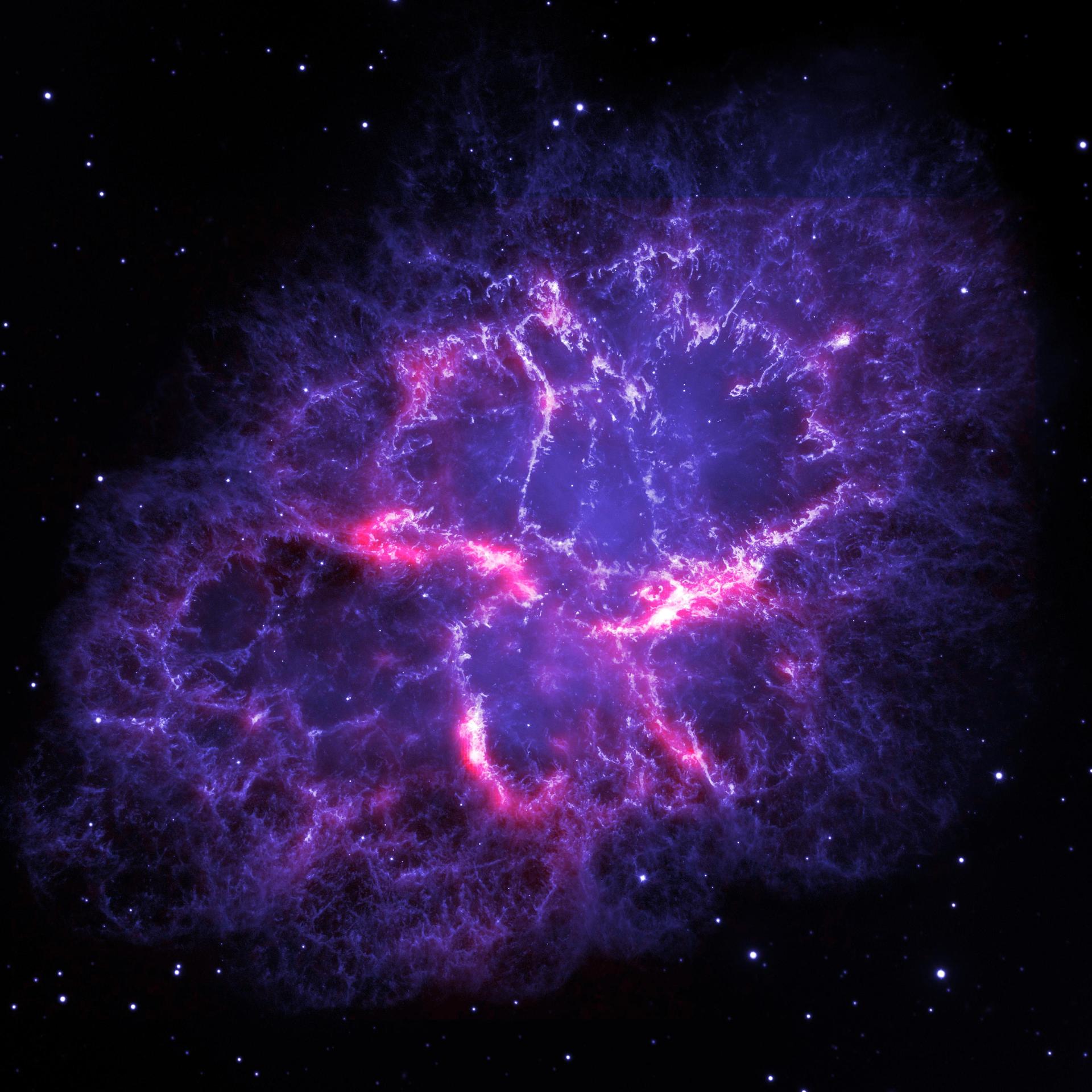
Crab Nebula (M1) — supernova remnant imaged by Herschel and Hubble Space Telescopes

Category: Feedback & Q&A

Reader feedback, questions and answers

Crab Nebula (M1), supernova remnant · ESA/Herschel/PACS; NASA, ESA & A. Loll/J. Hester (Arizona State Univ.) · NASA Image Library ↗

  • ENERGY SCIENCE QUESTIONS

    ENERGY SCIENCE QUESTIONS

    Copyright Harold Aspden, 1998

    In this section of these Web pages I present a sequence of questions which I will do my best to answer. They will be questions which warrant comment and some will be on topics which could be quite controversial. They may concern issues having no clear answer but which need to be discussed. I expect that most of the questions will aim to fill the gaps in the theoretical contributions which I have already put on record elsewhere. Also I will address questions of current research, though any primary activity of that nature will feature in the RESEARCH FORUM Web pages that aim to interest those of a more academic disposition who wish to build on similar theoretical foundations.

    THESE ARE MY ENERGY SCIENCE QUESTIONS:-

    QUESTION NO. 1: Is Energy Quantized?

    QUESTION NO. 2: Is there Energy in Space?

    QUESTION NO. 3: How much Energy is there in the Aether?

    QUESTION NO. 4: Who thinks the Michelson-Morley Experiment proves there is no Aether?

    QUESTION NO. 5: What is a Neutrino?

    QUESTION NO. 6: The Physics of Space-Time?


  • THE SIXTH QUESTION

    THE SIXTH QUESTION

    The Physics of Space-Time?

    Copyright © 1969 Harold Aspden

    This ‘question’ has a copyright notice dated some thirty years prior to the time when it is being entered into these Web pages. The question in simple terms concerns the real nature of whatever it is that occupies the vacuum. Physicists refer to this as ‘space-time’ but all that implies is that they have some notion of a theory developed by Einstein. No physicist believing in Einstein’s theory can give you a coherent account of what it is that occupies space devoid of matter.

    However, in 1969, as a way of drawing attention to a book I had written entitled: ‘Physics without Einstein’ and by reference to a paper I had had published in the Journal of the Franklin Institute, I wrote a two-page printed introduction to the reprints of that paper that I was distributing and I have decided to put the text of that introduction on the Web here as Energy Science Question No. 6.


    Einstein’s Theory of Relativity is founded upon the assumption that the laws of physics can be applied without change in any non-rotating inertial frame of reference. This principle is valid as applied to Newton’s laws of motion which, of course, relate to properties measured relative to the inertial frame. But is it valid for physical behaviour measured in the electromagnetic reference frame? Einstein assumes identity of the inertial frame and the electromagnetic frame. He assumes that a property of laws of mechanics shown in the inertial frame is shared by all physical laws.

    Now, look at what he missed by this assumption. Firstly, he failed to relate his theory with quantum mechanics. According to Heisenberg’s Principle of Uncertainty, the position and momentum of an electron are never certain but the product of the uncertainties in these quantities is certain. It is h/2, where h is Planck’s constant. May not this mean simply that since momentum is a mass property measured in the inertial frame and since position of charge is detected in the electromagnetic frame, there is a clear
    indication from quantum mechanics that the inertial frame and the electromagnetic frame, though definitely related, are nevertheless not identical?

    May it not be that the two frames are separated by a small but certain distance and that the electromagnetic frame moves cyclically and harmoniously about the inertial frame? Then an electron at rest in the electromagnetic frame has a variable momentum and position in the inertial frame but the
    product of the uncertainties in these quantities is the same wherever the electron is in the universe. Also, matter at rest in the electromagnetic frame will be centrifugally out of balance and will disturb space-time (whatever that is) in proportion to its mass, so giving rise to mass related effects (gravitation) in exact accord with the Principle of Equivalence. Gravitational mass and inertial mass are identical because gravitation, as a magnetic property developed by disturbing space-time, arises from an inertial disturbance. Then, if the Earth’s electromagnetic frame moves at uniform velocity with the Earth’s matter, we will, of course, be unable to detect changes in the speed of light measured in different directions in the Earth laboratory. The Michelson-Morley experiment confirms this. It does not prove anything about the applicability of the Principle of Relativity because it is concerned with electromagnetic properties and these are not measured in the inertial frame as Einstein’s principle requires.

    If we accept that space-time can contain separated inertial and electromagnetic frames in a relative cyclic harmonious and universal state of motion, we have immediate insight into the nature of time. Time is incorporated into the properties of space itself without recourse to the assumption that the propagation velocity of light c is a universal constant. Einstein somehow assumes c to be constant and then finds it can vary to allow the gravitational deflection of light. He has somehow confused us about time because we have inherited from him an unresolved problem known as the clock paradox. Why not accept that time is the universal constant and admit, as we have to anyway, that it is c which can vary? Why not forget the fourth space dimension, found by multiplying time and the velocity c, when it only leads to confusion and cannot, in any case, be portrayed in a physical form?

    Why be blinded by the limited success of Einstein’s theory when it purports to define the fabric of space-time and yet cannot unify physics? What is gravitation? Mere geometry? Is it not better to say that it is an electrodynamic force of attraction between mass disturbances in the space-time system? We can forge the link with electrodynamics so easily because, in the space-time system described, all matter is always moving mutually parallel due to its harmonious cyclic motion with the electromagnetic reference frame. This means that the related electrodynamic disturbances are mutually parallel current elements. Such elements attract in strict accordance with the inverse square law. Hence the force of gravitation. Then the propagation velocity of gravitation is the same as that of light, as is found. The cyclic motion does not interfere with this because the energy distribution of the field interaction is independent of such motion.

    A key factor is, of course, to know the true law.of electrodynamic attraction between isolated current elements. Many laws have been proposed. The problem is classical, has not been resolved, and tends to be thrown aside as ‘merely academic’. Yet, it is of fundamental importance. This introduces the writer’s law of electrodynamics presented in the appended paper. Equation (10) shows that for mutually parallel current elements there is a simple inverse-square attraction as required to explain gravitation.

    The foregoing account also introduces a new physics of space-time, the subject of a book by the writer entitled ‘Physics Without Einstein’, Sabberton Publications, P.O. Box 35, Southampton, England. In extending the above analysis in this work, the Schrodinger equation emerges immediately. The properties of space-time itself unfold to permit evaluation of the basic constants of physics, including Planck’s constant and the constant of gravitation. They are reducible to functions of three basic parameters, c, and the charge e and the mass m of the electron. In one sweeping account, the masses and spin magnetic moments of elementary particles are explained alongside the magnetic moments of astronomical bodies. All the tested results of Einstein’s Special and General Theories have simple and alternative explanation in this new unified form of physics.

    The above introduction was not published in the Journal of the Franklin Institute but the appended paper is reprinted from the February 1969 issue of this Journal and appears in Vol. 287 at pp. 179-183.

    Press the following link button to read the Abstract of that paper: [1969a]


    Harold Aspden
    February 11, 1999


  • THE FIFTH QUESTION

    THE FIFTH QUESTION

    What is a Neutrino?

    Copyright © 1998 Harold Aspden

    I shall introduce this section of my Web pages by reproducing the text of a paper I drafted some time ago with a view to publication by a scientific periodical. The editor of that periodical declined to publish this but encouraged its revision, asking me to acknowledge some prior work that was unknown to me and was of record in the German language but which, enquiry indicated, would be difficult to trace to establish availability. The claim was that someone else had already suggested that the neutrino was a manifestation of an aether property and I was trying to claim that idea as my own. Well, much of what I present in these Web pages is my own brainchild and all I can say is that I am only too happy to hear that I have been anticipated on some of my researches by others. Indeed, it endorses one’s efforts to know of related prior work and should help to secure acceptance by the scientific community generally. Science historians will then put the record straight as to who invented what. So I shall first present the paper I wrote and I expect I will follow that with an onward discussion as I add more pages to this website. If some reader is kind enough to compare what I say with what they might know concerning prior work then I will be glad to receive feedback and will report that in these Web pages. The only amendments I have made in presenting the paper are those providing links to other sections of these Web pages plus a noted revision concerning the references to Tifft’s discovery concerning galactic redshifts.


    THE ILLUSORY NATURE OF THE NEUTRINO

    Harold Aspden
    Energy Science Limited
    c/o P.O. Box 35, Southampton SO16 7RB, England

    Abstract

    It is shown that a vacuum medium in which lepton pairs are created from energy quanta may well contain, hidden in its zero-point energy background, a system of neutral particle forms which are constituted by the closely paired association of a virtual lepton system. The concept of the neutrino may then be an illusory effect arising from energy conditions which separate the components of those neutral entities. A major advance of this paper is the linking of the author’s earlier work, as reported in the Hadronic Journal, with the energy quantum threshold implicit in the determination of the fine-structure constant. The galactic red shift observations by Tifft (1977) are shown to confirm the theory for the fine-structure constant. See Tutorial Note No. 10 and Lecture No. 6 in these Web pages. Also, for a full reference to the author’s collected papers as they appeared in the Hadronic Journal take note of the current availability of the author’s 1996 book ‘Aether Science Papers’. See Books and Reports by Dr. Harold Aspden.

    Preliminary Introduction

    This paper has been written as a result of the author meeting R. M. Santilli (Editor in Chief, Hadronic Journal) on two occasions, firstly in Denver, Colorado at a conference on the New Energy theme and secondly in London, England at a conference on the interpretation of the theory of relativity. Dr. Santilli wondered why there had been no follow-on based on my papers [1-8] published in Hadronic Journal in the period 1986-1989 and urged the author on both occasions to address the question of the neutrino.

    The reason for that lack of follow-on, in simple terms, is that, it having become evident to the author that to prove the need for an aether, as the canvas on which we should paint the true picture of physics, we need a breakthrough discovery by which we are able to tap into the energy source that pervades the aether. The author has been diverted to explore and search for that breakthrough.

    As part of that experimental research a phenomenon has been encountered by which energy in the form of heat is converted into electricity in a way which appears to defy the second law of thermodynamics. [See Solid-State Thermoelectric Refrigeration in these Web pages.] Applied in its ultimate form, as now foreseen, it will involve assembling a laminated structure of nickel film interleaved with layers of an insulating medium which is superconductive. Now that might seem to be a contradiction in terms, but it is not. Applied science is now revealing to us the existence of polymer films which are heat insulating in the plane of the film but which have superconducting filamentary paths transversely through the film. Such a material, said to exhibit room temperature superconductivity, has been discovered by Grigorov, as reported in a recent article entitled: ‘The Goldsmid-Grigorov Accomplishment: A Major breakthrough in Thermoelectrics’ at pp. 67-69 in the the No. 10, 1996 issue of the periodical ‘Infinite Energy’ [9]. [See Infinite Energy to access the website giving information concerning that periodical.]

    This subject is mentioned here because it is connected with the fundamental physics addressed in this paper. The connection involves electron-positron chains. The author introduced these in his 1969 book [10] as links between individual nucleons in an aether-coupled structured distribution of the atomic nucleus which applies to atomic nuclei of mass number from tritium-3 onwards. Recently, in relation to the cold fusion theme, the electron-positron chain theme was used to explain the lifetime, the magnetic moment and, indeed, the mass of the tritium nucleus [11]. [This is the subject addressed at pp. 41-44 of the author’s Energy Science Report No. 5 ‘Power from Water: Cold Fusion’. See Books and Reports by Dr. Harold Aspden. As to the electron-positron chain theme, although the 1969 book ‘Physics without Einstein is now out-of-print, a relevant description contained in a 1974 work is to be found in these Web pages as Energy Science Essay No. 15 under the title of ‘The Chain Structure of the Atomic Nucleus’].

    It was a feature of the author’s theory that the aether comprises a degenerate form of electrical charges, each seated at a lattice site in a cubic structure and set in a uniform background continuum of charge of opposite polarity. The ratio of the unit cell volume to the lattice charge volume was found to be 5059, which made 1 in 5059 the chance of a ‘hit’ by a sporadic virtual muon involved in an ongoing pair creation and annihilation process creation targetted on the lattice charge. In contrast, the electron charge occupies a volume that is 1/1843 that of the lattice charge. As shown in [11], the theory for the triton lifetime requires 8 virtual muons to converge on a lattice charge which has a crucial position in the tritium nucleus. But those muons must have the right combination of charge polarities and the odds favouring decay increase by a factor of 9, because there are 9 chances in the 256 different ways in which 8 pairs of two virtual muons of opposite charge polarity can satisfy the decay condition.

    Without going into further detail, it is simply noted that the triton lifetime is formulated as:

    (5059)8/9(1.235×1020) seconds

    which is 12.2 years, exactly the mean lifetime found experimentally! Here we have used the Compton electron frequency, 1.235×10²⁰ Hz, as the rhythmic time cycle rate of the aether activity. I do, however, quote the following from pages 38-41 of [11]:

    ‘The triton does, in fact, comprise two protons plus one antiproton …. The triton, therefore, has to have a nuclear beta particle chain able to bridge two lattice sites and it probably has two protons in close proximity that straddle the lattice charge of one site whereas the antiproton nucleon constituent is seated at the other lattice charge site.’

    The decay corresponding to that lifetime of 12.2 years is based on a combined virtual muon ‘attack’ on that straddled lattice charge. These comments serve as giving background support to the charged lepton chain theme.

    Now, the structure and properties of the proton, deuteron and neutron had all been explained in Hadronic Journal papers [1, 7]. However, the ‘cold fusion’ report just referenced included also the theoretical justification, based on the Hadronic Journal background, justifying the observed abundance ratio as between protons and deuterons as present in normal water.

    As to electron-positron chains it is topical to note that T. Jacobsen in a very recent issue of European Physics Journal has discussed how an insulator can be superconducting [12]. He explains how ‘electric charge may be transported through the insulator not by conduction electrons but by a chain reaction of successive electron-positron annihilations not hindered by ohmic resistance’.

    In the following discussion of the neutrino, the concept of electron-positron chains will be seen to play an important role. In this connection an electron-positron chain can be visualized as an in-line linkage of alternate electrons and positrons as if they were beads threaded on a string. They are held together by mutual electrostatic attraction of adjacent charges and the string does not collapse owing to the special properties of the aether which requires each charge to be at rest in the electromagnetic frame of reference. In a sense one could say that the string-bead analogy applies as if the strings link adjacent sites in a cubic-structured aether and the groups of beads can slide along the string from site to site. In reality, however, the ongoing vacuum activity of mutual pair annihilation and recreation serves to relocate these charges when there is such migration. The centre of each charge must not, therefore, have relative motion with respect to the reference frame of its neighbours in a conglomerate system, as that would polarize the charge group and involve non-minimal energy states, given that the electromagnetic reference frame is itself in a state of jitter in the inertial frame.

    In the following description we will use symbols such as oo and oooo to indicate an electron-positron pair coupled as a neutral entity, the smallest string length, and a short electron-positron-electron-positron chain, respectively.

    We will rely on analysis presented in reference [1] for the reader to understand why the oo combination has an energy of 1.25 electron mass units and the oooo combination has an energy of 2.25 mass units. It will then be evident that we can have neutral electron-positron chains which can be ruptured from the oooo state to become oo plus o plus o, meaning that a free electron and a free positron have been ‘created’. The energy involved in this rupture is 2.25 minus 1.25 or one single electron rest-mass unit, yet an electron and a positron have been released from a neutral field background.

    [Since these numerical terms are of the utmost importance to this Web presentation, the relevant physical analysis has been entered as a separate item in these Web pages. See Electron-Positron Chaining.]

    By applying the principles disclosed in that same reference [1] the reader can verify that a six charge electron-positron chain oooooo has an energy of 3.225 electron rest-mass units. These three numerical quantities, 1.25, 2.25 and 3.225, will be used as we proceed to explain the physical nature of the neutrino.

    From this preliminary introduction, the reader should therefore now see the gist of the author’s case as we proceed in a more formal way.

    Main Introduction

    The author’s earlier papers in Hadronic Journal [1-8] show that it is possible to decipher much of what Nature discloses to us by packaging energy in the various species of fundamental particles. However, in this quest, which has preoccupied the author now for more than 30 years, there are two phenomena which seem not to fit into the author’s interpretation of the physical pattern. These are high energy gamma radiation at frequencies exceeding the Compton electron frequency and the so-called neutrino, if seen as a particle having a finite but extremely small mass.

    [Concerning gamma rays having frequencies exceeding the Compton electron frequency, I tend not to believe in that hypothesis. Has anyone ever measured such a frequency directly, as opposed to inferring it by unwarranted assumption based on an extrapolation of Planck’s radiation formula to a realm outide its empirical bounds?]

    [Concerning neutrino mass, that too seems to me to be an imaginary notion and my thoughts on that are not qualified, but rather reinforced, by the recent discoveries claimed from tests at a site in Japan. See Neutrino Mass.]

    Charged particles offer clues as to their form, by virtue of their response in a magnetic field which evidences their magnetic moments as well as their mass and lifetime properties. Even the neutron reveals its inner structure by showing us a magnetic moment and the fascinating feature of that quantity is that, measured in nuclear magnetons, it is -1.91304308(54), precise to 0.28 parts per million. Why, you wonder, is this so fascinating? The reason is that -g(22/23), where g, the gyromagnetic ratio is 2, is -1.9130435, that is, it agrees with experimental observation to a part or so in ten million. It means that the neutron is separated from one of its positive beta particles for one part in 23 of the time. The reason for this is explained in ref. [1].

    When we try to probe the mysteries of the neutrino there are, however, no such clues to help us. One then wonders if the neutrino is a figment of imagination invented in order to make the books balance on the momentum score board!

    As to the high energy gamma radiation, here again, one wonders whether there really is something having a characteristic very high frequency and corresponding to an extrapolation of the properties of the photon or whether this is another case where imagination has gone just a little too far. Perhaps here also we have simply a situation where momentum and energy imbalance imply a phenomenon which has no relationship whatsoever to gamma radiation of the kind seen in the 100 keV region. The ultimate threshold could well be at 511 keV, where the frequency reaches the cut-off value set by the rest-mass energy of the electron.

    Accordingly, there is some purpose in asking whether ultra-high energy gamma radiation and neutrinos describe the same phenomenon and whether that phenomenon can best be described by another name. By this one could infer the existence of something that can absorb energy and momentum and release that energy and momentum elsewhere but in a form duly packaged which somehow has the signature of specific threshold energy conditions of the emitting source.

    The task at hand, therefore, is to follow an intuitive line of reasoning and suppose that we have been ignoring something of a universal nature that intermediates in exchanging momentum and energy with matter, by which one infers an aether. Expressed in simple terms, can it be that our references to neutrinos and those high energy gamma rays are really nothing other than references to energy transactions involving the aether?

    Now before developing this theme by examining how we have come to accept that neutrinos are real particles which can penetrate matter as if unobstructed (a traditional property of the aether), it will help to review the situation posed by the photon.

    The Photon

    It is often asked whether the photon is a particle or a wave. This author answered that by deriving the physical relationship between the energy quantum locked into a photon and the frequency of that photon. This involved deciphering the code hidden in the numerical value of the fine-structure constant, it being a dimensionless physical quantity combining three quantities having physical dimensions. These are (i) Planck’s constant h, which has the dimensions of angular momentum, (ii) the unitary charge e, the magnitude of which is common to both proton and electron and seemingly all fundamental charged particles and (iii) the speed of light c. The latter quantity is a property of the expanse of space in which we know there can be resonance at photon energy levels sufficient to generate an electron-positron pair. Therefore space is filled with something that can resonate to shed electrons and positrons created as if from nowhere but only if the photon energy input is of adequate strength.

    Clearly, therefore, the fine-structure constant is the vital clue to understanding what is out there filling space and, by deciphering its numerical code, which is now measured to part in ten million precision, we can at least discover something about the nature of the photon.

    Before commenting further on that theme there is also an important point to consider concerning those high-energy gamma rays. Evidently we should need the energy of two photons at the Compton electron frequency, namely twice 511 keV to create an electron-positron pair, but does that really mean that we need one gamma ray of energy 1.022 MeV, as is often assumed? There is something physically unsatisfactory about expecting two particles, as individual photons, to come together in collision to combine to set up that energy resonance at 1.022 MeV. The true nature of the photon mechanism has to be our guide to the territory we are investigating. It is an ‘event’ in which energy and momentum are transferred between aether and matter with an additional association with a frequency characteristic attributable to aether wave propagation.

    [My account of the photon, backed by a theoretical derivation of the value of the fine-structure constant with part per million precision is to be found in these Web pages in Tutorial Note No. 8 and, concerning whether photons really transport energy across vast distances in space rather than setting up wave ripples in an existing sea of energy, refer to the experimental data of An Antenna with Anomalous Radiation Properties.]

    Digressing now, for a moment, let us ask a question which seems never to be raised in physics, namely what is it that determines whether a charge has positive polarity or negative polarity? There is one and only one answer that appeals to the author. This is that all focal points of electric charge participate in an oscillation at the Compton electron frequency. Not only does this endow the field medium with that threshold photon frequency set by the electron or positron rest-mass energy but it constrains the scope for interpreting effects assigned to the muon and taon neutrinos.

    If all charge is locked into a universal oscillation rhythm and set in either of two phases that are 180o apart then all positive charge will oscillate in one phase and all negative charge will oscillate in antiphase with the positive charge. The oscillation is seen as being a radial oscillation referenced on the charge centre, with charge volume of a particle and its anti-particle conserved as if they are situated in an incompressible enveloping medium. It is true that this implies instantaneous action-at-a-distance in the Coulomb gauge we use here, but remember that retardation and speed-of-light propagation are phenomena we associate with electromagnetic energy transfer, rather than electrostatic action [6].

    This model can be developed in many ways. For example, ignoring the oscillation, and prescribing that charge parity, energy and space volume of three charges forming a group are all conserved, one finds that the Thomson charge model used in references [2, 8] involves a self-stabilizing system. Including the oscillation condition then directs consideration to a four-charge grouping.

    The author’s paper [1] gives the essential clue for understanding how an electron-positron pair can be created from the input of a single 511 keV energy quantum.

    The Electron Neutrino

    In referring to the paper just referenced and with the neutrino question in mind it seems that we might solve the neutrino problem with very little difficulty.

    As already indicated in the Preliminary Introduction it was suggested that the rest-mass energy of a single electron would suffice to split the oooo neutral electron-positron chain into three components, a neutral oo pair, an isolated electron and an isolated positron. This is pair creation, ostensibly, from a 511 keV energy input.

    In neutrino terms the conventional scenario is one which describes the action as involving a `ghost particle’ (See Professor Sir Harrie Massey’s book ‘The New Age in Physics’, and the section commencing at p. 262 on ‘The Neutrino as a Ghost Particle’ [13]. However, in the standard literature the neutrino is presented as a mystery particle more in connection with the heavy electron, the muon, than with the normal electron, even though the physics is much the same for both.

    With regard to the electron neutrino, this appears in Massey’s account (page 254) as an item in the following equation:

    1H3 ~ 2He3 + e + no …….. (1)

    The symbol no represents the neutrino, but in this situation it amounts to a mere declaration that the energies of the source particle and the two products do not balance and so what has gone missing must be a ‘neutrino’. As Massey explains, in referring to Pauli’s neutrino hypthesis, we need “to suppose, boldly, that in beta decay a second particle is emitted together with an electron (and in muon decay, two such particles).”

    The point here is that the tritium nucleus sheds very little extra energy when it converts into a helium 3 nucleus and an electron, whereas the muon sheds almost all of its energy in decaying into an electron or positron and, in the absence of something to absorb the impact of this decay, it needs two additional component products to balance both energy and momentum. This is owing to the fact that the electron or positron produced can have different energies and momentum according to the way chance governs the decay. Why then, however, do we not see the need for two neutrinos in the tritium decay? The reason presumably is that there are already two particles involved and so, mathematically, one can generate the necessary number of equations to keep energy and momentum in balance. But in deciding in this way whether one or two neutrinos are created are we not merely playing with our mathematics and forcing an interpretation to suit our assumptions? Why cannot we just suppose that the aether can absorb any balance of momentum and energy and share that overall with all the other particle events that occur everywhere in space?

    Surely, concerning the muon, its decay is not self-motivated but involves, instead, a kind of impact by an external agency which does its work to rupture the muon and, after reducing it to an electron, sheds the rest of the energy into an external sink that absorbs it. Here we see the aether playing a role as both an emitter and an absorber.

    Now, the neutrino that is supposedly generated by equation (1) is of such small energy that it can hardly be regarded as a real particle. In contrast, the combined energy of the two neutrinos shed by the muon decay is very nearly the whole energy of the muon itself. However, why should we then divide that energy into two neutrino forms? It is submitted that the likely scenario is that something which this author declares to be a virtual muon impacts the real muon and the result is a collapse into an electron or positron with the energy of very nearly two muons being deployed into the aether.

    The author has referred in [2] to a P:Q system, which features in his theory of proton creation. The Q component is what the author terms a dimuon and the analysis in that paper explains that a Q:(mu) system has the same mass-energy as Q alone, but Q is charged and Q:(mu) is neutral. The energy of (mu), namely half of Q, can therefore be absorbed to separate (mu) from Q:(mu) whilst still conserving charge parity. Similarly if we revert to the theme of the Preliminary Introduction and take the oooo symbols as applying to short chains of positive and negative muons, rather than electrons, then the transition:

    oooo ~ oo + o + o+ ……… (2)

    would mean that a single unit of muon rest-mass energy has been absorbed with charge parity conserved. In other words, if the background field includes neutral objects oooo and we witness an event in which a muon decays to shed virtually all of its energy then that can be explained. One simply needs to see the resulting field background as comprising neutral entities oo plus muon pairs that become part of the quantum-electrodynamic field.

    It is important here to have regard to the fact that the author has derived the precise value of the proton-electron mass ratio and explained proton creation in terms of such an active virtual muon field background [7]. [See Debate on Creation.] Therefore the existence of a system which can absorb muon energy as a ‘neutrino’ process is part of that picture. The reaction:

    Emu+ Q:(mu) ~ Q+ + (mu) ……… (3)

    conserves charge parity but absorbs the energy Emu of the muon.

    It is submitted, therefore, that the problem of the ‘neutrino’ concerns, not the question of whether this is a mystery particle having enormous penetrating power and virtually no mass, but simply the capacity of the aether to absorb energy and momentum. The aether is particularly adept at absorbing energy shed by lepton decay for the simple reason that it is constituted by a particle system that, in its active form, is nothing other than a vast lepton system.

    A Key Item of Evidence

    To add to what has been said above the author now presents a quite remarkable and new aspect of his theory which bears upon this neutrino problem.

    It was shown in a 1972 paper [14] that the most degenerate negative particle form in the aether is a charge form that has the same charge as the electron but occupies a volume of space exactly 1843 times that of the electron. Its ‘pressure’ equilibrium with an enveloping muon environment led then directly to the evaluation of the mass-energy of the virtual muon as having a mass-energy 206.333 times that of the electron.

    Later [7,15] the author discussed this in relation to there being two types of virtual muon, one having precisely 207 times the electron mass and one having 205 times the electron mass. From this, taking the heavier version as the core for the real muon, it was shown how the actual mass of the real muon of 206.7683 electron mass units could be derived theoretically [15].

    Based on this background the author feels justified in presenting the following analysis.

    We regard the vacuum medium as alive with activity involving the ongoing creation and decay of virtual muons with a statistical incidence of one such pair in every cell of space in each cyclic period at the Compton electron freqency. A cell of space comprises one single vacuum lattice charge e, which the author will henceforth refer to as the quon, it being the quon that is the degenerate negative charge form occupying that volume of 1843 single electrons or positrons. In the author’s earlier writings this particle was termed a q particle or lattice particle because it formed with all other such particles a crystal-like structure defining the unit space cell just mentioned.

    The cell dimensions are those of a cube of side 6.374 10-11 cm, as shown in reference [16], [17] or [18]. The first reference was published in 1960 and shows that at that time, though the inertial mass of the quon was known, its physical size had not be determined. By 1966 [17] this problem had been solved in a quite remarkable manner. Knowing inertial mass of the quon from its natural rhythmic motion at the Compton electron frequency and the Maxwell displacement field theory governing that motion, one could determine the energy density of the enveloping medium. It was found that the energy of that medium per unit space cell was equal to that of two muons if the pressure throughout the charge body of the quon was equal to that of the enveloping medium. Importing a fact from hydrodynamics by which a sphere in motion through a fluid having the same mass density exhibits half its normal mass it then became possible to determine the physical radius of the quon. It was found to be 2.3×10⁻¹² cm.

    In this way the space occupied by the quon charge was determined and the fine-structure constant, alpha, indicated by the 1960 presentation of the theory [16] was determined to part per 100,000 precision. When the calculations over space, extended to virtually an infinite cell range, were made by independent researchers in 1972 using the computing facilities at the National Measurement Laboratory in Australia, it became evident that part per million precision in accord with the measured value of alpha pointed to the integer 1843 as being the volume ratio of the quon charge to that of the electron [14]. Charge radius was based on the use of the Thomson formula of 2e2/3mc2, where m is the rest-mass of the charge.

    We will now rely on this odd integer 1843 as signifying the possibility that, when energy is injected into the quon, by the incidence of those muons striking it as a target in their creation and ahhihilation activity, the result is the creation of 1843 electrons and positrons, meaning 922 electrons and 921 positrons.

    It would take nine muons to create a system in which all these electrons and positrons were isolated from one another. The chance of that occurring is very much smaller than the chance of, say, five muons impacting the quon in a sufficiently concerted way so as to operate collectively in its transmutation. This is why we need to consider the formation of electron-positron chains, as their formation needs lower energy.

    The shortest chain oo is not as stable as the oooo chain, since it takes at least three charges in a group to comply with the three governing conservation conditions (space volume, charge parity and energy) [19]. Therefore the oooo will be the most likely product to emerge from the quon source. Analysis then shows that 460 units of oooo have a collective mass-energy of 460 times 2.25 electron units, which is 1035, whereas 1840 electrons and positrons are involved in this process. The dominant virtual muon has a mass of 207 electron units and 5 times 207 is 1035, which is why attention is being focused onto this particular quantitative choice.

    Analysis shows that it is impossible to apply more than five or less than five muons and emerge with a result that allows 1842 electrons and positrons to emerge as neutral chains, however they may divide into groups, given the need for conservation of energy. The 1.25 for two components, 2.25 for four components and 3.225 for six components, converging to a limit just above 0.5 energy units per electron or positron component, precludes the muon energy input from being anything other than about half of 1843 units. Hence the five muon restriction.

    Now there is more than one solution to the ultimate combination of neutral e-p chains that are formed, given rigorous energy conservation and different possible groupings of five muons which can have either of 205 or 207 electron mass units. This does not matter, unless we seek, in developing this theory, to be too rigorous in estimating the lifetimes and creation rates of the ‘neutrino’ products, assuming these are the nearest we can come to tracing something resembling a neutrino form in our theoretical study of the space medium. For all cases there will be a predominance of the oooo state, because this has the greater stability. The primary combination, based on five 207 unit virtual muons being involved, is tabulated in Table I. E denotes the energy of the e-p chain components and W is total energy of the n components in a group. V is the total unit volume of that group and o signifies the isolated electron necessary to assure charge parity owing to 1843 being odd and the quon having the charge of the electron.

    TABLE I
    e-p E n W v
    oo 1.250 7 8.75 14
    oooo 2.250 427 960.75 1708
    oooooo 3.225 20 64.50 120
    o 1.000 1 1 1
    total —– —– 1035 1843

    Neutrino Abundance

    The proposal emerging from this analysis is that there can be neutral electron-positron chains formed as an ongoing activity in the vacuum medium and this is not just linked to the decay of the muon we see in our high energy particle reactions. However, the fact that ‘neutrinos’ of this special form exist gives us a glimmer of understanding as to how electrons and positrons can be created by vacuum energy fluctuations, as by separation of oooo into oo plus o plus o. Also, if energy is shed from decay reactions of lepton forms then its deployment amongst the different forms of our ‘neutrino’ as suggested by Table I could explain how the vacuum medium absorbs that energy into its neutral system.

    This would mean that the momentum imparted is an action propagated through the system of the main quon lattice and so communicating action to remote locations through space where eventual release of energy will balance the momentum condition.

    It is desirable that we have some rough indication at least concerning the factors governing the lifetime of these neutrino forms as just conceived.

    However, at the present time there is really no measured value that will allow us to check the theory now advanced and so what follows has to be seen as rather speculative. Even the recently reported estimate of the rest-mass energy of the neutrino as being 2.4 eV seems too vague to be of any meaning [20]. It is impossible to conceive that a rest-mass energy of 2.4 eV could be linked to any neutral combination of two equal and opposite unitary charges having the values we associate with all other particles in the universe. Even the neutron betrays its composition in meaningful terms by showing its magnetic moment, but we see no trace of a magnetic moment for the neutrino. It would seem that its oooo composition is never partially ruptured into separated charges in an ongoing recovery sequence, as it is for the neutron during one period in 23.

    To have a rest-mass energy of 2.4 eV the neutrino, as a combination of plus or minus e charges, would have to have a physical form of a radius several hundred thousand times that of the electron. It would exceed the spacing of atoms in solid matter. Such a neutrino could not penetrate through that matter. Therefore the 2.4 eV trace of energy deemed to be involved in the experiments involving the neutrino scenario will probably imply some small perturbation of the vacuum medium, rather than affording direct evidence of neutrino mass.

    Conclusions

    I had planned at this stage to discuss also the taon neutrino and then try to predict the abundance of these neutral lepton groups which I deem to be present throughout space. Abundance depends upon lifetime and incidence of creation and these depend upon the way in which the virtual muon bombardment affects the ‘physical chemistry’ of the two-way reaction:-

    E + oooo ~ oo + o + o …….. (4)

    Instead, owing to my attentions having been diverted by a news media report, I will end by commenting on that 1843 factor introduced above.

    The ‘neutrino’ sea which pervades all space as a catalyst constituent of the aether which allows energy to materialize as protons and electrons must also be present in remote galactic regions. The question then at issue is whether the 1843 factor is the same on a universal scale.

    I have always assumed that it would be the least value consistent with minimal zero-point energy activity and it being an odd integer to conserve charge parity when electrons and positrons are created from energy input. The 1972 Physics Letters paper [14] determined the zero energy limit for a non-integer value as being N = 1844.53. The relevant formula for the reciprocal of the fine structure constant alpha is:

    (alpha)-1 = hc/2(pi)e2 = 108(pi)(2)1/2N-1/6 = 144(pi)(r/d) …… (5)

    and the rigorous zero-energy evaluation gave r/d as 0.302874.

    Increase of energy activity means that the zero-point energy expands the quantized orbital motion of the aether charges in their orderly and synchronized jitter activity. As energy increases, N will decrease in value, but it evidently does that in integer steps, because 1843 is the value which gives us the fine-structure constant and other constants such as the proton-electron mass ratio that apply at least within our local galaxy.

    I did once wonder whether the red shift properties of quasars could mean that physical constants as we know them, such as G and h, have quite different values in some remote galactic regions. In particular, could the energy concentration become so overwhelming that, in some parts of the universe, the 1843 quantity is drastically reduced. If Planck’s constant h were to be increased, for example, in some galaxies, and by this I do not mean that it changes with time on the Hubble scale, but does remain a true constant in its own galactic system, then some galaxies might be seen to have a slightly anomalous red shift.

    That might seem to be pure speculation, but it caused me to work out how a reduction of N in one integer step could affect the fine-structure constant, and so h. The analysis itself is fascinating, because there are two terms in equation (5), r and d, which can both alter as more energy priming is added to the aether lattice.

    [The following section of text in the subject paper needs to be revised to conform with a revision that was applied to the subject of Tutorial No. 10 by a correction to be found in Lecture No. 6. However, for continuity in presentation, the original text will be retained and an Appendix will be added to the paper, the Appendix being a section of text taken from the above-referenced Lecture No. 6, the subject being Tifft’s Galactic Redshift Measurements.]

    The frequency of radiation for a particular spectral line is proportional to (alpha)2 and so N1/3, but it is also proportional to the Compton electron frequency. The latter is the frequency of the fundamental rhythm of the aether and this frequency times the distance d represents a speed that I regard as a universal constant. Therefore we need to know how d might change with N. The answer to this is readily found because the electron rest mass energy is also a universal constant, as is the energy density of the aether, and from this we can deduce that N-1/3/d3 is a universal constant as well. Therefore, d is proportional to N-1/9 and the Compton electron frequency is proportional to N1/9.

    The net result of all this is that the frequency of a spectral line emitted from an N-type galaxy will be proportional to N4/9, so, if N is reduced, there will be a red shift component attributable to this change in the N factor. A reduction by one integer step in the 1843-1833 range corresponds to a fractional shift of 1 part in 4135. If the red shift is expressed as an apparent speed difference this, as a fraction of the speed of light, becomes 72.5 km/s.

    Now, having spent 40 years developing this theory since I first discovered the theory for the fine-structure constant and some 25 years since the N-integer feature of that formula was first recognized, I confess surprise that, only now, have I been bold enough to explore the effect of N having a value other than that applicable here on Earth and within our immediate cosmic environment. My surprise turned into real excitement when, very recently, I heard that a senior figure (W. G. Tifft) in the astronomical world had published, some 20 years ago, a paper entitled: ‘Discrete State of Red Shift and Galaxy Dynamics II’ [21]. That paper reported that ‘red shift differentials between pairs of galaxies and between galaxies in clusters are found to take on preferred values which are various multiples of 72.5 km/s’. My attention was drawn to this only because The Times newspaper in U.K. reported this mystery and declared that Tifft’s discovery had been fully confirmed by research findings of independent observatories [22].

    Surely that is proof indeed that my theory for the fine-structure constant, as founded in an aether medium, is on sound foundations! That means, I submit, that the `neutrino hypothesis’ which I advance in this paper will come to be recognized also as well founded. However, given that I believe no one will ever be able to prove that a ‘neutrino’ is a material particle, I expect that what I say on that subject will remain a hypothesis. It should, however, awaken interest in my papers referenced below that have appeared in the Hadronic Journal.

    References

    [1] H. Aspden, ‘The Theoretical Nature of the Neutron and the Deuteron’, Hadronic Journal, 9, 129-136 (1986).
    [2] H. Aspden, ‘Meson Production based on Thomson Energy Correlation’, 9, 137-140 (1986).
    [3] H. Aspden, ‘An Empirical Approach to Meson Energy Correlation’, Hadronic Journal, 9, 153-157 (1986).
    [4] H, Aspden, ‘The Physics of the Missing Atoms: Technetium and Promethium’, Hadronic Journal, 10, 167-172 (1987).
    [5] H. Aspden, ‘Synhronous Lattice Electrodynamics as an Alternative to Time Dilation’, Hadronic Journal, 10, 185-192 (1987).
    [6] H. Aspden, ‘Instantaneous Electrdynamic Potential with Retarded Energy Transfer’, Hadronic Journal, 11, 307-313 (1988).
    [7] H. Aspden, ‘The Theory of the Proton Constants’, Hadronic Journal, 11, 169-176 (1988).
    [8] H. Aspden, ‘Conservative Hadron Interactions Exemplified by the Creation of the Kaon’, Hadronic Journal, 12, 101-108 (1989).
    [9] M. C. Nicolaou, ‘The Goldsmid-Grigorov Accomplshment: A Major Breakthrough in Thermoelectrics’, Infinite Energy, 2, Issue No. 10, 67-69 (1996).
    [10] H. Aspden, ‘Physics without Einstein’, (Sabberton, P.O. Box 35 Southampton, England), p. 147 (1969).
    [11] H. Aspden, ‘Power from Water: Cold Fusion: Part I’, Energy Science Report No. 5, (Sabberton, P.O. Box 35 Southampton, England), pp. 36-43 (1994).
    [12] T. Jacobsen, ‘A propos Superconducting Insulators’, European Journal of Physics, 17, 250-252 (1996).
    [13] Sir H. Massey, ‘The New Age in Physics’, (Elek Books, London), Chapter 9, (1966).
    [14] H. Aspden & D. M. Eagles, ‘Aether Theory and the Fine-Structure Constant’, Physics Letters, 41A, 423-424 (1972).
    [15] H. Aspden, ‘The Mass of the Muon’, Lett. Nuovo Cimento, 38, 342-344 (1983).
    [16] H. Aspden, ‘The Theory of Gravitation’, (Sabberton, P.O. Box 35 Southampton, England) p. 24 (1960).
    [17] H. Aspden, ‘The Theory of Gravitation’ (2nd Edition), (Sabberton, P.O. Box 35 Southampton, England), p. 112 (1966).
    [18] H. Aspden, ‘Physics Unified’, (Sabberton, P.O. Box 35 Southampton, England), p. 163 (1980).
    [19] H. Aspden, ‘Energy Correlation Formula applied to Psi Particles’, Speculations in Science and Technology, 1, 59-63 (1978).
    [20] J. R. Primack, J. Holtzman, A. Klypin & D.O. Caldwell, ‘Cold and Hot Dark Matter Cosmology with Muon Neutrino and Taon Neutrino Mass approximately equal to 2.4 eV’, Physical Review Letters, 74, 2160-2163 (1995).
    [21] W. G. Tifft, ‘Discrete States of Red Shift and Galaxy Dynamics. II Systems and Galaxies’, The Astrophysical Journal, 211, 31-46 (1977).
    [22] N. Hawkes, ‘Scientists hit Galactic G-spot’, The Times, London, p. 18, October 14, 1996.


    APPENDIX

    The following is an excerpt from Lecture No. 6 in these Web pages. It concerns the measurement of hyperfine frequencies in the radiation spectrum from remote galaxies, which exhibit anomalous redshift properties, seemingly differing in steps as between different galactic regions.

    QUANTIZED GALACTIC RED SHIFTS

    Note that fh is the frequency representing the hyperfine radiation spectrum of hydrogen. As a red shift, expressed as an apparent Doppler shift velocity, based on the 300,000 km/s speed of light, this formula tells us that the quantized step in the red shift is:

    (300,000)[1 – (No/N)1/9]km/s,

    so you can verify that if No, as reference, is taken to be 1843, then as N decreases in integer steps so the red shift changes in steps of 18.1 km/s.

    If you refer to the pages of my Tutorial No. 10 you will see from equation (5) that the aether lattice dimension d was shown to vary as N-1/9. Certain other aether quantities, such as mec2, hfo, e2/d and fod, were all deemed to be truly universal constants, notwithstanding the possibility that fo, d, h and e individually could be different in different galactic domain regions.

    The variation of d, the lattice spacing, was based on the assumption that the energy density of the aether lattice structure remains uniform throughout the universe. I now see that this was an error. I should have regarded the main energy constituent of the aether, that of the virtual muons, as being of uniform density. Thus you can see, from the expression for mmu/me,namely:

    mmu/me = [3/8(pi)][108(pi)]3(1/N)4/3

    that it is (1/N)4/3/d3 that is the universal constant and this makes d proportional to (1/N)4/9.

    Keep now in mind the fact that our Tutorial analysis showed us that d is equal to 108(pi) electron charge radii and that the rest-mass energy of the electron, which we assume to be a universal constant, is proportional to e2 and inversely proportional to that charge radius. This tells us that e4 is proportional to d2 and so to (1/N)8/9.

    Now, to come to the nature of the microwave radiation detected by Tifft and from which the quantization of galactic red shift was measured, it is noted that the formula for the frequency of hyperfine line separation producing the 21 cm emission is proportional, in theory, to the product of the Bohr magneton eh/4(pi)mec and the nuclear magneton eh/4(pi)mpc as divided by Planck’s constant h. This represents a term proportional to frequency and explains that sixth equation in the above group, namely:

    fh = Kh(me/mp)(e/mec)2 = K'(N)1/9,

    where K and K’ are constants of proportionality.

    Since me/mp is proportional to N4/3 and e4 is proportional to (1/N)8/9, that microwave expression becomes proportional to h(c)2/e2 times N4/9. Note that mec2 is a universal constant. Now we know from the fine structure formula above and its derivation that h(c)2/e2 is proportional to c(1/N)1/6 and c/r is proportional to fo, whereas r/d is proportional to (1/N)1/6, so that microwave expression becomes proportional to (N)4/9(1/N)1/6(1/N)1/6fod, which reduces to proportionality to N1/9, because fod is also a universal constant. Accordingly, we have justified the form of the sixth expression listed above.

    Remember that in the Tutorial No. 10 account, based on an assumed optical red shift, the corresponding variation was N4/9. That had explained the red shift steps of approximately 72.5 km/s with N stepping downwards through both odd and even integers.

    However, with our corrected analysis based on the radio spectrum observation, the theory implies red shift steps of 18.1 km/s as N decreases in integer sequence.

    Now it is my understanding from reading more of Tifft’s work that, though 72.5 km/s is the dominant feature in the quantization of galactic red shifts, there are intermediate levels of quantization, typically involving 36 km/s and 18 km/s red shift spacing.Tifft has written many papers on the subject, ranging over a 25 year period, many appearing in the Astrophysical Journal.

    It now becomes an interesting exercise to explore the factors which might govern how Nature selects one value of N with a stronger preference to another and to assess how this N quantization spectrum might have other cosmological implications.

    Having only recently come to see this feature that N can have a value other than 1843, I can only proceed tentatively in my own exploration of the subject, but a picture is developing. It is based on the belief that the virtual muon population, which must have the mean mass-energy values as determined by the above expression for mmu, adapt to a mix of virtual muon pairs of odd units disposed either side of that mean value. Thus, if the mean virtual muon has 206.3329 electron units of energy, as applies with N as 1843, then there are pairs of muons of 207 and 205 units in a mix having a ratio of very nearly two to one.

    Do note that this numerical circumstance might well explain why 1843 is rather special. An N value of 1844 corresponds to the least state of energy potential but it is 1843 that offers the easy route to proton creation, because nine virtual muons have to contribute to its creation and the statistical mix of 205 and 207 muons is virtually a 1 to 2 ratio. This means that three 205 muons plus six 207 muons can come together in a smooth energy transition to create the proton, whereas the N value of 1844 would involve some energy turmoil.

    Now, if you then consider how an aether domain can adapt to a higher energy state, meaning one for which r/d has increased and N reduced, there has to be creation of electrons and positrons to take up the volume of space freed by the reduction of N. Note that N is an integral number of electron charge volumes in an aether lattice particle, the quon. Now, there are only two ways in which N can change as a space domain boundary moves through the energy system that fills all space. N can increase or decrease. It will increase if it moves from a region where there are too many electrons and positrons in the quantum electrodynamic underworld. These will combine to create more compact forms of matter, those protons that we know are created by surplus aether energy. So as each electron positron-pair suffers its demise to shed energy for pooling as part of that creation process, their charge volumes will be taken up by two quons expanding their individual volumes by one unit. N will increase by 1.

    The reverse process is not that simple, because a quon has no way of acting alone to shed some volume and create an electron or positron. It has to look for assistance from the migrant leptons that are present everywhere in space. The electron-positron pairs cannot serve this purpose, because they act to increment N and we are now presuming that they are in a deficit state, because we are going to create them as the domain wall progresses.

    So we look to the virtual muons which we know bombard the quons to create the proton but we are only looking at an event where a virtual muon pair attacks the quon, rather than that rare event of proton creation when a multiplicity of virtual muons need to attack in the same rhythmic cycle period. The scenario therefore is one for which a pair of 207 muons, in ‘fertilizing’ the quon, shed energy to decay into a pair of 205 muons by creating two electrons and two positrons. This means that N can only decrease in steps of 4 units as the quon shrinks a little to free the space needed by those electrons and positrons.

    Consider what this means. There are regions of space in which there is an excess of thermal energy. Thermal energy is associated with motion of matter and all such motion involves inducing electron-positron activity in space. Indeed, the kinetic energy of an electron can be shown to be attributable to the statistical creation of electron-positron pairs in the close proximity of that primary electron. Space has a way of allowing such activity, whilst conserving energy, charge parity and the volume of space occupied by electric charge, but that process concerns the equilibrium of the interplay between matter and the aether and we are here considering the interplay between aether and aether at a space domain boundary wall. Those virtual electrons involved in the quantum-electrodynamic underworld are really part of the aether. They can store energy temporarily but we want our domain wall transition to be between two stable modes, each locked in a state defined by that number N.

    The thermal energy that escapes by being radiated well away from its matter source has to be absorbed by the aether and it must somehow over-populate space with those virtual electron-positron pairs which we see as affecting N at the seat of boundary transitions.

    We have argued that N can only increase one integer unit at a time, but it can only decrease in steps of 4 units. Decrease of N corresponds to increase of material energy activity in the domain. Therefore, where there are cataclysmic events in space releasing enormous amounts of thermal energy, the domains will form with lower N values, probably stepped down in units of 4 from the base value of 1843. As to probability of the N transition in the ‘cooling’ phase, domain boundaries do not move through points in space at short intervals of time. They are well separated by distances measured in light years, as evidenced by their effect on geomagnetic field reversals, so in stepping down one integer digit at a time we shall have a series of domains at the unit intervals which are associated with a ‘cooling’. The 4-step domain states are the ones set up by the ‘hot’ state, meaning the stronger source of microwave radiation.

    Then remember that each of those unit steps has been shown theoretically to involve a red shift difference of 18.1 km/s. The stronger radiation will come from the domains with the N tiering at the 4 unit separation. This would suggest 72.5 km/s red shift intervals between radiation from these domains. So what this all amounts to is my tentative explanation as to why 72.5 km/s is the dominant red shift interval, but red shifts said to be close to 36.6 km/s and 18.3 km/s are also observed.

    In questioning this idea, keep in mind that my theory holds firmly to the proposition that truly fundamental charge forms are spherical and comply with the J.J. Thomson formula relating energy E, charge e, radius R and mass M, namely:

    E = 2e2/3R = Mc2.

    This means that the quon, which has a charge volume N times that of the electron is important in these space volume considerations, as is the electron, but all other particle forms which have very much larger mass are insignificant as to the charge volume requirements. The story is, of course, very different for the taons and gravitons which sit in the G-frame, as even the most minute volume of space that they displace can make its presence felt through the space domain as a gravitational action.

    Having regard to the energy implications involved in these changes of N, it will need a great deal of analysis of the actual observations of those anomalous red shifts before one can comment further. I do feel, however, that it is here that the evidence can be found to prove my theory of the proton and with it the theory of the fine structure constant and the constant of gravitation. The parameter N holds the key and it seems that those red shifts observed by W. G. Tifft of the National Radio Astronomy Observatory, Green Bank, West Virginia and the Steward Observatory in the University of Arizona, Tucson have opened the door to which that key belongs.


    Harold Aspden
    June 18, 1998

    Press the following link button to proceed to the next Essay in this ‘Question’ series:

  • THE FOURTH QUESTION

    THE FOURTH QUESTION

    Who thinks the Michelson-Morley Experiment proves there is no Aether?

    Copyright © 1998 Harold Aspden

    Introduction

    Are you one of those physicists who are naive enough to think that the Michelson-Morley experiment proved the non-existence of the aether? Are you perhaps a student who seeks to learn the truth as to whether or not there is an aether and are puzzled by what your professor teaches concerning Einstein’s theory?

    Yes, I too have a physics textbook which describes the Michelson-Morley experiment and says that:

    “the null result of the Michelson-Morley experiment could be explained by assuming that at the time of the experiment the earth was stationary with respect to the aether.”

    That book goes on to explain why this cannot be, because the experiment has been repeated at different times with the same result and body Earth has moved meanwhile through that aether, the aether being ‘seen’ as a stationary medium.

    Does it not puzzle you that expressions such as ‘could be’ and ‘assuming’, not to mention how anyone knows that the aether is ‘stationary’ leave one wondering what it is that physicists do know about this subject?

    Has your professor explained to you that Michelson, for many years, indeed decades, after performing the experiment continued to believe in the existence of the aether and eventually detected rotation relative to that aether using a modified version of his apparatus? Now why would Michelson himself not have been convinced as to the verdict on the non-existence of the aether pronounced by his own experiment?

    So here is my main question. The Michelson-Morley experiment dates from the period (1881-1887), some few years before Wiener’s discovery in 1890 that there are such things as stationary waves set up when light waves are reflected from a mirror surface. Michelson could not have known that his apparatus would ‘drag’ those stationary waves and so their energy content along with the apparatus and that that energy must necessarily share the motion of the apparatus through the aether. Had he known, would he still have performed the experiment, knowing that it would give a null result anyway?

    Ask you professor what he or she thinks about that. To make the question a little more challenging ask your professor if there are mirrors which reflect light forward and backwards in a laser, again involving stationary waves, and why it is that lasers are relied upon as a modern means for verifying the Michelson-Morley null result to a very high degree of precision. Surely if one traps oscillatory waves in an enclosure and knows for certain that there are electric vector wave nodes locked to the mirror surface, as your physics professor should well know, then the energy of those waves is obliged to share that laser’s motion through space.

    Who has told you, first, that light moving through empty space travels at a constant and universal speed, c, relative to an absolute frame of reference and then, by a change of mind, said “No, that is impossible owing to Einstein’s theory and the findings of the Michelson-Morley experiment, so you must believe that the speed of light you see is referenced on you, the observer?”

    Why, Oh why, do you not see the ‘light’ everytime you look at the digital LED liquid crystal display of a pocket calculator? Imagine you were to be well and truly immersed in the fluid medium of that display and you were to travel along with it through space. Do you think the glowing digits of the display would not be able to keep pace and share your motion? They would move with the electric fields set up by the electrode structure of the display, just as those stationary waves mentioned above move with the mirror. So, who says that the aether cannot exist as a kind of fluid crystal medium, having structure that can adapt to electric fields of mobile material bodies and have its ‘structure’ share that motion whilst its own ‘substance’ as such does not share that translational motion?

    Your professor may not have told you that when there was belief in the existence of a real aether, physicists had problems in determining whether it was a kind of subtle solid or a true fluid, because its wave propagation properties to satisfy Maxwell’s equations demand some kind of rigidity in its form. Once the fluid crystal was discovered it should have been seen that this dilemma could be overcome. One is then left with scope for exploring that ‘structure’ and, as I then discovered, connecting that structure with the interpretation of the way in which Nature determines the fine-structure constant. That is the regulating vacuum quantity that underlies Planck’s constant and quantum theory.

    So Einstein avoided the aether by his notions about four-space and time distortion, but was lost when confronted with quantum theory and those who believe in the mathematical, as opposed to the physical, attributes of quantum theory think they can get by without worrying about the aether and the Michelson-Morley problem.

    Such is your world. My world offers the vista of a sea of energy filling space as a real aether medium and all I can say to you, if you are a student, is to suggest you ask those awkward questions and do not be satisfied with platitudes in response. If your professor says there is other evidence, then what is that evidence? If the argument takes you into the world of electrodynamics then the jungle there is even more dense owing to misinterpretation of experimental findings. For example, physicists perform experiments using electron closed circuit currents and then make the mistake of assuming that the force laws they devise apply to currents not carried by electrons. Mathematicians involved with the Theory of Relativity are more devious. They transform equations and can make something move with a steady velocity without saying it is a flow in a ‘closed circuit’. An electron can be at rest and can be said to move relative to a frame of reference if that frame of reference moves past it, but then every part of that frame extending to infinity is moving as well and, in my language, that ‘closes’ the circuit. Such discussion opens debate concerning the Neumann potential and the link between electromagnetism and gravitation, but that is something I have discussed elsewhere in the Tutorial section of these Web pages.

    I conclude by stressing that one does not need to get into arguments about Einstein’s theory, given that the foundations on which it has been built, or at least the platform from which it is taught, shifted and became insecure in view of those stationary waves set up in the Michelson-Morley experiment. For some reason, possibly connected with the way a believer in Relativity thinks, those who preach the gospel of Relativity do not seem to know that their platform collapsed once Wiener discovered the properties of stationary waves.


    May 20, 1998
  • THE THIRD QUESTION

    THE THIRD QUESTION

    How much Energy is there in the Aether?

    Copyright © 1998 Harold Aspden

    Introduction

    Before I begin this discourse on the energy content of the aether, I wish to present the summary description that appears on the back cover of my book: ‘Aether Science Papers’. It reads:

    AETHER SCIENCE PAPERS

    BY HAROLD ASPDEN

    The author has, for some 40 years now, sought to interest the world of science in his discoveries concerning the nature of the force of gravitation. His contribution has not been heeded because the research findings have not developed from the conventional theoretical stream. Yet, from his Ph.D. research at Cambridge on anomalous energy activity in ferromagnetism, Dr. Aspden could see so clearly where the mathematical philosophers had erred drastically in replacing the aether by mathematical symbols before they had fully understood how it stores energy. The aether plays a creative role, besides constituting a universal energy bank, giving us the means to deposit and withdraw energy. Left to its own devices it even absorbs the energy we shed as waste and which we write off under the heading `entropy’ but it does something our textbooks say is impossible. It thrives on that energy and regenerates it in a material form by creating the particles we know as protons and electrons. However, scientists have become blind and cannot `see’ such an aether in their vision of things. They look only at how created matter evolves and see no creative source. So they devise computer programs to test their imagination of a universe in a notional Big Bang scenario, with scant regard to the simple problem of how the energy of electromagnetic induction is actually stored in `empty’ space in our laboratories here and now on earth. In so doing they create obstacles in science where none exist, imposing their will on Nature’s province and missing key issues which should be obvious to any mechanic. They use equations to represent electrodynamics, say energy has mass, introduce a quantum jitter which makes the position and momentum of that mass uncertain, and then forget to look for whatever it is that accounts for dynamic mass balance and so keeps their jittering wave mechanical universe from tearing itself into pieces. They try to understand gravity as a property of matter and cannot see that it is a property of the aether by which it responds to the presence of matter to keep it in dynamic balance. They complicate gravitation by declaring it to be a distortion of `space-time’ by matter but still cannot reach their objective of field unification. In adopting Einstein’s theory mathematicians have confounded our understanding of physics, without realising that there is a better way forward by which to solve the mystery of unification of gravitation and electrodynamics. Although this unification is of clear record in the scientific literature, one needs a guide map to find a way to the relevant clearing in the jungle of periodicals which line university library shelves. This book provides that guidance and goes further in presenting the full text of fourteen of the basic papers. The reader will see from these papers how easy it is to derive the constant of gravity in terms of the electron charge-mass ratio and determine by simple theory the precise value of the proton-electron mass ratio. Given this unifying connection between gravitation and matter creation, one can see a way forward by which to tap some further energy from the same source as that which fed the creation of the universe. We are now on the brink of a technological revolution that will deliver us energy in abundance with no risk of pollution, but we need to understand its source, that real medium, the aether, that so many think of as a mere vacuum.

    ISBN 0 85056 015 2
    Sabberton Publications, P.O. Box 35, Southampton SO16 7RB, England

    The Energy Resource

    You may not believe that what we call a vacuum can contain energy. On the other hand you may have your doubts, especially so if you have read an article by Dr. Hal Puthoff of the Institute for Advanced Studies at Austin, of 4030 W. Braker Lane, Suite 300, Austin, Texas 78759-5329, USA. It appeared in ‘Infinite Energy’. July-November 1997 issue at pp. 72-75. It also featured in the December, 1997 issue of ‘Space Energy Journal’ at pages 19-24.

    The article had a rather challenging title: ‘Can the Vacuum be Engineered for Spaceflight Applications?’. It referred to the fact that space is really full of energy, a vast amount of energy, as evidenced by experiments which measure the Casimir force. It suggested that the vacuum is ‘the source of gravity and inertia’ and, under the heading: ‘Engineering the vacuum for “warp drive”‘ it implied that, in the long term, future generations could enjoy the prospect of space travel on what amounts to a magic carpet that somehow is propelled by the action of whatever constitutes the vacuum.

    Well, I do believe that that is not an unreasonable way of presenting the prospects ahead if only we really do come to understand what there is in the so-called ‘vacuum’. However, I do not myself accept the logic on which Dr. Puthoff bases his case.

    The Casimir force is not a sufficient foundation on which to develop a case leading to the prospect of antigravity. I would need to see an explanation of gravitation based on the Casimir force before I could extrapolate from there into the realm of antigravity. It is not sufficient to say that the vacuum is really a plenum containing a vast amount of energy or that inertia is explained by the inward radiation of energy returning from space.

    Inertia was explained in the 19th century when J. J. Thomson argued that an electric charge has a mass property simply because its ‘field’ gains electromagnetic energy related to its motion. Its electric energy, as augmented by motion, is the embodiment of its inertia. The only problem that upset this basic foundation on which one could build was the knowledge that the collective acceleration of billions of electrons could actually radiate energy.

    It was here that physicists, or engineers, or whatever brand of scientist developed these theories, took leave of their senses and applied the principles of mechanics to electrical phenomena, not realizing that there is no such thing as mutual kinetic energy as an embodiment of the energy of mutual inductance.

    They assumed that, because billions of electrons could work together in a cooperative venture to set up electromagnetic waves, then they must give their all, as it were, and destroy themselves by radiating their own energy as well. So they missed seeing what was obvious. The inertial property of an electron, for example, arises because it has energy that increases according to its speed, but, when acted upon by an electric field which promotes its acceleration, that electron will do whatever is necessary to keep its own energy intact. Its self-energy is conserved!

    Accordingly, the electron moves in just the way necessary to ensure that it does not radiate its own energy. That is the basis of its inertia as represented by the formula E= Mc2. You can, if you wish, say that Einstein’s equations control that electron. You can, if you wish, say, as does Hal Puthoff, that the electron radiates energy but gets it back from the vacuum environment so as never to lose any. That is your choice. But do keep in mind that there is some history concerning ideas such as this. Indeed, there was a time when the cosmologist Fred Hoyle was saying that the acceleration of an electric charge is governed by ‘signals from the future’, meaning that the electron not only gets back the energy it radiates, but it knows it is coming back before it decides on its rate of acceleration.

    Why, may I ask do physicists who teach students make their task more difficult, by ignoring the obvious? Energy is conserved and so an electron will not radiate energy and it will accelerate or decelerate as necessary to ensure that it does not shed its energy by radiation! That way you do not need Hal Puthoff to tell you that the energy comes back from the zeropoint field.

    If you do not believe me then check the classical history of the subject and see how the idea that an electron radiates energy, meaning the Larmor radiation formula, was derived. There is something missing in the analysis. It is one thing for us to accept that God said: “Let there be light” but quite another when a physicist says: “Let the electron be accelerated.” I ask: “By what?” and then look for the effects of the interaction of that ‘something’ upon the electron. Then I see why the electron refuses to radiate its energy, but understand how its mutual effects with other electrons accelerated with it will set up waves which can promote energy transfer.

    So I disagree with Dr. Hal Puthoff’s interpretation of inertia. I go further and say that the estimates of the energy content of space, whether asserted by Wheeler, Feynman, or whoever, if they are on the scale implied in Dr. Puthoff’s account, are grossly exaggerated.

    Now, at this point, I am going to digress very slightly to present to you, first, part of a Letter to the Editor that I wrote on May 3, 1966. It was published by the Institution of Electrical Engineers in their journal ‘Electronics and Power’ in Volume 12 at p. 236 (1966).

    Dear Sir – I read with interest P. Knight’s letter on the radiation pressure discrepancy.

    The fallacy in the discrepancy may lie in the assumption used in deriving the Poynting vector itself. This is that the field energy in an electromagnetic wave actually moves with the wave. The quantum theory and experiment have shown that an energy quantum can be received at a region remote from a wave source long before enough energy to sustain the quantum has, using the Poynting vector, been intercepted by that region. The Poynting vector may really have no significance in electromagnetic energy transfer. An electromagnetic wave is a disturbance of the medium which propagates it, and may well be sustained by energy deployed from that medium. The process of electromagnetic energy transfer may be a lot more complicated than we presently believe.

    Moving on 5 years, and converging now onto the theme championed by Dr. Puthoff, I had a Letter to the Editor of that same journal published in volume 17 at p. 84 (1971), which read:

    SIGNALS FROM THE FUTURE?

    Dear Sir – F. Hoyle, in his 1970 Kelvin Lecture, surprised us by speaking of signals from the future. It is of interest to note that, from relativistic formulations, Dirac showed in 1938 that the radiation of energy by the accelerated electron led to this same conclusion. The equations showed that electron acceleration was possible when there was no incident field, and, as Dirac put it:

    ‘the electron seems to know about the pulse before it arrives’.

    Hoyle’s signals?

    To make sense of this discovery, Dirac wrote:

    ‘In this way a signal can be sent from A to B faster than light. This is a fundamental departure from the ordinary ideas of relativity and is to be interpreted by saying that it is possible for a signal to be transmitted faster than light through the interior of the electron.’

    Dirac also notes that:

    ‘mathematically, the electron has no sharp boundary and must be considered as extending to infinity.’

    His conclusion was that:

    ‘the interior of the electron is a region of failure of some of the elementary properties of space-time.’

    I believe that the puzzle just presented is enough to confound any member of our institution. It is, however, made worse by Dirac’s reliance on the 1915 result of Schott, who showed that, when an electron moves in an electric field, all the absorbed field energy is converted into kinetic energy and ‘none is radiated’. Thus, to supply a source of energy to sustain radiation, Schott invented what he, and later Dirac, termed ‘acceleration energy’. Schott said:

    ‘Its existence is a direct consequence of a mechanical theory of the aether.’

    Now, according to Herrara, in a paper published recently, such energy, now termed ‘Schott energy’, is important because, apparently, if it is neglected, the particle radiates more than its initial kinetic energy.

    Therefore it seems that the future is telling us to revive the aether and to reject Einstein’s relativity. Or perhaps it will soon be realised that we have merely to say that an electron does not radiate energy at all, but that it is occasionally a catalytic agent in quantum-energy exchanges between atoms and whatever it is that provides the backcloth to our material world.

    References:
    1. Dirac, P.A.M.: ‘Classical theory of radiating electrons’, Proc. Roy. Soc., 1938, A 167, pp. 148-149.
    2. Herrara, J.C.: ‘Relativistic motion in a constant field and the Schott energy’, Nuovo Cimento, 1970, B 70, pp. 12-20.
    3. Schott, G.A., ‘On the notation of the Lorentz electron’. Phil. Mag., 1915, 29, pp. 49-62.

    I will aim in these Web pages to show you how to estimate the energy density of the vacuum medium. I want you, the reader, to work it out for yourself, albeit with a little guidance that I will provide. Before we talk of extracting that energy or warp-driving our space crafts, we must get our house in order in understanding the physics involved.

    I can jump ahead and declare that the amount of energy in every cubic cm of space is virtually the mass energy of two muons per unit cell of space, a cell being cubic and of side measuring approximately 6.37×10⁻¹¹cm. A muon has a mass-energy that is approximately 207 times that of the electron. So we are talking about a vast amount of energy, but nothing like the amount that Dr. Puthoff has in mind if he accepts the figures ‘conservatively estimated by Feynman and others to be of the order of nuclear energy densities or greater’. An atomic nucleus has a mass far greater than that of the muon and it is confined within a volume of space that is a billion, if not a billion, billion, times smaller than the space cell that my theory indicates. So I say we should get on with understanding protons and muons and their creation before we try to imagine tapping space energy and driving ourselves off into space.

    Now, I began writing this account at a time when BBC, the British Broadcasting Corporation, was televising the Christmas Lectures from the Royal Institution. They were about science and were addressed to a young audience, ranging from the age of 12. The 1997 Lectures were delivered by a mathematician, Professor Ian Stewart, and he sought to show how numbers play an important part in Nature.

    It was about order and chaos as evidenced in plant life and even in weather patterns and we heard about the ‘butterfly effect’ by which the momentary flutter of a butterfly’s wings can change the Earth’s weather. It was all of interest, even to those of us who have reached the age of 70 and more. However, I felt a shock wave (no doubt attributable to a solitary butterfly) when, in the closing phase of Professor Stewart’s fifth and last Lecture, he began to talk about ‘supersymmetry’. What, I wondered would a 12-year old comprehend from such a word?

    To complicate things further his audience of young people then heard him say something about ‘time reversal’ and a youngster was invited to come forward from the audience and handed a ‘Royal Institution teapot’, which he was told to handle with care. Obviously, the boy had been briefed beforehand and told to fumble a little and drop the teapot so that it shattered. This allowed Professor Stewart to make the point that if only we could run time backwards we could expect the fragments of that shattered teapot to come back together again and reconstitute that teapot in its former form.

    The operative words here were “If only”, but we were then invited to think that, in physics, there could really be ‘time reversal’. Indeed, I was then wondering how the subject of mathematics and numbers had suddenly got into the imaginary world of the deluded physicist.

    To show what he meant he had assistants who had made a video recording of the boy shattering the teapot and the recording was run backwards to show the teapot reforming as if by magic, but demonstrating what time reversal could mean if it were a real phenomenon.

    The facts underlying this kind of science were then summarized very briefly by Professor Stewart. There were ‘black holes’ which could prevent energy in the form of light from escaping. There were also the opposite, the time-reversed version of a ‘black hole’, the ‘white hole’ which one can only presume must emit light energy with the same efficiency as a ‘black hole’ can absorb such energy. Then Professor Stewart told those children of his audience that a ‘black hole’ and a ‘white hole’ can combine to form a ‘worm hole’! He then told them and a T.V. audience of millions that if one passes through a ‘worm hole’ one can go backwards or forward in time, depending upon the direction of that passage!

    Here I could but wonder at the damage that Einstein had inflicted upon the world of science by his notions about the merger of time and space, but that is with my wisdom of a 70-year old. Those children would have to travel through time in their own way, but I can see no worm hole pathway backwards in time, speaking personally.

    To give weight to Profeessor Stewart’s words, the boy who had broken the teapot was invited to collect together the broken pieces and then crawl through a tubular structure brought in by assistants. He entered at one end and, though one could not see him progressing inside the enclosure, he eventually emerged at the other holding a teapot that was intact.

    There was applause from the audience. The wise professor explained that we did not know at this time how to form a ‘worm hole’ but, maybe in 10 or even 20 years, or so, the onward research in science would make such a discovery.

    So that youthful community can progress forward to learn more about science, mathematics and physics, confident that one day they will experience ‘time reversal’ and enjoy their travels into history and the future by passing through those ‘worm holes’!

    Hopefully by their exploration of the future they will discover how to solve our energy problems of today, but I would not gamble on their success in such a venture.

    Nor, even without those ‘worm holes’, do I think we can expect to see much energy coming back to us ‘from the future’! At best, we can enjoy a state of energy equilibrium if we keep our minds on technology and push aside the notions of the future mathematicians who come under the spell of the doctrine of ‘time reversal’.

    The task ahead is to find a way in which to serve our energy requirements by tapping the vast energy resource of that aether sea in which we swim as fish unable to see where we are going. We cannot just live on in the hope that we will come to a ‘worm hole’ in space-time.


  • THE SECOND QUESTION

    THE SECOND QUESTION

    Is there energy in space?

    Copyright © 1998 Harold Aspden

    To put the question of whether there is energy in space in context, note that we have in mind the notion of space as something devoid of matter. The question which then arises is whether such energy as does exist in space exists only by virtue of its proximity with matter, whether we see ‘matter’ in its familiar solid, liquid or gaseous embodiments or as ‘matter’ of the kind we refer to as photons and neutrinos.

    Here I am venturing into what is known as ‘field theory’. Fields as such are activated by the presence of matter. That we know. However, if you try to understand the modern trend in science which concerns the efforts to unify field theory you will be told that the answer is to be found in what is known as the theory of the ‘superstring’.

    Now, if any would-be scientist ventures into an academic bookshop in the hope of finding a book that conveys an understanding of ‘superstring’ theory, then he or she may as well buy a ticket for a New Year’s Eve dinner dance and seek enlightenment by joining the string-like chain dance that is called the ‘conga’. You wander about everywhere, vibrating from side to side in a string, led like sheep by someone at the front who wanders about aimlessly, but links everything together in a paganish kind of celebration which worships the event that the Earth has completed another revolution in its orbit around the sun.

    You are thereby introduced to superstring theory. It is a theory for everything because in wanders about through everything. It tells us about vibrating strings but, if I am impatient enough to want to know more before New Year’s Eve, I can only go in search of the information by reading what others, who have joined the chain of knowledge, have written on the subject.

    Well, that is not strictly true, because, having published in these Web pages my own version of aether theory and its connection with field theory and the particle world, I have received an E-Mail letter which seeks to enlighten me by correction.

    It was on November 20th, 1997 that Edward Stevenson sent me the following short message:

    The present name for aether is superstring theory. And by combining these two we come to joining inertia and gravity and multi-dimensional space time. Even zero-point theory can be joined.
    A practical proof is a particle accelerator that produces a 100 amp beam at 60 kev. This will produce over-unity and gravity.

    Edward Stevenson

    Well, I wonder, how does one answer such a letter?

    Firstly, I claim to have an ‘aether’ theory, but I would not dream of calling it a ‘superstring theory’. I have linked the latter with the snake-like dance of the conga, but there might be aether models that resemble the matrix array of individuals performing an American line dance routine, whereas I see the aether as involving a more traditional dance of paired couples in which particles of matter have partnership with what I call ‘gravitons’. I feel comfortable with my theory because it explains everything that superstring theory claims to explain but doesn’t. For example, my theory explains gravitation, by which I mean the derivation of G, the Constant of Gravitation, and particle theory, by which I mean, for example, the derivation of the proton-electron mass ratio, and the quantum, by which I mean the theoretical derivation of the fine-structure constant.

    ‘Over-Unity’ involves us in the quest to extract energy from the aether and if superstring theory has been proved to do that then I have much to learn. If 100 amp electron currents at 60 keV, which is power of 0.6 of a megawatt are delivered from the aether by superstring theory then, Edward Stevenson, do tell us more!

    Meanwhile, the closest my theory can come to explaining such currents is the theory of electron chains constituting filamentary currents in units of 19 amps as each electron steps on quantum-fashion at its Compton electron frequency. I have long thought that that was the reason the current discharges in the old-fashioned mercury arc rectifiers break up into sporadic actions as seen by cathode spots on the surface of the mercury pool.

    Nor have I regarded my account of the excess energy delivered by the Correa plasma discharge devices as needing superstring theory, given that a modest reinterpretation of what is presented in Clerk Maxwell’s treatise on electricity and magnetism will serve that purpose. All one needs to do is to study the physics of the electrodynamic interaction as between free heavy ions and electrons, without just assuming that everything is the same as for the circuital current interactions of electrons. After all, there are experimental anomalies in plasma discharges. See, for example, my IEEE paper: [1986b].

    It is interesting also to hear from Edward Stevenson that superstring theory explains zero-point energy. Now, apart from not being able to discover anything meaningful in what is called ‘superstring theory’ I have, as must many a reader of these pages, also wondered about what has come to be termed ‘zero-point energy’. As I see it, all that means is that there is energy activity in what is seen to be empty space, but I hesitate to declare that that is fully embraced by what is referred to as the Casimir force.

    First of all, the Casimir force is measured in our laboratory environment and not in empty space remote from all matter. I know that there are thermal effects at work in our laboratories and these will assure that there is thermal radiation everywhere in such an environment. So, if the Casimir Effect shows that forces can develop as between two parallel plates in close proximity in a vacuum by excluding radiation of long wavelength, then ‘so what?’ Even at absolute zero of temperature (of matter, that is) there can still be electromagnetic radiation in the aether and so some energy to be revealed in our experiments.

    Then there is the inevitable cosmic background radiation at a temperature of 2.7 K, meaning that its electromagnetic activity is characteristic of radiation at such a temperature. That does not preclude cooling apparatus below that temperature. The radiation is still there. Indeed, cosmologists say it is a remnant of the Big Bang and so it cannot be excluded from consideration. As I see it, that temperature arises because whatever there is in the aether has itself a gravitational potential, owing to interactions with body Earth and the sun, so it must keep a store of energy to compensate for that. You see, gravitational potential is negative and I am not one to believe that we can sit in a field zone of negative energy density. The energy shed by matter coalescing owing to gravity will heat that matter, but the gravitational coalescence of matter and aether is something else and I suspect that the energy activity attributable to the aether will not disperse as does that of the matter-matter interaction. I would recommend that cosmologists should look to that phenomenon for an account of the 2.7 K background.

    However, even recognizing that such ‘zero-point’ sources of energy do exist in space, that does not mean that these supply the ‘free energy’ that we aim to tap when we replicate Nature’s habit of creating matter. The activity locked into that quantum dance that pervades the aether is the prolific source of energy that feeds our aspirations. That quantum dance is not the illusory vibration of the so-called ‘superstring’, of which it is said that its mathematical intricacies cancel phases so as to eliminate six of the ten dimensions of hypothetical space to reduce them to the reality of Einstein’s four-space. Even so, I have yet to see any predictions from Einstein’s theory compared with observation without the use of some further mathematical contrivance that converts four-space into our familiar three-space having its independent time dimension.

    I tend to deplore the situation where physicists interested in the prospect of ‘free-energy’ begin their discourses on the subject by introducing the theme of the Casimir force as evidence of a hidden source of energy. The point made is merely one of principle but it invites ridicule because the scale of energy involved in that discovery, does not offer prospect of energy on a practical scale. One cannot suggest that, just because a weak force can be detected, that promises the levels of energy that are involved in matter creation.

    It did not need a Casimir to tell us that matter was created when our universe came into being. I know that those who write popular works on science think that at time zero there was a Big Bang and since then all the matter that had been created has merely expanded to form the universe as we see it today. Matter exists. It was once created or it has always existed. The word ‘always’ implies that there is no zero-point in time – no beginning for a so-called Big Bang. So ‘creation’ is the key word and Nature must have a way of recycling energy to feed that creation unless we are willing to challenge the Principle of Conservation of Energy.

    My way of looking at such problems is to say that we should delve into the secrets of the aether to try to decode its messages and understand how it functions to recycle energy, creating matter from its hidden store of energy, that all-absorbing energy sink that we associate with the word ‘Entropy’.

    We should begin, in our efforts to connect and unify phenomena, with the facts of physical science that we can measure here in our Earthly environment. There is no sense whatsoever in talking about vibrating strings, the strings being filamentary compositions of space, whatever that is!

    I am not impressed when I read commentary such as:

    Undaunted, Schwartz kept plugging away. “String theory is too beautiful a mathematical structure to be completely irrelevant to nature,” he insisted. During the summers, he collaborated with Michael Green of the University of London, who had succumbed to the aesthetic appeal of the field and admitted to being hooked on strings”. ….. slowly, string theory took shape. Then, in August 1984, working together at the Aspen Physics Institute in Colorado, Schwartz and Green found themselves on the brink of finding a cure for the anomalies and thus producing a self-consistent string theory that incorporated supersymmetry. Ten years work had led them to a single hypothesis; technically stated, it was that the anomalies disappeared when one calculated one-loop amplitudes with either of two internal gauge symmetry groups. The question of whether this proposition was true came down to a bit of simple arithmetic; multiplying 31 times 16. If the answer was 496, string theory would be liberated from its long bondage in the thicket of the anomalies.

    The above is quoted from pp. 222-223 ‘The Whole Shebang – A State of the Universe(s) Report’, by Timothy Ferris, published by Weidenberg and Nicholson, London, 1997.

    As far as I could trace the relevance of these numbers, by discovering a few words on p. 226 of this book, ‘String invokes 496 massless gauge bosons, while the standard model is content with 12.’

    On pages 224-225 I read:

    A field theory of strings should derive the masses of the proton and other particles, but no such theory has yet been devised. “The problem,”, writes the physicist Michio Kaku of City College of the City university of New York, who has banged his head against this last difficulty as much as anyone, “is that no one is smart enough to solve the field theory of strings.”

    So, there you have a brief summary of superstring theory. It is too beautiful in mathematical terms to be wrong. It was vindicated when it was discovered that 31 times 16 is 496 but there is a problem because it cannot explain the proton-electron mass ratio or connect with field theory. Furthermore, those who work to develop superstring theory are completely unaware that there is already of record a theory which does explain the 1836.152 proton-electron mass-ratio! However, maybe I should correct that statement by saying that those who develop superstring theory do not know of a ‘superstring theory for the proton-electron mass ratio’, and ‘theory’ to them has to be nothing other than that associated with ‘vibrating strings’.

    One has to wonder how it is that those mathematicians or physicists or whatever breed of scientist they claim to be in their superstring endeavours can ever justify the support of university funding, when they do not pay attention to what is already of scientific record. The energy which fills all space has a way of materializing as protons and electrons in precisely that 1836.152 mass ratio. If ‘superstring theory’ is an ‘aether theory’, as Edward Stevenson tells me in his E-mail letter, then background research of record in scientific papers on that subject should not be overlooked by those researching the field. To say that no theory for explaining the creation of the proton and its mass in relation to the electron ‘has yet been devised’ is incorrect and it serves only to show that those who mislead by making such statements are ignorant of the foundations of their own subject.

    This is a topic on which I can justifiably be adamant, having regard to my published work on this subject, the main core of which dates from 1975. [1975a]

    I feel I am allowed to express such feelings, given that my efforts over several decades are ignored in this way? Well, it is only proper that I should do so after reading a November 24, 1997 commentary in The Times (London, Newspaper).

    Science Editor, Nigel Hawkes, writes about the search to get something for nothing, meaning energy from the vacuum. He refers to the Casimir force and its verification by Dr. Steve Lamoreaux of Los Alomos Laboratory in New Mexico. Nigel Hawkes notes that the forces measured are quite small:

    but that has not stopped some physicists touting zero-point energy as the solution to the world’s energy problems, as the Scientific American staff writer Philip Yam reports in the December (1997) issue of the magazine. One of them is Dr. Harold Puthoff … Dr. Puthoff and his colleagues have examined some ten different devices during the past decade and found that none can tap into zero-point energy. Dr. Puthoff is not discouraged. … If you could, in effect, use atoms as miniature Casimir plates you could extract infinitely more energy than Dr. Lamoreaux managed, he says. ….. Dr. Lamoreaux told Mr. Yam “It trivialises and abuses my work.” He is also irritated that people he describes as pseudo-scientists get support for their research.

    Well now, here we see an expression of feeling. A scientist, it seems, can claim territorial possession over the field in which he operates and be irritated if others, who he sees as nothing other than ‘pseudoscientists’ trespass into that territory. It is, it seems ‘abusive’ to suggest that science may hold secrets attracting outsider interest, if someone already immersed in the relevant field cannot sense the underlying mystery which provokes that outsider interest.

    It is no wonder that I cannot interest the ‘superstring’ theorist in my theory of the proton, given that he has claimed that as a quest yet to be solved only by ‘superstring’ theory.

    So, still in search of enlightenment on the superstring issue and wondering about that number 31 mentioned above, I glanced at the index of the book ‘The End of Science’ by John Horgan, published in England in 1997 by Little, Brown and Company and earlier, in USA, by Addison-Wesley. It had 17 sets of page references to ‘superstrings’ but all I could see that warranted my attention was the statement on page 61:

    The theory suffers from several problems, however. First, there seem to be countless possible versions, and theorists have no way of knowing which one is correct.

    Nowhere could I find anything that could help me understand what really held superstring theory together. Nowhere in any of the numbered page references did I see that ’31’ given a mention. However, just browsing through Horgan’s book and wondering why on Earth he had bothered to write it, I came to page 194. Here was a section of the book running from page 194 to 198 and bearing the titled caption: ‘The 31 Flavors of Complexity’. The nearest ‘superstring’ page references in the index were p. 175 and p. 215, so I assumed there had been an omission of the superstring reference to pp. 194-198. After all, I had come to expect that number ’31’ to be something special in connection with superstring theory. But no, nowhere from p. 194 to p. 198 was there any mention of superstring theory.

    Nor, to my surprise, was there any further reference to ’31’. Its presence in the title to that section of the book is therefore a complete mystery. The book is about ‘science’ but that section of the book concerned something called ‘complexity’ which involves a breed of scientist called ‘chaoplexologists’. One gem of wisdom I now quote from the book was the sentence on page 196:

    But can scientists achieve a unified theory of complexity if they cannot agree what, precisely, complexity is?

    So, this book was no help in solving the riddle of the number ’31’. Why ‘complexity’ comes in ’31’ flavours is not explained, nor are the 31 flavours listed or mentioned again beyond the introductory wording of that title. All I can suspect is that a wild ‘superstring’ has wriggled itself into John Horgan’s world of ‘complexity’, whereas I live in a real world in which science is applied to serve useful ends.

    Searching through the book, again and again, I found a few words on p. 73 which read:

    …scientists finally discover the answer to the riddle of the universe, and the answer is 42.

    That was said to be a reference to something in ‘The Hitchhikers Guide to the Galaxy’, a book of science fiction, but hardly something warranting mention in what purports to be a serious book telling us that John Horgan’s survey indicates that science has virtually reached its zenith. There is little left that needs explanation.

    One must wonder how our quest to discover the Holy Grail of ‘free energy’ fits into that picture. Well, maybe that is not something coming within the ambit of ‘superstrings’ or ‘chaos’ or ‘complexity’, but just something we ought to classify as ‘future technology’. The word ‘energy’ did not feature in the 10 pages that John Horgan provided as the Index to his book, but I did find, on page 273, a title to a new, but very brief, mere one page section of text, the heading being: ‘What About Applied Science?’

    Ah, I wondered, is he now going to tell us that applied science has reached the end of the road, as well? I read:

    A couple of critics faulted me for neglecting – and implicitly denigrating – applied science. Actually, I think a good case can be made that applied science, too, is rapidly approaching its limits. For example, it once seemed inevitable that physicist’s knowledge of nuclear fission – which gave us the hydrogen bomb – would also yield a clean, economical, boundless source of energy. For decades, fusion researchers have said, “Keep the money coming and in 20 years we will give you energy too cheap to meter.” But in the last few years ….. realists acknowledge that fusion energy is a dream that may never be fulfilled. The technical, economic and political obstacles are simply too great to overcome.

    With that one solitary example from physical applied science, John Horgan, reaches his conclusion that the end is in sight – no further progress is to be expected. As to ‘applied biology, its endpoint is nothing less than human immortality’. That is seen as a goal beyond the cure for cancer but Horgan concludes that: ‘Maybe cancer – and by extension mortality – is simply too complex a problem to solve.’

    What hope is there for the young would-be scientist of today who has the misfortune of reading John Horgan’s book? Where is the incentive to develop new ideas for exploring the mysteries of science and expanding into the realm of new technology? There is real hope if one embarks on the study of the kind of ‘Energy Science’ introduced in these Web pages. The prospect of power from nuclear fusion is far from dead, given that ‘cold fusion’ lies before us. The only question there, however, is whether that will be more a subject more for the pure physicist, as opposed to the applied physicist, who might prefer instead to tap the energy of the vacuum by discovering something new in the application of magnetism.

    I end this discourse by again referring to that E-Mail message from
    Edward Stevenson. His message was brief in saying that the modern aether theory was ‘superstring’ theory and that it holds the answer to gravity and ‘over-unity’ power generation. What I have said above is my reply.

    P.S. In these Web pages I present a full account of the way in which the aether offers us a complete understanding of gravitation and further provides a link between gravitation and super-conductivity. In that account you will see that a pair of the virtual particle clusters which I have called the ‘supergraviton’ happens to have 31 times the mass and energy of the virtual particle cluster that emerges as the basic ‘graviton’. So, if you see that prime number ’31’ appear elsewhere in these Web pages in that connection, I hope you will not think that my theory is a ‘superstring theory’.

    Dr. Harold Aspden

  • THE FIRST QUESTION

    THE FIRST QUESTION

    Is Energy Quantized?

    Copyright © 1998 Harold Aspden

    Scientists will tell you that the energy shed by the sun is packaged in units which physicists call ‘photons’ and that the amount of energy in a photon is determined solely by the frequency associated with the electromagnetic wave which conveys the photon through space. Accordingly, they will say: ‘Yes’ to our question. Energy is quantized in those photon units.

    Now, that answer is not correct if the intent of the question is to establish whether energy exists in discrete fundamental units which can be counted and so accounted for by whoever may be the God-figure who keeps track of the stock of energy in the universe.

    We need to be very careful in forming mental pictures of what is happening as energy is deployed in the world around us. Energy is a vital commodity. Scientific wisdom assures us that energy is conserved in all processes, whether physical or chemical, and so we know that energy is indestructible. If it exists in natural units, however small, then the governing principle, the Principle of Conservation of Energy, says that the universe must contain a specific number of such energy quanta. It then becomes a fascinating question to try to determine that number and ponder on the factors in science which determine that number. Note here that we are not talking about elementary particles, such as protons and electrons, but rather about ‘units’ of energy, recognizing that there may be many billions of such energy units in such particles.

    An intuitive reaction to this is to say that the question is unimportant and that if it has not already cropped up in some way in the development of science as we approach the end of the 20th century, it cannot be of any real significance.

    My answer to that is that we should not be so complacent where our understanding of energy is in question. It is of vital importance that we understand as much about energy as we do about electricity and that we tolerate no unresolved mysteries. We know that Nature packages electric charge in units that are standard on a universal scale, so far as our scientific capabilities allow us to judge, and I see no reason why we should not be equally certain in our knowledge as to whether energy is also packaged in units that are standard on a universal scale.

    I have in fact put effort into resolving this problem and I now intend, as we proceed in these pages, to show that Nature does provide a definitive answer to that question.

    As to the photon, whatever it is, it is at least something that combines three measurable properties. These are (a) its capacity upon creation or absorption to absorb or shed a standard unit of angular momentum, (b) its characteristic frequency, which is that of electromagnetic waves present at its seat of creation or demise, and (c) its energy package, which is that of something which has that unit of angular momentum and spins at an angular frequency proportional to that wave frequency.

    Note that I have not said that a photon is a unit of energy which travels from A to B at the speed of light to transfer its energy E from A to B at that speed. My reason for this omission is, simply, that we do not observe photons in flight carrying that energy E at that limiting speed. Indeed, I would not expect Nature to follow the doctrines of those physics teachers who say, on the one hand, that if an element of mass travels faster and faster until it reaches the speed of light then it will acquire infinite energy and so infinite mass and, on the other hand, that a photon travelling at the speed of light has a finite energy, because a photon at rest has no mass. To me, this idea of the massless photon, that can somehow use a relativistic scaling factor of infinity to produce a finite result from a zero base, is plain nonsense, especially so as we are told that the photon has angular momentum. Certainly, the physics of this subject of energy transfer by photons, quantum physics, as taught in universities today is lacking something until it faces up to this issue of its internal inconsistencies concerning the true nature of energy and its transfer by electromagnetic radiation.

    One could say that physicists have gone too far in building their theories upon a symbol, h, which denotes Planck’s constant, without really understanding how Nature gives physical embodiment to whatever that symbol represents. It is empirical. A package of energy E extracted from the electromagnetic spectrum of radiation will be shed from that component of the spectrum which has a frequency E/h. That we know from experiment. What we do not know is how the sun, if that is the source, sends that package of energy to Earth, keeping it intact, and does that with no loss, as if the ‘photon’ is a kind of massless ghost particle which travels through empty space, but somehow at a steady speed, kept constant by a mysterious influence that no one can understand.

    Ask your physics teacher to explain this and, by the time he or she has finished explaining Clerk Maxwell’s equations and the role played by the symbol c in Einstein’s equations of space-time, see if you can then picture the ‘photon’ as something real as a conveyor of energy from A to B.

    If you can, then try answering my question as to whether or not nature provides a fundamental unit of energy, a finite number of which will exist in that photon.

    Now, in this section of this work, I do not intend to offer my own description of the photon. I will come to that later. It does have some connection with the physical symbols e, h and c, e being the standard unit of electric charge, h being Planck’s constant and c being the speed of light. These three quantities are governing so far as concerns the quantum underworld of so-called ’empty space’. They combine to define a value of a fundamental constant in physics known as the ‘fine-structure constant’.

    Ask yourself where, in the books which teach physics, you can find a physical account showing how Nature determines the value of this constant. It is dimensionless, meaning that it is a pure number, as if Nature prefers to present ’empty space’ as a geometric pattern in which numerical ratios associated with a structured lattice-like system. No, you will not find that in the standard books used to teach physics in universities. Such teaching is silent on the key question of what it is that determines the precise value of the fine-structure constant, a dimensionless number fixed by Nature, one that does not depend upon the quirks of units of physical measurement.

    I say this because the speed of light c, is said to be constant, within a universe that is said to be expanding. So if you measure it by counting the number of wavelengths in a ray of light travelling between A and B, measure the light frequency and measure the distance from A to B, you can work out the speed of light which you believe you are measuring.

    Rather than build fundamental theory on physics which requires c to be constant, is it not far better to build such theory on the physical interpretation of the dimensionless constants of physics? Most physicists will agree with this, but they have to admit failure when it comes to devising a theory which offers answers to such questions, particularly concerning the fine-structure constant, the proton-electron mass ratio and the dimensionless constant linking G with the charge to mass properties of the electron or proton and the electrical constants of that elusive intervening ‘field medium’.

    Let us now look more closely at the issue of the standard energy unit. Does such a unit exist or not? Here I am not referring to the erg or the joule, just as when I refer to the standard charge unit e I am not referring to the coulomb. No, my question concerns whether, if I look closely into the smallest particle of energy, I can see a finite number of units of energy, just as I can say that a particle of matter having a given overall electric charge comprises a specific number of electrons and protons.

    Note that expression ‘particle of energy’. Can it be said that energy is always wrapped up in a particle form? That poses another question. When two electric charges seated in separate particles act on one another across a distance of separation, where is the energy of their mutual interaction located? If it is spread over the intervening ’empty space’, then what form does it adopt? Is it that of minute particles, as specks of energy in a gas-like sea of energy?

    Physicists avoid such questions. They are embarrassed by them, because they must not be seen to build their notions of physics on speculations reminiscent of 19th century efforts, which Einstein disdained. No, they prefer to stay on safer ground, taking comfort from mathematics, its structures in various dimensions and its symmetries. Mathematics is reliable. It never fails. If one can formulate something in symbols and extract relationships which seem to link with what is observed, then that suggests one has discovered an underlying truth and the formulated equations become a substitute for what we otherwise picture as the real universe.

    So, I will adopt the same tactics, just briefly, and refer to a mathematical formulation linking the physical size of an electric charge e with its energy E. This is a textbook formula often linked to the findings of J. J. Thomson:

    E = 2e2/3a …….. (1)

    where a is the radius of a sphere containing the charge e. The factor 2/3 is not of importance at this stage in our discussion. It arises because, of that energy E, three-quarters can be said to be in the field outside that radius a with one-quarter trapped inside as part of a uniformly field energy distribution equal in density to that just outside that boundary radius a.

    J.J. Thomson did not derive the formula in that way. He did not allow for the charge e being spread throughout the body of the charge and considered the effects of moving that charge as if it were all seated at the surface radius a, to find that electromagnetic energy was added to the field outside that radius. This he equated to kinetic energy, so coming to a relationship between mass, velocity v and c as the link between electrostatic and electromagnetic units. The above formula was really a formula for the mass of that charge if e is put in electromagnetic units. Indeed, had it not been for the mistake in regarding the electron as a hollow spherical shell of charge, J.J. Thomson would have discovered the formula E = mc2.

    As it is, it could be said that he came close, because his model which assigned the electromagnetic field energy as being the kinetic energy of the electron gave E as three-quarters of the mc2 value. He did show that, as the particle approached the speed of light, so its mass would approach infinity. Indeed, it was known, long before Einstein came onto the scene, that the mass of the electron increased in such a way as its speed increased.

    So, I am going to take equation (1) as my starting point for an excursion into mathematics.

    It suffices to accept that there is something special about a sphere as defining a volume of space containing something that is the seat of a source of energy, that something being the standard unit of charge e, which may be of positive or negative polarity.

    As is the custom I will now declare the hypothesis which I intend to formulate mathematically. My hypothesis says that particles of electric charge occupy spheres in space and that physical processes involving transmutations of those charges are governed or at least favoured for preference by events in which the total volume of space occupied by those spheres is conserved. If you wish you can see this as saying that space is a sea of something that has a uniform distribution, apart from its exclusion from those spheres, and that something escapes involvement in the transmutations if that conservation condition is not met.

    Now, looking at equation (1), it can be seen that the radius of a sphere having that standard charge e will be in inverse proportion to its energy. Therefore, its volume will be proportional to the inverse cube of its energy. If, therefore, we consider the transmutation of a particle-antiparticle pair into two separate particle-antiparticle pairs, with overall volume conserved, we can see that we are dealing with an equation of the form:

    1/(E1)3 = 1/(E2)3 + 1/(E3)3

    which, if we write:

    z = E2E3
    x = E1E3
    y = E1E2

    can be seen to be an equation of the form:

    x3 + y3 = z3 ….. (2)

    which will be recognized as of the type discussed in relation to Fermat’s Last Theorem.

    If those energies E1, E2, E3 are quantified in integer multiples of some standard unit of energy, then x, y and z must also be integers in an equation which Fermat’s Last Theorem denies has an integer solution.

    So, we have established something in our quest to determine if energy can be quantized in standard units. The notion of particle-antiparticle pair creation and annihilation features so strongly in the theory of quantum-electrodynamics that one can but suspect that all physical embodiments of energy have such form. Even the energy of field interaction can be seen as being that of transitory pairs of charges, e and e+ induced in the space between the interacting elements.

    Accordingly, we confront the situation where, if energy is quantized in standard units, our space conservation hypothesis is
    wrong or we question Fermat’s Last Theorem.

    To proceed we will yield to the conclusion that there is in fact no ultimate unit of energy, because, our next task will be to support the hypothesis of space conservation as we give physical account of the nature of gravitation. So far as concerns challenging Fermat’s Last Theorem, we cannot venture along that track, now that Andrew Wiles has established its validity. Even so, because I see it as important for the reader to be able to check the arguments on which I rely in building this account of the fundamentals governing energy science, I have tried myself to see how Fermat’s Last Theorem can be proved in a quite straightforward manner. I have, however, run into the problems that so many earlier venturers in this quest have encountered. At this time I must rely on the facts as they are, namely that the Theorem is sound and that Andrew Wiles has provided the proof.

    That task of proving Fermat’s Last Theorem, though purely a mathematical diversion from our main topic, was something that warranted attention. The reason is that it has remained a mystery confronting science for hundreds of years, along with the great mysteries of gravitation and geomagnetism. Physicists have to realize that there is purpose in solving the ancient mysteries of science, preferably by techniques which retain traditional concepts and are supported by physics of the kind we can picture in the three-dimensional space of the real world. Andrew Wiles’ solution to Fermat’s Last Theorem involves what is known as ‘modular theory’, and this verges on relationships that apply to multi-dimensional systems. I have hoped to avoid complexities that Nature does not share but circumstances force me to comment on the misguided efforts of those mathematicians who are would-be physicists who think that a multidimensional universe provides all the answers. Fermat’s Last Theorem assures me that there is no ultimate and fundamental unit of energy but I must now digress to comment on the multi-dimensional world that others see as underlying the space we inhabit.

    Press the following link button to proceed to the next Essay in this ‘Question’ series:

    Dr. Harold Aspden

    My main scientific interest concerns electrical science and the aether and, amongst my writings is a book ‘Aether Science Papers’, published in 1996, in which on pp. 5-9 I show how an adaptation of Fermat’s Last Theorem may tell us something about the nature of electric charge and its particle forms.


  • THE HYDROGEN QUESTION

    THE HYDROGEN QUESTION

    Why Does the Universe contain Matter other than Hydrogen?

    Chapter 2

    © Harold Aspden ????


    THIS IS BEING PREPARED


  • THE HYDROGEN QUESTION

    THE HYDROGEN QUESTION

    Why Does the Universe contain Matter other than Hydrogen?

    © Harold Aspden 1998


    Introduction

    By inviting you to share my thoughts as I venture into a research project aimed at answering the above very challenging question, I am hoping to attract interest from students who may find their own destiny in academic life and seek to build on some of the foundations that are envisaged in these Web pages.

    I believe that most cosmologists would say that the primordial form of matter that constitutes our universe has to be the two fundamental particles which, together, constitute the hydrogen atom, namely the proton and the electron. Accepting that and then taking note of what one has been taught about chemistry and atomic structure, there is then the question as to how atoms other than hydrogen are formed. We are guided by knowledge of the Periodic Table of Elements and the fact that the mean mass of the nucleons constituting those elements, as plotted against atomic mass number A, decreases to a minimum somewhere in the region of 52Cr, very close to where Fe is located. It then increases progressively to values beyond A=200 to where the range of stable atomic elements terminates and the Periodic Table ends after presenting a few short lived radioactive elements, the properties of many of which are only known from unnatural processes that we can generate in atomic reactors.

    Now the physics we are taught tells us that atomic nuclei at the lower end of that scale can fuse together to form heavier atoms and release energy because the atomic nuclei formed have a lower mean nucleon mass. They have positions closer to the minimum of that Periodic Table of Elements. Conversely, those heavier atoms in the upper sector of the scale can undergo fission to create atomic nuclei of lower mass per nucleon, also shedding energy as prescribed by that well-established physical formula E=Mc2.

    That said, and that being a factual statement that can hardly be open to question, there is scope for a student to ask the rather obvious question: ‘Why is it that all the matter we see around us in the universe has not already degenerated to the minimal nucleon energy form? In short, why are there elements, even the abundant isotopes such as hydrogen, carbon, oxygen, etc. still in existence and why is that all matter has not degenerated into the form of those metals that sit at the minimum of the curve which plots atomic mass per nucleon with the nucleon number A?

    Well, of course, physicists do not ask such a question because they have no answer other than being able to say that facts are facts and that is not how it is. They might say that the universe is evolving and that it is still early days in the evolution cycle. If it all began with the creation of protons and electrons, giving us hydrogen as the main component of stars, then the passage of time will mean change as those heavier atoms form.

    That is an answer I can understand, but then I ask myself why physicists are spending so much time trying to reinvent Creation by having their computers work out details of the so-called Big Bang, rather than using those computers to predict when we will see our Earth’s atmosphere transmuted into stone, iron or whatever fate that Periodic Table of Elements might imply?

    We would all like to understand something about how the universe was created, but I say that instead of guessing at various scenarios that might represent the way things were 10 or 20 thousand-billion years ago, why not ask why something that could have happened and be in evidence in our Earthly enivironment today is not, in fact, to be seen?

    In short, there are questions that can be asked and which warrant research as worthy Ph.D. projects, but they are not even considered. The reason is that they do not build on a platform of existing theory with which our professors are familiar. It takes courage, inspiration and a rather special qualities for would-be research students to venture along an unknown path from an unknown starting point. Of course, there are those who will say: “Point me in the right direction and tell me what to look for.”

    Well I have no answer to that question other than to say that one must look for anomalies in physical phenomena or be introduced to such anomalies by one’s teacher or professor. So I am daring here to introduce you, the reader, to what I see as an anomaly. I want to know why the universe has atoms in it other than hydrogen and how it is that hydrogen survives when, by the natural laws of physics and the scope for thermonuclear fusion, as in stars, it has not all been converted into some base metal form. I have my starting point and if you wish to accompany me on my research quest to find the answer to these questions I invite you to join me on the path of exploration.

    The Starting Point

    Assumption No. 1: Hydrogen is created naturally.
    Assumption No. 2: Energy is conserved.
    Conclusion No. 1: There is something in space that can shed energy to create hydrogen, meaning protons and electrons.
    Conclusion No. 2: We cannot ever understand how hydrogen is created unless we first understand what it is that accounts for that reservoir of energy we attribute to space.
    Conclusion No. 3: We must accept that energy can have a ‘material’ form or an ‘aetherial’ form.
    Conclusion No. 4: That ‘aetherial’ energy or ‘space’ energy is not field energy of the kind usually attributed to the electrical action of matter. Protons and electrons cannot be ‘created’ from their own ‘field energy’, inasmuch as that kind of energy is an attribute of their very existence.

    Now no amount of argument based on this kind of assumption can have much impact on a would-be theoretical physicist already versed in the basics of Einstein’s theory of relativity. Einstein’s ‘four-space’ is regarded as the right route for those who seek to unravel the secrets of space. The notion of an aether is seen as 19th century folklore.

    So I am relying on you, the reader, having at least glanced through the Tutorial Lessons which are to be found by pressing the following link:

    If what is there presented has not already captured your interest, then you are unlikely to see any purpose in reading on in the Web pages which now follow.

    If you are curious enough to proceed then I will move forward directly to tell you how I found a logical pathway to my belief in the aether.

    I knew that energy could be stored in a vacuum. That came from my education in physics. When I came to do my Ph.D. research in electromagnetism and especially concerning electromagnetic induction in ferromagnetic conductive materials, I came to realise that the vacuum had a way, not only of storing energy, but also of sending it back to us. Now it is one thing to write down a formula for the amount of magnetic field energy stored in 1 cc. of space (say within a solenoid in a vacuum) and quite another to say that that formula explains how that energy returns by setting up an EMF driving the solenoidal current even though we have cut off the external power supply.

    Oh yes, I knew the formulae for that as well, all empirical, of course, and all very useful in a practical technological sense, but all of that making no sense at all when one considered what we were doing in terms of the physical principles I had been taught. If I put energy into the vacuum, much as I can if I heat something and allow it to radiate energy into space, I would expect to lose that energy and not recover any. However, that is not the way things are. We can put energy into space by techniques of electromagnetism and get it back thanks to something discovered by Michael Faraday, but if we use the techniques of electromagnetism to set up electromagnetic waves, then the energy shed to the vacuum is lost.

    So when I encountered something in my experimental research that was inexplicable, even by those empirical formulae that are part of standard teaching, I realised how little we who are ‘expert’ in electrical science know about the real truths of space and its role so far as energy is concerned. Now, if you do not understand something in the real world, especially in that world that sits at the leading edge of new technology, it is rather foolish to run away from it all and cocoon yourself in a make-belief world that supposedly avoids the issue. You cannot just declare that, because your point of view is important, the physical processes which govern the world around you all take you, meaning your physical being, as their electromagnetic frame of reference.

    That is what Einstein did. He was concerned with the speed of light and a problem he felt he had to solve in his own way and to his own satisfaction. I, on the other hand, was concerned with the energy of space as stored by what we call ‘inductance’. Einstein said that the speed of light in vacuo was constant relative to his viewpoint as observer and he invited you all to think the same in your own personal ‘space’. I say that if there is energy stored somewhere in space it can affect the speed of light, just as energy embodied in the matter form of a block of glass can affect the speed of light, so I say that everything depends upon a proper understanding of energy.

    Well, to cut a long story short, I found that I had some new ideas as to why iron was ferromagnetic, as a function of its crystal structure and the orbital component of its 3d-state electrons in its atoms. I say ‘orbital’ motion and deliberately ignore what physicists refer to as ‘spin’, because inherent in that ‘spin’ notion is a subtle cover-up which avoids the physicist recognizing the existence of the aether. You see, it all comes down to a factor of two. The ferromagnet reacts to a magnetic field reversal with only half of the impetus expected on the assumption (a) that the aether is not involved in the reaction and (b) that the ferromagnetic state is seated in orbital electron motion. So something had to be wrong. The physicist led by the nose by Einstein could not bring the aether into play and so the ‘orbital’ theory had to be wrong. The notion of ‘spin’ was invented to get that ‘2’ out of the way – at least so far as this gyromagnetic property of bulk iron is concerned. However, that factor of ‘2’ or ‘1/2’, depending upon which way you introduce the angular momentum to magnetic moment ratio, is a vital issue having enormous significance where the aether is concerned.

    My interpretation of that factor has indisputable merit! The magnetic effects of electrons in orbital motion is double the value we are taught by our physics lecturers, but the aether always reacts by setting up a reaction of half that primary value. Then when we turn the primary current off in that solenoid I mentioned, that aether reaction takes over as the primary reaction and feeds back to the solenoid the energy it has stored owing to its reaction.

    Take away the aether and all you are left with is your mathematical equations. You will never progress beyond the point reached before Einstein came into the picture. You will never see how to extract energy from the aether, over and above the amount stored by you as inductance energy and you will be burying yourself under the pollution which your destiny indicates.

    That is why you must come to terms with the need to believe that there is an aether in what we see as empty space and why I am here doing my best to introduce you to its features, based on my own decades of effort to decipher its detail from the data implicit in the dimensionless constants of physics. The full story of those past endeavours has been, or will be, told in these Web pages, but here in this discouse we are seeking to explain something we have taken for granted, such as our own existence. Why, indeed, did the aether create protons and electrons and not stop there, rather than allowing the onward creation of the forms of matter from which we are composed? Alternatively, and equally perplexing, why did the onward evolution of atomic matter not move on rapidly until everthing was turned to metal or stone?

    Picture the Aether

    The aether, as I ‘see’ it, is a simple admixture of electric charge that is electrically neutral overall and has a structure.

    By logical elimination of the various alternative models that one could conceive, I settled on a version that offers scope for analysis leading to a determination of the dimensionless physical constant that characterizes the aether, namely the one combining Planck’s constant h, electron charge e and the speed of light c. That is known as the fine-structure constant.

    The picture of the aether that emerged is shown in Figure 1 below:

    Fig.1

    The figure depicts a number of negative charges (shown in green) set in a background continuum of opposite charge. The charges repel one another but find equilibrium in a structured array which is simple-cubic in form.

    Now, if you have read my Tutorial Notes, you will know that those negative charges (the quons) would be at a negative electric potential if they were all at rest and the ‘secret’ of my aether model is the realization that they have all been displaced in unison from the ‘least-energy’ state to one which excludes negative potential.

    This was an interesting calculation exercise from which a value of r, representing half of that displacement distance, could be calculated in terms of the lattice separation distance d. It was found that r is 0.3029d and onward analysis resulted in the formulae I present in Fig. 2 below.

    Fig. 2

    Here the first formula is an expression which my theory said was the value of hc/2(pi)e2, the reciprocal of the fine-structure constant, of approximate value 137. The second formula is an equation relating that dimension d with the charge radius a assigned to the electron according to the J. J. Thomson formula:

    mec2 = 2e2/3a

    Now, of course, owing to the displacement of the charge lattice, the whole lattice system must have a kind of orbital jitter motion relative to that background sea of positive continuum charge shown in pink in Fig. 1. That arises from the balance of centrifugal force and the electrical restoring force due to the charge displacement. However, here we are more concerned with other aspects of this aether charge.

    I found that I could progress to the discovery of those formulated expressions in Fig. 2 without needing to know anything else about the charge components of the aether. The model was simple. Its analysis was straightforward. It gave that wonderful result explaining the fine-structure constant and that meant that I knew how c, h and e all cooperated in that aether activity. I understood the nature of the photon and could calculate the energy stored by that charge motion in the aether. I also had the link I then exploited, namely the connection between the aether and the Bohr magneton, and the related quantization of the ferromagnetic state in terms of orbital electron motion. That was all part of this theory as it stood in the latter years of the 1950s.

    Then one day, some ten or so years on from there, I decided to test the idea that there might be something that needed to be added to that aether picture in Fig. 1 to keep the wholly-degenerate quon charges from expanding. I did not want to think of a kind of gas asserting pressure on those charges which formed the lattice system, but I did explore how things would work out if that continuum shown in pink in Fig. 1 had its own energy with a energy density exactly equal to that of the quon charge. The result was fascinating.

    I knew that my theory had shown that the radius of the quon charge was about 12.26 times that of the electron. If you track back to those Tutorial Notes you will find that number N of 1843 which is the calculated volume of the quon charge sphere in relation to that of the electron, the latter having that radius a. That had all emerged from the analysis involving that centrifugal balance against the restoring electric force. It linked the mass of the quon with its state of orbital motion and so with the Bohr magneton and the electron.

    So, if you take that value of d in Fig. 2 above you can calculate the volume ratio of the aether lattice cell and that of the quon occupying that cell. The ratio is the cube of 108(pi) divided by 4(pi)a3/3 and further divided by that value of N=1843.

    The result is 5059.49 and, since I knew that the electron had a mass that was the cube-root of N times that of the quon, I could translate this into electron-mass units to find the value given is 412.666. Like many physicists I had often wondered where the mu-meson fitted into the elementary particle scheme. It is often referred to as the ‘heavy’ electron and, as with the electron, it is created in a paired relationship with its anti-particle. The muon has a mass somewhat greater than 206 electron mass-units. Hence my cubic cell of aether had about the right amount of energy to create a mu-meson-pair. Here was a breakthrough!

    Now it takes more than just a numerical coincidence to make a physical theory, so I had to proceed with caution. I felt, however, that here was a promising situation, if only I could see it lead to something that could serve to confirm that I was on the right track. The energy density of ‘my aether’ had suddenly shot up from the mass-energy associated with those quons in that lattice formation and risen by a factor of 5059 to account for a virtual muon pair in each cubic cell of space!

    Then there arose the obvious question. Why would there be a pair of charges in each space cell, if they constituted a kind of gas? Why would the ‘pressure’ energy in a cell form into two charges having the values +e and -e of the standard electron charge unit?

    So it was here that I speculated that there could be pair-transformation as between those virtual muons and the quon-continuum system, just as there can be transformations as between muons and electrons and positrons. This was the realm of quantum-electrodynamics. Let me here interject a quotation from p.685 of a standard textbook on physics by Brancazio, ‘The Nature of Physics’, published by MacMillan (1975):

    One key feature of the quantum field theory is that photon exchange occurs so rapidly that it cannot possibly be observed; hence it is known as a virtual process.

    I introduce that quotation because there may be some who read this and wonder what ‘virtual’ means. It is not what some people these days call ‘virtual reality’, but ‘reality’ on a scale we cannot observe directly, because it is all happening in the microscopic activity of that underworld we should be referring to as the ‘aether’, if only physicists could get themselves into tune with the facts of physical science.

    The picture which emerged is presented in Figs. 3 and 4. A single cell of space is represented and I could envisage the transformations somehow occurring in a way which kept the quons and the successor quons in proper order notwithstanding the sudden spontaneous flips of state which served to equate the e value of the quon with that of the muon.

    Fig. 3
    Fig. 4

    In Fig. 3 the two charges in the upper part of the cell are positive and negative virtual muons. In the lower part the quon, as the negative charge, is depicted, but the + sign indicates the continuum charge background of the cell as a whole.

    In Fig. 4 the positions of the charges are reversed and it must be imagined that this occurs by transmutation of states. The transmutations need not occur so that the muons actually assume the positions previously occupied by the quon-continuum charge and vice versa. There has to be continuity of motion and position by the quon system, but, one way or another, those virtual muons contrive to get involved in a quantum-electrodynamic activity which makes all those charges of identical value e, whether positive or negative. Also, we must see in this the reason for there being a pair of virtual muons attributable to each cell in the aether.

    Now we come to the major breakthrough! It involved an assumption. This was that the rhythm of the aether, the jitter at the Compton electron frequency, was the period of cyclic transmutation of those virtual muons as they jumped around in the aether background. I reasoned that they could not belong to the frame of reference set by the quon lattice, because that would upset my derivation of the fine-structure constant. So I presumed that those muons were a kind of gas that determined the inertial frame of reference, bearing in mind that the quon lattice has that orderly jitter motion relative to the inertial frame of reference.

    Here I began to see the seeds from which a viable theory of gravity could develop. If the quon lattice really was the electromagnetic frame of reference then there could be something electrical in the aether system that could be unseen in electromagnetic terms as viewed from the electromagnetic frame of reference but yet set up electrodynamic interaction forces of attraction. It all looked a little complicated but the picture did develop very rapidly from that point onwards.

    Now, looking at the effects of virtual muon creation and annihilation within an aether cell, based on Figs. 3 and 4, one must ask the question as to what happens if a muon is created inside a quon. The muon has a charge radius that is very much smaller than that of the quon or, indeed, the electron. This event would be a rather frequent happening and so that indicated that the action would merely expedite the transmutations we contemplated above with no particular consequence. It would be an ongoing scenario and the aether would remain active but in its general state of equilibrium without there being anything giving rise to the kind of physics we sense in our laboratories.

    But then I asked myself whether it could be a chance possibility that
    a muon ‘hit’ would tend to have a lingering effect pending the quon restoring its form. In that eventuality, what if several muon ‘hits’ occurred in rapid succession, enough maybe to account for the creation of, say, an antiproton or a proton. Those bombarding muons come in two polarities and, with the right sequence of attack, one could imagine such a situation. All speculation, of course, but here there were formulae I could write to see how it all worked out.

    The history of all this shows that I advanced in two steps, separated by another decade. I first discovered the basic proton algorithm, which I shall now describe

    The Basic Proton Algorithm

    Suppose I say that, so far as proton creation is concerned, the quon is just a meeting place where, owing to that lingering action mentioned above, the energy of several muons can be captured long enough to trigger the formation of the proton. Suppose I further say that two muons of opposite polarity held captive in that way can develop an oscillation as they exchange energy so as to drive the energy of two muons into a concentrated dimuon form. The picture I have in mind is illustrated in Fig. 5.

    Fig. 5

    Suppose two virtual muons, each of radius z and each having energy determined by the Thomson formula, combine without mutual annihilations, to pool their energy. They could develop into two charge forms, depicted by the green and red spheres in Fig. 5, with one having a larger rasdius x than the other, of radius y. They keep their charges +e and -e, respectively.

    The overall energy formula for the combination, allowing for their mutual electric potential, is:

    2(2e2/3z) = 2e2/3x + 2e2/3y – e2/(x+y)

    and it is evident that, with energy conserved x and y could have a range of interrelated values, at least for a short transient period. One could, therefore, imagine that green charge, the negative component, finding itself with a very small proportion of the overall energy, say by becoming an electron, with x far greater than the value of z. Indeed, if z relates to the energy of a virtual muon in our aether model, then x will be greater by a factor of 206.333.

    From the above equation you can work out the value of y and so deduce the energy of that red charge shown in Fig. 5. You will come then to see that the energy of the two muons is virtually all driven into that red charge. However, we are trying to keep our minds on that picture of the aether and we should not be introducing electrons arbitrarily. So we will think again and say that the green charge is really a negative virtual muon of radius z. So we write x=z and then see what that tells us about that positive charge depicted in red.

    Well, now solve that equation above to find y. You will see that the solution is that y is z/2, which means that the positive charge, if isolated, has twice the mass of the basic virtual muon. In other words we can bring two virtual muons together and, with energy conserved, they will form a paired partnership in which they sit side-by-side with one having greedily absorbed all of the energy supplied and the other sitting there knowing that, if only its electric charge has a place to go, it can vanish without its energy leaving any trace at all!

    This is where we enter into the realm of the very unusual properties of quantified electric charges once we really begin to see what is hidden in the charge formula bequeathed to us by J.J. Thomson and others in the 19th century who saw what that formula meant. It was developed in order to explain the relationship between energy and mass, that is before Einstein got into the act and displaced the wisdom of history.

    From such reasoning there came the picture of what I termed ‘the dimuon’. It had that double amount of mass-energy of 412.666 electron units as possessed by the unit cell of aether.

    The question I then asked myself was this. Suppose I run that argument I have just presented in a different way and say that, instead of that green charge vanishing completely, once the dimuon has been created, that charge reappears by actually absorbing more and more energy until it becomes itself a proton. This was speculation but a most exciting discovery was then made. Looking at the above formula I wondered how y as z/2 and x might adjust relative to one another if the complex could gain energy until the overall energy had a minimum value consistent with y representing the dimuon and x representing the proton.

    Inverting this proposition, I wondering if it were the proton that was dominant and controlling as energy was shed until the proton happened to be paired by a dimuon. My reasoning was rather curious, seen in retrospect. I knew it was the muon that I could derive by my theory, not the proton, but I said: ‘Suppose that Nature creates a whole spectrum of fundamental particles in charge pairs such as depicted in Fig. 5, that promptly decay, but that the ones which just happen to involve protons paired with dimuons are survivors and rather special. Would these be a minimal energy state, meaning that the right hand side of the above equation has a minimum value for y held constant at the proton value?’

    This was conjecture, but now try your hand at differentiating that expression to see how x and y relate in value at the energy minimum. The answer is given by the equality:

    y = [(3/2)1/2 – 1]x

    In other words, if y is 412.666, then x is 1836.153. I remind you that the proton/electron mass ratio, as measured, is 1836.152701(37). So here I was confronted with something miraculous. The aether model I had developed had not only taken me into the realm of that mysterious heavy electron, the mu-meson or muon, as it is now called, but it had shed light on proton creation by giving the precise mass value of the proton!

    My problem, however, one I struggled with for years, was whether I had got the ‘cart before the horse’, as it were. If muons, which I knew had a role in the aether, actually do create protons, then why is it that this energy minimization process makes it look as if the protons come first and the muon develops by energy being shed to assure that minimal state?

    Discovering the Basic Proton Equation

    It is here in this discourse that we arrive at what is really the beginning of our project, namely the quest to discover why it is that matter exists in a form that is not exclusively hydrogen. Yes, I did discover the answer to my dilemma about proton creation, and I invite you to divert to the sections of these Web pages of mine where I give you that answer as it stands in the records of my published work. However, I just wish first to summarize the situation concerning the aether.

    The aether exists as a natural state and could do so without creating matter of any form, were it not for that muon presence to keep the aether energy density uniform throughout. In serving that role the muons happen to penetrate the quons on very rare occasions but in numbers sufficient to trigger proton creation, all because of a curious mathematical freak situation implicit in the ‘Basic Proton Equation’. The equation is really a dual equation and is quite remarkable.

    My path of exploration, as I confront the challenge set by this project, is illuminated just a little by something I see as another freak circumstance.

    Now, before I come to that, I feel a break is needed at this point. So I will regard this Web page as the first Chapter in a sequel and begin a new Chapter to tell the onward story. For the reader who wishes at this point to wander into a university library just to see if what I am talking about here has found its way into the regular scientific literature, given that it is very important to one’s education in physics, I will give just one reference. This is a short Letter of mine which is published at page 15 of the November 1984 issue of PHYSICS TODAY, its title being ‘Don’t forget Thomson’. You may also learn what was said in that Letter by going to Lecture No. 20 in these Web pages.

    To proceed to the next chapter of this Hydrogen Project press: Chapter 2.

  • ENERGY SCIENCE RESEARCH FORUM

    ENERGY SCIENCE RESEARCH FORUM

    Copyright © Harold Aspden 1998

    This section of these Web pages will delve into questions which the author has not explored hitherto but which warrant an ongoing commentary. The hope is that what is discussed will attract interest by readers who themselves might wish to contribute in taking the project theme forward.