1979a
The following is a paper by H. Aspden published in Lettere al Nuovo Cimento, 25, pp. 456-458 (1979).
THE SPATIAL ENERGY DISTRIBUTION FOR COULOMB INTERACTION
Abstract: It is shown that the electric interaction between two charges involves a mutual field energy which, as viewed from either charge, has a field energy distribution that sums to zero over a range equal to the charge separation distance, beyond which it diminishes progressively from a maximum value as the inverse square of distance.
Commentary: Although the author had, long before 1979, established the connection between the law of gravitation and the law of electrodynamics, there remained the elusive mystery of deriving the Neumann potential by a causal argument which did not rely on empirical data. The Neumann potential is an expression for the primary energy action underlying the law of electrodynamics. Somehow energy distributed in a field system set up by two interacting electric charges can find a way of setting up a dynamic potential when the charges are in motion. This means that the energy in the field is being redeployed. It is a start to our understanding of the nature of the action if we know where that energy might be in that field.
The subject paper is one of a series of three devoted to the Coulomb interaction, the electrodynamic interaction [1980a] and the
gravitational interaction [1980a], respectively. The Neumann potential proved elusive for several years, but, finally, it did succumb to the author’s investigations [1988a, 1995a]. It plays a key role in unifying the force of gravity with electrodynamic law, as is evident from the discussion of ‘time dilation’ in reference [1996a].
Full text of the paper (transcribed from the PDF)
Transcribed from the scanned pages of the printed paper. [p. N] marks where each printed page begins; figures are cut from the scans. The PDF above is the original.
[p. 456]
LETTERE AL NUOVO CIMENTO VOL. 25, N. 15 11 Agosto 1979
The Spatial Energy Distribution for Coulomb Interaction.
IBM United Kingdom Ltd., Hursley Laboratories, Winchester, England
(ricevuto il 30 Marzo 1979)
The Coulomb interaction energy and the related force between two electric charges at rest are fundamental in electrical theory. The electric-field energy density can readily be formulated, and is easily integrated throughout space. Its dependence upon the separation distance of the two charges allows the force to be readily determined. The spatial distribution of the energy is never considered except as a transitional formulation in this integration exercise.
However, if one enquires into the distribution of the interaction component of the field energy, which is the sole component affecting the Coulomb force, one is surprised to find that, as viewed from either charge, this component is zero up to the separation radius. This is such a simple result and is so easily demonstrated that it is surprising not to find it in textbooks on electrostatics. For this reason, the author seeks to draw attention to this aspect of electrostatic interaction. It may help in research into the [l]aws of electrodynamics, a subject of developing importance in view of the anomalous accelerations found in interactions between electrons and ions (1,2).
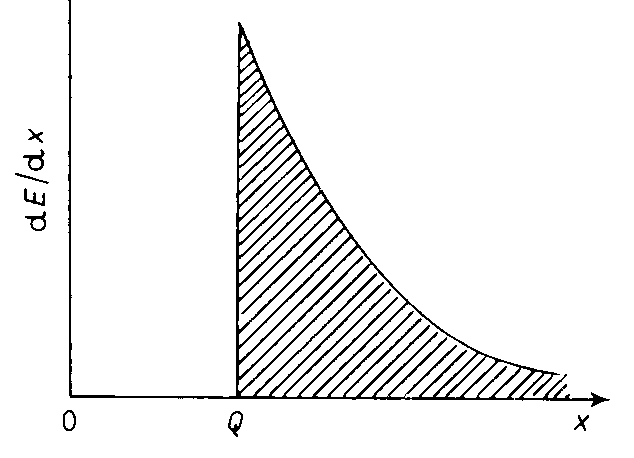
The Coulomb interaction energy associated with two charges is the total electric-field energy arising throughout space from the combined action of the charges less the self-energy components of both charges. The spatial energy distribution applicable to two charges e and e′ of like polarity is shown in fig. 1. The energy is summed in [p. 457] concentric shells centred on either charge. The energy dE in a shell of radius x and thickness dx is zero up to the separation distance OP between the charges. Thereafter it has a finite value which diminishes with increasing x in inverse square relation to x. The expression dE/dx depicted in fig. 1, being a measure of the rate of change of interaction energy with respect to x, is also a measure of the force acting on the charges at the separation distance x.
(1) H. Aspden: I.E.E.E. Trans. Plasma Sci., PS-5, 159 (1977).
(2) B. B. Godfrey: I.E.E.E. Trans. Plasma Sci., PS-6, 256 (1978).
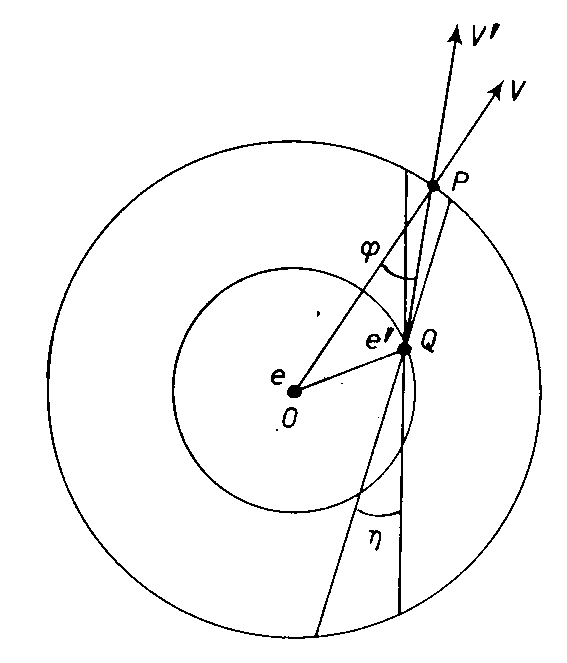
To verify this relationship consider a charge e in fig. 2 developing a radial electric field V at P. Imagine then a charge e′ at Q developing a radial electric field V′ at P. Write φ as the angle between V and V′. The electric-field energy density at P expressed in a Gaussian system of units is found by dividing the square of the combined field intensity by 8π. We are only interested in terms involving V and V′ together and their cross-product in the squaring operation is 2VV′ cos φ. The interaction energy density is therefore
(1/4π)(VV′ cos φ) .(1)
Consider an elemental volume at P bounded between spherical surfaces centered on O and separated by the elemental radius d(OP) and further bounded by a solid angle η centred on Q. This elemental volume is
η((PQ)2/cos φ) d(OP) .(2)
Multiplying (1) and (2) to find the energy element, we find that cos φ cancels and we may write V as e/(OP)2 and V′ as e′/(PQ)2 to obtain
(ηee′ d(OP))/(4π(OP)2) .(3)
The term in PQ has cancelled and this further allows us to sum the energy over the whole spherical shell by writing η as 4π, since η does not depend upon OP. The result [p. 458] is an elemental shell energy given by
dE = (ee′ d(OP))/(OP)2(4)
as depicted in fig. 1.
Formula (4) applies when OP is greater than OQ. In such a case the field vectors V and V′ act in unison, cos φ being everywhere positive. With OP less than OQ the solid angle from Q will intersect the spherical shell twice and though cos φ is always positive as stated in (2) it will be negative or positive in (1) depending upon which side of a plane through O we find Q. The result is the total cancellation of the interaction energy component within a sphere of radius OQ. This latter result is an essential consequence of the result given in (4) because if there were extra interaction energy within this sphere the Coulomb force deduced from (4) would not satisfy Coulomb’s law.
The implications of this energy distribution are interesting. For example, imagine that one charge is kept at rest and the other is allowed to move under the action of the Coulomb force. The moving charge will draw on the interaction energy to sustain its kinetic energy and its action in setting up a magnetic field. If the moving charge is the seat of this self-energy associated with its own motion, then this energy is supplied to the charge from an average distance exactly equal to that separating the two charges. If the energy travels at the speed of light we may then except a retardation equal to the time required for light to traverse the separation distance. However, there are perplexing questions. Does the motion precede the energy transfer or follow it? Why should energy be set in motion first, in one case, and why should the motion occur at all in the other?
These are problems beyond the realm of the engineer concerned with electrostatic effects, but they are problems which must be answered if we are to understand electric discharge processes better. Energy radiation by accelerated charge is beset by similar problems. Some authors speak of pre-acceleration and others of post-acceleration (3). However, a likely solution will be one connected with the so-called vacuum fluctuations called into account in quantum electrodynamics. The author, meanwhile, is seeking to understand electrodynamic interaction by analysing the spatial distribution of magnetic energy and connecting this with the law of electrodynamics analogous to that of Coulomb for electrostatics. From this work it is becoming increasingly evident that the established Lorentz formulation is a special case solution applicable to closed circuit problems but that a more general law is required for interactions between discrete charges in motion, particularly when their masses are widely different.
(3) J. Kapusta: Nuovo Cimento, 31 B, 225 (1976).