1982c
The following is a paper by H. Aspden published in Lettere al Nuovo Cimento, v. 33, pp. 481-484 (1982).
THE CORRELATION OF THE ANOMALOUS g-FACTORS OF THE ELECTRON AND MUON
Abstract: The resonant-cavity model by which the author has recently explained the anomalous electron g-factor has an alternative resonant mode suited to a less stable particle. When this is analysed it is found to give a result in full accord with the g-factor of the muon.

Full text of the paper (transcribed from the PDF)
Transcribed from the scanned pages of the printed paper. [p. N] marks where each printed page begins; figures are cut from the scans. The PDF above is the original.
[p. 481]
Lettere al Nuovo Cimento Vol. 33, N. 15 10 Aprile 1982
The author has obtained the permission of the copyright owner Societa Italiana di Fisica to publish this paper here in PDF format.
The Correlation of the Anomalous g-Factors of the Electron and Muon.
IBM United Kingdom Ltd., Hursley Laboratories – Winchester, England
(ricevuto il 19 Gennaio 1982)
Summary. – The resonant-cavity model by which the author has recently explained the anomalous electron g-factor has an alternative resonant mode suited to a less stable particle. When this is analysed it is found to give a result in full accord with the g-factor of the muon.
In a recent paper (1) it has been shown that the anomalous magnetic moment of the electron (the g-factor) can be explained in terms of a model of the electron as a sphere of charge centred in a resonant cavity of radius governed by the Compton wave-length λC. The electric energy of the field outside this resonant cavity was presumed to be decoupled from the electron mass energy for spin motion confined well within the resonant cavity, with the result that the mass difference between normal motion and spin gives the g-factor
g = 2/(1 − δ) ,(1)
where
δmc2 = e2/(2R) .(2)
Here, m is the mass of the electron, c is the speed of light in vacuo, R is the cavity radius and e is the electron charge.
The parameter δ is simply the proportion of the electron mass energy located outside the resonant-cavity radius. There is an inner spherical surface of radius r within the cavity and resonance involves the two-way radial traversal of the distance R–r at the speed of light c and at the Compton frequency. R–r is, therefore, half the Compton wave-length λC = h/mc, h being Planck’s constant.
Thus the δ value given by (2) can be written as (1 − r/R)α/2π, because e2/2(R − r) is e2mc/h or (e2/hc)mc2 and α, the fine-structure constant, is 2πe2/hc.
(1) H. Aspden: Lett. Nuovo Cimento, 33, 213 (1982).
[p. 482]
Note, therefore, that for an ideal system for which r is zero we can use a value of δ of α/2π and, from (1), develop a power series for g given by
½g = 1 + (α/2π) + (α/2π)2 + (α/2π)3 + … .(3)
It is conventional to present values for the g-factor as such a power series of α/π.
To proceed, the contribution in the referenced paper (1) was in showing that the radius r of the inner surface absorbing incident radiation has a value given by √3 times the Thomson radius of the electron, that is √3 times 2e2/3mc2. This gives a g-factor of
½g = 1 + (α/2π) + (¼ − 3−½)(α/π)2 + (⅔ − 3−½ + ⅛)(α/π)3 … .(4)
The measured value of α−1 is 137.036 and this gives a ½g value of 1.00115965 in close agreement with the observed value of 1.001159652. Even so, the accuracy to which the electron g-factor is measured and the corresponding accuracy of measurement of α−1 are such that we know eq. (4) is slightly discrepant. The author has been examining the scope for modifying eq. (4) by effects significant only at the order of the last term. One proposal is that there is a cosmological factor affecting the spin mass of the electron and the normal mass in different ways (2). An alternative approach which is looking quite promising is to trace the effects of energy radiation upon the radius r, using different acceleration parameters in the Larmor formula. These different parameters relate to the different masses of the spin and normal state. However, whatever the outcome of this research, the more important consideration is the viability of the theory when applied to the muon g-factor. Accordingly, in this paper we will address this issue.
For the electron the theory suggests that when an incident electromagnetic wave causes acceleration and so induces radiation, this radiation is seemingly intercepted across a section of radius r and continuously accumulated in the cavity pending release and onward radiation in quanta. Indeed, as shown in ref. (1), it is the balance of the Larmor radiation and the energy being absorbed from the incident wave that determines the radiation cross-section πr2. Now, the electron is a very stable particle and this suggests that the resonance condition may be an optimum one and slightly different from that applicable to an unstable particle such as the muon.
Accordingly, we will consider below the cavity resonance criteria of two charges, one complying with the electron model already discussed and another in which the resonance mode is more complex and involves a resonant interaction with the charge itself, as opposed to the simple resonance between the radiation-reflecting surfaces of radius r and R, respectively.
In fig. 1 an element of radiation travelling at speed c is shown to enter the cavity radius R and then oscillate within the cavity before leaving. The figure is drawn as a time chart and shows the radiation path between the outer cavity radius R and the centre 0 of the charge. The radiation is trapped in the system for a resonant period. In the simple electron model we have seen that the electron g-factor results from a resonance mode involving oscillations along a path confined between R and r. The frequency, being that associated with the Compton wave-length, is a natural frequency associated with electron annihilation and creation. It is interesting, therefore, to give the electron some physical character matching this oscillation frequency. However, when we consider other particles, we need to imagine not only the frequency changing, but the mode of oscillation corresponding to a less optimum resonant state and characteristic of a short-lived system.
(2) H. Aspden: Lett. Nuovo Cimento, 32, 114 (1981).
[p. 483]
In the case of the electron, imagine that the radiant energy trapped in the resonant state between R and r is very much greater than the normal quanta received from incident electromagnetic radiation and so tends to remain in the confined cavity between r and R. Now consider the alternative situation, where there is negligible energy trapped within the cavity and any incident radiation that is trapped for a limited time ranges over the whole space within the cavity. Our analysis then allows us to say that the radius r must still play a role because it is the parameter determining the cross-section related to Larmor radiation by the charge when accelerated. It cannot be transparent to radiation. It must be opaque to incident radiation. Hence, as fig. 1 shows, the incident ray is reflected at r. Then the ray must return, as otherwise the cavity model would have no role to play. Suppose now that the ray penetrates the surface at r. It travels to the centre 0 and is either reflected or passes directly through to reach again the surface at r. This surface, in providing a reflecting boundary, must absorb radiation momentum. Alternatively it must receive and reflect as much radiation on its inner and outer surfaces. Guided by the electron model, we presume that this surface at r can withstand the radiation pressure from inward momentum, because the electron charge is at the centre and is the seat of the mass-energy, but we will assume that any outward radiation acting on the inner surface at r has to be at least balanced by the same radiation acting on its outer surface. This sets the model in its optimum radiant mode. For least trapped energy, each ray of radiation must execute, on a statistical average, as many oscillations between R and r as between r and 0. This is the pattern of oscillation shown in the figure.
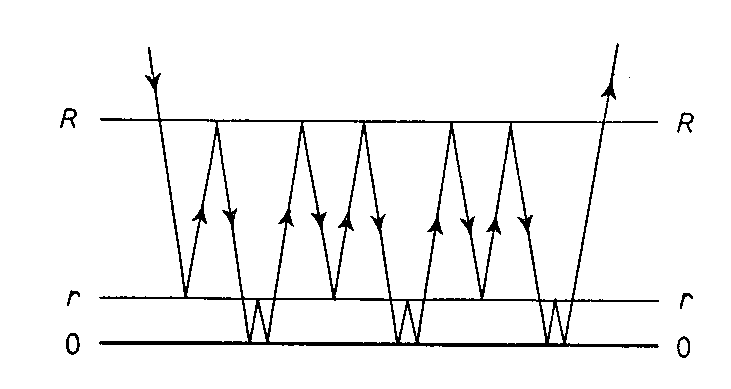
To the extent that the logic of the above argument is valid, we can say that there is but one resonant mode applicable to the short-lived particle. The muon is the only lepton having properties analogous to those of the electron. It is short lived. Hence the resonance mode depicted in the figure should guide us to its g-factor.
We see from the figure that, whereas the resonance distance for the electron was 2(R − r), the resonance distance for the muon is simply 2(R + r). The Compton frequency for the muon is higher in proportion to muon mass and this reduces R in inverse proportion. Therefore, if r were zero for the electron and the muon, both would have the same g-factor in accordance with eq. (3). However, r is finite. It may be shown that it too reduces in inverse proportion to mass because, in the same accelerating field, the balance of Larmor radiation across the cross-section of radius r puts r2 proportional to f2, where f is acceleration. Since f is inversely proportional to mass, we can say that the g-factor of the muon must be exactly the same as that the electron would have if R + r were substituted for R − r.
It is routine to present (3) as a power series in α/π with coefficients expressed in terms of r/R and it is a simple matter then to show that a reversal in sign of r changes the g-factor equally about the median value given by eq. (3), subject to error of the order of (α/2π)2(r/R)2. This is an error of one part in 1011. This applies without any [p. 484] dependence upon the actual value of r, provided it is inversely proportional to mass and is small enough for the error term just mentioned to be insignificant.
To find the value of the muon g-factor given by this theory, we simply take double eq. (3) and subtract the measured electron g-factor. Note that eq. (3) gives, with α−1 as 137.0360, the ½g value of 1.0011627602. Taking the measured electron ½g as 1.0011596522, we then deduce the muon ½g as 1.0011658682. This compares with the measured value (3) of 1.001165895(27).
It is submitted that this cavity resonance theory for explaining the g-factor of the electron is greatly strengthened by the simple manner in which it has now proved adaptable to account for the g-factor of the less stable muon.
However, quantum electrodynamics has proved so successful in accounting also for other phenomena that this alternative, yet somewhat complementary approach, must remain a tentative proposition pending further development. Such development would need to address the Lamb shift. The remarkable feature of the theory presented is its inherent simplicity and the ease with which accurate g-factors can be obtained. It is noted that the initial theory dealing with the electron g-factor model was first published in 1977 (4). At that time it was mentioned that there was a curious symmetry in the disposition of the electron and muon g-factors relative to the simple point charge expression presented in eq. (3). It is only now that this symmetry has been understood as being due to the supplementary resonant mode in the same basic model.
(3) E. R. Cohen and B. N. Taylor: J. Phys. Chem. Ref. Data, 2, 663 (1973).
(4) H. Aspden: Int. J. Theor. Phys., 16, 401 (1977).
H. Aspden
10 Aprile 1982
Lettere al Nuovo Cimento
Serie 2, Vol. 33, pag. 481-484