1983c
The following is a paper by H. Aspden published in Lettere al Nuovo Cimento, v. 36, pp. 364-368 (1983).
THE LAMB SHIFT FOR A CAVITY-RESONANT ELECTRON
Abstract: The author’s recently reported anomalous g-factor evaluations for the electron and the muon, based on a model charge centred in a cavity resonating at the Compton frequency, are here supported by an analysis of the Lamb shift using the same model.
Commentary: It was in 1982 that the author decided to take early retirement from his professional patent career with IBM and was allowed for a period before retirement in May 1983 to work full time on developing his theory. IBM then provided financial support for the author’s retirement research project at the University of Southampton for a transitional period. Readers will see, therefore from the spate of scientific papers now listed that such full time efforts were rewarded by rapid progress in the development of the theory.

Full text of the paper (transcribed from the PDF)
Transcribed from the scanned pages of the printed paper. [p. N] marks where each printed page begins; figures are cut from the scans. The PDF above is the original.
[p. 364]
Lettere al Nuovo Cimento Vol. 36, N. 11 12 Marzo 1983
The author has obtained the permission of the copyright owner Societa Italiana di Fisica to publish this paper here in PDF format.
The Lamb Shift for a Cavity-Resonant Electron.
IBM United Kingdom Ltd., Hursley Laboratories – Wincester, England
(ricevuto il 6 Gennaio 1983)
PACS. 12.20. – Electromagnetic and unified gauge fields.
Summary. – The author’s recently reported anomalous–g-factor evaluations for the electron and muon, based on a model charge centred in a cavity resonating at the Compton frequency, are here supported by an analysis of the Lamb shift using the same model.
It has recently been shown (1,2) that the anomalous g-factor of the electron and muon can be explained in terms of a cavity-resonant system. The method does not involve the very complex calculations found in quantum electrodynamic treatments and yet it does, by a simple classical style of analysis, give values of the g-factor in quite close accord with those observed. It is now the object of this paper to report progress in extending this same technique to the problem of the Lamb shift.
The electron is deemed to be at the centre of a field cavity having an outer bounding radius R and an inner bounding radius r, the latter being slightly in excess of the classical radius of electron charge. A radial electrical wave resonance exists at frequency ν0 and propagation speed c, travelling to and fro between these cavity radii. Thus
2(R − r)ν0 = c .(1)
The radius r defines a spherical surface which reflects this radial oscillation and so may also provide a scattering cross-section πr2 for radiation intercepted from propagated electromagnetic waves which accelerate the electron.
The inertia of the electron is determined (3) by the exchange of electric-field energy and electron kinetic energy in this process of interaction with intercepted waves, a conservation process in accord with E = Mc2. This requires there to be no radiation of electrical energy, apart from that which oscillates and does not escape from the resonant cavity. However, the acceleration of the electron does give rise to radiation due to [p. 365] magnetic action and so we may expect the scattered radiation of the wave energy to be that of only half the amount specified by the Larmor formula. Accordingly, the scattering cross-section of the electron is really only half that given by the Thomson-scattering cross-section (4):
(8π/3)(e2/mc2)2 .(2)
(1) H. Aspden: Lett. Nuovo Cimento, 32, 114 (1981).
(2) H. Aspden: Lett. Nuovo Cimento, 33, 481 (1982).
(3) H. Aspden: Lett. Nuovo Cimento, 33, 213 (1982).
Here, e is the electron charge, m its mass and c is the speed of light in empty space. We can equate half of this expression to the area πr2 to find
r = (2/√3)(e2/mc2) .(3)
The value of ν0 is the Compton frequency of the electron, so that
ν0 = mc2/h ,(4)
where h is Planck’s constant. Thus, from (1), (3) and (4)
R = (h/2mc)(1 + (4/√3)(e2/hc)) ,(5)
or
R = (h/2mc)(1 + (2/√3)(α/π)) .(6)
This theory requires the anomalous g-factor of the electron to arise because the electron mass for linear motion includes energy outside the cavity radius R, whereas the electron mass for a so-called spin motion confined well within the bounds of the cavity radius does not include this external energy. The spin mass is less, with the result that the gyromagnetic ratio is affected so that the anomalous term a in the relation g = 2(1 + a) has the form
a = mc2/(mc2 − e2/2R) − 1 .(7)
Note that e2/2R is the electric-field energy of the electron charge e disposed outside the radius R.
From (6), together with the substitution 2πe2/hc for the fine-structure constant α, we then see that (7) simplifies to
a = 1/(2πα−1 − 1 + 4/√3) .(8)
Putting α−1 as 137.036, this gives an anomalous component of the electron g-factor of 0.00115965, exactly in accord with the observed value to this level of accuracy.
For the muon the model requires the resonance to be on the inside wall of the inner [p. 366] cavity radius, so that the half–wave-length is R + r, rather than R − r. This involves writing the term 4/√3 in (8) with a minus sign and, upon evaluation, gives 0.00116589, also in exact accord with the anomalous term in the g-factor of the muon. The Compton frequency related to the muon mass has, of course, now appeared in the analysis.
(4) E. U. Condon and H. Odishaw: Handbook of Physics (New York, N. Y., 1967), p. 7.
The above summary of earlier work now sets the stage for the exploration of the Lamb shift. Here we are concerned with the effects of this external energy decoupled from the electron in the cavity. We will restrict attention in this preliminary enquiry to the specific problem of the electron in the hydrogen atom, exchanging states under conditions for which the only difference is that between an orbital motion and a linear oscillatory motion. This applies to the 22S½-to-22P½ transition.
When an electron travels along a linear path all the energy contained within the cavity radius R moves with it at velocity V. However, the electron energy outside the cavity, for example at P in fig. 1, does not move at the velocity V. This latter energy is decoupled from the charge e and it can only transfer as if it were moving at velocity V by the process of being drawn radially into the cavity and ehected therefrom to a new forward position. Thus, in order to assure normal mass properties of the electron in linear motion, we have a hypothesis that this energy flow accounts for the extra momentum of the electron energy within the cavity to match that we would otherwise associate with the energy lying outside the cavity.
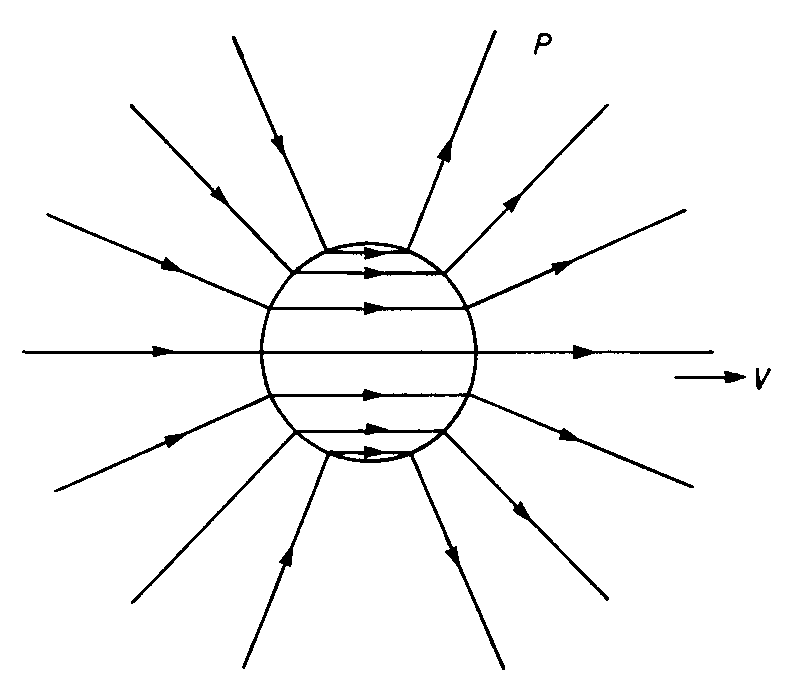
This action is not manifested in any obvious way for linear motion because we assume that the whole energy is merely transported with the electron at the speed V. However, when the electron is in orbital motion there is then a discrepancy in the inertial properties. The additional momentum attributable to the external energy is like that of a fixed spherical bob on a pendulum. The energy in transit through the electron cavity has an additional angular momentum matching a velocity moment:
(2/5)R2w(9)
causing the electron in orbit of radius r0 to have its normal angular momentum mr02w supplemented by an amount
(2/5)(Δ)mR2w ,(10)
[p. 367]
where w is the angular velocity of the electron in its orbit and Δ is the fraction of the electron’s mass energy that is in transit through the cavity corresponding to motion at w and needed to sustain the external-field energy balance.
To find Δ, we let σ denote a uniform energy density inside the cavity having an additional velocity component by which it may sustain this balance. Then, in travelling a distance 2R, the total external energy e2/2R will have passed through a cross-sectional area of πr2. It follows that
(πr2)(2R)(σ) = e2/2R(11)
and the total energy in transit at the speed of the electron is ((4π/3)R3)σ or e2/3R or ⅔ of the external energy.
Thus, since the external energy is approximately (α/2π)mc2, as may be deduced from (8), the quantity (Δ)w becomes
(2/3)(α/2π)w .(12)
Now, if the derivation of the Rydberg constant is traced, we find that it applies in association with a principal quantum number n and an azimuthal quantum number normally designed l, but here designated n0: Thus, whereas the energy state of a particular electron condition is normally stated to be hcR′/n2, where R′ is the Rydberg constant, we find that this includes a term hcR′/n02, provided n0 is not zero.
For the 22S½ state the energy is therefore simply hcR′/n2, because n0 is zero. For the 22P½ state the energy is exactly the same if n0 is unity, the nominal value for this state, but if n0 differs from unity by δn0, we find that the energy hcR′/n2 is reduced by
− δ(hcR′/n02) = (hcR′/n03)2 δn0 .(13)
This accounts for the Lamb shift. As a frequency the shift becomes
δν = 2cR′ δn0 ,(14)
because n0 is unity. We know that δn0 is the angular momentum (10) when expressed in units of ħ/2π. Therefore, from (10), (12) and (14), we have
δν = (8/15)cR′ αwmR2/h .(15)
The value of w is known from the conventional Bohr theory to be
w = 2πα2mc2/h ,(16)
this being the angular velocity of an electron having angular momentum h/2π. R is known from (6) to be approximately h/2mc. Therefore, (16) reduces to the approximate expression
δν = (4π/15) α3cR′.(17)
[p. 368]
The above formula is approximate to within about 1% of the true value. One reason is that R is slightly larger than h/mc as we see from (6). Also the external energy outside the cavity has been approximated as (α/2π)mc2 and it differs slightly from this, also from application of (6). Furthermore, a small correction factor involving a term in 2α is needed for reasons a little beyond the scope of this paper, which are the subject of continuing research. This is connected with the additional angular momentum needed by the electron when compensating a pair of interacting photon quanta, each such quantum needing an extra angular momentum α(h/2π). See the analysis in the author’s work elsewhere (5).
A complete formula, allowing also for the mass correction of the atomic nucleus (mass M) and using the Rydberg constant for infinite mass can be written thus
δν = (4π/15) α3R∞c (1 + 2α/(3½π)) (1/(1 + 2α)) (1 − m/M) .(18)
Upon evaluation, putting R∞ as 109737 cm−1, α−1 as 137.036, m/M as 1/1836 and c as 2.99793·1010 cm/s, we find that (18) gives a Lamb shift of 1057.848 Mc/s, a value in good accord with the recent experimental value of 1057.845(9) Mc/s reported by Lundeen and Pipkin (6).
This therefore provides a valuable heuristic account of the Lamb shift for this particular transition. This complements the author’s semi-classical treatment of the anomalous electron g-factor. Much now depends upon the development of this method to explain other transitions. Initial work on this looks quite promising. It is submitted, therefore, that this may provide an alternative avenue of exploration should the current problems in matching measurement of the Lamb shift with theoretical values derived from quantum electrodynamics remain unresolved.
(5) H. Aspden: Physics Unified (Southampton, 1980), p. 98.
(6) S. R. Lundeen and F. M. Pipkin: paper entitled Measurement of Lamb shift in hydrogen, presented at Second International Conference on Precision Measurement, NBS, USA, 8-12 June, 1981.