
⬇ Download PDF: Appendix II — Physics Without Einstein (1969)
Transcribed from the scanned pages of the printed book. [p. N] marks where each printed page begins; figures are cut from the scans. The PDF above is the original.
[p. 211]
APPENDIX II
Magnetic Field Angular Momentum Analysis
Referring to Fig. 1, consider two charges q1 and q2 in close association at O moving at right angles at velocities v1 and v2 respectively. The frame of reference is that in which magnetic field reaction is induced. That is, the velocities are measured in the E frame, in the sense in which this term is used in Chapter 4. Thus, the magnetic field induced at a point P distant OP from O may be expressed as the vector sum of two components H1 due to q1 and H2 due to q2,
Let q1 be taken as moving along the axis Ox.
Let q2 be taken as moving along the axis Oy.
Take axes Ox, Oy and Oz as orthogonal.
Let the angles θ, φ, ε, η be as shown.
The magnetic field at P due to q1 is:
H1y = +(q1v1/c) sin ε sin η/(OP)2 in the y direction
H1z = −(q1v1/c) sin ε cos η/(OP)2 in the z direction
The magnetic field at P due to q2 is:
H2z = −(q2v2/c) sin θ sin φ/(OP)2 in the z direction
H2x = +(q2v2/c) sin θ cos φ/(OP)2 in the x direction
Now, imagine that the field due to q1 exists but that the field due to q2 has only just been established by q2 having been suddenly accelerated from rest to assume the velocity v2. This means that the magnetic field energy density at P changes from (H1y2 + H1z2)/8π to [H1y2 + H2x2 + (H1z + H2z)2]/8π as the wave passes. At the point Q it may be shown that the same effect produces a change of magnetic field energy density from (H1y2 + H1z2)/8π to [H1y2 + H2x2 + (H2z − H1z)2]/8π.
The point now to note is that there is a component of energy density which has to be added in equal measure at P and Q by the passage of the wave. This is (H2z2 + H2x2)/8π. Also, there is a component to be added at P and an exactly equal component to be subtracted at Q. It is:
[p. 212]
(1/4π)(H1zH2z)(10)
As was discussed in Chapter 2, mutual magnetic energy is equal and of opposite magnitude to the mutual dynamic electric field energy. Indeed, the two sum to zero. Electric field energy has mass properties. This follows from the discussion of the velocity-dependence of mass in Chapter 1. We need not think in terms of the motion of magnetic energy. Consequently, in considering the motion of energy and its mass properties, expression (10) represents the energy density of the electric field which has to move from P to Q as the wave passes through these points. This is a measure of the mass redistribution in the field. The main energy terms, that is the non-interaction terms, are related to the self energies of the moving charges. The faster they move, the greater their dynamic electric field energies. Hence, the greater their masses, as explained in Chapter 1. Interaction itself does not augment mass in the system shown in Fig. 1. Interaction means repositioning of mass. The passage of the wave can result in angular momentum being imparted to the field energy.
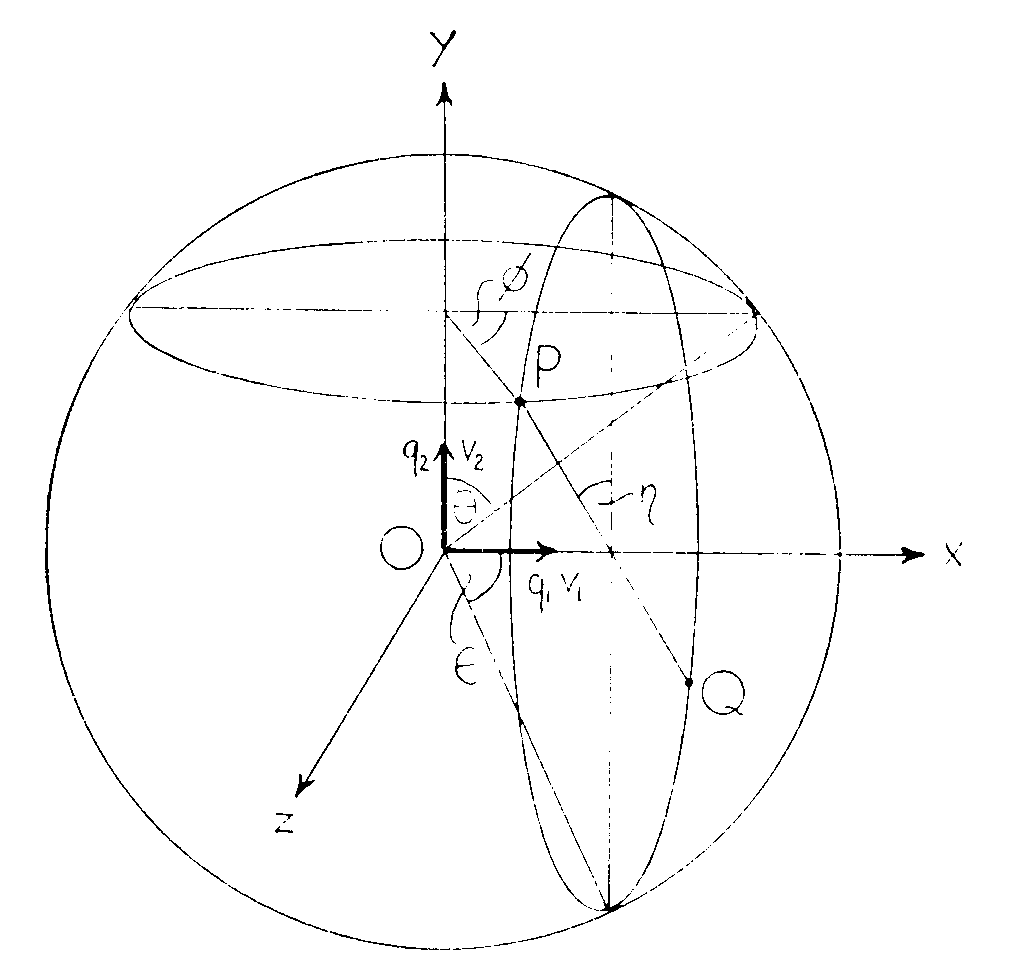
To calculate the angular momentum of this field reaction we note that mass is moving around the wave region about the axis Oz. [p. 213]Movement from P to Q is through an arc subtending the angle 2ε at radius OP but projected by multiplication by cos η. This movement is completed in the time taken for the wave to cross the region contributing to the energy interchange. Let w be the angular velocity of the energy transfer. Then the projected velocity moment is w(OP)2 cos η, and, since w is 2ε/dt, where dt is the time taken by the transfer, this velocity moment is:
2ε(OP)2 cos η/dt(11)
The radial thickness of the region under study is cdt and an elemental volume at P or Q can be formed by multiplying cdt by 2π(OP) sin ε and (OP)dε. Thus, the elemental energy being transferred between these volumes at P and Q is found, from (10), as:
½(OP)2cdt(H1zH2z) sin ε dε(12)
We divide this by c2 to obtain mass and multiply the result by (11) to determine the angular momentum as:
(1/c)(H1zH2z)(OP)4ε sin ε cos η dε(13)
Substituting now the originally stated values of H1z and H2z gives:
(q1q2v1v2/c3)ε sin2 ε sin θ cos φ cos2 η dε(14)
It may be seen from Fig. 1 that:
cos ε = sin θ cos φ(15)
From (14) and (15) the elemental field angular momentum given by (14) is obtained in terms of ε and η. When averaged for all values of η, cos2 η becomes ½. Thus the total angular momentum may be found by evaluating:
½(q1q2v1v2/c3)∫0π/2 ε sin2 ε cos ε dε(16)
This is:
(π/12 − 1/9) q1q2v1v2/c3(17)
Consideration shows that if v1 and v2 are not at right angles, as shown in Fig. 1, the expression has to be multiplied by the sine of the angle between them. Thus (17) is a measure of the maximum angular reaction between the charges.