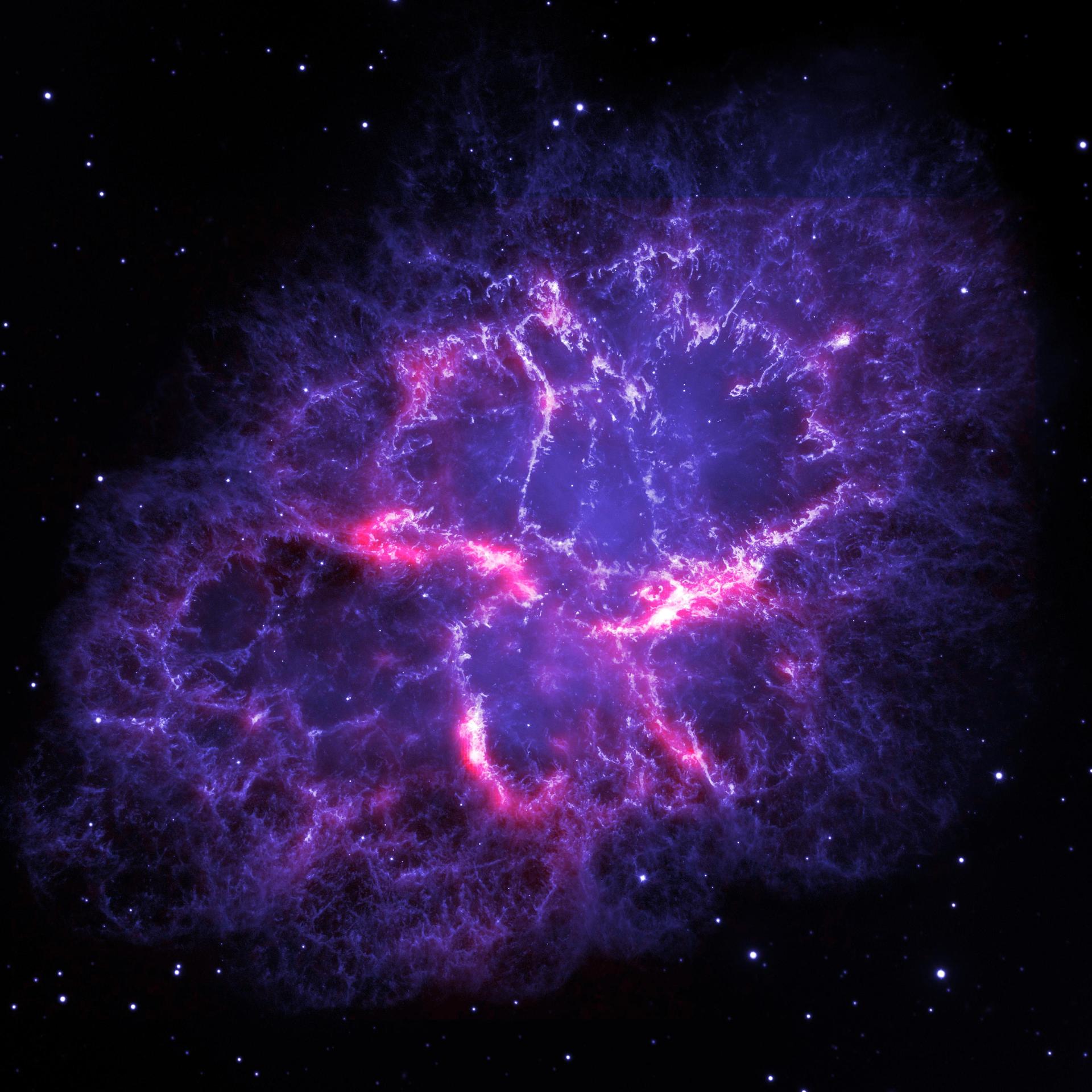
Crab Nebula (M1) — supernova remnant imaged by Herschel and Hubble Space Telescopes

Category: Feedback & Q&A

Reader feedback, questions and answers

Crab Nebula (M1), supernova remnant · ESA/Herschel/PACS; NASA, ESA & A. Loll/J. Hester (Arizona State Univ.) · NASA Image Library ↗

  • ANOTHER RESPONSE TO TONY ERICKSON

    FEEDBACK NOTE NO. 10

    ANOTHER RESPONSE TO TONY ERICKSON

    Copyright, Harold Aspden, 2002

    As I noted in FEEDBACK NOTE NO. 9, following his message to me of April 16, 2002 Tony Erickson, Tony@lasersafety.com, sent me an E-Mail which was insulting in declaring that I had made numerous untrue statements on my website concerning electromagnetic radiation. My polite response to this was my E-Mail message to him dated April 22, 2002 (sent at 8.06 am):

    “Will you kindly point to one section of my website where I make an untrue statement concerning electromagnetic radiation – a statement that is contrary to what you believe has been proven to be true from multiple directions? Identify the statement that concerns you and I will correct it and explain in my FEEDBACK section of my website why I have corrected it or I will otherwise give a full explanation of why I adhere to what I have said in the light of your criticism.”

    Some 8 hours later at 16.10 on April 22, Erickson sent me his E-Mail response, as presented below, and only 25 minutes later at 16.35 on April 22, he sent a further response, also presented below, in which you will see that he declares to me, as his point 4, ‘You are crazy, but I assume you knew that’, before signing off as “Tony Erickson, A REAL scientist.”

    I therefore duly responded to this by my very extensive FEEDBACK NOTE NO. 9 posted on this website on April 29th but Tony Erickson seems not to have looked at my website to see this reply to his criticism, because on May 7th he sent me the following E-Mail message:

    I quote from your site. �The onward story concerns the discovery that the creation of a plasma ball that has a substantial net electric charge of one polarity will immediately, by its interaction with enveloping aether, cause a state of spin to develop. Stars spin. Body Earth spins. The Moon spins. Thunderballs, the product of lightning in which electrodynamic pinch effects create charge clusters, spin. Tornadoes, which nucleate on whirlwinds and develop even more spin energy owing to recurrent lightning discharges through their funnels, are related phenomena. It all comes down to understanding how anomalous spin effects arise by interaction in or with the aether and the real story of this begins by deciphering the spin properties of the photon�

    Wrong again Einstein. Tornadoes do NOT spin because of interactions with the aether and lightning. My god, you set yourself up for so much abuse by making such easily dis-provable points. Learn some real physics. Tornadoes are not always associated with lightning, that PROVES you are wrong without even getting into the actual reasons you are wrong.

    �What then happens is that, within a single space domain, the protons, which are positively charged, see one another as two interacting particles subject to gravitation�

    If you study the actual laws of the universe, you will see that gravitation is NOT a significant force on sub-atomic scales. Electromagnetic and the nuclear forces are millions of times more powerful at those scales. This has been TESTED and PROVEN.

    You have never published a response to my other e-mails. Kind of hard to make up more fake science on the fly?

    You should be ashamed of yourself for propagating such lies. You make the creationists that may use your �information� as evidence look like morons.

    Now I have no idea how well-educated or ill-educated this fellow Tony Erickson is on the subject of physics, but he seems to assume a level of authority that few professors of physics would rise to or sink to in their debates with their peers. What, I ask, are these ‘actual laws of the universe’ that specify that the force of gravitation is insignificant on sub-atomic scales’? Even at school I was taught that the force of gravitation, being ever attractive and effective as between elements of mass however small, did regulate how planets interacted with the sun, there being no overriding effect attributable to electrostatic interaction. Later in life I read that Einstein had tried, but failed, to explain the force of gravitation as an electromagnetic interaction, the quest of what was called ‘unified field theory’. So how can this affect what I say about the role of gravitation in an ionized plasma of astronomical size?

    I note that at the age of 17 when I went to university I had won my school’s annual Physics Prize and, even then, knew by simple calculation that the electrostatic interaction force of repulsion between two electrons is greater by more than a factor of 10 to the power 43 than their gravitational interaction force of attraction. Two protons however repel by a electrostatic force that is greater than gravity by a factor of 10 to the power 36. Evenso the gravitational force is not insignificant when we look at the sun and not merely at something of subatomic size. There are more than 10 to the power 57 electrons and protons in the sun and, given its state of ionization, the only prevalent force is in fact the force of gravity!

    So, Mr. Erickson, do some physics and do the calculations according to the accepted laws of physics to see how that stronger force of gravitational attraction between every combination of pairs of protons in the sun has an overriding effect which causes the proton population to be slightly more concentrated than the electron population and ask yourself if that might account for the sun having a magnetic moment. If you need help then do refer to the APPENDIX I of my book ‘Physics Unified’ (ISBN 0 85056 0098) where, at pages 195-196 under the heading ‘Uniform Charge Induction in a Self-gravitating Electron Proton-Gas’, I present the mathematical analysis.

    Read up on the history of the Schuster-Wilson Hypothesis, which accepted that gravity had an action that could reveal itself in an electrical effect in stars, even though, as you put it:

    “Electromagnetic and nuclear forces are millions of times more powerful … This has been TESTED and PROVEN.”

    and ask yourself, Mr. Erickson, why a Nobel laureate in physics (Blackett) would go to the trouble of experimenting on this theme if what you say is true is a sufficient reason for dismissing the problem as not warranting any attention.

    Now, can I really be wrong about the tornado theme? My Erickson does not need to get into the actual reasons why I am wrong, because, as he puts it, he knows that “tornadoes do NOT spin because of interactions with the aether and lightning” as “tornadoes are not always associated with lightning”. Well, again, here I admit that my study of the subject has been limited, but it does suggest aether involvement when I read in a major physics periodical that tornadoes have been seen to travel in a direction opposite to that of the prevailing wind. Also, I tended to be influenced by the scientific reports of one specialist authority who explained that an observer looking upwards within the funnel of a passing tornado was impressed by the repeated flashes of lightning seen along the channel of the funnel. I accept that a whirlwind does not imply the pre-existence of a lightning discharge but I wonder at what stage a whirlwind develops into a tornado. I suppose it has something to do with the level of its destructive power, the wind speed of its rotational motion, and wonder, as did that expert (Vonnegut), what may have been the source of the energy inflow that built up the enormous power of that whirlwind. Vonnegut felt sure it was an electrical source and even experimented with tests on electrical discharges with air spinning slowly about the axis of discharge. He demonstrated that the slow rotation of air can stabilize that discharge and confine it to the central axis of spin. How could that by possible by our existing laws of physics? Mr Erickson says that the aether is “NOT” involved, but surely one might be forgiven for thinking that, if the the aether is entrained by the air so as to share that spin, then if there is an electric displacement induced in the aether radial to the spin axis it might just set up electric fields which confine that discharge to the central axis.

    You see, unlike Mr Erickson, who knows what a tornado is not but not what it really is, I do not know all there is no know about physics, because there is more that we can all yet learn, given that Nature still withholds a few secrets. However, I always have a reason for the advances in physical theory that I suggest and can but invite those interested to share my path of exploration of the unknown by taking due note of those reasons.

    As to Erickson’s final remarks in his E-Mail message of May 7th, saying “I have never published a response to his other E-Mails”, I can but draw attention again to the previous 9/02: Response to Tony Erickson FEEDBACK NOTE NO. 9 of April 29th as I smile upon reading of his absurd assumption that I have not answered because I find it “Kind of hard to make up more fake science on the fly?”

    Having reacted by replying to four of his taunts I now decline all further response to his insulting mode of communication. However, I will have more to say soon on the subject of how difficult it is to project new ideas in this modern world of physics, where there are many who regard themselves as arbiters as to what is right and what is wrong just because of their basic training in the standard disciplines of the science. Research is no easy task if it involves little more than new theory aimed at explaining what is known already but not fully understood. That reference to ‘fake science’ has more relevance to much that is said about the neutrino and its role in cosmology. Once the aether is eliminated from consideration in physical theory one is left to invent ‘fake’ notions in order to keep the books in balance and the neutrino is the ‘fake’ particle that fills the bill. New ideas find no easy entry into the world of the theoretical physicist because those who see themselves as well entrenched in that field combine forces to oppose a would-be rival. However, though it is fair game to debate the merits of rival theories, there is no justification for blocking consideration of new theoretical advances in physics based on the mere assertion that it has to be excluded owing to the definitive state of existing knowledge, as Mr Erickson has done.

    [H. ASPDEN, May 9th, 2002]

  • RESPONSE TO TONY ERICKSON

    FEEDBACK NOTE NO. 9

    RESPONSE TO TONY ERICKSON

    Copyright, Harold Aspden, 2002

    On April 16, 2002 Tony Erickson, Tony@lasersafety.com, sent me an E-Mail which was insulting in declaring that I had made numerous untrue statements on my website concerning electromagnetic radiation. His message read:

    Your site is filled with inaccuracies and out-right lies. You make suppositions about problems with the propagation of electromagnetic radiation that have been proven to be true from multiple directions. You would be well served to learn some actual physics. Your types of lies support the crazy anti-science groups that are the enemies of civilization. You can not take “hunches” and post them as facts. You should be ashamed of yourself.

    My polite response to this was my E-Mail message to him dated April 22, 2002 (sent at 8.06 am) which was:

    “Will you kindly point to one section of my website where I make an untrue statement concerning electromagnetic radiation – a statement that is contrary to what you believe has been proven to be true from multiple directions? Identify the statement that concerns you and I will correct it and explain in my FEEDBACK section of my website why I have corrected it or I will otherwise give a full explanation of why I adhere to what I have said in the light of your criticism.”

    Some 8 hours later at 16.10 on April 22, Erickson sent me his E-Mail response, as presented below, and only 25 minutes later at 16.35 on April 22, he sent a further response, also presented below, in which you will see that he declares to me, as his point 4, ‘You are crazy, but I assume you knew that’, before signing off as “Tony Erickson, A REAL scientist.”

    Now I have had very many E-mail messages supporting my efforts and congratulating me on my website presentations and I must admit that it comes as a surprise to find that here is someone who can get so ‘hot under the collar’ about an opinion on the debatable issues of, to use his own words, ‘REAL science’. Confronted with his insulting style of expression I have chosen not to respond to any further messages he might send me, but I will, for the benefit of those readers who may be interested in how I could refute his assertions, deal specifically and openly with the remarks he has made in his two communications below.

    Erickson’s Message No. 1:

    “The problem with this argument is that the photon is supposedly travelling at the speed of light, but that speed needs a reference frame and, to ….”

    WRONG! It does NOT need a reference frame. Please read up on Einstein�s
    theories (both general and special relativity while you�re at it) and
    you will see that the ‘reference frame’ is built into the very fabric of
    space/time. For the record, they are not even just theories, relativity has been proven to be correct countless times.

    That one was so easy as to not even be worth correcting you.

    I will provide you with one per day if you like. Your bible based ‘science’ is quite amusing and FULL OF HOLES.

    Tony

    Erickson’s Message No. 2:

    “It is that every electromagnetic wave travels in company with a companion wave of the same frequency. They serve to assist in at least partially balancing one another dynamically in their oscillations lateral to the direction of propagation, but they have different displacement amplitudes in terms of both their electric and their magnetic field properties. Analysis then shows that the wave frequency is coded into the relative strengths of those displacement amplitudes. As a result the wave in transit through space can be intercepted by quasi-material particles in its path and so shed energy in a way which progressively modifies that ratio of displacements, so affecting the coded data and reducing the wave frequency.”

    1. You have NO evidence at all that ‘every electromagnetic wave travels in company with a companion wave of the same frequency’. Pure supposition and speculation.

    2. “As a result the wave in transit through space can be intercepted by
    quasi-material particles in its path and so shed energy in a way which
    progressively modifies that ratio of displacements, so affecting the coded
    data and reducing the wave frequency.” Just PLAIN WRONG! You even make up
    a new form of matter with an off-hand remark like ‘quasi-material’. There
    is no evidence at all to support such a claim and all you are doing is
    taking explainable, observable phenomena like photon propagation and adding
    on some sort of extra physics that has no need or evidence.

    3. I assume you need to shed this energy and reduce the frequency so that you can prove the universe is young and small.

    4. You are crazy, but I assume you already knew that.

    Tony Erickson
    A REAL scientist.

    You will see that his first concern is my apparent ignorance of Einstein’s theory of relativity and his second concern is my lack of evidence in support of my companion wave hypothesis and my assumption that a form of ‘quasi-matter’ exists everywhere in so-called empty space. I will try to embrace both of these issues in one overall commentary.

    In 1916 Einstein wrote a book in which he set out to give ‘an exact insight into the theory of Relativity to those readers who, from a general scientific and philosophical point of view, are interested in the theory, but who are not conversant with the mathematical apparatus of theoretical physics’. His book was aimed at the student community having reached university entry requirements and Einstein explains how he has purposely treated the empirical foundations of his theory in a “step-motherly” fashion to make it easy for readers to follow. Now, I presume that Tony Erickson, being ‘A REAL scientist’, will be fully conversant with the necessary mathematics that go with a full in-depth study of Einstein’s theory, as indeed I am myself, but as his concerns are expressed in simple language so that will suffice for this response.

    Still concerning that Einstein book, one finds that by 1952 it had reached its final edition form, as the Fifteenth Edition, when a 23 page Appendix V was added. That Appendix was entitled ‘Relativity and the Problem of Space’. So, you see, ‘space’ as such was still a problem even in Einstein’s eyes, some 36 years after his theories of Special and General Relativity were cast in a form which those with only a high school education could understand. Indeed, one may well wonder how, as Tony Erickson insists, it has ceased to be a problem over the intervening half century since 1952.

    Now, to get to the specifics of Erickson’s concern, I will quote a few words from the Appendix IV of Einstein’s book, which was only 2 pages in length. It is a note on ‘The Structure of Space according to the General Theory of Relativity’. You see, ‘space’ as such does have a ‘structure’. In Einstein’s own words:

    “My original considerations on the subject were based on two hypotheses:
    (1) There exists an average density of matter in the whole of space which is everywhere the same and different from zero.
    (2) The magnitude (“radius”) of space is independent of time.
    Both of these hypotheses proved to be consistent, according to the general theory of relativity, but only after a hypothetical term was added to the field equations, a term which was not required by the theory as such nor did it seem natural from a theoretical point of view (“cosmological term of the field equations”).

    Einstein then goes on to explain how a different hypothesis according to a Russian mathematician Friedman was more appropriate and how the later discoveries of Hubble concerning the spectral red shift seemed to confirm Friedman’s ideas. Then Einstein asserts: “There does arise, however, a strange difficulty. The interpretation of the galactic line-shift discovered by Hubble as an expansion leads to an origin of the universe which lies only about 109 years ago, while physical astronomy makes it appear likely that the development of individual stars and systems of stars takes considerably longer. It is in no way known how this incongruity is to be overcome.”

    Now, Erickson states that I have ‘no evidence at all that every electromagnetic wave travels in company with a companion wave of the same frequency’, without, it seems, being aware that I find that I can derive the value of the Hubble constant by adopting this assumption. Bear in mind here that the alternative ‘assumption’ is that an electromagnetic wave has no companion wave, meaning that somehow its electric field can oscillate sideways as it advances at the speed of light and yet that oscillation has no counterpart to, as it were, push against in its passage over vast distances across empty space. I submit that the truth is that we have no evidence to prove the latter, albeit standard, assumption and that in terms of physics, as opposed to mathematics, and as guided by Newtonian dynamics we do need a companion wave to provide that dynamic balance within the composite wave system. As to evidence for my proposition, the evidence comes from the onward application of that proposition to explain quantitively and qualitatively something observed that is otherwise inexplicable, namely the Hubble constant. After all, one can hardly be impressed by the assumption that it arises from Doppler effects in a universe that is ever expanding from a singularity in space at time zero. That really is quite an arbitrary assumption and it means that once upon a time the whole mass and energy of the universe appeared as if from nowhere in a void having no field presence, a breathtaking proposition that defies all logic!

    Then Erickson goes on to affirm that I am “PLAIN WRONG!” in suggesting that if there are two waves advancing together in an anti-phase lateral motion so as to provide that dynamic balance, then, in shedding energy, the ratio of the amplitudes of the two waves must change and that could result in a progressive reduction of wave frequency. Yet, as I have stated, this is how I explain the physics governing the Hubble constant, a physical account which tells that the universe need not be expanding but can be steady state. To account for the obstruction in space which causes wave energy to be shed at a very modest by finite rate I point to the quasi-matter presence which I see as Nature’s ongoing attempts to create matter everywhere throughout space, attempts which only succeed, except transiently, should there be a surplus of field energy somewhere within that space medium. I support this by showing how those attempts do create the occasional proton along with an electron, the basic components of matter, and going on to derive by pure theory the precise value of the proton-electron mass ratio. Keep in mind also that reference by Einstein to a uniform distribution of matter throughout space and add to that the current cosmological belief that there is a significant amount of so-called ‘missing matter’ that is active in making theory match observation but that is not seen in the stellar system of matter.

    Of course, this notion that Nature has a process for transiently creating matter throughout space is a hypothesis, but a working hypothesis that gives results that explain what is hitherto not explained. That is how physics works and it really is not ‘extra physics’ to assert that there is a quasi-matter presence in space. After all, this is admitted by Einstein himself in that quoted text above and it is in any event recognized as existing by quantum physicists who study the lepton creation and annihilation properties of what we call the ‘zero-point’ energy of space.

    I find it a curious observation for Erickson to say “I assume you need to shed energy and reduce the frequency so that you can prove the universe is young and small”. In fact, I have no idea how large the universe might be or how old it might be and, if anything, my theory, though deriving the Hubble time period as some 14 or so billion years, suggests a steady-state universe of greater extent and longer existence than followers of Einstein assume.

    Then there is, in the first of Erickson’s above messages, that question of the ‘reference frame’. He says that the speed of light does not need a reference frame but then tells me to read up on Einstein’s theories where I will see that the ‘reference frame’ is built into the very fabric of space-time. Then he says that Einstein’s theories are not even theories because Relativity has been proven to be correct countless times.

    So a reference frame is not needed but yet it exists in Einstein’s theories and those theories are not even theories. What can Erickson mean to convey by such a self-contradictory style of expression?

    On this point I quote Einstein’s own words from page 9 of Chapter 3 of his book ‘Relativity’ referred to above:

    Moreover, what is meant here by motion ‘in space’? from considerations of the previous section the answer is self-evident. In the first place we entirely shun the vague word ‘space’, of which we must honestly acknowledge, we cannot form the slightest conception, and we replace it by ‘motion relative to a practically rigid body of reference’.

    Note here that sweeping assumption “.. of which we must honestly acknowledge, we cannot form the slightest conception..”. Surely, no would-be physics student should be exposed to such nonsense! “We must shun the vague word ‘space’ because we have no idea how to imagine the form of that medium!” Einstein was doing a selling job and grinding his own axe here in saying “Give up trying! It is too difficult! Buy a pair of spectacles from me that will allow you to see a distorted version of whatever you are looking at, a version that avoids the difficulties of simple logic, and with it comes a drug that will allow you to sense the passage of time at a different rate to the one of your natural experience.”

    Seemingly the word ‘relative’ is where one gets the name ‘Relativity’, just as I maintain that an electromagnetic wave has a transverse electric field oscillation that arises from a relative displacement as between two companion waves. It takes two of something to define a relationship! So Einstein tells us that we need not imagine space as being something real because everything is ‘relative’ to a ‘practically rigid body of reference’.

    Having noted that Tony Erickson’s E-Mail address includes the word ‘laser’ it is appropriate here to suggest that the electromagnetic wave activity that exists in the laser in the space we shun is an activity defined solely by motion relative to the reflecting mirrors at each end of the laser. Undoubtedly, when the laser is transported at high speed, the light waves travelling between those mirrors have no dependence whatsoever on that motion of the laser, the only rigid body of relevance. However, if I say there is an aether medium and that it has a structure that shares the motion of the laser and defines an electromagnetic frame of reference for light within (but not external to) that laser, does experiment prove me wrong and Einstein right? Does Einstein tell you how light escaping from that laser can travel onwards on its journey through space, always governed by its intrinsic ability to maintain a steady speed referenced solely on that laser source and do that without dependence upon the speed of transport of that laser? You are told to shun space and replace it by something called ‘space-time’, which is a mathematical notion, and accept Einstein’s doctrinaire ideas without question, even though they make no sense.

    Einstein tells you to shun the aether and even space itself so long as you have objects which provide the reference body for the speed of light. If that is so why is space given a new name ‘space-time’ and assigned special mathematically defined properties that govern how time itself can adopt different clock rates dependent upon the value of the speed of light in vacuo?

    I have yet to hear of any evidence which proves Einstein’s theory along with a confirmation of the implicit assumptions involved. The theory stems from the errors of an era of experimentation leading to a formulation of physical principles that were extrapolated beyond the scope of the experiments. Two relevant examples are (1) the assumption that the speed of light waves is not affected by encounter with the reflected form of the same light waves travelling in an opposite direction and (2) the assumption that electrodynamic interaction between two discrete charges in relative motion is identical to such an interaction as between a current element of a closed circuital current and a discrete moving charge.

    If Einstein’s theory has anything worthwhile to offer why is it that it has no predictive power leading to new discovery, given that it was expressly formulated to explain certain experimental facts that were already known?

    Einstein himself in his final Appendix V dating from 1952 evidently gets himself confused in twisting his ideas about space around and around to make them coherent. He writes:

    “In accordance with classical mechanics and according to the special theory of relativity, space (space-time) has an existence independent of matter and field. In order to be able to describe at all that which fills up space and is dependent on the co-ordinates, space-time or the inertial system with its metrical properties must be thought of as at once existing, for otherwise the description of ‘that which fills space’ would have no meaning. On the basis of the general theory of relativity, on the other hand,, space as opposed to ‘what fills space’, which is dependent on the co-ordinates, has no separate existence.”

    Later, in the same paragraph, we read:

    “There is no such thing as empty space, i.e. space without a field. Space-time does not claim existence on its own, but only as a structural quality of the field. Thus Descartes was not far from the truth when he believed he must exclude the existence of an empty space. The notion indeed appears absurd, as long as physical reality is seen exclusively in ponderable bodies. It requires the idea of the field as a representative of reality, in combination with the general principle of relativity to show the true kernel of Descartes’ idea; there exists no space ’empty of field’.”

    So there you are! Tony Erickson tells me to study Einstein’s theories for true enlightenment concerning the ‘reference frame’ and the ‘very fabric of space-time’ and here I am somewhat confused by what Einstein says. It is absurd to conceive of space being empty as it contains ‘space-time’, but space-time does not exist on its own, it being the ‘structural quality of the field’. The ‘field’ is something that exists in space, but it is not ‘seen exclusively in ponderable bodies’.

    So if I say that electromagnetic waves propagate as field disturbances that is O.K. but if I say that an electric field as part of an electromagnetic wave attributable to the physical separation of electric charge of opposite polarities then I am introducing something into space other than the field and that is not permissible, according to Einstein.

    Well I would rather take the facts of experiment as a basis and infer from that that the vacuum medium that I regard as filling space has properties consistent with those observations. I choose to ingore Einstein’s philosophical ideas and his notion of a space metric interwoven with time, according to a mathematical formulation that has no logical basis other than being a convenient empirical excuse for dodging the fundamental issues. Those fields according to Einstein can be electric or magnetic in nature, though Einstein seems obsessed with gravitational fields because his general theory of relativity hinges around the latter. He failed to explain gravitation in terms of electromagnetic action but soldiered on in pontificating as to the governing truths of the space medium. Instead, I prefer to give meaning to electric field theory and explore the nature of space, building on Maxwell’s formulations, this then obliging me to see space as containing electric charge that can be displaced. The displacement involves relative separation of two components of an electromagnetic wave and further, in the absence of such waves, displacement of charge from what otherwise would be a state of rest in a system devoid of motion. This assures that what would otherwise be a prevalent state of negative potential energy is virtually one of zero potential energy. In its turn this implies motion to sustain the charge separation, motion which one can link to the quantum of action we see as governing electron states in atoms. The same motion implies the need for dynamic balance and that introduces the the role of the graviton charges that give account of the phenomenon of gravitation, an electrodynamic phenomenon. So I see space as alive with action and a sea of electric charge in motion, but it complies with our observation of its elusive character.

    In summary, whereas Einstein ended his quest by admitting that he could only conceive of space as a field system and could not form the slightest conception as to its composition, I began by regarding space as a sea of electric charge of one polarity permeated by discrete charges of opposite polarity and set about the arduous mathematical task of investigating how its properties matched what was observed. By ‘observed’ here I mean the implicit regulating parameters we see in Planck’s quantum of action and G, the constant of gravitation, leading on from there to understanding the electromagnetic wave property that we see in the findings of Hubble.

    I accept that Ivor Erickson believes what he understands as Einstein’s theories and I see no point in trying to educate him as to the real truths that pervade science. It is not my wish to seek to discredit belief in Einstein’s doctrines, this being an assumption made by many who read of my research in its early stages years ago. My sole objective was to fathom the truths of the anomalies that beset my early experimental efforts, anomalies which I could only explain by wandering a little off-track by exploiting weaknesses I could see in standard theory. The prime example is the factor of 2 saga concerning the gyromagnetic ratio of the electron, which makes ferromagnetism an electron spin property of atoms rather than one involving electron orbital motion. This led me into a study of magnetic field reaction properties of space itself, that medium which Einstein would have us see only as a system of fields conforming with his special and general way of looking at things. Space had be occupied by a real aether and so my search for the truth began and Ivor Erickson’s intervention now is merely an amusing distraction which I hope will enliven this FEEDBACK section of my web site.

    ****************************

    Harold Aspden
    April 29, 2002


  • RESPONSE TO WILLIAM BUICK

    FEEDBACK NOTE NO. 8

    RESPONSE TO WILLIAM BUICK

    Copyright, Harold Aspden, 2001

    On January 6 2001 William Buick sent me a letter which enclosed a CD and a floppy disk. He had compiled a Windows version of a calculating program for working out the Aether Lattice potential that features in Tutorial No. 7 on my web site. This was quite unexpected, as I had simply supplied him with some books that he had ordered and sent an accompanying book with my compliments.

    I have in mind, with his permission, the intention of making this program available through these web pages, in which case it may be accessed from information I will add to that Tutorial No. 7. It is very much appreciated as it adds to the confidence of those interested in checking and understanding the analysis on which my aether theory is founded.

    Now, as to ‘feedback’, besides pointing out a minor error in my [1999] paper ‘The Contemporary Aether’ LECTURE No. 26 where I noted that 7.5×10⁻⁵ rad/s was one revolution every 17 hours, it being one revolution every 23 hours, the calculation of the Sun’s spin rate at creation, his letter further included reference to what I have said in my writings about the calculation of ‘vacuum spin’ rates. He was interested in seeing how the sequence of calculation hung together, without tracking through several cross-referenced publications.

    His specific questions were:

    In particular, I was hunting down reference to the formula relating spin charge density to spin angular frequency. Please could you point me to that formula, so that I might work out how to program it in software. I know there are comprehensive derivations of vacuum spin in your books and I am still reading and learning and have probably overlooked this in my hurry to find out things. Also, what is the decay time for vacuum spin, once it is established? Does this require a periodic application of electrical energy from an external source, at a frequency that matches the spin rate? Or does the spin continue for as long as the energy is applied?

    Accordingly, the remainder of this FEEDBACK NOTE No. 8 is devoted to the task of replying to these questions.

    It is easier to begin by dealing first with the ‘decay time’ questions. The simple answer here is that I have no theoretical way of calculating the decay time, short of venturing into the realm of hypothesis and having no guidance from observation data bearing upon the phenomenon.

    At one typical extreme we have the Sun itself, created long ago in a state of spin owing to its coupling with the vacuum spin induced by its creation process. It is still spinning, after several billion years, but it does have an enormous angular momentum.

    At the other extreme there is the plasma ball phenomenon seen from time to time as a ‘thunderball’. Observers have watched these objects floating in the sky, hovering over metal objects, such as a gun barrel, dropping into an open container filled with water and there dispersing to cause the water temperature to increase, and even drifting along the seat aisle within an aircraft. Always they collapse and decay as if vanishing into thin air, but what is their decay time? The larger they are, the longer they survive. One could imagine that they are aether in spin, enveloped in surrounding aether but slowly decaying as they shed the energy wich promotes ionization of air that characterizes their glow. That seems a matter of minutes, with the decay time being set by criteria somewhat akin to those applicable to a spinning top which precesses owing to a torque action and then topples, its spin time being a function of the initial spin rate and that torque.

    Intermediate these extremes is body Earth which also involves ‘vacuum spin’, or rather aether spin, in its own creation, a spin of something coextensive with, but internal to, body Earth, but yet which seemingly has a spin axis inclined somewhat to the Earth’s spin axis. I say this because that aether spin is evidenced by the geomagnetic field and we know that the magnetic poles are offset relative to the geographic poles and move around the latter in a circle over a period measured in hundreds of years. That inclined relationship implies to me the presence of two magnetic moments, tilted with respect to each other, and so producing a torque which determines the rate of precession. As to decay time, that concerns how long the action survives before the spin topples. Note that the Earth’s magnetism reverses periodically, every few hundred thousand years or so, whereas we see solar magnetic reversals at a much faster rate. Note further that, when I say ‘two magnetic moments’, I have in mind one owing to the main body in which it is induced by dislaced electric charge and one at the surface of that body where a compensating charge is seated owing to that displacement. They could share different spin axes.

    So I think it will need the talents of future scientific minds, armed with some yet to be discovered experimental data to piece together the elements of a theory that explains the decay time of a vacuum spin state. Meanwhile, the impetus for justifying such research comes, not just from the cosmological objective of having a better understanding of Nature’s creative properties, but more from the exploration of the way in which the vacuum spin phenomenon involves an inflow of the energy which powers the spinning objects thus created. Here, I can put together enough theory to point the way forward to building machines which involve vacuum spin and are fed by pulsating inflow of energy drawn from the aether itself. Indeed, as my writing indicate, as by that paper ‘The Contemporary Aether’, already mentioned, I suspect such machines or their equivalent in plasma discharge apparatus exist in embrionic form somewhere in the world’s backyard roamed by ‘free-energy’ enthusiasts. That prospect should serve as justification for now paying detailed attention to the following derivation of the formulae which relate vacuum spin with electric charge and energy, as I here endeavour to clarify the situation for William Buick.

    I trust it will justify me recording this response as a publication on my Web site, rather than mailing it to William Buick as a private communication.

    William Buick had read the section on this subject at pp.18-25 of my 1996 book ‘Aether Science Papers’ but that account was a rather summary treatment and the argument in the latter part of those pages was not the route I had actually followed in developing the theory from its early origins.

    What I will present below is a rigorous step-by-step analysis of the vacuum spin theory, building the theory from the aether analysis of the Tutorial No. 7 stage through to the fundamental theoretical derivation of the Sun’s spin angular momentum at its creation, a result that can be compared with what we observe today as the angular momentum of the whole solar system. Implicit here is the assumption that shortly after the Sun was created, for reasons I will seek also explain elsewhere in these Web pages, it sheds the matter from which the planets were formed, a process which involved most of that initial angular momentum of the Sun being tranferred to the motion of the planets around the Sun.

    You will surely agree that this is a quite formidable project to undertake and I hope the result will duly impress the reader. It could not have been contrived by simply making a few unwarranted assumptions to get the numbers to fit with observation and I assure you that what you see below emerged in its own way over a period of many years as pieces of the cosmic jigsaw came together. Happily the numerical basis of the dimensionless physical constants involved was rigorous and indeed precise in its foundation at least to the part-per-thousand level, dating back to the late 1959 period. By that I refer to the r/d parameter for which William Buick has now provided the above-mentioned Windows calculator program.

    The aether is a subtle non-material medium having properties akin to those of a fluid crystal, in that it is sensitive to extraneous electrical field effects and responds by causing its component elements to form a kind of crystal structure. This is easily dissolved and recreated according to change of those field conditions. The parameter d is a distance representing the lattice cell dimension applicable to that crystal structure, this being of simple cubic form. The parameter r represents the radius of a circular path in the inertial frame about which the components of that lattice move at velocity v in unison, perfect synchrony, so that, in the language of quantum theory, an electron (of mass m) sharing that state of motion will have a position that is uncertain by 2r and a momentum that is uncertain by 2mv but the product of tthese two uncertainties, 4mvr, will be certain because it has the value h/2π. We are considering here the root foundations of Heisenberg’s Principle of Uncertainty. It is the pointer to the most basic feature of the aether, the circular motion of a frame of physical reference, shared by matter, about an underlying inertial reference frame. This motion has a cyclic frequency equal to the Compton electron frequency, namely mc2/h, some 1.2356×10²⁰ cycles per second. Here resides the key to gravitation because the inertial mass property of matter involves a dynamic state and something has to exist in the aether to provide the necessary dynamic balance, something which sits in a juxtaposed frame of reference moving at a speed 2v relative to that aether-cum-matter frame. Here we expose the secret of the Unified Field Theory, the route to the link between gravitation and electromagnetism, because that aether-cum-matter frame sharing the Heisenberg jitter motion is surely the local electromagnetic frame of reference.

    You may verify from the above argument that:

    4mvr = h/2π

    and this allows us to determine v, because:

    v/2πr = mc2/h

    Evidently v equals c/2 and from this I was able to argue that whatever that something was sitting and moving in that frame which was in inertial juxtaposition with the aether-cum-matter frame, it was moving at speed c relative to the latter frame. That was the trigger for connecting gravity with the electrodynamic interaction of the elements of that something, bearing in mind the dynamic balance and its involvement with the mass of matter.

    With that in mind my next concern was the question of how I might determine the size of that radius r. Here I was, owing to my interest in ferromagnetism, quite captivated by the role played by the Bohr magneton, a fundamental unit of magnetic moment that applies to the motion of the electron around the nucleus of the hydrogen atom. It has a value which I knew from a school physics book was formulated as:

    he/4πmc

    Here e is the electron charge expressed in electrostatic units and h is, of course, Planck’s constant. So I thought it conceivable that the electric charge sitting in a unit cell of aether and moving in orbit of radius r and speed c/2 about a centre might well be quantized as a Bohr magneton.

    This then allowed me to deduce the value of the radius r, because that school physics book (in its seventh edition, dated 1941) stated that the Bohr magneton had the value 9.18×10⁻²¹. All I had to do was divide this quantity, or rather its value as updated by later measurements to 9.274×10⁻²¹, by e, 4.8032×10⁻¹⁰ in cgs electrostatic units, and I knew that r had to be 1.93×10⁻¹¹ cm.

    I had, therefore, a clear picture of the scale of the structured aether and it looked right, having regard to its scope for interacting with the electron shell structure of the atoms which form the material universe.

    Now, underlying all this, was the analysis by which I had explored the zero-energy condition of the electrostatic interaction between a structured system of charges e sitting in the electrically-neutral aether and balancing its background continuum of electric charge density σ. This had given the value of r/d, there being 1/d3 charges e in unit volume of that continuum and so this latter quantity is, in fact, σ.

    So, knowing r/d (its value being 0.3029), and knowing r, I had a measure of d as 6.3..x10-11 cm and, knowing e, it being presumed to equal the unitary charge of the electron, I knew the value of σ.

    The aether was, therefore, becoming, as it were, an open book, presenting itself in clear form and keeping no secrets.

    Emboldened by this I ventured to ask myself what happened if a spherical expanse of this aether were to rotate rather slowly within surrounding aether at an angular frequency ω, this being very small in relationship to the angular frequency Ω of that quantum jitter motion, c/2r. The constraint I saw as governing was the need for the aether to keep its synchrony of motion, meaning that the superimposed rotation would not affect the need for each aether charge to keep in step, owing to powerful electrostyatic interaction forces asserted by the enveloping aether medium.

    When formulated, back in the latter part of the 1950s when I researched all this, it meant that the effective positions of the aether charges in the rotating group would need to be displaced radially through a distance δR about the spin axis of the group, R being the radius distance of a charge from that axis. The resulting equations were:

    Ω(r + δR) = c/2 + ωR

    and:

    Ω(r – δR) = c/2 – ωR

    I concluded from this that:

    δR/R = ω/Ω = 2ωr/c

    Considering then a circular slice (disc) of the aether in spin at that angular frequency ω, a slice in a plane perpendicular to the axis of spin, the change δR expands (or, negative, contracts) the area of that disc by δπR2 or 2δR/R of the whole area. Since this is affects only the aether charges that constitute the lattice structure and not the neutralizung background continuum charge it means that there is a net charge density of δσ induced by the spin, its polarity depending upon the spin direction in relation to the underlying jitter spin direction at angular frequency Ω. This has the value:

    δσ/σ = 2δR/R = 4ωr/c

    and, since:

    σ = e/d3

    we find that:

    δσ = 4ωer/cd3

    We know the value of e, c and d, so here we have a formula which tells us the electrical charge density induced within aether if set spinning at angular frequency ωw. Conversely, the formula tells us how fast aether will spin if we can displace charge within it in a radial sense about the spin axis.

    Having derived this from pure theory we must then look around for evidence that this phenomenon really does exist. That evidence comes from thunderball phenomena, geomagnetism, even the tornado and laboratory experiments aimed at simulating the tornado phenomenon by controlling the snaking action of an electrical discharge along the central vertical axis of an enclosing cylindrical Faraday cage turning slowly about that axis. However, the prime example, the one we are concerned with here, is our Sun and its creation.

    I knew from my study of ferromagnetism during my early research education that the state of magnetic polarization (mutual attraction between iron atoms within an iron core) sets in only when iron cools through its Curie point temperature. So I speculated that gravitation (mutual attraction between elements of matter) sets in only when the chaos of an overheated aethereal medium dispersed over a region of space cools through a critical threshold state in which energy finds it more desirable to be deployed into a state of order, to become that we condsidered above as the structure fluid crystalline aether form. The analogy extends to space domains, regions confining the polarized state to interactions within the bounds of the local domain, just as we see in iron with the formation of magnetic domains. What this means is that a star could nucleate matter owing to its accretion by the sudden onset of gravity, with one star being created in each such space domain.

    This scenario comes into life once we see that the protons and electrons that constitute primordial matter by combining to form hydrogen atoms, being however separated in the ionized chaos existing in the pre-gravitation phase, would react differently during an initial period when drawn together by gravitational force. The combination of electrostatic interaction and gravitational interaction would favour initial nucleation of charge that is predominantly positive in polarity. The reason is that two protons have a mutual acceleration of gravity that is 1836 times greater than that of two electrons. So we know that the initial positive charge density of the primordial Sun at creation must be given by:

    2 = (σ)2

    ρ being the mean mass density of the Sun.

    To complete the picture we needs to see the action as involving two systems, the material body of the Sun and the coextensive spherical body of aether sitting inside the Sun. The matter comes together to form a sphere governed by the formula just presented. The protons predominate to keep the mass density uniform throughout the body of the Sun, owing to that perfect balance of force everywhere as between electrostatic repulsion and gravitational action. This sets up that state of spin at angular frequency ω w in the coextensive aether sphere. This spin is powered by the electrostatic forces exerted between aether charge within the sphere and outside the sphere as they keep the jitter motion in synchronism and import energy as necessary to sustain the angular momentum involved. Then, shortly thereafter those electrons that have been left behind in the nucleation process catch up with the protons and neutralize the solar body. However, that angular momentum associated with aether spin is not shed in this process. The energy inflow was a one-way phenomenon. So the aether in the solar body is left at that angular frequency ω. It will thereby set up its own radial electric field directed from the spin axis and this will be seen by the ionized material of the Sun as an electrical displacement which it will compensate by a corresponding neutralizing displacement of its elecron-proton population. The Sun will still remain electrically neutral overall. Its aether will still spin and have that high angular momentum acquired in the creation event. But it will now have a magnetic moment.

    Of more importance, however, is the destiny of that angular momentum. Clearly, one can expect it to be shared with the body of the Sun itself so that the Sun spins and eventually sheds its planets. How it does that is a matter for separate discussion, and our task here is nearly complete. I set out to explain by pure theoretical argument using a few parameters of quantum theory how the Sun acquired its spin angular momentum at its creation and to show William Buick how the formula relating induced charge denmsity and spin rate was derived.

    This I have done but to complete the account I will insert a few numbers into the above formula to compare the result with our estimate of the angular momentum of the solar system as it is today.

    The induced charge density per radian/s has the value of approximately 4.781 cgs esu/cc as I presented in equation (30) of my first printed essay on this subject, The Theory of Gravitation which was published in 1960. This is the value of 4er/cd3, with e as 4.805×10⁻¹⁰ esu, r as 1.93×10⁻¹¹ cm, c as 3×1010 cm/s and d as 6.371×10⁻¹¹ cm.

    Now, concerning the Sun, its mass density ρ is known because cosmologists know its overall mass and its radius and find it has a mean mass density of 1.41 gm/cc. Taking G as 6.66×10⁻⁸ in these cgs units, the relevant formula above gives a charge density of 3.64×10⁻⁴ esu/cc.

    Matching the two results just calculated we can find w, the angular velocity of the Sun at creation and before it shed its planets. It becomes 7.6×10⁻⁵ radians per second, which is one revolution every 23 hours.

    Now the Sun today rotates about its axis in a period of as many days and so it must have shed 96% or more of its angular momentum since its creation. How much of that angular momentum remains in the motion of the planets is therefore a matter of estimation based on astronomical data. My calculations, taking the Earth’s angular momentum in its orbit as a unit of reference, estimate that the planets have 1,200 such units of angular momentum and the Sun has of the order of 20 such units. I cannot justify further speculation on that theme, save to say that, any angular momentum dissipated into outer space over a period of what is probably 4 billion years would be more likely to be shed by the Sun than by the planets and that is consistent with the above findings.

    The real test of the charge induction formula comes from the analysis of the geomagnetic moment and some energy density measurements pertaining to thunderballs. Hopefully, however, we will see further supporting tests as machines come into being which harness the potential of vacuum spin energy.

    I hope the above will serve as an adequate answer to William Buick’s request.

    ****************************

    Harold Aspden
    March 18, 2001


  • RESPONSE TO JOHN WINTERFLOOD

    FEEDBACK NOTE NO. 7

    RESPONSE TO JOHN WINTERFLOOD

    Copyright, Harold Aspden, 2001

    On January 18 2001 John Winterflood (jwinter@physics.uwa.edu.au) sent me a message making reference to a Web posting of mine, an amended version of which is now posted as FEEDBACK NOTE No. 5.

    The message was constructive and polite and I thank John Winterflood for sending it. It has relevance to an experimental motor project in which I am involved and so, in spite of this delay in responding, which is due to other factors, I see this as now having priority.

    The background to this problem arises from my exposure to claims of other researchers investigating the anomalous energy behaviour of magnetic reluctance motors using permanent magnets which have hinted at or claimed what has come to be termed ‘over-unity’ performance. It has been my own conviction for several years now that the aether, in storing magnetic inductance energy, can act via the quantum motion of the 3d orbital electrons in iron to deliver energy which taps the energy resourse of the quantum underworld. I see that in certain experiments I have performed, but, hovering over the problem, there is a thermodynamic factor which gets into the act, as if heat produced by magnetization loss is regenerated as gap energy in the magnetic core, and also the problem that the aether has a way of reclaiming the energy it sheds before the machine cycle is complete.

    In the light of that background I now see that I was rather too enthusiastic when I wrote the above-referenced Web item which has attracted the John Winterflood’s comments.

    The offending passage has now been deleted but for the record I have tranferred it here to give basis for the comments which follow:

    I pose a challenge by inviting any academic electrical engineer or physicist to find a flaw in the following argument. Take a strong magnet and allow this to produce a magnetic field across an air gap between two pieces of iron. Now apply an electric current (d.c.) to a coil wound on that iron core, enough to double the strength of the magnetic field in that air gap. Since our teachings tell us that the energy in that air gap is now four times what it was before we switched on that current, electrical field energy increasing as the square of field intensity, now tell me where that added energy came from.

    The use of standard physical theory says that the energy supplied by that current is no different from what it would be if the magnet were not present. So the magnet must account for three quarters of the energy in that air gap. Now let the gap close, making sure that the current is reduced progressively during gap closure so as to keep that field intensity in the gap constant. This means that no voltage effect is induced in the winding so that no energy goes in or out, meaning that all the energy in the gap is deployed into the mechanical work done by the iron pieces being pulled together to close the gap.

    So you have four units of mechanical work as output for an input of one unit of electrical energy. Then, once the air gap has closed, switch off that current to allow the gap to be reopened by supplying just enough mechanical energy to overcome the attraction forces set up by the magnet. That energy input will be 1 unit, the amount of field energy in the air gap. Overall, therefore, one inputs in each cycle of operation one unit of electrical power and gets a net output of three units of mechanical power. Here you have what you need to design a motor that can operate with an overall efficiency of 300%.

    Now the magnets which I have incorporated in my test machine are of the neodymium-iron-boron type and their B-H magnetization characteristics can best be replicated by an equivalent circuit in which a solenoid having a magnetic moment produced by a steady d.c. current excitation sits in an air gap of commensurate size, the solenoid having no resistance loss.

    John Winterflood, quite correctly, draws attention to the role of that air gap in depleting the magnetizing effect of motor excitation in the operative pole gaps of the motor.

    I have, therefore, in my own style of presentation, worked through the energy analysis of the problem I posed, now allowing for this equivalence of the magnet in the magnetic core circuit. I have considered two cases, one in which the motor pole gap, when fully open, is the same in length as the length of the magnet and one for which the magnet has a length that is double the pole gap spacing. The latter represents more closely the specification applicable to my test machine. In neither case, treating the problem as an ideal situation, is there any net imbalance of energy, a result in full accord with John Winterflood’s remarks.

    I have qualified this by the use of the word ‘ideal’, because my experiments are still incomplete and certain doubts prevail. These doubts arise from a consideration of the lateral movement of a magnet across the pole gap and from magnetic circuit configurations which exploit flux leakage and intrinsic core demagnetization factors owing to open-ended core configuration. These are too complicated to be dealt with by theory, thereby leaving it to experiment to settle the question. However, the problem I posed in setting the above challenge is one that can be answered by theory and so I must correct the situation.

    Case I
    This applies where we consider an air gap length g in a high permeability magnetic core of uniform unit cross-sectional area with a permanent magnet of equal cross-section and length equal to that pole gap spacing g sitting in that core. A magnetizing winding is mounted on the core at some point removed from the pole gap.

    With no current input to the magnetizing winding and the pole gap fully open the magnetic flux density in the circuit and so across the pole gap is denoted B. The magnetic field energy in the pole gap is then proportional to B2g. There is, however, a corresponding equal amount of magnetic field energy in the space occupied by the magnet, given that it is effectively a region of magnetic permeability the same as that of air, albeit with a virtual highly-energized solenoid sitting around it.

    Now suppose there is current input to the magnetizing winding with the pole gap still fully open, enough to double the magnetic flux density. The magnetic field energy in the pole gap is now proportional to 4B2g and, of course, an equal amount of energy sits in the field within the magnet.

    We now let the pole gap close, keeping the magnetizing current at such a level that the flux density in the pole gap is constant during pole closure. No EMF is induced in the magnetizing winding and so there is no energy input or output via the magnetizing winding during this stage of operation. Accordingly, all of that energy 4B2g in the pole gap is converted into mechanical work, as motor output.

    With the pole gap closed we now turn off the current, leaving the magnet to sustain the 2B flux density condition. It will, because the magnetomotive force of its virtual solenoid system is now effective across a effective air distance of g, rather than 2g, and B was the flux density set up by the magnet for the 2g situation with no magnetizing current applied. There is no EMF induced as the current is switched off and so no energy input or output involving the magnetizing winding.

    Our task now is to do mechanical work by pulling the poles apart to recover the pole gap spacing of g. Note then that the flux density for an intermediate pole position (pole gap xg) will be 2B divided by (1+x). In the units of proportionality we are using this means that the work done in pole gap opening is the integral with respect to x of:

    4B2g/(1 + x)2

    over the range 0 to x=1. This, when evaluated, is 2B2g, half the value for mechanical output.

    It follows that the total mechanical output of the machine per cycle is represented by 2B2g.

    Now, as to energy input to the magnetizing winding, the task is to enhance the flux density from B to 2B with an effective gap distance, including the space occupied by the magnet, of 2g. The energy needed is [(2B)2-(B)2]2g in the units we are using, or 6B2g. The source of this input energy is partially the current fed to the magnetizing winding and partially the virtual current that accounts for the polarization of the magnet, the latter being constant, whereas the magnetizing winding current increases linearly in proportion to the increase of flux density from B to 2B. This means that the magnet will contribute two-thirds of this input energy. In summary, therefore, the energy books balance exactly, the electrical input to the machine being 2B2g, equal, that is, to the mechanical power output, assuming, of course, no parasitic losses owing to cyclic magnetization or circuit resistance loss.

    CASE II
    This applies where we consider an air gap length g in a high permeability magnetic core of uniform unit cross-sectional area with a permanent magnet of equal cross-section and length double that pole gap spacing g sitting in that core. A magnetizing winding is mounted on the core at some point removed from the pole gap.

    I will use exactly the same wording as used for CASE I, but merely change the numbers involved to cater for this 2g:g gap situation.

    With no current input to the magnetizing winding and the pole gap fully open the magnetic flux density in the circuit and so across the pole gap is denoted 2B. The magnetic field energy in the pole gap is then proportional to 4B2g. There is, however, a corresponding amount of magnetic field energy in the space occupied by the magnet, given that it is effectively a region of magnetic permeability the same as that of air, albeit with a virtual highly-energized solenoid sitting around it. This is double the above value because the magnet length is 2g.

    Now suppose there is current input to the magnetizing winding with the pole gap still fully open, enough to raise the magnetic flux density from 2B to 3B. The magnetic field energy in the pole gap is now proportional to 9B2g and, of course, double this amount of energy sits in the field within the magnet.

    We now let the pole gap close, keeping the magnetizing current at such a level that the flux density in the pole gap is constant during pole closure. No EMF is induced in the magnetizing winding and so there is no energy input or output via the magnetizing winding during this stage of operation. Accordingly, all of that energy 9B2g in the pole gap is converted into mechanical work, as motor output.

    With the pole gap closed we now turn off the current, leaving the magnet to sustain the 3B flux density condition. It will, because the magnetomotive force of its virtual solenoid system is now effective across a effective air distance of 2g, rather than 3g, and 2B was the flux density set up by the magnet for the 3g situation with no magnetizing current applied. There is no EMF induced as the current is switched off and so no energy input or output involving the magnetizing winding.

    Our task now is to do mechanical work by pulling the poles apart to recover the pole gap spacing of g. Note then that the flux density for an intermediate pole position (pole gap xg) will be 6B divided by (2+x). In the units of proportionality we are using this means that the work done in pole gap opening is the integral with respect to x of:

    36B2g/(2 + x)2

    over the range 0 to x=1. This, when evaluated, is 6B2g, two-thirds of the value for mechanical output.

    It follows that the total mechanical output of the machine per cycle is represented by 3B2g.

    Now, as to energy input to the magnetizing winding, the task is to enhance the flux density from 2B to 3B with an effective gap distance, including the space occupied by the magnet, of 3g. The energy needed is [(3B)2-(2B)2]3g in the units we are using, or 15B2g. The source of this input energy is partially the current fed to the magnetizing winding and partially the virtual current that accounts for the polarization of the magnet, the latter being constant, whereas the magnetizing winding current increases linearly in proportion to the increase of flux density from 2B to 3B. This means that the magnet will contribute four-fifths of this input energy. In summary, therefore, the energy books balance exactly, the electrical input to the machine being 3B2g, equal, that is, to the mechanical power output, assuming, of course, no parasitic losses owing to cyclic magnetization or circuit resistance loss.

    This concludes my comments on John Winterflood’s message, but I note that this is a subject that I will come back to when my experimental research is more advanced.

    The problem I confront with the machine is that it incorporates eight very powerful magnets and, although I have had the machine running at a moderate speed, I have problems in taking it up to the intended running speed. There is quite a lot of vibration and there are very substantial back EMFs induced owing to those magnets. The task is one of control consistent with appropriate measurement of power input.

    ****************************

    Harold Aspden
    March 14, 2001


  • RESPONSE TO GERALD LINDLEY

    FEEDBACK NOTE NO. 6

    RESPONSE TO GERALD LINDLEY

    Copyright, Harold Aspden, 2001

    Owing to a diversion of my activities during the past two years, essentially from developing these Web pages as I put effort into an experimental electric motor project, I have not been able to respond as I would have liked to readers comments. However, owing to two communications received from Gerald Lindley of P.O. Box 2552, Manchester, CT, 06045-2552, USA giving no E-Mail address, communications which were copied to 6 different journal editors, I have been stirred into writing this Feedback Note No. 6.

    The first message was dated November 5, 2000. It concerned Lindley’s criticism of my web page Cosmic Mud or Cosmic Muddle? which discussed a recent experimental claim bearing upon the all-important Higgs particle that is supposed to play a key role in the underworld of physics and is deemed of relevance to the force of gravity.

    I will quote this Lindley letter and discuss it after dealing first with his more recent communication to me and those six journal editors, which is dated February 28, 2001 and reads:

    “In his recent Lecture No. 6 available at

    http://www.energyscience.co.uk/ph/p006.html

    Harold Aspden extends his model of the aether to calculate the mass of the neutrino in the section of Lecture No. 6 entitled The Elusive Neutrino. The key point of this calculation is his assertion that each particle of matter has an energy 3kT/2. This quantity is the mean translational kinetic energy of the atoms of an ideal gas. The last I heard, a tank full of liquid water is not an ideal gas. Thus, this quantity cannot be used to calculate the translational kinetic energy of particles in a tank of water. The numerical equality between the measured mass difference between two types of neutrinos and the result of Aspden’s calculation is pure coincidence.

    In his desperation to get the establishment to accept his work, Aspden is making fundamental blunders. Aspden had better soon regain his grip on reality or he will be discredited.”

    Now, this is a rather blunt style of expression and one can but wonder how those six journal editors will view receiving unsolicited communications of this kind, given that Lindley did not invite my reaction, but merely copied them on the above. The message was not worded as a communication to me, but rather worded in such a way that Lindley expects those editors to publish what he has written. Accordingly, I will, in posting this on the Web, duly send a copy by normal mail to each of those editors. I certainly do not expect any of them to publish my comments or, indeed, those of Gerald Lindley.

    The item concerning the neutrino was included in my Physics Essay dealing with eleven key questions about the universe raised by a panel of U.S. scientists of the National Academy of Sciences. I dealt constructively and at some length with ten of those questions, but could only address the question concerning the neutrino mass in a critical and rather destructive way because I see the neutrino as something invented to avoid speaking of a property of the aether. However, Gerald Lindley has decided to target my comments on this neutrino question without reference to what I had to say concerning the other ten questions. So let us see what I did say about the neutrino. I quote the relevant passage:

    THE ELUSIVE NEUTRINO: In my opinion the neutrino concept is the work of a relativistic accountant who tries to balance his books by making a fictitious entry. He does not recognize the existence of the aether and so, when accounting for something where an energy transaction involves an energy transfer to or from the aether, he incorporates an entry under the heading ‘neutrinos’.

    That said, I have a mild curiosity when reading the question: “What are the masses of the neutrinos, and how have they shaped the evolution of the universe?”.

    The latter part of this question has already been answered by my references to the role played by the aether in creating protons and electrons which bring the universe as we know it into being. The first part of the question I cannot answer because I cannot compound, as it were, that accounting error by fiddling some numerical subterfuge that purports to be a mass quantity.

    So I leave the subject to await events, noting however, the web link offered by the U.K. Institute of Physics in drawing attention to the eleven questions, the link to ‘Super-Kamiokande finds neutrino mass’.

    If you pursue that link you will see how a few faint flashes of light in a tank containing 50,000 tons of ultra pure water 1000 meters below ground in Japan is said to reveal that the neutrino has a mass of 0.07 electron volts, but that budget cuts prevent completion of the experiments.

    So, you may ask how I react to this claim that 0.07 electron volts is the amount of energy representing the mass of a neutrino that I suspect does not even exist. Well, I can but say that this finding led me to ask what happens if a particle and its antiparticle are annihilated to transfer their energy to the aether and the particle pair is then recreated from aether energy at some other place, the kind of event we associate with quantum-electrodynamics.

    The point of interest to me is the energy 3kT/2 possessed by each particle of matter owing to its thermodynamic equilibrium with other nearby matter. Whatever the physical process which determines the fundamental mass-energy of the particles involved, I just cannot believe that Mother Nature takes account of the local temperature when she decides to reconstitute the particle pair in matter form. I suspect that they are delivered in their ‘birthday suits’, as it were, and have to rely on help from the existing material world to acquire heat and so warm to the ambient temperature T.

    In other words, the event I am discussing will shed an energy quantum 3kT and leave the recovery at particle recreation to a non-quantum process. I will then say no more, other than to point out that 3kT is, given that Boltzmann’s constant has the value 1.38×10⁻²³ joule/oK and that underground water tank used in the neutrino tests can only have a temperature T a little above 273 Kelvin. This gives 1.13×10⁻²⁰ joule, which, since 1 electron-volt is 1.6×10⁻¹⁹ joule, corresponds to 0.07 electron-volts, exactly the value reported by the Japanese tests!”

    Gerald Lindley, quite correctly, points out that the energy quantum 3kT/2 applies essentially to media which have gaseous properties, contrasting with the situation in liquids and solids where atoms and molecules are held in close contact with one another. So I point out that we know from nineteenth century physics, an era in which physicists did believe in the existence of the aether, that they were forced to conclude that the aether was neither a liquid nor a solid, but yet it had properties in regulating light propagation that were akin to those expected from a solid. Liquid crystals, as such, meaning substances in which electric field action can control the formation of crystals in a liquid medium, were not, one presumes, known at the time or, if known, seen as relevant to that aether question. However, in my early research I was led to conclude that the aether had a form that I can best describe as a fluid crystal, not a liquid from which a particle system could crystallize, but rather a kind of gas, as a positively charged continuum in which negatively charged particles existed and could form crystal structure without ever coming into contact.

    With that in mind, and having noticed that an energy quantum of 3kT at the temperature 273K is, within one per cent, equal to the energy quantum 0.07 electron-volts, the value claimed as the measured mass-energy of the neutrino, I thought this was worthy of mention, notwithstanding the speculation involved. Accordingly, the words I used in the above-quoted text were:

    “I can but say that this finding led me to ask what happens if a particle and its antiparticle are annihilated to transfer their energy to the aether and the particle pair is then recreated from aether energy at some other place, the kind of event we associate with quantum-electrodynamics.”

    I was seeing here the action in which the energy and momentum associated with the so-called ‘neutrino’ is absorbed from the aether as being in a medium exhibiting the properties of a gas and I followed this by the words:

    “The point of interest to me is the energy 3kT/2 possessed by each particle of matter owing to its thermodynamic equilibrium with other nearby matter.”

    With hindsight based on Gerald Lindley’s remarks I can see that this statement is not correct for matter generally but I will not speculate on whether a gaseous state accompanies the transition from aether energy to matter in the quantum-electrodynamic process.

    When I wrote the subject Web page I was prepared to leave this issue open and let events take their course. I did realize that one day such neutrino experiments might be performed by tests spread over a range of ambient temperatures and that this could could invalidate or confirm what I had proposed. However, I have, in documenting this reaction to the Lindley’s criticism, seen another case that warrants mention and consideration in the light of future events. I feel intuitively that Boltzmann’s constant k plays a role in this neutrino detection scenario. Accordingly, I have calculated the thermal energy per molecule of water per degree of temperature.

    The calculation proceeds as follows. A molecule of H2O has a mass of approximately 18 atomic mass units, that is 18 times 1.66×10-27 kg. Since the volume of a kilogram of water is 1,000 cc. this says that there are 3.35×10²² molecules per cc. The specific heat of water (cals/gm) is unity, and since 1 joule is 0.2389 calorie this means that, in raising the temperature of 1 cc. of water through 1 degree K, one needs 4.186 joules. On a per molecule basis, therefore, the energy quantum attributable to the thermal state of water, meaning the translational kinetic energy of each molecule, is 1.25×10⁻²²T joules. Given that there are three degrees of freedom, the mean kinetic energy associated with an oscillation of the water molecule per degree of temperature T, is 4.16×10⁻²³ joule. Now, Boltzmann’s constant k is 1.381×10⁻²³ joule/K and so that energy of the one-dimensional oscillation happens to be almost exactly equal to 3kT.

    At 273K the lowest temperature of water, this is an energy quantum equal to 0.07 electron-volts, the measured energy quantum said to be the mass-energy of the neutrino in the Super-Kamiokande experiments.

    So, you see, again, perhaps by further coincidence, that I am able to maintain my claim that the measurement of neutrino mass is somewhat illusory. If, for example, the aether, by its lattice particle system (crystal component) conveys momentum and energy which is absorbed in quanta by a water molecule and one senses an optimum response as an event in which the one-dimensional component of motion of the water molecule is arrested, then that energy of 0.07 electron volts is shed as a photon and so can be detected.

    Reverting now to the other of Gerald Lindley’s communications, this read:

    “Recently, Harold Aspden has extended his theoretical model of the aether to account for the recently observed mass of the Higgs particle. He further extends this analysis to calculate the spectrum of masses: 22.6, 46.1, 68.7, 92.3, 114.9, 138.4, 161.0, 184.6, 207.2 and 230.7 GeV [1]. The value 92.3 GeV is associated with the neutral Z boson and the value of 114.9 GeV is the mass of the Higgs particle.

    The masses above 114.9 Gev are the predicted masses of yet to be discovered particles that would be produced at higher energies. Notably absent from this predicted spectrum is the already observed mass of the top quark at 174.3 plus or minus 5.3 GeV [2].

    What happened to the top quark?

    [1] Aspden, Harold, Cosmic Mud or Cosmic Muddle? http://www.energyscience/2000/ES2007.html.
    [2] The Particle data Group, http://pdg/lbl.gov.”

    If you read what I did say in my web page (reference [1] above), you will find that I calculated those energy resonance values from a generic formula of possible energy thresholds that could occur with high energy collisions between electrons and positrons and went on from there to explain why the 114.9 GeV resonance was the one which Nature favoured over the rest. That point is very important and seems to have eluded Gerald Lindley’s attention.

    Now, concerning his question:”What happened to the top quark?”, the answer, in simple language, is that the ‘quark’ resonance at 174.3 GeV, as included in that Particle Data Group internet reference and its printed version in the European Physical Journal, Vol. C-15, p. 1 (2000), is clearly stated as being one observed in high energy collider experiments involving protons and antiprotons, not electrons and positrons! The theory involved here is entirely different. Indeed, why would particle physicists be so concerned about pushing their electron-positron collider experiments to higher energies in their search for the Higgs particle, if existing experiments using protons, already at even higher energies, suffice for that purpose?

    All I am saying in my web page concerning this Higgs situation is that, if indeed the Higgs particle has a mass-energy of 114.9 GeV, then my theory, as applied to electron-positron collisions, justifies exactly that value as a favoured resonance.

    As to that ‘top quark’ value of 174.3 GeV plus or minus 5.1 GeV found in the proton-antiproton collider experiments, I will, in order to respond constructively to Gerald Lindley’s question, now speculate a little on a theoretical account bearing upon that problem.

    In my basic paper concerning the supergraviton, as published in 1989 at page 179 in volume 12 of Speculations in Science and Technology, I did discuss the resonance states that could emerge from proton-antiproton collisions. The formula of equation (6) of that paper reads:

    W = 2(N)4/3E

    where N is an odd integer, E is the energy 0.9383 GeV of the proton and W is the energy of the resonance.

    The basis of this equation is the assumption that a proton or antiproton moving at very high speed will conserve its charge volume by sharing that volume equally between an odd number of created particles of equal energy. The unitary charge when squeezed into a smaller volume increments in energy in proportion to the inverse of the cube-root of that volume. The above equation is the consequence.

    The factor 2 with N odd arises because as the accelerated proton acquires more and more energy that energy forms pairs of antiparticles and so there are resonance levels involving an odd number of particles. The factor 2 arises because these particles are all brought into collision with an odd number of particles formed from the acceleration of the antiproton. For the collision to be optimum in producing a perfect energy resonance state the values of N for the proton group must be the same as that for the antiproton group.

    Now, applying the formula, we see that values of N of 29 and 31 produce a combined collision energy of 167.20 GeV and 182.75 GeV, respectively. Neither is within a standard deviation of the value 174.3+/-5.1 GeV, as measured for the so-called ‘top quark’ and so one may well doubt the theory proposed. Also, I am all too conscious of the fact that in my other writings I have relied on the argument of particle-pair creation more with regard to leptons such as muons and electrons which feature in the quantum-electrodynamic scenario than with hadrons such as protons. That scenario was very relevant in justifying my theory (Physics Unified, p. 146) where I derived the lifetime of the muon as 2.1973 microseconds, in perfect accord with its observed value, and went on to give account of why that lifetime increased for a muon moving at speed approaching lightspeed and in proportion to its increased mass-energy value.

    Accordingly, for the proton and antiproton, the above formula may not apply without some alteration of the energy E to represent the energy of a lepton. Indeed, though I did, immediately following presentation of the above equation in that 1989 paper, list a series of energy resonance levels based on the 0.9383 proton mass-energy quantum, later on the same page of that paper, I listed another set of energy resonance levels based on the use of a lepton energy form. I referred to this in the context of the Japanese H-quantum experiments (a study of the cosmic ray ‘fireballs’ in the 1970s), the evidence pointing to the range 2.5 to 2.6 GeV. My theory had indicated a graviton lepton form at 2.587 GeV, a crucial factor in my theoretical evaluation of G, the constant of gravitation.

    Using this 2.587 GeV base value as E, the above equation gives W as 158.16 and 191.40 GeV using N as 13 and 15, respectively. Neither value fits the observed 174.3+/-5.1 GeV claimed for that ‘top quark’. However, you can see that if, perchance, the hadron collider caused the proton to deploy at speed into 15 components with the antiproton deploying into 13 components, then the mean value of 158.16 and 191.40 GeV applies, with some spread consistent with that 5.1 Gev standard deviation measured. This gives 174.78 GeV, a value very close to that 174.3 GeV as measured. Indeed, here it is a quite curious coincidence that, using the 0.9383 GeV base value of the proton as E and the N values of 29 and 31,
    a similar argument based on the mean of those W values 167.20 GeV and 182.75 GeV gives the result 174.97 GeV.

    My next FEEDBACK NOTE No. 7 in these Web pages will deal with a more serious matter, one on which I do stand in need of correction, and which is relevant to the experimental motor project that I mentioned at the outset in introducing this FEEDBACK NOTE No. 6.

    ****************************

    Harold Aspden
    March 14, 2001


  • RESPONSE TO A JOURNALIST

    FEEDBACK NOTE NO. 5

    RESPONSE TO A JOURNALIST

    Copyright, Harold Aspden, 1999

    On February 5, 1999 I received a brief E-Mail message from ‘a Pennsylvania journalist working on a story about the twentieth anniversary of the partial meltdown at Three Mile Island, site of the nation’s worst nuclear disaster.’

    She stated ‘I would like to discuss future alternatives to nuclear power and the burning of fossil fuels. From your Web site, it seems you would have much to contribute to this discussion. I’d love to hear more about your findings – in layman’s terms.’

    I do not know at this point what I will send to her as my message in reply and it has occurred to me that it may help to clarify my own thoughts if I draft this Feedback Note and then review it to see if it warrants entry on my Web site. I certainly do not see this note itself as that reply – it is just an aide memoire to reconcile a few points from my own perspective.

    It may seem presumptuous to offer one’s personal views on what might appear on the future horizon concerning viable energy alternatives that can make us independent of nuclear methods of generating electricity or methods that do not burn our fossil fuel reserves. Why should my opinion be of interest?

    My early academic and industrial background was spent in electrical power engineering. My main career pursuit has been concerned with the development of the technology that fed the computer industry, but from the viewpoint of its patentable merit and the risks of patent infringement. That has little relevance to the alternative energy topic. However, I believe I know enough to know the borderline between what is practical and what is non-practical and I know enough about the ways of the scientific community and the business community to see things from a sensible viewpoint.

    Added to this I bring to bear something quite unusual, the dimension of having, since my Ph.D. research years, a deep conviction founded in my experimental pursuits which says that there is something lacking in the physics taught concerning how electrical energy is stored in our immediate space environment. This includes the conviction that energy radiated into space as heat does not go off on an endless journey in search of infinity but is absorbed into the fabric of space in the early phases of the journey. That energy becomes part of an unseen quantum dance routine taking place in the vacuum that we imagine as ‘nothing’, yet it is the basis of quantum physics and that quantum dance is revealed in the regulating interplay between atoms and that unseen quantum world. Many of the secrets that can affect our energy future lie in the related field of ferromagnetism.

    In layman’s terms the problem which our scientific community faces is one of opening one’s mind to consider something as being possible which 19th century physics assured us was impossible. The scientific community can justify spending enormous funds on projects that they know conform with standard physics but will not spend one cent or one moment of their time on projects that they ‘think’ are out of tune with their past experience of physics. Yet invention thrives on surprise! One cannot be surprised if all one does is stay in a conventional rut. Surprise comes from exploring new fields and, I submit, also by not just looking at new ground, but probing deeper and deeper into old and explored territory, just in case one has missed something and encounters the unexpected.

    Well, back in the 1950-1953, I delved into the problem of an inexplicable energy loss that occurs all the time, even today, in all of the electrical transformers that are used in the distribution of electricity by power companies. Three years of research did not reveal the true answer and, to this day, there is no answer of public record, save that which I, forty years on, later discovered by, as I say, ‘digging deeper into explored territory’.

    The loss is small in relation to the overall electrical power transmitted, being of the order of no more than 1%. That is not important. After all, what is a billion dollars worth of power loss set against a hundred and more billion dollars of power that gets through to its destination? What is important is the cause of that loss and the fact that power engineers do not understand it. If they did then they should be able to see the way forward and see prospect for turning that loss into an escalating bonanza for the future of energy generation.

    To digress just a little, a topical example of large scale funding in efforts to pursue alternative energy research is the presently topical claim that Russia has put a large mirror into orbit in space with the object of reflecting sunlight to illuminate a part of Siberia. It will save the cost of lighting that region at night and make the region more habitable. What I have not seen mentioned in the fact that the mirror must also connect by reflection the rest of Earth with the vastly large area of outer space not taken up by the solar disc. Outer space is very cold and mirrors can reflect cold as well as light and heat, so that mirror must cool the Earth overall. So we see here the prospect of redressing to a small extent the problems of global warming as well as illuminating parts of Siberia. But is that really worth the cost? So much more can be achieved by getting researchers to dig deeper into the sacred ground that forbids what might, in fact, be scientifically possible, once we avoid mixing up thermodynamic effects and electromagnetic effects!

    Reverting again to layman terms, that loss problem in power transformers arises because loss caused by electrical current flow produces heat and, inside the transformer, that heat is being converted back into electricity by the magnetic deflection of heat flow. In the transformer this enhances the parasitic current flow and escalates the loss, but our scientists have seen the symptoms but not understood the cause and so cannot exploit that knowledge. You see, the factor of the loss anomaly is not just a few per cent. In my own research I was seeing a six-fold factor of loss, and a factor of ten was later recorded by independent researchers. That is a mammoth rate of energy conversion of heat into electricity, given that the temperature difference in parts of a transformer core are little more than 40o C. The second law of thermodynamics, sacrosanct to physicists generally, says this is not possible. So there you are. What is sacrosanct cannot be changed. That loss remains a mystery, not to me, but to the rest of the world, and yet here may lie the secret of our energy future.

    It is a secret I could not solve at Cambridge in England where I did my Ph.D. because, being conventional and well trained academically, it never occurred to me even to think that my research was encroaching on the holy ground of that second law of thermodynamics. Yet, once that law is breached we can expect to produce useful electrical power from ambient heat and so let our air conditioning technology generate rather than absorb electricity.

    That statement, given that I am saying that the mystery loss in power transformers does breach that law, is enough for the orthodox scientist to classify me as a crank and ignore what I say. However, one day, when the scientific community wakes up to some of these realities, they will find that they really can begin to solve the world’s energy problems. In the meantime, all I can do is wave a flag and explain myself in the formal language that scientists should understand.

    There are, I now know, other ways of making progress in breaking through the barriers on the energy frontiers. Those barriers are mainly mental barriers, not technological barriers. They preoccupy the minds of many as one can see by the stream of reports of record in the periodical Infinite Energy. However, I think it best to forge ahead by concentrating on technology familiar to electrical engineers generally to get those who design the electrical alternators of the power industry interested in knowing what they are missing. Yes, they should have their attention drawn to that transformer energy loss, a loss occurring under their very noses without them even knowing what is happening in their equipment. If they have never heard of the ‘eddy-current anomaly’ then it is time they brushed up on their training! I first heard about it when I was an undergraduate student in the Department of Electrical Engineering at university back in the years 1945-48. Yes, I know designers get by using test specification data supplied by electrical steel manufacturers. They let the test data concerning loss suffice in their design calculations, but that does not excuse the academic community generally for their ignorance in not having addressed and solved the mystery of that anomaly.

    My message, in simple layman terms, is to demand that those who fund research in academic institutions pay attention to what I have said above. In turn they must demand that efforts are made to solve the mystery of the anomalous loss in power transformers. It may well be possible to devise a kind of transformer that taps ambient heat and generates electrical power without the Carnot efficiency constraint. One therefore needs to challenge what professors of mechanical engineering teach concerning that second law of thermodynamics and its broader application to energy in the magnetization process, a subject within the province of the electrical engineer!

    What more can I say? I will try to supplement these thoughts as I write more on this, my Web site, but if the academic world is looking to me to prove my case by demonstrating a commercial product before listening to common sense then I may be dead before that day comes and the world will, no doubt, live on for a while consuming fossil fuel and generating nuclear pollution until death comes to all!

    Harold Aspden
    February 7, 1999


    Footnote This Web page was edited on March 24, 2001 by removal of an erroneous end section. The correction is reported in FEEDBACK NOTE No. 7.


  • AETHER STRUCTURE FEEDBACK FROM ALLYN M SHELL

    FEEDBACK NOTE NO. 4

    AETHER STRUCTURE FEEDBACK FROM ALLYN M SHELL

    © Harold Aspden, 1998

    A very discerning reader has posed a question on a very specific topic concerning the aether theory which I have posted on my web site. It concerns the preferred axis about which the electric charges constituting the cubic structured lattice-like array that extends throughout the aether actually rotate so as to define the orientation of the spin axis relative to that cubic structure. As Allyn M shell puts the question: “Is the preferred axis of rotation face-centered, edge-centered or corner-centered?”

    Now I must admit that I had not given much attention to this thought as I developed my aether theory. It is true that I did build my theory from a platform of knowledge concerning the domain structure in ferromagnetic crystals. There the question of the spin axis is settled by experiment, iron, for example, being body-centred cubic in structure, has its preferred axes set in the 001, 010 or 100 directions, that is parallel with a cube edge. In ferromagnetism the preferred direction of magnetization is determined by energy criteria according to the strains set up by the ferromagnetic state.

    The aether lattice structure is not body-centred or face-centred, but is ‘simple cubic’ in form. In theory, since the whole aether charge lattice within a space domain moves in unison in sustaining the rotation component of motion about the inertial frame at the Compton electron frequency, the energy constraints which arise as a function of the lattice structure are solely dependent upon the boundary conditions. Such boundaries between adjacent space domains are separated by distance measured in light years. For that reason I have inclined to the view that the spin axis in a space domain can have any orientation relative to the prevalent lattice structure, this having a converse, which is that a segment of that structure could adapt a different orientation of its lattice in relation to a spin axis common throughout the domain.

    By ‘segment’ here I mean a sphere of aether lattice such as is coextensive with body Earth and rotates with body Earth. The aether spin axis of the whole enveloping space domain then has a direction not shared by the geographic (North-South) spin axis of body Earth or, indeed, by the Earth’s ‘aether spin’ axis, this being the axis of rotation of the spherical aether form inside body Earth. Note here that I have introduced three separate axes of spin pertaining to the physics prevailing inside body Earth, one being that of the matter forming Earth, one being that of the aether sphere rotating inside body Earth and one being the axis of the ultra-fast aether particle motion that prevails throughout the local space domain which is important when it comes to explaining the nature of gravitation. Of these three axes two are relevant in determining how and why the magnetic poles of Earth migrate with their 1,000 year or so period around the corresponding geographic poles. This is owing to precession attributable to the magnetic coupling as between effects induced in two of these axial directions.

    Which two is a matter of some speculation, because I tend to think that the axis about which the sun rotates or the effective axis about which the solar system as a whole rotates is the primary axis of our local space domain. That poses its own problems because occasionally on a time scale averaging of few hundred thousand years the sun traverses a space domain boundary and is unlikely to reorientate its spin axis without a significant time delay. When did our solar system cross a space domain boundary last? Answer: When the geomagnetic field reversed on the last occasion. Maybe that was 12,000 years ago. Body Earth has an axis tilted at 23.5o to the normal to the plane defined by that axis of the solar system. The geomagnetic field precesses about the Earth’s axis at an angle of about 17o, but, though we knw the angle roughly, to know precisely which axis it precesses about would require us to collect data for a few thousand years. The slow motion of the geomagnetic poles requires patience by scientists who are trying to decipher the facts governing that precession. So it is an open question as to which two of the three axes are meaningful as governing the precession of the geomagnetic field, though obviously the Earth’s spin axis has to be one of the three.

    Now to come back to Allyn Shell’s basic question, I really do not think it matters which direction is adopted for the space domain spin axis, so long as we understand that it prevails throughout the domain. It assures that gravity acts with its familiar constancy between all matter within that domain. That cubic lattice structure will probably be uniform throughout the domain space where matter is not present, regardless of that spin direction, but it need not be, because the lattice is that of a kind of fluid crystal. It can adapt to local field conditions and the presence of matter in particular. Indeed, I see the atomic nucleus, which itself has structure, as determining the aether lattice structure orientation in its immediate locality. If you consider this you may come to see that an atomic nucleus in uniform rectilinear motion may nucleate the attached aether structure which grows and is shared by other matter sharing exactly the velocity of that motion. A change of speed or direction, meaning acceleration of deceleration and all that we associate with thermal activity in matter, will rupture that cohesion of aether lattice structure.

    It is in this portrayal of aether and its association with matter that I first came to terms with the null result of the Michelson-Morley experiment. It is aether drag, yes, but aether drag associated with ‘fluid crystal’ properties and one that normally leaves the aether independent in terms of its effect on linear momentum of matter, though giving scope for dependence where angular momentum is concerned, as implied by what I have just said about geomagnetism.

    So, to answer, Allyn Shell’s question directly, I say that I believe that the orientation of the aether domain spin axis is independent of the orientation of the local aether lattice structure. In this respect there is no analogy with the crystal-structure determination of the preferred axes found in ferromagnetic domains.

    Harold Aspden
    November 9, 1998


  • ANTENNA FEEDBACK FROM DAVE GIESKIENG

    FEEDBACK NOTE NO. 3

    ANTENNA FEEDBACK FROM DAVE GIESKIENG

    Copyright, Harold Aspden, 1998

    After publishing Lecture No. 10 (Appendix) in these Web pages and duly informing Dave Gieskieng, Dave, not being on-line on the Web, made arrangements with a neighbour to send me the occasional communication by E-Mail. It was then on June 3 1998 that Dave sent me a message requesting that I add some additional information to my Lecture concerning the antenna canyon experiments, which Dave kindly supplied.

    In his first paragraph, Dave expressed his concern that the antenna configuration that he had tested on so many occasions and in different sizes had been termed the ‘Gieskieng Antenna’ in Lecture No. 10 (Appendix). He suggested that the antenna should be termed the ‘Maxwell Antenna’ his reason being that, though it was a thoughtful and appreciated gesture on my part to designate the antenna by a name that is “that of the inventor”, he felt “it should be named “Maxwell Antenna”, since it only radiates a wave of l ohm impedance by containing the extraneous excessive electric fields generated by conventional dipole antennas, meeting Maxwell’s prediction of radio waves having equal electric and magnetic components.”

    Now here I have a problem, because my use of the term was really intended to identify the kind of antenna that Dave Gieskieng had spent so much time and effort in testing. I did, in a sense, attribute the notion of ‘invention’ to the antenna, with Dave as the ‘inventor’ deserving recognition for the merit of his discoveries, but, my career background being in the patent profession, I would not seek to declare the antenna in question as an ‘invention’ in its own right.

    Although this may seem to wander off the subject, I will indulge in a little clarification. As to the antenna itself, it has the simple diagrammatic form illustrated below.

    Now, in browsing through textbook references in my local university library sometime after I first heard about Dave Gieskieng’s canyon tests, I did come across a book which disclosed many antenna configurations, including the very same one as that shown in this illustration. The book merely presented a fairly wide spectrum of the various forms that radio antennas could assume with no particular detail as to how they all perform relative to one another over different distances. I cannot trace my record of the book reference at the time I write this nor can I recall the specific technical name assigned to the antenna of the above form.

    What this means is that here was an antenna described in a published work that was hidden away as part of the state of the art in radio technology and, from the point of view of ‘novelty’, an essential attribute for something to be patentable and so an invention, that meant that the word ‘invention’ was of little relevance to the subject we are discussing.

    However, I was duly impressed by the research investigations performed by Dave Gieskieng on this particular form of antenna and realised that, whether or not the antenna was novel, there was certainly something unexpected and new about its performance and the prospective way in which it could be used to enhance technology in the relevant field. Dave himself had published his findings before I heard of his work and the patent aspect was of no relevance. It is just that this had aroused my patent ‘instinct’, patents being my career pursuit.

    The point of interest is that in the chemical field, if one discovers that a known substance exhibits unusual and unexpected properties when applied in a special way, meaning in some kind of process with well-defined boundaries that have not been mapped out in prior publications, a process that is new and has not been used before by others, then one can have subject matter for an invention, as such.

    I have never heard of a situation where an electronic element that has a prior-known form, but was presumably discarded as lacking in merit compared with rival designs, could reveal superior performance, when tested in pairs in a standard application for which such components are expressly designed, but yet reveal that superior performance only when tested over a greater, as opposed to a shorter, separation distance. Here it was not the antenna alone that one was considering, but the combined system of two antennas, working in conjunction with the aether in a way which precluded the aether from bringing to bear its energy dispersive properties. Yet the latter properties, which are themselves contrary to accepted physical teaching, are active in the communication between two conventional dipole antennas, on the basis of what Dave Gieskieng was claiming from his experimental findings.

    Happily, however, this was not a situation where I had to weigh the pros and cons of patentability from a professional viewpoint. I chose to term the antenna the ‘Gieskieng antenna’ solely because it was the prime subject of Dave Gieskieng’s experiments. As to whether I should refer to it instead as the ‘Maxwell antenna’, I submit that that would imply that its form was known to Maxwell, which can not be so. As to its use as a technical descriptive term, I have no reason to suppose that the emission from such an antenna squares well with Maxwell’s equations for electromagnetic wave propagation in free space unless those equations are modified and adapted to have symmetrical form.

    I invite the reader here to refer to Research Note 4/98 where I explain this by specific reference to Maxwell’s equations.

    Now, however, to come to the main message in Dave Gieskieng’s communication, I quote that in full below, adding a revision of Fig. 4 as extracted from Lecture No. 10: Appendix. I will, however, not alter Dave’s own use of ‘Maxwell antenna’ and its abreviated reference as a ‘Maxwell’ in the following presentation of his message.

    A conventional dipole antenna actually radiates a compound wave consisting of a Maxwellian electromagnetic 1 ohm wave from the center portion and extra electric field from the outer portions. The latter goes away in lockstep with the former, but being in excess is frittered away with distance, being dissipated in a distance of 15 miles. This loss amounts to 3 db, or 50% of the antenna power input. It also has led to some misunderstanding of the “propagation medium” through which radio waves travel, since conventional field strength measurements are subject to these
    temporary high electric results and misjudgments of the impedance of free space, which has been given as 377 ohms, presumably an average, but a very long way from 1 ohm.

    Electric field excited fluorescent bulbs held near the Maxwell antenna show containment of these excessive electric fields, and a very narrow null between the legs through to the shorting bar. The field about each leg is cylindrical to within a distance from the bar of about half the length of the bar, where it begins to taper off to the precipitous center null. It is as if being not able to radiate it is backed up all the way to the middle of the shorting bar and the electric field null there. A conventional dipole antenna in comparison has little electric field in the middle, since it is disposed of by radiation. The beginning of the electric field tapering mentioned may indicate where the Maxwellian radiating portion abuts the electric field containment portion. A curve from a previous paper indicates that the 1 ohm feed point is only 0.2 cm from the face of the shorting bar, or for all practical purposes at the joint between the bar and the line.

    The data for the various values of impedance test power, as need to construct the curve, were obtained from a 50 ohm feed line and small toroidal transformers, and is straight line when plotted semilog, impedance vs. distance to the shorting bar.

    The curve data is from a two meter, 4″, spaced, �” dia. copper pipe
    Maxwell with the cable sheath connected to the center of the shorting bar, and the inner conductor/transformer connection moved to achieve 1:1 swr. It is interesting that the curve yields approximate feed points to two, 20 meter Maxwell antennas constructed of �” copper pipe, with spacing of 3 ft. and 4 ft. 3 in.. A variety of 2 meter Maxwell antennas with different
    conductor diameters and spacing have been made with the same tested efficiency, so it would seem that the fields about the antenna have adaptive compatibility. It appears that both halves of the Maxwell antenna are operating in mutual imaging, and that the feed can be made directly from a cable to one side, or through a balun to both sides. It is important in either case that the cable leaves the shorting bar area as perpendicularly as possible to help preserve functional symmetry, by minimizing induction from the intense shorting bar field.

    Fig. 4 as amended to link the asterisk Yagi points.

    Attention is called to original Internet Fig. 4, (now amended in LECTURE NO. 10: APPENDIX) where a curve should have been sketched through the six asterisk Yagi points, to compare with the two Maxwell curves in vertical and horizontal modes. Otherwise, much of the Yagi representation is lost, and the bare points tend to mask the Maxwell trends. It will be noted that at height the favored direction Yagis are about 1 db less than either of the omnidirectional Maxwell curves with the no indication that lobe improvement with height would make a difference. At lower heights the Maxwell advantage is much larger. At an average distance of 20 miles to Squaw Mountain, the Yagi waves have been stripped of their extra electric field and are down to Maxwellian impedance. By containing that otherwise wasted field in the transmitting Maxwell antenna is most of what puts it ahead, even though it is omnidirectional.

    The Maxwell antenna is also a better receiving antenna, since pulse
    noise travels down both the transmission line legs and cancels itself in the shorting bar area, whereas the outstretched arms of a conventional dipole gather in both noise and signal with equal dexterity of microvolts per meter of length. The shorting bar length is a fraction of the transmission line length. Also, having a spherical pattern it is less subject to fading due to changing of polarity of the signal, or its incoming angle. In the 26 world wide contacts comparing Yagi and Quad to Maxwell, the Maxwell never had to ask for repeats, whereas the others did.

    The foregoing may be upsetting to those steeped in conventional antenna technology, but it offers an area for further exploration. A brief test using two Maxwells in Beam configuration rendered surprising gain and sharpness.

    D. H. Gieskieng, WOFK
    9653 Rensselaer Dr.
    Arvada, Colorado 80004
    U.S.A.
    June 3, 1998


  • ANSWER TO JOHN SHELBURNE

    FEEDBACK NOTE NO. 2

    ANSWER TO JOHN SHELBURNE

    Copyright, Harold Aspden, 1998

    It was on February 17 that I was sent an E-Mail message by John Shelburne. His message bore the title: ‘A question regarding the future’. He expressed interest in what might happen in the event that all conventional electromagnetic communications methods were to fail. He then stated:

    “This is vaguely similar to your discussion concerning the Earth proceeding to an area in space where the aether charge polarity was flipped. You said this may cause all atomic charges to change polarity, I think? In any case, do you think that the Earth’s proceeding into the new area in space would cause a communications breakdown?
    Respectfully, John”

    My immediate reply to this is presented below as I feel I should share these thoughts will others. I can also say that it caused me to write the comments now recorded in these Web pages as LECTURE NO. 12.

    Dear John,

    In reply to your enquiry concerning what will happen when the earth
    eventually makes its next crossing of a domain boundary separating the
    regions of different charge polarity, the effects on radio communication will only last for about a minute – whatever time it takes for Earth moving at some 400 km/s to pass through a planar boundary plus a little upset thereafter. That is the least of the problems confronting humanity.

    Gravity will be affected for the same period. There will be enormous
    earthquake effects and they will not be local; the whole surface of body Earth will suffer in the same event. Fish will have a far better chance of survival than will humans. This is a scenario that no amount of planning can cater for, especially as there will be no advance warning. Even if astronauts are on a mission, how will they ever get back to Earth? Maybe a submarine can survive the upheaval! That is something you might think about. If my theoretical interpretation is correct, and it is hardly possible to disprove what I say, then there is reason for concern, but …. well, I will say no more. Just ask yourself why our history of the human race as a developed community on Earth seems to date back for just a few thousand years – why not a million or a hundred million? Take note that a nearby star of the order of 4 or so light years away might move through the boundary ahead of our transit, but we are moving at about one thousandth of the speed of light, so the effect of the transit on that star occur 4,000 or so years before we encounter the domain wall. We would need to seek out
    data going back 4,000 years and more to see if there was a kind of nearby supernova owing to that traversal by the star and, on that data base, judge whether we have a problem in the near future. Frankly, it is better not to worry about it all. I am satisfying my own scientific curiosity in exploring Nature, as by explaining why the proton has the mass it has and how it is created. There is scope for science fiction in what I say, but I fear all this is not fiction, but reality.
    Thanks for your interest. Mankind has an energy problem on the horizon.
    There is probably ample time to solve that and enjoy the benefits before the ultimate, but recurrent, disaster strikes. So my efforts will go into that venture.

    Best regards,

    Harold Aspden


  • ANSWERS TO RICKARD IBERG

    FEEDBACK NOTE NO. 1

    ANSWERS TO RICKARD IBERG

    Copyright, Harold Aspden, 1997

    Abstract: On July 31, 1997 Rickard Iberg, a 22 year old computer science student in Sweden, who had seen the TUTORIAL NOTES section of my Web pages, sent me a message in which he posed certain questions concerning speed-of-light topics in connection with Einstein’s theory and concerning my aether theory. My answer to those questions may be of general interest and so I have compiled this Feedback Note.

    INTRODUCTION

    Rickard Iberg was quite enthusiastic about what I have disclosed in these Web pages and he posed the following questions, each with a suggested answer. I will now do by best to give a useful response to each of those questions.

    A general observation I do make, however, is that, when I embarked upon the task of preparing what I wish to present on the Web, I was not sure how best to begin. You see, I seek to span an important field of energy technology, whilst bringing some really fundamental physics into the picture of things. Not everyone is interested in Einstein’s theory and, indeed, my only interest in that subject arises because it has been thrust into my research path as an obstruction aimed at halting my efforts. Einstein’s theory contributes nothing to the advance of technology but a great deal to inspiring science fiction writers. I chose the ‘aether’ as my platform because I decided to ‘nail my colours to the mast’ as it were and make no pretence in presenting my scientific case in a disguised form. I did that knowing that so many of those who teach physics, if questioned about the ‘aether’ will turn away in disgust, whereas inwardly they harbour doubts they dare not voice to their peers or their students. Perhaps they might read my Web pages protected by the cloak of anonymity that Internet presents to the general browser.

    However, much as I wish to escape from the aura of Einstein’s theory and its well trodden pathways concerning the speed of light and the timing of lightning flashes, time dilation, twins aging at different rates and the like, those are the topics that students dwell upon when they hear that Einstein’s theory is being challenged. This is my response to the questions which Rickard Iberg has raised.

    QUESTIONS AND ANSWERS

    THE FIRST QUESTION “Is the speed of light constant?”

    His suggested answer was: ‘In one sense the answer is trivial. Since it defines the speed of propagation of energy/light in the aether it is constant, just as the speed of propagation of sound waves is constant. The question is really: If two observers are moving relative to the aether, if they check the time it takes to travel from one to the other, will the speed differ from c?’ He then noted that my comments on ‘optical sensing’ in Lecture No. 5 suggests a ‘yes’ and a ‘no’ to the original question and ‘yes’ to the modified question, but added: ‘I thought I’d ask just in case, since it is so important to get this right.’

    Now, I would like to ask why the question is ‘so important’ because I suspect it is only important because Einstein made it important, even though it has no relevance whatsoever to anything of real importance in technology or cosmology. What I mean by this is that there is nothing to be gained by discussing the constancy of the speed of light within a philosophy that admits that space and time are variable.

    Having said that I will now contradict myself, much as Einstein did so many times in his reasoning. Yes, I do know of an instance where the constancy of the speed of electromagnetic waves has importance technologically. I do not mean in connection with radar. If the speed of wave propagation varies by a few parts in a million owing to gravitational potential or the like, it will hardly have much impact on that technology. No, I have in mind something else.

    Suppose you were a radio enthusiast in a hilly part of Switzerland and were working in your back garden well away from your house, listening also to your favorite radio program. Suppose that was a transmission over a fairly long distance, broadcast from the BBC in London. The transmission was long wave, amplitude modulated, but your main receiver for that transmission was equipment coupled to your main antenna in your house and you had arranged for retransmission by F.M. (frequency modulation) to the small receiver where you were working at the end of your garden. (This is better than supposing you are a young Einstein interested in lightning flashes as you sit on a moving train).

    Now suppose that, all of a sudden, the perfect transmission you are getting by that radio system that is your pride and joy suddenly becomes noisy and incoherent owing to very bad signal distortion. You run back to your house to find that the A.M. long wave reception is still coming in with clarity and perfection, but your F.M. link is still suffering from that distortion and noise. You think something is wrong with your relay equipment, but before you have time to explore that problem your house is shaken by an earth tremor which you later discover has spread from an major earthquake many miles away in Northern Italy.

    Upon recovering yourself from that shock you discover that your radio equipment is, in all respects, then functioning perfectly as if nothing had happened. You are then so concerned at this combination of circumstances that you write a letter to the editor of a scientific journal in U.K. drawing attention to these events. You would not do that unless you were very sure that here was a phenomenon that needed some attention.

    Now I am not inventing this story. It happened in real life and is a fact of scientific record. See the reference to my paper: ‘Earthquake-related EM Disturbance’, Quarterly Journal of the Royal Astronomical Society, v. 28, pp. 535-536 (1987), [1987] in the Bibliographic section of these Web pages. So, I invite you to draw some conclusions from this. What scientific factor could have left the long distance amplitude-modulated signal transmission unaffected whilst distorting the short-range frequency-modulated transmission at that Swiss venue? Why, indeed, is F.M. radio so good compared with A.M.? The answer is that signal frequency is something definite and it holds true for normal signal transmission provided one is not involved in motion producing Doppler shifts and provided the speed of wave propagation is constant. That applies to F.M. As to A.M. (amplitude-modulated transmission) with long waves the speed of propagation is not so critical, because the energy conveyed by those waves is what matters and that is a more sensitive function of signal amplitude.

    Have you drawn the obvious conclusion? Could it not be that here was a situation where the speed of light at that Swiss location was fluctuating transiently owing to the effect of that Italian earthquake? The redeployment of large amounts of mass as the earth shifts to adjust to the effects of an earthquake could shake the aether violently over quite some distance and so affect the speed of light. However, an earthquake cannot shake Einstein’s theory and cause that redeployment of mass to affect the speed of light because Einstein declared as a founding principle that the speed of light is constant, and even though his General Theory allows mass to deflect light, one cannot go against the constancy of c as its the basic doctrine!

    Given that Einstein has convinced the world of science that the speed of light is constant, that radio phenomenon has to be regarded as one of those unexplained effects that occur in Nature from time to time. That Swiss radio enthusiast was probably being too enthusiastic, or was he? Such clues are ignored at our peril, especially if they could lead to a technique for detecting impending conditions leading to an earthquake disaster.

    So, I will now give the short answer to that first question. The speed of light is indeed constant, except when Nature ripples the aether to cause it to change. If you say there is no aether then you answer the question with a resounding ‘Yes’. If I then say that the speed of light in air, in glass, in water etc is always reduced below that in the vacuum, you are not impressed, even though it is evident that the speed of light does vary according to the medium through which it propagates. You still may say that there is no aether and so the speed of light in vacuo cannot change, though I can then ask why that speed is not either zero or infinite, because nothing controls it and so it must have an extreme value!

    Such an answer is not what you expect, because I am expected to debate the subject from the same stance as that adopted by Einstein. So, let me jump into the true vacuum and consider the gravitational deflection of light. Yes, Einstein’s theory tells us that light is deflected as it grazes past a star. Rather it tells us that light is deflected by twice the amount expected from applying Newton’s theory to light as if light is carried by corpuscles affected by the action of gravity. The space through which that light travels is as good a vacuum as you can get in Nature, yet the light is deflected. Now, how can light, which travels in rays with a planar wave front, be deflected unless the nearside speed is faster than the offside speed as it grazes past that star? It cannot change direction unless some parts of the ray of light are moving faster than other parts in its motion through the vacuum.

    However, now suppose you are a physicist well versed in the subject. You will say that the speed can still be constant but space itself is distorted by the presence of matter. In making that statement, however, you are now altering the language of the subject. You see, speed depends upon two parameters, distance and time and if you are not prepared to hold faith with the constancy of time or your standard of distance measurement as something independent of time or the speed of light, you are rolling along a jelly-like track that can lead nowhere.

    Let us go back to the original question. It is more logical for me to say that the speed of light can vary than to assert that it must always be constant. I believe in the existence of an aether and if I can see that as capable of being disturbed I can also understand how the speed of light can change. Rickard Iberg talks about two observers moving relative to one another and asks whether the time a flash of light takes to go from one to the other will differ from c. I interpret this question as asking whether the speed of light, c, depends upon the speed of the observer. Well, it does not according to Einstein’s theory and it does if the observer moves relative to the electromagnetic frame of reference, which in turn is rooted in that aether.

    You see, here Einstein declares the position and leaves you to argue against his postulations, whereas I say ‘yes’ or ‘no’ depending upon the facts of Nature. If the aether provides that frame of reference and that frame can move with an observer, then that is one scenario, but if that frame is at absolute rest, then that is another. I have reason for believing that there are circumstances, usually the prevailing circumstances, where aether lattice structure defining the electromagnetic reference frame can move with the observer and other circumstances where this is not the case. An observer at rest on body Earth moves around the Sun with body Earth but the aether structure of body Earth will move around the Sun as well. Einstein avoids such questions. He ducks the issue. It is easier to say that light speed is referenced on the observer, even though the observer rotating with body Earth about the Earth’s axis can detect that speed of Earth rotation by light speed interferometry measurements! In fact, Einstein got part way into the turmoil of these issues and then deserted the sinking ship, leaving you to sort it all out yourself.

    The problem really comes from that word ‘aether’ when interpreted as something which, by definition, is the frame of reference for the constant speed of light. If the word ‘aether’ means that something that fills the space devoid of matter, the medium in which energy can be stored as an electric or magnetic field, then there is need to provide answers without regard to any philosophical notions, whether those of Einstein or anyone else. When we talk about the ‘sea’ we know we are talking about something generic in form. It comprises, in the main, water, H2O, but we do not just use the words ‘the sea’ or ‘water’ as the sole descriptive feature. We well know that there can be currents and that there can be waves and that there can be ice floes or iceberg’s and we are not too upset as scientists if we notice that something in the ocean is moving at a speed different from the ‘sea’ as a whole, which stays absolutely fixed in position between the bounding continents.

    I can visualize a disturbance, as by the wind exerting pressure on those icebergs and blowing them South, where they melt, whilst currents in the water keep an overall equilibrium by moving some of that H2O in the Northerly direction. If something equivalent to those icebergs (a fluid-crystal formation or aether lattice structure) exists in the aether and we cannot ‘see’ it, then the speed of light is bound to be affected by such a phenomenon. It takes a little effort to wrap this up into a mathematical picture which physicists can digest and we know that scientists such as Samuel Earnshaw [1986f] worked on that in the early part of the 19th century, but something did, indeed, go wrong in the early part of the 20th century when Einstein’s indigestible mathematical concoction was swallowed hook, line and sinker by the few physicists who went fishing in the aether sea! They lost sight of reality.

    To pursue this argument we now move to Iberg’s next question.

    THE SECOND QUESTION

    “About the ‘optical sensing experiment’ (in Lecture No. 5) mentioned above, I thought the aether moved with the Earth with the same motion, hence the outlined Michelson-Morley experiment. Correct?”

    ‘Suggested Answer: I get a feeling from the text that the aether just moves with the earth partially, and that therefore it is possible to detect the partial disconnection.’

    Now, here I am being drawn into deeper water. I want to build my Web pages on the prospects of new energy technology as developed from an understanding of electrodynamics, gravitation and ferromagnetism, which in turn do depend upon the aether, but I do not want what I have to say on the subject to be dominated by details concerning the anomalous features of light speed measurement and its bearing upon that aether picture.

    I hope I can rely on simply saying that the aether has a way of forming itself into a structured system, as does a metal when it cools to form crystals. I seek further to secure an understanding that the aether behaves like the kind of fluid crystal we see in the displays used on pocket calculators. It is not cooling that forms the crystal, but electric field action. Then I say that when matter is present with its halo of electrical action then the aether coextensive with that matter crystallizes and moves with the matter. Whether there is one large crystal or numerous tiny crystals all sharing the same motion is not really significant, but one can be sure that the dynamic state of matter can affect the aether in that respect. Now, you can say that this is mere hypothesis, but my answer to that, as can be seen from the Tutorial Notes in these Web pages, is that I get specific qualitative and quantitative results from the analysis of this aether model and they fit observations of photon properties qualitatively and, indeed, quantitatively, the latter with part per million precision.

    So, what about those experiments on the speed of light? Well, which experiments are we talking about; there are so many? Michelson-Morley proved that the round-trip average of the speed of light in tests in an Earth laboratory does not depend upon the Earth’s motion around the Sun. Conclusion: Body Earth carries its aether lattice along with it.

    The Michelson-Gale experiment, some 30 or so years on from that experiment with Morley, did detect that the Earth was rotating and it did this by measurement of the effects on the speed of light in the laboratory. Conclusion: The speed of light is referenced on the aether lattice which moves with body Earth, but if one rotates that lattice it will not rotate the light rays. In other words it is the mass density of that aether lattice which determines the speed of light and that density does not change when the aether lattice rotates with body Earth.

    A one-way light speed experiment performed on a rotating disc [D.C. Champeney, G.R. Isaak and A. M. Khan, Proc. Phys. Soc.,, v. 85, 583 (1965)] did show that the speed of light from the centre to the perimeter of that disc did not vary by more than a few metres per second. Conclusion: That simply meant that the effect of the Earth’s rotation had been eliminated from the experiment, owing to rotation of aether lattice with the disc.

    It was R.V. Jones, Proc. Roy. Soc. Lond., v. A328, 337 (1972), who passed a light ray through a rotating glass disc to see if it dragged the light ray sideways. It did. This is easily explained as an aether phenomenon, (see pp. of my book ‘Physics Unified’ but is one of those experiments on which Einstein’s theory is silent.

    Incidentally, in that book, on p. 56, I show the following Figure:

    Optical experiments by observer A spinning with a rotating platform at speed v1 about its axis may detect this speed v1 but not his speed v2 about the Earth’s axis. Nor, similarly, will observer B moving with the Earth about the Earth’s axis be able to detect the Earth speed v3 about the Sun, but observer B could well be able to detect his speed v2 about this Earth axis.

    THE THIRD QUESTION

    “What experimental evidence do we have that the speed of light is constant? (Such evidence is crucial to the Theory of Relativity so it is important when arguing with relativists to know what evidence we really have)”.
    ‘Suggested Answer: I did a little research myself and found this: http://www.ldolphin.org/constc.shtml
    Apparently the measurements indicate that the speed is dropping(!), which could be an indication that the motion of the Earth relative to the aether is changing over time.’

    Here I must confine my remarks to the main issue as I see it, which is whether the speed of light is constant in vacuo, regardless of the direction in which it is measured. It seems too speculative to ponder on the question of cosmological time variations. I have just referred to one of my sources and see a listing of 30 measurements by different observers and different methods at intervals from 1947 to 1967 to find that the value measured was 299,792 km/s with an error estimate of 4 km/s in 1947 using cavity resonator techniques and 299,792 within an error estimate of 0.11 km/s in 1967 using microwave interferometer techniques. Michelson in 1926 used a rotating mirror technique and measured 299,798 within an error of 22 km/s. Earlier, in 1875, Cornu Helmert had used a toothed wheel experiment to measure 299,990 km/s within an error of 300 km/s. So I cannot see much point in looking for change of c over a long period of time.

    As to tests aimed at sensing change with direction, the Brillet and Hall experiment is one that impressed me. [1982e] Note that all such tests are performed to see if there is a detectable anisotropy of light speed, which itself tells you that those who perform the experiments are not 100% sure that Einstein’s theory can stand! It seems that you can get institutional funding aimed at tests which prove Einstein’s theory, whereas funding to test an ‘aether’ project would not be forthcoming. If one can be so sure that there is no aether, because Einstein’s theory stands supreme, then why test Einstein’s theory?

    THE FOURTH QUESTION

    “Can the aether move linearly?”
    ‘Suggested Answer: No, the aether can have a linearly moving wave which would make the aether substance move linearly forward but then back again to equilibrium. Analogy: sound wave in air displaces air particles temporarily which could be defined as a temporary linear motion.’

    Here, you are thinking of the aether as they did back in the mid 19th century. It is not really like a jelly! The aether is physically something that does have a mass density, but if it moves linearly at a steady speed whilst something coextensive with it is moving the opposite way, also at a steady speed, you need not experience any accelerating forces owing to that linear motion. This is why I referred above to the fluid crystal. If the aether has a uniform mass density it will not have a net linear momentum, but it can have angular momentum as a sphere set in rotation. Here is your route to cosmological phenomena and here also is the angular momentum h/2(pi) of the photon, as the smallest unit of aether structure that can spin about a central aether charge.

    THE FIFTH QUESTION

    “The quon/sub-electrons that make up the aether lattice are moving synchronously in a plane (two-dimensionally). Is it possible to change the direction of the plane locally?”
    ‘Suggested Answer: Yes (or so my intuition tells me)’.

    The universal jitter, meaning that synchronous motion, is a motion at all times orientated about a fixed direction in space, so far as the action of gravitation extends. This means that that direction is fixed, at least throughout a whole galactic domain which measures a few hundred light years across. If you have some parts of the aether spinning about one axial direction and other parts about another, then gravity between the two regions is upset. That synchronous motion has to be as universal as the range of gravitation. I do not believe that gravitation is a force acting over the full span of the universe, which is why the Big Bang scenario and the so-called Mach principle appear to me as nonsense.

    I have yet to put a great deal of material on my Web pages, including my analysis of the gravitational potential of the aether itself. It has mass but that mass does not assert gravitational forces on matter, nor are there gravitational forces (as such) in the interaction between those quons. You see, the force of gravity is an electrodynamic effect and it reveals itself as a distortion influence in the aether medium when matter is present, but otherwise it is an effect merged with the electrical interactions within the aether and that is covered by the energy equilibrium criteria of the electrical system.

    The gravitational potential of the solar system acting on the mass of an aether particle close to body Earth involves energy deployed from the gravitational action and put into the thermal (kinetic energy) state of that particle. As a result, using Boltzmann’s constant one can calculate the temperature of the aether near to body Earth. It is 2.7 K, the so-called cosmic background temperature, which cosmologists believe is a residue of their Big Bang. Now, if gravity did extend to the enormous range of billions of light years, the gravitational potential of all that stellar matter in the universe as measured in the vicinity of Earth would be so enormous that I would have to rule out all question of a gravitational interaction between aether and matter. My aether particle mass would then pose problems. I have, however, that clue concerning the 2.7 K cosmic background to assure me that I am right in limiting the range of gravity to those space domains that are a few hundred light years across. See my book ‘Modern Aether Science’ for further evidence as to the pattern of geomagnetic field reversals when those domain boundaries are crossed. Further, however, and here is something I have not written about in the past, ask yourself why spiral galaxies form. Why do not the stars, each one formed in its own galactic domain, owing to that limited range of gravity, all come together in one cluster (the Big Crunch as Professor Hawking terms it)? The answer is that they can only act gravitationally on one another when they have crept into the same galactic space domain. So they tend to form a chain with loose links that periodically tug them into line as the leader winds itself into a ball clustered in one such domain at the heart of the resulting spiral.

    THE SIXTH QUESTION

    “When calculating the gravitational forces between two masses should one include the ‘weight’ of the kinetic energy?”
    ‘Suggested Answer: No. There is a ‘mass’ increase due to kinetic energy, but gravitation is only based on the crystallized form of energy that makes the actual matter.’

    I cannot pretend to know all the answers to questions such as this. There is not much to go on. One wonders if the kinetic energy of electrons in atoms might contribute to the weight of the atom, but who knows what is the correct answer? An answer I would give is that, when an electron, for example, is accelerated, the energy added as kinetic energy appears, statistically, as the presence of electron-positrons pairs which have a transient existence. These pseudo-particles constitute matter and they have electric charges which means that they possess mass and so must gravitate. So I say ‘Yes, the kinetic energy will gravitate, not as kinetic energy as we understand it, but as the matter version produced according to the E=Mc2 formula.’ That does not mean that I adopt Einstein’s theory! I have derived E=Mc2 from energy conservation principles and by adaptation of the Larmor energy radiation formula. [I shall deal with this when I add Essay No. 6 to these Web pages.]

    SEVENTH QUESTION

    “You say that there is no need for particle-wave dualism used in the atom model. What is your version of the story?”
    ‘Suggested Answer: Since electrons do not radiate energy that comes from the intrinsic mass, there is no need for particle-wave dualism.’

    I shall need to go into this subject in much greater detail in my Web pages than I can here in this response. My story, simply, is that energy transferred by electromagnetic waves is not that carried by corpuscles moving at the speed of light. Photons do not travel. Photons are events involving the spin of a small unit of aether lattice. This spin sets up the vibrations which propagate as waves through the aether. There is no ‘dualism’ in the sense that physicists can use wave theory or the corpuscular photon theory to explain the same result two different ways.

    The aether can respond to the interception of waves by matter and shed energy from its local reserves to make it appear that that energy has come from a remote source at the speed of light. In fact, the aether is like the sea, in that if it sheds some of its activity at B because it is activated at A, it can find equilibrium by the slow flow of its substance from A to B.

    The real question here is that of wave functions in the atom, for example, and how these affect the electron distribution. This is not quite what is meant by wave-particle dualism, but I do not want people reading this to think I am opposed to everything in quantum theory. The Schroedinger equation can be derived using aether theory. I do that in both ‘Physics without Einstein’ and ‘Physics Unified’. This equation has solutions in polar coordinates which give probability functions allowing one to define states corresponding to different quantum features of electrons and thereby involving the Exclusion Rules as formulated by Pauli. Nevertheless, my way of deriving that wave equation does build on my model of the photon as a standing state of aether lattice spin or an ‘event’ within the atom. The transitions of the electrons in jumping from photon event to photon event set up the external waves which signal the radiation by the atom. The wave equation governing atomic structure is not the same as the electromagnetic wave emitted by the atom. I will soon be adding to my Web pages a commentary on the Pauli Exclusion Principle.

    THE EIGHTH QUESTION

    “What is the aether explanation for the successful antigravity experiment at Tampere University, Finland?”
    ‘Suggested Answer: Your research note on rotational discs should cover this.’

    You refer to my Research Note 12/97. That was about the Sandy Kidd antigravity machine and was written because of an enquiry I received from Ron Thompson who was involved in Sandy Kidd’s book on the subject. As to the Tampere University report, I recall writing something about that, not on these Web pages, and saying that the antigravity effects noticed on floors in the building above those spinning discs were caused by aether turbulence set up by precessing ghost-like ‘thunderball’ effects. You see, the idea I have concerning anti-gravity phenomena is that gravity comes from the gravitons that sit in the aether in a jitter frame that is separate from, but dynamically in balance with, the matter frame. This means that if one can do something with a spinning flywheel that can confuse that graviton system in dynamic balance and cause it to come loose from its coupling with matter, then that can result in a loss of weight.

    The feature in the antigravity research that can cause this effect is the forced-precession of a flywheel. Make it precess in a way different from its natural precession. It will then, I believe, shed the aether spin which has built up in the wheel and that spin affects the coupling between matter and the system which gives matter gravity. So, if the spinning aether comes loose and what are, in effect, weak ‘thunderballs’ drift upwards from the spinning system, passing through the floors, as can thunderballs, which are mere aether, then they will affect the gravitational properties of matter on the floors above.

    Now, all this sounds like science fiction, and I do not feel comfortable when I speculate in this way. I like to have closer knowledge of the facts and see some tangible data which make better sense of what I am proposing before I write about such matters. However, you have asked for comment and this is my answer.

    I do say that no one should try to extrapolate what they think they know about gravitation to far-off notions about Creation and the Big Bang until they really can secure their foundation by deriving the Constant of Gravitation using the theory to which they are addicted. Until then they should just pay attention when discoveries revealing anomalies in gravitational effects are demonstrated and try to verify and interpret those findings.

    For my part, I see gravity of an element of matter as something arising from a particle form coupled with that matter and I am willing to accept that circumstances could arise where that coupling could be severed and lead to what amounts to a loss of gravity in that matter.

    My theory of gravity, by which I evaluate G theoretically, has that feature built into it and so I listen when someone says there is an experiment that evidences an anti-gravitational phenomenon.

    This concludes my Feedback on the questions raised by Rickard Iberg.

    Harold Aspden
    September 30, 1997