ENERGY SCIENCE ESSAY NO. 6B (Continuation)
FERROMAGNETISM: Part II
Copyright, Harold Aspden, 1997
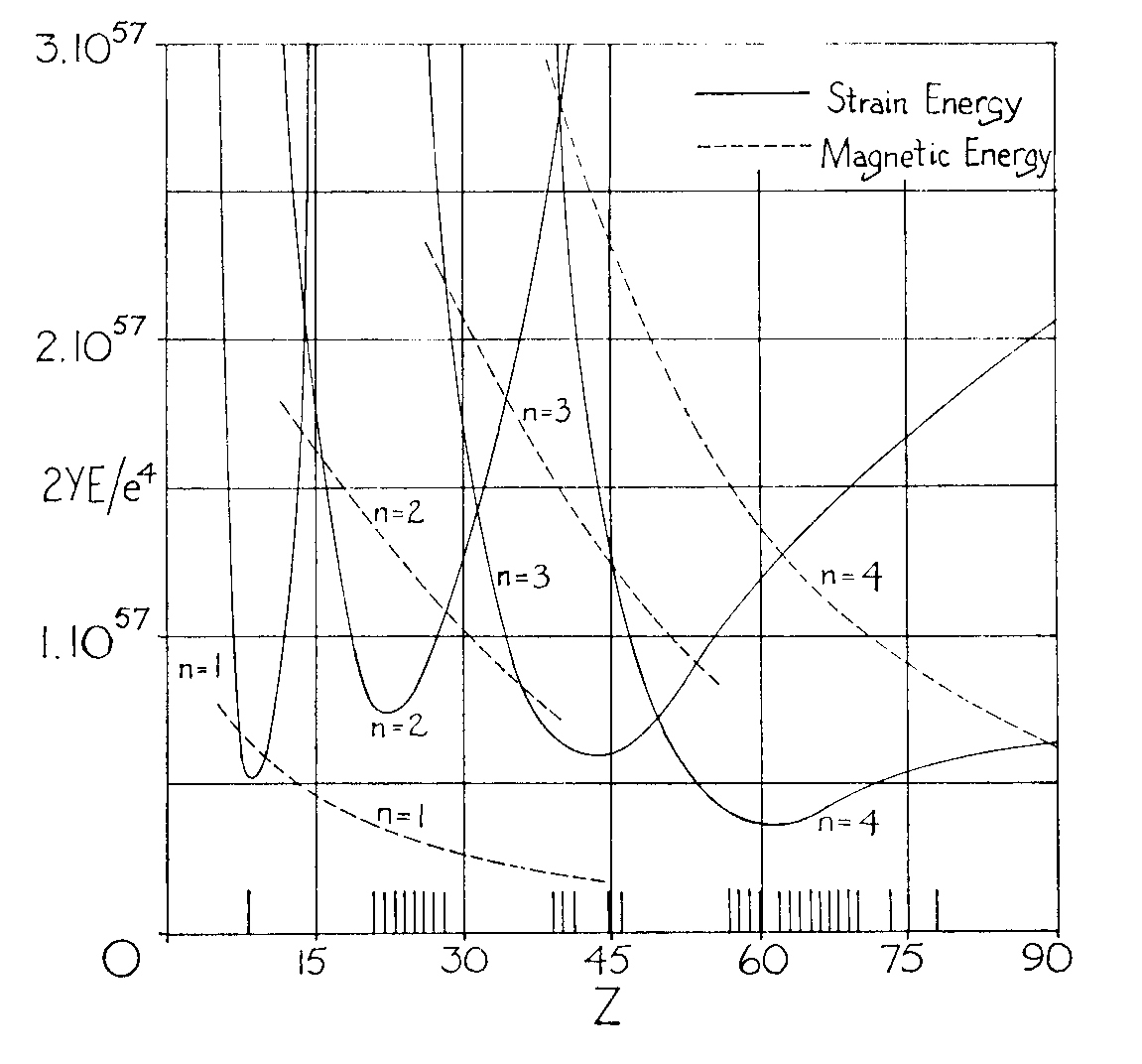
The quotation from Chapter 3 of ‘Physics without Einstein’ continues and Fig. 3.2 of the Part I of this Essay No. 6B is reproduced here to facilitate reference.
DISCUSSION OF NEW THEORY
Theoretically, ignoring the error factor in the under-estimation of the strain energy, the curves show that a simple cubic crystal of oxygen (Z=8), if it could exist and if its Young’s Modulus were 2×10¹² or higher, would be ferromagnetic. For n=1, the prospect of a ferromagnetic state has to be ruled out for other atoms, except possibly carbon. Diamond has an extremely high Young’s Modulus, some five times that assumed for the comparison curve. However, with Z=6, carbon, to be ferromagnetic, would have to sustain very high internal stresses and these probably preclude ferromagnetism. For n=2, iron, nickel and cobalt have to be given favoured consideration. They all have a relatively high Young’s Modulus, some 50% higher than for copper, for example. They are all strong enough to sustain stresses accompanying the ferromagnetic state. Note that for Fe, Co, Ni and Cu, Z is 26, 27, 28 and 29 respectively. The broken curve in Fig. 3.2 has to be placed 20% or so higher for Fe, Ni and Co and the same amount lower for Cu. Fig. 3.2, therefore, explains why iron is ferromagnetic and copper non-ferromagnetic. Of course, in applying the curves in Fig. 3.2, it should be noted that the analysis has only been approximate. Perhaps, also, it was wrong to ignore the screening action for some of the electrons in inner shells or perhaps this, and an accurate evaluation of the strain energy allowing for surrounding atomic interaction, will shift the minima of the curves very slightly to the right. This would better relate the minima to the susceptibility data and permit a higher error factor in the strain energy evaluation. Note that if the strain energy is underestimated by much in Fig. 3.2, nickel is only marginally ferromagnetic. With n=3 and n=4, the screening action of electrons will assume more importance and the evident prediction of a theoretical state of ferromagnetism in several substances shows some qualification of the actions to be necessary. It is significant that Gd with Z of 64, located near the minimum of the n=4 curve, is ferromagnetic. It may well be that the higher n and the higher Z, the more electrons there are in the shell which can be ferromagnetic. Then the less likely it is for the synchronous action to remain as a preferred energy state. The interference from the effects of other electrons could well suppress this condition in the larger atoms. [A footnote here indicated that in Physical Review Letters, v. 22, p. 1260, June 1969, E. Bucher et al. report the discovery that Pr and Nd, of atomic numbers Z=59 and Z=60, respectively, are ferromagnetic in their face centred cubic phases.]
The understanding of ferromagnetism by its relation to stress properties may prove of interest in that it may be that under the very high pressures prevailing inside the earth, even materials which are not ferromagnetic at the surface may become ferromagnetic. Young’s Modulus may then be of no importance and a compression modulus may be the factor which is deciding the state of balance between stress energy and magnetic energy.
SUMMARY
In this chapter, it has been shown how the nature of ferromagnetism can be explained without recourse to wave mechanics, The law of electrodynamics developed in Chapter 2 and the principles of negative magnetic energy are applied successfully in the analysis. In the next chapter we will explain how the theory is reconciled with wave-mechanics. It will be shown that an electron can spend some time in a Bohr orbit and some time in its wave mechanical state. Thus, a factor has to be applied to lower the magnetic energy curves in Fig. 3.2, so limiting the elements in the ferromagnetic state still further.
The text of Chapter 4 in ‘Physics without Einstein’ ended here, but I shall now update the discussion.
ONWARD DISCUSSION
The main contribution I had made in developing the above theory of ferromagnetism is summarized in Fig. 3.2. The threshold condition for ferromagnetism was determined by internal mechanical stress and the ferromagnetism was quite definitely seated in the orbital motion of electrons and not in that notion of ‘electron spin’.
I was gratified that the theory seemed to work for a single orbital electron in the 3d state, which had that orbital component matching the n=2 quantum level of the Bohr atom theory. The measured quantization in Bohr magnetons per atom in iron was 2.221, which seemed close enough. However, that small difference worried me. It needed explanation. Note also that I had to reconcile in my mind the reasons why the mutually attractive electrodynamic forces between atoms in an extended structure were not over-dominant. I wanted the synchronous orbital motion of electric charge, as a quantized state, to play a role in gravitation, which seems unbounded in its range of action, but yet there had to be something limiting the range of action of those corresponding electron interactions in the ferromagnet. Otherwise the iron crystal would surely crush itself to the point where ferromagnetism collapses.
Looking back, I expect that is why I laboured with the problems of propagation delay in determining phase shifts in the synchrony of the electron motion in adjacent atoms. I saw, however, that that meant there was inconsistency between my account of ferromagnetism and the account I gave in that book for gravitation, even though I had shown how to calculate the precise value of G, the constant of gravitation, from first principles.
My hope, however, in publishing my theory was to stimulate interest which could lead others to contribute improvement and clarification, but, some 30 years on, that was obviously mere wishful thinking as I have seen no such response. I attribute it to the fact that physicists in general were satisfied with Einstein’s doctrines and had less interest in understanding ferromagnetism in spite of its direct association with the machine technology which powers the world. Even nuclear power, which many see as arising somehow from the work of Einstein, depends upon electrical machines, which all depend upon ferromagnetism. Then there is the technology of the aerospace industry which depends upon striving to conquer gravitation, which many see as a subject also vindicating Einstein’s theory, even though Einstein never did discover the Holy Grail which hid the unifying link between electromagnetism and gravitation.
[I cannot resist here noting that the caption on the cover of my book immediately below the title ‘Physics without Einstein’ reads ‘A confrontation with the anomalies of electromagnetism which reveals a unified explanation for the physical phenomena of the universe’].
In the years which followed publication of that book I did solve that problem of reconciling 2.221 and 2 as the atomic quantization of iron atoms in their ferromagnetic saturation state. The secret, as will be fully explained, comes, in the first instance, from the realization that there might be two electrons in each atom contributing to set up that 2.221 Bohr magneton state. Basing this on electrons in orbital motion corresponding to two Bohr magnetons, to reach the 2.221 figure, all one has to do is to say that the magnetic field produced by charge in motion is really twice as strong as we think it is but that there is a reaction in the enveloping space medium which halves its average effect. If the field were produced by current in a solenoid then twice what is expected, halved, is what is expected, but what is involved in this game of ‘action and reaction’ is a thermodynamic activity of motion charge in the reacting field and energy transfer by thermodynamic processes can involve time delays which are hidden by the retardation inherent in magnetic inductance.
Two electrons in an atom, each quantized in 2 Bohr units, will develop a field action that is, not 2 Bohr magnetons in strength, but 8 Bohr magnetons. However, the ferromagnetic state could flip sequentially between the three mutually orthogonal x, y, z axes of the body-centred cubic iron crystal to spend equal times in each of the directions +y, -y, +z, -z, +x, +x, where x is the direction of polarization. This means that the primary effect of the Bohr magneton quantization is 8/3 or 2.667, but this is offset by half of this amount being effective for equal times in those same six directions. The offset in the x direction is then one sixth of 2.667, which is 0.444, so that the overal quantization observed is 2.222, less a very small amount to allow for the time of transition in the reorientation process. So, 2.221, as measured, fits quite well and we have here the clue we need to advance the theory.
I was, of course, not just seeking to explain a number. That numerical factor was a clue but there had to be more support for the physics involved. This support came from the consideration of strain anisotropy and anomalies connected with volume magnetostriction effects, notably in the transition between ferromagnetic and non-ferromagnetic states.
However, I then ran into a problem. I had to picture how two electrons in orbit in the same atom can contribute to magnetic polarization in the same direction, whilst retaining much the same result for the mechanical stress analysis. If those electrons were moving in juxtaposition about the atomic nucleus their interaction, electrostatically and electrodynamically with counterpart electrons in other atoms has a compensating effect which substantially reduces the stress levels already estimated. Yet I knew that there was clear evidence of the existence of very high mechanical stress in iron and nickel, attributable to the ferromagnetic condition.
It took a while, but I eventually came to a choice between two alternative explanations. I have presented one of these in the latter part Essay No. 6, where I contemplated a statistical migration of electrons in orbits that were mutually orthogonal, the two electrons jumping from position to position in their respective orbits but, in the main, not making those jumps at the same time. However, keeping that possibility in mind, I will not be satisfied on this matter until I have made a thorough analysis of the following alternative possibility. I would welcome initiatives by any reader who leads the way on the analysis involved, because I shall not get around to that for quite a while.
The alternative is this. I see the electrodynamic interaction forces between the contributing electrons in each atom as arising from their mutually parallel motion. These forces are attractive, sufficiently so as to offset the repulsive electrostatic forces set up by the synchrony of these electrons and keep the overall mechanical stress within the stress limits of the crystals forming the ferromagnet. Now, this electrodynamic effect implies a negative energy potential condition which could make it easier for the two electrons of a given atom to adopt positions in their common orbits that are not those giving the dynamic balance. You see, in the normal dynamic balance condition, they always move in opposite directions and that means that, in setting up interactions with their counterparts in adjacent atoms, they will have an attraction force as between those that are nearest and a repulsion force between those that are more separated. The question then is whether the energy potentials involved would favour a relative phase shift of the electrons in their orbits, albeit thereby affecting the dynamic balance (a state applicable anyway to an atom of odd Z). By this is meant one which has the two electrons chasing one another around in orbit with a 90 degree phase shift so that their electrodynamic current vectors are at right-angles to each other. This would eliminate the repulsive electrodynamic action as between the electrons in adjacent atoms. It should, therefore, be a state of minimal potential energy.
On such an assumption those two electrons in common orbit at any instant in an atom would satisfy the analysis above leading to that 2.222 Bohr magneton quantization.
It is doubtful, however, that the condition just described could ever be detected by experiment, since the electrons are too close to the atomic nucleus in the ferromagnet crystal. However, there is scope for rigorous calculation of states of stress and strain and the study of the effects of stress on magnetic properties might indicate ceertain threshold levels which affect such measurements.
Although I now suspect that the ferromagnetic condition in iron really stems from two orbital electrons in the n=2 shell, it has sufficed to accept the traditional picture and regard two 3d electrons as contributing in each atom and dividing their contributions to magnetism along one of the x, y, z axes, in the following way, the 2 symbolizing that there are two electrons contributing to that state of magnetism in each of the following alternative states:
		period	x	y	z
		(a)	+2	 0	 0
		(b)	 0	+2	 0
		(c)	 0	 0	+2
		(d)	+2	 0	 0
		(e)	 0	-2	 0
		(f)	 0	 0	-2
occurring for equal times, not necessarily in the order listed.
You can then see that, on average, the primary polarization effect in the x direction is 1/3 times the contribution of the two electrons, whereas there is no net polarization along the y and z axes. However, in mechanical stress terms, given that stress, whether compressive or tensile, is proportional to the square of force, we see that each axis has an equal share of the stress state. The action overall produces isotropic strain, which fits well with what is observed having regard to the known levels of high strain locked into the ferromagnetic condition.
We can now proceed with our analysis on the basis that two 3d electrons in the n=2 orbital condition will contribute 4g Bohr magnetons, where g is the gyromagnetic ratio which scales up the effective magnetic moment by a factor of 2. This gives 8 Bohr magnetons for each atom or 8/3 per atom effective along the x axis of magnetic polarization.
Note that the reaction field which operates, instant by instant, to halve this primary polarization will be directed against the instantaneous polarization vector, each of unit strength. This means that the 4/3 reaction will be asserted against the 8/3 amount for only one third of the time, giving 2.666 minus 0.444 or 2.222 Bohr magnetons as the theoretical net polarization per atom, not allowing for retardation in the transitional activity.
The task of reconciling the observed Bohr magneton polarization in iron at saturation is therefore accomplished and we have preserved the basis of the mechanical stress calculation as developed by the author in ‘Physics without Einstein’.
On the strength of this we can revisit the formulation quoted in Part I of this Essay from ‘Physics without Einstein’:
This applied if d were set at 2×10⁻⁸ cm. Now that we can take n=2 as the definitive value, we can advance the analysis using the more representative value of 2.8×10⁻⁸ cm for d applicable in iron. This alters that 4,000 figure to 2,000 and, with n=2, results in Z having the effective value of 19. However, we have altered the geometry of the relative positions of the electrons and so the basic calculations need to be reworked. Also one needs to perform the calculations by computer and extend the range of computation over many atoms.
The analysis has value, apart from testing the interest in ferromagnetism, because it should allow the verification of a proposition used elsewhere in developing aether theory. The synchrony of electrons in orbit should imply electrodynamic interaction forces to be calculated without concern for retardation effects. This is based on the assumption that if energy is not changing then the forces cannot be retarded. I well know that, in the 1969 Chapter 3 text of my book ‘Physics withour Einstein, I was following convention when I referred to the restrictive effect of retardation effects on the analysis, but I am now holding to my no-retardation position, given no energy change. Somewhat similar, and indeed even stronger considerations, apply to the electrostatic force interaction, but that is a subject I do not wish to develop here. See [1988a]. Suffice it to say that one needs to perform the rigorous computer calculation needed to explore the overall value of that 4,000 approximation factor. The interaction calculations should be extended to cover a whole section of the atomic lattice of the body-centred cubic structure, making due allowance also for the fact that such a structure intermeshes two simple cubic atomic lattice arrays.
I have not hitherto performed such calculations, but I may do that eventually and, in that case, will extend this Essay to present the findings. Meanwhile, I will be attentive to feedback should any reader undertake this task. I end this Essay by drawing attention to the case I have put elsewhere in a published paper referenced in these Web pages for the ‘half-field reaction’ theory as applied also to nickel and cobalt. See [1987c]
As to the conflict in what I have just described and what I wrote in the latter part of the Essay on the Exclusion Principle which introduced this ferromagnetic topic. I have argued two separate reasons for the 2.221 Bohr quantization. One is a kind of quantum-electrodynamic effect and the other is a more classical kind of electrodynamic interaction. Both give the same result, but I would prefer to know which interpretation is correct. That issue is something that will, I trust, be resolved by performing those computations I have just mentioned.
Priority attention has, however, to be given to the experimental projects which aim to exploit this knowledge of the quantum-orbital state of ferromagnetism as powered by reaction involving the vacuum medium which I call the ‘aether’.
Readers may find it interesting, therefore, to move on from here to Lecture No. 7 which discusses the ‘free energy’ technology demonstrated by Hans Coler.