DISCOURSE NO. 8
Copyright © Harold Aspden, 2001
WORLD IN PERIL: IMPENDING DOOM
The U.K. newspaper, THE TIMES, has today, August 29, 2001, alerted readers to the prospect of impending doom.
The report occupied most of page 7 of this broad sheet publication. Its first words declared:
“Britain is facing devastation from the largest wave in recorded history if a predicted catastrophic volcanic eruption in the Canary Islands occurs, according to scientific study.”
One goes on to read:
“The scale of destruction, however, will be nothing compared with that in the United States, the Caribbean and Brazil. Here, a series of waves measuring up to 165 ft will pound into densely populated regions, virtually wiping out cities such as New York and Miami and inundating an area up to six miles inland. The natural disaster is predicted to be amongst the worst in history, with the total cost running to many trillions of pounds.”
“A new prediction of the likely effects, by Simon Day of the Benfield Greig Hazard Research Centre at University College London, suggests that this would create a giant tsunami, much larger than those begun by earthquakes, that would sweep the Atlantic with huge destructive power. Details of his research, conducted with Steven Ward of the University of California, are published next month in the journal Geophysical Review Letters“.
“Within five minutes of the landslide, a dome of water about a mile high would form and then collapse, before the mega-tsunami fans out in every direction, travelling at speeds of up to 500 mph. A 330 ft. wave would strike the western Sahara in less than an hour.”
Well, now, after reading all this along with the extensive accompanying text, even taking note of the attempt to reassure and avoid arousing panic, by the last paragraph which says: “It is unlikely to happen in the next century”, I see the need to bring this series of OVERVIEW discourses to an end. I will, therefore, in this concluding Discourse No. 8, add a further prophecy of doom by pointing to a phenomenon connected with the aether itself, one that is rooted also in the geological history of past catastrophic events.
The theory of the aether which I have presented in these web pages and which I urge should be studied by energy-minded physicists, along with geophysicists concerned with hazards on the grand scale, involves what I have called ‘space domains’. These are vast regions of space bounded by planar boundaries which separate what one might term regions of space and regions of anti-space. In physical terminology, the electrical polarities of whatever constitutes the aether and accounts for the Maxwell-type electrical displacement that accompanies electromagnetic wave propagation, are interchanged as between two sides of a domain boundary, meaning that positive charge becomes negative charge and vice versa. If mankind, along with body Earth, moves through space at our cosmic speed of several hundred km/s, then, once in a while these domain boundaries will need to be crossed, as the Earth takes of the order of a minute or so, depending upon the angle of approach, to traverse a boundary.
What, then, will happen? Well, I believe there will be a reversal of the Earth’s magnetic field, hardly a traumatic event. But you may say that I am merely speculating about the existence of an aether of this domain-structured form and so doubt whether this warrants further interest. However, if you, the reader, are a geologist then perhaps you will be aware that reversals of the geomagnetic field feature as part of the history of record in rock formations at different strata levels. Along with that data there is evidence of upheaval and destruction, with occasional elimination of species of plant and life forms, seemingly coinciding with the geomagnetic reversals. One wonders if the Earth, in its long period galactic orbit, sometimes traverses a space domain boundary at such an acute angle that it takes several minutes to make the crossing. Consider then the consequences, given that the aether-based theory of gravitation that we discuss in these web pages, tells us that the force of gravity has a range confined to interaction between matter sharing the same space domain. You will then see that that geomagnetic reversal is accompanied by gravity between earthly matter switching-off, as it were, for a quite short period. Imagine the earthquakes and immense dust clouds that then result as the Earth’s surface lifts up owing to the consequential loss-of-gravity expansion effects and centrifugal forces produced by Earth rotation.
The combination of earthquakes and tidal waves will be of indescribable magnitude and no part of the Earth will remain unaffected. One can only pray that the Earth’s path will happen to be square-on (i.e. at right-angles) with respect to the planar form of the domain boundary, so that the transit period is not prolonged, as it will be if the crossing occurs at a low angle of incidence.
This, I fear, is the sad side of understanding the physics of the aether. It is as if Nature imposes a price for the intellectual enlightenment as to what constitutes the medium we call ‘space’.
That insight into the future is something the hazard-risk-evaluating geophysicist needs to consider along with the prospect of volcanic disturbance. Exploring the doomsday scenario from this viewpoint has, incidentally, a spin-off benefit in the interim in that it could redeem the physicist’s lost belief in the existence of a real aether. It opens the door on explaining gravity in terms of aether theory along with discovering how the aether with its domain structure built around a kind of fluid-crystal underworld can determine the most basic dimensionless constants of physics. That door, once open, will surely serve us well for some time yet by leading us to a new energy resource, the aether itself, given that its energy is used by Mother Nature to create all matter.
In ending, I suggest the reader, might like to know a little more about those geomagnetic field reversals and so I invite inspection of pages 168-174 of Chapter 8 of my book Physics Unified.
This ends this OVERVIEW section of these web pages. I have tried to present these eight DISCOURSES in an easily readable form, avoiding any specialized knowledge or mathematics and hope the reader has found them interesting.
H. Aspden
August 29, 2001


Full text (transcribed from the PDF)
Transcribed from the scanned pages of the printed pages. [p. N] marks where each printed page begins; figures are cut from the scans. The PDF above is the original.
[p. 168] considers energy deployment. The basic energy is still in the kinetic form of the rotating space medium. The polarity reversal of the space medium in crossing the boundary is not an actual reversal. It is an apparent reversal. The body has moved from one region to another. The synchronizing constraints in each region will assure that energy is available if needed to sustain a transient condition. Thus the 2Q charge can exist and will disappear as the space region slows down and enough electrons can move in to assure a balance. Bear in mind that the initial crossing of the boundary would destroy the gravitational field momentarily causing the negative charge in the surface regions to be displaced from the surface of the body. It takes a little time to react to the attraction of the central charge and the centrifugal motion seemingly is established in this interval.
Geomagnetism
Our next question is that of the effects on the Earth of crossing a space domain boundary. We must, even after the many eons since our Earth was created, be crossing these space domain boundaries as the whole solar system progresses on its course through space. It travels at about 390 km/s, as we saw from the opening words in Chapter 3. At this speed it takes 770 years to travel one light year. It would take about 700,000 years to traverse the space domain calculated in the above example. Therefore, every 700,000 or so years we should suddenly experience a violent upset as gravitation relaxes in effect for the few seconds of transit. Also we should find that the polarity reversal of σ′ causes a magnetic reversal of the Earth’s field.
In this connection we can calculate the magnetic moment produced by the residual charge Q of the Earth today. This charge is positive at the present time. Its polarity is set opposite to that of σ′ as induced by the rotation of the space frame with the Earth. Magnetic effects are evidenced by disturbances of the lattice particle system. The charge σ′ cannot itself induce a magnetic field because it arises from a displacement of the lattice. Thus it is only the compensating charge Q associated with matter rotating with the frame that can generate a magnetic effect. There is of course a balance charge −Q at the boundary which is part of the system of matter present and this also has to be taken into account. Indeed, it may be shown that the latter charge develops twice the magnetic moment of the distributed core charge. The difference is the same in magnitude as that due to the
[p. 169] distributed charge but has the direction we associate with negative charge. It is this double action which causes the field to be similar to that of a dipole at the centre of the Earth.
The earth’s magnetic moment is simply 1/2c times the electric charge velocity moment, or:
(1/2c)(2/5)(4πσ′/3)R5w(227)
From (218) and the fact that σ is e/d3:
σ′ = 2ew/Ωd3(228)
Then, since Ω is c/2r, we put (228) in (227) to find a magnetic moment of:
16πerR5w2/15d3c2(229)
In this expression er is the Bohr Magneton, known from experiment to be 9·27 10−21 cgs units. d was shown above to be 6·37 10−11 cm. For the Earth today w is 7·26 10−5 rad/s. c is 3 1010 cm/s.
The resulting value of the geomagnetic moment is very critically dependent upon R, the radius of the space medium rotating with the Earth. Thus, if R is 6·45 108 cm the magnetic moment is 7·86 1025 cgs units. If R is 6·50 108 cm the magnetic moment is 8·17 1025 cgs units. In fact, the radius of the Earth is 6·38 108 cm and the geomagnetic moment measured is 8·06 1025 cgs units.
These are very significant results, which bear out the essential validity of the theory presented. Evidently the Earth’s space boundary is about 100 km above the Earth’s surface on this theory. There is the question of the direction of the geomagnetic moment and the precession of the poles needs explanation, but we do have here the essential foundations for an understanding of the nature of the geomagnetic field.
It is feasible to think of the Earth’s magnetic field reversing at times when the Earth is carried across a space domain boundary. By studying the evidence of the Earth’s magnetic field reversals some indication of the existence, the size, and the form of the space domains should become available. We have inferred their approximate size from the theory of the space medium and the hypothesis that the known mass of the sun is typical of stellar mass generally. It remains a mystery as to why space domains of this particular size should form. To probe that question is to seek to understand why the stars have a particular mass and such questions must be deferred at this time. However, we can picture the reversal pattern of the
[p. 170] geomagnetic field for a simple domain structure. As each domain has about the same size a simple cubic domain structure seems an appropriate choice. The results will be an approximation only, inasmuch as all stars do not have the same mass/radius parameter. To estimate the degree of approximation let us consider the extreme example of a red giant star in comparison with the sun. Betelgeux is said by Jeans* to be about 40 times as massive as the sun and to occupy 25,000,000 times as much volume. The mass/radius parameter is 0·137 compared with the sun. The value of D given by (226) is 0·37 for this red giant star, compared with the sun’s domain radius D at creation. However, a red giant is believed to be the decaying form of a star, rather than the form it may have upon initial creation. Since the majority of stars are similar to the sun we can, therefore, expect a reasonably-representative pattern of magnetic field reversals to emerge from a choice of a simple cubic structured domain system. A reversal period of the order of 700,000 years is to be expected for motion parallel with a main axis of the cubic domain structure. In general, however, a motion will be inclined to such an axis and the planes separating domain boundaries will be crossed more frequently than this.
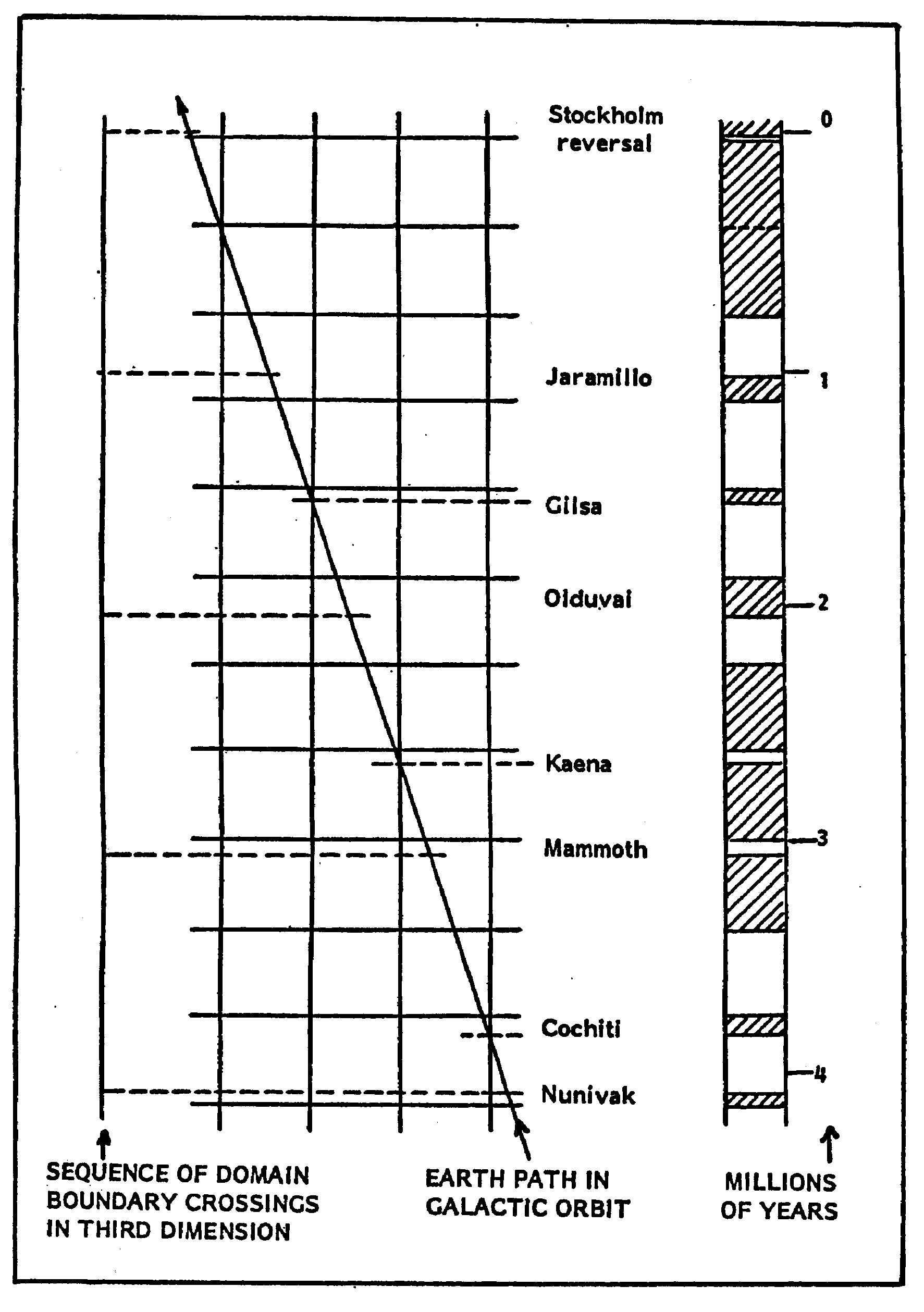
In Fig. 40 the hypothetical pattern of reversals due to motion through cubic domain space is shown in a time scale measured in millions of years before the present time. The solar system is imagined to move in a straight line through domain space over this period of time, though it does move in a slight arc owing to the galactic motion. The inclination of the line with the domain cube axes is chosen deliberately to give results which resemble the observed reversal sequence and the time scale has been matched accordingly. The names assigned to the reversals are those used conventionally to designate these events. There is a reasonably close correlation. The interesting result, however, is that such an erratic pattern of events lends itself to decoding in this way. The author believes that this is affirmative support for the domain theory suggested, especially as the size of the domains derived from the empirical data fit is in close accord with that calculated for the sun. Note that the analysis leading to (226) required D to be the radius of a spherical domain. The corresponding cube dimension would be smaller than this. The data in Fig. 40 suggest a domain cube size of about 400,000 years at the [p. 171] [p. 172] Earth’s speed through the space system. At 390 km/s this gives a domain cube size of about 500 light years.
* J. H. Jeans, The Stars in their Courses, Cambridge University Press, p. 92 (1931).
A textbook showing the Earth’s magnetic field reversal pattern over the past four million years is one by Tarling and Tarling.* They also comment on the rather perplexing evidence which shows that fossil species have disappeared at times of reversal and new species have appeared shortly thereafter. This implies that the geomagnetic field reversal was accompanied by a rather more traumatic event. Reporting on the documentary evidence of data gleaned from the deep-sea floor of the Indian Ocean, the Science Correspondent of The Times wrote in 1972:†
. . . tiny metallic and glass beads that originated from outer space . . . were fragments from some great cosmic catastrophe that caused molten particles to splash into the atmosphere some 700,000 years ago. The shower of debris coincided with the last reversal of the earth’s magnetic field.
The reader will notice that Fig. 40 shows a recent reversal of the geomagnetic field. The above report and the Tarling book both suggest that the last reversal was 700,000 years ago. If this were true then another reversal would be imminent on the time scale used in Fig. 40. However, since these reports were written evidence of a reversal about 12,000 years ago, a very short-lived reversal, has emerged. This fits very well with the empirical evidence in Fig. 40, which shows a near crossing of a cube domain edge, meaning two reversals in rapid succession. The author was unaware of the latest discovery of the reversal when outlining this domain theory at the end of his book Modern Aether Science, published early in 1972. The fact that we have had a magnetic reversal in relatively recent times is reassuring if such events are accompanied by cosmic upheavals. One may well wonder whether catastrophic geological events can be traced to this recent period.
On a longer time scale it is interesting to consider the circuital motion of the solar system in its galactic cycle and contemplate the fact that the Earth would cross the domain boundaries at different angles of incidence with a four-fold periodicity per galactic cycle. If
[p. 173] the gravitational field between matter in the Earth is disturbed when the domain boundaries are traversed, the faster the crossing, the less the disturbance. The crossing will be most rapid when the Earth approaches the boundary in the normal direction. If it approaches a boundary at a low angle it will take much longer to traverse it. Indeed, it seems statistically possible for an approach to be at such a low angle that the Earth could disintegrate on reaching the domain boundary. The probability is very small but it is a consequence of this theory and one might wonder whether the asteroids really originated in a planet broken up in this way.
* D. H. Tarling and M. P. Tarling, Continental Drift, Bell, London, pp. 52 and 66 (1971).
† P. Wright, ‘A Mine of Knowledge from the Sea’, The Times, London, August 17 (1972).
These ideas are highly speculative but take encouragement from the researches of Steiner.* He has made an extensive study of the possible correlation between geological events and the galactic motion and concluded that the constant of gravitation G may, in some way, depend upon the period in the galactic cycle. The theoretical interpretation of such data is difficult in view of the uncertainties in the present state of cosmological theory, particularly so far as concerns the variation of G. The problem is further confused by the expanding Earth hypothesis which is dependent upon a slowly varying G. Yet Einstein’s theory hardly permits G to vary and the author’s theory presented in this work requires G to be as constant as the charge-mass ratio of the electron. One feels that if the latter were to change then all other parameters, such as the speed of light and the dimensions of the space lattice and even energy, would change as well. The author therefore favours the supposition that G is constant but only acts between matter within specific domains of space. This renders G effectively dependent upon the position of our planet as far as geological events are concerned and seems to offer scope for relating geological events and galactic motion. However, far more research is needed before these ideas can leave the realm of speculation. Meanwhile, reverting to the statement above that there would be a four-fold periodicity of gravitational upset in the galactic cycle if the space domain ideas hold, the author draws attention to another paper by Steiner† in which he writes:
If Phanerozoic geological history incorporates any periodicities, they are of the order of 60 or perhaps 70 million years. . . . The galactic periodicity of the solar system is, however, approximately [p. 174] 274 million years, representing the length of the cosmic year, or one revolution around the galactic centre.
* J. Steiner, Jour. Geol. Soc. Australia, 14, 99 (1967).
† J. Steiner, ‘Geology’, p. 89 (1973).
The author’s ideas on space domains and their correlation with geomagnetic field reversals and geological disturbances are also presented in a paper in Catastrophist Geology, 2, 42 (1977).