THE PHYSICS OF CREATION: LECTURE NO. 7
The Standard Model and the Muon g-factor
INTRODUCTION
In preparing this Physics Lecture I am venturing into new territory. I am about to speculate on the physics of a problem that has emerged earlier this month (February 2001) as a news item published by the U.K. Institute of Physics. See PhysicsWeb.
It states that:
“The international team (at Brookhaven National laboratory) – which believes the discovery may hint at a new and unexplored area of physics – broke the news in a special conference held at Brookhaven yesterday (8 February 2001) and hopes to publish its work in Physical Review Letters.”
What is that discovery? Simply that “the Standard Model of particle physics – which has mapped the subatomic world with remarkable success for over 30 years – has been challenged by new results from Brookhaven National Laboratory in the US. Precise measurements of the behaviours of muons in a magnetic field disagree significantly with the Standard Model.”
My interest in this stems from the fact that, for more than 30 years, I have been thwarted in my efforts to gain recognition for my theoretical efforts in delving into the physical properties of sub-atomic particles, by having the finger pointed at something beyond challenge, namely the ability of QED (quantum electrodynamics according to the standard model) to account for certain numerical quantities with a level of precision that is so astounding as to be beyond question.
What I found to be particularly offensive was the fact that when I submitted a paper that offered a well-reasoned physical explanation for the factor-of-2 component of the electron g-factor, I was told that I should not waste my time; the methods of QED were sacrosanct and so precise that all other theoretical avenues did not warrant a hearing.
I was not at the time interested in the minor feature of the anomalous g-factor of the electron or that of the muon, the latter being the subject of this Lecture. By this use of the word ‘minor’ I mean what modern physics terms ‘the anomalous’ component of the g-factor. I personally regarded the more dominant factor-of-2 as ‘anomalous’, but the standard opinion is that for the electron g-factor of 2 times (1.0011596522) it is the 1.0011596522 that is anomalous but not the dominant factor 2! Indeed, my attention from my earliest efforts in physics research had concentrated on this factor-of-2 because I saw it as evidence that the magnetic moment produced by electric charge in orbital motion was really double the value assumed by orthodox teaching but was halved by a reaction set up by the aether of our environment. Such an effect would only be detected by an experiment which could give a true measure of the gyromagnetic ratio, the ratio of the magnetic moment to the angular momentum, which is the theme of my concern. It has been my life’s effort to try to get the physics community to see sense and recognize that the aether exists and sets up this reaction. I see it as the very secret of how the vacuum stores the energy we ascribe to magnetic inductance. However, particle physicists have yielded to Paul Dirac’s relativistic interpretation; the invention of the word ‘spin’ to describe an anomaly concerned with magnetic moment. (As if a point charge, or a charge sphere, when spinning can possibly set up a magnetic moment! Really, the notion is ridiculous!)
I was, of course, normally polite in the way I expressed myself when writing a scientific paper for referee consideration, but the referee rejections were not so considerate. Though I tried to avoid it, the very hint of the word ‘aether’ was like a red flag to a bull.
So, where do we stand now with the Standard Model under challenge?
As one can imagine, having my work rejected merely made me scrutinize the methods of QED and how the Standard Model gave that 1.001159… quantity.
Well, I soon realized that here was a branch of physics where experiment was always ahead of theory. Nothing was ‘predicted’. Everything was ‘explained’ by inventing new features which complicated the story.
I was researching anomalous energy aspects of magnetic induction in the 1950-53 years. That was experimental research. My related theoretical efforts began to tell me that there had to be an aether reacting to a magnetic field in storing magnetic field energy in the vacuum of space. Yet the aether was a taboo subject. Physicists had accepted it did not exist!
It was in 1955 that an excellent book entitled Atomic and Nuclear Physics was published (author: Robert S. Shankland) and one reads on page 319 that the theoretical value of the magnetic moment of the electron in terms of the Bohr magneton is:
which was compared with the experimental value of:
So, you see, in 1955, everything was well with theory versus experiment. One could hardly argue with such success.
However, over the years, as the measurements became more precise, the theory had to be ‘doctored’ to keep up with state of the art. New ingredients such as ‘hadron corrections’ had to be invented to get the theory to conform. Accordingly, by 1986, one finds that the experimental value of the ‘magnetic moment of the electron’ in terms of the Bohr magneton has risen to:
and, not surprisingly, the Standard Model was adapted to keep the theory in accord with the experimental findings.
As you can see, in 31 years, the experimental value had moved more than two standard deviations up on the 1955 experimental value and well above the theoretical value of 1955 period, as reported by Shankland, but yet the theory rose to the challenge.
Meanwhile, during these intervening years I had pondered on the question of why, in addition to the factor-of-2, the electron moving in restricted orbital motion (so-called ‘spin’) could exhibit a different magnetic moment to that it has in normal large radius orbital motion. My answer was that it is not the magnetic moment that is anomalous, but rather the angular momentum, the latter involving a slightly lower mass than applies for linear motion or motion in orbits of large radius. This was in contrast with the factor-of-2 anomaly, which arises from the magnetic moment being larger by that factor. For the ‘spin’ anomaly it is the angular momentum that is anomalous. What is excluded is the mass-energy of the field of the electron charge that lies outside a radius set by the value of the half-wavelength of the Compton frequency of the electron.
One needed further to allow for the finite size of the electron charge, but, essentially, there is a wave resonance condition that sets the bounding radius severing the coupling of mass energy deployed in the electron field. My analysis, as was duly reported in the papers I did manage to have accepted for publication after referee scrutiny, are to be found in International Journal of Theoretical Physics 16, p. 401 (1977) and Lettere al Nuovo Cimento 32, p. 114 (1981).
Based on a very simple theoretical presentation the latter paper showed how easy it was to derive an electron g-factor of:
and, it being published in 1981, this was five years before the above 1986 value was adopted by the International CODATA task force.
So, you see, somehow those responsible for the Standard Model have contrived to tune their model to fit the experimental electron g-factor of the electron and my theoretical derivation sits there of record, but unnoticed, in the vast spectrum of published scientific literature. That, therefore, seems to be a closed chapter in scientific progress, but at least it serves as an introduction to the latest development, the failure of the Standard Model so far as the muon g-factor is concerned.
THE MUON g-FACTOR
The experimental breakthrough that challenges the Standard Model is reported in a Physical Review Letters paper dating from February 8, 2001 by H. N. Brown plus 67 other authors entitled: “Precise Measurement of the Positive Muon Anomalous Magnetic Moment”.
It appears that it is possible to use a beam of muons moving at a speed which causes their mass to be increased by a factor in excess of 29 can be contained in orbit in a magnetic field and still serve at a speed close to that of light as a test source for measuring their anomalous g-factor with extremely high precision. The result obtained was:
which exceeds the theoretical Standard Model derivation, in spite of all its hadron corrections, by some 2.6 standard deviations. The verdict, according to the abstract of the paper, is that “This difference may be due to physics beyond the standard model”.
So, here we are, repeating the scenario of the 1955 theory of the electron g-factor, as overtaken by more than two standard deviations in adapting to the experimental value adopted in 1986, having, it seems, to adapt theory to fit observations or devise new theory.
So you may ask how I react to this situation, given my efforts of record concerning the electron g-factor. Well, here I confess to a little bewilderment, mainly because it seems so fantastic to extract such incredibly precise measurements from such a high energy scenario of muons in decay. However, accepting what so many physicists involved in the Brookhaven collaboration are claiming to have achieved, I will share my thoughts with readers of this Web Lecture.
I begin by quoting two equations from my 1981 paper referenced above, namely Lettere al Nuovo Cimento, 32, p. 114 (1981). It was entited ‘The Anomalous Magnetic Moment of the Electron’. The equations are:
and:
Note that α is the fine-structure constant. Given that α-1 is a little below 137.036 you may verify that the equations indicate that the value of g for the electron is approximately that given by:
but note that that particular paper was written to take account of the fact that there is an effect owing to gravitational potential which increases this g-factor by some 5.281 parts in a billion. Furthermore, my theory had indicated that the fundamental value of α-1 is 137.0359148. This increases g to the value given by:
Addressing the problem of the muon, which I did in my papers in Lettere al Nuovo Cimento, 33, p. 481 (1982) and 37, p. 210 (1983), I reasoned (note the use of a minus sign to replace a plus sign) that the g-factor would be given by:
and:
which, without the gravitational factor, yield:
and, with the gravitational factor, give:
That was very good indeed, given that the measured value reported by E. R. Cohen and B. N. Taylor in J. Phys. Chem. Ref. Data, 2, p. 663 (1973) was:
Now, however, some 18 and more years on from that 1983 paper, I confront this new evidence, telling me that the experimental g/2 factor of the muon is:
and I can but react to this situation.
So I invite the reader to share my thoughts on how to proceed as I now confront the problem.
A SPECULATIVE DISCOURSE
The fascination of the above analysis is the fact that the mere reversal of a plus sign to convert it to a minus sign has changed the g-factor formula of the electron to give it relevance to the muon. What does this really mean?
Well, first of all, the 2π/α term was the dominant factor in separating the two mass values of the particle, the normal mass and the mass effective in the spin state. It was calculated by regarding the field energy of the particle located beyond the range of half the Compton wavelength as not contributing to the spin mass.
In contrast, for the electron, the 4/31/2 term was the adjustment needed to offset that half wavelength from the centre of the electron charge, given that the electron cannot be a point charge. So far as that goes the physical model taken as the basis of the theory seemed in order.
However, when we come to the muon, the model adopted required the half wavelength to be offset, not from the outer convex surface determined by the physical spherical form of the charge, but rather from the concave surface encountered by waves which penetrate through the charge and are reflected from the corresponding diametrically-opposite contour of the charge. That explains the sign polarity reversal, the plus becoming a minus.
This is best depicted in Figure 1 below.
Note that the distance depicted as A is the λ/2 factor as applies to the elrectron, λ being the Compton electron wavelength. For the muon, albeit it on a much reduced scale, the distance B is the relevant λ/2 applicable using the Compton wavelength of the muon.
Note further that the significance of the inner circle is the cavity radius of a resonant wave system depicted in regard to the electron in Figure 2 below. This figure is that shown on page 51 of the author’s book Aether Science Papers where the electron g-factor is also discussed.
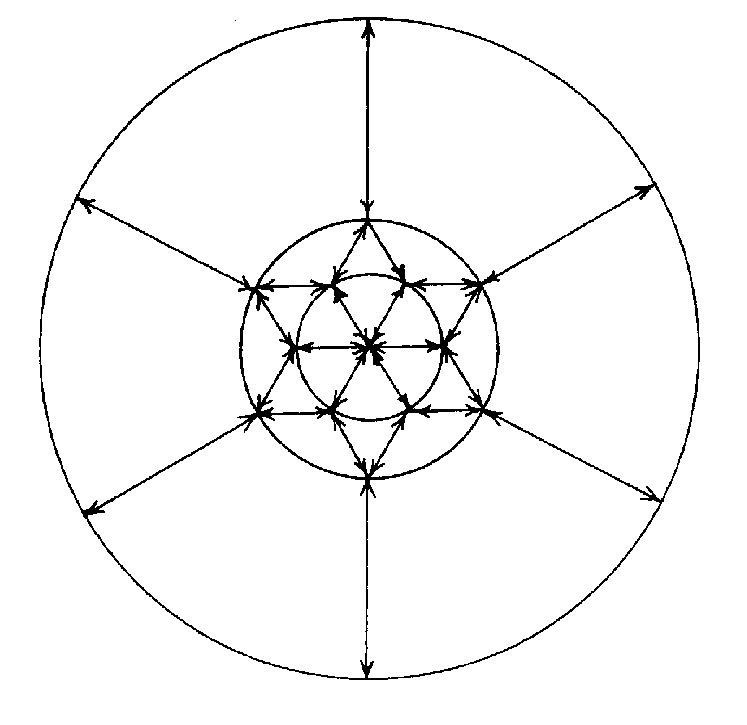
The inner circle at the centre depicts the surface boundary of the muon charge and so the small arrow-marked lengths are the radius a of the muon charge. The field cavity formed between that radius a and the sphere depicted at an intermediate radius can be seen, from the geometry of the standing wave system shown, to cause that intermediate radius to be 31/2 times a. This therefore should complete the picture of the two wave systems, that of the electron and the muon.
However, even if I can justify the above model for the muon in the state in which it demonstrates its g-factor, I confess some apprehension in using the Compton wavelength as applied to the muon. My concern arises from the fact that my whole aether theory is based on the aether having a rhythmic motion in universal synchrony at the frequency determined by equating the rest-mass energy of the electron and the photon energy that corresponds to the Compton wavelength of the electron. In short, whereas the electron wavelength is fundamental to the aether and so the aether can control the electron’s wavelength properties, for the muon to have a corresponding wavelength, shortened by a factor of some 207th (the inverse of the muon/electron mass ratio) of the electron wavelength, raises some doubts.
I am inclined to accept that the rest-mass energy of the muon, if equated to that of a high energy photon, will indicate a very high frequency and a tiny wavelength, but do wonder how that specific wavelength can be kept constant as an influence regulating the properties of the muon in spin. I much prefer the thought that a resonance condition linked to the radius of the muon charge is involved in the determination of the precise value of the effective wavelength. With this in mind I explored the proposition that the Compton wavelength λ of the muon or a small integer multiple thereof could be an integer times that charge radius.
Rigorous analysis revealed that 2λ was indeed quite close to being such an integer multiple, the latter integer being 2583, and this meant that the effective value of the term 2π/α was precisely 861.
It is then a simple matter of algebra to reformulate the g-factor of the muon in a way more conducive to accurate calculation using a hand-held calculator. One obtains:
which is:
which we now suggest could, owing to a resonance, be:
Upon evaluation this is:
which compares with the recently measured value given above of:
So you see, the ‘aether’ interpretation of particle physics, as based on an understanding of the causal factors governing α, when combined with the Thomson charge formula, gives a result superior to that of the so-called Standard Model.
It remains to be seen how even more precise measurement of the muon g-factor will affect what has been presented here, but, at least for the moment, all seems well.
Note that the Thomson charge formula:
gives the radius a of a charge e having a rest-mass m. In units of a the Compton wavelength h/mc is then hc/e2 multiplied by 3/2 and so you can see how a charge of radius a enclosed in a field cavity of radius 31/2a, when set alongside a λ/2 distance, will account for that term 4/31/2 in the above equations. Also, the 4/3 factor when divided into 861 gives 645.75 as a measure of (λ/2)a, which means that 2λ is 2583a or 3 times 861a. The resonant wave action of the muon involved overriding the formal value of 2π/α of 861.0225 and replacing it by 861.
Now, in spite of this theory giving such a satisfactory result, one needs to point out that the muon form under test at Brookhaven was in a very artificial state. The muons were moving at relativistic speeds with their energies enhanced more than 29 times. Such muons would have to be in bare charge form, albeit then complying with the Thomson formula, but surely lacking the structure of the composite charge form by which their rest-mass value is determined as being 206.768 259(62) times that of the electron, which I see is a recent measurement of record in Particle Data (European Physical Journal 15, No. 1 (2000) at p. 314).
I can but therefore refer to my 1983 paper entitled ‘The Mass of The Muon’, where I showed, using the same theoretical principles as discussed above, that the muon in its low energy structured state will have a mass in electron mass terms of:
which is comfortably within the estimated range of error of the measurement.
I note that the Standard Model offers no explanation of the mass of the muon.
CONCERNING PARTICLE LIFETIMES
Since the question of particle lifetime may arise where, as in the Brookhaven experiment, muons are travelling at speeds augmenting their mass by a factor of 29 it is appropriate to comment on the phenomenon involved. The aether has an underworld of a quantum-electrodynamic activity in which electron-positron pairs and muon-pairs are ever active. The electron does have a finite lifetime of the order of 10-13 seconds, whereas the muon has a finite lifetime measured in microseconds. The former is less in evidence because when the electron decays it is replaced by another electron and so the phenomenon is only manifested by experiments in which electrons are assumed to ‘tunnel’ through potential barriers. In fact the electrons decay into the aether on one side of the potential barrier and reappear from the aether on the other side of that barrier.
The muon lifetime can be derived theoretically from first principles as is shown in my 1980 book Physics Unified at p. 146. The theory indicated a lifetime of 2.1973 microseconds, whereas the measured value (1976) was:
Now, when a muon moves at very high speed, such as that applicable in the Brookhaven experiment, it is accompanied by an entourage of muon pairs in measure, on average, equal to the mass-energy added as kinetic energy. Accordingly, its chance of decay changes, because the muon runs around and hides amongst the muons in its field entourage by partnering, as it were, one of the muons of opposite polarity. If ‘hit’ by a decay transient when so partnered it will merely annihilate its partner and a new muon pair will reappear nearby. If ‘hit’ when it stands in isolation, then it will decay into an electron in the normal way. The odds of such a ‘hit’ therefore diminish as the mass-energy represented by that muon field increase, in a direct inverse relationship so that the muon lifetime ‘appears’ to be time-dilated according to the formula we refer to as the ‘relativistic’ mass increase, even though the physics involved owes nothing to Albert Einstein.
Now, that said, it is appropriate to speculate as to why the g-factors of the electron and the muon are different. Referring to the above figure one sees that the wave resonance for the electron is assumed to be confined to a cavity region between a field cavity enclosing the charge and the sphere separation the spin mass energy from the external field energy. In contrast the wave resonance assigned to the muon is assumed to extend through the central field cavity region. Note that the former, electron resonance state, involves waves reflected between a concave outer surface and a convex inner surface, whereas the muon resonance involves waves reflected between two concave surfaces. The former is seen as a less stable state and this is consistent with the electron being relatively short-lived compared with the muon. Accordingly, I suspect that the particle lifetime determines which resonance condition is adopted, but this is a feature of the theory that can but be somewhat speculative at this time. It is, after all, one step to decode what is hidden by the numbers involved, the secret behind those specific g-factor values, and another step to find the correct interpretation of that result. I can but leave that as a source of inspiration for others.
A NOTE CONCERNING GRAVITY
Astute readers may have noticed that, with regard to the muon, I have not introduced the correction for gravitational potential that was applied to the electron. The reason for this needs some explanation.
There is something quite unusual about the experimental physics used in measuring the electron g-factor and the muon g-factor. The theoretical physics treatment applies the methods of Standard Model to both, as if they have a common basis, with one simply having more mass than the other. Yet the electron g-factor does not involve measurements in which the electron mass has been increased nearly 30-fold, as applies to the reported muon experiment, owing to its acceleration to ultra-high energy at close to the speed of light. This may not seem to be of much importance, given that the experiment allows the g-factor to be measured with such high precision, but herein may be hidden the key which unlocks a door giving access to something having a truly fundamental bearing upon gravitation. It may be something that strikes a death blow to the heart of Einstein’s General Theory of Relativity.
Simply stated, take note that we have in issue three energy components each of which manifests itself as mass. Firstly, there is the mass of the energy bounded within that field cavity system centred on the electron or the muon. This is the ‘spin’ mass. Secondly, there is the mass of the energy of the particle that lies outside that cavity and which, together with the spin mass, accounts for the normal mass of the particle that we sense for translational motion, including normal orbital motion if the path radius is high in relation to the Compton wavelength. Thirdly, there is the extra mass arising from the kinetic energy acquired by a particle in moving at speed, a mass which, in the case of the reported muon g-factor measurements, is 29 times that of basic mass of the particle.
Now, viewing this from the background of my aether theory and its extension to give account of gravity, I have good reason to believe that only the spin mass is subject to the force of gravity. The reason is that the spin motion is a quantum condition involving a jitter motion in which the particle moves at the Compton electron frequency in a very small orbit in synchrony with the corresponding motion of other matter and it is balanced dynamically by a graviton system. The latter sets up the force of gravity. In contrast, the added mass energy effective in translational motion is that of a physical field system that is too dispersed for it to share the ‘spin’ motion which induces the gravitational reaction.
The result is that ‘spin’ mass is slightly less than the normal mass and so we have that anomalous component of the electron g/2 factor. However, owing to there being a gravitational potential effective here on Earth, and owing to the fact that the energy associated with gravitational potential is negative, Nature keeps the energy books balanced by keeping a small amount of thermal energy at the seat of the particles subject to that gravitational potential, and this, in fact, as referenced on the electric charge form of the underlying aether accounts for the 2.7K temperature in the Earth’s locality. That is all explained in my 1980 book Physics Unified pp. 175-177 as is the fact that the gravitational potential prevalent here on Earth is almost wholly attributable to the mass of the Earth and the mass of the Sun. It amounts to 9.493×10⁸ joules as between the Sun plus Earth and one kilogram of matter here on Earth. Half of this is effective in augmenting the non-spin mass of the electron as tested in our Earth laboratory. Therefore, division of this energy by the speed of light squared, that is division by 8.987×10¹⁶ m2/s4 gives us the factor 5.281×10⁻⁹. As we have seen above, the anomalous electron g/2-factor will therefore be increased by this small amount owing to the effect of gravity.
Now, when we consider the muon, we have the problem that the spin mass-energy is overwhelmed by a factor of nearly 30 owing to the energy added in bringing the muon up to the speed associated with the 3.09 GeV beam energy. This form of added energy is that possessed by the induction a statistical presence of virtual lepton pairs, positive and negative muon-sized particles that feature in the quantum-electrodynamic background of space. Such an energy form is not part of the system of matter that is involved in gravitation. It is non-gravitational and so the muon of the Brookhaven tests is not subject to g/2-factor enhancement by that 5.281×10⁻⁹ factor. The energy does exhibit the normal g-factor properties because each individual virtual muon still has its field cavity system and stands as a particle subject to segregated quantum and non-quantum states of motion alongside the core muon. Yet only the latter particle senses the effect of gravity and so one can only justify adding about 3% of that factor to augment the g/2 value. As this is less than 2 parts in 1010 and the experimental error of the Brookhaven measurement is 14 parts in 1010, the case presented in this Web Lecture holds.
However, the point of special interest is that here, in the experiment under discussion, we see a route forward if one wishes to challenge Einstein’s General Theory of Relativity. That theory will not tolerate the argument that gravitational mass and inertial mass can be distinguished. Yet, here, we have seen reason for saying that energy added by motion, the energy that augments mass upon division by c2, will exhibit inertial effects but not gravitational effects. That is something that warrants attention by theoretical physicists intent on probing physics to its limits in their search for their ‘holy grail’, the Unified Field Theory.
CONCLUSION
Now, in conclusion, I will not summarize what has been said above. Instead, I will end by referring to a communication I received by E-mail even as I was compiling this Physics Lecture for posting on the Web.
The message was sent to me on February 23, 2001 by Richard Geist who lives in Michigan, USA and I hope he will not mind me quoting two relevant passages:
“I wanted to make sure it had come to your attention that a new measurement of the g-factor has been reported (g=1.0011659203) by the Brookhaven National Laboratory. The short article in U.S. News and World Report (2/19/01) calls it “…the first sign of error in the biggest theory of all, the so-called Standard Model….”
You may recall I ordered a copy of “Physics Unified” in August of 1999 and you were kind enough to sign it for me. …. Lastly, I was fortunate enough to obtain a used copy of “Physics Without Einstein”. I know that with your remaining copies of this book you wanted them to be placed into libraries, so I expect it will not be received as good news that libraries are dropping the book. But I wanted to assure you that you have a long-term proponent of your theory. I like to describe your efforts as that of the consumate engineer trying to solve a problem. Your theory is geared towards predicting known quantities (an aim atypical of physicists), paying close attention to inconsistencies in prior theories and unexplained experimental findings, logically building upon prior theoretical efforts (the aether theories abandoned after Einstein). The systematic, logical nature of your approach – and incredible attention to detail – should be evident to anyone with an open mind willing to take the time to study your work. But that is it in a nutshell, is it not: finding open minded people, able and willing to take the time to study your work is a rarity.”
All I can say is: “Thank you, Richard Geist, and may others, particularly those who build their physics interest on an engineering background, come to see the creative forces of Nature as building our universe from an energy background rather than from a complex system of mathematical symbols woven into a multi-dimensional mould that defies imagination. I have heard it said by adherents of relativistic doctrine that “God is a Mathematician” but the skills needed to build the world in seven days are closer to those of the engineer.
Meanwhile, however, I just hope that one or two of those 68 authors of the Physics Review Letters paper reporting the muon g-factor measurement will scan through this Web Lecture and learn about something that rivals the Standard Model. Hopefully, having regard to the comments of Richard Geist, this will be before all of those library copies of my book Physics without Einstein are committed to oblivion.