1983e
The following is a paper by H. Aspden published in Lettere al Nuovo Cimento, v. 37, pp. 210-214 (1983).
THE NATURE OF THE MUON
Abstract: A quark-like model of the muon based upon the Thomson formula for the electron is correlated with a recent account of the muon g-factor and shown to determine the muon-electron mass ratio. The theory indicates that this is 206.6787, in close accord with its measured value. The model involves a resonance governed by the period at which a disturbance propagates around the electron charge, the radius being the same as that of the de Sitter micro-universe model of the electron suggested by Caldirola.
Commentary: Readers should understand that the author’s aether theory revealed that the vacuum energy sea comprises ‘virtual’ muons, meaning muons of a primordial form that only exist in that subtle medium we are terming ‘aether’. Such virtual muons have a calculable energy in relation to rest-mass energy of a real muon. It is 206.3329. The author had to confront the problem of reconciling this with the mass of the real muon and the subject paper develops that theme.

Full text of the paper (transcribed from the PDF)
Transcribed from the scanned pages of the printed paper. [p. N] marks where each printed page begins; figures are cut from the scans. The PDF above is the original.
[p. 210]
LETTERE AL NUOVO CIMENTO Vol. 37, N. 6 11 Giugno 1983
The Nature of the Muon.
IBM United Kingdom Ltd., Hursley Laboratories, Winchester, England
(ricevuto il 18 Gennaio 1983; manoscritto revisionato ricevuto il 20 Aprile 1983)
PACS. 12.70. – Hadron mass formulae.
Summary. – A quarklike model of the muon based upon the Thomson formula for the electron is correlated with a recent account of the muon g-factor and shown to determine the muon-electron mass ratio. The theory indicates that this is 206.7687, in close accord with its measured value. The model involves a resonance governed by the period at which a disturbance propagates around the electron charge, the radius of which is the same as that of the de Sitter microuniverse model of the electron suggested by Caldirola.
It seems likely that in the highly energetic parts of our universe energy quanta nucleated by electron-sized charges can merge to create numerous particle forms. The question why particular particles exist may then reduce simply to the understanding of their relative stability. It will be shown that there is something quite special about the muon in this contest for survival, because it can interact with the electron in a unique way by setting up a natural resonance within a radial-field cavity. The model differs from that of Caldirola (1), which requires the muon to be an electron excited to a higher-mass state and the electron to constitute a de Sitter microuniverse governed by a specific time unit known as the « chronon ». However, as will be shown, there is an interesting connection which should encourage further research.
Suppose N electron and positrons combine to form a charged particle of mass Nm and charge e, where m is the electron mass and e the electron charge. The mass of the muon is approximately 206.77m and, though this is not in accord with the integral relationship, we can imagine a quarklike combination of the core charge + e with two electrons each of charge − e, under less energetic conditions, so that the total energy, allowing for offset by Coulomb interaction forces, can be nonintegral in electron terms.
The most simple particle model of this kind, based on N being 207, would be one with a core charge + e of energy 207 mc2 with two electrons symmetrically disposed on either side at centres distant Δ from the centre of the core charge. If this is taken to be a negative muon (the positive one having two positrons and a negative core)
(1) P. Caldirola: Nuovo Cimento A, 45, 549 (1978).
[p. 211] then, in electron mass units m, we find that its mass will be
207 + 2 − 2(e2/Δ)(1/mc2) + (e2/2Δ)(1/mc2) .(1)
The author (2-4) has found the Thomson formula
m = 2e2/3ac2(2)
to be quite effective in the interpretation of charge properties, particularly in developing a heuristic model for explaining the electron and muon anomalous magnetic moment (the g-factor). Formula (2) correlates the electric energy of a charge e of radius a with its mass m, c being the speed of light in vacuo.
From (1) and (2) the muon mass expression becomes
209 − (9/4)(a/Δ) .(3)
The g-factor theory has a resonant feature by which the mass difference for translational motion and spin arises from the separation of field energy outside the cavity from the spin component. There is a field resonance at speed c for radial oscillations between an inner cavity radius and an outer-field cavity radius. The radial spacing between the cavities is half the Compton wave-length. The inner cavity radius is determined by a balance of energy scattered and energy radiated, as with Thomson scattering, and is found to be √3 times the charge radius a given by formula (2).
The g-factors of the electron and muon are then found to be
½g = 1 + 1/(hc/e2 − 1 ± 4/√3) ,(4)
where hc/e2 is a parameter in the fine-structure constant α = 2πe2/hc and the plus sign applies to the electron resonance, whereas the minus sign applies to the muon resonance. The reason for the difference in resonance mode as between electron and muon concerns the stability conditions and whether the radial oscillations penetrate the inner-field cavity so as to be reflected on its inner surface rather than its outer surface.
This model for cavity resonance has an interesting bearing upon the evaluation of the mass expression (3). The electron radius is a and the muon radius, from formula (2), is a/207. The inner cavity radius of the muon is √3a/207. The minimum possible value of Δ/a is therefore 1 + 1/207 and, from (3), this corresponds to a minimum muon mass of 206.760 8m, which is very slightly smaller than the measured value reported by Casperson (5) of 206.768 59(29).
The table below of comparative values of mass and Δ/a applies, if we write Δ/a = 1 + δ/207, where δ is a measure, in terms of charge radius, of the spacing between the surface of the sphere bounding the electron charge and the centre of the muon field cavity.
(2) H. Aspden: Int. J. Theor. Phys., 16, 401 (1977).
(3) H. Aspden: Lett. Nuovo Cimento, 33, 213 (1982).
(4) H. Aspden: Lett. Nuovo Cimento, 33, 481 (1982).
(5) D. E. Casperon: Phys. Rev. Lett., 38, 956 (1977).
[p. 212]
| Muon mass | δ |
|---|---|
| 206.7682m | 1.688 |
| 206.7683m | 1.697 |
| 206.7684m | 1.707 |
| 206.7685m | 1.716 |
| 206.7686m | 1.725 |
| 206.7687m | 1.735 |
| 206.7688m | 1.744 |
The basic quarklike model of the muon presumably has its two electrons positioned so that their charge surfaces are either in touching relationship or very close to this relative to the inner-field cavity boundary of the muon. For touching relationship a value of δ of √3 or 1.732 applies, corresponding to a muon mass of 206.768 7m.
In contrast, the muon g-factor given by the formula (4), which also relies on this same δ value, is 2(1.001 165 89) in good accord with the measured value of 2(1.001 165 895(27)) as listed by Cohen and Taylor (6). In this calculation a value of α−1 of 136.036 is used.
It would be remarkable if the explanation of the muon g-factor and the muon mass in terms of a √3 cavity radius factor were merely fortuitous. The electrons are, it would seem, kept outside the inner cavity radius by the same actions which make this radius a reflecting boundary for radiation.
The analysis suggests that, given an available energy quantum of the order of 208mc2 or 209mc2, one might expect to create a particle mass having the precise value associated with the muon. The author has suggested elsewhere (7) a process by which such an energy quantum is formed naturally and has further drawn attention to the possible correlation of muon mass mμ, proton mass mp and the proton spin magnetic moment, also involving α. The proton spin magnetic moment in nuclear magnetons is given by
(0.8/(1 − 2α))(mp/2mμ − 1) .(5)
With α−1 as 137.036, mp as 1836.152 and the experimental value of this quantity known to be 2.792 845 6, we find that mμ, also in electron units, is, from (5), very close to the value deduced above. It is 206.7689.
There remains also the key question concerning the possible existence of other particles according to the model discussed. This may be answered from a remarkable feature of the model evident when the electrons and the outer-field cavity centred on the positive-charge core are drawn to scale, as in fig. 1.
The electrons are wholly located in the field cavity of the muon. The distance between the inner and outer cavity radii is ½λC(m/mμ), where λC is the electron Compton frequency. In contrast, the diameter of the electron is 2αλC/3π.
(6) E. R. Cohen and B. N. Taylor: J. Phys. Chem. Ref. Data, 2, 663 (1973).
(7) H. Aspden: Physics Unified (Southampton, 1980), p. 140-142.
[p. 213]
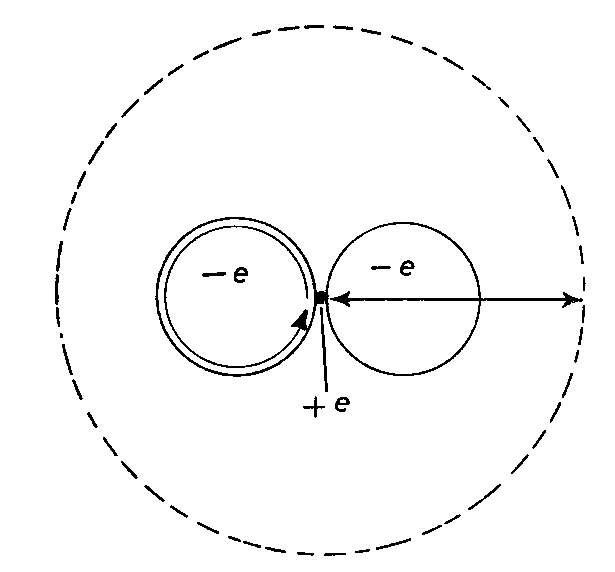
The time taken for an oscillation to traverse the return distance radially between the cavity boundaries is, therefore, almost exactly the same as that needed for a disturbance to travel at the same speed c around the periphery of the electron charge. This is because mμ/m ≃ 3/2α ≃ 206. No doubt, therefore, this helps to determine the unique resonance condition of the muon mass level and accounts for the quasi-stability of the muon. It is noted that it is easy to show that the speed at which a disturbance propagates within the body of charge of the Thomson electron is exactly c. It follows directly from the pressure and energy density, both uniform, within the body of charge.
On the theory proposed above the Compton wave-length for the electron will become an integral multiple of the Compton wave-length associated with the core charge of the muon, because N = 207. Bearing in mind that the radiation process involves an inward and an outward flow of energy, this should establish a resonance state by setting up standing-wave boundaries in the field. This is because the integral relationship between the frequencies assures that common boundary conditions for standing waves at both frequencies are possible. This could be the reason why the muon is held relatively stable with a core mass component that is an integral multiple of the electron mass.
It is important to correlate the rather simple model of charge depicting the muon in fig. 1 with the more sophisticated proposals of Caldirola (1). Caldirola’s theory has the advantage of embracing relativistic criteria by the remarkable intuitive step of introducing the basic unit of time, the « chronon », given by
θ0 = 2e2/3mc3(6)
and regarding the electron as analogous to a de Sitter microuniverse having a positive constant curvature given by 1/c2θ02.
In (6) e and m are the electron charge and rest mass of the electron, respectively. Thus θ0 is the time taken by a disturbance propagating at the speed c to traverse the radius a of the electron charge specified by the Thomson formula (2). This radius, therefore, becomes that of the electron’s de Sitter microuniverse in Caldirola’s theory.
The excited state of the electron which constitutes the muon can, therefore, be a state in which there is resonance as between the disturbance propagating around the boundary of the electron’s de Sitter world and one propagating radially within the cavity boundaries setting the Compton wave-length of the muon.
Caldirola (1) was able to formulate the approximate relationship
(mμ − m)c2 ≈ (3/2)(hc/2πe2)mc2(7)
[p. 214] from his analysis, a theme well supported by Freyberger (8) and further developed by Caldirola (9,10) by being applied to predict the existence of high-energy leptons.
Meanwhile, it should also be mentioned that the concept of a particle bounded by a resonant cavity has been proposed by Jennison and Drinkwater (11) as a method of explaining inertia.
So far as this paper is concerned, it may point the way towards bridging the gap between the approximation of eq. (7) and the actual measured mass of the muon, by underlining the role played by the cavity dimension of √3 times the effective muon charge radius. Finally, it is noted that there are advantages in the muon model presented in fig. 1, in that the decay process may be easier to understand. The decay product is an electron, resulting from the mutual annihilation of the positive core charge and one electron. This yields energy and traces of two neutrinos represented by the imbalance of the spatial volume represented by the electron annihilation. This bears upon the creation and decay processes discussed elsewhere by the author (12,13) in regard to the psi-particles, because energy, charge and the volume occupied by charge overall tends to be conserved in particle interactions.
(8) D. Freyberger: Phys. Rev. D., 24, 979 (1981).
(9) P. Caldirola: Lett. Nuovo Cimento, 27, 225 (1980).
(10) P. Caldirola: Lett. Nuovo Cimento (in press).
(11) R. C. Jennison and A. J. Drinkwater: J. Phys. A, 10, 167 (1977).
(12) H. Aspden: Spec. Science and Technology, 1, 59 (1978).
(13) H. Aspden: Lett. Nuovo Cimento, 26, 257 (1979).