1983f
The following is a paper by H. Aspden published in Lettere al Nuovo Cimento, v. 37, pp. 307-311 (1983).
THEORETICAL RESONANCES FOR PARTICLE-ANTIPARTICLE COLLISIONS BASED ON THE THOMSON ELECTRON MODEL
Abstract: A hypothetical quantum-statistical lepton particle model which gives a non-relativistic account of time dilation is shown also to predict natural resonances for quark-containing particles colliding with their antiparticles of equal energy. For proton and antiproton collisions the hypothesis indicates only one resonance between 70 and 95 Gev. This is at 82.03 GeV, a result in accord with recently reported experiments at CERN aimed at detecting the W-boson.
Commentary: The author here developed the charge-pair-creation theory by which the kinetic energy of a particle in motion is really a statistical energy of a mean presence of particle-pairs in the surrounding field. This is shown to give a phenomenological basis for the observations usually associated with relativistic mass increase and relativistic time dilation. High energy transitions based on these principles indicate a spectrum of particles developed from a base particle and it is further shown that the proton base particle develops a spectrum including the W intermediate vector boson.

Full text of the paper (transcribed from the PDF)
Transcribed from the scanned pages of the printed paper. [p. N] marks where each printed page begins; figures are cut from the scans. The PDF above is the original.
[p. 307]
LETTERE AL NUOVO CIMENTO Vol. 37, N. 8 25 Giugno 1983
Theoretical Resonances for Particle-Antiparticle Collisions Based on the Thomson Electron Model.
IBM United Kingdom Ltd., Hursley Laboratories
Winchester, Hampshire S021 2JN, England
(ricevuto il 12 Aprile 1983)
PACS. 13.20. – Leptonic and semi-leptonic decays of mesons.
Summary. – A hypothetical quantum-statistical lepton particle model which gives a nonrelativistic account of time dilation is shown also to predict natural resonances for quark-containing particles colliding with their antiparticles of equal energy. For proton and antiproton collisions the hypothesis indicates only one resonance between 70 and 95 GeV. This is at 82.03 GeV, a result in accord with recently reported experiments at CERN aimed at detecting the W-boson.
Although it is generally accepted that the increase in muon lifetime with speed is a consequence of time dilation according to Einstein’s theory of relativity, it is prudent to explore alternative hypotheses on occasion, if only to strengthen confidence in the primary theory. If the alternative can explain other phenomena, newly discovered, then there is cause for some reassessment of basic theory.
There are very few viable phenomenological accounts for the apparent time dilation properties of the decay lifetimes of mesons. Experiments (1) have well confirmed that the relativistic formula
τ = τ0/(1 − v2/c2)1/2(1)
holds for the lifetime τ of a muon moving at speed v. Here c is the speed of light in vacuo and τ0 is the muon lifetime at zero speed relative to the observer.
Cullwick (2) has suggested that the fact that the energy E of a particle increases with speed, according to the formula
E = E0/(1 − v2/c2)1/2 ,(2)
(1) J. Bailey and E. Picasso: Prog. Nucl. Phys., 12, 62 (1970).
(2) E. G. Cullwick: Bull. Inst. Phys., 52 (1959).
[p. 308] suggests a direct and proportional relationship between lifetime and energy. E0 is the rest mass energy of the particle.
According to Cullwick, the evidence favouring time dilation, as judged from meson lifetime measurements, is equally evidence for a hypothesis that the lifetime of a particular particle is enhanced in proportion to the energy it acquires from its motion.
This author (3) believes that an explanation of increased lifetimes of particles caused by their motion should await a viable theory for particle decay at rest. In principle, given such a theory, the doctrines of special relativity suffice to explain the increase in lifetime as viewed by an observer in relative motion, but it would be gratifying if a complementary explanation were available which is phenomenologically related to the processes of decay at rest.
Such an explanation can be developed by correlation with the author’s recent theoretical derivations of the lifetimes of the pion and neutron (4,5). The latter theory supposes that space is permeated by virtual muon pairs which migrate about in a random statistical manner at the electron Compton frequency mc2/h. Particle decay is then a function of the probability of the particle coming sufficiently close to one of these virtual muons of opposite polarity. Here m is the electron mass and h is Planck’s constant.
In common with the theory used in ref. (4,5), the hypothesis to be developed relies upon the Thomson concept of an electron charge e as having a bounding radius a given by
a = 2e2/3mc2 .(3)
This expression is also applicable to other simple charges e having mass m as used in a more general sense.
The hypothesis by which we can develop lifetime as a function of the speed of the particle is that the properties of the vacuum medium are such that the space occupied by a particle, that is the volume 4πa3/3, remains constant on a statistical mean basis as the particle fluctuates in form and includes virtual charge pairs in its field, induced as energy is exchanged statistically about a zero mean by interaction with the vacuum. These same principles are incorporated in a 1978 account and its sequel in 1979 by which the author (6,7) sought to explain the nature of the psi-particles and the resonance associated with their decay products.
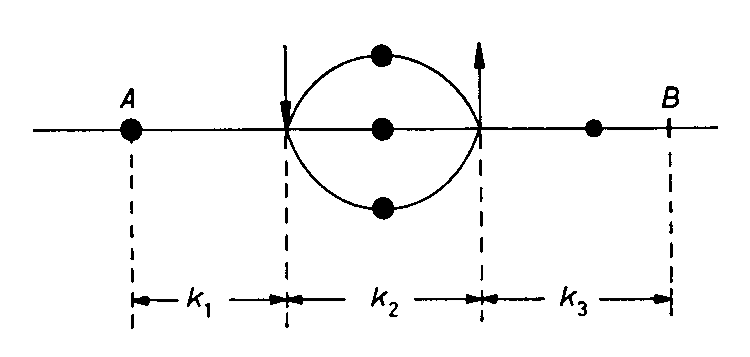
Figure 1 represents diagrammatically the hypothetical process just proposed. A particle at A satisfies the Thomson equation (3) and moves towards B. For a proportion k1 of its time of travel it has the simple phyisical form associated with its rest
(3) H. Aspden: Physics Unified (Southampton, 1980), p. 145.
(4) H. Aspden: Lett. Nuovo Cimento, 33, 237 (1982).
(5) H. Aspden: Lett. Nuovo Cimento, 31, 383 (1981).
(6) H. Aspden: Spec. Science Tech., 1, 59 (1978).
(7) H. Aspden: Lett. Nuovo Cimento, 26, 257 (1979).
[p. 309] state, that is it occupies a space volume 4πa3/3 and has an energy E0. For a proportion k2 of its travel time it has this same form, but is further associated with a pair or pairs of oppositely charged virtual particles identically satisfying the Thomson equation. Thus charge parity is conserved, but an energy quantum depicted by the arrow has been absorbed from the vacuum medium to ensure that there is enough energy (2N + 1)E0 to sustain the existence of these N pairs of charges in addition to the primary charge.
The action of creating the charge pairs causes a space volume fluctuation, owing to the extra space needed by the induced charges. As a result, upon the emission of the energy quantum coupled with the mutual annihilation of the charge pairs to restore the energy balance, the primary charge reverts to its isolated state, but in so doing it assumes a contracted form for a period proportional to k3 before reverting to its initial state. In this contracted form the primary charge has the reduced volume given by the Thomson formula in relation to its full energy E.
This seemingly elaborate model presents the optimum system conditions for i) pair creation ii) mean-volume conservation and iii) mean-energy conservation, as linked with exchanges between the system and the vacuum medium. The conditions can be formulated as three equations from which k1, k2 and k3 can be deduced. Thus
k1 + k2 + k3 = 1 ,(4)
k1 + (2N + 1)k2 + (E0/E)3k3 = 1 ,(5)
k1E0 + (2N + 1)k2E0 + k3E = E .(6)
Charge parity is ensured by specifying that N is an integer. Equation (4) merely ensures the relationship between the time parameters. Equation (5) expresses the unit volume conservation, bearing in mind that the charge radius given by equation (3) is inversely proportional to energy and so a charge of energy E will have a volume (E0/E)3 times that of the charge in its rest state of energy E0. Equation (6) gives the energy balance.
The lifetime of the particle, by the principles discussed in ref. (4,5) is reduced, the greater the volume displaced on the average by the primary charge. There is then a greater chance of and annihilating encounter with the migrant muon system. Hence decay occurs with a reduced probability owing to the offset of 2Nk2 from unity, corresponding to the volume of the created pairs. Their decay is irrelevant because the system is constantly creating and annihilating them anyway. For high-energy particles (E0/E)3 is small and can be neglected in eq. (5) so that when the 2Nk2 term is offset we are left with k1 + k2 as a direct measure of the probability of decay in relation to unity. Thus
(k1 + k2)τ = τ0 .(7)
From (4), (5) and (6), this is shown to be
τ = τ0(E/E0) ,(8)
when (E/E0) is appreciably greater than unity. The thoretical time of decay therefore converges rapidly upon the relativistic value as the speed of the particle closely approaches the speed of light. This result is in accord with the proposal made by Cullwick.
It is conventional to test the time dilation formula by measurements on mesons [p. 310] having very high energies, but this theory suggests that tests at lower energies might reveal discrepancies which could be of significance.
The hypothesis just discussed has particular bearing upon particles which readily induce virtual charge pairs of similar type, the notable example being the muon. It would help the model further if the electron itself had a recognized lifetime. None is of record, but one readily could question whether in fact the electron does decay but merely constitutes its own decay product and recreates itself after decay by reappearing in its near vicinity. Thus the decay phenomenon may pass undetected.
When we consider particles which include quarks, that is particles other than electrons and muons, there is a further dimension introduced into the model. The three conditions of charge parity conservation, charge volume conservation and energy conservation require a triple set of equations of state satisfied by energy exchanges with the vacuum medium. If, however, there are three quarks in the make-up of the particle, the quarks can collectively assure that the three conservation conditions are satisfied without requiring any energy exchanges with the vacuum medium. It may then be that the time dilation phenomenon is somewhat anomalous when manifested by quark-structured particles and it does not suffice to verify time dilation by experiments on muons.
Meanwhile, we can still test the theory on the supposition that, with volume conservation assured by exchanges between the quarks, the critical energy thresholds for resonance with the charges of the separate quarks having minimal interdependence will be set when the energy E of the particle is enough to create 2N + 1 sets of quarks, each of energy Es and, according to the Thomson formula (3), having a charge volume proportional to (1/Es)3.
For conserved overall volume of charge, including that of the charge pairs induced, we find that there are threshold energy levels given by
E = (2N + 1)Es(9)
and
(2N + 1)(1/Es)3 = K ,(10)
where K is a constant. From these equations
E = (2N + 1)4/3/K1/3 ,(11)
and, with N = 0 corresponding to the rest state E = E0, so that K can be eliminated to obtain threshold values of E at which a resonance condition can be expected. Thus
E = (2N + 1)4/3E0 .(12)
In an experiment in which a particle and an antiparticle of the same energy are brought into collision, the total energy quantum of the resulting object produced by the mutual annihilation of the clustered particle pairs will be twice the value given by (12)
E′ = 2(2N + 1)4/3E0 .(13)
A recent experiment at CERN brought protons and antiprotons into collision with the object of seraching for a resonance in the region of 80 GeV. It was reported that [p. 311] such a resonance appeared at (82 ± 2.4) GeV (8). It is then very relevant to note that with E0 = 0.938 GeV, the energy of the proton mass, the value of E′ given by (13) has but one value of 82.03 GeV between 70 GeV and 95 GeV and this is that for which N is 8.
It is submitted that the discovery of a particle resonance at 82 GeV is not necessarily confirmation of the existence of the W intermediate vector boson.
(8) E. Gabathuler: Lecture on « Quarks and Leptons », IBM Science and Synergy Conference (London, 3-4 March 1983).