1983h
The following is a paper by H. Aspden published in Lettere al Nuovo Cimento, v. 38, 342-344 (1983).
THE MASS OF THE MUON
Abstract: A recently reported resonant-cavity model of the muon is now shown to have an additional resonance mode involving wave propagation around the muon core charge. This resonance gives a slightly modified value of the muon-electron mass ratio and uniquely determines it as 206.7683078, in excellent accord with its latest experimental value 206.768 35(11).
Commentary: By this stage the author well knew that his aether theory could give extremely precise account of the nature of the most fundamental particles. He realized that their properties were only measured to such very high precision to provide the basis for testing new theory, but yet that his was the only viable theory that could give the right answers.
It became a challenge to decipher the form of the simple resonance that could account for the minor residual discrepancies one would expect as due to background energy noise in a physical environment. There had to be such resonances occurring naturally in order to explain why the measurements could be so consistent and definite. This challenge drove the author forward and the author had in mind the magnetic moment properties of the proton, the neutron and the deuteron. However, several other papers were to come before complete success could be reported on all those specific topics. Yet, the author had, whilst listening to a speaker describe neutron measurements at the 1981 Gaithersburg National Bureau of Standards conference, registered in his mind the governing resonance applicable to the neutron, and a full picture was already evolving at that
time.

Full text of the paper (transcribed from the PDF)
Transcribed from the scanned pages of the printed paper. [p. N] marks where each printed page begins; figures are cut from the scans. The PDF above is the original.
[p. 342]
Lettere al Nuovo Cimento Vol. 38, N. 9 29 Ottobre 1983
The author has obtained the permission of the copyright owner Societa Italiana di Fisica to publish this paper here in PDF format.
The Mass of the Muon.
Department of Electrical Engineering
The University of Southampton – Highfield, Southampton S09 5NH, England
(ricevuto il 31 Agosto 1983)
PACS. 12.70. – Hadron mass formulae.
Summary. – A recently reported resonant-cavity model of the muon is now shown to have an additional resonance mode involving wave propagation around the muon core charge. This resonance gives a slightly modified value of the muon-electron mass ratio and uniquely determines it as 206.768 307 8, in excellent accord with its latest experimental value 206.768 35(11).
Very recently the author (1) proposed that the muon has a composite quarklike structure, the negative muon comprising a core charge + e and two electrons − e contained within a resonant cavity. The muon g-factor was related to the dimensions of the cavity and the resonance condition required the propagation and reflection of radial waves within the cavity to be matched to the period in which a wave disturbance travels around the circumference of the electron charge.
A cavity surface surrounding the muon’s core charge has a radius determined by the balance of incident radiation and outgoing Larmor radiation. This radius was found to be √3 times the charge radius p given by the Thomson formula:
p = 2e2/3mpc2 ,(1)
where e is the charge, mp is the mass associated with this charge and c is the speed of light in vacuo. This radius is also the radius of the de Sitter microuniverse model of the electron suggested by Caldirola (2). Caldirola has further suggested that the period of wave propagation around an electron having this radius may be correlated with the effective Compton wave-length of the muon to so determine its mass.
In this way he was able to formulate a value for the muon mass mμ given by
(mμ − m)c2 ≈ (3/2)(hc/(2πe2))mc2 .(2)
(1) H. Aspden: Lett. Nuovo Cimento, 37, 210 (1983).
(2) P. Caldirola: Nuovo Cimento A, 45, 549 (1978).
[p. 343]
Here 2πe2/hc is the fine-structure constant and its reciprocal has a value 137.036, giving mμ/m as 206.554. The electron mass is denoted m.
The author (1) extended the analysis by arguing that the Compton wave-length of the muon is an integer 207 times the electron’s Compton wave-length, based on a wave resonance interaction between the electron and the muon core charge. This latter charge, therefore, has a radius p given by (1) that is a/207, where a is the radius of the electron charge. In this way a value of mμ/m was deduced in terms of the core mass 207 m plus 2 m for the two electrons as offset by Coulomb interaction energy. For location of the electrons in touching relationship with the inner resonant cavity the following formula was obtained:
mμ/m = 209 − (9/4)(207/(207 + √3)) .(3)
This give 206.7687, in quite close accord with the measured value.
The advance now presented recognizes that the two electrons cannot be located precisely in contact with the inner resonant field cavity but must lie very slightly within this cavity radius so as to encounter wave pressure. Furthermore, they must be hold in stable positions relative to the centre of the muon by the resonant impact with waves in the gap between the charges. Such waves are synchronized by a wave resonance associated with propagation around the muon core charge, all such motions involving the speed of light.
This step utilizes principles analogous to those involved in determining the main cavity resonance and the 207 parameter, but referenced, in this latter case, upon the resonance in the propagation around the electron charge.
The resonance system just discussed is depicted in fig. 1.
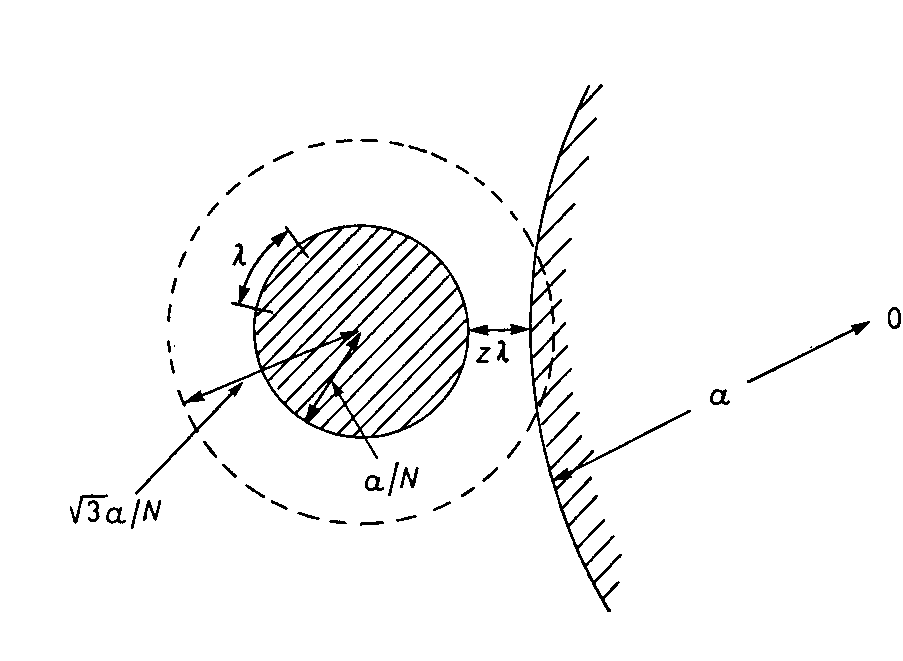
The electron charge of radius a, centred at 0, is shown to intrude slightly into the broken sphere denoting the inner resonant cavity. This sphere has a radius √3a/N, where N is an odd integer corresponding to the formation of the muon core charge by a merger of an odd number of electrons and positrons. The value of N is 207 because λC/N is the nearest an odd integer value of N comes to reaching 2πa, where λC is the Compton wave-length h/mc of the electron and, from (1), a is 2e2/3mc2. Thus 2πa is (2/3)(2πe2/hc)(h/mc) or λC/(205.554), so yielding N = 207.
We envisage a resonance around the circumference of the muon core charge setting [p. 344] up standing waves so that
nλ = 2πa/N ,(4)
where n is an integer and λ the related wave-length. Furthermore, there will be a wave resonance between the electron charge surface and that of the core charge, determining their separation by zλ, where z is also an integer.
The condition by which n is determined is then that for which the lowest value of n assures that
zλ < (√3 − 1)a/N .(5)
This corresponds to the strongest resonance condition capable of holding the muon system stable.
Combining (4) with (5), we obtain
2z/n < 0.233 .(6)
The greater z, the greater n needed to satisfy this condition. Hence z is minimal and so z = 1. The smallest value of n is then 9 because a value of n of 8 is 0.250 and this exceeds 0.233. (4) and (5) then combine to show that the √3 parameter needs to be replaced by 1 + 2π/9 to define the unique condition of resonance indicated for the muon system. Formula (3) can then be written as
mμ/m = N + 2 − (9/4)(N/(N + 1 + 2π/9))(7)
or, since N = 207,
mμ/m = 209 − (9/4)(207/(208 + 2π/9)) .(8)
This is a rigorous formula based upon the integers determined uniquely by the resonance muon model. It gives a value of mμ/m of 206.768 307 8 which accords well with the latest-reported measurement (3) of the muon-electron mass ratio of 206.768 35(11).
It is submitted that such a result, based upon wave resonance properties within the muon charge, should encourage further research along the lines followed by the author. The theoretical value of the muon-electron mass ratio is determined by a very simple formula and accords with the measured value to two parts in ten million and within half the standard deviation estimated for the experiment.
(3) E. Klempt, R. Schulze, H. Wolf, M. Camani, F. N. Gygax, W. Ruegg, A. Schenck and H. Schilling: Phys. Rev. D, 25, 652 (1982).