1983g
The following is a paper by H. Aspden published in Lettere al Nuovo Cimento, v. 38, 206-210 (1983).
MESON LIFETIME DILATION AS A TEST FOR SPECIAL RELATIVITY
Abstract: Predictions from the author’s recent alternative explanation of the apparent time dilation evidenced by meson lifetimes suggest that the dilation of lifetime observed should be
lower than that indicated by special relativity if the tests are made a low enough energies. Reported experimental data supporting this proposition are discussed.
Commentary: When scientists seek funding for new and better experiments needing more powerful equipment they concentrate their field of research into territory at one end of the experimental spectrum. Einstein’s theory is supposed to hold valid over the whole
spectrum. The subject paper shows that this author’s alternative explanation of the apparent ‘time dilation’ of fast-moving muons and kaons points to differences from the Einstein predictions that can be tested experimentally over the mid-velocity ranges. The reported experimental data supports the author’s theory and not that of
Einstein.

Full text of the paper (transcribed from the PDF)
Transcribed from the scanned pages of the printed paper. [p. N] marks where each printed page begins; figures are cut from the scans. The PDF above is the original.
[p. 206]
Lettere al Nuovo Cimento Vol. 38, N. 6 8 Ottobre 1983
The author has obtained the permission of the copyright owner Societa Italiana di Fisica to publish this paper here in PDF format.
Meson Lifetime Dilation as a Test for Special Relativity.
Department of Electrical Engineering, The University of Southampton
Highfield, Southampton S09 5NH, England
(ricevuto il 25 Luglio 1983)
PACS. 13.20. – Leptonic and semi-leptonic decays of mesons.
Summary. – Predictions from the author’s recent alternative explanation of the apparent time dilation evidenced by meson lifetimes suggest that the dilation of lifetime observed should be lower than that indicated by special relativity if the tests are made at low eneough energies. Reported experimental data supporting this proposition are discussed.
Time dilation is the most controversial issue concerning Einstein’s theory of relativity. It is the primary target for critics of the relativistic method, notably Dingle (1) and Essen (2). Yet its verification by appeal to observed meson lifetime dilation is regarded by relativists as the most direct evidence we have in support of relativity. This is greatly to the credit of Einstein’s theory, as mesons were unknown at the time he first enunciated his theory, far less their limited lifetimes and the fact that their decay was dilated with speed. However, as Zappfe (3) has pointed out in his own critical review of relativity, one should be cautious about inferring time dilation from meson lifetimes, in as much as not enough is yet known about the reason for particle decay at rest or the reasons for the differences in the lifetimes of particles according to the media through which they travel.
For the reasons to be presented below, more experiments are needed, not to focus on ranges of test at which there is accord with the relativistic factor, but rather to focus on those ranges where there is maximum discord. The object of such experiments should be to probe the weaknesses of relativity rather than looking solely for evidence aiding its verification.
In a recent paper the author (4) has presented a hypothetical quantum-statistical account of time dilation as evidenced by dependence of meson lifetime upon speed. [p. 207] As noted in that paper, the proposed theory can best be tested by accurate measurements of meson lifetime at low energies, rather than at the very high energies for which the predicted dilation of decay time on this alternative theory tends to the relativistic value. Further analysis, now presented, enables discussion of the feasibility of such tests in the light of comparisons using available data for muon lifetimes.
(1) H. Dingle: Science at the Crossroads (1972), p. 185.
(2) L. Essen: Wireless World, 84, 44 (1978).
(3) C. A. Zappfe: A Reminder on E = Mc2 (Baltimore, Cal., 1982), p. 84.
(4) H. Aspden: Lett. Nuovo Cimento, 37, 307 (1983).
The essential equation of the statistical particle model under consideration depended upon charge parity conservation, space volume conservation subject to fluctuations about a mean value as corresponding charge pairs were created in the rest state and recurrent transformation of the particle form as it changes between its rest state and a contracted state determined by its energy E according to the Thomson formula:
E = 2e2/3a ,(1)
where e is its electric charge and a is a characteristic radius bounding the charge. The radius a defined a sphere which had a space volume associated with the particle when in motion with energy E, but the same formula (1) also gave the radius and so the space volume applicable to the particle in its rest state for which E is written as E0. The faster the particle moves, the greater the ratio E/E0 and the greater the probability that there are induced charge pairs present in association with the basic charge of the particle.
It was from this hypothetical insight into the form of the moving particle that the following three equations were formulated in the original paper (4):
k1 + k2 + k3 = 1 ,(2)
k1 + (2N + 1)k2 + (E0/E)3k3 = 1 ,(3)
k1E0 + (2N + 1)k2E0 + k3E = E .(4)
Here, k1, k2, k3 represent, respectively, the fractional duration of the three states in a unit of time, k1 applying to the state when the particle exists in isolation with energy E0, k2 applying to the state for which it also has N charge pairs of similar energy present and k3 applying to the state for which the particle exists in isolation in the contracted form of energy E.
The particle lifetime is moderated with speed according to the change of an annihilation event affecting the primary particle, whether in its base energy state E0 or its contracted energy state E. The annihilation of a member of one of the induced charge pairs does not affect the observed lifetime because the creation and decay of these pairs is a continuous process anyway and if one of these events is triggered prematurely, this does not affect the overall statistical occupancy of the states as expressed by eqs. (2), (3) and (4). Hence the lifetime τ of the particle can be formulated thus:
1/τ = (k1 + k2)/τ0 + k3/τ′ ,(5)
where τ0 is the lifetime of the particle in its rest state and τ′ is the lifetime of the particle in its contracted full energy state.
Equations (3) and (4), respectively, specify the conditions for conservation of space volume and conservation of energy. They combine to give
k3(1 − α4) = 1 − α ,(6)
where α is E0/E. The faster the particle moves, the smaller α.
[p. 208]
Then, since (5) reduces from (2) to
1/τ = (1 − k3)/τ0 + k3/τ′ ,(7)
we find from (6) that
1/τ = 1/τ0 − ((1 − α)/(1 − α4))(1/τ0 − 1/τ′) .(8)
Much now depends upon the factors by which α is determined. If, for example, the decay time is inversely proportional to the volume of the particle charge region exposed to collision, then we see from (3) that so far, as the k3 period is concerned,
1/τ′ = (1/τ0)(E0/E)3 = α3/τ0 .(9)
This allows (8) and (9) to combine to give
τ/τ0 = (1/α)((1 − α4)/(1 + α2 − 2α3)) .(10)
ατ/τ0 as given by (10) is plotted in fig. 1 as a function of α = E0/E, it being noted that ατ/τ0 would be unity on relativistic theory because E0/E is (1 − v2/c2)½, where v is the speed of the particle and c its limiting speed and because τ is τ0(1 − v2/c2)−½ according to the relativistic explanation of time dilation.
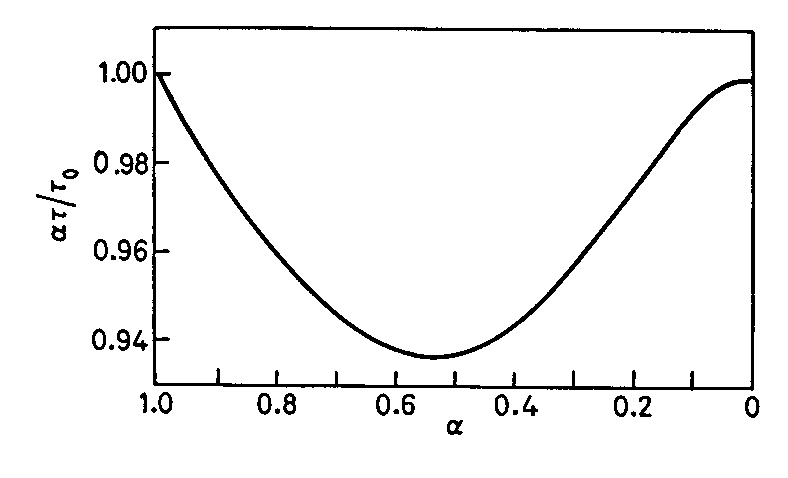
It is seen from fig. 1, and it may be be verified by analysis, that the theoretical value of lifetime predicted by this alternative explanation is somewhat lower than the relativistic value over a range of speeds varying around that for which E0/E is 0.5. Thus when the particle has a speed for which its total mass is doubled we expect its lifetime to be 6.25% below the relativistic value.
This, is, of course, subject to the simple condition imposed by eq. (9), but this general reduction should apply to some extent if the author’s theoretical proposition is basically sound. The author has not found any recorded data giving the muon time dilation parameter in this optimum energy region. However, a primary publication on this subject is that of Bailey and Picasso (5) who measured muon lifetime at very [p. 209] high speed for which the theoretical relativistic value was 26.69 microseconds compared with a rest lifetime of 2.198 microseconds. Thus E0/E or α in this case was 0.082. Equation (10) tells us that the observed lifetime at this value of α should be 0.56% low compared with the relativistic value. This is quite small, but it is also significant because Bailey and Picasso reported measurements to an experimental accuracy of 0.2% and did in fact find that the observed value was lower than the relativistic value by 1.2%.
(5) J. Bailey and E. Picasso: Prog. Nucl. Phys., 12, 62 (1970).
Though they regard this as adequate agreement the difference was sufficiently concerning for them to speculate at some length about the possible reasons for the difference. Only further research can verify this speculation, but it can be said that the question remains open and the indications are that the relativistic expectation is up to 1% above the measured value of the muon lifetime at these energy levels.
Encouraged by this, there is purpose in exploring the basis of eq. (9) in further detail to see how close agreement between this theory and observation may be. First however, it is appropriate to mention the later-reported work of Bailey and Picasso (6). They made measurements of muon lifetime at even higher energies for which E/E0 was 29 or α = 0.034 to find that the discrepancy between the observed value and the relativistic value diminished further. The observed value was low by 0.02% subject to a mean error of 0.09% and, therefore, in satisfying accord with the relativistic value. Tests at such high energies do not permit the alternative theory advanced here to be judged, but the paper just mentioned is helpful in providing a review of similar tests for a number of particles at lower energy values. From the data presented the K±, Ks and K0s decays all show a smaller lifetime than the relativistic value, with the error decreasing as speed brings the particle to higher energy levels. Thus the K± decay was (0.9 ± 0.3)% low at energy levels quoted as E/E0 equal to 3.38 or 4.17. These data tend to support the author’s contention that the discrepancy is accentuated at a low range of E/E0 and could be of the order of a few percent compared with the relativistic norm. It must, however, be noted that the pion decay showed the greatest departure from the relativistic value, being 2.5%out at E/E0 = 2.44 with an error estimate of 0.9%. Although this helps the author’s case for urging more research at such energy levels, the pion is a misfit in the scheme of things because the discrepancy was positive as reported, whereas it should be negative on the simple theory presented here.
Concentrating attention on the muon and the assumption made in deriving eq. (9) a more rigorous investigation will be made in order to compare thist heory with the measurements made by Picasso and Bailey at the α value of 0.082.
The decay event arises because a migrant charge of opposite polarity comes close enough to the particle to trigger the decay condition. Thus a charge − e of energy E′ distant x from the particle of charge + e and energy set by (1) is deemed to be at the decay threshold when
E′ + (2e2)/(3a) − e2/x = 0 .(11)
This expression is merely a statement that decay must occur if the total energy of the system, including that of the Coulomb interaction, has to fluctuate to less than zero in its energy exchanges with the surrounding field. Thus, if E′ = mμc2, where mμ is the rest mass of the muon and the particle of charge + e is a muon so that αE = mμc2, we can write (11) as
(1 + α − (3a)/(2x))mμc2 = 0 ,(12)
(6) J. Bailey and E. Picasso: Nature, 268, 301 (1977).
[p. 210]
to obtain
a/x = (2/3)(1 + α) .(13)
This expresses the decay condition only if x ≥ a, that is, only for the case when α ≤ 0.5, as otherwise the migrant point charge will have entered the zone occupied by the particle’s own charge. This latter condition has been investigated in detail by the author elsewhere (7) in relationship to the muon decay in the rest state. The 2.2 microsecond lifetime of the muon was deduced theoretically using principles similar to those later leading to the derived lifetimes of the neutron (8) and the pion (9). Accordingly, we will merely recite the decay condition from eq. (203) of ref. (7) which indicates that a/x (there expressed as x/y) is given by
(3/2)(a/x) ≈ 1 .(14)
This merely signifies that the point charge causing decay has to penetrate deeper into the body of charge of the particle when the particle has an energy below the α = 0.5 factor relative to the migrant charge.
Thus, from (14), since τ0 is (3/2)3 times the value it would have if decay where merely based upon the statistical chance of the migrant charge entering the full charge volume of the particle, we can write the high-energy decay condition as
1/τ′ = (1/τ0)(3/2)3(x/a0)3 ,(15)
where a0 is the particle charge radius for the rest state. Since a/a0 = α, (13) and (15) combine to give
1/τ′ = (1/τ0)((3/2)(α/(1 + α)))3 ,(16)
which now must be substituted for the assumed expression (9) for the range of α below 0.5. The effect is to modify (10) to become
τ/τ0 = (1/α)((1 − α4)/(1 + kα2 − 2kα3)),(17)
where k is ((3/2)(1/(1 + α)))3.
Taking the experimental value of α of 0.082 used by Bailey and Picasso in their experiment (5), we then use (17) to obtain ατ/τ0 as 0.9853, so that a theoretical relativistic lifetime of 26.69 microseconds expected by Bailey and Picasso implies a theoretical lifetime of 26.30 microseconds according to this alternative theory, a value much more in accord with the observed value of (26.37 ± 0.05) microseconds.
It is submitted that this result does warrant fuller investigation of muon lifetime dilation in the energy range just above twice the muon rest mass in order to focus attention on the region where maximum differences between this theory and relativity are to be expected.
(7) H. Aspden: Physics Unified (Southampton, 1980), p. 146.
(8) H. Aspden: Lett. Nuovo Cimento, 31, 383 (1981).
(9) H. Aspden: Lett. Nuovo Cimento, 33, 237 (1982).