1983j
The following is a paper by H. Aspden published in Lettere al Nuovo Cimento, v. 38, pp. 568-572 (1983).
THE SCOPE FOR FIRST-ORDER TESTS OF LIGHT SPEED ANISOTROPY
Abstract: New optical experiments aimed at testing light speed anisotropy to first-order in v/c are proposed on the basis of an intuitive enquiry into the physical processes by which the
vacuum exhibits zero dispersion when regulating the propagation of light waves. Such experiments can be justified because standing waves are present in experiments of the Michelson-Morley type and these may have a disturbing influence on light propagation speed
in the standing wave region. Though a null result from an initial experiment is reported, the outcome of a second experiment yet to be performed is needed to reach a conclusion from this investigation.
Commentary: The author had, at the time, been involved with correspondence with E.W. Silvertooth, who performed the first experiment mentioned and advised the null finding, but, as yet (1993), the second experiment has not been performed. Note that the
experiment, being of first-order in v/c, should allow the laboratory measurement of the Earth’s eastward speed. It was later that Silvertooth advised he had performed an experiment which sensed a motion at 378 km/s in the direction of constellation Leo.

Full text of the paper (transcribed from the PDF)
Transcribed from the scanned pages of the printed paper. [p. N] marks where each printed page begins; figures are cut from the scans. The PDF above is the original.
[p. 568]
Lettere al Nuovo Cimento Vol. 38, N. 17 24 Dicembre 1983
The author has obtained the permission of the copyright owner Societa Italiana di Fisica to publish this paper here in PDF format.
The Scope for First-Order Tests of Light Speed Anisotropy.
Department of Electrical Engineering, The University of Southampton
Highfield, Southampton S09 5NH, England
(ricevuto il 27 Giugno 1983; manoscritto revisionato ricevuto il 27 Ottobre 1983)
PACS. 07.90. – Other topics in specialized instrumentation.
Summary. – New optical experiments aimed at testing light speed anisotropy to first-order in v/c are proposed on the basis of an intuitive enquiry into the physical processes by which the vacuum exhibits zero dispersion when regulating the propagation of light waves. Such experiments can be justified because standing waves are present in experiments of the Michelson-Morley type and these may have a disturbing influence on light propagation speed in the standing-wave region. Though a null result from an initial experiment is reported, the outcome of a second experiment yet to be performed is needed to reach a conclusion from this investigation.
The interpretation of the null result of the Michelson-Morley experiment and the teachings of special relativity are both founded upon the assumption that light waves travel at the constant speed c relative to the notional observer. With the general acceptance of the theory of relativity one is no longer encouraged to probe the physical processes by which the speed of light waves are determined. Yet the very fact that light waves are deflected, whether by refraction or gravitational deflection, does imply that physical parameters associated with matter can affect the speed of light in an adjacent vacuum region. Even though the general theory of relativity gives an acceptable mathematical treatment of the gravitational deflection of light rays, it is debatable whether it really does give a truly physical justification for the phenomena involved. Therefore, one is ever conscious that the space-time metric of relativity must really describe what is in fact an aether medium in a modern sense.
Some insight into the processes regulating the propagation of light waves may be gained from a consideration of the dispersionless property of the vacuum when conveying these waves. It is quite possible, as the author has suggested elsewhere (1), that the vacuum itself may have the special property of adjusting its response locally so as to be in tune with the instantaneous rate of change (frequency) of the propagated signal. This was inferred because otherwise the physical properties of the vacuum [p. 569] medium, if regulating propagation speed, should (as in a real medium) cause the speed to depend upon frequency.
(1) H. Aspden: Wireless Worls, 88, 39, October issue (1982).
The absence of light dispersion properties is, in the author’s opinion, as important an indicator of the properties of the vacuum medium, as the null of the Michelson-Morley experiment. Indeed, just as Heaviside is well known for his innovation in adapting the properties of the transmission line for telegraphic communication to secure distortionless propagation, so Nature herself has, it would seem, already anticipated Heaviside by providing a self-adjusting property in the vacuum, so as to secure this same result.
The author (1) has presented a physical illustration of the field medium to account for its compliant nature. The essential feature of this model is the introduction of a reciprocal displacement to provide a partial dynamic balance offsetting the normal Maxwell displacement and so causing the natural resonance of the medium to adjust automatically to the frequency of the signal in transit. This condition holds up to a critical frequency deemed to be that corresponding to the threshold at which electromagnetic energy creates electron-positron pairs. Our object here, however, is not to speculate on such physical processes, but rather to discuss the scope for experimental investigation.
Whereas the propagation of a wave can occur without its propagation speed being affected and so without there being any distortion, there are problems with regard to the interference of two waves travelling through one another in opposite directions. The field medium is able to respond to one-way propagation and follow changes in frequency of a composite signal because it has to respond momentarily only to one value of the signal rate of change and one value of its strength. It faces a dilemma in trying to respond to two signals travelling through one another in opposite directions. To the extent that these signals have components of equal amplitude, but different frequency they will combine to generate an amplitude-modulated standing wave which travels relatively slowly, at velocity v, say.
The other components will constitute a normal superimposed signal travelling at the natural propagation speed of the vacuum medium. They represent the surplus energy of the counter-moving signals and this residue travels one way only.
Physically, it can be questioned whether a medium with compliant self-tuning properties normally responding to propagate waves at the characteristic limit speed c will not in some way tend to moderate the slow-moving standing-wave signal. Whereas effects propagated at speed c allow no time for interactions in the medium along the propagation path, this is not the case when there is a standing-wave system. It seems, therefore, at least to be a possibility that the standing-wave system may be moderated in propagation to adopt an equilibrium mode of minimal energy exchange, a mode for which the wave has a uniform and unmodulated amplitude. This, of necessity, means that the energy conveyed by the wave, just as matter itself, can assert some effect upon the speed of propagation, because the counter-moving components of the signal have to move at slightly different speeds relative to an observer witnessing the forward migration of the standing wave. If the physical processes in the vacuum have an adaptive property of some kind, then we cannot hold too firmly to the theoretical belief that the speed of light has to be a fixed quantity in the vacuum, except when matter asserts some influence.
This is an important question because the techniques of the Michelson-Morley experiment rely on the retro-reflection of rays along common paths, whereas the theory of the experiment depends upon the assumption that the interference between the rays does not affect their propagation speeds.
In the Michelson-Morley experiment the reverse ray is produced by reflecting the forward ray at a mirror surface moving at velocity v in the forward direction. Now, it is a well-known fact, easily justified, that in optics such a reflection generates a [p. 570] standing wave which moves with the mirror. The whole wave travels with the mirror surface being at a node as far as the electric vector is concerned and at an antinode as far as the magnetic vector is concerned. It follows that, if f1 is the forward signal frequency and it travels at speed c1 relative to an observer to be reflected at a mirror surface moving at velocity v and produces a reverse wave seen to have frequency f2 and, for generality, travels at a reverse speed c2 relative to the same observer, then from classical Doppler theory
f2 = f1(c2/(c2 + v))((c1 − v)/c1) .(1)
The wave-length λs of the envelope of the standing-wave system can then be written as
λs = (c1N)/f1 = (c2(N ± 1))/f2 .(2)
The plus or minus sign in this expression depends upon whether c1 is greater or less than c2. N is the number of wave-lengths in the primary signal of frequency f1 within the distance λs.
From (1) and (2):
(c1 − v)/(c2 + v) = (1 ± 1/N) .(3)
It then follows from this eq. (3) that, if the physical processes governing the interaction of the wave components of the standing wave can regulate the speeds c1 and c2 slightly so that the standing wave has an unmodulated amplitude along its length for optimum energy exchange, then λs and N are virtually infinite. This causes (3) to reduce to
c1 − v = c2 + v .(4)
In other words, since the mirror is moving at speed v relative to our observer, c1 and c2 are not equal in the observer’s reference frame (a requirement of relativity) but the speed in either direction relative to the moving mirror is the same (a requirement of the Michelson-Morley test). The Michelson-Morley experiment is believed to comply with relativity because the observer was in that case moving with the mirror system.
From such analysis it can be argued that c1 and c2 may well be different for different observers in relative motion and further that, if there were no standing wave, the motion of the light rays would not be governed by the mirrors, but would be governed by the vacuum medium exhibiting its own frame of reference.
This explanation of the null result of the Michelson-Morley experiment reopens the question of detecting motion through the vacuum by further experiment. Pursuing this, one experiment has already been performed to investigate whether the standing wave effect discussed can, contrary to the assumption made in the above analysis, moderate the speed of any additional ray components travelling one way and conveying the residual radiation along the same path. The experiment involved an optical arrangement as shown in fig. 1. The author is greatly indebted to Silvertooth for performing this experiment and reporting the results (2).
(2) E. W. Silvertooth: private communication, May 1983.
[p. 571]
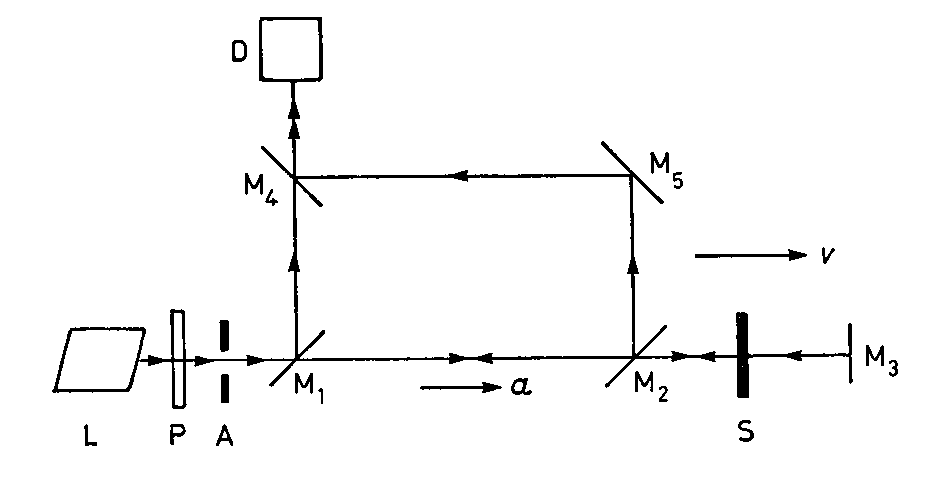
In the apparatus shown schematically in the figure a ray which is linearly polarized travels from the 4 milliwatt HeNe laser L, through a quarter wave plate P and through a limiting aperture A. M1 and M2 are very partially reflecting mirrors formed by uncoated glass plates which reflected about 20% of the incident radiation. M3 and M5 were fully reflecting mirrors and M4 was a half-coated mirror. D denotes the detector of the beam formed by bringing rays from M4 into interference and S is a screen which can be optionally placed into the path between M2 and M3.
The principle of the experiment is to establish a normal interference between the rays entering the detector to achieve a minimum or maximum indication. This is done with the screen S obscuring the mirror M3. Then, with the screen absent and M3 not obscured, it was determined whether or not the detector showed any changed response. With a strong-light ray travelling in the direction a and reflected back on itself in the direction b there should be a standing wave locked into the path between mirrors M1 and M3. If this sets the light speed along this path to a constant value referenced on mirror M3, then the transit time of the ray from M1 to M2 is independent of any motion of the apparatus at velocity v relative to the vacuum medium. However, with the screen S in place this transit time should be dependent upon v, assuming that there is some anisotropy effect.
The test was made when the direction of a was east-west and at a time when the constellation Leo was near the horizon, this corresponding to an anisotropy optimum on the basis of the detection of the anisotropy associated with cosmic background radiation. No detectable change in output from D was observed when the screen S was introduced and removed.
This result was a null finding, showing that, if the effect sought does exist, it is only the ray components of the standing-wave system that have their speeds moderated. The residual component reflected by mirror M2 must transit from M1 without experiencing any interference in propagation from the standing wave.
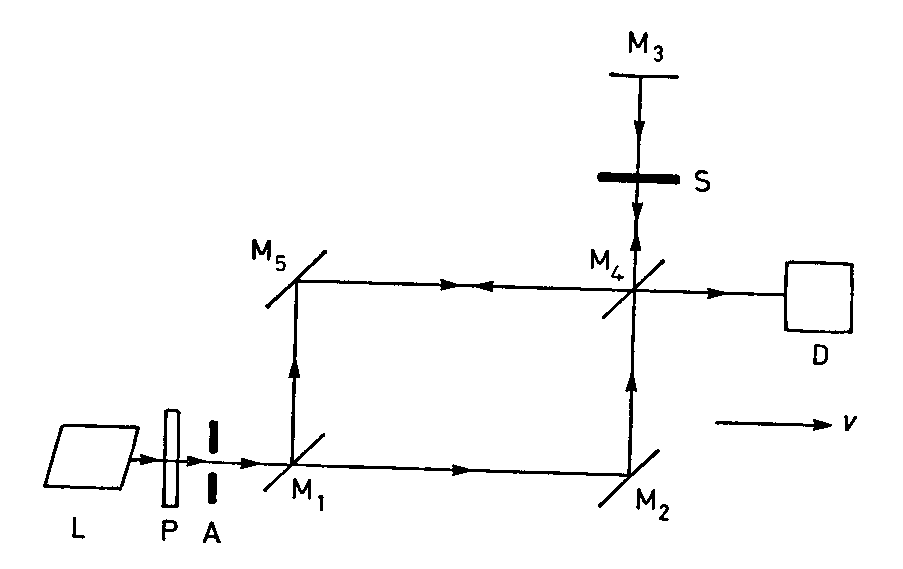
However, an experiment using apparatus as shown in fig. 2 should provide a more direct test. This experiment has not yet been performed, but it should prove conclusively whether standing-wave effects influence the detection of motion through the vacuum in light speed anisotropy measurements. The arrangement is self-evident from fig. 2 and the analogous description of fig. 1. Mirror M1 is about 20% reflecting as before, but M2 is fully reflecting and M4 is half-reflecting. This should cause the rays travelling in opposite directions between M5 and M4 to have the same intensity and so develop a standing wave with no residual signal. Thus the ray emerging from this standing wave and passing into the detector must have travelled at the moderated speed without indicating any anisotropy. This is the speed c indicated. In contrast the ray travelling from M1 to M2 will have a speed c − v, if what is sought applies, v being the speed at which the apparatus travels through the vacuum medium. With the screen S [p. 572] present and the standing wave eliminated, the ray traversing from M5 to M4 will also move at speed c − v. It follows that insertion or removal of the screen should cause the interference pattern to slip through a number of wave-lengths linearly proportional to the anisotropy speed v.
Until this experiment is carried out and its result is known, the many experiments on light speed anisotropy hitherto reported and involving retro-reflection of waves along the same ray path to secure the detected interference are, in the light of what has been said in this paper, open to question.
It is noted that the experiment should also utilize a Faraday isolator to prevent undue feedback to the laser from the mirror system. The quarter wave plate in fig. 1 and 2 acts as a spoiler by converting circularly polarized light into plane polarized light, so facilitating inspection of the pattern of interference. The limiting aperture makes it possible to redirect rays along the incident path upon reflection at M3 by adjusting M3 to centre the reflection on the aperture and minimize any image on the surface adjacent the aperture.
This research is part of a program of enquiry into the nature of the electromagnetic reference frame and particularly its relevance to the interpretation of the Trouton-Noble experiment. The null of this Trouton-Noble experiment, if divorced from its relativistic explanation, provides the last empirical fact needed to determine the general law of electrodynamics (4), which is generic to the Lorentz law as applied to closed-circuit situations, but it gives scope for a unification with the form of Einstein’s law of gravitation when applied to actions between discrete elements (5).
* * *
The author acknowledges the help afforded him by Dr. J. P. Wesley in emphasizing the significance of standing-wave effects in the interpretation of the Michelson-Morley experiment.
(3) F. T. Trouton and H. R. Noble: Philos. Trans. R. Soc. London, Ser. A, 202, 165 (1903).
(4) H. Aspden: J. Franklin Inst., 287, 179 (1969).
(5) H. Aspden: J. Phys. A, 13, 3649 (1980).