1983k
The following is a paper by H. Aspden published in Lettere al Nuovo Cimento, v. 38, pp. 243-246 (1983).
PLANAR BOUNDARIES OF THE SPACE-TIME LATTICE
Abstract: Having regard to the developing interest in a lattice-structured vacuum in intepreting the structure of particles, an aspect of the electrically structured lattice model of the vacuum is discussed in relation to electric field energy. It is shown that a necessary condition is that the lattice should have planar boundaries. This implies a domain structure somewhat analogous to that found in ferromagnetic materials.
The subject of the paper is discussed elsewhere in these Web pages. See WHY HAWKING IS WRONG!. Several quoted sections are there included.

Full text of the paper (transcribed from the PDF)
Transcribed from the scanned pages of the printed paper. [p. N] marks where each printed page begins; figures are cut from the scans. The PDF above is the original.
[p. 243]
Lettere al Nuovo Cimento Vol. 38, N. 7 15 Ottobre 1983
The author has obtained the permission of the copyright owner Societa Italiana di Fisica to publish this paper here in PDF format.
Planar Boundaries of the Space-Time Lattice.
H. Aspden
Department of Electrical Engineering
University of Southampton – Southampton, S09 5NH, England
(ricevuto il 15 Luglio 1983)
PACS. 12.20. – Electromagnetic and unified gauge fields.
Summary. – Having regard to the developing interest in a lattice-structured vacuum in interpreting the structure of particles, an aspect of the electrically structured lattice model of the vacuum is discussed in relation to electric-field energy. It is shown that a necessary condition is that the lattice should have planar boundaries. This implies a domain structure somewhat analogous to that found in ferromagnetic materials.
Modern physical theory is tending to regard the vacuum medium as having structure somewhat analogous to that of crystalline materials. Thus we see Weisskopf (1) discussing quantum electroweak dynamics and asserting that the Higgs field implies that the vacuum has a certain fixed direction in isospace, namely that of the spinor associated with the Higgs field. Weisskopf states that the situation is like that of a ferromagnet, in which the direction in real space is determined as long as the energy transfers are smaller than the Curie energy.
This, of course, implies an ordered structure of the vacuum medium, a feature discussed at some length by Rebbi (2) in an article entitled The lattice theory of quark confinement. Rebbi refers to a 1974 proposal by Wilson that QCD (Quantum Chromodynamics) should be formulated on a cubic lattice, an array that divides space and time into discrete points, but is essentially an approximation to real space-time. The advantage is that this allows calculations to be made that would otherwise be impossible.
This author, in collaboration with Dr. M. Eagles, has advocated the analysis of a vacuum structure and shown how a value of the fine-structure constant correct to about one part in a million can be determined by a cubic lattice model of the vacuum (3). Further research on this model has now shown the essential need for a particular boundary condition imposed upon a physical portrayal of the vacuum state expressed in terms of electrical charge. It is in view of the current interest in lattice theory as [p. 244] applied to the vacuum field system that it seems appropriate to draw attention to what has been, to the author at least, a rather elusive consideration.
(1) V. F. Weisskopf: Phys. Today, 34-11, 69 (1981).
(2) C. Rebbi: Sci. Am., 248, 36 (1983).
(3) H. Aspden and D. M. Eagles: Phys. Lett. A, 41, 423 (1972).
The vacuum is seen to be electrically neutral on a macroscopic scale. It has long been regarded as the seat of electric displacement currents according to Maxwell’s theory and so should have some electrical content microscopically. In recent times the physical character of the vacuum could be ignored by reliance upon Maxwell’s equations, but experiments by Graham and Lahoz (4) have now given cause for coming back to the position that the vacuum does contain electrical structure and can be the seat of forces asserted on test apparatus.
If the elements of this vacuum structure are in a state of stable equilibrium and comprise electric charge, then, in order to satisfy Earnshaw’s law, they must pervade a charged electrical continuum of opposite polarity. The latter is necessary to assure stability by providing a restoring action upon displacement. Accordingly, the only feasible electrical model for a vacuum state having structure is one for which discrete charges q of the same polarity interact to form a lattice within a continuum of opposite charge density σ. It seems logical to suppose that the charges q are of equal magnitude and that σ is uniform over a local region of space.
Then, by simple analysis, one may show that if a lattice parameter d is written to satisfy
q = σd3 ,(1)
the electrically-neutral state of the vacuum implies that each charge q takes up a space volume d3. With a uniform electric field of intensity E applied we find that the charges q will all be displaced in unison to satisfy
Eq = kx ,(2)
where k is a constant restoring force rate and x is displacement. In effect, the whole lattice is displaced relative to the background continuum.
The energy density stored by this displacement is
W = ½kx2/d3(3)
or, from (2)
W = ½(Eq)2/kd3(4)
and as this is E2/8π, for a vacuum of unit permittivity, we find that k is given by
k = 4πq2/d3 = 4πσq(5)
from (1), thereby justifying the statement that it is a constant.
The use of this restoring force rate is fundamental to classical electron theory and it might seem somewhat elementary to have derived it from the electrically neutral vacuum model under discussion. However, a problem emerges upon analysis of radial displacement of a charge q within an arbitrarily spherical bounded system. At a distance R from the centre of a sphere of continuum charge the total continuum charge acting [p. 245] on q is 4πσR3/3. The electric field is radial and is found by dividing this charge by R2. Thus the electric field is 4πσR/3, where R is now a vector.
(4) G. M. Graham and D. G. Lahoz: Nature (London), 285, 154 (1980).
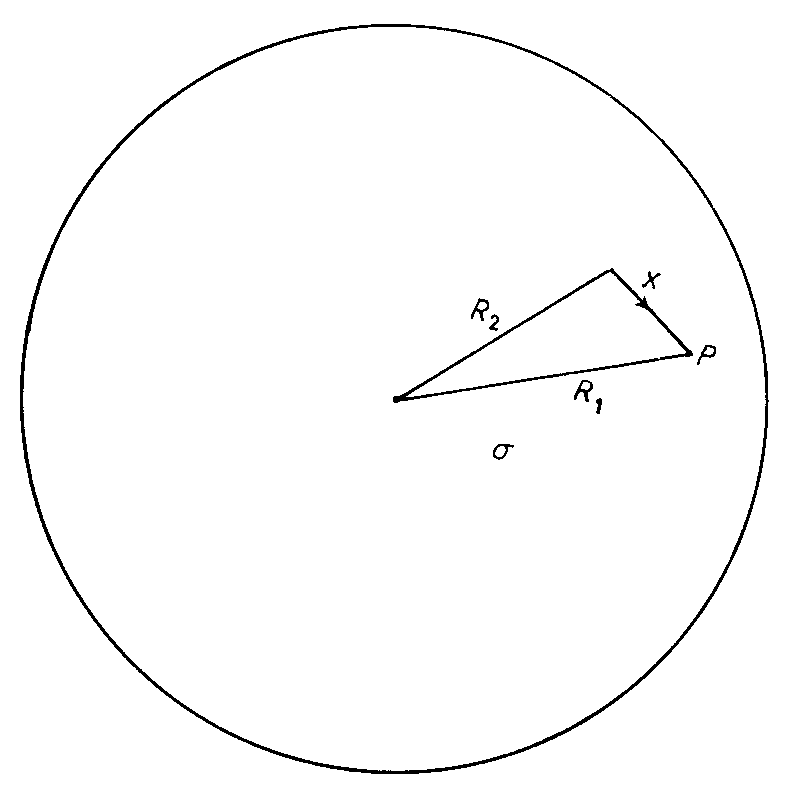
For any displacement x, as shown in fig. 1, a charge q at P will be subject to a restoring force which is the expression 4πσ/3 times the vector difference between two radius vectors R1 and R2. This is simply (4π/3)σx. It follows that if q is part of a rigid lattice which is displaced as a whole by the distance x within the bounding spherical continuum, then the lattice is subject to restoring forces which are only one-third those expected from eq. (5).
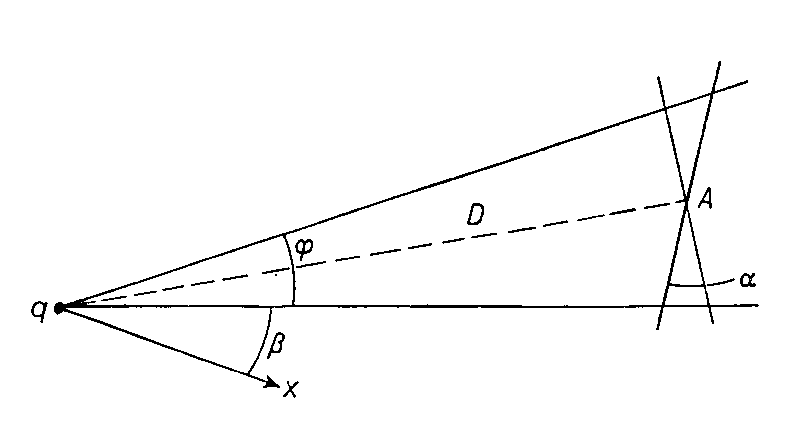
Now consider a charge q at a position at which it subtends a solid angle φ with respect to an elemental area A at a planar boundary of the continuum. Let α be the angle between this surface of area A and a plane surface drawn normal to the line joining q and A. This is shown in fig. 2.
Suppose now that q is displaced slightly through a distance x and that the corresponding displacement along qA is y. The effect of this is to cause the electric potential due to the continuum in the same solid angle to reduce in effect upon q. It is as if q were left at rest and a planar slice of thickness y cos α were removed from the boundary surface. The electric field acting on q is, therefore, reduced by Aσy cos α/D2, where D is the distance of q from A. Now, the solid angle φ intercepts a spherical surface distant D over an area φD2 and this must be A cos α. It then follows that the electric field changes by φσy, owing to the component effect of the continuum contained by the planar boundary and this solid angle φ. If qA is at an angle β to the displacement x then we find that y cos β = x, but since the force qφσy due to the elemental continuum segment shown acts at this same angle to x the force resolves into a component along x of qφσy cos β. This is qφσx and it sums upon integration over a full solid angle of 4π to 4πqσx to give the restoring force set by (5).
It follows that, provided the boundaries of the continuum space domain are planar we will have conformity with the normal energy density formulation. Conversely, since the energy density has to be that known from experimental observation, we can say that a lattice-structured space of the kind described must have planar boundaries, a feature which further enhances the analogy with the ferromagnetic state. We may [p. 246] then wonder whether we may yet discover the further property that space itself does have the domain structure predicted by this enquiry.
It remains to be seen whether such domain structure would be of a microscopic nature confined to the dimensions of elementary particles or whether it may even extend to a cosmic scale. One consequence of the latter possibility is the prospect that electric polarities of lattice charge and continuum may be reversed in adjacent domains, a kind of antispace analogous with antimatter. Alternatively, there may be a harmonius cyclic motion which is shared by the lattice, but which is reversed in adjacent domains. Either way, if one argues that rotation shared with the Earth causes the space medium to induce the geomagnetic field (as suggested by Aspden (5)), it is to be expected that geomagnetic field reversals might signal a traversal of a cosmic space domain. By correlating the pattern of such geomagnetic field reversals with the Earth’s cosmic motion through space we may then plot any large scale domain structure of the vacuum. Some evidence of this is presented elsewhere (6,7), the cubic structure of the space medium being evidenced by reversals which occur in pairs as the Earth traverses obliquely near a cube edge.
The main point of this paper, however, is showing that planar boundaries are indicated from field energy considerations. It is also relevant to note that, if the lattice displacement in the structured vacuum were subject to propagation delays, the analysis would present the conflict discussed above because the symmetrical propagation would imply spherical boundary action. The answer to this could be that lattice displacement which involves no lattice distortion keeps the relative spacings of all charges unchanged and so the energy associated with their interaction is not affected. If no energy is transferred, then the action appears to be one of harmonius motion and what may otherwise be taken to be an action at a distance. This result may have some bearing upon the reported conflicts between quantum theory and the theory of relativity involving the measurement of polarization of matched pairs of photons and their apparent coupling at speeds in excess of the speed of light.
* * *
The author concludes by thanking Dr. D. M. Eagles who drew attention to the problem of the restoring force anomaly for spherically bounded systems and has urged its resolution.
(5) H. Aspden: Institute of Physics Conf. Ser., No. 66 (London 1983), p. 179.
(6) H. Aspden: Catastrophist Geology, 2, 42 (1977).
(7) H. Aspden: Physics Unified (Southampton, 1980), p. 170.