1984b
The following is a paper by H. Aspden published in Lettere al Nuovo Cimento, v. 39, pp. 247-251 (1984).
‘ELECTROMAGNETIC RADIATION PARADOX’
Abstract: Alternative explanations for free-electron diamagnetism appear paradoxical and inconsistent with the reactive induction properties of magnetic materials. It is shown that the paradox can be eliminated by a generalized definition of the magnetic field with interesting spin-off consequences, including a justification for the anomalous doubling of the positron’s effective mass in a free-electron environment.
Commentary: Here, once again, the author drew attention to his theme on diamagnetic reaction as the clear evidence of the need for an aether capable of justifying the g-factor of 2. This time, however, the author pointed to its relevance to positron reaction properties. Whereas Dirac-type theory implies symmetry, the experiments reveal the asymmetry which this author’s theory implies.

Full text of the paper (transcribed from the PDF)
Transcribed from the scanned pages of the printed paper. [p. N] marks where each printed page begins; figures are cut from the scans. The PDF above is the original.
[p. 247]
Lettere al Nuovo Cimento Vol. 39, N. 11 17 Marzo 1984
The author has obtained the permission of the copyright owner Societa Italiana di Fisica to publish this paper here in PDF format.
Electromagnetic Reaction Paradox.
H. Aspden
Department of Electrical Engineering, University of Southampton
Highfield – Southampton, SO9 5NH, England
(ricevuto il 25 Gennaio 1984)
PACS. 71.60. – Positron states.
Summary. – Alternative explanations for free-electron diamagnetism appear paradoxical and inconsistent with the reactive induction properties of magnetic materials. It is shown that the paradox can be eliminated by a generalized definition of the magnetic field with interesting spin-off consequences, including a justification for the anomalous doubling of the positron’s effective mass in a free-electron environment.
There are several alternative explanations for the apparent absence of significant diamagnetic reaction from free electrons owing to their motion in conductors subject to steady magnetic fields. Van Vleck (1) refers to the theorem of Miss van Leeuwen and the work of Bohr in showing that classical Boltzmann statistics deny that electrons should assert any diamagnetic reaction. Van Vleck further suggests that free electrons do produce a reaction field, but that other electrons deflected at the boundary surface by a potential barrier are guided around that surface so as to produce an exactly compensating field.
Van Vleck then qualifies his account by noting that «in a true theory, quantum modifications must be taken into account, and … in quantum mechanics there is a diamagnetic effect from free electrons». Dingle (2) has investigated this subject extensively to find that such effects are still very much smaller than one could expect from a full electron reaction. A general assumption by which such a primary diamagnetic state is discounted is connected with the fact that the Lorentz force acts on the electrons at right angles to their motion and so the magnetic field can in no way be affected by electron reaction because energy is not transferred by electron reaction because energy is not transferred in this process. This same argument is used (3) to show that the magnetic moment of charged particles subject to a changing magnetic field is adiabatically invariant.
(1) J. H. Van Vleck: The Theory of Electric and Magnetic Susceptibilities, Oxford University Press (1932), p. 94.
(2) R. B. Dingle: Proc. R. Soc. London, Ser. A, 211, 500 (1952).
(3) E. U. Condon and H. Odishaw: Handbook of Physics, 2nd Ed. (McGraw-Hill, New York, N. Y., 1967), p. 4, 193.
[p. 248]
It is paradoxical to argue from the Lorentz force that a changing magnetic field cannot transfer energy to reacting electrons. Experience from magnetic induction and eddy-current effects tells us that there are induced electromotive forces acting on electrons in their direction of motion. The fact that there appears to be no free-electron diamagnetism commensurate with the energy of the ordering magnetic field present is perplexing. Quantization or statistical attempts to interpret the result may provide the answer, but there may still be a more deep-rooted explanation.
The principal paradox, however, is that there are so many alternative explanations for the same phenomenon, a fact which implies that none is sufficiently convincing.
A plausible answer to the paradox appears if we examine the empirical origins of the electromagnetic field as induced by charge in motion. The empirical data in Ampère’s early work concerns the forces of interaction between currents. This was extended by Maxwell (4) and has been reviewed by Whittaker (5). Whether one terms it the law of Grassmann or that of Biot and Savart, the point is that, in scalar vector form, the force asserted by a current i in a circuit element ds, when acting upon a current i′ in a circuit element ds′ at a vector separation distance r, is known empirically to be
F = (ii′/r3){(ds′·r)ds − (ds·ds′)r} .(1)
Both Maxwell and Whittaker observed that this law could contain a term (ds·r)ds′, because the empirical data concerned only observations for which i was circuital and this term vanishes under these conditions. Some authors argue that this is irrelevant because displacement currents in the field invariably render charge motion effectively circuital so that (1) applies rigorously for action between isolated charges.
Equation (1) can be written in the form
F = (ii′/r3)∫s[ds′[dsr]](2)
and from this one can define the magnetic field H as
H = ki∫s(1/r3)[dsr](3)
and write the force F as
F = (i′/k)[ds′H] .(4)
Since it is force and current that are measured, the field H is somewhat arbitrary, serving only as a connection between the two eqs. (3) and (4).
However, we have independently defined the field H by analogy with the properties of magnets and known that the apparent value of H, in the units we are using and for action in the vacuum medium, is such that k above is unity. The inconsistency arises in our use of empirical data which inevitably involves diamagnetic effects. If the magnetic field produced by the current i is really augmented by the factor k and [p. 249] offset by diamagnetic effects which make k appear to be unity, then we can adhere to the usual force formula witk k = 1 in (4), but accept that H is then given by a more elaborate version of (3):
H = ki∫s(1/r3)[dsr] − kΣiR∫s(1/r3)[dsr] ,(5)
where iR signifies reaction currents generating diamagnetic effects.
(4) J. C. Maxwell: A Treatise on Electricity and Magnetism, 1954, Vol. 2 (Dover Ed, Yew York, N. Y., 1891), p. 174.
(5) E. Whittaker: A History of the Theories of Aether and Electricity: The Classical Theories (Nelson, London, 1951), p. 87.
k is not unity in (5) but has a value which assures that the equation adopts the form
H = kH − HR ,(6)
where HR is the diamagnetic reaction field and is 4πk times the current moment of reacting charge in unit volume. Let q, m and v denote the electromagnetic charge, mass and speed of a reacting charge element deflected by the field H into a circular orbit and orientated to produce a field component in opposition to H. Let r be the radius of the orbit. Then qvr/2 is the current moment and
HR = 4πkΣ (qvr/2) .(7)
Also, since (4) applies with k unity,
Hqv = mv2/r(8)
and the summation over unit volume of (qvr/2) becomes, from (8), Σ (½mv2)/H. We write this kinetic-energy density term as E/H and combine (6), (7) and (8) to show that
H = kH − 4πkE/H(9)
or
E = (H2/4π)(1 − 1/k) .(10)
In the magnetization process an energy density of H2/8π is fed into the field as H increases from zero. The resulting induction of electromotive forces around any path in the field can supply the additional kinetic energy given by (10) and this indicates that E is, by its very nature, the magnetic energy stored by the field. Thus we see that k must be 2.
In effect, therefore, the free reacting charge in the field medium stores magnetic energy and invariably exhibits a diamagnetic component of reaction which cancels half of the induced field, leaving quantum and statistical processes to account for secondary effects in the accepted way.
This phenomenon passes unnoticed in most situations because, as eq. (3) shows with k = 2, the induced field is double that measured. However, it does have consequences which appear in special situations, including at least the following three.
Firstly, the gyromagnetic properties of an orbital charge, whether primary or reacting, will cause the measured ratio of magnetic moment to angular momentum to be double that given by classical theory. This is known to be the case from experiments [p. 250] by Barnett (6) there being a well-established anomaly factor of 2 in the gyromagnetic behaviour of electrons in ferromagnetic substances. Bates (7) has summarized the experimental data demonstrating this phenomenon. It has, however, been interpreted as a spin phenomenon dependent upon Dirac’s theoretical work, with the consequence that theories of ferromagnetism presume that only a small portion of the magnetism arises from the orbital electron motion.
Secondly, the saturation magnetic moments of ferromagnetic materials, which are not integral quanta of the Bohr magneton per atom, become so when we allow for the diamagnetic reaction, at least for iron, nickel and cobalt. This is eastly verified for the body-centred iron structure, on the assumption that one low magnetostriction implies a stress isotropy due to the magnetic state and suggests that the polarization φ Bohr magnetons per atom switches between the three cubic axes to spend one-third of its time in the preferred direction and one-sixth of its time in each of the four orthogonal directions. This produces an average polarization of φ/3 per atom, but this is offset by a diamagnetic effect of φ/6, half the mean polarization, which itself switches about between axes, so as always to oppose the primary polarization φ. Thus the resulting diamagnetic reaction is one-third of φ/6 or φ/18, on average. The measured polarization, from the theory outlined, is, therefore, φ/3 − φ/18 or (5/18)φ.
When this is compared with the measured 2.221 Bohr magnetons per atom, we see that φ is, indeed, an integer, being 8.00. In fact, it should be twice an integer, owing to the double field effect. This is consistent with the ferromagnetic state in iron being attributed to two 3d electrons.
Such theory does depend upon a relatively weak coupling between the primary electron motion and that of the diamagnetic response, but this gives it potential for further research along new and possibly fruitful lines.
Thirdly, whereas the free-electron reaction offsets the field effect of a primary electron and so produces momentum in opposition, we would expect such free electrons to react differently if the primary action is that of a positron. The field reaction would still be half the primary field, but the momentum would augment, rather than offset, that of the positron.
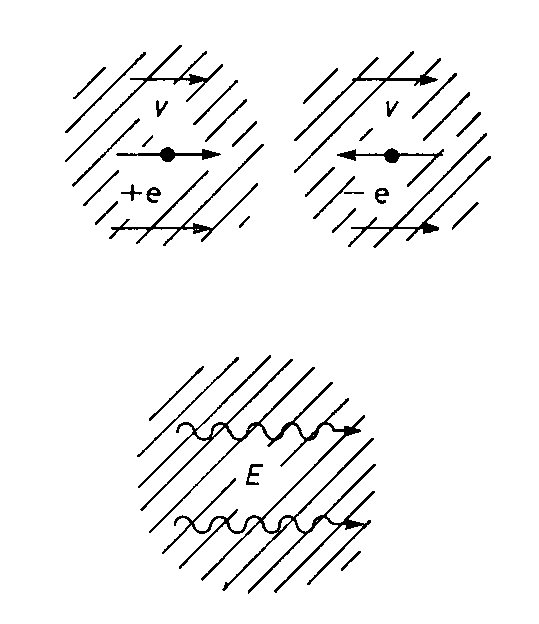
Imagine a positron to be moving through a conductor and to have acquired the thermalized velocity state of the free electrons. A head-on collision between the positron and an electron is depicted in fig. 1, the upper section showing that just before collision the positron of charge + e and the electron of charge − e, both having speed v, are each accompanied by a diamagnetic reaction generated by surrounding electrons and shown shaded. The arrows imply the direction of the momentum carried by each shaded area and, as it originates in electrons, the momentum of each area is half that of the positron. The lower section of fig. 1 depicts the situation after annihilation of the positron and the electron. The energy E of the photon has a momentum residual to the collision that is equal to that possessed initially by the isolated positron. In effect, therefore, we expect that the theory presented should account for an apparent doubling of positron mass as judged from their annihilation from the thermalized state in conductors.
This is exactly what is observed. Steward and Shand (8) reported an experiment designed to test directly whether or not positrons in a metal were thermalized. The authors asserted that what they observed was surprising in that «the positron is thermalized, but has an effective mass in sodium metal approximately twice the rest [p. 251] mass». Their actual result, based upon analysis of photon emission resulting from positron bombardment, gave the positron an effective mass m* of
m* = (1.9 ± 0.4)m ,(11)
where m is electron mass. They concluded that this result was a measure of the many-body mass of a positron in an electron sea.
(6) S. J. Barnett: Rev. Mod. Phys., 7, 136 (1935).
(7) L. F. Bates: Modern Magnetism, 4th Ed. (Cambridge University Press, 1961), p. 243.
(8) A. T. Stewart and J. B. Shand: Phys. Rev. Lett., 16, 261 (1966).
Bergerson and Pajanne (9) later confirmed that Stewart and his co-workers had correctly given the positron mass, also in respect of later work which gave m*/m as 1.8±0.3, 1.8±0.2, 2.1±0.3 and 2.3±0.3 for Li, Na, K and Rb, respectively. Bergerson and Pajanne, however, stressed that, if the mass increase were really due to electron gas effects, there was an inexplicable discrepancy between theory and observation. Their own efforts to explain the effect as due to positron-phonon interaction proved insufficient to account fully for the data and their conclusion was that more experimental work was needed. Meanwhile, Garg and Saraf (10) maintained the view that the positron’s effective mass did depend upon its interaction with the electron gas by inferring a correlation between the apparent variation of m*/m and differences in the electron densities in the substances tested. This supported their early investigations on the lifetime of the positron in an electron gas (11).
It is submitted that this positron mass anomaly is explained by the same diamagnetic reaction actions as evidenced by the gyromagnetic properties of charge and that there is consequently evidence that even in the vacuum field there is reacting charge of some kind having a mass property. This would be in accord with Maxwell’s efforts to explain the nature of displacement in his electromagnetic theory and in accord with the recent experimental findings of Graham and Lahoz (12) who have shown that the vacuum does exhibit inertial properties somewhat in accord with Maxwell’s theory.
(9) B. Bergersen and E. Pajanne: Phys. Rev. B, 3, 1588 (1971).
(10) J. C. Garg and B. L. Saraf: Phys. Lett. A, 31, 144 (1970).
(11) J. C. Garg and B. L. Saraf: Phys. Lett. A, 30, 369 (1969).
(12) G. M. Graham and D. G. Lahoz: Nature (London), 285, 154 (1980).