1984c
The following is a paper by H. Aspden published in Lettere al Nuovo Cimento, v. 39, pp. 271-275 (1984).
‘THE MUON g-FACTOR BY CAVITY RESONANCE THEORY’
Abstract: It is shown that a cavity-resonance model by which the muon/electron mass ratio was recently determined as 206.7683078 yields also a muon g-factor of 2(1.001165918), both of these quantities being in accord with their measured values.

Full text of the paper (transcribed from the PDF)
Transcribed from the scanned pages of the printed paper. [p. N] marks where each printed page begins; figures are cut from the scans. The PDF above is the original.
[p. 271]
Lettere al Nuovo Cimento Vol. 39, N. 12 24 Marzo 1984
The author has obtained the permission of the copyright owner Societa Italiana di Fisica to publish this paper here in PDF format.
The Muon g-Factor by Cavity Resonance Theory.
H. Aspden
Department of Electrical Engineering, University of Southampton
Highfield – Southampton, SO9 5NH, England
(ricevuto il 25 Gennaio 1984)
PACS. 12.90. – Miscellaneous theoretical ideas and models.
Summary. – It is shown that a cavity-resonance model by which the muon/electron mass ratio was recently determined as 206.768 307 8 yields also a muon g-factor of 2(1.001 165 918), both of these quantities being in accord with their measured values.
In a recent paper the author (1) has shown that the time dilation evidenced by the muon can be explained by a quantum-statistical transition between states, including charge-pair creation and balanced exchanges of energy between the muon and the vacuum itself. The governing conditions were 1) charge conservation, 2) energy conservation and 3) conservation of the volume of space occupied by the quarklike charge constituents of a particle, the volume of the space occupied by charge being determined by the Thomson formula
mc2 = 2e2/3a .(1)
Here m is the mass of the charge, c the speed of light, e the electric charge and a the radius bounding the spherical form of the charge.
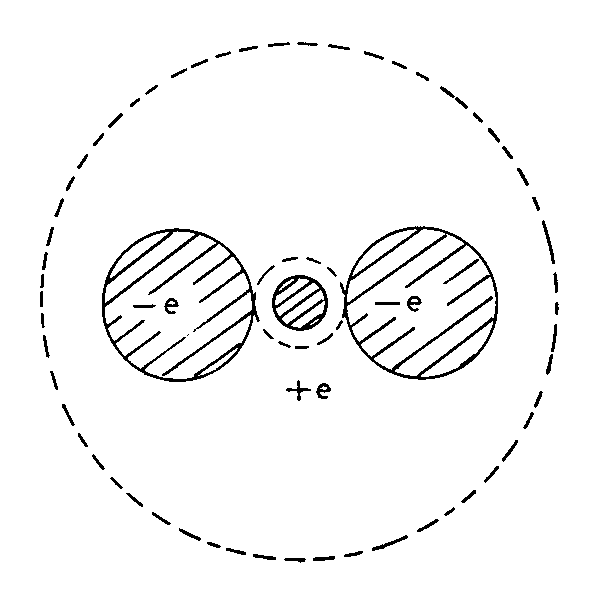
Separately, in another paper, the author (2) has shown that the muon has a mass regulated by its composite structure as three charges, the negative muon comprising a positive core charge + e plus two electrons − e, as illustrated in fig. 1.
The essential feature was the development of a resonance within a cavity centred on the core charge, waves traversing the radial spacing between the cavity boundary and an inner reflecting spherical surface (depicted by the broken circles) in synchronism with a harmonic of the electron’s Compton frequency and in near synchronism with the fundamental of a standing wave on the surface of the electron charge.
(1) H. Aspden: Lett. Nuovo Cimento, 37, 307 (1983).
(2) H. Aspden: Lett. Nuovo Cimento, 37, 210 (1983).
[p. 272]
This determines the muon’s radial cavity spacing as 1/207 times that of the electron. The inner reflecting cavity surface is determined by a balance of energy intercepted from the standing wave across this surface section and the electric-field energy radiation (half the Larmor radiation) from the accelerated charge. For an electron the Thomson scattering cross-section, as quoted in reference books (3), is
(8π/3)(e2/mec2)2(2)
Half of this, from (1), is 3πa2, which tells us that the radius of the inner cavity surface is √3 times the radius of the charge given by the Thomson formula (1). me is the electron mass in (2), but (1) and (2) apply generally to any discrete charge, including the muon core charge.
The radius of this reflecting surface is crucial to the determination of the spacing between the electrons and the central core charge of the muon and so the consequential determination of the rest mass of the muon. Subject to a primary resonance condition involving the standing wave at the surface of the muon core charge, it can be shown that the muon/electron mass ratio is precisely
mμ/me = 209 − (9/4)(207/(208 + 2π/9)) ,(3)
which is 206.768 307 8. This is the subject of a recent paper (4). The measured values known to the author are 206.768 35(11) by Klempt and co-workers (5) and 206.768 272(64) from a conference report (6).
The √3 radius parameter is also crucial to the determination of the anomalous component of the electron g-factor and one can write
(1/2)ge = 1 + 1/(hc/e2 − 1 + 4/3½) ,(4)
(3) E. U. Condon and H. Odishaw: Handbook of Physics (McGraw-Hill, New York, N. Y., 1967), p. 7134.
(4) H. Aspden: Lett. Nuovo Cimento, 38, 342 (1983).
(5) E. Klempt, R. Shulze, H. Wolf, M. Camani, F. N. Cygnx, W. Ruegg, A. Schenck and H. Schilling: Phys. Rev. D, 25, 652 (1982).
(6) A. Rich: Conference paper, Second International Conference on Precision Measurement and Fundamental Constants, National Bureau of Standards (Gaithersburg, 8-12 June 1981).
[p. 273]
where hc/e2 is 2πα−1, α being the fine-structure constant. This formula gives the measured electron g-factor to an accuracy of a few parts in 109, but is subject to a correction for gravitational potential which can bring it into exact accord with the measured value at the level of a few parts in 1012. See Aspden (7). However, the muon g-factor is not known to such accuracy. The author (8) has shown that a second resonance mode internal to the inner reflecting surface which thereby constitutes an inner cavity can modify (4) by changing the plus sign before the term involving the root 3 parameter to a minus. This increases the g-factor and gives a value which suggests that the muon may have such an alternative resonance mode. As shown in ref. (8), the resulting value of ½g is 1.001 165 868 2, based on a value of α−1 of 137.036 0, and this compared with a measured value reported in 1973 of 1.001 165 895(27).
Such a result seemed in excellent accord with the theory for the muon g-factor, but, as Klempt and co-workers (5) report, the measured muon g-factor is now indicating that ½g is 1.001 165 923 0(85). This small difference is enough to warrant a re-examination of the theory of the muon g-factor based on cavity resonance, particularly in the light of the new understanding of the muon charge structure suggested by the explanation of its mass.
The model shown in fig. 1 has one evident disadvantage. This appears at the time of its decay and in connection with the quantum-statistical transition between states mentioned in our introduction. A negative muon decays into a single electron so far as the conservation rules governing transitions between states are concerned. Other rules may affect the traces of neutrinos, as is well known. The problem then is that the space conservation requirement is violated if a muon of the form shown in fig. 1 can decay into a simple electron. The volume of the electron charge given by (1) is many million times larger than the volume of the muon core charge given by the same formula. The logical assumption which follows from this is that the state shown in fig. 1 applies only half of any period of time and that during the other half of this period the core charge has become negative and stands in isolation. This can occur by the quantum-statistical process discussed in ref. (1). The positive core charge may expand spontaneously to transfer an energy quantum to the vacuum surrounding the charge. It expands into a positron which annihilates one electron as the other electron recaptures all the energy to restore energy balance by becoming a negative core charge now having the true muon mass. The charge parity is conserved. The volume conservation is violated transiently, but preserved in average provided the sequence of state change is cyclic. If the mean volume of the muon system is that of one electron, then the muon must change state in the manner suggested, spending half of its time in each state.
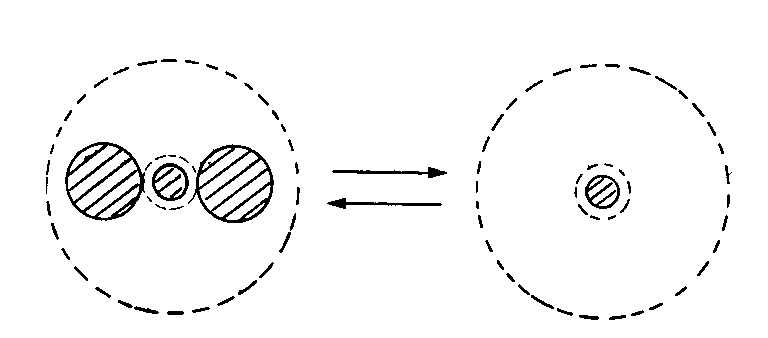
This is depicted in fig. 2, where the muon system of fig. 1 is shown to interchange with one having a single charge. Since the muon mass is 206.768 03me and this is [p. 274] conserved on average on a statistical basis, allowing for some vacuum fluctuations in which energy is exchanged, we may suppose that this second single charge state sometimes comprises a coalesced single charge form of 205 electrons and positrons and sometimes one formed from 207 electrons and positrons. The resonant cavity radial spacing will vary for each of these forms, but will always be equal to a harmonic of half the electron’s Compton wave-length.
(7) H. Aspden: Lett. Nuovo Cimento, 37, 169 (1983).
(8) H. Aspden: Lett. Nuovo Cimento, 33, 481 (1982).
Each of the three charges in the first muon state develops its own cavity resonance centred on its charge, thus providing three overlapping cavities in the associated field systems. The positive core charge has a cavity set by its mass component of 207me, whereas the other negative electron charges have the cavity dimensions of the electron. The g-factor in this state is governed by the mass of the field energy lying outside these cavities. Thus, taking the isolated electron as a reference we may formulate the electron’s g-factor as
½ge = me/ms = 1/(1 − δ) .(5)
The electron’s spin mass ms can be identified with a motion of the electron charge that does not affect the field outside the cavity radius. The mass δme is effectively that of the field located outside the cavity. This is represented in the table below.
| Mass | Electron | Muon | ||
|---|---|---|---|---|
| A | B | C | ||
| outside cavity | δme | 209 δme | 207 δme | 205 δme |
| in spin | (1 − δ)me | mμ − 209 δme | 207 (1 − δ)me | 205 (1 − δ)me |
| total | me | mμ | mμ on average | |
For the muon in its three-charge state A there are 207 + 2 such δme units of mass decoupled from the spin state because the electric-field energy outside a radius which is 1/207 times the cavity radius of the electron is 207 times that applicable to the electron. In the single charge state B or C of the muon there are either 207 or 207 − 2 such mass units in the decoupled field as the muon transiently adopts the resonance mode associated with the shedding of an electron-positron pair in its exchanges with the vacuum, but on average there are 206.768 3 such units, corresponding to the muon mass mμ.
Considering the ratios of the total mass to the spin mass, we find that the muon in states B or C has the same g-factor as the electron, but that in state A it is slightly higher. The actual muon g-factor is found by averaging the action over the half-period in which state A applies and the half period in which states B or C apply. Thus
(1/2)gμ = 2mμ/(mμ − 209 δme + (1 − δ)mμ) .(6)
This can be evaluated because we know mμ/me and δ is known from the electron g-factor as measured and, from (5), δ is 1 − 2/ge. Putting ge as 2(1.001 159 652), its measured value, the corresponding value of δ taken with the known mass ratio of 206.768 3 gives a muon g-factor of 2(1.001 165 918). This is in remarkable agreement with the measured value of 2(1.001 165 923 0 ± 85) already referenced (5). Our theoretical value is about half the standard deviation different from the measured value.
[p. 275]
It is submitted that the model of the muon by which its mass has been determined with such high precision lends itself to a simple quantum-statistical interpretation of the muon g-factor. Only further improvement in the measurement of the muon g-factor can decide how this new theory stands in relation to conventional quantum electrodynamics. QED is reported (6) as giving a theoretical muon g-factor of 2(1.001 165 921), but from a composition of three theoretical contributions. The factor 1 165 921 comprises 1 165 852 as the true QED values plus 67 for a strong-interaction effect plus 2 for a weak-interaction effect and the overall result is uncertain by ±8. Yet such theory, although having full acclaim for its precision in accounting for the measured g-factor, offers no explanation of the muon/electron mass ratio, a parameter which Nature determines in some controlled way to a constancy of about 3 parts in 107. There is benefit in following a theoretical avenue which can embrace both the mass and the g-factor of the muon and, since this paper concludes the research into the resonant-cavity properties of the electron and muon undertaken by the author, it is hoped that the merits of this new theory will be appreciated by those engaged in this field of enquiry.