1984d
The following is a paper by H. Aspden published in Lettere al Nuovo Cimento, v. 40, pp. 53-57 (1984).
‘BOSON CREATION IN A SUB-QUANTUM LATTICE’
Abstract: Photon emission from a cubic lattice in the resonant cavity of an electron implies a specific symmetry in particle groupings involved in boson creation. On this theory the charge W boson at 82.0 Gev is the only proton-based resonance state between 40 Gev and 130 Gev, and the neutral Z boson found at 96 Gev implies the existence of the long-predicted 2.587 Gev primary constituent of the subquantum medium which mediates in gravitational interaction.
Commentary: This paper is important in that it provides a convenient reference to the author’s early derivation of the formula for G, the constant of gravitation, and the author’s derivation of the fine structure constant.
The theme of the paper links the graviton with the neutral Z boson, and this set the author on course for the later discovery that the neutral Z boson is connected with the ‘supergraviton’. The latter heavy virtual particle cluster form of the gravity mediator appears in matter of high atomic or molecular composition. It plays a role also in the phenomenon of ‘warm superconductivity’ [1989a] and it is here that we see another entry point to the regenerative energy technology theme which has now become the subject of the author’s attention.

Full text of the paper (transcribed from the PDF)
Transcribed from the scanned pages of the printed paper. [p. N] marks where each printed page begins; figures are cut from the scans. The PDF above is the original.
[p. 53]
Lettere al Nuovo Cimento Vol. 40, N. 2 12 Maggio 1984
The author has obtained the permission of the copyright owner Societa Italiana di Fisica to publish this paper here in PDF format.
Boson Creation in a Subquantum Lattice.
H. Aspden
Department of Electrical Engineering, University of Southampton
Highfield, Southampton S09 5NH, England
(ricevuto l’1 Febbraio 1984)
PACS. 14.80. – Other and hypothetical particles.
Summary. – Photon emission from a cubic lattice in the resonant cavity of an electron implies a specific symmetry in particle groupings involved in boson creation. On this theory the W±-boson at 82.0 GeV is the only proton-based resonance state between 40 GeV and 130 GeV, and the Z0-boson found at 96 GeV implies the existence of the long-predicted 2.587 GeV primary constituent of the subquantum medium which mediates in gravitational interaction.
Cosmic-ray research in Japan has shown that multiple meson production takes place through an intermediate state involving a fundamental energy unit of mass energy (2.4 ± 0.4) GeV (1). This follows theoretical prediction by Hasegawa (2,3) by which the mass of a fundamental unit, called the H-quantum, was forecasted as approximately two nucleon masses. Independently, Aspden (4) in 1966 presented a theory of gravitation based upon there being a graviton in a cubic sub-quantum lattice constituting the vacuum state. This graviton was shown theoretically to have an energy of 2.587 GeV and further shown empirically to have such a value from the derived equation:
G = (1/(k0μ0))(e/me)2(3/Kg4)2 ,(1)
where G is the constant of gravitation, k0 and μ0 are the dielectric constant and magnetic permeability of the vacuum (unity in the system of units used here), e/me is the charge-mass ratio of the electron, g is the mass of the graviton in electron units and K is a numerical parametr (3/4π)(108π)3. Putting e/me as 5.273·1017 e.s.u./gm and g as 5063 (equivalent to 2.587 GeV) gives G as 6.67·10−8 c.g.s.
(1) S. Hasegawa: Prog. Theor. Phys., Suppl., 47, 126 (1971).
(2) S. Hasegawa: Prog. Theor. Phys., 26, 150 (1961).
(3) S. Hasegawa: Prog. Theor. Phys., 29, 128 (1963).
(4) H. Aspden: The Theory of Gravitation, 2nd edition (Sabberton, Southampton, 1966).
[p. 54]
The significance of the parameter K is discussed in a recent paper (5). It is the ratio of the volume of a cubic cell of the vacuum lattice to the volume of the charge occupied by the electron according to the Thomson formula.
This theory awaits the discovery of the graviton with this energy of 2.587 GeV. In 1970 it was reported that the shape of the cosmic X-ray spectrum has an inexplicable kink or break in the range (2 ÷ 5) GeV (6). A baryon of energy 2.585 GeV was listed in 1973 by the Particle Data Group (7) and recently Prentice (8) has discussed the measurement of lifetimes of the order of 10−13 s for a whole range of particles designated as D0. One reported decay had a lifetime of 10.69·10−13 s and was noted as «the longest-lived entry … giving a fitted mass of (2583 ± 26) MeV/c2». Earlier, when the discovery of the psi-particles was reported, the author (9) demonstrated how the underlying theory from which eq. (1) was derived permitted complementary resonances at 3.095 GeV and 3.683 GeV linked with the 2.587 GeV graviton. Later (10) the same principles were extended further to show how the decay modes of the psi-particles could be explained.
The theory required particle creation processes to observe three regulating conditions 1) charge conservation, 2) energy conservation and 3) the overall conservation of volume displaced by the charges supposing that each satisfies the Thomson formula
E = 2e2/3a ,(2)
where a is the radius bounding a charge e of energy E.
Very recently, these conditions have been applied to determine the resonance condition applicable when high-energy protons and antiprotons collide (11). It was shown that the boson resonance would have an energy E′ given by
E′ = 2(2N + 1)4/3E0 ,(3)
where E0 is the restmass energy of the proton and N is an integer.
We can now make an important advance on this proposition. It will be shown below that N has to be 4, 8 or 12 and it is interesting then to tabulate the possible values of E′ for E0 as the proton energy of 0.9383 GeV and also for E0 as the graviton energy 2.587 GeV. We obtain
| N | E0 = 0.9383 GeV | E0 = 2.587 GeV |
|---|---|---|
| 4 | 35.13 GeV | 96.86 GeV |
| 8 | 82.03 GeV | 226.16 GeV |
| 12 | 137.18 GeV | 378.22 GeV |
In this table there are two resonances between 40 GeV and 130 GeV. One resonance is based on proton-antiproton collisions and is at 82.03 GeV. It has recently been [p. 55] reported that the W±-boson discovered at CERN has an energy of (81 ± 2) GeV (12). Also, it has been further reported that there is evidence of the Z0-boson at 96 GeV (13). This coincides precisely with the first resonance based on the graviton and, as the latter is a hidden constituent of the vacuum, its realization as an energy resonance would appear to be electrically neutral.
(5) H. Aspden: Lett. Nuovo Cimento, 38, 423 (1983).
(6) Editorial, New Scientist and Science Journal (February 11, 1970), p. 287.
(7) T. A. Lasinski: Rev. Mod. Phys., 45, S1-S175 (1973).
(8) J. D. Prentice: Phys. Rep., 83, 102 (1982).
(9) H. Aspden: Spec. Science Tech., 1, 59 (1978).
(10) H. Aspden: Lett. Nuovo Cimento, 26, 257 (1979).
(11) H. Aspden: Lett. Nuovo Cimento, 37, 307 (1983).
It is, therefore, submitted that the discovery of the Z0-boson at 96 GeV is a primary indication of the existence of the 2.587 GeV quantum. On this basis there is purpose in scanning the energy spectrum very carefully in the range just below 2.59 GeV in order to verify this proposition. The graviton may well be elusive and only show itself indirectly via its reactions with other energy quanta, but if it were to be confirmed to exist as a primary vacuum constituent, then the theory of gravitation on which eq. (1) is based should engender more interest.
In the remainder of this paper the author’s photon theory from which N is determined will be briefly outlined. The vacuum is deemed to have an electrical lattice structure having planar domain boundaries, as analysed elsewhere (14). The structure is an ordered cubic structure somewhat analogous to a ferromagnetic crystal with a fixed direction in isospace (cf. the spinor associated with the Higgs field) (15,16). An electron, for example, defines a resonant cavity of radius equal to half the Compton wave-length (17,18) and this bounds also a subgroup of lattice sites in the cubic array. This subgroup is a minimal 3 × 3 × 3 array and it can react to the standing radial waves in the cavity to spin about the centre of the cavity, so disturbing the surrounding vacuum lattice at four times the spin frequency. This develops the photon frequency in direct proportion to the angular momentum of the array. The lattice is subject to linear force rates when disturbed (14) and so stores energy in proportion to its angular momentum. Thus the Planck relationship between energy and frequency is developed.
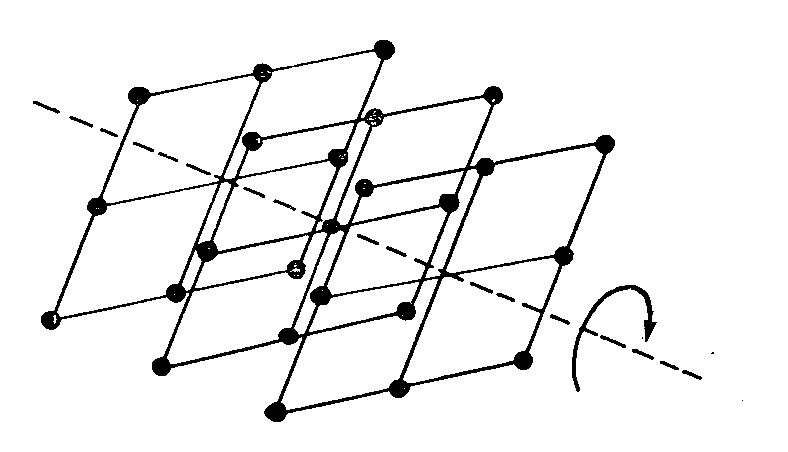
Just as an electron can occupy a lattice site, a proton or other charged particle can be a focal point for the spin. If a great deal of energy is concentrated on a proton nucleus, then other lattice sites in the spinning system can be filled by protons. As one can see from fig. 1, any lattice spin that is dynamically balanced and inherently symmetrical about its axis must, in addition to the central proton, comprise either 8 or 24 other protons, bearing in mind the 3 × 3 × 3 lattice array. These spinning systems occur in pairs in order that the angular momentum should be conserved, similar considerations [p. 56] applying as for electron-positron pair creation. However, the 8 + 1 spinning unit can pair with a 24 + 1 spinning unit. The result is that the two units combined, if based on a proton form, will comprise 18 protons, 34 protons or 50 protons. This limits the formula for 2(2N + 1) to N equal to 4, 8 or 12.
(12) A. Astbury: Phys. Bull., 34, 434 (1983).
(13) Editorial, Phys. Today, 36, No. 11, 17 (1983).
(14) H. Aspden: Lett. Nuovo Cimento, 38, 243 (1983).
(15) V. F. Weisskopf: Phys. Today, 34-11, 69 (1981).
(16) C. Rebbi: Sci. Am., 248, 36 (1983).
(17) H. Aspden: Lett. Nuovo Cimento, 32, 114 (1981).
(18) H. Aspden: Lett. Nuovo Cimento, 36, 364 (1983).
The derivation of eq. (3) is based upon the energy quantum E′ creating 2(2N + 1) units from two colliding proton-sized particles, subject to the condition that the created elements are confined to the volume of these two protons. The model for the W-boson, therefore, has particles heavier than protons occupying the individual lattice sites, but one could imagine a multiplicity of protons coming together to fill lattice positions as suggested.
So far as their effective charge is concerned, if they occupy a lattice site, having displaced a charge from that site, they will appear neutral. Furthermore, composite quark-structured units can presumably also occupy the lattice sites, perhaps having a bearing upon nuclear structure. One can then think in terms of protons, anti-protons and neutrons all being present in the same dynamic spin system, provided neutralization arises from electrons or positrons or the electrical properties of the vacuum, an unoccupied lattice site being a hole in the electrical subquantum medium.
To support the proposition concerning Planck’s law and the lattice array defining the photon source, we will below list the analytical steps involved.
The vacuum lattice stores energy E and angular momentum in the ratio w0, where w0 is the angular velocity corresponding to the natural frequency of vacuum oscillations. Thus
E = Hw0 .(4)
The angular momentum H is equal to that of 24 lattice elements rotating about an axis through their cubic array. The cube dimension is d and the notional mass of each element is m0. Thus
H = 36m0d2w(5)
for rotation at angular velocity w, there being 12 elements distant d and 12 distant 2d from the axis. The photon radiation frequency ν is four times w/2π. Therefore, from (4) and (5)
E = (9m0d2)(2π)w0ν ,(6)
which is Planck’s law, Planck’s constant h being
h = (18π)(m0d2w0) .(7)
When hν = mec2 the value of 2πν is w0, because we know that the vacuum has a resonance mode corresponding to electron-positron pair creation. Replace w0 in (7) to find
h = 6πdc(m0me)½ .(8)
For balanced oscillatory lattice motion with a restoring force rate of 4πe2/d3 (see ref. (14)) we find that
8πe2/d3 = m0(w0)2 .(9)
[p. 57]
Eliminate w0 as before and use (2) with E = mec2 to obtain from (9)
3(a/d) = πm0mec2d2/h2 .(10)
From (8) and (10):
d = (108π)a ,(11)
from (8) and (11):
hc/2πe2 = (108π)(m0/me)½(3a/e2)(mec2) ,(12)
which, from (2) is
hc/2πe2 = (108π)(4m0/me)½ .(13)
It is beyond the scope of this paper to show that (me/2m0)3 is an odd integer uniquely determined on energy minimization to be 1843, but this is of record elsewhere (19,20). The resulting formula for the reciprocal of the fine-structure constant is (108π)(8/1843)1/6 which gives 137.035915.
We can, however, evaluate d because (2) gives the electron charge radius as 1.88·10−13 cm. Therefore, d is 6.38·10−11 cm, which is about one-quarter of the Compton wave-length of the electron. Since the cavity radius of the system shown in fig. 1 is half the Compton wave-length, we can verify whether the 3 × 3 × 3 array in fig. 1 is the lattice element grouping isolated by the cavity. The cavity radius is, in fact, 1.9 d, which is precisely the value needed to include the corner elements of the lattice and exclude those at 2d spacing from the centre, assuming that the lattice elements have a small finite form or a range of position that fluctuates slightly.
The value of m0c2 can be determined from the above analysis. It is found to be 21 keV. In contrast we have suggested that the graviton constituent of the lattice, which is a sparsely populating element providing dynamic balance for the lattice elements, has a mass energy of 2.587 GeV. It will, therefore, be understood why the author was particularly interested in the following words quoted from ref. (6):
«The main stumbling block to progress is the shape of the X-ray spectrum. This has a curious discontinuity at (20 ÷ 40) keV, usually termed the kink or break; it corresponds to a break at (2 ÷ 5) GeV in the parent electron spectrum, which is itself hard to explain».
It is submitted that this is evidence of the two energy levels set by the subquantum vacuum medium, which may come into evidence in single energy units or paired energy units. The Z0-boson, when confirmed, may be a crucial indicator of the existence of the 2.587 GeV graviton.
(19) H. Aspden and D. M. Eagles: Phys. Lett. A, 41, 423 (1972).
(20) H. Aspden: Physics Unified (Sabberton, Southampton, 1980), p. 112.