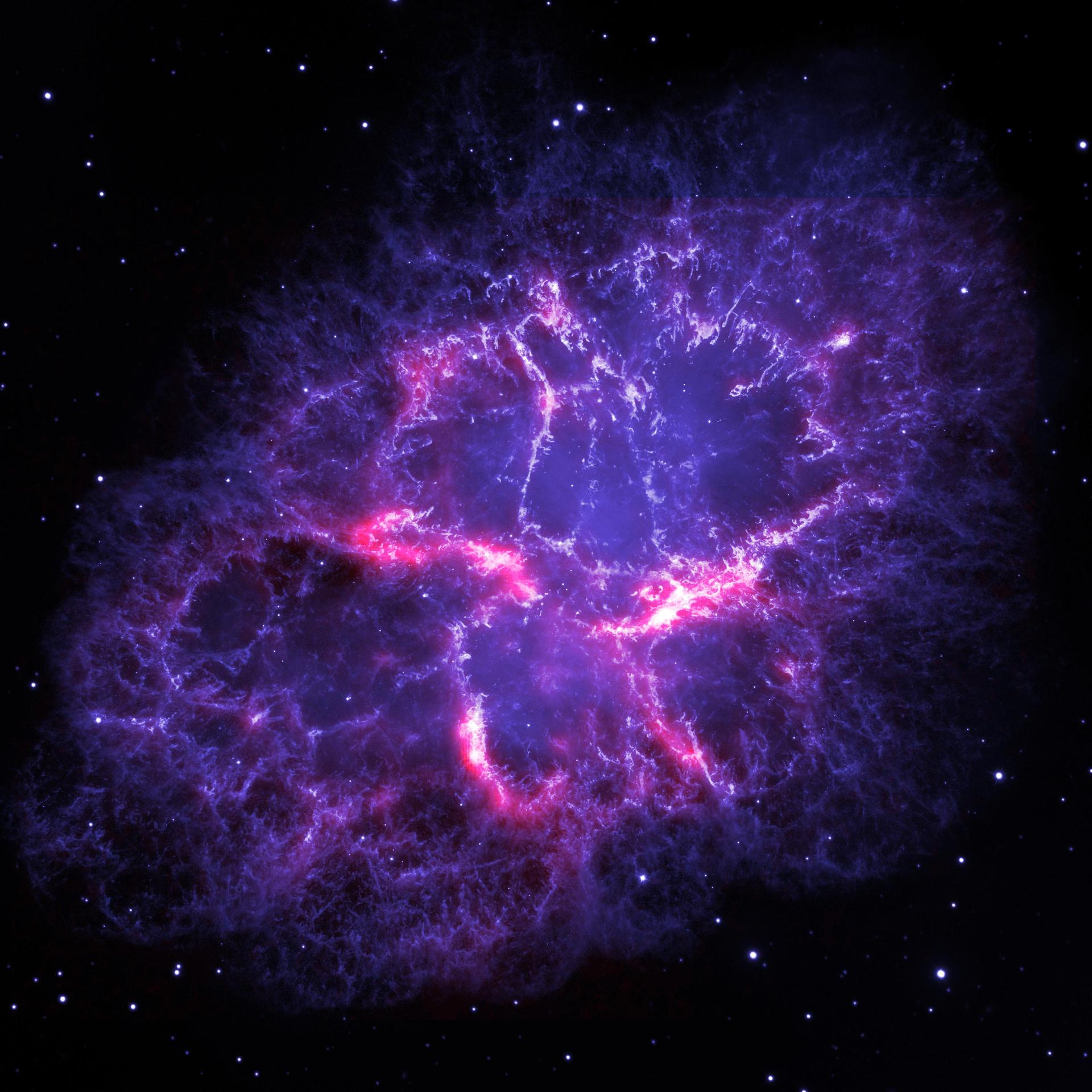
Crab Nebula (M1) — supernova remnant imaged by Herschel and Hubble Space Telescopes

Category: Papers & Publications

Peer-reviewed papers and publications by Harold Aspden

Crab Nebula (M1), supernova remnant · ESA/Herschel/PACS; NASA, ESA & A. Loll/J. Hester (Arizona State Univ.) · NASA Image Library ↗

  • 1980d

    1980d

    The following is a paper by H. Aspden published in Speculations in Science and Technology, v. 3, pp. 114-116 (1980).

    SPECULATIONS IN GENERAL, PLUS SOME OF MY OWN

    Commentary: There is reference here to Millikan’s account of the foresight of Jeans in 1904 in suggesting that there could be mutual annihilation of an electron and its anti-particle as a basis for convertibility of mass and energy as needed to explain the enormous amount of sustained energy radiation from stars.

    Then the discussion extends on Heaviside’s view that, before one could explain gravitation, one needs to study the seat of energy and how this same theme was pursued by Leon Brillouin in his book ‘Relativity Reexamined’.

    This leads into the pre-Einstein research of Paul Gerber and this author’s own theme that anomalous electrodynamic ion acceleration tells us how the high translational speeds of the stars were established when they were created by the onset of gravitational action and the resulting gravitational coalescence of protons followed by the retarded inflow of electrons.

    It is noted that this author’s theory of gravitation, based as it is upon the analogy of ferromagnetism appearing upon cooling through the Curie temperature, requires gravity to ‘switch on’, as it were, as the cosmic dust of the universe cooled down in a sequence of events at the time the universe was created. Big Bang theories assume that gravitation has always existed as a feature of what physicists regard as ‘curved space-time’ but they do not contemplate that it arises as a secondary event from the onset of order as the aether develops its crystal-like lattice structure. They prefer to picture their ‘space-time’ as a mathematical formalism devoid of step functions and quantum features but G, the constant of gravitation, is not seen as temperature-dependent, in spite of that clue that ferromagnetism has such a dependence.


  • 1980c

    1980c

    The following is a paper by H. Aspden published in Energy Unlimited, v. 8, pp. 37-40 (1980).

    UFOS AND THE COSMIC CONNECTION

    Commentary: The author here indulges in a strong expression of opinion on the evidence of the energy which powers the thunderball phenomenon. The concept of a sphere of aether in a state of spin is seen as having a cosmic connection in that comets are such large scale manifestations. The energy density of the Tungusta event which devastated a large region in Siberia in June 1908 is compared with that of the thunderball and analysis presented to show the aether connection. Under the section heading ‘New Energy Source’, the author points to the new horizons in energy technology that open up if vast amounts of energy are stored in a spin state of the vacuum medium and controllably released after transferring the ‘object’ from its
    generating source and through the housing of apparatus to its seat of application.


  • 1980b

    1980b

    The following is a paper by H. Aspden published by the Institute of Physics (UK) in J. Phys. A.: Math. Gen., v. 13 pp. 3649-3655 (1980).

    THE INVERSE SQUARE LAW AND ITS SPATIAL ENERGY DISTRIBUTION

    Abstract: Using generalized mathematical considerations the inverse-square law of force is shown to imply specific spatial energy distribution relative to the interacting bodies. The retardation effects associated with energy redeployment when the bodies are in motion are examined. It is found that, as applied to the gravitational interaction between sun and planet and provided there is no discontinuity in the spatial energy distribution, retardation will give a law of motion conforming with Einstein’s law of gravitation. A necessary condition is that the energy in transit in the field system is ineffective in determining force for a retardation period equal to the time required for a photon to travel from one body to the field and then return from the field to the other body. The implication is that gravitation could be a quantum
    interaction which assures causality and balance of action and reaction by this dual photon exchange interaction.

    Commentary: This paper was, for the author, a breakthrough, in the sense that referees of a journal published by the U.K. Institute of Physics had yielded a little ground and allowed the publication of a paper that so clearly aimed to undermine Einstein’s theory.

    The paper was strictly a mathematical exercise to establish where the mutual interaction energy between two interacting particles was deployed, given that the particles were subject to an inverse square law of force. Although the solution was indeterminate so far as full three-space energy distribution was concerned, the range distribution of energy from either charge was determinate as one of two alternatives. The Coulomb interaction fitted one case and the magnetic interaction fitted the other case. The latter option, as
    applied to gravitation, was found to yield, on a retarded energy transfer basis, with a three-dimensional space metric, the identical equation to that which Einstein had derived from his complex four-space theory.

    Even so, readers interested in this, will see that the eventual solution of the problem of the Neumann potential [1988a] was needed to justify why the retarded energy transfer was local to each particle and involved sequential action centred on the two
    interacting particles, coupled with an instantaneous action-at-distance directly between the particle centres.

    Reference is now made to a criticism raised by Allen D. Allen concerning the validity of the mathematical case presented in this U.K. Institute of Physics paper. His comments were directed at the counterpart text in the author’s book ‘Physics Unified’. The following quotation is drawn from this author’s paper [1983b] of these Web pages:

    “The author has shown in ‘Physics Unified’ how Einstein’s General Relativity equation for the law of gravitation can be explained by energy propagation. The theory depends upon analysis of the spatial energy distribution corresponding to the inverse square law of force. Allen D. Allen, in his review, quotes an equation (27) from the book:

    -r-3[sum]cn(n+2)(x/r)n=0

    from which the author deduced that n was -2 and that the coefficients cn, were zero for values of n not equal to -2. [Note that the expression ‘sum’ is used instead of a summation sign.]

    Allen D. Allen pointed to the difficulty of justifying this conclusion.

    The author therefore seeks here to amplify the argument. The above equation is derived from a general formulation subject to the condition that with x larger than r it holds for all x. The summation applies for all negative integer values of n. Imagine that there are N coefficients Cn that are not zero and bear in mind that x can have an infinite number of values. We may take N+k different values of x to formulate N+k equations, each with N unknowns. r is fixed. k can be as great as we like. In these circumstances the only solution is that for which each term in the summation is itself zero, as one readily sees by solving:

    y+2z=0
    3y+4z=0
    5y+6z=0

    Here we have three equations and two unknowns and both y and z must be zero. Then, given that each term in the summation is zero, one is led to the conclusion that n is -2 and that the coefficients cn with n as -1, -3, -4, etc. are all zero.”


  • 1980a

    1980a

    The following is a paper coauthored by D. M. Eagles and H. Aspden published in Acta Physica Polonica, A57, pp. 473-482 (1980).

    THE SPATIAL DISTRIBUTION OF THE CONTRIBUTION TO THE MAGNETIC FIELD ENERGY ASSOCIATED WITH TWO MOVING CHARGES

    Abstract: The interaction contribution to the magnetic-field energy associated with two moving charges q1 and q2 with velocities v1 and v2 separated by a spatial vector s is evaluated to order

    (v1v2/c2)

    by direct integration over all space. It is shown that the
    contribution to the magnetic interaction energy from a spherical shell of radius r greater than s centred on one particle is equal to

    (2q1q2/3c2)(v1.v2)r-2dr,

    while for a shell with r less than s the contribution is

    (q1q2/3c2)[3(v1.s)(v2.s)/s2-(v1.v2)]s-3rdr.

    After integration the negative of the usual expression

    (-q1q2/2sc2)[(v1.v2)+(v1.s)(v2.s)/s2]

    for the interaction contribution to the Hamiltonian for two moving charged particles is obtained. The change in the electric field
    energy due to effects of retardation on electric fields does not contain any terms proportional
    to (v1v2/c2), and so the convention sometimes adopted of calling

    [-(q1q2/sc2)(v1.v2)]

    the magnetic interaction and attributing the remainder of the interaction, viz.

    (q1q2/2sc2)[(v1.v2)-(v1.r)(v2.r)/s2],

    to retardation appears to be misleading.

    Commentary: Dr. D. M. Eagles, co-author of this paper, and, in fact, fully authored the text and was exclusively responsible for the extensive mathematical analysis involved. This author’s contribution was to pose the problem and the initial formal derivation of the interaction energy applicable in the very simple case where the two interacting current elements are in collinear motion. The latter calculation was, in fact, presented in the author’s 1960 book ‘The Theory of Gravitation’. It was of interest because there are, supposedly no longitudinal forces acting along the common line of flow of two current elements, at least according to accepted theory based on the Lorentz formulation. Einstein began his writings on relativity by addressing electrodynamics, but, in declaring conformity with the Lorentz force law, he lost sight of the true forces that arise in electrodynamic actions under certain special circumstances. The actions which are involved in gravitational forces are of that special kind!

    The paper is important in providing the basis for arguing that the conventional concept of a magnetic field leads to absurdities in that, for action between two discrete charges in motion, the field energy deployment at distances remote from the source charge must change drastically when a charge alters course slightly.

    Readers must understand that the notion of the magnetic field is artificial and is founded only upon empirical data deriving from the study of electron current interactions where at least one of the interacting currents is non-segmented and flows around a complete circuit loop.

    Energy science as it becomes more developed will have to overcome the error of this traditional magnetic field assumption and avoid using the concept when developing technology in which non-electron currents are a primary feature or where there is non-circuital electron flow. This is an absolutely fundamental requirement and is at the very heart of the problem which caused Einstein to be sidetracked down a blind alley when trying to forge the unification of magnetic and gravitational theory.


  • 1979c

    1979c

    The following is a paper by H. Aspden published in Lettere al Nuovo Cimento, v. 26, pp. 257-260 (1979).

    ENERGY CORRELATION OF RADIATIVE DECAYS OF ψ(3684)

    This paper shows how the author’s derivation of the proton-electron mass ratio, the subject of paper 1975a leads directly to the psi particle of 3,684 MeV and its decay products. It is best read in its full non-abstracted form as a PDF file 1979c


  • 1979b

    1979b

    The following is a U.K. Patent Application by Harold Aspden filed on August 18, 1977 with a publication date of February 29, 1979

    U.K. PATENT APPLICATION NO. 2,002,953

    ‘ION ACCELERATORS AND ENERGY TRANSFER PROCESSES’

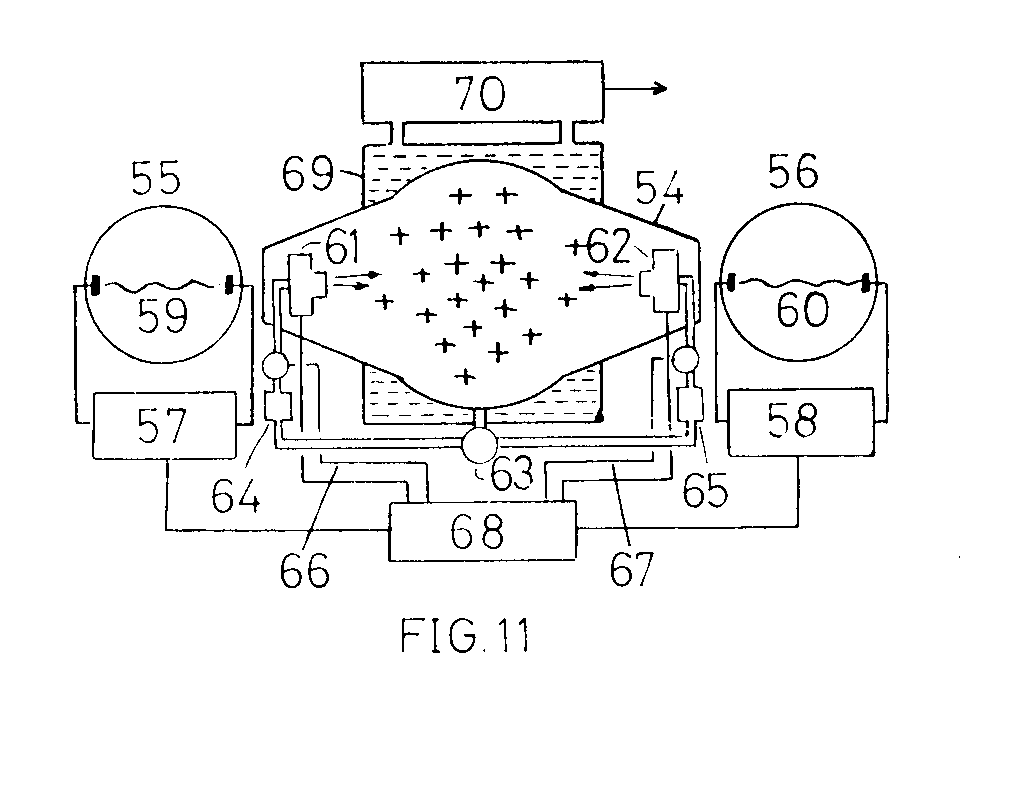
    Abstract: Ions are accelerated by subjecting them to the electrodynamic effects of a driving circuit comprising a separate closed circuital current which in one circuit segment comprises an electron flow in a conductor and in another segment comprises at least partially a flow of ions. The invention applies a general law of electrodynamics published in the Journal of the Franklin Institute in 1969 at page 179 of volume 287 ([1969a] in these Web page abstracts), which concerned anomalous cathode forces attributed to the action of electrons upon ions carrying current in the same closed circuit. The invention also has application to energy transfer processes dependent upon th catalytic action of high energy ions. Various apparatus is disclosed. In Fig. 11, for example, the driving circuits 55,56 comprise cold cathode gas discharge systems excited by high voltage pulse generators 57,58 and they accelerate ions from sources 61,62 towards the centre of housing 54. Cooling jacket 69 extracts heat from the housing and supplies it to power generator 70. In another arrangement two adjacent oppositely directed ion beams serve as the driving circuit for each other.


  • 1979a

    1979a

    The following is a paper by H. Aspden published in Lettere al Nuovo Cimento, 25, pp. 456-458 (1979).

    THE SPATIAL ENERGY DISTRIBUTION FOR COULOMB INTERACTION

    Abstract: It is shown that the electric interaction between two charges involves a mutual field energy which, as viewed from either charge, has a field energy distribution that sums to zero over a range equal to the charge separation distance, beyond which it diminishes progressively from a maximum value as the inverse square of distance.

    Commentary: Although the author had, long before 1979, established the connection between the law of gravitation and the law of electrodynamics, there remained the elusive mystery of deriving the Neumann potential by a causal argument which did not rely on empirical data. The Neumann potential is an expression for the primary energy action underlying the law of electrodynamics. Somehow energy distributed in a field system set up by two interacting electric charges can find a way of setting up a dynamic potential when the charges are in motion. This means that the energy in the field is being redeployed. It is a start to our understanding of the nature of the action if we know where that energy might be in that field.

    The subject paper is one of a series of three devoted to the Coulomb interaction, the electrodynamic interaction [1980a] and the
    gravitational interaction [1980a], respectively. The Neumann potential proved elusive for several years, but, finally, it did succumb to the author’s investigations [1988a, 1995a]. It plays a key role in unifying the force of gravity with electrodynamic law, as is evident from the discussion of ‘time dilation’ in reference [1996a].


    To see the full text of this paper as presented in pdf format press: [1979a]

  • 1978d

    1978d

    The following is a paper by H. Aspden published in Intercom, pp. 21-22 (December 12, 1978).

    A PERSPECTIVE ON A NEW ENIGMA

    Commentary: ‘Intercom’, the U.K. Home Office Journal edited by the Directorate of Telecommunications, Home Office, published the above article immediately following one entitled the ‘Radioquake Mystery’. Its author Richard Hill had suggested that this author
    should write an accompanying article explaining the scientific basis for the anomaly observed.

    The subject is that reported later in these Web pages by the commentary on ‘Earthquake-related EM Disturbances’ reference [1987d]. That later paper was published by the Royal Astronomical Society. See also [1987k].


  • 1978c

    1978c

    The following is a paper by H. Aspden published in Speculations in Science and Technology, v. 1, pp. 281-288 (1978).

    CRYSTAL SYMMETRY AND FERROMAGNETISM

    Abstract: An empirical energy analysis of the nature of ferromagnetism suggests an accompanying high degree of elastic strain, which, however, is incompatible with the observed degree of crystal symmetry and magnetostriction. This is explored on the
    assumption that magnetic polarization occurs equally along all axes of symmetry in a ferromagnetic crystal. Equal time sharing of this state between these axes is proposed. As evidence supporting this hypothesis, it is found that it explains the apparent non-quantum
    moments of the atoms of iron, nickel and cobalt.

    The argument involves a new theoretical concept of what is termed a half-field reaction effect. For example, the effective Bohr magneton quantization of atoms in iron becomes one third times the true quantization Q (that is gQ/3), offset by a half of one third of
    the polarization gQ/3, to give 5gQ/18, which, for a gyromagnetic factor g of 2, gives 2.222 Bohr magnetons with Q = 4.00. The experimental value is 2.221.

    Commentary: This paper concerns a theme that is the very heart, and was the starting point, of the author’s theory. The author’s Ph.D. thesis based on his 1950-53 research at Cambridge concerned the loss properties of ferromagnets under mechanical stress. The author evolved a theory which was later to be extended as a model of action in the vacuum medium, but it relied upon orbital electron motion and went against the Dirac ‘spin’ theory of the electron g-factor. The 1969 book ‘Physics without Einstein’ presents the ferromagnetic theory in chapter 3 and the g-factor theory in chapter 2. However, the material in the subject paper was not included.

    The paper mentions the work of Oxley who had stressed the fact that latent heat properties reveal the presence of enormous internal stresses in a ferromagnet which are relieved once the substance becomes paramagnetic, stresses that are not just those associated with unequal crystal strain. This means that we have to accept that the magnetic internal strains in a ferromagnet are isotropic.

    The author’s theory follows that theme and explains the electron g-factor as an orbital electron phenomenon. In its turn this meant that the aether itself had to exist as a real medium exhibiting diamagnetic half-field reaction properties. The above paper
    developed that idea and confirmed it by making the quantum link with Bohr magneton units. The 3d electrons in iron have a level 2 quantized orbital action. There are two electrons contributing to the ferromagnetic state. Hence Q = 4.00. The g-factor doubling and the time-sharing between three axes, with the reaction field offset gives the 2.222 theoretical maximum quantization, which compares with the measured 2.221 saturation value.

    This author sees this as clear evidence in support of his theory. The subject paper was presented as a lecture at a meeting of the Magnetics Group of the German Physical Society held in Salzburg on March 29, 1971. Though abstracted in the printed program of papers, the paper was not adopted for inclusion in the published proceedings of the conference. It is an extremely important paper, which experts on magnetism chose to ignore, presumably because it went against their doctrinaire belief in the Dirac ‘half-spin’ model of ferromagnetism.

    The above, duly edited, version of this paper, which the author, was able to offer to the then-newly-founded periodical Speculations in Science and Technology in 1978 was published some 7 years after it was first written. It describes the physical action that is
    the very doorway for the passage of energy between the hidden quantum energy sea and atomic matter. Put in simple language, there can be no magnetic ‘grip’ between a tiny electric point-like charge ‘spinning’ in a QED background and the Heisenberg jitter of the
    energy sea in space. The ‘handle’ for that ‘grip’ is the orderly orbital motion of electrons in the atoms of the ferromagnet.

    By adhering to the accepted spin theories of ferromagnetism, physicists have turned their backs on magnetic regeneration technology as a ‘free energy’ source.

    The subject paper should not have been ignored!

  • 1978b

    1978b

    The following is a paper by H. Aspden published in Speculations in Science and Technology, v. 1, pp. 59-63 (1978).

    ENERGY CORRELATION FORMULA APPLIED TO PSI PARTICLES

    Abstract: The 2.587 Gev graviton of a unified field theory presented in 1966 is here shown to control the existence of two energy quanta of 3.095 Gev and 3.683 Gev, identifiable as the
    psi particles. the energy correlation formula by which the proton-electron mass ratio was deduced in 1975 provides the necessary link.

    Commentary: The author had, in his 1966 book ‘The Theory of Gravitation’, reported the discovery that the mediating quantum involved in the gravitational force depended upon a 2.587 Gev particle. This had nearly three times the mass of the proton. The quite remarkable discovery of the psi particles aroused the author’s interest, in wondering whether the energy correlation formula, used to explain how the proton is created from muons, could have extended application to the origin of the psi particles.

    This paper shows how the author’s theory so easily provides that link and this advance gave very firm foundation for the onward development of the theory into the broader spectrum of fundamental particle physics. This work was later reported in the series
    of papers listed later as published in the Hadronic Journal.

    There are three sections of this paper which are particularly important in a more general sense. One section is headed ‘Charge Pair Interaction’, an other ‘Charge Interaction Stability’, and the third ‘Pair Creation Stability’. The essence of fundamental particle creation as charges pair up and absorb energy to create families of particles, as offspring, is embraced by the very simple physical concepts applied in the theoretical analysis. Conservation principles, concerned with both energy and space feature in this activity.

    It may be noted that this paper was published in the first volume of a new periodical. The author had been invited to be a founder member of its editorial board. Initially that journal was edited and published from a university in Australia.