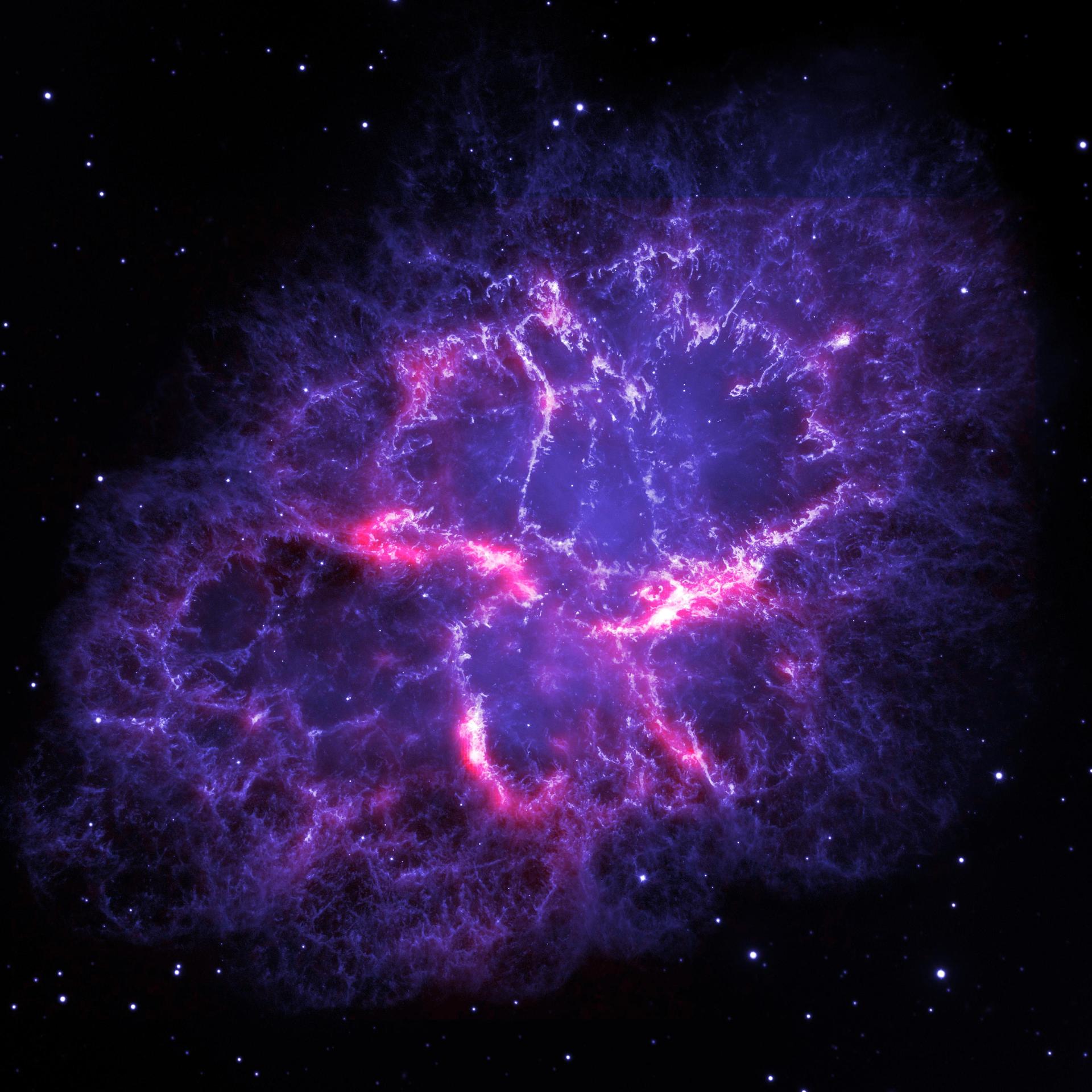
Crab Nebula (M1) — supernova remnant imaged by Herschel and Hubble Space Telescopes

Category: Papers & Publications

Peer-reviewed papers and publications by Harold Aspden

Crab Nebula (M1), supernova remnant · ESA/Herschel/PACS; NASA, ESA & A. Loll/J. Hester (Arizona State Univ.) · NASA Image Library ↗

  • 1969a

    1969a

    The following is a paper by H. Aspden published in Journal of the Franklin Institute, v. 287, pp. 179-183 (1969).

    THE LAW OF ELECTRODYNAMICS

    Abstract: The indeterminate state of the empirical law of electrodynamic action between current elements is reviewed. It is shown that a form of law fully consistent with experiment can be deduced from simple Newtonian dynamics. This law points to anomalies to be expected in electrodynamic interactions between electric particles of unequal charge-mass ratio. This result may account for certain hitherto unexplained anomalies in electric discharge phenomena.


  • 1967b

    1967b

    The following is a Letter to the Editor of the IEE journal ‘Electronics and Power’ published in the March, 1967 issue at p. 95.

    MAGNETIC ANOMALIES

    Dear Sir – R. A. Waldron, in a reply to a previous letter (Jan. 1967 Electronic and Power, p. 22) [1967a], states that he cannot understand my comments about conduction electrons in metals reacting to screen magnetic fields; and he
    states that the null result of the Trouton-Noble experiment is only surprising in the light of aether theory.

    To clarify the first point, consider electrons in motion in a steady magnetic field. It is well known that they are deflected into a helical path, and always move to produce a magnetomotive force opposing the field. If there are free conduction electrons in random thermal motion in a metal, the metal should, on
    electron theory, act as a screen against steady magnetic fields. Quantitatively, the reaction magnetic moment is the kinetic energy of the reacting electrons, calculated from their component velocities normal to the field direction, divided by the magnitude of the resultant field (Aug. 1966 Electronic and Power, p. 288) [1966c]. For example, 1022 electrons per cm3 at 104 cm/s would develop a reaction field of 4000 oersted for a 1 oersted resultant field. A strong applied field would, therefore, be heavily screened by a
    good nonferromagnetic metal conductor at room temperature.

    The fact that this event does not happen presents an anomaly in magnetic theory. It can be explained by theorising, as I did in the letter mentioned above, that the kinetic energy of the reacting charge maximises, and is, in fact, the magnetic-field energy inside the conductor. Then the density of free electrons
    is determined by the magnetic-field strength, in accordance with the thermal-velocity state. Also the reaction effect exactly cancels half the applied field.

    To keep our units correct, the actual field produced by any motion of charge has to be doubled, which then explains the observed
    gyromagnetic-ratio factor of 2, whether determined from reversing magnetism in a pivotally mounted ferromagnetic rod or from magnetic-resonance experiments; and the explanation requires only orbital motion of charge. Whatever is meant by ‘spin’ in physical theory is not relevant to the observations. Indeed, spin might be a kind of motion in a minor orbit, but this does not matter.

    The Trouton-Noble experiment proved that two charges of opposite polarity, moving in parallel at the same velocity and in any direction relative to the line joining the charges, develop electrodynamic interaction forces only along the line joining the charges. This fact is contrary to the usual electrical engineering teaching about magnetic fields set up by a charge in motion and the forces on a charge in motion in a magnetic field. The experiment was founded on such theories, and a suspended capacitor should have turned about the suspension by an amount proportional to the velocity of the apparatus. It did not turn, proving either
    that our laws of electrodynamics were wrong, that the aether could develop a reaction couple on the charges, or that the electrodynamic reference frame or aether moves with the apparatus.

    If one ignores the aether, the laws of electrodynamics need modification. The empirical law is presented as equation (2) in an earlier letter (April 1965 Electronics and Power, p. 137) [1965a]. This law is consistent with the null result of the Trouton-Noble experiment and all other
    observations. However, as applied between charges in nonparallel motion without an aether to complete the system, Newton’s
    Third Law of Motion is defied.

    To avoid the problem, radiation momentum is added to the momentum of matter to satisfy this law. The system of the charges is thus completed by energy somewhere in space. Such energy is mixed up with energy from millions of other such systems, and surely forms the metric of space-time otherwise known as the aether. The aether is a medium permeating all space. It is primed with energy, and is able to take up the balance forces in electrodynamic interactions. Our difficulty is that there is reluctance in appreciating that energy has been dispersed into the aether for so long that it has become uniformly distributed, and become a medium well worth studying in its own right.

    H. ASPDEN
    IBM United Kingdom Laboratories
    Hursley, Winchester, Hants.
    3rd January 1967


  • 1967a

    1967a

    The following is a Letter to the Editor of the IEE journal ‘Electronics and Power’ published in the January, 1967 issue at p. 22.

    BALLISTIC THEORY OF LIGHT

    Dear Sir – If light is a ballistic phenomenon, rather than a propagated disturbance of the aether, the corpuscles of gamma-radiation emitted by source atoms in the Mossbauer effect would come directly from the atoms and not, as experiment shows, from the notional radiation frame defined by the mean position of the atom in the source body. The ballistic theory of light, as presented by R. A. Waldron (Nov. 1966 Electronics & Power, p. 394), is not, therefore, supported by this basic Mossbauer experiment. Further, if, as Mr. Waldron suggests, a photon is emitted at the velocity c plus that of its source, a photon emitted by an atom would travel at the velocity c plus the thermal
    agitation velocity of the atom. This latter component is of the order of 104cm/s, and would completely mask the Doppler effects of the velocities (as low as 0.1 cm/s) measured in Mossbauer experiments.

    Even if the photons are absorbed and re-emitted by other atoms, whether in the source or the absorber, the fact remains that, as
    corpuscles of matter, they must ultimately be absorbed by an atom having a high relative thermal velocity, and the Mossbauer phenomenon becomes inexplicable. The Mossbauer effect can really only be explained if the photons generated by energy quanta released by atoms are formed at their characteristic frequencies in a medium separate from the individual atoms.

    This medium, a sort of aether or, if we do not like the word ‘aether’, a mere notion of something providing a frame of reference for radiation, appears to be located by the mean positions of atoms in a crystal lattice. Thus, when energy is released by an atom, the velocity of the atom relative to this frame has no effect on the velocity of the energy package transmitted by the photon. The thermal velocity is only manifested by a slight effect on the value of the energy quantum, resulting in a line broadening. The photon appears as a disturbance in the radiation-reference frame, and conveys a Doppler effect determined by the velocity of this frame, i.e. the velocity of the source body and not that of the source atom.

    Mr. Waldron states that all attempts to detect the aether have failed. It may well be true that all attempts to detect an aether according to the preconceived notions of an experimenter have failed, but the aether manifests itself in numerous ways. Instead of looking for evidence of an aether someone has invented, we should construct our notions of the aether from the existing
    evidence. The Mossbauer effect presents a clear need to recognise a ‘medium’ for photon propagation. Maxwell’s displacement
    currents can hardly be sustained without charge in motion in this ‘medium’.

    My own strong belief in the aether came from my researches on eddy-current phenomena. Conduction electrons in metals should
    react to magnetic fields and act to screen magnetic fields; the fact that this phenomenon does not occur needs explanation. My explanation is that there is a half-field reaction due to conduction electrons in conductors and mobile charge in the medium
    constituting a vacuum (Aug. 1966 Electronic and Power, p. 288).

    This same explanation applies to the gyromagnetic anomaly experienced in ferromagnetism. From this, we see four electromagnetic phenomena all linked by an aether we refuse to recognise. Further, our understanding of the nature of practically every other electromagnetic phenomenon discovered since the time of Faraday is in such a sorry state that it seems unreasonable to pretend that the aether does not exist. It is
    well known that electromagnetic-energy transfer based on the Poynting vector is in complete conflict with quantum theory. We are taught how to calculate the magnetic field due to a charge in motion and how to calculate the force on a charge in motion in
    a magnetic field. Yet these teachings are in conflict with a famous experiment performed by Trouton and Noble (Phil. Trans. Royal Society, 1903, 202A, p. 165).

    This conflict might not matter, were it not for the fact that we read that our scientists cannot explain instabilities in electrical discharges in fusion-reactor research. Nor, it seems, can they explain the substantial anomalous cathode-reaction forces in mercury arc discharges [see, for example, ‘Cathode processes in the mercury arc’, (Consultants Bureau, New York, 1964]. If we add to this the inadequacies of our understanding of the nature of ferromagnetism, terrestrial magnetism, and gravitation (believed by many to be a magnetic phenomenon), it becomes very difficult to
    understand how electrical science can get by without aether theories.

    Therefore, let us examine ballistic theories of light, but not out of conviction that the aether is non-existent – at least until electromagnetic theory can keep abreast of anomalies and begin to progress from its present stagnation.

    H. ASPDEN
    IBM United Kingdom Laboratories,
    Hursley, Hants.
    1st November 1966


    [R. A. Waldron writes: Dr. Aspden’s letter appears to be an attack on the ballistic theory, and favours the aether theory. However, many of the points he raises present difficulties – for which he takes me to task – only on the aether theory; other points give no difficulty at all on either theory.

    The null result of the Trouton-Noble experiment is only surprising in the light of the aether theory. In the absence of an aether, there is no reason to expect any other than a null result.

    Poynting’s theory is not in conflict with quantum theory.

    I am not familiar with the subject of electrical discharges, but I believe the difficulty here is that not enough is known about what happens in a discharge. Perhaps, when the facts are known, it will be possible to find explanations for them. Even if facts are already known which conflict with existing theories, I do not see how this could be a ground for objecting to a new theory.

    In the earlier letter to which he refers (Aug. 1966 Electronics and Power, p. 288), Dr. Aspden does not distinguish between orbital motion of electrons and spin. It is for spin that the
    gyromagnetic ratio is 2, which value he appears to dislike for subjective reasons, but the calculation he gives appears to relate to orbital motion and leads to the wrong answer.

    I do not understand the sentences: ‘Conduction electrons in metals should react to magnetic fields and act to screen magnetic fields. The fact that this phenomenon does not occur needs explanation.’ Conduction electrons can only be expected to screen a magnetic field if it is time-varying, and then, of course, they do; we call it the skin effect.

    The existence of the Mossbauer effect depends on the quantisation of radiation, and so is quite in keeping with a ballistic theory of light. In my theory, the photons are emitted with velocity c with respect to the source. In the Mossbauer phenomenon, the source is the whole crystal – not the individual atom. The manner in which the small linewidth is achieved is well understood, and does not depend on the wave or particle interpretation of radiation. An excellent description of the phenomenon is given by C. E. Johnson in the March 1962 issue of Cryogenics.]


    Commentary: The sequel to this item of correspondence was my Letter to the Editor of Electronics and Power as published in April, 1967. See [1967b].


  • 1966c

    1966c

    The following is a Letter to the Editor of the IEE journal ‘Electronics and Power’ published in the August, 1966 issue at p. 288.

    THE GYROMAGNETIC RATIO

    Dear Sir – The anomalous gyromagnetic ratio is observed when magnetism is reversed in a ferromagnetic specimen mounted to pivot about the direction of magnetisation. The angular-momentum reaction observed is half that expected on the assumption that electrons generate the magnetic field.

    This anomaly has been explained by physicists in terms of electron spin – the concept of an electron spinning about a diameter. However, most electrical engineers who have heard of electron spin do not know that, to derive his gyromagnetic-ratio factor of 2, the physicist argues that the electron has two charges, one not rotating with the electron and the other rotating, and one uniformly distributed over the electron surface and the other having a specified non-uniform distribution.

    As an electrical engineer, I have always been sceptical about this weird hypothetical concept of the electron, and, for the past 12 years, have subscribed to a personal belief that the explanation really lies in a field-reaction phenomenon due to conduction electrons in the ferromagnetic. Further, this opinion has convinced me that electrical science just cannot progress significantly unless we are prepared to revert to the old-fashioned idea of the aether.

    A few days ago, I heard it said by a physicist that, in spite of its wide acceptance, physicists had never really been happy with the idea of electron spin. This has prompted me to put forward here my simple alternative account for the gyromagnetic phenomenon, and I hope that it will cause some of your readers to join me in my heretical belief in the need to recognise the aether medium.

    Consider an electrical charge q of mass m, moving at velocity v in a magnetic field H. The lateral magnetic force on the charge is Hqv/c, where c is the ratio of electrostatic and electromagnetic units. This will balance a centrifugal force mv2/r, because the charge is constrained by the magnetic force to follow a circular orbit of radius r. The result is that a reaction magnetic field is set up by this charge. This reaction field is that due to a current-area quantity of:

    (q/c)(v/2πr)πr2 or qvr/2c

    where the summation applies to all elements of reacting charge. Now, since Hqv/c equals mv2/r, it follows that

    qvr/2c = (mv2/2)/H

    or 1/H times the kinetic energy of the reacting charges.

    In a dynamical system, kinetic energy tends to a maximum, just as potential energy tends to a minimum. Thus, if Ho is the applied magnetic field, the reaction field Ho-H is proportional to the kinetic energy W divided by the field H. Then W is proportional to:

    HoH – H2

    and:

    d(W)/d(H) = 0, when Ho = 2H

    Thus, we see that the field applied to any system containing charges capable of motion will be halved.

    The kinetic-energy density stored by the charges in motion will be proportional to H2, and will, in fact, be H2/8π if the reaction field is 8π times the current-area summation quantity per unit volume. Clearly, then, the kinetic energy of the reaction charges is the magnetic-field energy, and magnetic moment, normally believed to be 4π times the current-area summation, is really double this. The gyromagnetic ratio, therefore, is a factor of 2 for an electron-induced ferromagnetic state, simply because current really generates twice the magnetic field predicted normally, but a reaction effect set up by charges also having mass properties invariably halves this field.

    Since a magnetic field can be ‘stored’ in a vacuum it follows that this explanation requires recognition of Maxwell’s displacement currents, even to sustain a steady field. We ought, therefore, to recognise the real existence of the charges giving rise to such currents and come to terms with the aether concept. These charges in the vacuous aether medium need not be electrons. They are, seemingly, of higher charge/mass ratio, because, in the ferromagnetic, the conduction electrons provide the reaction in preference to other free charges and presumably in accordance with the maximum-kinetic-energy condition.

    Yours faithfully,
    H. ASPDEN
    IBM United Kingdom Laboratories Ltd.
    Hursley Park, Winchester, Hants.
    9th June 1966


    Commentary It is an interesting exercise to ponder on what I have said in this item of IEE correspondence. In doing so one should ask oneself the question of whether our empirical man-made laws of physics should overrule the process of magnetic field energy density maximization as kinetic energy of reacting charge if the law says one thing and the energy criteria say another. Putting this into context the real question is whether the applied magnetic field is able to deflect every single one of the conduction electrons in motion in the metal or whether just enough can react to assure the optimization of the energy deployment. I believe the latter alternative is the dominant consideration. Energy deployment criteria dominate, regardless of how we view the empirical effects observed as between a magnetic field and electric currents in wires. A force is only exerted if the energy backing that force is there to do its work! This warrants very careful consideration. The laws of physics are subservient to the role which energy deployment has in the interactions between elements of matter and the interactions between matter and aether.


  • 1966b

    1966b

    The following is a Letter to the Editor of the IEE journal ‘Electronics and Power’ published in the July, 1966 issue at p. 236.

    RADIATION-PRESSURE DISCREPANCY

    Dear Sir – I read with interest P. Knight’s letter on the radiation-pressure discrepancy.

    The fallacy in the discrepancy may lie in the assumption used in deriving the Poynting vector itself. This is that the field energy in an electromagnetic wave actually moves with the wave. The quantum theory and experiment have shown that an energy quantum can be received at a region remote from a wave source long before enough energy to sustain the quantum has, using the Poynting vector, been intercepted by that region. The Poynting vector may really have no significance in electromagnetic energy transfer. An electromagnetic wave is a disturbance of the medium which propagates it, and may well be sustained by energy deployed from that medium. The process of electromagnetic energy transfer may be a lot more complicated than we presently believe.

    Furthermore, the normal source of electromagnetic radiation, the accelerated electron, does not really radiate electromagnetic wave energy – though it can be calculated that it does if we ignore the presence of the electric field which causes the acceleration. This was pointed out in a discussion [1] of Prof. Hammond’s paper [2] about the Poynting vector. It may also be shown [3] that the familiar formula E=Mc2 is an essential requirement for non-radiation of energy by the accelerated electron, and it is not surprising that, as Mr. Knight has found, the formula and the Poynting vector lead to a discrepancy if used together.

    Yours faithfully,
    H. ASPDEN
    IBM United Kingdom Laboratories Ltd.,
    Hursley Park, Winchester, Hants.,
    3rd May 1966.

    References
    1 ASPDEN, H.: Discussion contribution, Proc. IEE, 1958, 1O5C, p. 359 [See [1958a]
    2 HAMMOND, P.: ‘Electromagnetic energy transfer’, ibid., 1958, 105C, p. 352
    3 ASPDEN, H.: ‘The theory of gravitation’ (Sabberton Publications, Southampton, 1966). See [1966a]


  • 1966a

    1966a

    The following is a reference to a book by H. Aspden published by Sabberton Publications in 1966.

    THE THEORY OF GRAVITATION: 2ND EDITION

    Eventually excerpts from this work will be made available on the author’s website www.aspden.org. The book updates Dr. Aspden’s theory of gravitation up to the year 1966, but there has been much onward development as the latter website shows. This book ‘THE THEORY OF GRAVITATION’ was published in 1966. Officially it is out of print but several copies remain in the author’s possession and, so long as stocks last, the book will be sent with the author’s compliments and at the author’s expense to anyone who can affirm having purchased a copy of the author’s 1996 work Aether Science Papers and requests a copy by postal mail enquiry to:

    Dr. H. Aspden
    Sabberton Publications,
    P.O. Box 35 Southampton SO16 7RB,
    England

    All that is requested in return is that recipients will be sufficiently serious in their interest in the physics of gravitation to debate with their colleagues, particularly academic colleagues, the issues which this aether-based theory raises.

    The book order ISBN reference for Aether Science Papers is:

    ISBN 0 85056 0152


  • 1965b

    1965b

    The following is a Letter to the Editor of the IEE journal ‘Electronics and Power’ published in the June, 1965 issue at p. 202.

    ELECTRODYNAMIC THEORY

    Dear Sir – In my letter of the above title (April 1965, Electronics and Power, p. 137), I proposed the following equation for the electrodynamic force between two current elements:

    F = (ii’/r3)[(ds’.r)ds – (ds.r)ds’ – (ds.ds’)r] …. (1)

    where F is the force on a circuit element ds’ due to a current i in a circuit element ds, r is the line frorn ds to ds’ and i’ is the current in ds’. In this expression the currents and the term r3 are scalar and ds, ds’ and r are vectors.

    The law of force between two current elements is important in practice since it is used to calculate make-and-break forces on contact members in circuit breakers and end forces on windings in dynamoelectric machines. It can, however, be argued that in all practical situations current flows in continuous closed circuits, and it may then be shown that the middle term in the above
    expression, which represents force directed along the line of current flow, integrates to zero. It can equally be argued that all sources of current flow, even displacement current, may arise from a motion of isolated charge, be it due to the flow of electrons or elements of charge in the aether. The concept of a
    closed filament of current must then be qualified by the concept of a series of microscopic discontinuities in the current
    filament. The middle term in the above law of force then assumes very significant eftect. In fact, for an infinitesimal discontinuity in the current filament, the law of force would
    cause a compressive force of i2 dyne to act along the filament. (Here i is in abamps, units of 0.1 amps) This force value still applies if there are many discontinuities and exists even if the discontinuities are transient, provided that there is always at least one break in the current path.

    This poses a very important question. Do we accept the ideal mathematical concept that current flow must be continuous, or do
    we recognise that Nature may provide such discontinuities on a microscopic scale? If we accept the former viewpoint, we accept
    that there is no compressive force along the current filament and no electrodynamic hold-on compressive force across circuit-
    breaker contact faces. If we accept the other viewpoint, we can better understand instabilities in electrical discharges in thermonuclear reactors, and we can explain the very significant result evident from the photograph presented on p. 14 of the January 1965 Electronics and Power.

    This photograph shows a falling column of mercury which carries a heavy current and develops, under the action of this current, a helical motion of increasing radius. Near the bottom of its fall, it is drawn back by its own electrodynamic action to the central axis of the system. The really interesting point is that the column is able to hold together at the bottom of its fall and turn back to the central axis as the current pulls it towards the fixed electrode in a receiving pool of mercury. This clearly shows that the electrodynamic force on the mercury column
    due to its own closed current circuit has, contrary to present theory, a resultant action directed along the line of current flow, and I submit that we must take note of this fundamental anomaly.

    Yours faithfully,
    H. ASPDEN
    IBM Research Laboratories
    Hursley Park, Winchester, Hants.
    8th April 1965

    Commentary: Note that here I was suggesting that the mutual attraction of current elements in the discharge would set up a compressive force directed axially along that discharge. The implication then is that this would make the discharge extend so as to form those sinuosities that were observed.

    On this interpretation I could see that there was little chance of success in the efforts in thermonuclear fusion research where the task was to stabilize a deuterium plasma discharge. Here I had developed an insight into the form of electrodynamic law destined to provide us with a Unified Field Theory, but by the same destiny killing all prospect of electrodynamic pinch being used to trigger thermonuclear reactions (hot fusion). My efforts in suggesting the invention described in U.K. Patent No. 892,333 [1958b] were then best forgotten, and indeed scientists should have realized that the effort going into the hot fusion research back in the mid 1960s was not justified and should have been curtailed in the light of this observation concerning the falling column of mercury. After all, that experiment had a research purpose and it was in connection with that thermonuclear field of research. Dr. Ware, who had commented on my earlier Letter [1965a], was a pioneer in that field.

    It is worth noting here that I had in mind in this 1965 period the thought that our knowledge of electrodynamic interaction was founded exclusively on empirical data involving electron currents. There was scope for study of how an electron current might interact with a proton current or a currentr carried by moving heavy ions. Here one thinks of the cold cathode discharge, where heavy ions feature in the discharge and force anomalies are observed. Also, the free conduction electrons in the mercury column experiment exist in a background of heavy positive ions. The mean transport speed of electrons as they carry current is quite slow and comparable with, indeed much slower than, the flow rate of that falling mercury column. So there was an experiment which involved something unusual electrodynamically and I was saying in my Letters to the Editor of Electronics and Power that mercury column discharge instability was anomalous.

    You may then understand why it is that I began to study theoretically the electrodynamic interaction between moving charges having different mass. Indeed, you can see what emerged very rapidly because in 1966 I published my book The Theory of Gravitation, where, on page 23-31 I presented the formal theoretical derivation of the Law of Electrodynamics, corresponding to equation (1) above, and further showed how it was affected if the interacting current circuit elements involved moving charges (e) of different mass. Here was the answer to those anomalous axial forces in the cold cathode discharge! The theory was later published in the Journal of the Franklin Institute. See [1969a]. The theory is also presented in the Tutorial Notes of these Web pages, namely in Tutorial No. 4.

    Harold Aspden


  • 1965a

    1965a

    The following is a Letter to the Editor of the IEE journal ‘Electronics and Power’ published in the April, 1965 issue at p. 137.

    ELECTRODYNAMIC THEORY

    Dear Sir – Sir Edmund Whittaker, in his historical writings about the theory of electricity, [WHITTAKER, E: ‘Aether and Electricity (Classical Theories)’, (Nelson, 1951), pp. 84-87] reports that Amptre based his analysis of the mutual action of currents upon the following experimental observations:
    (a) the effect of a current is reversed when the direction of the current is reversed,
    (b) the effect of a current flowing in a circuit twisted into small sinuosities is the same as if the circuit were smoothed out,
    (c) the force exerted by a closed circuit on an element of another circuit is at right angles to the latter,
    (d) the force between two elements of circuits is unaffected when all linear dimensions are increased proportionately, the current-strengths remaining unaltered.

    Although these data are adequate to allow the formulation of the laws of forces between a closed current circuit and an individual
    current element, they do not allow one to obtain a conclusive result for the law of force between two individual current elements.

    There has been much speculation on this subject. It assumes importance when considering effects between individual charged
    particles in motion and is therefore of some significance in plasma physics.

    With this in mind, the article by Dr. A. A. Ware (January 1965, Electronics and Power, p. 12) relating to controlled thermonoculear power assumes a particular interest. On p. 14 of that article there is a reproduction of a photograph which shows, very clearly, that a column of mercury carrying current develops instabilities by extending itself to form sinuosities. This experimental discovery, unknown in Ampere’s time, might well provide the additional fact needed to solve the problem of the true law of electrodynamic force. In the research application described by Ware there is no doubt that every effort will have been taken to ensure that the mercury column is well screened from the magnetic effects of the current in its return loop. Therefore, the following experimental observation can seemingly be added to the four stated above:
    (e) an element of a circuit carrying a constant current has an intrinsic tendency to increase in length.

    It is a curious result that the combination of the observations (b) and (c) is consistent with the increase in length of the mercury column causing the column to assume its sinuous form.

    Using the observations (a)-(d), Whittaker has shown that the force F on a circuit element ds’ due to a current i in a circuit element ds is given by:

    F = (ii’/r3)[(ds.r)ds’ + (ds’.r)ds – (ds.ds)r] …… (1)

    where r is the line from ds to ds’ and i’ is the current in ds’. In this expression the currents and the term r3 are scalar quantities, whereas ds, ds’ and r are vectors. There is an assumption in the derivation that there is no out-of-balance linear force between the elements, though there is normally out-of-balance couple.

    From Whittaker’s analysis, one other equation for the force is equally likely:

    F = (ii’/r3)[(ds’.r)ds – (ds.r)ds’ – (ds.ds’)r] …… (2)

    This is based on the supporting assumption that there is no out-of-balance couple on the elements, though there may normally be
    out-of-balance linear force.

    Both equation (1) and equation (2) satisfy the conditions (a)-(d).

    Considering the tendency to form the sinuosities in a straight column of mercury, it is seen that ds and ds’ as well as r are parallel.

    In this case, equations (1) and (2) both reduce to:

    F = (ii’/r2)[(ds.ds’]

    where all quantities are scalar. As derived from equation (1) the axial force is repulsive, whereas as derived from equation (2) the force is attractive. The electromagnetic component of the energy of the mercury column may be shown from this to be proportional to
    (ii’/L)(L)2, where L is the length of the mercury column, but is positive or negative according to whether the mutual force between its elements is repulsive or attractive. If the force is repulsive and equation (1) applies, a decrease in L reduces overall energy. If the force is attractive and equation (2) applies, the larger L then the less the overall energy. Therefore, from the experimental observation (e), it is clear that the tendency for L to increase corresponding to equation (2) is applicable.

    It is concluded that the expression given by equation (2) is the basic law of electrodynamic force between two current elements.

    Unlike equation (1), the law given by equation (2) is particularly interesting because it includes in its range of application a state in which, for any direction of r, there is no out-of-balance force or torque acting between the elements. Thus,
    it can, for this particular state, satisfy fully the law that action balances reaction. The state is that in which the elements as charged particles in motion move mutually parallel. Under these conditions two like charges having like motions experience electrodynamic forces of attraction satisfying the inverse square law, a statement which hitherto has not been supported by experimental evidence or theory. This might well further attempts to account for the nature of gravitational force in terms of electromagnetic action.

    I am hopeful that by these comments the very important significance of the photograph published in your January issue will not pass unnoticed.

    Yours faithfully, H. ASPDEN
    IBM Research Laboratories
    Hursley Park, Winchester, Hants.
    25th January 1965


    [Dr. Ware writes: Dr. Aspden raises the subject of the force between two current elements which, although interesting, is I
    think academic. In practice, an element of conductor always experiences the force due to an entire circuit. Elements of circuits can never exist in isolation. Even in the case of a
    single moving charged particle the circuit is closed by the displacement current. The mercury-column experiment, to which I
    referred in my article, is no exception. An element of the column is acted upon by the whole of the circuit of which it is part. Any screening will either modify the return part of the circuit or introduce new closed circuits, but the resultant system is always made up of a series of closed circuits.

    As stated by Sir Edmund Whittaker in the book referred to by Dr. Aspden, the different formulas all yield the same result for the
    force on a current element due to a complete circuit. Where Dr. Aspden goes wrong is in integrating the formulas for only the length of the mercury column and not the whole circuit. The rest of the circuit is also acting on an element of the column. Hence the experiment does not distinguish between the various formulas.]


    Commentary: The topic I raised in the above Letter to the Editor of that IEE journal is very important and it cannot just be brushed aside by the above response by Dr. Ware. I well knew that the integrated effect of the closed current circuit so far as its action on a segment of itself amounts to zero. This, in theory, requires that middle term in equation (2) above to cancel to zero for such a closed circuit situation. That eliminates forces acting axially along the current path and reduces the force given by equation (2) to a scalar product version of the familiar Lorentz force law which we usually see expressed in vector product notation.

    However, here was an experiment involving a falling column of mercury carrying a high current and developing as a result a sinuous motion during its fall. That had to be produced by the self-action of the electrodynamic effects of that current, meaning the whole closed circuit flow of the current. So we can see how the lateral deflection of the column from the vertical arises, there being scope for producing forces on the column acting at right angles to its current, that is in a horizontal direction. What was apparent from the photograph illustrating those sinuosities was not just the increase of that lateral deflection as the mercury was falling but also the fact that at the bottom of its fall when it joined the pool of mercury at its base that column had come back to its central axial position. Now lateral forces alone could not account for that. I have therefore to insist that the evidence points to forces holding the column together and able to pull it back to its central axis at the bottom of its fall.

    Nor, indeed, can one just declare that every charge in motion is really part of a closed loop circuit, thanks to displacement currents in the field environment. Think what that means if we consider two electrons travelling along a common line. If each has its own current loop then the current loop of one electron acts on the other electron to apply force to it that can only be at right angles to its motion. There would be no electrodynamic force acting between the two electrons, as I say there is according to the force law of equation (2) above. The idea that gravity can be an electrodynamic interaction force is then washed away and along with it all hope of finding the ultimate Unified Field Theory. Surely common sense says that there must be scope for electrodynamic forces acting on those electrons along the axis of their motion. How else can one expect energy to be fed to and from electrons in their interplay with a magnetic field as part of the process of magnetic induction. Do remember the need to explain how energy goes from a solenoidal into the ‘field’ and returns to the solenoid as the current is switched off.

    Forces asserted by displacement currents are forces exerted by the aether. Yet physicists tell us the aether is a figment of 19th century imagination. Then if, as I have done in my Letter above, I say that two current circuit elements acting on one another develop a force according to equation (2) above, then I am told by Dr. Ware that I am ignoring the effect of displacement currents and these are part of the whole circuit. My concern about the connection with the force of gravity and the electrodynamic forces internal to that mercury column which somehow hold it together yet extend it in length is not heeded.

    Now, of course, in raising this issue at all in the professional forum to which I belonged I was only laying the foundations for a stronger attack on the problem. I was mindful of anomalies that existed in the forces exerted on cathodes where electrical discharges involved heavy ions and not just electrons. These were forces acting along the discharge axis. This was the territory known as the ‘cold cathode discharge’. I knew that those forces were electrodynamic in character because they varied as the square of the discharge current and that the anomalous forces could be 100 and more times what might be expected from self-pinch pressure in the discharge as estimated using the standard Lorentz Law. Accordingly, I pursued the above matter one step further by submitting another Letter to the Editor of Electronics and Power. It was published in June 1965 as can be seen by pressing [1965b].

    Harold Aspden


  • 1962b

    1962b

    The following is a U.K. Patent Application filed on June 18, 1958 by The English Electric Company Limited, Harold Aspden being one of the three co-inventors. It was published on March 17, 1962.

    U.K. PATENT NO. 890,791

    ‘NAVIGATIONAL AIDS’

    Commentary: This is a patent concerning navigational aids for use by a pursuing fighter aircraft attacking a moving target. It concerns a radar display with means for superimposing optically or electronically a reference grid comprising a family of curves indicating precalculated optimum paths by which a pursuing vehicle may achieve a predetermined position relative to the target vehicle from a range of initial positions of the pursuing vehicle. The curves indicate the bearing to be followed by the fighter in attacking the target.


  • 1962a

    1962a

    The following is a U.K. Patent Application filed on February 14, 1958 by The English Electric Company Limited, Harold Aspden being one of the three co-inventors. It was published on February 28, 1962.

    U.K. PATENT NO. 890,308

    ‘ELECTRICAL PHASE ANGLE COMPARATORS’

    Commentary: This is a patent having quite broad claim coverage relating to electrical control systems which respond according to the phase angle between two alternating signals.

    Claim 1 reads: A phase angle comparator comprising reactive circuit means for shifting the phase angle between two alternating electrical signals by a predetermined amount and polarity sensitive electrical circuit means for determining the sense of the polarity change of one of the signals whilst the other signal has a chosen polarity.