Crab Nebula (M1) — supernova remnant imaged by Herschel and Hubble Space Telescopes

Category: Papers & Publications

Peer-reviewed papers and publications by Harold Aspden

Crab Nebula (M1), supernova remnant · ESA/Herschel/PACS; NASA, ESA & A. Loll/J. Hester (Arizona State Univ.) · NASA Image Library ↗

  • 1997b

    1997b

    The following is an abstract of Energy Science Report No. 3 by H. Aspden published by Sabberton Publications in 1997.

    THE THERMOELECTRIC GENERATOR

    This is a 39 page report. The subject of the report has already been introduced in describing the scope of Report No. 2. Neither Report No. 2 nor Report No. 3 is intended for general readers interested in Energy Science. Both reports are specifically intended as technical briefings for those expert in thermoelectrics and actively interested in new product development. The reports are aimed at encouraging R&D on a project which needs follow-through development, preferably by a corporate laboratory. Neither of the original inventors can take the invention further except by cooperation with others who assert their own initiatives. The first 16 pages of this Report No. 3 comprise a 1997 update suggesting the way forward for R&D. Pages 17-39 are simply research notes dating from the period 1994, outlining the research in prospect at that time. The 1994 status of the main project, as specifically related to the patented devices built by Scott Strachan, is essentially the subject of Report No. 2 . Such material as dates from 1994, though disclosed in confidence to sponsoring interests, is now made available in these 1997 publications of Reports Nos 2 and 3. Publication date March 31st 1997.

    The full text of this Report can be seen via the following link: REPORT No. 3


  • 1997a

    1997a

    The following is an abstract of Energy Science Report No. 2 by H. Aspden published by Sabberton Publications (1997).

    POWER FROM ICE: THERMOELECTRICS

    This is a 70 pp. report. It is a documentary account relating to the Strachan-Aspden invention. This is a thermoelectric device of very unorthodox construction, mainly comprising a parallel plate capacitor assembled from a polymer dielectric film coated with very thin bimetallic layers of nickel and aluminium. Heat is applied so as to flow through those thin metal coatings in a direction transverse to the electrical oscillations set up in the capacitor. Without any input of electrical power the application of a temperature differential of only 20 degrees can promote oscillations which generate electricity which runs a small motor. A small cube of ice melting on one heat surface is sufficient to power the motor. The device operates in reverse, with input of electricity producing oscillations which can rapidly freeze water. The efficiency is so high that extensive research is warranted to understand fully the physics involved. However, although each device built functioned well for many successive demonstrations to potential sponsors, there was eventually a mysterious deterioration in performance with repeated testing. Strachan could not resolve this problem and the initial sponsorship support was withdrawn. In the event, this author (Aspden) has persevered and now believes that the deterioration is easily remedied. This Part I report is a full account of the research, including test data, to the time when the project was abandoned in 1994. Energy Science Report No. 3 is the Part II document which now (1997) discloses the cause of the deterioration and provides an update on the patent position. The remedy, however, is very simple and revival of the development activity is now justified in view of the potential importance of the subject invention to the refrigeration field as well as the efficient generation of electricity from low grade sources of heat. By this disclosure it was sought to encourage research on this project and the patents (there were three granted U.S. patents, now no longer in force). This Report No. 2 was published on March 31st 1997.

    The full text of this Report can be seen via the following link: REPORT No. 2


  • 1996d

    1996d

    This is one of a series of 10 Energy Science Reports made available by the author through U.K. company Energy Science Limited, under the publishing name Sabberton Publications.

    ENERGY SCIENCE REPORT No. 9

    POWER FROM MAGNETISM: OVER-UNITY MOTOR DESIGN
    ISBN 0 85056 024 1

    This is a 34 page report in which the author reveals another way in which to tap aether energy, one which may well replace main electrical power generating installations in the years ahead. The Report is in four parts. Part I outlines the design of a large scale motor such as might become a prime mover in a power generating plant or be used to power an ocean liner. Part II concerns the design features of a small prototype motor that can be assembled in a home workshop. Part III is an academic discourse aimed at educating students and even university professors of electrical engineering on some elementary, but unfamiliar principles of magnetism. Part IV discusses further the scope for research and commercialization. It is aimed at government officials and research directors in industry, with a view to urging action to exploit this new technology. The primary thrust of this Report is to show why over-unity operation of an electric motor, meaning one that can deliver more mechanical power output than is supplied as electrical power input is really possible. A motor tested by the author is described and illustrated. This Report summarizes some of the progress made in a research project funded by the U.K. Department of Trade and Industry aimed at improving the efficiency of a magnetic reluctance motor by tapping thermal energy in a regenerative magnetocaloric process. Report No. 7 provides more details of the experiments performed in the early phases of the project. This Report No. 9 was issued on November 6th 1996.

    The full text of this Report can be seen via the following link: REPORT No. 9


  • 1996c

    1996c

    This is one of a series of 10 Energy Science Reports made available by the author through U.K. company Energy Science Limited, under the publishing name Sabberton Publications.

    ENERGY SCIENCE REPORT No. 8

    POWER FROM SPACE: THE CORREA INVENTION
    ISBN 0 85056 016 0

    This is a report on the author’s interpretation of how the Correa over-unity plasma discharge energy generator really works. The invention is the subject of three quite remarkable, recently granted U.S. patents owned by Dr. Paulo Correa and Alexandra Correa. It is an invention which can have a dominant effect on future energy technology. The technology involves plasma discharge tubes of unusual design connected in an unusual circuit configuration. The tubes exhibit a negative resistance characteristic which is exploited to cause the d.c. input power to sustain oscillations in a closed circuit. The output load is in a shunt circuit connected across the tube terminals through a capacitor coupling, so drawing a.c. power from the tube. This output is rectified and it is found that the output power exceeds the input power by a significant factor. The purpose of this report is to describe the operating principles as interpreted by this author and explain the nature of the hidden energy source which accounts for this over-unity operation.

    The full text of this Report can be seen via the following link: REPORT No. 8


  • 1996b

    1996b

    The following is a reference to a book by H. Aspden published by Sabberton Publications in 1996.

    AETHER SCIENCE PAPERS

    This book comprises 168 pages. The book is essential reading for anyone who understands physics and is interested in understanding how the universe was created and the truth concerning the action of gravitation. It includes reprints of 14 of the author’s papers as published in the refereed scientific literature plus an introductory commentary, the full text of which can be read by pressing:

  • 1996a

    1996a

    The following is a U.K. Patent Application filed by Harold Aspden on September 2, 1995 with a first publication date of March 6, 1996.

    U.K. PATENT APPLICATION NO. 2,292,830

    ‘THERMOELECTRIC POWER GENERATION’

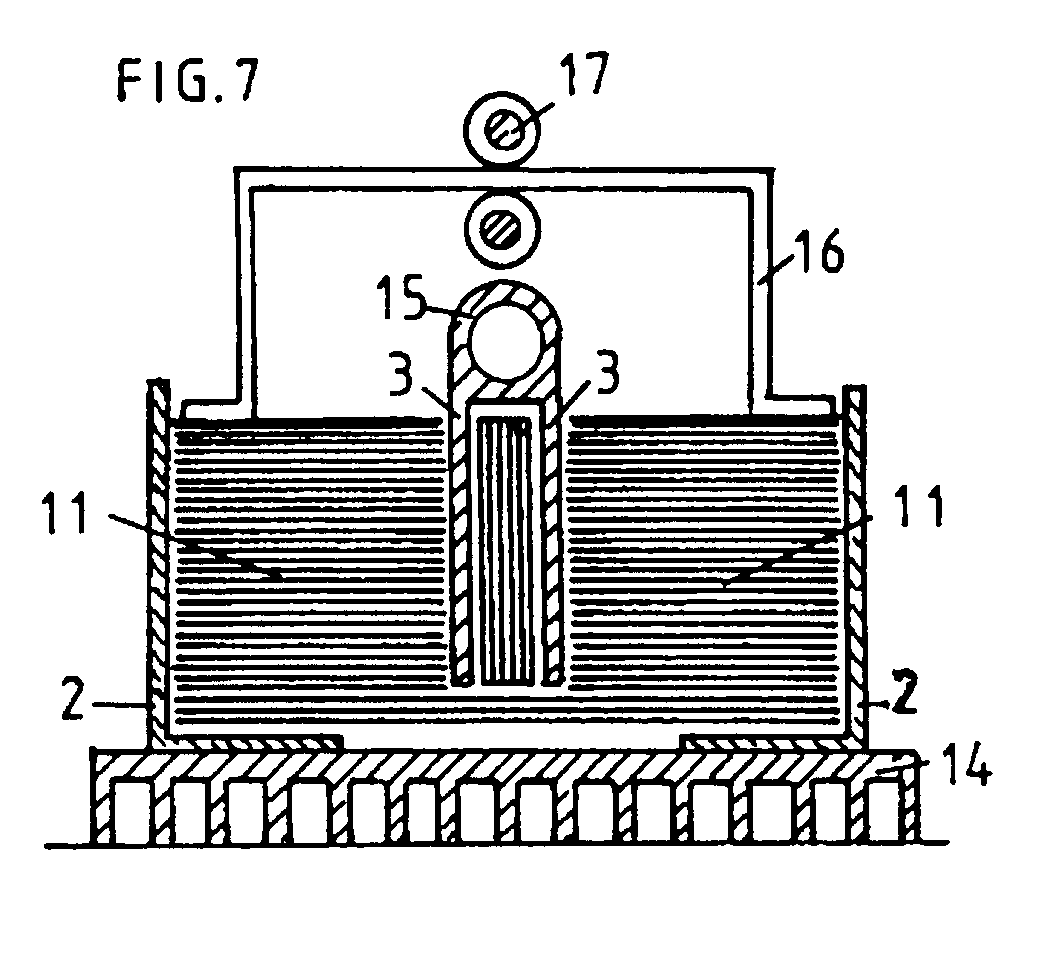
    Abstract: An apparatus for generating electricity comprises a laminated stack of ferromagnetic metal 11. The stack is part of a transformer core and an a.c. circulating current is set up in the stack by eddy current induction. A heat gradient is established in the stack by means of heat sinks 14,15. The Nernst effect converts the heat input to an output EMF which is delivered through a secondary winding. laminated rotor sections 19 axially spaced along a supporting spindle 1.


  • 1995f

    1995f

    The following is a paper by Harold Aspden published in New Energy News, volume 2, pp. 1-2 (1995).

    ‘Discovery of Virtual Inertia’

    I report an anomalous energy phenomenon found in my motor experiments.

    Imagine an electric machine having no electrical input itself and which, when started on no load by a drive motor and brought up to speed (3250 rpm), thereafter runs steadily at that speed with the motor drawing a little extra input power with a time delay rate of about two minutes. The machine rotor has a mass of 800 gm and at that speed its kinetic energy together with that of the drive motor is no more than 15 joules, contrasting with the excess energy of 300 joules needed to satisfy the anomalous power surge [to spin up from rest].

    Imagine further that when the motor, after running five minutes or more, is switched off and the machine is stopped, you can restart it in the same or opposite direction and find that it now has a memory in the sense that it will not now ask for that 300 joules of excess input. 30 joules will suffice provided that the time lapse between starting and restarting is no more than a minute or so.

    This is not a transient heating phenomenon. At all times the bearing housings feel cool and any heating in the drive motor would imply an increase of resistance and a build-up of power to a higher steady state condition.

    The experimental evidence is that there is something spinning of an ethereal nature coextensive with the machine rotor. That ‘something’ has an effective mass density 20 times that of the rotor, but it is something that can spin independently and take several minutes to decay, whereas the motor comes to rest in a few seconds.

    Two machines of different rotor size and composition reveal the phenomenon and tests indicate variations with time of day and compass orientation of the spin axis. One machine, the one incorporating weaker magnets, showed evidence of gaining strength magnetically, as the test were repeated over several days.

    I will soon be reporting in detail on these findings, after further work and evaluation of the implications. The phenomenon was something I should have been prepared for, having regard to my years of theorizing, but this discovery was unexpected as it has crept in loud and clear in a project aimed at testing a motor principle totally unrelated to ‘vacuum spin’. It has appeared obtrusively and I do not yet know whether, in adapting to its presence, it can serve in improving machine performance or become detrimental.

    Readers who are curious about my more general research endeavors may find interest in the specification of U.S. Patent No. 5,376,184 granted to me on December 27th 1994. In connection with the subject of this particular communication I quote from lines 3 to 28 of column 21 of that patent:

    “Now, in a practical device, one can similarly set up electric fields in a metal rotor by displacing those charge carriers, either by inertial action or the action of a magnetic field directed along the spin axis. However, even here physicists have problems understanding the phenomena they observe, as one may see from the scientific paper by James F. Woodward: Electrogravitational Induction and Rotation, Foundations of Physics, 12, pp. 467-478 (1982). On page 472 one reads, after a statement that machine operation produced induced charge in evidence from a voltage:

    Plainly, an effect of some sort is present. Since a negative charge appears during spindown, we may infer either that (1) an initially present positive charge disappears during spindown, or (2) some process drives the sample case to negative potentials during spin-down. The genuine disappearance of charge from the sample/sample-case assembly would be, of course, prima facia evidence for the existence of electrogravitational reduction.

    What this means is that electric charge can be held displaced within a metal to set up electric field gradients in that metal. Woodward did this by inertial spin action, possibly affected by the earth’s field, but a similar result can be obtained by building a series-connected capacitor stack.”

    ***************************

    The above-referenced U.S. patent is abstracted in these webpages as 1994b.


  • 1995e

    1995e

    The following is a paper by Harold Aspden published in Physics Essays, volume 8, pp. 19-28 (1995).

    ‘Retardation in the Coulomb Potential’

    Abstract: The spatial disposition of field energy owing to mutual interaction of two particles is usually considered in retarded force interaction theories. Stimulated by a comment from Allen [Physics Essays, v. 6, p. 614 (1993)], the author briefly summarizes his own prior published analysis of the electrostatic, electromagnetic, and gravitational field energy distributions and their bearing on action-at-a-distance theories.

    The full text of this paper may also be seen in PDF format as Paper No. 14 [1995e] in the Appendix to the author’s 1996 book: Aether Science Papers.


  • 1995d

    1995d

    The following is a U.K. Patent granted to Harold Aspden on May 8, 1996 with a first publication date of December 6, 1995.

    U.K. PATENT NO. 2,289,994

    ‘MAGNETIC RELUCTANCE MOTOR’

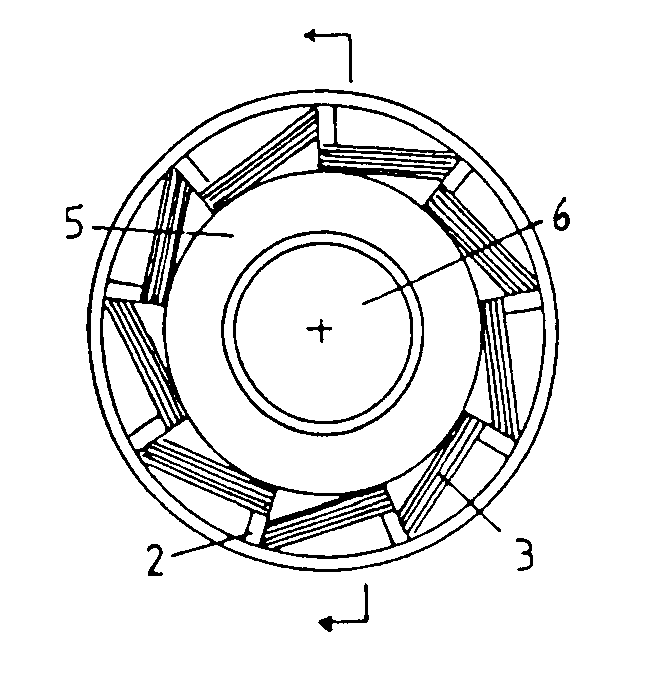
    Abstract: A magnetic reluctance motor has a salient pole rotor 3 interacting with stator poles 1, 2 to form a machine operating on the magnetic reluctance principle. The machine incorporates a shaded-pole feature by introducing an angle of inclination between laminar structures forming the rotor and stator cores. This performs eddy-current screening restricting magnetic flux transit between poles as they separate. It allows the magnetic attraction between poles during the approach phase to drive the motor.

    This patent is based on the same disclosure as that of U.K. Patent No. 2,287,134. The tilted stator poles provide the shaded-pole feature, whereas the other patent concerns the feature of the single solenoidal winding 5 which is powered to drive the machine.


  • 1995c

    1995c

    The following is a U.K. Patent granted to Harold Aspden and Robert George Adams on November 6, 1996 with a first publication date of April 12, 1995.

    U.K. PATENT NO. 2,282,708

    ‘ELECTRICAL MOTOR-GENERATOR’

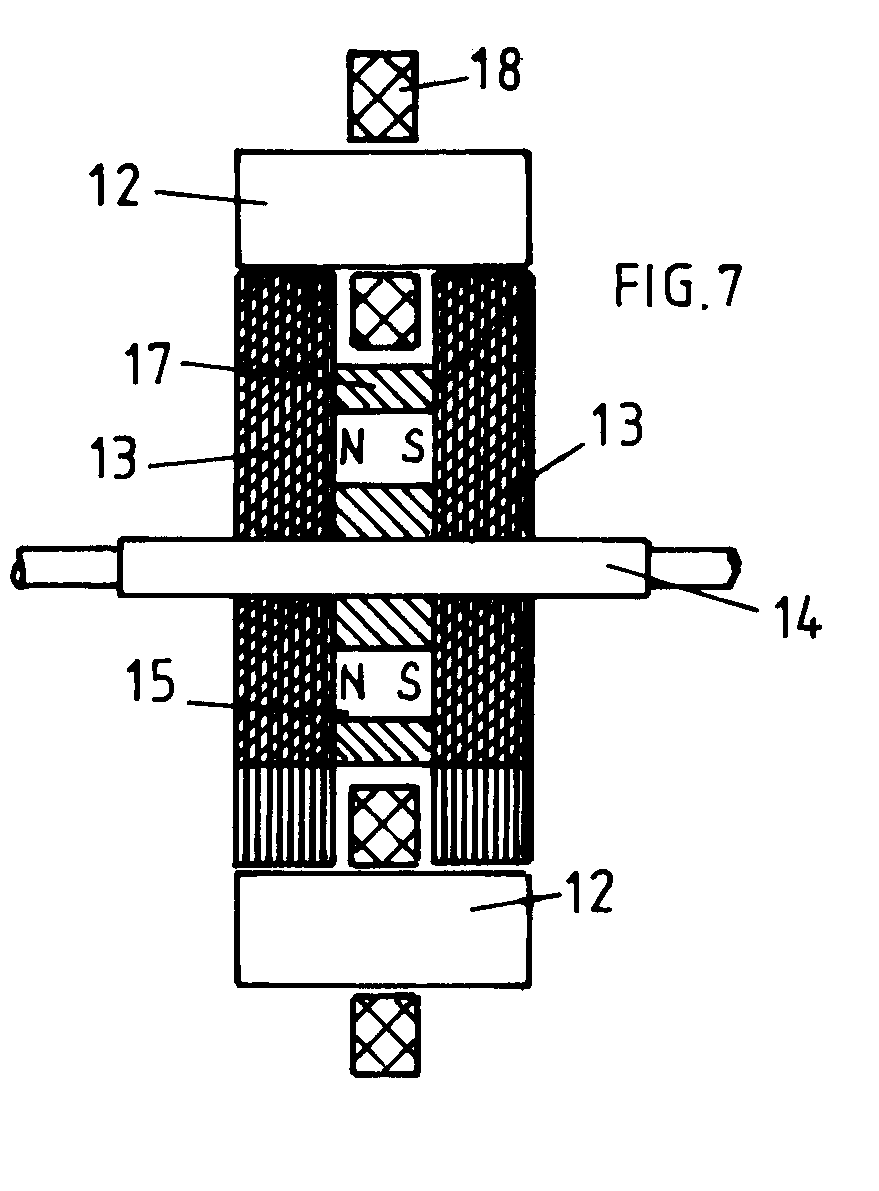
    Abstract: An electrodynamic motor-generator has a salient pole permanent magnet rotor interacting with salient stator poles to form a machine operating on the magnetic reluctance principle. The intrinsic ferromagnetic power of the magnets provides the drive torque by bringing the poles into register whilst current pulses demagnetize the stator poles as the poles separate. Inasmuch as less power is needed for stator demagnetization than is fed into the reluctance drive by the thermodynamic system powering the ferromagnetic state, the machine operates regeneratively by virtue of stator winding interconnection with unequal number of rotor and stator poles. A rotor construction is disclosed in (Fig. 6, 7). The current pulse may be such as to cause repulsion of the rotor poles.