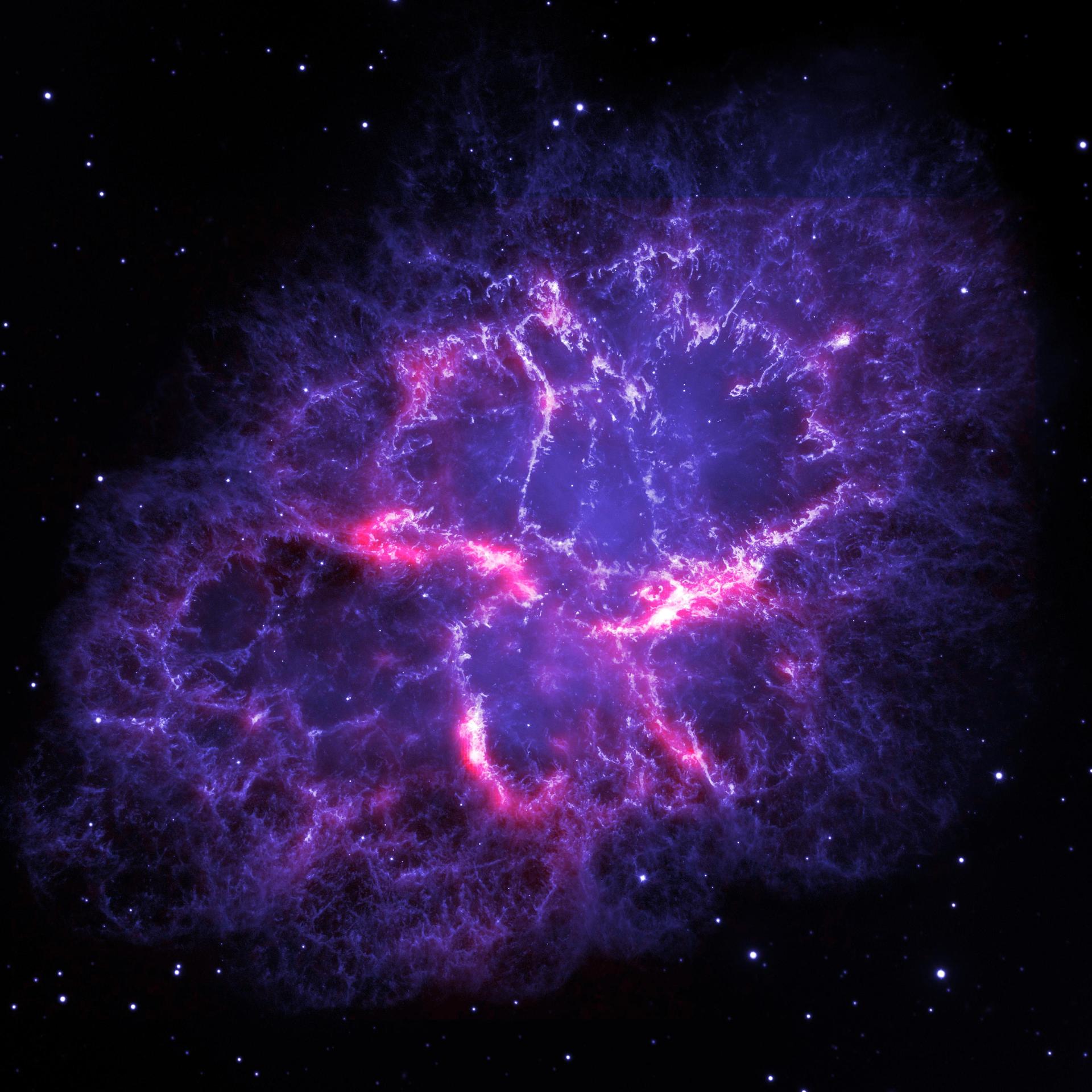
Crab Nebula (M1) — supernova remnant imaged by Herschel and Hubble Space Telescopes

Category: Papers & Publications

Peer-reviewed papers and publications by Harold Aspden

Crab Nebula (M1), supernova remnant · ESA/Herschel/PACS; NASA, ESA & A. Loll/J. Hester (Arizona State Univ.) · NASA Image Library ↗

  • 1995e

    1995e

    The following is a paper by Harold Aspden published in Physics Essays, volume 8, pp. 19-28 (1995).

    ‘Retardation in the Coulomb Potential’

    Abstract: The spatial disposition of field energy owing to mutual interaction of two particles is usually considered in retarded force interaction theories. Stimulated by a comment from Allen [Physics Essays, v. 6, p. 614 (1993)], the author briefly summarizes his own prior published analysis of the electrostatic, electromagnetic, and gravitational field energy distributions and their bearing on action-at-a-distance theories.

    The full text of this paper may also be seen in PDF format as Paper No. 14 [1995e] in the Appendix to the author’s 1996 book: Aether Science Papers.


  • 1995d

    1995d

    The following is a U.K. Patent granted to Harold Aspden on May 8, 1996 with a first publication date of December 6, 1995.

    U.K. PATENT NO. 2,289,994

    ‘MAGNETIC RELUCTANCE MOTOR’

    Abstract: A magnetic reluctance motor has a salient pole rotor 3 interacting with stator poles 1, 2 to form a machine operating on the magnetic reluctance principle. The machine incorporates a shaded-pole feature by introducing an angle of inclination between laminar structures forming the rotor and stator cores. This performs eddy-current screening restricting magnetic flux transit between poles as they separate. It allows the magnetic attraction between poles during the approach phase to drive the motor.

    This patent is based on the same disclosure as that of U.K. Patent No. 2,287,134. The tilted stator poles provide the shaded-pole feature, whereas the other patent concerns the feature of the single solenoidal winding 5 which is powered to drive the machine.


  • 1995c

    1995c

    The following is a U.K. Patent granted to Harold Aspden and Robert George Adams on November 6, 1996 with a first publication date of April 12, 1995.

    U.K. PATENT NO. 2,282,708

    ‘ELECTRICAL MOTOR-GENERATOR’

    Abstract: An electrodynamic motor-generator has a salient pole permanent magnet rotor interacting with salient stator poles to form a machine operating on the magnetic reluctance principle. The intrinsic ferromagnetic power of the magnets provides the drive torque by bringing the poles into register whilst current pulses demagnetize the stator poles as the poles separate. Inasmuch as less power is needed for stator demagnetization than is fed into the reluctance drive by the thermodynamic system powering the ferromagnetic state, the machine operates regeneratively by virtue of stator winding interconnection with unequal number of rotor and stator poles. A rotor construction is disclosed in (Fig. 6, 7). The current pulse may be such as to cause repulsion of the rotor poles.


  • 1995b

    1995b

    The following is a U.K. Patent granted to Harold Aspden on April 16, 1997 with a first publication date of May 3 1995.

    U.K. PATENT NO. 2,283,361

    ‘REFRIGERATION AND ELECTRICAL POWER GENERATION’

    Abstract: The thermoelectric device disclosed in U.K. Patent 2,227,881 is developed by this invention to accentuate the Nernst Effect contribution. By using thin ferromagnetic metal laminations 1 of thickness commensurate with or smaller than the normal magnetic domain size (100 micron) and feeding current transversely through the laminations with heat flow in the laminar planes, the current, regardless of polarity, selects a passage through the lamination which traverses a magnetic domain polarization having a direction in which the Nernst EMF assists the current. This results in a conversion of heat into electricity. A superconducting polymer, oxidized polypropylene, may be used as a heat resistant filler between the laminations to provide the continuity for transverse current flow. Heat sinks 2 are insulated by coatings 3 and connections are made by conductors 4.


  • 1995a

    1995a

    The following is a U.K. Patent granted to Harold Aspden on April May 8, 1996 with a publication date of September 6, 1995.

    U.K. PATENT NO. 2,287,134

    ‘MAGNETIC RELUCTANCE MOTORS’

    Abstract: A magnetic reluctance motor has a salient pole rotor interacting with stator poles to form, a machine operating on the magnetic reluctance principle. The machine incorporates a shaded-pole feature on the stator pole edges which performs eddy-current screening restricting magnetic flux transit between poles as they operate. This allows the magnetic attraction between the poles during the approach phase to drive the motor. A d.c. powered solenoid axially positioned intermediate two sets of rotor poles provides the magnetic polarization of the rotor core body to set up pole flux. The motor may include a permanent magnet fitted as a sleeve on the central part of the rotor core and the d.c. excitation of the solenoid then acts on the inner shaft section to magnetize it in the same direction as the permanent magnet and thereby augment the drive action whilst blocking flux closure from the magnet through the shaft.

    This patent is based on the same patent application as that of granted U.K. Patent No. 2,289,994 (Ref. [1995d] in these Web pages). The difference is that this patent covers the feature of the coaxially-mounted solenoidal winding 5 which powers the machine, whereas the tilted pole feature providing the shaded-pole action is the subject of the invention of Patent No. 2,289,994.

  • 1994h

    1994h

    This is one of a series of 10 Energy Science Reports made available by the author through U.K. company Energy Science Limited, under the publishing name Sabberton Publications.

    ENERGY SCIENCE REPORT No. 1

    POWER FROM MAGNETISM: THREE EXPERIMENTS
    ISBN 0 85056 017 9

    This is a 41 pp. report by which the author introduces experimental evidence that offers promise in the quest to discover new ways by which to regenerate spent energy. It is shown how one can verify that there is more energy set up by a magnetic field traversing a pole gap than is supplied to the magnetizing winding. This implies that the quantum activity sustaining action in a ferromagnetic core can tap energy from the the thermodynamic state of the aether. There is an analogous way in which magnetism can be used, not to tap energy from the aether, but as a catalyst which converts heat in the body of the test apparatus into useful electrical form. This is a thermoelectric effect which seemingly defies the second law of thermodynamics and gives basis for the second experiment described. This report provides background for onward more specific reporting on the author’s experimental efforts in this series of Energy Science Reports. This Report No. 1 concerns the research status as at February 1994.

    The full text of this Report can be seen via the following link: REPORT No. 1


  • 1994g

    1994g

    This is one of a series of 10 Energy Science Reports made available by the author through U.K. company Energy Science Limited, under the publishing name Sabberton Publications.

    ENERGY SCIENCE REPORT No. 6

    POWER FROM SPACE: INERTIA AND GRAVITATION
    ISBN 0 85056 022 5

    This is a 34 pp. report. Its purpose is to show that the true nature of inertia arises from a conservative energy property of each element of electric charge as it responds to the accelerating effects of other charge. Attention is drawn to a fundamental error in the conventional derivation of the Larmor formula for energy radiation, which fails to give proper account of interaction with the accelerating field. The report reproduces three of the author’s published papers, bringing together in this short monograph a summary analysis which explains the force of gravity and Nature’s way of creating the proton. This report is for the student of physics who seeks to understand inertia and to know what determines the actual values of the proton-electron mass ratio and G, the constant of gravitation.

    The full text of this Report can be seen via the following link: REPORT No. 6


  • 1994f

    1994f

    This is one of a series of 10 Energy Science Reports made available by the author through U.K. company Energy Science Limited, under the publishing name Sabberton Publications.

    ENERGY SCIENCE REPORT No. 4: POWER FROM MAGNETISM: THE POTTER DEBATE

    ISBN 0 85056 020 9

    This is a 38 pp. report. There are many unanswered questions concerning possible experiments involving magnets as a means for adding power to an electric motor. Frank Potter had struggled to find someone of academic standing who could prove to his satisfaction that what he had in mind would not work. Contrary to orthodox opinion this author supported the Potter case. This report is a preliminary feasibility study based on theoretical analysis of the magnetic actions involved. Much of what is described in this text has bearing upon the experimental findings which are to be reported in later Energy Science Reports, notably in Report No. 7 and Report No. 9.

    The full text of this Report can be seen via the following link: REPORT No. 4


  • 1994e

    1994e

    The following is a Conference paper by H. Aspden published in the Proceedings of the International Symposium on New Energy held in Denver, Colorado on May 12-15, 1994, pp. 1-20.

    ‘MAGNETISM AND THE ENERGY OF CREATION: THE $64 QUESTION: WHAT IS THE ENERGY SOURCE’

    Abstract: By following the theme that ‘energy is money’, the way in which energy transfers in magnets and solenoids is discussed by analogy with a world banking system. There are creative forces in Nature by which energy is shed from a vast reserve to set up the present state of equilibrium between matter and aether. This paper discusses how that equilibrium can be disturbed to give us access to ‘free energy’. It reveals the design secret of the Adams motor and it goes beyond such technology to explain where science went wrong in interpreting important physical phenomena incorrectly. We see why this has meant that the technology of ‘Creation’ has eluded us until now and impeded those who seek better ways to bring new power into industry. It is simply a question of understanding that universal banking system, meaning the energy bank that pervades all space.

    *********

    The delivery of this paper at the Denver International Symposium on New Energy in 1994 marked the author’s introduction of a series of ten Energy Science Reports which the author published between 1994 and 1997, copies of which are to be made available for access via these web pages. This Symposium paper is therefore seen by the author as being an important contribution to the subject.

  • 1994d

    1994d

    This is one of a series of 10 Energy Science Reports made available by the author through U.K. company Energy Science Limited, under the publishing name Sabberton Publications.

    ENERGY SCIENCE REPORT No. 5. POWER FROM WATER: COLD FUSION: PART I

    This Report was first published by the author in 1994 and was reissued later and made more generally available from Sabberton Publications as ISBN 0 085056 0217 in October 1996. It is now made available freely via this Internet facility. It concerns theory pertaining to the creation and properties of deuterons which, as present in atoms in heavy water, deuterium oxide, are involved in the experiments which gave birth to the notion of ‘cold fusion’. The technology of that field is slow to develop and, though the author did plan to write a Part II Report as a sequel to this report, which is entitled POWER FROM WATER: COLD FUSION: PART I, this has not materialized. This Report nevertheless is an important contribution to the theory of the subject, also because it explains how the triton, the third isotope of hydrogen is created. It is worthy of study as an adjunct to the author’s latest work, the book: The Physics of Creation, because the latter explains in updated detail how the proton itself, the primary isotope of hydrogen is created. For this reason it is given priority in updating this website by now adding progressively each of these ten Energy Science Reports as they are withdrawn from normal printed publication. It should be noted that the book just referenced is a substantial work and should not be confused with Appendix A of this Report, which has the same title. The latter featured as a 12 page Chapter 4 in the author’s book GRAVITATION, published in 1975, which gives an early insight into what has now become a 28 year-old account of the origin of proton creation. ………. Harold Aspden, 1 June 2003

    The full text of this Report can be seen via the following link: REPORT No. 5