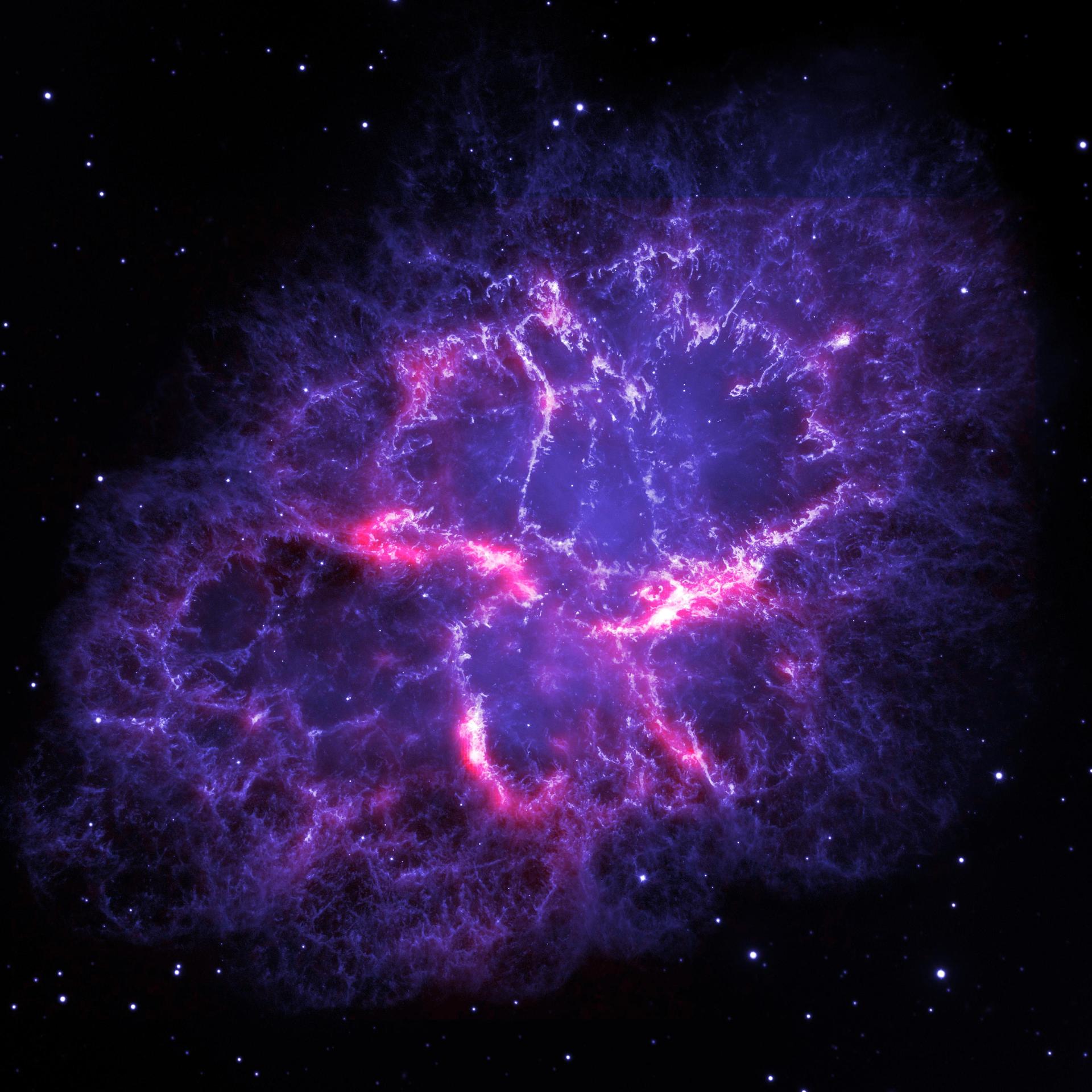
Crab Nebula (M1) — supernova remnant imaged by Herschel and Hubble Space Telescopes

Category: Papers & Publications

Peer-reviewed papers and publications by Harold Aspden

Crab Nebula (M1), supernova remnant · ESA/Herschel/PACS; NASA, ESA & A. Loll/J. Hester (Arizona State Univ.) · NASA Image Library ↗

  • 1952a

    1952a

    The following is a paper by H. Aspden published in the Journal of Applied Physics, vol. 23, pp. 523-528 (1951).

    EDDY-CURRENTS IN SOLID CYLINDRICAL CORES HAVING NON-UNIFORM PERMEABILITY

    Abstract: A method of estimating magnetization losses in solid cylindrical cores of ferromagnetic material is given. The conception of complex permeability is introduced to show the effects which hysteresis has upon the degree of flux penetration. A formula is given for the effective permeability which should be used in the classical treatment in which non-linearities have been ignored. An arbitrary case in which the permeability changes across the core section is considered and the solution is extended to a core which is homogeneous, but whose permeability changes with the degree of magnetization. In this way errors due to a non-linear B-H curve are reduced and the complex permeability notation is shown to lead to a more reasonable Steinmetz relationship. The eddy-current anomaly is mentioned and it is noted that the theory developed is suited to a consideration of the anomaly as explained in terms of time-lag effects.

    Commentary: This paper was written during a period when the author was working for a Ph.D. degree which involved experimental research on the eddy-current anomaly. See the related paper: [1956a]. However, the detailed analysis based on complex magnetic permeability as covered by the mathematics in this paper in relation to a non-linear B-H magnetization curve was not included nor involved in the research thesis which was submitted in support of that Ph.D. degree.


  • 1951a

    1951a

    The following is a paper by H. Aspden was published in The Review of Scientific Instruments, vol. 22, pp. 869-871 (1951).

    A FERROMAGNETIC HYSTERESIS POTENTIOMETER

    Abstract: The potentiometer embodies the principle of the normal fluxmeter method of measuring hysteresis loss but, while retaining the accuracy, enables the measurement to be made in a fraction of a minute. The potentiometer incorporates a number of tappings which are connected to individual contact studs so that by rotating a contact arm the current applied to a magnetizing circuit can be varied in a cyclical manner between two limiting values. There are intermediate positions of the arm which correspond to intermediate values of current and these values differ by fixed amounts from one cycle to the next. The contact arm also forms part of a stud switch so that a search coil can be disconnected from a fluxmeter over the part in each cycle over which the current changes between the intermediate and one of the limiting values. In this way a complete rotation of the arm is made to take a specimen through twelve cycles of magnetization and since the intermediate current values are evenly distributed over the complete cycle the fluxmeter registers a deflection which can be related to the hysteresis loss.

    Commentary: This paper was written during a period when the author was working for a Ph.D. degree which involved experimental research on the eddy-current anomaly. See the related paper: [1956a]. However, this potentiometer was not used in the eventual experiments which were the basis of that Ph.D.


  • Aspden Www Aspden Org Papers P2002A Notes

    NOTES ON BERLIN LECTURE

    Copyright, Harold Aspden, 2002

    This set of six Notes was compiled as an aide memoire for use in the author’s onward discussions following the presentation of the Lecture at the 2nd Berlin Conference for Innovative Energy Technologies organized by BINNOTEC e.V., Berlin and held the location of SolarEnergy 2002, Messe Berlin, Messedamm 22, D-14055 in Berlin, Germany on June 13th-15th 2002.

    I

    EINSTEIN: ENERGY AND THE VACUUM

    When reading about energy as a property of the medium we call the ‘vacuum’, there will
    be those who wonder about the role which Einstein played in clarifying our picture of things.
    Well, much as you may wonder, you will find that Einstein had very little to say about energy, as
    such, and far less, if anything, about the vacuum as a source of energy. Do not be deceived by
    what you think may be implied by the formula E = Mc2. This equation is easily derived by
    investigating how an electric charge accelerated by an electric field can respond to avoid radiating
    its energy E and, indeed, its very charge. Its response has to be such that it exhibits inertia
    according to a mass property M as given by the above formula, c being the speed at which electric
    field disturbance propagates through the vacuum from the seat of action, the electric charge.
    However, that was not how Einstein came to formulate that equation. His approach was
    somewhat philosophical, albeit guided by a fact known from experiment in the latter part of the
    19th century that, the faster an electric particle moves, the greater its mass, subject to a limiting
    threshold set by the speed of light c. The correct interpretation, however, is the simple fact that
    energy has to be conserved and, as an electric charge has an associated amount of energy, energy
    which increases by augmenting the electric field energy of the particle with a retinue of kinetic
    energy, that energy is not dispersed by radiation and so accumulates and enhances the mass.

    As you can see, under that heading of the Berlin Lecture ‘Capacitor Magic or a Mere
    Dream’, I began by asking you to ‘imagine’ a capacitor as having a rather unexpected property
    and followed this by asking how you would turn this into a ‘practical’ device. Imagination of
    what might be possible in our world of reality, coupled with practical skill are characteristic of the
    engineer and inventor and energy is the realm of the engineer. In contrast, noting that that Berlin
    Lecture, though prepared in draft form in January 2002 before I accepted the invitation to speak
    at the Berlin meeting and completed on 8th March after returning from a four week absence on
    vacation, it struck a chord in the author’s mind to read, on 14th March 2002 in the English
    newspaper THE TIMES, that that day was the anniversary of the birth of Albert Einstein and that:

    While at secondary school, Albert Einstein – who was born on this day in Ulm,
    Germany in 1879 – wrote an essay in which he proposed becoming a teacher of
    theoretical science, because of his “disposition for abstract and mathematical
    thought, and my lack of imagination and practical ability”.

    It is no wonder, therefore, that Einstein came to see the aether, or rather space-time, as an
    abstraction definable in terms of mathematical equations but could not imagine its real form and
    see its potential as a practical energy source!

    Admittedly, this author is here giving vent to his feelings, having in mind the hostility he
    encountered when trying to advance his insights into the nature of the aether and encountering
    shocked reaction expressed by the words “Have you never heard of Einstein?”. To have one’s
    scientific papers during a 14 year period up to 1969 rejected on sight for non-conformity with
    Einstein’s teaching did leave its scars. This accounts for the unusual choice of title of the author’s
    first major printed work, namely Physics without Einstein, a 224 page book which, incidentally,
    at pp. 8-14, presents the full mathematical analysis proving that an accelerated electrical charge
    that seeks to preserve itself from loss of energy must exhibit an inertial property according to a
    formula E = Mc2 where M is the mass defining that inertial property, E is the energy of the particle
    and c is the speed at which disturbances produced by accelerating electric field action propagate
    by displacing the electric charge system of the aether.

    [H. Aspden: 15th March 2002]

    II

    AN UNEXPLAINED ANOMALY

    It was only as I finalised the text of the BERLIN LECTURE that I recalled that, some 19
    years before, in 1983, I had been given a copy of a Ph.D. thesis by someone I knew as a Research
    Manager at IBM’s development laboratories in U.K., Dr. Bruce P. Piggin. I and Dr. Piggin had
    just retired from IBM and I had become a Visiting Senior Research Fellow at the University of
    Southampton in England. Dr. Piggin’s Ph.D. research had been in the Chemistry Department of
    that university and his thesis entitled ‘Pulse Studies on an Electrochemical System’ was dated July
    1967.

    I remembered that he had some particular views about capacitors and an aspect that he
    saw as warranting attention, but what he had said at the time did not stir my interest, even though
    I was then intent on experimenting with a torsionally suspended capacitor system excited by high
    voltage pulsations to repeat my own version of the Trouton-Noble Experiment, which had in 1904
    been an attempt to detect the Earth’s motion through space. Indirectly that experiment is
    concerned with the law of electrodynamics because the detection of motion through the aether
    depends upon a certain interpretation of that law, as it concerns the notion of two spaced
    capacitor charges moving with body Earth through space and an experiment aimed at detecting
    the effects of electrodynamic interaction forces as between the moving charges.

    So my copy of that thesis has lain dormant in my files for those 19 intervening years, and
    it is only now, having been inspired by new ideas to write the BERLIN LECTURE, that I have
    seen reason to browse through it once more. My reason is that the test capacitor of Bruce
    Piggin’s thesis is a cell of concentric cylindrical electrode construction and it is pulse-charged.
    I also note that, as I now read this 1967 Southampton University thesis, it has occurred to me that
    the cold fusion theme that captured our headlines in the 1989 era, had involved a cell of somewhat
    similar construction and that Professor Fleischmann, of cold fusion fame, had his professorial seat
    in the Department of Electrochemistry at Southampton University.

    Now, in this brief note, which I admit I present as possibly only of passing interest, I only
    wish to draw attention to a feature of the Piggin thesis that I find curious as it may have some
    bearing upon the claim I am making in presenting that BERLIN LECTURE. Remember that in
    that Lecture I am suggesting that the aether can import energy anomalously into a concentric
    cylindrical capacitor. Critics will ask for evidence in support, so I feel obliged to point to anything
    that can help in this quest.

    So all I intend to present here is a copy of page 105 from Dr. Piggin’s thesis, which
    introduces his Fig. 49, and couple this with a quotation concerning that Fig. 49 that appears on
    page 100 of the thesis. I leave others who may read this to infer what they may, but say further
    that in his experiment Piggin applies an electrical pulse to charge the capacitor and follows this
    by an opposite polarity pulse to force its rapid discharge, after which, for some mysterious reason,
    that capacitor begins to recharge of its own accord. Can the inertial energy of the aether that I
    discuss in the BERLIN LECTURE be feeding in by a sub-microsecond delay?

    That quotation reads:

    ” An interesting observation is shown in Fig. 49. In this case, decay of the stored
    charge is assisted by the search pulse of opposite polarity. It is observed that the
    voltage decays at an accelerated rate during the search pulse as expected. The
    interesting question posed is why should the decay voltage rise of its own accord,
    after the search pulse has finished? Similar observations will be reported in later
    chapters.”

    Readers do need to be mindful of the fact that Dr. Piggin’s thesis concerned tests on cells
    using a chemical dielectric in the capacitor system, platinum electrode in iodine-iodide solutions
    and so chemical factors may account for the observed anomaly, but equally the chemical factor
    would not preclude aether-energy inflow and that phenomenon could well have been in evidence.
    Without there being test data for cells not loaded with a chemical dielectric this remains an open
    question.

    The following is a copy of page 105 from the thesis.

    Footnote

    As a point of interest I recall from my school education (some 60 years ago) that my
    physics master introduced us to the properties of a Leyden jar by demonstrating an experiment
    with two concentric electrodes and a removable cylindrical dielectric spacer element. He charged
    the assembly as a capacitor and then removed the dielectric element before (I believe – if my
    memory serves me well) then connecting the electrodes to discharge any energy they might have.
    Then he reassembled the capacitor with its dielectric spacer element and showed us that the
    capacitor did, indeed, still have some electric charge. His message was that there was energy
    stored in that dielectric spacer element, which I now can imagine as attributable to an inertial
    aether spin action within its cylindrical form, an action which can shed energy immediately on
    demand only if the electrode system is present and its electrodes are short-circuited so as to permit
    a discharge current to flow.

    [H. ASPDEN : 16th March 2002]

    III

    THE ASYMMETRICAL CAPACITOR ACTION

    In the BERLIN LECTURE it was suggested that a capacitor, particularly one of
    concentric cylindrical electrode construction, might deliver as output, when discharging, an
    amount of energy that could be as much as double that supplied as input when charging. This
    might seem to pose a problem with regard to the conventional mathematical analysis of capacitor
    properties, bearing in mind that we assume that the charge input Q is equal to the capacitance C
    multiplied by voltage V.

    I will, therefore, examine this problem from two points of view. I will begin by making
    a strong assertion, expressing an opinion that I feel sure 99% of the academic community versed
    in electrical theory will support, but I will then contradict what this implies by reference to
    experimental data. After that I will engage in a measure of theoretical speculation in presenting
    the only alternative point of view available, an approach which not even 1% of that academic
    community would support, and then I will endorse what this implies by pointing to experimental
    data that has been drawn to my attention but which I cannot vouch for as verified by independent
    researchers.


    The First Point of View

    One can be sure that the charge displaced around a circuit from one electrode to the other
    cannot suddenly double in value merely because of the transition which occurs as the charge-discharge cycle peaks at its maximum value. The action, therefore, must occur in the state of the
    aether between the two electrodes of the capacitor as the energy stored in that region of aether
    seeks release as the aether there senses a transition from the input to the output state.

    In short, it has to be the effective permittivity of the dielectric properties of the capacitor
    that changes to deliver the extra energy as output. In mathematical terms, it would seem that the
    permittivity during discharge must be half that applicable during the charging period, even though
    we are referring essentially to the properties of what we understand as the vacuum state. This
    implies a capacitance during discharge that is half that during the charging period, so that the
    charge Q, which equals CV, remains the same at the instant of transition, whilst the voltage V
    doubles. C, which is proportional to that permittivity value, is halved. In energy terms, bearing
    in mind that energy E = CV2/2, this results in a doubling of the energy E, meaning that the
    discharge will release twice the amount of energy that was fed in as input during charging.

    Now, the problem here is that I am not aware of any experimental evidence that reveals
    a doubling of output voltage when a capacitor begins to discharge. Even if the case is restricted
    to capacitors having concentric electrodes I still think that, if such a phenomenon were to occur,
    it would have been mentioned in our textbooks on the subject. Indeed, to the contrary, as
    reference to the Ph.D. thesis of Bruce Piggin just discussed in the preceding note shows, the
    capacitor voltage of the concentric cylindrical electrode capacitor merely follows the normal path,
    but yet, if then abruptly fully discharged by a negative input pulse, there is some kind of after
    effect which does show a mysterious voltage build-up.

    Accordingly, adopting this first point of view, has still left us with the problem of
    understanding how a capacitor can shed energy electrically if in truth it has acquired an excess of
    energy from aether input.


    The Second Point of View

    Here I need to outline a feature of the aether that my rigorous theoretical analysis of that
    structured vacuum medium has revealed. The aether has a cubic cell structure with an aether
    particle seated in each cell. It sits in a uniform continuum of electric charge which fills the space
    in that cell not occupied by the particle form and this continuum charge has a polarity opposite
    to that of the aether particle, so that the aether overall is electrically neutral. The aether particle
    would itself expand under its internal electrostatic repulsion forces were it not for there being a
    an energy presence in the cell pervading that continuum, the energy concentration matching that
    of the aether particle form so as to have equilibrium and balance of pressure. That energy
    presence is provided by a virtual pair of leptons, the heavy electrons that particle physicists refer
    to as mu-mesons or muons. They perform no known role in the physical constitution of the
    universe, because that role is primarily the one they serve in assuring pressure equilibrium within
    the aether itself and because the aether, as such, is ‘unknown’ to the theoretical physicist of today.

    I know this fact about the aether virtual muon system because my theory has allowed the
    evaluation of the unit cell energy in terms of the rest mass energy of the electron and the analysis
    suggests that a virtual muon can be either a positive or negative electron unit of charge with an
    associated energy quantum that is either 205 or 207 times the value of the electron rest mass
    energy. The theory indicates that the 207 units outnumber the 205 units by a two to one ratio.

    Indeed, by assuming that these virtual muon quanta migrate through space and suffer
    mutual annihilation and recreation at the same cyclic frequency as the quantum jitter motion of
    those aether particles, one can recognize their secondary role which accounts for the process of
    proton creation and so derive a theoretical value for the proton/electron mass ratio that is
    1836.152, in good accord with the measured value.

    This is all of record in this author’s published work, as summarized in ‘Aether Science
    Papers
    ‘ (1996), but I make particular reference to the ninth of the fourteen appended papers in
    that book, which is ‘A Theory of Proton Creation‘, Physics Essays, v. 1, pp. 72-76 (1988). It
    discusses the role of the virtual muon in creating the proton from the energy underworld of the
    aether, the energy equilibrium of that medium being maintained as it absorbs energy dissipated by
    matter, reorganizes it into a quantized virtual muon form and then sheds it as surplus by creating
    protons with an accompanying electron to keep the electrical charge balance.

    Now, why is this relevant to our capacitor problem? The simple answer here is that, if the
    capacitor is to deliver twice the amount of energy on discharge as it receives during the charge
    period, and do this without doubling its voltage for the discharge period, then it must somehow
    be able to double its charge so as to deliver twice as much output charge as it received as input.
    That is impossible unless the vacuum medium within the capacitor plates can itself produce a flow
    of charge through what is normally seen as a non-conductor of electricity.

    My proposition, therefore, is that, given that the aether has energy it seeks to release and
    given that it is alive with a virtual muon activity that passes unnoticed normally, we can look to
    that muon activity to find a way of shedding that energy as a flow of current from that capacitor.

    The action is probably one where a negative muon of 207 electron mass units sheds two
    electrons at the negative capacitor electrode and converts into a positive virtual muon of 205
    electron mass units, whilst the reciprocal action occurs at the positive electrode as two electrons
    are drawn from that electrode and absorbed into a positive virtual muon 205 to convert it into a
    negative virtual muon 207. As the virtual muons deploy in their equilibrium activity this will
    amount to a flow of electrons through the space between the electrodes.

    It means that the capacitor can, without doubling its voltage, deliver the double energy
    output by delivering double the input charge as output.

    It may all sound highly speculative and that I do not deny, but at least I offer a possible
    answer to the problem. Furthermore, though it is indeed quite fortuitous, I find that, after a lapse
    of 14 years since a previous contact, a U.S. researcher named Alexis Guy Obolensky mailed me
    a letter dated February 28, 2002 in which he reminds me of a supporting opinion I expressed back
    in 1988 concerning his discovery of faster-than-light-speed action in an experiment involving
    transmission via coaxial cables. It is quite astounding to find that, as I write this commentary as
    a Note to back up the text of the BERLIN LECTURE that I compiled in January, I can quote a
    paragraph from Obolensky’s February letter that seems to endorse my speculation. It reads:

    “I was the first to employ matched coaxial cable time delays and phase matched
    current sensors to demonstrate the existence of electromagnetic (faster than light)
    shock waves. This substantiated Tesla’s magnifying transmitter patent
    application’s superluminal claim. His technique to extract fuelless coherent-energy, from the incoherent-heat of the ambient medium, was suggested but not
    proven back in 1988. This, notwithstanding the numerous superluminal shock
    wave experiments that revealed an approximate doubling of the remote receiver’s
    integrated-current output compared to a simultaneous measurement of the local
    transmitter’s integrated-current input. To my knowledge, electronic research has
    still not investigated electromagnetic shock waves by using equal-time-delay,
    simultaneous measurements, to circumvent the Einstein clock problem.”

    That reference to the electric charge output from a pulse-excited coaxial transmission line
    being double the charge input has attracted my attention. It implies an energy gain which
    Obolensky, in the next paragraph of his letter attributes to ‘the incoherent heat in our planet’s
    atmosphere’ as the source. However, my opinion, as is evident from my BERLIN LECTURE is
    that the aether is the energy source and I can but point out that a voltage pulse travelling along
    a coaxial cable is the sequential charging and discharging of a capacitative component which has
    a conductor as central electrode and an earthed electrode formed by a concentric conducting
    sleeve, that is a concentric cylindrical electrode capacitor in which one can develop aether spin.

    Accordingly, I can but regard what Obolensky describes as supporting this second point
    of view and endorsing my conductive aether notion based on those virtual muons.

    [H. ASPDEN: 16th March 2002]

    IV

    CAPACITOR ENERGY ESCALATION ANALYSIS

    Here we calculate the condition for the circuit shown in Fig. 7 of the BERLIN LECTURE
    to tap aether energy based on the capacitor property there discussed, namely the feature that for
    a cyclic change of capacitor energy the capacitor energy doubles during the discharge. It seems
    appropriate to assume that the development of aether spin in a system which is to be governed
    by a phase-lock between a space region in spin and a non-spinning enveloping space region will
    require that a small but finite threshold of radial electric field intensity between the capacitor
    electrodes has to be exceeded.

    Let C be the value of each capacitor. Let V be the d.c. capacitor priming potential in
    volts. Let v denote the voltage of a transient potential drop across each of the two sections of the
    inductor system. Let R here denote the resistance of each such inductor section, this resistance
    including that of a load which is connected to the secondary winding of a transformer of which
    the primary winding is the inductor system just mentioned.

    At any instant the voltage across one capacitor will be V-v when that across the other
    capacitor is V+v. This is because capacitor charge can oscillate between the two capacitors as
    current flow through the inductors changes cyclically, the corresponding induced EMFs of
    strength v across each inductor section being in anti-phase and so of opposite polarity relative to
    the central earth terminal.

    By standard electrical theory the energy stored by the two capacitors is given by:

    C(V+v)2/2 + C(V-v)2/2

    which is:

    C(V2 + v2)

    and so as v changes there is no energy gain but merely a loss owing to the flow of current through
    the overall inductor resistance 2R.

    However, we are considering a situation where the discharging capacitor is shedding twice
    as much energy as it gained during charging. Therefore, allowing for the presence of the aether
    energy acquired during the charging stage, in discharging to the V-v condition, a capacitor will
    shed an excess of energy drawn from the aether amounting to:

    C(V+v)2 – C(V-v)2

    which is:

    4CVv

    This excess energy is deemed to flow in as input from the aether owing to the quantum
    synchronisation of the zero-point vacuum energy of that aether medium. This latter energy is
    replenished in each half cycle of oscillation only to the extent needed by the fluctuation of the
    voltage v across the inductors.

    Suppose now that v, which is zero initially, is induced by some internal fluctuation or
    external field stimulus and so begins a natural oscillation at the resonant frequency of the circuit.
    Let v now denote the amplitude of a sinusoidal variation so that as this passes through its zero
    value the energy 4CVv which has come from the aether has been shed in half a cycle.

    This energy has to do more than overcome resistance loss if there is to be a build up of
    the oscillations as needed to render the system useful as a power generator. Note then that the
    resistance loss plus power delivery will be proportional to v2, because v is the amplitude of the
    voltage acting across the inductors and so, with inductance fixed, the current magnitude is
    proportional to v and the resistance loss plus power delivery is proportional to the current
    squared. Accordingly, the crucial factor is whether kv2, with k determined by that inductance and
    resistance, is less than 4CVv when multiplied by twice the frequency of oscillation. If so, and
    provided that threshold condition mentioned above is exceeded, then the oscillations will escalate
    in strength and provide a source of ‘free’ energy. It is then clear why the priming voltage V is
    important.

    The factor k will also depend upon the capacitance of the capacitor as this limits the
    current. Indeed the current amplitude is 2πvC times the frequency of oscillation and if 2R is the
    circuit resistance the overall condition for an escalating energy action becomes one for which
    2V/v is greater than π2CR times the frequency. This is a simple numerical ratio because CR has
    the dimension of time. It is a condition that, at least in theory, is easily satisfied but that unknown
    threshold value of electric field intensity has to be exceeded, a factor which makes that priming
    voltage V extremely important.

    It must be high and, being high, this means that v will increase more and more until it rivals
    V in value, which in turn means that a high rate of energy output can be achieved if V+v is of the
    order of 25,000 volts and the resonant frequency is of the order of 100 kHz. Indeed, potentially,
    a pair of capacitors each of only 1 nanofarad capacitance could, on this theoretical basis, deliver
    aether energy at a power rating of the order of 50 kW, 62.5 kW being applicable if v were to
    climb to a limiting value V.

    To put this in perspective, if this capacitor energy escalation theme is a valid proposition,
    one can begin to contemplate a practical application based on the above 50 kW power output
    from a pair of 1 nanofarad capacitors. Such a capacitor using air as dielectric would need an
    electrode separation of the order of 1 cm to withstand the 25,000 volt charge. If it were to
    comprise two concentric cylinders, one having an internal diameter of 20 cm and the other an
    external diameter of 19 cm, and an overall length of 50 cm, then its capacitance would be 2.2
    nanofarad and two such capacitors would only take up a fraction of the space assigned to the
    engine compartment of an ordinary automobile. Yet the potential power rating, based on that 2.2
    nanofarad value would be in excess of 100 kW, which is an acceptable level for such an
    application. The equipment needed to generate a 25 kV capacitor priming voltage, taken together
    with a standard electrical car battery to feed in the initial charge of the capacitors plus the
    inductor/transformer units which form the resonant circuit and provide a lower voltage
    transformer output need be no larger in volume than the capacitors. One is then left with the need
    for an electric motor that can provide the mechanical drive for the automobile, this being standard
    technology but the greater weight factor in terms of drive power generated and so the primary
    design criterion that could limit vehicle performance.

    One can, however, be sure that if the new technology implied can meet the requirements
    of powering an automobile, it can be even more advantageous in large scale electric power
    generation for domestic and industrial use as well as in ship propulsion.

    Accordingly, the scientific principle involved warrants the necessary research to verify or
    disprove what is suggested and, if viable, ascertain such criteria as may impose limitations on
    performance.

    [H. ASPDEN: 17th March 2002]

    V

    POWER FROM CONCENTRIC CAPACITOR PAIRING:

    A GENERAL OBSERVATION

    The inevitable question concerning my BERLIN LECTURE is: “Why what is suggested
    has not been discovered already in the electrical laboratories of our many universities?” To
    suggest that energy outputs of some 100 kW could be delivered as if from nowhere by connecting
    two capacitors of a few nanofarads capacitance by inductors to form a resonant circuit is an awe
    inspiring proposition.

    My simple answer has to be to ask where I can look up the record of such an experiment
    having been performed and its negative result recorded. Clearly, had such an experiment been
    performed and had it delivered a ‘free’ energy output, then that would inevitably have been
    newsworthy besides being documented in a scientific periodical.

    Has the experiment ever been performed? Until someone can say: “Yes” to this question
    and quote the reference for my inspection, then I must assume the answer is: “No” and adhere to
    my argument that the issue must be clarified in view of its potential importance.

    However, just ask yourself why anyone in a university electrical laboratory would be
    interested in setting up an oscillation in an inductor-capacitor circuit as between two series-connected capacitors and an inductor and how they would proceed. I suggest that if they did they
    would obtain the capacitors commercially and that those capacitors would not be of concentric
    electrode construction. I suggest that they would not see much point in using a series connection
    of the capacitors, given that one normally connects capacitors in parallel if one seeks to augment
    the capacitance in circuit. I suggest that the series connection, if adopted, might be deemed to
    serve only as means for using capacitors of lower voltage rating in a higher voltage application,
    perhaps in a high voltage laboratory for delivering high voltage d.c. pulse discharges for test
    purposes, but not as part of a resonant inductor-capacitor circuit.

    Then consider the chance that someone would deem it worthwhile to build themselves two
    large concentric cylindrical electrode capacitors for coupling with an inductor in a resonant circuit
    and then connecting a high d.c. voltage source to the junction between the two capacitors when
    standard circuit theory says that, once connected, no steady current would flow from that d.c.
    source. Yes, were the capacitors to be of electrolytic form and have the necessary polarized
    medium as the dielectric element, one might contemplate such an assembly but then consider the
    point I now make. The ‘free’ energy theme we are discussing requires a high priming voltage V
    and a resonance that involves the capacitance attributable to the aether alone. A high dielectric
    permittivity merely means a higher loss-generating current oscillation, whereas the maximum
    ‘free’ energy gain arises from the base permittivity value of the vacuum medium and the
    capacitors with vacuum or an air-cored dielectric medium offer that maximum gain. Any spurious
    power gain in a circuit using electrolytic capacitors, even if their assembly were to be a simple
    single-pair electrode form (which is extremely unlikely) would easily be overlooked in an
    application aimed at some other objective than power generation.

    Then there is the factor of operating voltage level. I have used 25,000 V as a nominal
    voltage in estimating the ‘free’ energy potential output of the order of 50 kW based on operating
    a pair of 1 nanofarad capacitors at 100 kHz. However, an experiment on a laboratory test bench
    not in a high voltage electrostatic test laboratory environment is more likely to be performed at
    a voltage of the order of 250 V. This would lower the anomalous output power to a mere 5
    watts, which could easily pass unnoticed unless one was expressly looking for such a power
    discrepancy.

    The chance of building a circuit of the kind required and then discovering that it generates
    power in a manner contrary to expectation as founded on conventional theory is, therefore,
    extremely improbable. Yet, given that this has happened in history, what chance is there that the
    discoverer of the new ‘free’ energy source can stir interest by those in authority who are
    committed to their belief that what amounts to a ‘perpetual motion’ device is impossible because
    it defies the established laws of physics?

    There is the greater chance of what seems to be a ludicrous scientific claim being given
    attention for its general interest as a story worthy of the telling. So it is the authors of books on
    fringe-science topics that we must applaud for bringing such ‘free’ energy claims to our attention.
    There is entertainment value in the subject and, as ever, the excitement that the underdog may yet
    be proved right and turn the world of energy science around just in time to save us from the
    impending disaster that is getting ever nearer owing to the demise of our oil reserves. In saying
    this I am mindful of the reference I made in my BERLIN LECTURE to the book by Keith Tutt.

    I can but conclude that the formal academic task of pursuing the necessary experiments
    is there as a challenge for our learned brethren of the physics and electrical engineering sectors
    to undertake. Disprove by experiment what I have suggested in that lecture and find comfort in
    the ongoing belief that all is well with the prevailing laws of energy conservation which exclude
    energy inflow from the aether. Alternatively, prove that such inflow can occur and ease our
    concern about future energy resources, besides opening the door for the entry of a new
    cosmological belief, namely that our Sun and Earth were created by energy shed by an overactive
    aether.

    [H. ASPDEN: 12 April 2002]

    VI

    THE PARALLEL PLATE CAPACITOR

    The key factor pointing to how energy is extracted from the vacuum medium by the cyclic
    charging and discharging of a capacitor, the subject of my BERLIN LECTURE, is the need for
    synchronisation as between the orbital motion of charge forming the quantum underworld even
    though the charges sit in different regions subjected to different extraneous field effects. The
    presence of an electric field between the electrodes of a capacitor displaces the charge orbits there
    located and this means that, to hold that synchronism with charges elsewhere throughout the
    orbital cycle, the system of that charge between the capacitor plates must move in a direction at
    right angles to the electric field direction.

    This is possible in the cylindrical electrode capacitor configuration of Fig. 6 but this poses
    problems for the action in the parallel plate capacitor configuration of Fig. 5. I have suggested
    that the linear motion of the charge system in this latter case does deploy energy from the vacuum
    medium to keep that state of synchrony but that as the capacitor discharges the collapse of that
    linear motion would dissipate the energy within the aether itself and so not be available as a useful
    excess power output.

    Here, on reflection, I find that I may have been in error in suggesting that holding to strict
    synchrony throughout the orbital period without lateral motion might lead to an impossible
    process of continuous very high frequency oscillation of energy exchange. If that linear lateral
    displacement of charge were to be precluded by the fact that charges would be driven into one
    another and so set up an electric field opposing that motion, then the charge orbits between the
    capacitor electrodes could not be displaced in that lateral direction.

    Then what I at first deemed to be impossible may indeed be possible. The quantum
    underworld may well be able to cope with extremely rapid exchanges of energy as between its
    constituent vacuum charges and the ruling factor has to be the facts of experiment that prevail in
    the different circumstances. The phenomenon under consideration appears not to manifest itself
    in experiments involving parallel plate capacitors, where we see no anomalous behaviour, but the
    evidence, as discussed in that BERLIN LECTURE, does reveal itself when the capacitors have
    cylindrical concentric electrodes. In other words, in order for us to gain access to energy that can
    be shed by the vacuum medium by setting up a pulsating electric field between two capacitor
    electrodes, those electrodes must have a configuration which provides a passageway for free flow
    of the charges in the direction lateral to the field direction.

    [H. ASPDEN, 28th April 2002]

    ***************************
  • Aspden Www Aspden Org Papers P2002A Berlin

    LECTURE NO. 27

    OUR FUTURE ENERGY SOURCE – THE VACUUM!

    Copyright, Harold Aspden, 2002
    HAROLD ASPDEN
    LECTURE FOR BERLIN MEETING
    June 2002

    This was written for presentation at the 2nd Berlin Conference for Innovative Energy Technologies organized by BINNOTEC e.V., Berlin and held at the location of SolarEnergy 2002, Messe Berlin, Messedamm 22, D-14055 in Berlin, Germany on June 13th-15th 2002.

    A Scientific Introduction

    Whilst oil companies scan ocean beds in search of future drilling sites by which to
    replenish our dwindling energy resources there seems to be little or no interest in looking for
    energy within the omnipresent vacuum medium which exists everywhere, both here on Earth and
    in outer space.

    The reason, of course, is that scientists do not recognize the vacuum as a source of energy.
    They tell us that the vacuum is, in simple words, a mere ‘nothing’, but yet they teach by reference
    to textbooks which declare that the vacuum has a magnetic permeability expressed as �o of value
    410-7 henries per metre and a permittivity 1/�oc2 of 8.854187817×10⁻¹² farads per metre.

    How can the vacuum, as a medium devoid of matter, be said to have such curious
    properties if it is a mere nothing? Consider what we mean by that word ‘permittivity’. It tells us
    how much energy we can store by setting up a voltage between two metal plates in a vacuum.
    That energy sits in the vacuum – not in those metal plates! The vacuum has a way of releasing
    that energy when that voltage is reduced and that mysterious quantity we call ‘permittivity’
    governs that action.

    Note now my point that a magnetic property is also involved owing to that �o term, as is
    c, the speed of light. Magnetism is basically a dynamic action arising from electric charge in
    motion and motion implies energy. The vacuum, that mere ‘nothing’, also somehow determines
    the speed of light c, a factor in the famous energy equation E = Mc2, and yet scientists ignore the
    vacuum as a potential source of energy. There is indeed much they have to learn about this aspect
    of Energy Science and I intend here to summarize this in four stages.

    In the first and third of these I will point to free energy technology that has been
    demonstrated. In the second stage I will outline the physical principles involved and in the fourth
    stage I will conclude my message by reminding you that our universe had to be created from
    energy that apparently came from nowhere and cast some light on that great mystery.

    I. Capacitor Magic or a Mere Dream?

    I want you to imagine that you have discovered an electrical capacitor that you can charge
    with energy and which, on discharge, gives you double that amount of energy as output. It is as
    if you can perform magic, though you are merely dreaming.

    How would you turn this into a practical device? The problem you face is that the
    capacitance is quite small. Let me tell you how I would do it.

    I would connect two identical capacitors through an inductive circuit to form a resonant
    system and let the energy oscillate between the two capacitors, as one discharges whilst the other
    charges. I would draw power off, as, for example, by incorporating an electrical load denoted R
    in the Fig. 1.

    Fig. 1

    Now, the chances are, that if I built such a device it would not work because of that low
    capacitance property and the energy loss owing to the resistance of the inductive circuit. So,
    exercising my ingenuity, I would connect a high d.c. voltage V to the capacitors (see Fig. 2),
    knowing that this additional source could not deliver energy continuously, once I had switched
    the device on. The reason is that d.c. does not flow through capacitors.

    Fig. 2

    For a high enough d.c. voltage this would, as I can verify by basic electrical theory, have
    the quite remarkable effect of making the energy oscillations escalate in strength sufficiently to
    overcome the resistance loss problem. I would then surely have a working ‘free energy’ device.

    If I did not use that high voltage d.c. polarizing source then there is still the possibility that
    I could get a self-sustaining oscillation and draw as output a small amount of ‘free energy’, but
    only if I made sure that the inductors were quite large and wound from thick gauge wire so as to
    have a very low resistance.

    Can solving our future energy problems really be so simple? It is such a wonderful dream,
    truly magical, but we have, of course, to live with reality and here we need to face up to the facts
    of life. Can such a capacitor property ever be a reality? As to facts, I have several examples in
    mind, three of which I now mention.

    Fig. 3

    Firstly, as long ago as 1871, there was a U.S. patent granted which comprised two cross-coupled inductive components each having two concentric windings separated by insulation and
    so constituting, in effect, a capacitor which could develop a resonant oscillation with the
    inductance of the other cross-coupled component. Fig. 3 is a copy of Fig. 2 of that patent. The
    introductory paragraph of the patent specification stated that the invention:

    ‘relates to the combination of two or more simple or compound helices and iron
    cores or magnets in such a manner as to produce a constant electric current
    without the aid of a galvanic battery’.

    Here then in 1871 was U.S. Patent No. 119,825, as granted to Daniel McFarland Cook
    of Mansfield, Ohio, telling us how to build a device which somehow generates electricity with no
    evident power input source. Here I see a device in which electric charge can oscillate between
    the two components and somehow generate a steady excess of output energy which is supplied
    by the windings on those two inductive components. Here there was no priming d.c. high voltage
    input source, but large gauge wire was specified as essential for the inductive windings.

    These were very early days in the history of the electrical power industry. Thomas Edison
    was only 24 years old and Nicola Tesla was 15 years of age at the time, so it is no wonder that
    this very important invention was buried in Patent Office records.

    Secondly, there is the almost incredible story of the efforts of Dr. Henry Moray. It was
    reported that on 21 December 1925, Moray and three others, who went along to witness what
    was to be demonstrated, took a trip to a canyon in USA which was well removed from any
    electric power lines. A wire antenna was strung between two points well above the ground and
    connection made from the antenna to Moray’s apparatus, which itself had a ground connection.
    Electric power was delivered as if from nowhere. It was said to be powered by ‘radiant energy’,
    energy somehow delivered via the aether, but in spite of repeated demonstrations, some delivering
    substantial power measured in kilowatt terms, Moray’s discovery, notwithstanding our developing
    hunger for a new energy source, has not found its way into modern technology. The reason, of
    course, is incredulity on the part of our learned scientists plus lack of insight as to the true energy
    source.

    A description of the Moray device by T. J. Yates of Cornell University, dated 16 March
    1929, says that, in the demonstration he witnessed, two wooden boxes were placed on a table.
    On one box there was a high-frequency transformer and in the other box there were ten large
    capacitors and ten small capacitors, these all being connected by wires in a circuit including the
    antenna. One can see, therefore, that somehow it is possible to set up a resonant inductor-capacitor circuit which can deliver aether energy with the help of an antenna placed well above
    ground level in open air which delivers that high d.c. input voltage but not the steady input power
    needed to explain what was observed.

    It is, by the way, experimental fact that atmospheric electricity exists everywhere in the
    open air and has a vertical voltage gradient of several hundred V/m. It is caused by solar-powered thermal radiation exerting a downward pressure on electrons in the atoms of our
    atmosphere. Of itself, this is not a useful source of power but, as the Moray apparatus shows, it
    can serve as a priming agency in setting up the operating charge on those capacitors.

    Thirdly, there are the reports on the ‘free energy’ apparatus of the Methernitha
    community in Switzerland. They have an electrical generating machine they call Thesta-Distatica.
    It produces a substantial output of electrical power. Its main features are inductive coils
    connected to a pair of glass Leyden jars plus an electrostatic generator that we in England call a
    Wimshurst machine. When the discs of that Wimshurst machine rotate high voltages are
    generated and the pulsed output somehow activates the energy-generating properties of those two
    Leyden jars. A Leyden jar is merely a capacitor having concentric cylindrical electrodes, one on
    the outside and one on the inside of that glass jar. Here also we have two capacitors in an
    oscillatory circuit and a d.c. source that can supply high voltage but very little energy. Yet,
    somehow those capacitors can tap aether energy and generate electricity which serves that Swiss
    community.

    I believe we have here a situation where there is skill and knowledge in that community
    as to how to build this ‘free energy’ device, but I feel sure that no one there understands the
    physics that can explain where the energy that is generated really comes from.

    An extensive account of both this Swiss discovery and the story of Henry Moray’s efforts
    is provided in a recently-published book by Keith Tutt entitled ‘The Search for Free Energy’,
    published in 2001 by Simon & Schuster (ISBN 0-684-86660-9).

    II. The Physics of the ‘Magic’ Capacitor

    All physicists have heard of Clerk Maxwell and Werner Heisenberg. Some few may have
    heard of Alexandre Veronnet. Maxwell’s name is associated with electrical displacement within
    the aether (the medium we refer to as the ‘vacuum’). Heisenberg’s name is linked to quantum
    mechanics and the Principle of Uncertainty by which matter has an underlying jitter motion as if
    sharing a universal circular motion in tiny orbits at the very frequency physicists associate with
    the creation of the electron. As to Veronnet, he has also a place in history. On December 16, 1929
    the French Academie des Sciences conferred the Henry Poincare medal on Louis de Broglie for
    his work on wave mechanics, but on that same occasion Veronnet was presented with the Prix
    Lalande for his works in astronomy. The point I want to make is that Veronnet saw the aether
    as having electrical structure and an underlying quantized angular motion akin the that we learn
    of from Bohr’s theory. Veronnet realised that jitter motion in the aether could perhaps explain
    why electrons in atoms have a quantized angular momentum, that is, why they have specific
    energy quanta linked to their rotation.

    Fig. 4

    So, as I see it, it is quite logical that we should be influenced by the perceptions of these
    three great men of science and begin to portray the aether as I do in Fig. 4 which I copy here from
    page 89 of my 1980 book ‘Physics Unified’ (ISBN 0-85056-009-8). Here I depict the vacuum
    as having a cubic structure, a state of order of the kind we see in crystals or in the magnetic
    domains of a ferromagnetic material. In each notional cubic cell there is an aether particle
    describing a circular orbit with all such particles keeping in step in a synchronous motion. They
    all have the same electrical polarity and are immersed in a continuum of uniform charge of
    opposite polarity and are attracted to their respective centres of those cubic cells, but are
    displaced from those centres to radii at which their mutual electrostatic energy avoids being
    negative. Therefore they must move in orbit to assure that their centrifugal force is in balance
    with the electrostatic force attracting them to the centres of those cubic cells. It all sounds very
    hypothetical, but I can assure you that this model of the aether holds the key to solving the
    prevailing mysteries of physics, and it is unquestionably correct.

    However, here my subject is concerned with capacitors and their ‘free energy’ potential
    and I must not digress into other fascinating realms of fundamental physics. So let us now
    consider a parallel plate capacitor sitting in the aether as just portrayed. I refer now to Fig. 5.

    Fig. 5

    When I asked myself what happens when an electric voltage is applied between those two
    capacitor plates I could see that the aether charges would all be displaced in unison relative to the
    centres about which they are in circular orbit. Then I could see that they could not keep strictly
    in synchronism with their counterparts elsewhere in nearby space unless they were subject to a
    continuous very high frequency oscillation of energy exchange, something I felt was impossible.
    Then, and by ‘then’ I mean nearly 50 years ago, I saw how Mother Nature deals with this
    problem. If that applied voltage has a two-fold effect, in that it displaces the aether charge in the
    direction of the electric field to a new equilibrium position but also produces, between the
    capacitor plates, a continuous motion of that charge at right angles to that direction, then there
    can be absolute synchrony with external space charge with no high frequency energy exchange
    problems. In Fig. 5 the centres of the charge orbits are indicated and one can see that charges
    seated between the capacitor plates have an eccentric orbital motion and so their velocities in orbit
    need to be compounded with a superimposed velocity in order to keep in synchronism throughout
    their orbital period. This means the whole structure of aether particles must acquire a linear
    motion in the space between the capacitor plates, a motion which increases as the voltage between
    those plates is increased.

    In other words, I could see that one unit of electrical energy added to charge the capacitor
    would be supplemented by a further unit of energy accounting for that linear motion and it would
    be supplied by the external quantum jitter of the aether, since it was the external aether that was
    applying the constraint that assures the universal synchrony. Here was the ‘free energy’ source
    but the extra energy was locked into that aether motion and, as soon as the capacitor was
    discharged, that motion would collapse and dissipate the energy within the aether itself as it
    recovers and sustains its equilibrium.

    What I have just described applies to the parallel plate capacitor but even back in the late
    1950 era when I was researching on these matters I knew that that aether motion produced by
    electric field action could import both energy and angular momentum but I saw this as limited to
    the realm of cosmology and so of no technological significance. I earned my living by dealing with
    technological issues but still let my thoughts wander into pure physics and that higher plane that
    is the realm of those who seek to understand our universe on a grand scale and delve into that
    quest for the Holy Grail that is termed ‘Unified Field Theory’ and the problem of gravitation.
    With a Ph.D. in electrical engineering and working in a high technology corporate environment
    I really had no platform from which to project my scientific contribution, especially as my belief
    in a real aether medium made me an outcast from the world of theoretical physics.

    Nevertheless, 20 years on, in the 1970s I had seen how the aether feeds energy into events
    on body Earth, as evidenced by the creation of the thunderball and the inflow of energy to power
    the action of a tornado. This was still far from the ‘free energy’ technology theme we are
    discussing today.

    Fig. 6

    To jump rapidly ahead, now consider Fig. 6. Here I show a section of a concentric
    capacitor. That aether motion I mentioned is now not linear motion but rotary motion confined
    between the capacitor electrodes and so, when the capacitor voltage is reduced, that motion will
    have inertia and not dissipate by collisions which feed energy back into the enveloping aether.
    Instead, it will try to sustain the electric displacement, meaning that it will deploy its energy into
    the release of electrical energy which can be drawn from the capacitor. In other words, we have
    our ‘magic capacitor’. It can deliver very nearly twice as much energy on discharge as is supplied
    during charging!

    One, therefore, now has a physical explanation of the energy source that may have been
    tapped accidently and in ignorance of the true physics involved, by Cook back in 1871, Henry
    Moray in the 1920s and the Methernitha community in the 1980s.

    That, at least is my personal assumption, and I leave it to others to judge on such matters,
    whilst I am all too conscious of the implications of what I say here from the point of view of
    patenting technology in this field.

    If we now move ahead to develop technology that taps energy from the aether, guided by
    the physical principles just outlined, will the U.S. patent granted in 1871 be seen as prior
    disclosure? Will the work of Henry Moray, which was denied U.S. Patent protection, be seen as
    prior disclosure? Will the confusing reports we have heard concerning that Methernitha apparatus
    be seen as prior disclosure, when the only inference is that Leyden jars (concentric capacitors)
    were used in conjunction with a Wimshurst machine to deliver the `free energy’ as they claim?

    If so, then the patent system offers no incentive to those who pioneer the forthcoming
    revolution in the ‘free energy’ field, but we must do our best to take things forward in spite of the
    inevitable hostility of those who oppose our efforts.

    III. ‘Free Energy’: The Way Forward

    Fig. 7 shows how one can design a circuit aimed at tapping aether energy. I leave it to
    those of you who understand electrical circuit theory to work out what may be the practical scale
    of what is suggested on the basis of this ‘magic capacitor’ theme.

    Fig. 7

    My own calculations assure me that a concentric capacitor system running at a bias of, say,
    25,000 volts and oscillating at, say, 100 kHz, can deliver power, whether on a power/size or a
    power/weight basis, that can more than rival existing power plant technology – all with no
    chemical pollution and no cost for fuel input. It can even suit the needs we have for powering an
    automobile when our oil resources dry up.

    One can, therefore, dream of what might be possible, but, as ever, one might be deluded
    and encounter new obstacles, but, at least, one should confront those who ridicule the possibility
    by getting them to heed the underlying scientific message in the hope that they will wake up and
    see the sense of joining us, or leading us, in our efforts.

    As to those ‘obstacles’, one might doubt whether aether energy can flow in fast enough
    to satisfy one’s design specification, but I feel assured on that from the performance data reported
    by those who have witnessed Henry Moray’s demonstrations. The one ‘obstacle’ I would see as
    warranting special attention is the effect of large current oscillations at a high kHz or even MHz
    frequency in the large inductors of a future power generating plant. There are those who worry
    about the adverse EM (electromagnetic wave) radiation effects of using mobile telephones. To
    allay such concerns I draw attention to the Energy Science Report No. 10 that I published in
    1997, ‘Cyclotron Resonance in Human body Cells’ (ISBN 0-85056-011-X), where I discussed
    the real danger, which occurs at the much lower power frequencies as used in overhead power
    lines and in electric blanket heating. High frequency EM power radiation leaking from our future
    power generating systems need only be an interference problem affecting radio communication
    that happens to be in the same frequency band.

    As to the way forward, I can but draw attention to something I published in 1996 as
    Energy Science Report No. 8, ‘Power from Space: The Correa Invention’ (ISBN 0-85056-016-0).
    That report was essentially directed at highlighting the experimental findings in Canada of
    Alexandra and Paulo Correa, who have already proved over-unity operation of their PAGD
    (Pulsed Abnormal Glow Discharge) technology. As that report explains I see there the same
    physical action for generating excess power that I have just discussed. Also I mention that I was
    so interested by the recently reported experimental efforts of the Correas on another anomalous
    energy generating theme [‘The Reproducible Thermal Anomaly of the Reich-Einstein Experiment
    under Limit Conditions’, Infinite Energy, 7, 37, pp. 12-21, 2001] that it caused me to write about
    this energy inflow from the aether topic in a related article published earlier this year [‘Gravity and
    its Thermal Anomaly’, Infinite Energy, 7, 41, pp. 61-65, 2002].

    In that Report No. 8 I also mentioned the apparatus designed by Geoffrey Spence, an
    inventor based in U.K. This is the subject of
    his U.S. Patent No. 4,772,816.

    I feel, after what I have explained to
    you about the physical principles of tapping
    energy from the aether, that, just by looking at
    Fig. 8, copied from that patent, you will see
    how this relates to the Spence invention.

    Electrons injected into a chamber
    formed between two concentric electrodes are
    deflected into the inner electrode by a pair of
    magnets that provide and magnetic field along
    the central axis of the concentric electrodes.
    Of itself, this should add no excess energy,
    because the energy fed into accelerating the
    electrons is merely absorbed by electrostatic

    Fig. 8

    repulsion in charging the central electrode and so the capacitor. However, if that electron flow
    pulsates and there are connections to draw electron current from that central electrode then the
    pulsation implies a recurring sequence of charge and discharge. That ‘magic capacitor’ function
    is then harnessed.

    The questions then are whether the Spence invention really works and whether it is
    commercially viable? Well, I wrote that Energy Science Report back in 1996, six years ago, and
    it is only a few months ago that I heard any more of that project. Geoffrey Spence has developed
    the prototype product to the stage where he has closed the loop in the sense that a portion of the
    output power was fed back to impart the energy needed to sustain the electron beams. He has a
    self-sustaining unit that can deliver kilowatts of useful electrical power with no visible energy
    input.

    In the light of what I have discussed here, there will, no doubt, be those who take note of
    my message but say: “Well, we have heard it all before; so, when will see ‘aether energy’ heating
    our houses and powering our automobiles?” My answer is that it will be only be when the
    scientific explanation of that potential source of energy is well understood and endorsed by our
    energy research community. That is the real hurdle that stands in the way of progress, given that
    inventors in this field who see excess energy are mystified themselves.

    I recall Stanley Meyer in 1993 at the International Symposium on New Energy held in
    Denver, Colorado (April, 1993) describing his so-called ‘Water Fuel Cell’. He claimed to be
    producing a combustible gas mixture of hydrogen and oxygen by the electrical pulsing of a
    concentric cylindrical capacitor using water as a dielectric. His oral explanation and the paper as
    published in the conference proceedings were completely incomprehensible, even allowing for his
    terminology for a resistor as an ‘amp consuming device’ or as an ‘amp inhibitor’. He inferred that
    some kind of cold fusion process was involved but it was evident he had no idea as to the true
    source of the excess energy that he was claiming.

    So, having explained the energy source, and guided by what others have discovered, I feel
    vindicated in asserting that a concentric capacitor system can perform as the ‘magic capacitor’ of
    our dream world and I just hope that I may live long enough to see the technology applied on the
    grand scale.

    IV. The Energy of Creation

    As to the ‘grand scale’ of things, what can be grander than the creation of stars such as
    our sun and their satellites such as our Earth?

    I see a beginning where matter, essentially protons and electrons, is dispersed throughout
    space, along with the electrical charges that come together to form the aether. Once the aether
    condenses from a state of chaos into the ordered state of its quantum form, as by shedding a little
    more of the energy which created that matter, then the phenomenon of gravitation would be born.
    There is analogy here with the state of ferromagnetism which appears in iron only when it cools
    into a state of order that we see as magnetic domains in the iron crystals. I simply mention this
    because it was my Ph.D. research interest in ferromagnetism that caused me to think in depth
    about the aether.

    Once gravity appeared then those protons, being of greater mass than the electrons, would
    cluster together in each space domain to form a spherical body of matter having a positive
    electrical charge, pending the eventual arrival of all the electrons.

    That would set up a radial electric field and, as I have explained, that means aether energy
    inflow and aether spin. The star so formed will acquire angular momentum and, as that builds up,
    the star will seek to shed much of that angular momentum as matter, and so we have the planets.

    My message here is that the prospect of ‘free energy’ and our future on a non-polluted
    Earth is related to the very creation of this our Earth and the scientific community that seeks to
    explain everything as a Big Bang scenario in an expanding universe is wandering astray and
    neglecting the real issue common with the phenomenon of Creation, our concern with ‘aether
    energy’ as a ‘free’ energy source that can power our future.

    Harold Aspden

    8 March, 2002

    **************************

    See now the NOTES prepared to facilitate discussion of the controversial issues that the above Lecture will have opened.

  • LECTURE NO. 26

    LECTURE NO. 26

    The Contemporary Aether

    Copyright © Harold Aspden, 1996


    This is the text of a paper written as a contribution to a conference held at the University of Perugia in Italy in 1996 to pay tribute to the memory of Rene Descartes.

    It was later (1999) published at pp.291-307 of ‘La Scienza e i Vortici del Dubbio’, Pubblicazione dell’Universita degli Studi di Perugia (ISBN88-8114-996-6)

    Introduction

    Although 20th century scientific philosophy has sought to banish
    the aether and outlaw it from our modern civilisation, that effort has
    failed. The great contributions of philosophers of earlier centuries,
    giving us recognition of the aether, and notably by Rene Descartes,
    live on, nothwithstanding acceptance of the four-space notions of the
    theory of relativity. The aether remains the essential fabric of
    space, the canvas on which Nature has painted the glorious picture of
    the world and the universe we see around us. This paper will simply
    point to one scientific phenomenon which reveals a direct
    manifestation of the aether and shows us how to tap into its power.
    This paper also provides a bibliographic listing of this author’s 20th
    century discoveries concerning the aether, this being research which
    has been published in spite of the opposition by those who prefer to
    accept the virtual reality images which stem from Einstein’s
    doctrines. The key property of the real aether is its universal
    rhythm, its universal time keeping, as enforced by a phase-lock
    between its quantum properties. This property is manifested by aether
    in rotation because the phase-lock involves one-way energy transfer
    from aether to matter in company with an electric charge induction by
    rotation, neither of which feature in Einstein’s vision of the
    properties of space.

    Descartes was the first to bring the aether into science, by
    postulating that it had mechanical properties. Descartes assumed that
    the aether comprises particles that are continually in motion, but as
    there is no empty space, he inferred that those particles are
    continually moving into places vacated by other aether particles which
    are themselves in motion. Overall, the motion was that of vortices as
    the particles were all part of a great machine, but one which we can
    now examine at a microscopic quantum level and see as a kind of
    universal clock mechanism.

    Sadly, however, towards the end of the 19th century, the
    mechanistic aether seems to have lost favour, because the aether came
    to be viewed, not as a clock which kept everything in the universe
    together in a rhythmic dance, but rather only as the ‘sea’ rippled by
    light waves. The luminiferous aether concept became the dominant
    consideration. The aether was not deemed to be the bonding agency
    which wedded all matter in the universe together in an energy machine.
    Electromagnetic waves and their finite speed were seen as the
    signature that proved the aether existed and, once that signature
    became blurred, there were those who broke away from the aether faith.

    It was in the early part of the 20th century that a French
    astronomer, Alexandre Veronnet, made a bid to arouse interest in an
    ‘etheron’ particle picture of the aether, bringing the Bohr magneton
    into that ‘clock mechanism’, but wave mechanics had a different style
    of presentation and the aether began to sink into its own sea of
    oblivion.

    Einstein was the champion who led the aether dissenters. As
    philosopher Bertrand Russell explained:


    Empty space, to Descartes, is as absurd as happiness
    without a sentient being who is happy. Leibnitz, on
    somewhat different grounds, also believed in the plenum,
    but he maintained that space is merely a system of
    relations. On this subject there was a famous controversy
    between him and Newton. The controversy remained
    undecided until the time of Einstein, whose theory gave
    the victory to Leibnitz.”

    History of Western Philosophy, 1961 Edition,
    Published by Allen & Unwin, page 87.

    Well, I now submit here that the controversy is far from over.
    Space is not merely a system of ‘relations’. It is a real mechanism,
    albeit one that is, as is all matter, rooted in the electrical form of
    the constituent aether particles.

    The way forward from the Einstein diversion requires that we
    heed what another British philosopher had to say about Einstein’s
    theory.

    “The effects of rotation are among the most widespread
    phenomena of the apparent world, exemplified in the most
    gigantic nebulae and in the minutest molecules. The most
    obvious fact about rotational effects is their apparent
    disconnection from outlying phenomena. Rotation is the
    stronghold of those who believe that in some sense there
    is an absolute space to provide a framework of dynamical
    axes. Newton cited it in support of this doctrine. The
    Einstein theory in explaining gravitation has made
    rotation an entire mystery.”

    The above was quoted from p. 356 of ‘The Principle of
    Relativity’ in the book ‘Alfred North Whitehead: An Anthology’,
    published by Cambridge University Press, 1953. (A further quote at the
    end of this text is from p. 357).

    So, I introduce the subject of this paper by asserting that we
    must look to ‘rotation’ to see how we can revive belief in the aether,
    and I note that vortices and rotation are complementary aspects of the
    universal mechanism that is tuned to the spirit of Descartes.

    Vacuum Spin

    Can the aether spin? If those ‘vortices’ or those aether
    particles describing minute circular orbital motion, as part of that
    universal clock we call the aether, can store energy, as by expanding
    their orbits so as to move faster, then we have territory to explore.
    If, further, those aether particles can, by analogy with matter, group
    together to form structure, but by keeping their mutual spacing, then
    we have the makings of a geometry which determines a dimensionless
    physical constant connected with both energy quanta and that aether.
    That gives us a larger aether form that we can explore in terms of
    spin, a form which might set up pulsating ripples as surrounding
    aether is disturbed by that structure in rotation. This suggests a
    route to the photon, linked to the theoretical derivation of the fine-structure constant, the latter comprising Planck’s constant, the
    fundamental unitary electric charge and the speed of light.

    On a larger scale, maybe large spherically-formed expanses of
    aether can be set in rotation, as with body Earth or the Sun, all
    leading to interesting properties revealing the role of the aether.

    On an intermediate scale, there are other possible spin forms of
    aether. Remember that we can move through the aether, as if it does
    not exist, and so aether in spin can move through a solid wall to
    transport its action from one side of that wall to the other. Yes,
    there is evidence of that to be seen in the thunderball phenomenon,
    which becomes a candidate for research enquiry into the aether. There
    are other mysteries connected with atmospheric electrical phenomena
    and invariably there is something spinning, as in the funnel of a
    tornado. Indeed, observers have seen the tornado travel one way when
    the prevailing wind direction was in the opposite direction!
    Rotation, therefore, offers the logical entry point for a fascinating
    study of the aether.

    Now, my main aim here is to interest the reader in my theory as
    a whole, but that can only be by individual study of my many published
    papers and other writings on the subject. The appended bibliographic
    listing is, therefore, the primary contribution I make in presenting
    this paper.

    In 1977 I was invited to explain my aether theory to the
    students and staff of the Physics Department at Cardiff University in
    Wales [113]. My argument was that the aether contains electric
    charge, as needed to sustain displacement according to Maxwell’s
    theory. Charge has the dimensions of mass M, length L, and time T,
    taken together with the electrical dimension of the dielectric
    constant k. The question at issue was that of understanding how, if
    the aether could develop spherical pockets that could rotate inside
    enveloping aether, its angular rotation or spin would relate to
    electric charge. If I assumed that a uniform charge density would be
    induced in proportion to the angular velocity of vacuum spin I found
    that the aether would need to exhibit a uniform mass density to keep
    the dimensions to balance. In fact, I developed the relationship
    between vacuum spin, the radial electric field and the angular
    momentum of aether spin, together with their energy connection.

    charge density σ ………. M1/2L-3/2T-1k1/2
    angular velocity ω ………. T-1
    mass density ρ ………. ML-3
    22ρ) ………. k

    I was aiming at the objective of showing that the energy added owing to that rotation would be both the electric field energy stored by charge displacement and an equal amount of kinetic energy.

    The easiest way in which to explain this ‘vacuum spin’ induction is to imagine that all space exhibits a quantum activity as if everywhere there is electric charge keeping in universal phase in minute orbital loop motion at the same frequency. Here we need to picture large spheres of aether as capable of spin at an angular frequency ω and see every charge in that aether as a quantum unit having a microcosmic orbital spin motion at a very high frequency compared with ω. This latter frequency is the Compton electron frequency (Ω/2π) and it corresponds to the photon energy needed to create an electron. Quantum mechanics involves linear harmonic oscillations and that tells us that the controlling medium has a linear restoring force rate when displaced. An electric charge e in the aether, as needed in Maxwell’s displacement theory, complies with a force rate of 4πNe2, where there are N charges e in unit volume of space, all neutralized overall by a universally-constant density of background charge of opposite polarity. Here I use the c.g.s system of units, in which an electric field of strength E stores energy density E2/8π in vacuum of unit dielectric constant, owing to Ee being equal to 4πNe2.

    This restoring force rate determines the jitter frequency of
    the vacuum state by the equation:

    8πN2e2 = ρ(Ω)2 …… (1)

    where ρ is the effective mass density of the aether, which is
    proportional to N. In the equation 8π has replaced 4π because, to
    assure dynamic balance, the orbital radius of the motion is half of
    the displacement, which spans the orbit diameter.

    Now consider the superimposed effect in a sphere of aether which
    spins at the angular frequency ω. If the spin is in the same sense (parallel axes of spin) as the quantized orbital motion, then to keep the phase-lock as between enveloping aether and aether in spin, the
    equation (1) becomes:

    8π(N-δN)e2 = (ρ/N)(Ω – ω)2 ……. (2)

    where ρ/N is constant.

    From (1) and (2) we can deduce the relationship:

    δN/N = 2ω/Ω …………. (3)

    This means that δN charges e per unit volume of that aether
    sphere are displaced from it owing to spin ω.

    Conversely, if we can feed electrostatic energy into that sphere
    to displace that amount of charge, the phase-lock asserted by the
    external aether will promote the spin at ω. Or, if we can get the
    aether sphere to spin by other means, the phase-lock asserted by the
    external aether will promote charge induction. Once the external
    aether has to assert itself to hold that phase-lock as between
    different regions of aether, it does work and that is our ‘free
    energy’ input!

    Suppose we can contain some positive ions into a small sphere.
    The aether will see this as producing a radial electric field from the
    centre of that sphere and it will develop a charge displacement to
    neutralize that core charge and effectively transfer the charge effect
    to the surface of the sphere. Now, this means that N has been changed
    in that sphere and so the natural frequency of quantum jitter will
    change. The aether charges lying outside that sphere will, however,
    not allow this loss of synchronism and very powerful electrostatic
    forces are asserted to ensure that the synchronism holds. The vast
    amount of energy sustaining the quantum jitter at the Compton electron
    frequency in the aether of enveloping space will be pooled with that
    of the rotating aether sphere to keep that state of synchronism. The
    relative frequency is what is held constant. Thus, if N increases in
    the sphere to cause the local value of Ω to increase, then the offset of ω, will assure that synchronous condition. In other words, rotation at ω follows as a consequence of the phase-lock constraint.

    This imports energy from the aether.

    Owing to the linear harmonic motion properties of the quantum world, there is equipartition of energy in the sense that for every unit of electric field energy stored there is an equal unit of kinetic energy stored. Therefore, by adding one joule of energy in one pulsation of the ‘vacuum spin’ state we receive ‘gratis’ one further unit of energy drawing on the universal energy priming of the aether activity at that jitter angular frequency Ω.

    It has therefore become an interesting task, technologically, to
    reiterate this action at a rapid pulse rate, given that we can, in
    fact, set up that priming radial electric field or the spin in an
    effective way. This is what now takes this aether subject from the
    realm of oblivion and, without stopping in the arena of philosophical
    debate, progressing directly into the field of technology, where the
    aether can be seen to serve us as an energy source.

    As long ago as 1960 I published my first account of this ‘vacuum
    spin’ induction theory [107] and evaluated the spin charge density in
    relation to spin angular frequency ω. The formula gave the charge
    density as 4.781 esu/cc per rad/s of spin (page 32 of that reference).
    In terms of coulombs, one micro-coulomb per cc would correspond to
    aether spin at 6,000 rpm. I note that one micro-coulomb per cc.
    squeezed into a sphere of 7 cm. diameter corresponds to an energy
    density of the order of 109 J/m3.

    I now note that the experimental data of record in recently
    granted U.S. patents [116, 117] concern a method of holding 500 J in
    an abnormal glow discharge which is trapped between electrodes, close
    to the cathode, and probably confined to a volume of a fraction of 1
    cc, which also corresponds to 109 J/m3 of energy density.

    In my 1977 lecture paper [113] I explained how the Sun was created by gravitational attraction between protons setting up a positive core charge which produced a radial electric field. That charge had the density of (G)1/2 times the 1.4 gm per cc mass density of
    the Sun. Put G as 6.67×10⁻⁸ in c.g.s units and one obtains 3.6×10⁻⁴ esu/cc, which develops a vacuum spin of 7.5×10⁻⁵ rad/s or one revolution every 23 hours. If the whole angular momentum of the solar system as it is today were to be put back into the Sun, then, as that paper [113] shows, the Sun would spin at 8.3×10⁻⁵ rad/s or one revolution every 21 hours. My 1980 book ‘Physics Unified’ [112] put on record a more formal account.

    This is close enough to explain how the solar system got its angular momentum from the phase-locked aether and support the proposition that energy can be shed by this ‘vacuum spin’ activity of the aether and transferred to matter. Our experiments can tap the aether energy in the same way, simply by setting up a radial electric field inside a conductive medium that can sustain the build up of the charge displacement.

    In 1983 I presented the theory of ‘vacuum spin’ at a conference
    held by the U.K. Institute of Physics at Oxford University. See pages
    179-184 of reference [29]. I explained how the known facts about the
    energy density of thunderballs pointed to an aether in which there
    could be energy storage by spin.

    I referred to Altschuler et al. of the High Altitude Lab. in
    Boulder, Colorado (1970) and their suggestion in Nature [114] that
    thunderballs might be nuclear powered because they all had an energy
    density in the range 2 to 5×10⁹ J/m3. This is the same energy density as mentioned above!

    My 1983 paper went further because I knew that if the Earth shared its spin with the aether then that would involve two systems each neutralizing one another in electric charge terms but in a way
    which would still produce a magnetic field. The Earth’s magnetic
    field is seated in the charge displaced in, and rotating with, the
    Earth, but the vacuum charge involved in that aether spin cannot
    develop a magnetic field because it is the reference against which
    magnetic action is measured.

    From knowledge of the strength of the Earth’s magnetism I could
    calculate the Earth’s vacuum spin charge and it was found to have a
    value which would constrain vacuum spin, whether in thunderballs,
    tornadoes or in our motor experiments, to have an energy density
    estimated as being 2.37×10⁹ J/m3. See page 183 of reference [29].

    Proof that there is an Aether

    If we can get energy from vacuous space, energy in excess of that we can store by setting up electric or magnetic fields, then that proves there is something in space that stands apart from matter. That ‘something’ is the aether.

    Now, I know of several ways in which this ‘free energy’ scenario
    can be demonstrated. Indeed, it is the subject of my primary research
    interest at this time. However, I will take up the theme that follows
    from my 1983 paper [29]. It refers in its penultimate paragraph to
    Nobel Laureate Kapitza’s efforts to produce thunderballs for
    application in triggering fusion reactions [121]. Then, in the last
    sentence, I declared in my paper that:


    It remains to devise and conduct experiments aimed at
    inducing this (vacuum) spin condition by using radial
    electric fields, so as to verify and perhaps apply the
    phenomenon to useful ends.”

    That was my outlook in 1983. I can now quote the research achievement of Dr. Kiril Chukanov. He reports [119]:


    I first produced experimental proof that artificially
    created ball lightning could produce energy for practical
    needs in 1987 in Bulgaria.”

    After describing his experimental set-up, which involved an
    ionized gas discharge in a quartz tube, he wrote:


    I experienced great difficulty in evaluating the amount
    of power produced by the quantum plasma macro-object, but
    my rough estimation was three to four times more power
    output than that being supplied by the (input of the high
    frequency signal-generating) lamp.”

    By 1990 he had taken his research project into Sunnivale,
    California and his onward reporting on his production of excess energy
    showed that he had measured heat generated in a water jacket enclosing
    the evacuated glow discharge chamber used in his tests. In his 1994
    book ‘Final Quantum Revelation’ he reports a 900 watt rate of excess
    energy generation using electrodes of some 3 cm separation. The
    vacuum, or rather, aether spin in a filamentary discharge region
    having a volume of, say, 3 cc, drawing in ‘excess’ energy at the rate
    of 109 J/m3, would need to take about 3 seconds to regenerate each action cycle to give the 900 watt excess output.

    Chukanov mentions a 3 second duration of the burst discharge before the discharge, in writhing like a snake, spread to the sides and touched the walls of the containing tube and caused overheating.

    Professor Chernetskii and his team of researchers in Russia have
    also produced excess energy at power levels in a self-sustaining
    plasma discharge device, claiming 4 to 5 times electrical power output
    compared with power input. This was reported in 1989 in a Novosti
    Press Agency Press Release [115].

    Dr. Wingate Lambertson at a conference in 1994 in Denver, Colorado reported similar levels of power gain from a solid-state discharge device formed as a specially-fabricated thyristor [120].

    Recently reported Canadian research in 1995 by Dr. Paulo Correa and Alexandra Correa [116 & 117] has established a sustained excess power generation of 500 J per pulse in a cold-cathode discharge confined to an abnormal glow region, with a prospective 40 megawatt-hour electrode lifetime. The Correa technology delivers electrical d.c. output steadily at several hundred volts and a power gain that is also of the order of 5:1 over d.c. input at similar voltage level.

    The Correa technology will undoubtedly lead us forward on the quest to
    exploit energy sourced in the aether, especially as it is already
    well-patented in the USA.

    Several other reports of excess energy production are now of record in the scientific and patent literature and one needs, therefore, to be prepared for the aether to reappear into our scientific philosophy, as being the only source that can supply that excess energy.

    When the consequences of these developments and onward research
    on this new energy theme become generally known and accepted, the
    aether will reclaim its rightful place in physical science and then
    acquire a stature which will dwarf its early role in history.
    Meanwhile, we need to be a little patient and watch events as the
    interest grows and conferences on the subject as well as new journals
    devoted to these matters escalate in numbers.

    Methodology in Science?

    In conclusion, it is submitted that science has lost its
    methodology. Technology has needed science to point the way forward
    towards new sources of energy that are non-polluting, but science has
    faltered. Sensible methodoloy would have been tolerant of retention
    of the aether as the foundation on which to build the material world.
    Even though it is academically interesting to see how far we can go
    without using a word meaning the ‘aether’, it was not at all wise for
    science to reject the concept totally and without reservation. Now,
    in the present circumstances, too many of the scientists who build
    their hopes on physical theory are committed to the denial that there
    is a universal timing mechanism governing everything. They deny the
    possibility that energy can be delivered to us by an aether, which, if
    seen at all, is deemed wholly passive in its role. As a result,
    instead of leading our thought processes and guiding us forward into
    a new technological era, building on knowledge of the aether, the
    scientific philosophers of today have crippled the mental agility of
    younger generations and made progress so much more difficult.

    For my part, in writing this paper, my main objective is to draw
    attention to the bibliographical record of papers I have written in
    connection with aether theory. I say there is an aether and I use it
    throughout my research to explain much in physics that has otherwise
    remained unexplained.

    I have been obstructed in my efforts by the prejudice of orthodox belief and have had many more papers rejected than have been accepted, especially in my earlier years of endeavour, from 1955 to 1975.

    I here acknowledge my gratitude to the Italian Institute of Physics for their more tolerant review of several of my papers that were published thereafter in Lettere al Nuovo Cimento, that is, until the demise of that periodical. I think it was a great pity that the Italian Institute of Physics ceased publication of their Letter periodical at the end of 1985. Indeed, I almost wonder whether there was any special significance in the fact that two of my papers, referenced [46 & 47] in the appended list, featured together at the end in that last issue!

    The future ahead now rests, not with reason and philosophy, but
    with the forces of new technology, because pursuit of reason and logic
    is claimed as the exclusive province of those who insist on inventing
    descriptive language alien to Nature’s own method of revelation. In
    physical science we now destined to witness a slow reformation as
    technology leads the field and those amongst us who are wise enough to
    seek recovery of lost ground will hopefully do so by paying more
    respect to those who have pioneered a belief in the aether. We need
    to pay homage to the memory of Rene Descartes and, again quoting the
    words of philosopher Alfred North Whitehead, words he used by
    reference to Albert Einstein:

    The worst homage we can pay to genius is to accept uncritically formulations of truths which we owe to it.

    In my writings I have not criticised Rene Descartes. Indeed, in
    my book ‘Modern Aether Science’ [110] published in 1972, I have
    developed my theory on the basis of Descartes’ work, but as further
    advanced by that early-20th-century French astronomer, Alexandre
    Veronnet [118]. He quantized the aether particle motion in units of
    the Bohr magneton and partly anticipated what I was later to discover
    from my research as an analogy between aether and the ferromagnetic
    state. I go much further, even including the domain aspect of
    ferromagnetism. I came to picture each individual star nucleating
    within its own space domain as gravity appeared, akin to ferromagnetism appearing when a crystal inside iron cools through the Curie temperature.

    There is always the need to be critical as, so often, revision
    of one’s ideas and formulations is necessary, but, progressively, so
    long as we keep the main uncertainties in science as our target, we
    will solve all problems. The need for the phase-lock on a universal
    scale has been my main target, because it brings together magnetism,
    gravitation and the quantum connection as encapsulated in the fine-structure constant and from that flows the photon and the problem of
    duality with electromagnetic wave theory.

    I leave it to my papers, as listed in the following bibliography, to tell their own story and to prove that many of the
    secrets of the aether are now exposed.

    References

    Papers by H. Aspden

    [1] ‘The Law of Electrodynamics’, Journal of the Franklin Institute, 287, 179-183 (1969).
    [2] [Jointly with D. M. Eagles] ‘Aether Theory and the Fine Structure Constant’, Physics Letters, 41A, 423-424 (1972).
    [3] [Jointly with D. M. Eagles] ‘Calculation of the Proton Mass in a Lattice Model for the Aether’, Il Nuovo Cimento, 30A, 235-238 (1975).
    [4] ‘The Fresnel Formula applied to Empty Space’, International Journal of Theoretical Physics, 15, 263-264 (1976).
    [5] ‘Inertia of a Non-radiating Particle’, International Journal of Theoretical Physics, 15 631-633 (1976).
    [6] ‘A New Approach to the Problem of the Anomalous Magnetic Moment of the Electron’, International Journal of Theoretical Physics, 16, 401-404 (1977).
    [7] ‘Electrodynamic Anomalies in Arc Discharge Phenomena’, IEEE Transactions on Plasma Science, PS-5, 159-163 (1977).
    [8] ‘Energy Correlation Formula Applied to Psi Particles’, Speculations in Science and Technology, 1, 59-63 (1978).
    [9] ‘Crystal Symmetry and Ferromagnetism’, Speculations in Science and Technology, 1, 281-288 (1978).
    [10] ‘G Fluctuations and Planetary Orbits’, Catastrophist Geology, 3-2, 1-2 (December 1978).
    [11] ‘Ion Accelerators and Energy Transfer Processes’, U.K. Patent Specification No. 2,002,953A (Published 28 February 1979).
    [12] ‘The Spatial Energy Distribution for Coulomb Interaction’, Lettere al Nuovo Cimento, 25, 456-458 (1979).
    [13] ‘Energy Correlation of Radiative Decays of psi(3684)’, Lettere al Nuovo Cimento, 26, 257-260 (1979).
    [14] [Jointly with D. M. Eagles] ‘The Spatial Distribution of the Interaction Contribution to the Magnetic-Field Energy Associated with Two Moving Charges’, Acta Physica Polonica, A57, 473-482 (1980).
    [15] ‘The Inverse-Square Law of Force and its Spatial Energy Distribution’, J. Phys. A: Math. Gen. 13, 3649-3655 (1980).
    [16] ‘Speculations in General Plus Some of My Own’, Specculations in Science and Technology, 3, 114-116 (1980).
    [17] ‘UFOs and the Cosmic Connection’, Energy Unlimited, 8, 37-40 (1980).
    [18] ‘A Theory of Neutron Lifetime’, Lettere al Nuovo Cimento, 31, 383-384 (1981).
    [19] ‘Atmospheric Electric Field Induction’, Speculations in Science and Technology, 4, 314-316 (1981).
    [20] ‘The Anomalous Magnetic Moment of the Electron’, Lettere al Nuovo Cimento, 32, 114-116 (1981).
    [21] ‘Electron Form and Anomalous Energy Radiation’, Lettere al Nuovo Cimento, 33, 213-216 (1982).
    [22] ‘A Theory of Pion Lifetime’, Lettere al Nuovo Cimento, 33, 237-239 (1982).
    [23] ‘The Correlation of the anomalous g-Factors of the Electron and Muon’, Lettere al Nuovo Cimento, 33, 481-484 (1982)
    [24] ‘Mirror Reflection Effects in Light Speed Anisotropy Tests’, Speculations in Science and Technology, 5, 421-431 (1982).
    [25] ‘Charge Induction by Thermal Radiation’, Journal of Electrostatics, 13, 71-80 (1982).
    [26] ‘The Aether – an Assessment’, Wireless World, 88, 37-39 (October 1982).
    [27] ‘Relativity and Rotation’, Speculations in Science and Technology, 6, 199-202 (1983).
    [28] ‘The Lamb Shift for a Cavity-Resonant Electron’, Lettere al Nuovo Cimento, 36, 364-368 (1983).
    [29] ‘The Thunderball – an Electrostatic Phenomenon’, Institute of Physics Conference Series No. 66: Electrostatics 1983, pp. 179-184.
    [30] ‘The Determination of Absolute Gravitational Potential’, Lettere al Nuovo Cimento, 37, 169-172 (1983).
    [31] ‘The Nature of the Muon’, Lettere al Nuovo Cimento, 37, 210-214 (1983).
    [32] ‘Theoretical Resonances for Particle-Antiparticle Collisions based on the Thomson Electron Model’, Lettere al Nuovo Cimento, 37, 307-311 (1983).
    [33] ‘Meson Lifetime Dilation as a Test for Special Relativity’, Lettere al Nuovo Cimento, 38, 206-210 (1983).
    [34] ‘Planar Boundaries of the Space-Time Lattice’, Lettere al Nuovo Cimento, 38, 243-246 1983).
    [35] ‘The Mass of the Muon’, Lettere al Nuovo Cimento, 38, 342-345 (1983).
    [36] ‘The Assessment of a Theory for the Proton-Electron Mass Ratio’, Lettere al Nuovo Cimento, 38, 423-426 (1983).
    [37] ‘The Scope for First-Order Tests of the Light Speed Anisotropy’, Lettere al Nuovo Cimento, 38, 568-572 (1983).
    [38] ‘The Finite Lifetime of the Electron’, Speculations in Science and Technology, 7, 3-6 (1984).
    [39] ‘Electromagnetic Reaction Paradox’, Lettere al Nuovo Cimento, 39, 247-251 (1984).
    [40] ‘The Muon g-Factor by Cavity Resonance Theory’, Lettere al Nuovo Cimento, 39, 271-275 (1984).
    [41] ‘Boson Creation in a Sub-Quantum Lattice’, Lettere al Nuovo Cimento, 40, 53-57 (1984).
    [42] ‘The Steady-State Free-Electron Population of Free Space’, Lettere al Nuovo Cimento, 41, 252-256 (1984).
    [43] ‘Don’t Forget Thomson’, Physics Today, 15 (November 1984).
    [44] ‘The Nature of the Pion’, Speculations in Science and Technology, 8, 235-239 (1985).
    [45] ‘The Maxwell-Fechner Hypothesis as an Alternative to Einstein’s Theory, 8, 283-289 (1985).
    [46] ‘Unification of Gravitational and Electrodynamic Potential based on Classical Action-at-a-Distance Theory’, Lettere al Nuovo Cimento, 44, 689-693 (1985)
    [47] ‘The Paradox of Constant Planetary Mass as Evidence of a Leptonic Lattice-Structured Vacuum State’, Lettere al Nuovo Cimento, 44, 705-709 (1985).
    [48] ‘The Exploding Wire Phenomenon’, Physics Letters, 107A, 238-240 (1985).
    [49] ‘A New Perspective on the Law of Electrodynamics’, Physics Letters, 111A, 22-24 (1985).
    [50] ‘Theoretical Evaluation of the Fine Structure Constant’, Physics Letters, 110A, 113-115 (1985).
    [51] ‘The Proton Enigma’, American Journal of Physics, 53, 938 (1985).
    [52] ‘More on Thomson’s Particles’, Americal Journal of Physics, 53, 616 (1985).
    [53] ‘Weak Violation – a New Concept in Relativity?’, Nature, 318, 317-318 (1985).
    [54] ‘Earnshaw’s Theorem’, Nature, 319, 8 (1986).
    [55] ‘Anomalous Electrodynamic Explosions in Liquids’, IEEE Transactions on Plasma Science, PS-14, 282-285 (1986).
    [56] ‘How to Test Special Relativity’, Nature, 321, 734 (1986).
    [57] ‘Classical Relativity’, Nature, 320, 10 (1986).
    [58] ‘Electron Self-Field Interaction and Internal Resonance, Physics Letters, 119A, 109-111 (1986).
    [59] ‘The Mystery of Mercury’s Perihelion’, The Toth-Maatian Review, 5, 2475-2481 (1986).
    [60] ‘Flat Space Gravitation’, Physics Education, 21, 261-262 (1986).
    [61] ‘Fundamental Constants derived from Two-Dimensional Harmonic Oscillations in an Electrically Structured Vacuum’, Speculations in Science and Technology, 9 315-323 (1986).
    [62] ‘The Theoretical Nature of the Neutron and the Deuteron’, Hadronic Journal, 9, 129-136 (1986).
    [63] ‘Meson Production based on Thomson Energy Correlation’, Hadronic Journal, 9, 137-140 (1986).
    [64] ‘An Empirical Approach to Meson Energy Correlation’, Hadronic Journal, 9, 153-157 (1986).
    [65] ‘The Theoretical Nature of the Photon in a Lattice Vacuum’, pp. 345-359 in the Proceedings of the NATO Advanced Research Workshop on Quantum Violations: Bridgeport, Connecticut 23-27 June 1986, published by Plenum in NATO ASI Series B: Physics vol. 162.
    [66] ‘A Causal Theory of Neutron Diffraction’, Physics Letters 119A, 105-108 (1986).
    [67] ‘On the Creation of the Sun’, The Toth-Maatian Review, 5, 2609-2612 (1986).
    [68] ‘The Case for the Sub-Electron’, The Toth-Maatian Review, 5, 2827-2833 (1987).
    [69] ‘Ampere’s Law: Comments on a Discussion by Milnes’, The Toth-Maatian Review, 6, 2981-2984 (1987).
    [70] ‘Derivation of the Electrodynamic Force Law’, The Toth-Maatian Review, 6, 2985-2987 (1987).
    [71] ‘The Exploding Wire Phenomenon as an Inductive Effect’, Physics Letters, 120A, 80-82 (1987).
    [72] ‘Earthquake-Related EM Disturbances’, Quarterly Journal of the Royal Astronomical Society, 28, 535-536 (1987).
    [73] ‘A Note on the Silvertooth Experiment’, Speculations in Science and Technology, 10, 9-12 (1987).
    [74] ‘Earnshaw’s Theorem’, American Journal of Physics, 55, 199 (March 1987).
    [75] ‘The Physics of the Missing Atoms: Technetium and Promethium’, Hadronic Journal, 10, 167-172 (1987).
    [76] ‘Synchronous Lattice Electrodynamics as an Alternative to Time Dilation’, Hadronic Journal, 10, 185-192 (1987).
    [77] ‘Steady State Electrodynamic Induction – A Feature of the General Law of Electrodynamics’, Progress in Space-Time Physics 1987, Editor J. P. Wesley, Benjamin Wesley, Blumberg, Germany, pp. 137-155 (1987).
    [78] ‘Tests of Photon Theory in Terms of Precision Measurement’, Problems in Quantum Physics; Gdansk ’87, (Conference Proceedings), Editors L. Kostro et al., World Scientific, New Jersey, pp. 353-373 (1987)
    [79] ‘EM Wave Interference’, American Journal of Physics, 56, 103 (February 1988).
    [80] ‘Ghost Mass and the Unseen Energy World as Revealed by the Anomalies of the Gyroscope’, The Toth-Maatian Review, 6, 3165-3171 (1987).
    [81] ‘Instantaneous Electrodynamic Potential with Retarded Energy Transfer’, Hadronic Journal, 11, 307-313 (1988).
    [82] ‘The Theory of the Proton Constants’, Hadronic Journal, 11, 169-176 (1988).
    [83] ‘A Theory of Proton Creation’, Physics Essays, 1, 72-76 (1988).
    [84] ‘Do We Really Understand Magnetism?’, Magnets, 1, 19-24 (1988).
    [85] ‘The Vacuum as our Future Source of Energy’, Magnets, 3(8), 15-18 (1988).
    [86] ‘A Modern Test for the Ether?’, Physics Today, 41, p. 132 (March, 1988).
    [87] ‘The Proton Factor and its Unknown Effects’, The Toth-Maatian Review, 7, 3725-3734 (October 1988).
    [88] ‘Anti-Gravity Electronics’, Electronics & Wireless World, 29-31 (January 1989).
    [89] ‘Extremely Low Frequency Electromagnetic Radiation and Biological Effects’, Speculations in Science and Technology, 12, 17-20 (1989).
    [90] ‘Conservative Hadron Interactions Exemplified by the Creation of the Kaon’, Hadronic Journal, 12, 101-108 (1989).
    [91] ‘The Theory of the Gravitation Constant’, Physics Essays, 2, 173-179 (1989).
    [92] ‘A Theory of Pion Creation’, Physics Essays, 2, 360-367 (1989).
    [93] ‘The Supergraviton and its Technological Connection’, Speculations in Science and Technology, 12, 179-186 (1989).
    [94] ‘Standing Wave Interferometry’, Physics Essays, 3, 39-45 (1990).
    [95] ‘The Harwen Energy Radiation Regenerator’, Speculations in Science and Technology, 13 295-299 (1990).
    [96] ‘Maxwell’s Demon and the Second Law of Thermodynamics’, Nature, 347, 25 (1990).
    [97] ‘Switched Reluctance Motor with Full A.C. Commutation’, U.S. Patent 4,975,608 (4th December 1990).
    [98] ‘Thermal Power Device’, U.K. Patent Specification 2,239,490A (Published 3rd July 1991).
    [99] ‘The Theory of Antigravity’, Physics Essays, 4, 13-19 (1991).
    [100] ‘Power Lines, Cancer and Cylotron Resonance’, Electronics World and Wireless World, pp. 774-775 (September 1991).
    [101] ‘Magnets and Gravity’, Magnets, 6(6), 16-22 (1992).
    [102] ‘Electricity without Magnetism’, Electronics World, 540-542 (1992).
    [103] ‘The Law of Perpetual Motion’, Physics Education, 28, 202-203 (1993).
    [104] ‘The First Law of Thermodynamics’, Physics Education, 28, 340-342 (1993).
    [105] ‘Retardation in the Coulomb Potential’, Physics Essays, 8, 19-28 (1995).
    [106] ‘Vacuum Spin as a New Energy Source’, Proceedings: International Symposium on New Energy, Denver, Colorado, pp. 1-19, April 25-28, 1996.

    _________________________

    Books by H. Aspden

    [107] ‘The Theory of Gravitation’, pp. 48 (1960), Sabberton Publications, P.O. Box 35, Southampton SO16 7RB, England.
    [108] ‘The Theory of Gravitation’, 2nd Ed. pp. 132 (1966), Sabberton Publications, P.O. Box 35, Southampton SO16 7RB, England.
    [109] ‘Physics without Einstein’, pp. 224 (1969), Sabberton Publications, P.O. Box 35, Southampton SO16 7RB, England.
    [110] ‘Modern Aether Science’, pp. 165 (1972), Sabberton Publications, P.O. Box 35, Southampton SO16 7RB, England.
    [111] ‘Gravitation’, pp. 78 (1975), Sabberton Publications, P.O. Box 35, Southampton SO16 7RB, England.
    [112] ‘Physics Unified’, pp. 206 (1980), Sabberton Publications, P.O. Box 35, Southampton SO16 7RB, England.

    ____________________________

    Other publications by H. Aspden

    [113] ‘Space, Energy and Creation’, pp. 24 (1977) Sabberton Publications, P.O. Box 35, Southampton SO16 7RB, England.

    ______________________________

    Other references

    [114] Altschuler, M. D., Howe, L. L. & Hildner, E., ‘Is Ball Lightning a Nuclear Phenomenon?’, Nature, 228, 545 (1970).
    [115] Samokhin, A., ‘Vacuum Energy – a Breakthrough?’, Press Release No. 03NTO-89071CM04, Novosti Press Agency, Moscow (1989).
    [116] Correa, P. & Correa, A., (1995). ‘Electromechanical Transduction of Plasma Pulses’, U.S. Patent No. 5,416,391.
    [117] Correa, P. & Correa, A., (1995). ‘Energy Conversion System’, U.S. Patent No. 5,449,989.
    [118] Verronet, A., Comptes Rendus, 188, 1380-1381 (1929).
    [119] Chukanov, K. B., ‘Final Quantum Revelation’, General Energy International, Salt Lake City, Utah, pp. 220-221 (1994).
    [120] Lambertson, W. A., ‘History and Status of the Win Process’, Proceedings of the International Symposium on New Energy, Denver, Colorado, May 12-15, 1994, pp. 283-288.


  • THE CRYSTALLINE VACUUM

    ENERGY SCIENCE ESSAY NO. 13

    THE CRYSTALLINE VACUUM

    Copyright, Harold Aspden, 1998

    This Energy Science Essay which first appeared on the website www.energyscience.co.uk is a paper by H. Aspden, later published in the Journal of New Energy, vol. 3, No. 1, pp. 46-53 (1998).

    Introduction

    In the January 30, 1998 issue of SCIENCE, vol. 279, pp 675-676 and pp. 686-689, there are two articles concerning the discovery that ions can form into a crystal-like cubic array in a cold plasma. The experimental technique by which the crystal structure is detected is quite interesting as is the fact that it has an intrinsic tendency to rotate.

    Now, this is particularly interesting to me because I have, over the years, been advocating the belief that the vacuum itself is a very cold ionized medium having a crystalline structure and that it is the rotation or rather spin of a small 3x3x3 cubic element of such a structure that really constitutes what we know as the ‘photon’.

    Furthermore, I have, in my writings, drawn attention to the fact that it is the rotation of large spherically bound forms of such a vacuum structure that accounts for the rotation of stars and, indeed, planets, as well as explaining their magnetic properties. I have regarded the event of the cooling of that ionized world of ‘free space’ as forming the crystal structure, which by analogy with the onset of ferromagnetism as iron cools below its Curie temperature is the event which initiates the related action we refer to as ‘gravitation’. Indeed, the onset of gravitation is the event which, in lieu of the so-called ‘Big Bang’, nucleates the protons dispersed throughout space and forms the stars. The initial concentration of positive charge in that way sets up the radial electric fields which act upon the cold and structured space plasma to promote the rotation which is imparted to stars at birth.

    All that is mere theory, but theory from which I have developed a truly wonderful unifying account of the fundamental features of the aetherial world which we inhabit.

    In recent times I have seen developments on the ‘New Energy’ front which have further encouraged my efforts and provided what I regard as confirmation of my theoretical efforts. So it was that I developed a particular interest in claims concerning the anomalous generation of electrical power as if by tapping the energy of the environment by techniques using plasma discharges of a special kind. One such technique reveals ionized plasma spheres, charge clusters, which seemingly defy what can be expected using standard physical principles.

    In my own experiments in which I had a magnetic rotor spinning I sensed an anomalous inertial effect which I could attribute in quantitative and qualitative terms to the induction of a radial electric field which in turn induced ‘aether spin’ or what one could call ‘vacuum spin’.

    That said, it came as a pleasant surprise when I received a letter dated April 10, 1998 from Dr. Gerald Lindley of Manchester, Connecticut, USA, drawing my attention to those two articles in the January 30, 1998 issue of SCIENCE. He claimed that what is disclosed in those articles is “enough to falsify and disprove the charge cluster hypothesis of Jin and Fox plus Shoulders, King and Aspden.”

    I use the word ‘pleasant’ because it is pleasing to be informed that the model of the simple cubic structure that I developed for the old but yet energy-active vacuum has been found to have an analogous counterpart in the ionized matter form. It is pleasing to see that rotation develops naturally in such a medium. Also, in some respects, it is pleasing to receive criticism, rather that being ignored, because that then excites a greater interest in one’s onward efforts to unravel whatever it is that hides us from the truth.

    This, therefore, is my introduction to this Essay No. 13. I feel that I can now present my comments concerning aether, photons and ‘vacuum spin’ energy with more chance of being given a hearing than hitherto and I appreciate Dr. Lindley’s consideration for drawing those SCIENCE articles to my attention, notwithstanding a certain lack of grace in his assertion that “The charge cluster hypothesis of … and Aspden is totally absurd” and that “The entire charge cluster hypothesis is falsified, disproved, demolished, torn to shreds, blown to pieces, smashed, annihilated and obliterated.”

    The Crystal Structure of the Vacuum Medium

    The ‘vacuum medium’, otherwise known as the ‘aether’, is a cold neutral ionized plasma that has such a perfect crystalline form that it cannot be ‘seen’ or ‘felt’ as a medium resisting force. In fact it responds so easily in its reaction to invasion by matter that it dissolves its structure and reforms that structure in the wake of matter that does move through it. These are mere words, but they will be converted into a formal physical description once we explore the structural form of the aether and connect that to observable phenomena.

    I will build my case by reference to the second of those articles in SCIENCE, namely that by Itano et al at p. 686 of Vol. 279, 30 January 1998.

    That article begins by saying:

    “Plasmas, the ionized states of matter, are usually hot and gaseous. However, a sufficiently cold or dense plasma can be liquid or solid. A one-component plasma (OCP) consists of a single charged species embedded in a uniform, neutralizing background charge. Aside from its intrinsic interest as a simple model of matter, the OCP may be a good model for some dense astrophysical plasmas, such as the crusts of neutron stars or the interiors of white dwarfs, where nuclei are embedded in a degenerate electron gas.”

    Well, that is a good introduction to an interesting topic in physics in this year 1998. However, something very similar was seen by me, back in the early years of the 1950s, when I was trying to devise a model which I could apply to a ferromagnetic crystal in a way which could account for the magnetic polarization of the magnetic domains inside the body-centred crystal structure of iron. That model had a version that regarded one solitary electron in each atom as moving in synchrony with corresponding electrons in adjacent atoms, each contributing to the ferromagnetic saturation in the host domain.

    My model was an ‘OCP’, a one-component plasma, that being initially the easiest case to treat mathematically. I did, however, abandon the ‘OCP’ model when I saw that two electrons per atom had to cooperate in the co-ordinated motion. I was not worried about the fact that the 3d electrons in the atom are the ones responsible for the ferromagnetic state, but only have an orbital motion able to contribute two Bohr magnetons per atom. My reason was that I knew (a) that the measured value was 2.221 Bohr magnetons and (b) that there was something wrong with the existing theory and that in fact that magnetic moment was really double the value normally assumed. So, I had my sights on a contribution per atom of 8 Bohr magnetons which my intuition, based on the need to keep magnetostrictive strain within the bounds of sensible theory, said was flipping between the three axial directions in the body-centred structure. That meant that, on average, there would be 2.667 Bohr magnetons developing the primary polarization in one crystal axis direction, with the lateral transient polarizing effects compensating to zero. It further meant that, since I had established by my theoretical probing that the prevailing primary polarization effect would set up a half-cancelling reaction confronting the instantaneous 8 Bohr magneton field, then half of 2.667, divided by 3, would be the true mean offset. That said that the 2.667 Bohr magnetons per atom of the iron crystal would be offset by 0.444 Bohr magnetons to give, overall, a net effect of 2.222 Bohr magnetons.

    The experimental value was 2.221 Bohr magnetons and so, as you can imagine, I was rather pleased with this discovery, especially when I got similar results for nickel and cobalt which have a different crystal structure. That work was eventually published, but it was frowned upon by the referee physicists who saw themselves as experts in magnetism. After all, I was suggesting that there is a universal reaction to any primary magnetic field and that it acts to half-cancel that field.

    To me, given that a unit measure is unity, it is not that outrageous to suggest that unity is 2 minus 1, especially when that unity reaction can be the action which feeds inductance energy back to a solenoid when power is switched off. However, those experts had somehow convinced themselves that ferromagnetism in iron comes from something called ‘electron spin’ and here I was suggesting it all came from the orbital motion of electrons! Add to that the fact that a discerning referee could well have sensed that I was talking about a real field reaction seated in a real aether and it is no wonder that I was left to wander in the scientific wilderness.

    I did wander and I also wondered about that ‘OCP’ model of mine, eventually seeing this, not as the kind of structure to expect in a neutron star, whatever that is, but rather the very structure that must exist in the aether itself!

    That is how my all-embracing unified ‘field’ theory was born, because that ‘OCP’ model of the vacuum medium, with its structural features, yielded a valid theoretical account of the fine-structure constant.

    A point vital to this onward discourse, however, is that I discovered that the structure of the vacuum is not body-centred-cubic, as it is in the ionized plasma of the experiments reported in that article in SCIENCE. No, the vacuum has a simple cubic structure, not body-centred (bcc) and not face-centred (fcc)! If you wonder why, then ask yourself what determines the (bcc) structure in the real crystals we see around us.

    The answer is that atoms in a solid bond together owing to some overlap in the electron entourage and so, in effect, all crystals are, in some respects, ionized plasma forms, though one does not use that terminology. In the cold plasma experiments of that article in SCIENCE, one can assert quite authoritatively that the crystal structure that develops is governed by ‘least energy’ considerations.

    Now the problem with applying such theory to real matter is that we can build material systems in which the internal electric potential has a negative value. Take a cube of positive charge which is distributed uniformly throughout that cube and put a particle having a compensating negative charge at the very centre of that cube and you have a model of a material cell in that ‘OCP’ plasma form. Work out the electric potential energy attributable to the interaction between the positive and negative charges and the self-interaction as between the distributed elements of that positive charge. This net energy potential governs the position adopted by that negative charge within that cubic cell. It has a minimum when the charge is at the centre of the cell, but that minimum value is a negative quantity!

    One needs to do work to displace the negative charge from the centre of that cube, but you will find that the overall potential becomes positive before the negative charge reaches a cube face. However, if the potential can be negative then that negative charge will come to rest at the cube centre.

    If negative potential is permitted and there are numerous negative charges all seated in a corresponding cube of positive charge, then they will pool their energy potential and not just take up positions each at the centre of a simple cubic structure. Instead, the (bcc) structure is adopted by the plasma, such as we see in our material systems, typically iron. However, underlying the real world there is that backcloth or sub-structure of the quantum world of the aether. If the aether is intolerant of the negative energy potential state there can be no way in which it can tolerate the presence of matter in (bcc) or (fcc) of other structural form. Yet, as we well know, it does tolerate those (bcc) and (fcc) crystal forms and the aether itself cannot have regions of negative potential.

    So here was my breakthrough, made in the mid-1950s, the realization that the aether is a cold plasma, essentially of that ‘OCP’, one component plasma, form and it has the one structure which corresponds to least electric energy potential, provided that potential is a little greater than zero everywhere. It has to be sufficiently greater than zero for it to outweigh the negative energy potential densities that accompany the (bcc) and related crystal structures in matter present locally. This tells us that the lattice spacing as between the charges constituting the aether itself is very much smaller than those we see in crystalline matter. Indeed, there are of the order of tens of millions of aether lattice cells within every lattice cell of an iron crystal, for example.

    The resulting structure of the aether is simple-cubic and every one of the charges which are that ‘one-component’ constituent must be displaced from the centre of the compensating charge cell in which it is located. Yet its energy must remain minimal and positive. That can only be if all those charges orbit their cell centres in unison so as to preserve their relative structural arrangement. This in turn introduces the features we associate with quantum theory, the Bohr magneton quantization in particular.

    Such then was my introduction to the mysterious realm we call the ‘aether’ and it will take a great deal more than criticisms of the kind raised by Dr. Gerald Lindley to knock me off course, bearing in mind that I am now more that 40 years on from these initial discoveries and onward research during those years has reinforced my position.

    The Lindley Criticisms

    This particular Web page is not the place in which I wish to spend time explaining details concerning my theory. I will therefore concentrate on the specific attack mounted against my work by Dr. Lindley.

    The case he puts is that the experiments reported in the SCIENCE articles prove that an ion plasma in its lowest energy state has a maximum ion density experimentally measured as being of the order of 2.15×10⁸ to 4.53×10⁸ per cc. He concludes from this that “the charge cluster hypothesis of Jin and Fox plus Ken Shoulders, Moray B. King and Harold Aspden requires a charge cluster density that is fifteen orders of magnitude greater than the physically possible maximum density.”

    Now, that, without him having elaborated further, is his total case. He declares that whatever I and these other worthy individuals have said in our quite independent utterances on this charge cluster topic has to be in error by an enormous factor, solely because something measured in very cold plasma involves an ion concentration that does not square with our independent assertions.

    Now, firstly, so far as I am aware Ken Shoulders has not claimed that the charge clusters appearing in his experiments have any crystal structure. Furthermore, I have assumed that those experiments were performed in a laboratory using vacuum tubes that would no doubt get rather warm in their operation. I note that the SCIENCE article experiments were performed on plasma that is cooled, not just to a very low temperature near absolute zero Kelvin, but down to 10 mK, that is one hundredth of a degree absolute!

    There is no comparison between the energy states in that cold plasma experimental work and the energy levels involved in the research aimed at generating excess energy from spinning plasma. However, I have just used the word ‘spinning’ and here we do have something that warrants comment.

    First, I make the simple point that if, by cooling an ionized plasma down to 10 mK, it is possible to slow the ions down to the level at which they can each stay within an orbit confined to a single cell volume of that plasma, then that is the basis on which the cubic structure can form. As I have read the SCIENCE articles the plasma is a very rarified state set up in a vacuum environment as otherwise there would be more ions present than some 4.53×10⁸ per cc. This measure of the uniformly dense plasma was what was dictated by the criteria needed to permit formation of that cubic structure.

    Surely, if one ionizes a gas that is at a normal or moderate pressure, as in a lightning discharge, there will be a higher concentration of ions per cc than that 4.53×10⁸ figure relied upon by Dr. Lindley in his criticism. No one is suggesting that there will be structure, cubic or otherwise, in the plasma formed in that way.

    I can only assume, therefore, that Dr. Lindley has misdirected his comments by including names other than mine in his attack.

    I will, however, concede that I have suggested in my writings that it is the structural crystal-like form of the vacuum state that gives scope for its exploitation as a source of energy in those plasma cluster experiments that do concern Dr. Lindley. I need therefore to clarify why Dr. Lindley’s remarks are utterly absurd in that connection.

    Vacuum Spin

    When I realized that the vacuum medium, the aether, had a cubic structure owing to there being within it a crystal-like array of electric charges uniformly distributed in a background continuum of opposite charge, precisely that (OCP), one-component plasma, system mentioned in the article in SCIENCE, I was interested in how spherical sectors of that medium could spin, as with body Earth. How would the rotation affect its cubic structure? Keep in mind that, besides there being that cubic distribution of charge, each such element of charge describes a small orbit to ensure that it stays displaced from the position of minimal, but negative, energy potential and holds itself at a positive level of potential.

    That orbital motion or quantum jitter, as I have called it, ensures that those charges keep in synchronism in their jitter motion. Now, to do that, it works out that they must suffer a slight radial displacement with respect to the spin axis. This is because, if the rotation is in the same sense as that orbital jitter motion, the charges are travelling faster at their outermost positions than they are at their innermost positions and, relative to the centre of charge about which they orbit, they must therefore be displaced inwardly in order that they can stay in synchronous motion throughout their orbital jitter motion.

    In short, this meant that if, for some reason, there was a radial electric field set up by a concentration of electric charge, then the enveloping aether would develop a spin motion about that charge concentration. That was what my theory predicted and it caused me to understand how astronomical bodies develop their rotation. I presented the theory in mathematical terms in a small 48 page printed booklet, the preface of which bears the date 22 November 1959. That is nearly 40 years ago. My aether theory not only gave the theoretical value of the fine-structure constant, meaning the dimensionless constant combining Planck’s constant, the electron charge and the speed of light, all parameters of the vacuum itself, but it gave, both qualitatively and quantitatively the value we observe as the Earth’s magnetic moment.

    That convinced me that the vacuum medium was as I suggested, namely a simple cubic array of charges set in a uniform background continuum of opposite charge.

    It has led me in recent times to suggest that the setting up of a radial electric field about an axis will develop aether rotation about that axis, something I have called vacuum spin. More than this, however, it meant that, in constraining those orbital jitter motions to keep in step, the external enveloping system of charge which is all part of the same dynamic system, must supply energy as necessary to assure that the charges do not get out of step. This is a one-way process in that energy converges on the focal point or rather the system at the focus or centre of this activity. Here then is a mechanism by which excess energy can be expected to creep into plasma discharges or other physical systems which develop electric fields directed radially with respect to a spin axis.

    Naturally, although my theory concerning this dates from the 1950s, I could not, merely on the strength of this theory, contemplate such a breach of the kind of physics I had been taught in my early academic years. However, when I did hear of claims concerning experiments that implied generation of excess energy, I then started to wonder and began to see a connection with the theory I had been developing since the mid 1950s.

    So now in early 1998 when Dr. Gerald Lindley draws my attention to an experimental discovery reported in SCIENCE, one which he says disproves my theory but yet which on my reading indicates otherwise, I am more than just interested.

    I have said above that my case as published in my copyrighted work back in 1959 was that a radial electric field acting on a cubic charge array would cause it to spin owing to a phase-lock acting throughout that structure. So I say that my prediction is confirmed when I read in the Itano et al SCIENCE article:

    “In our experiment the ions were confined in a cylindrical Penning trap, consisting of an electrostatic quadrupolar potential and a uniform magnetic field. The radial electric field leads to a rotation…”

    Yes, the plasma not only developed its cubic structure, but it then began to rotate about a spin axis owing to the setting up of a radial electric field inside that plasma. The test data indicated that the spin speed was determined by the strength of that radial electric field.

    Now, how can it be that an ionized plasma will spin bodily about a central axis merely because there is an electric field radial from that axis? Surely it will only do that if it is a least energy state for that spin to develop. The magnetic field will no doubt help to keep the charge orbits in mutually parallel planes, but that will not account for that plasma spin. In fact the magnetic field acting alone would merely develop a reacting motion of charge in tiny helical paths. The data concerning the strength of the magnetic field then tells us that such helical motion would be at frequencies far in excess of those observed for the plasma spin.

    In summary, therefore, the SCIENCE articles support the proposition that the combination of a cubic charge structure in an ionized plasma plus the presence of a radial electric field will assure that plasma spin develops.

    That said, I am now left to contest Dr Lindley’s assertion that the charge densities observed in those plasma experiments are far less than those deemed necessary to assure excess energy gain in charge clusters formed by experiments such as that of Ken Shoulders or, one presumes, those of the PAGD (Pulsed Abnormal Glow Discharge) experiments performed by Paulo and Alexandra Correa in Canada.

    Well, first of all, I am looking at cubic charge structure in the vacuum medium, whereas Dr. Lindley is looking at a cubic charge structure generated in an extremely-rarified ionized plasma, which by some very freak conditions of extreme cooling to incredibly low temperature happen to permit such structure to develop.

    I know that the charge density of that (OCP) vacuum medium itself is very nearly 4×1030 per cc. If it were as low as Dr. Lindley suggests as the maximum value then the spacing between the charges in the cubic structure would be about 1.35×10⁻³ cm. That means that the aether, which contains charge needed to explain Maxwell displacement currents and the energy storage in the electric field, would have to get by on having its charge components, if of electron size, spaced so far apart that one could, for example, not set up electric fields in logical circuitry on the microscopic scale now prevalent in the computer industry.

    So I simply cannot understand how Dr. Lindley can question the need for the very substantial ion densities that go with normal electrical activity in plasma generally and in the aether in particular. There are of the order of 1023 free ions per cc in copper at room temperature, but they do not form into any structure. However, if I set up a strong flow of current through a copper rod, I well know that those electrons will experience an electrodynamic pinch effect, meaning that they will set up a radial electric field with respect to the central axis of that rod. I suspect that the effect of that radial field upon the structured aether ‘plasma’ inside that rod will promote rotation of that ‘plasma’, but it makes no sense at all to hear from Dr. Lindley that, because the ion density in a rarefied plasma in a Penning trap with no copper core present is quite low, notwithstanding the presence of that plasma rotation, so one cannot have plasma ion densities any greater in that copper rod or in a normal room temperature plasma glow discharge.

    I submit that the SCIENCE articles to which Dr. Lindley has referred help my case in asserting that the setting up of a radial electric field in a conductive medium, be it of metal or plasma, will induce what I call ‘vacuum spin’. That spin arises because of a phase-lock enforced by the constraints set up by the cubic ion structure and the need for synchrony in the motion of those ions to conserve that structure. Such constraints exerted as between charges constituting a real aether medium are then likely to be effective in drawing energy from the enveloping environment in order to keep the charge motion in a phase-locked state.

    So long as physicists accept that an ionized plasma can contain more that 4.53×10⁸ ions per cc, the case presented by Dr. Lindley has to be considered meaningless. Numerous chemical solutions that are subject to ionic dissociation have far more free ions per cc than Dr. Lindley suggests as being the possible maximum.

    The thunderball could not exist if Dr. Lindley’s assertion was true. In a book Modern Aether Science, that I wrote in 1972, I drew attention to the experiments, in 1963, of D J Ritchie of the Bendix Corporation. (Journal of the Institution of Electrical Engineers, p. 202 (1963). Ritchie was experimenting on the assumption that the thunderball is an ionized sphere of gas energized by the induction of short-wave electromagnetic oscillations produced in a thunderstorm. As the years went by it came to be recognized that the energy densities inside thunderballs based on measurement of their capacity to heat water when terminating their stable existence upon falling into a water barrel was between 2×10⁹ J/m3 and 5×10⁹ J/m3. This was reported by M D Altschuler et al in Nature in 1970 at p. 545 of v. 228. Later, in 1979, one could read in Reviews of Modern Physics at p. 417 of v. 51 that Nobel Laureate P L Kapitza had recognized that the energy densities of the thunderball are of the right order for application in fusion reactors and that he sought to create them artificially by radio frequency techniques.

    Dr. Lindley would have us believe that such phenomena are not possible because he has read about an experiment in a Penning trap which shows that the maximum ionic density in a plasma that can create a spherical charge cluster having cubic structure is 4.53×10⁸ ions per cc.

    I will therefore adhere to the opinion which I expressed on p. 14 of my 1972 book Modern Aether Science:

    If a spherical volume of the unseen aether medium rotates, it may result in an electric displacement effect radial from its axis of rotation. It is well known from Maxwell’s work that a vacuum exhibits electric displacement properties so we are not making an unreasonable proposition. Rotation of a sphere of aether would then develop a magnetic field. It is easy then to say that if such a sphere housed an ionized plasma rotating with it, then both the radial electric field and the magnetic field would be cancelled. However, we know that the sun has a magnetic field and we also know that “lightning balls have been known highly to magnetize metallic objects such as gun-barrels” [Here there was a footnote reference to that above-mentioned paper by Ritchie]. Therefore, the cancellation may only be partial and we can examine with justified curiosity the properties of the rotating aether medium.

    In conclusion, do keep in mind that those experimental results reported in SCIENCE do show that ions in a cold plasma can form into cubic structure and that not only may have relevance to there being a kind of crystal structure in stars, but undoubtedly must have relevance to the prospect of there being such a charge structure in the vacuum medium itself, meaning the aether!

    27 May 1998

  • PAPER NO. 1987o

    PAPER NO. 1987o

    TESTS OF PHOTON THEORY IN TERMS OF PRECISION MEASUREMENT

    Copyright © Harold Aspden, 1987

    This paper was presented at a conference held at the University of Gdansk, Poland 21-25 September 1987. It appears at pp. 353-373 in the proceedings of that conference under the title ‘Problems in Quantum Physics; Gdansk ’87’ published by World Scientific (Singapore, New Jersey, Hong Kong) as ISBN 9971-50-449-9.


    TESTS OF PHOTON THEORY IN TERMS OF PRECISION MEASUREMENT

    H. ASPDEN
    Department of Electrical Engineering,
    University of Southampton,
    Southampton SO9 5NH, England.

    ABSTRACT

    The author’s photon theory, which gives a theoretical value of the reciprocal of the fine-structure constant as 137.0359148 for actions in space undisturbed by matter is extended to the material environment. It is shown that effects related to our motion through the cosmic reference frame can account for the part-per-million discrepancies between the above theoretical value and that measured. The photon theory is further supported by a phenomenon connected with resonance effects in an interaction between atomic electrons and the natural oscillations of the space medium, which are at a frequency involving resonant interaction with the gravity field. This concerns the extreme scarcity of the element promethium.

    INTRODUCTION

    The study of the photon usually involves the formal methods of quantum theory and their application to experimental data that essentially
    concern the qualitative features of interactions. Yet one of the most
    direct indicators of the true nature of the photon is that provided by
    the quantitative value of the Planck constant h. This constant features
    prominently in one of the most basic dimensionless constants of physics,
    namely the fine-structure constant et, which is a pure number representing
    2πe2/hc, where e is electron charge and c the speed of light in vacuo. Historically, there have been several attempts to derive this constant on pure theoretical grounds. See the review by Eagles [1] which draws attention to the early proposals of Eddington [2], the more recent proposals of Wyler [3] and refinements by Vigier [4], but, more particularly, the theory of this author (Aspden [5]).

    This approach to understanding the photon by calculating the precision value of a is viewed with some measure of scorn by many physicists working in this field, because it tends to be seen as a game of playing with numbers, rather than true physics [6]. Some physicists rely on the
    ‘Anthropic Principle’ and see a need for the ‘Large Number Hypothesis’,
    looking for answers in some grand philosophical scheme, rather than
    probing the causal physical basis for individual constants.

    Yet, the very reason for measuring certain physical constants with high
    precision, which is a serious pursuit in national physical laboratories
    concerned with standards, is recognized [7] as necessary in order to test
    theories via the accuracy of their numerical predictions. Tests of QED,
    the theory of quantum-electrodynamics, rely on the progressive advances
    in the measurement field, which then stimulate further theoretical
    refinement, followed by a new onward stimulus to perform more accurate
    tests. However, what has been lacking in this pursuit is the interest
    in relating the measured values of the fine-structure constant with a
    recognized theory for the photon. This is no doubt due to the unwillingness by zhose involved in such measurements to recognize that there is a viable photon theory of record that gives a sufficiently definitive estimation of the expected value of a.

    The object of this paper is to show that there is good reason for looking at the precision measurement of the fine-structure constant as a means for learning more about the photon. The following discussion will also show that some very fundamental issues come under scrutiny in this exercise, notably the possibility of detecting a preferred frame of cosmic reference. It will also be shown that there is independent evidence supporting the author’s photon theory, which comes from resonance features, one relevant to the QED properties of the electron and one which concerns the atomic element spectrum and accounts for the extreme scarcity of the element promethium.

    THE NATURE OF THE PHOTON

    The full details of the author’s photon theory were summarized in the paper presented at the NATO Advanced Research Workshop on Quantum Violations at Bridgeport University, Connecticut, USA in 1986 [8]. The progressive development of the theory is of long-standing record, culminating in 1972, when, in collaboration with Dr. D. M. Eagles of the National Measurement Laboratory in Australia, the definitive resonance condition which determines the precise free-space value of a was discovered [9]. Since then the author has published a full account of the photon analysis in book form [10]. A brief summary analysis in a scientific paper of easy reference [11] dates from 1984.

    Essentially, the author’s analysis treats the vacuum itself as having the properties we associate with quantum oscillations in an ordered electron gas in which the oscillations are harmonic and confined to two dimensions. The vacuum oscillations are at the Compton electron frequency and, as with any linear dynamic system sustaining synchronous oscillation modes, disturbances store potential energy and dynamic energy in equal measure. However, because of the two-dimensional character of the oscillation modes, the effect of feeding a quantum of energy E into the vacuum field is that a related quantum of angular momentum is also fed into the field. The reaction by which angular momentum is balanced involves a spin structure of the vacuum field which perturbs the surrounding field at a frequency proportional to the spin speed of this structure. Accordingly, if this frequency υ is that of the photon, we see that it must be proportional to E, so determining Planck’s constant h in a way which is connected with the configuration of the field spin structure.

    The theory then concerns the calculation of this structural system and leads to a value for the free-space dimensionless fine-structure constant that is, in its reciprocal form, found to be 137.0359148, as shown in the 1972 paper [9]. This is in agreement with the measured value to within part per million precision. Yet, of itself, this has proved insufficient to command acceptance and has caused the author to seek the further substantiation presented in this paper.

    Since the Bridgeport conference the author’s attentions have focussed on
    two aspects of the theory. One is the theme touched upon in Bridgeport,
    concerning a possible second-order dependence of the photon theory upon
    frequency. This involved examining the additional energy needed to sustain the rotation of the spin field structure nucleating the reaction angular momentum for the brief period during which the photon wave train is generated. This energy is a kind of priming energy component that is left behind as the main energy E is dissipated by the photon in its emitting mode. The additional energy is of the order of one ten millionth of the photon energy E at optical frequencies. Some supporting evidence for this proposition has emerged, in that the model of interacting spin units of this kind, associated with a captured photon or standing wave resonance in the electron field, can account for the de Broglie wavelength of the electron. A report on this has already been published and so the subject will not be addressed further in this paper [12].

    The other aspect of development is the subject now under discussion, namely the reason for the very slight discrepancies between the value of a as calculated and as measured. To explore this we need to look into the nature of the measurement.

    THE QUANTIZED HALL RESISTANCE

    It is significant that the most effective method nf measuring the fine-structure constant has proved to be one which simulates experimentally the two-dimensional charge oscillations in the author’s 30-year-old model of the vacuum field system.

    The experiment involves applying an intense magnetic field in a direction
    normal to the plane of a very thin film of conductive substance having a
    very low population density of charge carriers. This and the fact that
    the experiment is performed at low temperatures assures that collisions
    are less likely. The charge carriers are caused to convey current in
    one direction in parallel with the film and the related Hall voltage
    is measured at right angles to both the magnetic field and the current.
    The ‘resistance’ determined by the ratio of this induced voltage and the
    current, if expressed in electrostatic units, is found to be dependent
    solely upon the fine-structure constant.

    The force balance on the charge carriers can be written as:

    Ee = Beu/c …………….. (1)

    where e is the charge of a carrier, u is the carrier speed, E is the
    electric field intensity, B is the magnetic field intensity and c is the
    speed of light in vacuo.

    The current I per carrier layer has the form:

    I = neu/c ……………… (2)

    where n is the number of carriers in unit layer and unit length of conductor. The Hall resistance R per layer of width w is, therefore,
    wE/I or, from (1) and (2):

    R = wB/ne ………………. (3)

    wB/n is the flux quantum φ, found by supposing that the work done inductively by such flux quantum linking a circular loop described by a charge carrier in its reaction to the magnetic field is equal to the energy of a photon having the related frequency. To find φ we write:

    φi = hυ ………………… (4)

    where the loop carrier current i is found from:

    (2πr)i = ev/c ……………….. (5)

    and:

    υ = v/2πr ……………….. (6)

    Here, r is the radius of the charge circuit linked by the flux and formed by the charge e describing this circuit at speed v.

    Combining these equations:

    φ = hc/e ……………….. (7)

    Then, since wB/n is φ, one finds, from (3), that:

    R = hc/e2 = (α-1/2π) …………….. (8)

    By measuring R (in electrostatic units) one has, therefore, a direct
    measurement of α, the fine-sutcture constant. Such measurements give α-1 as close to 137.036, a typical measurement, recently reported [13], being 137.036012(11).

    However, one of the problems being faced by the experimenters is that
    they cannot quite reconcile the values obtained at different times and
    at different locations with the standard error ranges involved. One
    wonders, therefore, whether some variable of a few parts in ten million
    is affecting their data.

    THE COSMIC MOTION EFFECT

    In order to compare the author’s photon theory with measurements such
    as that just discussed, one needs to remember that the theoretical
    value of 137.0359148 was derived for free-space conditions. This
    concerns a vacuum field not disturbed by local matter or the state of
    motion of this matter.

    When considering the release of an energy quantum to create a dispersing
    photon state in the field medium, one needs to think in terms of a photon being created where matter exists and then travelling out into the free-spac-. regions of the field. The frequency of the photon will not change in this process, apart from the apparent effects of Doppler action caused by relative motion. The energy released will go, in the main, into setting up the dispersing photon state carried at the photon frequency. However, some energy may go into an ancillary condition residual to the local field which shares the motion of matter at the photon source.

    Now, it is not customary in modern physics to think in terms of a motion
    of a field, as opposed to a propagating disturbance of the field relative
    to an observer. Yet, if we think in classical terms and imagine that
    we are at rest in a preferred frame looking at matter moving, with its
    field system, through that preferred frame, we can ask the question as
    to how a photon sourced in that matter disposes of the energy component
    that the source matter has owing to its motion in that preferred frame.
    Considering the Earth’s motion at a few hundred kilometres per second
    relative to the preferred frame (the background in which cosmic radiation
    is isotropic), we can take its speed, using a redesignated term v, as
    being such that v/c is very much smaller than unity. Then we can be sure that the energy component is one half of (v/c)2 times the photon energy quantum E. This is merely the kinetic energy of the mass-equivalent of E. Looked at in the frame of reference seated in the field of matter moving at speed v, the photon energy is E, but this energy comes from a source which releases the energy that is ‘seen’ in that frame plus a further amount of (v/c)2/2 times this energy, owing to motion through the cosmic frame. The energy quantum that is ‘seen’ in the Earth frame of the Hall resistance experiment is φi (c.f. equation 4), but the actual energy released is hυ augmented by the factor (v/c)2/2.

    In terms of evaluating the flux quantum, it is necessary to imagine that
    the photon energy hv requires supplementing by the additional term so
    that the condition of the local field co-moving through the cosmic or
    preferred frame is suitably primed to cater for this action.

    Consider what this does to the determination of the flux quantum or the
    value of the quantized Hall resistance R. It will increase by the very
    small factor (v/c)2/2, meaning that α-1 will be greater in the moving Earth frame than it is for photons generated in the static free-space preferred frame. In other words, the discrepancy between the theoretical free-space value and the measured value will tell us how fast the Earth is moving through the preferred frame.

    The ratio of 137.036012(11) to 137.0359148 is 1+(v/c)2/2, telling us that v is 357+/-21 km/s, or rather that it had this particular value at the time of measurement.

    Had we argued from relativistic considerations that the motion v cannot
    be sensed by experiments confined within the Earth laboratory, then v
    should be zero and the discrepancy between the theoretical and measured
    values of α remains. By arguing that there is a cosmic motion effect we have obtained a value close to the 390+/-60 km/s obtained from the measurement of cosmic background radiation [14].

    It is then clear from this that the author’s photon theory might be
    tested by precision measurements of the fine-structure constant that are
    accurate enough to trace the Earth’s annual motion around the sun. This
    would be represented by the effects of the 30 km/s speed of the Earth in
    its solar orbit, which should correspond to the fluctuations in the
    fine-structure constant measurement in an annual cycle.

    Before discussing this further, it is of interest to discuss supporting
    evidence that is independent of the argument just used.

    ELECTRON g-FACTOR MEASUREMENTS

    Resonant interactions are of basic importance to the author’s photon
    analysis. An interaction involving the fine-structure constant is found
    in resonant cavity models of the electron. Such models have been used
    by Jennison [15] to explain the property of inertia and by the author [16]
    to explain the anomalous component of the electron magnetic moment in
    the g-factor expression.

    The general property involved is that there is a spherical field cavity
    containing resonant oscillations centred on the electron. These are at
    the Compton electron frequency and imply a field cavity radius of half
    the Compton electron wavelength.

    The question of interest here is whether this spherical field cavity is
    distorted if the electron is moving through the preferred frame. Now, if the cavity were formed by a rigid body, we could think of it as a system of mirrors having attributes of the mirror configuration used by Michelson and Morley in their famous experiment. They could not detect any motion through the preferred frame. However, the fact that the mirrors are spaced apart by distances measured in tens of thousands of wavelengths means that standing waves are formed. These could act as a forcing constraint to cause the energy field to affect the wave velocity differently in opposite directions, in spite of the motion through the preferred frame. The Michelson-Morley test is not, therefore conclusive in disproving that such motion is detectable.

    When one considers longitudinal oscillations of the electric field over
    a round trip distance equal to one wavelength there is no basis for
    standing waves in the conventional sense. Also the field cavity radius
    is not rigidly determined. It can vary in dependence upon the resonant
    conditions. Indeed, we may expect it to vary with orientation relative
    to the direction of motion of the cavity centre with respect to the
    cosmic background or the preferred frame of reference. This may seem to
    be speculation, but, just supposing that the resonance exists, then we
    know that the radius of the cavity in a given direction will be related
    to the radial wave velocity.

    If the radial wave velocity is c+v in the direction opposite to that in
    which the electron is moving at speed v through the preferred frame and
    c-v in its direction of motion, then the radius is such that the round
    trip period is independent of v. The period is that characteristic of
    the Compton electron frequency. For resonance regardless of the direction of the wave velocity, the bounding field cavity will be of ellipsoidal form, having its major axis in the direction of motion of the electron. Indeed, this major axis will be determined by the Compton wavelength of the electron and be independent of v. The electron can be regarded as lying at a focus of the elliptical form, when the field perturbation becins to radiate from it outwardly at speed c in the preferred frame. The electron is then deemed to be moving at a steady speed v towards the other focus, reaching it with the perturbation that is reflected back to this new focus after deflection at the field cavity boundary. Then the cycle repeats with the electron in its new forward position and a new field cavity is fcrmed in a correspondingly-advanced position in the next cycle of oscillation at the Compton frequency.

    The semi-minor axis is smaller than the semi-major axis by the small
    factor (v/c)2/2. When averaged over all directions, bearing in mind that the semi-major axis is independent of v, the average cavity radius is reduced by the small factor (v/c)2/3.

    What this means is that, owing to the cosmic motion at speed v, the field energy of the electron that is located outside the resonant cavity is increased in proportion to this factor (V/C)2/3. Now, it is this external energy component that is excluded from the effect of electron spin and that causes the electron g-factor to be anomalous, as shown by the author elsewhere [16]. It follows that the empirical value of the fine-structure constant, as derived by assuming that v = 0 by the author’s method, using the experimental value of the g-factor, will be in error by the fractional amount (v/c)2/3. Then, since the empirical value found for α-1 was 137.0359894, as shown in reference [17] on the
    assumption that v = 0, that is that there is no v-dependence, we really
    need to correct this value by reducing it by the (v/c)2/3 factor. Now,
    ideally, according to the author’s photon theory, the free-space (v=O)
    value of α-1 is 137.0359148. Therefore, if this theory is valid, the empirical data tell us the speed v at which the laboratory was moving through the preferred frame at the time of the measurement. This allows us to determine v/c as 0.001278, which tells us that v was 383 km/s.

    This value is in such close accord with estimates of the cosmic speed
    of the solar system relative to the isotropic radiation background that
    it does suggest that the theory is valid. We have arrived at the interesting proposition that the precision measurement of the electron g-factor should ultimately reveal a variation in an annual cycle as the km/s motion of the Earth around the sun is compounded with the sun’s
    motion to give a value of v that varies. The effect of this annual variation would be quite small, resulting in a mean deviation in the electron g-factor of the order of 50 parts in a trillion, but, curiously, this happens to be commensurate with the reported uncertainty in the measurement, supposing that it is a true constant.

    THE VARIATION OF THE FINE-STRUCTURE CONSTANT

    It is generally supposed that the fine-structure constant does not vary
    with time. The reason for this is the argument that the comparison of the time kept by an atomic clock and by a resonant oscillation sustained in a superconducting cavity shows no variation [18]. The argument supposes that the atomic clock involves a in a different dimensional combination from that applicable to the superconducting cavity. Then the constant ratio of their time rates infers that a cannot change, even by the very small amount that we would expect from the earlier discussion.

    The weakness of this argument is the assumption that Planck’s constant h and the speed parameter c in the formula α=2πe2/hc are true constants. In fact, it is pure assumption to suppose that h as used to determine the basic quantum of angular momentum of the atomic electron is identically the same as the h which defines the relationship between a frequency and an energy quantum. So far as c is concerned, our whole discussion concerns its possible variation, either owing to our choice of reference frames or because light speed is affected by passage through energy fields, whether within matter or due to resonant interactions, as in standing wave situations. Indeed, the speed of light is known to vary under the influence of a gravitational field in the vacuum medium.

    Accepting the assumption in reference [18] that the dimensions of the superconducting cavity cannot physically depend upon motion at speed v,
    which is the author’s opinion also, we must accept that the speed c depends upon v. The reason for this is that we know that the atomic clock suffers a loss of time rate owing to translational motion. The experiment shows, in effect, that two clocks keep the same relative time. Therefore, even though they operate in different ways, the period of the oscillations in the superconducting cavity must also be affected by motion at speed v.

    To underline this critism of the accepted argument on which a is deemed
    to be invariant, note that it depends upon the supposition that the
    physical separation of atoms in the substance forming the superconducting
    cavity is fixed in relation to the Bohr radius of the atomic electron. This radius is determined by the value of h as it applies to the quantum of angular momentum. Logically, if this is a universal quantum set by the undisturbed vacuum field, it would mean that h as used in this context is a true constant. Equally, the fundamental unit of charge e should be time-invariant. The frequency of oscillations in the superconducting cavity will, accordingly, be proportional to the speed of
    electromagnetic waves in the cavity, which is likely to be a function of
    v. In contrast, the time-keeping of the atomic clock considered in
    reference [18] concerns a hyperfine transition in a Caesium atom.
    Supposing that the gyromagnetic ratio of the proton and the proton-
    electron mass ratio are both constants, which is consistent with the
    author’s theoretical evaluation of these quantities [19], [20] it may then be shown that the frequency of the clock is proportional to the square of the fine-structure constant α, as derived from the angular momentum meaning of h, and inversely proportional to h in its connotation as an energy-to-frequency conversion factor.

    It follows that the experiment reported in reference [18], which shows that the clock rates keep the same time independent of v, for the atomic clock and the superconducting cavity oscillator, merely tells us that, if a based on the angular momentum connotation is a true constant, then a based on a combination of a v-dependent h and a v-dependent c is also constant. This does not preclude v-dependence of effective values of a formulated by using a v-dependent h and a non-v-dependent c, and vice-versa.

    To facilitate this argument, the v-dependence can be expressed in terms of a factor β, which approximates 1-(v/c)2/2 for small v/c. Then, if the angular momentum quantum value of Planck’s constant is ho, we can write h as ho/β, where h has a value applicable to the equation E=hυ in a system moving at speed v through the preferred frame. Also, we can think in terms of a constant value of light speed c, in the preferred frame and a speed c equal to βco in a system moving at speed v through the preferred frame. The superconductivity cavity oscillator operates at a frequency proportional to c or βco. The atomic clock operates at a frequeny inversely proportional to h or ho/β. The ratio of their frequencies is independent of β but the atomic clock rate is still a function of β. The fine-structure constant formulated from hc is also independent of β and is the same as that formulated from hoco, but the question at issue is what is measured in the test based on equation (7).

    The derivation of equation (7) involves an α relationship containing a v-dependent value of h, because h comes in via the E=hυ term of equation (4), and a non-v-dependent value of c, because c comes in really as co via the quantized motion of the charge e and not from the standing wave system that holds, for example, in the superconducting cavity oscillator. The flux quantum of equation (7) is really hco/e and this tells us that the Hall resistance measurement of R is really a measure of (1/β) times hoco/e2. This latter expression, in its reciprocal and adjusted form as 2πe2/hoco or 2πe2/hc can be said to be the true fine-structure constant. It follows, as we have seen from the earlier analysis, that the fine-structure constant is underestimated by the measurements of the quantized Hall resistance, by a small factor that depends upon motion through cosmic space at the speed v. Also, the experimentally-based argument that the fine-structure constant is
    invariant proves to be valid. It is just that the experiment used to measure the fine-structure constant, whether the quantized Hall resistance measurement or via the Josephson route, happens to measure a hybrid version of the fine-structure constant that depends upon motion through space.

    THE VARIATION OF LIGHT SPEED

    By introducing the expression c=βco we have raised a very fundamental issue. The author sees this as the alternative to time dilation, which is the enigmatic feature in Einstein’s theory. The speed co is the isotropic light speed of free waves in vacuo as referenced on the preferred frame. The speed c is a speed that is characteristic of motion of components of a standing wave system, whether set up in the superconducting cavity oscillator, a laser, or the Michelson-Morley apparatus.

    A wave moving one way through an oppositely-directed wave of the same
    frequency and intensity will set up standing wave oscillations. The standing wave energy is transported w-ith the apparatus and, unless we are prepared to accept that there is some phase-modulation which affects the symmetry of the interference, speeds of the two waves through the preferred frame have to adjust to become equal in the frame of the apparatus [21]. This is why the Michelson-Morley experiment gave a null indication. It did not preclude the existence of a true light speed c referenced on the preferred frame. The speed of a light wave is known to be affected on passage through the field energy of a refractive substance and it must, therefore, be affected by passage through a counterpart field of equal intensity set up by its own reflected wave.

    The author believes that something characteristic of a space metric is caused to be transported by matter in which there are standing wave oscillations. This is the basis of the author’s photon theory, which requires a lattice-structured space metric. A state of resonance characterizes this metric, causing the standing wave light speed c to be isotropic as judged by an observer moving with the metric. This goes a long way towards a compliance with some of the principles of Einstein’s methods. However, Einstein would preclude the possibility of detecting motion of that metric or lattice with respect to a preferred frame. This is not the position taken in this paper.

    Considering standing waves set up by a reflected beam perpendicular to motion through space at speed v, the energy in the standing waves is not carried relative to the preferred frame. The nodes which bound the energy packets have zero velocity relative to that preferred frame. Hence, we can suppose that the wave components can travel at the speed co, effectively being free waves. Then by the construction with which we are familiar from the theory of the Michelson-Morley experiment we can show that:

    (co)2 = C2 + v2 …………… (9)

    This gives us equality between co and c/β, thereby supporting the argument used in the previous section.

    In order to prove experimentally that there is a preferred frame the
    above theory can be applied in the following way. The objective is to
    cause two light waves of identical frequency but different intensity to
    travel through one another in opposite directions along an axis in which a component of v is to be measured. To the extent that these waves cancel they will set up the standing wave system causing the wave components to move at speed c in the frame of the apparatus. However, to the extent that one wave is stronger than the other, the residual wave component will travel as a free wave at speed co referenced on the preferred frame. All that then needs to be done is to apply rather obvious interference methods to verify that c and c0do differ as a function of orientation of the apparatus. This experiment was proposed in reference [21]. A brilliant implementation has recently been reported by Silvertooth.

    THE SILVERTOOTH EXPERIMENT

    Silvertooth has recently claimed a break-through in the detection of our motion through cosmic space by optical interference tests in a confined laboratory [22], [23], [24] The tests indicated a typical cosmic speed of 378 km/s.

    Silvertooth sets up the standing wave by using oppositely-directed rays
    from the same laser. He does not do this by direct retro-reflection at a mirror. Rather, the source beam is split and sent separately as two rays around a circuit of mirrors. The two ray paths are not symmetrical because one ray is reflected more times than the other. This helps to assure that the rays have different intensifies when they intercept at the detector.

    The standing wave component sets up nodes that depend upon the speed c, whereas the residual wave component travels at speed co, which differs from c. As a result, the uniform amplitude of the standing wave is modulated by superimposed effect of the residual wave, which presents a wavelength differing from that of the standing wave components by the small factor v/c.

    Silvertooth uses a special standing wave detector to scan along the beam and oscillates the mirrors to provide a measure of the wave amplitude. By tracking over the range of maximum change of signal a distance is measured which corresponds to (c/2v)λ, where λ is the wavelength of the laser beam used.

    Silvertooth has found that v is directed along the axis that applies to our motion through space relative to the assumed-isotropic cosmic background radiation and he obtains values of v that are in accord with those measurements.

    Note that this experiment does not measure the difference in the magnitudes of the two speeds c and co, meaning their second-order difference in terms of v/c. The experiment measures the first-order difference arising from the fact that they are referenced on different frames in relative motion at speed v. It is the precision measurement of the fine-structure constant that requires second-order adjustment.

    Although Silvertooth has been preoccupied by experimental investigations
    aimed at achieving what Michelson and Morley set out to do over 100 years ago, success in this has repercussions for the parallel 1903 experimental work of Trouton and Noble [25]. They failed to detect our cosmic motion by an electrodynamic test based on the Lorentz force formula.

    In this regard, the author [26], [27], [28], [29], [30] has, since 1960, been urging physicists to realize that the Lorentz force is deficient, in
    that it fails to include a term corresponding to the process of induction.
    The action between two separate discrete charges in motion is not that of a steady state magnetic field acting on a charge without transfer of energy. Allowance for induction effects adds a term which makes the Lorentz force have symmetrical form when written as a vector expression using scalar product notation. This additional term completely nullifies the Trouton-Noble experiment as a test for motion through the preferred frame.

    The formal analysis which corrects for this deficiency results in a
    modification of the basic electrodynamic force law which, for action
    between like polarity charge in like (parallel) motion at the same speed, gives a mutual interaction force acting directly between the charges and varying only as the product of their strengths if their speeds are kept constant. The force -satisfies the inverse-square-of-distance form. Hence, the author, even in 1960, saw this as the link between electromagnetism and gravitation. It was from this that the author’s photon theory led to a gravitational theory in which the constant of gravitation G could be derived in a dimensionless relationship with other constants, just as h had proved derivable in its fine-structure constant settings [10]. A basic feature of this theory was that gravitational effects involve a characteristic resonance at the frequency of the Compton electron.

    The essential and underlying feature of the theory is the synchronously
    oscillating lattice comprising the ordered constituent of the vacuum
    medium. A recent paper discusses cosmic motion effects upon such a
    lattice [30].

    THE MISSING ATOM

    The object of this paper so far has concerned the support available for the author’s photon theory to be found in precision measurements of the fine-structure constant. This support is important, from the author’s viewpoint, because it reconciles a quantitative result deduced some 15 years ago with the latest measurements. It leads, however, to the need to accept that our motion through space at speeds approaching 400 km/s can be affecting the measurement of the fine-structure constant. This is tantamount to suggesting that our translational motion through space can be detected within the confines of the laboratory. This result is very far-reaching, because it runs counter to Einstein’s theory and so will not be readily accepted. This is especially the case, because the basic photon theory involved relies on the formal analysis of the vacuum as a real and structured field medium, an approach which is very different from the mathematical formalism of fields in 4-space. It is for this reason that the author has taken a particular interest in the researches of Silvertooth and his experiment proving that we are moving at speeds of the order of 400 km/s through a preferred frame affecting the speed of light. To the author, this discovery in recent years has been quite exciting, because it had been thought that the experimental evidence supporting the author would be less direct. The problem of the Trouton-Noble experiment had, as already noted, been seen as the crucial factor in the author’s earlier work.

    In looking at the photon in a 3-space background and taking its very source to be the physical form of a spinning structure, the question now arises as to whether this structure intrudes upon the internal structure of atoms. This is not a new thought, but what is new is the idea that spinning photon structure can perturb an atomic electron at a frequency that is close enough to the Compton electron frequency to induce a resonant interaction with the gravity field in such a way that it is energetically unfavourable for the affected atom to exist with a normal lifetime in the stable Earth environment.

    Accordingly, the author has explored this aspect of his theory to look for evidence of relevance, hopefully linking the photon with gravitational effects. This is an entirely different approach to verification of the author’s photon theory.

    The frequency at which an electron in the innermost shell of an atom would have to oscillate to be in resonance with the Compton electron frequency is exactly that which corresponds to an atom having a nuclear charge that is α-1 or 137.036 times that of the proton. An atom with an atomic number Z equal to 137 should, therefore, exhibit interesting
    properties related to positron emission and energy anomalies connected
    with gravitation.

    Such atoms do not occur naturally, but can, in effect, be created transiently in high speed collisions between two atoms which have a combined Z value of 137. Research on this should give support for some of the views here expressed.

    A relevant question then arises in the following way. Suppose that space has an electrical structure on a dimensional scale commensurate with the orbits of electrons in the K shell of the heavier atomic nuclei in the periodic table. This could perturb the electron motion. It will lead to harmonics in their basic modes of oscillation. Symmetry considerations indicate that it is the odd harmonics that will be produced. Accordingly, we then find that the nth harmonic, with n odd, would give a near resonance in an atom having a Z value given by 137/(n). This effect will be all the greater if the mean radius of the K shell happens to be close to the structural dimensions of the vacuum according to the author’s photon theory. Hence, that theory can be tested if it leads to a prediction of an atomic nucleus that does have the necessary highly-anomalous properties.

    The photon spin unit of the theory is a 3x3x3 cubic lattice defining sites which could be occupied by electric charges set in a neutralizing uniform sea of opposite charge. The optimum perturbation occurs when the spin axis drawnthroughthree charges is also the axis applicable to the orbital electron motion in the K shell. This means that the critical radius of the K shell is 2 times the lattice spacing d. As shown in reference [11], d is 72π times the classical electron radius.

    From these very simple considerations, using Bohr theory as a guide, the
    value of Z given by this condition will be close to that satisfying
    equality between Z2 and (137)2/72π. This gives Z as close to 59, but we know that resonance selects the nearest value of Z as 137/(n), with n odd and as low as possible to make a resonance more likely. This has a unique solution with n=5, giving Z=61, which is the element promethium.

    The crucial test for the theory then is whether promethium exhibits any special properties that might signal interaction with gravitation, as by exciting energy exchanges that somehow make the element unstable. Such evidence is before us in any data concerning the crustal abundance of elements. Promethium is so scarce that its natural abundance has not been measured. It is a rare earth that is so rare that gold is at least a million times more abundant and gold happens to be the element for which n=3 in the above argument. Promethium stands as the least abundant of all the elements in the periodic table that are not highly radio-active and, in particular, it is extremely scarce compared with its immediate neighbours in the periodic table. Yet the theory points to promethium as the unique element that should be special in the sense that photon interaction should excite resonance between its electrons and the natural frequency at which electrons and positrons are created.

    This opens the way for research aimed at technological exploitation of the connection with the gravitational energy field, with spin-off that could verify this photon theory. Numerical aspects of the precision measurement of the fine-structure constant are not the sole means by which the photon theory can be verified.

    A discussion of the abundance of promethium and a related phenomenon
    connected with technetium will be published separately [32], but it is
    suggested, as a conclusion to the work reported here, that resonance effects play a predominant role in determining the most fundamental physical constants. The ultimate truths concerning the photon will, it seems, provide the link between electromagnetism and gravitation via the structural properties of the vacuum medium.

    REFERENCES

    1) Eagles, D. M., Int. Jour. Theor. Phys., 15, 265 (1976).
    2) Eddington, A. S., “Fundamental Theory”, Cambridge University
    Press, 1948.
    3) Wyler, A., Comptes Rendus Acad. Sc., 269A, 743 (1969) and 271A, 186 (1971).
    4) Vigier, J. P., Comptes Rendus Acad. Sc., 277A, 397 (1973).
    5) Aspden, H., “Physics without Einstein”, Sabberton, P.O. Box 35 Southampton, England (1969).
    6) Petley, B. W., “The Fundamental Constants and the Frontier of
    Measurement”, Adam Hilger, Bristol, p. 164 (1985).
    7) Taylor, B. N., Langenberg, D. N. and Parker W. H., Scientific
    American, 223, 62 (1970).
    8) Aspden, H., “The Theoretical Nature of the Photon in a Lattice
    Vacuum”, paper presented at NATO Advanced Research Workshop on
    Quantum Violations (June 23-27, 1986), University of Bridgeport,
    CT., U.S.A. (Proceedings to be published by Plenum).
    9) Aspden, H. and Eagles, D. M., Physics Letters, 41A, 423 (1972).
    10) Aspden, H., “Physics Unified”, Sabberton, P.O. Box 35 Southampton, England (1980).
    11) Aspden, H., Lett. Nuovo Cimento, 40, 53 (1984).
    12) Aspden, H., Physics Letters, 119A, 105 (1986).
    13) Sloggett, G. J., Clothier, W. K,. and Ricketts, B. W., Physical Review Letters, 57, 3237 (1986).
    14) Smoot, G. F, Gorenstein, M. V. and Muller, R. A., Physical Review
    Letters, 39, 898 (1977).
    15) Jennison, R. C. and Drinkwater, A. J., Journal of Physics, A, 10, 167 (1977).
    16) Aspden, H., Int. Jour. Theor. Phys., 15, 631 (1976).
    17) Aspden, H., Physics Letters, 119A, 109 (1986).
    18) Petley, B. W.. “The Fundamental Constants and the Frontier of
    Measurement”, Adam Hilger, Bristol, p. 43 (1985).
    19) Aspden, H., Speculations in Science and Technology, 9, 315 (1986).
    20) Aspden, H. and Eagles, D. M., Il Nuovo Cimento, 30A, 235 (1975).
    21) Aspden, H., Lett. Nuovo Cimento, 38, 568 (1983).
    22) Silvertooth, E. W., Nature, 322, 590 (1986).
    23) Silvertooth, E. W., Speculations in Science and Technology, 10, 3 (1987).
    24) Wesley, J. P., “Progress in Space-Time Physics 1987”, Benjamin
    Wesley, Blumberg, West Germany, p. 11 (1987).
    25) Trouton, F. T. and Noble R. H., Proc. Royal Society, 72, 132
    (1903).
    26) Aspden, H., Journal of the Franklin Institute, 287, 179 (1969).
    27) Aspden, H., IEEE Trans. Plasma Science, PS-5, 159 (1977).
    28) Aspden, H., Physics Letters, 111A, 22 (1985).
    29) Aspden, H., Speculations in Science and Technology, 10, 9 (1987).
    30) Aspden, H., Toth-Maatian Review, 6, 2985 (1987).
    31) Aspden, H., “Synchronous Lattice Electrodynamics as an Alternative
    to Relativistic Time Dilation”, Hadronic Journal (in press).
    32) Aspden, H., “The Physics of the Missing Atoms: Technetium and
    Promethium”, Hadronic Journal (in press).

    **********************

    NOTE: The above paper is as published in the conference proceedings (see heading of the paper). It includes in the references three items that were not as yet published at the time the conference was held. The later publication data for these three items [8], [31] and [32] above are:
    (8) Published by Plenum Press, New York in NATO ASI Series B: Physics Vol. 162 (ISBN 0-306-42670-6) 1987.
    (31) Published in Hadronic Journal, 10 pp. 185-192 (1987)
    (32) Published in Hadronic Journal, 10 pp. 167-172 (1987)