The following is a paper by H. Aspden published in Catastrophist Geology, v. 3/2, pp. 1-2 (1978).
G FLUCTUATIONS AND PLANETARY ORBITS
Commentary: This was a response to comment by E. W. Crew on the author’s earlier paper [1977c]. That earlier paper had discussed the author’s space domain theory and the consequences of boundary crossings upsetting gravitation at intervals between periods of
geological time, the latter having been first introduced in the author’s 1972 book ‘Modern Aether Science’. Crew stated that the author had not considered the effects on planetary orbits.
By this response the author calculated the effect on the eccentricity of a planetary orbit that could be expected from a single domain crossing. It was shown that the author’s prediction of catastrophic effects owing to G fluctuations at times of a space domain crossing was in no way disproved by the existing data for the elliptical orbits of the planets.
The following is a paper by H. Aspden (using an alias name J. N. Kidman) published in Lettere al Nuovo Cimento, v. 18, pp. 181-182 (1977).
QUANTUM GRAVITATION AND THE PERIHELION ANOMALY
This paper shows a way of deriving the theoretical formula for the anomalous perihelion motion of a planet, exactly the same as that developed from Einstein’s four-space theory, but based on an extremely simple proposition founded in classical physics. The paper is a mere two pages in length and should be read in its full non-abstracted form as a PDF file 1977e
The reason why this paper was authored by an alias is that I wondered whether my many submissions of papers for publication, inevitably followed by referee rejection, had classified me as someone whose ideas were not to be encouraged. I wanted to test the water, as it were, by writing from a different personal (not business and non-academic) address and using a different name. This paper was promptly accepted and so I drew the conclusion that at least it was not the use of my home address that was obstructing acceptance, though my experience later, as well in my early university days, was that an address that implied a scientific environment was, indeed, as important as the merit of the paper itself.
Full text of the paper (transcribed from the PDF)
Transcribed from the scanned pages of the printed paper. [p. N] marks where each printed page begins; figures are cut from the scans. The PDF above is the original.
[p. 181]
LETTERE AL NUOVO CIMENTO VOL. 18, N. 6 5 Febbraio 1977
The author has obtained the permission of the copyright owner Societa Italiana di Fisica to publish this paper here in PDF format.
Quantum Gravitation and the Perihelion Anomaly.
J. N. Kidman(ALIAS : H. ASPDEN)
10 Birch House, Lingwood Close – Bassett, Southampton, England
(ricevuto il 13 Settembre 1976)
Consider the following hypothesis: If a particle of relatively small mass m is acted upon by a particle of relatively large mass M so as to be accelerated towards M at a rate f, then the force which M exerts on m is that applicable when m is a distance s further away from M, s being the distance (1/2)ft2 corresponding to the acceleration f in the time t, where t is the time taken for a photon to travel from m to M and back to m.
This involves a retarded action of the force which M exerts on m, in as much as it takes time for the field system the adjust to the motion of m.
On the basis of this hypothesis we find that when m is in orbit about M and subject to mutual gravitational attraction then m describes an ellipse whose major axis advances about a focus in the direction of motion of m. This corresponds to the advance of perihelion for planetary motion. The equation of motion is identical to that deduced using the general theory of relativity.
Since the hypothesis could have quantum features, by virtue of its dependence upon a propagation mechanism similar to that of photons for establishing the interaction force, it may be that a link can be established between general relativity and quantum gravitation. The need for a new physics to account for such a link has recently been discussed by Ginzberg (1), who has, however, expressed the view that quantization of general relativity is unimportant under normal astronomical conditions. Nevertheless it may be that phenomena evident only in the astronomical situation, such as the anomalous motion of planetary perihelia, can lead us to the connection between the quantum world and the world of gravitation.
This paper serves solely to present the argument that the above hypothesis gives the same equation for the advance of perihelion of a planet as does that derived from general relativity. It is left to the reader to assess the relevance of this to the physical interpretation of the natural phenomena involved. The identity of the result with that obtained by Einstein is possibly significant in itself, because there are several theories of gravitation from which perihelion formulations are derived. A comparison of such theories has been presented by Whitrow and Morduch (2).
(1) V. L. Ginzberg: Quart. Journ. Roy. Astron. Soc., 16, 265 (1975).
(2) G. J. Whitrow and G. E. Morduch: Nature, 188, 790 (1960).
[p. 182]
To calculate the perihelion motion we apply Kepler’s third law of planetary motion: the squares of the periodic times are proportional to the cubes of the mean distances of the planets from the Sun. An orbit period T is related to the distance R separating the two masses by the relation:
T ∝ R3/2 .(1)
There is no perihelion advance in the Newton-Kepler system due to two-body interaction. A radial perturbation has the same harmonic frequency as the orbital motion. There is perihelion advance if the radial perturbation has an oscillation period which is slower than the orbital period. Thus if (1) represents the orbital period and is modified due to the change of R to R + s for radial oscillations, as results from the above hypothesis, we will expect a perihelion motion. The radial-oscillation period is T(1 + s/R)3/2, a fractional increase over T of 3s/2R, if s is small relative to R. Now to find s we put t = 2R/c, where c is the speed of light. The acceleration f is v2/R, where v is the orbital-speed component. T is then 2πR/v. Since s = (1/2)ft2, these data give 3s/2R = 3(v/c)2, which is the proportional rate of advance of perihelion. The advance in radians per revolution is 2π-times this quantity or, in terms of T,
(24π3/T2)(R2/c2) .(2)
For elliptical motion in which eccentricity e is significant, the above retardation effect modifies Newton’s law of gravitation:
m(d2u/dθ2) + mu = GMm/h2(3)
to the Einstein law of gravitation:
m(d2u/dθ2) + mu = (GMm/h2)(1 + 3h2u2/c2)(4)
and leads to a perihelion advance of
(24π3/T2)(a2/(c2(1 − e2)))(5)
in radians per revolution, presented here in the form used by Einstein (3) in his 1916 paper.
In these expressions u = 1/R, h = vR, G is the constant of gravitation, θ is the angular position of m in its elliptical orbit of major semi-axis a.
(3) A. Einstein: The Principle of Relativity (New York, N. Y., 1952), p. 109. (This is collection of papers including Einstein’s paper on The Foundation of the General Theory of Relativity, in Ann. der Phys., 49 (1916).)
The following abstract is that of a paper by H. Aspden distributed by the author as a hand-out to accompany a Lecture on the subject held in the Physics Department of the University in Cardiff in Wales in 1977.
SPACE, ENERGY AND CREATION
Abstract: This lecture presents some new scientific evidence which may help our understanding of the creation of the solar system. It suggests an experimental approach for exploring the phenomenon involved. It results from theoretical enquiry into the structure of the vacuum medium, a pursuit which is somewhat controversial. It is hoped, however, that the evidence presented will speak for itself and encourage those with the resources to undertake the necessary experimental research.
To see the full text of this paper in PDF format press [1997d]
Full text of the paper (transcribed from the PDF)
Transcribed from the scanned pages of the printed paper. [p. N] marks where each printed page begins; figures are cut from the scans. The PDF above is the original.
This lecture presents some new scientific evidence which may help our understanding of the creation of the solar system. It suggests an experimental approach for exploring the phenomena involved. It results from theoretical enquiry into the structure of the vacuum medium, a pursuit which is somewhat controversial. It is hoped, however, that the evidence to be presented will speak for itself and encourage those with the resources to undertake the necessary experimental research.
SOLAR ENERGY AT CREATION
We believe the sun to be a nuclear inferno and that it was formed by matter in space condensing under gravitational force. This resulted in a build-up of temperature until eventually the primordial matter in the form of hydrogen began to be steadily converted into helium by nuclear processes. The radiation from this nuclear core then prevented the sun fron contracting further and we have a stable but slowly dying sun which could well feed us with solar energy for another 10,000,000,000 years.
We no longer worry about what happened to the energy released by the gravitational field when the sun was first formed. There was enough energy from this source to sustain the present level of solar radiation for about 20,000,000 years. We suppose that it was all radiated away long ago. However, it must have performed some role during the early stages of the sun’s creation and it is this which I find of interest.
Therefore the angular momentum of the solar system is
(1200) (2.665 1047)
or 3.2 1050 gm cm2/sec
[p. 2]
For example, if the energy released was somehow all stored by the sun as kinetic energy, the sun would have to move at about 500 km/s. Curiously, measurements of the Earth’s motion through space by reference to the supposed-isotropic cosmic background radiation do indicate speeds of this general order (Conklin, 1969)*. This then leads one to ask whether the gravitational energy released is perhaps conserved in the local cosmic environment as a state of motion.
Speculation such as this raises problems of momentum balance. We know that interactions between matter must satisfy the action and reaction law of Newton. Angular momentum is conserved in any complete system subject to central laws of force such as the law of gravitation. This follows from energy conservation principles.
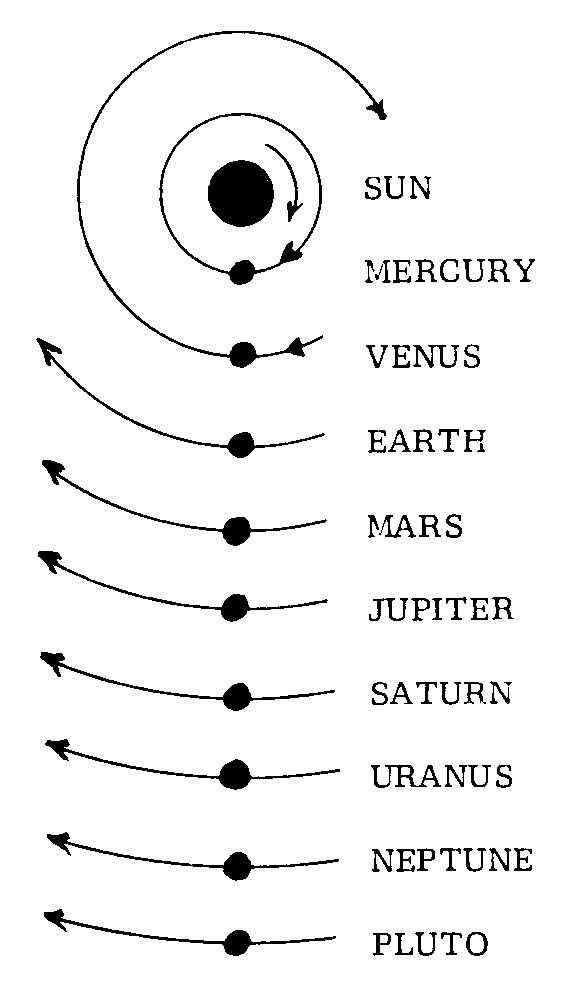
However, the source of the angular momentum of the solar system poses a very perplexing problem. We would like to think that the planets were formed from the sun, but the planets revolve in their orbits in exactly the same sense as the rotating sun. Somehow the sun must have acquired a substantial angular momentum when it was first formed and somehow it shed most of this in giving birth to the planets.
So difficult is this problem that philosophers have resorted to the unlikely hypothesis that another star once passed close to our sun, imparting angular momentum and inducing planetary creation. Such an event, they recognized, is so improbable that the solar system could be perhaps unique in the universe, assuring man a rather special place in the cosmic scene.
I prefer to regard the problem of the source of the sun’s angular momentum as a clue linked with the storage of gravitational energy released when it was formed.
* E.K. Conklin, ‘Velocity of the Earth with respect to the Cosmic Background Radiation’, Nature, 222, p.971, 1969.
[p. 2]
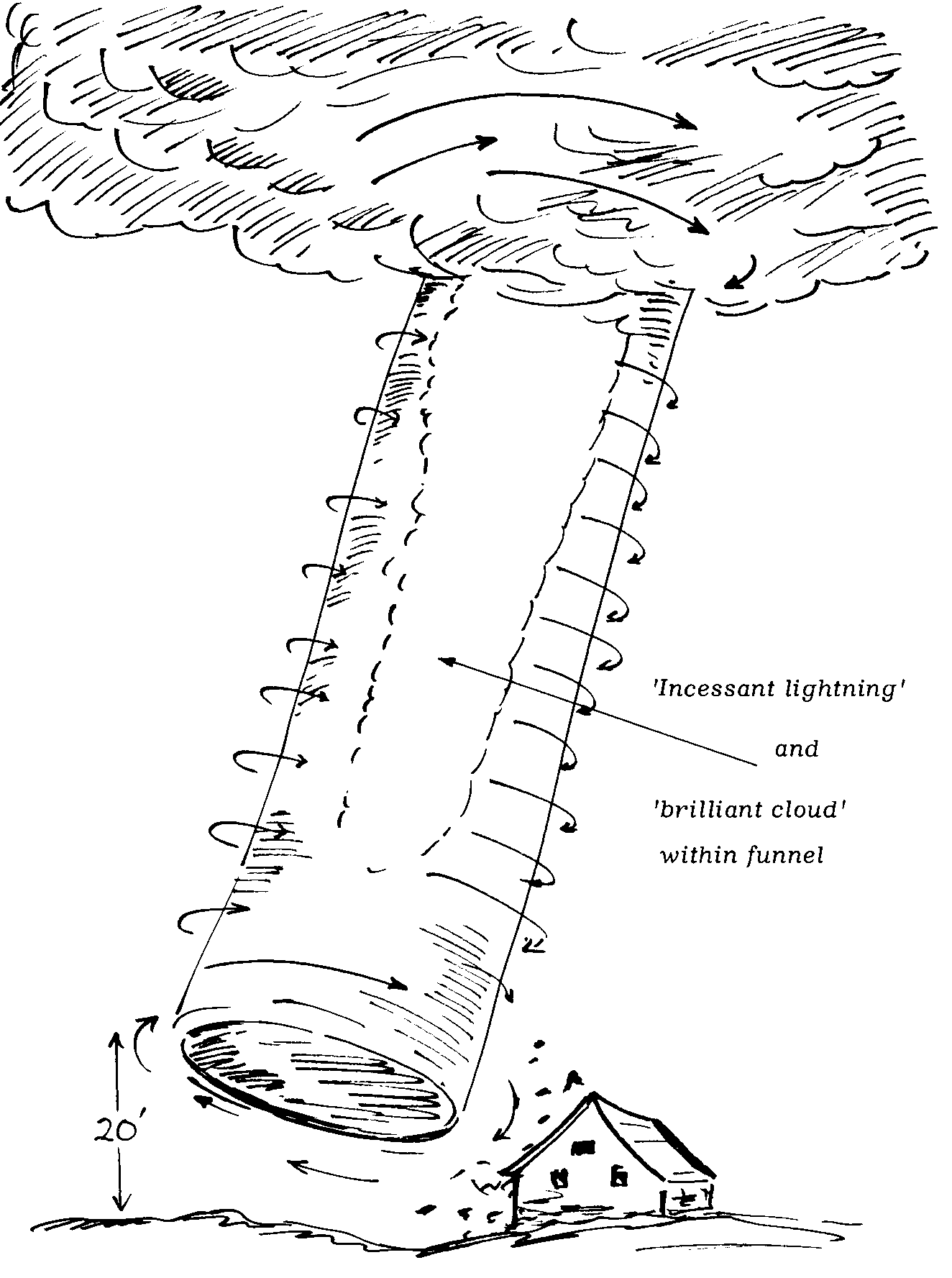
Features of a tornado as described by Vonnegut in Journal of Geophysical Research, 65, 203, 1960
[p. 3]
ENIGMA INVOLVING ROTATION
There is other evidence of phenomena which involve unusual angular momentum properties or raise difficulties with the principle that action balances reaction.
One example is the mysterious energy source of tornadoes. It has been argued very persuasively by Vonnegut (1960)* that this energy really comes from the electrical discharges we associate with thunderstorms but the very substantial angular momentum of the tornado is also a problem. It may be that the energy somehow concentrates the angular momentum of an ordinary whirlwind or, as Vonnegut writes,
‘it is possible that the vortex is initiated directly by electrical energy.’
Vonnegut also remarked that:
‘an understanding of ball lightning may very well be necessary if the tornado puzzle is to be solved.’
Thus ball lightning becomes the second enigma. It is the problem of the glowing spheres which are regularly seen to float about in the air following a thunderstorm. They have an aethereal character because they can pass through walls, get inside aircraft and vanish suddenly, sometimes explosively with release of substantial energy. They are so peculiar and the subject of such strange reports that they evoke a great deal of scepticism. However, the fact remains that they are a mysterious scientific phenomenon produced by lightning. They contain energy of some 109 joules per cubic metre and apparently form as spinning spherical objects. The implication is that they have an associated angular momentum.
* B. Vonnegut, ‘Electrical Theory of Tornadoes’, Journal of Geophysical Research, 65, p.203, 1960.
[p. 3]
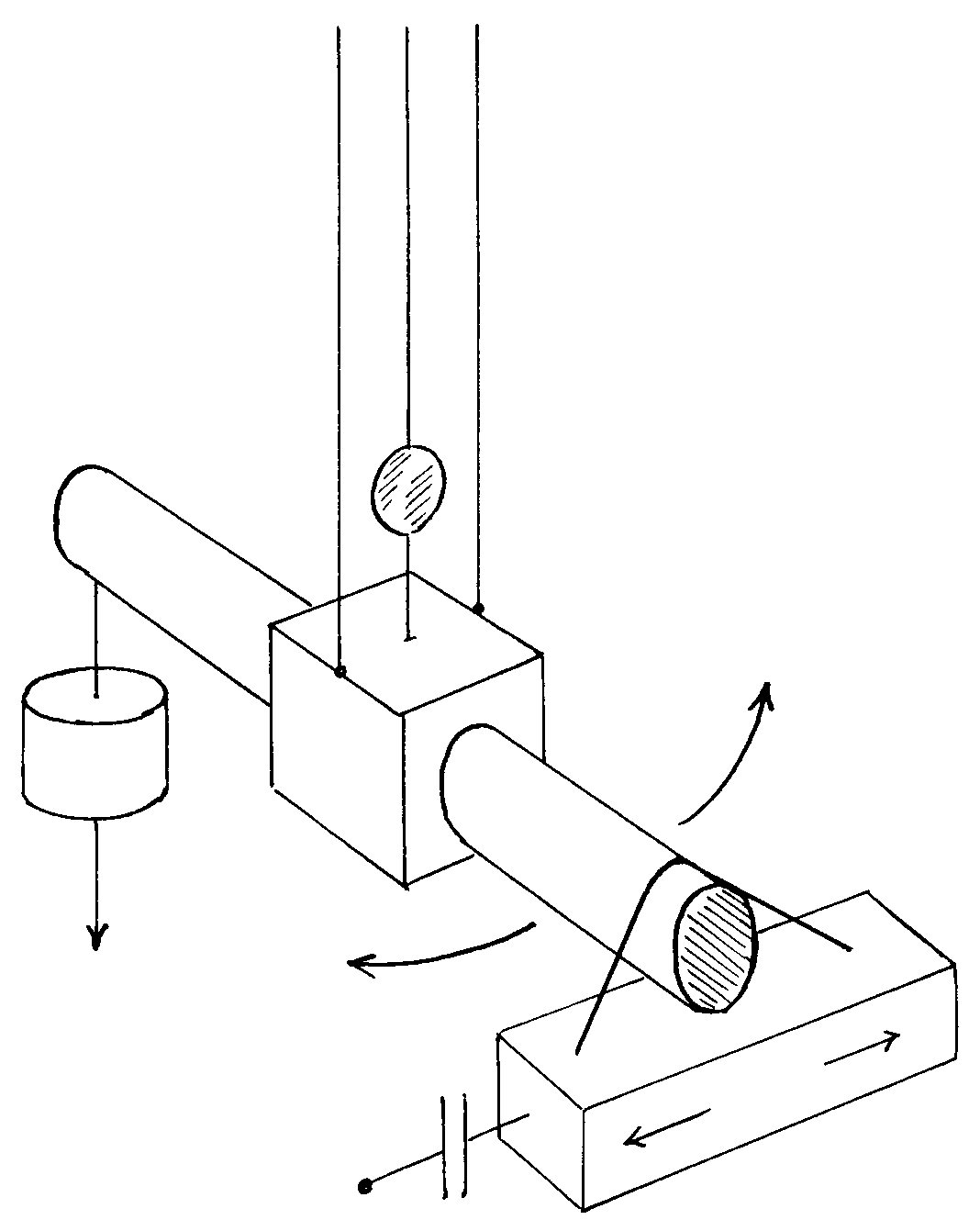
THE APPARATUS DESCRIBED IN UMSHAU ARTICLE (vol. 5, p.152, 1975) The system senses a very-slowly decaying uni-directional torque once the capacitor excitation is switched off
[p. 4]
In the laboratory environment there are two reports of anomalous behaviour known to the speaker and seemingly relevant. In 1972 a demonstration at a meeting of the Institution of Electrical Engineers in U.K. surprised its author. A rotor in a machine speeded up when the power was switched off. It happened and yet could not be reproduced in later efforts to study the phenomenon (Laithwaite, 1972)* It is as if, by some very special circumstance, energy was stored as rotational kinetic energy in the environment of the machine and was fed back to the machine when it was switched off.
The other report appeared in the German publication Umshau in 1975**. Experiments are here reported as consistently verifying a phenomenon which defies explanation. An energy pulse communicated at high frequency across a capacitative coupling is absorbed by a specimen suspended in a torsion balance. After the pulse has subsided, a unidirectional torque prevails in the system for up to two hours for no apparent reason. It is as if energy is stored by some kind of unseen flywheel that feeds energy back to the apparatus slowly once the power is switched off in the system.
It is clear from these examples that there is a case to answer and we can rightly examine the source of the sun’s angular momentum in relation to electrical action and the rotation of an unseen medium. I am therefore suggesting that the vacuum medium itself may exhibit properties attributable to its rotation. Before developing this thought, however, I wish to give one more example of the problem we have with the balance of action and reaction if we choose to ignore the role of the vacuum medium in interactions between matter.
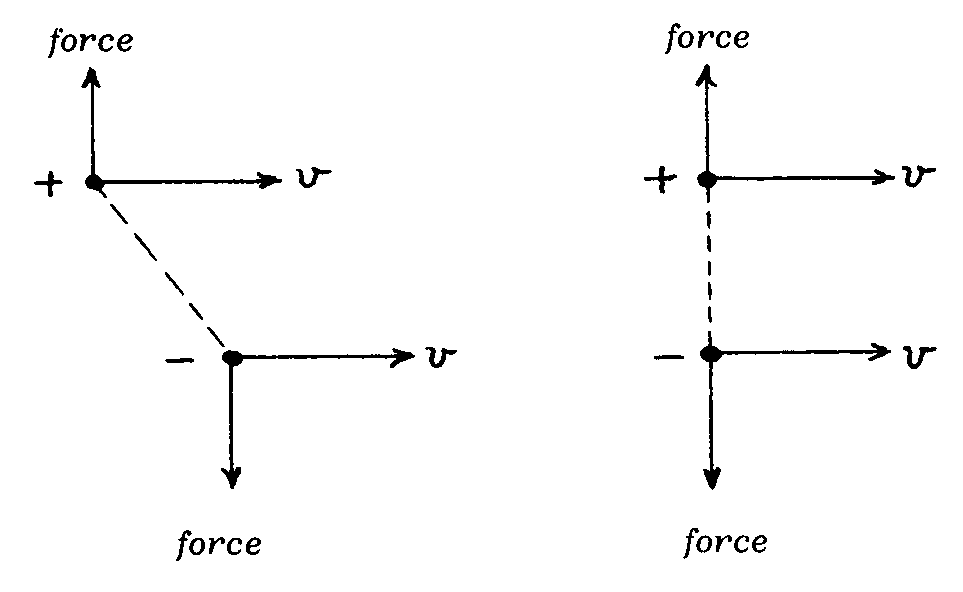
Electrodynamic interaction between two opposite charges in parallel motion, as expected from conventional theory
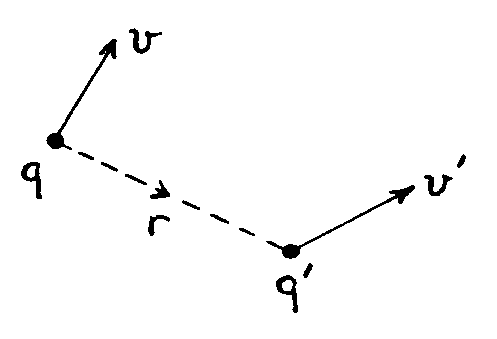
F = (qq′/r3)[(v′.r)v − (v.r)v′ − (v.v′)r]
Electrodynamic force F on q′ due to q, according to Maxwell’s Third Law of Electrodynamics
[p. 5]
THE LAW OF ELECTRODYNAMICS
Theoretically there is good reason to suppose that the electrodynamic action between two charges in parallel motion can produce forces which develop rotation.
By suspending a charged capacitor any transverse motion should result in a turning effect until the line joining the effective centres of charge is at right-angles to the motion. Only then will action balance reaction in a steady uniformly-moving system.
The experiment was performed by Trouton and Noble in 1903*. They sought to detect the Earth’s linear motion through space, but a null result was reported. It gave stimulus to relativistic doctrine but equally it demonstrated the inapplicability of Lorentz’s electrodynamic formula. The law is inadequate to deal with actions between isolated electric charges in motion.
All the empirical evidence before that time had involved the interaction of effectively closed circuital charge motion with individual charges. This did not give enough empirical data to formulate a unique law of electrodynamics. It was a point well appreciated by Maxwell because he wrote about this in his great treatise**. He presented four alternative laws of electrodynamics, all equally valid for the closed circuit application but all different when applied to action between discrete electric charges in motion.
* F.T. Trouton & H.R. Noble, ‘The Mechanical Forces acting on a Charged Electric Condenser moving through Space’, Phil. Trans. Roy. Soc. London., 202A, p.165, 1903.
** J.C. Maxwell, ‘A Treatise on Electricity and Magnetism’, Section 526 of 3rd Edition, 1891. See p.173 of reprint vol. II by Dover Publications, New York, 1954.
[p. 5]
If v and v′ are parallel Maxwell’s Third Law of Electrodynamics:
F = (qq′/r3)[(v′.r)v − (v.r)v′ − (v.v′)r]
becomes:
F = − ((qv)(q′v′)r)/r3
Compare with Newton’s Law of Gravitation:
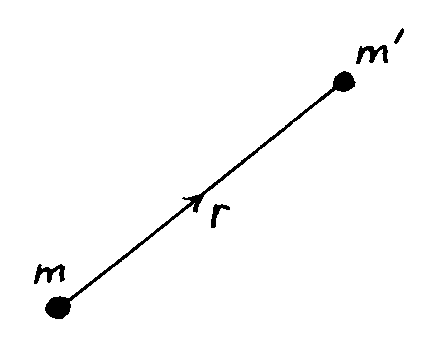
F = − G(mm′/r3)r
Where G is constant and the interacting masses are m, m′.
Aspden’s Law of Electrodynamics is:
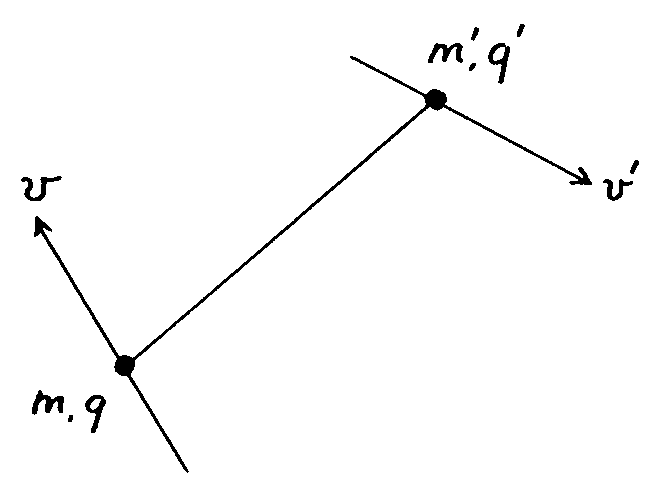
F = (qq′/r3)[(v′.r)v − (m′/m)(v.r)v′ − (v.v′)r]
[p. 6]
This problem attracted my attention because there is an interesting choice available in the formulation of the likely general law. Either one has to admit inequality of action and reaction in the linear sense or one has to accept it from the point of view of rotation. This, bear in mind, applies to a system which may not be complete because we ignore the presence of charge in motion in the vacuum medium itself. We seek a law of electrodynamics applicable solely to interaction between two charges.
Faced with the choice and guided by the null result of the Trouton-Noble experiment it seemed that the mutual electrodynamic action of two charges cannot develop a torque. This favoured the third law of electrodynamics in Maxwell’s work. Also, independently of this hypothesis, there is theoretical justification for the assumption made by Maxwell in deducing this law empirically. This comes from an analysis of the magnetic field energy deployment and its change when the two charges separate.
The law has two very interesting consequences. When applied to charge of like polarity moving with the same velocity we obtain an inverse square law of attraction exactly of the form needed to correlate with Newton’s law of gravitation. This gives basis for unifying field theory. Secondly, there is the curious problem of the linear imbalance of action and reaction, which arises for generally-directed charge motion or, as analysis has shown*, for parallel motion if the interacting charges have different mass.
Experimentally, there should be interesting anomalies in the forces exerted by electrons on ions in arc discharges and plasma. This is now appearing in the literature, though the anomalous behaviour of cold-cathode discharges (those involving ions rather than electrons) has been of record for many years. More recently it has been recognized that
* H. Aspden, ‘The Law of Electrodynamics’, Jour.Franklin Inst., 287, p.179, 1969.
[p. 6]
ANALYSIS OF VACUUM SPIN (Density Property)
Dimensions
Charge density
σ
M½L−3/2T−1k½
Angular velocity
ω
T−1
Mass density
ρ
ML−3
(σ2/ω2ρ)
k
k is dielectric constant, a known property of vacuum.
Hence if σ ∝ ω vacuum must have mass density ρ.
[p. 7]there is a high anomalous acceleration of ions by electrons in plasma.* The new law which I have been urging is Maxwell’s third law of electrodynamics but adapted to cover interactions between charges of different mass. It is a law which is different from that derived using relativity theory. Indeed it has recently been said that the acceptance of relativity as a faith and the refusal to consider criticism of relativistic doctrine has hindered the rational development of electrodynamic theory. I am quoting here from a paper dated June 1977 circulated by Prof. McCausland of the University of Toronto in which he makes reference to some words by Dr. Essen**:
There is some evidence that a new theoretical approach could break the stalemate in the development of nuclear fusion, which appears to offer the only source of energy that could prolong our civilisation far into the future.’
Such is the possible importance of resolving the problems which are addressed here.
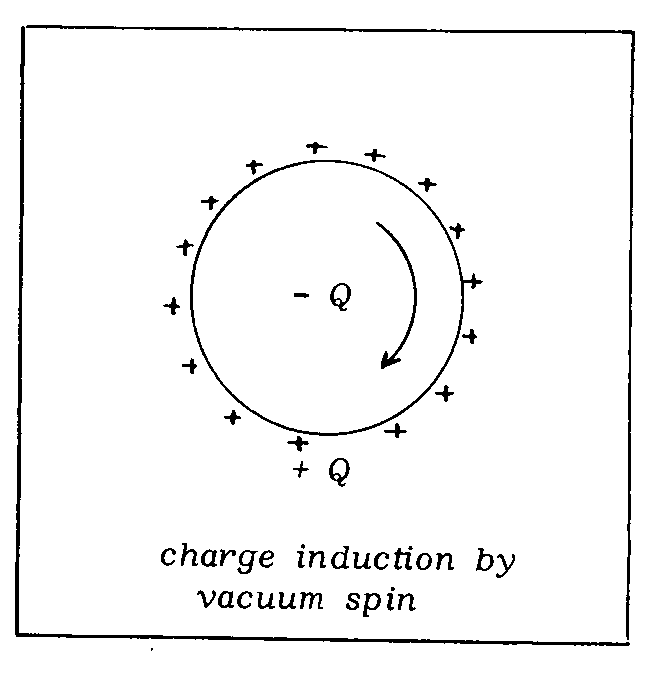
CHARGE INDUCTION BY VACUUM SPIN
Reverting now to the problem of anomalous angular momentum effects, we consider the hypothesis of vacuum spin. If rotation of the vacuum medium induces an electric charge displacement we can show from dimensional analysis that the induced charge density will be proportional to the speed of rotation and proportional to the square root of a mass density. In short, the vacuum medium has a mass density property which must be manifested when spinning. Now it is known from Maxwell’s work that charge is displaced linearly in the vacuum. It is the basis of his displacement currents. Therefore we must be open to
* H. Aspden, ‘Electrodynamic Anomalies in Arc Discharge Phenomena’, IEEE Trans. Plasma Science, PS-5, p.159, 1977.
** L. Essen, ‘Einstein’, The Economist, March 19, 1977, p.4.
[p. 7]
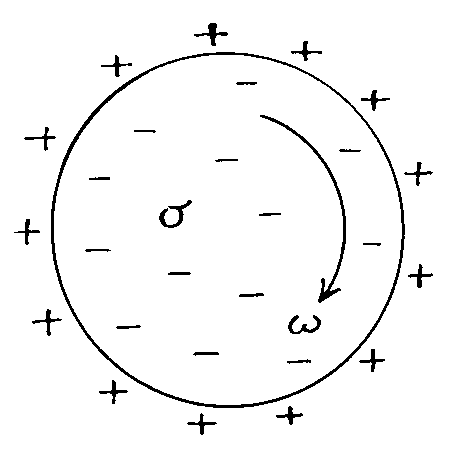
[p. 8]the possibility that charge can be displaced in a radial sense. Put another way, we can expect that a charge density within a volume of matter might induce a reaction by the vacuum medium to cancel the matter charge. Such a reaction should involve vacuum spin.
One way of developing a charge distribution is by a strong electric discharge. The fast moving electrons will be drawn together by the pinch effect, so generating a radial electric field centred on the axis of the discharge. If the vacuum medium reacts to develop a compensating effect then it will absorb the field energy to sustain a vacuum spin about the discharge axis. This spin may be shared by the air surrounding the discharge with the result that the tornado angular momentum becomes explicable.
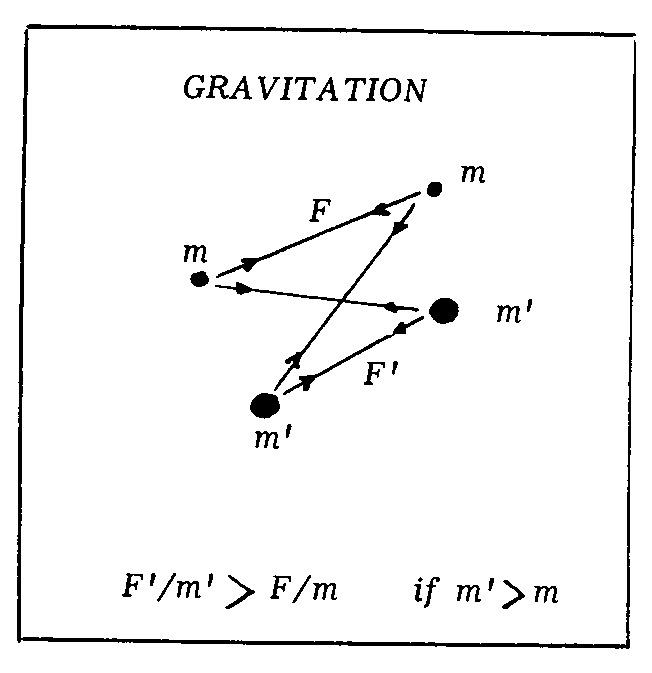
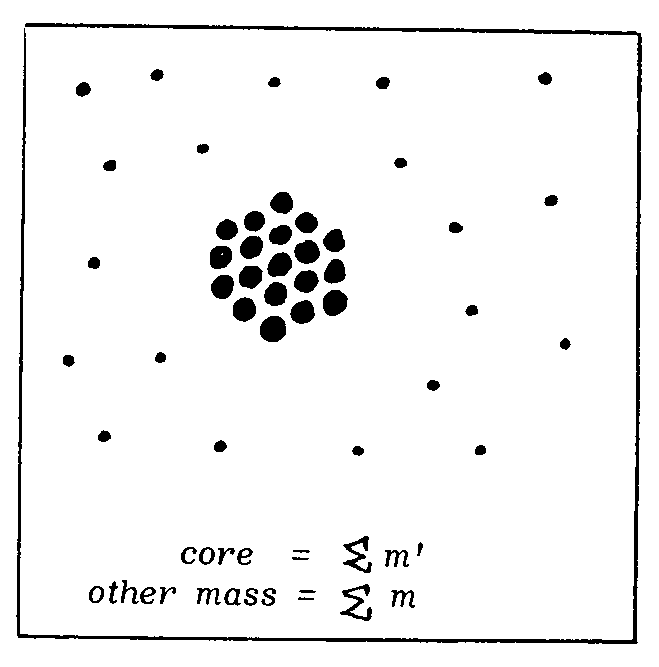
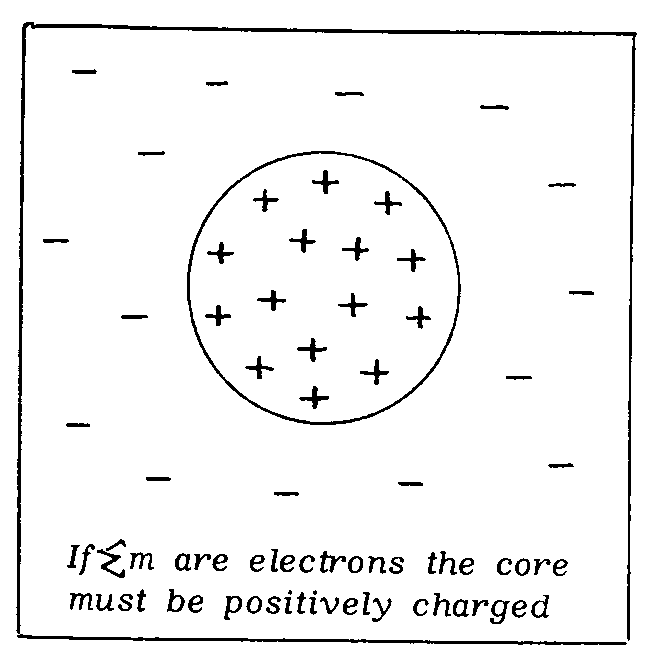
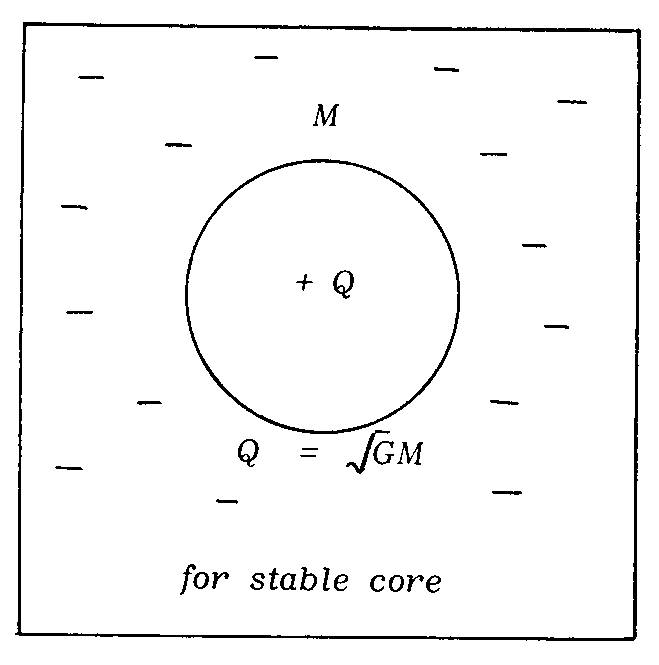
Another way of developing a charge distribution is by the gravitational condensation of stellar substance. Two heavy masses will have greater mutual acceleration under gravity than two lighter masses. In the cosmic dust from which astronomical bodies form there will probable be quite a few free electrons. Thus the heavier matter will aggregate to form a core temporarily leaving an electron population behind in surrounding space. The core need not stabilise initially by a balance of nuclear energy pressure radiation and gravitational force. It can stabilise by a balance of gravitation and the mutual electric repulsion of the positive charge associated with the core. Therefore we know that when an astronomical body is first created it has an electric charge given by G½ times its mass, where G is the constant of gravitation.
As explained already, this charge will then develop a vacuum spin and we can formulate a mathematical relationship between this speed of rotation and the mass density of the body, involving only the value of G and a density parameter of the vacuum.
[p. 8]
VACUUM MEDIUM ANALYSIS
σ/w = √(Aρ) by vacuum spin induction
σ = √Gρm by core stabilisation
Therefore: Aρ = G(ρm/w)2
I If the sun had 100% of the angular momentum of the solar system when created it would have
(2/5) MR2w = 3.2 1050 where R = 6.96 1010 cm
and M = 1.989 1033 gm. Hence w is 8.3 10−5 rad/s
For the sun ρm = 1.4 gm/cc and G = 6.67 10−8 cgs units
II For the Earth-Moon system according to R.A. Lyttleton (Science Journal, 5, 53, May 1969) the Earth rotated once every 5.5 hours before the Moon was ejected. ρm for Earth is 5.5 gm/cc.
III For the Asteroids the data of G.P. Kuiper (Celestial Mechanics, 9, 321, May 1974) show that the mean speed of rotation is once in 6 to 7 hours. If we estimate the value of ρm as 4 to 5 gm/cc this gives:
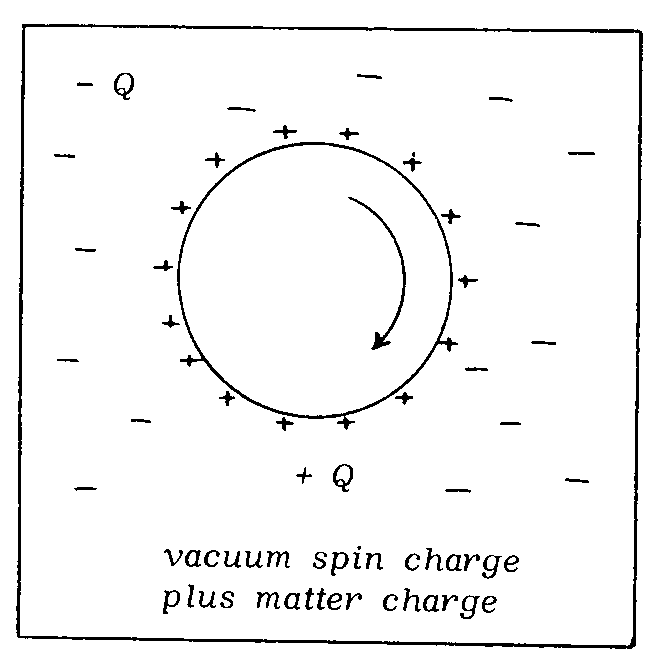
By supposing that the vacuum spin will be coupled, albeit rather loosely, with the body, the speed of rotation of both will become the same. Thus we have basis for explaining how the newly-created sun or Earth was caused to rotate. Furthermore, the production of satellites becomes explicable. Once the electron population reaches the surface of the parent body it will begin the process by which the vacuum medium returns its energy to matter. The vacuum spin will slow down as the atmosphere of negative charge accumulates this energy. The electrical attraction between the positive core and this negative orbiting atmosphere will balance the centrifugal force. This will determine how much mass from the parent body will be swept into the satellite system. Then, as the two charges become neutralised by mutual discharge or extraneous particle radiation the satellite will move away from its parent to take up its eventual orbit. Meanwhile much of the energy released will have gone into electric discharges and possibly have been dissipated. Some energy may even, as I suggested at the outset, have found its way into an ordered state of translational motion of the sun in its galactic path through space.
Suffice it to say at this stage that the creation of the solar system need present no insuperable mystery, of the kind which has troubled us to date. The data verify the hypotheses involved, because we can deduce the same numerical vacuum density property from three separate creation processes. These are the asteroid creation, the sun creation and the Earth creation. Furthermore, when this then-known density parameter of the vacuum is applied to the formulae for satellite creation, we deduce the satellite/parent mass ratio in reasonable accord with that of the solar system and the Earth-Moon system.
[p. 9]
SATELLITE FORMATION
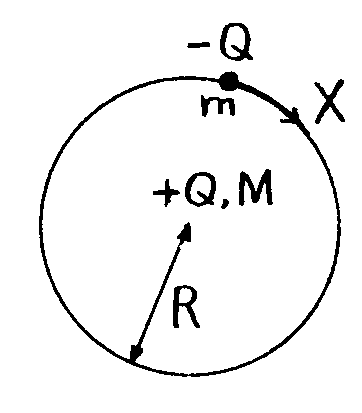
X = angular momentum of m
Force balance gives:
(kQ2)/(R2) = (X2)/(mR3)(1)
Charge −Q will be where k < 1 because not all fully effective as implied by the illustration.
Note that: GM2 = Q2(2)
It appears that a spinning charged system tends to concentrate angular momentum in a faster-rotating surface region. Taking X as the factor β times the initial angular momentum of M at creation:
X = (2/5) βMR2ω(3)
where ω = ρm √(G/Aρ)(4)
and M = (4π/3) R3ρm(5)
Combining equations (1) to (5):
m/M ≈ (6β2ρm)/(50πAρk)
but Aρ ≈ 20 gm/cc so that m/M ≈ (β2/k) (ρm/524)
For the sun with ρm = 1.4, if β ≈ 0.5 and k ≈ 0.5:
m/M ≈ 1/748 (observed value 1/745)
For the Earth with ρm = 5.5, if β ≈ 0.75 and k ≈ 0.5:
m/M ≈ 1/85 (observed value 1/81)
Note that β will not represent deployment of angular momentum between parent and satellite as observed today because tidal effects promote angular momentum transfer.
[p. 10]
STRUCTURED SPACE
An important question is that of why the solar system suddenly came into being some 4,500,000,000 years ago. It is as if there was a sudden decision that gravitation would come into being. The usual starting point is to suppose a diffused cosmic dust begins to come together due to gravitation. But why should there be such a beginning? If matter dispersed in space was created slowly and steadily the results which have just been presented would not apply. An answer comes from the understanding of the nature of the force of gravitation and the realisation that it only exists in a vacuum medium which has structure. The analogy is found in ferromagnetism. There are forces which depend solely upon the prevailing ordered state of the ferromagnetic substance. Above the Curie temperature there is no magnetism. Similarly, in any crystalline substance there are forces which vanish once the crystal becomes disordered by high temperature effects. Therefore, I offer the suggestion that the electrical medium permeating the vacuum has structure and that some 4,500,000,000 years ago this structure went through a transition which allowed gravitation to assert itself. Eventually, when the sun cools and its density increases it may well be the seat of a disturbance which can spread through space creating a new disorder in the vacuum structure belonging to the sun’s cosmic domain. This is speculation founded upon a great deal of evidence indicating that the vacuum is structured.
The geometry of a lattice structured vacuum can yield parameters determining the fundamental physical constants and assuring their universal equality.* However, this takes us beyond the scope of this paper and I wish to conclude by suggesting some experiments.
* H. Aspden & D.M. Eagles, ‘Aether Theory and the Fine Structure Constant’, Physics Letters, 41A, p.423, 1972.
H. Aspden & D.M. Eagles, ‘Calculation of the Proton Mass in a Lattice Model for the Aether,’ Il Nuovo Cimento, 30A, p.235, 1975.
[p. 10]
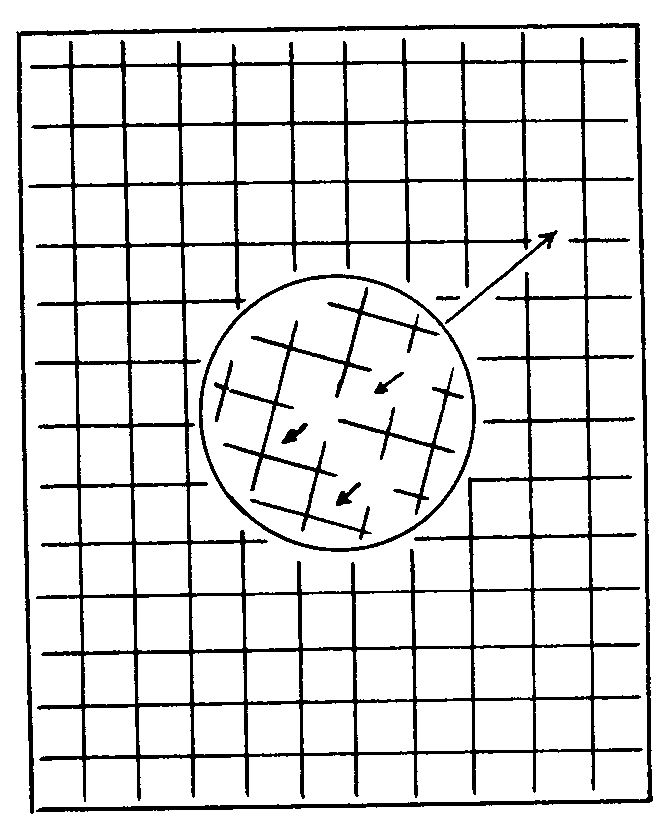
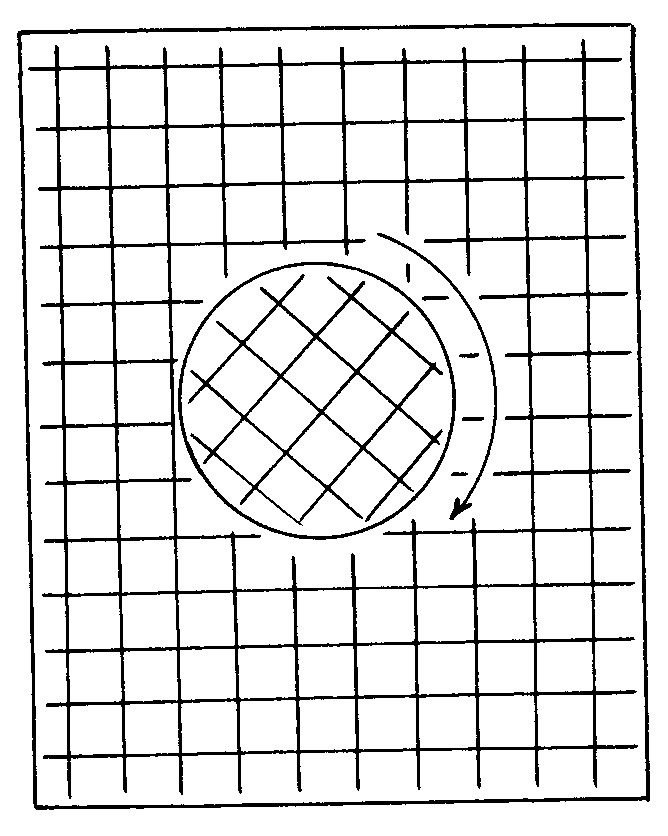
LINEAR MOVING VACUUM FRAMEROTATING VACUUM FRAME
[p. 11]
OPTICAL SENSING OF THE VACUUM
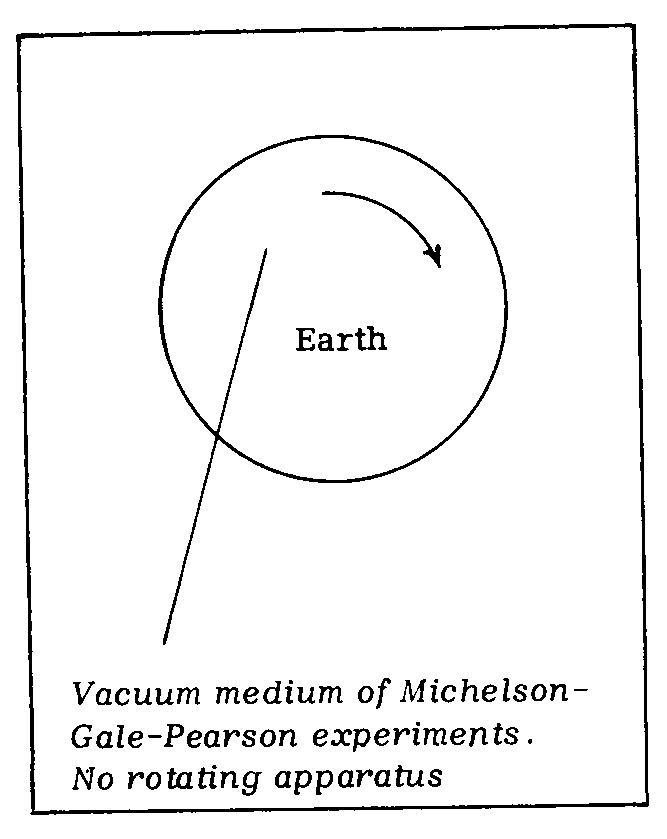
It should be possible to distinguish between linear motion and rotation by optical sensing of the vacuum medium. A sphere of rotating structure will not disturb a similiar surrounding structure. The linear motion of a lattice-like structure through a similar surrounding structure seems impossible. Yet it is possible if the lattice density is reduced by linear motion and the free lattice substance is in counter-motion within the body of the lattice. Analysis* shows that the optical reference frame moves with the lattice in linear motion, a result confirmed by the famous Michelson-Morley experiment. On the other hand, since the lattice density is unchanged in the rotation state, the optical reference frame remains the non-rotating reference frame. Thus an experiment involving the measurement of the speed of light in the Earth’s rotating frame should be sensitive to the Earth’s rotation. This is confirmed by the experiments of Michelson, Gale and Pearson (1925)**.
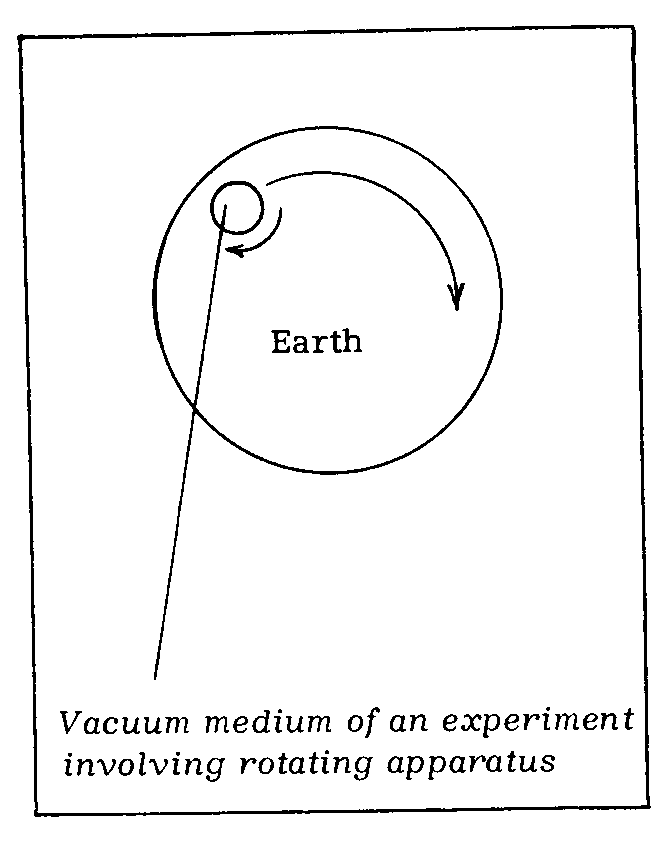
The interesting question is whether the vacuum can be set in rotation by test apparatus and this Earth rotation component obscured in optical tests. For example, at the equator the laboratory moves at a speed of about 460 m/s. Speed of light tests should indicate a difference of 920m/s between the west-east and east-west speeds. This is provided the apparatus has not become, in effect, a system within its own rotating vacuum and so carried forward around the equator with what is effectively a vacuum system in linear motion. In short, if rotating apparatus is avoided it should be possible, as in the Michelson-Gale-Pearson experiment to detect the 920m/s speed difference in the light tests. If the presence of rotating apparatus obscures this measurement and differences of a few
* H. Aspden, ‘The Fresnel Formula applied to Empty Space’, Int. Jour. Theor. Phys., 15, p.263, 1976
** A.A. Michelson, H.G. Gale & F. Pearson, Astrophysical Journal 61, p.140, 1925.
[p. 11]
CHARGE INDUCTION BY VACUUM SPIN
(Linear Oscillator Property)
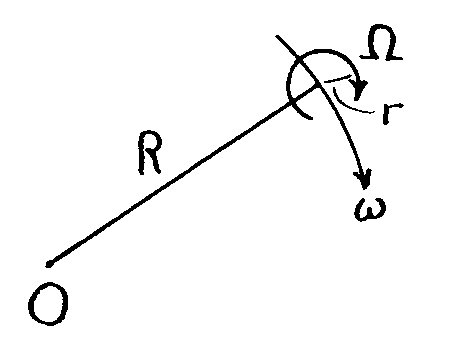
Each element of the structured vacuum rotates at the universal angular frequency Ω in small orbits of radius r. If there is vacuum spin at angular frequency ω then in plane of Ω an element moving at radius R from spin axis 0 will be radially displaced by Δr = ωR/Ω. The area of a disc of radius R will change in proportion to 2Δr/R or 2ω/Ω.
Note then that σ = σo(2ω/Ω)(1)
Let α be the restoring force rate when a charge e of mass mo is displaced amongst a sea of opposite charge of charge density σo in a vacuum which is electrically-neutral in the non-spin state.
Then α = moΩ2
where Ω is also the natural frequency of the vacuum
The electrical nature of the restoring force is readily explained by dimensional analysis.
Dimensionally
α =
MT−2
σo =
MT½L−3/2T−1 k½
e =
M½L3/2T−1 k½
Hence
eσo =
MT−2 k
Thus α as a property of the vacuum is proportional to eσo so that:
eσo ∝ moΩ2
or σo2 ∝ ρΩ2(2)
where ρ is mass density of the vacuum.
From (1) and (2):
(σ/w)2 ∝ ρ
[p. 12]metres per second are measured then this is evidence supporting the vacuum spin hypothesis presented above. I submit that the many experiments which now verify the isotropy of the speed of light relative to the laboratory and claim results to within a few metres per second all have test apparatus in rotation during the experiment. Therefore what is needed is an experiment which involves no rotating apparatus and measures the Earth rotation speed, but which can then be subjected to rotation and shown to become insensitive to Earth rotation. Then any delay in the onset of this change following rotation of the apparatus will give evidence of the inertial properties of the vacuum spin.
The follow-on from this is to seek to sense mechanically the coupling between the vacuum spin and the rotating apparatus.
ELECTRICAL SENSING OF VACUUM SPIN
Another experiment worth attention involves setting up an electrical charge and seeking to induce vacuum spin which might be sensed by its magnetic field. In this connection it is noted that the Earth generates a magnetic field which is of the magnitude expected from vacuum spin. This is known from the Schuster-Wilson hypothesis based on the fact that the Earth exhibits the magnetic moment it would have if its mass had electric charge related by the factor G½. Blackett (1952)* claims to have disproved this hypothesis experimentally. He sought to concentrate the magnetic effect by using a dense gold cylinder but obtained a null result. However, he did not suspect that the vacuum medium might generate the field and this is not influenced by the density of gold.
* P.M.S. Blackett, ‘A Negative Experiment Relating to Magnetism and the Earth’s Rotation’, Phil. Trans. Royal Society, 245A, 309, 1952/53.
[p. 13]Finally, an interesting experiment has been performed by Ryan and Vonnegut (1971)*. They arranged for a cage to rotate around an electric arc discharge at quite low speed and found that this stabilised the arc. The task of stabilising an electric arc is one of the major problems of thermonuclear fusion research. It seems therefore very difficult to believe that the wild antics of the arc discharge are tamed merely by the slow rotation of a column of air. Perhaps there is vacuum spin in this experiment and it is the influence of the induced vacuum fields which stabilise the arc. Here then is more scope for research. Can the arc be stabilised in a vacuum? It is research which the modern physicist will not readily undertake because there is widespread belief that the vacuum is a non-entity devoid of any special properties. It is a belief encouraged by the development of relativity and in my experience those who believe in relativity deny the existence of the aether. On the other hand I was once reassured by a comment Professor Cullwick** made about something I published. He quoted Einstein as saying:
‘the special theory of relativity does not compel us to deny the existence of the ether …… there is weighty evidence in favour of the ether hypothesis.’
15 September 1977
* R.T. Ryan & B. Vonnegut, ‘Formation of a Vortex by an Elevated Electrical Heat Source’, Nature Physical Science, 233, 142, 1971.
** E.G. Cullwick, ‘Relativity and the Ether’, Electronics & Power, 22, p.40, 1976.
The following is a paper by H. Aspden published in Catastrophist Geology, v. 2/2, pp. 42-47 (1977).
GALACTIC DOMAINS, G FLUCTUATIONS AND GEOMAGNETIC REVERSALS
Abstract: The degree of constancy of the universal constant of gravitation G is discussed. The hypothesis is presented that a constant G is subjected to occasional short-duration fluctuations at times of reversal of the geomagnetic field. Evidence suggests a correlation between field reversals and deformations of the Earth’s crust, and the hypothesis is further supported by the one to four frequency correlation between the Galactic cycle and related
sedimentation sequences.
Commentary: This paper is very important to those who are interested in how cosmology evolves in a way which promotes change of the fundamental constants. Dirac argued that G changes over cosmic time, whereas analysis in 1975 by Landsberg and Bishop required that e, h, c and H/G are time invariant. This author’s theory requires all these constants and both G and Hubble’s constant H to retain their individual constancy. However, as this paper shows at length, after discussing these opinions on the constants, there is reason to believe that G experiences transient upsets at regular intervals in the evolution cycle. This is something that can be predicted from the author’s aether theory as being the sequence of events corresponding to the Earth’s traversal of the domain boundaries separating regions of ‘space’ and ‘antispace’, meaning aether with the polarities of virtual lattice particles and background continuum reversed.
The paper should also interest those having a morbid outlook who might see in the author’s theory the prophesy of doom. Some charted data are provided from which readers might extrapolate to estimate when such an event is to be expected, but this author
wishes to assure the less morbid that he sees enough of a future ahead to make it worthwhile to resolve our energy problems and develop the ‘free energy’ source. If that day of doom is to come, it means that there is an ‘aether’ through which we journey at our peril and, if there is an ‘aether’ then at least we have the prospect of
enjoying the nourishment of the ‘aether’ energy source before the next catastrophic event overtakes us!
The key question is whether there was what the author terms the ‘Stockholm reversal’, some 12,400 years ago, an event which might have shifted the positions of those heavenly bodies which Plato mentions and which may have some connection with the story of Atlantis. If there was such an event then the data indicate that we have the prospect of a peaceful future for more than 100,000 years.
It will be seen, therefore, that ‘aether’ theory offers some excitement to compete with Einstein’s suggestion that by moving at different speeds we can age at different rates!
The following is a paper by H. Aspden published in International Journal of Theoretical Physics, v. 16, pp. 401-404 (1977).
A NEW APPROACH TO THE PROBLEM OF THE ANOMALOUS MAGNETIC MOMENT OF THE ELECTRON
Abstract: A heuristic model for deriving the anomalous magnetic moment of the electron is presented. A term α/2π-0.327(α/π)2 is deduced, in better agreement with experiment than is the QED derivation of α/2π-0.328(α/π)2. The result is strengthened by the recent non-QED account of the Lamb shift by Yu and Sachs.
Commentary: Note that α is the fine structure constant, a dimensionless quantity having a numerical value slightly smaller than 1/137. In cgs units, where the dielectric constant of the vacuum is unity, α-1 is the formulation 2πe2/hc, where e is the charge of the electron in esu, c is the speed of light and h is Planck’s constant. These three physical components are the properties which characterize the aether. To explain the physical basis which determines Planck’s constant and its dimensionless embodiment in the fine structure constant, α, one must decipher the structure of the aether.
Apart from being confronted with Einstein’s theory, the author had found that his efforts to interest scientists in a lattice-structured aether, which had the merit of allowing the theoretical derivation of the precise values of the most important of the fundamental physical constants, were scorned for other reasons. It was made very clear by referees that, where theoretical precision evaluation of basic dimensionless constants were concerned, the only way forward was by the use of QED. Quantum electrodynamics had given account of the anomalous magnetic moment of the electron and the Lamb shift. Why these second-order effects should preclude the author from developing an independent first-order theory for the proton-electron mass
ratio or the fine structure constant really was beyond comprehension. Accordingly, the author was motivated to probe the domain of QED just as he had felt obliged to develop a defence on the Einstein front. However, one finds that, whereas the general theory of relativity and the derivation of its key results is the subject of a single chapter in an advanced physics textbook, QED is not so accommodating.
Very few physicists reading this text will know how to calculate the higher-order terms involved in QED calculations. Whereas QED introduces a concept of renormalization to avoid infinities and point charges, this author begins with a finite spherical charge form and introduces a field cut-off boundary at a distance determined by a standing wave system. In this way, the author believes that he has discovered a classical approximation to the statistical field activity involved in QED. It is simple and sufficiently ‘approximate’ to provide in a few pages of analysis a result at least as good as any that have a fully detailed worked solution presented in print, whether in books or scientific papers. Indeed, you will have very great difficulty if you try to find any publication containing a truly comprehensive analysis that you can verify yourself in working through the document. Invariably, with QED, apart from the very approximate preliminary terms one finds a recital of numerous Feynman diagrams which one has to take on trust as having the solutions as listed.
The author does not seek to have his theory replace QED, but he does challenge those who understand QED to find a way of deriving the fine structure constant and the proton-electron mass ratio. He is convinced that these two quantities are so basic that they cannot depend upon the spurious auxiliary statistical activity of a lepton field. They are fixed by structural constraints, even though they exist in such a field background. This statement is backed by evidence of their derivation given in the papers already referenced [1972a] and [1975a]. Accordingly, the author confronts those who understand QED with the fact that the aether based theory has already provided us with sufficiently perfect derivations of these dimensionless quantities, backed by comprehensive qualitative reasoning. He well knows that much as they may extend QED techniques and philosophy into the higher domain of QCD, quantum chromodynamics, they are hopelessly lost in a maze of computation.
The paper [1975a], abstracted in these Web pages, presented the aether theory evaluation of the proton-electron mass ratio and this author’s company location, as stated on that paper was that of an IBM laboratory. It is appropriate, with this IBM connection, therefore, to refer to the rival 1985 IEEE Computer Society paper by Beetem, Denneau and Weingarten, of the IBM Watson Research Center, on the ‘GF11 Supercomputer’. Quoting from that paper:
“GF11 is a parallel computer conceived primarily for the numerical solution of problems in quantum chromodynamics (QCD), a proposed theory of the class of particles which participate in nuclear interactions. A typical calculation in QCD, for example an evaluation of the masses of the proton, neutron and a few related particles, is estimated to require as many as 3×10¹⁷ arithmetic operations. With a 100 MFLOP machine (such as Cray 1) this calculation would take 100 years. By a parallel application of its 576 processors, GF11 is capable of 11.5 GFLOPS peak and about 10 GFLOPS sustained performance for QCD. The mass calculation can be completed in about 1 year.”
This author has not heard that the IBM GF11 computer mentioned in this 1985 paper has completed its duty cycle and found the expected answer, nor whether the precision of the overall calculation has come within sight of overtaking the precision reached in 1975 by the author’s aether theory. However, the author does know that those who research QCD theory are hostile to the very simple methods adopted with success by this author and suspects that that hostility is not founded in a spirit of true science, but has other motivation.
The following is a paper by H. Aspden published in IEEE Transactions on Plasma Science, PS-5, pp. 159-163 (1977).
ELECTRODYNAMIC ANOMALIES IN ARC DISCHARGE PHENOMENA
Abstract: The assumption that two electric particles are insufficient by their mutual action to develop a torque makes the Lorentz law a special case of a more general law of electrodynamics, of importance when electrodynamic closed circuit interactions involve charge carriers of different mass. Experimental anomalies evident in the mutual electrodynamic behaviour of ions and electrons are reviewed. It is argued that there is now sufficient evidence for this more general law of electrodynamics to be given attention by the electrical engineer interested in plasma and discharge phenomena.
The following is a paper by H. Aspden published in International Journal of Theoretical Physics, v. 15, pp. 631-633 (1976).
INERTIA OF A NON-RADIATING PARTICLE
Abstract: A solution of the Abraham-Lorentz equation of motion for a radiating particle is found to have non-runaway form if its mass components are subject to non-uniform acceleration. By supposing that the energy radiated is absorbed by the particle’s own field, inertia is found as a resulting property and the relation E = Mc2 follows as a consequence.
Commentary: The author had, many years previously, justified the basis for inertia as being the self-preservation property of electric charge in refusing to radiate energy owing to the influence of an external electric field. Explaining the nature of inertia has been a long-standing challenge confronting the physicist and there have been some rather way-out ideas, such as the Mach Principle. The latter implies that the whole universe is involved in determining the inertial reaction of each and every minute particle of matter. Yet, in fact, the action if merely an energy conserving response of a charged particle when subjected to an external electric field. To assure that energy is not radiated the accelerated particle has to exhibit a mass property related to the energy that it does possess. The equation relating energy and mass is a consequence of this circumstance and not the consequence of Einstein’s deliberations! This paper merely underlines the author’s point on this subject, but it offers nothing new over what the author had proposed earlier [1958a]. The case is dealt with fully in the 1969 text of ‘Physics without Einstein’ and in still more detail in the 1980 work ‘Physics Unified’. The subject paper had, however, no impact on the scientific community which had already abandoned all thought of explaining the energy-mass relationship by anything other than subservience to Einstein’s philosophy.
The following is a paper by H. Aspden published in International Journal of Theoretical Physics, v. 15, pp. 263-264 (1976).
‘THE FRESNEL FORMULA APPLIED TO EMPTY SPACE’
Abstract: Scalar field theories require the refractive index of empty space to diverge from unity. First-order divergence is analysed using the Fresnel formula. There is no divergence for an observer in linear motion with the space frame.
Commentary: In developing an aether theory the author had suffered severe criticism by referees who insisted that Einstein’s theory precluded belief in an aether. The null result of the Michelson-Morley experiment had, in their view, demolished the aether concept. Yet in the text of ‘Physics without Einstein’ (1969b) the author had shown how easy it was to bring to bear an analogy from the effect which a moving transparent body has on light. This paper brought the author’s prior-published case into an orthodox scientific periodical to underline the fact that the aether really is compatible with the Michelson-Morley observation. Readers pursuing this point will, however, find that the extended treatment on pp. 99 to 106 of Physics without Einstein deals far more thoroughly with this subject. This paper had, however, no impact on the scientific community which had already abandoned all thought of the vacuum as a real medium warranting interpretation using conventional physics.
The following is a reference to a book published by Sabberton Publications in 1975. It will be included on this website in PDF format in the near future. [H. Aspden; 15 July 2002]
GRAVITATION
This book is a monograph comprising 78 pages. It is an account, updated to the year 1975, of Dr. Aspden’s theory of gravitation, which is one of the key subjects of these web pages.
An earlier version of this page, from the energyscience.co.uk site, is preserved here: 1975b (earlier version).
a value very close to the observed proton-electron mass ratio of 1836.15152(70).
Commentary: As for reference [1972a], this paper was co-authored with Dr. D. M. Eagles of the then-named National Measurement Laboratory in Sydney, Australia. The author had, by reference [1974a], reported an advance which had substituted a dimuon mass quantum for the pion in a correlation function involving the proton, the latter being in the author’s 1969 book ‘Physics without Einstein’. This led to discussion with Dr. Eagles and the appreciation that the muon might be the standard building block from which protons are formed. Dr. Eagles took the initiative of writing the paper, again including the emotive word ‘aether’ in the title and again securing support from his Laboratory Director for its submission to a reputable scientific journal. Il Nuovo Cimento is published by the Italian Institute of Physics. It was 10 years later, in 1985, that Van Dyck, Moore, Farnham and Schwinberg, reporting on their measurement of the proton-electron mass ratio in the International Journal of Mass Spectroscopy and Ion Processes, vol. 66, pp. 327-337 (1985), had occasion to refer to our paper, using the words:
“Finally, as a point of interest, Aspden and Eagles have computed a theoretical value (1836.152320) for this mass ratio by apparent classical arguments. The value that they calculate is remarkably close to our experimentally measured value (i.e. within two standard deviations) This is even more curious when one notes that they published this result several years before direct precision measurements of this ratio had begun.”
To see the full text of this paper as presented in pdf format press: [1975a]
Full text of the paper (transcribed from the PDF)
Transcribed from the scanned pages of the printed paper. [p. N] marks where each printed page begins; figures are cut from the scans. The PDF above is the original.
[p. 235]
IL NUOVO CIMENTO Vol. 30 A, N. 2 21 Novembre 1975
Dr. Aspden has obtained the permission of the copyright owner Societa Italiana di Fisica to publish this paper here in PDF format.
Calculation of the Proton Mass in a Lattice Model for the Aether.
H. Aspden
European Patent Operations, I.B.M. United Kingdom Limited Hursley Laboratories – Winchester
D. M. Eagles
CSIRO National Measurement Laboratory – Sydney
(ricevuto il 24 Febbraio 1975; manoscritto revisionato ricevuto il 3 Settembre 1975)
Summary. — A lattice model for the aether is shown to give indications of a fundamental charged particle of mass M such that M/me = (3/4)(108)3π2(1843)−4/3[(3/2)1/2 − 1]−1 = 1836.152 32, a value very close to the observed proton-electron mass ratio of 1836.151 52(70).
A model for the aether involving a simple cubic lattice structure of negatively charged particles embedded in a continuum of positive charge has been shown by Aspden (1) to be capable of giving alternative explanations of many of the experimental supports for relativity theory (*), and to permit calculations of some of the fundamental constants of physics which are treated as empirical parameters in more conventional approaches. Recently a slight development of part of Aspden’s original work was shown to permit an exact formula to be obtained for the calculation of the fine-structure constant (2) α. It was found that
α−1 = 108π(8/1843)1/6 = 137.035 915 .(1)
(1) H. Aspden: Physics without Einstein (Southampton, 1969).
(*) Relativity has good support experimentally from the increased lifetimes of fast-moving mesons which give direct evidence of time dilation. A nonrelativistic explanation based upon the aether concept has yet to be developed but may perhaps be found in the contraction of electric charge in storing energy due to increase in speed.
(2) H. Aspden and D. M. Eagles: Phys. Lett., 41 A, 423 (1972).
[p. 236]
This value lies within 0.9 p.p.m. of the latest estimate from experimental results (3). In the present paper we give arguments to indicate how a particle of mass equal to that of the proton can appear in the lattice aether theory, and we find a precise expression for the ratio of the mass of this particle to that of the electron.
The aether lattice shares the motion and rotation of the Earth locally, and also moves in such a way that each lattice point rotates in a small circle of radius r = ħ/2mec = 1.93·10−11 cm about its position of equilibrium at an angular speed Ω = c/2r = 7.76·1020 s−1. The ratio of r to the lattice constant d satisfies (1,2)
r/d = (3/2)(a/2b)1/2 = 0.302 916 ,(2)
where
a/b = (1843)−1/3(3)
is the ratio of the radii a and b of the electron and lattice particle respectively, with (1,4)
a = (2/3)e2/mec2 ≈ 1.88·10−13 cm .(4)
The ratio of the lattice constant to the electron radius is given by (1)
d/a = 108π .(5)
A fruitful postulate in ref. (1) was that creation of matter is likely to be concerned with changes in lattice cells near boundaries between normal regions of the lattice aether and regions in which the signs of the charges of lattice particles and the continuum are reversed. Such a reversal was assumed to occur in the interiors of stars. The creation is envisaged as proceeding from the lighter to the heavier particles. If we suppose that as a first stage a number of lattice particles and a corresponding number of cells of the continuum mutually annihilate, and that the equivalent volume is replaced by an appropriate number of positively or negatively charged particles of the same type as those forming the lattice, then an energy quantum Q0 associated with the number of these particles per lattice cell will be given by (*)
Q0 = (2/3)(e2/b)(3d3)(4πb3)−1 .(6)
(3) E. R. Cohen and B. N. Taylor: J. Phys. Chem. Reference Data, 2, 663 (1973).
(4) M. Born: Einstein’s Theory of Relativity (New York, N. Y., 1965), p. 211.
(*) An alternative way of viewing the quantum Q0 is to regard it as equal to the energy contained within two lattice cells (one of each polarity) associated with the pressure of magnitude P = e2/4πb4 required to keep lattice particles from disintegrating. Reasons are given in ref. (1) for thinking that such a pressure pervades all space.
[p. 237]
From eqs. (3) to (6) we find that Q0/mec2 = 412.665 816. This quantum does not appear to have been observed in experiments performed to date, but it may be of significance that (1/2)[Q0/mec2 + 1] = 206.8 is close to the muon-electron mass ratio.
In order to progress from this quantum to the mass of the proton we need to make the postulate that for calculations of the ground-state energy of elementary particles and of some composites it is not appropriate to use quantum theory, and that a classical consideration of spheres with charges ± e in contact is a valid approach. The relation between the masses and radii of the particles concerned is assumed to be similar to that given by eq. (4) for the electron. Then, if positive- and negative-charged particles associated with energy quanta P and Q are allowed to come into contact with each other, it is easy to show that the energy E of the composite system satisfies
E = P + Q − (3/2)PQ/(P + Q) .(7)
Minimizing this energy with respect to Q we find that
Q/P = (3/2)1/2 − 1 .(8)
Thus it appears plausible that, if heavy particles of mass P/c2 form one of the main types of building block for matter, then the environment will be such as to involve energy quanta Q given by eq. (8); but we have already indicated how quanta of energy Q0 given by eqs. (3) to (6) are associated with matter creation in the lattice aether theory. Hence, identifying Q and Q0, we calculate that
A recent reassessment of experimental data (3) gives the proton-electron mass ratio as 1836.151 52(70). Thus, although there is no a priori reason for the identification of Q rather than, e.g., P with Q0, the numerical result which follows from such an identification is persuasive.
The present note and ref. (2) have demonstrated that lattice aether theory can be used to find expressions that give close agreement with experiment for two very accurately determined fundamental constants of physics. The agreement with the most probable experimental value is to within 0.91 p.p.m. for the fine-structure constant and within 0.44 p.p.m. for the proton-electron mass ratio. Thus the calculated values lie only just outside the estimated standard deviation errors of 0.82 p.p.m. and 0.38 p.p.m. given for the two experimental figures (3). An extension of the ideas presented in ref. (1,2) and the present note can be used to give an exact expression for the gravitational [p. 238] constant G in terms of the charge-mass ratio of the electron. Agreement with a recent experimental value (5) is obtained. The constant G is only known to an uncertainty of about 90 p.p.m., so this agreement does not provide a very strict test of the significance of the model on its own. However, in combination with the two accurate results for the fine-structure constant and for mp/me, it provides additional support for thinking that the lattice aether model merits thorough study and further development. Details about the calculation of G have been published recently (6).
(5) C. Pontikis: Compt. Rend., 274, B 437 (1972).
(6) H. Aspden: Gravitation (Southampton, 1975).
● RIASSUNTO (*)
Si mostra che un modello reticolare dell’etere dà indicazioni di una particella fondamentale carica di massa M tale che M/me = (3/4)(108)2π2(1843)−3/4[(3/2)1/2 − 1]−1 = 1836.152 32, un valore molto prossimo al rapporto osservato fra la massa del protone e quella dell’elettrone che è 1836.151 52(70).
(*) Traduzione a cura della Redazione.
Резюме не получено.
H. Aspden, et al. 21 Novembre 1975 Il Nuovo Cimento Serie 11, Vol. 30 A, pag. 235-238