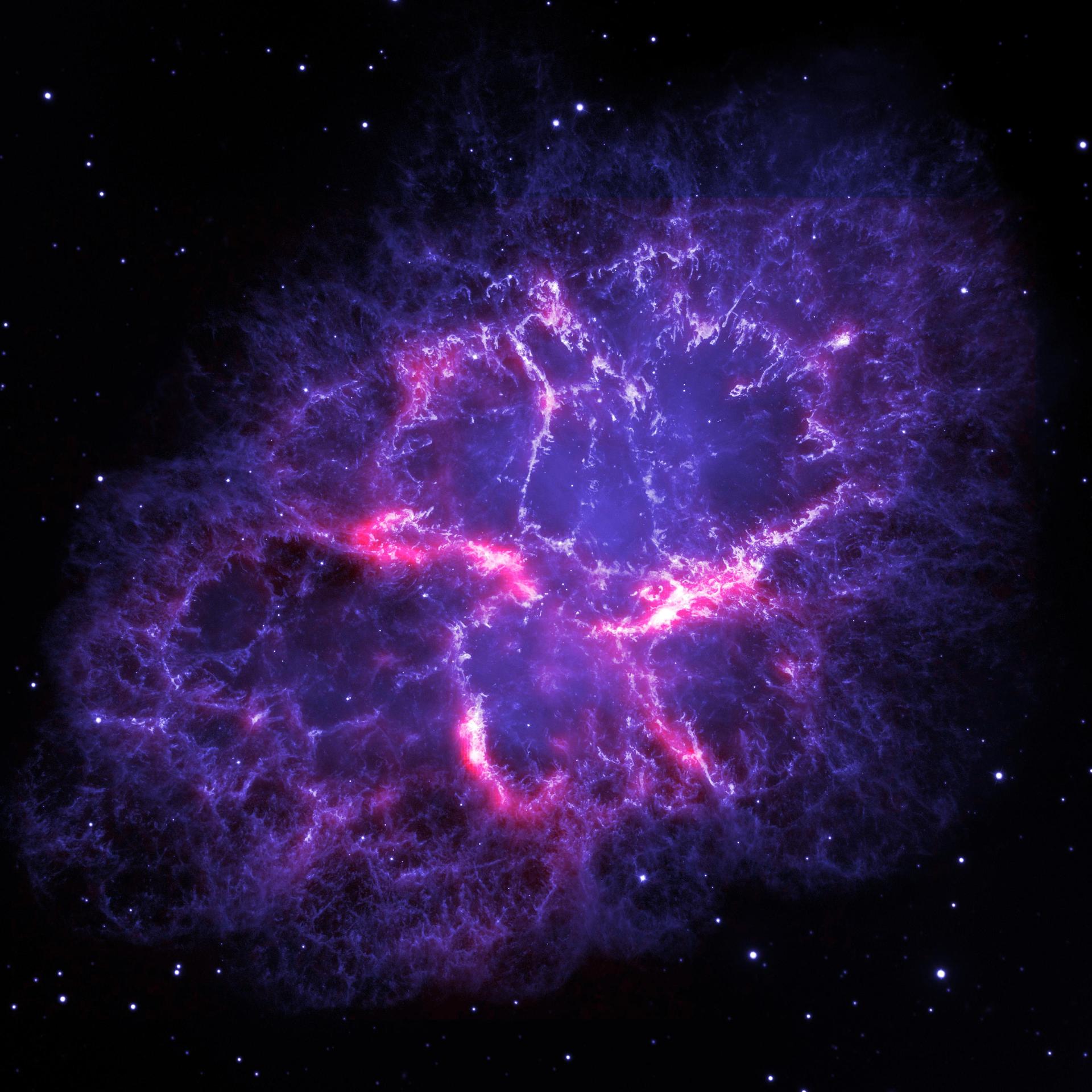
Crab Nebula (M1) — supernova remnant imaged by Herschel and Hubble Space Telescopes

Category: Tutorial Notes

Tutorial and lesson notes

Crab Nebula (M1), supernova remnant · ESA/Herschel/PACS; NASA, ESA & A. Loll/J. Hester (Arizona State Univ.) · NASA Image Library ↗

  • TUTORIAL NOTE 10

    TUTORIAL NOTE 10

    These notes teach the mathematical basis of Aether Science theory

    TIFFT’S DISCOVERY

    © Harold Aspden, 1997

    INTRODUCTION

    It was in 1959, some 38 years ago, that I sent the manuscript of my short 48 pp. book entitled ‘The Theory of Gravitation’ to the printers. There on page 23, as equation (21), was that formula 144π(r/d) giving the value of hc/2πe2 and that followed the chapter on ‘THE AETHER’ where that (r/d) quantity was calculated by using the principles presented here as Tutorial No. 7 in these Web pages.

    To know r/d, the orbital radius of the quantized activity of the aether in terms of the unit cell dimension of that aether, was shown to be sufficient for a determination of Planck’s constant h in terms of the unit charge e of the aether action that was in quantized motion at the speed c/2 relative to the inertial reference frame.

    To know Planck’s constant and understand how the aether sets up the relationship E=hf between energy quanta E and electromagnetic wave frequency f, as explained in that book, takes us a long way forward in our efforts to decipher the secrets of the universe.

    I could not have guessed at the time that, over the years which followed, there would be a major discovery in astronomical observation that could confirm my derivation of the precise value of that dimensionless quantity hc/2πe2.

    Here I refer to an observation by Tifft as reported in THE TIMES, (U.K. newspaper), on October 14, 1996.

    TIFFT’S DISCOVERY

    “The story began with the discovery in the 1970s by William Tifft, of the University of Arizona, that the speeds of the galaxies he studied were always multiples of 72 kilometres per second.”

    “Red shifts should be able to take any value, but Dr. Tifft seemed to show they were ‘quantized’ – restricted to certain values.”

    “This appeared impossible, but more recent research by Bill Napier at Oxford and Bruce Guthrie of the Edinburgh Royal Observatory confirmed it. Explaining why is very tricky, unless you assume that red shifts don’t really tell us anything about speed or distance and that would undermine the whole basis of cosmology.”

    THE 1843 FACTOR

    Now I have already, in Tutorial No. 8, explained how my theory developed to show that the aether has levels of energy density at which it becomes, as it were, locked into a quantum state corresponding to an integer value of the cube of (9/8) times (d/r)2. One can say that for each such integer step, which corresponds to the number of electrons and positrons that can be created as a group upon the annihilation of an aether particle and occupation of the aether space thereby vacated, there is the possibility of such a quantum state. It all depends upon the energy activity in the aether domain under consideration and there are many such different domain regions in the whole expanse of the universe.

    What is so fascinating about this theory is the way in which it affords, for our local domain sector of the universe, the precise values of that quantity hc/2πe2 as found by measurement, namely 137.0359, and the proton-electron mass ratio of 1836.152, the latter being a little below that integer value of 1843 that prevails in our domain sector.

    What promises to be equally fascinating is the scope for extending the theory to examine what happens in regions of outer space that are primed with far more energy activity than we see locally. If the r/d factor increases then that 1843 factor reduces and the proton mass will increase in terms of electron mass, but that then raises an interesting question. It is whether or not the 1843 factor in relation to the 1836 factor is fortuitous or whether it has real physical significance. My proton theory was developed by building the proton from muons rather than electrons, so my guess at this stage is that the similarity of these numbers is fortuitous, but this subject warrants some onward research.

    Now, I am going to let you, the reader, take such research forward if that is your wish. For my part I am now going to document the text of something I have written and offered for publication on this topic and do no more, at least, until I have got much further ahead with my experimental endeavours on New Energy research. You see, I cannot compete with astronomers in interpreting astronomical observations. I can only point the way forward, where my theory offers an avenue of exploration. I may, however, be able to apply my electrical engineering skills to show that there is some technological potential for tapping aether energy and that keeps my sights locked on our immediate space locality where r/d has the value corresponding to that 1843 integer. In this quest I am not looking into outer space, but looking instead at the activity occurring within a ferromagnetic core. The aether interacts with that magnetic core by determining r as h/4πmec, whereas he/4πmec, with electron charge e here written in electromagnetic c.g.s units, is the unit we term the Bohr magneton. The aether also mediates in sustaining an energetic activity in flux switching in the magnetic domains of the ferromagnet conforming with quanta related to that Bohr magneton. See my paper reference [1978c] in the Bibliographic section of these Web pages.

    As I say, I must now get back to my research interests in that field, but I will leave this 1843 topic and the Tifft’s findings by noting that my specific interest here is restricted to one single question. Why, in the light of Tifft’s findings, is the value of that integer not 1844, which is a lower energy state? Remember that at 1845 the energy state would become negative and that is impossible!

    I do not know the answer to that question, but it may be connected with the need for the aether locally to store the energy that relates to the gravitational potential of stars in our local galaxy.

    I will say no more here on this subject other than documenting below the copy of the paper I mailed to Physics Letters and the Editor’s responses. I will let these Web pages do their work in disseminating that information.

    This Tutorial No. 10 completes my plans for presenting this ‘Educational Course’. I have sought to show students and others how easy it is to solve the key outstanding problems of physics, completing a task of deciphering the fundamental dimensionless physical constants as inspired by Sir Arthur Eddington. Now I shall get on with my experimental work in the New Energy field, the subject addressed in my earlier Energy Science Reports.

    What now follows is the text of a manuscript I sent to Physics Letters A in October, 1996. Its receipt was acknowledged by Editor, Professor P.R. Holland on October 31, 1996.

    Intergalactic Red Shift confirms Alpha-Theory
    H. Aspden*
    Energy Science Limited
    P.O. Box 35, Southampton SO16 7RB, England
    *****
    [* Retired. Formerly Visiting Senior Research Fellow, University of Southampton.]
    ____

    The theoretical derivation of the dimensionless fine-structure constant α, giving α-1 as 108π(2)1/2/N1/6, where N is 1843, reported in Physics Letters 41A, 423 [1972], is shown to be confirmed by the 72.5 km/s steps observed by Tifft in the red shifts of closely-positioned galaxies. Spectral lines are shifted in proportion to (N1/3)(N1/3)1/3 or N4/9 and, with N decreasing in integer steps, 4c/9N is between 72.4 km/s and 72.6 km/s over a range from N=1841 to N=1828.

    Recent media interest [1] has drawn attention to the discovery by Tifft [2] that the differences of recession speeds of galaxies in the pairs or small groups he studied were always a multiple of 72.5 km/s and the fact that this was later confirmed by independent observers.

    Although it has been suggested that this is attributable to a cyclic variation in the constant of gravity G, which affects the cosmological red shift by introducing ripples in the rate of expansion of the universe, Tifft expressly noted that he could find no evidence of gravitational interaction between those galaxies. The following alternative explanation therefore warrants attention.

    The combined spectral emission from the numerous stars in a galaxy will have its basic frequency components determined by the usual Rydberg formula. The derivation of this formula involves the fine structure constant alpha (here denoted A) and the frequency f of any spectral component at its source can be expressed as proportional to A2 and the Compton electron frequency fo. Thus, as equation (1), we can say that f is proportional to:

    A2fo

    The primary question at issue, therefore, is whether A and/or fo can vary from galaxy to galaxy, because we should look first at the source of the radiation before elaborating the task by interpreting the phenomenon as G-dependent with G fluctuating over time. Doppler red shifts in steps of 72.5 km/s referenced on the speed of light are also far in excess of the gravitational red shifts of stars such as the Sun.

    Petley [3] has reviewed theories for deriving A and the most recent entry in his Table 5.3 on page 161 of his book is the formulation (equation 2):

    A-1 = 108π(8/1843)1/6

    which has the value 137.0359. This theoretical value for A was reported by Aspden and Eagles [4], where 1843 was a variable determined as the odd integer which represented the least finite zero-point energy state in a cubic-structured representation of the vacuum field medium. Writing the formula as equation (3):

    A-1 = 108π(8/N)1/6

    it was shown that the zero energy state for electric displacement governing charges e quantized according to the Bohr magneton criteria which introduced Planck’s constant, required N to be 1844.53. The advance in that paper was the realization that the transition between the sub-atomic vacuum charge form and materialization of electrons and positrons demanded an integer N relationship. As the zero-point vacuum energy per unit charge e increased, so N would reduce and least energy applicable to an odd integer indicated the value 1843. The odd integer relationship seemed necessary for charge parity conservation.

    However, since the equilibrium between energy quanta is assured by a population of virtual muon pairs and state transitions occur at domain boundaries, one need not rule out energy fluctuations creating even integer states, resulting in different values of N prevailing in some domain sectors of a galaxy. As can then be seen, if N can reduce in integer steps, this will decrease the value of f and there will be a red shift in steps deducible from that proportional relationship (1).

    Now, it is not intended here to introduce any new principles of physics. It is merely sought, using the theory as it stands in [4], to assess the bearing which Tifft’s observations might have on physical constants seen from the perspective of different galactic domains. The full formal derivation of equation (3) is of record in several earlier works by the author, the most recent being [5], and the author now feels justified in drawing the following facts to the reader’s attention.

    Firstly, rest-mass energy of the electron mec2 is equal to hfo and the derivation of equation (3) shows that these also are linearly proportional to e2/d, where d is the lattice dimension of the cubic structure of the vacuum model used to derive the equation. All three of these energy terms are deemed to be universal constants in an intergalactic sense. Secondly, the model requires a universal uniformity of the vacuum lattice energy density, because energy has to be conserved in a spatial context, but the zero-point energy of each unit cell of volume d3 can still exceed the minimum value, corresponding to the decrease of N. The uniformity of the zero-point energy density is the dominant universal factor. Then, though this is not a mechanical fluid model subject to normal dynamics, one is led, from a physical dimensional analysis, to conceive the need for a constant speed parameter affecting perturbations or distortions of the lattice structure. Thirdly, therefore, since fo and d are the only physical parameters we can combine with a numerical quantity to define a speed parameter, we must be prepared to accept that fod is also a universal constant.

    Note that, although the four terms mec2, hfo, e2/d and fod are all universal constants, if the value of N can differ in different galactic domains, this will change fo, d, h and e individually. However, here in this paper, we are only interested in how fo changes in (1).

    To proceed, given that the mass-energy density of the structure forming the vacuum medium is uniform, we know that moc2/d3 is constant, where me3 is N times (2mo)3, because, as seen from [4] this is the fundamental basis on which the vacuum model was established, mo being the virtual mass of the lattice charge forming the vacuum structure. Therefore, we can write, as equation (4):

    mec2(1/N)1/3/d3 = constant

    and from this, since mec2 is a constant, we conclude, as equation (5) that:

    (1/N)1/9/d = constant

    Since fod is constant, equation (5) then tells us that fo is proportional to N1/9 and, introducing this fact and the relationship of equation (3) into expression (1), we see that the frequency f varies linearly in proportion to (N)1/3(N)1/9 or (N)4/9.

    Remembering that the least energy condition for odd integer N sets Nmin at 1843, but admitting even integer values at higher energy states, balanced by fewer cells, we tabulate below the red shift factors applicable for increased cell energy in a space domain involving lower values of N.

    		  N	 (N/Nmin)4/9 	km/s	  ~		 
    		1843	 1.0000000	  0	  0
    		1842	 0.9997588  	 72.3	 72.3
    		1841	 0.9995176	144.6	 72.3
    		1840	 0.9992762	217.0	 72.4
    		1839	 0.9990348	289.4 	 72.4
    		1838	 0.9987933  	361.8 	 72.4
    

    The speed in km/s is calculated by determining the factor change in the second column and multiplying by the speed of light, thereby expressing the shift in the equivalent Doppler form corresponding to a recession velocity.

    As can be verified, the 72.5 km/s steps reported from astronomical observation are in precise accordance with the theory under discussion, it being found that a further 10 steps take the increment through 72.5 km/s to 72.6 km/s. The author regards this as confirming his theory by which the fine-structure constant was first derived at the part per million level of precision [4]. The theory in its non-integer N form dates from early work published in the 1960-69 period.

    The conclusion one reaches from this remarkable result is that galaxies can, so far as the different space domain origins of their primary radiation sources are concerned, lock into slightly different sets of fundamental physical constants, and this, particularly with regard to fo, has interesting implications in confining the range of action of gravity forces to interaction between matter within the same galactic domain. The author recognized the need to accept the existence of such ‘space domains’ even within our local galactic system in Chapter 16 of his 1972 book [6] but see also Chapter 8 in the 1980 work [7]. Such domains have bearing on geological events such as geomagnetic field reversals occurring as the solar system transits through boundaries separating adjacent space domains.

    References

    [1] N. Hawkes, ‘Scientists hit Galactic G-spot’, The Times, London, October 14, 1996, p. 18.

    [2] W. G. Tifft, ‘Discrete States of Redshift and Galaxy Dynamics II. Systems of Galaxies’, The Astronomical Journal, 211, 31-46 (1977).

    [3] B. W. Petley, ‘The Fundamental Physical Constants and the Frontier of Measurement’, Adam Hilger, Bristol, p. 161 (1985).

    [4] H. Aspden & D. M. Eagles, ‘Aether Theory and the Fine Structure Constant’, Physics Letters, 41A, 423-424 (1972).

    [5] H. Aspden, ‘The Theory of the Proton Constants’, Hadronic Journal, 11, 169-176 (1988).

    [6] H. Aspden, ‘Modern Aether Science’, Sabberton, PO Box 35, Southampton, England (1972).

    [7] H. Aspden, ‘Physics Unified’, Sabberton, PO Box 35, Southampton, England (1980).

    *****
    THE REFEREE VERDICT ON THE ABOVE PAPER

    It was some six weeks or so before I received the Editor’s response to my paper submission. Professor Holland simply declared that “on the basis of the referee’s report your paper is not suitable for publication in Physics Letters A.”

    Now, I want you to take note that my paper made explicit reference and, indeed, relied upon my original theoretical discovery as reported in quoted reference [4], which was deemed worthy of publication by Physics Letters A some 24 years previously. In this new paper I was saying that here, at last, was proof in support of the theory of that earlier contribution. I was referring to something topical, a recent confirmation of a major new discovery in astrophysical observation that had defied explanation for 20 years but yet had now been confirmed by others. Yet this was the anonymous referee opinion that Editor Professor Holland saw fit to pass on to me with his letter of rejection:-

    I am afraid that I believe this paper to be of no scientific value. It is based on a collection of unfounded numerological relations of Aspden’s. It is unfortunate that he seeks to use them to explain some peculiar astronomical claims regarding quantization of velocities and red shifts by variations in physical constants. The author seems unaware of the entire literature concerning observational constraints on varying constants. In this respect I would draw attention to the very strong astronomical limits that come from quasar spectra on possible variations of constants between us and the location of the quasar in space and time. See for example Varshalovich et al, Astronomy Letters 22, 6 and Space Science Reviews 74, 259 and Cowie and Songalla, ‘Astrophysical limits on the Evolution of Physical Constants over Cosmological Time’, Ap. J. Nov 10th (1995). Other limits include T. Damour and F. Dyson, The Klo Bound and the Time Variation of the Fine Structure Constant, Nucl. Phys. B 1996. These investigations place upper limits on the time variation that are at least ten thousand times slower than the Hubble expansion rate. I recommend that this paper be rejected on the grounds that its methods are unfounded and it fails to account for the existing literature.

    *****

    Now, it was clear to me from this referee’s comments that he (or she) had not read my paper properly. Nowhere in my paper is there any suggestion that the physical constants mentioned were changing over time. I was simply saying that in far off galactic regions where energy concentrations are more intense than they are in our local galactic territory there was reason from my theory to see cause for a very small range of difference in the fine-structure constant. My theory had explained the precise value of the zero-energy threshold of the fine structure constant and I could see that the same theory indicated the slightly different quantum-stepped values for that constant that were actually being observed! To talk about changes over Hubble time is complete nonsense. The whole structure of my theory demands a constant structural form in space and allows only slight quantum-stepped perturbations of the energy thresholds that affect physical constants.

    I have had many rejections of my papers over the years and, though unfair rejections are the norm, I can remember only one previous occasion where I decided to challenge the Editor’s decision. That previous case warrants a Lecture of its own in these Web pages and it will be added soon. As to this subject situation I protested and requested Professor Holland to ask another referee to take a look at my paper.

    *****

    I received another formal rejection as a reply dated February 5, 1997 which included a report by the second referee to be consulted. It reads:


    Changes in N cause changes in alpha, the fine structure constant. That in turn would cause changes in the spacing of spectral lines. This is never observed in spectra of galaxies or even very high red shift quasars.

    The integer changes in N which yield the 72.4 km/sec red shift periodicity, however, are very interesting. (And I think the observed accuracy of that number is +/- 0.1) but there is no way I, or anyone else, I believe, can tell what N is from what is written in this paper or the referenced Phys. Lett. A paper. If it is meaningful I believe it is possible to explain it simply. Does N have any connection with the proton/electron mass ratio of 1836?

    Because of the above mentioned restriction on changing alpha I would investigate whether something like the magnetic moment of the electron in the atom (connected with alpha) were projected at different quantized states. I was also interested in the suggestion that fod was a universal constant.

    But there are a number of papers now appearing on this subject which the author should read, ponder and reference in an attempt to clear up, instead of deepening, the confusion. One of these is Astron. Astrophys., 315, L9, 1996. In that paper, regardless whether Nottale gets it almost right about the planets, he makes the same mistake that most people make with regard to the galaxy red shift quantization. Those favoured galaxy red shifts cannot represent velocities because differently projected peculiar or orbital velocities would wipe out the quantization!

    Another paper Aspden should read and discuss is the Tifft paper in Ap. J. 468, 491, 1996. Tifft believes that time is three dimensional and that periodicities are given by ninth roots of the speed of light. I have not met anyone who understands this theory but I note that Aspden also has periodicities coming out of ninth roots. I don’t believe anyone will pay any attention to a paper unless they (a) understand physically what the mechanism is and (b) how it is related to the observations. I urge Aspden to read the new material (including Apeiron, vol. 2, No. 2, p. 43, April 95) and not try to publish until he can bring some measure of clarification to the problem.

    *****

    So here was something more normal from a referee. He (or she) had read my paper, understood its gist, but did not know how I derived N, even though the earlier Physics Letters paper (which had involved analysis by two scientists at the Australian National Measurement Laboratory) had been accepted by reference to the derivation of N in my book ‘Physics without Einstein’. You see, if a referee is not already familiar with the background state of the art that is referenced he or she presumes that what is proposed has no foundation.

    The first paragraph of the referee’s letter is puzzling. Is it just a statement that there is no dispersion evident in red shift observation? That has no relevance to my paper, because all the lines in the frequency spectrum of a radiating atom are shifted in the same proportion if the fine structure constant changes. That is implicit in expression (1) in my paper. The question of dispersion is important in interpreting the physical processes which account for the cosmological red shift but that is something my theory has dealt with elsewhere. See reference [1984a] in these Web pages.

    The penultimate paragraph is a criticism of a paper published by someone else. It may be useful to open a paper by criticism of work of others, to show that one is familiar with the literature, but that reference poses no obstacle to what is suggested in my paper. The km/s measure is notional and is just a convenient way of expressing a red shift value. If the fine structure constant changes, red shift changes without any doppler factor coming into play.

    Concerning the remainder of the referee’s opinion it expresses interest in what I say and aims to be encouraging but the end result is that you, the world at large, will not now see my paper to Physics Letters amongst the many millions of scientific papers that adorn university library shelves. The fact that the Tifft findings confirm the method of derivation of the fine structure constant of my aether theory is therefore something that you can learn about only from these Web pages.

    As to the formula I derived from my theory I cannot expect anyone to understand what that integer N means unless there is a willingness to study the basics of my theory as explained in my books and now in these Tutorial Notes. Hopefully, if you have followed this course of tutorials to this point you will by now understand how the formula involving N is derived and will know that it is a step function involving energy thresholds governing particle creation processes prevailing in the aether.

    In conclusion I am tempted to say again that there is little point in scientists wasting time and government money trying to probe the secrets of ‘Big Bang’ creation, ‘Black Holes’ and the presumed expansion of the universe, when they still do not understand the true nature of gravitation and the photon as seated in aether activity. They look at spectral images without regard to how energy creating those images is deployed as between aether and matter. For my part the Tifft observations tell me that jitter radius r of the aether deserves our attention because it determines the store of energy that we can visit when we go shopping for that commodity.

    As and when I progress on that technological excursion I will aim to report my findings in these Web pages. This concludes the last of these ten Tutorials.

    H. Aspden
    June 28, 1997

    Footnote added in August 1997: There has been a development on the subject of this Tutorial No. 10 as you will see if you follow this link to:

  • TUTORIAL NOTE 9

    TUTORIAL NOTE 9

    These notes teach the mathematical basis of Aether Science theory

    PROTON CREATION

    © Harold Aspden, 1997

    The Role of the Muon

    The most fascinating question in physics is that of Creation, whether one has in mind the stars and planets or their offspring, including mankind or the fundamental particles from which we and the universe are formed. The primary challenge is to explain how protons with their attendant electrons are created. Then one needs to explain gravity so as to provide the reason why the stars formed, but neither of these perplexing problems can be resolved without accepting that there is an aether which is the active agent in these creation processes.

    In these tutorials I have done my best to summarize in a concise way my perception of the aether that is ever at work in keeping our universe alive. The universe can never die unless it expands to the point where it can find space for all of its energy in a state of rest in a dormant condition where it will have cooled to the point where all charge motion in the aether has stopped. However, that cannot happen because, as we have seen, that involves a negative energy potential in the aether charge interaction and the combination of aether plus universe can never have an overall energy that is negative. The universe can perhaps develop sporadic events in regions where temporary overheating carries the underlying structure of the aether charge through, as it were, its ‘Curie temperature’ and causes it to lose its gravitational action in those regions.

    As we have seen, the force of gravity is an electromagnetic force but one that is tuned to develop interactions only at the resonant frequency of the aether itself, which happens to be the Compton electron frequency. So it comes as no surprise to find that the aether can create electrons. However, the aether is a sea of energy in the form of ‘heavy electrons’, those mu-mesons we call muons, which exist in opposite polarity charge pairs, and this provides a bombardment of all sectors of space at that aether frequency, as those muons move around, expanding, annihilating, and reappearing elsewhere in their initially contracted form.

    When energy is dispersed in the normal way, as by radiation from a star, it is eventually absorbed by that rhythmic aether motion of the quons as they expand their orbits to bring that energy into their rhythmic dance at that Compton electron frequency. This alters the equilibrium of the aether machine and gives scope for the muons to create matter in the form of protons along with the attendant electrons, namely hydrogen atoms and so matter as we know it. The energy cycle is regenerative because energy is conserved. It has nowhere to go other than into the aether system, but the aether seeks to reestablish its equilibrium by shedding that energy at the first opportunity. The muon activity provides that opportunity by bombarding the quons and so, from time to time, everywhere in space, protons are created along with the electrons and that is why the dimuon energy quantum of 412.6658 electron rest-mass energy units features in the proton creation process. Our task in this tutorial is to explain that process and so complete the account presented in Tutorial No. 8.

    Now, when a muon hits a target quon of opposite charge polarity its energy merges with that of the muon and it takes a while before what is produced decays into something that has at least some quasi-stability. Meanwhile that quon target volume, meaning the space occupied by the quon charge, can also serve as a target space for capturing other muons. This is a statistical process and only very occasionally will the situation develop for a particular target quon that allows a truly stable particle product to emerge. By that is meant our proton and its electron.

    So our task is that of finding the algorithm governing this process and there has to be something special about it that can explain why the proton is the unique end product capturing virtually all of the energy involved.

    I may add here that it took me 30 years to discover the algorithm after I had seen how the aether works and obtained the formula for the fine-structure constant. The dimuon energy quantum emerged after 10 years but yet it took still another 20 years to arrive at the formulation now to be presented. So, please, do give some thought here to the wonders of Nature as involved in proton creation.

    You must first learn your Ps and Qs, by which I mean the way in which a particle of energy P can give birth to a particle Q when seeded with an electric charge of opposite polarity. Take a charge +e of energy P, so that the charge has a radius 2e2/3P, as given by the J.J. Thomson formula. Then bring a charge -e into contact. The latter could be that of a muon. Let this merging of particles develop but keep each unitary charge intact and separated in its own charge sphere, but with those two spheres having surface contact. Let us denote the radii of the spheres a and b, respectively. Now note that there will be a negative interaction component of energy in this system as given by e2/(a+b), whereas the self-energy of each charge will be that given by the J.J. Thomson formula.

    The parent particle of energy P will now be assumed to shed energy or consume more energy, as required, until it reaches a state where its offspring is ready to be born. That state is one of minimal overall energy, meaning that, if a has remained constant, b has adjusted so that the sum of the three energy components is a minimum. You will see that b must then have a unique value in terms of a. What is that value?

    To formulate this let a/b=x and write the energy equation as:

    E = (e2/a)[2/3 + (2/3)x – x/(1+x)]

    Now find Emin by differentiating with respect to x:

    dE/dx = (e2/a)[2/3 – 1/(1+x)2]

    Equating this to zero gives:

    x = (3/2)1/2 – 1

    We can put this value of x into the energy equation to find Emin, but note that, by knowing x, we have found the energy the offspring would have if separated intact from the parent. It is simply:

    Q = P[(3/2)1/2 – 1] = 0.224744871P

    So here is what I meant by learning the Ps and Qs, because if the value of P is 1836.1523 then the value of Q is 412.6658 and you will recognize these as the proton and virtual dimuon masses in electron units as discussed in Tutorial No. 8. We have derived the first of the relationships which we brought into that earlier tutorial.

    Now, the problem with this is that it tells us how, given that the parent proton exists already, we may create that dimuon energy quantum, but our picture of creation requires that things work the other way around. We want to know how protons are created from those virtual muons that populate empty space. Of course, having discovered the astounding numerical factor that accounts for the proton/electron mass ratio so precisely, it was appropriate to publish that finding and that was done in 1975 by reference [1975a]. However, so far as this author was concerned that was only a stepping stone to finding the real answer. It took another 10 years from that point.

    The onward step involved regarding the parent particle as a charge having the dimuon energy and developing its own offspring according to the above formulation. Then, before the offspring separates, that entity is deemed to be bombarded by muons until the statistical event occurs that allows the offspring to be born whilst leaving a parent proton with its still unborn new offspring, after which the first offspring, being an energy misfit in the stable particle world, is gobbled up by the proton and its unborn to cause a miscarriage, the end result of which is simply the solitary proton.

    In this way the proton can be created by the muon activity of the aether, but only if the numbers can come out right in conserving energy in the two separate steps in this process.

    Now the remarkable feature of what has just been proposed is the fact that there is a unique solution to the scenario described. First let us write an equation to portray the process:

    nEmu + (kEmu: z)min = (P: kEmu)min + z = P

    Here we are saying the k muons of energy Emu come together to form an electrically neutral entity which develops by first shedding some energy to settle in a minimal energy state in which the unborn offspring of energy z appears. Then n more muons bombard that entity and pool their energy to create a parent charge of energy P with an unborn offspring, that is in fact the parent of the original target entity, shedding a charge of energy z in the process. This is followed by that charge of energy z being recaptured, by chance encounter, by the main parent body of neutral charge to create that solitary end product, the proton of energy P.

    For this to occur k must be an even integer and n must be an odd integer and the question is whether we can find any such integer combinations that assure energy balance across the two equation signs in the above formulation. Let us begin the search. We start by first evaluating that Emin factor. I will let you, the reader, make a start by first showing that when that value for x is put into the equation for minimal energy of the parent plus offspring combination it gives the factor (61/2-3/2), meaning that Pmin, for example, is 0.949489742P.

    Next we will restate the energy equation involving n and k in the form:

    nEmu + (61/2-3/2)kEmu = (61/2-3/2)P + ([3/2]1/2 – 1)Emu =
    P

    Now, again, I leave you to do some checking to find n and k solutions to this double equation. There are four unknowns and only two equations, but we are only interested in the ratio between P and the muon energy Emu so that reduces the unknowns to three. There is therefore no certain solution to the two equations that can be found by routine mathematics. If, however, we simply say that k has to equal 2 because we can expect the simplest solution to arise from the simple pairing and merger of the two muons of opposite polarity, then we can use mathematics to find a solution for n, but it would seem to be a miracle if that solution turned out to be an integer! Yet, indeed Nature does deliver that miracle, because there is a solution with n equal to 7.

    So P has the value (4+2(6)1/2)Emu or (2+(6)1/2)(2Emu) or (2+(6)1/2)Q and you can verify that, with Emu as half of Q, that is half of 412.6658, we obtain P as 1836.152.

    We can here end our quest to explain the creation of the proton, but if you ask how it is that physicists tell us that protons appear to comprise three quarks, then you open another chapter of enquiry and I need to explain how that can be accommodated by this aether theory. The point to keep in mind here is that we are discussing the fundamentals of creation and not the ultimate states of matter. You see, these unitary charge particles find comfort in merging together in groups of three or four components and then flipping between alternative states that are possible in such groupings. This is conducive to stability and so long as energy is conserved notwithstanding a fluctuation about a mean condition then real matter forms exhibit such conditions. You will see more on this subject in my Lectures and other writings in these Web pages and in what I have published in book form and in the scientific periodicals.

    Taon creation and Gravity

    Now, to move on, we need to come to the question of how protons get involved in the creation of taons. One aspect of this story is told in my paper [1986j]. Its gist is as follows. If charges group together in clusters and by an exchange process they contrive to share their energy in a reduced space then they can develop into hybrid forms. Such clusters are never alone. There are always numerous other such clusters not too far away, but things can happen where, local to a cluster, there is conservation of energy as space occupied by charge locally contracts by the local annihilation of charge pairs.

    Now, to give examples, suppose that a group of three particles of the same family, one of negative and two of positive charge, suffer charge pair annihilation and the vacated space closes locally. We are left with three times the energy for one unit of charge volume. Note I am here working in the E-frame, the matter frame, and there is no need to conserve the energy to charge volume ratio in this frame as there is in the G-frame, where the gravity conditions prevail. Put three units of energy in a sphere of charge where one unit of energy existed before and the J. J. Thomson formula poses a problem. However, if there are numerous particles all trying to cope with this same problem and we can allow them to form more of the same new particle family so that each requires less space, then that triple energy condition can be accommodated in the same overall space as before.

    Check this by considering the two equations below. The first represents conservation of charge volume, N being the initial number of particles and N’ the final number of new particles. The second equation represents energy. The radius r of the charges of the new particle family is expressed in units of the radius of the initial particle family.

    N = N’r3
    3N = N’/r

    Divide one equation by the other to eliminate N and N’ and you can see that 1/r becomes the fourth root of 3, meaning that each new particle has a mass that is that much greater than that of the initial particle.

    Next, consider a different scenario, one where the initial particle form finds that it has to absorb more energy and it does this by dividing its existing charge volume into three separate spheres as a newly-induced charge pair appears in the two new spheres whilst the charge in the original sphere contracts to match the energy of the newcomers. Here the new particles have a mass which is simply the cube root of 3 times their original mass.

    Now, if both of these processes can occur in tandem, you can see how an initial particle form can transmute into one that has more energy or more mass by a factor that is the fourth root of 3 times the third root of 3 larger. This is 3 raised to the power 7/12, which is a factor of 1.898107 and if we multiply this by the proton mass in electron units, namely 1836.152, we get 3485.21 electron mass units, which is 1781 MeV. This identifies the taon and I have now, to this stage, shown you how one can derive the relationships I used in Tutorial No. 8 to derive G, the constant of gravitation.

    The processes just discussed are part of a family of processes involved in meson creation, as listed in the paper I referenced above under reference [1986j]. However, I must disclose to you some misgivings that I have on this derivation of taon mass so far as concerns the evaluation of G. I asked myself how it is that the taons could appear in the G-frame, that is on the graviton side of the dynamic balance. We know there are taons amongst the particles of matter that put in a fleeting presence owing to their short-lived existence, but that does not give us assurance when it comes to accepting that taons feature as the primary particle in the G-frame. They must be regenerated constantly to assure the action of gravity and it does not seem right that those graviton-type taons should be produced as part of the material world that we witness as a meson generation chain.

    So, let us go back to the drawing board, as it were, and think again. Maybe we have encountered one of the several coincidental features of Nature that tend to crop up so regularly in this theory. The point here is that Nature will allow particles to live longer if they have companions of the same family close by or if they have association with other such families that have nearly the same rest-mass. If they live longer they are detected more easily and they are given a name, but it is a fact of Nature that the spectrum of particles that can be created is enormous and so, to appear long enough to be noticed, there will be some that are similar enough to be given the same name but yet which can appear by two quite separate processes.

    I must therefore now argue my case for the taon rather differently. I suggest that we should look again at that muon activity which creates the proton and imagine the same activity as occurring in the G-frame. We have seen how those z particles that are created momentarily get recaptured to allow the proton to materialize, but you can be sure that, owing to their very large volume compared with the gravitons, they will exhibit an enormous gravitational influence if they survive for long in the G-frame. They will find it more expedient to join up in pairs, suffer mutual annihilation and exit the scene. This will leave us with those (P:kEmu)min quanta which are electrically neutral.

    Now suppose that these quanta, which are themselves misfits in the gravity scene, also suffer instability because of their enormous gravitational interaction. Though electrically neutral they will soon come together to merge their energy and, in finding that their charge components come into close proximity and exist in pairs, we can be sure there will be some annihilation and ejection of charge to leave the bulk of the energy concentrated in a single charged particle. I am tempted to suggest that three of the four charges form an electron-positron cluster of 1.875 electron energy units and quit the scene after reducing the energy of the residual state by that amount. I do not wish to justify that 1.875 quantity at this time, but note that its basis is of record elsewhere, for example on page 154 of that same reference [1986j]. It is the rest-mass energy of an in-line cluster of three leptons, two of one polarity and one of the other in the middle, with the three units of self-energy offset by the appropriate negative potential energy of their mutual interactions.

    With this in mind let us now evaluate that residual energy quantum. The value of each of the two component energy quanta is the rest-mass energy of the proton reduced by the factor [3/2)1/2-1)]2 or 0.9494897 times 1836.152 in electron units. This is 1743.407. Twice this is 3486.814 but if 1.875 is energy carried away by the three-charge electron-positron cluster then the residual charged particle has a mass 3484.939 electron units. You can see that this is very close to that taon mass deduced above for meson activity in the E-frame.

    Reverting now to the calculation of G and noting the fact that we have derived the graviton/taon mass ratio as being 1.452627, its inverse being 0.688407, I tabulate below the significant figures applicable to the taon, graviton and G computation, using the formula given in Tutorial No. 8.

    		   Taon		Graviton     G
    		   3484		5060.95	   6.687
    		3484.9395	5062.32	   6.672
    		   3485	        5062.41    6.671
    		   3486         5063.86    6.656
    

    You can see that the taon energy just derived by assuming that a pseudo proton creation process is at work in the G-frame gives a value of G that compares well with experimental findings. I must, therefore, in the light of this result, see the proton creation process as the key to the creation of gravitons and taons in the G-frame and as the essential basis for the value of the constant of gravitation. The measured value of G is 6.67259(83)x10-8 in c.g.s. units.

    I now end this Tutorial No. 9, having accomplished my task of showing you how to derive G, the constant of gravitation by pure theory. To those who have read through these nine Tutorial Lessons and who lecture on physics in a university, I suggest that much of what I have presented in these tutorials should be incorporated in your teaching curriculum. It is not history, as I hope you may realize if you now glance through the concluding Tutorial No. 10.


    To progress to the next Tutorial press:

    *
  • TUTORIAL NOTE 8

    TUTORIAL NOTE 8

    These notes teach the mathematical basis of Aether Science theory

    THE NATURE OF THE PHOTON

    © Harold Aspden, 1997

    Introduction

    You have in these tutorials been introduced to the idea that matter, typically an electron, is subject to a jitter motion in the inertial frame owing to its orbital component of motion at radius r about a local charge centre in the aether. It can be visualized as attached in some way to a quon and we shall expect its dynamic unbalance to be catered for by a graviton system moving in juxtaposition, but you must accept that that electron does have that ‘jitter’. You can, if you wish, imagine the electron replacing a negative quon in that structured underworld we are picturing as ‘aether’, but then you have to expect that a positive charge e will appear in the aether if that electron escapes. You will not be far then from the scenario suggested by Paul Dirac.

    As I stated in the chapter on wave mechanics in ‘Physics Unified’, it was in 1932 that Dirac delivered his Nobel Prize lecture under the title ‘The Theory of Electrons and Positrons’ making the statement:

    “It is found that an electron, which seems to us to be moving slowly, must actually have a very high frequency oscillatory motion of small amplitude superimposed on the regular motion which appears to us. As a result of this oscillatory motion, the velocity of the electron at any time equals the velocity of light. This is a prediction which cannot be directly verified by experiment, since the frequency is so high and the amplitude so small.”

    Now I urge you, please, not to rush off to read and believe what Dirac has to say in developing that theme. You will not find answers helpful to your task of deriving that value of G or hc/2πe2 in Dirac’s onward writings, because he gets locked into the relativistic way of thinking. However, you may now see from this that the relative motion between the G-frame and the E-frame in the theory I introduced in Tutorial No. 6 and Tutorial No. 7 is that speed c. Furthermore, to use the words of Eddington, quoted from p. 220 of his 1929 book ‘The Nature of the Physical World’:

    “A particle may have position and it may have velocity but it cannot in any exact sense have both.”

    From this you ought to infer that the position of the electron is uncertain over a range 2r and speed is uncertain over a range c, so that the electron has an uncertainty factor given by the product of uncertainty of momentum and uncertainty of position that is 2mecr. Now, you will find from your physics textbooks that Heisenberg’s Principle of Uncertainty tells us that this quantity comprising uncertain components is, in fact, certain in having the value h/2π, where h is Planck’s constant.

    From this we know the value of r in the aether model we have developed in Tutorial No. 6:

    r = h/4πmec

    We are therefore moving on because we now have the link between the electron mass and the radius parameter of the aether. Knowing r, we can determine d and, knowing d and e, we can determine σ, the continuum charge density of the aether.

    The Quon

    However, how do we progress from here to the stage where we can calculate the mass of the quon? This requires us to understand how energy is stored in the aether and, as you might guess, that is simply a process of expanding the radius r of the quon orbit, whilst the synchronism of the universal angular motion is preserved.

    We are then dealing with a linear oscillator, a harmonic system subject to a linear restoring force rate, and that means that every unit of energy we store as added potential energy is matched by an equal unit of kinetic energy. So, remembering that angular speed of the aether jitter is constant at c/2r, we find the angular momentum of unit volume of aether is 2ρo(c/2r)r2, where ρo is the mass density of the quon system. The factor 2 arises because the graviton system in dynamic balances contributes the same angular momentum as the quon system. The corresponding kinetic energy density is ρo(c/2)2/2 and, doubling this to get the total kinetic energy density including that of the graviton system, then doubling again by including the electric potential, we find that the energy density stored in the aether by the quon activity is 2ρo(c/2r)2r2. It follows that the energy of the aether activity is equal to (c/2r) times the angular momentum involved.

    This is a fundamental feature of the aether. If one adds an amount of energy to its dynamic system, meaning that the quon orbits expand in radius, then one adds angular momentum and they are related by that fundamental angular frequency of the universal jitter.

    Now, take note that a photon is regarded as an energy quantum which has a characteristic frequency and the two are related by Planck’s constant of action. Then remember the above formula for r in terms of h, which tells you that c/2r is mec2 divided by h/2π. Remember also that the photon has a spin of 1, which is a unit of h/2π. This tells you that a photon is essentially something that is characterized by the rest-mass energy of the electron. However, what do we mean when we use Planck’s constant to express an energy quantum that we say is a ‘photon’? Something in conventional physics does not make sense here in the declaration that a photon is a ‘spin-1’ particle.

    Let us therefore proceed in our own way and imagine that we shed to the aether an energy quantum E that is just a few electron volts and not the 511 keV needed to represent the electron’s rest-mass energy. We know that it will generate an angular momentum reaction of E(2r/c) from our above analysis. So we must look for something in the aether that can spin or change its state of spin to set up that reaction. We will call that something the ‘photon unit’. My approach here, back in the latter half of the 1950s when I developed this theory, was to say that the photon unit will be the smallest symmetrical structural component of the quon lattice system that can spin freely within the enveloping quon system. I saw that this would be a 3x3x3 cubic array of quons, a group for which N would be 1 in the energy analysis of Tutorial No. 7.

    I then worked out the angular momentum change for a change of spin of this unit as a whole. Its moment of inertia I is that of 12 quons distant d from the central spin axis and 12 distant 21/2d, so one can show that the angular momentum Iw for an angular frequency w is 36mod2w. Here mo is the quon mass.

    The above is a copy of Fig. 23 taken from my book ‘Physics Unified’. The grid lines are notional and represent a cubic lattice structure. Their significance is that their intersection points define the location of an aether lattice charge (the quon). A 3x3x3 cubic array of such charges form a ‘photon unit’ and will nudge the surrounding charge system at a frequency which is four times that of the spin of that photon unit.

    Note that angular momentum Iw corresponds to energy E of Iw(c/2r) but that the rotation of a cube will disturb surrounding aether at a rate four times greater, because a cycle in the pulsation rate is completed for a 90 degree angle of rotation. Therefore the photon radiation frequency f will be 4w/2π and E will then equal (Ic/4r)πf. We have now Planck’s radiation law E=hf and can see that h is I(c/4r)π). Now substitute 36mod2 for I and look for a way of eliminating mo.

    You need not look very far because that restoring force rate of 4πe2/d3 stretched to a distance of 2r gives the force that balances the centrifugal force set up by the quon in its orbital motion at speed c/2. Nor need you worry about any such thing as relativistic mass increase here, because the synchronizing constraints set up by the quon interactions oblige the quons to retain their basic rest-mass. We are not dealing here with a solitary quon which has to store its own added kinetic energy in its mass system. Accordingly, you can write the equation:

    mo(c/2r)2 = 8π(e2/d)(2r/d)2

    From this one sees that (36)πmod2(c/4r) is equal to 288π2e2(r/dc), this being h. This can be then be simplified by writing:

    hc/2πe2 = 144π(r/d)

    This is the reciprocal of the fine structure constant, usually denoted by the Greek symbol alpha, and our achievement at this point is that we can evaluate it if we know r/d, as we do from our calculations so far, but provided we can be sure that the zero energy potential condition governs the quon state. To explore this we need to take our analysis a little further.

    Starting with the equation just deduced we now replace r by its value h/4πmec and we replace mec2 by 2e2/3a, where a is the charge radius of the electron. This takes us to the relationship d/a=108π which we used earlier in Tutorial No. 7. Then we go a little further and write an equation:

    moc2 = e2/3b

    which incorporates an important feature of this aether theory. The formula of J.J. Thomson requires the radius of the charge to relate to mass-energy by a 2/3 factor rather than the 1/3 factor used in the above equation. However, the quon is rather special. It is the only particle where mass is ‘seen’ on its own in the E-frame. The fact is that when an electron, for example, is studied in its motion in laboratory experiments it is moving along with its ‘graviton ghost mass’ as well and so the electron mass, as expressed by the J. J. Thomson formula is really the combination of these two mass components. The quon, however, plays its role in the E-frame jitter motion with its ‘ghost’ mass transferred to the dynamic balance of the G-frame.

    We combine the equation just presented and:

    mo(c/2r)2 = 8π(e2/d)(2r/d)2

    to obtain:

    d/b = 96π(r/d)2

    which is the other equation we utilized in deriving the correction term for the finite volume of the quon charge in Tutorial No. 7.

    At this stage we can progress to determine whether the quons orbit at a larger radius r than needed for the absolute minimum zero energy potential condition. The determining factor here concerns how the quon itself might be affected by the ongoing particle transmutations that feature in the ever-active underworld of the aether. Key to this is the charge volume occupied by the quon charge in relation to that occupied by the electron charge. The charge radii of these two particles have the ratio b/a, where b has the value just given in terms of d and where a is d/108π. Therefore, we can compute the charge volume ratio as being the cube of (9/8)(d/r)2.

    Now, suppose we declare that this quantity has to be an odd integer, so that we can have transmutations whereby energy injected into the quon can convert it into an electron plus a number of electron-positron pairs. This is just an assumption but I am guided to it by the fact that it is an appealing thought, given that the aether is a charge plenum, to regard the volume of ‘space’ occupied by charge as being conserved when particles exchange energy in creation processes. I see space, energy and time as the fundamental physical dimensions and, just as energy is conserved, so it may be that ‘space’ is conserved in a sense, whereas time is universal owing to that synchronizing action between the quons.

    So, if you are willing to explore where that takes us, you will see that the requirement for (9/8)(d/r)2 cubed to be an odd integer limits the quon energy potential to correspond to specific values of r/d. The following table lists some values above the zero energy potential state as already computed.

    			Integer	   r/d
    			 1843	0.3029159
    			 1841	0.3029707
    			 1839	0.3030256
    

    Now, is it not curious that the integer values which correspond to a quon energy potential very slightly in excess of the minimum zero value, as expressed as a number of electrons and positrons, happens to be so close to the proton/electron mass ratio of approximately 1836?

    Remember that the integers in the above table represent the number of electrons and positrons that would take up the space vacated if a quon charge were to convert into an electron.

    I leave you to think about that as we move on to see how the minimum aether energy odd integer value in the tabulation would affect the value of hc/2πe2, which, as you will recall is 144π(r/d). Put that value of r/d of 0.3029159 in this expression and you obtain 137.0359. Then take note that r/d would have to be less than 0.302862 to allow that odd integer to be as high as 1845 and compare this with the finding in Tutorial No. 7 that the zero energy aether potential value of r/d is 0.30287465. You will now see why that calculation exercise in Tutorial No. 7 has to be so precise.

    Then take note that the measured value of this fundamental physical constant is, in fact, 137.0359895(61), which is rather close to the value just derived by our aether theory! Can you wonder, then, why I find this aether theory gives me assurance that I am on the right track towards understanding what determines the fundamental physical constants?

    However, I can surprise you further on the significance of what is presented in the above tabulation and will do that in Tutorial No. 10.

    First, we need to progress in our quest to derive the value of G, the constant of gravitation, and this we do by examining the role played by the virtual muons that I mentioned. The logical question confronting us concerning the quon is the question of whether it is a concentrated ‘speck’ of energy immersed in ‘nothing’ in energy terms or whether it is a particular form that energy assumes in a background sea of uniform energy density. To understand what I mean by this, take the mass-energy of the quon, divide it by its charge volume and ask what the mass-energy of a cubic cell of side d would be if it had, throughout, the same energy density as the quon.

    It is an easy calculation from the analysis already presented. We simply calculate how many electron charge volumes would fill the cubic cell and divide by that number 1843. So we calculate the value of [108π]3 and divide by 4π/3 and then divide again by 1843 to obtain 5059.4923. To convert this into electron rest-mass energy units, we need to divide by the cube root of 1843 to obtain 412.6658.

    I will now declare that this energy of 412.6658 electron units is the energy of two virtual muons, those heavy electron forms I mentioned in an earlier tutorial. The muon found in our experiments has a mass betweeen 206 and 207 times that of the electron, though we are not here discussing real muons in their matter form, but rather the muon activity of the aether. In that context the 412.6658 value is exact and not an approximation.

    So how can we advance from here to evaluate the mass of the super heavy electron, that of the taon, because that is what we need to determine G? Well, it will take another tutorial, Tutorial No. 9, to show the derivation of the two formulae needed to go from 412.6668 to that taon mass, but we will come to that. Meanwhile, let us use these formulae to work out the value of G.

    The first relationship connects the dimuon energy quantum with the proton mass-energy. The applicable equation is:

    [(3/2)1/2 – 1]P = 412.6668

    from which you can calculate that the proton P has a mass-energy that is 1836.152 times that of the electron. Note that the measured value of the proton/electron mass ratio is 1836.152701(37). So, if I can show how that equation just presented is justified, then I hope you will be duly impressed by what this theory has to offer!

    The second relationship is a little complex because it is a derivative of a sequence of actions involving clusters of triple particle forms which conserve both energy and charge volume in transmutations involving protons and dimuons. The taon mass-energy comes out as the cube root of 3 times a quantity that is itself the fourth root of 3 times the mass-energy of the proton. Calculate this and you obtain 1.898107 times that 1836.152 quantity in electron units or 3485.2 electron units.

    Now recall that in Tutorial No. 6 it was shown that the taon has a mass-energy that is slightly greater than 0.6884 times the mass-energy of the standard graviton. From this we can derive that term Mg/me in the equation:

    G1/2 = 4π(e/me)(me/Mg)4/[(108)π]3

    That mass ratio is found to be a little below 5062.7 and that completes our task concerning G, because we can put this in the above equation, with e/me as 5.2728×10¹⁷ in c.g.s units to obtain, in those units:

    G = 6.668×10⁻⁸

    Here we are very close to the measured value of G = 6.672×10⁻⁸ and one can wonder if there are some correction factors that we have missed in developing the theory, but equally, since measuring G is not particularly easy, it may be that there is enough uncertainty in the measurement for us to leave the question open. At least that is what I thought as I wrote these words, but when I came to write Tutorial No. 9 for these Web pages I found myself arguing along a track that, as you will see, looks like giving the ultimate answer to that ‘open question’.

    Suffice it to say that here you have a theory for gravity which offers something that Einstein could only dream about. We have not only found the unifying link between electrodynamics and gravitation, but we have shown how Nature determines G and the findings are precise enough to prove our case. Bearing in mind the linking connection with the derivation of the proton/electron mass ratio and the value of the fine structure constant, the case in favour of this theory is overwhelming.

    We shall move on to Tutorial No. 9 now to derive those proton-taon formulae used above and then in Tutorial No. 10 we shall come to that rather exciting development concerning the 1843 factor that featured in the above analysis.


    To progress to the next Tutorial press:

    *
  • TUTORIAL NOTE 7

    TUTORIAL NOTE 7

    These notes teach the mathematical basis of Aether Science theory

    AETHER DYNAMICS

    © Harold Aspden, 1997

    Introduction

    In this tutorial we shall calculate a feature of aether structure that is of vital importance in determining the fundamental constants of physics. The crucial factor is energy and the manner in which it is deployed amongst the charged particle forms that populate the aether medium.

    As we saw in Tutorial No. 6, the presence of matter moving in an orbital jitter about the inertial frame must be balanced dynamically by the graviton system. However, in regions of the aether devoid of matter we still need to preserve the harmony of that jitter motion because it is sufficiently universal in its influence as to span the range of action of gravitational force. That range is at least adequate to cover distances between adjacent stars, as otherwise the galaxies could not hold together and form their spiral configurations. It follows that the ’empty’ space between stars must comprise aether which, intrinsically, has its own gravitational properties and that suggests that its mass density, which we designated ρ in Tutorial No. 5, must itself be in need of dynamic balance by a graviton population spreading throughout all space.

    Now there is much evidence that one can bring to bear to support this statement, particularly in relation to the cosmic background temperature in the near presence of stellar matter, and concerning the gravitational interaction between aether and matter, but we will defer that as a subject for a future Lecture topic on these Web pages. It is dealt with in chapter 9 of my book ‘Physics Unified’. For the moment our attention must centre on the nature of that something having mass that we know exists in aether regions whether matter is present or absent. That something is the particle system which endows the aether with the mass density ρ that is effective in determining the light propagation property and in assuring the null result of the Michelson-Morley Experiment that we discussed in Tutorial No. 5.

    I regard this particle system as being the structured array which accounts for the ‘crystal’ form of the aether in the analogy with its ‘fluid crystal’ attributes. I regard the particles of this structured array as being those quons I mentioned in Tutorial No. 6. Quons all have the same electrical polarity in any local region of space and so they repel one another to form into a simple cubic array. Unlike the situation in solid matter, where atoms bond together as if attracted to one another and so form compact structures, such as body-centred cubic or face-centred cubic lattice-like systems, the aether adopts the simple cubic structure. This makes our calculation task easier.

    The Calculation

    We are able to divide space into cubic cells and say that in each cell there is a single quon. Then, to assure that this cell of space is electrically neutral overall we can declare that there is that charge density σ of the uniform charge continuum we introduced in Tutorial No. 6, to write e as σd3.

    So far as electrical actions are concerned these two charge ingredients are all we need consider in our initial energy analysis, because all other particle forms present come in charge pairs in which positive and negative charges have a random presence and so cancel in their effects on other charge. There will be those taons and those gravitons present to provide the dynamic balance already mentioned, but now we need to make a major step forward in our analysis by explaining why there is need for such balance and why those quons are not at rest, each at the centre of its own space cell.

    Well, to proceed, let us assume initially that the quon has a negative charge of magnitude e and is attracted by that positive charge density that envelops it and fills the cubic cell of side d. We will calculate the electric potential of the quon as set up by its interaction with all other quons in the aether, but as offset by its interaction with the continuum charge in all of the other cells comprising the aether. This will be the finite difference between two extremely large quantities but we shall have no problem performing this calculation. It can be done unaided by electronic computing facilities but we will here resort to such computer calculation to speed things up.

    The plan of action is to perform that calculation for the quon at rest at the centre of its cubic space cell and so find what proves to be a negative energy potential. Then we will declare that the aether cannot possibly have a negative energy potential condition as its fundamental state, because we do not know what can be meant by ‘negative energy’ in that context. The whole secret of success in this aether theory is the realization that the charges forming the lattice structure of the aether must have positive but minimal energy potential.

    Accordingly we shall displace each quon from its cell centre sufficiently to increase its potential from its negative value to a value that is minimal but not less than zero. That will give us a distance, a radius term r, expressed as a ratio factor in terms of d. Then we shall have to consider how that quon can hold stable in that displaced position in spite of the attractive force pulling it back towards the centre of the cell. Note that we are driven here by the physics of the situation and are not making arbitrary assumptions. So you will see why the quons all have to move in circular orbits about the centres of the charge of a cell. The centrifugal force has to balance the restoring force. To keep their distance from one another as they describe their orbits they must all share a synchronous motion and I mean exactly that, in spite of whatever you might imagine about retardation effects! There are no retarded actions in this basic aether activity, because no energy is being transferred inasmuch as there is no relative motion between the quons. Furthermore, they define the electromagnetic reference frame and so they set up no electrodynamic action.

    All this makes our analysis straightforward and quite simple. Now note that I referred to displacement of the quon from the charge centre of a cubic cell and said that gave a radius. It does, but remember that the radius we need to evaluate centrifugal force is that of the radial displacement relative to the inertial frame, and the continuum charge need not be at rest in that inertial frame. Indeed, we need to form an opinion on the location of that continuum charge, bearing in mind that it plays a role in the gravitational action. It was the presence of gravitons that created a condition in that charge continuum for which the volume of the graviton charge times the continuum charge density set up an electrodynamic effect owing to the relative motion with respect to the E-frame or matter frame at speed c. Logically, the G-frame associated with the gravitons and that charge continuum provides the common frame in which both the charge continuum and the gravitons are, relatively speaking, at rest.

    Our task then is to determine how this G-frame is disposed relative to the inertial frame and the E-frame, meaning the question of the radii of their respective orbits of their motion around the inertial frame. I will here quote a section from pp. 41-42 of my 1975 book: ‘Gravitation’:

    ” Note that the separation between the G-frame and the E-frame is determined by the displacement between the quon charges and the continuum. Let x now be the E-frame orbit radius and y the G-frame orbit radius. Let Me denote the mass of the E-frame dynamically balancing a mass Mg of the G-frame. Define r and s by the relations:

    x = r(1-s)
    y = r(1+s)

    so that:

    x + y = 2r

    Since x+y is a constant, it being the displacement needed to assure the zero interaction energy condition, only s can be deemed variable. For dynamic balance:

    Mex = Mgy

    which is assured if:

    Me = Mo/(1-s)
    Mg = Mo/(1+s)

    where Mo is a constant. Combining these last two expressions:

    Me + Mg = Mo/(1-s2)

    which, for minimum mass energy consistent with a state of balance, requires that s must be zero. Thus both the E-frame and the G-frame orbit at the same radius r relative to the inertial frame.”

    The underlying proposition here is that the aether medium will shed energy from the muons constituting the inertial frame as required to create the gravitons needed for dynamic balance, but it will only shed the minimum necessary for this purpose.

    So this means that our displacement of the quon from the centre of its cubic cell of continuum charge will be through a distance 2r, but the centrifugal force asserted by the quon will be related to motion in an orbit of radius r. We are, therefore, now able to confront the calculation of the energy potential of the quon.

    For the quon interaction, the summation of the potential energy over a range extended to N lattice site positions in all three orthogonal directions will comprise three components, each a summation, as listed below:

    6 times the summation of a-1
    12 times the summation of (a2 + b2)-1/2
    8 times the summation of (a2 + b2 + c2)-1/2

    where a, b and c each range from 1 to N. This gives the interaction energy in units of e2/d.

    Now we need to calculate the corresponding negative potential energy for the interaction between the quon and the charge continuum of a cube ranging to (N+1/2)d in all three directions from that central quon, that is, for a cube of overall side dimension (2N+1)d. This is not an easy calculation but it is one that can be formulated and solved by applying standard undergraduate level mathematical skill. The formula is the integral from y=0 to y=1 of:

    (12N2 + 3N)[sinh-1(1 + y2)-1/2dy]

    and, upon integration, this becomes:

    (12N2 + 3N)[cosh-12 – π/6]

    which, as N increases in steps of unity, increments by:

    19.040619N

    Now, this analysis is copied from my 1960 ‘The Theory of Gravitation’ 1st Ed. and I present it here mainly for information. Note, by the way, that

    cosh-12

    is the natural logarithm of (2+31/2) and so can be evaluated on your pocket calculator, but I shall now show you a different way by which to compute this negative potential energy. I assume you will not wish to verify what I say by undertaking the formulation and integration that lead to the mathematical solution just presented.

    The alternative and convenient way to proceed is to write a simple computer program for evaluating that summation of the quon interaction terms and then generate that 19.040619N factor above as the difference between adjacent terms for N and N+1 with N reasonably high valued. The program can then incorporate the offset of the quon continuum interaction and give directly the value of the energy potential of the quon at its rest position in its continuum charge cubic cell.

    I have added, by way of an Appendix to this tutorial, the program listing which I wrote to include here in this tutorial and ran on my IBM personal computer using QBASIC. It only needs a value of N of 5 or so to get an answer with fairly good accuracy but there is a crucial factor concerning the precise value of that 19.040619N increment which is important to onward research and, as it only takes a matter or two or three minutes or so running time to the get the result by a personal computer, I let the machine run in its double precision mode to N=30.

    Note that the ‘DELTA FUNCTION’ mentioned is the incremental coefficient calculated from the N+1 and N potentials. The ‘ONE EIGHTH DELTA FUNCTION’ is the energy potential coefficient that applies to the first charge continuum cube as estimated from the progressive N level computations of the ‘DELTA FUNCTION’. Its near equality of the ‘DELTA FUNCTION’ to the value 19.0406189101956 found by running the short second program listed in the Appendix to compute that 19.040619N derived by integration, is a measure of the precision of the task we are performing. Note that the energy potential of the quon interaction with the charge continuum cube is proportional to the amount of continuum charge in the cube as divided by its linear dimension, so it is proportional to the square of the linear dimension. That dimension extends from N-N/2 to N+N/2 for each increment. If the square of this is integrated over such a range, i.e. we compute the difference of the squares of these two quantities and divide by 2N, we get a function proportional to N. That function is the ‘DELTA FUNCTION’. For the cube between 0 and N/2, this exercise gives one eighth of that function. The overall energy potential up to the N+N/2 dimension therefore becomes (12N2+3N)/24 times 19.040619, which increments in steps of 19.040619N, this being in units of e2/d.

    The following data were obtained:

    N? 5
    AETHER LATTICE POTENTIAL
    CUBIC BOUNDARY RANGE -N TO +N
    N SUMMATION:- 285.6754503234328
    N+1 SUMMATION:- 399.9192240001104
    DELTA FUNCTION:-
     19.04062894611294
    ONE EIGHTH DELTA FUNCTION:-
     2.380078618264117
    CALCULATION OF r/d
    (r/d):- 0.3028976690023924
    FINE STRUCTURE CONSTANT: 137.0276772036159
    N? 10
    AETHER LATTICE POTENTIAL
    CUBIC BOUNDARY RANGE -N TO +N
    N SUMMATION:- 1047.30036062874
    N+1 SUMMATION:- 1256.747178337156
    DELTA FUNCTION:-
     19.04061979167419
    ONE EIGHTH DELTA FUNCTION:-
     2.380077473959274
    CALCULATION OF r/d
    (r/d):- 0.3028807822129387
    FINE STRUCTURE CONSTANT: 137.0200378000447
    N? 30
    AETHER LATTICE POTENTIAL
    CUBIC BOUNDARY RANGE -N TO +N
    N SUMMATION:- 8853.954165768031
    N+1 SUMMATION:- 9444.213352465826
    DELTA FUNCTION:-
     19.04061892573531
    ONE EIGHTH DELTA FUNCTION:-
     2.380077365716914
    CALCULATION OF r/d
    (r/d):- 0.3028746523594567
    FINE STRUCTURE CONSTANT:- 137.0172647196608
    

    As can be seen from a study of the program details there are three numbers that may need explanation. The number 25.13274123 is simply 8π. The number 452.3893421 is 144(pi). The number 0.00820893 is a small adjustment term that corrects for the quon point charge assumption, as is now explained.

    Note that to convert the numbers obtained for the potentials into physical units we multiply by e2/d. This puts the ‘zero displacement’ energy potential Iq in true energy form and this applies to a quon at the charge centre of its cubic space cell, but only if the quon is a point charge. In fact the quon has physical form and is no different from other truly fundamental charge particles in that it complies with the J. J. Thomson formula relating its intrinsic energy E to a charge radius of 2e2/3E.

    We need therefore to adjust our computed value for Iq to take this into account, because a small but significant component of potential resulted from the interaction with continuum charge deemed to be within that quon charge radius and we must confine our analysis to continuum interactions external to the quon. Iq is, of course, a negative quantity because it applies to the quon-continuum interaction.

    To allow for the finite size of the quon a correction term which is the integral of 4πσex.dx must be taken into account, dx here being the elemental increment of x and the integration must be performed over the range x=0 to x=b, where b is the charge radius of the quon. This is:

    2π(b/d)2(e2/d)

    and I am now going to ask your indulgence once again, just as I did in bringing forward the relationship d/a=108π, before deriving it in these tutorial notes. I will similarly now introduce the relationship:

    d/b = 96π(r/d)2

    where r is to be the radius of the quon orbit in the inertial frame or half the quon displacement from the charge centre of the cubic cell. I say ‘is to be’ because we are working out an energy potential not knowing the quon charge radius until we find its value as a function of its orbital radius and we will not know what this is until we compute the displacement to the zero potential position. It is a reiteration exercise involving a very small adjustment.

    Combining the two equations we obtain:

    (d/r)4/4608π

    so that, in units of e2/d this amount of energy potential must be added as a positive term to the value of Iq derived above.

    To obtain that correction term 0.00820893 used in the program below I worked from the estimated r/d value of 0.3028745 as part of the reiteration process, but you can verify that this is justified, bearing in mind that if we can calculate the fine structure constant to part per million precision then that should suffice as a valid theoretical result.

    This is a small correction and it can be noted that any corresponding correction for the quon-continuum interaction to allow for this finite charge adjustment is negligible in comparison. Therefore the computed value of the quon-continuum interaction over the range of N is that based on the summation using the 19.040619N value derived above. As already shown, we need to multiply this by (12N2+3N)/24 to obtain Io, the negative energy potential of the quon-continuum interaction over the range N.

    All that now remains, before collecting the three energy potential terms together, is the calculation of the positive potential added by displacing the quon from its rest position in the space cell through a distance of 2r. Note that the restoring force rate is 4π(e2/d3) because if you work out the action of an electric field E on the charge e and work out the energy density involved in the resulting displacement using this restoring force rate you will get E2/8π, which is the established electric field energy density stored in the vacuum medium by such a field. You need, of course, to take into account that there is e charge in each cell of volume d3.

    There may then be some doubt concerning effect of that finite volume of the quon upon the restoring force rate just deduced, owing to the quons being immersed in aether continuum charge. Could this really affect the restoring force rate in some way? Well, it seems that e, as used in this restoring force rate expression, gives the right answer for the field energy density and so I shall assume that we can proceed on that basis. My thinking is that the continuum charge will not really be a true spread of charge dispersed as if it were not in the unitary charge electric particle form. In calculating the energy potential of the quon we are dealing with the small difference between two enormous quantities and the continuum could be a statistically uniform average state comprising numerous positive and negative charges of magnitude e all migrating at random, no doubt annihilating one another and being recreated in an ongoing scenario. Maybe there are positive quons in that sea of action, assuming that the negative quons are those that take up sites in an orderly cubic pattern to form that structure we are analyzing. Therefore, in the belief that these uncertainties do not affect the result, I can only proceed by seeing where the analysis leads. In calculating the added energy potential as the quon is displaced through that distance 2r against that restoring force rate, I obtain:

    4π(e2/d)(2r/d)2/2

    which is 8π(r/d)2e2/d

    We now have four terms to combine as our energy potential of the quon and we know the result must be at least positive. So we calculate r/d assuming that the result is, simply, zero. I have incorporated the calculation in the computer program and have further added the calculation of 144π(r/d), because this will soon be seen to be a formula for calculating the value of the hc/2πe2, the reciprocal of the fine structure constant. This latter constant is the most directly-evidenced property of the aether, because it incorporates the quantum of action h along with e and the speed of light c, all of these being intrinsic to the vacuum state.

    The fact that the computed data presented below indicate a value for hc/2πe2 that is slightly below the observed value, which is a little above 137.0359, tells us that the quons in the aether medium are not at their absolute zero minimum of energy potential, but are primed with just a little added energy by being displaced radially just a little further in their orbital motion. We shall show in Tutorial No. 8 how the electron gets into this act and then we shall be ready to come back to that question of deriving the value of G, the constant of gravitation.

    APPENDIX: QBASIC PROGRAMS

    PROGRAM I: COMPUTING THE AETHER LATTICE POTENTIAL

    10 INPUT "N"; N
    20 PRINT "AETHER LATTICE POTENTIAL"
    30 PRINT "CUBIC BOUNDARY RANGE -N TO +N"
    40 FOR A = 1 TO N
    50 LET E# = 1 / A
    60 LET T# = T# + E#
    70 NEXT A
    75 LET X# = 6 * T#
    80 FOR A = 1 TO N
    82 FOR B = 1 TO N
    90 LET H = A * A + B * B
    100 LET M# = SQR(H)
    110 LET F# = 1 / M#
    120 LET G# = G# + F#
    130 NEXT B
    132 NEXT A
    135 LET Y# = 12 * G#
    140 FOR A = 1 TO N
    142 FOR B = 1 TO N
    145 FOR C = 1 TO N
    150 LET J = A * A + B * B + C * C
    160 LET K# = SQR(J)
    170 LET R# = 1 / K#
    180 LET V# = V# + R#
    182 NEXT C
    185 NEXT B
    190 NEXT A
    195 LET Z# = 8 * V#
    200 LET P# = X# + Y# + Z#
    210 PRINT "N SUMMATION:-"; P#
    220 LET N = N + 1
    240 FOR A = 1 TO N
    250 LET E# = 1 / A
    260 LET D# = D# + E#
    270 NEXT A
    275 LET I# = 6# * D#
    280 FOR A = 1 TO N
    282 FOR B = 1 TO N
    290 LET H = A * A + B * B
    300 LET M# = SQR(H)
    310 LET F# = 1 / M#
    320 LET L# = L# + F#
    330 NEXT B
    332 NEXT A
    335 LET O# = 12 * L#
    340 FOR A = 1 TO N
    342 FOR B = 1 TO N
    345 FOR C = 1 TO N
    350 LET J = A * A + B * B + C * C
    360 LET K# = SQR(J)
    370 LET R# = 1 / K#
    380 LET S# = S# + R#
    382 NEXT C
    385 NEXT B
    390 NEXT A
    395 LET U# = 8 * S#
    400 LET W# = I# + O# + U#
    410 PRINT "N+1 SUMMATION:-"; W#
    420 LET Q# = (W# - P#) / (N)
    425 PRINT "DELTA FUNCTION:-"
    430 PRINT Q#
    435 PRINT "ONE EIGHTH DELTA FUNCTION:-"
    440 PRINT (W# - P#) / (8 * N)
    450 PRINT "CALCULATION OF r/d"
    455 LET N = N - 1
    460 LET PP# = Q# * (N * N + N) / 2
    470 LET QQ# = P# - PP#
    480 LET RR# = Q# / 8
    490 LET SS# = RR# - QQ# - .00820893#
    500 LET TT# = SS# / (25.13274123#)
    510 LET UU# = SQR(TT#)
    520 PRINT "(r/d):-"; UU#
    530 PRINT "FINE STRUCTURE CONSTANT:-"; (452.3893421#) * UU#
    540 END
    

    PROGRAM II: COMPUTING THE AETHER CONTINUUM POTENTIAL

    10 LET P# = LOG(2 + SQR(3))
    20 LET Q# = (3.141592654#) / 6
    30 PRINT (24) * (P# - Q#)
    40 END
    

    To progress to the next Tutorial press:

    *
  • TUTORIAL NOTE 6

    TUTORIAL NOTE 6

    These notes teach the mathematical basis of Aether Science theory

    THE TASK AHEAD

    © Harold Aspden, 1997

    A Summary Overview

    Rather than merely advancing these tutorial notes and making point by point in a succession of steps, I think we need at this stage to provide a glimpse of what we will see at the end of our journey. We will, for example, see the solution to the riddle of gravitation, including the link between G, the Constant of Gravitation and the charge-mass ratio e/me of the electron.

    We will not stay together in this quest unless you, the reader, are prepared to delve into some mathematics, helped by your computer, if you wish to check yourself how the numbers all work out. G has to be shown to be 6.67×10⁻⁸ in c.g.s. units and the only numerical input data you will have to help you derive that number is the charge to mass ratio of the electron, which is 5.2728×10¹⁷ in c.g.s. electrostatic units.

    Now obviously this is no easy task and we will not discover how to formulate the physical connection between these two numbers without learning quite a lot of new physics en route. So I am going to introduce you now to some of the characters on the physical stage that play a role in the gravitational scene.

    The electron is one such actor and there are three other players but you will see none of them in the final act where we explain how the force of gravitation is set up between, for example, two protons. You will now soon see why we need to set our sights on a particle form that can mediate in setting up the force of gravity. Every speck of dust, every atom and every unit of energy that we see as gravitating matter has its own mass and I would not like to try to find any common unit of gravitating matter that can be used to define components of such an infinite mass spectrum. Yet to get to a ‘constant of gravitation’ we need a unique quantum condition, a building block that gives us a unit from which we can develop a universal force that relates to such a constant. So what we shall do is to say that matter as we know it has a jitter motion and, collectively, it is associated by dynamic balance with an unseen particle form that is quantized in some way. So, if an element of matter has a mass that is, say, 305.6493 units in terms of the mass of the particle form in the balancing system, then 305 such particles will be fully deployed to sustain the gravitational action of that element, but one such particle form will be deployed part time, 0.6493 of the time, to supplement that action.

    Now I shall call such particles ‘gravitons’ and declare that the graviton family includes the ‘super heavy electron’, otherwise known as the tau or taon. In fact, it was discovered experimentally long after I developed this graviton theory. Indeed, there was a period when I thought there was only one form of graviton, a particle which was about 45% more massive than the taon or nearly three times the mass of the proton.

    Next, I must introduce a particle form which does not play a direct role in the gravitational action but does dominate the whole stage. This particle form provides the energy that keeps the action alive. It is hidden centre-stage. This is the ‘heavy electron’, a part of the ghost world of the aether, the ‘virtual muon’. Muons have a mass between 206 and 207 times the electron mass, whereas the taon has a mass some 3485 times that of the electron. Physicists will tell you that quantum electrodynamics as applied the field activity in the vacuum medium is made alive with electrons, muons and taons and their anti-particles appearing in pairs as if from nowhere and then disappearing again, but they will not tell you how all this accounts for gravity. Indeed, they do not know because they have not bothered to learn about what I am revealing to the world in these tutorial notes. They have not bothered to study my earlier writings and I can say that because, if they had, they would have been endorsing what I say and writing about this gravitational theory for many years by now.

    There are, therefore, muons and taons active in that underworld we call space, but which I call the aether. We will need to deduce the masses of these particle forms in terms of the mass of the electron and we will also need to look for even more massive and less massive particle forms that sit on either side of this taon-muon-electron mass spectrum. The path to G will not be easy, but, if we really can check progress by deducing the relative masses of these particles as we proceed and the results fit well with experimental observation, then we know we are on track in our quest.

    To complete the aether particle picture I will now declare that my research told me there are three other aether particle forms, which I will call the ‘supergraviton’, the ‘graviton’ and the ‘quon’, respectively. They all have the same unitary charge magnitude as the electron. That charge quantity is denoted e. However, the quon has a mass much smaller than that of the electron, and the supergraviton has a mass much larger than that of the graviton or the taon.

    So far as our derivation of G is concerned, I shall, in this initial stage of analysis concentrate my attention on the standard ‘graviton’ form. The reason is that I came to realize, as the theory developed, that gravitational forces are seated in particles of the graviton family that work together like wolves in a pack. There has to be at least one standard ‘graviton’ in a particle cluster that mediates in setting up the force of gravity. It acts as a buffer for minor energy fluctuations.

    Accordingly, the first step in deducing the link between G and e/me, the charge to mass ratio of the electron involves the assumption that there is a perturbation in which the standard ‘graviton’ sheds energy which becomes the matter mass form that corresponds to the forces attributable, as gravity, to the corresponding change of state of that graviton.

    To proceed, you need to picture all elements of matter as sharing a common synchronized motion, all those elements moving in tiny circular orbits about an inertial frame. Then the gravitons must be pictured as moving in counterbalance in orbits of the same radius, so that, denoting the radius r, the separation distance between the matter frame and the graviton frame becomes 2r. Then, sitting in the inertial frame and defining that frame are the virtual muons and these have no orderly motion, being subject to a kind of random activity and contributing nothing to that orbital motion which is the basis on which we shall account for gravitation.

    You may now be wondering how there can be an orderly circular motion of particles forming a kind of crystal structure but yet able to dissolve and allow counterflow of those particles as part of that Fresnel aether drag scenario presented in Tutorial No. 5. Accordingly, I present below a figure copied from p. 39 of my 1975 book ‘Gravitation’. S denotes the forward velocity of the whole system of the aether charges (denoted q) and you can see that some are in free counter-motion in jumping backwards to balance overall momentum. This is only a notional picture. Indeed, these charges q could well merge to become part of the muon background and migrate backwards through the lattice as muons. This does not affect our analysis leading to the derivation of G.

    Physicists often refer to the ‘electromagnetic frame of reference’ and the ‘inertial frame of reference’ and they assume that they are both one and the same. We shall not make such an assumption, but will, instead, as you have seen, declare that all matter, which we see as being at rest in the electromagnetic reference frame, is moving all the time in that circular jitter motion in those orbits centred on the inertial frame. It follows that at any instant the position of all elements of matter will be uncertain, as will the velocity, but that the product of the two, the radius of the orbit times the speed in orbit, will be constant. If you have heard of Heisenberg’s Uncertainty Principle, you will see that here we have a physical explanation of that basic aspect of quantum theory. Indeed we shall later deduce Planck’s constant h in terms of electron charge e and the speed of light c based on our new insight into the particle underworld as connected with graviton dynamics.

    The relative velocity of the graviton frame (the G-frame) and the matter frame or electromagnetic frame (the E-frame) will be assumed to be c, this being a natural speed parameter we surely recognize as a property of the vacuum medium. Therefore, any electric charge that happens to be part of that G-frame will interact electrodynamically with other such charge, but will not interact electrodynamically with matter charge at rest in the E-frame. Furthermore, that speed c will make the electrodynamic effect of a charge e in the G-frame seem to have the strength we associate with electrostatic interactions and so, even though gravitation is an electrodynamic force, we will not see c in our eventual formula linking G and e/me.

    The task now becomes more simple. We need to look for a change of the volume of space occupied by a graviton charge and resulting from the perturbation in which that graviton sheds energy. Then, provided the graviton is immersed in a background continuum that has itself a uniform charge density, we can relate that change in volume with a quantity of electrical charge to which we can attribute the gravitational effect. If we know the mass-energy of the graviton, we can work out how it changes volume dV as it sheds energy. If we know the charge density of the background continuum σ we can then formulate a value for G.

    You do not need to be a genius then to see that:

    G1/2M = σ(dV)

    where dV is the graviton volume change upon release of energy dEg having that mass M.

    Now write the mass-energy of the graviton as Eg and relate this to the particle radius g by the J.J. Thomson formula:

    Eg = 2e2/3g

    From this you can work out how energy changes as g alters and so link dEg with the change of radius dg. Then write the formula linking volume V with the radius g of a sphere and you can deduce how a change of volume dV occurs as a function of dg. Combining these two results you can replace dV in the above equation with an energy term dEg and then you will know that G can be determined because dEg is Mc2. Note that c has reappeared but it will depart from the scene once we eliminate σ.

    You should have arrived at the equation:

    G1/2 = 6πσg4c2/e2

    and so we can evaluate G in terms of e/me once we know the values of g, and σ.

    We shall need to move on to the next tutorial session before we can evaluate oo and I am therefore going to anticipate the result here so that we can develop the formula for G further. We shall see that the aether comprises cubic cells of side dimension d and in each such cell there is a quon (denoted q in the above figure) of charge e balanced by an equal amount of charge of negative polarity dispersed uniformly as that continuum charge σ. That σ quantity becomes e/d3.

    The result I shall prove later is the fact that d/a is 108π, where a is the radius of the electron according to the J.J. Thomson formula by which:

    mec2 = 2e2/3a

    It follows then that the graviton/electron mass ratio Mg/me is equal to a/g, the inverse of the radii of these charges.

    We can now combine the relationships presented above to derive the formula:

    G1/2 = 4π(e/me)(me/Mg)4/[108π]3

    This leaves us the task of evaluating that graviton/electron mass ratio and we will have then deduced the value of G, the Constant of Gravitation.

    The Role of the Taon

    The standard ‘graviton’ which features in the above formula for G serves a role in shedding or absorbing energy in interacting with the creation and annihilation of gravitating energy in the electromagnetic reference frame in which matter is seated. The process is a conservative process in energy terms, meaning that the energy fluctuations can occur as perturbations rather than quantum events associated with the creation and demise of particles and their anti-particles. The latter activity, so far as the graviton side of the action is concerned, is where the taons play their role.

    Note that the standard graviton will itself exhibit a gravitational effect commensurate with its overall charge volume. You can easily verify that the energy to volume ratio of the whole graviton is one third that applicable to a perturbation where a small increase in charge radius accounts for the gravitational action of the energy shed by that increase in radius. This is where we need to introduce quantum gravity and the taons. The taons have a larger charge volume to energy ratio and so can partner the graviton so that, overall, the charge volume to energy ratio is the same as for the perturbation of the graviton. Note that there will be two taons, one of each charge polarity, and they can exchange energy by one expanding slightly and the other contracting, conserving their combined volumes but with very little energy shed externally. So we shall regard the cluster of one graviton and two taons as a unit, the overall charge volume of which is, in relation to overall energy, precisely equal to that dV/dEg ratio which applied to graviton perturbation.

    Formulated, this results in the following equation involving x, the ratio of the masses of taon and graviton, Mt and Mg, respectively:

    3x4 + x3 = 1

    To derive this equation, note that both particles have the same charge magnitude and their masses are similarly proportioned in relation to their energies. Their charge radii are also inversely proportional to their masses and this means that their charge volumes are inversely proportional to the cube of their masses.

    We can let the graviton mass be unity along with its volume and energy for our immediate task in deriving the above equation, whereas the mass or energy of the taon becomes x and its volume 1/x3. The combined volume to energy ratio of two taons plus one graviton is then the ratio 1+2/x3 to 1+2x and this ratio has to equal 3, which is the corresponding factor for the graviton perturbation. From this you obtain the equation:

    1+2/x3 = 3 + 6x

    and that can be rearranged as shown in the preceding equation.

    You can easily verify that x is then slightly greater than 0.6884, which means that, once we can know the actual masses of the graviton or taon, we can evaluate G. The taon is the super-heavy electron of the lepton family and its mass-energy is known from experiment. So you could look that up in data tables and check how we are progressing in our quest to solve the mystery of gravitation by deriving the value of G. However, that was not how I came to solve the mystery and I would rather guide you along the route I followed in my research.

    The Search for Evidence of the Graviton

    This means going back in time to a period before scientists had discovered the taon and so we shall follow the few clues afforded by early particle physics such as were based on cosmic ray analysis. Of course, having obtained a formula for G in terms of graviton mass, I did work out the value of mass, or rather mass energy, needed by that graviton. It bore no resemblance to any particle of matter, being about 5063 times the mass of the electron or, in mass-energy terms, 2.587 GeV. I developed my aether theory in the 1950s and wrote my first printed publication on the subject towards the end of 1959, so it is appropriate to quote from a Table entitled ‘Properties of Known Sub nuclear particles (1959)’ that I see in a book I now have in my possession. The book is entitled ‘The Nature of Physics‘ and its author is Peter J. Brancazio. It was published in 1975 by Macmillan Publishing Co., Inc of New York.

    The list comprises baryons, mesons, leptons and massless bosons and gives masses in electron units and MeV, but the following data are in electron units. The baryons are the Ξ of 2586, Ξo of 2573, the negative, neutral and positive Σ particles of 2343, 2338 and 2,338, respectively, the Λ neutral particle of 2183 and two nucleons, the neutron of 1839 and the proton of 1836 electron mass units. The mesons are the neutral kaons of 974, the charged kaons of 966, the charged pions of 273 and the neutral pion of 264. The leptons are the negative muon of 207, the electron of 1 unit mass and also listed are the the muon-neutrino and electron-neutrino of zero mass. Finally, the massless bosons are the photon and the graviton.

    Yes, there is a ‘graviton’ mentioned as having zero mass! It is said to be ‘stable’ and to have a spin of 2, whereas the photon has a spin of 1, but it is merely a name for a hypothetical particle that mediates in the gravitational force.

    So we have textbook authority dating from a 1959 listing that says our graviton has no mass. How then did I manage to proceed in seeing a connection between those baryons and mesons and my graviton? Well, let me say that my original data source, a 1952 book by R E Marshak entitled Meson Physics, gave slightly different numbers for some of the particles and even gave the charged pion mass as 276, which is too high, but this helped, rather than hindered my efforts at the time. I had enough to piece together some evidence that pointed to that graviton form at a mass of about 5063 electron mass units. The easiest way for me to report on that here is to quote a section of text from pages 112 to 114 of my book ‘Physics Unified‘.

    I had just presented the analysis showing how a basic energy quantum of 412.665816 electron mass units could be derived by my theory and followed this by:

    “This happens to be very close to the energy of two muons, which are heavy electrons with a mass between 206 and 207 times that of the electron. Accordingly, it is tempting to suggest that the unit cell of the space medium comprises a pair of virtual muons in general migration and providing the equilibrium for the energy of the lattice particle.”

    [Note that this lattice particle is the ‘quon’ referenced earlier in this Tutorial.]

    In recent times heavy particle decay has come to be characterized by the emission of dimuons. Indeed the ratio of hadrons to dimuon pairs produced in high energy collisions has become an important parameter in particle physics.

    It occurred to me that one way in which to discover the mass of the graviton would be to suppose that it was a heavy particle which could decay by producing energy quanta Eo corresponding to a muon pair plus the quanta 1843 electron rest-mass energy units, with the residual energy forming hadrons. [Note that this 1843 quantity had also emerged from the theory and we shall be deriving that in Tutorial No. 8 in this series.] Thus, in a book published in 1966, my book ‘The Theory of Gravitation’, 2nd Ed., I proposed that gravitons of energy g might decay into pairs of muons plus pairs of the 1843-quanta plus one or two hadrons. Apart from single graviton decay a double graviton decay suggested by collision seemed possible. The need to separate the hadron energy from the 1843-quanta suggests that the latter escape in pairs to assure momentum conservation. Below a tabulation is given of the energy needed to create 1 or 2 muon pairs and 0, 1 or 2 1843-quantum pairs. The former require 412 electron energy units and the latter 3686. An exclusion rule was applied by which the number of muon pairs could not exceed the 1843-quantum pairs by more than one. This excludes the combination 2, 0 as well as 3, 1 and 4, 1 etc.

    The following Table summarizes the data that appeared on pages 81 and and 82 of that 1966 book. The data is also tabulated at page 119 of my book Physics without Einstein, published in 1969.

    Hadron Energy Product of Graviton Decay
    No. of particles

    Energy in electron units
    gravitons muons

    1843 leptons (L) gravitons (G) hadrons (G-L)
    1 2 0 412+0 5064 2(2326)
    1 2 2

    412+3686 5064 966
    1 4

    2

    824+3686

    5062

    2(276)
    2 2

    2

    412+7372

    2(5063)

    2342
    2 4

    4

    824+7372

    2(5064)

    2(966)

    Bearing in mind that we contemplate a decay of either one or two gravitons, the table tells us that the energy g is likely to exceed 4510, the combined energy of two pairs of muons and a pair of the 1843 quanta (see the third listed decay), with the fourth and fifth listed decays involving 2g. The first decay would then leave a hadron energy greater than 4098. This seemed too high from 1966 data to correspond to a single hadron. Accordingly, a pair of hadrons was deemed to be formed of energy (g-412)/2. The second decay suggested that the hadron product would be a meson of much smaller mass. There were two candidates, the pion or the kaon. A fit was found by using the kaon of energy value 966 (this is a positive kaon of today of 493.7 MeV). There was a sigma hyperon of mass 2326 (1189 MeV) amongst the few well-known hadrons of the early 1960 period. When a pair of these were put into the first decay, the same g value emerged. Next, the fourth listed decay from two gravitons gave another mass value of the sigma hyperon family 2342 (1197 MeV).

    The author, therefore, felt that the pattern emerging gave evidence of the graviton in the region of 5063 electron mass units (2.587 GeV). This was particularly encouraging because this is the value which gives us the constant of gravitation, G.

    I have, incidentally, listed the 1843 energy quantum under the lepton heading, even though it is not of itself a lepton. The reason for this is that I wanted to group it with the muon energy to signify that it represented energy absorbed directly into the aether medium or released from that medium by leptonic activity, rather than being surplus energy that could manifest itself in hadronic matter form. My other justification is that this 1843 quantity is derived in my theory as being the number of electrons and positrons (which are leptons) that can be formed within the volume of space taken up by the quon. Indeed, it was this notion that put me on course for deducing the precise value of the proton-electron mass ratio, as being due to the periodic happenings when a number of muons come into existence inside a quon charge owing to the ongoing the quantum electrodynamic fluctuations of the aether.

    Now, recapitulating, I can say that I derived the formula for G in terms of a graviton mass in the early 1960s period, having fully developed the basic model for the structured aether in the latter part of the 1950s. The onward search to establish evidence for the mass value of the graviton led to the above picture of decay processes linked to baryons and mesons. Note that, of the lepton family, the electron and the muon featured in the theory, but the taon had not appeared on the scene and the neutrino was not deemed anything other than a manifestation of an aether event in which momentum was transferred. It did not warrant comment, because it was invented to explain something that needed an aether reaction, but, with the aether outlawed, the neutrino concept had to stand in, as it were, even though it is meaningless as a particle form.

    The onward development of the theory of gravitation, as already reported in the author’s 1966 book ‘The Theory of Gravitation’, 2nd. Ed., included the formal derivation of graviton mass by pure theory, but the presentation of that must await our analysis of the aether model and the derivation of the heavy electron mass, that of the muon. Thereafter, we will turn attention to the proton and then come back to show how the taon mass comes about. In this way, by a double-pronged attack on the graviton problem, we converge on its creation from two directions and it is a feature of the author’s theory that if physical processes occur and, by coincidence, form similar energy quanta that are quasi-stable, then particles having such energy will appear in a dominant manner. The graviton is such a particle, albeit one belonging to that ‘ghost’ world providing dynamic balance for real matter, but it exists alongside the virtual taon in filling the gravitational role.

    The constant of gravitation, G, is only one of the several major advances you will learn about as you now proceed with this sequence of Tutorials, but our next task is to engage in the primary analytical problem now confronting us, namely the determination of the governing parameters of the structured aether.


    To progress to the next Tutorial press:

    *
  • TUTORIAL NOTE 5

    TUTORIAL NOTE 5

    These notes teach the mathematical basis of Aether Science theory

    LIGHT AND THE AETHER

    © Harold Aspden, 1997

    The Hypothetical Aether

    Now, although, in the earlier tutorial sections, we have introduced an electrodynamic basis for a force law that has the form needed to conform with the force of gravity, to set the stage for building a full picture of how gravity comes about, we need to believe that there is, in fact, an aether filling all space. Your physics teachers will tell you that the aether is a myth, an imaginary medium that passed away with the demise of the physicists of the 19th century.

    They will tell you about the Michelson-Morley experiment and explain that it proved that light travels as fast one way, as in the opposite direction, through the space enclosed in laboratories on body Earth. It was intended to detect the Earth’s motion through space, but gave a null result. This, they will argue, assures us all that the vacuum medium, the so-called ‘aether’ which supposedly regulates the finite speed of light, must, if it exists at all, be dragged along with body Earth. Yet, they will say, “If this is so, how does that traveling aether move through enveloping aether? The aether hypothesis presupposes a vacuum medium at absolute rest, not one which can break up so as to move with moving matter!”

    Accordingly, the logical conclusion they chose to adopt was that there is, in fact, no aether at all. You are not therefore introduced to the subject, but may instead be told about Einstein’s four-space. If you have progressed in studying that subject and you think you understand something about physics as a result, then you are taking too much on trust and probably lack what is needed to proceed much further with these tutorials. If on the other hand you are perplexed by Einstein’s ideas and are willing to face up to the realities of the physical underworld, with its unsolved mysteries, then you will find what follows interesting.

    In this tutorial I plan to deal with the issue raised by the Michelson-Morley experiment and will assume that you have read a little about the way the experiment was performed. However, can I assume that you have read, or been told by your physics teacher, about ‘Fresnel drag’? One cannot dismiss ‘aether drag’ without first exploring how Fresnel drag gets into the act.

    You see, I do not, and never did, assume that the aether had to be something at absolute rest on a universal scale. To me the aether is ‘that unseen something that can store energy and affect light propagation but yet fills any free space in and around the protons and electrons and their derivative particles that we do see as the matter form’. I do not think that this definition of mine will change your teacher’s opinion on the aether question, but I am sure that the aether he or she has rejected is that one said to be at absolute rest.

    So what is Fresnel drag? Well, if you measure the speed of light in a block of glass or in a tank of water the speed is reduced below that applicable in the vacuum, reduced by a factor we call the refractive index. That you will know. If, however, the glass or the water is itself moving through space and relative to the laboratory frame, then the speed of light in passage through that medium is affected by that speed. It is a function of the speed of the test medium and the speed of that medium relative to the laboratory frame. The experiments on this provide the formula for the drag coefficient involved and we call this the ‘Fresnel drag coefficient’.

    I will quote the formula for this convection of light by moving matter as given in a textbook written by Max Born. The edition of the book I refer to was published by Dover Publications, New York in 1962. It is a curious book. From pages 128 to 140 it discusses ‘The convection of light by matter’ and on page 136 one reads: “Now the velocity of light in a body moving at velocity v, measured relative to the absolute ether, is:

    c1 + fc = c1 + (1-1/n2)v

    This last formula will serve us as a link to Fresnel’s interpretation. He assumed that the density of the ether in a material body is different from the density in free ether…”

    Why, you may wonder, do I regard Born’s book as curious? Well, it is curious because the first half of the book tells us about the physics that belongs to the aether era and yet the book is entitled: ‘Einstein’s Theory of Relativity‘. Only in the second half of the book does one read about Einstein’s ideas. It is as if Born began writing a book about real physics, giving the aether an appropriate share of the action, but decided as the book progressed to add reference to Einstein’s theory merely to keep the book in tune with modern trends. To me it is just a convenient reference to our knowledge of aether theory as it stood before Einstein’s notions intruded and pushed the aether out of sight.

    That coefficient denoted fc is the Fresnel drag coefficient. Fresnel explained it by a theory which required the aether to adopt a different density when inside a material body. I, however, will use that coefficient in a similar, but slightly different, way to explain what was found in the Michelson-Morley experiment. There need be no matter in the space between the optical components of that experiment, but yet the aether can be affected as if its density were changed. “How?” you may ask. Well, all you have to do is to take note that 19th century physicists were puzzled by the aether because it exhibits some properties telling us it is a fluid and some telling us it is a solid. That was the perception from a time when little if anything was known about ‘fluid crystals’. The displays in many pocket calculators use electrical signals and rely on the properties of a substance that, like the aether, exhibits properties characteristic of both the liquid state and the solid state as a function of electric field disturbances.

    So if the apparatus of the Michelson-Morley experiment entrains effects akin to the action of electric fields, why should it not drag some of the structured solid-like (or crystalline) aether along with it, only to allow this to dissolve into fluid-like form which can flow backwards freely through the interstices of the solid portions of the aether to keep density constant and, indeed, avoid setting up any linear aether momentum.

    I interject here the comment that my onward research into this subject tracks evidence of the aether being able to exhibit rotational momentum, angular momentum, inasmuch as a sphere of something having a mass density can spin about a central axis and not disturb enveloping aether. Such is the vista that opens provided we keep faith with the aether belief and do not allow our minds to be usurped by Einstein doctrines.

    Now, we next come to some analysis to prove what I say about that Fresnel drag coefficient being relevant to the aether and the interpretation of the null finding in the Michelson-Morley Experiment.

    You can, if you prefer, look up accessible references in your university library to see that the analysis is duly recorded in the annals of science. One is in ‘Physics Education’, v. 10, p. 327; 1975, the periodical for physics teachers published by the U.K. Institute of Physics [1975c]. Another is at p. 263-264 of v. 15 (1976) in International Journal of Theoretical Physics; abstract reference in these Web pages [1976a]. Alternatively see the author’s article ‘THE ETHER – AN ASSESSMENT’, pp. 37-39 October 1982 issue of Wireless World; abstract reference in these Web pages [1982a].

    I quote now from the first of these three references:
    The Elusive Ether

    A T Jackson writing about the detection of the ether (Physics Education 1974, v. 9, p. 265) said that ‘the most important fallacy in Fresnel’s drift theory would seem to be that he assumed the moving medium dragged both the light and the ether along with it, although the existence of the ether had not been established’. Yet Fresnel’s formula was verified by Fizeau and it was Michelson and Morley who assumed that the ether did not move with the earth and then were surprised to find that the earth’s motion through the ether defied detection.

    The very astute student may question why Fresnel’s analysis involved a fallacy. If the role of the ether in controlling light propagation is analogous to the role of a substance in transmitting sound, the propagation velocity c1 is proportional to (P/ρ)1/2, where P is a pressure modulus and ρ is density. Since the speed of light is fixed at c and refractive index n is c/c1, we then find that n2 is proportional to ρ. Now, Fresnel said that the velocity of light would be increased by u(1-1/n2) due to motion of a disturbing medium at velocity u. If then the ether has structure and its bulk has density ρk that moves as a disturbance at velocity u, we may write:

    n2 = 1 – k
    uk + v(1 – k) = 0

    because n equals 1 when k equals zero and the ether exerts no linear force on matter, meaning that its momentum is conserved as k varies.

    It is then a simple matter of algebra to show that u(1-1/n2) is simply v. This means that the velocity of light relative to the earth frame is constant, as Michelson and Morley found.”

    I end this tutorial by declaring that I find it absolutely incredible that those who teach physics have failed to take note of this very clear message that an aether having the properties of a fluid crystal medium must, on the basis of historical experiments on light convection in moving media, exhibit the null effect observed in the Michelson-Morley experiment. It defies all logic for physics teachers to quote the Michelson-Morley experiment as evidence disproving the existence of the aether when all it did show was that the speed of light is affected by the motion of that medium through which it is propagated.

    I see no discussion in the textbooks of the fact that the light rays in the experiment were not propagating freely through empty space, as was assumed. Those rays were encountering full frontal collision with their own reflection from mirrors, meaning that the energy they conveyed had to struggle to penetrate through the energy associated with those reflected waves. The null result of the Michelson-Morley experiment should never have been regarded as a sufficient reason to abolish belief in the existence of an aether. At best it proved that some preconceived notions about the aether were false but the aether cannot be eliminated because a few physicists had some false ideas!

    Read on in the tutorials which follow and see what has been missed by following false doctrine and, if you, the reader, are a physics student, do press your teachers to tell you why the Fresnel drag coefficient is not applied by them to explain the null result of that famous Michelson-Morley experiment.


    To progress to the next Tutorial press:

    *
  • TUTORIAL NOTE 4

    TUTORIAL NOTE 4

    These notes teach the mathematical basis of Aether Science theory

    NEUMANN POTENTIAL

    © Harold Aspden, 1997

    Introduction

    Faraday, Ampere, Neumann, Gauss, Weber and Fechner are names one finds amongst the pioneers of early and mid-19th century electrical science. That was the period during which the empirical foundations of the electrodynamic interaction of currents in separate circuits were thoroughly established. Key to this work was a potential function which came to be known as the Neumann potential. It can be expressed in various ways, for example as the energy potential expressed as the integral of two current circuit elements i.ds and i’.ds’, presented in the form:

    ii'(ds.ds’)/r

    where the (ds.ds’) term is the scalar product of the two interacting circuit elements. If ds and ds’ are segments of circuits separated by the distance r and mutually inclined by the angle A, then (ds.ds’) is (ds)x(ds’)x(cosA).

    Another way of expressing the potential is in the form that applies to two separate electric charges in motion:

    ee'(v.v’)/rc2

    where e, e’ are the two electric charges and v, v’ are their respective velocities, r being their separation distance.

    Now whereas the integral of that first Neumann potential expression, as a circuit integral, represents the mutual potential energy of an electrodynamic interaction involving a closed current circuit and is something that can be established empirically, the other elemental version cannot be proved experimentally because the electrodynamic interaction of two isolated charges in motion has not, as yet, been possible. Accordingly, the validity of the charged particle version has only been inferred from the closed circuit tests of the current circuit version.

    The issue is extremely important scientifically, because gravitation, if it is to yield to unification with electrodynamic force law, concerns action between discrete elements and not circuital systems. The task we confront, therefore, is that of determining from very first principles the true force law and the true electrodynamic potential that applies to the action between two discrete electric charges in motion. Even that is only part of the full solution to the gravitational problem, but it is an essential part.

    Now I do wish in these tutorials to adhere to proving the grounds on which I rely by building from first principles, but it helps in the presentation here to advance by using a hypothesis that is well documented in science history. To prove it I would need to show that when an electron is deemed to move from A to B it really is part of a team active in the aether owing to the induction at B of electron-positron pairs from ‘nowhere’. The electron moves only half way from A to B as the positron moves from B to that half-way point. They meet and are annihilated to disappear into that ‘nowhere’ world of the aether. This leaves the electron at B ready to move on in such quantum steps. This is my interpretation of the actual physical process which is implicit in Fechner’s hypothesis, a hypothesis advanced on empirical evidence even before the electron was discovered and long before the positron was discovered. Well, this does not amount to a ‘proof’, but you will see that it serves as an adequate foundation for our onward analysis. As to that materialization of electron-positron pairs from the vacuum, albeit thanks to there being some energy present, that is something physicists accept in spite of their disbelief in the existence of the aether. It is a feature of quantum electrodynamics.

    Fechner’s hypothesis requires acceptance that the flow of electric current in a circuit element is really a counterflow of electric charge of opposite polarity. Thus a charge e moving at velocity v/2 and a charge -e moving at velocity -v/2 is equivalent to a single charge e moving at velocity v, so far as its electrodynamic effect or effect as an electric current are concerned. The notion of electrons and positrons was unheard of in the 19th century, but those who pioneered electrical science in the latter part of that century could, guided by the Fechner hypothesis, derive the Neumann potential from that formula we deduced in Tutorial No. 3.

    Consider two electric charges, e, -e having velocities v/2, -v/2, respectively at P distant r from Q and interacting with e’, -e’ having velocities v’/, -v’/2, respectively, at Q. Use that force formula involving the relative velocity V:

    F = ee'(V/c)2/2r2

    and you should be able to show that the addition of the four force components set up by the particle interactions have velocity squared terms which cancel, but have cross product terms which sum to give a net force:

    F = -(ee’)(v.v’)/rc2

    This is a force and, if it were expressed as an energy potential by multiplying by r, it would be the Neumann potential duly derived by using the Fechner hypothesis. F is a force acting directly between the charges and directly proportional to their separation distance r, regardless of the relative disposition of those charges in relation to the separation vector r. Furthermore the force is always an attractive force whose strength is independent of the relative disposition of those charges in relation to the separation vector, if those charges move in mutually parallel directions. This, it is stressed, applies regardless of the angle between the separation vector r and those velocity vectors and this is extremely important in our quest to resolve the riddle of unification of gravity and electromagnetism. Our quest to develop that link with the force of gravity has got easier, since we now know that the requirement is a mutually parallel charge system at the very heart of the action accounting for the phenomenon of gravitation.

    Now, physicists had reached this position, but not appreciated it, well before the end of the 19th century but there was something they missed in their efforts to understand actions in real electric circuits. They were determined to adhere to that law of Newton which requires action and action to be equal and opposite. They had seen how the Neumann potential affected charge interaction and that seemed to work well provided they restricted attention to interactions involving a closed circuit, but they did not make that scientific leap across the gap that was then directly before them.

    They had, in fact, forgotten the reality of their problem, which is that two charges never, ever, exist in isolation from other charge unless they restrict their interactions to oscillations in modes that ensure their respective motions are mutually parallel. In the real world of electrical engineering and laboratory science tests on electricity the Neumann potential and its equivalent force formulation are strictly component forces of a partial system. Newton’s Third Law of Motion need not apply to each and every pair of charges in such a case, meaning that other forces can be acting on the individual charges, as set up by the influence of other electric charge in motion in the environment. The reason is that energy is pooled as between the separate charge interactions. The sole governing requirement is that the energy of the Neumann potential is conserved overall in its deployment into and from the kinetic energy of the motion of the charges involved in setting up that potential.

    Now, I am going to try, in presenting these tutorials, to avoid reference to textbook back-up but I do mention at this stage that much of what I will be presenting is of convenient record in my book ‘Physics Unified’ which is available and can be ordered from booksellers or as indicated in the book and report section of these Web pages. At this point in developing the onward argument I shall be following fairly closely the text to be found on pp. 3-17 of that book, though some of that detail that adds considerable weight to what I say will be omitted here. Indeed, the points I am making are so simple that it really does not need such treatment. It is just that the task of getting scientists to wake up to the realities of where Einstein went wrong has proved to be such a struggle that proof and over-proof seemed warranted when I wrote ‘Physics Unified’ and its earlier version ‘Physics without Einstein’.

    The Electrodynamic Force

    Merely by taking full account of the conservation of energy there are certain general aspects of the force which acts on a charged particle in motion that we can investigate.

    Referring to the figure below, imagine two electric particles q, Q of mass m, M moving at velocity v, V, respectively and subject to a mutual force F acting directly between them along their line of separation. Note that F is not the only force acting on the particles, because we will be taking into account inertial reaction forces and extraneous interaction effects owing to the presence of other charge in the near environment.

    Consider next the energy deployment as charge Q moves under the action of the force F in the direction -r. This is depicted in the next figure:

    Note that force is merely a manifestation of an effect which occurs as energy seeks to redeploy as a function of time and distance, taking into account the energy package wrapped up as ‘mass’ in the intrinsic state of the particle on which it acts.

    Now, key to the argument I am following here with regard to the above figure is the assumption that V is a velocity which, for some reason, is sustained at a constant value. Therefore, if the action is deemed to be purely electrodynamic in origin, we simply cannot have the charge Q moving at a constant velocity V solely under the action of the force F. The force F expends work at a rate expressed by the scalar product (F.V) and the energy has to go somewhere. We might expect V to change, but we are considering what happens if V does not change, namely the circumstance prevailing if there are energy transfer processes at work within the electrodynamic system itself. This implies the ‘field’, but I prefer to avoid use of that term in this analysis.

    The consequence of this, if we are to assure energy conservation, is that Nature must assert another force component on Q. We denote this as the force Z as shown in the next figure and write the energy conservation equation:

    (F.V) + (Z.V) = 0

    We now take note that, whereas F acts through the centre of mass of the two-body system formed by q and Q, the force Z must assert a turning moment on Q about that centre of mass. Z cannot act through that mass centre because, if it did, then, to satisfy the above equation, it would merely cancel F completely and there would be no electrodynamic action to consider.

    Now, at this point I am going to declare that no material body in its completeness can develop a spin of its own accord, meaning by the agency of its own internally produced forces. It can develop a spin if, somehow, it can push in a rotational sense against something non-material, meaning the aether. I believe that is possible for reasons explained elsewhere in these Web pages (notably in my Lecture No. 5 where I discuss the creation of stars and planets), but that action is basically seated in the electrostatic displacement state in the vacuum medium and is not a function of what can be termed electrodynamic action. So far as the electrodynamic action is concerned there is no way in which that two-body charged particle system can develop spin, which means it cannot acquire angular momentum by virtue of its self-interaction and the induction of forces such as that we term Z above. Remember also that I shall, as we proceed in these tutorials, be proving that gravitation is of electrodynamic origin.

    It is well established by experiments on the measurement of gyromagnetic properties in magnetized pivotally-mounted rods that when the direction of intrinsic ferromagnetism is reversed so the electrons in the atoms within that rod impart a rotational kick on the rod, the reason being that angular momentum is conserved. If the rod is seen to spin clockwise, the electrons spin unseen in the anticlockwise sense and this is detected by measurements which relate to the individual charge to mass ratios of those electrons. Now you know what I mean by the word ‘completeness’ as used above. That rod and those electrons within it must be considered together as a whole system. The rod may spin and lead you to think that a law of physics has been disproved, but angular momentum is still conserved because you need to take account of the change of angular motion of those electrons.

    Reverting to our problem of the two charges q, Q, to balance the turning action of Z, there has to be a third force component acting on Q in the above figure. This third force P is an extraneous force arising as the inertial reaction. As is usual with reaction phenomena, this reaction force is that associated with a maximization of the amount of energy transferred, corresponding to a minimization of the potential energy associated with the primary action. Thus, for optimum reaction involving maximum energy transfer as Q is displaced, the force P has to be in line with the velocity vector V.

    The figure shows both charges with forces Z’ and P’ designated as the counterparts of Z and P that act on charge q. Now, to avoid any turning effect owing to the self-interaction of q and Q, the forces shown must combine to accelerate the two particles in the same direction and at the same linear rate. When formulated, this condition just deduced leads to:

    Z = (M/m)P’
    Z’ = (m/M)P

    with Z parallel to P’ and Z’ parallel to P.

    In this analysis I have avoided discussing the change of kinetic energy associated with the forces P and P’ acting in those directions v and V, respectively. Analysis on those lines is found in my book ‘Physics without Einstein’ [1969b] or in my Journal of the franklin Institute paper [1969a]. The result is the same as we find by proceeding from the equations already formulated.

    I did, on pp. 7-10 of my book ‘Physics Unified’ include an argument based essentially on symmetry considerations by which I derived the form of the Neumann Potential and so the force F. However, I later discovered how to prove the true origin of that force and it was published in Hadronic Journal. See reference [1988a] and note that a full copy of that paper is reproduced in my 1996 book ‘Aether Science Papers’. For our purposes here it suffices to proceed by writing the force F attributable to the Neumann Potential as:

    F = -K(v.V)r

    where:

    K = qQ/r3

    and then, from the energy balance equation involving Z and F above derive:

    -K(v.V)(V.r) = (Z.V) = 0

    From this:

    Z = K(V.r)v

    Conversely:

    Z’ = -K(v.r)V

    Replacing Z’ by (m/M)P then gives:

    P = -K(M/m)(v.r)V

    and, as a result, the total force acting on Q, which is F+Z+P, is:

    FQ = (qQ/r3)[(V.r)v – (M/m)(v.r)V -(v.V)r]

    This is the complete and general law of electrodynamics to which we have been led by straightforward analysis. It will form the basis of the unified theory by which we shall explain gravitation as an electrodynamic force.

    I may add here that some detailed background which refers to Clerk Maxwell’s study of this same problem can be found in my Lecture No. 5 in these Web pages. That M/m term is interesting from the viewpoint of plasma experiments where there are anomalous interaction forces asserted between electrons and heavy ions. It is also of interest in connection with the prospect of extracting energy from the aether, which is the subject of the research findings of Dr. Correa and Alexandra Correa, as described in my Energy Science Report No. 8. However, from the viewpoint of gravity, the first two terms in that general law of electrodynamics cancel to leave only the last term. The first term, incidentally, when combined with the last term, gives the Lorentz force law.

    Remember here that you are taught to think that electromagnetic action on moving charge can only be at right angles to the charge motion. You ought to ask your teacher how the charge can lose or gain energy by transfer to the magnetic field if its reaction with that field prevents it from slowing down or speeding up. If Faraday’s name is then mentioned or that of Lenz, then ask how that affects the form of the law of electrodynamics, which should stand on its own to explain the phenomenon of electrodynamic action.

    On the gravity theme, we shall soon see in these tutorials that the aether includes electric charges that share an organized synchronous motion on a universal scale and it also contains energy in the form of electric charges that migrate around at random. The organized system is in two parts which are dynamically balanced. Any matter present shares the motion of one part and, in spite of that motion, is effectively at rest in the electromagnetic frame of reference, because that ‘part’ of the aether constitutes that frame of reference. The other ‘part’ comprises charges that I term ‘gravitons’ because they are the seat of the gravitational action. They move relative to the electromagnetic reference frame and always share motion that is mutually parallel as between all the gravitons. They are held in place by powerful electrostatic forces which keep them in step with limited freedom of movement. They are not ‘free’ in the sense that their masses can affect electrodynamic interaction as opposed to dynamic balance in the permitted degree of freedom. In short, the first two terms in the general law of electrodynamics are ineffective and this leaves the force:

    F = -(qQ/r3)(v.V)r

    which establishes the form of law we seek for correspondence with Newton’s law of gravitation.

    Note that the general form of the law of electrodynamics or the Lorentz version of that law, meaning the versions adding terms to the equation just presented, play no role in the theory of interactions between charges within atoms. Nor can they affect interaction between moving atoms (as opposed to ions). Those charges are not free to move solely under electrodynamic constraints. They are not akin to the effects of steady state current flow through electrical circuits, where electrostatic interactions are fully neutralized. The dominant forces in atomic systems are electrostatic in origin and the same applies to the aether, except for that one type of interaction as between the gravitons in that half of the vacuum medium which provides dynamic balance for matter and the aether’s related electromagnetic reference frame. If those gravitons can attract one another, that attraction is communicated to the matter they are balancing and we see that as gravitation. Gravitation is not an electrodynamic force acting directly on matter. Its effect is indirect and is communicated by the dynamic linkage with the graviton system.

    I must now conclude this tutorial. I set out to explain the Neumann Potential and the role it plays in determining the form of the law of electrodynamics. This is part of my plan to work towards that account of gravitation by which we shall evaluate G, the constant of gravity in terms of the electron’s charge/mass ratio. However, I have gone just a little too far in opening the door to show how the aether performs on the gravity stage. We must halt that discussion now to examine in Tutorial No. 5 a traditional feature of the aether which concerns the speed of light.


    To progress to the next Tutorial press:

    *
  • TUTORIAL NOTE 3

    TUTORIAL NOTE 3

    These notes teach the mathematical basis of Aether Science theory

    ELECTRODYNAMIC FORCE FORMULA

    © Harold Aspden, 1997

    En Route to the Neumann Potential

    After the Law of Conservation of Energy the next truly fundamental law is Coulomb’s Law, by which the electrostatic potential energy of the interaction between two electric charges e, e’ separated by a distance r is simply ee’/r. Note that here we are using a system of units in which the vacuum medium has a dielectric constant of unity as well as unit magnetic permeability and that when we come to use units for energy, space and time we shall use ergs, centimetres and seconds, meaning the Gaussian cgs system. Where space means a volume of space, the units used are cm3.

    Thus the electrostatic force acting between those two charges is ee’/r2 directed along the line joining the charges and, as potential energy tends to reduce, that force is one of repulsion if e and e’ have the same polarity. This is, of course, extremely elementary, but it ceases to be so the moment we ask what happens should e and e’ be in motion. Motion is a word which cannot be given meaning just by writing a number of cm/s. One needs to specify a direction and indicate the frame of reference. If there is an aether then that can give such a reference, but otherwise one is left in a quandary. Motion relative to the ‘inertial frame’ has no meaning because uniform motion does not ‘see’ that frame. Motion relative to the other charge does, however, have meaning and so we shall see how far we can get on that basis. Also, if we introduce c, the speed of light, then again we complicate the picture, but that cannot be avoided, as we now will discover.

    We proceed by assuming that the Coulomb interaction is instantaneous, meaning that the electric influence asserted at a remote point by charge e is not affected by retardation should e be moving relative to that point. So, however e and e’ are moving, the Coulomb potential is unaffected by that motion, as such, but it is affected as a function of changing separation distance. Should the two charges be separating to increase r, then that energy potential is reduced and each charge, or at least the system as a whole, must, somehow, shed energy to the aether. It does that by radiation as a collective act involving both charges, because, simultaneously, the charges each experience the reaction effect of an energy quantum dE shed in directions that are opposed so that the Coulomb force ee’/r2 is offset by a radiation reaction force (1/c)dE/dt. Note that we are here accepting that energy radiation occurs at speed c. Note also that we are discussing what happens to the mutual energy of that two-charge interaction and not the self-interaction energy locked up in the individual charges. Energy shed to the aether has a way of regenerating itself as matter which adds mass to the system but it suffices here to consider those energy quanta dE.

    We see that 2dE is the net background energy component that accompanies the event under consideration. It is energy that has been borrowed from or added to the radiation field, disturbing the equilibrium from which it then seeks to recover. Somewhere in the electric field system that sets up the Coulomb force there is energy that has been shed to the background owing to the change of the separation distance r.

    Now, rigorous analysis of the energy deployment in the Coulomb field shows that, as viewed from either charge, there is no net energy within the sphere bounded by the range r from either charge. This is surprising but true but the proof is given elsewhere. It can be seen by referring to reference [1979a]. It follows that any energy transfer between that Coulomb field and the individual charge locations must involve transfer over a mean distance equal to r. Radiation in the electromagnetic background will traverse that distance in a time T of r/c. Thus we can formulate the energy 2dE in transit as being:

    2dE = TdP/dt

    where P is the Coulomb potential ee’/r.

    It is now very important to realize that E is never negative, so a reduction in P has to be treated as a positive rate of change in computing dE from the above equation. Similarly, all components of the rate of change of momentum of the energy dE have to be assigned a direction that amounts to a reaction opposing the Coulomb force. Indeed, the radiation reaction arising from transverse relative motion has to be separated from the radiation reaction resulting from relative radial velocity in setting these directions. This explains why the sign in the next equation is positive rather than negative.

    The offset force, or electrodynamic force, acting on e or e’ is then determined as 1/2c times the time derivative of (r/c)dP/dt. Since P is a simple function of r, we then readily obtain:

    F = (ee’/2c2)[(dr/dt)2/r2+(d2r/dt2)/r].

    This equation simplifies if we write the relative radial velocity dr/dt as u and the relative radial acceleration d2r/dt2 as v2/r, where v is the relative transverse velocity. These two velocities u and v are at right angles and so the sum of their squares can be written as V2, where V is the relative velocity between the two charges e and e’. It then follows that:

    F = (ee’/2r2)(V/c)2.

    This is the formula which we set out to derive from first principle analysis. It will seem unfamiliar to physics teachers but it is in fact the electrokinetic potential assumed by classical physicists as a basis for deriving the Neumann potential. This derivation just presented appears in the author’s Hadronic Journal paper, reference [1988a]. In that paper it was noted that: ” So far as this author is aware, this electrokinetic potential term has never before been deduced directly from the Coulomb potential. Hitherto it has been introduced by assumption, owing to its analogy with the kinetic energy of electromagnetic mass. It is believed, therefore, that the argument presented above is an important advance, especially in view of its intrinsic simplicity and its direct relevance and applicability to electromagnetic problems.”

    Our next tutorial task is to make progress towards the unifying connection between electrodynamic force law and the law of gravitation. You see, we are going to aim directly at that territory which Einstein could not conquer, but first we must digress a little to learn something about the way in which electrons move though space.

    If you fear that the mathematics involved is going to get more complicated then rest assured, the analysis you have just confronted in this Tutorial is more demanding than anything which now follows.


    To progress to the next Tutorial press:

    *
  • LESSON NO. 2

    LESSON NO. 2

    These lessons teach the physics that governs Aether Science theory

    COLLISIONS

    © Harold Aspden, 1997, 2002

    Electric Particles in Action

    In Lesson No. 1 we discussed the principles governing the motion of a particle of mass m when acted upon by a force. In this Lesson No. 2 the same approach based on energy conservation will be applied to the collision of two particles. We are, however, going to complicate the problem by declaring that all particles of matter are, at the truly fundamental level, not just something having a mass we can denote as m and then proceed by using Newtonian principles. Instead, we shall see them in their true form as being minute particles of electric charge concentrated into a small volume of space so as to have an energy which we know governs their mass.

    Eventually we will need to explain how charge derives its polarity in terms of energy, space and time, in order to justify our master plan of reducing everything in fundamental physics to these three dimensions. However, we are obliged to proceed step by step and so we will accept that those fundamental charges each have the unitary charge e equal in magnitude to that of the electron. Indeed, I admit that I cannot, as yet, solve the riddle of charge polarity. It lies in unexplored territory and, apart from a few brief excursions into that territory, I see it as uncharted ground.

    Though electricity is everywhere in us and around us, just as is the aether, the question of what determines whether an electric charge is positive or negative and why like polarity charges repel and unlike polarity charges attract is a mystery. Note that I could say that the measure of energy density is the square of field strength, that the polarity of the charge is the direction of that field and that, since there are positive and negative square roots to a positive energy density expressed as the square of field strength, so there must be two polarities of opposite sign. If that level of explanation satisfies your curiosity then we can move on without concern but, if you share my thoughts, you would still wonder whether there is an oscillation mode at the universal Compton electron frequency and whether phase relationships are the governing factor.

    Indeed, I see that question of charge polarity as a challenge and possibly the final frontier of our conquest of physics. It surprises me that the subject is not even mentioned by physicists as something warranting research investigation. It seems that it is easier to explore what happened in the first moments of the ‘Big Bang’ than to look into what is happening within us and all around us here and now on Earth.

    Note also that I shall not be bringing relativistic mass increase into this enquiry. When two charged particles come into collision at high speed they are normally moving ‘freely’ and my comments in Tutorial No. 1 concerning relativistic mass increase do apply. Indeed, as I explained in my book ‘Physics without Einstein’ on pp. 17-18 under the title ‘Fast Electron Collision’ I can draw attention to an experimental study which confirms this in an interesting way. See the paper by F. C. Champion, Proc. Roy. Soc. Lond., v. 136A, p. 630 (1932). There are two points of special interest raised by this paper. One is the statement by Champion that:

    “Considering the total number of collisions measured it would appear that, if any amount of energy is lost by radiation during close encounters, the number of such inelastic collisions is not greater than a few per cent of the total number.”

    Yet, your teachers will persist in telling you that there is such energy radiation, as given by the Larmor formula, even though one cannot do the mathematics of deriving the formula for mass increase with speed if there is such radiation. They know that energy is radiated by a radio antenna where, if there are billions of electrons (say, N) all oscillating together as current, then that current squared is a measure of the strength of that radiation. However, they do not seem to comprehend the fact that the individual electrons will not radiate on their own. They can only act collectively and so the energy radiated by that antenna is proportional to N(N-1) and not proportional to N2. To the radio world, with N measured in billions, or rather many billions of billions, these two quantities are as good as the same, but the individual mass of each of those electrons is quite small and that small difference in energy radiated is what accounts for the inertial mass of the electron. Champion’s experiment proved that they do not radiate the energy that gives them that inertial mass. Even Einstein had to assume that, but teacher’s have swept the problem aside and they still teach that energy is radiated by the electron when accelerated. Then, when confronted with electron acceleration within the atom, they hide behind the notions of quantum theory to say that the electron only radiates when it jumps between two stable states of motion in the atom.

    The other point is rather subtle. There is some evidence hidden in the experimental data obtained by Champion which leads me to think that there is a statistical chance that a hidden jitter motion, that of the aether, can get involved in those fast electron collisions. Perhaps one day I shall discover my old notes on that theme and put my findings into my Web pages.

    Why Action equals Reaction

    Moving on, our reason for introducing electric charge in motion is the physical reality that energy involved in all collision events between particles, as seen at the ultra-microscopic level, is essentially in electrodynamic form and spreads over the field environment of the collision. It is not just something that is seated in one or other of the particles and which gets pooled only at the instant of contact in the collision. The dominating fact is that energy is conserved and, now assuming that the masses of the individual particles do not change because the speeds involved are so low compared with the speed of light, we will proceed here by relying on a force formula that we shall derive from first principles in the next Lesson No. 3.

    That formula declares that the electrodynamic force between two charges e, e’ acts directly along the line joining them and is proportional to ee’, inversely proportional to the square of their separation distance and directly proportional to the square of their relative velocity. Two electrically neutral particles really comprise numerous such charges of opposite polarity and it is easy to suppose that those individual forces between the numerous pairs of charges approaching collision will cancel out because they all share the motion of their parent particle. However, our sole concern is what happens at the moment of each individual impact between two charges as the parent particles crash into one another. Each colliding pair will have a Coulomb potential ee’/x, if x is the distance between their charge centres at the moment they suffer the change of speed. That remains the same, whether the collision is about to occur or whether it has just occurred. The electrodynamic potential, according to our above formulation, will similarly need to remain the same under these circumstances, since energy is conserved, and so the square of relative velocity of the charges is unchanged as well. However, as you know from mathematics, the square of a negative quantity is the same as the square of its positive equivalent. This means that the event of collision can reverse the sign of the relative velocity as between the two colliding charges.

    What is here suggested is that two electrically neutral particles of matter can enter a collision and, given no loss of energy in the process, emerge from that collision with their relative velocities reversed. Yet the reason for this is their microscopic composition as an aggregation of numerous fundamental component electric particles, such as electrons and positively charged atomic nuclei. This proposition has been deduced by applying a force formula that we shall in turn derive from first principle analysis in Lesson No. 3.

    To proceed, the task at hand is to analyze in terms of mechanics the energy involved when two particles of different masses m, M come into collision at velocities of u, U, respectively and emerge from that collision at velocities v, V, respectively, assuming no loss of energy by radiation or otherwise. We proceed, basing our analysis solely on the energy conservation requirement and the reversal of the relative velocities in the collision.

    Write:

    U-u = v-V

    and rearrange to give:

    U+V = v+u

    Equate the combined kinetic energies of the two particles before and after the collision:

    mu2/2+MU2/2 = mv2/2+MV2/2

    Now multiply throughout by 2, rearrange and factorize the terms to get:

    m(u-v)(u+v) = M(V-U)(V+U)

    Next, use the second equation to simplify the above expression and obtain:

    m(u-v) = M(V-U)

    Again rearrange:

    mu+MU = mv+MV

    The equation now obtained says that the combined linear momentum of the two particles before impact is equal to that of the particles after impact and so shows that momentum is conserved when two particles interact. In mechanics particle interaction is by contact and so, since rate of change of momentum is a measure of force, we can say that no net force is generated by particle interaction. In other words, if one part of a mechanical system acts on another part to set up forces between those parts, the action equals the reaction because the two forces must sum to zero.

    It follows that we have derived Newton’s Third Law of Motion by applying first principles based solely on energy conservation and a law of force involving relative motion.

    Take note that the conservation of energy applies to the whole system and that the system is, in its microcosmic sub-structure, comprised of electric charges, as is the aether itself. Therefore, at all times, in applying Newton’s Third Law of Motion, one must not be unduly surprised if anomalies are encountered because the aether itself has got into the act. Isaac Newton had no authority to rule out possible circumstances where, with energy conserved, the reaction of the aether intrudes into the picture and asserts forces on matter. Indeed, it must if it is to shed energy that finds its way into the matter form as by creating protons and electrons.

    The starting point for determining what is possible and what is not possible concerning unbalanced forces is the conservation of energy without the help of Newton’s Third Law of Motion. The territory where the force anomalies are to be found is that known as electrodynamics, which in turn gets us into the world of gravitation. So let us proceed by moving to Tutorial No. 3 and deriving that electrodynamic formula introduced above.


    To progress to the next Tutorial press:

    *
  • TUTORIAL NOTE 1

    TUTORIAL NOTE 1

    These notes teach the mathematical basis of Aether Science theory

    FIRST PRINCIPLES

    © Harold Aspden, 1997

    Introducing Laws and Principles

    In physics it is usual for the student to be introduced to what are termed ‘laws’ or ‘principles’ as these are to be the basis on which one builds an understanding of the physical nature of the world around us and, indeed, what we see as the enveloping universe.

    Thus one is introduced to Newton’s Law of Gravity, the Law of Conservation of Energy, Coulomb’s Law, Newton’s Third Law, the First and Second Laws of Thermodynamics, the Principle of Equivalence, the Heisenberg Uncertainty Principle, and so on. We are expected to regard these laws as sacrosanct because we are assured that those who have pioneered to discover the secrets of Nature have never encountered circumstances which run counter to what they prescribe.

    Now, I expect you to question what I say in these tutorials, so I wonder if you are astute enough in your study of physics to see a flaw in what I have just stated. It may be that you have heard, though possibly not well understood, that Albert Einstein is renowned for discovering a new law, one formulated as E=Mc2, and for also introducing a new law of gravity to replace that of Isaac Newton. So, you see, as science advances laws can change.

    Concerning those ‘principles’, these grow from tentative hypotheses until they appear almost self-evident as being based on fundamental truth consistent with the logic by which we reason. The Law of Conservation of Energy is often referred to as the Principle of Energy Conservation and otherwise as the First Law of Thermodynamics. It is so firmly established that it has triple foothold in governing how we build our picture of the scientific world. We shall not question its authenticity. Indeed, all you need to accept is that one cannot take energy from nowhere and apply it to our needs, nor, indeed, can Nature create matter out of nothing, given that Nature is governed by her own laws.

    What you need then to ask yourself is: “What is energy?” Also, again if you are astute, you might ask the question: “What is nothing?” Is ‘nothing’ a way of saying ‘space devoid of matter’? If so, then you are facing the question of the ‘aether’ and whether or not it exists, because the word ‘aether’ or ‘ether’, as used in this context, is merely a word we use to mean ‘space devoid of matter’. Indeed, to quote dictionary definitions, the Concise Oxford Dictionary (a 1934 edition) that I have had since my school days describes the ‘ether’, in its physics connotation, as being the ‘subtle elastic fluid permeating space and filling interstices between particles of air and other matter’. A Chambers Technical Dictionary (a 1958 edition) I have had for over 30 years has the entry ‘ether or aether (Phys.): A hypothetical non-material entity supposed to fill all space whether ’empty’ or occupied by matter…, but it possesses no properties in common with matter.’ By 1992 in its first publication as Chambers Pocket Dictionary one reads: ‘ether (also aether): a substance formerly believed to fill all space, and to be responsible for transmtting light’.

    Is it not curious that a dictionary which is supposed only to tell you the meaning of specific words can reflect change in scientific opinion. The word still has the same meaning that it had in the 19th century, but between 1934 and 1958 it ceased to be ‘a subtle elastic fluid that permeated space’ and became ‘a hypothetical non-material entity possessing no properties in common with matter’? Furthermore, between 1958 and 1992, it then ceased to be ‘supposed to fill all space’ and became a ‘has been’, something that had a fleeting existence in an earlier era when it was supposed to fill all space. That tells us that, whether or not there is an aether is not a question of fact, but a matter of opinion, as scientists tolerate it in their language only so long as they can influence what the word means. As a result the physics students of the 21st century are destined to live in a world of imaginary make-belief by thinking that the aether can have played no part in the creation of matter. Instead, they will learn that the universe emerged from nowhere, meaning from absolutely nothing, in an event billions of years ago which is termed the ‘Big Bang’. Those who compile dictionaries can feel relieved at this, because a two-word expression need not have a dictionary definition. Otherwise, the word for that hypothetical event would need defining in terms somewhat akin to the definition of ‘aether’!

    Now, we will have none of that nonsense in our tutorials, because we will hold firm in taking that word ‘aether’ as being that something which is non-material but fills all the interstices of space not occupied by matter. We will use ‘aether’, rather than ‘ether’, because ‘ether’ has a different meaning in chemistry and we do not wish to confuse the terminology.

    I assume that you, the reader, will bear with me as I advance my case, because I assume that you think, as I do, that it is logical for energy, whatever that is, to be conserved and so, if matter can be created from energy and appear in our experiments as if from nowhere, then there is something in that ‘nowhere’. I note that scientists now believe that particles of matter, pairs of electrons and positrons, can appear ‘as if from nowhere’, though they hide all this in their mathematical equations and refer to the phenomenon as ‘vacuum energy fluctuations’.

    They still pretend that there is no aether but we, in these tutorials, will take a bold frontal position and challenge the views of those who lead would-be theoretical physicists into their own non-aetherial field of confusion. Our sights are on that ‘energy’ theme and the fundamental question of whether we can ever ourselves mimic Nature by tapping into that sea of energy from which Nature created the protons and electrons that form the matter we see as the universe.

    Energy at Work

    Now we come to a little mathematics in this opening lesson. You will know from Newtonian mechanics that the motion of a particle of mass m around a circular orbit involves an acceleration f equal to v2/r directed radially inwards towards the centre of that orbit. You will also have been told that action and reaction are equal and opposite by virtue of Newton’s Third Law of Motion and that, by Newton’s Second Law of Motion, the change of momentum of a particle is proportional to the impressed force and takes place in the direction in which that force is acting. So the rate of change of mv which, with m constant, becomes mf if this is the force directed towards the centre of that orbit and it has the form mv2/r. This is elementary, but we are in the world of Newton’s laws, his first law merely saying that the particle would keep going in a straight line unless compelled to stray owing to the influence of external forces.

    Where, you may ask, is that Principle of Conservation of Energy in this very basic physical picture?

    To answer this we will now approach this same problem rather differently by making that principle our starting point and all we will do is to assert that there is a force F acting on the particle from a centre about which it moves. Let r denote, as before, the radial distance from that centre. Then F.dr is the negative work done by that force if dr is the small incremental distance by which r increases in a time interval dt. Had r reduced that force would do work but, owing to r increasing, it stores energy instead. Where does that energy come from and how is it stored?

    The energy comes from the work done by the force mv2/r developed inertially by the tendency of that particle of mass m in trying to get back to its preferred state of rectilinear motion if it were free from that restraining force F. In creeping towards that state by increasing r the work done is simply m(v2/r)dr, but you may now ask “What about the change of kinetic energy?”

    So you have realized that the kinetic energy lost by the motion of the particle m has to equal this quantity just deduced, which in turn supplies that energy F.dr stored as potential energy by the displacement. Note that this energy change is (mv2/r).dr. This reduces the problem to a simple mathematical exercise involving no laws of physics. Write vr=constant and form the differential expression v.dr+r.dv=0. Rearrange this as (r/v)dv=(-dr) and replace dr in the above expression for work done to get mv.dv as the added potential energy. Then from the integral of this, which is d(mv2/2), you will see that we have conserved energy by balancing kinetic energy loss against the potential energy gained.

    From this analysis it is evident that, to conserve energy, the assumption just made that vr is constant has to be an accepted fact.

    Now take stock. We have only used mathematical principles based on a definition of acceleration f as dv/dt and combined this with a physical statement that energy is conserved to show that F=mf. We have not really gone beyond the recognition of what we may term the Principle of Inertia and it could be said that we have deduced that principle from the assertion that energy is conserved. Acceleration is, after all, just a mathematical (kinematic) definition based on what we refer to as distance and time. Why then should we be ensnared by the magic of ‘the law’? It suffices to accept that energy is conserved and to recognize that there are three dimensions to physics, namely energy, space (as the cube of distance) and time.

    The real challenge of physics is to explain everything in terms of three such physical dimensions, M. L, T, that is mass, length and time being those adopted by tradition, but energy, space and time being those I believe that we should adopt in our ultimate quest to understand all that can become known about fundamental physics. I even include here the representation of the polarity of an electric charge in terms of a time dimension because I see positive and negative polarity as in-phase and anti-phase states of a universal oscillation. However, apart from a few comments in Tutorial No. 2, I will not burden you by saying more on that theme in these tutorial lessons.

    No one will ever be able to reduce physics to fewer than three such physical dimensions. They are not arbitrary, but are the facts of Nature. Ask yourself “What is energy?” and you can never answer that question, except by ducking the issue and reverting to your own different choice of three fundamental dimensions. Ask yourself ” What is distance or space and to where does it extend?” and you will never find an answer. Ask yourself “What is time?” and whatever you try to say about clocks or the rotation of body Earth you will end up with no answer. Note that I am not asking how time is measured eg. “What is a minute?” That you can answer. No, I am asking you to tell me what, in physics, determines the onward flow of what we call time, meaning the universal rhythm of that something inherent in us all that gives us the feeling that time is passing.

    Strangely enough we will in these tutorials come to unravel that mystery as to the steady universal rhythm of time, but we will not ever know what time really is other than a progressive change of state that is ever ongoing. You will see that in the quantized motion of the electric charges that constitute a structured system in the aether. Without time there could be no change in that aether. It would be a sterile system frozen in something akin to a solid state. Without space nothing could have form and without energy nothing could exist. Our physics has to build on the mysterious foundations of energy, time and space and express itself in terms of these three quantities, but the only law or principle that we really need build into our analysis could well be that Principle of Energy Conservation. Everything else is open territory for advancing physics and breaking through a few of the arbitrary barriers put there as man-made ‘law’.

    Now, take further stock of what has been said above and reexamine that statement that vr is a constant, coupled with the need for m itself to be constant. If you have heard that mass increases with speed owing to Einstein’s theory of relativity, then you (quite rightly) will have your reservations, but we can readily dispose of that problem. It arises from energy conservation. Add energy to a particle that is free to move without any restraint and it gains in kinetic energy which is carried along with that particle. Once we can show that all energy is that of electric charge in motion and that an electric charge when accelerated will not, under any circumstances, radiate itself, meaning its intrinsic energy, then we can deduce E=Mc2 and the relativistic equation for mass increase with speed follows as a mathematical consequence. If you need convincing then begin by looking up my books or the reference [1976b] in the bibliographic reference section of these Web pages (‘Inertia of a Non-Radiating Particle’, International Journal of Theoretical Physics, v. 15, pp. 631-633 (1976)). So far as these tutorial lessons are concerned we are dealing essentially with motion that is constrained by forces which restrain freedom and, especially in the aether where that motion of mass is constrained to be simple harmonic in form, we know that mass does not vary with speed.

    I can therefore come back to the point that if vr is constant and m is constant for that state of motion of m under the influence of that force F, we know that mvr is constant. It follows that we have deduced the Law of Conservation of Angular Momentum as it applies in Newtonian theory, rather than simply needing to accept it as a basic fact we have had to learn by indoctrination.

    This, therefore, has been a lesson about principles and essentially about our scope for questioning physical laws. It is our starting point for addressing in the next tutorial lesson the question of linear momentum conservation and what that means in the context of ‘perpetual motion’, which keeps us on track in our interest in getting energy from ‘nowhere’. However, we will address the task by using physics in a formal way, as the object of the exercise is to learn the scientific truths which govern us and avoid mischievous speculation.


    To progress to the next Tutorial press:

    *