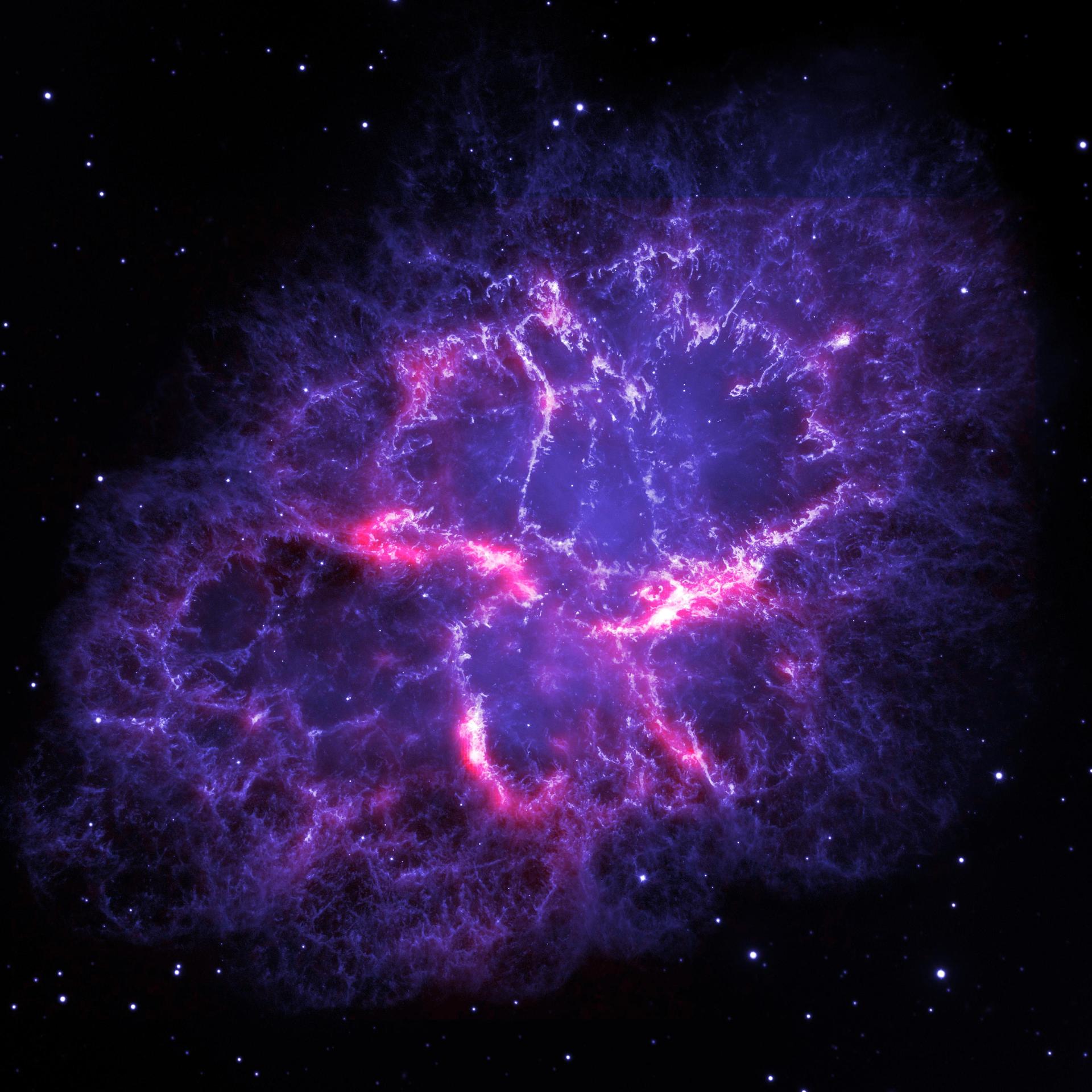
Crab Nebula (M1) — supernova remnant imaged by Herschel and Hubble Space Telescopes

Category: Tutorial Notes

Tutorial and lesson notes

Crab Nebula (M1), supernova remnant · ESA/Herschel/PACS; NASA, ESA & A. Loll/J. Hester (Arizona State Univ.) · NASA Image Library ↗

  • TUTORIAL NOTES: SECOND SEMESTER


    TUTORIAL NOTES: SECOND SEMESTER

    Copyright Harold Aspden, 1999

    In this section of these Web pages I present my second set of ten tutorial lessons which are intended to provide a course of learning for students and others who would like to see how easy it is to decipher the numerical data coded in the most fundamental dimensionless constants of physics.

    SECOND SET OF TEN TUTORIAL LESSONS ON AETHER SCIENCE:-
    I hope these Tutorials have proved interesting.

    HAROLD ASPDEN, January 1, 1999

  • TUTORIAL LESSONS


    TUTORIAL LESSONS

    © Harold Aspden, 1997

    In this section of these Web pages I present ten tutorial lessons which are intended to provide a course of learning for students and others who would like to see how easy it is to decipher the numerical data coded in the most fundamental dimensionless constants of physics.

    By progressing from lesson to lesson you will find you can actually deduce theoretically the precise value of G, the constant of gravitation, expressed in terms of the electron charge/mass ratio. You will find you can determine the numerical value of Planck’s constant h in terms of the electron charge e and the speed of light c. Furthermore you will learn also how to calculate the precise value of the proton/electron mass ratio.

    Once you can do all that yourself and so find you can explain Nature’s physical processes that are at work in determining these three quantities, you will have a skill your physics teachers can only dream about.

    If you are at all interested in the foundations on which the whole of science stands you must follow this course of lessons. Then you can begin to make sense of the problems confronting the broader fields of science, particularly concerning cosmology and the universe, particle creation and on from there into the world of the atom, which leads on into chemistry, biochemistry and the evolution of plants and living organisms.

    Without this fundamental knowledge, which is based on deciphering what it is that fills the space we see as a ‘vacuum’, you will not be one of those who is to see a way of taking us forward to a pollution-free environment in which we will feed on clean energy provided by the ‘aether’. That is where the energy of everything you can see in the universe came from. Once you understand the ‘engine’ which powers the proton creation process, then by developing an interest in magnetism and the quantum underworld that projects itself into ferromagnets, you may inspire hope of technological success in that search for New Energy.

    It is only in my retirement years that I have woken up to the fact that I was misguided in my university education by teachers who saw our world as a kind of heat engine that could never regenerate energy once it was spent by conversion into a degraded heat form. These ten short tutorial lessons encapsulate the key research findings of my lifelong study of the fundamentals of physics during the years when I did accept that there was an unassailable barrier between us and that ‘free energy’ source. I came to understand that ‘vacuum energy’ background that we inhabit, but saw it as inaccessible. But I am now sure we can get to it! The remainder of these Web pages concern my belated but ongoing efforts, as a solitary individual, to go forward on that New Energy quest, whilst hoping to influence the academic world into preparing itself to see the need to list the ‘aether’ alongside coal, oil, gas and nuclear power as the primary contender for supplying our future energy needs.

    THESE ARE MY TEN TUTORIAL LESSONS ON AETHER SCIENCE:-

    I hope these Tutorials have proved interesting. If so, then you may wish to move on now to the Second Semester.
    HAROLD ASPDEN, June 28, 1997

  • GEOMAGNETISM: SHAKY GROUND BUT SOLID FACTS!

    GEOMAGNETISM: SHAKY GROUND BUT SOLID FACTS!

    Copyright © Harold Aspden, 1998

    Research Note: 10/98: December 20, 1998


    I am writing this Research Note after reading an item of news in the British newspaper, THE TIMES, dated December 16, 1998. It was a Science Briefing by Nigel Hawkes and appeared at page 16.

    It was entitled ‘Solid Facts about Quake Waves’. It tells readers that:

    “Scientists have finally found evidence that we do stand on solid ground, even if it lies a long way down. Geologists have for ages believed that the very centre of the Earth, which lies inside a core of molten iron, is solid because of the immense pressures. Now seismic waves generated by an earthquake in Indonesia in June 1996 have proved the case.”

    When I read this I could not understand what it was that had been proved. Is it that belief that a solid external shell stands on a liquid spherical shell which in turn has a solid spherical core that has been confirmed? If so then I see this as contradicting the following part of Nigel Hawkes’ report, which reads:

    “In Earth and Planetary Science Letters, Professor Emil Okal of Northwestern University in Evanston, Illiniois, says that after the quake, he and a French colleague, Dr. Yves Cansi, detected the kind of waves that can be propagated only by solids.”

    To verify that the Earth’s central region is solid the waves would have to propagate through liquid if, in fact, molten iron does separate the central core from what underlies the solid crust on which we stand. So, to make sense, of this news item I have to assume that the evidence suggests a solid Earth with no molten interior.

    I did try to inspect the relevant paper but my local library facility, Southampton University, does not stock that periodical. Also, I note the Nigel Hawkes did not give the page and volume reference. So, pending further enlightenment, I must assume Earth is solid right through to its core and am encouraged to explain why such a discovery would be, and hopefully is, very welcome news to me at least.

    I quote next from page 26 of my book Modern Aether Science published in 1972 and still in print at year end 1998, the reason it is not sold out being that those who read scientific books have no interest in the ‘aether’. Maybe the subject news item will stimulate that interest:

    “Gilbert can be said to have discovered that the earth is a large magnet and it seems that this discovery will stand as firmly established as any ever made by man, but does the modern physicist understand why the earth is a magnet? He thinks he does because he has, in recent times, discovered that a thermally-agitated
    electrical medium can induce a magnetic field when rotating. We have what is called a theory of hydromagnetism. If the earth has a hot rotating fluid core it is natural to rely on this to account for the earth’s magnetism. We do not apparently need any other explanation, even though there is no reasonably certain quantitative verification of the theory.”

    Now do, please, draw the necessary conclusion. If Earth is solid throughout then it cannot have a ‘hot rotating fluid core’ and the accepted theory for geomagnetism stands rejected. You are left, as you are with gravitation and its link with electromagnetism, with no viable physical theory, unless, that is, you come to accept my explanation in these web pages of the role of the aether in governing these phenomena.

    You try explaining how something spinning inside a solid body can set up a magnetic field having north and south poles that precess around the axis of spin, unless that something is aether. We know that a solid body can move through the aether, so aether can move inside a solid body. If you say the aether does not exist then you cannot explain geomagnetism and the precession of the geomagnetic poles. However, if you can accept that the aether exists then I can show you how to calculate the strength of the Earth’s magnetic field. That is a subject addressed in my earliest writings on the aether topic, as you can see by reading through my book The Theory of Gravitation published early in 1960 and, more particularly, its second edition published in 1966.

    It is now some 40 and more years on from the time when I discovered how easy it was to explain geomagnetism using the same aether theory that gave me a physical account of the photon, with a precise quantitative theoretical derivation of the underlying quantum property expressed by the dimensionless fine structure constant. I am therefore delighted at the prospect that geophysicists have now run into this solid Earth problem. It gives a very great boost to my theory.

    Looking back, and in case you are wondering what I did to draw attention to my discovery of the aether explanation of geomagnetism, I can only say that, being employed in industry and not academia, I had little opportunity to project my ideas. Had I been on the physics staff of a university I expect, however, that I would have not got very far in my career in advocating belief in the aether. However, being in industry, I was not slow to exploit opportunity when it appeared. I remember that shortly after I joined IBM in U.K. in a managerial position in which I reported directly to the CEO, the Managing Director, a new Director of high standing in the academic world was welcomed to IBM U.K.’s Board of Directors. His name was Professor Sir Edward Bullard, noted for his contribution to the understanding of geomagnetism. Thanks to the good auspices of the Managing Director, Sir Edward was invited to comment on my aether interpretation of that phenomenon. However, Sir Edward did not seek to discuss the subject with me but simply wrote a note explaining that the magnetic properties of planet Mars did not comply with what my theory indicated.

    So, as with my earlier efforts to arouse the interest of the academic community, I was put in the position of having to have a theory which can explain everything before its explanation for something could warrant attention, even though rival theory that has been accepted has certainly not explained everything. On the contrary, it seems that the accepted theory for the Earth’s magnetism was built on the unproven, but now seemingly rejected, assumption that Earth had a liquid core. Maybe one day cosmologists will also realize that they have made an unfounded assumption in their Big Bang theory in supposing that G, the constant of gravitation, applies unchanged for interactions between matter having extremely high densities, given that their laboratory experiments are based on the interaction of normal matter.

    I await with interest to see how the physics community will reconcile their belief in the liquid core theory of geomagnetism with this discovery that Earth is a solid body.


    Harold Aspden
    December 20, 1998


  • INERTIA OR REACTION?

    INERTIA OR REACTION?

    Copyright © Harold Aspden, 1998

    Research Note: 9/98: October 16, 1998


    I am writing this Research Note after reading the September 1998 issue of New Energy News, the monthly newsletter edited by Dr. Hal Fox on behalf of the Institute for New Energy of P.O. Box 58639, Salt Lake City, UT 84158-8639, USA.

    In choosing the above title I was tempted to head this Research Note: ‘Reinventing the Wheel’, but prudence and the serious nature of the issues involved overcame that temptation.

    There is something odd about the world of theoretical physics, in that those who seek to advance in that field of knowledge tend to get in a groove and stumble along, ignoring cracks and crevices, but always looking downwards in search of new foundations and seldom looking back at the distant hills to check their bearings.

    In this context I will refer to two items from pp. 7 and 9 in that September issue of New Energy News.

    Firstly, there is the notification that a paper has issued in Physics Letters A, vol. 240 (1998) pp. 115-126, to which Hal Fox has assigned the heading ‘INERTIA AS A REACTION’. The paper itself is entitled: ‘Inertia as Reaction of the Vacuum to Accelerated motion’.

    It seems that the inspection of that furrow in the onward path of ‘zero-point’ field theory is telling us something about the equivalence of ‘Sakharov’s conjecture of a connection between Einstein action and the vacuum’ and this concept, according to the reported conclusion would: ‘if correct, substitute for Mach’s principle and imply that no further mass-giving Higgs-type fields may be required to explain the inertia of material objects, although extensions to include the zero-point fields of the other fundamental interactions may be necessary for a complete theory of inertia.’

    In plain English the property of inertia assigned to any body of matter stems from the individual electrically charged particles that collectively consitute that body. There is supposed to be electromagnetic radiation from those particles when the body is accelerated and, ‘Lo and Behold’ – ‘wonder of wonders’, the vacuum by its zero-point activity reacts to feed enough of that energy back to that body, to thereby account for its inertia. Putting this latter statement in even plainer English, the inertia of an electric particle arises because it says to itself “I believe in the Principle of Conservation of Energy and if any external electric influence tries to accelerate me then I shall react to prevent any loss of my intrinsic electrical energy!”

    I wonder why, in 1998, the authors of that paper, Rueda and Haisch, need to get into issues such as the so-called Higgs-type fields, when that common sense assertion concerning energy conservation suffices. An electric action affecting the aether will have its reaction, but if the two are found to balance out then who can say there is any action in the first place? It is different for the steady-state electromagnetic action, where there is non-accelerated motion of charge and where the aether must get into the act with its reaction ‘field’, because there is then no such nullification effect. Energy is transferred to the ‘field’, the aether, because that is where magnetic energy is stored.

    So what about that glimpse backwards to see the hills on the horizon? Looking back one can see, if one really looks with properly focused vision, a short scientific paper published in 1976 in the International Journal of Theoretical Physics at pp. 631-633 of v. 15, having the title: ‘Inertia of a Nonradiating Particle’. It abstract includes the sentence:

    “by supposing that the energy radiated is absorbed by the particle’s own field, inertia is found as a resulting property and the relation E=Mc2 follows as a consequence.”

    There is nothing involving such ideas as Higgs-type fields, zero-point energy, or Einstein philosophy in that paper. The analysis merely corrects an omission or rather an error in the classical theory of electromagnetism by which Larmor first suggested than accelerated charge could radiate energy. Note that the point of concern is radiation by a discrete charge as opposed to the collective activity of interacting electromagnetic fields set up by numerous charges all accelerating together but generating action from their individual source positions.

    Inevitably, from such a track record, perhaps in another 25 or 50 years a future physicist will rediscover this secret of the inertial property and tell us about it once again, but by reference to some future new notions of physics as yet to be invented.

    Hence I say to would-be students of physics: “Raise your heads high, stop scanning deep into those grooves and furrows that your forebears have been digging and just look back once in a while to take stock of that real world on the horizon. There may be ‘gold in those hills and even greater gems if you can focus on the odd mountain! If there is mist obstructing your view then that is the aether, but that then is your primary research challenge, namely to use the right optical means to aid your sight so that you can see through that aether mist.”


    By way of a footnote at this point I add the comment that very often, to get refereed papers accepted by science journals, one cannot write in plain English. It is necessary to disguise what is sometimes very simple and make it look complicated to as to appear to keep faith with the current state of peer-review opinion. Ideally, one’s starting point is to build on the proposals of a recent author published by the same periodical and develop a constructive or critical argument from there. Editors will otherwise not publish what is a quite revolutionary but yet simple contribution to our understanding of physics, simply because its spirit runs contrary to what is deemed to have become the orthodox belief. As author of that 1976 paper in the International Journal of Physics, I can say this from experience. Indeed, my interpretation of inertia in its full and simple form was privately published earlier, in 1966, in my book ‘The Theory of Gravitation’ (2nd. Edition) at pp. 10-15 and a little later in 1969 in my book ‘Physics without Einstein’ at pp. 8-14, and again thereafter in 1980 in my book ‘Physics Unified’ at pp. 80-84.


    Now we come to that second point I take from the September 1998 issue of New Energy News, the subject heading being ‘TELEPORTATION OF PHOTONS’. This was a reference by Editor Dr. Hal Fox to an article on ‘Experimental Quantum Teleportation’ which appeared in Nature, v. 390 at pp. 575-597 in December 1997.

    Photons, it seems, can be split and they can also be entangled! Scientists do not really know what photons actually are, but they can split them and get them entangled, if I understand this item correctly.

    It is Dr. Hal Fox’s remarks that attract my special interest, because he declared:

    “An author said that those who claim to understand quantum mechanics are not honest. As an honest editor, it is proposed that an explanation for this unusual quantum event could be derived from the existence of an aether, the speed of transmission of information in the aether as being many times the speed of light, and a new concept of conservation.”

    Dr. Fox then suggested that ‘entangled particles’ should be regarded as dynamic constructs of the aether such that the creation of one such particle implies a second particle where such particles are in communication at superluminal velocities and such particles have their quantum nature conserved. In short he affirmed that:

    “This editor can understand superluminal communication better than quantum physics.”

    Now one sometimes hears theoretical physicists talk about a ‘theory of everything’. What they mean is a theory that they are looking for and which has yet to be discovered. They would laugh if one said to them: “Stop looking down as you probe the depths of the mathematical jungle where you have lost your way and come out into the open to look back at those hills on the distant horizon. You will then see that the aether which you pretend does not exist is, in fact, your ‘theory of everything’”

    So, you see, I tend to agree with Dr. Hal Fox
    and take this opportunity to draw attention to an ‘entangled photon’ theory that is aether-based. I refer to a paper published in Physics Letters A, v. 119 at pp. 105-108 in 1986. Whether one discusses entangled photons and split photons or entangled particles and split particles it is all embraced by that ‘theory of everything’, the aether.

    The paper just quoted sets out to explain why the neutron, a single particle form, can suffer diffraction as if it were a wave or a particle with a split personality. The secret lies in its encounter with the photon world of the aether and its interplay with an ‘entangled’ photon system, meaning a team of four photons that come into existence as the apparent wave that accompanies the neutron in its passage through space. The quantum properties are preserved and even the de Broglie wavelength formula for the neutron is derived, all by an aether theory of some 50 years standing.

    So perhaps one day, whether reacting to these comments by Hal Fox or digging deep into future grooves and furrows, theoretical physicists may ‘reinvent the wheel’ or rather reinvent the aether. I just wonder how closely the new aether might resemble that aether of mine that lies out of view in those hills of the past!


    As an added footnote, and bearing in mind that my main theme in these web pages concerns ‘energy science’, it is of possible interest to mention that, whilst the mysteries of quantum theory are rooted in the aether, the dominant factor controlling the behaviour of photons, electrons or even neutrons is not quantum theory or its embodiment in the structural fabric of the aether, but rather the energy considerations. I have, for example, declared that the accelerated electron does not radiate its energy because it is governed by its efforts to conserve its energy. Equally, concerning the wave properties of the electron (and much the same applies to the neutron), the electron “develops a photon spin system of its own when in motion and balances its angular momentum by compensating the effect of a primary spin unit by three complimentary spin units orthogonally positioned in the adjacent lattice metric of the vacuum medium (aether). The electron does not radiate electromagnetic waves, but its photon system contains a standing wave system having the de Broglie wavelength. The spin energy of the four photon units is identified as the kinetic energy of the electron. When the electron is diffracted some of this energy spills out, as the waves are no longer contained by the perfect interference of the pulsations set up by the units.” [This quotation is from the text of the Physics Letters paper just mentioned.]


    Harold Aspden
    October 16, 1998


  • IMPRESSIONS CONCERNING GRAVITY

    IMPRESSIONS CONCERNING GRAVITY

    © Harold Aspden, 1998

    Research Note: 8/98: October 8, 1998


    I have two reasons for writing this Research Note at this time. One reason is that today I received a communication from Dave Saltrese who lives near Carmarthen in Wales. He sent me a copy of a paper entitled ‘The Gravitational Wave’, it being the text of a lecture delivered to an audience of medical practitioners nearly 50 years ago. He suggested I might be interested in it owing to this paper having certain similarities to the ideas I have on the theme of gravitation and aether. The other reason stems from a meeting I had a month ago with Dr. Costa Kyritis at the University of Portsmouth here in U.K. Dr. Kyritis of the National Technical University in Athens, Greece, was visiting that Portsmouth location after participating in a seminar at the University of Lancaster where, on September 3rd, he had spoken about ‘A unifying derivation of Newtonian gravity and Maxwell’s electromagnetism’ in the context of ‘Non-linear electromagnetism and propulsion’ and done so by referring to the ‘H. Aspden Effect’ and ‘J. Searl’s Effect’, both seen as involving aether in the dynamics of propulsion.

    I seek in this Research Note to register two reactions, my personal reactions, one being directed at what the author of that text on ‘The Gravitational Wave’ had said about his own theory on that subject and one directed at what Dr. Kyritsis had to say, also about his own theory concerning the role aether plays as a mediator of the force of gravity. The first author, though evidently well versed in physics, was presumably someone having a broader outlook than many a physicist of today’s mould. His name was Rev. Father A J K Glazewski and his qualification was theological.

    I had never heard of Glazewski before Dave Saltrese mentioned him and has now kindly sent me his writings on ‘The Gravitational Wave’. The paper was recorded in the ‘Proceedings of the Scientific Technical Congress of Radionics and Radiesthesia, London 1950, May 16-18’, as published in printed book form by the Congress Committee.

    I will comment first on the topic addressed by Dr. Kyritsis. Like many of those who theorize about aether and gravitation, Dr. Kyritsis adopts the notion that the aether is a subtle fluid having the kind of properties that we associate with fluid dynamics. However, in introducing his subject, he alludes to a whole spectrum of topics that sound familiar to the theoretical physicist, but in such a way that it is difficult to find the focus and see clearly what it is that Dr. Kyritsis is offering or, indeed, requesting.

    As I read the summary of his Lancaster Seminar paper it progresses by first arguing that all particles may be made up of minute component particles, and that there may be particles that one could call aetherons that constitute the aether and are so small in relation to the electron as the electron is to the sun. This is then followed by a recital of the normal physical attributes which suggest the existence of the aether, typically the notion that wave momentum is meaningless if there is no aether substance to convey that momentum and determine the speed of light. So we are introduced to the need for an aether that has a tangible form of some kind.

    Then, however, is this same context, as an argument in favour of aether, Dr. Kyritsis lists as a supporting point:

    “The flying machines of J. Searl and of Aspden have a buoyancy force that cannot come from the ‘vacuum’ but from a material medium in it.”

    Thereafter his case evolves under several headings, many presenting a mathematical proposition. The first of these begins with a Lagrangian formulation of ‘Maxwell’s Electromagnetised Aether’. The energy associated with electric and magnetic fields is deemed to imply a pressure of the kind we associate with a gas.

    From there the argument moves on to present a comparison of the ‘Poisson equation of Newtonian gravity’ with the ‘Fourier heat conduction equation’, from which Dr. Kyritsis concludes that the ‘scalar electromagnetic potential must be the temperature of the aether’. He lays stress on his argument that the key to understanding the mechanism behind Newtonian gravitation is the correspondence of the scalar Newtonian gravitational potential as being proportional to aether temperature.

    Support for this is related to the Podkletnov experiment, in which a ceramic superconductor having a temperature close to absolute zero ‘produces less aether heat due to motion of its molecules’. This leads him to discuss this in the context of a ‘Mie-Dirac’ gas and terms concerning ‘viscosity pressure’ which are to be interpreted by reference to the ‘general heat transfer equation’.

    His onward conclusion from this is that ‘the well known phenomena of antigravity of superconductors tend to confirm our conception of Newtonian gravity as an aether heat effect’. This moves the argument into a series of mathematical equations involving the ‘inverse acceleration due to internal viscosity of the electromagnetised aether’. Then follows more commentary on the relationship between the ‘Maxwell Gas’ and the ‘Mie-Dirac gas’ and a claim that the aether is a mixture of gases.

    Eventually, under his last heading I read:

    “In order to explain the buoyancy forces of the Aspden engine, we believe that we must describe a new interaction which is neither Newtonian gravitation nor Maxwell’s electromagnetism. We could classify it as Einsteinian gravitation that changes the curvature of space-time around the gyroscope, but then what happens is that Einstein’s gravitation goes wrong and the observed experimental results are not predicted! … We believe that the best solution is to introduce a new interaction which is nothing else than the old controversial aether drag force.”

    Finally there is a comparison between the ‘buoyancy’ forces of ‘Searl’s engine’ and ‘Aspden’s engine’, in that “Aspden’s is a purely mechanical propellor while Searl’s is based on the Lorentz force and requires nevertheless mechanical rotation.” This is then followed by a reference to diagrams which purport to show an engineering principle useful in the onward design of antigravitational machines.

    So there you are. Here was someone referring to my ‘engine’ but describing something that I could not really understand. The message was that gravity has some connection with aether as being a kind of subtle gas with a temperature related to gravitational potential and involving both frictional forces and viscosity effects or buoyancy as agents promoting propulsion and lift.

    The simple fact is that I have no such ‘engine’, nor have I ever made such a claim. I have seen and, indeed, handled a machine built by a Scotsman named Scott Strachan, which demonstrated an anomalous lift force by force-precessing two flywheels in a gyroscopic mounting. I am aware of the reports of machines built by another Scotsman, Sandy Kidd, of similar form and I have witnessed privately the seemingly anti-gravitational levitation of a force-precessed offset flywheel as manipulated by Professor Eric Laithwaite. This was of interest to me because I have my own ideas concerning the theory of gravity and my theory offers a route by which one can explain those anti-gravitational phenomena.

    I presume that Dr. Kyritsis had seen an article I wrote for the periodical Electronics and Wireless World where I sought to relate the phenomenon of the Strachan machine with electrodynamic theory. My title was ‘Anti-Gravity Electronics’ and the article appeared at pp. 29-31 of the January 1989 issue. See [1989f] on this web site.

    To summarize my position, I ‘see’ matter as having a universal quantum jitter motion which it shares with a hidden crystal-like structure that is a feature of the aether. I ‘see’, as part of that aether, a kind of ghost property by which some of the energy in the aether assumes a form having mass positioned to jitter in dynamic balance with the mass of the local matter present. I suspect that a flywheel in spin, if its spin axis is forcibly deflected, will have that ghost mass spinning in a partially detached (decoupled) mode, owing to that forced-precession. This means that the gravity forces, which are in truth interaction forces as between those ghost components of the aether, will become less effective in coupling the gravitational force with such a flywheel, thereby leading to the antigravitational effects observed. In a sense this is a buoyancy effect, but those gravitational forces are, by my theory, electrodynamic forces. I have no knowledge that can support or deny the claims made by John Searl and have only heard of that from hearsay.

    I do, however, share the opinion expressed by Dr. Kyritsis that aether temperature and gravitational potential are connected. Indeed, I have published my thoughts on this in the scientific literature of the Institute of Physics here in U.K. [1993d] under the title: ‘The First Law of Thermodynamics’, as as well as in a scientific periodical issued by the Italian Institute of Physics [1983d] under the title: ‘The Determination of Absolute Gravitational Potential’. The fascinating contribution I had to offer on that subject was that gravitational potential, when integrated over all mass in the universe, is infinite unless gravitation only acts over a limited range. I do not accept Mach’s Principle which ascribes a finite value to the gravitational potential of a finite universe, with the potential (the energy released by gravitational attraction) equated to the rest-mass energy of the particle subject to that potential.

    If I were to adopt the aether temperature argument here I would need to argue that the aether has temperature measured beyond imagination, found by equating kT/2 to the product of the gravitational potential and the mass of an aether particle. Just take the value of Boltzmann’s constant k and, for each degree of freedom you choose to assign to the aether gas, multiply that by temperature T to get a finite value that you equate to an extremely high potential divided by an extremely small mass value and you will see what I mean.

    No, the simple fact has to be that gravity has a limited range of action which limits that potential and so the aether temperature. Just do your calculation assuming that here at the position of Earth the gravitational potential is virtually all attributable to the sun and Earth. Multiply that value of potential by an aether particle mass of about 0.04 times that of the electron (this being the value predicted by my aether theory [1972a] and you will find that, if you equate the result to kT, T will be about 2.7 K, the temperature we measure as the ‘cosmic background temperature’. The details of the calculation are given in those papers [1983d] and [1993d].

    The way to interpret this aether temperature effect is to say that aether devoid of matter has its own mass property vested in its system of aether particles. When matter is present there is gravitational potential as between the particles of matter and each of those aether particles. That means a release of energy, but energy is conserved and the logical place for it to be stored is at the very spot where it is released, that is where the relevant aether particle sits. How is that energy stored? The answer, simply, is that it is stored by adding kinetic energy (heat) to the aether particle. As the matter, typically that of the sun, moves away from that particle in its onward cosmic travel through the aether, the particle experiences a diminution of the magnitude of its gravitational potential and sheds that heat energy, restoring it to match the change of that gravitational potential.

    The full analysis of all this is reported in my book Physics Unified at pages 177-180. I do not present a theory of the aether as being a gas. It has certain properties that resemble those of a crystal, a kind of fluid crystal, meaning one that can restructure according to local field conditions. To be sure, I would never contemplate there being friction or viscosity in such an aether. It is a perfect electrical system and its properties are not those of normal matter. We can only comprehend those properties by deciphering the signals which the aether projects into the physics of our material world, the main signal being the value of the fine-structure constant, which links Planck’s constant, the speed of light and the unit of electrical charge shared by the electron. So my way forward on such questions has not been one of following in Einstein’s footsteps, which lead one into a wilderness. Nor would I dream of delving into the theoretical notions implied by a so-called ‘Mie-Dirac’ gas. I would rather divorce the pursuit of theory from the pursuit of new technology, accepting that physics advances as we discover and decipher the clues and signals which Nature delivers when we probe our environment, whilst technology progresses on the back of the discovery of genuine and unexpected anomalies that are revealed in our efforts to master our environment.

    So we come now to the subject of ‘The Gravitational Wave’ and that lecture delivered by Reverend Father A J K Glazewski.

    Here the subject also concerns anomalous effects produced by rotation, but not concerning gyroscopes. It concerns what is observed on an astronomical scale and a possible connection between magnetism and gravitation produced by spin. The lecture presented Glazewski’s interpretation of the nature of electricity as being:

    “a sudden drop or change of gravitational potential at a locus or area of space (mathematically in the change of the value of a tensor) in relation to the surroundings where the distribution of this potential is comparatively isotropic. Such change of gravity potential is noticed as electricity by an observer standing outside the closed physical system and therefore existing in a relativiely uniformly distributed potential pertaining to his own space.”

    Here you see Glazewski arguing in the shadow of Einstein but the ideas being projected are destined to lead nowhere. The proposition is that curved space-time produces gravitation and electricity as such has to be part of that space-time metric, suitably distorted to squeeze it into forms that we can say are ‘positive’ and ‘negative’. I here quote a few of his statements:

    “This immediately led the writer to the conclusion that gravity must definitely be due to a wave, and a wave of mechanical and inertial character. Such concepts as inertia, mass, weight, acceleration, force, work, power, friction, elasticity, resistance, and, in general, all concepts of mechanics, were formally based on principles of gravity and vice versa. All considerations of gravity were forcibly reduced to a mechanical basis.

    The only and indispensable condition for a conception of gravity in its full significance was to regard it not only as a phenomenon connected with the astronomical bodies, but also to connect it automatically with inter-atomic and inter-molecular forces, where electric fields are due to the change of gravitational potential at the locus owing to a change in direction of motion of the mass. This means that to reduce all phenomena to electricity is to reduce all to gravity.”

    Now having myself written extensively about the theory of gravitation, I feel I need to comment on this quite revolutionary proposition that electricity as such is really a manifestation of gravitational action. To me it makes no sense to try to build a theory of electricity on the platform of gravitation, just because it so happens that we came to learn more about mechanics than electricity in an earlier phase of history.

    To put the above idea into perspective just imagine that, well removed from other matter, there is somewhere in outer space a single isolated hydrogen atom. It has two electric charges, that of the proton and that of the electron. Those charges attract because of their opposite polarities. Gravitation is also at work and so those particles, the proton and the electron, have a mutual gravitational attraction as well. We can calculate the relative strengths of those two forces of attraction without knowing anything about the spacing of the proton and the electron, because both forces comply with an inverse square form of law. You can work this out from standard data in physics books and you will find that the electric force outweighs the gravitational force by a factor that is truly enormous, it being in excess of 1039.

    Now tell me how you might begin to explain electrical force in terms of gravitational action? If you argue curvature of space then does space have two curvatures, one very small to match the gravitational situation and one very high indeed to match the electrical situation? That would involve two hypotheses and presumably two intermeshed space-time systems – a highly unlikely state of affairs.

    So let us see how Glazewski came to justify his proposal. He made reference to a then-recent conclusion reached by Nobel Laureate Professor P M S Blackett based on a discovery in 1947 concerning the star Virginis 78. I was at Manchester University in 1947, where Blackett held his professorial chair and this may explain why I, too, became interested in what Professor Blackett later claimed concerning the relationship between G and the magnetic moment of astronomical bodies (Nature, v. 159, pp. 658-666; 1947). Glazewski quotes the following from Professor Blackett’s paper:

    “It has been known for a long time, particularly from the works of Schuster, Sutherland and H A Wilson, though lately little regarded, that the magnetic field moment and the angular momentum of the earth and sun are very nearly proportional, and that the constant of proportionality is nearly the square root of the gravitational constant G divided by the velocity of light.”

    Glazewski further notes that when that star Virginis 78, a star very much larger than the sun, was found to fit the same relationship:

    “Blackett concluded that probably we are dealing here with one of the fundamental laws of nature. He further showed in his formulae that generally the same mathematical expression can be applied to electrons and to Bohr’s magnetons.”

    From this Glazeski draws the conclusion that:

    “It seems to indicate that there is one law which rules matter from the size of atoms up to stars.”

    So now let us reconsider that isolated hydrogen atom and imagine an enormous number N of hydrogen atoms clustered together to form a star. The atoms, as a whole, are electrically neutral and so that electrical action within each such atom is merely replicated N times in the star, because there is no electrical force effective between those separate atoms. However, the mutual gravitational effect as between those atoms is increased by a factor N2/2 because there are that many such interactions, reduced however by some, albeit substantial, factor to cater for the increase in the average interatomic spacing and increased by the factor 1836 because two protons will have that much stronger gravitational interaction than applies between electron and proton. N is very large indeed and so I can see that in a star the gravitational energy potential has far greater magnitude than the sum of the electrical potentials of its constituent atoms.

    Does this alter my case about there needing to be two space curvature systems? No it does not. So I still cannot accept Glazewski’s proposition. Gravitation just has to be a secondary effect linked somehow to the electrical properties of the particles involved.

    How does one then justify that evidence on which Blackett based his thought that here was support for a general law relating gravity and magnetism? Well, let me say that, in the event, Blackett soon thereafter did an experiment in which he mounted a large gold test specimen in a test position well removed from extraneous electrical interference and sought to sense the magnetic field it might produce solely owing to its rotation with body Earth. He thought that the high density of gold meant a higher concentration of matter and so the action producing that magnetic field. He obtained a null result and so abandoned the idea that there could be such a fundamental relationship.

    I was later to discover that the seat of the magnetic field produced by matter rotating is actually the aether which shares that rotation. That aether is not concentrated as a direct proportional function of the density of matter and so the Blackett experiment was not definitive in proving that rotating objects do not generate magnetic fields. That triple, sun-star-earth, formulation still needed explanation as a link between G and magnetic moment/angular momentum ratio.

    That explanation emerged when I considered how a star might form, assuming that the event was akin to there being a God who could throw a switch and turn on gravity. Another assumption amounting to much the same thing is that gravity, like magnetism in iron, switches on as the medium (the aether for gravity and the iron for magnetism) cools through what amounts to a Curie temperature at which energy can find a more stable state. So I thought that there was an event governing the creation of every star when all the dispersed plasma comprising free protons and free electrons suddenly felt the force of gravity. Now two protons will pull together under gravity with a rate of acceleration that is 1836 times that governing how an electron is pulled towards a proton. It follows that the primordial star will find itself positively charged by a preponderance of protons at least for a period before those slowly accelerated electrons can catch up. So during that period the equilibrium between electric repulsion and gravitational attraction means that the star will have an amount of positive charge which equates to the square root of G times the mass of that star. Here then is the clue to what Blackett described.

    Of course, it needs something else to explain why that transient state can persist as a seemingly stable situation so as to allow the star to exhibit the magnetic moment. The answer came from my aether theory. I had discovered, in explaining the photon, that a sphere of aether in a state of spin will develop a radial electric field owing to it acquiring a distributed charge. Conversely, this meant that if one could establish an electric field radial from a spin axis in a sphere of aether then that sphere would spin as a whole about that axis. The star, in forming, had such an electric field and so its aether must spin. That would cause the star as a whole to spin and that would lock in the intrinsic electric charge action and the rotation could then account for the magnetic moment of the star, all in conformity with the Blackett picture.

    This began to make sense when the aether spin was seen as a radial charge displacement, c.f. linear electric displacement in Maxwell’s theory and the theory we use in explaining capacitance and dielectric porperties of parallel plate capacitors. Those surplus electrons, when they arrived, would sit at the spherical (ionospheric) boundaries of the star’s aether and cancel the surface charge component of that displacement, whereas the distributed charge in the body of the star, being a balance of aether-induced charge and the charge of those excess protons, would cancel within the body so far as direct electric action is concerned. However, the magnetic action would not cancel, because aether charge does not generate a magnetic field, inasmuch as a magnetic field is the disturbance of the aether by material forms of charge in motion.

    I have said enough to outline the interpretation I placed on the subject. There is more to read in these web pages on the subject, including more details about the Schuster-Wilson hypothesis which had interested Blackett. See particularly Chapter 5 of my 1960 book The Theory of Gravitation and particularly Chapter 6 of the 1966 second edition of that work.

    Here I mention what I see as a mere assertion in Glazewski’s account of gravity, namely his words:

    “As G is a tensor, being reckoned from the Einstein computation, it can be easily shown that the stress-strain relationship is of vital importance. In the light of the tensorial concept of G, space, whatever size we take, atomic or astronomic, is not an isotropic but an anisotropic medium, in which the gravitational forces are differently distributed along different co-ordinates. Actually, astronomical space as an anisotropic medium can be compared with to a crystalline lattice (of an astronomical size), where this lattice is anistropic just because the gravity fields of the space between the molecules are differently distributed. The above statement is essential for the understanding of the nature of gravity and further development of the theory.”

    I draw attention to this because my own theory of the aether is based on a crystal-like structure, but one which is isotropic in form, apart that is for the microstructure down at the level of the lattice dimension, which is less than 10-10 cm, somewhat smaller than the Compton wavelength of the electron, but very much larger than the physical size of the electron or the atomic nucleus and yet smaller than the innermost electron orbital radii within an atom. I shudder at the thought of trying to explain electrical forces down at that sub-microscopic level in terms of gravitation and space-time curvature.

    Indeed, I wonder what the Reverend Father Glazewski might have said had he studied the writings of a century early by the Reverend Samuel Earnshaw. Earnshaw set out to investigate the possibility that the aether had a crystalline type of structure by assuming that it comprised subtle particles that exerted forces on one another according to a variety of assumed force laws, including the familiar inverse square law that governs gravity or electric forces.

    Earnshaw’s Theorem which emerged from that effort made it clear that no system of spaced particles could be held in a stable structure solely owing to their interactions being subject to such a force law. So if a crystal-like structure is the microcosmic form of the aether then one needs to introduce something to defeat this constraint. That something is a continuum which itself is the seat of action that asserts force on the particles forming the structure, such as might exist if a kind of uniform background gaseous medium of very much finer composition permeates all the interstices within that structure. To evolve such a picture of the aether one needed to say that the particles all repelled one another as did the elements forming that gaseous background, but that to hold things together in a kind of neutral state the continuum and the particles had to be mutually attractive. That was the course I followed but it was one which said that the basic source of the force action had to vest in electric charge, because that provides the separate attraction and repulsion features. Gravity just has to be a secondary phenomenon.

    So, if the tensor feature was linked to gravity and the stress-strain pattern of the medium to satisfy the Einstein principles and that tensor form implied structure, especially anisotropic structure, then the Earnshaw principles could be in conflict, a factor which militates in favour of the dominant electrical action based on a continuum-particle model of the aether.

    I shall now end this Research Note by explaining why I am reacting at this time to the Reverend Father Glazewski publication and that Seminar presentation delivered by Dr. Kyritsis at Lancaster University.

    In both cases there is a lack of that something that one can say is the ‘punch line’, meaning that element of surprise that shines through as a confirming point. In my own writings I have held off publishing ideas as such and waited until I have had something special to say as my ‘punch line’ contribution. So many authors of scientific papers project their ideas, often in complicated mathematical form, and end leaving the reader wondering whether he or she has been left with a puzzle to sort out themselves. There seems to be some kind of impulsive desire to write papers and burden people with one’s thoughts, aimed at generating rapport and interest amongst the many, but creating nothing but a state of chaos in the scientific literature. If there are gems in the collections of published work that adorn university library shelves, then those gems rely on regular polishing so as to be noticed. That act of polishing amounts to attracting publicity by organized advertising in the form of the author’s participation in select conference groupings, given that the proponents have the time and funding to keep their gems well burnished. Alternatively, the author needs a champion who can keep the shine on things, often by promoting interest in his or her own work.

    All I am saying is that there are a few ‘jewels in the crown’ that are ignored by the scientific community at large and, putting it as modestly as I can, that what I describe in these web pages amounts, in my opinion, to a chart giving access to a real treasure which the scientific community would do well to inspect. I accept that some of the jewels may need to be reset or perhaps reshaped, but my ultimate point is that if you set out in search of sunken treasure you need to probe the depths of that great ocean we inhabit, namely the ‘aether’, rather than set out on futile missions into outer space in search of the truths which regulate our physics here and now on body Earth.

    As I post this Research Note on the web I shall also load the pages pertaining to the full text of my 1960 publication entitled The Theory of Gravitation. Some of the notions there presented may seem naive, but I hope they will be instructive. I fell into a few traps laid by the false foundations prevalent in academic teaching, such as the formulation of the form of a magnetic field attributed to a discrete charge in motion, when no experiment has ever verified that such a field exists. Bear in mind that we never ‘see’ that field, we only sense the action that electric charge in motion has on other such charge in motion and we always perform those tests with at least one of those charges being part of a collective act in a troop of charges moving around a closed path. When I woke up to some of those errors I began to discover the real gems of my collection. There was one ‘error’ I thought I had made that was not an error when seen in retrospect. I explained A in terms of B and then found that later I had a second explanation for A in terms of C. I thought one had to be wrong and it confused me for a while, until I eventually realized that I had discovered that both explanations are correct, subject to … well, that is a puzzle you can enjoy probing yourself if you are interested in what I have said about Blackett’s proposition. It concerns the radius of the aether rotating with a planet and sharing its motion about the sun.

    I know there are some planets in our solar system that may not comply with that Schuster-Wilson proposition that interested Blackett. There are secondary effects to consider and the consequences of an aether adapting to the motion of the matter constituting the planet. The question of the radius of the aether form that shares the spin of the planet and the possible internal precession of the aether spin relative to the planetary spin is a fascinating consideration. Therefore, even for those more interested in space research and planets, there is scope for taking my findings forward, beginning by reading that 1960 The Theory of Gravitation in the light of my recent 1996 work Aether Science Papers.


    Harold Aspden
    October 8, 1998

  • THE TAU-PARTICLE

    THE TAU-PARTICLE

    © Harold Aspden, 1998

    Research Note: 7/98: September 28, 1998


    I am writing this in response to a challenge. The nature of the challenge, which concerns supergraviton theory, chaos theory and a conflict between the mathematical and the physical approach to the interpretation of what we observe in nature is not of any special interest; it is a matter which concerns myself and my challenger. The crucial point involved concerns the precise value of the heavy lepton known as the ‘tau’ or taon’. However, I seek here to record my comments on how mother Nature determines that mass, because I have at this time confronted this issue and just wish to put my findings on record. They are of general interest only for those who have understood some of the more advanced features of my theoretical investigations concerning the fundamentals of gravitation

    When I embarked on the task of building a viable theory of gravitation, linking G, the constant of gravitation with electromagnetic field theory, I was unaware of the role that the tau particle might play in the dynamics of the balancing act as between matter and the ghostly underworld of the background aether. Indeed, since that was back in the 1950s, I had no reason to suspect such a connection, given that the tau lepton had not been discovered. Cosmic ray mesons had come onto the physical scene in the 1935 period, thanks to Yukawa theorizing about exchange forces between nucleons and mesons made their experimental debut at about the same time in the work of Anderson and Nedermeyer, but it took until 1947 before the picture clarified as between two meson forms, the pi-meson or pion and the mu-meson of muon.

    The latter belongs to the lepton family. It is a heavy electron, but it was to be many years on before the even heavier lepton, the tau or taon was discovered.

    So far as the early development of my theory of gravitation is concerned, this was wholly concentrated on the role played by the aether in separating chaos from order in the ongoing interplay between aether and matter, and to me matter was something composed of proton-sized particles plus that abundant lepton form we call the electron.

    However, I will here contrast the state of my theory in the late 1950s period with its developed form I now see as its 21st century status.

    Fig. 1

    Referring to Fig. 1, my picture of our presence in an aethereal environment is one in which matter comprising electrons and protons exist in what I call the E-frame. The whole of this frame moves with a circular gyratory motion at the Compton electron frequency, the frequency we associate with the wave properties of the electron. This puts the E-frame out-of-balance dynamically unless there is something acting as a counter-balance. This I call the G-frame. There had to be something hidden in this G-frame to set up that balance. It had to exhibit mass and yet not reveal itself in our experiments, except, that is, for the role it plays in determining G and setting up the force action we call gravity.

    Now back in the 1950s, I contrived to devise a quantum theory of gravity, imagining that perhaps the neutrino was at work in conjunction with a proton-sized unit of mass, the neutrino being deployed in the G-frame, where its motion in its dynamic association with the proton-sized unit of mass ‘carved-out’, as it were, a hole in the electrical background continuum of the aether. The motion of that hole was seen as setting up the electrodynamic action which gave the force of gravity.

    If you wish to inspect the version of my theory as it stood at year-end 1959 then refer to: The Theory of Gravitation.

    The key feature of that theory is the explanation of how the aether sets up the framework for regulating Planck’s quantum of action. That gives a definitive evaluation of the fine-structure constant, the fundamental constant of quantum theory, and it determines the parameters from which we can deduce G, the constant of gravitation, in terms of the charge/mass ratrio of the electron.

    The analysis points to the existence of a cubic array of aether particles, otherwise called lattice particles, or, as now in Fig. 1, ‘quons’, and these form an ordered background system prevailing throughout all space. Everything else is in at least a partial state of chaos, and, so far a concerns the E-frame, we and the matter form we represent constitute something that amounts to a modest amount of chaos sharing the underlying rhythmic motion of that E-frame.

    Take note here that the Heisenberg Principle of Uncertainty implies an underlying order in the motion of all material particles. Their momenta might be uncertain and their position uncertain, as they describe those orbits in their rhythmic jitter motion at the Compton electron frequency, but, for electrons, the product of momentum and displacement from the inertial frame (the I-frame) is certain, it being h/2.

    So, back in the 1950 period my theory pictured what is shown in Fig. 1, but it lacked the presence of those muons in the I-frame.

    Physicists have long admitted that they have no idea as to how muons feature in the scheme of things. They are not seen as building blocks in the particles of matter, but they are known to decay into electrons and can appear as decay products in particle transmutations.

    Now, as my theory developed, I came to realise that those gravitons in Fig. 1 existed in three forms, namely the g-particle or basic graviton, which has a mass somewhat less than that of three protons, the tau, which has a mass nearly twice that of two protons and the supergraviton, which has a mass of about 100 times that of the proton. The prevalent form is the combination of the g-particle and the tau in the presence ratio of one to two, meaning that there are generally two tau particles for every g-particle. The supergravitons come into being when the mass density of matter in the E-frame is high so that the lepton activity of pair creation and annihilation adapts in an optimum fashion to provide that dynamic mass balance. This is necessary when atoms in the upper half of the periodic table are present.

    In Fig. 1 you can see that I have included the word ‘virtual’ in the G-frame section. This indicates that the particles here are the transiently stable charge forms that one can associate with pair creation and annihilation in quantum electrodynamics. In this sense electrons in their free state are also virtual, but I am using this expression ‘virtual’ to distinguish between states which are bare electric charge forms and those which are part of composite structures, the latter assuring a quasi-stability and so being their form as seen sporadically in matter generally.

    The muon, for example, has, according to my theory a theoretical form in which it would, if part of the G-frame, exhibit a mass that is not the same as that of the muon as seen and measured in our experiments. There is a slight difference owing to the fact that the ‘real’ muon is really a ‘virtual’ muon nested between two electrons or two positrons, according to its polarity.

    To appreciate what I am saying about that it is necessary to refer to my published scientific papers on that subject, namely the two papers ‘The Nature of the Muon’ and ‘The Mass of the Muon’ published in 1983 in Lettere al Nuovo Cimento, an English language scientific periodical published at that time by the Italian Institute of Physics, [1983e] and [1983h].

    A further feature or ‘discovery’ which crept into my theory as it developed, and has been mentioned in my writings (see the reference to C A Bjerknes at page 52 in my 1996 book Aether Science Papers), is that charge polarity has its physical embodiment as a state of phase in the radial oscillation of the unitary charge form of a fundamental particle. In other words, charges we say are ‘positive’ are really, so far as Nature is concerned, alternating between ‘positive’ and ‘negative’ in anti-phase with the oscillations of ‘negative’ charges. Essential to this is that synchrony of action that governs the aether system as a whole in its electrostatic behaviour.

    One cannot, however, rule out the possibility that the oscillations can be very much more rapid in particle forms that confine their energy into a smaller space. Thus the tau particle, meaning the one we ‘see’ in our experiments, might well be changing polarity state internally, but yet overall keep an apparent steady polarity as referenced on the polarity of the electron.

    Fig. 2

    To understand this refer to Fig. 2. This shows the electrons of negative polarity, but the tau and the muon can have either polarity. Indeed, they can flip between polarity states as the composite tau-particle form flips between State A and State B. The process involves the background aether in an energy fluctuation such as is involved in creating an electron-positron pair in quantum electrodynamics, but since charge polarity has to be conserved the action creates instead the two electrons shown in the State B composition.

    This process is somewhat analogous with that discussed in my paper 1986d concerning the neutron and the deuteron.

    Though this may seem to be hypothesis, I would rather say that it is the interpretation of evolving facts, facts provided by the precision measurement of the particle involved, namely the tau.

    When I first introduced the tau into my theory and discovered its role as a graviton the tau had a reported mass value several MeV greater than that I calculated as being the true mass of the virtual-tau in its gravitational role. As the years moved on I found that the measured value sank below the one I had calculated. That allowed me to verify an analogy related to the similar scenario I had encountered in theorizing about the muon and I was greatly heartened by the result. You may judge this for yourself by reference to a section incorporating page 12 of my 1996 work Aether Science Papers.

    The analysis in that latter work was based on the picture of the tau as being that shown in State A of Fig. 2 above.

    I quote from that work:

    “Now I have, above, mentioned the ‘harmonics of the primes’, having in mind the wave resonances and standing wave effects that can control the deployment of energy in particle groups. Such effects have been recognized in my researches in connection with the proton and neutral pion, as mentioned below. Also, in 1972, I had adopted the odd integer space volume quantization to derive the fine-structure constant [Physics Letters, 41A, 423 (1972)]. Later, the evidence pointed to the wave resonance as well, so that in 1983 I did explain why the ‘aether’ muon or ‘virtual’ muon, being a bare muon, had a mass slightly below that of the real muon, the one having a electron retinue. Referenced on the integer mass ratio 207, the applicable formula, to a first approximation is:

    mμ/m = 207 + 2 – (9/4)(207)/(207+3)

    which is 206.7687. The second Lett. Nuovo Cimento paper referenced above gave reason for ‘tuning’ this to a slightly lower value, bringing it into perfect accord with the measured value of 206.7683.

    What I now declare as being extra proof and vindication of my research in arguing in support of the wave resonances just mentioned, is the fact that the real taon should replicate the muon situation by having a retinue of two virtual muons, whereas the muon had a retinue of two virtual leptons of electron size. The number 207 can be replaced by 17, at least to a first approximation, because the taon is that much more massive than the muon. Accordingly 17 can replace 207 in the above equation to give:

    mτ/mμ = 17 + 2 – (9/4)(17)/(17+3)

    which is 4.43 Mev below the value of mτ corresponding to the factor 17, if mμ/m is 207. So the 1780.94 MeV estimate of the virtual taon mass indicates a ‘real’ taon mass of 1776.51 MeV, whereas the value, as now reported, is 1777.1 +/- 0.5 Mev.”

    Now, as time has moved on, the mass of the tau particle has been measured to even greater precision as being 1777.05 MeV with an uncertainty of 0.02 MeV. Looking at Fig. 2 one can see that, on average, the mass of the tau-particle will be one electron mass unit (0.511 MeV) above that of State A, assuming that the tau-particle spends half its time in State A and half in State B, which is logical for the oscillatory action. Thus the theoretical value of the tau mass is increased from 1776.51 MeV to 1777.02 MeV and that again shows that my theory can hold its ground.

    Should you wonder why all this is important, my answer is that I have a theory of gravitation which is part of a unified account embracing the various particle forms which physicists study and measure with precision. Why do they make such measurements? Surely it is to provide data helpful in
    evolving theories and so strengthening our knowledge of Nature. Why else would they measure the mass energy of a particle that they regard as quite exotic and ostensibly serving no special role. My theory recognizes that the tau has a role in a unified theory connecting gravitation and electromagnetism. The precision measurement of the tau mass is therefore something that adds more confirmation in support of my theory.

    So far as the ‘challenge’ is concerned, the one I mentioning in introducing this Research Note, I just note that my challenger was seeking to disprove my theoretical association of the tau particle with the graviton form and, in particular, with the supergraviton form, which he deemed had a value determined by number theory as applied to ‘chaos’. The route he suggested left no structure by which to connect physically with the force of gravitation, and far less to derive a theoretical value for G, the constant of gravitation. Hence I am obliged to confine my response to the ‘challenge’ to this showing that the updated measurement of the tau mass is still within the scope of my theory.


    Harold Aspden
    September 28, 1998
  • ELECTRON-POSITRON CHAINING

    ELECTRON-POSITRON CHAINING

    © Harold Aspden, 1998

    Research Note: 6/98: June 18, 1998


    I am writing this as an item supplementary to the Essay: Question No. 5, which is entitled What is a Neutrino?

    In presenting that Essay I stated that I would show how an in-line combination or ‘string’ element comprising an electron and a positron in close surface charge contact would have an energy of 1.25 times that of the individual electron. A larger ‘string’ or ‘chain’ of four such charges has an energy 2.25 times that of an isolated electron and a six-long composition has an energy of 3.225 times that of the electron.

    The analysis is quite simple. One just needs to formulate the energy E given by the J J Thomson formula for the electron as:

    E = 2e2/3a ……….. (1)

    where a is the radius of a sphere bounding the electron charge e, our analysis here being in the classical c.g.s system of units, where we take the dielectric constant of the vacuum as unity.

    From this it is evident that two electron-sized charge spheres of opposite polarity will, when in surface contact, have two units of energy E, offset by the energy:

    e2/2a = 3E/4 ……… (2)

    That gives the result 1.25E for the energy of the two-charge electron-positron string.

    With four such charges in line the offset as applied to 4E is three of the quantites stated in equation (2) plus the offset of one third of the equation (2) value, but there is then the addition of positive energy owing to two interactions of half the value given by equation (2).

    That is (2.25 + 0.25)E as an offset with 0.75E as an addition to the 4E value, giving, overall, 2.25E as the energy of the four-charge string.

    To derive the energy of six charges in a string, the procedure is the same. Take 6E, offset 5(3E/4), offset 3(E/4), offset (3E/4)/5, add 4(3E/4)/2, and add 2(3E/4)/4. The result is 3.225E.

    Had we worked with other charged lepton forms, muons or taons, the result is the same, E becoming the energy of such a single basic charge form. The question one must ask, however, is how composite charge forms move, and whether they travel as a single spherical charge form, dividing into separate charge spheres and regrouping as they proceed.

    The above completes the simple analysis needed to support what is said in
    What is a Neutrino? but, of course, anyone reading this without that introduction will wonder how electrons and positrons forming strings or chains can possibly survive without annihilating one another. Well, of course, they do annihilate one another in their pairs, but I ask you then how that the energy shed is then deployed. Surely it goes back into creating electrons and positrons in the same string configuration, because energy has to assume a particle form somehow and, in a sense, electrons and positrons are the lowest form of life in the charged particle spectrum!

    I suspect that it is the ability of charge to engage in such transformations that allows electric currents to migrate through forms of matter linked by such electron-positron chains. The movement of isolated charges at different speeds and the consequent problem of wondering how kinetic energy is represented in Nature’s storehouse is otherwise a very problematic topic. I will try to address that in these Web pages, particularly by reference to proton motion. There is now some evidence experimentally that tells us that an antiproton and a proton have identical mass to within less than a part in one billion. The way that is measured opens the question discussed in the earlier Research Note Research Note No. 3/98 and that concerns the issue of whether Coulomb interaction energy, such as that of equation (2) above, exhibits the mass property in motion. That is indeed a very interesting topic for the scientific minds of the 21st Century to contemplate.


    Harold Aspden
    June 18, 1998
  • NEUTRINO MASS

    NEUTRINO MASS

    © Harold Aspden, 1998

    Research Note: 5/98: June 5, 1998


    I am writing this after reading a Science Briefing item by Nigel Hawkes, Science Editor of the British newspaper: The Times. The article was entitled ‘Mountain tests allow scientists to put weight on the neutrino’. It appeared at p. 10 in the June 5, 1998 issue of that newspaper.

    I shall make a few quotations from the above article and add my own commentary.

    “Neutrinos were produced in the Big Bang, which began the Universe, and are emitted by the Sun and all other stars. Theory says they should be a billion times more common than the particles that make up atoms.”

    Well, my theory, the one I am trying to get across in these Web pages, certainly does not support this statement. Indeed, in my theorizing about space, the universe and energy processes occurring in Nature, I have not, so far, ventured to probe the realm of the neutrino in my published work, simply because I think the word ‘neutrino’ was invented to avoid referring to the ‘aether’. You see, one cannot have energy exchanges or fluctuations involving the aether unless there is something that explains balance of momentum and conservation of energy. So if you see a momentum imbalance in the way certain particles behave, typically where electrons, muons or taons are involved, then you need to say that either the aether is throwing its own weight around in the act or something else is discharging that task. That ‘something else’, in the language of accepted, but erroneous, physics is the neutrino.

    I do not believe that the aether was created in a so-called ‘Big Bang’. If I did I would not be able to sleep without dreaming about how things were a few seconds before the event of the Big Bang. The universe is so vast that to contemplate it ever having been created at one instant called a ‘Big Bang’ is just so irritating to any reasonable person, that it simply has to be discounted as utter nonsense.

    Rest assured, if you even think that cosmologists might be right, that there exists some other way of interpreting what those cosmologists term the redshift. That and their assumption that there can be no frequency attenuation by light propagating through space, is all they have to support their hopes that there was a ‘Big Bang’. They cannot be right, but even if they think they are, then they have yet to tell us what happened before the ‘Big Bang’. The only answer I have heard on that reminds one of a tape recording played in an automobile, where, when the tape gets to the end of its play, it runs in reverse and can keep on playing music because there is no ending, nor need there be a beginning if all one knows about that automobile is based on hearing the music as played. So one reads of nonsensical ideas such as ‘time runs backwards’ once the current expansion cycle ends, meaning that we all turn around and head to that one point in space where the ‘Big Bang’ happened and, once there, we decide to get the whole act rolling again in the opposite time sense and so we evolve into another multi-billion year cycle with a new ‘Big Bang’.

    Well, the question now is: ‘What is a neutrino?’ and, if we can answer that, there is the question: ‘Does it have a mass?’ or rather: ‘Do they have mass?’, because neutrinos supposedly come in different varieties.

    “Physicists announced today (presumably June 5, 1998) at a conference in Japan that they believe neutrinos, ghostly particles hitherto believed to be without mass, do weigh something after all. Since the universe is suffused with neutrinos in vast numbers, this means that they must make up a large part of the “missing mass” believed to be present in the universe but invisible to the eye.”

    Now I am not at all sure how scientists even know of such a thing as “missing mass” unless they are relying on their interpretation of how fast the universe is expanding and see it as expanding faster than it should from their estimates of the ‘non-missing’ mass. So, again, all they are saying is that: “We think the universe is expanding, because we cannot otherwise explain how empty space can attenuate signal frequency, but that leads us to think that the expansion is too fast and so there is some missing matter somewhere in space and that can only be what we call ‘neutrinos’ and, if we can prove neutrinos have mass, we can say that that accounts for that missing matter.”

    We have here an interesting situation. Empty space is supposedly filled with neutrinos. They have mass and so empty space has a mass density. So how is it that space cannot attenuate the frequency of those light waves we see as having a redshift? Given that it must attenuate those waves, then surely the ‘missing mass’ theory is wrong and we had best think about a steady state universe, rather than one that is expanding. In that case, to say that neutrinos can explain missing matter, is illogical.

    So where do I come into this picture with my theory? Well, I have just posted Lecture No. 24 in these Web pages and it shows that in 1982 I published an article in Wireless World which explained how the aether can have structural form and fill all space whilst yet allowing passage of light waves with no frequency dispersion but having frequency attenuation such as one sees in the redshift.

    I may also say that I have on published record in a scientific periodical a paper 1984e which discusses that same subject and goes on to deduce theoretically the actual frequency attenuation one can expect to measure. That is provided my theory is correct in saying that Nature everywhere in space is trying to create protons and electrons from the sea of virtual muons that provide the main sea of energy in the aether. In that paper I suggested that the transient existence of those attempts at matter creation could account for ‘missing matter’, but I confess that I have yet to be convinced that there is any need to recognize the existence of so-called ‘missing matter’.

    That said, I now wonder about the significance of this reported neutrino discovery:

    “They (the neutrinos) pass unnoticed through the Earth, and through our bodies, all the time, which makes them very difficult to detect. The new results come from the first two years of data from Super-Kamiokande, a $100,000,000 experiment in a cavity under Mount Ikena near Kamioka in the Japanese alps. The detector is a million gallon tank of water.”

    “They have found fewer than expected muon neutrinos coming from great distances, and this deficit indicates that muon neutrinos disappear and reappear as they travel through the Earth. This in turn means they must have mass, since massless particles cannot change their form.”

    “…. “Neutrinos cannot now be neglected in the bookkeeping of the mass of the universe. One only gets such great data once or twice in a professional lifetime, maybe never,” said Professor John Learned of the University of Hawaii, one of the team responsible.”

    It was not stated in this report exactly what mass values had been assigned to the members of the neutrino family, but there was the statement that there are believed to be 500,000,000 neutrinos in every cubic metre of space, meaning that “a mass for the neutrino of even one millionth that of the electron – the figure suggested by earlier experiments – would be sufficient to make the total mass of neutrinos a significant, and perhaps a major, part of the total matter in the universe.”

    Well we shall have to see how all this provides us with information of value. I feel we know so little about how an electron moves through space or through matter and it does not take $100,000,000 to finance experiments detecting the behaviour of electrons travelling at their natural speed. Incidentally, the energy of a free electron in a metal conductor is said to be that given by its velocity as determined by Fermi-Dirac statistics, of the order of about one millionth of the mass-energy of the electron. Might it be then that the electron neutrino is the ghostly presence of the carrier of the kinetic energy of the electron in electrically conductive matter or even in that weakly conductive tank of water under Mount Ikena? In that case I would be inclined to look more closely at the theory governing electrons.

    Also one needs to examine the theory as to how protons move through space. What form does its kinetic energy assume? Can it be that of the neutrino, albeit some combination of muon and tau neutrinos, if not simply electron neutrinos? In other words, I am suggesting that the ‘neutrino’ might be simply an artifact of Nature occasioned by the transient presence of the electron-positron pair or its counterparts in the muon family or taon family. The neutrino may even be a more subtle transient activity related to the aether itself, meaning those quons or lattice particles that I have referred to elsewhere in these Web pages.

    In any event, since I did draft a paper on neutrino theory some time ago, but did not pursue it to publication, I will now edit that paper and bring it into these Web pages in the very near future.


    Harold Aspden
    June 5, 1998
  • MAXWELL’S EQUATIONS

    MAXWELL’S EQUATIONS

    © Harold Aspden, 1998

    Research Note: 4/98: June 6, 1998


    I am writing this in conjunction with Gieskieng’s Addendum in order to clarify my point of view concerning the relevance of the findings of Dave Gieskieng in his antenna experiments performed by propagating radio signals across canyons in USA. The question at issue is the validity of Maxwell’s equations.

    Now, very few scientists could ever dream that Maxwell’s equations are open to challenge, but it is as well to ask if the majority of scientists familiar with electrical theory and the theory of radio transmission have answers to the following questions.

    Firstly, given that we are taught in physics to recognize that, in fundamental terms, energy has three forms, namely electric, magnetic and kinetic, how do we explain the difference between magnetic energy and kinetic energy?

    Well you might say that one has to do with how electric charges in motion interact with one another across empty space and the other is something far more familiar that is just the energy acquired by a something having mass owing to its motion. Now, in history, J J Thomson, the person who discovered the electron, derived a theoretical expression for the electromagnetic energy acquired by an electron of electric charge e, of radius a, and moving at a speed v, obtaining the result:

    Ek = (e2/3a)(v/c)2 …… (1),

    c being the speed of light, and he compared this with the formula for kinetic energy:

    Ek = mv2/2 ……… (2)

    to deduce an ‘electromagnetic mass’ value m, which one can see satisfies the equation:

    m = (2/3)e2/3ac2 ……… (3)

    This was based on the electric field energy Es of the electron being assumed to be

    Es = e2/2a ……… (4)

    and so we can then see that Es, which is applies at zero speed and so has something to say about rest mass is:

    Es = (3/4)mc2 ……… (5).

    He pondered the question of whether this electromagnetic energy Ek was in fact nothing other than the kinetic energy of the electron. Indeed, he went so far as to show that, if it were, then the electron could never be accelerated to a speed exceeding that of light. This was many years before Einstein came along and, indeed, it was back in the 19th century that it had been shown experimentally that electrons got heavier and heavier as their speed converged on that of light.

    In case you wonder about that factor 3/4, not being unity, as needed to satisfy E=Mc2, take note that J J Thomson had assumed that the electron was a charged sphere with all its charge distributed around its surface, as if it were of conductive material. Had he assumed that the sphere was simply holding electric charge within it at uniform pressure and so uniform energy density, he would have obtained the E=Mc2 formula.

    So you have here two auxiliary questions to weigh in your minds. Did we really need Einstein and his Theory of Relativity to understand that E=Mc2? Is the kinetic energy of a fundamental electric particle wholly that of, and nothing other than, the magnetic energy set up in the surrounding field as that charge moves?

    My answer to the first question is: “No” and my answer to the second question is revealed as we move on to the next primary question.

    Secondly, why is it that Maxwell’s equations contain no terms which represent mass? Here you may jump to the obvious conclusion. From what has just been said about J J Thomson, one can see that there is no need for mass terms at the fundamental level, if electric and magnetic field energy is all there is to consider.

    That, however, is not my answer. I have an eye to the need to account for gravity and the problem of how energy travels at the speed of light. I spent a very long time trying to decipher the secrets underlying something called the ‘Neumann Potential’, on which electrodynamic interaction forces are founded. I also explored in various ways the notion that electric, magnetic and kinetic energies are distinct energy forms. The outcome depends upon experimental proof, something that is rather elusive, but I see a glimmer of such a proof in the antenna research findings of Dave Gieskieng.

    Now you may think that, if I challenge the Einstein account for E=Mc2 and accept the derivation founded in J J Thomson’s method, I must identify kinetic and magnetic energy as one and the same. That is not so. The reason is that, fortunately, long ago and shortly after I began to raise these fundamental questions, I found a flaw in the Larmor derivation of the formula for energy radiation by the accelerated electron. The formula is used in physics and physicists will say that it works and so must be valid. They are wrong, because their experimental data only indicate that it works in respect of the collective action of charges sharing a common acceleration. The question I am concerned with is radiation by an individual electron, as opposed to how it may play the ‘field’ when part of a team.

    I reasoned that Larmor had declared the electron to be accelerated without saying how it was accelerated and without allowing for its charge interaction with that essential accelerating field. Keep in mind here the advent of the ‘quantum’ and the need to explain why the single electron in its accelerated motion around the proton in the hydrogen atom did not radiate energy according to the Larmor formula. If atoms were to lose energy by radiation in that way, then all motion within atoms would have stopped long ago, but, as it is, they enjoy a life of perpetual motion!

    So it was that I argued that an electric charge would respond to an accelerating field in just such a way as to conserve its energy against the prospect of radiation. When analysed mathematically, that gave me the formula E=Mc2, without appeal to J J Thomson’s method or the methods used by Einstein [1976b]. My derivation meant that the inertia and mass of an elementary particle are in no way dependent upon magnetic fields. Kinetic energy stands as an energy form in its own right. A full formal derivation of the E=Mc2 formula by this method is to be found in my 1980 book ‘Physics Unified’ at pp. 80-84.

    Just to put this in context, what it means is that all the elementary particles, such as protons, which have a core charge radius that is less than one thousandth that of the electron, have an intrinsic kinetic energy somehow stored as part of their moving system. The questions that then arise make one wonder if leptons, such as electrons and muons handle that kinetic energy storage in a manner different from hadrons, such as the proton. However, our immediate concern is Maxwell’s Equations and where mass might feature in those equations.

    Now here it is a question of where you want to begin. I submit that if you really want to understand Maxwell’s Equations you have to think in terms of an aether containing charge that can be displaced. How else can waves sent between Sun and Earth make that transit through intervening space. If you think it is all done by photons then I ask you, where do you see photons in Maxwell’s equations? Cast those equations aside and forget them, if the photon picture can satisfy your need for knowledge! You cannot back both horses and expect both to win.

    I maintain that we must accept that the aether exists and contains electric charge in some form and so I say that it contains quons, electric charges of common polarity permeating a uniform continuum of opposite charge. That is the model of the aether which I find does give the right answers.

    Now instead of bringing into play our empirical equations, such as that which expresses the law of induction, meaning something involving magnetic energy, let us first ask how those quons in the aether might oscillate as they transmit an undulating electric wave. They will, like the up-and-down wave motion of the sea, oscillate laterally with respect to the wave propagation direction and the potential energy stored by electric displacement will be exchanged with the kinetic energy of the up-and-down charge motion. In fact, the energy is that of a standing wave condition, meaning that energy does not have to flow at the propagation velocity of the wave.

    If you study the mathematics of Maxwell’s Equations you will see that they are reduced in form to two wave equations, one representing the electric field and the other the magnetic field. Both of those equations imply the transport of energy at the wave propagation velocity. Yet the equation for the electric oscillations is the same as that we can deduce if the electric potential is exchanged cyclically with the kinetic energy involved in those lateral oscillations, given that the quons must have a mass property. Is it then a problem that the aether has mass?

    Before we consider that let us now look at that wave equation assigned to the magnetic field. Here it helps to have an idea as to what a magnetic field really is and how, and where, it involves energy storage. Never mind what the empirical formulations tell you, just think here about passing current through a long solenoid. There is a magnetic field set up along the axis of that solenoid and all of it is contained within the solenoid if that solenoid is infinitely long. That could be in a vacuum. How is energy stored in a vacuum?

    Well I have already explained this elsewhere in these Web pages but I will describe the process once more. What we think of as empty space is not empty. It contains charge in motion. A component of that motion could be said to be a random vibration characteristic of heat. Apply a magnetic field and a proportion of those charges, just enough to set up an optimum reaction, as determined by maximum energy transfer, will react by assuming a helical kind of motion setting up a reaction magnetic field in opposition to the applied field. This works out as being precisely half that of the primary field. So, given that 2 minus 1 is 1, we know that the primary magnetic field set up by current in the solenoid is really double that we assume in our standard theory, because half of it, a half we do not ‘see’, is cancelled by the reaction. The analysis involved in that tells us also that the energy transferred from the primary field source to the secondary reacting field system is precisely that we formulate as ‘magnetic energy’.

    In other words, when we power a solenoid the magnetic energy we supply is transferred into that random thermal component of motion of the reacting charge in the aether. It heats that charge and that heat energy disperses through the aether. However, when we switch off the current supplying that solenoid, that 2 minus 1 reaction, becomes a primary action, equal but opposite to what we thought was the original primary input action, and it feeds energy back to the solenoid by cooling the aether within the solenoid.

    That is what magnetic induction is all about. There is really no such thing as ‘magnetic energy’. All one needs to consider is the kinetic energy of reacting charge in the aether.

    So one can understand how Maxwell’s Equations operate. Maxwell did not factor into his analysis the kinetic energy of the quons in the aether. Instead he incorporated the notion of the ‘magnetic field’ and assigned that an energy density. However, the problem with that was that he derived two wave equations which supposedly move waves together in step at the wave velocity, each carrying energy forward in the propagation direction. In fact, the energy of a single wave oscillation, that of the electric field, remains in situ as it oscillates between kinetic and electric forms. In free space remote from matter and a radiating source, electromagnetic waves therefore travel without conveying energy and they really would be better termed as ‘electric waves’, given that no magnetic field energy is involved.

    You see, if the aether charge sets up the ‘reaction’, how can it at the same time sustain the ‘action’? Where is the source of a magnetic field out there, well into space? If you say charge in motion must set up a magnetic field, I say where is the separate charge that can absorb the energy and store that magnetic field. In other words, I say that there is no such thing as a magnetic field out there in free space and that what we call electromagnetic waves are merely electrical oscillations exchanging electric potential energy and kinetic energy.

    Now, of course, I cannot say that radio antenna do not radiate energy. They shed energy in setting up the disturbance which is that electric wave and, so long as there is undispersed surplus energy forced into the radiation field energy, there is an associated but rapidly attenuating wave that could be identified as a magnetic field wave. As with the wave on water analogy if something sets up a tidal wave, forcing water to move as a wave, then one distorts the natural equilibrium of the wave oscillations of the system.

    You will then see why the antenna experiments of Dave Gieskieng are relevant to this question. If that antenna used by Gieskieng is specifically adapted to set up pure electric wave oscillations then it will ripple the ocean of space with a minimum of power input, because so little of the power needs to be dispersed by that thermal activity of the reacting aether charge.

    On the fundamental scientific front, given my case that magnetic fields involve reacting charge, how can the J J Thomson formula hold up for the calculation of electromagnetic mass if those reacting charges are of far greater physical size than the primary charge? To satisfy that equation they must be minute in relation to the primary charge. Yet if they then have the unitary charge e common to all fundamental charged particles, they in turn must have an enormous mass compared with the primary particle. That is an escalating argument which takes one into the realm of absurdity and so one has to conclude that the electromagnetic mass notion of J J Thomson is erroneous.

    I hold firm to my interpretation of inertia and mass as being the unwillingness of a charge to radiate its self-energy (as opposed to energy shared by mutual field effects) when accelerated. That ‘unwillingness’ or ‘sluggishness’ is what we call ‘inertia’ and the mass property that expresses that is given by the electric energy intrinsic to the particle as divided by the square of the speed of propagation of disturbances within the body of that energy Es of the particle, invariably the parameter c.

    There is then the question of how the aether can have all those quons with a significant measure of mass, given that the energy involved in those wave oscillations is by no means negligible.

    The answer to this is that the quon system does have mass. Indeed, I calculated this long ago and found that it was very nearly 144 gm/cc, meaning that the aether has a mass density well exceeding that of Earthly matter. That is, however, no problem. Indeed, it is essential and was deemed so by our forebears in the 19th century who tried to explain the finite speed of light in terms of an analogy with propagation properties in solid matter. All one has to do is to explain the evident lack of aether momentum by accepting there is scope for motion of free quon charges in counterflow through moving aether [1976a] or an analogous activity by a leptonic activity involving muons The Ether – An Assessment, and it all begins to make sense, taking Michelson-Morley’s experiment along with it.

    To conclude, I can but say that it would be a pity if the copious experimental evidence provided by the researches of Dave Gieskieng were not investigated further and, indeed, repeated to secure full verification. If they do prove that we can set up waves in the aether with a minimum of energy input and support the suggestion that there is very little actual energy transport from transmitter to receiver, as opposed to an energy exchange with the thermal aether background, then one can see scope for a technology that is reminiscent of the efforts of Tesla. At the very least the experiments should establish the reality of the aether and dispose of the notion that photons, as particles, transport energy. That would be a very significant breakthrough in the onward march of science. There is so much wrong with the state of the art in pure physics that technology must be suffering as a consequence and it is due time that we faced up to the issues involved and began to see the ‘aether’ as a future workplace for the energy technologist.


    Harold Aspden
    June 6, 1998
  • ANTIPROTON MASS

    ANTIPROTON MASS

    © Harold Aspden, 1998

    Research Note: 3/98: June 6, 1998


    I am writing this after reading a Science Briefing item by Nigel Hawkes, Science Editor of the British newspaper: The Times. The article was entitled ‘It ain’t heavy, it’s a proton’. It appeared at p. 16 in the June 1, 1998 issue of that newspaper.

    The report declared that “Physicists have trapped a proton and an antiproton and proved that they have the same mass, down to the tenth decimal place. The precision of the measurement is a tour de force in physical measurement.”

    Apparently, what the researchers, Dr. Gerald Gabrielse and Dr. Anton Khabbaz of Harvard University, did, using facilities in Geneva in Europe, was to trap a single antiproton in a radial electric field and a longitudinal magnetic field so that the antiproton would orbit around an axis and then they added a ‘negative hydrogen ion’. This is a normal hydrogen atom, a proton plus an electron, with an additional electron attached. Both particles would then travel in an orbit around that axis subjected to the same electric and magnetic fields.

    One, the negative hydrogen ion, would have more mass than the other, amounting to that of two electrons, which means that it would orbit around the axis at a slightly slower rate.

    By measuring how fast the two particles raced around the ‘trap’ in virtually identical circles at 90 million times a second, they were able to conclude, after allowing for the electron masses, that the proton had the same mass as the antiproton, an important fact, given that some physical theories require the two masses to be different.

    What I wonder is whether the precision of that measurement allows one to reach a conclusion concerning one of the very basic unresolved questions in science, which is, given that the proton and antiproton do have the same mass, whether the energy of Coulomb interaction as between that proton and its two satellite electrons contribute to the mass of the hydrogen ion.

    If the precision of that measurement of the relative masses of the proton and antiproton really does indicate precise equality to within the tenth place of decimals, as is reported, then it certainly must provide the answer to the question just raised. The Coulomb interaction energy of the proton-electron interaction in the hydrogen atom would affect the measurement at the eight decimal place, if it contributes to the mass of the hydrogen atom.

    This is an extremely important question in physics and it bears heavily on the validity of Einstein’s theory. The reason is that Einstein declared that all energy has mass, whereas there are those in science, including myself and Leon Brillouin, the author of ‘Relativity Reexamined’, as published by Academic Press, New York in 1970, who think that the Einstein proposition poses questions that need an answer, one being the issue of whether Coulomb interaction energy exhibits the mass property. You see, that energy is not seated in either of the interacting bodies. It exists in their interaction across space. It exists somewhere between them in the aether and, though logic implies that it must move in a translational sense with both bodies, it does not follow that it necessarily will contribute to the effective mass of the combination of the two bodies in an orbital motion.

    My belief, as based on the derivation of the E=Mc2 formula 1976b by a method quite independent of the Einstein philosophy, is that only energy vested in the self-action of electric charge can exhibit mass. Hence my interest in knowing the answer to this question, given that the answer must be there in the results of the reported experiment.


    Harold Aspden