Copyright, Harold Aspden, 2002
This set of six Notes was compiled as an aide memoire for use in the author’s onward discussions following the presentation of the Lecture at the 2nd Berlin Conference for Innovative Energy Technologies organized by BINNOTEC e.V., Berlin and held the location of SolarEnergy 2002, Messe Berlin, Messedamm 22, D-14055 in Berlin, Germany on June 13th-15th 2002.
IEINSTEIN: ENERGY AND THE VACUUM
When reading about energy as a property of the medium we call the ‘vacuum’, there will
be those who wonder about the role which Einstein played in clarifying our picture of things.
Well, much as you may wonder, you will find that Einstein had very little to say about energy, as
such, and far less, if anything, about the vacuum as a source of energy. Do not be deceived by
what you think may be implied by the formula E = Mc2. This equation is easily derived by
investigating how an electric charge accelerated by an electric field can respond to avoid radiating
its energy E and, indeed, its very charge. Its response has to be such that it exhibits inertia
according to a mass property M as given by the above formula, c being the speed at which electric
field disturbance propagates through the vacuum from the seat of action, the electric charge.
However, that was not how Einstein came to formulate that equation. His approach was
somewhat philosophical, albeit guided by a fact known from experiment in the latter part of the
19th century that, the faster an electric particle moves, the greater its mass, subject to a limiting
threshold set by the speed of light c. The correct interpretation, however, is the simple fact that
energy has to be conserved and, as an electric charge has an associated amount of energy, energy
which increases by augmenting the electric field energy of the particle with a retinue of kinetic
energy, that energy is not dispersed by radiation and so accumulates and enhances the mass.As you can see, under that heading of the Berlin Lecture ‘Capacitor Magic or a Mere
Dream’, I began by asking you to ‘imagine’ a capacitor as having a rather unexpected property
and followed this by asking how you would turn this into a ‘practical’ device. Imagination of
what might be possible in our world of reality, coupled with practical skill are characteristic of the
engineer and inventor and energy is the realm of the engineer. In contrast, noting that that Berlin
Lecture, though prepared in draft form in January 2002 before I accepted the invitation to speak
at the Berlin meeting and completed on 8th March after returning from a four week absence on
vacation, it struck a chord in the author’s mind to read, on 14th March 2002 in the English
newspaper THE TIMES, that that day was the anniversary of the birth of Albert Einstein and that:While at secondary school, Albert Einstein – who was born on this day in Ulm,
Germany in 1879 – wrote an essay in which he proposed becoming a teacher of
theoretical science, because of his “disposition for abstract and mathematical
thought, and my lack of imagination and practical ability”.It is no wonder, therefore, that Einstein came to see the aether, or rather space-time, as an
abstraction definable in terms of mathematical equations but could not imagine its real form and
see its potential as a practical energy source!Admittedly, this author is here giving vent to his feelings, having in mind the hostility he
encountered when trying to advance his insights into the nature of the aether and encountering
shocked reaction expressed by the words “Have you never heard of Einstein?”. To have one’s
scientific papers during a 14 year period up to 1969 rejected on sight for non-conformity with
Einstein’s teaching did leave its scars. This accounts for the unusual choice of title of the author’s
first major printed work, namely Physics without Einstein, a 224 page book which, incidentally,
at pp. 8-14, presents the full mathematical analysis proving that an accelerated electrical charge
that seeks to preserve itself from loss of energy must exhibit an inertial property according to a
formula E = Mc2 where M is the mass defining that inertial property, E is the energy of the particle
and c is the speed at which disturbances produced by accelerating electric field action propagate
by displacing the electric charge system of the aether.[H. Aspden: 15th March 2002]
IIAN UNEXPLAINED ANOMALY
It was only as I finalised the text of the BERLIN LECTURE that I recalled that, some 19
years before, in 1983, I had been given a copy of a Ph.D. thesis by someone I knew as a Research
Manager at IBM’s development laboratories in U.K., Dr. Bruce P. Piggin. I and Dr. Piggin had
just retired from IBM and I had become a Visiting Senior Research Fellow at the University of
Southampton in England. Dr. Piggin’s Ph.D. research had been in the Chemistry Department of
that university and his thesis entitled ‘Pulse Studies on an Electrochemical System’ was dated July
1967.I remembered that he had some particular views about capacitors and an aspect that he
saw as warranting attention, but what he had said at the time did not stir my interest, even though
I was then intent on experimenting with a torsionally suspended capacitor system excited by high
voltage pulsations to repeat my own version of the Trouton-Noble Experiment, which had in 1904
been an attempt to detect the Earth’s motion through space. Indirectly that experiment is
concerned with the law of electrodynamics because the detection of motion through the aether
depends upon a certain interpretation of that law, as it concerns the notion of two spaced
capacitor charges moving with body Earth through space and an experiment aimed at detecting
the effects of electrodynamic interaction forces as between the moving charges.So my copy of that thesis has lain dormant in my files for those 19 intervening years, and
it is only now, having been inspired by new ideas to write the BERLIN LECTURE, that I have
seen reason to browse through it once more. My reason is that the test capacitor of Bruce
Piggin’s thesis is a cell of concentric cylindrical electrode construction and it is pulse-charged.
I also note that, as I now read this 1967 Southampton University thesis, it has occurred to me that
the cold fusion theme that captured our headlines in the 1989 era, had involved a cell of somewhat
similar construction and that Professor Fleischmann, of cold fusion fame, had his professorial seat
in the Department of Electrochemistry at Southampton University.Now, in this brief note, which I admit I present as possibly only of passing interest, I only
wish to draw attention to a feature of the Piggin thesis that I find curious as it may have some
bearing upon the claim I am making in presenting that BERLIN LECTURE. Remember that in
that Lecture I am suggesting that the aether can import energy anomalously into a concentric
cylindrical capacitor. Critics will ask for evidence in support, so I feel obliged to point to anything
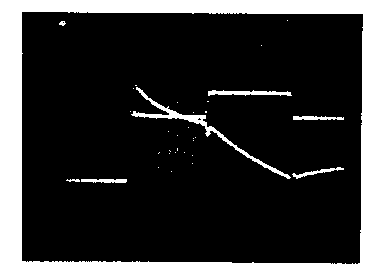
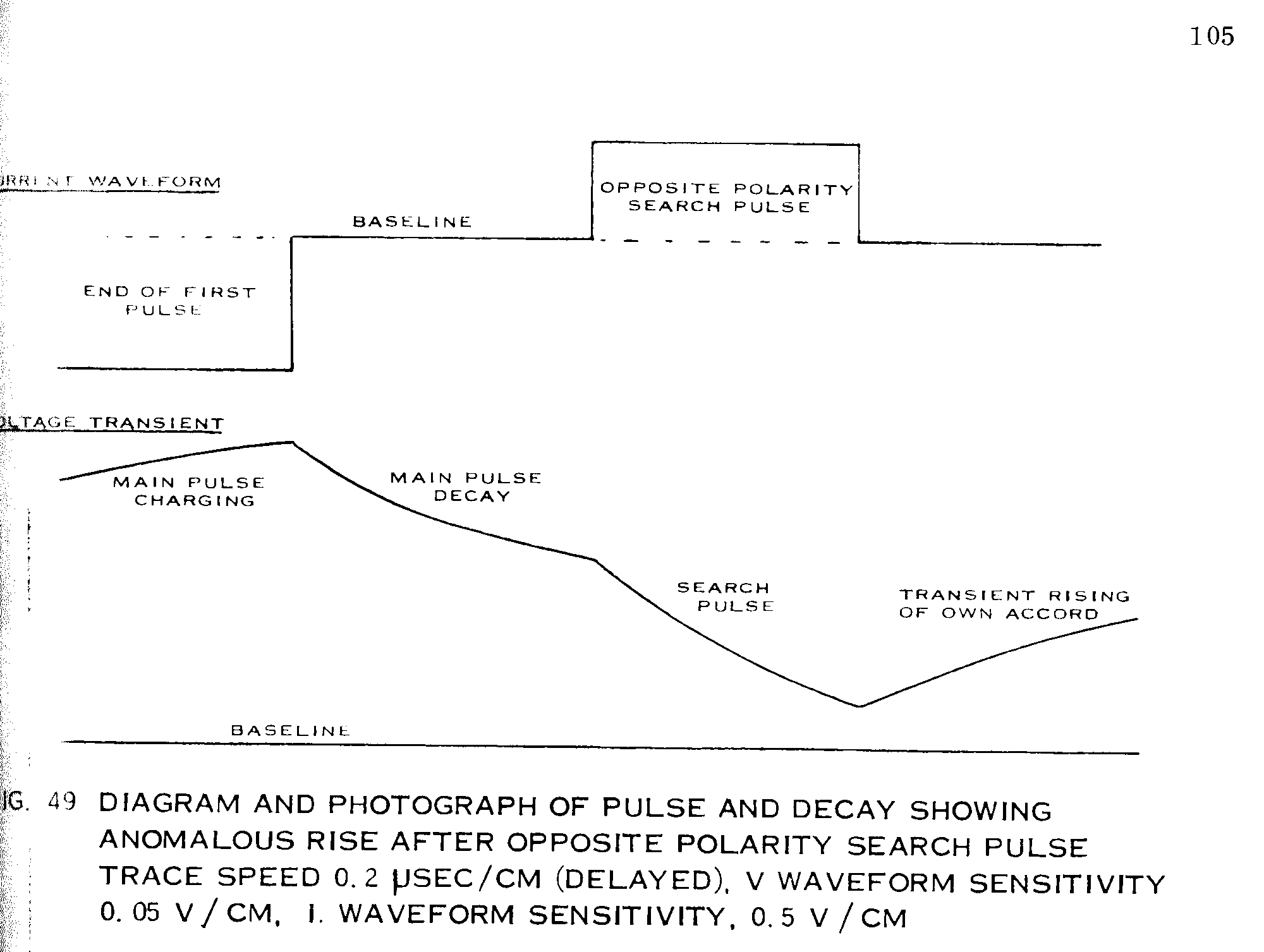
that can help in this quest.So all I intend to present here is a copy of page 105 from Dr. Piggin’s thesis, which
introduces his Fig. 49, and couple this with a quotation concerning that Fig. 49 that appears on
page 100 of the thesis. I leave others who may read this to infer what they may, but say further
that in his experiment Piggin applies an electrical pulse to charge the capacitor and follows this
by an opposite polarity pulse to force its rapid discharge, after which, for some mysterious reason,
that capacitor begins to recharge of its own accord. Can the inertial energy of the aether that I
discuss in the BERLIN LECTURE be feeding in by a sub-microsecond delay?That quotation reads:
” An interesting observation is shown in Fig. 49. In this case, decay of the stored
charge is assisted by the search pulse of opposite polarity. It is observed that the
voltage decays at an accelerated rate during the search pulse as expected. The
interesting question posed is why should the decay voltage rise of its own accord,
after the search pulse has finished? Similar observations will be reported in later
chapters.”Readers do need to be mindful of the fact that Dr. Piggin’s thesis concerned tests on cells
using a chemical dielectric in the capacitor system, platinum electrode in iodine-iodide solutions
and so chemical factors may account for the observed anomaly, but equally the chemical factor
would not preclude aether-energy inflow and that phenomenon could well have been in evidence.
Without there being test data for cells not loaded with a chemical dielectric this remains an open
question.The following is a copy of page 105 from the thesis.
Footnote
As a point of interest I recall from my school education (some 60 years ago) that my
physics master introduced us to the properties of a Leyden jar by demonstrating an experiment
with two concentric electrodes and a removable cylindrical dielectric spacer element. He charged
the assembly as a capacitor and then removed the dielectric element before (I believe – if my
memory serves me well) then connecting the electrodes to discharge any energy they might have.
Then he reassembled the capacitor with its dielectric spacer element and showed us that the
capacitor did, indeed, still have some electric charge. His message was that there was energy
stored in that dielectric spacer element, which I now can imagine as attributable to an inertial
aether spin action within its cylindrical form, an action which can shed energy immediately on
demand only if the electrode system is present and its electrodes are short-circuited so as to permit
a discharge current to flow.[H. ASPDEN : 16th March 2002]
IIITHE ASYMMETRICAL CAPACITOR ACTION
In the BERLIN LECTURE it was suggested that a capacitor, particularly one of
concentric cylindrical electrode construction, might deliver as output, when discharging, an
amount of energy that could be as much as double that supplied as input when charging. This
might seem to pose a problem with regard to the conventional mathematical analysis of capacitor
properties, bearing in mind that we assume that the charge input Q is equal to the capacitance C
multiplied by voltage V.I will, therefore, examine this problem from two points of view. I will begin by making
a strong assertion, expressing an opinion that I feel sure 99% of the academic community versed
in electrical theory will support, but I will then contradict what this implies by reference to
experimental data. After that I will engage in a measure of theoretical speculation in presenting
the only alternative point of view available, an approach which not even 1% of that academic
community would support, and then I will endorse what this implies by pointing to experimental
data that has been drawn to my attention but which I cannot vouch for as verified by independent
researchers.
The First Point of View
One can be sure that the charge displaced around a circuit from one electrode to the other
cannot suddenly double in value merely because of the transition which occurs as the charge-discharge cycle peaks at its maximum value. The action, therefore, must occur in the state of the
aether between the two electrodes of the capacitor as the energy stored in that region of aether
seeks release as the aether there senses a transition from the input to the output state.In short, it has to be the effective permittivity of the dielectric properties of the capacitor
that changes to deliver the extra energy as output. In mathematical terms, it would seem that the
permittivity during discharge must be half that applicable during the charging period, even though
we are referring essentially to the properties of what we understand as the vacuum state. This
implies a capacitance during discharge that is half that during the charging period, so that the
charge Q, which equals CV, remains the same at the instant of transition, whilst the voltage V
doubles. C, which is proportional to that permittivity value, is halved. In energy terms, bearing
in mind that energy E = CV2/2, this results in a doubling of the energy E, meaning that the
discharge will release twice the amount of energy that was fed in as input during charging.Now, the problem here is that I am not aware of any experimental evidence that reveals
a doubling of output voltage when a capacitor begins to discharge. Even if the case is restricted
to capacitors having concentric electrodes I still think that, if such a phenomenon were to occur,
it would have been mentioned in our textbooks on the subject. Indeed, to the contrary, as
reference to the Ph.D. thesis of Bruce Piggin just discussed in the preceding note shows, the
capacitor voltage of the concentric cylindrical electrode capacitor merely follows the normal path,
but yet, if then abruptly fully discharged by a negative input pulse, there is some kind of after
effect which does show a mysterious voltage build-up.Accordingly, adopting this first point of view, has still left us with the problem of
understanding how a capacitor can shed energy electrically if in truth it has acquired an excess of
energy from aether input.
The Second Point of View
Here I need to outline a feature of the aether that my rigorous theoretical analysis of that
structured vacuum medium has revealed. The aether has a cubic cell structure with an aether
particle seated in each cell. It sits in a uniform continuum of electric charge which fills the space
in that cell not occupied by the particle form and this continuum charge has a polarity opposite
to that of the aether particle, so that the aether overall is electrically neutral. The aether particle
would itself expand under its internal electrostatic repulsion forces were it not for there being a
an energy presence in the cell pervading that continuum, the energy concentration matching that
of the aether particle form so as to have equilibrium and balance of pressure. That energy
presence is provided by a virtual pair of leptons, the heavy electrons that particle physicists refer
to as mu-mesons or muons. They perform no known role in the physical constitution of the
universe, because that role is primarily the one they serve in assuring pressure equilibrium within
the aether itself and because the aether, as such, is ‘unknown’ to the theoretical physicist of today.I know this fact about the aether virtual muon system because my theory has allowed the
evaluation of the unit cell energy in terms of the rest mass energy of the electron and the analysis
suggests that a virtual muon can be either a positive or negative electron unit of charge with an
associated energy quantum that is either 205 or 207 times the value of the electron rest mass
energy. The theory indicates that the 207 units outnumber the 205 units by a two to one ratio.Indeed, by assuming that these virtual muon quanta migrate through space and suffer
mutual annihilation and recreation at the same cyclic frequency as the quantum jitter motion of
those aether particles, one can recognize their secondary role which accounts for the process of
proton creation and so derive a theoretical value for the proton/electron mass ratio that is
1836.152, in good accord with the measured value.This is all of record in this author’s published work, as summarized in ‘Aether Science
Papers‘ (1996), but I make particular reference to the ninth of the fourteen appended papers in
that book, which is ‘A Theory of Proton Creation‘, Physics Essays, v. 1, pp. 72-76 (1988). It
discusses the role of the virtual muon in creating the proton from the energy underworld of the
aether, the energy equilibrium of that medium being maintained as it absorbs energy dissipated by
matter, reorganizes it into a quantized virtual muon form and then sheds it as surplus by creating
protons with an accompanying electron to keep the electrical charge balance.Now, why is this relevant to our capacitor problem? The simple answer here is that, if the
capacitor is to deliver twice the amount of energy on discharge as it receives during the charge
period, and do this without doubling its voltage for the discharge period, then it must somehow
be able to double its charge so as to deliver twice as much output charge as it received as input.
That is impossible unless the vacuum medium within the capacitor plates can itself produce a flow
of charge through what is normally seen as a non-conductor of electricity.My proposition, therefore, is that, given that the aether has energy it seeks to release and
given that it is alive with a virtual muon activity that passes unnoticed normally, we can look to
that muon activity to find a way of shedding that energy as a flow of current from that capacitor.The action is probably one where a negative muon of 207 electron mass units sheds two
electrons at the negative capacitor electrode and converts into a positive virtual muon of 205
electron mass units, whilst the reciprocal action occurs at the positive electrode as two electrons
are drawn from that electrode and absorbed into a positive virtual muon 205 to convert it into a
negative virtual muon 207. As the virtual muons deploy in their equilibrium activity this will
amount to a flow of electrons through the space between the electrodes.It means that the capacitor can, without doubling its voltage, deliver the double energy
output by delivering double the input charge as output.It may all sound highly speculative and that I do not deny, but at least I offer a possible
answer to the problem. Furthermore, though it is indeed quite fortuitous, I find that, after a lapse
of 14 years since a previous contact, a U.S. researcher named Alexis Guy Obolensky mailed me
a letter dated February 28, 2002 in which he reminds me of a supporting opinion I expressed back
in 1988 concerning his discovery of faster-than-light-speed action in an experiment involving
transmission via coaxial cables. It is quite astounding to find that, as I write this commentary as
a Note to back up the text of the BERLIN LECTURE that I compiled in January, I can quote a
paragraph from Obolensky’s February letter that seems to endorse my speculation. It reads:“I was the first to employ matched coaxial cable time delays and phase matched
current sensors to demonstrate the existence of electromagnetic (faster than light)
shock waves. This substantiated Tesla’s magnifying transmitter patent
application’s superluminal claim. His technique to extract fuelless coherent-energy, from the incoherent-heat of the ambient medium, was suggested but not
proven back in 1988. This, notwithstanding the numerous superluminal shock
wave experiments that revealed an approximate doubling of the remote receiver’s
integrated-current output compared to a simultaneous measurement of the local
transmitter’s integrated-current input. To my knowledge, electronic research has
still not investigated electromagnetic shock waves by using equal-time-delay,
simultaneous measurements, to circumvent the Einstein clock problem.”That reference to the electric charge output from a pulse-excited coaxial transmission line
being double the charge input has attracted my attention. It implies an energy gain which
Obolensky, in the next paragraph of his letter attributes to ‘the incoherent heat in our planet’s
atmosphere’ as the source. However, my opinion, as is evident from my BERLIN LECTURE is
that the aether is the energy source and I can but point out that a voltage pulse travelling along
a coaxial cable is the sequential charging and discharging of a capacitative component which has
a conductor as central electrode and an earthed electrode formed by a concentric conducting
sleeve, that is a concentric cylindrical electrode capacitor in which one can develop aether spin.Accordingly, I can but regard what Obolensky describes as supporting this second point
of view and endorsing my conductive aether notion based on those virtual muons.[H. ASPDEN: 16th March 2002]
IVCAPACITOR ENERGY ESCALATION ANALYSIS
Here we calculate the condition for the circuit shown in Fig. 7 of the BERLIN LECTURE
to tap aether energy based on the capacitor property there discussed, namely the feature that for
a cyclic change of capacitor energy the capacitor energy doubles during the discharge. It seems
appropriate to assume that the development of aether spin in a system which is to be governed
by a phase-lock between a space region in spin and a non-spinning enveloping space region will
require that a small but finite threshold of radial electric field intensity between the capacitor
electrodes has to be exceeded.Let C be the value of each capacitor. Let V be the d.c. capacitor priming potential in
volts. Let v denote the voltage of a transient potential drop across each of the two sections of the
inductor system. Let R here denote the resistance of each such inductor section, this resistance
including that of a load which is connected to the secondary winding of a transformer of which
the primary winding is the inductor system just mentioned.At any instant the voltage across one capacitor will be V-v when that across the other
capacitor is V+v. This is because capacitor charge can oscillate between the two capacitors as
current flow through the inductors changes cyclically, the corresponding induced EMFs of
strength v across each inductor section being in anti-phase and so of opposite polarity relative to
the central earth terminal.By standard electrical theory the energy stored by the two capacitors is given by:
C(V+v)2/2 + C(V-v)2/2
which is:
C(V2 + v2)
and so as v changes there is no energy gain but merely a loss owing to the flow of current through
the overall inductor resistance 2R.However, we are considering a situation where the discharging capacitor is shedding twice
as much energy as it gained during charging. Therefore, allowing for the presence of the aether
energy acquired during the charging stage, in discharging to the V-v condition, a capacitor will
shed an excess of energy drawn from the aether amounting to:C(V+v)2 – C(V-v)2
which is:
4CVv
This excess energy is deemed to flow in as input from the aether owing to the quantum
synchronisation of the zero-point vacuum energy of that aether medium. This latter energy is
replenished in each half cycle of oscillation only to the extent needed by the fluctuation of the
voltage v across the inductors.Suppose now that v, which is zero initially, is induced by some internal fluctuation or
external field stimulus and so begins a natural oscillation at the resonant frequency of the circuit.
Let v now denote the amplitude of a sinusoidal variation so that as this passes through its zero
value the energy 4CVv which has come from the aether has been shed in half a cycle.This energy has to do more than overcome resistance loss if there is to be a build up of
the oscillations as needed to render the system useful as a power generator. Note then that the
resistance loss plus power delivery will be proportional to v2, because v is the amplitude of the
voltage acting across the inductors and so, with inductance fixed, the current magnitude is
proportional to v and the resistance loss plus power delivery is proportional to the current
squared. Accordingly, the crucial factor is whether kv2, with k determined by that inductance and
resistance, is less than 4CVv when multiplied by twice the frequency of oscillation. If so, and
provided that threshold condition mentioned above is exceeded, then the oscillations will escalate
in strength and provide a source of ‘free’ energy. It is then clear why the priming voltage V is
important.The factor k will also depend upon the capacitance of the capacitor as this limits the
current. Indeed the current amplitude is 2πvC times the frequency of oscillation and if 2R is the
circuit resistance the overall condition for an escalating energy action becomes one for which
2V/v is greater than π2CR times the frequency. This is a simple numerical ratio because CR has
the dimension of time. It is a condition that, at least in theory, is easily satisfied but that unknown
threshold value of electric field intensity has to be exceeded, a factor which makes that priming
voltage V extremely important.It must be high and, being high, this means that v will increase more and more until it rivals
V in value, which in turn means that a high rate of energy output can be achieved if V+v is of the
order of 25,000 volts and the resonant frequency is of the order of 100 kHz. Indeed, potentially,
a pair of capacitors each of only 1 nanofarad capacitance could, on this theoretical basis, deliver
aether energy at a power rating of the order of 50 kW, 62.5 kW being applicable if v were to
climb to a limiting value V.To put this in perspective, if this capacitor energy escalation theme is a valid proposition,
one can begin to contemplate a practical application based on the above 50 kW power output
from a pair of 1 nanofarad capacitors. Such a capacitor using air as dielectric would need an
electrode separation of the order of 1 cm to withstand the 25,000 volt charge. If it were to
comprise two concentric cylinders, one having an internal diameter of 20 cm and the other an
external diameter of 19 cm, and an overall length of 50 cm, then its capacitance would be 2.2
nanofarad and two such capacitors would only take up a fraction of the space assigned to the
engine compartment of an ordinary automobile. Yet the potential power rating, based on that 2.2
nanofarad value would be in excess of 100 kW, which is an acceptable level for such an
application. The equipment needed to generate a 25 kV capacitor priming voltage, taken together
with a standard electrical car battery to feed in the initial charge of the capacitors plus the
inductor/transformer units which form the resonant circuit and provide a lower voltage
transformer output need be no larger in volume than the capacitors. One is then left with the need
for an electric motor that can provide the mechanical drive for the automobile, this being standard
technology but the greater weight factor in terms of drive power generated and so the primary
design criterion that could limit vehicle performance.One can, however, be sure that if the new technology implied can meet the requirements
of powering an automobile, it can be even more advantageous in large scale electric power
generation for domestic and industrial use as well as in ship propulsion.Accordingly, the scientific principle involved warrants the necessary research to verify or
disprove what is suggested and, if viable, ascertain such criteria as may impose limitations on
performance.[H. ASPDEN: 17th March 2002]
VPOWER FROM CONCENTRIC CAPACITOR PAIRING:
A GENERAL OBSERVATION
The inevitable question concerning my BERLIN LECTURE is: “Why what is suggested
has not been discovered already in the electrical laboratories of our many universities?” To
suggest that energy outputs of some 100 kW could be delivered as if from nowhere by connecting
two capacitors of a few nanofarads capacitance by inductors to form a resonant circuit is an awe
inspiring proposition.My simple answer has to be to ask where I can look up the record of such an experiment
having been performed and its negative result recorded. Clearly, had such an experiment been
performed and had it delivered a ‘free’ energy output, then that would inevitably have been
newsworthy besides being documented in a scientific periodical.Has the experiment ever been performed? Until someone can say: “Yes” to this question
and quote the reference for my inspection, then I must assume the answer is: “No” and adhere to
my argument that the issue must be clarified in view of its potential importance.However, just ask yourself why anyone in a university electrical laboratory would be
interested in setting up an oscillation in an inductor-capacitor circuit as between two series-connected capacitors and an inductor and how they would proceed. I suggest that if they did they
would obtain the capacitors commercially and that those capacitors would not be of concentric
electrode construction. I suggest that they would not see much point in using a series connection
of the capacitors, given that one normally connects capacitors in parallel if one seeks to augment
the capacitance in circuit. I suggest that the series connection, if adopted, might be deemed to
serve only as means for using capacitors of lower voltage rating in a higher voltage application,
perhaps in a high voltage laboratory for delivering high voltage d.c. pulse discharges for test
purposes, but not as part of a resonant inductor-capacitor circuit.Then consider the chance that someone would deem it worthwhile to build themselves two
large concentric cylindrical electrode capacitors for coupling with an inductor in a resonant circuit
and then connecting a high d.c. voltage source to the junction between the two capacitors when
standard circuit theory says that, once connected, no steady current would flow from that d.c.
source. Yes, were the capacitors to be of electrolytic form and have the necessary polarized
medium as the dielectric element, one might contemplate such an assembly but then consider the
point I now make. The ‘free’ energy theme we are discussing requires a high priming voltage V
and a resonance that involves the capacitance attributable to the aether alone. A high dielectric
permittivity merely means a higher loss-generating current oscillation, whereas the maximum
‘free’ energy gain arises from the base permittivity value of the vacuum medium and the
capacitors with vacuum or an air-cored dielectric medium offer that maximum gain. Any spurious
power gain in a circuit using electrolytic capacitors, even if their assembly were to be a simple
single-pair electrode form (which is extremely unlikely) would easily be overlooked in an
application aimed at some other objective than power generation.Then there is the factor of operating voltage level. I have used 25,000 V as a nominal
voltage in estimating the ‘free’ energy potential output of the order of 50 kW based on operating
a pair of 1 nanofarad capacitors at 100 kHz. However, an experiment on a laboratory test bench
not in a high voltage electrostatic test laboratory environment is more likely to be performed at
a voltage of the order of 250 V. This would lower the anomalous output power to a mere 5
watts, which could easily pass unnoticed unless one was expressly looking for such a power
discrepancy.The chance of building a circuit of the kind required and then discovering that it generates
power in a manner contrary to expectation as founded on conventional theory is, therefore,
extremely improbable. Yet, given that this has happened in history, what chance is there that the
discoverer of the new ‘free’ energy source can stir interest by those in authority who are
committed to their belief that what amounts to a ‘perpetual motion’ device is impossible because
it defies the established laws of physics?There is the greater chance of what seems to be a ludicrous scientific claim being given
attention for its general interest as a story worthy of the telling. So it is the authors of books on
fringe-science topics that we must applaud for bringing such ‘free’ energy claims to our attention.
There is entertainment value in the subject and, as ever, the excitement that the underdog may yet
be proved right and turn the world of energy science around just in time to save us from the
impending disaster that is getting ever nearer owing to the demise of our oil reserves. In saying
this I am mindful of the reference I made in my BERLIN LECTURE to the book by Keith Tutt.I can but conclude that the formal academic task of pursuing the necessary experiments
is there as a challenge for our learned brethren of the physics and electrical engineering sectors
to undertake. Disprove by experiment what I have suggested in that lecture and find comfort in
the ongoing belief that all is well with the prevailing laws of energy conservation which exclude
energy inflow from the aether. Alternatively, prove that such inflow can occur and ease our
concern about future energy resources, besides opening the door for the entry of a new
cosmological belief, namely that our Sun and Earth were created by energy shed by an overactive
aether.[H. ASPDEN: 12 April 2002]
VITHE PARALLEL PLATE CAPACITORThe key factor pointing to how energy is extracted from the vacuum medium by the cyclic
charging and discharging of a capacitor, the subject of my BERLIN LECTURE, is the need for
synchronisation as between the orbital motion of charge forming the quantum underworld even
though the charges sit in different regions subjected to different extraneous field effects. The
presence of an electric field between the electrodes of a capacitor displaces the charge orbits there
located and this means that, to hold that synchronism with charges elsewhere throughout the
orbital cycle, the system of that charge between the capacitor plates must move in a direction at
right angles to the electric field direction.This is possible in the cylindrical electrode capacitor configuration of Fig. 6 but this poses
problems for the action in the parallel plate capacitor configuration of Fig. 5. I have suggested
that the linear motion of the charge system in this latter case does deploy energy from the vacuum
medium to keep that state of synchrony but that as the capacitor discharges the collapse of that
linear motion would dissipate the energy within the aether itself and so not be available as a useful
excess power output.Here, on reflection, I find that I may have been in error in suggesting that holding to strict
synchrony throughout the orbital period without lateral motion might lead to an impossible
process of continuous very high frequency oscillation of energy exchange. If that linear lateral
displacement of charge were to be precluded by the fact that charges would be driven into one
another and so set up an electric field opposing that motion, then the charge orbits between the
capacitor electrodes could not be displaced in that lateral direction.Then what I at first deemed to be impossible may indeed be possible. The quantum
underworld may well be able to cope with extremely rapid exchanges of energy as between its
constituent vacuum charges and the ruling factor has to be the facts of experiment that prevail in
the different circumstances. The phenomenon under consideration appears not to manifest itself
in experiments involving parallel plate capacitors, where we see no anomalous behaviour, but the
evidence, as discussed in that BERLIN LECTURE, does reveal itself when the capacitors have
cylindrical concentric electrodes. In other words, in order for us to gain access to energy that can
be shed by the vacuum medium by setting up a pulsating electric field between two capacitor
electrodes, those electrodes must have a configuration which provides a passageway for free flow
of the charges in the direction lateral to the field direction.[H. ASPDEN, 28th April 2002]