LECTURE NO. 28
Copyright, Harold Aspden, 1977
The printed version of this paper was issued on the occasion when the author, Dr. Harold Aspden, delivered an invited lecture to the students and staff of the Physics Department at the University of Cardiff in Wales in 1977. It is appropriate here, some 25 years on from that date, to draw attention to some aspects of it that warrant special comment in the light of onward developments. The paper itself is in PDF format and can be accessed by pressing the link to it at the end of the text which follows.
The paper highlights new scientific evidence that should help in our understanding of the creation of the solar system. As there stated, it was based on the author’s theoretical investigations into the structure of the vacuum (the aether) and it pointed to a quite simple experimental approach which could possibly verify the effect of the aether in controlling the stability of an electrical discharge by inducing aether rotation about the discharge axis.
So far as the author knows this suggestion of what could prove to be a very important experiment has not aroused interest and has not, as yet, been performed by our academic fraternity.
The paper drew attention to three unexplained phenomena evident in laboratory bench testing and related these to the major unexplained phenomena that confront cosmologists. These are (1) the mystery source of energy and angular momentum fed into the solar system at its creation, (2) the mystery of the expected but unresolved unification of the action of gravity and electrodynamic interaction, and (3) and the mysteries posed by the creation of thunderballs.
Admittedly, the paper had a limited distribution, being a hand-out at that Cardiff event and thereafter given away to those who corresponded with the author on scientific matters of mutual interest. The author was not a active researcher seated in a university and there was hardly any chance of getting a peer-reviewed paper published on the taboo subject of the aether. The aether had been well and truly outlawed by theoretical physicists who were addicted to the Einstein doctrines concerning space-time and its abstract formulations of virtual reality in an imaginary world which depends more on the observer than the underworld of a real aether medium.
However, the author’s private research efforts were progressing and, gradually, the theme of that paper on “Space, Energy and Creation” did gain in strength. Publication in scientific periodicals became easier, thanks to the open-mindedness of the editorial staff of Lettere al Nuovo Cimento, of the Italian Institute of Physics, a research periodical that was published in the English language before its demise in 1986. It was a peer-reviewed periodical offering rapid publication and, though several of the author’s papers were found acceptable, there were others which were rejected, an indication that not all of the referees used were of like-minded opinion.
Now, in the author’s writings, certain anomalies in electric arc discharges in ionized plasma having bearing upon the basic law of electrodynamics had been stressed and these eventually attracted the attentions of a Canadian man and wife research team, namely Paulo and Alexandra Correa. They had made a rather breathtaking discovery that, by a method of discharge pulsing using a suitable circuit and a specially configured electrode system in a discharge tube, it is actually possible to generate electrical power by tapping energy from the aether itself.
Arising from this and our mutual contact at conferences in USA the author wrote ENERGY SCIENCE REPORT No. 8 which was entitled “Power from Space: The Correa Invention”, which was published in 1996. By inspecting that Report it will be seen that its final reference [85] is the subject paper “Space, Energy and Creation”. That Report No. 8 includes material which, apart from the Correa breakthrough, shows how there has been further development having bearing on the author’s observations in “Space, Energy and Creation”.
Now, at the time of writing these words in May 2002, we are on the eve of a conference event in Berlin in which the author will have opportunity to update his further contribution to the insight we have into the scope for tapping energy from the aether and hear also of the onward research of the Correas. It is for this reason that Space, Energy and Creation” is now being added to this web site, as Lecture No. 28, even though it is 25 years on since it was delivered to that university audience in Cardiff.
Also added at this time is the author’s BERLIN LECTURE “Our Future Energy Source – The Vacuum!”.
It is hoped the reader will find these of interest.
Harold Aspden
[May 28, 2002]
Full text (transcribed from the PDF)
Transcribed from the scanned pages of the printed lecture. [p. N] marks where each printed page begins; figures are cut from the scans. The PDF above is the original.
[p. 1]
SPACE, ENERGY AND CREATION
© H. Aspden, 1977
INTRODUCTION
This lecture presents some new scientific evidence which may help our understanding of the creation of the solar system. It suggests an experimental approach for exploring the phenomena involved. It results from theoretical enquiry into the structure of the vacuum medium, a pursuit which is somewhat controversial. It is hoped, however, that the evidence to be presented will speak for itself and encourage those with the resources to undertake the necessary experimental research.
SOLAR ENERGY AT CREATION
We believe the sun to be a nuclear inferno and that it was formed by matter in space condensing under gravitational force. This resulted in a build-up of temperature until eventually the primordial matter in the form of hydrogen began to be steadily converted into helium by nuclear processes. The radiation from this nuclear core then prevented the sun fron contracting further and we have a stable but slowly dying sun which could well feed us with solar energy for another 10,000,000,000 years.
We no longer worry about what happened to the energy released by the gravitational field when the sun was first formed. There was enough energy from this source to sustain the present level of solar radiation for about 20,000,000 years. We suppose that it was all radiated away long ago. However, it must have performed some role during the early stages of the sun’s creation and it is this which I find of interest.
[p. 1]
| ANGULAR MOMENTUM IN EARTH UNITS | ||||
|---|---|---|---|---|
| SUN | 332800 | ≈ 20 | ||
| MERCURY | 0.05 | 0.387 | 0.24 | 0.03 |
| VENUS | 0.82 | 0.723 | 0.62 | 0.69 |
| EARTH | 1.00 | 1.00 | 1.00 | 1.00 |
| MARS | 0.11 | 1.52 | 1.88 | 0.135 |
| JUPITER | 317.8 | 5.20 | 11.86 | 724.6 |
| SATURN | 95.2 | 9.54 | 29.46 | 294.1 |
| URANUS | 14.5 | 19.18 | 84.01 | 63.5 |
| NEPTUNE | 17.2 | 30.07 | 165 | 94.3 |
| PLUTO | 0.11 | 39.44 | 248 | 0.69 |
| ≈ 1200 | ||||
| mass | orbit radius | revolutions per year |
1 Earth unit = (2π(1.496 1013)25.977 1027)/((365) (24) (3600)) gm cm2/sec
= 2.665 1047 gm cm2/sec
Therefore the angular momentum of the solar system is
(1200) (2.665 1047)
or 3.2 1050 gm cm2/sec
[p. 2]
For example, if the energy released was somehow all stored by the sun as kinetic energy, the sun would have to move at about 500 km/s. Curiously, measurements of the Earth’s motion through space by reference to the supposed-isotropic cosmic background radiation do indicate speeds of this general order (Conklin, 1969)*. This then leads one to ask whether the gravitational energy released is perhaps conserved in the local cosmic environment as a state of motion.
Speculation such as this raises problems of momentum balance. We know that interactions between matter must satisfy the action and reaction law of Newton. Angular momentum is conserved in any complete system subject to central laws of force such as the law of gravitation. This follows from energy conservation principles.
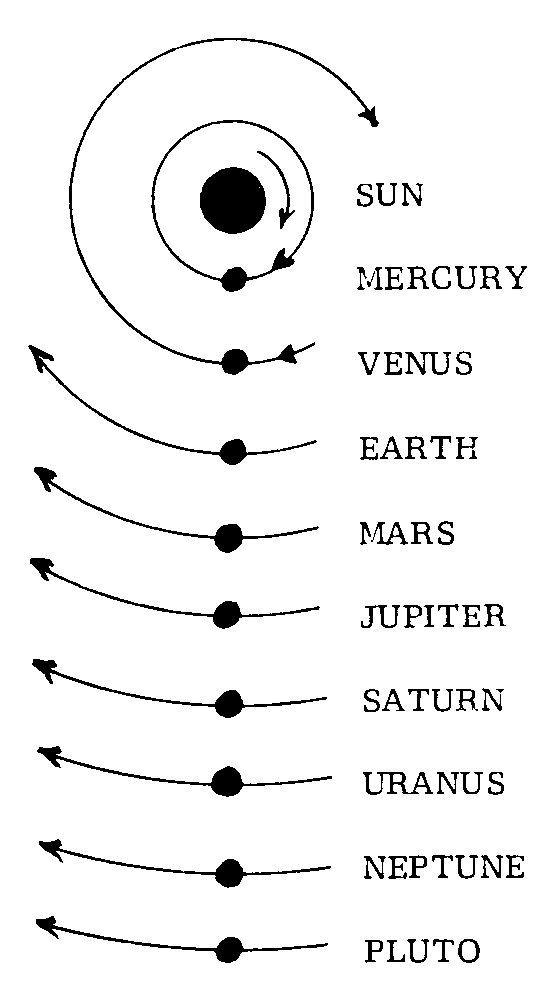
However, the source of the angular momentum of the solar system poses a very perplexing problem. We would like to think that the planets were formed from the sun, but the planets revolve in their orbits in exactly the same sense as the rotating sun. Somehow the sun must have acquired a substantial angular momentum when it was first formed and somehow it shed most of this in giving birth to the planets.
So difficult is this problem that philosophers have resorted to the unlikely hypothesis that another star once passed close to our sun, imparting angular momentum and inducing planetary creation. Such an event, they recognized, is so improbable that the solar system could be perhaps unique in the universe, assuring man a rather special place in the cosmic scene.
I prefer to regard the problem of the source of the sun’s angular momentum as a clue linked with the storage of gravitational energy released when it was formed.
* E.K. Conklin, ‘Velocity of the Earth with respect to the Cosmic Background Radiation’, Nature, 222, p.971, 1969.
[p. 2]
[p. 3]
ENIGMA INVOLVING ROTATION
There is other evidence of phenomena which involve unusual angular momentum properties or raise difficulties with the principle that action balances reaction.
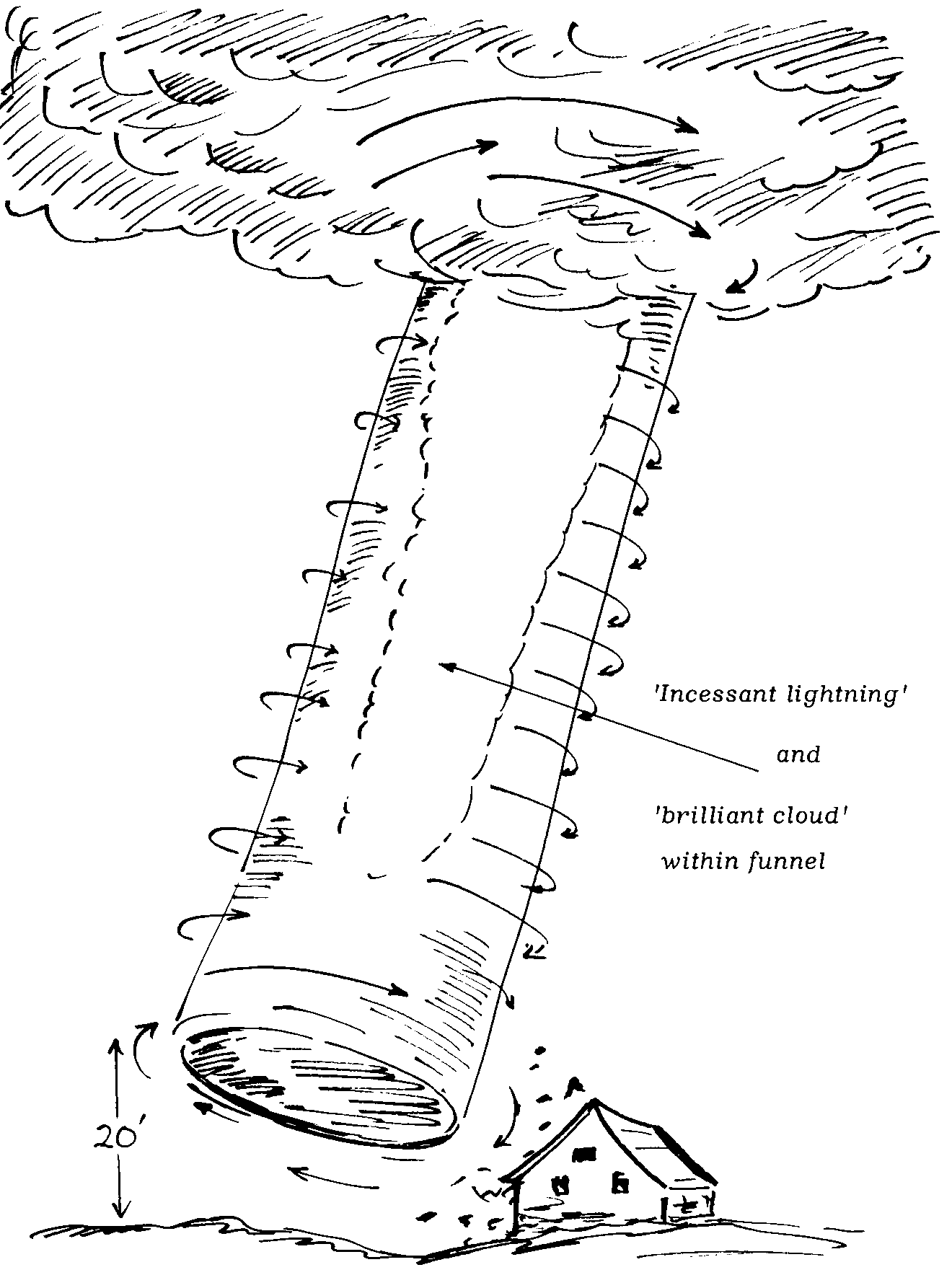
One example is the mysterious energy source of tornadoes. It has been argued very persuasively by Vonnegut (1960)* that this energy really comes from the electrical discharges we associate with thunderstorms but the very substantial angular momentum of the tornado is also a problem. It may be that the energy somehow concentrates the angular momentum of an ordinary whirlwind or, as Vonnegut writes,
‘it is possible that the vortex is initiated directly by electrical energy.’
Vonnegut also remarked that:
‘an understanding of ball lightning may very well be necessary if the tornado puzzle is to be solved.’
Thus ball lightning becomes the second enigma. It is the problem of the glowing spheres which are regularly seen to float about in the air following a thunderstorm. They have an aethereal character because they can pass through walls, get inside aircraft and vanish suddenly, sometimes explosively with release of substantial energy. They are so peculiar and the subject of such strange reports that they evoke a great deal of scepticism. However, the fact remains that they are a mysterious scientific phenomenon produced by lightning. They contain energy of some 109 joules per cubic metre and apparently form as spinning spherical objects. The implication is that they have an associated angular momentum.
* B. Vonnegut, ‘Electrical Theory of Tornadoes’, Journal of Geophysical Research, 65, p.203, 1960.
[p. 3]
(vol. 5, p. 152, 1975)
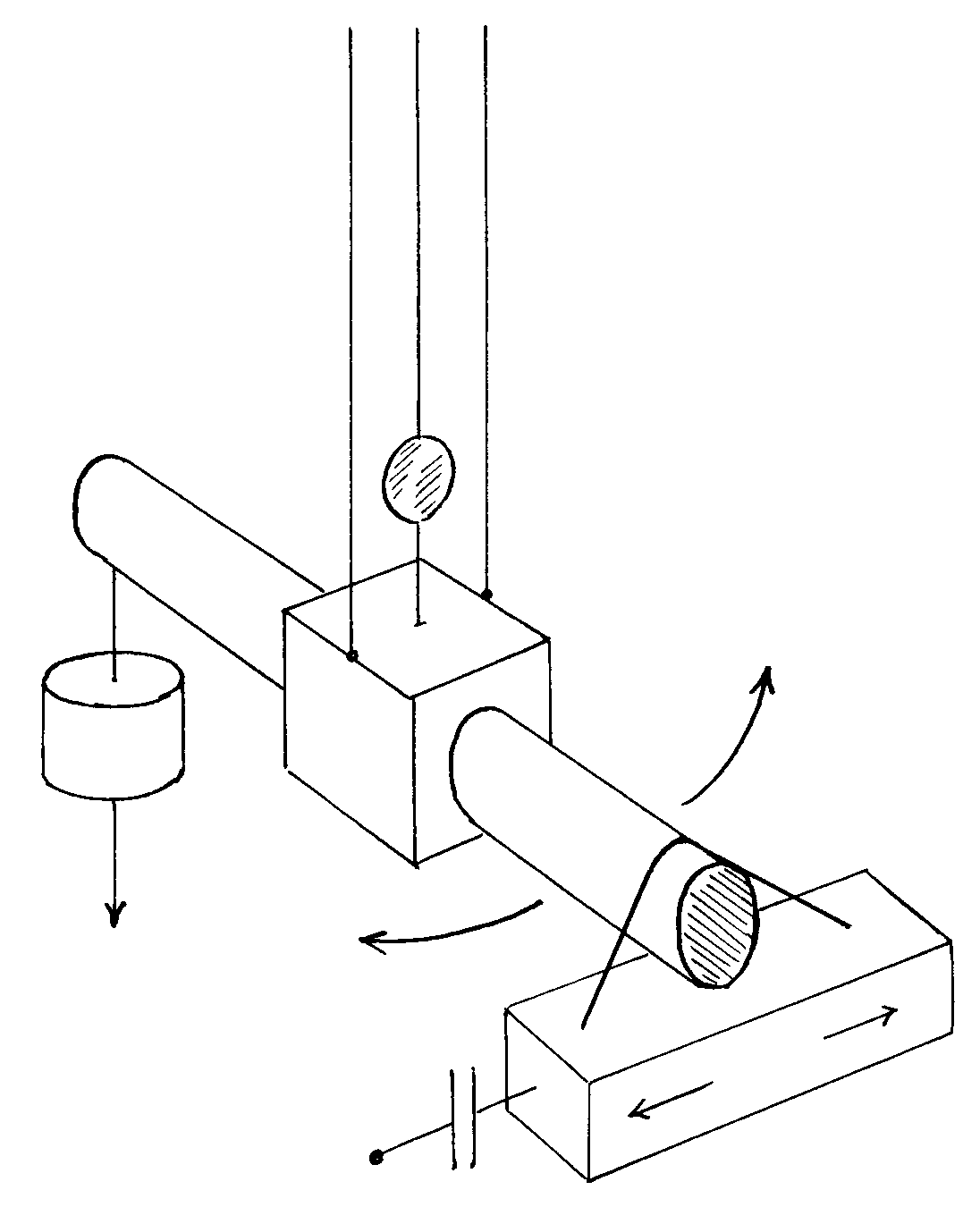
The system senses a very-slowly decaying uni-directional torque once the capacitor excitation is switched off
[p. 4]
In the laboratory environment there are two reports of anomalous behaviour known to the speaker and seemingly relevant. In 1972 a demonstration at a meeting of the Institution of Electrical Engineers in U.K. surprised its author. A rotor in a machine speeded up when the power was switched off. It happened and yet could not be reproduced in later efforts to study the phenomenon (Laithwaite, 1972)* It is as if, by some very special circumstance, energy was stored as rotational kinetic energy in the environment of the machine and was fed back to the machine when it was switched off.
The other report appeared in the German publication Umshau in 1975**. Experiments are here reported as consistently verifying a phenomenon which defies explanation. An energy pulse communicated at high frequency across a capacitative coupling is absorbed by a specimen suspended in a torsion balance. After the pulse has subsided, a unidirectional torque prevails in the system for up to two hours for no apparent reason. It is as if energy is stored by some kind of unseen flywheel that feeds energy back to the apparatus slowly once the power is switched off in the system.
It is clear from these examples that there is a case to answer and we can rightly examine the source of the sun’s angular momentum in relation to electrical action and the rotation of an unseen medium. I am therefore suggesting that the vacuum medium itself may exhibit properties attributable to its rotation. Before developing this thought, however, I wish to give one more example of the problem we have with the balance of action and reaction if we choose to ignore the role of the vacuum medium in interactions between matter.
* E. Laithwaite, ‘Unexplained Phenomenon’, Electronics & Power, 18, p.360, 1972
** R.G. Zinsser, ‘Kinetobarische Effekte – ein neues Phänomen?’, Umshau, 5, p.152, 1975.
[p. 4]
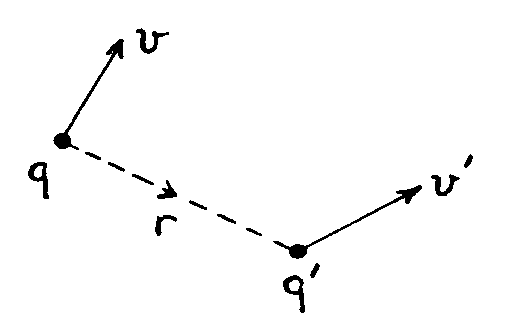
F = (qq′/r3)[(v′·r)v − (v·r)v′ − (v·v′)r]
[p. 5]
THE LAW OF ELECTRODYNAMICS
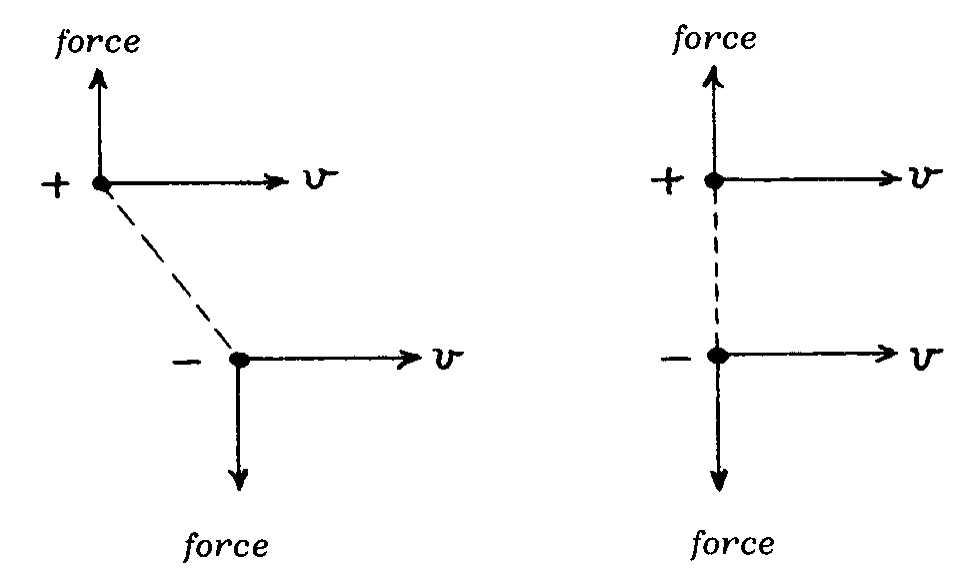
Theoretically there is good reason to suppose that the electrodynamic action between two charges in parallel motion can produce forces which develop rotation.
By suspending a charged capacitor any transverse motion should result in a turning effect until the line joining the effective centres of charge is at right-angles to the motion. Only then will action balance reaction in a steady uniformly-moving system.
The experiment was performed by Trouton and Noble in 1903*. They sought to detect the Earth’s linear motion through space, but a null result was reported. It gave stimulus to relativistic doctrine but equally it demonstrated the inapplicability of Lorentz’s electrodynamic formula. The law is inadequate to deal with actions between isolated electric charges in motion.
All the empirical evidence before that time had involved the interaction of effectively closed circuital charge motion with individual charges. This did not give enough empirical data to formulate a unique law of electrodynamics. It was a point well appreciated by Maxwell because he wrote about this in his great treatise**. He presented four alternative laws of electrodynamics, all equally valid for the closed circuit application but all different when applied to action between discrete electric charges in motion.
* F.T. Trouton & H.R. Noble, ‘The Mechanical Forces acting on a Charged Electric Condenser moving through Space’, Phil. Trans. Roy. Soc. London., 202A, p.165, 1903.
** J.C. Maxwell, ‘A Treatise on Electricity and Magnetism’, Section 526 of 3rd Edition, 1891. See p.173 of reprint vol. II by Dover Publications, New York, 1954.
[p. 5]
If v and v′ are parallel Maxwell’s Third Law of Electrodynamics:
F = (qq′/r3)[(v′·r)v − (v·r)v′ − (v·v′)r]
becomes:
F = − ((qv)(q′v′)r)/r3
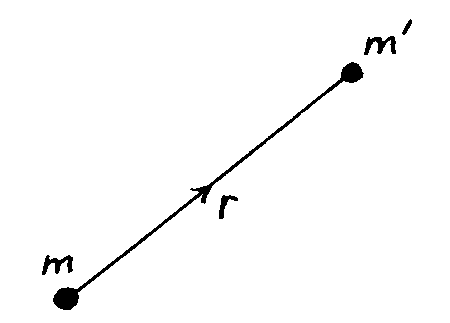
Compare with Newton’s Law of Gravitation:
F = − G(mm′/r3)r
Where G is constant and the interacting masses are m, m′.
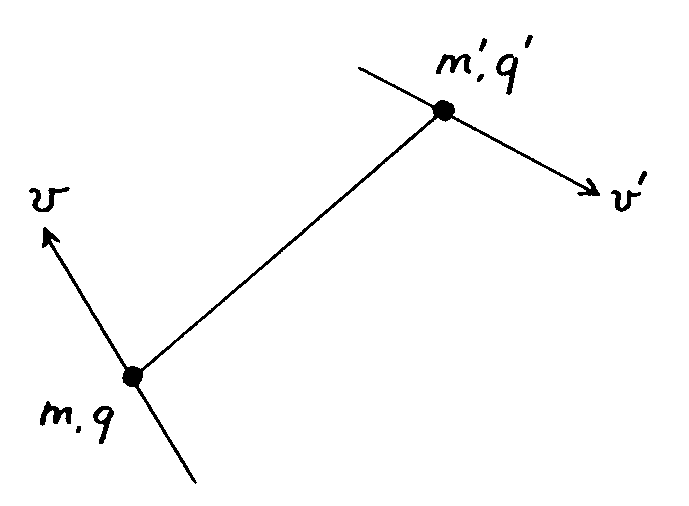
Aspden’s Law of Electrodynamics is:
F = (qq′/r3)[(v′·r)v − (m′/m)(v·r)v′ − (v·v′)r]
[p. 6]
This problem attracted my attention because there is an interesting choice available in the formulation of the likely general law. Either one has to admit inequality of action and reaction in the linear sense or one has to accept it from the point of view of rotation. This, bear in mind, applies to a system which may not be complete because we ignore the presence of charge in motion in the vacuum medium itself. We seek a law of electrodynamics applicable solely to interaction between two charges.
Faced with the choice and guided by the null result of the Trouton-Noble experiment it seemed that the mutual electrodynamic action of two charges cannot develop a torque. This favoured the third law of electrodynamics in Maxwell’s work. Also, independently of this hypothesis, there is theoretical justification for the assumption made by Maxwell in deducing this law empirically. This comes from an analysis of the magnetic field energy deployment and its change when the two charges separate.
The law has two very interesting consequences. When applied to charge of like polarity moving with the same velocity we obtain an inverse square law of attraction exactly of the form needed to correlate with Newton’s law of gravitation. This gives basis for unifying field theory. Secondly, there is the curious problem of the linear imbalance of action and reaction, which arises for generally-directed charge motion or, as analysis has shown*, for parallel motion if the interacting charges have different mass.
Experimentally, there should be interesting anomalies in the forces exerted by electrons on ions in arc discharges and plasma. This is now appearing in the literature, though the anomalous behaviour of cold-cathode discharges (those involving ions rather than electrons) has been of record for many years. More recently it has been recognized that
* H. Aspden, ‘The Law of Electrodynamics’, Jour.Franklin Inst., 287, p.179, 1969.
[p. 6]
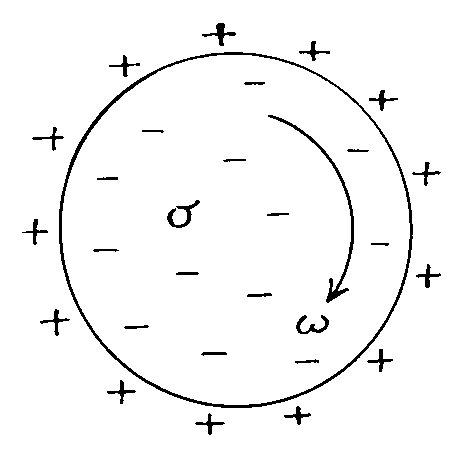
(Density Property)
| Dimensions | ||
|---|---|---|
| Charge density | σ | M½ L−3/2T−1 k½ |
| Angular velocity | ω | T−1 |
| Mass density | ρ | ML−3 |
| (σ2/ω2ρ) | k |
k is dielectric constant, a known property of vacuum.
Hence if σ ∝ ω vacuum must have mass density ρ.
[p. 7]there is a high anomalous acceleration of ions by electrons in plasma.* The new law which I have been urging is Maxwell’s third law of electrodynamics but adapted to cover interactions between charges of different mass. It is a law which is different from that derived using relativity theory. Indeed it has recently been said that the acceptance of relativity as a faith and the refusal to consider criticism of relativistic doctrine has hindered the rational development of electrodynamic theory. I am quoting here from a paper dated June 1977 circulated by Prof. McCausland of the University of Toronto in which he makes reference to some words by Dr. Essen**:
There is some evidence that a new theoretical approach could break the stalemate in the development of nuclear fusion, which appears to offer the only source of energy that could prolong our civilisation far into the future.’
Such is the possible importance of resolving the problems which are addressed here.
CHARGE INDUCTION BY VACUUM SPIN
Reverting now to the problem of anomalous angular momentum effects, we consider the hypothesis of vacuum spin. If rotation of the vacuum medium induces an electric charge displacement we can show from dimensional analysis that the induced charge density will be proportional to the speed of rotation and proportional to the square root of a mass density. In short, the vacuum medium has a mass density property which must be manifested when spinning. Now it is known from Maxwell’s work that charge is displaced linearly in the vacuum. It is the basis of his displacement currents. Therefore we must be open to
* H. Aspden, ‘Electrodynamic Anomalies in Arc Discharge Phenomena’, IEEE Trans. Plasma Science, PS-5, p.159, 1977.
** L. Essen, ‘Einstein’, The Economist, March 19, 1977, p.4.
[p. 7]
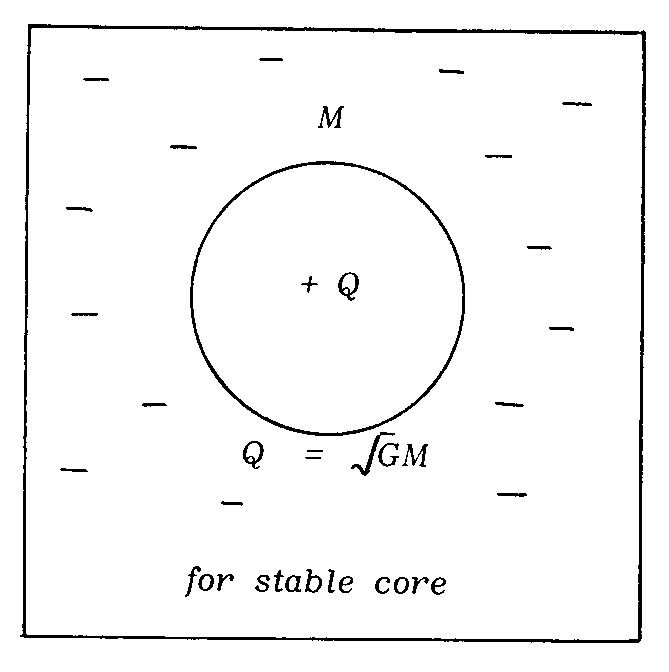
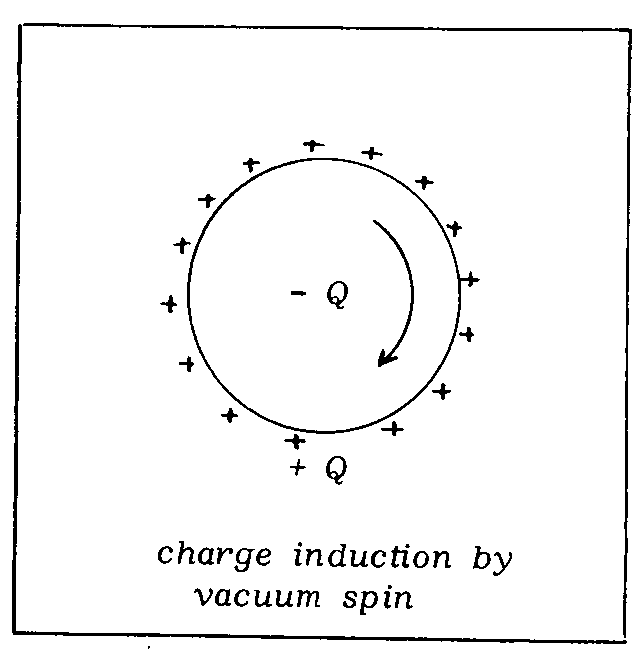
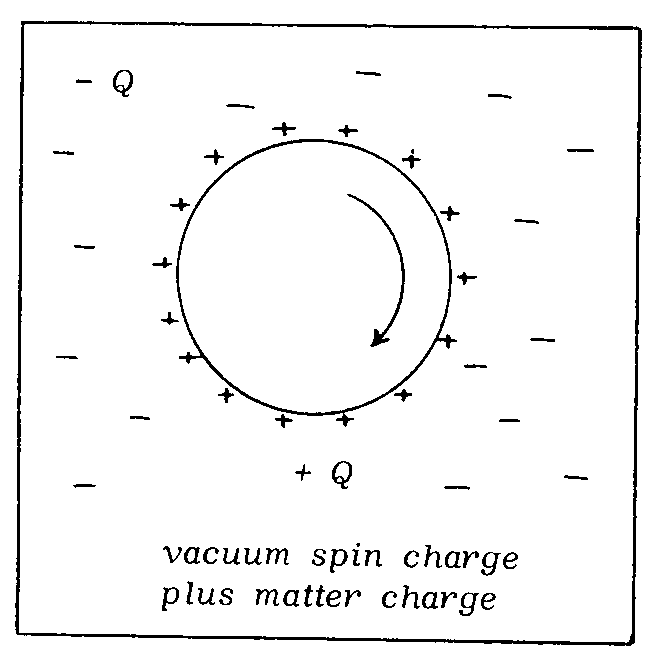
[p. 8]the possibility that charge can be displaced in a radial sense. Put another way, we can expect that a charge density within a volume of matter might induce a reaction by the vacuum medium to cancel the matter charge. Such a reaction should involve vacuum spin.
One way of developing a charge distribution is by a strong electric discharge. The fast moving electrons will be drawn together by the pinch effect, so generating a radial electric field centred on the axis of the discharge. If the vacuum medium reacts to develop a compensating effect then it will absorb the field energy to sustain a vacuum spin about the discharge axis. This spin may be shared by the air surrounding the discharge with the result that the tornado angular momentum becomes explicable.
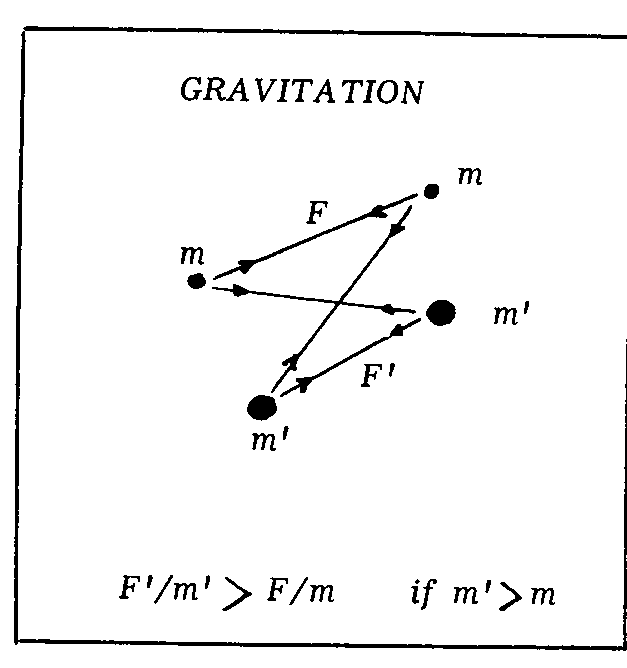
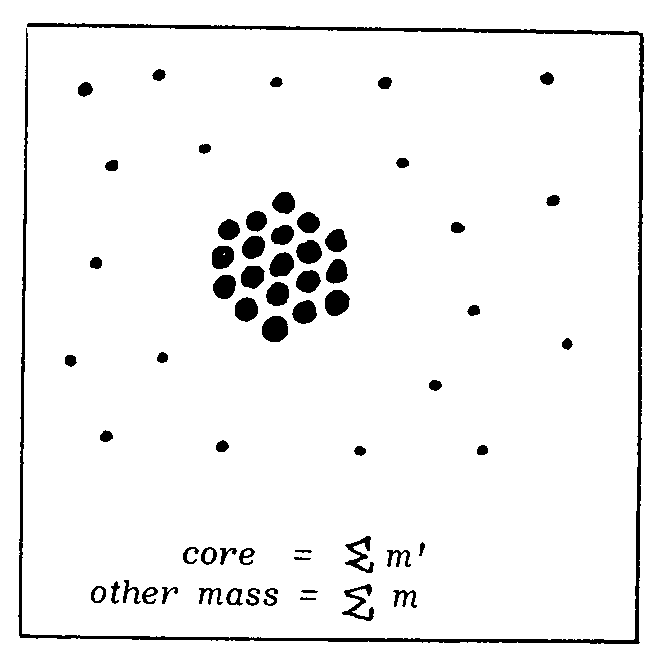
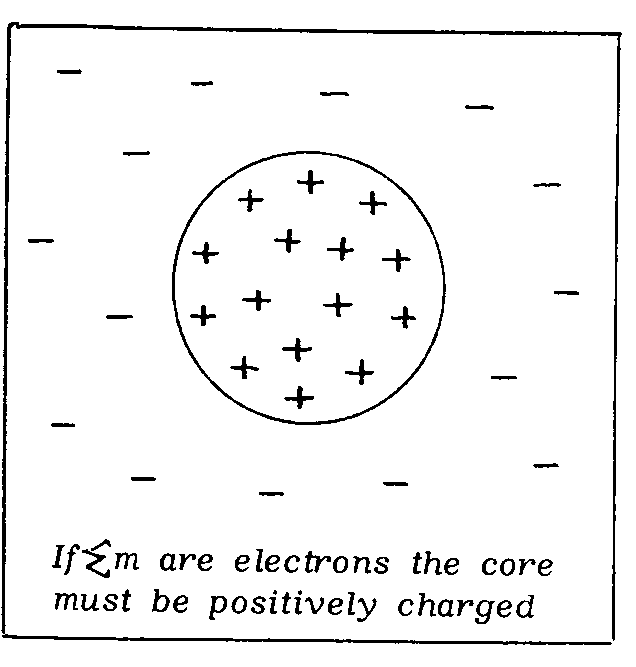
Another way of developing a charge distribution is by the gravitational condensation of stellar substance. Two heavy masses will have greater mutual acceleration under gravity than two lighter masses. In the cosmic dust from which astronomical bodies form there will probable be quite a few free electrons. Thus the heavier matter will aggregate to form a core temporarily leaving an electron population behind in surrounding space. The core need not stabilise initially by a balance of nuclear energy pressure radiation and gravitational force. It can stabilise by a balance of gravitation and the mutual electric repulsion of the positive charge associated with the core. Therefore we know that when an astronomical body is first created it has an electric charge given by G½ times its mass, where G is the constant of gravitation.
As explained already, this charge will then develop a vacuum spin and we can formulate a mathematical relationship between this speed of rotation and the mass density of the body, involving only the value of G and a density parameter of the vacuum.
[p. 8]
VACUUM MEDIUM ANALYSIS
σ/w = √(Aρ) by vacuum spin induction
σ = √G ρm by core stabilisation
Therefore: Aρ = G(ρm/w)2
I If the sun had 100% of the angular momentum of the solar system when created it would have
(2/5) MR2w = 3.2 1050 where R = 6.96 1010 cm
and M = 1.989 1033 gm. Hence w is 8.3 10−5 rad/s
For the sun ρm = 1.4 gm/cc and G = 6.67 10−8 cgs units
Therefore: Aρ ≈ (6.67 10−8 (1.4)2)/(8.3 10−5)2 ≈ 19 gm/cc
II For the Earth-Moon system according to R.A. Lyttleton (Science Journal, 5, 53, May 1969) the Earth rotated once every 5.5 hours before the Moon was ejected. ρm for Earth is 5.5 gm/cc.
Therefore: Aρ ≈ (6.67 10−8 (5.5)2 (3600)2 (5.5)2)/(2π)2 ≈ 20 gm/cc
III For the Asteroids the data of G.P. Kuiper (Celestial Mechanics, 9, 321, May 1974) show that the mean speed of rotation is once in 6 to 7 hours. If we estimate the value of ρm as 4 to 5 gm/cc this gives:
Aρ ≈ (6.67 10−8 (4.5)2 (3600)2 (6.5)2)/(2π)2 ≈ 19 gm/cc
[p. 9]
THE SOLAR SYSTEM
By supposing that the vacuum spin will be coupled, albeit rather loosely, with the body, the speed of rotation of both will become the same. Thus we have basis for explaining how the newly-created sun or Earth was caused to rotate. Furthermore, the production of satellites becomes explicable. Once the electron population reaches the surface of the parent body it will begin the process by which the vacuum medium returns its energy to matter. The vacuum spin will slow down as the atmosphere of negative charge accumulates this energy. The electrical attraction between the positive core and this negative orbiting atmosphere will balance the centrifugal force. This will determine how much mass from the parent body will be swept into the satellite system. Then, as the two charges become neutralised by mutual discharge or extraneous particle radiation the satellite will move away from its parent to take up its eventual orbit. Meanwhile much of the energy released will have gone into electric discharges and possibly have been dissipated. Some energy may even, as I suggested at the outset, have found its way into an ordered state of translational motion of the sun in its galactic path through space.
Suffice it to say at this stage that the creation of the solar system need present no insuperable mystery, of the kind which has troubled us to date. The data verify the hypotheses involved, because we can deduce the same numerical vacuum density property from three separate creation processes. These are the asteroid creation, the sun creation and the Earth creation. Furthermore, when this then-known density parameter of the vacuum is applied to the formulae for satellite creation, we deduce the satellite/parent mass ratio in reasonable accord with that of the solar system and the Earth-Moon system.
[p. 9]
SATELLITE FORMATION
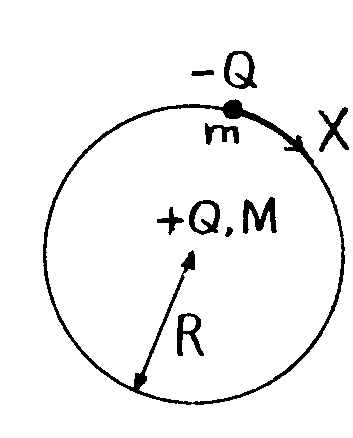
X = angular momentum of m
Force balance gives:
(kQ2)/(R2) = (X2)/(mR3)(1)
Charge −Q will be where k < 1 because not all fully effective as implied by the illustration.
Note that: GM2 = Q2(2)
It appears that a spinning charged system tends to concentrate angular momentum in a faster-rotating surface region. Taking X as the factor β times the initial angular momentum of M at creation:
X = (2/5) β MR2ω(3)
where ω = ρm √(G/Aρ)(4)
and M = (4π/3) R3 ρm(5)
Combining equations (1) to (5):
m/M ≈ (6β2ρm)/(50πAρk)
but Aρ ≈ 20 gm/cc so that m/M ≈ (β2/k) (ρm/524)
For the sun with ρm = 1.4, if β ≈ 0.5 and k ≈ 0.5:
m/M ≈ 1/748 (observed value 1/745)
For the Earth with ρm = 5.5, if β ≈ 0.75 and k ≈ 0.5:
m/M ≈ 1/85 (observed value 1/81)
Note that β will not represent deployment of angular momentum between parent and satellite as observed today because tidal effects promote angular momentum transfer.
[p. 10]
STRUCTURED SPACE
An important question is that of why the solar system suddenly came into being some 4,500,000,000 years ago. It is as if there was a sudden decision that gravitation would come into being. The usual starting point is to suppose a diffused cosmic dust begins to come together due to gravitation. But why should there be such a beginning? If matter dispersed in space was created slowly and steadily the results which have just been presented would not apply. An answer comes from the understanding of the nature of the force of gravitation and the realisation that it only exists in a vacuum medium which has structure. The analogy is found in ferromagnetism. There are forces which depend solely upon the prevailing ordered state of the ferromagnetic substance. Above the Curie temperature there is no magnetism. Similarly, in any crystalline substance there are forces which vanish once the crystal becomes disordered by high temperature effects. Therefore, I offer the suggestion that the electrical medium permeating the vacuum has structure and that some 4,500,000,000 years ago this structure went through a transition which allowed gravitation to assert itself. Eventually, when the sun cools and its density increases it may well be the seat of a disturbance which can spread through space creating a new disorder in the vacuum structure belonging to the sun’s cosmic domain. This is speculation founded upon a great deal of evidence indicating that the vacuum is structured.
The geometry of a lattice structured vacuum can yield parameters determining the fundamental physical constants and assuring their universal equality.* However, this takes us beyond the scope of this paper and I wish to conclude by suggesting some experiments.
* H. Aspden & D.M. Eagles, ‘Aether Theory and the Fine Structure Constant’, Physics Letters, 41A, p.423, 1972.
H. Aspden & D.M. Eagles, ‘Calculation of the Proton Mass in a Lattice Model for the Aether,’ Il Nuovo Cimento, 30A, p.235, 1975.
[p. 10]
[p. 11]
OPTICAL SENSING OF THE VACUUM
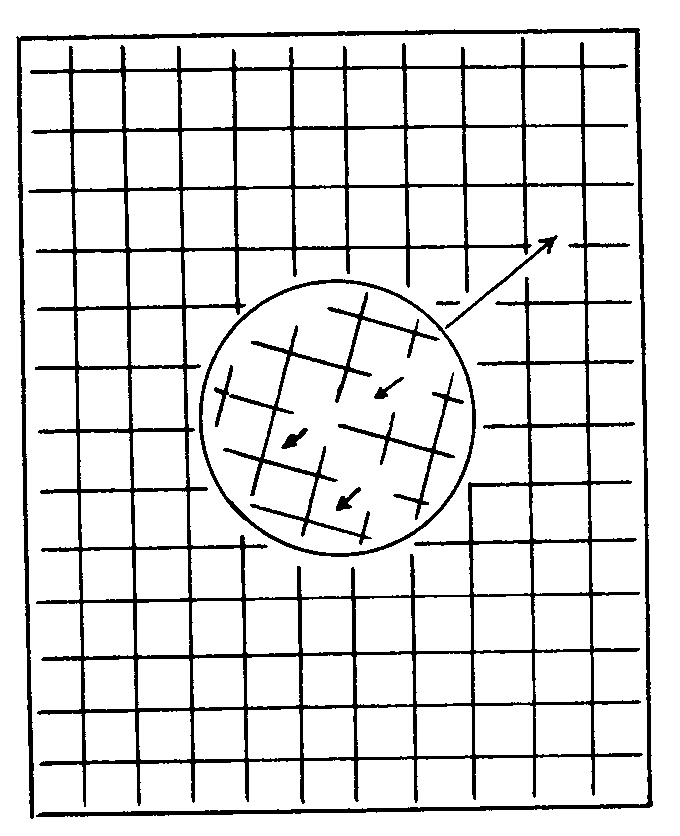
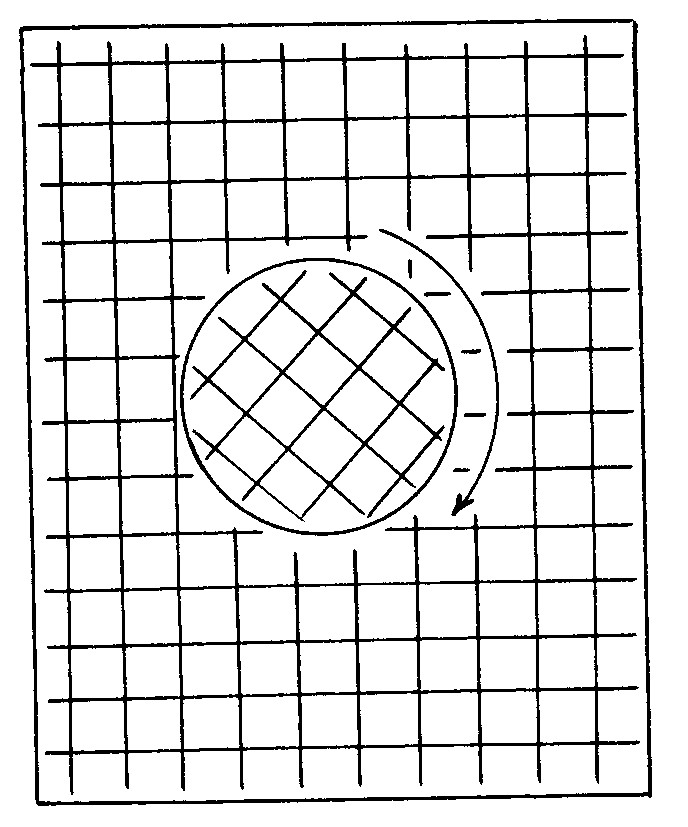
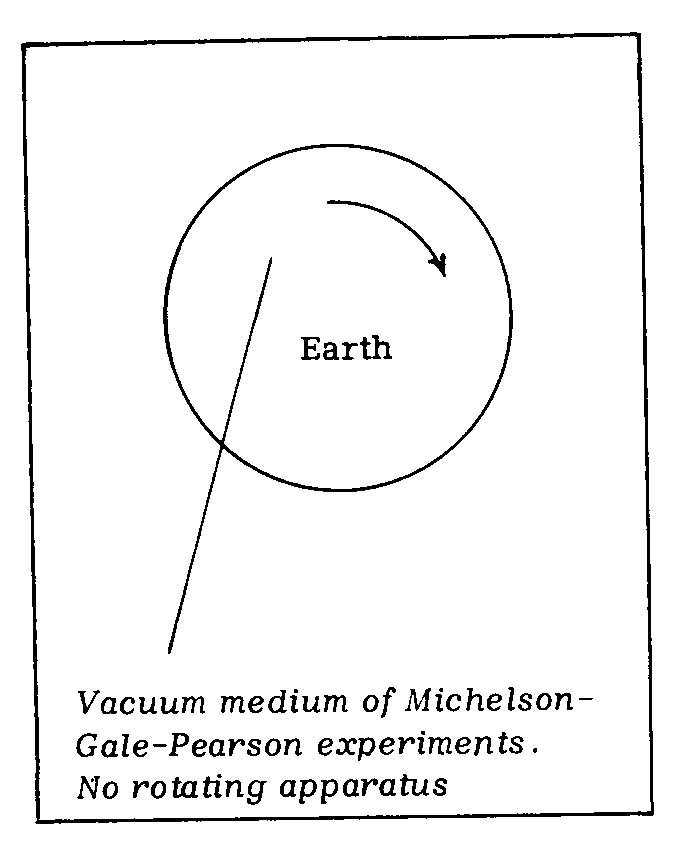
It should be possible to distinguish between linear motion and rotation by optical sensing of the vacuum medium. A sphere of rotating structure will not disturb a similiar surrounding structure. The linear motion of a lattice-like structure through a similar surrounding structure seems impossible. Yet it is possible if the lattice density is reduced by linear motion and the free lattice substance is in counter-motion within the body of the lattice. Analysis* shows that the optical reference frame moves with the lattice in linear motion, a result confirmed by the famous Michelson-Morley experiment. On the other hand, since the lattice density is unchanged in the rotation state, the optical reference frame remains the non-rotating reference frame. Thus an experiment involving the measurement of the speed of light in the Earth’s rotating frame should be sensitive to the Earth’s rotation. This is confirmed by the experiments of Michelson, Gale and Pearson (1925)**.
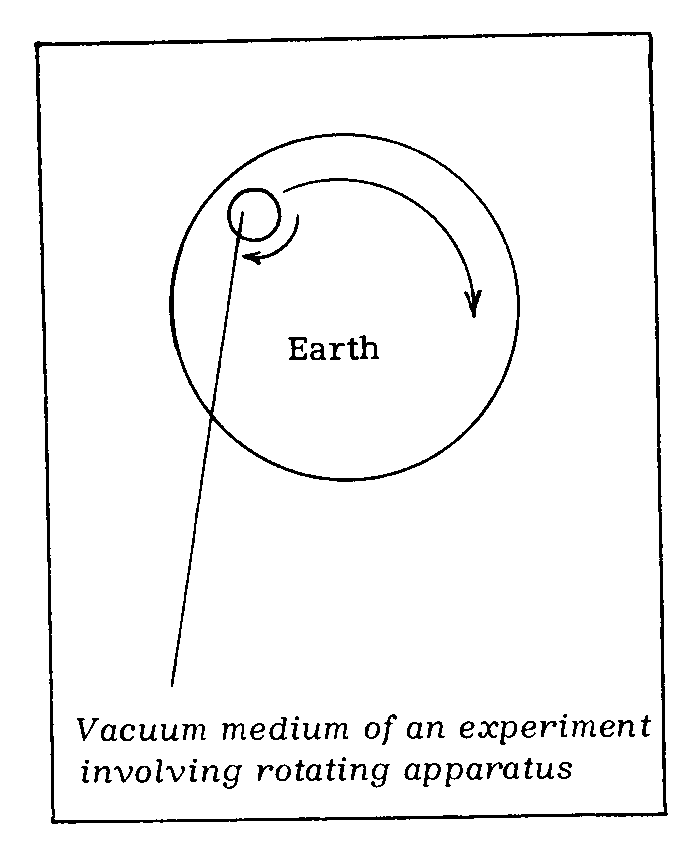
The interesting question is whether the vacuum can be set in rotation by test apparatus and this Earth rotation component obscured in optical tests. For example, at the equator the laboratory moves at a speed of about 460 m/s. Speed of light tests should indicate a difference of 920m/s between the west-east and east-west speeds. This is provided the apparatus has not become, in effect, a system within its own rotating vacuum and so carried forward around the equator with what is effectively a vacuum system in linear motion. In short, if rotating apparatus is avoided it should be possible, as in the Michelson-Gale-Pearson experiment to detect the 920m/s speed difference in the light tests. If the presence of rotating apparatus obscures this measurement and differences of a few
* H. Aspden, ‘The Fresnel Formula applied to Empty Space’, Int. Jour. Theor. Phys., 15, p.263, 1976
** A.A. Michelson, H.G. Gale & F. Pearson, Astrophysical Journal 61, p.140, 1925.
[p. 11]
CHARGE INDUCTION BY VACUUM SPIN
(Linear Oscillator Property)
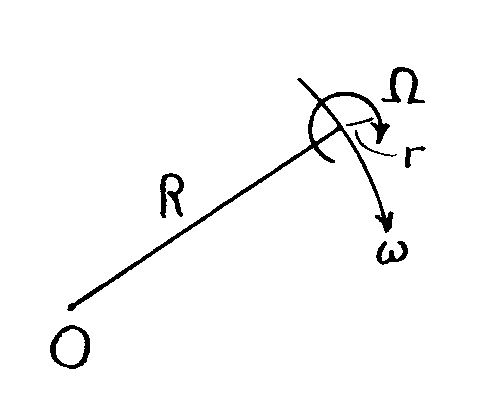
Each element of the structured vacuum rotates at the universal angular frequency Ω′ in small orbits of radius r. If there is vacuum spin at angular frequency ω then in plane of Ω an element moving at radius R from spin axis 0 will be radially displaced by Δr = ωR/Ω. The area of a disc of radius R will change in proportion to 2Δr/R or 2ω/Ω.
Note then that σ = σo(2ω/Ω)(1)
Let α be the restoring force rate when a charge e of mass mo is displaced amongst a sea of opposite charge of charge density σo in a vacuum which is electrically-neutral in the non-spin state.
Then α = moΩ2
where Ω is also the natural frequency of the vacuum
The electrical nature of the restoring force is readily explained by dimensional analysis.
| Dimensionally | α = | MT−2 |
| σo = | MT½L−3/2T−1 k½ | |
| e = | M½L3/2T−1 k½ | |
| Hence | eσo = | MT−2 k |
Thus α as a property of the vacuum is proportional to eσo so that:
eσo ∝ moΩ2
or σo2 ∝ ρΩ2(2)
where ρ is mass density of the vacuum.
From (1) and (2):
(σ/w)2 ∝ ρ
[p. 12]metres per second are measured then this is evidence supporting the vacuum spin hypothesis presented above. I submit that the many experiments which now verify the isotropy of the speed of light relative to the laboratory and claim results to within a few metres per second all have test apparatus in rotation during the experiment. Therefore what is needed is an experiment which involves no rotating apparatus and measures the Earth rotation speed, but which can then be subjected to rotation and shown to become insensitive to Earth rotation. Then any delay in the onset of this change following rotation of the apparatus will give evidence of the inertial properties of the vacuum spin.
The follow-on from this is to seek to sense mechanically the coupling between the vacuum spin and the rotating apparatus.
ELECTRICAL SENSING OF VACUUM SPIN
Another experiment worth attention involves setting up an electrical charge and seeking to induce vacuum spin which might be sensed by its magnetic field. In this connection it is noted that the Earth generates a magnetic field which is of the magnitude expected from vacuum spin. This is known from the Schuster-Wilson hypothesis based on the fact that the Earth exhibits the magnetic moment it would have if its mass had electric charge related by the factor G½. Blackett (1952)* claims to have disproved this hypothesis experimentally. He sought to concentrate the magnetic effect by using a dense gold cylinder but obtained a null result. However, he did not suspect that the vacuum medium might generate the field and this is not influenced by the density of gold.
* P.M.S. Blackett, ‘A Negative Experiment Relating to Magnetism and the Earth’s Rotation’, Phil. Trans. Royal Society, 245A, 309, 1952/53.
[p. 13]Finally, an interesting experiment has been performed by Ryan and Vonnegut (1971)*. They arranged for a cage to rotate around an electric arc discharge at quite low speed and found that this stabilised the arc. The task of stabilising an electric arc is one of the major problems of thermonuclear fusion research. It seems therefore very difficult to believe that the wild antics of the arc discharge are tamed merely by the slow rotation of a column of air. Perhaps there is vacuum spin in this experiment and it is the influence of the induced vacuum fields which stabilise the arc. Here then is more scope for research. Can the arc be stabilised in a vacuum? It is research which the modern physicist will not readily undertake because there is widespread belief that the vacuum is a non-entity devoid of any special properties. It is a belief encouraged by the development of relativity and in my experience those who believe in relativity deny the existence of the aether. On the other hand I was once reassured by a comment Professor Cullwick** made about something I published. He quoted Einstein as saying:
‘the special theory of relativity does not compel us to deny the existence of the ether …… there is weighty evidence in favour of the ether hypothesis.’
15 September 1977
* R.T. Ryan & B. Vonnegut, ‘Formation of a Vortex by an Elevated Electrical Heat Source’, Nature Physical Science, 233, 142, 1971.
** E.G. Cullwick, ‘Relativity and the Ether’, Electronics & Power, 22, p.40, 1976.