The following is a paper by H. Aspden published in The Toth-Maatian Review, v. 5, pp. 2609-2612 (1986).
ON THE CREATION OF THE SUN
Abstract: A recent contribution by Edwards on ‘Weightlessness’ is discussed and shown to have particular relevance to the process of creation of the Sun. Edward’s hypothesis is also
discussed in relation to the causal basis of Planck’s radiation law and evidence for the existence of a real aether.
Commentary: The author here presents a general discussion on the energy in relation to Einstein’s theory and discusses the deployment of energy at the time the Sun was created. The gravitational energy released was not radiated as heat but was transferred into the translational motion of the Sun as can be verified by equating the Sun’s cosmic kinetic energy with that available from the gravitational source. Here was evidence that the aether in its magnetic action that we sense as gravity can break the standard rules of momentum conservation and promote linear motion. Similarly the secondary radial electric field action arising from the faster coalescence of protons in comparison with electrons gives the
coupling with the aether which transfers energy by electric action to develop the Sun’s rotation. Those interested in ‘Energy Science’, the title adopted for this work, need to keep this account of the Sun’s creation in mind and to challenge the doctrines of Einstein and
the Big Bang hypothesis.
The following is a paper by H. Aspden published in Physics Education, v. 21, pp. 261-262 (1986).
FLAT SPACE GRAVITATION
Commentary: Here, in this periodical which is published by the U.K. Institute of Physics for physics teachers, the author draws attention to the alternative non-relativistic ways of explaining the perihelion anomaly of planet Mercury. Quite deliberately, the author did not refer to his earlier paper [1980b] in the main periodical series published by the U.K. Institute of Physics, which showed first-principle justification for alternative non-Einstein theory. The reason was that referees in their ‘peer review’ activity do not approve of author’s urging acceptance of physics which they see as controversial, particularly if attention is drawn to earlier work in a way which leaves them no room for doubt or dissent. The science community is now wedded to Einstein’s theory and the bond is so strong that the author believes it will take a powerful breakthrough on the vacuum energy front before physicists will turn away from their mathematical abstraction and focus on reality!
The following is a paper by H. Aspden published in The Toth-Maatian Review, v. 5, pp. 2475-2481 (1986).
THE MYSTERY OF MERCURY’S PERIHELION
Commentary: This was a general article discussing the background of debate concerning Einstein’s theory of planetary perihelion motion. It particular, it gives a fuller account of the
author’s interest in the earlier work of Paul Gerber, who derived the correct formula for the perihelion motion by a ‘space and time propagation’ theory 18 years before Einstein wrote on the subject.
The following text by H. Aspden is an item of Correspondence published in Nature, v. 319, 2nd January 1986 at p. 8.
EARNSHAW’S THEOREM
This theorem is not often mentioned in scientific journals. It denies the possibility that an electric charge can be held stable solely under the electrostatic influence of other electric charge. It was used in a recent letter [Nature v. 317, p. 208; 1985] to refute a case put earlier by Berezin [Nature, v. 315, p.104; 1985]. It is as well to keep in mind that the Reverend Samuel Earnshaw developed his theorem with an eye to the constitution of the aether as a medium comprising a structured system of electric charges, separated by what, presumably, would be regarded as a truly void state of the vacuum.
The theorem fails if the charges permeate a charge plenum or continuum having a charge density, because displacement can then be subject to a linear restoring force rate, owing to interaction with this continuum.
We have now come to accept that the vacuum medium
does have some rather special characteristics and a possible structure, so it is not unlikely that it comprises electric charges permeating a charge plenum, notwithstanding the Earnshaw theorem. If this is the case, then the theorem cannot even be applied without some reservation when considering the mutual stability of charge in matter. The support for the structured vacuum is enhanced by the theoretical derivation of the fine-structure constant in terms of the geometrical features of an electrical charge system neutralized by a charge continuum. A value of the fine-structure constant in matching accord with its measurement at the level of one part in ten million has recently been reported from such analysis [Phys. Lett., 110A, 113; 1985].
The following is a paper by H. Aspden published in Hadronic Journal, v. 9, pp. 137-140 (1986).
MESON PRODUCTION BASED ON THOMSON ENERGY CORRELATION
Abstract: Attention is drawn to a remarkable energy correlation which uniquely determines the rest-mass energies of all the intermediate particles in the electron-proton energy spectrum. The correlation formula uses a classical expression formulated by J. J. Thomson, which represents the charge of a particle as confined within a sphere of radius 2e2/3mc2.
The full text of this paper may also be seen in PDF format as Paper No. 2 [1986e] in the Appendix to the author’s 1996 book: Aether Science Papers.
An earlier version of this page, from the energyscience.co.uk site, is preserved here: 1986e (earlier version).
The following is a paper by H. Aspden published in Hadronic Journal, v. 9, pp. 129-136 (1986).
THE THEORETICAL NATURE OF THE NEUTRON AND THE DEUTERON
Abstract: A Thomson-charge group model, which in 1975 gave a theoretical proton-electron mass ratio of 1836.15232, is now shown to give equally precise results for the several quantitative properties of both the neutron and the deuteron.
Commentary: This is the first of a sequence of eight papers by the author which were published in Hadronic Journal during the period 1986-1989. Full copies of all these papers and the six published in Physics Essays during the period 1988-1995 are included in the author’s separately published collection of papers entitled ‘Aether Science Papers’.
The ‘Thomson-charge group model’ referenced in the abstract is a composite structure formed by spherical charges in surface contact, each charge having an energy given by:
E = 2e2/3a
where e is the electric charge and a is the radius of the sphere bounding the charge.
When two such charges are in contact one obtains an overall energy which is the sum of the two energies of the individual charge offset by the negative Coulomb interaction energy, which, in the cgs esu system of units used for vacuum interactions, is e2 divided by the sum of the two radii. It is simple algebra to show that certain relationships exist between charge radii and the corresponding individual particle energies when overall energy is minimized or is put equal to the energy of either individual charge. Thus one can begin with a source charge and bring in standard charge quanta which grow in energy terms by virtue of the interaction and can be shed as newly-created particle forms when energy impulses promote separation.
The whole scenario of fundamental particle creation develops from the
above formulation by J. J. Thomson when applied in this way. The author has found that this is at the very heart of all activity in
fundamental physics, ranging from the proton to the graviton and notwithstanding the imaginary picture of ‘quarks’. It was first ‘discovered’ in its most fundamental application when the author developed a model of the aether based on point charges and found that to get to a theoretical value of the fine-structure constant that was exact he simply had to make those charges finite in form. The formula that worked to give the right result was the J.J. Thomson formula!
Concerning the so-called ‘quark’, the particles of imaginary fractional charge, rather than the unitary charge e, the way the reader should view that subject is to question whether a particle of charge e that stands alone for one third of the time but is part of a three-charge, e, -e, e group, the remaining two thirds of the time, if deemed a single entity, comprises two charges of 2e/3 and one charge of -e/3. Sometimes physicists have problems if what they think is a single charge e behaves as if it can split into three fragments and yet they cannot isolate those individual fragments. They look for complex solutions and abstract interpretations when a little common sense and a classical view on the causal foundations of physics will, in the end, give the answers.
Of course, the classical viewpoint can be misleading, as one may see from a study of the background to Earnshaw’s theorem, which does concern how charges interact in a vacuum, but that is another story as the reader may see by reading chapter 9 of the author’s 1972 book ‘Modern Aether Science’.
The full text of this paper may also be seen in PDF format as Paper No. 1 [1986d] in the Appendix to the author’s 1996 book: Aether Science Papers.
The following is a paper by H. Aspden published in Physics Letters, v. 119A, pp. 109-111 (1986).
ELECTRON SELF-FIELD INTERACTION AND INTERNAL RESONANCE
Abstract: Recent proposals that an electron might contain an ‘imprisoned’ photon in its field system suggest a wave resonance which allows the QED determination of the electron g-factor to be used to establish the precise value of the fine structure constant, given its approximate value as 1/137. The value of α-1 is found to be 137.03599, in precise accord with its measured value.
The following is a paper by H. Aspden published in IEEE Transactions on Plasma Science, v. PS-14, pp. 282-285 (1986).
ANOMALOUS ELECTRODYNAMIC EXPLOSIONS IN LIQUIDS
Abstract: The recently reported Graneau experiment on electrodynamic explosions in liquids, which reveal anomalous longitudinal electrodynamc forces of the order of 104 times greater than expected, verify the need for a term in the law of electrodynamics that corresponds to the ion/electron mass ratio. this confirms an earlier theoretical interpretation of the anomalous cathode reaction forces found in the vacuum arc.
The following is a paper by H. Aspden published in Speculations in Science and Technology, v. 9, pp. 315-323 (1986).
FUNDAMENTAL CONSTANTS DERIVED FROM TWO-DIMENSIONAL HARMONIC OSCILLATIONS IN AN ELECTRICALLY STRUCTURED VACUUM
Abstract: Based on a 1972 analysis of two-dimensionless harmonic oscillations in an electrically structured vacuum, the fine-structure constant, magnetic moment of the proton and the g-factor of the electron are all derived theoretically and found to have values in perfect accord with measurement data. The analysis is based on newly discovered resonant interaction.
Commentary: The author had been impressed by the fact that Von Klitzing had earned the Nobel physics prize in 1985 for work closely connected with quantum Hall phenomena as applied to the measurement of the fine-structure constant. This was research which, in effect, replicated the orderly orbital motion of the aether lattice charge in a two-dimensional electron gas. Bearing in mind that the author’s theory of the vacuum medium has vacuum charge in a two-dimensional motion, which gives the fundamental foundation for the fine-structure constant, this work of Von Klitzing was clear
vindication of the author’s methods. The subject paper was essentially a review paper to which was added the new discovery of a resonant standing wave model for the proton magnetic moment. The
theoretical value is the same as the measured value to the part per million precision of six significant digits.
To see the full text of this paper as presented in pdf format press: [1986a]
Full text of the paper (transcribed from the PDF)
Transcribed from the scanned pages of the printed paper. [p. N] marks where each printed page begins; figures are cut from the scans. The PDF above is the original.
[p. 315]
Speculations in Science and Technology, Vol. 9, No. 5, page 315
Fundamental constants derived from two-dimensional harmonic oscillations in an electrically structured vacuum
H. Aspden
Department of Electrical Engineering, University of Southampton, Southampton SO9 5NH, UK
Received: November 1985
Abstract Based on a 1972 analysis of two-dimensional harmonic oscillations in an electrically structured vacuum, the fine-structure constant, magnetic moment of the proton and the g-factor of the electron are all derived theoretically and found to have values in perfect accord with measurement data. The analysis is based on newly discovered resonant interactions.
The experimental work of Nobel laureate Von Klitzing, which earned him the 1985 prize in physics, has highlighted the value of studying the quantum properties of an electron gas in which the oscillations are harmonic and confined to two dimensions. This has led to the new technique of precision measurement of the fine-structure constant, based on the quantum Hall phenomenon.
Earlier research has shown that analysis of the vacuum itself as a medium in which there are two-dimensional harmonious oscillations at the Compton electron frequency can account for Planck’s radiation law and lead to a derivation of the fine-structure constant on pure theoretical grounds.
The analysis presupposes that the vacuum has properties analogous to those of a fluid-crystal medium, but governed by quantum electrodynamic (QED) transitions. Thus, charges e permeate a background continuum of uniform and opposite charge polarity. They form into a structure and tend to share the motion of coextensive material energy forms, but at the boundaries of microdomains the charges can mutually annihilate with the corresponding amount of charge in the continuum and shed energy which is transferred into a background of muon charge pairs. The latter form a migrant gas which can reconstitute the lattice structure and the continuum at boundaries where domains separate. The result is a vacuum medium exhibiting no linear momentum but able to provide a light reference frame which adapts to the motion of the laboratory-based observer and so accounts for the light-speed isotropy measurements of Michelson and Morley.
The explanation of Planck’s radiation law is based on a feature of the two-dimensional harmonic oscillations of the charges e relative to the continuum [p. 316] charge. Storage of energy by increase of oscillation amplitude implies storage of a proportional amount of angular momentum. As angular momentum is conserved, the balance involves the counter-spin of a small cubic sub-unit of the lattice. This rotates at a frequency proportional to the energy quantum fed into the field and so perturbs the lattice in the manner formulated as Planck’s radiation law and characterized by the Planck constant h.
The fundamental step I took in 19601 was of realizing that the charges e must be at zero potential relative to the continuum. Had they been at minimum potential, a negative energy state, then they would all be at rest and the vacuum would have no natural oscillation. It was an easy task to show that the charges e would have to be displaced in unison through a distance 2r relative to the centres of cubic cells of continuum charge of side d, neutralizing e, where r/d is approximately 0.3029.
Equally, it was quite straightforward to show that, if r were the Compton electron half-wavelength parameter h/4πmec, one could formulate:
α−1 = hc/2πe2 = (108π)(4r/3d)(1)
This is the reciprocal of the fine-structure constant α and is known to be slightly greater than 137, from experiment. Hence the theory was well supported, as may be checked by putting r/d = 0.3029 in equation (1).
For a formal derivation of equation (1) see ref.2 or the more recent ref.3 which deduces it in the form:
α−1 = hc/2πe2 = (108π)(2/β)½(2)
where β is the energy ratio of the electron to that of the lattice charge e.
The major step was taken in 1972 when, in collaboration with Eagles, I established4 that a resonance condition required β3 to be an odd integer. The most appropriate value satisfying the non-negative but minimal potential energy condition was found to be 1.843, making r/d 0.302915878 and hc/2πe2 = 137.0359148.
Petley5 has recently reviewed the theoretical determinations of the fine-structure constant and given due recognition to this method as defined by equation (2). It is valid at the level of 1 part per 106 when compared with the measured value.
However, Petley6 in the same work draws attention to the fact that data available to the beginning of 1983 collectively yield a value of α−1 of 137.036004 to within 2.4 parts in 107. This gave me the impetus to look more closely at the theory discussed above to see whether there is any scope for modification.
The difficulty with such a proposal is that the analysis involving the resonance is so rigorous that I had little scope for correction and, indeed, hold the view that the value calculated is the true value for undisturbed vacuum conditions.
I have, however, long realized that the synchronizing constraints acting between lattice domains in relative motion will cause a displacement of the orbit of the lattice charges proportional to the relative velocity. This was applied to explain how the vacuum medium could develop magnetic fields [p. 317] when in a state of spin, leading to an explanation of the primary geomagnetic field. Wesson7 acknowledged this saying “The origin of geomagnetism as a cosmological problem is in a confused state, however, the only really connected account being that of Aspden (1966)” (see ref.8).
In spite of this, the theory of the harmonic two-dimensional vacuum oscillations has remained dormant, physicists being reluctant to revive anything that might appear to be an aether. However, the constraining mechanism involved in the rotation of lattice structure in an enveloping lattice, the basis of this geomagnetic field induction, has a counterpart in linear motion. The Earth moves at a cosmic speed of about 390 km/s relative to isotropic background radiation. If the latter is isotropic in the enveloping lattice, then we know that the relative velocity v is 390 km/s and can work out how this affects the energy storage in the spins connecting with Planck’s radiation law.
This motion is directed at about 12° to the plane in which the planets orbit the Sun and we will suppose that this plane is common to, or parallel with, the two-dimensional oscillations of the vacuum medium. Because cos 12° is 0.978 we can suppose that the in-plane component of v is about 380 km/s.
Now, the continuum charge and the lattice of e charges move in juxtaposition in orbits of radius r in the inertial frame when the vacuum is undisturbed by translational motion. This accounts for a 2r separation, noted above. If, however, they keep in register with charges having no translational motion, in spite of their own additional velocity v in their orbital planes, then their compounded orbital velocity will vary with angle in orbit and be Ωr + vcosθ, where θ is changing harmonically. Ω is 2πmec2/h, the Compton angular frequency of the electron. From the value of r already given we see that Ωr is c/2, meaning that the charges e and the continuum have relative motion at the speed c of light, a not unnatural feature of the vacuum medium under study.
Now, to stay in register at their compounded velocities, the expression Ωr + vcosθ must be of the form Ω(r + δrcosθ), this being the tangential velocity in orbit, where δr is the planar displacement of the e charge orbit as a whole. Thus we can write:
δr/r = 2(v/c)(3)
The energy associated with this orbital motion is proportional to (2r + δrcosθ)2, so far as the electric displacement component is concerned. There is no displacement dependent kinetic energy because the motion in orbit about the displaced centre is at constant speed; translational linear motion does not affect either the angular momentum storage or the orbital kinetic energy. This means that since, normally, there is equipartition of energy between the displacement and kinetic energy storage, for the same change of angular momentum we have a change of field energy enhanced by the factor:
((2r)2 + (2r + δrcosθ)2)/((2r)2 + (2r)2)(4)
which, for θ averaged over a complete 360° angle, is:
1 + (δr/r)2/16(5)
[p. 318] From equation (3), this becomes 1 + (v/c)2/4. This is the factor by which hc/2πe2 must be increased when measured in a space domain having a cosmic motion at the speed v. With v = 380 km/s, (v/c)2/4 is 4.02 × 10⁻⁷. This increases the value for v = 0 of 137.0359148 to 137.0359699, but bearing in mind that there is a small uncertainty in the measurement of the cosmic speed v and that it varies anyway by 30 km/s during the Earth’s orbit around the Sun, this theoretical value will change by amounts commensurate with the current uncertainty in the measured value. The theory is, therefore, quite viable.
It is appropriate here to note that the basic lattice structure of the vacuum, meaning the dimensions of the lattice cells and the properties of the charge elements, is unaffected by translational motion. For this reason, the value derived in 1975 (see ref.9), for the proton/electron mass ratio remains as a firm result of the theory. This is:
mp/me = (3/(4π))(108π)3/γβ4(6)
where, as already noted, β3 is 1843 and the factor γ is √(3/2) − 1.
Upon evaluation it may be verified that the proton/electron mass ratio thus predicted is 1,836.15232. This is in excellent accord with the measured value and has been assessed in relation to the latest measurement,10 as well as a further comment on proton creation.11
This strengthens the case in support of the fine-structure constant evaluation discussed above.
We now extend the discussion to show that two other, very basic constants can be calculated with similar or better precision. We address first the question of the proton magnetic moment expressed in nuclear magnetons.
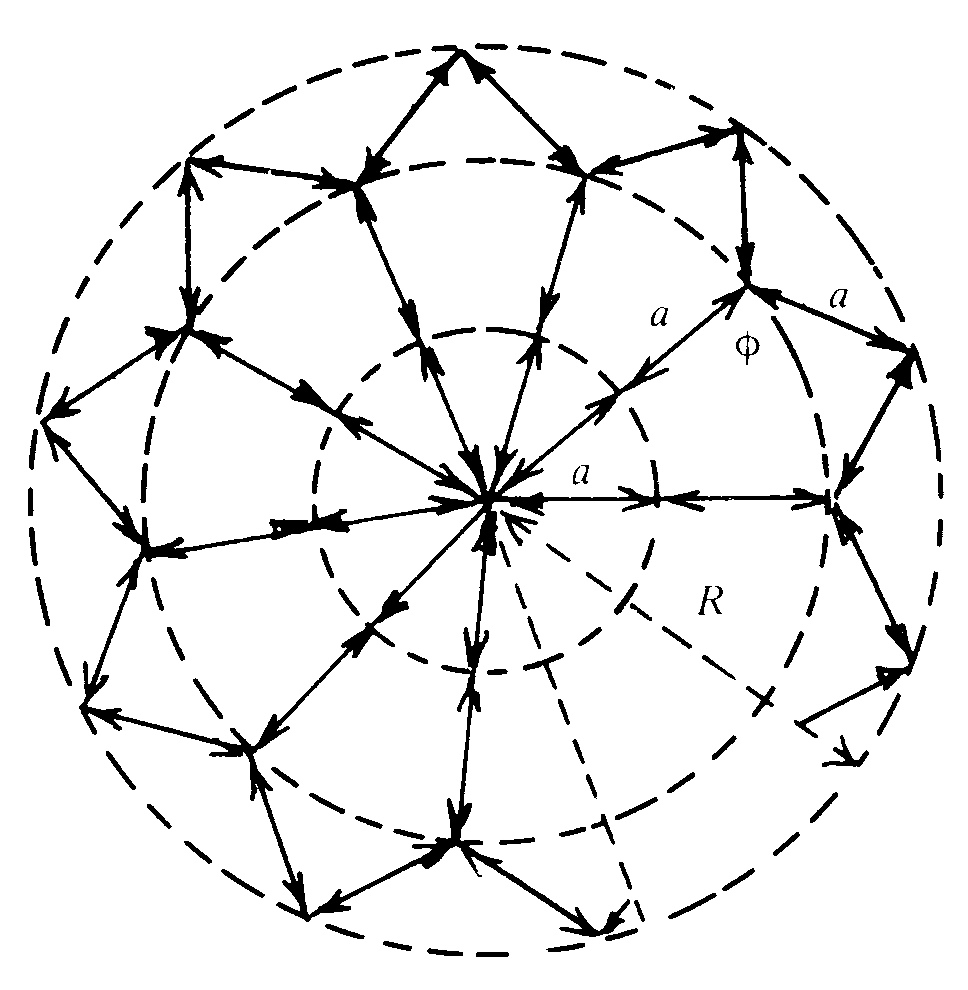
Figure 1Spherical charge form of radius a centrally located within two spherical field boundaries.
[p. 319] In Figure 1, a spherical charge form of radius a is depicted centrally located within two spherical field boundaries. It is assumed that standing wave resonances exist in the field system thus portrayed, the half wavelength of which is the radius a. There are three spheres because one defines the charge and the charge is capable of limited movement within the field system relative to the two boundaries. The latter have a fixed radial spacing determined by the cavity resonance mode set up within the space between them. The limited motion of the charge really requires that the radius of the middle sphere is 2a so that the charge boundary tends to move about a mean position in which it lies at the nodes of the standing oscillations. The radius of the outer sphere is deemed to be as near as is feasible to a condition in which waves can travel around the cavity in a plane passing through the centre of the system with an angle of incidence at the middle sphere of 60°. For standing waves set up by two travelling waves moving in opposite directions this assures that the field energy pressure across the interface set by the middle sphere is the same on both faces.
The intrinsic magnetic moment of such a charge is that due to its confined oscillations as if its total inertia is that set by the energy bounded by the outer field cavity sphere. Because the angular momentum is carried by a mass reduced by q2/2Rc2, where R is the radius of this bounding sphere, q is the charge and c is the speed of light, we expect the magnetic moment to be anomalously increased by the usual factor 2 and by the factor:
M/(M − q2/2Rc2)(7)
Using the classical formula:
Mc2 = 2q2/3a(8)
which I have used in many fruitful particle analyses,12 we can reduce equation (7) to:
2/(1 − 3a/4R)(9)
with the factor 2 now added.
The charge q and mass M are now eliminated, but we will be applying the formula to the proton and regarding it as a unitary charge, when reacting electrodynamically, or suppose that its quark constituents each individually have their own resonance wave system defined by equation (9). Our task is to calculate the ratio a/R; the value of a or R can be different for different quarks without affecting equation (9), provided the ratio a/R is determined.
As a preliminary guide, we know that a is the side of a triangle making an angle of approximately 120° with a side 2a and that R is the third side. Simple trigonometry then gives the value of R/a as √7, based on the formula:
R2 = (2a)2 + a2 − 2(2a)cosθ(10)
where θ is 120°. Putting this approximate value in equation (9) gives a factor 2.7912 as the magnetic moment of the charge compared with that it would have in large orbital motion, where all its mass shares the angular momentum. Thus, 2.7912 is an approximate estimation of the magnetic moment in nuclear magnetons if our particle system is the proton.
[p. 320] The measured value is 2.792846, so we are close. To take the analysis further we need to make sure that the standing wave resonance in the cavity between radii 2a and R is closed and does not involve an infinite number of revolutions around the system.
Let there be N reflections at the outer boundary in n complete revolutions. Given N and n we can then calculate θ and find R/a. For θ to be close to 120°, N/n must be close to 9.4208.
There are synchronizing constraints in this case determined by resonant interaction with electrons and muons in the surrounding lepton field. The wave path around the proton cavity involves a wavelength of 2Na and we now suppose that the radius a is 1/1,836 approximately of that of the electron charge. Thus, the wavelength of a disturbance making one revolution around the electron charge will be 2π(1,836)a, which we take to be as close as possible to 2Na so that resonance is encouraged. Thus N is approximately 5,768.
The muon field involves a response at a frequency μ times that of the electron, where μ is the effective muon/electron mass ratio. Resonance implies that this is 205 or 207 (see also ref.13 for an independent analysis of muon properties). Thus, we expect that n will be a integral number z times μ.
The latter resonance is stronger than that of the electron and so we expect the two muon resonant modes to alternate, with the cavity resonance of the two states having minimal transitional effect on the radius R. This means that N/n must be as near equal as can be, consistent with a value of N in one case being near 5,768 and N/n being near 9.4208.
By working through the various possible values of N and n for the two muon modes, the optimum resonant state is found to be that for which N is 5,765 with n as 3 times 205 and N is 9,702 with n as 5 times 207. This gives a value of N/n of 9.373948 for both, to within 3.78 parts per 106. Note also that both ratios factorize down to lower values, 1,153/123 and 1,078/115, which enhances the resonance condition.
When this value of N/n is used to calculate θ we obtain 119.665213° and (R/a)2 becomes 6.979724759. From equation (9) this gives a proton magnetic moment of 2.7928467 if we suppose that the two muon resonances have equal influence. If either resonance dominates this value can alter by up to 0.44 parts per 106.
However, the essential point is that this is extremely close to the measured value. Petley,14 for example, quotes a 1983 measurement of this quantity in H2O as 2.7927738 with a correction of 26.19 parts per 106 to convert to the free proton state. This gives 2.7928469, a value in excellent accord with that just calculated.
To advance this theoretical dissertation, I will now explore the scope for applying these same principles to the electron. In doing this we are treading on the territory of QED which already claims tremendous quantitative success. Indeed, according to Petley,15 the ½g factor of the electron, as measured, is:
1.001159652200(40)(11)
whereas the theoretical value from QED is:
1.001159652460(12)
[p. 321] which itself is uncertain because it relies on measured values of the fine-structure constant, the uncertainty being of the order of 100 parts per 1012.
We will enter this field in the hope that we may discover some overriding resonance condition which can help to resolve the discrepancy between equations (11) and (12).
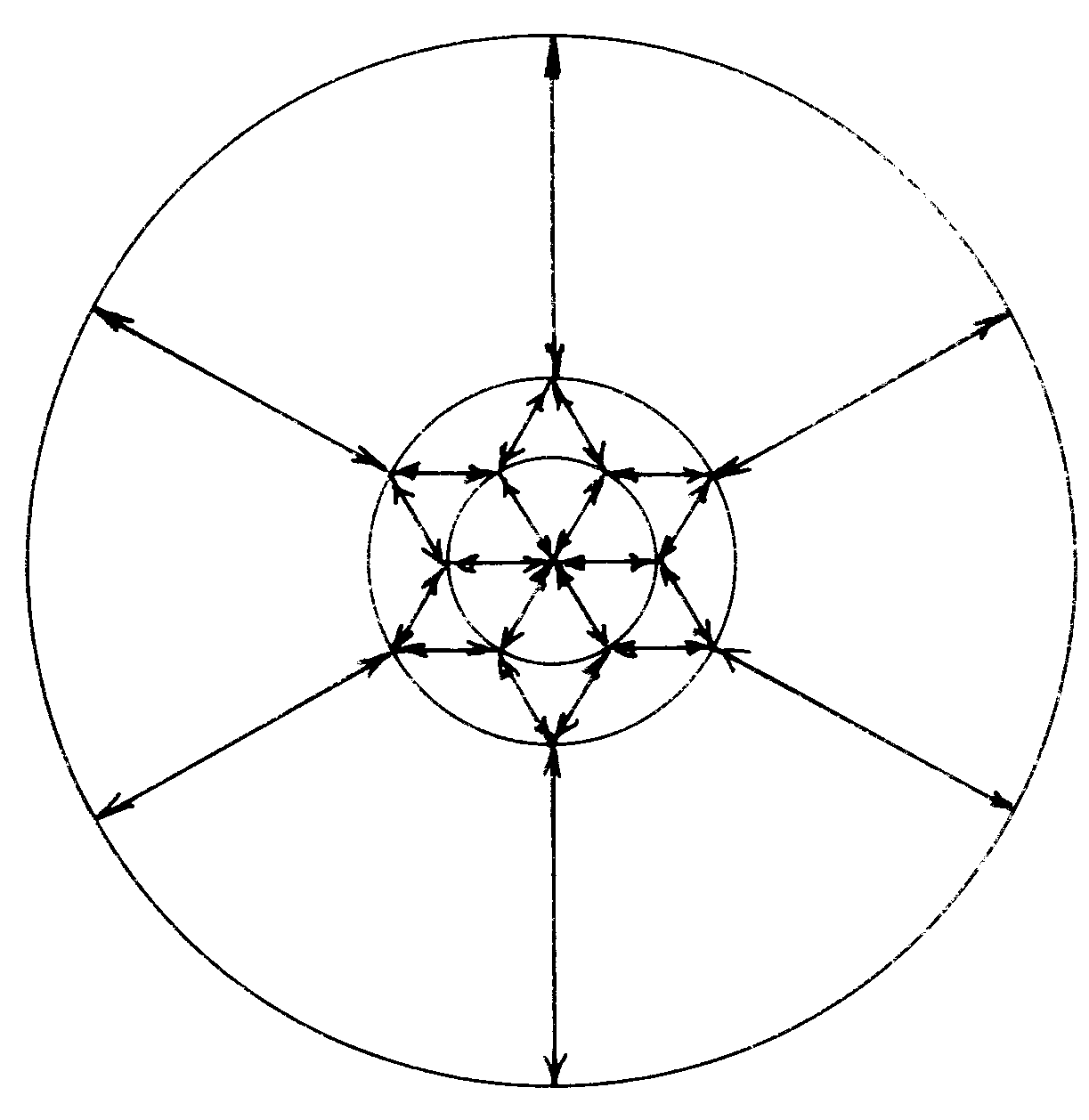
Again we consider a standing wave resonance involving three spheres, but in this case, as depicted in Figure 2, the resonance condition in the outer cavity is deemed to be a radial resonance at the Compton frequency. Thus the radial spacing between the middle and outer sphere is set by half the Compton electron wavelength. This is 3π/2α times the electron charge radius determined by equation (8). Note that we are not dealing with normal electromagnetic waves when we consider these cavity field oscillations. They should be imagined as analogous to sound waves and are essentially oscillations of the energy in the field just as sound waves concern oscillation of gas.
The inner cavity resonance of the electron appears to have the simple symmetrical balanced form illustrated in Figure 2, which is closed in one revolution. Taking a as the radius of the electron charge, the radius of the middle sphere is simply √3a. We can, therefore, add this to 3πa/2α to obtain the radius R and so deduce the electron g-factor from equation (9). However, a [p. 322] problem is that the waves in the outer cavity have a different frequency from those in the inner cavities and, ideally, to keep a regulated phase, which might be a consideration in understanding the nature of the charge polarity, this ratio should be an odd integer.
Figure 2Pattern of electron field cavity wave resonance.
This point is of less consequence so far as the proton is concerned because the frequencies are so different that a constraint assuring this integer relationship would only modify the proton g-factor by about 2 parts per 107.
We therefore make the overriding condition of this odd integer relationship by saying that the actual half wavelength of the oscillations in the two inner field cavities is less than but as near as possible to the radius a. In other words, R is the half wavelength at the electron’s Compton frequency incremented by the small factor √3/N, where N is the nearest odd integer above the value of 3π/2α.
From the fact that α−1 is just a little more than 137, N = 647 and:
g/2 = 1 + α/(2π(1 + √3/647) − α)(13)
from equation (9), where g denotes the electron g-factor.
We may tabulate the values of the fine-structure constant and the g-factor as related by equation (13) in Table 1.
Table 1Relationship between the fine-structure constant and the g-factor.
α−1
g/2
137.03597
1.001 159 652 365
137.03598
1.001 159 652 280
137.03599
1.001 159 652 195
Now, bearing in mind that the value given in equation (12) was based on a measurement of α−1 of 137.035 963,15 it comes as quite a surprise to find that equation (13) has given what does appear to be virtually identical results. Therefore, both QED and this wave resonance theory would suggest that the measured electron g-factor in expression (11) corresponds to a value of α−1 close to 137.035 989.
Only further experimental work to measure the fine-structure constant can resolve the issues left open. If the value holds closer to the upper end of Table 1 then QED and the wave-resonance electron model discussed are both a little discrepant. Otherwise, the theory for the fine-structure constant might still be incomplete at the part in 107 level. Perhaps QED and the wave resonance combine at an intersection of their g-values to so determine a common value for the fine-structure constant. Alternatively, one might suppose that much of the analysis in both cases is dealing with the same field model, using different analytical techniques, and that the departure comes from the refinements in the model. Thus we see hadron corrections introduced in QED and contrasting with the dual resonance modes in the model just presented.
[p. 323] Equally, one can wonder how the QED theory of electron g-factor could be so close and yet be challenged. In this connection note that quirks of nature do occur in these theoretical calculations. Believers in magnetic monopoles could easily have adopted the formula provided by Wangsness16 which gave the proton magnetic moment as 2.79253 nuclear magnetons but had dubious foundation in dimensional number theory. It did use equation (8), which itself is interesting. The more blatant mere numerical proposition is that of Lenz,17 which merely presented the formula 6π5 = 1,838.118 for the proton/electron mass ratio, a theme which has encouraged Stanbury18 to advance the numerology based on π to other fundamental constants, in the hope that something physical might connect with the method.
Such research based on numbers does tend to make analysis of fundamental constants appear as a disreputable pursuit, but this does not mean that the constants cannot yield their secrets. As we have seen, physical principles can lead to precise evaluation and QED techniques need not be the sole method of enquiry. The latter have failed completely to give account of the proton/electron mass ratio and the proton magnetic moment, causing researchers to turn in hope to quantum chromodynamics for their ultimate enlightenment.19 However, hopefully, the reader will favour the techniques presented above.
References
Aspden, H., The Theory of Gravitation, Sabberton, Southampton (1960).
The following is a paper by H. Aspden published in JOURNAL OF METEOROLOGY, v. 10, pp. 376-380 (1985).
ELECTRICAL ASPECTS OF TORNADO THEORY
Abstract: This paper discusses some rather speculative aspects of possible electrical phenomena that might be present in tornadoes formed in thunder conditions. Particular reference is made to arc discharge phenomena in which unusually high forces and rotation about the discharge axis are in evidence.
Commentary: The author argues that the aether in a state of spin inside the tornado funnel is the primary actor in the accounting for the energy and power behind the tornado. This is discussed at some length, but scientists are not persuaded by such argument because they have been taught not to believe in the existence of the aether. It was for this reason that the last few lines of this article quoted the words of a report of a tornado storm:
“The unusual direction of tornado motion, compared with the ‘normal’ eastward movement of storms, as well as with individual storm movements on the day, would hardly fit the expectations of a trained radar operator. As one of the eyewitnesses
said, ‘the storm went East, while the tornado cloud went West’.”
If the energy and power driving the tornado was traveling West and the air involved in the storm was traveling East, then that energy was clearly concentrated in a medium that could move through the air. The aether is the only known medium recognized in science history having such a property!