Crab Nebula (M1) — supernova remnant imaged by Herschel and Hubble Space Telescopes

Category: Papers & Publications

Peer-reviewed papers and publications by Harold Aspden

Crab Nebula (M1), supernova remnant · ESA/Herschel/PACS; NASA, ESA & A. Loll/J. Hester (Arizona State Univ.) · NASA Image Library ↗

  • 1984e

    1984e

    The following is a paper by H. Aspden published in Lettere al Nuovo Cimento, v. 41, pp. 252-256 (1984).

    ‘THE STEADY STATE FREE-ELECTRON POPULATION OF FREE SPACE’

    Abstract: The author’s structured space model by which the fine structure constant and the proton/electron mass ratio have been determined is now shown to contain a very rarified disordered matter state, whose free-electron population of approximately 10-27 kg per cubic metre presents a scattering cross-section limiting the visible universe to the measured range of 1010 light years.

    Commentary: This is a very important paper. The author, in advocating his aether theory, had been confronted with Einstein’s theory and the QED theory with the Dirac-spin interpretation of electron g-factor, but another general objection was the belief in the ‘Big Bang’ and the ‘expanding universe’. This paper now attacked the ‘Big Bang’ interpretation simply by showing how one can derive the Hubble constant from aether theory.

    There is far more that is involved in this paper. It concerns the dispersionless properties of the aether and its dual displacement nature [see 1982a] and it introduces the theme that Nature is always trying to create protons, throughout the universe. It is the proton creation activity which accounts for the mass ‘noise’ we associate with ‘missing matter’.

    Special Note: Shortly after the above paper was published it came to the author’s attention that there was need to correct an error in the paper. This affected the theoretical evaluation of the expression we associate with the Hubble constant and the following note was sent to recipients of further off-prints of the paper:-

    The Thomson scattering cross-section of the electron has been incorrectly quoted in the analysis in the paper. The following itemized data show theoretical values for the Hubble constant H for effective fully-absorbing cross-sections in the ultra-rarified electron gas. Note that the Thomson scattering cross-section is 6 times the cross-sectional area of the charge having the Thomson electron radius. It is 2.667 times that of a charge having the classical electron radius. It is twice the cross-sectional area of the scattering radius derived from the author’s g-factor analysis in reference 1982b (referred to below as the Aspden electron). According to the electron’s effect, which depends upon the assumed form of the electron, one finds, therefore, that the following values for the Hubble time constant apply: (a) Thomson electron: 1/H is 21,600 million years, (b) classical electron: 1/H is 9,000 million years, (c) Aspden electron: 1/H is 7,200 million years and (d) Thomson scattering: 1/H is 3,600 million years.


    To see the full text of this paper as presented in pdf format press: [1984e]


    Full text of the paper (transcribed from the PDF)

    Transcribed from the scanned pages of the printed paper. [p. N] marks where each printed page begins; figures are cut from the scans. The PDF above is the original.

    [p. 252]

    Lettere al Nuovo Cimento Vol. 41, N. 7 13 Ottobre 1984

    The author has obtained the permission of the copyright owner Societa Italiana di Fisica to publish this paper here in PDF format.

    The Steady-State Free-Electron Population of Free Space.

    H. Aspden

    Department of Electrical Engineering, University of Southampton
    Highfield, Southampton S09 5NH, England

    (ricevuto il 19 Luglio 1984)

    PACS. 12.90. – Miscellaneous theoretical ideas and models.

    Summary. – The author’s structured space model by which the fine-structure constant and the proton/electron mass ratio have been determined is now shown to contain a very rarified disordered matter state, whose free-electron population of approximately 10−27 kg/m3 presents a scattering cross-section limiting the visible universe to the measured range of 1010 light years.

    In an earlier letter (1) presenting a derivation of the fine-structure constant it was suggested that space may have properties associated with a characteristic cubic-cell of lattice dimension d = 72πe2/mec2, a characteristic frequency ν = mec2/h and a characteristic threshold energy quantum which analysis gave as the combined energy of 1843 electrons. This led to a value of α−1 of

    108π(8/1843)1/6 = 137.035 915 .(1)

    Above, e is the electron charge, me the electron mass, c the speed of light in vacuo and h is Planck’s constant. α is the fine-structure constant.

    The theory also indicated that space may well be populated by virtual energy quanta, equivalent to having a muon pair in each cell. In 1975 this model was applied to the exact derivation of the proton/electron mass ratio (2), the dual muon energy constituting the nucleus on which the proton form was synthetized. Recently, by regarding these muon constituents as point charges migrating at random at the frequency ν, the model has found further application in explaining and evaluating the muon lifetime (3), the neutron lifetime (4) and the pion lifetime (5). Furthermore, the critical energy threshold [p. 253] set by the 1843mec2 quantum was crucial to the neutron lifetime determination and is of significance, on stability criteria, to the creation of the proton.

    (1) H. Aspden and D. M. Eagles: Phys. Lett. A, 41, 423 (1972).

    (2) H. Aspden and D. M. Eagles: Nuovo Cimento A, 30, 235 (1975).

    (3) H. Aspden: Physics Unified (Sabberton, Southampton, 1980), p. 146.

    (4) H. Aspden: Lett. Nuovo Cimento, 31, 383 (1981).

    (5) H. Aspden: Lett. Nuovo Cimento, 33, 237 (1982).

    Physically, this quantum arises because each cubic cell has a lattice charge element q set in a uniform background continuum of opposite-charge density and the condition for which q can change in form without displacing the continuum is that it absorbs energy to create N electrons and positrons occupying the same volume. Thus

    q ⇌ N(e−, e+) .(2)

    The argument is that q has to be at zero or near zero potential in relation to all other q charge and continuum charge. This fixes the cubic structure and the position of q in relation to the centre of each cell. The dynamics of the space model are linked to the properties of the electron and the physical size of the electron charge in relation to that of q. The analysis shows (1) that a true zero potential condition would correspond to a nonintegral value of N lying between 1844 and 1845. Since the potential cannot be negative for a true vacuum state N has to be lower than this and it must be odd to cater for electron-positron pair creation and q converting to an electron or positron. Thus N is 1843.

    The pair of virtual muons in each cell were identified as such because they assure energy equilibrium by giving the cell the same energy density as the q elements. Analysis indicated that their mass was very slightly less than the mass of a real muon. The same analysis (6,7), applying the Thomson formula relating charge radius and energy, allowed the volume of q to be determined as (1/N)1/3(me/2mμ)d3, where mμ is the mass of the virtual muon.

    The advance now to be presented in this paper is based on the simple realization that in free space the transition indicated by eq. (2) will occur naturally but with a very low probability. It takes the energy of nine virtual muons to exceed the energy threshold set by Nmec2, with N = 1843. The virtual-muon mass is a little in excess of 206mec2. Therefore, we look to the event when four muon pairs plus one muon of charge opposite to q all combine within the volume of q in the same cycle of migration. The muon pairs have a random freedom of movement and are not confined to a particular cell. The chance of one muon entering the q volume is one in (1/N)1/3(me/2mμ). Therefore, the chance of nine muons entering this same volume at the same time is this factor raised to the power 9. The logic of this supposes that each muon arrives independently and simultaneously and that the chance of four negative muons appearing is the factor raised to the power 4, whereas the chance of five positive muons appearing is the factor raised to the power 5, the total chance being the product of the two. We find that the overall effect is that at any time the chance of a q element converting according to eq. (2) is (1/N)3(me/2mμ)9. It is supposed that the reverse transition occurs at the end of each cycle when the muons migrate to new positions. In effect, however, the condition just described is ever present and is a steady-state condition.

    The formula given in the introductory paragraph can be used to evaluate d as 6.37·10−11 cm, meaning that there are 3.87·1036 cells in a cubic metre of space. With N = 1843 and mμ/me = 207 it is evident that one cell in 2.2·1033 is subject to the transition just discussed. There are, therefore, approximately 1.760 excited electron cells in each cubic metre of free space.

    The state of excitation involves a q charge becoming an electron and the nine muons shedding energy and creating 921 electron-positron pairs to leave the residual energy [p. 254] nucleated in a positive charge of larger energy content, but physically very much smaller in size than the electron. The question then is whether 1760 such systems in each cubic metre of free space might be detected owing to the disorder they represent in what is otherwise a transparent and wholly ordered medium.

    (6) H. Aspden: Physics Unified (Sabberton, Southampton, 1980), p. 103.

    (7) H. Aspden: Physics without Einstein (Sabberton, Southampton, 1969), p. 118.

    The electron-positron pairs will not obstruct the passage of electromagnetic waves because they have a mutual inertial balance and are collectively neutral in their response to electric fields. This leaves the electrons, 1760 per cubic metre, as the dominant factor presenting a scattering cross-section to radiation. The Thomson-scattering cross-section of an electron is well established as 2.1·10−29 m2 and, accordingly, our theory tells us that the free vacuum should present a cross-section of 3.7·10−26 m2 per metre cubed. On average, therefore, a photon would have to travel at the speed of light 3·108 m/s for 9·1016 seconds before being wholly absorbed. Such a phenomenon could well pass undetected. The mass density of the electron population causing this obstruction of radiation is as low as 1.6·10−27 kg/m3, which is curiously of the order of the mean mass density seen in the galaxies and attributed to the so-called missing mass in cosmological theory.

    There is purpose in examining whether the scattering process just discussed has some bearing upon the cosmological red-shift. Universal expansion by which the red-shift becomes a cosmological Doppler effect is the accepted hypothesis. The alternative provided by the «tired light» hypothesis, which requires the degeneration of frequency in transit, is discounted by Misner, Thorne and Wheeler (8) who quote Zel’dovich (9). He stressed that the statistical nature of photon interception by particles in the interstellar space would require some photons to lose more energy than others, resulting in a spectral line broadening that is not observed. Yet, space is so tenuous that one may well question how one can be sure that a statistical interception process applies when the particles involved are about 10 cm apart. The physics of our experimental experience was not developed from observations on tenuous media having such ultra-rarified character. It may well be unwarranted speculation to rely on the Zel’dovich argument.

    There is something very special about the true vacuum that is never mentioned in this context. It has the ability to transmit waves without frequency dispersion, the very property that Zel’dovich sees as missing when matter is present. The author (10) has recently discussed this zero dispersion vacuum property and argues that space itself must adapt to the local wave disturbance so as always to be in tune locally with the signal in transit. Furthermore, this frequency property must somehow be codified at each point in space-time without regard to whatever happens at adjacent points and without involving the propagation speed c.

    The author has shown that this state of affairs applies if one accepts that the electric field vector E is a composite of two electric field vector components E1 and E2 having separate physical significance. This allows us to write two equations:

    E = E1 − E2 ,(3)

    (dE)/(dt) = (E1 − E2)F(E1/E2) ,(4)

    where t is time and F is a function of the ratio of E1 and E2. The rate of change of the amplitude of an electromagnetic wave can be codified in this way in terms of the strengths [p. 255] of two electric-field components at the point in question. It need not be determined by the speed at which the wave progresses to adjacent points.

    (8) C. W. Misner, K. S. Thorne and J. A. Wheeler: Gravitation (Freeman, San Francisco), p. 775.

    (9) Y. B. Zel’dovich: Sov. Phys. Uspekhi, 6, 475 (1964).

    (10) H. Aspden: Wireless World, 88, 37 (1982).

    The function F is governed by the condition that there is zero frequency dispersion, at least up to the threshold frequency at which electrons and positrons are created. One can infer that at this limit E2 is zero, whereas at frequencies in the radio and optical spectrum E1 and E2 are approximately equal, even though their actual ratio is a crucial indicator of the frequency.

    With such a feature electromagnetic theory admits the possibility that the presence of matter could attenuate E1 and E2 unequally, that is, not in linear proportion. In this case the ratio E1/E2 can change and the frequency might vary in transit. In the quantum situation, where collective action of intercepting matter co-operates in a photon reaction, the change is substantial and the frequency is reduced in a quantum step, but in a very rarified interstellar medium, the frequency will reduce progressively as each element of matter is intercepted to scatter energy.

    The analysis involves analogy with a simple harmonic oscillator for which the linear restoring force rate is a variable giving a resonant frequency f, where

    f2 = kν2 .(5)

    The variable k is equal to E/E1, this being 1—E2/E1. It gives E2 = 0 when f = ν, as already mentioned, ν being the Compton frequency of the electron.

    For a sinusoidal planar wave the amplitude of dE/dt is 2πfE or 2πνk½(E1 − E2), which is of the form given by eq. (4) because k is a function of E1/E2. Also, E1 and E2, though approximately equal in magnitude over much of the frequency spectrum, are associated with relatively very different charge densities and inversely so related to very different physical displacements. This causes one of them to be the seat of almost all wave energy loss so that E1 is effectively constant in a planar wave and E2 is the main variable.

    The energy density W of such a wave is proportional to E2 or (kE1)2, which means that (1/W)∂W can be written as (2/k)∂k. Also, from (5), with ν constant, we find that (2/f)∂f is (1/k)∂k. Taken together, these relationships allow us to write

    (1/f)(∂f/∂x) = (1/4W)(∂W/∂x) ,(6)

    where x is the distance travelled by the wave.

    We arrive, therefore, at the remarkable proposition that the dual-component electric displacement, needed to explain the zero dispersion property of the vacuum, gives it the property of attenuating the frequency of waves in transit at one quarter of the rate at which the wave energy is absorbed, subject to overriding quantum effects present with matter. In the true vacuum where only the electron induction process discussed in this paper causes any attenuation, there should be a progressive reduction of frequency with a time constant of 3.6·1017 s, that is four times the period calculated for energy attenuation. This is 11 400 million years, a quantity comparable with the 12 000 million years estimated as the average age of the galaxies as judged from their spectral character (11).

    (11) J. Narlikar: The Structure of the Universe (Oxford University Press, 1977), p. 228.

    (12) D. H. Gieskieng: The Mines Magazine (January, 1981), p. 29.

    [p. 256]

    The author sees the contribution in this paper as a major advance in a theory of the structured vacuum which has been evolving for many years. It is extremely gratifying that a theory which has proved to be so fruitful in determining fundamental constants with high precision should so easily lead to the theoretical derivation of the most relevant constant in cosmology. The interpretation of Hubble’s constant as a phenomenon linked to dual displacement in the field medium should now encourage experimental enquiry into the detection of this property of radiation, one avenue being the study of the anomalous antenna properties reported by Gieskieng (12). The author hopes to report on this in due course.
  • 1984d

    1984d

    The following is a paper by H. Aspden published in Lettere al Nuovo Cimento, v. 40, pp. 53-57 (1984).

    ‘BOSON CREATION IN A SUB-QUANTUM LATTICE’

    Abstract: Photon emission from a cubic lattice in the resonant cavity of an electron implies a specific symmetry in particle groupings involved in boson creation. On this theory the charge W boson at 82.0 Gev is the only proton-based resonance state between 40 Gev and 130 Gev, and the neutral Z boson found at 96 Gev implies the existence of the long-predicted 2.587 Gev primary constituent of the subquantum medium which mediates in gravitational interaction.

    Commentary: This paper is important in that it provides a convenient reference to the author’s early derivation of the formula for G, the constant of gravitation, and the author’s derivation of the fine structure constant.

    The theme of the paper links the graviton with the neutral Z boson, and this set the author on course for the later discovery that the neutral Z boson is connected with the ‘supergraviton’. The latter heavy virtual particle cluster form of the gravity mediator appears in matter of high atomic or molecular composition. It plays a role also in the phenomenon of ‘warm superconductivity’ [1989a] and it is here that we see another entry point to the regenerative energy technology theme which has now become the subject of the author’s attention.


    To see the full text of this paper as presented in pdf format press: [1984d]


    Full text of the paper (transcribed from the PDF)

    Transcribed from the scanned pages of the printed paper. [p. N] marks where each printed page begins; figures are cut from the scans. The PDF above is the original.

    [p. 53]

    Lettere al Nuovo Cimento Vol. 40, N. 2 12 Maggio 1984

    The author has obtained the permission of the copyright owner Societa Italiana di Fisica to publish this paper here in PDF format.

    Boson Creation in a Subquantum Lattice.

    H. Aspden

    Department of Electrical Engineering, University of Southampton
    Highfield, Southampton S09 5NH, England

    (ricevuto l’1 Febbraio 1984)

    PACS. 14.80. – Other and hypothetical particles.

    Summary. – Photon emission from a cubic lattice in the resonant cavity of an electron implies a specific symmetry in particle groupings involved in boson creation. On this theory the W±-boson at 82.0 GeV is the only proton-based resonance state between 40 GeV and 130 GeV, and the Z0-boson found at 96 GeV implies the existence of the long-predicted 2.587 GeV primary constituent of the subquantum medium which mediates in gravitational interaction.

    Cosmic-ray research in Japan has shown that multiple meson production takes place through an intermediate state involving a fundamental energy unit of mass energy (2.4 ± 0.4) GeV (1). This follows theoretical prediction by Hasegawa (2,3) by which the mass of a fundamental unit, called the H-quantum, was forecasted as approximately two nucleon masses. Independently, Aspden (4) in 1966 presented a theory of gravitation based upon there being a graviton in a cubic sub-quantum lattice constituting the vacuum state. This graviton was shown theoretically to have an energy of 2.587 GeV and further shown empirically to have such a value from the derived equation:

    G = (1/(k0μ0))(e/me)2(3/Kg4)2 ,(1)

    where G is the constant of gravitation, k0 and μ0 are the dielectric constant and magnetic permeability of the vacuum (unity in the system of units used here), e/me is the charge-mass ratio of the electron, g is the mass of the graviton in electron units and K is a numerical parametr (3/4π)(108π)3. Putting e/me as 5.273·1017 e.s.u./gm and g as 5063 (equivalent to 2.587 GeV) gives G as 6.67·10−8 c.g.s.

    (1) S. Hasegawa: Prog. Theor. Phys., Suppl., 47, 126 (1971).

    (2) S. Hasegawa: Prog. Theor. Phys., 26, 150 (1961).

    (3) S. Hasegawa: Prog. Theor. Phys., 29, 128 (1963).

    (4) H. Aspden: The Theory of Gravitation, 2nd edition (Sabberton, Southampton, 1966).

    [p. 54]

    The significance of the parameter K is discussed in a recent paper (5). It is the ratio of the volume of a cubic cell of the vacuum lattice to the volume of the charge occupied by the electron according to the Thomson formula.

    This theory awaits the discovery of the graviton with this energy of 2.587 GeV. In 1970 it was reported that the shape of the cosmic X-ray spectrum has an inexplicable kink or break in the range (2 ÷ 5) GeV (6). A baryon of energy 2.585 GeV was listed in 1973 by the Particle Data Group (7) and recently Prentice (8) has discussed the measurement of lifetimes of the order of 10−13 s for a whole range of particles designated as D0. One reported decay had a lifetime of 10.69·10−13 s and was noted as «the longest-lived entry … giving a fitted mass of (2583 ± 26) MeV/c2». Earlier, when the discovery of the psi-particles was reported, the author (9) demonstrated how the underlying theory from which eq. (1) was derived permitted complementary resonances at 3.095 GeV and 3.683 GeV linked with the 2.587 GeV graviton. Later (10) the same principles were extended further to show how the decay modes of the psi-particles could be explained.

    The theory required particle creation processes to observe three regulating conditions 1) charge conservation, 2) energy conservation and 3) the overall conservation of volume displaced by the charges supposing that each satisfies the Thomson formula

    E = 2e2/3a ,(2)

    where a is the radius bounding a charge e of energy E.

    Very recently, these conditions have been applied to determine the resonance condition applicable when high-energy protons and antiprotons collide (11). It was shown that the boson resonance would have an energy E′ given by

    E′ = 2(2N + 1)4/3E0 ,(3)

    where E0 is the restmass energy of the proton and N is an integer.

    We can now make an important advance on this proposition. It will be shown below that N has to be 4, 8 or 12 and it is interesting then to tabulate the possible values of E′ for E0 as the proton energy of 0.9383 GeV and also for E0 as the graviton energy 2.587 GeV. We obtain

    N E0 = 0.9383 GeV E0 = 2.587 GeV
    4 35.13 GeV 96.86 GeV
    8 82.03 GeV 226.16 GeV
    12 137.18 GeV 378.22 GeV

    In this table there are two resonances between 40 GeV and 130 GeV. One resonance is based on proton-antiproton collisions and is at 82.03 GeV. It has recently been [p. 55] reported that the W±-boson discovered at CERN has an energy of (81 ± 2) GeV (12). Also, it has been further reported that there is evidence of the Z0-boson at 96 GeV (13). This coincides precisely with the first resonance based on the graviton and, as the latter is a hidden constituent of the vacuum, its realization as an energy resonance would appear to be electrically neutral.

    (5) H. Aspden: Lett. Nuovo Cimento, 38, 423 (1983).

    (6) Editorial, New Scientist and Science Journal (February 11, 1970), p. 287.

    (7) T. A. Lasinski: Rev. Mod. Phys., 45, S1-S175 (1973).

    (8) J. D. Prentice: Phys. Rep., 83, 102 (1982).

    (9) H. Aspden: Spec. Science Tech., 1, 59 (1978).

    (10) H. Aspden: Lett. Nuovo Cimento, 26, 257 (1979).

    (11) H. Aspden: Lett. Nuovo Cimento, 37, 307 (1983).

    It is, therefore, submitted that the discovery of the Z0-boson at 96 GeV is a primary indication of the existence of the 2.587 GeV quantum. On this basis there is purpose in scanning the energy spectrum very carefully in the range just below 2.59 GeV in order to verify this proposition. The graviton may well be elusive and only show itself indirectly via its reactions with other energy quanta, but if it were to be confirmed to exist as a primary vacuum constituent, then the theory of gravitation on which eq. (1) is based should engender more interest.

    In the remainder of this paper the author’s photon theory from which N is determined will be briefly outlined. The vacuum is deemed to have an electrical lattice structure having planar domain boundaries, as analysed elsewhere (14). The structure is an ordered cubic structure somewhat analogous to a ferromagnetic crystal with a fixed direction in isospace (cf. the spinor associated with the Higgs field) (15,16). An electron, for example, defines a resonant cavity of radius equal to half the Compton wave-length (17,18) and this bounds also a subgroup of lattice sites in the cubic array. This subgroup is a minimal 3 × 3 × 3 array and it can react to the standing radial waves in the cavity to spin about the centre of the cavity, so disturbing the surrounding vacuum lattice at four times the spin frequency. This develops the photon frequency in direct proportion to the angular momentum of the array. The lattice is subject to linear force rates when disturbed (14) and so stores energy in proportion to its angular momentum. Thus the Planck relationship between energy and frequency is developed.

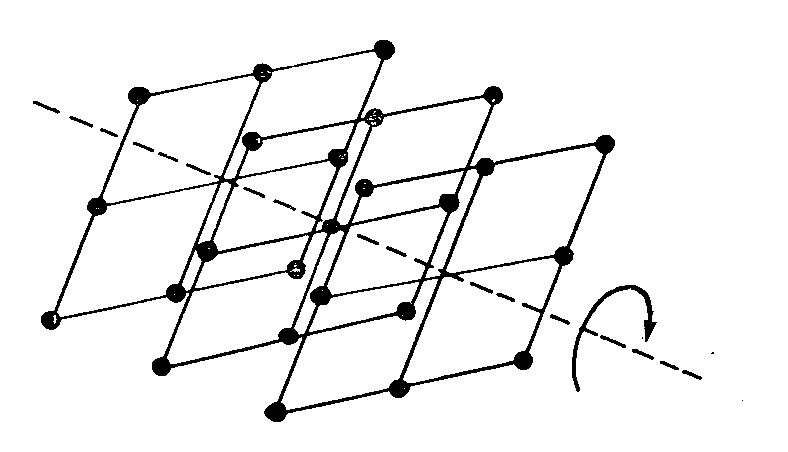
    Just as an electron can occupy a lattice site, a proton or other charged particle can be a focal point for the spin. If a great deal of energy is concentrated on a proton nucleus, then other lattice sites in the spinning system can be filled by protons. As one can see from fig. 1, any lattice spin that is dynamically balanced and inherently symmetrical about its axis must, in addition to the central proton, comprise either 8 or 24 other protons, bearing in mind the 3 × 3 × 3 lattice array. These spinning systems occur in pairs in order that the angular momentum should be conserved, similar considerations [p. 56] applying as for electron-positron pair creation. However, the 8 + 1 spinning unit can pair with a 24 + 1 spinning unit. The result is that the two units combined, if based on a proton form, will comprise 18 protons, 34 protons or 50 protons. This limits the formula for 2(2N + 1) to N equal to 4, 8 or 12.

    Fig. 1. – A 3 × 3 × 3 cubic lattice array of dots in three parallel planes, spinning about an axis (dashed line) through its centre
    Fig. 1.

    (12) A. Astbury: Phys. Bull., 34, 434 (1983).

    (13) Editorial, Phys. Today, 36, No. 11, 17 (1983).

    (14) H. Aspden: Lett. Nuovo Cimento, 38, 243 (1983).

    (15) V. F. Weisskopf: Phys. Today, 34-11, 69 (1981).

    (16) C. Rebbi: Sci. Am., 248, 36 (1983).

    (17) H. Aspden: Lett. Nuovo Cimento, 32, 114 (1981).

    (18) H. Aspden: Lett. Nuovo Cimento, 36, 364 (1983).

    The derivation of eq. (3) is based upon the energy quantum E′ creating 2(2N + 1) units from two colliding proton-sized particles, subject to the condition that the created elements are confined to the volume of these two protons. The model for the W-boson, therefore, has particles heavier than protons occupying the individual lattice sites, but one could imagine a multiplicity of protons coming together to fill lattice positions as suggested.

    So far as their effective charge is concerned, if they occupy a lattice site, having displaced a charge from that site, they will appear neutral. Furthermore, composite quark-structured units can presumably also occupy the lattice sites, perhaps having a bearing upon nuclear structure. One can then think in terms of protons, anti-protons and neutrons all being present in the same dynamic spin system, provided neutralization arises from electrons or positrons or the electrical properties of the vacuum, an unoccupied lattice site being a hole in the electrical subquantum medium.

    To support the proposition concerning Planck’s law and the lattice array defining the photon source, we will below list the analytical steps involved.

    The vacuum lattice stores energy E and angular momentum in the ratio w0, where w0 is the angular velocity corresponding to the natural frequency of vacuum oscillations. Thus

    E = Hw0 .(4)

    The angular momentum H is equal to that of 24 lattice elements rotating about an axis through their cubic array. The cube dimension is d and the notional mass of each element is m0. Thus

    H = 36m0d2w(5)

    for rotation at angular velocity w, there being 12 elements distant d and 12 distant 2d from the axis. The photon radiation frequency ν is four times w/2π. Therefore, from (4) and (5)

    E = (9m0d2)(2π)w0ν ,(6)

    which is Planck’s law, Planck’s constant h being

    h = (18π)(m0d2w0) .(7)

    When hν = mec2 the value of 2πν is w0, because we know that the vacuum has a resonance mode corresponding to electron-positron pair creation. Replace w0 in (7) to find

    h = 6πdc(m0me)½ .(8)

    For balanced oscillatory lattice motion with a restoring force rate of 4πe2/d3 (see ref. (14)) we find that

    8πe2/d3 = m0(w0)2 .(9)

    [p. 57]

    Eliminate w0 as before and use (2) with E = mec2 to obtain from (9)

    3(a/d) = πm0mec2d2/h2 .(10)

    From (8) and (10):

    d = (108π)a ,(11)

    from (8) and (11):

    hc/2πe2 = (108π)(m0/me)½(3a/e2)(mec2) ,(12)

    which, from (2) is

    hc/2πe2 = (108π)(4m0/me)½ .(13)

    It is beyond the scope of this paper to show that (me/2m0)3 is an odd integer uniquely determined on energy minimization to be 1843, but this is of record elsewhere (19,20). The resulting formula for the reciprocal of the fine-structure constant is (108π)(8/1843)1/6 which gives 137.035915.

    We can, however, evaluate d because (2) gives the electron charge radius as 1.88·10−13 cm. Therefore, d is 6.38·10−11 cm, which is about one-quarter of the Compton wave-length of the electron. Since the cavity radius of the system shown in fig. 1 is half the Compton wave-length, we can verify whether the 3 × 3 × 3 array in fig. 1 is the lattice element grouping isolated by the cavity. The cavity radius is, in fact, 1.9 d, which is precisely the value needed to include the corner elements of the lattice and exclude those at 2d spacing from the centre, assuming that the lattice elements have a small finite form or a range of position that fluctuates slightly.

    The value of m0c2 can be determined from the above analysis. It is found to be 21 keV. In contrast we have suggested that the graviton constituent of the lattice, which is a sparsely populating element providing dynamic balance for the lattice elements, has a mass energy of 2.587 GeV. It will, therefore, be understood why the author was particularly interested in the following words quoted from ref. (6):

    «The main stumbling block to progress is the shape of the X-ray spectrum. This has a curious discontinuity at (20 ÷ 40) keV, usually termed the kink or break; it corresponds to a break at (2 ÷ 5) GeV in the parent electron spectrum, which is itself hard to explain».

    It is submitted that this is evidence of the two energy levels set by the subquantum vacuum medium, which may come into evidence in single energy units or paired energy units. The Z0-boson, when confirmed, may be a crucial indicator of the existence of the 2.587 GeV graviton.

    (19) H. Aspden and D. M. Eagles: Phys. Lett. A, 41, 423 (1972).

    (20) H. Aspden: Physics Unified (Sabberton, Southampton, 1980), p. 112.

  • 1984c

    1984c

    The following is a paper by H. Aspden published in Lettere al Nuovo Cimento, v. 39, pp. 271-275 (1984).

    ‘THE MUON g-FACTOR BY CAVITY RESONANCE THEORY’

    Abstract: It is shown that a cavity-resonance model by which the muon/electron mass ratio was recently determined as 206.7683078 yields also a muon g-factor of 2(1.001165918), both of these quantities being in accord with their measured values.


    To see the full text of this paper as presented in pdf format press: [1984c]


    Full text of the paper (transcribed from the PDF)

    Transcribed from the scanned pages of the printed paper. [p. N] marks where each printed page begins; figures are cut from the scans. The PDF above is the original.

    [p. 271]

    Lettere al Nuovo Cimento Vol. 39, N. 12 24 Marzo 1984

    The author has obtained the permission of the copyright owner Societa Italiana di Fisica to publish this paper here in PDF format.

    The Muon g-Factor by Cavity Resonance Theory.

    H. Aspden

    Department of Electrical Engineering, University of Southampton
    Highfield – Southampton, SO9 5NH, England

    (ricevuto il 25 Gennaio 1984)

    PACS. 12.90. – Miscellaneous theoretical ideas and models.

    Summary. – It is shown that a cavity-resonance model by which the muon/electron mass ratio was recently determined as 206.768 307 8 yields also a muon g-factor of 2(1.001 165 918), both of these quantities being in accord with their measured values.

    In a recent paper the author (1) has shown that the time dilation evidenced by the muon can be explained by a quantum-statistical transition between states, including charge-pair creation and balanced exchanges of energy between the muon and the vacuum itself. The governing conditions were 1) charge conservation, 2) energy conservation and 3) conservation of the volume of space occupied by the quarklike charge constituents of a particle, the volume of the space occupied by charge being determined by the Thomson formula

    mc2 = 2e2/3a .(1)

    Here m is the mass of the charge, c the speed of light, e the electric charge and a the radius bounding the spherical form of the charge.

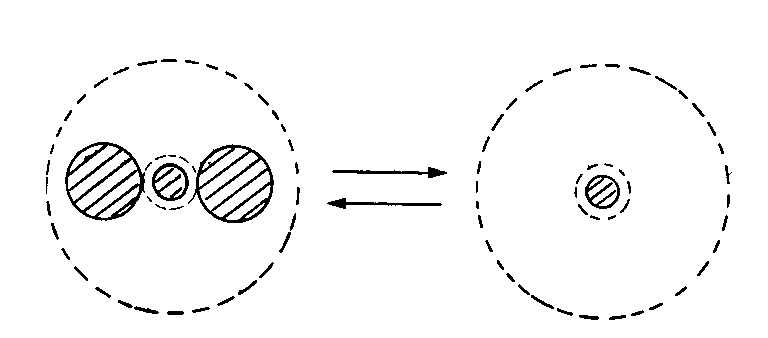
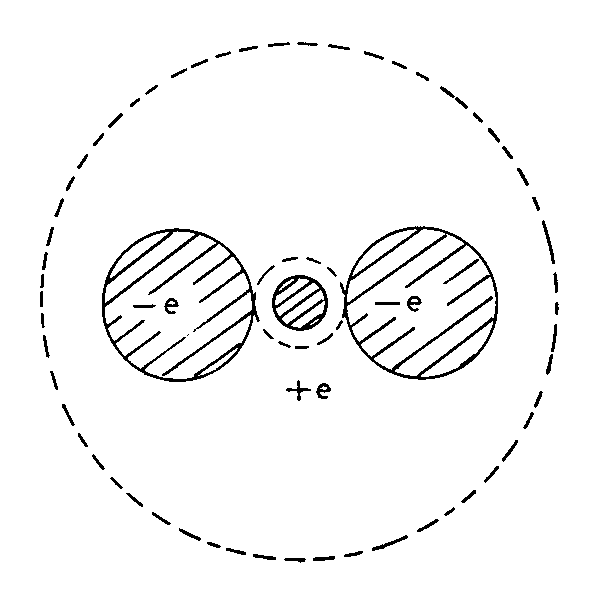
    Separately, in another paper, the author (2) has shown that the muon has a mass regulated by its composite structure as three charges, the negative muon comprising a positive core charge + e plus two electrons − e, as illustrated in fig. 1.

    The essential feature was the development of a resonance within a cavity centred on the core charge, waves traversing the radial spacing between the cavity boundary and an inner reflecting spherical surface (depicted by the broken circles) in synchronism with a harmonic of the electron’s Compton frequency and in near synchronism with the fundamental of a standing wave on the surface of the electron charge.

    (1) H. Aspden: Lett. Nuovo Cimento, 37, 307 (1983).

    (2) H. Aspden: Lett. Nuovo Cimento, 37, 210 (1983).

    [p. 272]

    Fig. 1. – The negative muon: a positive core charge +e between two electrons −e, with broken circles marking the cavity boundary and the inner reflecting surface
    Fig. 1.

    This determines the muon’s radial cavity spacing as 1/207 times that of the electron. The inner reflecting cavity surface is determined by a balance of energy intercepted from the standing wave across this surface section and the electric-field energy radiation (half the Larmor radiation) from the accelerated charge. For an electron the Thomson scattering cross-section, as quoted in reference books (3), is

    (8π/3)(e2/mec2)2(2)

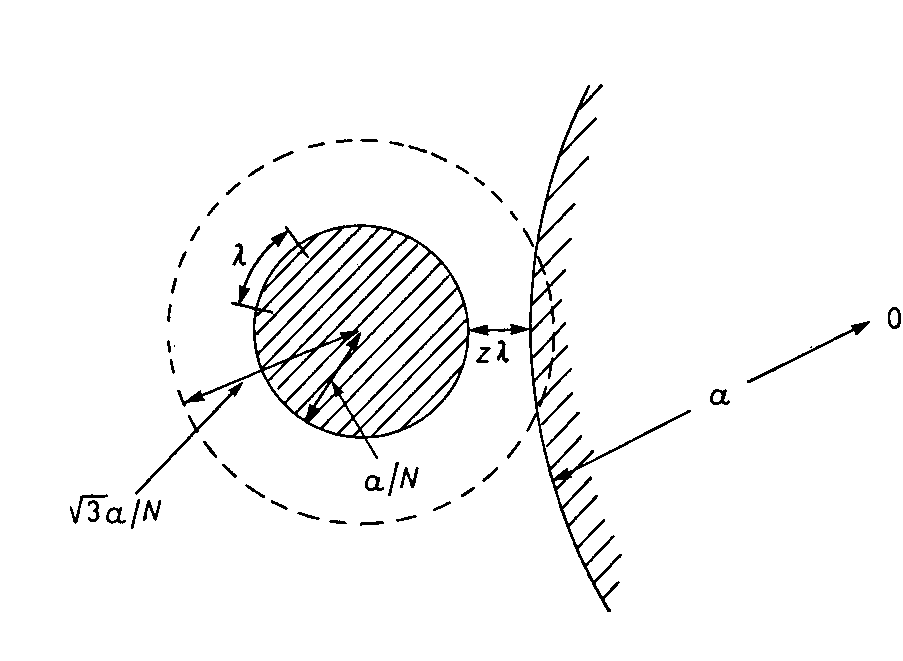
    Half of this, from (1), is 3πa2, which tells us that the radius of the inner cavity surface is √3 times the radius of the charge given by the Thomson formula (1). me is the electron mass in (2), but (1) and (2) apply generally to any discrete charge, including the muon core charge.

    The radius of this reflecting surface is crucial to the determination of the spacing between the electrons and the central core charge of the muon and so the consequential determination of the rest mass of the muon. Subject to a primary resonance condition involving the standing wave at the surface of the muon core charge, it can be shown that the muon/electron mass ratio is precisely

    mμ/me = 209 − (9/4)(207/(208 + 2π/9)) ,(3)

    which is 206.768 307 8. This is the subject of a recent paper (4). The measured values known to the author are 206.768 35(11) by Klempt and co-workers (5) and 206.768 272(64) from a conference report (6).

    The √3 radius parameter is also crucial to the determination of the anomalous component of the electron g-factor and one can write

    (1/2)ge = 1 + 1/(hc/e2 − 1 + 4/3½) ,(4)

    (3) E. U. Condon and H. Odishaw: Handbook of Physics (McGraw-Hill, New York, N. Y., 1967), p. 7134.

    (4) H. Aspden: Lett. Nuovo Cimento, 38, 342 (1983).

    (5) E. Klempt, R. Shulze, H. Wolf, M. Camani, F. N. Cygnx, W. Ruegg, A. Schenck and H. Schilling: Phys. Rev. D, 25, 652 (1982).

    (6) A. Rich: Conference paper, Second International Conference on Precision Measurement and Fundamental Constants, National Bureau of Standards (Gaithersburg, 8-12 June 1981).

    [p. 273]

    where hc/e2 is 2πα−1, α being the fine-structure constant. This formula gives the measured electron g-factor to an accuracy of a few parts in 109, but is subject to a correction for gravitational potential which can bring it into exact accord with the measured value at the level of a few parts in 1012. See Aspden (7). However, the muon g-factor is not known to such accuracy. The author (8) has shown that a second resonance mode internal to the inner reflecting surface which thereby constitutes an inner cavity can modify (4) by changing the plus sign before the term involving the root 3 parameter to a minus. This increases the g-factor and gives a value which suggests that the muon may have such an alternative resonance mode. As shown in ref. (8), the resulting value of ½g is 1.001 165 868 2, based on a value of α−1 of 137.036 0, and this compared with a measured value reported in 1973 of 1.001 165 895(27).

    Such a result seemed in excellent accord with the theory for the muon g-factor, but, as Klempt and co-workers (5) report, the measured muon g-factor is now indicating that ½g is 1.001 165 923 0(85). This small difference is enough to warrant a re-examination of the theory of the muon g-factor based on cavity resonance, particularly in the light of the new understanding of the muon charge structure suggested by the explanation of its mass.

    The model shown in fig. 1 has one evident disadvantage. This appears at the time of its decay and in connection with the quantum-statistical transition between states mentioned in our introduction. A negative muon decays into a single electron so far as the conservation rules governing transitions between states are concerned. Other rules may affect the traces of neutrinos, as is well known. The problem then is that the space conservation requirement is violated if a muon of the form shown in fig. 1 can decay into a simple electron. The volume of the electron charge given by (1) is many million times larger than the volume of the muon core charge given by the same formula. The logical assumption which follows from this is that the state shown in fig. 1 applies only half of any period of time and that during the other half of this period the core charge has become negative and stands in isolation. This can occur by the quantum-statistical process discussed in ref. (1). The positive core charge may expand spontaneously to transfer an energy quantum to the vacuum surrounding the charge. It expands into a positron which annihilates one electron as the other electron recaptures all the energy to restore energy balance by becoming a negative core charge now having the true muon mass. The charge parity is conserved. The volume conservation is violated transiently, but preserved in average provided the sequence of state change is cyclic. If the mean volume of the muon system is that of one electron, then the muon must change state in the manner suggested, spending half of its time in each state.

    Fig. 2. – The three-charge muon system of fig. 1 interchanging (arrows) with a state having a single charge
    Fig. 2.

    This is depicted in fig. 2, where the muon system of fig. 1 is shown to interchange with one having a single charge. Since the muon mass is 206.768 03me and this is [p. 274] conserved on average on a statistical basis, allowing for some vacuum fluctuations in which energy is exchanged, we may suppose that this second single charge state sometimes comprises a coalesced single charge form of 205 electrons and positrons and sometimes one formed from 207 electrons and positrons. The resonant cavity radial spacing will vary for each of these forms, but will always be equal to a harmonic of half the electron’s Compton wave-length.

    (7) H. Aspden: Lett. Nuovo Cimento, 37, 169 (1983).

    (8) H. Aspden: Lett. Nuovo Cimento, 33, 481 (1982).

    Each of the three charges in the first muon state develops its own cavity resonance centred on its charge, thus providing three overlapping cavities in the associated field systems. The positive core charge has a cavity set by its mass component of 207me, whereas the other negative electron charges have the cavity dimensions of the electron. The g-factor in this state is governed by the mass of the field energy lying outside these cavities. Thus, taking the isolated electron as a reference we may formulate the electron’s g-factor as

    ½ge = me/ms = 1/(1 − δ) .(5)

    The electron’s spin mass ms can be identified with a motion of the electron charge that does not affect the field outside the cavity radius. The mass δme is effectively that of the field located outside the cavity. This is represented in the table below.

    Mass Electron Muon
    A B C
    outside cavity δme 209 δme 207 δme 205 δme
    in spin (1 − δ)me mμ − 209 δme 207 (1 − δ)me 205 (1 − δ)me
    total me mμ mμ on average

    For the muon in its three-charge state A there are 207 + 2 such δme units of mass decoupled from the spin state because the electric-field energy outside a radius which is 1/207 times the cavity radius of the electron is 207 times that applicable to the electron. In the single charge state B or C of the muon there are either 207 or 207 − 2 such mass units in the decoupled field as the muon transiently adopts the resonance mode associated with the shedding of an electron-positron pair in its exchanges with the vacuum, but on average there are 206.768 3 such units, corresponding to the muon mass mμ.

    Considering the ratios of the total mass to the spin mass, we find that the muon in states B or C has the same g-factor as the electron, but that in state A it is slightly higher. The actual muon g-factor is found by averaging the action over the half-period in which state A applies and the half period in which states B or C apply. Thus

    (1/2)gμ = 2mμ/(mμ − 209 δme + (1 − δ)mμ) .(6)

    This can be evaluated because we know mμ/me and δ is known from the electron g-factor as measured and, from (5), δ is 1 − 2/ge. Putting ge as 2(1.001 159 652), its measured value, the corresponding value of δ taken with the known mass ratio of 206.768 3 gives a muon g-factor of 2(1.001 165 918). This is in remarkable agreement with the measured value of 2(1.001 165 923 0 ± 85) already referenced (5). Our theoretical value is about half the standard deviation different from the measured value.

    [p. 275]

    It is submitted that the model of the muon by which its mass has been determined with such high precision lends itself to a simple quantum-statistical interpretation of the muon g-factor. Only further improvement in the measurement of the muon g-factor can decide how this new theory stands in relation to conventional quantum electrodynamics. QED is reported (6) as giving a theoretical muon g-factor of 2(1.001 165 921), but from a composition of three theoretical contributions. The factor 1 165 921 comprises 1 165 852 as the true QED values plus 67 for a strong-interaction effect plus 2 for a weak-interaction effect and the overall result is uncertain by ±8. Yet such theory, although having full acclaim for its precision in accounting for the measured g-factor, offers no explanation of the muon/electron mass ratio, a parameter which Nature determines in some controlled way to a constancy of about 3 parts in 107. There is benefit in following a theoretical avenue which can embrace both the mass and the g-factor of the muon and, since this paper concludes the research into the resonant-cavity properties of the electron and muon undertaken by the author, it is hoped that the merits of this new theory will be appreciated by those engaged in this field of enquiry.

  • 1984b

    1984b

    The following is a paper by H. Aspden published in Lettere al Nuovo Cimento, v. 39, pp. 247-251 (1984).

    ‘ELECTROMAGNETIC RADIATION PARADOX’

    Abstract: Alternative explanations for free-electron diamagnetism appear paradoxical and inconsistent with the reactive induction properties of magnetic materials. It is shown that the paradox can be eliminated by a generalized definition of the magnetic field with interesting spin-off consequences, including a justification for the anomalous doubling of the positron’s effective mass in a free-electron environment.

    Commentary: Here, once again, the author drew attention to his theme on diamagnetic reaction as the clear evidence of the need for an aether capable of justifying the g-factor of 2. This time, however, the author pointed to its relevance to positron reaction properties. Whereas Dirac-type theory implies symmetry, the experiments reveal the asymmetry which this author’s theory implies.


    To see the full text of this paper as presented in pdf format press: [1984b]


    Full text of the paper (transcribed from the PDF)

    Transcribed from the scanned pages of the printed paper. [p. N] marks where each printed page begins; figures are cut from the scans. The PDF above is the original.

    [p. 247]

    Lettere al Nuovo Cimento Vol. 39, N. 11 17 Marzo 1984

    The author has obtained the permission of the copyright owner Societa Italiana di Fisica to publish this paper here in PDF format.

    Electromagnetic Reaction Paradox.

    H. Aspden

    Department of Electrical Engineering, University of Southampton
    Highfield – Southampton, SO9 5NH, England

    (ricevuto il 25 Gennaio 1984)

    PACS. 71.60. – Positron states.

    Summary. – Alternative explanations for free-electron diamagnetism appear paradoxical and inconsistent with the reactive induction properties of magnetic materials. It is shown that the paradox can be eliminated by a generalized definition of the magnetic field with interesting spin-off consequences, including a justification for the anomalous doubling of the positron’s effective mass in a free-electron environment.

    There are several alternative explanations for the apparent absence of significant diamagnetic reaction from free electrons owing to their motion in conductors subject to steady magnetic fields. Van Vleck (1) refers to the theorem of Miss van Leeuwen and the work of Bohr in showing that classical Boltzmann statistics deny that electrons should assert any diamagnetic reaction. Van Vleck further suggests that free electrons do produce a reaction field, but that other electrons deflected at the boundary surface by a potential barrier are guided around that surface so as to produce an exactly compensating field.

    Van Vleck then qualifies his account by noting that «in a true theory, quantum modifications must be taken into account, and … in quantum mechanics there is a diamagnetic effect from free electrons». Dingle (2) has investigated this subject extensively to find that such effects are still very much smaller than one could expect from a full electron reaction. A general assumption by which such a primary diamagnetic state is discounted is connected with the fact that the Lorentz force acts on the electrons at right angles to their motion and so the magnetic field can in no way be affected by electron reaction because energy is not transferred by electron reaction because energy is not transferred in this process. This same argument is used (3) to show that the magnetic moment of charged particles subject to a changing magnetic field is adiabatically invariant.

    (1) J. H. Van Vleck: The Theory of Electric and Magnetic Susceptibilities, Oxford University Press (1932), p. 94.

    (2) R. B. Dingle: Proc. R. Soc. London, Ser. A, 211, 500 (1952).

    (3) E. U. Condon and H. Odishaw: Handbook of Physics, 2nd Ed. (McGraw-Hill, New York, N. Y., 1967), p. 4, 193.

    [p. 248]

    It is paradoxical to argue from the Lorentz force that a changing magnetic field cannot transfer energy to reacting electrons. Experience from magnetic induction and eddy-current effects tells us that there are induced electromotive forces acting on electrons in their direction of motion. The fact that there appears to be no free-electron diamagnetism commensurate with the energy of the ordering magnetic field present is perplexing. Quantization or statistical attempts to interpret the result may provide the answer, but there may still be a more deep-rooted explanation.

    The principal paradox, however, is that there are so many alternative explanations for the same phenomenon, a fact which implies that none is sufficiently convincing.

    A plausible answer to the paradox appears if we examine the empirical origins of the electromagnetic field as induced by charge in motion. The empirical data in Ampère’s early work concerns the forces of interaction between currents. This was extended by Maxwell (4) and has been reviewed by Whittaker (5). Whether one terms it the law of Grassmann or that of Biot and Savart, the point is that, in scalar vector form, the force asserted by a current i in a circuit element ds, when acting upon a current i′ in a circuit element ds′ at a vector separation distance r, is known empirically to be

    F = (ii′/r3){(ds′·r)ds − (ds·ds′)r} .(1)

    Both Maxwell and Whittaker observed that this law could contain a term (ds·r)ds′, because the empirical data concerned only observations for which i was circuital and this term vanishes under these conditions. Some authors argue that this is irrelevant because displacement currents in the field invariably render charge motion effectively circuital so that (1) applies rigorously for action between isolated charges.

    Equation (1) can be written in the form

    F = (ii′/r3)∫s[ds′[dsr]](2)

    and from this one can define the magnetic field H as

    H = ki∫s(1/r3)[dsr](3)

    and write the force F as

    F = (i′/k)[ds′H] .(4)

    Since it is force and current that are measured, the field H is somewhat arbitrary, serving only as a connection between the two eqs. (3) and (4).

    However, we have independently defined the field H by analogy with the properties of magnets and known that the apparent value of H, in the units we are using and for action in the vacuum medium, is such that k above is unity. The inconsistency arises in our use of empirical data which inevitably involves diamagnetic effects. If the magnetic field produced by the current i is really augmented by the factor k and [p. 249] offset by diamagnetic effects which make k appear to be unity, then we can adhere to the usual force formula witk k = 1 in (4), but accept that H is then given by a more elaborate version of (3):

    H = ki∫s(1/r3)[dsr] − kΣiR∫s(1/r3)[dsr] ,(5)

    where iR signifies reaction currents generating diamagnetic effects.

    (4) J. C. Maxwell: A Treatise on Electricity and Magnetism, 1954, Vol. 2 (Dover Ed, Yew York, N. Y., 1891), p. 174.

    (5) E. Whittaker: A History of the Theories of Aether and Electricity: The Classical Theories (Nelson, London, 1951), p. 87.

    k is not unity in (5) but has a value which assures that the equation adopts the form

    H = kH − HR ,(6)

    where HR is the diamagnetic reaction field and is 4πk times the current moment of reacting charge in unit volume. Let q, m and v denote the electromagnetic charge, mass and speed of a reacting charge element deflected by the field H into a circular orbit and orientated to produce a field component in opposition to H. Let r be the radius of the orbit. Then qvr/2 is the current moment and

    HR = 4πkΣ (qvr/2) .(7)

    Also, since (4) applies with k unity,

    Hqv = mv2/r(8)

    and the summation over unit volume of (qvr/2) becomes, from (8), Σ (½mv2)/H. We write this kinetic-energy density term as E/H and combine (6), (7) and (8) to show that

    H = kH − 4πkE/H(9)

    or

    E = (H2/4π)(1 − 1/k) .(10)

    In the magnetization process an energy density of H2/8π is fed into the field as H increases from zero. The resulting induction of electromotive forces around any path in the field can supply the additional kinetic energy given by (10) and this indicates that E is, by its very nature, the magnetic energy stored by the field. Thus we see that k must be 2.

    In effect, therefore, the free reacting charge in the field medium stores magnetic energy and invariably exhibits a diamagnetic component of reaction which cancels half of the induced field, leaving quantum and statistical processes to account for secondary effects in the accepted way.

    This phenomenon passes unnoticed in most situations because, as eq. (3) shows with k = 2, the induced field is double that measured. However, it does have consequences which appear in special situations, including at least the following three.

    Firstly, the gyromagnetic properties of an orbital charge, whether primary or reacting, will cause the measured ratio of magnetic moment to angular momentum to be double that given by classical theory. This is known to be the case from experiments [p. 250] by Barnett (6) there being a well-established anomaly factor of 2 in the gyromagnetic behaviour of electrons in ferromagnetic substances. Bates (7) has summarized the experimental data demonstrating this phenomenon. It has, however, been interpreted as a spin phenomenon dependent upon Dirac’s theoretical work, with the consequence that theories of ferromagnetism presume that only a small portion of the magnetism arises from the orbital electron motion.

    Secondly, the saturation magnetic moments of ferromagnetic materials, which are not integral quanta of the Bohr magneton per atom, become so when we allow for the diamagnetic reaction, at least for iron, nickel and cobalt. This is eastly verified for the body-centred iron structure, on the assumption that one low magnetostriction implies a stress isotropy due to the magnetic state and suggests that the polarization φ Bohr magnetons per atom switches between the three cubic axes to spend one-third of its time in the preferred direction and one-sixth of its time in each of the four orthogonal directions. This produces an average polarization of φ/3 per atom, but this is offset by a diamagnetic effect of φ/6, half the mean polarization, which itself switches about between axes, so as always to oppose the primary polarization φ. Thus the resulting diamagnetic reaction is one-third of φ/6 or φ/18, on average. The measured polarization, from the theory outlined, is, therefore, φ/3 − φ/18 or (5/18)φ.

    When this is compared with the measured 2.221 Bohr magnetons per atom, we see that φ is, indeed, an integer, being 8.00. In fact, it should be twice an integer, owing to the double field effect. This is consistent with the ferromagnetic state in iron being attributed to two 3d electrons.

    Such theory does depend upon a relatively weak coupling between the primary electron motion and that of the diamagnetic response, but this gives it potential for further research along new and possibly fruitful lines.

    Thirdly, whereas the free-electron reaction offsets the field effect of a primary electron and so produces momentum in opposition, we would expect such free electrons to react differently if the primary action is that of a positron. The field reaction would still be half the primary field, but the momentum would augment, rather than offset, that of the positron.

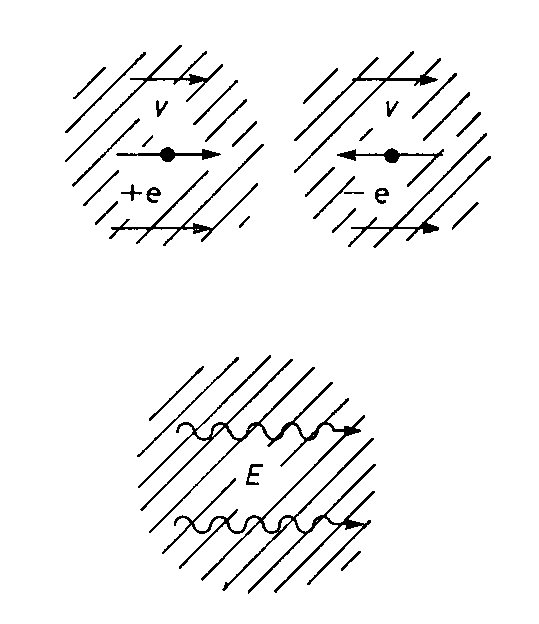
    Imagine a positron to be moving through a conductor and to have acquired the thermalized velocity state of the free electrons. A head-on collision between the positron and an electron is depicted in fig. 1, the upper section showing that just before collision the positron of charge + e and the electron of charge − e, both having speed v, are each accompanied by a diamagnetic reaction generated by surrounding electrons and shown shaded. The arrows imply the direction of the momentum carried by each shaded area and, as it originates in electrons, the momentum of each area is half that of the positron. The lower section of fig. 1 depicts the situation after annihilation of the positron and the electron. The energy E of the photon has a momentum residual to the collision that is equal to that possessed initially by the isolated positron. In effect, therefore, we expect that the theory presented should account for an apparent doubling of positron mass as judged from their annihilation from the thermalized state in conductors.

    This is exactly what is observed. Steward and Shand (8) reported an experiment designed to test directly whether or not positrons in a metal were thermalized. The authors asserted that what they observed was surprising in that «the positron is thermalized, but has an effective mass in sodium metal approximately twice the rest [p. 251] mass». Their actual result, based upon analysis of photon emission resulting from positron bombardment, gave the positron an effective mass m* of

    m* = (1.9 ± 0.4)m ,(11)

    where m is electron mass. They concluded that this result was a measure of the many-body mass of a positron in an electron sea.

    (6) S. J. Barnett: Rev. Mod. Phys., 7, 136 (1935).

    (7) L. F. Bates: Modern Magnetism, 4th Ed. (Cambridge University Press, 1961), p. 243.

    (8) A. T. Stewart and J. B. Shand: Phys. Rev. Lett., 16, 261 (1966).

    Fig. 1. – Positron (+e) and electron (−e), each with speed v, in shaded diamagnetic reaction regions before collision (top); the photon of energy E after annihilation (bottom)
    Fig. 1.

    Bergerson and Pajanne (9) later confirmed that Stewart and his co-workers had correctly given the positron mass, also in respect of later work which gave m*/m as 1.8±0.3, 1.8±0.2, 2.1±0.3 and 2.3±0.3 for Li, Na, K and Rb, respectively. Bergerson and Pajanne, however, stressed that, if the mass increase were really due to electron gas effects, there was an inexplicable discrepancy between theory and observation. Their own efforts to explain the effect as due to positron-phonon interaction proved insufficient to account fully for the data and their conclusion was that more experimental work was needed. Meanwhile, Garg and Saraf (10) maintained the view that the positron’s effective mass did depend upon its interaction with the electron gas by inferring a correlation between the apparent variation of m*/m and differences in the electron densities in the substances tested. This supported their early investigations on the lifetime of the positron in an electron gas (11).

    It is submitted that this positron mass anomaly is explained by the same diamagnetic reaction actions as evidenced by the gyromagnetic properties of charge and that there is consequently evidence that even in the vacuum field there is reacting charge of some kind having a mass property. This would be in accord with Maxwell’s efforts to explain the nature of displacement in his electromagnetic theory and in accord with the recent experimental findings of Graham and Lahoz (12) who have shown that the vacuum does exhibit inertial properties somewhat in accord with Maxwell’s theory.

    (9) B. Bergersen and E. Pajanne: Phys. Rev. B, 3, 1588 (1971).

    (10) J. C. Garg and B. L. Saraf: Phys. Lett. A, 31, 144 (1970).

    (11) J. C. Garg and B. L. Saraf: Phys. Lett. A, 30, 369 (1969).

    (12) G. M. Graham and D. G. Lahoz: Nature (London), 285, 154 (1980).

  • 1984a

    1984a

    The following is a paper by H. Aspden published in Speculations in Science and Technology, v. 7, pp. 3-6 (1984).

    THE FINITE LIFETIME OF THE ELECTRON

    Abstract: It is shown that the corpuscular electron may have a finite lifetime of the order of 10-13 seconds, which defies detection owing to a statistical process by which the electron is immediately recreated. Anomalies in reported experiments are discussed as evidencing this decay process indirectly.

    Commentary: The author is here beginning to develop the concept that stable matter, as we know it, which is nucleated from protons and electrons, is really the ultimate decay state which energy adopts in the material world. If energy is radiated into space it is eventually captured by the vacuum and becomes part of the ordered quantized motion of the ‘aether’ energy sea. The energy equilibrium criteria as between matter and that aether background will govern when energy is shed to create protons and electrons, but this occurs in a continuous background of proton and electron decay and recreation determined by their respective lifetimes, which defy direct measurement because recreation in the same form occurs in the immediate vicinity. In the case of the electron we see indirect evidence from the barrier penetration phenomenon. It can tunnel through potential barriers as if it has the lifetime calculated by the theory presented in the subject paper.


  • 1983k

    1983k

    The following is a paper by H. Aspden published in Lettere al Nuovo Cimento, v. 38, pp. 243-246 (1983).

    PLANAR BOUNDARIES OF THE SPACE-TIME LATTICE

    Abstract: Having regard to the developing interest in a lattice-structured vacuum in intepreting the structure of particles, an aspect of the electrically structured lattice model of the vacuum is discussed in relation to electric field energy. It is shown that a necessary condition is that the lattice should have planar boundaries. This implies a domain structure somewhat analogous to that found in ferromagnetic materials.

    The subject of the paper is discussed elsewhere in these Web pages. See WHY HAWKING IS WRONG!. Several quoted sections are there included.


    To see the full text of this paper as presented in pdf format press: [1983k]


    Full text of the paper (transcribed from the PDF)

    Transcribed from the scanned pages of the printed paper. [p. N] marks where each printed page begins; figures are cut from the scans. The PDF above is the original.

    [p. 243]

    Lettere al Nuovo Cimento Vol. 38, N. 7 15 Ottobre 1983

    The author has obtained the permission of the copyright owner Societa Italiana di Fisica to publish this paper here in PDF format.

    Planar Boundaries of the Space-Time Lattice.

    H. Aspden

    Department of Electrical Engineering
    University of Southampton – Southampton, S09 5NH, England

    (ricevuto il 15 Luglio 1983)

    PACS. 12.20. – Electromagnetic and unified gauge fields.

    Summary. – Having regard to the developing interest in a lattice-structured vacuum in interpreting the structure of particles, an aspect of the electrically structured lattice model of the vacuum is discussed in relation to electric-field energy. It is shown that a necessary condition is that the lattice should have planar boundaries. This implies a domain structure somewhat analogous to that found in ferromagnetic materials.

    Modern physical theory is tending to regard the vacuum medium as having structure somewhat analogous to that of crystalline materials. Thus we see Weisskopf (1) discussing quantum electroweak dynamics and asserting that the Higgs field implies that the vacuum has a certain fixed direction in isospace, namely that of the spinor associated with the Higgs field. Weisskopf states that the situation is like that of a ferromagnet, in which the direction in real space is determined as long as the energy transfers are smaller than the Curie energy.

    This, of course, implies an ordered structure of the vacuum medium, a feature discussed at some length by Rebbi (2) in an article entitled The lattice theory of quark confinement. Rebbi refers to a 1974 proposal by Wilson that QCD (Quantum Chromodynamics) should be formulated on a cubic lattice, an array that divides space and time into discrete points, but is essentially an approximation to real space-time. The advantage is that this allows calculations to be made that would otherwise be impossible.

    This author, in collaboration with Dr. M. Eagles, has advocated the analysis of a vacuum structure and shown how a value of the fine-structure constant correct to about one part in a million can be determined by a cubic lattice model of the vacuum (3). Further research on this model has now shown the essential need for a particular boundary condition imposed upon a physical portrayal of the vacuum state expressed in terms of electrical charge. It is in view of the current interest in lattice theory as [p. 244] applied to the vacuum field system that it seems appropriate to draw attention to what has been, to the author at least, a rather elusive consideration.

    (1) V. F. Weisskopf: Phys. Today, 34-11, 69 (1981).

    (2) C. Rebbi: Sci. Am., 248, 36 (1983).

    (3) H. Aspden and D. M. Eagles: Phys. Lett. A, 41, 423 (1972).

    The vacuum is seen to be electrically neutral on a macroscopic scale. It has long been regarded as the seat of electric displacement currents according to Maxwell’s theory and so should have some electrical content microscopically. In recent times the physical character of the vacuum could be ignored by reliance upon Maxwell’s equations, but experiments by Graham and Lahoz (4) have now given cause for coming back to the position that the vacuum does contain electrical structure and can be the seat of forces asserted on test apparatus.

    If the elements of this vacuum structure are in a state of stable equilibrium and comprise electric charge, then, in order to satisfy Earnshaw’s law, they must pervade a charged electrical continuum of opposite polarity. The latter is necessary to assure stability by providing a restoring action upon displacement. Accordingly, the only feasible electrical model for a vacuum state having structure is one for which discrete charges q of the same polarity interact to form a lattice within a continuum of opposite charge density σ. It seems logical to suppose that the charges q are of equal magnitude and that σ is uniform over a local region of space.

    Then, by simple analysis, one may show that if a lattice parameter d is written to satisfy

    q = σd3 ,(1)

    the electrically-neutral state of the vacuum implies that each charge q takes up a space volume d3. With a uniform electric field of intensity E applied we find that the charges q will all be displaced in unison to satisfy

    Eq = kx ,(2)

    where k is a constant restoring force rate and x is displacement. In effect, the whole lattice is displaced relative to the background continuum.

    The energy density stored by this displacement is

    W = ½kx2/d3(3)

    or, from (2)

    W = ½(Eq)2/kd3(4)

    and as this is E2/8π, for a vacuum of unit permittivity, we find that k is given by

    k = 4πq2/d3 = 4πσq(5)

    from (1), thereby justifying the statement that it is a constant.

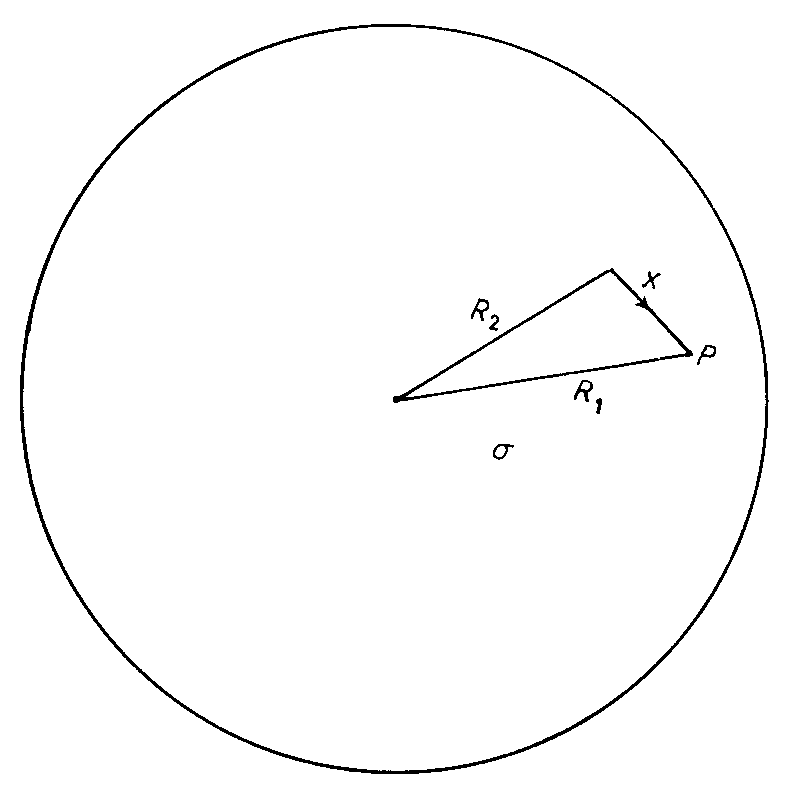
    The use of this restoring force rate is fundamental to classical electron theory and it might seem somewhat elementary to have derived it from the electrically neutral vacuum model under discussion. However, a problem emerges upon analysis of radial displacement of a charge q within an arbitrarily spherical bounded system. At a distance R from the centre of a sphere of continuum charge the total continuum charge acting [p. 245] on q is 4πσR3/3. The electric field is radial and is found by dividing this charge by R2. Thus the electric field is 4πσR/3, where R is now a vector.

    (4) G. M. Graham and D. G. Lahoz: Nature (London), 285, 154 (1980).

    For any displacement x, as shown in fig. 1, a charge q at P will be subject to a restoring force which is the expression 4πσ/3 times the vector difference between two radius vectors R1 and R2. This is simply (4π/3)σx. It follows that if q is part of a rigid lattice which is displaced as a whole by the distance x within the bounding spherical continuum, then the lattice is subject to restoring forces which are only one-third those expected from eq. (5).

    Fig. 1. – A sphere of continuum charge σ with radius vectors R1 and R2 to a charge at P displaced by x
    Fig. 1.

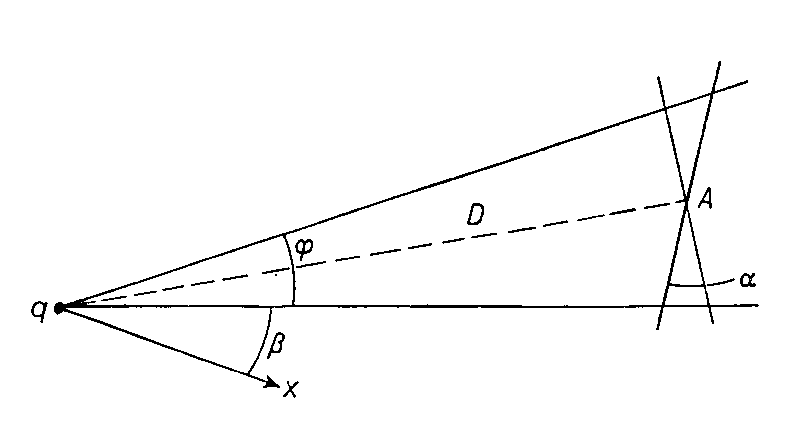
    Now consider a charge q at a position at which it subtends a solid angle φ with respect to an elemental area A at a planar boundary of the continuum. Let α be the angle between this surface of area A and a plane surface drawn normal to the line joining q and A. This is shown in fig. 2.

    Suppose now that q is displaced slightly through a distance x and that the corresponding displacement along qA is y. The effect of this is to cause the electric potential due to the continuum in the same solid angle to reduce in effect upon q. It is as if q were left at rest and a planar slice of thickness y cos α were removed from the boundary surface. The electric field acting on q is, therefore, reduced by Aσy cos α/D2, where D is the distance of q from A. Now, the solid angle φ intercepts a spherical surface distant D over an area φD2 and this must be A cos α. It then follows that the electric field changes by φσy, owing to the component effect of the continuum contained by the planar boundary and this solid angle φ. If qA is at an angle β to the displacement x then we find that y cos β = x, but since the force qφσy due to the elemental continuum segment shown acts at this same angle to x the force resolves into a component along x of qφσy cos β. This is qφσx and it sums upon integration over a full solid angle of 4π to 4πqσx to give the restoring force set by (5).

    It follows that, provided the boundaries of the continuum space domain are planar we will have conformity with the normal energy density formulation. Conversely, since the energy density has to be that known from experimental observation, we can say that a lattice-structured space of the kind described must have planar boundaries, a feature which further enhances the analogy with the ferromagnetic state. We may [p. 246] then wonder whether we may yet discover the further property that space itself does have the domain structure predicted by this enquiry.

    It remains to be seen whether such domain structure would be of a microscopic nature confined to the dimensions of elementary particles or whether it may even extend to a cosmic scale. One consequence of the latter possibility is the prospect that electric polarities of lattice charge and continuum may be reversed in adjacent domains, a kind of antispace analogous with antimatter. Alternatively, there may be a harmonius cyclic motion which is shared by the lattice, but which is reversed in adjacent domains. Either way, if one argues that rotation shared with the Earth causes the space medium to induce the geomagnetic field (as suggested by Aspden (5)), it is to be expected that geomagnetic field reversals might signal a traversal of a cosmic space domain. By correlating the pattern of such geomagnetic field reversals with the Earth’s cosmic motion through space we may then plot any large scale domain structure of the vacuum. Some evidence of this is presented elsewhere (6,7), the cubic structure of the space medium being evidenced by reversals which occur in pairs as the Earth traverses obliquely near a cube edge.

    Fig. 2. – A charge q subtending a solid angle φ at an elemental area A, distance D, at a planar boundary inclined at α; displacement x at angle β
    Fig. 2.

    The main point of this paper, however, is showing that planar boundaries are indicated from field energy considerations. It is also relevant to note that, if the lattice displacement in the structured vacuum were subject to propagation delays, the analysis would present the conflict discussed above because the symmetrical propagation would imply spherical boundary action. The answer to this could be that lattice displacement which involves no lattice distortion keeps the relative spacings of all charges unchanged and so the energy associated with their interaction is not affected. If no energy is transferred, then the action appears to be one of harmonius motion and what may otherwise be taken to be an action at a distance. This result may have some bearing upon the reported conflicts between quantum theory and the theory of relativity involving the measurement of polarization of matched pairs of photons and their apparent coupling at speeds in excess of the speed of light.

    * * *

    The author concludes by thanking Dr. D. M. Eagles who drew attention to the problem of the restoring force anomaly for spherically bounded systems and has urged its resolution.

    (5) H. Aspden: Institute of Physics Conf. Ser., No. 66 (London 1983), p. 179.

    (6) H. Aspden: Catastrophist Geology, 2, 42 (1977).

    (7) H. Aspden: Physics Unified (Southampton, 1980), p. 170.

  • 1983j

    1983j

    The following is a paper by H. Aspden published in Lettere al Nuovo Cimento, v. 38, pp. 568-572 (1983).

    THE SCOPE FOR FIRST-ORDER TESTS OF LIGHT SPEED ANISOTROPY

    Abstract: New optical experiments aimed at testing light speed anisotropy to first-order in v/c are proposed on the basis of an intuitive enquiry into the physical processes by which the
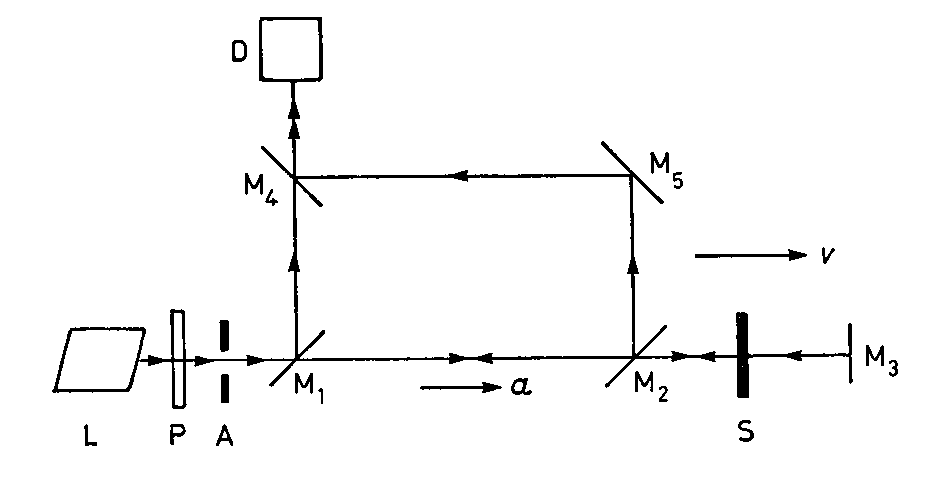
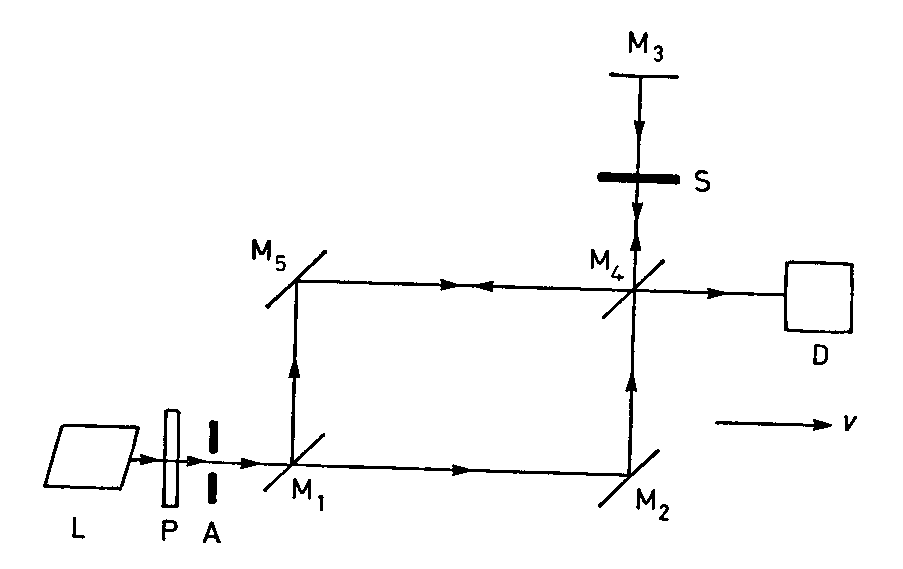
    vacuum exhibits zero dispersion when regulating the propagation of light waves. Such experiments can be justified because standing waves are present in experiments of the Michelson-Morley type and these may have a disturbing influence on light propagation speed
    in the standing wave region. Though a null result from an initial experiment is reported, the outcome of a second experiment yet to be performed is needed to reach a conclusion from this investigation.

    Commentary: The author had, at the time, been involved with correspondence with E.W. Silvertooth, who performed the first experiment mentioned and advised the null finding, but, as yet (1993), the second experiment has not been performed. Note that the
    experiment, being of first-order in v/c, should allow the laboratory measurement of the Earth’s eastward speed. It was later that Silvertooth advised he had performed an experiment which sensed a motion at 378 km/s in the direction of constellation Leo.


    To see the full text of this paper as presented in pdf format press: [1983j]


    Full text of the paper (transcribed from the PDF)

    Transcribed from the scanned pages of the printed paper. [p. N] marks where each printed page begins; figures are cut from the scans. The PDF above is the original.

    [p. 568]

    Lettere al Nuovo Cimento   Vol. 38, N. 17   24 Dicembre 1983

    The author has obtained the permission of the copyright owner Societa Italiana di Fisica to publish this paper here in PDF format.

    The Scope for First-Order Tests of Light Speed Anisotropy.

    H. Aspden

    Department of Electrical Engineering, The University of Southampton
    Highfield, Southampton S09 5NH, England

    (ricevuto il 27 Giugno 1983; manoscritto revisionato ricevuto il 27 Ottobre 1983)

    PACS. 07.90. – Other topics in specialized instrumentation.

    Summary. – New optical experiments aimed at testing light speed anisotropy to first-order in v/c are proposed on the basis of an intuitive enquiry into the physical processes by which the vacuum exhibits zero dispersion when regulating the propagation of light waves. Such experiments can be justified because standing waves are present in experiments of the Michelson-Morley type and these may have a disturbing influence on light propagation speed in the standing-wave region. Though a null result from an initial experiment is reported, the outcome of a second experiment yet to be performed is needed to reach a conclusion from this investigation.

    The interpretation of the null result of the Michelson-Morley experiment and the teachings of special relativity are both founded upon the assumption that light waves travel at the constant speed c relative to the notional observer. With the general acceptance of the theory of relativity one is no longer encouraged to probe the physical processes by which the speed of light waves are determined. Yet the very fact that light waves are deflected, whether by refraction or gravitational deflection, does imply that physical parameters associated with matter can affect the speed of light in an adjacent vacuum region. Even though the general theory of relativity gives an acceptable mathematical treatment of the gravitational deflection of light rays, it is debatable whether it really does give a truly physical justification for the phenomena involved. Therefore, one is ever conscious that the space-time metric of relativity must really describe what is in fact an aether medium in a modern sense.

    Some insight into the processes regulating the propagation of light waves may be gained from a consideration of the dispersionless property of the vacuum when conveying these waves. It is quite possible, as the author has suggested elsewhere (1), that the vacuum itself may have the special property of adjusting its response locally so as to be in tune with the instantaneous rate of change (frequency) of the propagated signal. This was inferred because otherwise the physical properties of the vacuum [p. 569] medium, if regulating propagation speed, should (as in a real medium) cause the speed to depend upon frequency.

    (1) H. Aspden: Wireless Worls, 88, 39, October issue (1982).

    The absence of light dispersion properties is, in the author’s opinion, as important an indicator of the properties of the vacuum medium, as the null of the Michelson-Morley experiment. Indeed, just as Heaviside is well known for his innovation in adapting the properties of the transmission line for telegraphic communication to secure distortionless propagation, so Nature herself has, it would seem, already anticipated Heaviside by providing a self-adjusting property in the vacuum, so as to secure this same result.

    The author (1) has presented a physical illustration of the field medium to account for its compliant nature. The essential feature of this model is the introduction of a reciprocal displacement to provide a partial dynamic balance offsetting the normal Maxwell displacement and so causing the natural resonance of the medium to adjust automatically to the frequency of the signal in transit. This condition holds up to a critical frequency deemed to be that corresponding to the threshold at which electromagnetic energy creates electron-positron pairs. Our object here, however, is not to speculate on such physical processes, but rather to discuss the scope for experimental investigation.

    Whereas the propagation of a wave can occur without its propagation speed being affected and so without there being any distortion, there are problems with regard to the interference of two waves travelling through one another in opposite directions. The field medium is able to respond to one-way propagation and follow changes in frequency of a composite signal because it has to respond momentarily only to one value of the signal rate of change and one value of its strength. It faces a dilemma in trying to respond to two signals travelling through one another in opposite directions. To the extent that these signals have components of equal amplitude, but different frequency they will combine to generate an amplitude-modulated standing wave which travels relatively slowly, at velocity v, say.

    The other components will constitute a normal superimposed signal travelling at the natural propagation speed of the vacuum medium. They represent the surplus energy of the counter-moving signals and this residue travels one way only.

    Physically, it can be questioned whether a medium with compliant self-tuning properties normally responding to propagate waves at the characteristic limit speed c will not in some way tend to moderate the slow-moving standing-wave signal. Whereas effects propagated at speed c allow no time for interactions in the medium along the propagation path, this is not the case when there is a standing-wave system. It seems, therefore, at least to be a possibility that the standing-wave system may be moderated in propagation to adopt an equilibrium mode of minimal energy exchange, a mode for which the wave has a uniform and unmodulated amplitude. This, of necessity, means that the energy conveyed by the wave, just as matter itself, can assert some effect upon the speed of propagation, because the counter-moving components of the signal have to move at slightly different speeds relative to an observer witnessing the forward migration of the standing wave. If the physical processes in the vacuum have an adaptive property of some kind, then we cannot hold too firmly to the theoretical belief that the speed of light has to be a fixed quantity in the vacuum, except when matter asserts some influence.

    This is an important question because the techniques of the Michelson-Morley experiment rely on the retro-reflection of rays along common paths, whereas the theory of the experiment depends upon the assumption that the interference between the rays does not affect their propagation speeds.

    In the Michelson-Morley experiment the reverse ray is produced by reflecting the forward ray at a mirror surface moving at velocity v in the forward direction. Now, it is a well-known fact, easily justified, that in optics such a reflection generates a [p. 570] standing wave which moves with the mirror. The whole wave travels with the mirror surface being at a node as far as the electric vector is concerned and at an antinode as far as the magnetic vector is concerned. It follows that, if f1 is the forward signal frequency and it travels at speed c1 relative to an observer to be reflected at a mirror surface moving at velocity v and produces a reverse wave seen to have frequency f2 and, for generality, travels at a reverse speed c2 relative to the same observer, then from classical Doppler theory

    f2 = f1(c2/(c2 + v))((c1 − v)/c1) .(1)

    The wave-length λs of the envelope of the standing-wave system can then be written as

    λs = (c1N)/f1 = (c2(N ± 1))/f2 .(2)

    The plus or minus sign in this expression depends upon whether c1 is greater or less than c2. N is the number of wave-lengths in the primary signal of frequency f1 within the distance λs.

    From (1) and (2):

    (c1 − v)/(c2 + v) = (1 ± 1/N) .(3)

    It then follows from this eq. (3) that, if the physical processes governing the interaction of the wave components of the standing wave can regulate the speeds c1 and c2 slightly so that the standing wave has an unmodulated amplitude along its length for optimum energy exchange, then λs and N are virtually infinite. This causes (3) to reduce to

    c1 − v = c2 + v .(4)

    In other words, since the mirror is moving at speed v relative to our observer, c1 and c2 are not equal in the observer’s reference frame (a requirement of relativity) but the speed in either direction relative to the moving mirror is the same (a requirement of the Michelson-Morley test). The Michelson-Morley experiment is believed to comply with relativity because the observer was in that case moving with the mirror system.

    From such analysis it can be argued that c1 and c2 may well be different for different observers in relative motion and further that, if there were no standing wave, the motion of the light rays would not be governed by the mirrors, but would be governed by the vacuum medium exhibiting its own frame of reference.

    This explanation of the null result of the Michelson-Morley experiment reopens the question of detecting motion through the vacuum by further experiment. Pursuing this, one experiment has already been performed to investigate whether the standing wave effect discussed can, contrary to the assumption made in the above analysis, moderate the speed of any additional ray components travelling one way and conveying the residual radiation along the same path. The experiment involved an optical arrangement as shown in fig. 1. The author is greatly indebted to Silvertooth for performing this experiment and reporting the results (2).

    (2) E. W. Silvertooth: private communication, May 1983.

    [p. 571]

    Schematic of the first experiment: laser L, quarter wave plate P and aperture A send a ray to mirror M1; from M1 the ray a travels to M2, screen S and mirror M3, with the apparatus moving at v; rays from M1 and via M2 and M5 meet at M4 and pass to the detector D
    Fig. 1.

    In the apparatus shown schematically in the figure a ray which is linearly polarized travels from the 4 milliwatt HeNe laser L, through a quarter wave plate P and through a limiting aperture A. M1 and M2 are very partially reflecting mirrors formed by uncoated glass plates which reflected about 20% of the incident radiation. M3 and M5 were fully reflecting mirrors and M4 was a half-coated mirror. D denotes the detector of the beam formed by bringing rays from M4 into interference and S is a screen which can be optionally placed into the path between M2 and M3.

    The principle of the experiment is to establish a normal interference between the rays entering the detector to achieve a minimum or maximum indication. This is done with the screen S obscuring the mirror M3. Then, with the screen absent and M3 not obscured, it was determined whether or not the detector showed any changed response. With a strong-light ray travelling in the direction a and reflected back on itself in the direction b there should be a standing wave locked into the path between mirrors M1 and M3. If this sets the light speed along this path to a constant value referenced on mirror M3, then the transit time of the ray from M1 to M2 is independent of any motion of the apparatus at velocity v relative to the vacuum medium. However, with the screen S in place this transit time should be dependent upon v, assuming that there is some anisotropy effect.

    The test was made when the direction of a was east-west and at a time when the constellation Leo was near the horizon, this corresponding to an anisotropy optimum on the basis of the detection of the anisotropy associated with cosmic background radiation. No detectable change in output from D was observed when the screen S was introduced and removed.

    This result was a null finding, showing that, if the effect sought does exist, it is only the ray components of the standing-wave system that have their speeds moderated. The residual component reflected by mirror M2 must transit from M1 without experiencing any interference in propagation from the standing wave.

    However, an experiment using apparatus as shown in fig. 2 should provide a more direct test. This experiment has not yet been performed, but it should prove conclusively whether standing-wave effects influence the detection of motion through the vacuum in light speed anisotropy measurements. The arrangement is self-evident from fig. 2 and the analogous description of fig. 1. Mirror M1 is about 20% reflecting as before, but M2 is fully reflecting and M4 is half-reflecting. This should cause the rays travelling in opposite directions between M5 and M4 to have the same intensity and so develop a standing wave with no residual signal. Thus the ray emerging from this standing wave and passing into the detector must have travelled at the moderated speed without indicating any anisotropy. This is the speed c indicated. In contrast the ray travelling from M1 to M2 will have a speed c − v, if what is sought applies, v being the speed at which the apparatus travels through the vacuum medium. With the screen S [p. 572] present and the standing wave eliminated, the ray traversing from M5 to M4 will also move at speed c − v. It follows that insertion or removal of the screen should cause the interference pattern to slip through a number of wave-lengths linearly proportional to the anisotropy speed v.

    Schematic of the proposed second experiment: laser L, quarter wave plate P and aperture A send a ray to mirror M1; rays go from M1 to M2 and up to M4, and from M1 up to M5 and across to M4; mirror M3 with screen S sits above M4, the detector D to its right, with the apparatus moving at v
    Fig. 2.

    Until this experiment is carried out and its result is known, the many experiments on light speed anisotropy hitherto reported and involving retro-reflection of waves along the same ray path to secure the detected interference are, in the light of what has been said in this paper, open to question.

    It is noted that the experiment should also utilize a Faraday isolator to prevent undue feedback to the laser from the mirror system. The quarter wave plate in fig. 1 and 2 acts as a spoiler by converting circularly polarized light into plane polarized light, so facilitating inspection of the pattern of interference. The limiting aperture makes it possible to redirect rays along the incident path upon reflection at M3 by adjusting M3 to centre the reflection on the aperture and minimize any image on the surface adjacent the aperture.

    This research is part of a program of enquiry into the nature of the electromagnetic reference frame and particularly its relevance to the interpretation of the Trouton-Noble experiment. The null of this Trouton-Noble experiment, if divorced from its relativistic explanation, provides the last empirical fact needed to determine the general law of electrodynamics (4), which is generic to the Lorentz law as applied to closed-circuit situations, but it gives scope for a unification with the form of Einstein’s law of gravitation when applied to actions between discrete elements (5).

    * * *

    The author acknowledges the help afforded him by Dr. J. P. Wesley in emphasizing the significance of standing-wave effects in the interpretation of the Michelson-Morley experiment.

    (3) F. T. Trouton and H. R. Noble: Philos. Trans. R. Soc. London, Ser. A, 202, 165 (1903).

    (4) H. Aspden: J. Franklin Inst., 287, 179 (1969).

    (5) H. Aspden: J. Phys. A, 13, 3649 (1980).

  • 1983i

    1983i

    The following is a paper by H. Aspden published in Lettere al Nuovo Cimento, v. 38, 423-426 (1983).

    THE ASSESSMENT OF A THEORY FOR THE PROTON-ELECTRON MASS RATIO

    Abstract: Recent precision measurements of the proton-electron mass ratio confirm a theoretical evaluation dating from 1975 to one part in 107. The theory suggests that this discrepancy, which measurements show to be 0.833 +/- 0.436 parts in 107, may evidence a very small inequality between the magnitudes of the proton charge and the electron charge,
    theoretically predicted to be 1.07 parts in 107.

    Commentary: The reader should here understand that the author was conscious of the fact that his theory assigned a finite spherical form to the electron, which needed to have a very much larger radius than the proton. If, therefore, the aether is a kind of charge plenum or continuum neutralized by unitary lattice charges e, all having the same polarity in our local space domain, there has to be a minute discrepancy of effective charge owing to the continuum displaced by the presence of the electron. This was not assumption, inasmuch as the very explanation for gravitation advanced by the author in the 1960s relied upon such a charge discrepancy, as seated in the microcosm of space occupied by the graviton. The problem, however, is that, in explaining very minor discrepancies at this
    part in ten million level of activity, one can be drawn into a realm of speculation which may detract from the quality of the primary work. It is hoped that the reader will preserve a measure of circumspection at this level of enquiry, until more is known experimentally that can confirm what is suggested.

    Note here that the issue is whether the electron charge and the proton charge have equal magnitudes at this part in ten million level. We now know that a proton and an antiproton have equal mass (and so presumably equal charge) magnitude, with agreement to within 1 part in 108 [Physics World, ‘Antihydrogen’ pp. 44-48 (July 1993)]. This, however, can apply, because the proton space-occupancy volume is so small. If, however, the electron and positron charges are compared, on the theory of the part in ten
    million discrepancy of the subject paper, we should expect a two part in ten million charge discrepancy. In terms of an electron spin anomaly this would translate into a g-factor discrepancy between positron and electron somewhat larger than the one actually measured.
    However, the overriding effect of secondary wave resonance effects could well normalize the actions measured and make them equal.


    To see the full text of this paper as presented in pdf format press: [1983i]


    Full text of the paper (transcribed from the PDF)

    Transcribed from the scanned pages of the printed paper. [p. N] marks where each printed page begins; figures are cut from the scans. The PDF above is the original.

    [p. 423]

    Lettere al Nuovo Cimento   Vol. 38, N. 12   19 Novembre 1983

    The author has obtained the permission of the copyright owner Societa Italiana di Fisica to publish this paper here in PDF format.

    The Assessment of a Theory for the Proton-Electron Mass Ratio.

    H. Aspden

    Department of Electrical Engineering, The University of Southampton
    Highfield, Southampton S09 5NH, – England

    (ricevuto il 30 Agosto 1983)

    PACS. 14.20. – Baryons and baryons resonances (including antiparticles).

    Summary. – Recent precision measurements of the proton-electron mass ratio confirm a theoretical evaluation dating from 1975 to one part in 107. The theory suggests that this discrepancy, which the measurements show to be 0.833 ± 0.436 parts in 107, may evidence a very small inequality between the magnitudes of the proton charge and the electron charge, theoretically predicted to be 1.07 parts in 107.

    A theory for the proton-electron mass ratio Mp/me presented in 1975 by Aspden and Eagles (1) gave a value of 1836.152 317, which at that time was within 4 parts in 107 of the measured value of 1836.151 52(70). There has since been considerable progress in the accuracy of the measurement techniques, leading to the latest and most precise measurement by Van Dyck, Moore and Schwinberg (2) which gives a proton-electron mass ratio of 1836.152 470(80), a value in much closer accord with the 1975 theoretical evaluation.

    Bearing in mind the relative simplicity of the formulations given by the theory and the fact that the same principles had earlier in 1972 (3) yielded a value of the fine-structure constant α exact to one part in 106, this improved accord of the proton-electron mass ratio to within one part in 107 demonstrates the underlying strength of the theory and warrants some assessment.

    Now that the precision of the measurement techniques has advanced so far, it becomes important to clarify a feature of the theory which has significance at the one part in 107 level and which is implicit in the data of the basic papers (1,3). No further assumptions need to be introduced.

    The theoretical model on which the theory was developed required the vacuum to have an electrical lattice structure, a feature which is coming more into favour in particles physics and which contemplates the vacuum having an ordered cubic structure [p. 424] somewhat analogous to a ferromagnetic crystal (4,5). This structure comprises an array of lattice charges immersed in a uniform background continuum of charge density σ, which effectively neutralizes the charge in the lattice. Fundamental to the author’s theory is the recognition that a charge e has a spherically bound form of radius a for which the Thomson formula

    mc2 = 2e2/3a(1)

    applies. Here m is the mass associated with the charge and c is the speed of light.

    (1) H. Aspden and D. M. Eagles: Nuovo Cimento A, 30, 235 (1975).

    (2) R. S. Van Dyck jr., F. L. Moore and P. B. Schwinberg: Bull. Am. Phys. Soc., 28, 791 (1983).

    (3) H. Aspden and D. M. Eagles: Phys. Lett. A, 41, 423 (1972).

    The volume of the continuum displaced by the sphere of charge e was an important consideration in evaluating the fine-structure constant. Applying the formula (1) to the lattice charges, deemed to have the same charge e as the electron, the conservation of this volume (*) in particle pair creation processes assured, for example, that an odd integer relationship had to apply to the ratio of the volume of the lattice charge and the volume of the electron or positron charge. Rigorous analysis of the energy balance in the vacuum model for minimal potential energy showed that this depended upon the mass ratio and so the charge volume ratio of the lattice charge and the electron. This led to a unique minimal energy value for the odd integer specifying this ratio. It was found by a computer analysis of the interaction energy of the electrical vacuum model to be 1843. This parameter, together with the cubic lattice dimension of 108π in terms of electron charge radius, features prominently in the derived formulae:

    Mp/me = (3/(4π))(108π)3(1843)−4/3[(3/2)1/2 − 1]−1 ,(2)

    α−1 = 108π(1843)−1/6(2)1/2 ,(3)

    which, respectively, gave 1836.152 317 and 137.035 914 8 for these quantities.

    Evident from this is the simple fact that the volume of the electron charge 4πa3/3 is smaller than the volume of the lattice cubic cell (108π)3a3 by a factor which is one part in (3/4π)(108π)3, a parameter appearing in formula (2) for the proton-electron mass ratio.

    This quantity has the value 9 324 644, the reciprocal of which is 1.07·10−7, and since the magnitude of the continuum charge in unit lattice cell is equal to the electron charge e, it tells us that the electron displaces 1.07·10−7 units of its own charge of opposite polarity. This was too small to warrant comment in 1975, but it is important now that experimental work has reached the 1 part in 107 level of precision.

    Electrodynamically the electron will exhibit a charge e incremented by this factor of 1.07·10−7 because its motion through the charge continuum causes displacement and counterflow of this small opposite-polarity charge quantity. This has, therefore, to be allowed for in comparing measurement data with the theory for the proton-electron mass ratio. So far as the proton itself is concerned, its form according to the Thomson [p. 425] formula would make its charge volume smaller than that of the electron by a factor of 10−10 and this implies a charge discrepancy electrodynamically as low as 10−17 e, which is negligible compared with the augmented charge 1.07·10−7 e of the electron.

    (4) C. Rebbi: Sci. Am., 248, 36 (1983).

    (5) V. F. Weisskopf: Phys. Today, 34, No. 12, 69 (1981).

    (*) In the first footnote of the 1975 paper (1) it was explained how, at that time, the model had difficulty assuring a reconciliation between the phenomenon of meson time dilation and the form of the charge suggested. Since then, however, the space conservation principles have proved to be essential and to have a direct bearing upon this meson lifetime issue, as shown in the very recent paper by Aspden (6).

    (6) H. Aspden: Lett. Nuovo Cimento, 37, 307 (1983).

    Now in the measurements of the proton-electron mass ratio it is assumed that their charges have the same magnitude. If they have different effective charges the mass ratio adduced from frequency measurements when subjected to the same magnetic field has to be increased in proportion to their charge ratio. Thus, since the proton charge is smaller by 1.07·10−7 than the electron charge, according to this theory, the measured value of the proton-mass ratio needs to be reduced by the same amount to make a comparison between theory and experiment (*).

    It may be seen from the data presented above that the reported proton-electron mass ratio is higher than the theoretical value by 153 ± 80 parts in 1.836·109 or 0.833 ± 0.436 parts in 107. If, however, we correct for the charge ratio to bring the theory fully into comparable form with the measured mass ratio, we find that the overall discrepancy between theory and experiment is 0.239 ± 0.436 parts in 107.

    This is a conclusion we arrive at in comparing a 1983 reported measurement with a theory proposed in 1975. No further assumptions have been made. Evidently the theory is well supported.

    It remains to consider further the consequences of isolated protons having a charge which differs slightly in magnitude from that of the electron, at least when sensed electrodynamically. Note that, owing to the space conservation process discussed above a cluster of 1843 electrons in a body of matter would imply the annihilation of a vacuum lattice charge of equal volume and suggest that one of the electrons substitutes for the lattice charge in neutralizing the continuum. Any forward motion of this substitute electron with matter progressing through the lattice would be balanced by a reverse motion of lattice charge exchanging its lattice position with the electron. The result of this is that the continuum displacement due to forward motion of 1843 electrons in the body is balanced by the reverse motion of lattice charge. It follows that no electrodynamic action would arise.

    Between the extreme of the single proton and single electron and a body containing 1843 electrons, there is scope for up to half the 1843 electrons moving without the compensation of a lattice particle. Thus the maximum out-of-balance charge to be expected on any body of matter is ½(1843)(1.07·10−7)e or about 10−4e. In principle, therefore, the theory indicates that a residual charge of 10−4e at most may exist as an intrinsic charge on the average particle of matter, provided it comprises enough atoms to sustain 922 electrons. Since the cancelling lattice charges will keep company only with those particles containing the substitute electrons, the result will be that this charge of the order of 10−4e will be positive for some and negative for others, cancelling overall.

    The topic of inequality of positive and negative charge in an atom is discussed in a book by Millikan (7), who describes an experiment by which the positive- and negative-charge quanta on an oil drop were shown to differ by less than one part in 2000. Such work was not accurate enough to detect the 10−4e charge suggested above, but modern research techniques along the lines suggested by Millikan should allow this theory to be tested, in as much as the charge on an oil drop should fluctuate by 10−4e as molecules evaporate from the drop. Also there may be scope for assessing whether small systematic charge discrepancies can affect the data available from atomic mass [p. 426] spectroscopy and cause anomalous fluctuations in the isotopic masses, particularly for the heavier atoms.

    (*) See appendix.

    (7) R. A. Millikan: Electrons (+ and −), Protons, Photons, Neutrons and Cosmic Rays, (Chicago, Ill. 1935), p. 82.

    To conclude, the author submits that the recently reported precision measurement of the proton-electron mass ratio gives positive support to the 1975 theory and justifies further effort to explore other implications of this theory.

    Appendix. – There is experimental evidence from collision data indicating that the proton may comprise three elements and have a physical dimension of the order of 10−13 cm. This is similar to the size of the electron.

    It is suggested that this may be due to the fact that the proton charge of the form suggested by the Thomson formula (1) may migrate in some statistical manner and have an intermediate «rest» condition relative to the charge continuum, in which state some of its energy is momentarily deployed in creating electron-positron pairs. A statistical transition between states involving pair creation and the state defined by the Thomson formula is the basis on which the meson lifetime dilation was explained nonrelativistically in ref. (6). Furthermore, the emission of β-particles when a neutron decays into a proton suggests that the electrons can be bound in some way to the nucleon form.

    However, the essential point is that the proton’s form when reacting electrodynamically to its motion in a magnetic field appears to be that having a dimension set by the Thomson formula (1).

    H. Aspden
    19 Novembre 1983
    Lettere al Nuovo Cimento
    Serie 2, Vol. 38, pag. 423-426

  • 1983h

    1983h

    The following is a paper by H. Aspden published in Lettere al Nuovo Cimento, v. 38, 342-344 (1983).

    THE MASS OF THE MUON

    Abstract: A recently reported resonant-cavity model of the muon is now shown to have an additional resonance mode involving wave propagation around the muon core charge. This resonance gives a slightly modified value of the muon-electron mass ratio and uniquely determines it as 206.7683078, in excellent accord with its latest experimental value 206.768 35(11).

    Commentary: By this stage the author well knew that his aether theory could give extremely precise account of the nature of the most fundamental particles. He realized that their properties were only measured to such very high precision to provide the basis for testing new theory, but yet that his was the only viable theory that could give the right answers.

    It became a challenge to decipher the form of the simple resonance that could account for the minor residual discrepancies one would expect as due to background energy noise in a physical environment. There had to be such resonances occurring naturally in order to explain why the measurements could be so consistent and definite. This challenge drove the author forward and the author had in mind the magnetic moment properties of the proton, the neutron and the deuteron. However, several other papers were to come before complete success could be reported on all those specific topics. Yet, the author had, whilst listening to a speaker describe neutron measurements at the 1981 Gaithersburg National Bureau of Standards conference, registered in his mind the governing resonance applicable to the neutron, and a full picture was already evolving at that
    time.


    To see the full text of this paper as presented in pdf format press: [1983h]


    Full text of the paper (transcribed from the PDF)

    Transcribed from the scanned pages of the printed paper. [p. N] marks where each printed page begins; figures are cut from the scans. The PDF above is the original.

    [p. 342]

    Lettere al Nuovo Cimento   Vol. 38, N. 9   29 Ottobre 1983

    The author has obtained the permission of the copyright owner Societa Italiana di Fisica to publish this paper here in PDF format.

    The Mass of the Muon.

    H. Aspden

    Department of Electrical Engineering
    The University of Southampton – Highfield, Southampton S09 5NH, England

    (ricevuto il 31 Agosto 1983)

    PACS. 12.70. – Hadron mass formulae.

    Summary. – A recently reported resonant-cavity model of the muon is now shown to have an additional resonance mode involving wave propagation around the muon core charge. This resonance gives a slightly modified value of the muon-electron mass ratio and uniquely determines it as 206.768 307 8, in excellent accord with its latest experimental value 206.768 35(11).

    Very recently the author (1) proposed that the muon has a composite quarklike structure, the negative muon comprising a core charge + e and two electrons − e contained within a resonant cavity. The muon g-factor was related to the dimensions of the cavity and the resonance condition required the propagation and reflection of radial waves within the cavity to be matched to the period in which a wave disturbance travels around the circumference of the electron charge.

    A cavity surface surrounding the muon’s core charge has a radius determined by the balance of incident radiation and outgoing Larmor radiation. This radius was found to be √3 times the charge radius p given by the Thomson formula:

    p = 2e2/3mpc2 ,(1)

    where e is the charge, mp is the mass associated with this charge and c is the speed of light in vacuo. This radius is also the radius of the de Sitter microuniverse model of the electron suggested by Caldirola (2). Caldirola has further suggested that the period of wave propagation around an electron having this radius may be correlated with the effective Compton wave-length of the muon to so determine its mass.

    In this way he was able to formulate a value for the muon mass mμ given by

    (mμ − m)c2 ≈ (3/2)(hc/(2πe2))mc2 .(2)

    (1) H. Aspden: Lett. Nuovo Cimento, 37, 210 (1983).

    (2) P. Caldirola: Nuovo Cimento A, 45, 549 (1978).

    [p. 343]

    Here 2πe2/hc is the fine-structure constant and its reciprocal has a value 137.036, giving mμ/m as 206.554. The electron mass is denoted m.

    The author (1) extended the analysis by arguing that the Compton wave-length of the muon is an integer 207 times the electron’s Compton wave-length, based on a wave resonance interaction between the electron and the muon core charge. This latter charge, therefore, has a radius p given by (1) that is a/207, where a is the radius of the electron charge. In this way a value of mμ/m was deduced in terms of the core mass 207 m plus 2 m for the two electrons as offset by Coulomb interaction energy. For location of the electrons in touching relationship with the inner resonant cavity the following formula was obtained:

    mμ/m = 209 − (9/4)(207/(207 + √3)) .(3)

    This give 206.7687, in quite close accord with the measured value.

    The advance now presented recognizes that the two electrons cannot be located precisely in contact with the inner resonant field cavity but must lie very slightly within this cavity radius so as to encounter wave pressure. Furthermore, they must be hold in stable positions relative to the centre of the muon by the resonant impact with waves in the gap between the charges. Such waves are synchronized by a wave resonance associated with propagation around the muon core charge, all such motions involving the speed of light.

    This step utilizes principles analogous to those involved in determining the main cavity resonance and the 207 parameter, but referenced, in this latter case, upon the resonance in the propagation around the electron charge.

    The resonance system just discussed is depicted in fig. 1.

    Diagram: the hatched muon core charge of radius a/N inside a broken sphere of radius √3a/N, with wave-length λ marked around the core and a gap zλ to the hatched surface of the electron charge of radius a centred at 0
    Fig. 1.

    The electron charge of radius a, centred at 0, is shown to intrude slightly into the broken sphere denoting the inner resonant cavity. This sphere has a radius √3a/N, where N is an odd integer corresponding to the formation of the muon core charge by a merger of an odd number of electrons and positrons. The value of N is 207 because λC/N is the nearest an odd integer value of N comes to reaching 2πa, where λC is the Compton wave-length h/mc of the electron and, from (1), a is 2e2/3mc2. Thus 2πa is (2/3)(2πe2/hc)(h/mc) or λC/(205.554), so yielding N = 207.

    We envisage a resonance around the circumference of the muon core charge setting [p. 344] up standing waves so that

    nλ = 2πa/N ,(4)

    where n is an integer and λ the related wave-length. Furthermore, there will be a wave resonance between the electron charge surface and that of the core charge, determining their separation by zλ, where z is also an integer.

    The condition by which n is determined is then that for which the lowest value of n assures that

    zλ < (√3 − 1)a/N .(5)

    This corresponds to the strongest resonance condition capable of holding the muon system stable.

    Combining (4) with (5), we obtain

    2z/n < 0.233 .(6)

    The greater z, the greater n needed to satisfy this condition. Hence z is minimal and so z = 1. The smallest value of n is then 9 because a value of n of 8 is 0.250 and this exceeds 0.233. (4) and (5) then combine to show that the √3 parameter needs to be replaced by 1 + 2π/9 to define the unique condition of resonance indicated for the muon system. Formula (3) can then be written as

    mμ/m = N + 2 − (9/4)(N/(N + 1 + 2π/9))(7)

    or, since N = 207,

    mμ/m = 209 − (9/4)(207/(208 + 2π/9)) .(8)

    This is a rigorous formula based upon the integers determined uniquely by the resonance muon model. It gives a value of mμ/m of 206.768 307 8 which accords well with the latest-reported measurement (3) of the muon-electron mass ratio of 206.768 35(11).

    It is submitted that such a result, based upon wave resonance properties within the muon charge, should encourage further research along the lines followed by the author. The theoretical value of the muon-electron mass ratio is determined by a very simple formula and accords with the measured value to two parts in ten million and within half the standard deviation estimated for the experiment.

    (3) E. Klempt, R. Schulze, H. Wolf, M. Camani, F. N. Gygax, W. Ruegg, A. Schenck and H. Schilling: Phys. Rev. D, 25, 652 (1982).

  • 1983g

    1983g

    The following is a paper by H. Aspden published in Lettere al Nuovo Cimento, v. 38, 206-210 (1983).

    MESON LIFETIME DILATION AS A TEST FOR SPECIAL RELATIVITY

    Abstract: Predictions from the author’s recent alternative explanation of the apparent time dilation evidenced by meson lifetimes suggest that the dilation of lifetime observed should be
    lower than that indicated by special relativity if the tests are made a low enough energies. Reported experimental data supporting this proposition are discussed.

    Commentary: When scientists seek funding for new and better experiments needing more powerful equipment they concentrate their field of research into territory at one end of the experimental spectrum. Einstein’s theory is supposed to hold valid over the whole
    spectrum. The subject paper shows that this author’s alternative explanation of the apparent ‘time dilation’ of fast-moving muons and kaons points to differences from the Einstein predictions that can be tested experimentally over the mid-velocity ranges. The reported experimental data supports the author’s theory and not that of
    Einstein.


    To see the full text of this paper as presented in pdf format press: [1983g]


    Full text of the paper (transcribed from the PDF)

    Transcribed from the scanned pages of the printed paper. [p. N] marks where each printed page begins; figures are cut from the scans. The PDF above is the original.

    [p. 206]

    Lettere al Nuovo Cimento   Vol. 38, N. 6   8 Ottobre 1983

    The author has obtained the permission of the copyright owner Societa Italiana di Fisica to publish this paper here in PDF format.

    Meson Lifetime Dilation as a Test for Special Relativity.

    H. Aspden

    Department of Electrical Engineering, The University of Southampton
    Highfield, Southampton S09 5NH, England

    (ricevuto il 25 Luglio 1983)

    PACS. 13.20. – Leptonic and semi-leptonic decays of mesons.

    Summary. – Predictions from the author’s recent alternative explanation of the apparent time dilation evidenced by meson lifetimes suggest that the dilation of lifetime observed should be lower than that indicated by special relativity if the tests are made at low eneough energies. Reported experimental data supporting this proposition are discussed.

    Time dilation is the most controversial issue concerning Einstein’s theory of relativity. It is the primary target for critics of the relativistic method, notably Dingle (1) and Essen (2). Yet its verification by appeal to observed meson lifetime dilation is regarded by relativists as the most direct evidence we have in support of relativity. This is greatly to the credit of Einstein’s theory, as mesons were unknown at the time he first enunciated his theory, far less their limited lifetimes and the fact that their decay was dilated with speed. However, as Zappfe (3) has pointed out in his own critical review of relativity, one should be cautious about inferring time dilation from meson lifetimes, in as much as not enough is yet known about the reason for particle decay at rest or the reasons for the differences in the lifetimes of particles according to the media through which they travel.

    For the reasons to be presented below, more experiments are needed, not to focus on ranges of test at which there is accord with the relativistic factor, but rather to focus on those ranges where there is maximum discord. The object of such experiments should be to probe the weaknesses of relativity rather than looking solely for evidence aiding its verification.

    In a recent paper the author (4) has presented a hypothetical quantum-statistical account of time dilation as evidenced by dependence of meson lifetime upon speed. [p. 207] As noted in that paper, the proposed theory can best be tested by accurate measurements of meson lifetime at low energies, rather than at the very high energies for which the predicted dilation of decay time on this alternative theory tends to the relativistic value. Further analysis, now presented, enables discussion of the feasibility of such tests in the light of comparisons using available data for muon lifetimes.

    (1) H. Dingle: Science at the Crossroads (1972), p. 185.

    (2) L. Essen: Wireless World, 84, 44 (1978).

    (3) C. A. Zappfe: A Reminder on E = Mc2 (Baltimore, Cal., 1982), p. 84.

    (4) H. Aspden: Lett. Nuovo Cimento, 37, 307 (1983).

    The essential equation of the statistical particle model under consideration depended upon charge parity conservation, space volume conservation subject to fluctuations about a mean value as corresponding charge pairs were created in the rest state and recurrent transformation of the particle form as it changes between its rest state and a contracted state determined by its energy E according to the Thomson formula:

    E = 2e2/3a ,(1)

    where e is its electric charge and a is a characteristic radius bounding the charge. The radius a defined a sphere which had a space volume associated with the particle when in motion with energy E, but the same formula (1) also gave the radius and so the space volume applicable to the particle in its rest state for which E is written as E0. The faster the particle moves, the greater the ratio E/E0 and the greater the probability that there are induced charge pairs present in association with the basic charge of the particle.

    It was from this hypothetical insight into the form of the moving particle that the following three equations were formulated in the original paper (4):

    k1 + k2 + k3 = 1 ,(2)

    k1 + (2N + 1)k2 + (E0/E)3k3 = 1 ,(3)

    k1E0 + (2N + 1)k2E0 + k3E = E .(4)

    Here, k1, k2, k3 represent, respectively, the fractional duration of the three states in a unit of time, k1 applying to the state when the particle exists in isolation with energy E0, k2 applying to the state for which it also has N charge pairs of similar energy present and k3 applying to the state for which the particle exists in isolation in the contracted form of energy E.

    The particle lifetime is moderated with speed according to the change of an annihilation event affecting the primary particle, whether in its base energy state E0 or its contracted energy state E. The annihilation of a member of one of the induced charge pairs does not affect the observed lifetime because the creation and decay of these pairs is a continuous process anyway and if one of these events is triggered prematurely, this does not affect the overall statistical occupancy of the states as expressed by eqs. (2), (3) and (4). Hence the lifetime τ of the particle can be formulated thus:

    1/τ = (k1 + k2)/τ0 + k3/τ′ ,(5)

    where τ0 is the lifetime of the particle in its rest state and τ′ is the lifetime of the particle in its contracted full energy state.

    Equations (3) and (4), respectively, specify the conditions for conservation of space volume and conservation of energy. They combine to give

    k3(1 − α4) = 1 − α ,(6)

    where α is E0/E. The faster the particle moves, the smaller α.

    [p. 208]

    Then, since (5) reduces from (2) to

    1/τ = (1 − k3)/τ0 + k3/τ′ ,(7)

    we find from (6) that

    1/τ = 1/τ0 − ((1 − α)/(1 − α4))(1/τ0 − 1/τ′) .(8)

    Much now depends upon the factors by which α is determined. If, for example, the decay time is inversely proportional to the volume of the particle charge region exposed to collision, then we see from (3) that so far, as the k3 period is concerned,

    1/τ′ = (1/τ0)(E0/E)3 = α3/τ0 .(9)

    This allows (8) and (9) to combine to give

    τ/τ0 = (1/α)((1 − α4)/(1 + α2 − 2α3)) .(10)

    ατ/τ0 as given by (10) is plotted in fig. 1 as a function of α = E0/E, it being noted that ατ/τ0 would be unity on relativistic theory because E0/E is (1 − v2/c2)½, where v is the speed of the particle and c its limiting speed and because τ is τ0(1 − v2/c2)−½ according to the relativistic explanation of time dilation.

    Graph of ατ/τ0 (0.94 to 1.00) against α (1.0 to 0): the curve falls from 1.00 at α = 1 to a minimum near 0.937 at α about 0.55 and rises back towards 1.00 as α approaches 0
    Fig. 1.

    It is seen from fig. 1, and it may be be verified by analysis, that the theoretical value of lifetime predicted by this alternative explanation is somewhat lower than the relativistic value over a range of speeds varying around that for which E0/E is 0.5. Thus when the particle has a speed for which its total mass is doubled we expect its lifetime to be 6.25% below the relativistic value.

    This, is, of course, subject to the simple condition imposed by eq. (9), but this general reduction should apply to some extent if the author’s theoretical proposition is basically sound. The author has not found any recorded data giving the muon time dilation parameter in this optimum energy region. However, a primary publication on this subject is that of Bailey and Picasso (5) who measured muon lifetime at very [p. 209] high speed for which the theoretical relativistic value was 26.69 microseconds compared with a rest lifetime of 2.198 microseconds. Thus E0/E or α in this case was 0.082. Equation (10) tells us that the observed lifetime at this value of α should be 0.56% low compared with the relativistic value. This is quite small, but it is also significant because Bailey and Picasso reported measurements to an experimental accuracy of 0.2% and did in fact find that the observed value was lower than the relativistic value by 1.2%.

    (5) J. Bailey and E. Picasso: Prog. Nucl. Phys., 12, 62 (1970).

    Though they regard this as adequate agreement the difference was sufficiently concerning for them to speculate at some length about the possible reasons for the difference. Only further research can verify this speculation, but it can be said that the question remains open and the indications are that the relativistic expectation is up to 1% above the measured value of the muon lifetime at these energy levels.

    Encouraged by this, there is purpose in exploring the basis of eq. (9) in further detail to see how close agreement between this theory and observation may be. First however, it is appropriate to mention the later-reported work of Bailey and Picasso (6). They made measurements of muon lifetime at even higher energies for which E/E0 was 29 or α = 0.034 to find that the discrepancy between the observed value and the relativistic value diminished further. The observed value was low by 0.02% subject to a mean error of 0.09% and, therefore, in satisfying accord with the relativistic value. Tests at such high energies do not permit the alternative theory advanced here to be judged, but the paper just mentioned is helpful in providing a review of similar tests for a number of particles at lower energy values. From the data presented the K±, Ks and K0s decays all show a smaller lifetime than the relativistic value, with the error decreasing as speed brings the particle to higher energy levels. Thus the K± decay was (0.9 ± 0.3)% low at energy levels quoted as E/E0 equal to 3.38 or 4.17. These data tend to support the author’s contention that the discrepancy is accentuated at a low range of E/E0 and could be of the order of a few percent compared with the relativistic norm. It must, however, be noted that the pion decay showed the greatest departure from the relativistic value, being 2.5%out at E/E0 = 2.44 with an error estimate of 0.9%. Although this helps the author’s case for urging more research at such energy levels, the pion is a misfit in the scheme of things because the discrepancy was positive as reported, whereas it should be negative on the simple theory presented here.

    Concentrating attention on the muon and the assumption made in deriving eq. (9) a more rigorous investigation will be made in order to compare thist heory with the measurements made by Picasso and Bailey at the α value of 0.082.

    The decay event arises because a migrant charge of opposite polarity comes close enough to the particle to trigger the decay condition. Thus a charge − e of energy E′ distant x from the particle of charge + e and energy set by (1) is deemed to be at the decay threshold when

    E′ + (2e2)/(3a) − e2/x = 0 .(11)

    This expression is merely a statement that decay must occur if the total energy of the system, including that of the Coulomb interaction, has to fluctuate to less than zero in its energy exchanges with the surrounding field. Thus, if E′ = mμc2, where mμ is the rest mass of the muon and the particle of charge + e is a muon so that αE = mμc2, we can write (11) as

    (1 + α − (3a)/(2x))mμc2 = 0 ,(12)

    (6) J. Bailey and E. Picasso: Nature, 268, 301 (1977).

    [p. 210]

    to obtain

    a/x = (2/3)(1 + α) .(13)

    This expresses the decay condition only if x ≥ a, that is, only for the case when α ≤ 0.5, as otherwise the migrant point charge will have entered the zone occupied by the particle’s own charge. This latter condition has been investigated in detail by the author elsewhere (7) in relationship to the muon decay in the rest state. The 2.2 microsecond lifetime of the muon was deduced theoretically using principles similar to those later leading to the derived lifetimes of the neutron (8) and the pion (9). Accordingly, we will merely recite the decay condition from eq. (203) of ref. (7) which indicates that a/x (there expressed as x/y) is given by

    (3/2)(a/x) ≈ 1 .(14)

    This merely signifies that the point charge causing decay has to penetrate deeper into the body of charge of the particle when the particle has an energy below the α = 0.5 factor relative to the migrant charge.

    Thus, from (14), since τ0 is (3/2)3 times the value it would have if decay where merely based upon the statistical chance of the migrant charge entering the full charge volume of the particle, we can write the high-energy decay condition as

    1/τ′ = (1/τ0)(3/2)3(x/a0)3 ,(15)

    where a0 is the particle charge radius for the rest state. Since a/a0 = α, (13) and (15) combine to give

    1/τ′ = (1/τ0)((3/2)(α/(1 + α)))3 ,(16)

    which now must be substituted for the assumed expression (9) for the range of α below 0.5. The effect is to modify (10) to become

    τ/τ0 = (1/α)((1 − α4)/(1 + kα2 − 2kα3)),(17)

    where k is ((3/2)(1/(1 + α)))3.

    Taking the experimental value of α of 0.082 used by Bailey and Picasso in their experiment (5), we then use (17) to obtain ατ/τ0 as 0.9853, so that a theoretical relativistic lifetime of 26.69 microseconds expected by Bailey and Picasso implies a theoretical lifetime of 26.30 microseconds according to this alternative theory, a value much more in accord with the observed value of (26.37 ± 0.05) microseconds.

    It is submitted that this result does warrant fuller investigation of muon lifetime dilation in the energy range just above twice the muon rest mass in order to focus attention on the region where maximum differences between this theory and relativity are to be expected.

    (7) H. Aspden: Physics Unified (Southampton, 1980), p. 146.

    (8) H. Aspden: Lett. Nuovo Cimento, 31, 383 (1981).

    (9) H. Aspden: Lett. Nuovo Cimento, 33, 237 (1982).