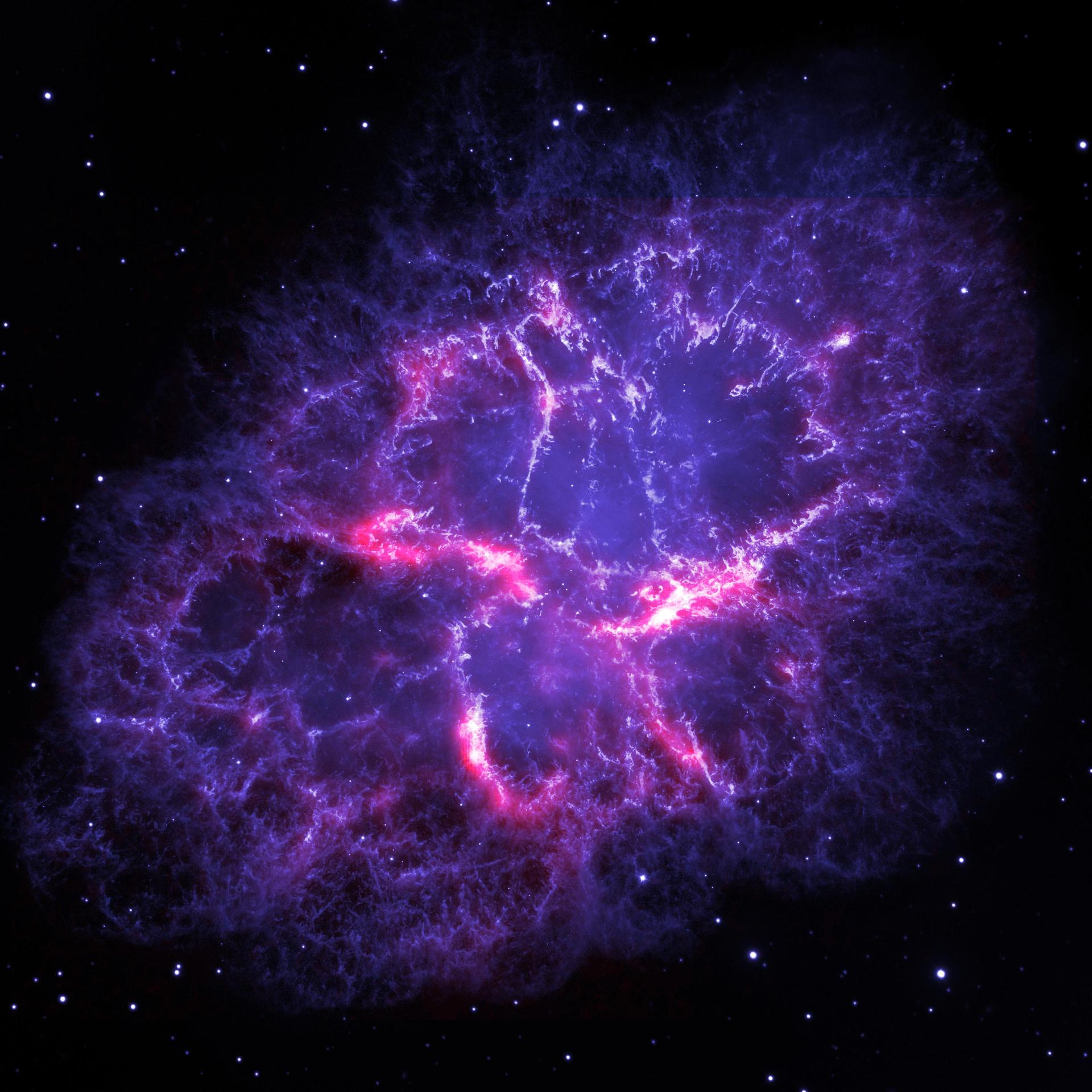
Crab Nebula (M1) — supernova remnant imaged by Herschel and Hubble Space Telescopes

Category: Papers & Publications

Peer-reviewed papers and publications by Harold Aspden

Crab Nebula (M1), supernova remnant · ESA/Herschel/PACS; NASA, ESA & A. Loll/J. Hester (Arizona State Univ.) · NASA Image Library ↗

  • 1987h

    1987h

    The following is a paper by H. Aspden published in The Toth-Maatian Review, v. 6, pp. 2981-2984 (1987).

    AMPERE’S LAW: COMMENTS ON A DISCUSSION BY MILNES IN TOTH-MAATIAN REVIEW, v. 6, pp. 2981-2984 (1987).

    Commentary: In volume 5 of the October 1986 issue Dr. Milnes initiated a critical review, some 18 years after its publication, of the author’s ‘The Law of Electrodynamics’ published in the Journal of the Franklin Institute [1969a]. This article was the author’s response to that criticism.


  • 1987g

    1987g

    The following is a paper by H. Aspden published in The Toth-Maatian Review, v. 6, pp. 2947-2953 (1987).

    A COUNTER-ARGUMENT TO THE NINE OBJECTIONS TO THE AETHER POSED BY MILNES

    Commentary: Dr. Harold Milnes, the Editor and publisher of the Toth-Maatian Review, had earlier in an April 1986 issue of this periodical presented nine reasons puporting to show that the aether does not exist. Dr. Milnes had invited readers to challenge his views. By this article this author responded to that challenge.


  • 1987f

    1987f

    The following is a paper by H. Aspden published in The Toth-Maatian Review, v. 5, pp. 2827-2833 (1987).

    THE CASE FOR THE SUB-ELECTRON

    Abstract: One of the most basic questions in physics is whether there is a degenerate form of the electron, a charge of smaller mass than that of electron. If there is then it is likely to be a primary constituent of the background field medium we recognize as sustaining electric displacement, namely the aether. This paper discusses the evidence indicative of the existence of such a particle, a sub-electron, having an effective mass of 1/24.52 that of the electron.

    Commentary: In this general article the author introduces his aether theory and shows how the recognition of a sub-electron, in the form of the virtual particle which occupies the aether lattice sites in the vacuum medium to endow it with quasi-liquid crystal properties, plays a direct role in relation to three physical phenomena. These are in the determination of the temperature of the Sun, the solution of an unexplained mysterious fact of astrophysics, which has been named the Wesson constant, and the mystery of the mass of the neutral pion. This is besides the explanation 2.7 K cosmic radiation background temperature, as presented on p. 177 of the author’s 1980 book ‘Physics Unified’.


  • 1987e

    1987e

    The following is a paper by H. Aspden published in Speculations in Science and Technology, v. 10, pp. 9-11 (1987).

    A NOTE ON THE SILVERTOOTH EXPERIMENT

    Commentary: The author here presented a commentary following a paper by Silvertooth which described an optical experiment claimed to have sensed the Earth’s motion at 378
    km/s through space. The author’s paper discussed the implications and drew attention to the related issue posed by null indication of the 1903 Trouton-Noble experiment.


  • 1987d

    1987d

    The following is a paper by H. Aspden published in Quarterly Journal of the Royal Astronomical Society, v. 28, pp. 535-536 (1987).

    EARTHQUAKE-RELATED EM DISTURBANCES

    Commentary: The author here drew attention to the article [1978d] in which he had discussed the experimental evidence which showed that earthquake conditions could disturb the aether. The essential point here was that atmospheric conditions which could distort frequency-modulated radio waves but not amplitude-modulated radio waves meant that the carrier medium, the aether, was subjected to shock vibrations.

    The energy in transit was not affected but the speed of transit was affected. This had been noticed in radio reception in Switzerland as affecting radio transmission from England during an earthquake in Italy. It was also seen as relevant that earthquakes deep
    underground develop E.M. radio disturbance on the surface but E.M. radio waves propagating under normal conditions at the surface do not penetrate more than a few metres of the Earth’s crust.

    This is an example where doctrinaire belief in Einstein’s theory has led to a cosmology that denies the existence of the aether and that precludes belief of what the author is saying here about the possibility of sensing earthquakes by radio waves before the
    ground-propagated shock wave arrives.


  • 1987c

    1987c

    The following is a paper by H. Aspden published in Physics Letters, v. 120A, pp. 80-82 (1987).

    THE EXPLODING WIRE PHENOMENON AS AN INDUCTIVE EFFECT

    Abstract: This paper responds to criticism in the controversy concerning the exploding wire phenomenon. It is maintained that this occurs owing to high current transients interacting with the self-inductive field within the wire, which preclude the electron charge carriers from balancing the tensile stress set up by the effect of the applied EMF on the positive ions of the wire structure.

    Commentary: The author had become quite concerned about the way in which the Lorentz force law was being challenged in an effort to substitute Ampere’s law. The point which was being missed by those researching this field was that the law of electrodynamics
    concerns forces set up with steady-state currents. Sudden high-current discharges involve powerful inductive reaction forces, whereas the classical Ampere force law denies any out-of-balance force action and can only be used to argue wire rupturing if the current discharge is deemed to be segregated in spaced current elements, rather than being the continuous current normally assumed. This was important to the author because the whole of his theory of
    gravitation depends upon the law of electrodynamics having the non-Lorentzian, non-Amperian form which he advocates in reference [1969a].


  • 1987b

    1987b

    The following is a paper by H. Aspden published in Hadronic Journal, v. 10, pp. 185-192 (1987).

    SYNCHRONOUS LATTICE DYNAMICS AS AN ALTERNATIVE TO TIME DILATION

    Abstract: In view of the very strong indications that the time rate of atomic clocks dilates in dependence upon motion relative to a preferred frame, an alternative to relativistic time dilation is needed. It is shown that atomic clock rates are affected by motion relative to the preferred frame, according to the synchronous lattice dynamics as used by the author to explain the nature of the photon and the elementary particle spectrum in recent Hadronic Journal papers.


    The full text of this paper may also be seen in PDF format as Paper No. 5 in the author’s 1996 book Aether Science Papers which is of record in the author’s website www.aspden.org.

  • 1987a

    1987a

    The following is a paper by H. Aspden published in Hadronic Journal, v. 10, pp. 167-172 (1987).

    THE PHYSICS OF THE MISSING ATOMS: TECHNETIUM AND PROMETHIUM

    Abstract: Technetium (Z=43) and promethium (Z=61) are by far the least abundant of all atoms below the radioactive elements (Z=84 onwards). Their scarcity confirms theoretical predictions emerging from a theory of the photon derived from synchronous lattice
    electrodynamics. This theory has given precise theoretical values for the fine-structure constant α and the constant of gravitation G and is now shown in this paper to indicate resonant interactions between the vacuum lattice oscillations and technetium and promethium. In the case of promethium there is strong reason for believing that this atom can assume supergravitational or antigravitational properties, accounting for its scarcity. This paper not only adds support to the earlier theoretical work on the photon and gravitation, but suggests a research route that might lead to new technology based on controlled interactions with gravity fields.

    Commentary: This paper was written because the author was asked if his theory of gravitation might have any practical implications. Although the author had, for nearly 30 years prior to this request, had a clear understanding of the electrodynamic nature of gravity, he had always believed that the frequencies needed to promote controlled interaction with the gravity field put that possibility out of reach.

    In the early years of the author’s theory thought had been given to electron activity in the rare earth atoms, particularly erbium, which has a Z value close to half of α-1=137. However, the thought of suggesting a practical research route seemed too difficult and it was too remote from the circumstances facing the author, namely the need first to find acceptance for his theory. Confronting the question anew and with a fresh mind at the time of the above request, the author saw that until then he had never considered how electrons in certain atoms that could possibly be caused to resonate with the gravitational field might be affected by collision with the vacuum aether lattice.

    Once this thought registered, attention converged on the significance of this with regard to promethium and the author woke up to the fact that this element plus the element technetium were the only elements in the periodic table below the upper radioactive
    range that simply were missing as having any natural abundance.

    One day, when the author’s theory has become the accepted theory of
    gravitation, it will be deemed right to deploy enough scientific resource into devising and building a solid-state anti-gravity machine. This paper might suggest one route to that objective.


    The full text of this paper may also be seen in PDF format as Paper No. 4 in the author’s 1996 book Aether Science Papers which is of record in the author’s website www.aspden.org.


  • 1986k

    1986k

    The following is a paper by H. Aspden published in Physics Letters A, v. 119, pp. 105-108 (1986).

    A CAUSAL THEORY FOR NEUTRON DIFFRACTION

    Abstract: It is shown that a phenomenological interpretation of the photon of long standing can explain the recent discovery that a single neutron can exhibit diffraction.

    Commentary: The ‘photon spin’ unit, which is a 3x3x3 array of aether lattice particles, spinning so as to disturb surrounding aether lattice structure, which is the key feature from which the author has determined, theoretically, the value of the fine structure constant, is here applied to the problem of electron and neutron diffraction. It is shown that the electron travels with an entourage of four such photon spin units, which collectively set up a standing wave system, with the balanced angular momenta of the spins containing energy so that it is not shed by radiation.

    This paper extends on the theme presented at a NATO Advanced Research Workshop, the subject of paper [1987m] in the Abstracts section of these Web pages. Single neutron wave diffraction and the derivation of the de Broglie formula for that action follow from the fact that electrons and positrons are involved in the structure and motion of the neutron.


  • 1986j

    1986j

    The following is a paper by H. Aspden published in Hadronic Journal, v. 9, pp. 153-157 (1986).

    AN EMPIRICAL APPROACH TO MESON ENERGY CORRELATION

    Abstract: An alternative empirical approach, differing from the quark model, is presented for analysing particle constitution. It relies upon an energy correlation based upon the Thomson
    charge-mass formula and primary energy quanta, notably those of the proton (938 Mev), the related dimuon (211 Mev), and two graviton-related quanta, denoted g(2587 Mev) and g*(3259 Mev), respectively.


    The full text of this paper may also be seen in PDF format as Paper No. 3 in the author’s 1996 book Aether Science Papers which is of record in the author’s website www.aspden.org.