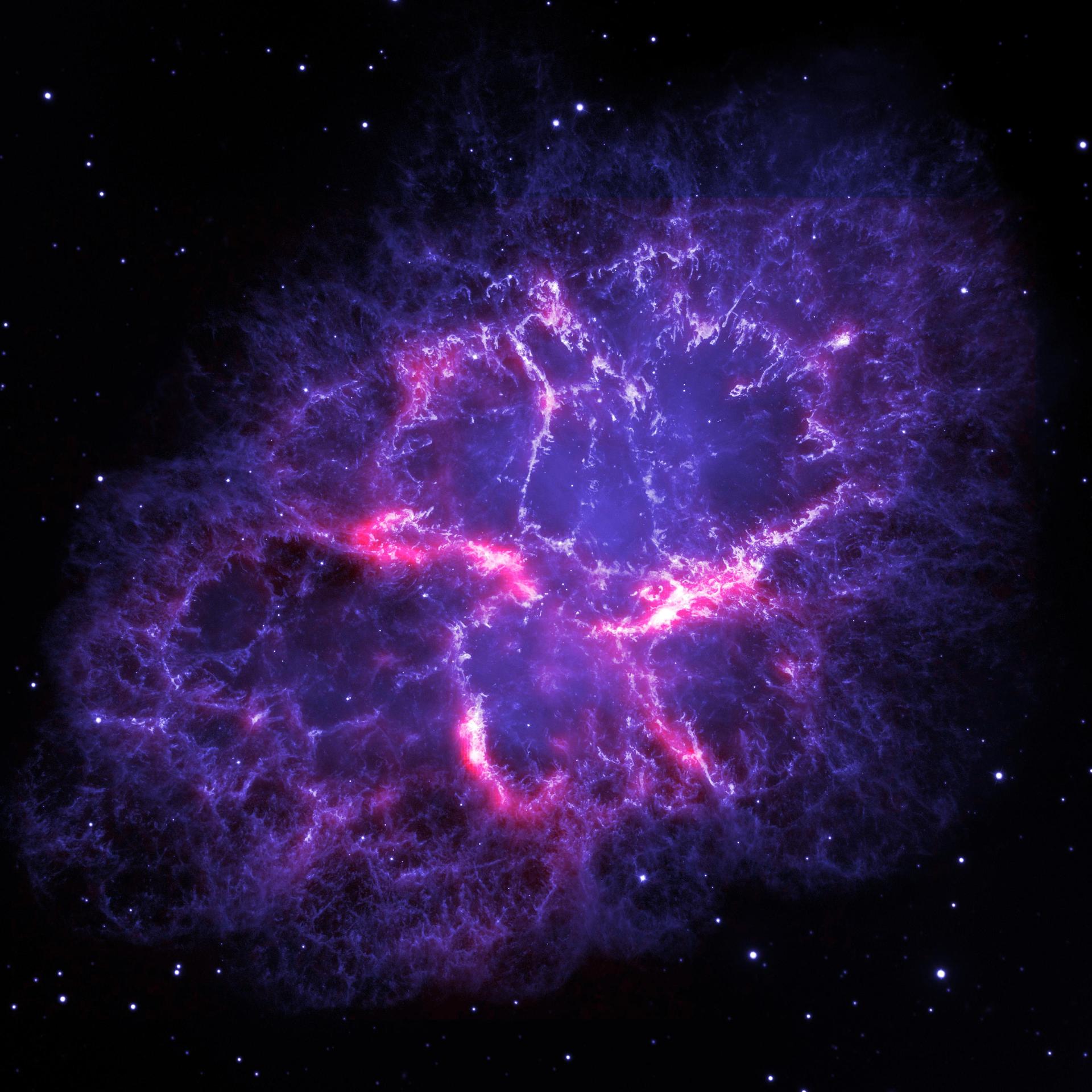
Crab Nebula (M1) — supernova remnant imaged by Herschel and Hubble Space Telescopes

Category: Papers & Publications

Peer-reviewed papers and publications by Harold Aspden

Crab Nebula (M1), supernova remnant · ESA/Herschel/PACS; NASA, ESA & A. Loll/J. Hester (Arizona State Univ.) · NASA Image Library ↗

  • 1987a

    1987a

    The following is a paper by H. Aspden published in Hadronic Journal, v. 10, pp. 167-172 (1987).

    THE PHYSICS OF THE MISSING ATOMS: TECHNETIUM AND PROMETHIUM

    Abstract: Technetium (Z=43) and promethium (Z=61) are by far the least abundant of all atoms below the radioactive elements (Z=84 onwards). Their scarcity confirms theoretical predictions emerging from a theory of the photon derived from synchronous lattice
    electrodynamics. This theory has given precise theoretical values for the fine-structure constant α and the constant of gravitation G and is now shown in this paper to indicate resonant interactions between the vacuum lattice oscillations and technetium and promethium. In the case of promethium there is strong reason for believing that this atom can assume supergravitational or antigravitational properties, accounting for its scarcity. This paper not only adds support to the earlier theoretical work on the photon and gravitation, but suggests a research route that might lead to new technology based on controlled interactions with gravity fields.

    Commentary: This paper was written because the author was asked if his theory of gravitation might have any practical implications. Although the author had, for nearly 30 years prior to this request, had a clear understanding of the electrodynamic nature of gravity, he had always believed that the frequencies needed to promote controlled interaction with the gravity field put that possibility out of reach.

    In the early years of the author’s theory thought had been given to electron activity in the rare earth atoms, particularly erbium, which has a Z value close to half of α-1=137. However, the thought of suggesting a practical research route seemed too difficult and it was too remote from the circumstances facing the author, namely the need first to find acceptance for his theory. Confronting the question anew and with a fresh mind at the time of the above request, the author saw that until then he had never considered how electrons in certain atoms that could possibly be caused to resonate with the gravitational field might be affected by collision with the vacuum aether lattice.

    Once this thought registered, attention converged on the significance of this with regard to promethium and the author woke up to the fact that this element plus the element technetium were the only elements in the periodic table below the upper radioactive
    range that simply were missing as having any natural abundance.

    One day, when the author’s theory has become the accepted theory of
    gravitation, it will be deemed right to deploy enough scientific resource into devising and building a solid-state anti-gravity machine. This paper might suggest one route to that objective.


    The full text of this paper may also be seen in PDF format as Paper No. 4 in the author’s 1996 book Aether Science Papers which is of record in the author’s website www.aspden.org.


  • 1986k

    1986k

    The following is a paper by H. Aspden published in Physics Letters A, v. 119, pp. 105-108 (1986).

    A CAUSAL THEORY FOR NEUTRON DIFFRACTION

    Abstract: It is shown that a phenomenological interpretation of the photon of long standing can explain the recent discovery that a single neutron can exhibit diffraction.

    Commentary: The ‘photon spin’ unit, which is a 3x3x3 array of aether lattice particles, spinning so as to disturb surrounding aether lattice structure, which is the key feature from which the author has determined, theoretically, the value of the fine structure constant, is here applied to the problem of electron and neutron diffraction. It is shown that the electron travels with an entourage of four such photon spin units, which collectively set up a standing wave system, with the balanced angular momenta of the spins containing energy so that it is not shed by radiation.

    This paper extends on the theme presented at a NATO Advanced Research Workshop, the subject of paper [1987m] in the Abstracts section of these Web pages. Single neutron wave diffraction and the derivation of the de Broglie formula for that action follow from the fact that electrons and positrons are involved in the structure and motion of the neutron.


  • 1986j

    1986j

    The following is a paper by H. Aspden published in Hadronic Journal, v. 9, pp. 153-157 (1986).

    AN EMPIRICAL APPROACH TO MESON ENERGY CORRELATION

    Abstract: An alternative empirical approach, differing from the quark model, is presented for analysing particle constitution. It relies upon an energy correlation based upon the Thomson
    charge-mass formula and primary energy quanta, notably those of the proton (938 Mev), the related dimuon (211 Mev), and two graviton-related quanta, denoted g(2587 Mev) and g*(3259 Mev), respectively.


    The full text of this paper may also be seen in PDF format as Paper No. 3 in the author’s 1996 book Aether Science Papers which is of record in the author’s website www.aspden.org.


  • 1986i

    1986i

    The following is a paper by H. Aspden published in The Toth-Maatian Review, v. 5, pp. 2609-2612 (1986).

    ON THE CREATION OF THE SUN

    Abstract: A recent contribution by Edwards on ‘Weightlessness’ is discussed and shown to have particular relevance to the process of creation of the Sun. Edward’s hypothesis is also
    discussed in relation to the causal basis of Planck’s radiation law and evidence for the existence of a real aether.

    Commentary: The author here presents a general discussion on the energy in relation to Einstein’s theory and discusses the deployment of energy at the time the Sun was created. The gravitational energy released was not radiated as heat but was transferred into the translational motion of the Sun as can be verified by equating the Sun’s cosmic kinetic energy with that available from the gravitational source. Here was evidence that the aether in its magnetic action that we sense as gravity can break the standard rules of momentum conservation and promote linear motion. Similarly the secondary radial electric field action arising from the faster coalescence of protons in comparison with electrons gives the
    coupling with the aether which transfers energy by electric action to develop the Sun’s rotation. Those interested in ‘Energy Science’, the title adopted for this work, need to keep this account of the Sun’s creation in mind and to challenge the doctrines of Einstein and
    the Big Bang hypothesis.


  • 1986h

    1986h

    The following is a paper by H. Aspden published in Physics Education, v. 21, pp. 261-262 (1986).

    FLAT SPACE GRAVITATION

    Commentary: Here, in this periodical which is published by the U.K. Institute of Physics for physics teachers, the author draws attention to the alternative non-relativistic ways of explaining the perihelion anomaly of planet Mercury. Quite deliberately, the author did not refer to his earlier paper [1980b] in the main periodical series published by the U.K. Institute of Physics, which showed first-principle justification for alternative non-Einstein theory. The reason was that referees in their ‘peer review’ activity do not approve of author’s urging acceptance of physics which they see as controversial, particularly if attention is drawn to earlier work in a way which leaves them no room for doubt or dissent. The science community is now wedded to Einstein’s theory and the bond is so strong that the author believes it will take a powerful breakthrough on the vacuum energy front before physicists will turn away from their mathematical abstraction and focus on reality!


  • 1986g

    1986g

    The following is a paper by H. Aspden published in The Toth-Maatian Review, v. 5, pp. 2475-2481 (1986).

    THE MYSTERY OF MERCURY’S PERIHELION

    Commentary: This was a general article discussing the background of debate concerning Einstein’s theory of planetary perihelion motion. It particular, it gives a fuller account of the
    author’s interest in the earlier work of Paul Gerber, who derived the correct formula for the perihelion motion by a ‘space and time propagation’ theory 18 years before Einstein wrote on the subject.


  • 1986f

    1986f

    The following text by H. Aspden is an item of Correspondence published in Nature, v. 319, 2nd January 1986 at p. 8.

    EARNSHAW’S THEOREM

    This theorem is not often mentioned in scientific journals. It denies the possibility that an electric charge can be held stable solely under the electrostatic influence of other electric charge. It was used in a recent letter [Nature v. 317, p. 208; 1985] to refute a case put earlier by Berezin [Nature, v. 315, p.104; 1985]. It is as well to keep in mind that the Reverend Samuel Earnshaw developed his theorem with an eye to the constitution of the aether as a medium comprising a structured system of electric charges, separated by what, presumably, would be regarded as a truly void state of the vacuum.

    The theorem fails if the charges permeate a charge plenum or continuum having a charge density, because displacement can then be subject to a linear restoring force rate, owing to interaction with this continuum.

    We have now come to accept that the vacuum medium
    does have some rather special characteristics and a possible structure, so it is not unlikely that it comprises electric charges permeating a charge plenum, notwithstanding the Earnshaw theorem. If this is the case, then the theorem cannot even be applied without some reservation when considering the mutual stability of charge in matter. The support for the structured vacuum is enhanced by the theoretical derivation of the fine-structure constant in terms of the geometrical features of an electrical charge system neutralized by a charge continuum. A value of the fine-structure constant in matching accord with its measurement at the level of one part in ten million has recently been reported from such analysis [Phys. Lett., 110A, 113; 1985].


  • 1986e

    1986e

    The following is a paper by H. Aspden published in Hadronic Journal, v. 9, pp. 137-140 (1986).

    MESON PRODUCTION BASED ON THOMSON ENERGY CORRELATION

    Abstract: Attention is drawn to a remarkable energy correlation which uniquely determines the rest-mass energies of all the intermediate particles in the electron-proton energy spectrum. The correlation formula uses a classical expression formulated by J. J. Thomson, which represents the charge of a particle as confined within a sphere of radius 2e2/3mc2.


    The full text of this paper may also be seen in PDF format as Paper No. 2 in the author’s 1996 book Aether Science Papers which is of record in the author’s website www.aspden.org.


  • 1986d

    1986d

    The following is a paper by H. Aspden published in Hadronic Journal, v. 9, pp. 129-136 (1986).

    THE THEORETICAL NATURE OF THE NEUTRON AND THE DEUTERON

    Abstract: A Thomson-charge group model, which in 1975 gave a theoretical proton-electron mass ratio of 1836.15232, is now shown to give equally precise results for the several quantitative properties of both the neutron and the deuteron.

    Commentary: This is the first of a sequence of eight papers by the author which were published in Hadronic Journal during the period 1986-1989. Full copies of all these papers and the six published in Physics Essays during the period 1988-1995 are included in the author’s separately published collection of papers entitled ‘Aether Science Papers’.

    The ‘Thomson-charge group model’ referenced in the abstract is a composite structure formed by spherical charges in surface contact, each charge having an energy given by:

    E = 2e2/3a

    where e is the electric charge and a is the radius of the sphere bounding the charge.

    When two such charges are in contact one obtains an overall energy which is the sum of the two energies of the individual charge offset by the negative Coulomb interaction energy, which, in the cgs esu system of units used for vacuum interactions, is e2 divided by the sum of the two radii. It is simple algebra to show that certain relationships exist between charge radii and the corresponding individual particle energies when overall energy is minimized or is put equal to the energy of either individual charge. Thus one can begin with a source charge and bring in standard charge quanta which grow in energy terms by virtue of the interaction and can be shed as newly-created particle forms when energy impulses promote separation.

    The whole scenario of fundamental particle creation develops from the
    above formulation by J. J. Thomson when applied in this way. The author has found that this is at the very heart of all activity in
    fundamental physics, ranging from the proton to the graviton and notwithstanding the imaginary picture of ‘quarks’. It was first ‘discovered’ in its most fundamental application when the author developed a model of the aether based on point charges and found that to get to a theoretical value of the fine-structure constant that was exact he simply had to make those charges finite in form. The formula that worked to give the right result was the J.J. Thomson formula!

    Concerning the so-called ‘quark’, the particles of imaginary fractional charge, rather than the unitary charge e, the way the reader should view that subject is to question whether a particle of charge e that stands alone for one third of the time but is part of a three-charge, e, -e, e group, the remaining two thirds of the time, if deemed a single entity, comprises two charges of 2e/3 and one charge of -e/3. Sometimes physicists have problems if what they think is a single charge e behaves as if it can split into three fragments and yet they cannot isolate those individual fragments. They look for complex solutions and abstract interpretations when a little common sense and a classical view on the causal foundations of physics will, in the end, give the answers.

    Of course, the classical viewpoint can be misleading, as one may see from a study of the background to Earnshaw’s theorem, which does concern how charges interact in a vacuum, but that is another story as the reader may see by reading chapter 9 of the author’s 1972 book ‘Modern Aether Science’.


    The full text of this paper may also be seen in PDF format as Paper No. 1 in the author’s 1996 book Aether Science Papers which is of record in the author’s website www.aspden.org.


  • 1986c

    1986c

    The following is a paper by H. Aspden published in Physics Letters, v. 119A, pp. 109-111 (1986).

    ELECTRON SELF-FIELD INTERACTION AND INTERNAL RESONANCE

    Abstract: Recent proposals that an electron might contain an ‘imprisoned’ photon in its field system suggest a wave resonance which allows the QED determination of the electron g-factor to be used to establish the precise value of the fine structure constant, given its approximate value as 1/137. The value of α-1 is found to be 137.03599, in precise accord with its measured value.