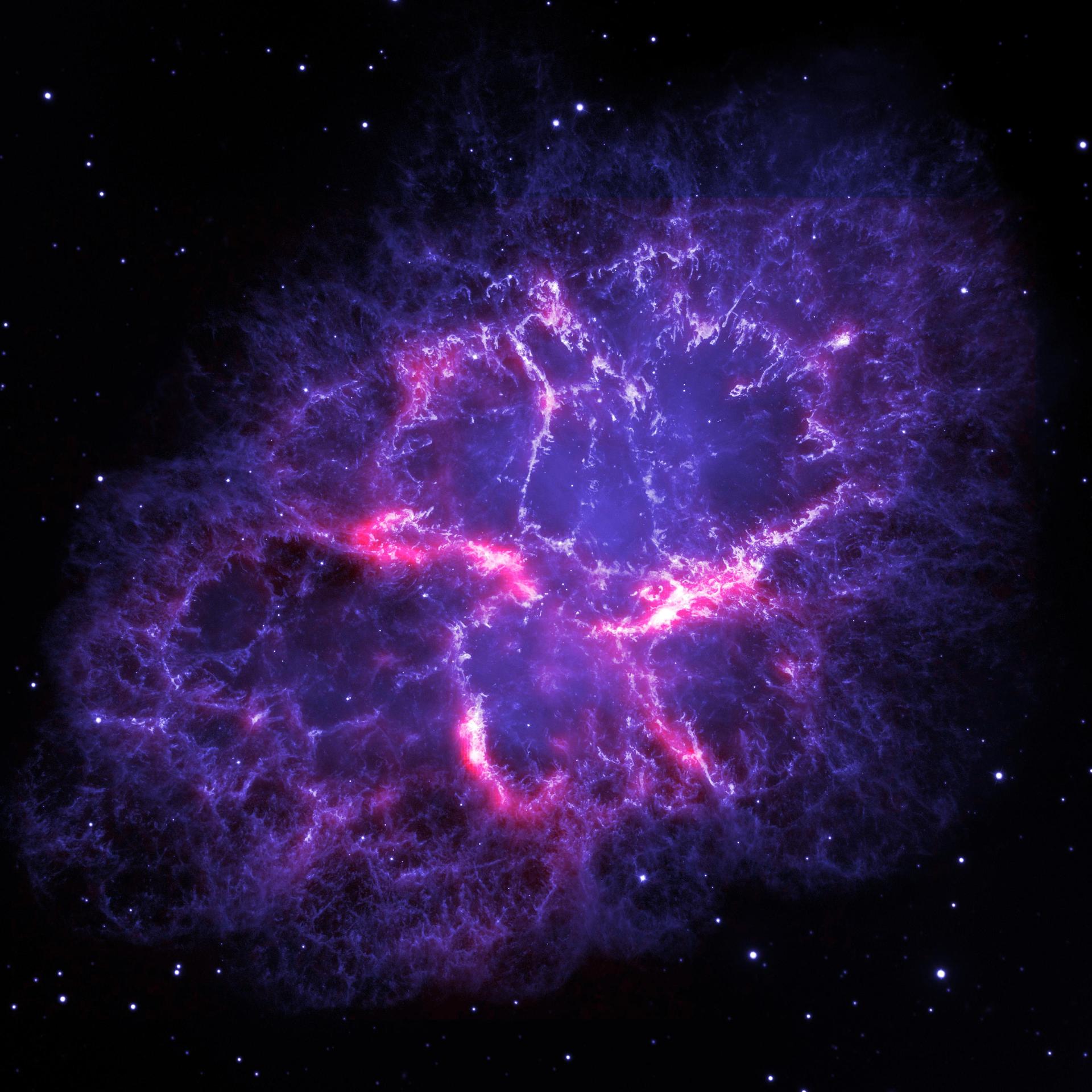
Crab Nebula (M1) — supernova remnant imaged by Herschel and Hubble Space Telescopes

Category: Uncategorized

Crab Nebula (M1), supernova remnant · ESA/Herschel/PACS; NASA, ESA & A. Loll/J. Hester (Arizona State Univ.) · NASA Image Library ↗

  • THE AETHEREAL ROLE OF FERMAT’S LAST THEOREM

    Aether Science Papers: Part I: The Creative Vacuum
    Pages 3-9

    Copyright © 1996 Harold Aspden

    THE AETHEREAL ROLE OF FERMAT’S LAST THEOREM

    As we approach the end of the 20th century we should pause to examine our achievements in science and technology in the past 100 years. They are indeed remarkable and there is reason to wonder whether there is much left to conquer as we enter the 21st century. After all, the discovery of new territory in a geographic sense came to an end once exploration had completed the survey of the Earth’s surface, so one day soon science, at least physical science, should reach its zenith.

    We will then still have to ponder on our incomplete knowledge of space that we cannot easily explore and still need to confront the few never-to-be solved mysteries that science has bequeathed to us even from centuries past. To be sure there is much for us yet to discover in the medical and biochemical field, but physics should by now have yielded the answers to all the secrets that Nature is willing to reveal.

    We will never understand what lies beyond our comprehension, such as why the universe exists and what there is beyond its bounds in the context of time and space. Indeed, whatever we might foresee in the long range future of the universe, is not really relevant to mankind, because it seems probable that, on a more limited time scale, our planet is destined to encounter catastrophy sufficient to terminate human and animal life on Earth.

    So let us take stock and reflect a little on what the transition to a new millenium can mean for physical science.

    Yes, indeed, there are very few challenges now left to tax the mind of a true physicist. However, in saying this, I, as author, am speaking from my own knowledge as a physicist and each of us has our own different and limited perception. I am all too conscious of the fact that, if the scientific community on Earth were to be eradicated and all the books on science were to be destroyed, then, even though the human race might survive, so science as we know it would have to evolve again from nothing. It would then take several more centuries, perhaps another millenium, to bring us back to where we are today.

    However, would it really matter and would science develop in the same way as our history indicates? Would we have another Newton and another Einstein? Surely, there would be another Pythagoras! The Pythagoras theorem has a unique quality. It is a survivor, a fact of science on which one can build and, though taught as mathematics, one can even wonder whether it is a statement in physics. Once a surviving remnant of mankind can reason sufficiently to rediscover and find interest in the theorem of Pythagoras then science, including physical science, has been reborn.

    Thinking along such lines might seem to be pure fantasy, but let me make my point a little differently. Suppose that I were to say that I know how to formulate the Unified Field Theory and how to explain the true nature of gravitation and certain other still unsolved fundametal issues in physics. Suppose I were to die, as is inevitable, and my writings on these subjects were to be ignored, as seems not unlikely. Then how would that impact the world at large?

    It would not even be noticed. Nor, I submit, would the loss of much of the knowledge that takes up space on our university library bookshelves. The simple truth is that mankind in general is not concerned with the understanding of the kind of physics or mathematics that fills the minds of many of our university professors.

    However, technology has become important to our daily lives and there are certain basic teachings that physics in its applied form does contribute to that spectrum of activity, so I must not decry what physics at its applied level does offer to our well being. The major problem ahead of us in the 21st century is the need to discover a new and abundant non-polluting source of energy. I am convinced that this is a problem that could easily have been avoided if some aspects of the 20th century could be erased from our memories.

    We have ventured into the realm of nuclear power whereas we should have been ‘burning the midnight oil’ in studious endeavour and probing the energy secrets of the aether. We erred because Einstein outlawed the aether, closing off access to the power source which created the universe. We erred by adopting Einstein’s belief in a mathematically abstruse philosophy of so-called four-space, a four dimensional distortion of reality, a virtual world that has become a drug to which theoretical physicists have now become addicted.

    Einstein took us into a mental world which had no Pythagoras. The two space dimensions of a flat surface on which one can draw a triangle with two sides and a hypotenuse were replaced, not by the three-dimensional space of the curved surface of the Earth we inhabit, but by an illusory scheme we cannot picture in our mind’s eye. We are even being told today that, thanks to Einstein, we can look forward to ‘time travel’ as we exit through ‘worm holes’ in a ‘time warp’ to leap into the past and perhaps into the future. That surely tells us that Einstein’s theory is a drug we can best do without!

    Yet, in their hearts, all of those Einstein-drug-addicted theoreticians must know that they have draped the universe in a web so fine that it cannot be seen or felt or serve any useful purpose. Does it really need a child to cry out: “The Emperor wears no clothes?” Does it not suffice, after 80 years since Einstein enunciated his General Theory of Relativity, for us to ask what it does for mankind?

    Why would God create four-dimensional space and give us a perception of it in three dimensions? Why, even, in applying General Relativity, do we always need to transform its results back into three dimensions to give them meaning?

    So, as I say above, if we could erase all this from science as we know it, the world would be unaffected and a new generation of physicists could begin anew in developing a theory which says that the universe was created from energy shed by the aether. After all, if something is created there has to be something serving as a source for what is created.

    In saying this I am reminded that Sir Edmund Whittaker, author of ‘A History of the Theories of Aether and Electricity’, quoted Spinoza to introduce his work as ‘The intellectual love of God’. This was a way of saying that to understand the aether is to understand the Creator.

    The purpose of this work is to show that the 20th century did, in fact, provide most of the answers to the primary unsolved problems of fundamental physics, including discovering that Holy Grail we call the ‘Unified Field Theory’. Sadly, however, that drug-addicted community of relativists which regards such theory as their private province has refused to listen to those not sharing their addiction and so I am seeking to interest those outside that community who have retained their senses and their sanity.

    It is the author’s intention to show elsewhere, under the title of ‘Energy Science Reports’, that the 20th century has also delivered a solution to the impending energy crisis by the discovery of ways of extracting energy from the aether. This touches upon the beliefs of a more practical scientific community, but one responsive to what can be demonstrated, whereas this work is strictly concerned with reason and theory, something far more difficult to project into the minds of others than is the reality of the new energy scene. This work describes that aether and its creative role.

    It may be that if this account is ignored by the scientific community then it may take several centuries before some future scientist rediscovers what is here presented. Take note that even knowing that someone once did prove something in scientific history does not make the task of rediscovery any easier.

    Witness the centuries of effort in trying to solve the problem of Fermat’s Last Theorem. This was Pythagoras converted to a power higher than 2, with integer sides to a notional ‘triangle’, the impossible dream! Fermat assured us that he could prove it was impossible but his secret was somehow lost.

    Modern opinion, today, is that Fermat may have been deceived in thinking he had proved his theorem. Very probably that is valid opinion, because if there were a simple proof it would, undoubtedly, have been discovered by now. As will be seen below I do have reason for connecting an aspect of the aether problem with Fermat’s Last Theorem, but first note that in 1995 it was announced that, after centuries of effort, a Professor of Mathematics, Andrew Wiles, at Princeton had at long last discovered a proof of Fermat’s Last Theorem.

    It was this reference to Princeton, the university where Einstein had spent many years as a professor, that aroused my interest. I knew how to connect Fermat’s Last Theorem with the nature of electricity and thereby introduce the aether in a way that could be a challenge to Einstein’s theory. With my Cambridge background and my anti-Einstein disposition, I then thought of introducing this theme in this work.

    It was also the memory I had from 1981 when my wife and I passed through Princeton on our way south for a weekend in colonial Williamsburg. This was before going back north to attend a conference on fundamental physical constants at the Bureau of Standards at Gaithersburg near Washington D.C.

    My wife popped into the university bookstore at Princeton and persuaded them to stock my book ‘Physics Unified’, published just a few months earlier. How long, I wondered, would the book be reordered, once the relativistic community on the teaching staff woke up to what their students might see in my book. Indeed, it took a while before the inevitable happened and orders stopped, but a similar venture at the university bookstore at Stanford in California has led to a sustained inflow of orders for stock, even to this day.

    I had, incidentally, already seen a brief mention of Andrew Wiles for his achievement in solving Fermat’s Last Theorem in the pages of the Michaelmas Term 1995 issue of CAM, the University of Cambridge Alumni Magazine. There it was explained how, according to John Coates, Sadleirian Professor of Mathematics, “Cambridge has always produced some of the most original and gifted mathematical minds in the world.” The report declared that ‘notable amongst them is number theorist Andrew Wiles who sparked worldwide press interest when he cracked one of the great conundrums in all mathematics: Fermat’s Last Theorem’.

    It went on to quote Fermat as noting on a Greek mathematical text found after his death in 1665: &quotI have a truly marvellous demonstration of this proposition which the margin is too narrow to contain.” Then the report further declared “Today’s scholars doubt that he had. But, says Coates, over the centuries pure mathematicians have developed deep mathematical ideas trying to resolve the problem”, followed by “I did not expect to see it happen in my lifetime”.

    It was later reported by Marcus du Sautoy in the British newspaper THE TIMES on Monday April 8th 1996 that Andrew Wiles, ‘for his solution of Fermat’s Last Theorem was rewarded in the Knesset (Israel’s parliament) with one of mathematics’ highest accolades, the Wolf prize worth $100,000, which he shares with his colleague at Princeton, Robert Langlands.’ The headline caption of that report read: ‘The solving of a famous condundrum will lead to new challenges. Is this solution the end of maths?’

    Well, Marcus du Sautoy, it may not be the end of mathematics but it might well become the beginning of a new age in physics as we see its scope for uprooting Einstein’s theories. The event described is a reminder that Albert Einstein was offered the Presidency of the State of Israel, whilst scientists at large still seek that Holy Grail, their Unified Field Theory which eluded Einstein.

    Curiously, there was something in Marcus du Sautoy’s report that reveals an extrasensory perception because I had already written the text which appears ahead on pages 12 and 49. He suggested that the next challenge would concern the ‘Riemann Hypothesis’ concerning prime numbers. “Those numbers are in some sense the harmonics of the ‘Riemann zeta function’. It is these harmonics which tell you all about prime numbers. Riemann conjectured what these harmonics look like. If true, it could imply that the music of the primes is far from being just noise.”

    Well, true or false, the harmonics of the primes do feature in this author’s theory as outlined ahead, but I did not know I was treading the holy ground of the mathematician when I confronted the electrodynamic resonances in my study of the subject. I still think that the discipline of mathematics is a tool designed to help us to understand Nature, rather than to fashion it by shaping it to fit what we want to believe. The challenge ahead is not one to be classified as mathematics.

    Curiously, one senses history beginning to repeat itself, because it was the Riemann tensor which was applied to underpin the mathematics of Einstein’s Theory of General Relativity. My attack using ‘the music of the primes’ will be aimed at proving the aether exists and that the concert hall in which Nature plays that music is one having three space dimensions.

    To migrate from the numerology of Fermat’s Last Theorem to the physics of electrical phenomena we need now to consider physical dimensions and how we incorporate electrical phenomena in this system of dimensions.

    The standard physical dimensions used when expressing measured values are mass M, length L and time T plus something that has an electrical connection, the dielectric constant k. To bridge the gap between inertia and electricity it is not mass that has primary significance, but energy E, inasmuch as the inertia of any electric charge is the property by which it conserves its energy to avoid continuous (non-quantum) loss by radiation when accelerated. See my paper in International Journal of Theoretical Physics, v. 15, p. 631, 1976 or see section 7 of the last of the fourteen appended papers.

    This introduces us to the problem of understanding the true nature of electricity and in particular why it comes in positive and negative forms. The answer is similar to there being odd and even numbers. They represent alternate states in a sequence. In the binary number system we see the last digit as either 1 or 0, this being the odd or even condition. In electricity we have (+) or (-) as the polarity of electric charge which I envisage as having spherical form. There is no zero charge state at the truly fundamental level because that only arises where electric particles combine into a neutral aggregation. It is, however, possible for two charges, a particle and its antiparticle, to annihilate one another and shed energy, a quantum event leaving no electrical form or normal electromagnetic wave that we can trace, which is why physicists invented the ‘neutrino’, but the root question we face is ‘what attribute determines whether a charge is positive or negative?’

    Mass M has dimensions EL-2T2 and it is appropriate to seek to explain all phenomena in terms of E, L and T as the primary physical dimensions and, as we are probing fundamental physics rather than applied physics, to use the esu system in which the dielectric constant k of the vacuum medium is unity. Thinking in terms of energy E, length L and time T, the way forward is to regard an electric charge as a package of energy E which occupies a volume of space L3 but oscillates at a frequency 1/T by exchanging some of that volume with a similar package of energy, albeit also with with energy transfer to and fro between them. This means that there will be two types of charge, or rather states, which differ in character only according to the instant at which we observe them. One will be expanding and the other will be contracting. One, the positive charge, will be in ‘phase’ with whatever charge form we take as our positive reference and the other at the same moment will be in anti-phase and so be a negative charge.

    Do note here that Einstein’s declaration that space and time were intermeshed precluded him from ever accepting the concept of instantaneous action at a distance, thereby excluding the synchrony and phase-locked oscillations which we shall use as the key to understanding electric charge polarity. Einstein lost his way with the first step he took on his path of relativity.

    We, following a different path, can now, if we wish to go to really fundamental levels, explore how electric particles develop into different families, the conservation of energy and the space they occupy being key features of the transmutation process. That will lead us automatically to the point where we see how to solve the problem of linking gravitation and electrical action. The task in sight is no less than that of meeting the challenge posed by Unified Field Theory, but from there we can move even further ahead and come to terms with the very nature of electricity.

    Fermat’s Last Theorem can play a role in this pursuit.

    When an electric charge is compressed into a sphere of radius a the charge occupies a volume of space 4(pi)a3/3 and it has, if under uniform pressure within the sphere, an energy E inversely proportional to a. Now, given the hypothesis that charge polarity depends upon the phase of an oscillation under conditions where volume of space occupied by charge is conserved, we see that a group of particles in close proximity can only change form subject to the combined volume (pi)a3 being constant. In energy terms this means that the summation of (1/E)3 is constant, so if two fundamental particles could merge to become one single particle, which adopts one or other charge polarity then, using x,y z as their energy parameters:

    x-3 + y-3 = z-3

    If this had an integer solution then, by multiplying throughout by x3y3z3, we could use the numbers yz,xz and xy of that solution as an integer solution to a Fermat equation for which n=3. This is impossible and so, if we were to assume that the energy quantities really do comprise integer multiples of a basic energy quantum and the space taken up by the particles is conserved, the merger of two such electrical forms vibrating in anti-phase can never result in the creation of a single particle of unitary charge. We know this without appeal to empirical fact concerning how charges of different polarities are seen to interact. In effect, we have given meaning to the polarity of electrical charge by logical argument based on the physical dimensions E, L and T and the use of Fermat’s Last Theorem.

    So far as this author is aware this is the only application of Fermat’s Last Theorem to a truly physical problem.

    It does, however, open the question of whether, if one searches to find integer solutions to equations such as:

    xn + yn = zn + wn

    or:

    xn + yn + zn = wn

    for n equal to -3, such solutions will be found which bear upon the issue of the hypothetical fundamental quantum of energy.

    To satisfy simple equations of the above form, such an energy quantum would, of course, be extremely small in relation to the mass energy of the electron and we would then need to see the neutrino as comprising large quantities of such quanta. However, since the neutrino is surely a figment of imagination, just something invented as a `bookkeeping’ exercise to keep the energy and momentum balance as between matter and aether, the aether itself becomes the storehouse for energy which, in its ultimate form, may well be quantized in units of the notional energy quantum.

    Unless we pursue this possibility we cannot but wonder whether an avenue of science remains unexplored, and it may well be that there is no integer solution to these equations which has any special significance.

    It is to be noted that two of the appended papers use the following equation:

    x-3 + y-3 = Nz-3

    with N=5 expressing the merger of 5 muons to form a kaon, but that did not extend to a search for the fundamental energy quantum. [Hadronic Journal, v.9, p.137, 1986] and [Hadronic Journal, v.12, p.101, 1989]. These are the second and eighth of the appended papers. Note that the equation as used in those papers has a special meaning in that the kaon was portrayed as a particle oscillating constantly between two states, spending half of the time in each state, one being that of a particle of unitary composition (x) and the other being that of a three-particle form, (x) plus two (y), so that on average it comprised simply a single (x) and a single (y) form.

    With N=6 the latter equation does have integer solutions, as one sees reported by Mike Mudge in Personal Computer World, p. 614, April 1995. Values x=357, y=777 and z=629, satisfy the equality, but these do not relate in any way helpful in our search for the fundamental energy quantum. Solutions, if any, for N=2 are of primary interest.

    The idea that conservation of three-dimensional space is the determining factor governing the properties of a fundamental electric charge, whereas the phase of the pulsating state of this space volume determines the charge polarity, may seem quite revolutionary. Physicists have, it seems, spent less time pondering the question of why electric charge comes in negative and positive forms than they have in hypothesizing about the imaginary notions of negative mass, negative energy and negative time. Concern about the nature of electric charge proper, rather than worrying about the speed of light, is important because it provides a more appropriate line of demarcation between the features of aether theory and relativity. Historically, the investigations of C. A. Bjerknes (c. 1877) on spheres pulsating in antiphase in an enveloping medium to set up mutually attractive or repulsive forces give us a lead. See references on p. 284 of Sir Edmund Whittaker’s ‘A History of the Theories of Aether and Electricity: The Classical Theories’ (Nelson, 1951).

    This, therefore, is this author’s justification for arguing that Fermat’s Last Theorem has real relevance to physics. It concerns the physics of three space dimensions and three physical dimensions, such as energy, length and time. The three dimensional world is the real world which the true scientist should be exploring, not the imaginary mathematical jungle which followers of Einstein have adopted.


    The author’s E-Mail address is:

  • NOTE ON SUPERCONDUCTIVITY

    NOTE ON SUPERCONDUCTIVITY

    The ghostly influence of the supergraviton in magnesium diboride

    Copyright, Harold Aspden, 2001

    I write this after reading an item of news on the web posted by the U.K. Institute of Physics http://physicsweb.org/article/news/5/2/3 which is dated 2 Feb 2001. Japanese scientists have discovered that magnetisium diboride is superconductive at 38 K – almost double the transition temperature of any other metallic superconductor. Once again I venture to apply the supergravition (102) test indicated by my theory SUPERCONDUCTIVITY AND THE SUPERGRAVITON

    When I hear of a new discovery involving superconductivity at higher temperatures I am always tempted to check to see if my theory concerning supergraviton resonance can claim the support of another candidate, meaning a molecular composition or atomic grouping that has a mass very nearly equal to that of just a few supergravitons. The supergraviton is a unit of mass induced in the quantum-electrodynamic underworld of space in the presence of heavy atoms and large molecules and providing the physical action which accounts for their gravitational properties. The relevant theory provided a unified causal link between electrodynamic forces and gravitational forces. The supergraviton has a mass of approximately 102 atomic mass units, this being the value that accords with the value of G, the Constant of Gravitation, and which also is deduced theoretically from first principle analysis presented elsewhere in these web pages. My task in this brief Essay is to explore its connection with the superconductive property of magnesium diboride.

    The phenomenon of superconductivity, according to my theory, is one in which the passage of electron currents involves electrons colliding with molecules of the substance with higher incidence rate for molecules moving in the opposite direction. The magnetic field inductance associated with each such collision preserves the inertial property of the current and sustains the electron current at the expense of kinetic (thermal) energy shed by those molecules. Superconductivity applies if the energy exchanges are sufficiently local and confined to mulecular groupings which involve the presence of but a few supergravitons, the latter having a mass that matches that of their associated molecular system. This is because the force of gravity is a force that acts between the graviton population, the latter being created on an equal mass basis in the presence of particles of matter. In fact, the Heisenberg quantum jitter motion exhibited by matter is that of a dynamic balance between matter and those unseen gravitons in the underworld of local space. The test we are interested in is whether the 102 supergraviton unit of mass has a relationship with the magnesium boride molecule.

    The atomic mass of magnesium depends upon the isotopes involved, as does that of boron. The relative abundance is such that for five atoms of boron one has a mass of 10 amu and four a mass of 11 amu, which accounts for 54 amu. Add the mass of twice that of the prevalent isotope of magnesium (that is twice 24 amu) and one obtains 102 amu, the mass of the supergraviton. One such supergraviton can therefore provide the dynamic balance of a pair of magnesium diboride molecules along with that of a boron atom of an adjacent molecule. However, the larger perspective requires us to consider a dynamic resonance involving nine supergravitons coupled with 20 molecules of magnesium diboride, namely 20 times 45.934 amu since the atomic weight of magnesium is 24.312 and that of boron is 10.811. One can then see that a supergraviton mass of 102.08 amu is needed for perfect resonance.

    I see this as another result supporting my theory and once again express my wonderment at a scientific community that persists in ignoring what my theory offers. It points the way to searching for better high temperature superconductors by fabricating materials by processes conducive to a controlled selection of isotopes to give better mass resonance interaction with the supergraviton mass.

    H. Aspden
    February 6, 2001


  • SUPERCONDUCTIVITY AND THE SUPERGRAVITON

    SUPERCONDUCTIVITY AND THE SUPERGRAVITON

    The link strengthens as more superconductors are discovered

    Copyright, Harold Aspden, 2000

    Earlier in these web pages I have pointed to the connecting link between the supergraviton and the phenomenon of superconductivity. See
    WARM SUPERCONDUCTIVITY. The link is a mass quantity that is approximately 102 atomic mass units.

    Matter comprises atoms and molecules which share a quantum jitter motion having the high frequency of a photon, the energy of which is equal to the rest-mass energy of the electron. That cyclic motion would mean that matter is dynamically out-of-balance were it not for the juxtaposed motion of a counterbalancing system of gravitons induced as part of the zero-point field system hidden in the fabric of space. One can calculate G, the Constant of Gravitation, in terms of the electron by developing the appropriate quantum relationships based on gravitons and their interaction according to electrodynamic force law. This is of record elsewhere in these web pages. See THE THEORY OF GRAVITATION.

    With the advance of this theory over the years, it became evident that heavy molecules induce a complex form of graviton as a cluster of graviton components which overall is capable of providing dynamic balance for a mass slightly greater than 102 atomic mass units, this being what is here termed the ‘supergraviton’.

    The first experimental evidence which was seen to point to this particular quantum mass unit came with the discovery of several warm superconductor materials having the perovskite molecular structure. The molecules individually or collectively as a small group had mass which was an integer multiple of a common quantity, the supergraviton mass, a mass derived theoretically according to this author’s theory of gravitation.

    The relevance to superconductivity arises because the dynamic balance involved in the action of gravity allows a molecule to absorb impact by an electron or shed an electron without dissipating energy in molecular vibrations. There is a magnetic inductance process involved by which collisions between free conduction electrons and those molecules can sustain a flow of electrical current by, as it were, cooling the molecule, and storing the energy as inductance energy during the collision whilst deploying the heat released to meet any accompanying spurious loss owing to that dynamic balance not being absolutely perfect.

    This, in summary, is the background to this author’s argument that warm superconductivity and quantum gravitational theory are linked to the existence of a mass quantum that is slightly greater than 102 atomic mass units.

    As the above theory developed, it was noted by chance that the molecular composition or alloy compositions of certain permanent magnet materials seemed to point also to the dynamic link with the supergraviton. Could it be that the property of permanent magnetism arises owing to a sustained circulating current flow in the body of the magnet? The numerical evidence was strong. (NOTE: Here, I hoped to include a reference to another page of this web site where I have already discussed this theme, but I cannot find it and even wonder if it was erased unintentionally. I will rectify this situation as soon as I can.) The problem, however, was that this implied the existence of room temperature superconductivity in those permanent magnet materials that do exhibit very high coercive force. The problem is also compounded by the general recognition that a strong magnetic field cannot penetrate within a superconductor.

    This brings us to the essential and new contribution of this Essay.

    First, I note that long before I had heard of ‘high temperature superconductors’ (they were only discovered in the latter part of the 1980s) I had expressed my views on why certain substances are ferromagnetic. My account was published in 1969 in my book Physics without Einstein. It was based on my experimental Ph.D. research studying the effects of mechanical stress on the anomalous eddy-current losses found in iron and in nickel. Essentially, I reasoned that magnetic inductance energy can be stored in the vacuum, a factor which told me that there has to be something in that vacuum that reacts and becomes itself polarized by the presence of a magnetic field. Now do keep in mind here that advanced physics texts dealing with magnetic field energy need to take account of the fact that magnetic field energy has a negative potential. A magnetic state involves negative potential and iron is ferromagnetic below its Curie temperature simply because the magnetic field produced by the collective action of certain of its atomic electrons has a negative magnetic potential that is not outweighed by the accompanying mechanical strain energy set up by electrodynamic interaction forces acting between those particular electrons.

    The modulus of elasticity, whether for iron, nickel or cobalt, is quite high, meaning that the powerful stresses that accompany the ferromagnetic state involve less strain and so less strain energy, energy which is at a positive potential. Energy deploys in a physical system in seeking a minimum potential state. It so happens that, for iron, nickel and cobalt, this is the ferromagnetic state, as I show in my book Physics without Einstein.

    Now, as to superconductivity, I did not wake up to the link with the supergraviton until many years on from that 1969 book, though gravitons do feature in that book because it describes a unified theory linking gravity and electromagnetism. The supergraviton comes into being only in the presence of heavy molecules and it is the interplay of such molecules with electrons, as they carry a current flow, that brings us into the realm of superconductivity. In that 1969 book I did explain why electrons can avoid shedding energy by radiation as they progress through a conductive material and even pointed to the fact that it was anomalous that uranium 235 changes from superconductive to the normal conductive state at a lower temperature than does uranium 238. That is discussed on p. 16 of the book. However, at the time, the “102” test mentioned above was something that was 20 years ahead along the path of discovery. Yet, when I did discover the supergraviton mass and saw how it related to energy transfer in the electrical conduction process, I remembered what I had said about uranium. Three atoms of uranium 238 share a mass of 714 atomic mass units and, note it well, 714 is 7 times 102! That is why the heavier isotope of uranium is a superconductor to a higher temperature.

    So, with that digression referring to the theory of ferromagnetism and superconductivity, we come to the discovery reported in the October, 2000 issue of Physics World. A report on pp. 24-25 is entitled: Ferromagnetic superconductor revealed. The report concerns the account by S. Saxena et al 2000 Nature 406 587 describing findings from collaboration between three universities. Quoting from the report:

    “The group has discovered the first material where metallic ferromagnetism and superconductivity co-exist. Under high pressure, uranium germanium (UGe2) loses its electrical resistance without expelling the internal magnetic field. The million dollar question is why did it take so long for these phases to get together?”

    Well, from my point of view, I had to be interested (a) in wondering how this particular molecular composition fitted with my theory of the ferromagnetic state, as outlined above, and (b) whether my “102” test would rise to the occasion.

    So, judge for yourself. As you will have seen above, it required a grouping of 3 uranium 238 atoms to form a mass resonance that could engage 7 supergravitons in dynamic balance to thereby avoid too much energy dissipation. Take one atom of uranium, which data sources say has an atomic mass of 238.14, and two atoms of germanium, which data sources say has an atomic mass of 72.60, and so find that the composite molecular form has a mass of 383.34 a.m.u. Then ask if a small grouping of just a few such molecular forms can point to that “102” resonant state. You will discover that 4 such molecular forms have an aggregate mass of 1533.36, which is 15 times 102.224.

    So, I am still seeing here support for my “102” supergraviton theory and, admittedly, I had also to see how my theory of the ferromagnetic state could apply to this uranium germanium material. Happily it can and I here put on record, by way of an Appendix to this account, a brief note that covers the point, though it is little more than an personal aide memoir which needs clarification by reference to the chapter on ferromagnetism in my book Physics without Einstein.

    The above item in the October, 2000 issue of Physics World has now been followed by a report at pp. 25-26 of the November, 2000 issue of this same periodical concerning the discovery of the “first non-cuprate material that superconducts above liquid-nitrogen temperatures (Y Levi et al 2000Europhys. Lett. 51 564.”

    The material involved is sodium-doped tungsten trioxide. It is stated that the tungsten atoms are surrounded by six oxygen atoms in a perovskite structure having the composition NaxWO3, which is an insulator for x=0, but becomes an n-type semiconductor with x increasing to 0.3, but thereafter it becomes a metal.

    So, I was tempted to perform my “102” test, seeing here a composition in which layers of molecules comprising composite molecular units of the formula Na2W2O6 are formed in a material which otherwise contains tungsten trioxide without the same concentration of sodium atoms. The net atomic weight of this composite molecular form, given that Na, W and O atoms account for 23, 184 and 16 units, respectively, is then seen to be 510. This is exactly 5 times that quantum supergraviton mass unit 102!

    So, once again, we see scientific discovery pointing the finger at the dynamic mass resonance involving the supergraviton.

    However, what I have had to say on this “102” mass resonance theme is simply ignored, because scientists want to believe otherwise and so they soldier on looking for clues to help their search for higher temperature superconductive materials. As this Physics World article describes the path ahead:

    “Historically, there are three approaches to such a quest. The reasoned approach works from a raft of theoretical insights to narrow down possibilities and hopefully predict a candidate. The trial-and-error approach resorts to sheer effort to eventually stumble on a candidate. Then there is serendipity – the fortuitous happenstance of unexpected discovery. History tells us that serendipity is nature’s favoured route. The ideal approach, perhaps, is to attempt to bring all three to bear on a problem.”

    So, whoever may read this, if already embarked on the quest of discovery by stumbling on the ultimate room temperature superconductor, should pay attention and factor the “102” mass resonance into the ‘trial-and-error’ choice of molecular compositions warranting investigation.


    APPENDIX

    The ferromagnetic state of iron arises from the contribution of two electrons in each iron atom which have energy states close enough to cause them to lock into a synchronized orbital motion by sharing energy via their mutual interaction. These electrons are 3d state electrons, meaning that they belong to the n=3 shell of the quantized system of motion well known in physics. The 3d state electrons have an orbital motion that corresponds to the n=2 level of the earlier Bohr theory of the atom.

    The frequency of this orbital motion is, in Bohr theory, proportional to Z2/n3, where Z is the atomic number of the atom.

    Now, confronting the question of how a composition of uranium and germanium could possibly be ferromagnetic, there are two considerations. Firstly, we need to see scope for frequency synchronization of d state electrons in both uranium and germanium, albeit of different energy levels. Secondly, there is need for the resulting electrodynamic interaction forces between those electrons, as moderated by electrostatic interaction, to produce resulting mechanical stress that lies within elastic yield limits of the material, with the negative potential energy density of the resulting magnetic field being of greater magnitude than the associated mechanical stress energy density.

    The second of these considerations would need extensive analysis and require data concerning the perovskite composition, which this author does not have, including data concerning the modulus of elasticity of the material. However, the first of these considerations can be tested.

    If we regard the synchronous interaction as being between 3d state electrons in germanium and 5d state electrons in uranium, the relevant n values for orbital quantization according to Bohr theory are 2 and 4, respectively. Now, for synchronized interaction to occur, this means that the corresponding Z2 ratio has to be the inverse of the n3 ratio.

    Since Z for uranium is 92 and Z for germanium is 32, it is then of interest to calculate the ratio of (92)2 to (32)2 to see how close this is to (2)3.

    You may then verify that the ratio is actually (2.02)3, which seems close enough to make a convergence to the synchronized state seem possible. This is therefore an encouraging result which does seem to offer support for my theory of the ferromagnetic state, but all the more so given the interrelated support from the superconductive aspect discussed above.

    ********

    Readers interested in this subject have more to learn in the next Essay: NOTE ON SUPERCONDUCTIVITY

    ********

    H. Aspden
    November 4 2000


  • COSMIC MUD OR COSMIC MUDDLE?

    COSMIC MUD OR COSMIC MUDDLE?

    Why squander taxpayers’ money to allow particle physicists to wallow in mud?

    Copyright, Harold Aspden, 2000

    I am motivated to write this after hearing a radio programme here in U.K. this morning which informed listeners about the developments at CERN in Geneva, Switzerland concerning the demise of the electron-positron collider and its replacement by its higher energy proton-antiproton counterpart. We were well on track, with the discovery of Higgs in sight, but, with this heavily funded venture at CERN now changing direction, the Americans, we were told, with their onward plans for a more powerful electron-positron collider might now be the first to discover Higgs.

    Having read about this in the literature issued by the Institute of Physics here in U.K., I was only passively interested, but I wondered how the ordinary person could see sense in scientists building a 27 km circular tunnel in the vicinity of Geneva and then sucking the air out of it to allow free passage for high energy electrons and positrons in opposite directions aimed at bringing them into collision to see what might happen. That free passage was along imaginary tracks that physicists describe as a curved field, a magnetic field set up by a very costly system of electromagnets built along the inside of that circular tunnel. Power is imparted to the electrons and positrons by accelerating electric fields, the technology being familiar to those who understand what happens in a television tube, where electric fields give power to electrons and also guide them as they scan row after row across the screen.

    You can imagine how many millions of television sets could be made for the cost of a CERN particle collider. You can imagine the pleasure those televisions can deliver to the public at large who pay for the CERN collider and you can wonder how the public might benefit from what is discovered using that CERN collider.

    Well, enlightenment on that was not forthcoming in that radio report. I, however, did learn something I had not heard of before. It seems that if the Higgs particle is discovered it will deliver an answer to the question of why you, the reader, has mass. That I had heard, but what I did not know is the logic of the link between Higgs and mass, mass here not being the mass of the Higgs particle (called a boson), but rather the mass of anything, given that Higgs interacts with everything having a mass property. No, Higgs is not, it seems, about the force of gravity. That is something else. Gravity sets up a field which acts on mass in proportion to the value of that mass, but Higgs, on the other hand, is a kind of field that gives the mass of anything its particular value.

    I was enlightened as to the logic of the connection when the scientist reporting on the subject declared that, in the language particle physicists use amongst themselves, they call the Higgs field ‘cosmic mud’. Once a particle sets a course to travel through that mud it encounters an effect owing to ‘mud’ sticking to it and that gives it mass.

    So there you are. Your money paid in tax and diverted into science funding which gets into the hands of particle physicists cooperating internationally is being spent on trying to solve a riddle of an imaginary universe which wallows in mud, a pursuit which can only be deplored.

    So this is why I am putting these thoughts of mine on record today, November 2, 2000, after hearing that radio broadcast, given, however, that I did put my previous Essay WHY HIGGS? on record on this web site two weeks ago.

    That Essay did show why the CERN electron-positron collider could indicate energy resonance at certain threshold levels, including that interpreted as a sighting of Higgs, but there is no way that the phenomenon could explain why particles have mass.

    For many years that question to me has been a closed subject, easily explained by the physics of the past. Put in simple terms and without reference to mud, cosmic mud or otherwise, a particle exhibits mass as its property of inertia, it being its response in interacting with an accelerating field to react as we do by the instinct of self-preservation. I have written on this elsewhere and so many times over the years that it is becoming tiresome to say it all again. However, in summary, at the demise of the 19th century and dawn of the 20th century, following the discovery of the electron, physicists argued that a charged electric particle, if accelerated would radiate its energy. In their theory they did not take full account of the interaction of that electric charge and the electric field producing the acceleration. Had they done that then, as I was to discover in due course, some half century on, they would have found that, by assuming that no energy could be radiated owing to the particle responding just so as to conserve its energy, then it would exhibit inertia and mass, the mass being in proportion to the electric energy intrinsic to its unitary charge. The constant governing that proportion is simply c2, where c is the speed at which a disturbed electric field ripples through the body of electric charge defining the particle.

    Do keep in mind here that all matter at its truly fundamental level is a composition of electrically charged particles. Even the neutron, which has no net electric charge, comprises positive and negative electric charges which balance to be neutral overall.

    The formula E=Mc2 is the result of that field ripple within electric charge serving to conserve energy. J J Thomson came close to discovering this in the late 19th century, when he discovered a theoretical link between the kinetic energy and electromagnetic energy of an electron in motion. He had limited his calculation to electromagnetic energy seated outside the body of charge involved and so his formula did not give E=Mc2. Instead, it gave E=3Mc2/4. That was before Einstein got into the act. Once Einstein started writing about the electrodynamics of the electron, he only got his E=Mc2 formula consistent with the related mass increase with speed, as known from early electron theory, by making the absurd assumption that the electron was accelerated slowly and so energy radiation could be ignored. It is very poor science to argue mathematically that something can be ignored because it is small, given that a true zero is needed to justify the result observed.

    All this amounts to saying that we surely know why and how any electric particle has a mass property. It is a corollary of the Principle of Energy Conservation. It does not involve ‘sticking mud’ and a playmate called ‘Higgs’!

    Once the electron structure of the atom was deciphered and we knew that the electrons in it were being accelerated all the time without radiating any energy, it should have been obvious to ask the relevant questions and solve the riddle of why the mass property exists as a direct manifestation of energy conservation.

    Instead, physicists introduced hypotheses giving birth to quantum theory, without taking that energy conservation into account, without appreciating how electrons adopt different states of motion expressly to avoid interactions which do promote energy radiation and without taking account that the vacuum itself is a real medium which also contains electric charge in motion.

    That is the background, background which offers no mud bath in giving scope for the Higgs phenomenon.

    I admit now that I have a second motive in writing this Essay so soon as a follow-up to the previous Essay on Higgs. I had developed the theme of that Essay by reference to a paper published in 1972 in Physics Letters. It made sense, therefore, to offer what I had to say about Higgs for publication in Physics Letters and so I wrote the paper which I append below as part of this Essay.

    I think it is instructive for those who read this to see how my submission was processed by the relevant Editor of this scientific periodical and so what follows first is my letter to his E-mail address at the department of Applied Mathematics and Theoretical Physics at Cambridge University, followed by his reply dated October 21, 2000.

    P.V. Landshoff,

    Dear Sir,

    I present below the text of a paper which I would be pleased to have considered for publication in Physics Letters B. There are no figures. The case presented is simple and brief. It has the merit of relying solely on what was disclosed in a 1972 Physics Letters paper which I co-authored with a colleague working at the National Measurement Laboratory in Australia. What is new and original is the appreciation that the high energy involved in electron-positron collisions may force just a few electrons to substitute for the prevalent particle form of that 1972 account by which the fine-structure constant was theoretically derived. The result, which requires no equations to present, speaks for itself.

    Incidentally, I am now retired and have not declared a university affiliation, although I do at this time have an active research project here at the University of Southampton in the Department of Electrical Engineering.

    Also, I mention that decades ago when I was developing the subject theory I had left academia to work for IBM, but a physicist Dr. D. M Eagles took an interest in my theoretical efforts, which stem from my experimental Ph.D. work on magnetic reaction phenomena and related energy anomalies, and he was very critical and tried to disprove what I was saying. In the event, however, he was converted to my cause and the outcome was that 1972 Physics Letters paper. I would find it a gratifying tribute to Dr. Eagles if the paper I now offer were to be accepted. Its acceptance might also stimulate further interest in extending electron-positron collider experiments to take us a little closer to the ultimate truth.

    Please advise if you require copies of any of the references.

    Yours sincerely,

    H. Aspden (Ph.D. Cantab)

    **********

    Dear Dr Aspden

    Thank you for submitting your paper, which has been assigned the reference number 8901.

    The paper introduces ideas that differ somewhat from those of the conventional theory. The conventional theory is highly successful: it explains a very large number of experimental facts. So the author of any alternative theory has an obligation to show that it is equally successful, as well as pointing out where its predictions differ from the conventional ones.

    This will need a rather long paper, which will not be suitable for a
    letters journal. I am sorry.

    Peter Landshoff

    *******

    ENERGY THRESHOLDS IN HIGH ENERGY ELECTRON-POSITRON COLLISIONS

    Harold Aspden
    Energy Science Ltd
    P.O. Box 35, Southampton SO16 7RB

    Abstract

    Based on criteria concerning particle interactions in relation to volume conservation of space occupied by transmuting electrical charge forms, as originally disclosed in Physics Letters in 1972, it is shown that the data of that paper indicate an energy threshold at 114.9 GeV, the precise value recently observed in CERN electron-positron collider experiments.

    Main Text

    Although the reported sighting of the Higgs boson at CERN at 114.9 GeV [1] is seen as a landmark in the quest to unravel the mysteries of the aether, the particle underworld of the vacuum state, it leaves open the question of which theory it supports.

    The Higgs boson is the missing link in the Standard Model, the last of seven parameters requiring experimental identification. Six are mass-energy quantities and one is a dimensionless constant having a numerical value incorporating the fine-structure constant.

    However, though little known, there is a different aether model of record in Physics Letters since 1972 [2] which also depends upon seven parameters, six of which are also mass-energy quantities with the other one also involving that dimensionless fine-structure constant. This latter theory, as it developed [3], provided a precise theoretical derivation of all of these seven parameters, although one of the six mass-energy quantities is necessarily unity, it being the unit of reference for the other five.

    Taking the 0.511 MeV electron as that unit, the five are the virtual forms of muon and tau, the graviton (2.587 GeV) [4], the supergraviton (95.18 GeV) [5] and the mo particle, the latter featuring in the key role defined in the 1972 account. As there shown, its mass is 0.04078 times that of the electron. The Higgs boson at 114.9 GeV is not involved as a primary component in this alternative theory.

    The functional role of those particle components in the framework of the aether can be summarized in the following way. The mo particle constitutes the component of the lattice structure, the basis of what is a kind of fluid crystal property of the vacuum state, which defines the E-frame (local electromagnetic reference frame in which matter at rest is seated). The virtual muons are the primary energy component. They populate and define the I-frame (the inertial reference frame). The E-frame has a cyclical harmonious motion about the I-frame and so needs to be dynamically balanced by a G-frame system in juxtaposed motion relative to the E-frame. Here G implies the gravitational role of the vacuum state, which is seated in the presence of the tau, graviton and supergraviton particles which have transient existence in that G-frame, serving only to keep the E-frame in dynamic balance but incidentally developing the phenomenon of gravity. Pairs of tau particles serve the primary quantum gravitational role, whereas gravitons supplement that action in providing mass balance for the E-frame and matter in that E-frame, but cater also for non-quantum gravitational mass fluctuations. The supergraviton is really a cluster of particles created only when heavy molecules of matter are present and then overriding the function of the tau as required to assure full gravitational balance.

    Given this introduction, the contribution here concerns only the response of this particle-vacuum system when we bring an electron and a positron into collision at very high energy as in the CERN collider experiments. The process involves each particle, in acquiring an entourage of virtual electron-positron pairs which embody the energy of their motion. Crucial to the case presented in that 1972 account [2] is the hypothesis that the volume of space occupied by fundamental electric charge forms is always conserved. If of spherical, symmetric, form, charge volume is proportional to the cube of the bounding radius and energy trapped by electrical charge housed within that radius is inversely proportional to that radius. Mass, though normally proportional to energy, is a property that also depends upon the continuum in which the charge is immersed. In the ultimate hydrodynamic balance in a system having uniform mass density, a sphere exhibits half the mass it would otherwise have given no background continuum. Only the mo particle is really affected by this, because electrons and more massive particles occupy so little volume in relation to their intrinsic mass that the effect is negligible.

    What this means, however, is that the mass ratio of electron to mo is such that the cube of [me/2mo] is equal to the volume ratio of the mo particle to that of the electron. Now, the thrust of that 1972 Physics Letters paper involved determining that volume ratio, because it was a vital term in the theoretical evaluation of the fine-structure constant. It was there shown to be 1843, which further corresponds to the ratio mo/me being 0.04078 as that paper also shows.

    To take this argument forward in the context of the CERN collider experiment, we can now see, given that enough volume of space has to be deployed to allow creation of the electron-positron entourage of the colliding particles, this can only come from an action which provides a substitute for some of the mo particles in the E-frame to free the space they occupy. The need is to keep the dynamic balance. The substitution involves matching the mass density, given that the vacuum has its own way of adjusting to preserve its electrical neutrality.

    Now, since an electron in the E-frame has a mass that is 24.52 that of the mo particle, if a single electron is created to take over that dynamic balancing role, then the space occupied by 24 mo particles becomes available to accommodate the electron-positron energy field in the collider experiment. If five electrons are created in such an event, given a higher energy requirement, then the space of 122 mo particles is available. This corresponds to a mass-energy of 122 times 1843 times 0.511 MeV or 114.9 GeV, precisely the value of the event which is claimed as a sighting of the Higgs boson [1].

    It is submitted, therefore, that this experimental discovery offers support to this author’s particle-vacuum model, but not necessarily support for the Standard Model, which in any event does not predict a Higgs boson mass of this specific value.

    A crucial test, of course, is whether, in the future, the electron-positron collider experiments will reveal other energy states, corresponding to the number of substitute electrons deployed in the specific field region occupied by the colliding particles. The following energy levels are indicated over the range of 1 to 10 electrons: 22.6, 46.1, 68.7, 92.3, 114.9, 138.4, 161.0, 184.6, 207.2 and 230.7 GeV.

    However, the constraints imposed by the need for dynamic balance in an active energy field may exclude all but a few of these energy threshold values. The analysis in that 1972 paper [2] leading to the evaluation of the fine-structure constant was based on a 3x3x3 cubic array of those mo particles spinning about a central axis. Dynamically, this can imply a 3×3 sub-group, or even a 4 or 5 sub-group of substituted me electrons. Hence the energy threshold set by 9 electrons, with onward separation into energy quanta set by 5 and 4 electron sub-groups, could be favoured. This fits well with the statement in report [1] that the Higgs was seen at 114.9 GeV in company with what seemed to be a neutral Z boson (91.2 GeV) when the energy of each colliding beam was just over 103 GeV. The 9 electron threshold is at 207.2 GeV and the 5:4 electron sub-group division corresponds to the energy thresholds at 114.9 GeV and 92.3 GeV, respectively.

    Presumably the Standard Model requires only one Higgs boson form. In contrast this author’s model indicates the above spectrum of energy levels. It is submitted that this warrants recording in the archives of science, just in case onward experimental research indicates discovery of several energy thresholds at the levels just predicted. The author would have hesitated in offering this for publication were it not for the remarkable fact that the theory yields an unambiguous value of 114.9 GeV, precisely that reported as observed. However, this is the kind of result that the theory has revealed, notably for constants such as G, the constant of gravitation and the proton/electron mass ratio, the latter derived from proton creation sourced in that virtual muon field of the I-frame [6] and so it is appropriate to put the result on record.

    References

    [1] Valerie Jamieson, Physics World, October 2000, p. 5.
    [2] H. Aspden & D. M. Eagles, Physics Letters, 41A, 423-424 (1972).
    [3] H. Aspden, ‘Aether Science Papers’, Sabberton Publications, 1996.
    [4] H. Aspden, ‘The Theory of Gravitation’, Sabberton Publications, p. 80, 1966.
    [5] H. Aspden, Speculations in Science and Technology, 12, 179-186 (1989).
    [6] H. Aspden & D. M. Eagles, Il Nuovo Cimento, 30A, 235-238 (1975).

    ********

    H. Aspden
    November 2, 2000

    Readers interested in these Essays may now wish to progress to the next Essay: SUPERCONDUCTIVITY AND THE SUPERGRAVITON

    ********


  • WHY HIGGS?

    WHY HIGGS?

    Here we ask how the discovery of an unknown mass can be acclaimed as the Higgs particle

    Copyright, Harold Aspden, 2000

    Physicists delving into what they term ‘Electroweak Theory’ have set their sights on their ‘Holy Grail’, the experimental discovery of the energy quantum they denote mH, but express as a symbolic mass term, which they say is the Higgs particle.

    Alarmed at the impending closure of the CERN electron-positron collider, they sought to extend its lease of life by announcing that the Higgs was in sight at around 114.9 GeV [Physics World, October 2000, p. 5]. The report ends with the words: “we are writing a line in the history of mankind.” Seemingly the Higgs particle, if it exists, is a vital component which completes the picture of things for those interested in ‘Electroweak Theory’, though what it all means to the real world of science is itself a mystery.

    However, what does it really mean if an electron and positron moving at the same high speed in opposite directions are brought into collision and the result evidences that a new, but short-lived, particle has been created from the energy involved? Given that some kind of energy threshold has been reached, and knowing the amount of energy involved, does that tell us anything confirming what is implied by textbook accounts of ‘Electroweak Theory’? Or does it instead tell us something about the way in which the aether structure inherent to the vacuum medium has a way a determining certain energy thresholds at which things happen, as it were, with a bang?

    ‘Electroweak Theory’ concerns what is meant by vacuum in particle physics. One reads [pp. 173-174 of ‘Introduction to Gauge Field Theory’ by D. Bailin and A. Love, Adam Hilger, 1986]:

    We must take the Hamiltonian (Lagrangian) of the field theory to be invariant under the symmetry, but the vacuum to be characterised by some field which is (non-zero) not invariant under the symmetry transformation. …. The particle physics vacuum is observed to be rotationally invariant, so it is clear that the internal symmetry with which we are concerned must be broken by a scalar field having a non-zero value in the vacuum. This scalar field is called the Higgs field, and, although it has never been measured in the way that M has, we are postulating its existence in order to break the internal symmetry spontaneously.

    So, that tells you what is meant by the Higgs field! In simple words: ‘Even though we say the vacuum is empty space, the assumption is that the vacuum is not empty! M is defined in the pages of the book leading to the text just quoted as being a state of magnetization, as evidenced in a ferromagnet. It is said that if a ferromagnet is heated above its Curie temperature M vanishes but that, if then allowed to cool in a zero external field, the ferromagnet will, in general, have a ground state for which its state of magnetisation is not necessarily equal to M. This leads to the statement:

    Thus the symmetry resides in the degeneracy of the ground state; any particular ground state is not symmetric since the magnetization points in a different direction. This direction is selected ‘spontaneously’ by the system as it cools, and this is why the symmetry is said to be ‘spontaneously broken’.

    One must understand that those who write about ‘Electroweak Theory’ not only use a lot of fancy expressions to describe their subject but they go much further as they clothe their argument in numerous layers of a mathematical blanket of terms, presenting symbol after symbol and equation after equation, only to leave a reader completely mystified.

    When it comes to putting ‘Electroweak Theory’ to the test, by page 232 of the referenced book, one reads:

    The electroweak theory which we have developed so far is incomplete because we still have to include the couplings of the hadrons (quarks). Thus we are not yet able to calculate the S-matrix elements for processes such as neutron decay or pion decay. Nevertheless there are a number of weak processes involving only leptons which may be used to test the consistency of the theory so far. At present we have introduced seven independent parameters into the theory….

    Now, it was here that I, in my effort to understand the theory presented and in particular the role of the Higgs particle, could see that I was wasting my time. ‘Electroweak Theory’ is a jungle of nonsense. Those seven ‘independent’ parameters are, in fact, far from being independent in the real world. They are all related by the physics of that real underworld we call the ‘vacuum’ but which is best referred to as ‘aether’.

    Identifying them, they are (i) a dimensionless constant which is essentially an arithmetically-modified form of the fine-structure constant, (ii) the mass-energy of the electron, (iii) the mass-energy of the muon, (iv) the mass-energy of the tau particle, (v) and (vi) the W and Z particles that were discovered in 1983 and (vii) the mass-energy of the Higgs particle.

    As to their mutual association in the framework of physics, with the exception of the seventh item, the Higgs particle, this is explained elsewhere in these web pages and I shall, before I end this account, offer some enlightenment bearing upon that Higgs question.

    In summary, the dimensionless constant, the fine-structure constant, is determined by the geometry of the structure inherent in space itself. This is the starting point. That reference to M above bears upon this. My research efforts began in the field of ferromagnetism. A ferromagnet develops within its atomic crystal structure a separate structure comprising magnetic domains in which there is magnetization to saturation in directions set by the atomic crystal axes. That is a field structure, an energy pattern, physically distinct from the structure of matter. My ‘aether’ research began when I realised how inductance energy is stored in the vacuum field and when I explored the aether itself as having structure in which there is that distinct pattern of field energy segregated into space domains akin to the magnetic domains in a ferromagnet. Given structure, its cubic form, I could evaluate how energy deployed when the aether was disturbed by field effects and that gave me a route to evaluating the fine-structure constant, the starting point shared by ‘Electroweak Theory’.

    Now, when we come to the other six items in that list of seven parameters of ‘Electroweak Theory’, they are all energy quantities. There is no dimensionless number here to present the physicist with a deciphering challenge. One must choose a unit of energy or of mass, preferably one having a basic physical significance. The normal choice would be electron rest mass or electron rest mass-energy, but I have that Higgs particle in view and I will use instead something more basic than even the electron as my unit. Note that I asserted that the vacuum medium has structure. That structure is formed by an array of a kind of virtual particle which defines the familiar unit of electrical charge e, but which also has a mass. That mass is found to be 0.040781346 times of the electron rest-mass. How do I know that? Well, it is explained along with the theoretical derivation of the fine-structure constant.

    The reference is a paper published in Physics Letters, 41A, 423-424 (1972), which I co-authored with Dr.D.M.Eagles. It was entitled ‘Aether Theory and the Fine Structure Constant’. The fine-structure constant is a numerical quantity linking the three properties of the aether, namely c, the speed of light, e, the charge of the electron and h, the symbol of the energy quantum, Planck’s action constant. Measurement indicates an approximate relationship:

    hc/2πe2 = 137.0359

    and, back in 1972, based on the development of my theory pertaining to gravitation at that time, I discovered the physical basis of this numerical quantity. My formulation was:

    hc/2πe2 = 108π(8/1843)1/6

    That number 1843 was determined by an energy minimization argument, subject to energy not becoming negative, but with the physical quantity represented by that 1843 number being the number of electrons and positrons that could fill the volume of space occupied by one unit charge particle in the aether. The number had to be an odd number. Its value was derived by rigorous analysis from first principles, as that paper shows.

    The paper also indicates the mass ratio of the electron to that aether particle, its value being half divided by the cube root of 1843 you will obtain that number 0.040781346, but I will not dwell on the reasons here. Suffice it to say that it is derived by rigorous physical theory, which means that, given, the unit of mass set by the aether lattice charge I can derive by theory the mass of electron, that second item in the list of seven of the ‘Electroweak Theory’.

    As to the muon, the tau, the W and the Z these are all derived from the same theory, the results being of published record. See ‘The Nature of the Muon’ and ‘The Mass of the Muon’, Lett. Nuovo Cimento, 37, 210-214 (1983) and 38, 342-345 (1983), respectively. The tau is discussed in these web pages in ES2003 and the theory pertaining to the W and Z bosons is of record in these web pages as Photons, Bosons, and the Weinberg Angle.

    So, finally, we come back to our basic question, the Higgs topic. Now, first, let me say that I do not see how the determination of any of the six mass quantities proves anything about ‘Electroweak Theory’. So, whatever discovery is made pertaining to a particle having a certain high mass-energy value it hardly proves that one can can say it closes the book on ‘Electroweak Theory’. After all, what if two or more such particles are found at different energy levels? Can they all be Higgs particles?

    I do, however, moderate that comment to the extent that, if I also say that there is a particle form or a pattern of particles that proves a feature of my theory then the related discovery will endorse my theory. However, I am not then sure where Higgs gets into the act and I may as well describe the particle family as Aspden particles rather than Higgs particles.

    So, where does that leave us? Well, we are looking at evidence delivered from an experiment in which electrons and positrons come into collision. As each electron or positron is accelerated to ultra high-speed it somehow acquires an entourage of field energy that must involve numerous virtual electron-positron forms. My theory demands that space occupied by electric charge is conserved and so I am going to speculate that, to free sufficient space to create that entourage of electrons and positrons, there is involvement of the omnipresent aether lattice elements, those having that unit mass mentioned above.

    You can then work out the steps in the energy quanta involved. According to my theory, those aether lattice particles share a Heisenberg jitter motion with matter as they move in a harmonious motion at the Compton electron frequency in dynamic balance with a graviton system that is part of a virtual underworld of the vacuum. Therefore, given their mass value as being 0.04078 times that of the electron, if an electron were to substitute itself transiently in serving the dynamic balance role, then that would allow 24 aether lattice particles to relinquish their normal role. If five electrons were needed then this would allow 122 aether lattice particles to free their volume to allow pair-creation of the virtual electron-positron entourage of the high energy colliding electron and positron.

    The energy involved is the rest-mass energy of 122 times the number of electrons and positrons that could fill the space vacated by one aether lattice particle or, simply, 122 times 1843 electron rest-mass energy units, which is 0.511 MeV times 122 times 1843 or 114.9 GeV.

    The spectrum of quantum energy levels corresponding to the 24, 49, 73, 98, 122, 147, 171, 196, 220, 245 … units of lattice particle volume (a range deploying the space occupied by 1 to 10 electrons and positrons) imply particle resonances at 22.6 GeV, 46.1 GeV, 68.7 GeV, 92.3 GeV, 114.9 GeV, 138.4 GeV, 161.0 GeV, 184.6 GeV, 207.2 GeV, 230.7 Gev …

    Now, bearing in mind that the CERN collider data indicated that when the energy of each colliding beam was just over 103 GeV, and so reached the 207.2 GeV threshold in this energy spectrum, it delivered particle evidence pointing to an energy of 114.9 GeV, exactly one of the other values in this energy spectrum, I am tempted to suggest that my theory has predictive power far exceeding that of ‘Electroweak Theory’. The latter simply predicts, or rather presumes, the existence of a Higgs particle at some value or other, albeit at a high energy level, without saying what its estimated energy might be, but yet physicists say they may have glimpsed that particle at 114.9 GeV.

    Note also that physicists claim to have seen the Z particle emerge as part of the Higgs scenario, and that somewhat lower energy quantum of 92.3 GeV derived from my theory is also part of the above energy spectrum is then in contention also at that energy level, the Z particle being very close to this latter value.

    Readers interested in this subject have more to learn on this subject in the next Essay: COSMIC MUD OR COSMIC MUDDLE?

    ********

    H. Aspden
    October 17, 2000


  • UNEXPLAINED PHENOMENON

    UNEXPLAINED PHENOMENON

    A 28 year old mystery

    Copyright, Harold Aspden, 2000

    If you have read the previous Essay, ES2004, then you may wonder how it is that the those of the science and technology community have not already embraced the notion that Nature has been telling us to research the mystery of the hidden forces that can develop rotation in defiance of the accepted principles of mechanics.

    Now, I did say that long before I had ever heard of ‘free energy’ machines, other than by reference to the historic heresy of ‘perpetual motion’, I was already, from my fundamental theoretical studies of magnetism and my experimental Ph.D. degree research, convinced that the omnipresent aether could shed energy and angular momentum. This made me pay special attention to something reported in Electronics & Power, the member’s journal of the Institution of Electrical Engineers in U.K. nearly three decades ago in October 1972.

    It describes a machine of very unusual construction that was demonstrated at the Institution of Electrical Engineers in a lecture delivered by Professor Eric Laithwaite. It was a machine involving magnetic induction and the motion of a roller (steel washer) moving around the inside of a circular track which was part of the stator of the machine.

    Although it was not an intended feature of the demonstration, and, indeed, it came as a surprise to Laithwaite himself, when the power feeding the machine was switched off, that roller began to move faster for a period before slowing down. Professor Laithwaite even doubted what he saw until, after the lecture he asked his assistant if he too had seen anything unusual, and his observation was confirmed. In the event, this so concerned Professor Laithwaite that he wrote an article for Electronics & Power entitled ‘Unexplained Phenomenon’, duly published in the October 1972 issue at p. 360.

    Now, for the most part, members of scientific and technological organizations, even those in academia, show little interest in what happens outside their own specialist field, and there are few that ‘specialize’ in the ‘unexplained’ and the ‘unnatural’. This may explain why only two Letters to the Editor directed at the Laithwaite article appeared in the January, 1973 issue of Electronics & Power. One was by someone who said:

    “Professor Laithwaite’s dissertation on an unexplained phenomenon is highly entertaining, but surely he casts grave doubts on his own powers of observation and verification of facts by reducing Gideon’s redoubtable 300 men to 200! Perhaps the stricture in his introduction that the supernatural does not exist, has led to the exclusion of the bible from his shelves even for reference…..”

    So here we see how this anomalous behaviour of an electrical machine can be trivialized, simply because the preamble to Laithwaite’s article implied that something unnatural had been observed which needed scientific explanation without invoking the hand of God or the mystique of a supernatural influence.

    The other Letter to the Editor was the one I wrote in which I stated:

    “The observed phenomenon can, of course, be explained if the ether rotating with the copper cylinder and the surrounding ether moved by the counter-rotating washer are coupled by ether eddies, as illustrated in Fig. 8.3 of my book [1]. When Prof. Laithwaite’s machine was switched off, the inertia of these coupled ethers evidently transferred angular momentum from the cylinder to the washer via the ether coupling. This sounds weird. specially as Prof. Laithwaite is having trouble reproducing the phenomenon. But it is no more weird than the regularly observed phenomenon of thunder balls. They certainly exist, they cannot yet be made to order and they too are probably due to the phenomenon of ether rotation.

    The experiment to work on is that of Wilson [2]. He found anomalous magnetic effects when rotating an object at speed, but went off the scent when he had no success in an experiment using relativity, in which he thought he was rotating the Earth relative to his detector. A century ago, Gore [3] wrote of a demonstration: “These experiments and the following ones produce a striking effect because rotation appears to be produced without reaction of moving parts of the apparatus upon any external or fixed body.” Profs. Maxwell and Stokes put Gore off his scent by guiding him to modify the experiment to avoid the phenomenon.

    Maxwell contemplated electrical displacement in the vacuous medium in empty space. Are there electrical effects when this medium rotates? Recently, Ryan and Vonnegut [4] have demonstrated that an electrical arc can be stabilised by rotating a surrounding cylindrical cage at low speed. Would this work in a vacuum? Can ether be set in rotation by a central arc discharge? Can lightning produce thunder balls? Can Prof. Laithwaite reproduce his phenomenon?”

    References
    [1] ASPDEN, H.: ‘Physics without Einstein’ (Sabberton, Southampton, 1969), p. 180
    [2] WILSON, H. A.: ‘Rotations of bar magnets and conductors’, Proc. Roy. Soc., 1923, 104A, p. 451
    [3] GORE, G.: ‘An experiment on the origin of the Earth’s Magnetic Field’, Proc. Roy. Soc., 1875, 24, p. 121
    [4] RYAN, R. T., and VONNEGUT, B.: ‘Formation of a vortex by an elevated electrical heat source’, Nature (Phys. Sci.), 1971, 233, pp. 142-143

    This Letter to the Editor was published in Electronics & Power at p. 21 of the January, 1973 issue. So, nearly 28 years ago, here was something published in the main journal circulated to all members of the IEE in U.K. which pointed a way forward in the onward exploration of what I refer to elsewhere as ‘vacuum spin’. In my later years I have come to see this ‘unexplained phenomenon’ as featuring in the homopolar motor research of Bruce DePalma and the Swiss M-L Converter, both rotary machines. I believe it also features in certain plasma discharge experiments which are claimed to deliver excess energy. However, my message has not been heeded.

    Having presented above that Fig. 8.3 of my book Physics without Einstein, I add here, as a kind of footnote, that the book is now out-of-print, all 2000 copies printed having been sold long ago. But I note that those sales were not helped by ‘peer review’. Indeed, when the book was sent to the Review Editor of The Philosophical Magazine he replied as follows from his address at the Cavendish Laboratory in Cambridge:

    “I feel it is impossible to review a book which claims to provide an alternative theory to Einstein’s. If the author is right, the proper place for an assessment is through discussion by scientific societies and in scientific papers. We cannot undertake to provide reviews which give just assessment of major claims in physics.”

    Signed by: Prof. Sir Nevill Mott, F.R.S., Reviews Editor

    At the time I wondered how anyone could ever get the academic world to engage in discussion as to the pros and cons of reviving belief in a real aether medium, without basing the case on a comprehensive book-length dissertation, given the overwhelming popular belief in the doctrines of Einstein’s theory. Indeed, I still wonder and, although I have authored many scientific papers since, I have now fallen back on the hope that the reality of the aether will be revealed in its full glory when it shows its hand by delivering ‘free energy’ as such machines proving this emerge on the commercial scene.

    If you wish now to see the next Essay in this 2000 series, which reverts to a topic deep in the heartland of theoretical particle physics, then press:

    H. Aspden
    September 2, 2000


  • THE SWISS M-L CONVERTER

    THE SWISS M-L CONVERTER

    It’s Secret: Why it operates ‘Over-Unity’

    Copyright, Harold Aspden, 2000

    This machine is a ‘free-energy generator’ and several versions of it are in operation at a Christian community site, close to the village of Linden in the Emmental valley, an isolated valley high in the Swiss Alps. The M-L (Methernita-Linden) converter is, by all accounts, little more than a form of ‘influence machine’, closely resembling the Wimshurst machine that many of us in bygone years saw operating in our school physics laboratory. However, this Swiss community version of that machine happens to generate useful electric power output without needing any energy input other that a gentle pull on the discs to set them in motion.

    The question which every ‘free energy’ researcher might well ask is: “Why does it work?”.

    Having just read an article on the machine by Lev Sagopin, which appeared at pp. 64-65 of the No. 32 issue, 2000 of Infinite Energy, and which reported some of the history connected with this machine, I am prompted to make the following observations.

    I had, from my impressions of what I have read and heard about this Swiss activity, already formed the conclusion that the very capable people of that community that were specifically involved in its construction and operation do not themselves really understand why it works. One suspects that originally the idea was to build a normal operating Wimshurst-type machine, possibly intending it to be driven by a windmill, and that, somehow, instead of having to keep it turning by feeding power input, the machine took off and ran itself. Why else would those of the community build several modified versions of the machine? Why else would they allow Stefan Marinov to ‘get a device’ (as Lev Sagopin words it) after visiting the community twice (July 1988 and February-March 1989), if it was not to probe into and decipher its mode of operation so as help the community to understand its operational principle? Maybe the secret is so well kept, because the Community itself does not know the secret and so cannot disclose it anyway!

    This is speculation, but it struck a chord with me when I read in the Lev Sagopin article:

    “He (Marinov) got a device with the power of 300 W at 0.3 A for study in his laboratory. As far as I (Sagopin) have understood, even the inventor of this device does not completely understand its working principle and, therefore, out of scientific curiosity he got in touch with Marinov.”

    So I will, in this fifth of my Energy Science Essay 2000 series, give my opinion as to why the Swiss M-L Converter works as an ‘over-unity’ or ‘free energy’ machine.

    First, I need to refer to a little of the background of my own theoretical research in fundamental physics. It is not really all that surprising to encounter a problem as to why something begins to spin for no apparent reason. The prime example is the solar system. The sun rotates and all its planets orbit the sun in the same direction. That means that collectively they possess an enormous angular momentum. What was it that delivered that angular momentum? What could the sun push against to initiate its spin?

    Oh, I know this is a problem confronted in history and answered in the past by saying that the planets were created when a passing star came close to the sun, something that was deemed statistically to be so unlikely that the sun was seen as unique in having planets, from which reasoning our Earth was seen as the only abode in the universe for anything living.

    I also know that the problem was swept away when the Big Bang hypothesis took off. That angular momentum could then be balanced by the counter rotation of some other stellar object which has since been carried far off by the cosmic expansion.

    However, apart from deciphering the grand mechanism of the aether which did set stars rotating as they were created, I became interested in anomalous effects involving rotation on a smaller scale. Now, I cannot justify going into all the details of my research on this that have been published elsewhere, so I will advance here by quoting some conclusions that I reached from my theoretical investigations into aether phenomena. By that I stress that I do mean serious investigations within the discipline of physics, i.e. nothing mystical or spiritual.

    It was on page 33 of my book ‘Modern Aether Science’, published in 1972, that I began to explain at considerable length why certain unexplained phenomena involving rotation indicated involvement of aether in a state of spin. The prime example was the Earth’s magnetism, notably its field distribution at different depths below the ground. Professors of physics, even a Nobel Laureate here in U.K., were going to incredible lengths to prove or disprove the hypothesis that matter, as a function of mass, has an intrinsic property of developing a magnetic field when in a state of spin. My case was that it is the aether, and displacement of charge in the aether, when spinning, that develops the magnetic field. An example was the experiment performed by Professor Blackett (reported in 1952) in which he somehow acquired a very large gold test specimen which he installed in a special test location far removed from anything electrical that could produce a magnetic field. His assumption was that its very high mass density would concentrate its intrinsic magnetism as induced by its rotation with body Earth and his attempted measurement involved an extremely sensitive magnetometer. The result was a null result, the reason being that the aether in which the real charge effect producing a component of the Earth’s magnetic field is not concentrated by the presence of matter. However, the aether did not and still does not feature as an element in the working vocabulary of the physicist of the mid 20th century, nor does it even now. Accordingly, mystery still surrounds the truths about the cause of the Earth’s magnetic field. Remember here that one has to explain how, periodically, at intervals of the order of 100,000 years, the Earth’s magnetic field can reverse, but the Earth still keeps rotating in the same direction. Remember also that the axis of the Earth’s magnetic field actually precesses about the Earth’s axis of spin, as the magnetic north and south poles migrate around the geographical poles. I can see sense in aether moving through matter, just as matter moves through aether, and so that precession of aether spin relative to body Earth is not a theme one can dismiss lightly.

    It was in 1980 that I published a full updated theoretical account presenting the qualitative and quantitative details of this relationship between matter and aether, including a theoretical derivation of the strength of the Earth’s geomagnetic field and the energy involved in aether spin. That was in my book ‘Physics Unified’, but in 1980 I knew nothing about the the evolving world of ‘free energy’. I had never heard of that Swiss community or any of the pioneers of ‘free energy’ that we hear about today, other than Tesla, of course, who I knew, from somewhere in my early studies of electrical engineering, had played an important role in the history of invention pertaining to the induction motor.

    Evenso, my awareness and interest in certain anomalies concerning charge induction, electromagnetism and rotation having aether undertones, inspired by the progress of my theoretical work, led me to write the following on page 188 of ‘Physics Unified’:

    “Note that we are led from the analysis of the optical experiments by reference to Fig. 20 in Chapter 3 to suspect that there can be local rotation of space lattice in the presence of rotating apparatus. However, it would be absurd to suggest that the lattice could readily rotate at full speed of rotation of the apparatus and pass undetected in our observations. Accordingly, there must be a mechanism limiting the rate of rotation under normal circumstances. Equally, one should not exclude the prospect that it might be possible to induce rapid rotation of the space lattice under certain circumstances.

    This raises all kinds of interesting questions. We have seen that an electrical charge induction within matter can stimulate the spin of the space lattice. Once spinning as a result of the deployment of this electrical energy, there is a radial lattice particle displacement which generates a magnetic field and holds electric charge in matter in a compensating electric balance. The body and rotating space lattice will tend to stay together in their onward migration through space. Therefore, should it not be possible within the laboratory to establish the coupled rotation of a body and the coextensive space lattice? The answer must be affirmative and the consequence is that we have here basis for putting this theory to its test, possibly with practical consequences.”

    So you see, here I was, in 1980, coming from a very fundamental insight into the workings of the aether and beginning to see the ultimate prospect of something practical evolving from an understanding of the aether spin connection.

    However, in 1980 I was still locked in my career pursuit, earning my living as European Director of Patent Operations in a international corporation and not as a professor in academia having laboratory facilities, laboratory technicians and research students under my wing. I could not research the above subject at the laboratory bench, nor, admittedly, could I at that time define a clear research route with ‘free energy’ machines in my sights. After all, I had never heard of that scenario other than in the context of ‘perpetual motion’ machines, which I knew were outlawed in Patent Law from my professional patent training and outlawed in physical law from my scientific education.

    Neverless, in that book in 1980 I was making the point that the theme I was writing about could have practical consequences. Indeed, I stressed this point further on page 189 of the book when I wrote:

    “Within the laboratory there is evidently scope for seeking to induce ‘vacuum spin’. An electrical or magnetic coupling is needed and there is scope for tapping some of the angular momentum of the space medium. Thus any experiment in which there appears anomalous torque deserves more serious attention than one would think.”

    Now, it was ten or so years on from this 1980 period that I first heard about the claims of Bruce DePalma concerning over-unity performance of his homopolar generator. Here was a rotating metal disc, operating in conjunction with a magnetic field acting along its spin axis, in effect a Faraday disc machine, something I had read about in my electrical education, allegedly delivering more electrical power output than was needed as input to spin the disc. Now, of course, that raised my eyebrows a little. It was not beyond my prowess as a Ph.D. for research in electromagnetic phenomena, to formulate the theory of the Faraday disc motor and conclude that there was a sound energy balance sheet for its operation. Equally, however, my career pursuit in patent work involving the realm of electrotechnology, my earlier years even being in the heavy electrical industry, had made me attentive to the workings of what inventors claimed as their brainchild. One does not discard an inventor’s claim as ‘rubbish’, just because it sounds somewhat out-of-line with past experience. Invention does take one into new territory intellectually. But here, I was not looking at Bruce DePalma’s claim with a view to protecting it by a patent. My sole interest was curiosity, curiosity stimulated by having written about that ‘vacuum spin’ theme in that 1980 book some ten years earlier.

    Yes, I could see the connection. I had the explanation, but I could also see the practical problems. The machine output was enormous current at low voltage, mainly drawn from the power input spinning the disc, but some drawn from the added drive from the injection of angular momentum from that vacuum spin phenomenon. Bruce DePalma had a machine that did display an over-unity performance but it overheated too quickly and it was a seemingly transient effect and lacked a steady inflow of excess energy.

    The reason, as I saw it, was that the vacuum spin coupling in responding to the radial electric charge displacement in the disc, as produced by a metal conductor rotating through a magnetic field, is a one-off event. The inflow of aether energy and angular momentum is a once only event at start up, unless something is done to set up pulsations. Either the magnetic field has to vary cyclically in strength or the disc speed has to change cyclically, if there is to be a continuous succession of incoming energy surges. The induction of wasteful eddy-currents precludes magnetic field strength change and the inertia of a heavy spinning wheel precludes speed change. These factors explain why attempts by others to replicate DePalma’s findings, with two or three notable exceptions, have been met with failure.

    However, suppose we have two non-metallic discs rotating close together about the same axis but in opposite directions. Assume that the spin with their axis somewhat in the direction of the horizontal component of the Earth’s magnetic field. It is a weak field compared with that of an electromagnet, but it will still develop a radial electric field in any radial strips of metal film cemented to those discs. One disc will develop a positive potential at its rim relative to its axis and the other disc will develop a negative potential at its rim. Suppose now that, in response to that weak radial electric field, the aether coextensive with the each disc, reacts to displace aether charge and so compensates for the electric charge displaced in the metal strips. The aether must spin and in so doing it must import angular momentum and so energy from the enveloping universal expanse of aether. As with the DePalma machine this can only occur as a one-off event, unless there is some action that causes a pulsation.

    Now ask yourself what one has with a Wimshurst-type machine. There are two discs rotating in opposite directions. Each disc has several radially orientated metal plates cemented to its surface. As the plates sweep past one another there is electric charge induction, which charge builds up, being a negative (electron) charge displacement radially outwards in one disc and effectively a positive charge displacement radially outwards in the other disc, the latter really being the radially inward displacement of electron charge. Assuming that a common base potential applies at the axis, a difference in potential is thereby set up between the rim regions of the closely-adjacent discs, and the result is the steady recurrence of arc discharges between those rim regions owing to the quite high voltages induced.

    Here then is the pulsation which resets the machine to accept another inflow of vacuum spin energy and angular momentum. Instead of providing a drive mechanism, with its gearing or pulleys and friction problems, as with a normal Wimshurst machine, just suppose the discs are left free to turn, but they are put in slow rotation rotation by a hand start. Need you then be surprised if you hear that they keep on turning of their own accord, given that you have understood what I have reported by reference to the above quotations in my 1980 book ‘Physics Unified’?

    Note that there is no forced cyclic change of disc speed in this case. Their speed is steady. Note also that there is no fluctuation of the Earth’s magnetic field strength. It is steady. But there is the rapid periodic upset of the electric charge priming as the influence machine performs its normal role of causing cycles of charge and discharge, so upsetting the equilibrium of the ‘vacuum spin’ response and thereby causing the aether to disgorge parcels of energy and angular momentum continuously. Presumably by the use of electric brush connections to tap into that disc potential, some of that energy appears as electrical output and is collected and put to use by that community using the M-L Converter. The inflow of angular momentum overcomes any frictional and windage effects and keeps the ‘wheels’ of the machine, those discs, turning.

    That, in summary, is my explanation of the reason for the ‘free energy’ operation of the M-L Converter. It is another step forward in the story of the aether, but I suspect that the technology involved in this particular design of machine is not going to be of much significance in the commercial exploitation of future ‘free energy’ methods. One needs to look elsewhere.

    The next Essay in this 2000 series presents some further background information relating to this ‘vacuum spin’ topic.

    H. Aspden
    September 2, 2000

    If you wish now to see the next Essay in this 2000 series then press:


  • THE THEORY OF GRAVITATION

    THE THEORY OF GRAVITATION

    Here we face the Ultimate Challenge: Explaining the value of G as now measured in the year 2000

    Copyright, Harold Aspden, 2000

    Over the past 40 years I have sought to interest the world of science in my theory of gravitation. It is a theory based on interpreting the quantum activity which underlies our immediate environment and pervades all space. There are energy transitions involving what are called ‘leptons’, constantly occurring, even in the vacuum, in an underworld scenario which some physicists refer to as the field of ‘zero-point energy’.

    My theory is a comprehensive ‘unified field theory’ in that it explains gravitation as an electrodynamic process and is successful in that it allows G, the Constant of Gravitation, to be determined quantitatively and qualitatively in terms of the electric charge to mass ratio of the electron.

    The theory has developed in stages, but its phenomenological basis, the link with electrodynamics, stands on the firm foundations disclosed in the first edition of ‘The Theory of Gravitation’ published in 1960. I wrote that text in the latter part of 1959 to put my theory on record at a time when I had decided to make a career move by joining IBM in England as a Senior Manager. I had not opted for an academic university career following my Ph.D. research years at Cambridge. Instead I decided to develop specialist skills concerning technological innovation and its protection in an industrial environment.

    The theory of gravitation was of interest to me, essentially because my research had shown how the electromagnetic energy we associate with magnetic induction is stored in what we term a ‘field’, whether within solid matter or in vacuo. I could see a basis for connecting that with the phenomenon of gravitation, but had come to see the need to believe in the existence of a real aether, something of a ‘taboo’ subject in the world of academic science. Physicists had come to accept the Einstein doctrine implicit in his theory of relativity and the aether has no place in that doctrine. ‘Four-space’, a concept that defies visualization in physical terms, had displaced the ‘aether’ and I well knew that, to project my theoretical notions I would have to contest territory that was the exclusive province of the physicists who were addicted to Relativity.

    Over the years, I did update the my theory of gravitation as it advanced step-by-step, notably in 1966, 1969, 1975, 1980 and 1996. [See book titles in list of references]

    However, the scientific community has remained unconcerned and has seemingly ignored my efforts. So, with two new major advances of this the millennium year 2000, the one reported in the preceding web page item and that I now present, I venture now upon what I presume will be the culminating step, namely the task of deriving G, the constant of gravitation, by theory which gives the precise value in accord with the 1.5 part in 100,000 precision of the year 2000 measurement, which has involved a quantum leap in the degree of experimental measurement precision of this very-difficult-to-measure quantity.

    Contrary to conventional practice, and contrary to the natural and logical path I followed in reaching the result, I will present the formulation first and then show how it is derived. I want the numbers to point to the underlying physical picture, because it is all too easy, if I start by portraying a physical scheme, for the unbelieving reader to presume that that I rely on hypothesis and that the assumptions implicit in that scheme were deliberately chosen to give the correct numerical result.

    Of course, even with this approach, critics will be critical. They will suggest that I am merely playing with numbers, pressing the buttons on a calculator until I find a mathematical relationship that gives the right answer. However, I think the mathematical odds against finding the formula I present below, as one fitting the known answer, are high enough to upset that argument, but you must judge. I can only say that I have been guided by what I see as the physics underlying the formulation and believe it portrays how Nature regulates the phenomenon of gravitation.

    The formula defines the action of gravity as a quantum phenomenon, quantum in this case meaning ‘as involving discrete units of action’. Two distinct quanta are needed, as I shall explain later, and these are odd integer numbers that signify a multiple of a unit based on the form of the electron. These numerical quanta are denoted A and B, respectively.

    I shall formulate an expression for the square root of G, which I express as Gr, the reason being that I see the action as between systems each involving the same two basic quantum units, each such unit comprising one A quantum and two B quanta, for reasons that I shall explain in detail later. Then, without further ado, I present the formula:

    Gr = (4π/3)(4.8032×10-10)/(108π)3(A)4(9.10939×10-28)X

    where:

    X = [1 + 2(A/B)3]/[1 + 2(B/A)]

    Now, if you use your calculator and substitute the numbers 5061 and 3485, for A and B, respectively, you will discover that G has the value 6.67435×10⁻⁸ and I ask you now to compare this with the latest, year 2000, value of the Constant of Gravity G reported in SCIENCE, v. 288, p. 944 (2000), which is 6.67423+/-0.00009 times 10-11 N.m2.kg-2.

    Note that my derivation, as formulated, involves the old-fashioned cgs system of units, as applied to a vacuum assigned unity permeability and permittivity. I prefer that because the vacuum is my reference base and the numbers are easier to work with if one bases the units on that as reference, given that the object is to understand physical phenomena occurring in vacuous space, rather than find a convenient way of dealing with practical problems by avoiding numerical expressions that put 4π into the calculation.

    Those G values differ by very slightly more than one standard deviation of the year-2000 measurement. That is more than one order of magnitude more precise than any previous measurement of G.

    So, I claim that my formula, as just presented, has something to say about the nature of the force of gravity, subject of course, to it having a true physical basis.

    Well, first of all, if you are astute on matters relating to physics, you will already have noticed that the electron charge/mass ratio features in the equation for Gr. The charge of the electron in cgs esu is 4.8032×10⁻¹⁰ and the mass of the electron is 9.10939×10⁻²⁸ gm.

    So here is that ‘Unified Field Theory’ connection. The mutual force of electrodynamic attraction between two discrete electrical charges separated by unit distance is equal to the product of their charge values in esu, if they are moving mutually parallel at the limiting speed governing electromagnetic wave propagation in vacuo. That, in physical terms, raises certain questions, because we see particles generally as being close to a position of rest in the electromagnetic frame of reference. However, note that I am using the electron as a unit only. I do not say that gravitation stems from the interaction of electrons. Instead, I say that it arises from interactions between what I call gravitons, a kind virtual lepton that lives in a world that is ever moving at the speed of light, c, relative to the frame occupied by matter.

    You see, the quantum energy activity underlying everything imparts a universal motion to matter (physicists call it the Zitterbewegung), a jitter associated with Heisenberg’s Principle of Uncertainty. That system of matter in motion in an inertial frame defines the local electromagnetic frame of reference, and so the material universe would be dynamically out-of-balance inertially, were it not for a hidden counterpart system of gravitons moving in juxtaposition about the inertial frame. The relative motion, as between that graviton system and the matter it balances, is the speed of light c. However, we are dealing here with a system that is kept in step by synchronizing actions which override certain considerations that govern material particles moving linearly at high speed through the electromagnetic reference frame. The gravitons do not gain kinetic energy in the context of the relativistic mass increase that applies to material particles. I accept that this may seem a little complicated, but it is fully explained in my published works and here I am intent on justifying the numerical formulation just presented.

    The formula contains four other quantities, namely 4π/3, 108π, 5061 and 3485.

    As to 4π/3 you can guess that this is the numerical coefficient used to derive the volume of a sphere from the radius. So we are concerned with units of electric charge that sit within a spherical unit of space, or, alternatively, that, as part of a uniformly dense system of charge, are excluded from a spherical space.

    Note then that 108π appears as a cubed expression. This also suggests a volume measure, where 108π is proportional to a side dimension of a cubic form. You will further notice that it has the effect of very substantially weakening the mutual attraction force implied by the interaction of two electrons. However, the force of gravity as based on the interaction of two electron masses is still far weaker than that reduction would imply. So we look, not to the unit charge of the electron, but rather to the unit charge excluded from a spherical form on the basis that the charge density is determined by e, the electron charge, as distributed uniformly over a cube of size involving that expression (108π)3.

    Here I am going to digress for a moment to refer to a paper published in Physics Letters, 41A, 423-424 (1972), which I co-authored with Dr.D.M.Eagles. It was entitled ‘Aether Theory and the Fine Structure Constant’. The fine-structure constant is a numerical quantity linking the three properties of the aether, namely c, the speed of light, e, the charge of the electron and h, the symbol of the energy quantum, Planck’s action constant. Measurement indicates an approximate relationship:

    hc/2πe2 = 137.0359

    and, back in 1972, based on the development of my theory pertaining to gravitation at that time, I discovered the physical basis of this numerical quantity. My formulation was:

    hc/2πe2 = 108π(8/1843)1/6

    That number 1843 was determined by an energy minimization argument, subject to energy not becoming negative, but with the physical quantity represented by that 1843 number being the number of electrons and positrons that could fill the volume of space occupied by one unit charge particle in the aether. The number had to be an odd number. Its value was derived by rigorous analysis from first principles, as that paper shows.

    The 108π term has the following meaning. The unit charge particle sat in a cubic volume of space with its charge balancing the opposite polarity of a uniform charge density filling that space. The aether is electrically neutral on a macroscopic scale but has electrical structure on a microscopic scale, as needed to account for Maxwell’s displacement currents.

    Analysis, based on explaining the energy quantum of the photon and deriving the action underlying Planck’s radiation law, which includes h, told me that the side dimension of a unit cube of space is 72π times the classical radius of the electron, the latter being e2/mec2 in cgs units. Here you see that charge/mass ratio of the electron mentioned above. Now, the so-called classical radius of the electron is a notion only. In fact, the correct formulation of electron radius is that advocated by J.J.Thomson, which is two-thirds of the value of the classical radius. So one can say that the unit cube side of the space occupied by one aether charge e is actually 108π times the actual radius of the electron. You can, by cubing this quantity, and dividing by 4π/3 obtain a measure of the unit volume of a cubic cell of the aether in terms of electron volume.

    It is, simply, 9,324,644, but one needs to divide this by that number 1843 to get a measure of the volume of that unit cube in terms of the volume of the unit aether particle that sits in that cube. The result is 5059.49. That explains how I first began to see something special about such a numerical quantity pertaining to the aether. You see, I could work out the electrical charge density that filled those cubic units of space, and I suspected that units of a spherical particle form in dynamic balance with matter would displace a tiny amount of charge owing to their finite volume, and I simply worked backwards on the assumption that this would account for gravity to estimate the physical size of that particle. I found that, using the J.J.Thomson formula, it would have a mass of approximately 5063 times that of the electron. Hence my interest when I saw that analysis of the photon by deriving the fine structure constant had led me to that 5059.49 quantity.

    So I come to that 5061 term which appears in the gravity formula to a fourth power. The fourth power arises because, in electron unit terms, a non-composite particle of charge e that is N times the mass of the electron, has a volume that is 1/N3 that of the electron. Then, since volume determines the electrical charge involved, but gravitational action, in the Gr context, is scaled according to mass, we need to adjust that by the factor 1/N to obtain 1/N4 as the appropriate term to use.

    Now, why have I used 5061, rather than 5059 or 5063? This is the real breakthrough in the development of my theory, guided now by this new year-2000 report of the latest G measurement.

    The answer to this is that my theory has evolved in stages. Initially I was concerned with how gravity could arise from the influence of very tiny masses and yet satisfy the same constant of gravitation that applied to large masses. Even the energy content of electromagnetic waves gravitate, because we see them deflected in a gravitational field and I say this in the firm belief that Einstein is wrong in declaring that this arises because space is curved. My case, based on aether theory, is that the aether medium can offer the same G response to large systems of mass as it does for tiny units of mass, meaning the mass-equivalent of energy. [I note here that I adhere to an interpretation of the basis of the formula E=Mc2 as justified historically by energy conservation theory in classical electron theory, again rejecting the Einstein theoretical doctrine.]

    The outcome of these considerations led me to picture a graviton system in which a component of unit charge of higher mass was partnered by a pair of unit charges of equal mass somewhat lower than that of their companion. The idea was that, consistent with quantum electrodynamic principles, the charge pair could be leptons which could mutually annihilate to vacate space and shed energy as needed should the populace of the particles of higher mass have to adjust slightly in volume to keep the energy balance and assure that the volume to mass ratio remains constant. The latter is essential for G to be a constant.

    The simple equation governing G is:

    G = (σV/M)2

    where σ is the electric charge density filling those cubic cells of space and V/M is the volume to mass ratio of the graviton-lepton system that provides the dynamic balance for any matter present.

    On this basis a mass M sitting at rest in the electromagnetic reference frame (the E-frame) has angular momentum owing to its motion about the inertial frame (I-frame) and its centrifugal action needs to be balanced by a corresponding mass M of gravitons and leptons of a gravitational frame (G-frame) moving with that frame in juxtaposed relationship.

    So we can determine V/M if we know the mass values of the gravitons A and the leptons B in terms of units of electron mass. For a system with twice as many leptons B as gravitons A, one can calculate the volume V of charge they displace as:

    V = (1/A)3 + 2((1/B)3

    in electron charge volume units. Similarly, one can calculate the their combined mass M as:

    M = A + 2B

    in terms of the unit of electron mass.

    The ratio V/M becomes:

    V/M = [1 + 2(A/B)3]/[(A)4][1 + 2(B/A)]

    which one can see has the form needed to justify the remaining components of our basic formulation for the value of the square root of G.

    It follows that we can say that we have here a theory that can account for the precise value of G, the Constant of Gravitation, guided by the empirical data that A has the value 5061, meaning the graviton has a mass of 5061 times that of the electron, and B has the value 3485, which says that the lepton has a mass that is 3485 times the electron rest mass.

    Now, again I digress, this time to explain that there are in physics essentially three basic forms of lepton that have mass. They are the (a) the electron, which in my theory has a prominent role in the E-frame, as part of matter, (b) the muon, which in its virtual form, has a major role to play in my theory by sitting in the I-frame and functioning as an omnipresent energy source and (c) the taon (the tau-particle), which, in its virtual form, and being the only remaining lepton, has to be the lepton form B that sits in the G-frame.

    The theory developed from the initial calculation of the energy content of the aether particle that sits in every cubic cell of the aether. Using the J.J. Thomson formula:

    E = 2e2/3a

    for the electron of mass-energy E and charge e, a is electron charge radius, but applying this same formula to the aether particle, the energy scales by the factor (1843)-1/3 to a lower value. Here I am using the fact that the aether particle has a charge volume that is 1843 times that of the electron, as I knew from the photon theory mentioned above that gave the fine-structure constant. I regarded this energy of the aether particle as determining a pressure in the aether medium which signified a uniform energy density. Accordingly, I deduced the energy content of the unit cubic cell of aether, because I knew, as shown above, that the volume of that cell is some 5059.49 times that of the aether particle. Note then that:

    (5059.49)(1843)-1/3 = 412.6656

    In energy terms, as units of electron rest-mass energy, this is the energy needed to create two virtual muons, the leptons of the I-frame. Here was the component building block from which Nature creates protons and I did decipher that process by 1975, three years after the publication of that Physics Letters paper on the aether derivation of the fine-structure constant. It was duly published by the Italian Institute of Physics in Il Nuovo Cimento, v. 30A, pp. 235-238 (1975). It is entitled: ‘Calculation of Proton Mass in a Lattice Model for the Aether’. The proton/electron mass ratio was found to be:

    1836.1523

    a value that was one part in two million too high according to measurements of that period, but which fitted even closer to the eventual measurements using a new direct method rather than merging two separately measured quantities.

    The next advance relevant to this account was the discovery by which I deciphered the process of creation of the tau particle. It evolved from a sequence of reactions in which mesons are created, the subject of my paper in Hadronic Journal, v. 9, pp. 153-157 (1986). The paper is entitled:‘An Empirical Approach to Meson Energy Correelation’ Here I had shown that the common building block, the virtual muon, from which protons and tau-particles develop, gave simple formulated relationships from which one can deduce that the tau particle has a mass energy that is greater than that of the proton by a factor of 37/12.

    This was a curious result, but, given that theoretical proton quantity 1836.1523, it told me that the tau particle should have a value close to 3485.21 in electron rest-mass energy units. Here, then you can see how I arrived at the odd integer value 3485 as used in the above gravity formula.

    But still, what about that 5061 value? Here I struggled with a dilemma for quite a while, given that I had derived that value of 5059.49 from basic aether theory and the empirical evidence, also from certain particle decay reactions, was telling me that a particle form of that mass in electron terms had to exist in Nature, whereas I knew that the 5063 value had a link with G.

    The latter connection arose because I presumed that such a particle existed in the G-frame and worked out that, if it expanded slightly to increase a certain amount in volume, that would increase its gravitational effect. I argued that it would thereby shed a commensurate amount of energy, which, since energy is conserved, would assume material form in the E-frame. The corresponding mass added to the E-frame would then have the gravitational property set up by the effect of that volume change in displacing charge in that G-frame. Now, you can easily work this out yourself. Given a particle satisfying the J.J.Thomson formula and having a certain V/M ratio as applies to its whole spherical form, how does a small increment of V relate to a change of M? The answer is that it is minus three times the V/M ratio.

    Now, what this means is that, whereas the graviton A in the G-frame can engage in energy fluctuations as between itself and matter
    in the E-frame, and keep things in order gravitationally, there has to be a process by which, given a steady state matter presence in the E-frame, creation of the latter is accompanied by creation of the lepton-graviton form in the G-frame. The latter must comply with the V/M ratio. The volume V comes into being as M is created.

    This is what we see with pair creation and annihilation in quantum-electrodynamics and I imagine a scenario where a pair of tau leptons group with a graviton, so that the tau leptons can feature in matter creation and annihilation reactions, whereas the gravitons serve in regulating minor energy fluctuations.

    In any event it then becomes possible, owing to that minus three factor, to calculate the ratio of the mass g of the graviton to the mass τ of the tau particle. The ratio is simply that obtained by solving the equation:

    (g/τ)3 – 3τ/g -1 = 0

    which gives;

    g = 1.452627τ

    Given adoption of 3485 as the odd integer value of B based on the tau mass-energy calculation, one finds, using this formula, that g has to be close to 5062.4, but since A must be an odd integer and particle creation involves energy requirements that can exceed but not fall short of what is required, we need to opt for the next lower odd integer value, namely 5061 as the value of A.

    Accordingly, I have, in physical terms, justified the values of A and B as used in the formulation of G, the Constant of Gravitation.

    Before ending this summary discourse updating my theory of gravity, I need to clarify one important point that has crept into my writings over the years.

    The question at issue has been the effect of an electric charge sitting in a surrounding sea of charge having a uniform charge density σ, given that the charge has a significant volume. I knew that the aether has a charge density that can be expressed as e/d3, where e is the charge of the proton and d is the side dimension of a cubic cell of aether. This assumes that the aether particle that sits in that cell and neutralizes that charge continuum is a negative charge of magnitude e that we associate with the electron. Above we have seen that knowledge of d allows one to calculate that charge density and we found that the volume of that cubic cell was 9,324,644 times the volume of the electron charge or 5059.49 times the volume of that aether particle. It follows, therefore, that the effect of a charge e sitting in what is, in effect, a hole in the continuum of charge density σ, will exhibit a net effect that is modified by the presence of that hole, meaning the absence of charge that otherwise would fill the space defined by that hole.

    So I wondered if the calculation of the value of σ would need adjusting by one part in 5059 or so to keep the charge balance. I saw this as implying that I might need to increase the value I calculated for G, as a squared effect in terms of σ, by a factor of 2/5059, or 0.000395, which was enough to change a G value of 6.6700×10⁻⁸, say, to a value of 6.6726×10⁻⁸, which is an appreciable difference given that the standard deviation or degree of uncertainty recorded for G in tables of physical data was 0.00085×10⁻⁸ until this recent and far more precise measurement of G was announced.

    It is necessary now to settle this issue. Note, however, that it really has little bearing upon the actions of charged particles of higher mass than the electron or the discrete aether charge sitting in the cubic cell of aether. The σ charge background would affect the electron charge by one part in ten million and so affect the fine-structure constant evaluation by 2 parts in ten million. The G calculation is where we see the primary effect of this problem.

    Now, we take e as the unitary charge value by assumption and without thinking of any background charge continuum effects. Given no charge continuum in the background of space and ignoring the reality of Maxwell’s displacement currents and their need to have a charge source, one can readily assume that a proton charge is equal in magnitude to the charge of an electron, but opposite in polarity. However, if we say there is that σ continuum present, then we should be declaring instead that the net effect in electric and magnetic field action stemming from the fundamental unit charges of opposite polarity is the quantity to be equated in magnitude. In other words, a positive charge of nominal value e and volume V sitting in a positive σ background really has a charge value equal to e plus σV because, when offset by the effect of the hole it occupies in the continuum charge, it is seen at a distance as having a net effect of a charge e. In contrast a negative charge of nominal value -e and volume V must really have a charge of minus e plus σV, but will be sensed at a distance as having the net charge -e.

    Then, when the two charges are involved in a mutual annihilation process, given the slightly different values of their actual charge, they create a charge residue of 2σV which fills the 2V volume of the vacated space.

    As to the neutral balance of continuum charge and the discrete aether charge sitting in one of those cubic cells of the aether, this then gives the relationship:

    σ(d3-V) + (-e+σV) = 0

    from which we see that:

    e = σd3

    Accordingly, it was rigorously correct to use this latter relationship in the formulation of G, without making any correction for the finite form of the discrete aether charges sitting in those cubic cells of the aether.

    REFERENCES
    [1] The Theory of Gravitation, 2nd. Ed., (1966)
    [2] Physics without Einstein (1969)
    [3] Gravitation (1975)
    [4] Physics Unified (1980)
    [5} Aether Science Papers (1996)

    ********

    H. Aspden
    August 29, 2000

    If you wish now to see the next Essay in this 2000 series then press:


  • THE CONSTANT OF GRAVITATION

    THE CONSTANT OF GRAVITATION

    An Anomaly that Challenges Orthodox Theory!

    Copyright, Harold Aspden, 2000

    Recently there has been a breakthrough of enormous significance on the gravity issue. Something new concerning the constancy of G has been discovered by exploration of space in the vicinity of the solar system. It has been discovered from analysis of the motion of several spacecraft used to probe regions close to our solar system that, at least up to a range of 60 A.U., there is a small additional constant rate of gravitational acceleration drawing matter towards the sun. As used here ‘constant’ means invariant with distance from the sun. Such a phenomenon is quite surprising as it implies a breakdown of accepted gravitational law unless one accepts that there is some dispersed gravitational influence akin to that of matter permeating the vacuum. It is as if Einstein’s ‘space-time’ itself exhibits mass, implying that the space metric has a quite small but yet significant mass density.

    This discovery leads one to imagine that space devoid of matter nevertheless does contain something akin to matter that is uniformly distributed and comprises N quasi-particles of mass m in unit volume, the expression ‘quasi-particle’ being used here for want of a more descriptive term, given that the scientific community has no idea what this ‘something’ might be.

    Now what we do know about space is that it contains something which exhibits a temperature, this temperature being 2.7 K in the near vicinity of Earth. It is the temperature of the cosmic background and, from measurement of the anisotropy of the intensity of its radiation, we know that our solar system moves through that heat bath at a speed of the order of 350 km/s.

    It is tempting therefore to suggest that each of those N ‘quasi-particles’ in unit volume has an energy quantum determined by that temperature T and Boltzmann’s constant k. Given then that energy exhibits a mass property, a real mass property that gravitates, we can argue the case that space does have a real mass density, the mass density of the thermal energy.

    This does not alter the primary feature of free space, its uniformity and its equilibrium with itself, which conceal its very existence save as a medium that can store energy. This medium, if devoid of thermal effects, will not exert a gravitational force on matter, just as matter does not exert force on free space. The reason is that force has to have a direction and one confronts some very difficult questions concerning the boundaries of space if the gravitating action of an enveloping and indefinitely bound mass density has to be summed to determine that direction. One simply must assume that the free space medium contrives to elude detection by somehow finding a state of equilibrium which avoids creating such a force.

    The situation of special interest is that arising from the gravitational effect of the sun upon that thermal mass density. Their interaction involves gravitational energy potential, which, being a negative quantity, must offset a positive energy counterpart seated in the space medium. Accordingly, for each unit of that cosmic background of thermal energy, there is an equal negative amount of gravitational potential energy that is related to the presence of the sun. This energy has the property needed to define direction and so assert a force action on a space craft immersed in that gravitational potential energy produced by the sun’s interaction with the enveloping space medium.

    We may now formulate the additional gravitational force which this produces on the spacecraft. This force acting on unit mass of the spacecraft distant R from the sun is directed towards the sun and is G/R2 times the mass equivalent of the total energy of the gravitational potential of that thermal mass density of space contained within a sphere of radius R centred on the sun. If the thermal energy of a ‘quasi-particle’ is kT and there are N such particles in unit volume of space, the thermal mass density is NkT/c2. We multiply this by GM/Rc2, where M is the mass of the sun, c being the speed of light in vacuo, to find the gravitational potential of unit volume of the thermal mass density. Then our task, after introducing the factor G/R2, is to integrate over a range of elemental spherical shells of space to find the overall force acting on unit mass of the spacecraft.

    The integral has the form (G/R2) times the integral from 0 to R of:

    4πR2(GMNkT/Rc4)dR

    which is:

    2πG2MNkT/c4

    Note that this is a force on unit mass or rate of acceleration that is in no way dependent upon R, the distance from the sun. It is a constant rate of acceleration exactly of the form observed by the NASA tests.

    Note further that the value of this constant, as measured, tells us the value of N, given that we know the values of all the other terms. Now, of course, all this may seem to be hypothesis designed to give a result not dependent upon R. However, there is a converse approach to consider. Some 40 years ago [Aspden, 1960], long before NASA launched their satellites that detected this new gravitational phenomenon, the value of N was determined by a theoretical analysis of the nature of the photon. It would indeed be significant if N as predicted 40 years ago happened to have precisely the value we find from the above equation. This is in fact the case and so one must at least admit that the argument we have relied upon is substantiated by the further evidence now afforded by the NASA satellite data.

    The value of N is 3.87×1030 per cc. It was derived from analysis delving into the quantum properties of a space medium having everywhere an intrinsic property of determining the value of the fine-structure constant, its reciprocal 137.036 being shown to be 144π(r/d), where r is h/4πmec. From standard physical data r has the value 1.93×10⁻¹¹ cm and so d is determined as 6.37×10⁻¹¹ cm and, N being 1/d3, this tells us the value of N. [Aspden & Eagles, 1972]. Alternatively, for an extensive account leading to the derivation of N see the NATO ASI Series reference [Aspden, 1986].

    Using this value of N and the solar mass M of 2×1033 gm, Boltzmann’s constant as 1.38×10⁻¹⁶ erg/oC, G as 6.67×10⁻⁸ cgs. units and c as 2.998×1010 cm/s one can derive the anomalous acceleration as a function of T. It is found to be 3.69×10⁻⁸ cms-2 for each degree Kelvin of the general cosmic background temperature.

    This may be compared with the reported anomaly in the recorded motion of three spacecraft: Pioneer 10, Pioneer 11 and Ulysses as they moved out of the solar system upon completing their main missions, that of exploring the outer planets.

    “The spacecraft move as if they they were subject to a new, unknown force pointing towards the sun. This force imparts the same constant acceleration, of about 10-7 cms-2 to all three spacecraft, about ten orders of magnitude less than the free-fall acceleration on Earth.”

    (Quotation from Physics World, January 1999, p. 20).

    Now, comparing this result with the theoretical value deduced above, we find that T is 2.7K, which is the temperature we measure as that of cosmic background radiation.

    This author [Aspden, 1993] has, incidentally, in the periodical ‘Physics Education’, published bimonthly by the Institute of Physics in U.K. as inspiration for those who teach physics, already drawn attention to the fact that the 2.7K cosmic background radiation temperature is local evidence of the Principle of Conservation of Energy in the vacuum and shown how gravitational potential energy, as a deficit energy state, is balanced by the thermal energy of the vacuum. It was there explained that the energy quantum kT was used rather than 3kT/2 because the mode of thermal energy storage involves motion having only two degrees of freedom.

    It may be further noted, as can be seen from that 1972 reference, that the space medium has a small residual component of energy needed to elevate it from a zero state to one in which those ‘quasi-particles’ satisfy an odd integer space occupancy relationship with the electron. The reason for this was the scope for their transitional involvement in the creation of virtual particles in electron and positron form. The data presented in that paper indicated that the reciprocal of the fine-structure constant would be 137.017 and not 137.036, as measured, were it not for this priming energy state. This odd integer space accommodation requirement amounts to an enhancement of about one part in 7200 and corresponds to a thermally-related speed of those ‘quasi-particles’ of c/7200, which, from the data presented in that paper, can be seen to be 3.2×10⁻¹⁶ ergs per particle. Equating this to kT then gives a cosmic background temperature of 2.3 K. This is somewhat lower than the measured cosmic background temperature of 2.7 K in the near vicinity of Earth.

    Using this lower 2.3 K temperature to determine the rate of acceleration towards the sun we get 8.48×10⁻⁸cms-2 and so one has reason to predict that the cosmic background temperature in the near vicinity of the sun is actually higher than the steady state background temperature prevailing in outer space. That acceleration as measured by the three space craft should reveal this and indeed it does.

    The main report by Anderson et al in ‘Physical Review Letters’ [1998] tells us that Ulysses measured a higher anomalous acceleration rate of (12+/-3)x10-8cms-2 over the range of 1.3 to 5.4 astronomical units, but over the range 40 to 60 astronomical units Pioneer 10 and Pioneer 12 measured (8.09+/-0.20)x10-8cms-2 and (8.56+/-0.15)x10-8cms-2, respectively.

    If the cosmic background temperature is higher in the 1.3 to 5.4 A.U. range than in the 40 to 60 A.U. range then there is a greater energy density producing an anomalous gravitational mass density in that inner range. It will affect the gravitational rate of acceleration acting on a spacecraft and make the rate of anomalous acceleration larger in that inner range.

    Here then, as more data are collected from future space probes, one can see scope for research directed at proving the existence of a real space medium which exhibits quasi-mass properties owing to the effects of gravitational potential energy.

    References
    H. Aspden, ‘The Theory of Gravtitation’, 1st Ed., (Sabberton Publications, P.O. Box 35 Southampton, England), 1960
    H. Aspden & D. M. Eagles, Physics Letters, 41A, 423 (1972).
    H. Aspden, Quantum Uncertainties pp. 345-359 (NATO ASI Series B, vol. 162), Plenum Press, 1986.
    H. Aspden, Physics Education, 28, 340 (1993).
    J. D. Anderson, P. A. Lang, E. L. Lay, A. S. Liu, M. M. Nieto & S. G. Turyshev, Physical Review Letters, 81, 2858 (1998).

    The above was an Essay submitted to the GRAVITY RESEARCH FOUNDATION as an entry for their YEAR 2000 COMPETITION. The author recorded his credentials as ‘Dr. Harold Aspden, now retired, formerly Visiting Senior Research Fellow at Southampton University in England’. The Essay was not judged as deserving a mention in the published listing of the successful prizewinners and those deserving commendation.

    ********

    H. Aspden
    August 29, 2000

    If you wish now to see the next Essay in this 2000 series then press:


  • IS THERE A REACTING AETHER?

    IS THERE A REACTING AETHER?

    Here is the Proof: It powers the BEDINI Machine!

    Copyright, Harold Aspden, 2000

    If I were to suggest that the aether is a source of energy, then, if you, the reader, are an informed and well-trained scientist, you are likely to turn away from this web page and assume that I am ignorant of the facts of modern science.

    Well, I am not ignorant of the scientific evidence relied upon by the modern scientist that bolsters what has come to be the accepted non-belief in the existence of a real aether medium filling all space. Yes, I know that the speed of light in vacuo is constant and seems to change its base of reference according to whichever observer happens to be making the speed measurement. Yes, I know that this only applies to the non-accelerated observer. I just happen to find that difficult to accept as it seems to be complete nonsense and I wonder if the method of measurement involves something that affects the true speed of light within the test system. Yes, I know that distant stars exhibit a spectral red shift, as if we are part of an ever-expanding universe, and, yes, I confess that if that were to be true it would make it very difficult to adhere to a belief in a real aether presence, because I cannot imagine that the aether expands along with the universe.

    However, if you are sufficiently well informed on such matters, then you must know that there is an overriding factor in all this, which bears upon energy and the source of energy that created the universe. A ray of light is associated with energy transfer. As concerns the red shift, the problem is the specific feature of the spectra of distant stars by which the different frequency components of the light emitted by the stars degrade in frequency in a proportional relationship, notwithstanding the distance over which the light has travelled through space to reach our observatories. We have laboratory experience of light speed being slower in material media than its speed in vacuo but in its passage through such media each frequency component slows at a different rate as a function of its frequency, and so there is what scientists call ‘frequency dispersion’. So, if I say the passage of starlight though the aether between us and a distant star is what accounts for its spectrum, as we observe it, being reduced in frequency as a function of that distance, then you will, as a wise and well-informed scientist, tell me that I must be wrong. Your reason is that you assume that the aether must, in regulating the passage of light, behave, as does a medium such as water or glass, in producing frequency dispersion. On that assumption you say that the stellar red shift is not produced by the passage of light over a very long distance through a real medium and so there can be no aether in reality.

    However, do keep in mind that you have made an assumption, and sometimes assumptions can be wrong, whereas I rely on the simple experimental fact implied by observation that the aether must have such properties as do assure the dispersionless passage of light. So if I assert that the energy which created the universe came from the aether, for no other reason than the presumption that the energy comes from somewhere and the notion of an omnipresent aether is the only candidate I can ‘see’ in that ‘somewhere’, then your assumption says I have to be wrong and you must look elsewhere for an energy source. If you cannot find that energy source, then, be sensible, and accept that the aether does exist!

    Note here that the aether in the sense I use that word is merely that mysterious something that sits in space and has two basic properties, one of which I learned about when my school physics teacher explained that a parallel plate electrical capacitor when energized stores energy in the space between the plates, even if in a vacuum. That meant that the aether can store electrical energy. As to the other property, one also pertaining to the true vacuum that prevails between us and distant stars, I learned about that only later in my university years, it being the fact, already mentioned, that light rays from distant stars can travel through that aether medium without suffering frequency dispersion. I emphasize that I do happen to believe that the speed of light through a true vacuum is a constant and is referenced on that medium, but I do not go further in thinking that the aether provides what has come to be termed ‘an absolute universal frame of reference’.

    Always keep in mind that ‘aether’ is only a word and it is only when we experience its properties that we can picture its meaning as something real, albeit in its non-material form.

    If you ask how I can justify zero frequency dispersion in what I refer to as a real, albeit non-material, medium, given that all real material media that transmit light do exhibit frequency dispersion, then my answer is quite simple. I say that oscillations transmitted through real material media must be dynamically balanced and so I would expect the aether to provide its own intrinsic dynamic balance when conveying electromagnetic oscillations. So I would expect the aether to have two components capable of electric displacement in opposite directions. Yet, Maxwell’s theory, which is the foundation of our understanding of light propagation in the vacuum medium, offers no dual-displacement feature associated with energy storage. Allow for that duality and you have an additional parameter which can optimize its action to ensure that the aether responds to the passage of electromagnetic waves to assure that there is no frequency dispersion. [See my paper entitled The Steady-State Free-Electron Population of Free Space, Lett. Nuovo Cimento, 41 252-256 (1984)] where I justify this and go even further in showing how to derive by pure theory a value of the Hubble constant in accord with that observed. See also my article on this subject The Ether – an Assessment in the October 1982 issue of Wireless World at pp. 37-39, where the distortionless properties of the vacuum medium, as an electrical system, are also explained by analysis of this dual-displacement feature.

    In other words, the aether has the property of self-tuning to adapt to the frequency of waves in transit through it, something which Oliver Heaviside discovered was even possible in communication by wire by his invention of his distortionless line. However, real media cannot so adapt to signal transmission frequency with the perfection of the aether response. Indeed, if an electromagnetic oscillation involves an electric displacement in an optical fibre, for example, the body inertia of the fibre has to absorb the lateral force oscillations to keep the dynamic balance and this action is a function of signal frequency.

    That said, let us focus on the aether from the viewpoint of its energy storage properties, and put aside the issues concerning the speed of light and dispersion. Otherwise I can but leave you to ponder the question of how physicists can say they measure the speed of light in vacuo when, in true magician style, they rely on mirrors. By that I mean that they reflect light rays forward and back on themselves to make their measurements and so the light rays are not travelling one way through a true vacuum; they are travelling each through the energy field of a counterpart ray travelling in the opposite direction. That must set up standing wave effects, a phenomenon discovered only after Michelson and Morley performed their famous experiment, and since standing waves take their reference as that of the mirrors involved, namely those of the laboratory observer, so the experiment hardly proves anything concerning the speed of light in vacuo as a function of motion through space. It most certainly does not disprove the existence of the aether.

    If you ignore the aether, along with its non-dispersion feature, the cosmological red shift says the universe is expanding. Then, building on that assumption, you deceive yourself into thinking back in time to the moment when an ever-expanding universe has its start point. Ah yes, here is where you see the energy input as a one-off event! Wherever the energy came from, it all came compacted in a point concentration at the moment at which time began and, although you cannot explain the circumstances leading to that event or the energy source, you sign off by naming the event as the Big Bang and leaving future generations of scientists to ponder on your delusion!

    Well, in a few centuries from now, mankind will experience what happens as our planet’s natural energy resources dwindle away. We will be bystanders watching the slow demise of the human race, unable to halt the decline, simply because wise men of science cannot see the aether and have falsely interpreted Nature’s energy behaviour as stemming from that mysterious Big Bang event.

    For those few readers who may want to know about an alternative future, in which the aether can serve us as an abundant, inexpensive clean energy source, all I ask is that you regard the ‘aether’ as something real that sits unseen in space and exists alongside the matter form that we can see and sense in many ways. The aether must comply with the scientific experimental evidence, but we must be wary of making unwarranted assumptions.

    If you say it is a reference frame for the constant speed of light, then you are speculating in emphasizing that feature and not keeping faith with the scheme I wish to follow. My approach is based on the aether being alive with energy and having properties which regulate the quantum underworld of physics. I see it as able to store energy in a controlled manner, my insight being based on the experimental facts of electromagnetic induction and the corresponding aether reaction. I see it also as the scene of random events, regulated by the preservation of equilibrium occurring on a quasi-statistical basis, as the aether, a living medium, in a scientific rather than biological sense, keeps its energy priming by shedding surplus energy in a quantum process. The result is matter creation, in the form of electrons and protons.

    So I put the case that the pollution of our planet arises from our exploitation of processes that have an uncontrolled nature, characteristic of the triggering of a chemical or nuclear reaction in contrast with the control exercised when we increase the electric current in a magnetizing solenoid and find that the energy we supply is stored in the aether bounded by that solenoid. Here physics teachers talk about energy being stored in a ‘field’, whatever that is, but the truth is that the energy is stored in the aether. I may add that I could say that it would be difficult, if not impossible, for a physics teacher to explain precisely how the energy is stored in that ‘field’ of their imagination. You might laugh if I suggested that, if there really is a field, one might as well imagine that it is full of sheep ready to eat up any shreds of energy that come along, but are equally ready to disgorge that energy if the situation arises, meaning the switch off of that solenoidal current. However, I go further, I see no field and no sheep but I do sense there is an aether and that it can react to absorb and disperse energy input, only to recover as necessary owing to that solenoidal current control, and then release that energy and await a balancing energy influx as equilibrium prevails. Here one needs to think in terms of thermodynamics and picture a region of space heating up as magnetic energy is stored and cooling down to its base temperature as that thermal energy disperses. Conversely, one must picture that region of space cooling down as it sheds energy when the solenoidal current is switched off, only to recover its equilibrium by drawing in energy from the infinity of surrounding space. The process of magnetic induction is, in fact, a thermodynamic effect using the aether as the working medium.

    My enlightenment on this goes back about half a century to my Ph.D. theme concerning energy anomalies in the magnetization process and my own way of deciphering the experimental factor-of-two, the g-factor that physicists see as connected with a so-called ‘half-spin’ quantum. What should be 1 appears as 1/2 in the electron reaction property of the ratio of angular momentum and magnetic moment As a short summary my argument is that 2 can be seen as 1, rather than 1 being seen as 1/2, if we say that 2 minus 1 is 1, where that minus term refers to an aether that I see but the physics community in general cannot see. Take away the aether and what you think is 1 appears to be halved. Hold faith with the aether and what you see is 2 offset by a reaction of 1 to leave you with the 1 you see as the action of an electron in its orbital motion, but you do not then need the ‘half-spin’ notion to explain away the factor-of-two anomaly observed in the gyromagnetic ratio experiments, the g-factor experiments involving anomalous magnetic inductive reactions concerning the ratio of magnetic moment and angular momentum. Accept the aether and the fact that you observe the net effect of an action as halved by aether reaction and you are in sight of how the aether stores magnetic energy.

    I appreciate that the comments I make in the above paragraph may seem to be incomprehensible if read by a person not familiar with the physics of the ‘half-spin’ notions of quantum theory. However, keep in mind here that the physics community makes no effort whatsoever to explain in simple terms what they mean when they refer to ‘half-spin’. They are really talking about minute energy differences in the energy responses of atoms, but they have wrapped up the theory with relativistic notions of four-dimensional space which no one can really understand. We are duly pacified by their assurances that Paul Dirac, who had a hand in this idea of the half-spin property, earned a Nobel Prize for deciphering the secrets of the abstract mathematical underworld of four-dimensional space. It is all a far cry from our discovery of how to tap into the energy of the space medium and apply that energy for useful purposes, but at the heart of all this there is the contest between belief in ‘four-space’ and ‘aether’ and I say that the latter has to become the focus of interest, rather than the nonsense of `four-space’, if we are to progress towards a solution of our future energy problems.

    Full details concerning my interpretation of that gyromagnetic action (spin as a 2 minus 1 problem rather than a problem of 1, but sometimes 1/2) is all of record in my published work so I will not dwell on that further. Please do, however, accept what I say and begin to suspect that I might just be right in claiming that the aether exists and can serve as a source of energy, pollution-free energy that is, if we can tap it in a controlled manner, something I know to be possible.

    My case, as presented so far, is that the energy of our universe is delivered to us by the aether and that it can come in an uncontrolled manner (though not as a Big Bang event) or in a controlled manner (as evidenced by magnetic induction).

    Now, all that I have said above is merely a repetition of argument that I have pursued for many years, with little or no impact on the scientific community. So you may wonder why I am bothering to say it all over again. In fact, I did intend to wait a little longer until I had completed some experiments that I am currently [June, 2000] pursuing on a magnetic reluctance motor, my aim being to prove the existence of the aether as an energy source as well as contributing to the new technology of so-called ‘free energy’.

    In the event, however, my task has been eased by becoming aware of the details of a motor experiment performed by John Bedini, as just reported in the June-July 2000 issue of the magazine ‘NEXUS’ at pp. 53-55 which puts into print material disclosed by Bedini and shows the structure of the Bedini machine. See also the web site account at http://www.sightings.com/general/resistors.htm, which provides a commentary on the Bedini machine.

    The experiment is one I can but admire for its simplicity. The motor is easy to build and has evidently been reproduced by others with the findings confirmed. The only objection I have is that the theory put forward to explain the ‘free energy’ source is well off-track and so I am writing what follows here to put the simple truths as to this energy source, as I see them.

    The Bedini motor causes magnets to sweep past the end of a solenoidal winding so that the magnetic field linking the winding alternates. The solenoid delivers an alternating current which is full-wave rectified by a bridge rectifier to feed d.c. to charge a battery system. The battery system provides the d.c. power to run an electric motor which spins the rotor supporting the magnets and, instead of the battery system discharging power, its net effect is to gain energy substantially and become more charged. We have a ‘free-energy’ generator.

    The question then is: “Why does it work?”

    The answer resides in my concerns of the mid-1950 era when I was researching anomalous magnetic energy losses in iron. A side consideration I faced at that time was why, if I apply a magnetic field to a solid copper cylindrical rod, with the field directed along its axis, the copper does not react to suppress the passage of that magnetic field. Yes, there is a small diamagnetic reaction, and, yes, as the magnet is moved into position, there is an eddy-current reaction that ceases when the magnet is at rest. However, a little calculation, considering how the magnetic field should act on the numerous free electrons moving at high speed inside the copper, told me that the copper should virtually preclude the possible existence of a residual magnetic field inside the copper with the magnet at rest relative to the copper, which I knew was not the case.

    When I read into this question in the scientific literature I found it had been explained away but by different and somewhat arbitrary theories, none of which was convincing. I soon realized that it was wrong to rely on the standard formulation, the Lorentz law, as a measure of force acting on a system comprising numerous electrical charges in motion. The dominant controlling (limiting) factor has to be optimum energy transfer, meaning that the action of a magnetic field on a system of moving electrical charge will not be such as to maximize the strength of the field reaction, but rather such as to maximize the density of the energy deployed into that reaction.

    The analysis was simple, a back-of-envelope type of calculation and one I have presented several times in my published work, the easy reference here being to my book Physics Unified at pp. 36-40. The full text of this book is of record on my website www.aspden.org . Yes, I did have to accept that when we put current into a solenoid to set up a magnetic field that field had to be twice as strong as standard theory indicates but the world is put right by the ever-present reaction of a back-field that halves the effect of the primary field effect. You might think that it merely complicates things to say that 2 steps forward accompanied by one back is the way one advances by one step, and so one can ignore that retrograde component, but it is that step back that reveals the reacting medium, be it the presence of a lump of copper or the presence of the aether that otherwise provides the reaction.

    Now, my own motor research aims at tapping energy from the aether itself, but the Bedini machine, as I see it, taps energy from that reaction in a copper solenoid, which involves a thermodynamic effect in matter as opposed to aether. I think the Bedini machine charges its drive battery system by drawing on ambient heat conducted into the copper, the latter being a close-wound coil of copper wire. Note here that a solid rod of copper containing a circulating reaction current will heat and cool cyclically as the magnetic field is changed cyclically, this being a process supplemented by eddy-current heating. The latter is minimized by replacing the solid copper rod by a solenoid of thin wire having the usual insulated coating. This results in an alternating current which we can draw from the solenoid. Note that there is no iron core to that solenoid. As near as possible it is merely a cylindrical copper form that sits in the space subjected to the cyclically changing magnetic field produced by a N-S orientated magnet and a S-N orientated magnet spinning alternately past its end faces to produce the field reversals. In responding to the alternation of magnetization direction, the copper solenoid limits the current flow according to its normal resistance rather than the dominant inductance there would be if it had an iron core.

    Remember, however, that I have asserted that the copper will heat and cool alternately if it is a solid form, but if it is a solenoidal winding then what happens depends on how we deploy the input energy. If the solenoid were short-circuited then the same heating effect would result. However, by connecting the a.c. output to a bridge rectifier, Bedini, did, during what would be the heating half-cycle, guide the current through the rectifier to charge a battery. Instead of the copper heating, much of the energy is conserved by charging the battery. However, during the other half-cycle period it is the copper that cools and in so doing it feeds the energy shed by that cooling also into the battery. This is part of a magnetization cycle where we intercept energy otherwise shed as heat and capture output energy associated with cooling. The net effect has to be that ambient heat conducted into the copper sustains the energy balance to give electrical output power.

    Technologically, this suggests that one can have air-conditioning (cooling) combined with electrical power generation, without using any fuel as input. Scientifically, in terms of fundamental physics, it means that the ‘half-field’ reaction process by which I explain the electron’s g-factor of two, the half-spin notion of atomic physics, is justified and that proves the aether a reality. That provides firm ground on which to pursue the quest of tapping energy from that aether by a thermodynamic process linked to ferromagnetism. Physicists do recognize a magnetocaloric process by which the onset of ferromagnetism as iron cools through the Curie temperature involves a release of energy (not a gain) over and above that expected from the specific heat property. They admit that magnetic potential energy (as for gravitational potential energy) is a negative quantity, which is a curious fact if one pretends that the aether does not exist as a background energy medium that can be depleted to match the negative potential energy state implied.

    The way to look at this is to imagine a magnet moving along through space devoid of matter. As it leaves one region of space that region cools down by a process of ‘cooling by adiabatic demagnetization’ and as enters a new region of space that region heats up. The energy books are balanced. The heating process arises because there is electromagnetic induction that sets up electromotive forces which polarize the reacting region. It will dissipate that heat, sharing it with enveloping space, but it will remain polarized so long as that magnet is present, even though it has settled to an equilibrium temperature. Yet, move the magnet away and immediately that polarization will vanish and the reverse induction process will shed energy which can only be accounted for by cooling that region vacated by the magnet. If, however, a lump of copper sits in that space traversed by the magnet, then that heating and cooling sequence will occur and be manifested by the temperature change in the copper, supplemented by the irreversible heating associated with eddy-current effects. Avoid using a lump of copper as such and use instead a wound coil of insulated copper wire and (a) you minimize eddy-current heating but (b) find, with the appropriate axial orientation of the coil and the magnet, that what would otherwise be current flow dissipated as heat becomes current flow that can be directed into a battery to store much of that energy before it can convert into heat. This is the phenomenon we see in the Bedini machine. It proves there is a thermodynamically-reacting aether of the kind I recognized nearly half a century ago as a result of my Ph.D. research on the eddy-current anomaly.

    Now, before moving on to describe my own magnetic reluctance motor research, I will, in the next Essay, present what I regard as a major discovery concerning the theory of gravity, and in a way which highlights the thermal properties of the aether. I realize that theoretical physicists will have some difficulty in accepting that the aether, which they say does not exist, can have a temperature, but they must learn to come to terms with the real reality of things. It is just a matter of correctly reinterpreting experimental facts, and being guided by new experimental facts to step back in the evolution of their ideas and branch out along a better path, one that leads somewhere rather than nowhere and one that does not imply its origin in a Big Bang event.

    H. Aspden
    August 28, 2000

    If you wish now to see the next Essay in this 2000 series then press: