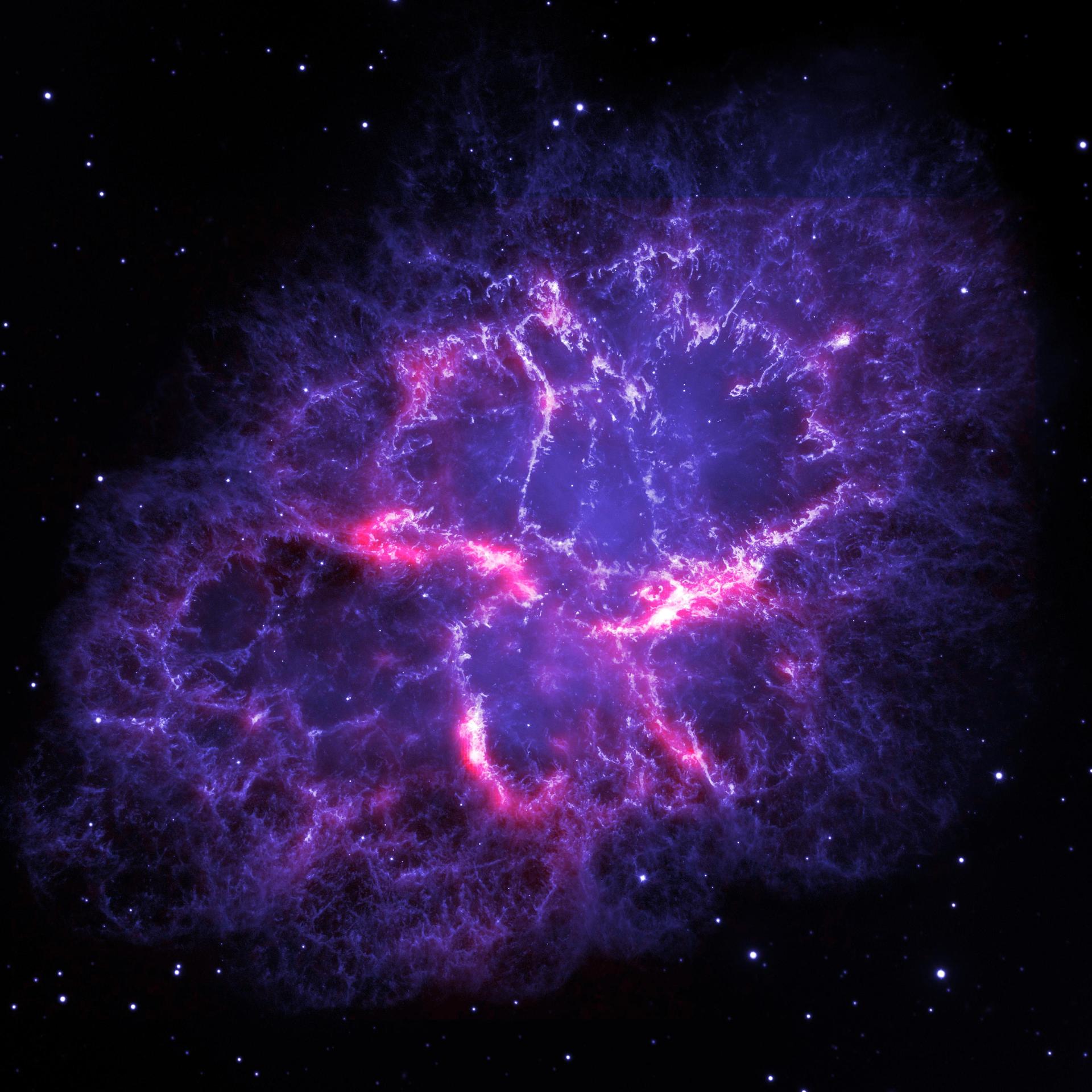
Crab Nebula (M1) — supernova remnant imaged by Herschel and Hubble Space Telescopes

Category: Uncategorized

Crab Nebula (M1), supernova remnant · ESA/Herschel/PACS; NASA, ESA & A. Loll/J. Hester (Arizona State Univ.) · NASA Image Library ↗

  • CHAPTER 4 The Creation of the Proton

    CHAPTER 4
    The Creation of the Proton

    Introduction

    In this chapter we will address the problem of proton creation. The proton is the most fundamental particle in the composition of matter. Our task here is to explain how it is created and how similar creation processes attempt to create other particles that we only glimpse by their transient existence.

    The proton is indeed very special as there is something unique about the conditions under which it is created, something which assures its stable existence. However, contrary to general belief, even a proton must have a finite lifetime, but in view of its creation propensity its decay is followed by its immediate re-creation and so it appears to be immune from decay. It is the same for the electron, but we can infer a measure of its lifetime from its ability to tunnel across potential barriers.

    The starting point in this account is the activity of the virtual muon system that populates all space. The muon is a lepton form intermediate the taon and the electron. It decays to form the electron but it can also, in its game play with other muons, build the particle forms that include both the taon and the proton and, once created, those protons are survivors for the reason now to be explained.

    The Proton Creation Formula

    Earlier in this work there has been extensive use of the formula ascribed to J. J. Thomson for the mass-energy of a charge e confined within a sphere of a radius we here denote by the symbol x. The energy E is simply:

    E = 2e²/3x ………………………………… (4.1)

    If we now imagine that two such charges of opposite charge polarity but different radii x and y exist in surface contact, we see that their centres are separated by a distance (x+y). This means that the combination has an energy amounting to that of the two components as offset by the Coulomb interaction energy e²/(x+y).

    Suppose now, given such a combination, that one charge, that of radius x, is not susceptible to x changing in value but that the other charge can adapt by adjusting the radius y to suit some optimum energy condition. This is an electrostatic system and we are familiar with the energy of such systems seeking to minimize. Therefore, now let y change until the total energy of the combination is a minimum.

    This will mean that:

    – 2e²/3x² + e²/(x+y)² = 0 ……………………….. (4.2)

    and so we find that y is equal to x times the square root of 3/2 minus 1 or 0.2247x.

    The energy of the charge combination in this minimal energy state is then found to be even less than that of the stable charge of radius x by the small factor of 0.2247 squared or 0.0505, meaning that the overall combination has an energy slightly less than 95% of that stable charge.

    The two-charge unit just described is electrically neutral and, with the dominant component having a mass-energy A and the dependant component having a mass-energy B, we now adopt the following expression to symbolize its energy:

    (A:B)MIN

    that energy being 0.9495A.

    Now suppose that a proton of energy P and charge +e has been created from the turmoil of excess energy in the aether that is seeking a state of equilibrium by deploying that energy into a standard particle form. Remember that in discussing the graviton in chapter 2 it was evident that the volume of the charge continuum displaced by the existence of the graviton bore a crucial relationship with the energy of that graviton. If that volume expands slightly, signifying a loss of some of that energy, there had to be other gravitons that absorbed that energy by contracting in equal measure. Such a scenario implies greater particle stability where all those particles have identical form.

    In the aether the taon is one such particle form and in matter the proton is such a particle form. Then there is that ubiquitous virtual particle form, the muon of chapter 3, and its ‘double’, the dimuon now introduced, the mystery particles of the vacuum medium.

    Once created the proton will be stable by virtue of its association with so many other protons of identical form, but the proton, along with other particles, can engage in a violent encounter if one of those muons or dimuons gets too close. The result is that an amount of energy z will be shed in a form nucleated by a charge +e but the muon or dimuon will escape unscathed to leave a neutral entity:

    (P:kµ)MIN

    where k is 1 or 2 and µ signifies the energy of the muon.

    The existence of the dimuon is explained by considering the combination of two muons, one of charge +e and one of charge -e, with the energy being retained without loss in a neutral combination represented by:

    (2µ:µ)

    To understand this simply put y equal to 2x in the system described at the beginning of this section to signify that one charge has twice the radius and half the mass-energy of the other and you will see that the Coulomb interaction energy exactly cancels the energy of the second charge. The dimuon is a latent component in the neutral system transiently formed by muon pair combination.

    It seems possible therefore that k could be 2 and, keeping this in mind, we now write the equation:

    (P:kµ)MIN + z = P ………………………….. (4.3)

    Given that the proton is somehow created and is a survivor, this equation is presumably one that is reversible in the sense that it says something about the creation of a positively charged particle z when P does get embroiled in a decay incident but it is equally a statement that has bearing upon how P is created. Somehow that particle of energy z has an independent origin and, if we can discover what that origin is, then we will discover the secret of proton creation.

    Well, one can now utter the word “Eureka”, because the answer is so obvious. In that (A:B) expression put A as 2µ as if we are considering that transiently neutral combination of a muon charge pair, but suppose the muon component B sheds energy to become z as that combination adopts its minimum energy state. One then has a neutral particle form of energy:

    (2µ:z)MIN

    This then becomes the target for attack by an odd number n of muons which drive out the z component and combine as a charge of energy P within the new neutral entity. The formulation of this is:

    nµ + (2µ:z)MIN = (P:kµ)MIN + z ………………… (4.4)

    We know the value of z from this latter step. It is 0.2247(2µ) and we also know from the earlier equation (4.3) that z is 0.0505(P), all of which merely tells us that:

    P = 8.899(µ) ……………………………….. (4.5)

    which was evident anyway once k was seen to be 2 but the theory has relied on the assumption that P rather than the dimuon is the dominant partner in the neutral combination yielding this result.

    That assumption has to be justified and it is here that the factor n comes into the picture. It sits in that two-stage equation (4.4) indicating that the major energy input needed for proton creation is a muon source but, absent verification, we have no assurance that its integer value n will give the now-expected answer, nor whether it will prove to be an odd integer.

    Also there is so much scope in particle physics for energy discrepancies owing to Nature not complying with one’s ideal theoretical portrayal that one would surely expect to find that some adjustment in regard to charge spacing or whatever will become necessary to satisfy the odd integer n requirement.

    Now take note that the value of:

    (2µ:z)MIN

    is simply 0.9495 times 2µ or 1.899(µ) which tells us that precisely 7 muons have to be added to create the proton. It just so happens that the mathematics of all this works with such perfection in requiring n to be an odd integer that can only have the value 7 given the dimuon foundation.

    It is an almost miraculous feature of the underworld activity of the aether medium that it has this truly amazing unique energy resonance property which causes a particle to form which locks its energy level at a unique value so precisely related to that of the prevalent lepton of the aether, the virtual muon.

    In saying this I can but emphasize the fact that we have here the secret of the feature of Creation by which one, and only one, high mass-energy particle form has a dominating presence in matter. It is the proton family, by which I include the antiproton. The electron is equally prevalent but its existence is linked to the unique value of the universal rhythm of time, owing to its relatively low rest-mass-energy being that given by the frequency of the aether as multiplied by Planck’s constant h, as will be discussed in chapters 6 and 7. Although physicists may argue that the neutron can claim also to be very prevalent in matter, I deny that claim, because the neutron has only been detected as a short-lived particle form, which decays into a proton and an electron. Its imagined existence in atomic nuclei is based solely on theory which pretends there is no aether and tries to balance the books accounting for mass and charge. An atomic nucleus having n units of charge and N units of mass is deemed to comprise n protons and N-n neutrons, but given the role played by the aether, with atomic nuclei having charges which meld into the aether particle lattice by adopting its structural form, one can imagine that atomic nucleus having n protons and N-n antiprotons, but with those antiprotons each having displaced a quon from its seat in the aether lattice. So, by understanding how protons are created in terms of aether activity, we are opening the way forward for a better understanding of the structure and composition of atomic nuclei. However, that is digressing from our main theme and we must get back on track.

    Once we have derived from first principles the precise energy quantum of the aether’s virtual muon we shall know the precise mass-energy of the proton. Our progress so far assures us that it is 8.899 times that of the virtual muon or, as may be shown by the very simple mathematics involved, to be far more precise as 8.898979486 times that quantity.

    Note that, the equivalent algebraic formulation for this quantity is:

    9 – 2[(3/2)½ – 1]²

    which is the expression used in equation (2.8) in chapter 2.

    The Mass-Energy of the Taon

    In the effort to understand the myriad of particles that have revealed themselves in high energy experiments by particle physicists, one has sought to build patterns of their relationship and classification. This seems not to be aimed at understanding how these particles are created but rather more directed at spotting gaps in the pattern and looking for evidence that might fill those gaps. All that is a rather futile exercise, bearing in mind that those particles are all so short lived that one wonders whether they are Nature’s creation or man-made resonance effects arising from the high energies used in their manufacture.

    Nevertheless, there has to be a natural process by which those gravitons discussed in chapter 2 are created and, given the argument that the activity of the muons in the aether creates the proton, it is logical that we should try to build on that theme in considering graviton creation.

    I would expect that, since the creation of protons can mean that matter is being added to the E frame of the aether and this implies the need for gravitons to be created to provide dynamic balance by settling in the G-frame, the creation of protons and gravitons could well occur as if from the same manufacturing process. One needs to imagine that the aether is ever trying to deploy its energy to create protons but failing to keep them alive if the energy surplus to its equilibrium requirements is insufficient. Also, and with equal vigour, it will surely seek to create gravitons as well, given the necessary energy and vacancy in the graviton frame that provides dynamic balance for the quantum jitter of matter, such as those protons that are created amongst the quons in their reference frame.

    So proton creation and graviton creation go hand in hand. Note, however, that what you will see emerge from this exercise is the creation of the more prevalent graviton, the taon form already discussed in chapter 2, where it was shown how the taon and the more massive g-graviton form were related. The latter, as we have seen, has a mass that is 1.452627 times that of the taon.

    If taons are created with protons, why not just consider the possibility that they can emerge from the very same process as that represented for proton creation in equations (4.4) and (4.5)? All we need to do is to imagine that two proton creation events occur side by side, meaning a proton and an antiproton, so that, in energy terms, the overall equation is:

    2(P:kµ)MIN + 2z = 2P …………………….. (4.6)

    Then suppose that, before the emerging proton-antiproton pair 2P are created, only to decay by mutual annihilation, the two z particles, being of opposite charge e, as otherwise they would not come together, merely combine first and so decay to dissipate their energy. That would leave the energy of those two neutral combinations of charge which might find a way of combining with a similar neutral energy entity to then divide as two particles of opposite polarity charge e. If the product were a pair of taons then, by the following equation:

    4(P:kµ)MIN = τ+ + τ- ……………………… (4.7)

    The mass of each of those taons would be 2(0.9495)P or 1.899(P). Now, since the proton P has the mass-energy 938.3 MeV, this means that the taon has the mass-energy value close to 1.782 GeV. This corresponds with the algebraic formulation of equation (2.9) in chapter 2.

    So here we have the taon that assumes the role of a graviton emerging from the very same process that accounts for proton creation. This mass-energy quantum is that found from measurements of the taons that appear transiently in the matter state.

    Moreover, there is something we can even add in connection with this process that is a kind of additional check of our analysis. It is the fact that:

    (P:kµ)MIN = 891 MeV ……………………… (4.8)

    and that there is a meson in the experimental particle spectrum that is denoted K*(892) to signify that its measured mass-energy is approximately 892 MeV and this meson is the only one intermediate the proton mass-energy of 938.3 MeV and the mass-energy 783 MeV of the ω(783) meson.

    This, therefore, endorses both the above derivation of proton mass and this more direct route of accounting for the taon creation process.

    Now, at this stage, it is interesting to explore this subject of taon creation just a little further and ask ourselves what happens if Nature tries to create more massive particles by bombarding the taon with pairs of muons. Well, once the energy involved is high enough then it would seem that the onward decay could bring those heavier gravitons into their transient existence. However, other particle forms having a much shorter lifetime will surely be created as well and it is of interest to consider this, as we now see.

    Hyperon Creation

    Taons are leptons. They decay by mutual annihilation and such decay can be triggered by muons. Consider then their combination with a pair of muons of opposite charge. Might the taon be converted into a charged particle of higher mass-energy? If it were and this new particle, lacking the company of an abundance of similar particle forms, found it was unstable, then how might it stage that decay? Well, since space in the continuum cannot be created by a spontaneous demand, it seems likely that it would share its own charge volume with that of two of its brethren of opposite charge e, so that, by decay of an opposite charge pair, the single charge could take up residence in a space having three times the volume as the original charge form.

    This would mean that the particle so formed would have a charge radius larger by the cube root of 3 than the original particle and so smaller in mass-energy in inverse proportion.

    What this means is that, if N muon pairs merge their energy with the taon to create a single particle of charge e and energy τ plus 2Nµ, then three such particles could come together and shed much of their pooled energy in a high energy environment to leave a new residual particle having a mass given by:

    0.693(τ + 2Nµ)

    Note that 0.693 is the inverse of the cube root of 3. With τ as 1.782 GeV and 2µ as 211 MeV this suggests that, depending upon N, a series of particle by-products might be generated in high energy particle experiments, their mass-energies being:

    • 1.235 GeV for N = 0 : ∆(1235)
    • 1.381 GeV for N = 1 : Σ*(1385)
    • 1.527 GeV for N = 2 : Ξ*(1530)
    • 1.674 GeV for N = 3 : Ω-(1675)

    These mass-energy values can be seen to correspond to hyperons that feature in the high energy particle spectrum, as indicated by their standard symbols. The data listings from which these are quoted evidently rounds-off energy values to multiples of 5 MeV, no doubt owing to the approximate nature of the measurements.

    It is submitted that on this basis we can be quite confident about the physics underlying the particle creation processes here discussed. The taon is clearly a major player on the aether scene and it is very reassuring to find that its creation stems from activity which also produces the proton.

    It is not intended here in this discussion of the physics of creation that we should try to delve into the creation of the many other particles that are found in high energy experiments. All I seek is to give account of the creation of the primary matter particles and the particles hidden but ever at work in its governing agency, the aether. The task, as we have already seen, has taken us into the realm of unified field theory and there is much more to discuss concerning cosmic issues.

    This has to be after we have really delved deeper into the mathematics of the aether to show how its structure and form give basis for wave mechanical phenomena and determine the fine-structure constant. The latter is a key factor in any pursuit to understand the foundation for the creation of our universe.

    Also much has to be said to reinforce the case for the aether already presented, given the strength of conviction of theoretical physicists on the relativistic front, the group hostile to aether theory with its three-space dimensions, and those of the quantum-electrodynamic front, the group hostile to attempts at deriving the dimensionless constants of physics by methods they see as unorthodox.

    This effort, which may seem a little tedious, will include the theoretical derivation of the virtual muon mass, thereby allowing full theoretical evaluation of the proton-electron mass ratio, but, for those who have skipped over the latter part of the previous chapter, one can see by referring back that we have not ignored the slightly different mass of the muon in evidence in the matter frame.

    Happily, once through the detail of the next three chapters, we shall arrive at the more exciting prospect of seeing how stars are created and the spin-off from that pursuit which brings us down to Earth as we explore the scope for using the knowledge so gained to tap into the energy resource of the aether itself.

  • The Ubiquitous Muon

    The Ubiquitous Muon

    Introduction

    The mu-meson, or muon, is the ghost particle that inhabits all space. It is ‘ubiquitous’, which, according to dictionary definition, means it is ‘omnipresent; being everywhere or in an indefinite number of places at the same time’. Yet it has no recognized role in the structure of matter. When it does appear, as in cosmic radiation or as a decay product of the pi-meson, the pion, it has a fleeting existence, but it has been found to have properties of the kind we associate with electrons. Indeed, as mentioned earlier, it is sometimes referred to as ‘the heavy electron’ and it can, though only transiently, drive an electron out of its orbit around the nucleus of an atom and itself move around that nucleus, though in an orbit of much smaller radius.

    So why do I refer to it as the ‘the ghost particle that inhabits all space’? Well, although it is there, everywhere in space, we cannot sense any resistance to our motion that we can attribute to such a presence. Why is that?

    I can but suggest that it is because that is characteristic of its ghostly behaviour. You might, of course, be tempted to suggest much the same by assuming that I am merely ‘imagining ghosts that do not exist at all’, but do, please, stay with me as I show you how muons cooperate in the creation of the proton, the primary particle constituent of all matter.

    Muons exist in pairs of electrical charges that can simply dissolve by annihilating one another and shedding energy which can meld into a uniformly dense background which allows those charges to reappear once an intruder has moved on. Indeed, we should not expect what is hidden from us in the quantum underworld of space to exhibit the same properties that are revealed to us by the atoms and molecules of our material world. If we meet resistance to our motion and press forward then we exert force and energy is dissipated as heat, but that heat energy is merely energy we have transferred to the obstructing object and that object is normally an atom, meaning a unit of matter and not a member of the lepton family that exists in the aether in a state of equilibrium consistent with uniform energy. If the medium that fills all space is already in a state of uniform equilibrium with pairs of muons conserving their energy in spite of material bodies moving amongst them and has already shed any surplus energy to create matter (protons and electrons), it will surely contrive to stay that way.

    At best, therefore, with the exception of a phenomenon to be referred to as ‘vacuum spin’ or ‘aether spin’ as we proceed, we can expect that ghost world of the aether to cooperate in making it possible for matter in motion to suffer events in which that matter transforms itself into some other form of matter. In this respect, since electrons and positrons exist as matter and not as a constituent of the aether, we can look to the participation of the electron-positron lepton family when contemplating energy transfer processes that involve photons and deployment of kinetic energy as in electrodynamic actions. It would be foolish, indeed, to reject the picture of space as populated by the ‘ubiquitous muon’, solely on the ground that it offers no resistance to our passage through it. So, you may say, “If it is there and we cannot feel its presence, then why should we concern ourselves with its existence? Also, why use the word ‘muon’, given that is already the name of a particle that has materialised and has been seen as part of the particle spectrum in physics?”

    The answer to this first question is that we can feel its presence indirectly, but not in the way one might expect. We do sense those muons by the existence of their reaction to our presence as a function of our mass, because they regroup in a stronger ghostly form (the tau-particle, the τ-graviton of chapter 2) in which they assume a role that we sense as the phenomenon of gravitation. In other words, they react to ensure that we mortals, for example, stay put on body Earth and do not drift off into outer space.

    The answer to the second question is, to be frank with you, simply that I did not want to invent a new name for what I found was a pristine, newly born, version of an electrically charged energy quantum it is naked state, before it added just a little weight by consuming, as it were, an electron-positron pair, which then gave it a momentary presence as matter on the stage where we also perform. I have tried referring to it as the ‘virtual muon’ to distinguish it from the real muon, but, in the end, I have chosen to call it the ‘muon’ and, before leaving this chapter, I will enlighten you on the details of what I have just introduced.

    Reverting to the first question and that link with gravitation, it is this gravitational connection that is the reason why we should not ignore the ‘ubiquitous muon’. The story of Creation is based on the muon as the building block from which the edifice of our universe has been constructed and the muon is also the agent giving birth to the action accounting for the force of gravity, without which the stars and planets could not have formed.

    So please accept as our starting point that space is primarily a densely populated ocean of muons in which we, as intruding matter, have very little relevance. As we, with awe and due reverence, worship God, the Creator, those physicists amongst us might find a measure of satisfaction that can strengthen one’s faith concerning the Creation of the universe by studying what now follows from this introductory insight into the creative workings of Nature.

    A snapshot overview of what lies ahead in later chapters is evident from Fig. 3.1.

    The Muon Lifetime

    The muon, as reported in Review of Modern Physics, (v. 48, 2, Part II, April, 1976), has an observed mean lifetime of: 2.197134 +/- 0.000077 microseconds and it is an interesting task in physics to discover what it is that determines this particular lifetime period.

    Physicists have seen a way in which to progress in this quest by using the techniques of what is termed ‘Electroweak Theory’. Under a chapter heading ‘Feynman Rules for Electroweak Theory’ on p. 236, Bailin and Love in their book ‘Introduction to Gauge Field Theory’ (Adam Hilger Ltd, 1986) derive a theoretical value for the muon lifetime, namely: 2.90 +/- 2.61 microseconds. Of this result they say: “Thus, while our result is consistent with the data, the large errors on this theoretical value of muon lifetime mean that this is hardly a rigorous test of the theory.”

    So if one is really interested in delving into the theoretical foundations which govern much of particle physics and particularly physics pertaining to leptons, the realm of quantum electrodynamics, one presumably should not be concerned with the kind of aether advocated in this work.

    However, do note that the theoretical derivation of numerical quantities that arise in basic physics is seen as a test of the theory involved. So let us put our alternative theory to the test by trying to derive the lifetime of the muon.

    First of all, we ask, “What is a muon, meaning the one that appears in the matter frame of high energy particle physics?” It will, according to the theory already presented, comply with the formulation used by J. J. Thomson for the electron, though having its charge radius reduced by a factor equal to the muon/electron mass ratio. Yet, given that electrons and positrons are prevalent in the quantum electrodynamic arena, one can wonder if a simple positive muon charge might attract two electrons and form a three-charge entity having the character we recognize as a negative muon.

    With this in mind, the author has surmised that such muon entities might well comprise a core charge that, of itself, has a mass that is an odd integer multiple of the electron mass, that multiple being 207. The reason is that those two electrons, in repelling one another, take up positions in near-contact with the muon charge but at diametrically opposite locations and, by adding two units of electron mass as offset by the negative mass-energy of their electrostatic interaction, the net result is that the muon entity would have a mass of approximately 206.75 electron mass units.

    The measured muon/electron mass ratio is 206.76835(11) (Physical Review D, 25, 652; 1982) but onward analysis which involved a resonant wave interaction governing the actual spacing of the core muon body and the satellite electrons (or positrons) led to the author’s theory giving the mass ratio as: 207 + 2 – 9[207/(208+2π/9)]/4 which is 206.7683078. The full theory for this is of published record in the Italian Institute of Physics publication Lettere al Nuovo Cimento (38, 342; 1983). So, this result being precisely in accord with the measured value, you see why the author is confident that this model of the muon is the proper basis from which to seek to explain the lifetime and so test the theory further. Indeed, what is now to be described supercedes the theory for that lifetime that features at p. 146 of the author’s book ‘Physics Unified’, published in 1980.

    Concerning muon lifetime, physicists well know that Einstein’s theory requires the lifetime of a particle to increase with speed according to a relativistic formula, just as the same theory requires the energy of a particle to increase according to the same formula. Already in this work, in discussing electron energy theory as advocated by J. J. Thomson, we have seen why the mass of a particle moving at high speed is increased in accordance with what is observed, as in the Kaufmann’s experiments of the 19th century. There is no particular merit in Einstein’s derivation of the mass-increase formula. Concerning muon lifetime, however, the lifetime enhancement with speed is best explained once one has an acceptable theory for the muon lifetime with the muon virtually at rest. Otherwise, it makes no sense at all to theorize about the lifetime changing with speed when it would seem that all one needs to do is to argue that lifetime is proportional to mass-energy and, as Einstein does, then argue that time itself is perceived to change in its rhythm as a function of speed.

    We will confine our concerns here with deriving that muon lifetime for the rest condition, but if readers wish to see how this same aether theory does give account of muon lifetime dilation with speed then the appropriate reference is this author’s paper entitled: ‘Meson Lifetime Dilation as a Test of Special Relativity’, (Lettere al Nuovo Cimento, 38, 206; 1983). Einstein’s theory is not involved in this exercise, but one can point to a section of that paper where one may read: “A primary publication on this subject is that of Bailey and Picasso (Progress in Nuclear Physics, 12, 62; 1970) who measured muon lifetime at very high speed for which the theoretical relativistic value was 26.69 microseconds compared with a rest lifetime of 2.198 microseconds. Thus … (this author’s theory) …. tells us that the observed lifetime at this value (of energy at the high speed compared with rest-mass energy) should be 0.56% low compared with the relativistic value. This is quite small, but it is also significant because Bailey and Picasso reported measurements to an experimental accuracy of 0.2% and did in fact find that the observed value was lower than the relativistic value by 1.2%. Though they regard this as adequate agreement the difference was sufficiently concerning for them to speculate at some length about the possible reasons for the difference. Only further research can verify the speculation, but it can be said that the question remains open and the indications are that the relativistic expectation is up to 1% above the measured value of the muon lifetime at these energy levels.”

    Concerning the muon and this author’s theory, one further point of interest before we come to the derivation of that lifetime property is that the very same model which the author used for deriving the mass of the muon gave a full account of the muon g-factor, again without involving Einstein’s theory or, indeed, the standard arguments based on Feynman diagrams. The principles involved are much the same as those this author has applied in deriving the anomalous magnetic moment (g-factor) of the electron, the latter being presented in this work as Appendix III.

    The periodical reference is this author’s paper: ‘The Muon g-factor by Cavity Resonance Theory’, Lettere al Nuovo Cimento, 39, 271; 1984. The theoretical value for the muon g-factor was found to be 2(1.001165918), a result in quite remarkable agreement with the then measured value of 2(1.0011659230), given the simplicity of the theory used.

    One can see, therefore, in this digression from the main topic of this work, that concerning the physics of Creation, we need not lose sight of the reality of what is observed concerning the muon in our laboratory experiments. This point is made particularly because, in introducing the ‘ubiquitous muon’ of the aether medium as something different but active in the quantum underworld of space, it may seem that we are invoking arbitrary assumptions, whereas the analysis, once we reach the realm of quantum theory, will be seen to lead us to a mass-energy for that ‘ubiquitous muon’ which is indeed very close to that of the real muon which reveals itself in our experiments.

    Now we come to the question of the muon lifetime. The aether we are considering in this work has a unit cell volume that is (108π)3 times the cube of the radius of the electron charge and it will emerge as we proceed that the aether has a rhythmic cycle at the Compton electron frequency, the photon frequency corresponding to the electron mass-energy quantum. In every such cycle there is a quantum-electrodynamic event associated with the energy quantum of a pair of virtual muons but such events occur at random positions in space. The proposition now advanced is that if those two electron charges associated with the core muon form sustain a hit simultaneously in the same rhythmic period, then the muon will be conditioned for decay.

    By ‘hit’ it is meant that the virtual muon of opposite charge polarity is created within the space occupied by the electron charge. By ‘conditioned for decay’ is meant the transient creation of a system which statistically has the prospect of decaying in the manner now explained.

    Given one unit of muon energy plus two similar units owing to the impact of the two virtual muons, there are three units of muon energy. Given also the fact, as we shall see later in this work, that the space occupied by material charge forms is conserved in particle reactions, the muon, when subjected to such a ‘hit’ is converted to a higher energy level, pending decay or reversion to the normal state.

    Some muons so affected are transiently elevated to an energy level that is less than three times their normal rest-mass energy, whereas others are elevated to an energy level that is greater than three times their normal rest-mass energy. The latter are the ones that experience decay. The energy deployment determines the ratio of the two states as being 17:8, meaning that the chance of decay for each ‘hit’ is 8 in 25.

    This immediately leads us to the formula for muon lifetime as being: (25/8)(3/4π)2(108π)6(8.093)10-21 s which is: 2.199 microseconds a value that is within one part per thousand of the experimental value.

    If a muon core charge +e is suddenly forced to shed its two electron (or positron) associates and is driven to an energy level some three times greater then one could contemplate the space occupied by its basic charge form being shared equally by three charges, +e, -e and +e. Each such new charge form will have a charge radius that decreases by a factor equal to the cube root of 3. Conversely, each such charge will have a mass-energy enhanced by the same factor 1.44225, according to the Thomson formula already introduced.

    Now, depending upon how these three charges arrange themselves in a group, the overall mass-energy can be greater or less than that of three basic muons.

    Fig. 3.2

    One possible configuration of the three charges is depicted in Fig. 3.2 and such a charge group has an electric energy that, in the basic muon units, is 3 as offset by the sum of three components of electrostatic interaction energy. This leads to the following quantity: 3 – 0.75 – 0.75 + 0.375 = 1.875 and, upon multiplication by 1.44225, this becomes 2.7042.

    We could then expect that, since muons are involved and are subject to pair creation and pair annihilation, the number of such configurations that might be created as a group would require an energy threshold that is an appropriate integer multiple of the basic muon energy quantum. If now one multiplies 2.7042 by successive integers until one comes to a value that is itself well within one part in 1,000 of being an integer value, then it is found that the necessary multiple is 17.

    As such a group forms by deploying a total of three muon units of energy at each step there will be a surplus of energy of 0.2958 units, some of which is likely to be deployed in helping to create a more energetic version of that three-charge system, as shown in Fig. 3.3.

    Fig. 3.3

    Here one of the charges is separated from the other two and the energy at separation to a distance far in excess of the charge radius may then be as high as: 3 – 0.75 = 2.25 times 1.44225, which is 3.2451.

    It seems then possible that, as each of the Fig. 3.2 charge combinations forms by shedding that energy of 0.2958 units, there is the possibility that the two such quanta of energy shed by the nearby activity of creating two similar charge combinations will converge on the primary combination and act to separate the charges and so form the Fig. 3.3 charge system. This is because 2(0.2958) exceeds (0.2958 + 0.2451), meaning that 0.0507 units of energy disperse at this second stage of action to leave three charge combinations, two of the Fig. 3.2 form and one of the Fig. 3.3 form. Therefore, in progressing to the threshold stage at which 17 of the Fig. 3.2 combinations have been created one has by then also created 8 of the Fig. 3.3 form. This is very satisfactory because 8 times 3.2451 is 25.96, which is itself within one part in 650 of being an integer.

    As to the muon decay process, the Fig. 3.2 charge combination will revert to the basic muon state because two adjacent charges will annihilate one another and, being close to the remaining charge, their charge volume will be conserved for use by that residual charge as it sheds surplus energy. However, for the Fig. 3.3 charge system, the decay by charge pair annihilation occurs at a distance from the residual charge and that charge, in shedding energy, cannot capture the space vacated by the charge pair and so revert to its basic muon form. It stands in isolation and lacks the stability assured by the close presence of other charges having the same properties. The latter is important because a group of three or more like charges conforming with the J. J. Thomson formula for energy in terms of charge volume can preserve equilibrium by exchanging energy and still conserve their overall energy and charge volume. Hence, owing to that isolation, the Fig. 3.3 charge combinations must decay at the end of the rhythmic quantum cycle.

    For this reason there is the statistical probability that in every group of 25 muons that happen to be excited to the potentially-unstable condition, there are 8 that will decay and 17 that survive decay, thereby substantiating the above formula for the muon lifetime.

    Now, the author will be the first to concede that the above account is somewhat complicated in the derivation of that 8 to 17 ratio and there may be a better alternative yet to be discovered, but it does give what seems to be the right answer. Accordingly, it is included here for the record and also to make the case that, in comparing this aether theory with Einstein’s theory or what is referred to as ‘Electroweak’ theory, there is really no contest, given that Einstein’s theory does not even offer any estimate of the muon lifetime that one can define in numerical terms, whereas the other standard theory gives, as stated above, a figure well off target and is anyway subject to an uncertainty having a standard deviation amounting to 90% of the estimated value.

    Concerning other particle lifetimes we shall not, elsewhere in this work, be seeking to derive further theoretical values as evidence supporting this theory. Our primary concern in this work is the problem of Creation on the universal scale. However, by way of reference, readers interested in particle lifetime theory may find it of interest to look up the following papers by this author.

    • ‘A Theory of Pion Lifetime’, Lettere Nuovo Cimento, 33, 237 (1982).

    • ‘A Theory of Neutron Lifetime’, Lettere al Nuovo Cimento, 31, 383 (1981).

    • ‘The Finite Lifetime of the Electron’, Speculations in Science and Technology, 7, 3 (1984).

    The latter paper discusses the reason why the electron has a finite lifetime evident from its electron tunnelling properties. It must have a lifetime if the above theory for muon lifetime is correct, because it is the dual ‘hit’ of two electrons (or positrons) as a target that gives basis for muon decay. That electron lifetime, based of course on a single ‘hit’, is of the order of 0.75×10⁻¹³ seconds and may be derived from what has been presented above by using the formula: (3/4π)(108π)3(8.093)10-21 s

    One of the most fascinating questions one can then consider is whether the proton has a finite lifetime. As for the electron, standard physics offers no suggestion that these two most fundamental of all particles of matter may be subject to eventual decay. However, may not the reason for this be that decay sheds energy which our aether has to take under its wing and look after pending finding a new home for that energy in the system of matter? It is simply a question of equilibrium as between the energy the aether can store to meet its own structural needs and surplus energy it may possess transiently pending shedding it to create matter. Given then that the basic forms of matter in the local space domain of our experience consist in negative electric charges assuming the form of the electron and positive electric charges forming as protons, need we be surprised if we were to find that both an electron and a proton may have finite lifetimes but, upon decay, they are recreated almost at the point where they suffered their demise?

    As to the proton, though we shall see in the next chapter how it is created, we will later in this work discuss an aspect of this process that explores the broader picture of proton creation even in outer space, or rather the aether’s attempts at proton creation that fail owing to lack of surplus energy. That ongoing scenario of an aether subject to quantum fluctuations involving those ‘ubiquitous’ muons in trying to create protons is one from which we can derive the theoretical value of the Hubble constant as a feature of a non-expanding universe necessarily set in that aether. Such is the scale and scope of the subject of this book concerning Creation.

  • CHAPTER 2

    CHAPTER 2

    Gravitation and the Continuum

    Introduction

    In chapter 1 our consideration of Earnshaw’s theorem established that all space must be permeated by a uniform continuum of electric charge. Since space overall is electrically neutral that continuum must contain numerous electrical charges having a charge polarity opposite to that of the continuum. Those charges can, notwithstanding Earnshaw’s theorem, form into a stable array, a simple cubic structure, which gives the aether certain characteristic properties.

    One such property arises when there is an intruding presence of something that takes up space in that continuum. That something, if itself electrically neutral overall, may be assumed to be, in effect, the occupant of a hole in that continuum. Consider then two such holes, spaced apart, each of volume V within an electrical continuum of charge density σ. Given that the continuum charge, being everywhere of the same charge polarity, will repel itself owing to its electrostatic action, this means that those two holes will experience a force of mutual attraction.

    It is tempting, therefore, to suggest that this may account for the force of gravitation should whatever it is that occupies those holes have the appropriate association with matter.

    Note that the charges of the structured array, which will be referred to as lattice charges, will not interfere with this force of attraction because they merely attract the charge of the continuum, which, being of uniform charge density, takes precedence of position in keeping those holes away from these aether lattice charges.

    By way of illustration two such holes in a background charge continuum are depicted in Fig. 2.1. The arrows indicate a mutual force of attraction and one can imagine that as the holes come together, at the relatively slow speeds we associate with matter moving owing to gravitational attraction, the continuum charge will flow around the holes without there being any significant concentration of the charge density σ.

    Fig. 2.2 depicts the presence of the lattice charges. The relative sizes of these compared with the gravitating holes are far from being represented by this figure. In fact, those aether lattice charges each have a volume that is quite enormous compared with the occupants of those holes, but even so, in displacing continuum charge they do not themselves contribute to the overall gravitational attraction between regions of space. The reason for this, as we shall see, is that the lattice charges are moving relative to the charge continuum at a very high speed, so fast in fact that, in being thereby forced by sudden pressure to flow around such a charge, the continuum charge is compacted in the regions denoted X in Fig. 2.3 to increase σ in those regions enough to ensure that the net continuum charge in the vicinity of the hole the lattice charge occupies compensates the effect of that hole and so does not contribute to the gravitational action. Gravitation is simply a question of the speed of whatever it is that takes up space within the charge continuum, a difficult concept perhaps, but one offering a convincing insight once we see how it leads us to the theoretical derivation of the value of G, the constant of gravitation. More will be said about this later, but meanwhile suffice it to say that we have introduced the theme of gravity as a property dependent upon the aether and our task now is to develop the formulation by which G is determined.

    Introducing the Graviton

    Suppose that those holes of volume V are each associated with a mass M so that the mutual force of attraction between two such holes is (σV)² at unit distance. The force law will be of inverse-square–of-distance form and so it can be said that this force is a gravitational force GM².

    If we know the value of σ and M has some standard value, which we can also evaluate in terms of the mass of the electron, then we can formulate that basic numerical factor involving G.

    Now, the problem with gravitational mass is that it is not something that comes in specific units. The smallest amount of energy can exhibit the mass property. To cater for this under normal conditions Nature has adapted by creating two types of what we will here refer to as gravitons. These are unit charges e of either polarity that occupy those holes but they have different mass values.

    Although it may appear to be mere assumption to say that Nature creates charged particles as needed and given the necessary energy, this is a fact evident from the phenomena of quantum-electrodynamics, where pairs of oppositely-charged electrons are produced by energy activity in the vacuum medium. These electron pairs, or rather electron-positron partnerships have a short lifetime, because, after their creation as charges spaced apart from one another, those charges come together by mutual attraction and are annihilated. They vanish to leave the energy quantum from which they were first created. Somehow the aether in its ongoing and well organized activity then contrives to recreate the electron and positron in a spaced relationship and so the cycle of charge pair creation and annihilation is repeated. The electron and positron are members of the lepton family. They are leptons and, indeed, those gravitons just mentioned are also leptons.

    We need to know their mass values and the amount of space which their charges occupy if we are to derive a formula for the constant of gravitation G. We also need to know the value of the continuum charge density σ.

    The latter quantity will be the unit of charge e as divided by the volume d³ of a cube of side dimension d, where d is the lattice spacing of the cubic array of those aether lattice particles that permeate the aether continuum. Later in this work it will be shown that d is 108πa, where a is the radius of the Thomson electron. Therefore we have the following value for σ:

    σ = e/(108πa)³ ……………………… (2.1)

    Note that this equation applies without adjustment to cater for the volume of the lattice charges or particles of matter that might be present and sharing the motion of those lattice charges. The reason is that the compaction of σ in flowing around these intruding objects exactly balances the continuum charge displaced by their presence.

    Concerning the charge volume to mass ratio of the graviton, this is complicated by the fact that there are two basic types of graviton, each type having a different role. By their creation and existence the gravitons create holes in the charge continuum which their charges fill. The ratio of the volume of those holes to the graviton mass is the primary factor determining G. Now, considering a group of three gravitons, if two have the same mass and so the same charge volume it is possible for them to exchange energy by very slight volume fluctuations where one expands in radius slightly as the other contracts slightly. Keep in mind that formula for the Thomson electron. As charge radius expands, so the energy and mass decreases and vice versa. The existence or non-existence of that group of three gravitons is a quantum transition for which gravitating mass changes in steps of whole units. Yet we need to cater for the smallest element of gravitating mass-energy. The third graviton in the group is deemed therefore to have the property that, if it sheds energy, its gravitational action, as represented by its increase in volume, will increase in just the right amount to match that quantity of mass-energy.

    Now, a little exercise in mathematics will reveal that, if the graviton mass changes slightly, so the graviton charge volume will change in inverse proportion by an amount that is precisely three times the basic volume to mass ratio of that graviton.

    Let the mass of one graviton form, the one of larger charge volume, be denoted as τ times that of the electron and the mass of the other graviton form be denoted as g times that of the electron, there being one g-graviton present for every two τ−gravitons. We will justify this ratio presently. What this then means is that, in terms of the charge volume to mass ratio of the electron, the graviton charge volume to mass ratio will be given by:

    (2/τ³ + 1/g³)/(2τ + g) ………………….. (2.2)

    Then, owing to that third graviton of a group of three, the g-graviton, having that threefold differential property in respect of the charge volume to mass ratio, we know that this ratio must equal:

    3(1/g³)/g ……………………………… (2.3)

    From which one can write:

    3(τ/g)⁴ + (τ/g)³ = 1 ……………………. (2.4)

    and so find that:

    g = (1.452627)τ ……………………. (2.5)

    We can now progress in formulating the value of G as:

    G¹ᐟ² = (4π)(1/108π)³(1/g)⁴e/me …………… (2.6)

    which provides the numerical factor concerning gravity that we set out to find.

    However, we have yet to justify that 108π factor and we confront also the task of deriving the value of g from pure theory. Also there is that question of the two to one ratio of the τ- and g-graviton population, not to mention the many unanswered questions that can be raised as to how all this relates to the mass of many forms of matter that exist in our universe. We can but proceed in stages, but, by way of reassurance, the reader is invited to take note that the known varieties of charged leptons in physics are limited to but a few. There is the electron family, the heavy electron family otherwise known as the mu-mesons or muons, and then the even heavier lepton form, the tau lepton. It would seem that the latter is the τ−graviton. As to the g-graviton form this seems rather elusive in the spectrum of particle physics, but we shall point to some evidence later as we refer to the Japanese H quantum in chapter 9 [See section entitled: Numbers Game].

    Meanwhile, from the above formulations (2.5) and (2.6), the reader may check the value that τ must have to satisfy the relationship between G as 6.67259(85)×10⁻⁸ dyne.cm²/gm² and e/me as 0.527281×10¹⁸ cm² esu/gm. The answer you will find is that τ is 3485, meaning that the tau-lepton should have a mass energy of 1.781 GeV, some 3485 times 0.511 MeV, the mass-energy of the electron. On this basis g is 5062.3, which corresponds to a mass-energy of 2.587 GeV. Now, of course, these values for τ and g are empirical, having been derived from measured data on the assumption that the theoretical formulation is valid. However, it is our intention to show in chapter 4 that both τ and g can be derived theoretically and found to have values quite close, indeed very close, to those just presented and this will then mean that we have deciphered Nature’s message implicit in the value of the constant of gravitation G.

    The 2:1 Graviton Ratio

    The two to one ratio of the τ-graviton to g-graviton population can be justified in the following way. Imagine the τ-graviton as having the primary existence as a kind of parent from which the g-gravitons are born. The isolated τ-graviton is suddenly confronted with an influx of energy which it has to absorb. It has a unit charge e which can be positive or negative but we will take the case of it being positive. It has a certain charge volume. It can absorb energy by contracting in radius but we need to accept that space in the aether charge continuum is at a premium and, in contracting, some space becomes available for occupation by other charge. However, it takes time for the aether to adjust to changes associated with energy deployment.

    The scenario envisaged therefore is one where the sudden influx of an appropriate quantum of energy absorbed by the τ-graviton will contract it approximately to the g graviton form, whereupon, to take up the volume of continuum vacated, two similar g-graviton forms will be created, one of charge +e and the other of charge −e. This is a process of lepton charge pair creation which must be followed soon thereafter by the onward quantum transitions that occur with a time delay as the movement of continuum charge imports the added space commensurate with the net amount of energy that is absorbed.

    Since, for the case of the initial τ-graviton having a positive charge, the transition state has two positively charged pseudo g-gravitons and one negatively charged pseudo g-graviton, those quantum transitions, given that added space, will mean a decay back to the τ-graviton form with charge pair annihilation, except for the one case where the two positively charged g-gravitons decay before the third graviton in the group is affected. The residual three graviton group will comprise two positively charged τ-gravitons plus one negatively charged g-graviton. This is a combination which resists spontaneous decay by charge pair annihilation and so there is a physical basis for saying that the graviton system that pervades space will have two graviton forms, which exist in this two to one ratio.

    As to the reference to the pseudo g-graviton form, this arises because, in dividing into three gravitons, the primary graviton will allot one third of its charge volume to each newly created pseudo-gravition with the result that the latter have a charge radius smaller by a factor of 1.44225 as compared with the τ-graviton. This means that during the rapid transition in adjusting to the energy fluctuations under consideration, the transient g-graviton form will be about 0.7% smaller in mass and so energy as compared with the ultimate g-graviton form. The completion of the transient phase therefore involves the residual g-graviton absorbing that extra energy.

    It will, of course, be understood that it is the displaced volume of the continuum of charge density σ that matters in determining G, there being overall as many positively charged gravitons as negatively charged gravitons of either the τ or g form and graviton charge pairs being close enough together to preclude their actual charge from having any gravitational effect.

    The Onward Quest

    The task ahead involves us in an extensive analysis of the aether as that charge continuum permeated by those aether lattice particles. There is relative motion between these charge forms and that motion gives us the insight we need into the physical activity giving foundation for quantum mechanics and leads us to the derivation of equation (2.1) above and so that factor 108π.

    Then there is the challenge of discovering how matter is created from the activity of the aether medium, and we will find that the creation of the proton and of those τ-gravitons, along with the g-gravitons, go hand-in-hand.

    In this pursuit we find an answer to one of the great mysteries of physics. Physicists have long been puzzled as to why the muon, the mu-meson, the lepton particle form intermediate the electron and the taon, the tau particle, exists at all. It seems to serve no purpose whatsoever. Unlike the electron it is not seen as present in matter but yet it appears transiently in high energy particle physics.

    It forms the subject of our next chapter but, as our story unfolds, you will see that the energy of a pair of muons is actually present in each unit cell of volume d³ of the aether. The resulting energy density is that pertaining to those aether lattice particles, meaning their charge volume as divided by their electric energy according to the Thomson charge formula.

    We shall find, by the analysis from which that 108π factor is derived, that the aether lattice particle, which we name the quon, is of much larger charge volume than the electron, by a factor N, which will be shown to have the integer value 1843. This leads us to the equation:

    E₀ = (3/4π)(108π)³(1/N)⁴ᐟ³ mₑc² …………… (2.7)

    as the energy contained within each unit cell of the aether. With N as 1843, the factor in this equation has the numerical value 412.6658. Note that the muon that materializes in experiments of high energy particle physics has a mass somewhat greater than 206 times that of the electron. The numerical quantity just calculated represents the energy in electron terms of two virtual muons, meaning the lepton pair of muons that populate the aether.

    The proton/electron mass ratio, P/me will, as we shall see, be that given by a quantity:

    P/me = {9 − 2[(3/2)½ − 1]² }E₀/2mₑc² ………………….. (2.8)

    which has the value 8.8989795 as multiplied by half of the above factor 412.6658, and so is 1836.152, which compares well with the measured value of 1836.152701(37).

    This rather incredible degree of precision for the measured value of the proton/electron mass ratio is a daunting challenge for anyone who ventures in search of a theoretical explanation of this quantity. Having indicated that this theory, in its basic structure, succeeds to within a few parts in 10 million, it seems best now to await acceptance of the foundations on which the theory is constructed, namely the aether of the form introduced in this work, and leave onward progress for future generations of physicist.

    One has to assume that the purpose of precision measurements of physical constants is to establish just how constant such quantities are, just in case they vary from place to place and with the passage of time. Also, whereas the constants themselves may not vary, history indicates that variation does occur in the assumed values, especially as new techniques of measurement are developed and more measurements are reported. However, it would seem that the proton/electron mass ratio as now measured is likely to survive as an adequate indication of its ultimate value.

    Having introduced the τ-graviton and its alternative role as the tau-particle, the taon, it is appropriate here to note that the theory also gives a formula similar to (2.8) that accounts for its mass in terms of the rest mass of the electron. It is:

    τ = 2(P/me)(1 − [(3/2)½ − 1]²)……………… (2.9)

    which is 3487. This corresponds to a mass-energy 1.782 GeV. This is a little higher than the empirical value 3485 derived above from the G formula (2.6) and this raises the fascinating issue of what factors are at work in determining the quasi-stable energy state of the taon, a topic to be mentioned in the discussion chapter 9.

    Finally, as part of this preliminary glimpse of the power of this theory in revealing how Nature determines the fundamental dimensionless constants of physics, it is noted that the quantity referred to by physicists as the fine-structure constant has also been deciphered as being that of the formulation:

    hc/2πe² = 108π(8/N)¹ᐟ⁶ ………………. (2.10)

    where N, as before, has that value 1843.

    This expression is that of the inverse of the fine-structure constant which physical tables list as having a measured value of 137.0359895(61). In contrast our theoretical value as it applies in the true vacuum environment remote from matter is, as may be verified from (2.10), 137.0359153. In this case there are reasons why some slight upward modification of this quantity can occur for measurements made in laboratories that are moving through enveloping space at the speeds we associate with the cosmic motion of the solar system.

    At this stage the author yields to temptation by pointing out that Einstein’s acclaim owes a great deal to the support he received from the Cambridge scientist Sir Arthur Eddington in the early years when his General Theory of Relativity was under scrutiny.

    Eddington is well known also for his attempts to decipher Nature’s numerical factors, those dimensionless physical constants. However, at the time (1930) the fine structure constant had not been measured to a degree of precision which allowed one to be sure that that 137 figure was other than an integer. Eddington, who was impressed by Einstein’s four-dimensional notions of the space medium, evolved a theory by which 137 was seen as being:

    (16² − 16)/2 + 16 + 1

    which theory, in the words of B.W. Petley of the U.K. National Physical Laboratory (p. 161 in his book ‘The Fundamental Physical Constants and the Frontier of Measurement’, Adam Hilger Ltd. (1985)), declared as coming:

    “from considerations of the number of independent elements in a symmetrical matrix in 16-dimensional space where 16 equals 4 times 4 (4 being the number of dimensions in Minkowski’s world).”

    However, Petley then added the comment:

    ‘The theory lost respectability partly because Eddington at first predicted the number as 136.’

    It is noted that on that same page 161 of Petley’s book there appears a table listing theoretical expressions that have been, as the author puts it, ‘derived’ for the fine structure constant. The last entry in this table, in date sequence, before the experimental review value, is the one dated 1972, being the formulation of this author’s theory giving that value 137.035915, the reference being to the paper entitled: ‘Aether Theory and the Fine Structure Constant’ in Physics Letters 41A at p. 423. This paper was jointly authored, by this author, Dr. H. Aspden, who was with IBM at their Hursley Laboratory in England, and Dr. D. M. Eagles of the National Standards Laboratory, Sydney, Australia, who had contributed to the development of the theory by involving Dr. C. H. Burton who used the computer power of that laboratory to verify the author’s analysis of the electrical structure of the aether and thereby cooperating in the determination of the 1843 value of that factor N mentioned above.

    However, reverting to the Eddington theme by reference to his book ‘New Pathways in Science’ (1935, Cambridge University Press) one surely must agree with a comment he made on p. 234 in introducing his theory:

    ‘I think that the opinion now widely prevails that the constants (A), (B), (C), (D) are not arbitrary but will ultimately be found to have a theoretical explanation.’

    Here (A), (B), (C) and (D) were, respectively, the proton/electron mass ratio, the fine-structure constant, the ratio of the electrical force between an electron and proton to the gravitational force between them, and a rather curious quantity ‘the ratio of the natural radius of curvature of space-time to the wave-length of a mean Schrodinger wave’. Eddington, being Professor of Astronomy at Cambridge University, saw this latter quantity as important, its value, as he states, “depending upon the observed recession of the spiral nebulae and being about 1.2×10³⁹.” Readers will therefore find it of interest, as we proceed, to see that this author’s theory can rise to the challenge posed by this fourth constant but we shall derive instead a formulation including the value of the Hubble constant as that is a more familiar quantity. See chapter 8.

    It is somewhat hilarious to see that Eddington, in explaining his theory for the fine structure constant on p. 237 of that book, says the following:

    “It is a feature of quantum theory that the particles are so much alike that we can never tell which is which; and we shall later see that this indistinguishability is actually the source of the energy that we are studying, so that we must not ignore it here. We have then to make one of 16 possible presents to one particle and one of 16 possibly similar presents to the other; but the particles are communists, not believing in private ownership, and it makes no difference which present has gone to which particle. There are 16 ways in which the commune can receive two like presents and 120 in which it can receive two unlike presents, making 136 in all.”

    That is a curious way of saying that for each of 16 components to have two unlike or two like quanta, given that 16 of each variety are available, is, mathematically 16×15 divided by 2 plus 16.

    However, Eddington was puzzled by the 136, when he really needed a figure of 137. He ends his account on p. 237 by saying:

    “Is it unreasonable to suggest that the fact that (each of those quanta) is one of a gang of 136 may have something to do with it? Apparently the majority of physicists think that it is. But for my own part the clue seems to me good enough to follow up.”

    Clearly, Eddington is on the defensive here, but he struggles even further in seeking to derive a figure of 137. He concludes with the words:

    “But, you may say, the fraction is really 1/137, not 1/136. I think if we can account for 136/137 of the quantum, the remaining 1/137 will not be long in turning up. There is a saying: One spoonful for each person and one for the pot.”

    As to another of the basic constants, Eddington, by an argument based on wave functions, formulated a quadratic equation of the form:

    10m² − 136mm₀ + m₀² = 0 …………. (2.11)

    relating two mass quantities and, taking m₀ as a standard unit, argued that, since the equation had two solutions for the value of m, these were, respectively, the electron mass and the proton mass. From this he derived the proton/electron mass ratio as having the value 1847.6, which, albeit in 1935, he declared “agrees very well with the observational determination of the mass-ratio”.

    Eddington deemed there to be such a mass unit m₀ “furnished by the universe as a comparison object”. It would have a mass which the above equation shows as being 135.926 times the electron mass. Readers should note here that this author’s theory in no way supports the notion that a mass unit having this particular value exists and that we shall be using the symbol m₀ extensively later in this work to signify a different mass quantity, that of the aether lattice charges depicted in Fig. 2.2.

    As to Eddington’s formulations, it was this kind of physics that caused the physics community to develop a great distaste for any attempts to account for physical phenomena that were guided solely by prior knowledge of the measured numerical factors involved. Where numbers seemed to dominate the argument this outlawed the theory and caused physicists to find more appeal in factors such as symmetry in mathematical formulations purporting to describe physical phenomena. Yet those numbers, as they evolved from high precision measurement, do convey Nature’s message, whereas the notional pictures of symmetry in an imaginary mathematical picture of space are merely the product of wishful thinking.

    This author hopes, however, that with the passage of time since Eddington’s days and with the failure of existing techniques in physics to bridge the gaps which link gravitation with quantum theory and particle physics, physicists of this 21st century era will take note of what this author is offering in this work.

    In our next chapter, we will come to the introduction of our overall theme, an account of the physics governing the creation of our universe, and this brings on stage the principal player, the virtual muon that was mentioned above as the primary energy form in our aether. In a sense, one could say that Eddington led the way in trying to decipher those numbers and he was headed in the right direction in postulating something in the universe having a standard mass intermediate the proton mass and the electron mass. However, it was too fanciful an argument to attribute those masses to the two solutions of a quadratic equation. The logical approach was to heed what J. J. Thomson had already presented as the mass-energy defined by the electron as a charge confined within a spherical volume of space and apply the general formula to other charges, including our unit mass form, the virtual muon, and combine these in an energy equation which seeks a minimum value.

  • The Epilogue

    The Epilogue

    Having concluded this account of ‘The Physics of Creation’, I can but let the reader judge and form his or her own opinions on the subject. Defining God as the Creator, the better our understanding of the creative forces at work in our universe, the more likely we are to find the ground on which to build a common religion conducive to a peaceful existence.

    However, as indicated in the INTRODUCTION on page 1, those who lead in this quest will have to be conversant in the language of physics, as otherwise they will be basing their beliefs on fictional notions, historical hearsay or mere hope and intuition. Awareness of the Science of Creation plus a will to embrace the discipline of a common and universal moral code of behaviour should surely suffice as the intellectual basis for one’s religious horizons, without the promise of life after death.

    The scientific approach reveals how the universe was created as a system of order developed from chaos and so established an aether in which events governed by statistical factors created the forms of matter we see evolving around us. We are part of that system of matter and though subject to a game of chance we can, as thinking beings, optimise our prospects of survival in a secure and happy environment, albeit having, as do all particles of matter, a limited lifespan. Education founded too heavily on religious indoctrination in ignorance of the physics that rules the universe can but lead to unnecessary strife given that there will always be those who challenge the word of those who say they speak for a God of their own making.

    Concerning the physics, however, there are lessons from history that we must learn.

    Though the language of physics is universal, the stories told in that language can be conflicting and the truths of Nature have yet to be presented in their ultimate form. This work on ‘The Physics of Creation’ is a major step in that direction.

    As to history, in recent centuries it has been important for scholars to build their scientific convictions on religious foundations, rather than build their religion on the evidence emerging from scientific discovery.

    Admission to the scholarly fraternity and the funding of institutions of learning depended upon religious disposition. Rivalry and prejudice combined with dogmatism have been dominant factors amongst scholars and there is no reason to think that what has been presented in this work will emerge unscathed from the debate which it will hopefully foster.

    With this in mind, it is interesting to compare the physical picture of the aether as now envisaged with what is implied in the following words, quoted from a book “NEWTON: The Making of a Genius’ (MacMillan, 2002) by Patricia Fara. On pages 82–89, under the heading ‘DISCIPLES’, she refers to the physician George Cheyne (1672–1743) concerning Newton’s conjectures about gravity, with this as a statement on page 87:

    “Cheyne was one of the first of Newton’s successors to explore aether models, which became increasingly prevalent from around 1740. Interpretations varied enormously, largely because as the mediators between matter, motion and spirit, aetherial fluids carried huge theological implications. Relying on arguments that ranged from the ineffably vague to the extraordinarily convoluted, natural philosophers described weightless invisible fluids of subtle particles seeping through the pores of solids, forcing gases to expand, and cushioning the sun in a great repellent cloud whose graduating density maintained the planets in their appropriate orbits. Often authenticated by the adjective ‘Newtonian’, aethers proliferated and diversified as authors with very different religious commitments summoned them up to explain mysterious phenomena like electric charge, magnetic repulsion, or human memory.”

    Our modern generation as a result has been brain-washed, as it were, into believing that the aether is non-existent, merely an old-fashioned idea that has been disposed of by scientific evidence. It was seen as a medium which provides an absolute frame of reference in which the speed of light is constant, but experiment based on reflecting light back on itself in different directions in the laboratory on Earth which moves at very high speed relative to the cosmic background, failed to provide a measure of speed through the aether. As the aether did not live up to man’s expectations it had to be discarded in favour of a philosophy based on Einstein’s doctrines on ‘space-time’ and ‘relativity’ which makes the observer the frame of reference.

    Yet, surely, we must bear in mind that the existence of the aether is not a question of whether Newton was right or wrong in that belief, or whether, in modern physics, Einstein’s authority is the governing factor.

    The experimental facts in the discipline of physics, if interpreted correctly, tell us what we need to know about the aether and neither Newton nor Einstein has shown us how Nature determines G, the constant of gravitation in terms of a unified theory.

    As to scholarly debate and challenge of one’s ideas, in a chapter entitled ‘ENEMIES’, Patricia Fara’s study of Newton shows how God features in the aether discussion.

    On page 113 of her book one reads:

    “Protagonists on both sides often used the metaphor of a clock to portray the conflicting accounts presented by Leibniz and Newton of how God superintends the universe. On Newton’s model, God is constantly active throughout the cosmos, and intermittently exerts His supreme power to intervene and alter the laws of nature. Leibniz was scathing about this view: ‘Nay, the machine of God’s making is so imperfect, that he is obliged to clean it now and then …. and even mend it, as a clockmaker mends his work.’ Surely, he protested, God is no sloppy mechanic, but a skilled craftsman who could initially wind up His clock to run perfectly throughout eternity. According to Newton, God created independent, individual particles that, as they travelled through empty space, constantly interacted with each other and formed new associations. In contrast, Leibniz maintained that God has established a harmonious universe completely filled by inherently active entities called monads. Although they operated independently, and no longer needed God’s direct control, Leibniz’s nomads had been in a sense pre-programmed so that they worked together to fulfil His plans.”

    It is no wonder that, by invoking God, these ideas about the aether should attract comment and, indeed, ridicule by the non-scientifically minded men of religion. National rivalry also contributed to the criticism directed at Newton, as we see from some words on page 139 in Patricia Fara’s book in the chapter entitled ‘FRANCE’.

    Nor does great NEWTON’S famous system stand,
    On one compact foundation, simply plann’d
    Reflect how vainly is that Art employed,
    Which founds a stately fabrick on a Void
    Confess the fair result of sober thought,
    Who builds on vacuum, merely builds on nought.

    This was attributed as a quotation from a poem ‘Anti-Lucretius’ by Cardinal de Polignac (1747), dedicated to promoting ‘Religion and Virtue’ and said to be ‘resolutely Cartesian’.

    In presenting an account of the aether in this year 2003 it seems unlikely that the religious opinion will intrude in such a way, given the state of science and technology of our modern day.

    However, one has to consider the climate of opinion prevailing amongst the scientific community. I therefore introduce what I have to say on this by making one final quotation from Patricia Fara’s book which appears on page 254 in a chapter entitled ‘INHERITORS’:

    “Newton may have regarded himself as a giant who stood on other’s shoulders, but new contenders for the position of outstanding genius would, in their turn, come to surmount him. During the twentieth century, the main competitors for Newton’s place were Einstein and Hawking.”

    I find this a curious assertion as it is hard to believe that, in the pursuit of scientific truths, one should be ‘contending for the position of outstanding genius’. In this modern world of communication with its all pervading ‘media’ activity one would surely need to have a publicity agent to engage in such a contest and the winner claiming the title could but feel somewhat foolish.

    One need not question Einstein’s ‘genius’, as such, given the impact he has had on those who teach physics. However, whereas the physics of Newton will survive in the teaching curriculum it seems improbable that Einstein’s ‘space-time’ notions can survive for long, given that physics students emerging from their school education may have heard of Einstein but know next to nothing about his theories. Already in this work we have seen how aether theory can so easily explain the phenomena on which Einstein has built his claims. Certainly, I see no case for saying that Einstein could ever displace Newton as a figurehead in the world of physics.

    Einstein made his contribution in the earlier years of the twentieth century and the ‘contender’ for Newton’s place at the end of the twentieth century is, according to Patricia Fara, Stephen Hawking, a professor at Cambridge University in England.

    Hawking bases his claim to fame on ‘Black Holes’ and their effects on leptons in nearby vacuum, but one must wonder how anything meaningful can emerge from a study of effects in remote space, given that the study is based on insufficient knowledge as to the nature of gravitation. There seem to be some stellar objects in galaxies that exhibit enormous mass compared with our sun, if that estimate of mass is based on the value of G that we associate with Newton’s observations of our solar system. However, G depends upon those gravitons discussed in chapter 2 and therefore one could say that a star which finds itself in a region of aether subject to intense energy activity might have its quantum dynamic motion balanced by gravitons that are leptons of the heavy electron variety, muons, rather than tau-leptons that are super-heavy electrons. The mass of the stellar object need not be too different from that of the sun, but the volume of the associated graviton system in the vicinity of that object could be greater by tens of thousands, meaning that G as applied to that object could even be many millions of times greater than applies in our solar system.

    Stephen Hawking may have been born 300 years after the death of Galileo (1642), as we are told by his books, just as Isaac Newton (1642–1727) was born 100 years after the death of Galileo, but that is hardly a qualification adding authority to their respective contributions.

    If it were, then I too, being born in 1927, two hundred years after the death of Newton, would hope that this could add a little weight to what I have offered in this work.

    It is on this light-hearted note that I now close this account, whilst noting that more information concerning my theory and its onward development can be found by inspecting my website www.aspden.org which I maintain in my retirement as my voluntary contribution to the scientific community.

  • CHAPTER 1

    CHAPTER 1

    Nature’s Coded Messages

    The processes by which Nature creates the fundamental particles which combine to form atomic matter and so our whole universe determine certain numerical factors which are precisely the same whenever and wherever measured. These are known as the fundamental dimensionless constants. They are merely numbers but yet those numbers are encoded expressions which tell us that Mother Nature has, for some special reason, determined a definite relationship between certain physical quantities.

    There are three such numbers that, collectively, can reveal to us the secrets of Creation, if only we can discover their physical formulation.

    One is the numerical factor which relates the mass of the proton to that of the electron, an important ratio, given that the partnership of these two fundamental particles constitutes the hydrogen atom. This is the primary atomic element from which all matter evolves. The numerical factor here is 1836.152.

    Another, equally important numerical factor, is that having the measured value of 137.0359. This relates the speed of light c in vacuo with the electric charge e of the electron and Planck’s constant h. Planck’s constant is the factor by which the frequency of an electromagnetic wave is determined as a function of the energy quanta involved. That number 137.0359 is Nature’s message which says:

    “Decipher me and you will understand what governs the phenomena of quantum physics as evidenced by matter at the sub-atomic level.”

    Thirdly, there is the numerical quantity that relates the constant of gravitation G and the charge to mass ratio, e/me, of the electron. Unlike the first two numbers, this does not appear in the tables of physical constants. It is not one that is measured directly, but has to be inferred from separate measurements of G as the force of attraction between two bodies of known mass, and e/me as by measurements using a cathode ray tube. One simply cannot hope to fathom the mysteries of Creation without an understanding of the physical processes that govern the value of G. The measurement data applicable to G and e/me depend upon the units physicists have chosen to use.

    Concerning units, it is intended in this work, to use the system of units that prevailed during the period in history when our knowledge of physics at the fundamental level expanded by the discovery of the electron. This system, the cgs system, regards the force between two unit electric charges separated in vacuo at unit distance as being itself unity, whereas the practical system of units as used in modern physics complicates the force formulation by ascribing properties to the vacuum medium itself, properties which need expression in their own units. To use the practical system of units for the purpose of this work would over-complicate the mathematical equations and add unnecessary complexity to the project at hand, that of understanding the creative forces at work in our universe.

    So, to summarize, the task ahead is to examine the factors which govern the physical actions that determine the three numerical quantities introduced above. Our object is simply to unravel, so far as we can, the secrets of Creation and, at the very least, decipher the three numbers introduced above, by which is meant the discovery of the mathematical formulae which they signify as relations between the physical quantities involved.

    Historical Foundations

    An appropriate starting point is provided by Newton’s Law of Gravitation as seen in the context of Coulomb’s Law concerning the force acting between two electric charges. Although Isaac Newton established that gravitation was governed by an inverse-square-of-distance law of force which implied the constant of gravitation G, it was not until a century later in 1797/8 that Henry Cavendish, using a delicate torsion balance for measuring the attraction of two small bodies, could quantify its value.

    Joseph Priestley in 1767 proposed that the electric force acting between two charged objects was also subject to an inverse-square-of-distance law. Having been advised by his friend Benjamin Franklin that when a small charged body is placed anywhere inside a hollow charged conducting sphere, no electric force is exerted on that body, Priestley recalled that Newton had shown mathematically that the gravitational force attributable to the mass of a hollow spherical shell is zero everywhere inside that shell. This is only true if the gravitational force is inversely proportional to the square of the distance between the two interacting bodies. Therefore, Priestley reasoned that the electric interaction force must itself be of the inverse-square-of-distance form.

    In 1750 an Englishman Michell had devised an instrument in which the known torsion of a thread balances an unknown force acting at the ends of a bar magnet and had used this to show that an inverse square law acts between magnetic poles. Coulomb reinvented the torsion balance and with it, in 1785, verified the law for both magnetic pole interaction and electric charge interaction.

    So we see that, by the end of the 18th century, physicists were able to formulate the magnitude of the force acting between bodies as a function of their mass, their electric charge and, indeed, their magnetic pole strength, but, still two centuries later, there remains the need to decipher the messages implied by those measured quantities to understand how Nature determines their values.

    In this pursuit we should find inspiration in the account above by which Priestley deduced that the electric force had to be of the inverse square form. The mathematics involved is of the kind we shall be using in this work as we explore the same force laws to probe the mysteries of Creation and this will include an account of the small but very significant modifications affecting the law of gravitation to cater for the planetary perihelion anomaly. This is a question of how energy travels between interacting bodies when their separation distance is changing.

    Just as Newton was able to prove mathematically that there is no gravitational force acting on a body within a spherical shell of uniform mass density per unit area of the spherical surface, so we shall prove, on the same assumption, that the interaction component of the field energy of two electric charges separated by a distance R sums to zero within a sphere of radius R centred on either charge [See Appendix I]. It is analysis of this kind that can point to the connecting links between electric, magnetic and gravitational laws of force and provide the elements of a unified theory by which to comprehend how Nature regulates the values of those dimensionless constants already mentioned.

    As to the historical picture, take note that the electron did not present itself as something whose electric charge and mass could be measured until another hundred years or so had passed. J. J. Thomson in 1897 made progress in his cathode ray tube measurements by which the charge to mass ratio of the electron was measured and by 1911 Millikan, by his falling-drop technique of measurement had discovered how we can measure electron charge and so separate it from the mass of the electron.

    Early in the 20th century, therefore, and especially after the introduction of wave mechanical theory with the advent of the photon, physicists had all that was needed to decipher Nature’s messages, the subject of this work. Yet, the task has, it seems, been left to this author, whose interest was aroused when engaged on Ph.D. research in 1950-3 on the subject of anomalous energy losses found in electrical steels when reacting to oscillating magnetization. The reaction phenomena associated with magnetization of electrical conductors has an analogy with the reaction which must of necessity exist when a magnetic field acts across space devoid of matter. It was the study of that reaction that opened the door leading to the pathways we are to explore in this work.

    So how shall we proceed? Well, it seems appropriate to present at the outset a glimpse of what lies on the far horizon, the answers to our deciphering exercise. Hopefully, this will allow the reader to anticipate some of the onward steps as the theory develops and so share some of the excitement which this task arouses. There is, however, one preliminary historical feature that must be presented first. This concerns the ‘Thomson electron’.

    The Thomson Electron

    There has to be a starting point from which one can build a picture of the electrical structure of the space medium and matter which sits in that medium. The electron is the embodiment of the unit of electric charge in physical theory. It is the appropriate foundation for our exploration of the electrical properties of the medium that pervades all space, it being well established that the vacuum medium has properties by which it can store electrical energy.

    The reader well versed in modern physics will now wonder how one can possibly justify the need to refer to this space medium in terms which seek to revive what amounts to the old-fashioned notion of the aether. After all, every physicist today is indoctrinated in the belief that space is a four-dimensional medium referred to as ‘space-time’ and subject to the relativistic principles which Albert Einstein introduced between 1905 and 1916. E=Mc² is taken as a sufficient testimonial in proof of Einstein’s theory and no one can argue with the experimental evidence which gave birth to the atomic bomb.

    “With Einstein’s work, the old substantial aether vanished from higher physics. In spite of the internal difficulties which had dogged it, it was long mourned by the older school of physicists, who found the reasoning of Einstein perilous – and hard to follow.”

    — from p. 287 of ‘Science since 1500′ by H. T. Pledge, a 1939 Ministry of Education publication then available from the U.K. Stationery Office

    Well, it is this author’s submission that it is due time for the younger physicists of today to visit the graveyard where the aether was put to rest and consider its reincarnation. That visit takes us back to the year 1904, one year before Einstein launched his theory. In that year 1904 a book entitled ‘The Recent Development of Physical Science’ was published in its second edition. Its author was W. C. D. Whetham, a Fellow of Trinity College, Cambridge and so a close associate of J. J. Thomson, the discoverer of the electron, who had entered Trinity College in 1876 at the age of 20 and who remained there for another sixty-four years, becoming Master of Trinity College from 1919 to his death in 1940.

    In now quoting a section of text from that 1904 book, one can see that it gives basis for one to wonder why our modern generation is so impressed by Einstein’s E=Mc² contribution. This is a quotation from pages 283-284 of Whetham’s book, which include the table below:

    “The property of mass, the most fundamental property of matter for dynamical science, is explained by the electron theory as an effect of electricity in motion. Forasmuch as a moving charge carries its lines of electric force with it, it possesses something analogous to inertia in virtue of its motion. The quantitative value of this effect has been calculated by Thomson, Heaviside and Searle. Definite experimental evidence has been given by Kaufmann, who finds that the ratio e/m of the charge to mass of the corpuscles ejected by radium diminishes as their velocity increases. The charge is almost certainly constant, and thus the mass must increase with velocity. Theory shows that, for a slowly moving corpuscle, the electric inertia outside a small sphere of radius a, surrounding the electrified particle, does not depend upon the velocity, and is measured by 2e²/3a where e is the electric charge on the particle. But when the velocity of light is approached, the electric mass grows very rapidly; and, on the assumption that the whole of the mass is electrical, Thomson has calculated the ratio of the mass of the corpuscle moving with different speeds to the mass of a slowly moving corpuscle, and compared with the results of Kaufmann’s experiments.

    In this remarkable manner has it been possible to obtain experimental confirmation of the theory that mass is an electrical phenomenon.”

    velocity in cm/s calculated mass ratio observed mass ratio
    2.36 x 10¹⁰ 1.65 1.5
    2.48 x 10¹⁰ 1.83 1.66
    2.59 x 10¹⁰ 2.04 2.0
    2.72 x 10¹⁰ 2.43 2.42
    2.85 x 10¹⁰ 3.09 3.1

    That is a commentary on the state of knowledge of the electron in the year 1904 but that knowledge seems not to have been heeded by future generations of physicists. Today, if you refer to the tables of physical constants, you will find that the electron radius is not formulated according to the above formula, but rather as something that is 50% greater, a notional parameter that has no physical meaning as justified by theory that explains why the radius expressed in relation to mass, electric charge and the speed of light should have that particular value.

    However, that energy quantity 2e²/3a is the true measure of the electric energy of an electron of radius a and students of physics should see it as important and know how to derive this formula themselves. Just assume that the charge e is confined within a sphere of radius a. Take note that the speed of light c is also the ratio of electrostatic to electromagnetic units in the cgs system. Then assume the charge is moving in a straight line at velocity v so that it defines a current circuit element of strength ev/c and formulate the strength of the magnetic field produced by that circuit element at points distant from the charge. From that work out the magnetic field energy density at such a point and then integrate that energy over all space external to that charge sphere. You will obtain the formula (ev/c)²/3a. Now equate that to kinetic energy mv²/2 and the result will be that mc² is 2e²/3a.

    This was, no doubt, the manner in which this result was obtained in that 1904 report, but there is another quite simple derivation that has more merit. Take note that the electric energy of a sphere of charge e and radius a, having all of its charge at the surface of that sphere, as if it were of conductive material, is e²/2a, but if we do not make that assumption and simply declare that the charge e is actually distributed within that sphere of radius a so as to have uniform electric energy density or pressure inside that sphere that equals the energy density just outside the boundary radius a, then it is easily proved that the component of electric energy inside the sphere is e²/6a. Add that to the energy outside the radius a and one obtains 2e²/3a.

    This is surely the energy of the electron that accounts for its inertial property. It is the formula referred to in this work by reference to the ‘Thomson electron’. It is equal to the mass of the electron as multiplied by the square of the speed of light, as you have just seen, and yet physicists see E=Mc² as something we owe to Albert Einstein’s theory of relativity that came along after 1904.

    As to the so-called ‘relativistic mass increase’ that one also attributes to Einstein’s philosophy, was this not explained in that 1904 text in deriving the data for that table presented above? The gain in energy with speed adds inertial mass and, if whoever computed that data did not use the formula E=Mc², it becomes an interesting exercise to discover how, given the measured electron speeds, the increase of mass factor could have been calculated.

    The known speed of light in 1904 was much the same as it is today, very nearly 3×1010 cm/s, and using the formula for mass increase that one derives from electron theory, the same as that later obtained by Einstein’s methods, one sees, using this speed of light value, that an observed mass increase by the factor 3.1 corresponds to an electron speed of 2.84×1010 cm/s. The difference between this and 2.85×1010 cm/s as listed in the above table is only marginal and probably attributable to approximations in the calculation.

    In any event, the point made here is that the Thomson electron formula can be relied upon in our onward theoretical investigation. It is, however, noted that the formal derivation of E=Mc² as an expression relating the electrical energy E of a charge with its inertial mass M is possible, as this author has shown. See discussion in Appendix II. One has merely to accept that the charge, when subjected to acceleration by an electric field, will move in just such a way as to conserve its intrinsic electric field energy from being radiated.

    Based on the physics of 1904, with its aether, we can now confront those messages that pertain to Creation and we do so by using the Thomson electron formula in a quite fascinating way, as will emerge in chapter 4 when we show how the proton is created.

    Concerning a Theorem and the Aether

    19th century physicists went adrift by assuming that the aether had certain properties, notably that of providing a universal and absolute frame of reference for the constant speed of light in vacuo. They should, instead, have studied the aether with an open mind, allowing its properties to be revealed by their experiments. First and foremost is the fact that the aether can and does store energy, electrical energy, and so it must have an electrical composition.

    19th century physicists were obsessed by its properties as a medium in which electromagnetic waves propagated. They were baffled because it seemed, in one sense, to exhibit the properties of a solid medium and, in another sense, the properties of a fluid. Considered as an electrical system having structure as if it comprises electric particles formed into a kind of crystal pattern, the problem was one of stability, as was pointed out by Samuel Earnshaw, a Cambridge scientist, by presenting his famous mathematical theorem. In 1839 he read a paper before the Cambridge Philosophical Society, which was later published in their Transactions at pp. 97-114 of volume 7 of 1842. That paper was entitled: ‘On the Nature of the Molecular Forces which regulate the Constitution of the Luminiferous Ether’. Quoting from that paper one reads:

    “It is therefore certain that the medium in which luminiferous waves are transmitted to our eyes is not constituted of such particles (acted upon by purely inverse-square forces). The coincidence of numerical results, derived from a medium of such particles, with experiment, only shows that numerical results are no certain test of a theory, when limited to a few cases only.”

    So, at the very outset of the project undertaken in this work, one has it on the authority of an eminent scientist, speaking some 164 years ago, that an aether constituted by electric particles conforming with the inverse-square-of-distance force law is an impossibility on mathematical grounds, whatever our number deciphering exercise might prove.

    Earlshaw’s Theorem was a basis for rejection of early attempts by this author to secure publication in the mainstream science publications and, indeed, this was how the author first came to know that there was such a theorem.

    Why then are we proceeding with our quest? Well, there was something about this author’s perception of the aether that made that theorem helpful rather than obstructive. Earnshaw had overstated his case. If the medium contains electric charges of like polarity governed by the inverse-square law then they can arrange themselves in a stable configuration, provided they are immersed in a uniform continuum of charge of opposite polarity. Conversely, one might say, if the evidence supports an aether having a structured form composed of electric charges governed by the inverse-square law, then, with certainty, that aether must incorporate a background continuum of electric charge which envelops those charges.

    So, you see, dating from 1839, physicists seeking to understand the aether were wandering in the dark as they confronted problems of this kind and confronted an aether that had to exhibit the properties of both a fluid and a solid. The fluid crystal of modern physics with its state dependent upon electric field excitation had not been discovered and, almost as soon as the electron had been discovered and its charge and mass measured, Einstein came onto the scene and gone was all hope of salvaging the aether from the wreckage.

    This author, however, having committed so much effort into the project of understanding the aether, aether of a form that overcame Earnshaw’s theorem, could but soldier on without support from the physics community. By 1966 the author had published two works based on aether theory, both entitled ‘The Theory of Gravitation’, the first, dating from 1960, being only 48 pages in length and the second, dating from 1966, being an enlarged 170 page second edition.

    Coincidentally, in that year 1966, as the author discovered later, a book by an author named W.T. Scott appeared with the title: ‘The Physics of Electricity and Magnetism’, published by Wiley, and this included a commentary on Earnshaw’s theorem. It is relevant to mention it because Scott had also seen where the theorem fails. A passage in his book reads:

    “In a region of continuous charge distribution, a maximum or minimum could exist, but a continuous distribution is an idealization. We have to consider each electron or proton as an isolated charge, so that pure electrostatic equilibrium is impossible.”

    Earlshaw’s theorem sought to prove stability by showing how a differential equation could have a maximum or minimum but the analysis denied that possibility for the interaction of discrete electrical charges immersed in a true void. Scott had seen what this author had seen, namely that the presence of a uniformly charged background could provide that stability. However, Scott says that involves ‘an idealization’. One may answer that by saying that the aether could well be an idealization, meaning a physical medium of such ideal and simplified form that it has rather special properties not shared by matter. One may also say, given the evidence to be presented in this work, that the aether has to have that uniform background continuum of charge as a kind of sea in which the other charged particle forms are immersed and in which a stable array of such charges can exist.

    This brings us to the stage where we can begin to introduce the formulae which emerge from the deciphering of what is implied by those numerical constants and so we move on to chapter 2 and begin by exploring the factors that determine the force of gravity.

  • APPENDIX VII

    APPENDIX VII

    Einstein and 100 Years of Wisdom

    Physicists will soon be celebrating the centenary of the birth of Einstein’s Special Theory of Relativity and as news of such an event reaches the general public via the media, there may be those who ask what is meant by its underlying ‘principle of relativity’.

    In Einstein’s own words it is: ‘A generalisation when we express the tenet thus: If, relative to one Galilean co-ordinate reference system, another Galilean co-ordinate reference system is a uniformly moving co-ordinate system devoid of rotation, then natural phenomena run their course with respect to the second co-ordinate system according to exactly the same general laws as with respect to the first co-ordinate system. This statement is called the principle of relativity.’

    I think I know what this means but I doubt if there are many, even of the physics community, who really care as to its meaning. After all, it adds up to saying that whatever happens in the scientific and technological arena today will, if we repeat whatever we did to make that happen, have the same result tomorrow, even though we and our Earth have moved on through the cosmic background. However, I know that there will be those of you who question this because our frame of reference, Earth, is itself rotating. So it really is impossible here on Earth to test what Einstein claims as a ‘principle’ unless we can stop the Earth from rotating. Alternatively, we could go off in a spacecraft equipped with sensors and controls that preclude any rotation. However, Einstein did not do that, nor could he 100 years ago.

    There is also scope for misunderstanding because, in a sense, Einstein’s wording is somewhat ambiguous. He refers to two frames of reference and natural phenomena, but there is doubt here as to whether the principle refers to a specific phenomenon or, rather, physical event or whether what is implied is physical phenomena in general. As an example of what I mean, consider the mechanics of a ball bouncing from a surface. The principles of motion governing that bouncing ball are, by one interpretation, the same if studied from the perspective of either reference frame. But if we think of two observers one in each of those two frames are we to understand that from their individual perspectives, looking at the same ball, their assessment of the physics governing the motion will be exactly the same?

    On this latter interpretation the principle of relativity would fail because, should the ball bounce from a surface in that second reference frame with a certain velocity relative to that surface and that frame be moving at the same velocity relative to the first reference frame, one observer would see the ball bounce and the other would see it stop on impact.

    On the first interpretation Einstein was on safe ground in postulating the so-called ‘principle’, subject to limiting conditions, because, relying on the teachings of classical mechanics and Isaac Newton, it is a direct consequence of the physical laws governing what happens in the mechanical world. Einstein was aware of this limitation, but claimed his notoriety by venturing beyond that boundary and asking us to accept the ‘principle’ without such a restriction.

    On this he declared, after saying that in regard to classical mechanics ‘there was no need to doubt the validity of this principle of relativity’: ‘in view of the more recent development of electrodynamics and optics it became more evident that classical mechanics affords an insufficient foundation for the physical interpretation of all natural phenomena. At this juncture the question of the validity of the principle of relativity became ripe for discussion, and it did not appear impossible that the answer to this question might be in the negative.’

    So, you see, here was Einstein himself weighing the validity of his ‘principle’ as a matter of probability, another word for ‘uncertainty’, owing to the physical phenomena that we encounter in electrodynamics, the motion and interaction of electric charges, rather than the physical phenomena that pertain to electrically neutral matter. A point of interest here is that electrodynamics and electromagnetic waves (light) require an electromagnetic frame of reference, whereas mechanics requires an inertial frame of reference and there is an implicit distinction between these akin to the distinction between v and dv/dt, velocity and acceleration.

    Indeed, one might ask what Einstein had in mind as a basis for that qualifying remark in the last sentence of the above quotation. He does not reveal that. Instead he moves on by declaring that ‘there are two general facts which favour the validity of the principle of relativity’. Here that word ‘favour’ has its implication, given that, in physics, one is expected to prove a proposition rather than judge its merits by speculating on chance.

    As to the first of these ‘facts’, judge for yourself whether what he declares can be regarded as fact: ‘The principle of relativity must apply with great accuracy in the domain of mechanics. But that a principle of such broad generality should hold with such exactness in one domain of phenomena, and yet should be invalid for another, is a priori not very probable.’

    That is a factual statement in a semantic sense but far from logical in a scientific context.

    As to his other ‘fact’, this is one he develops by reference to observations made from railway carriages moving relative to an embankment, a mechanical scenario, but one he sums up by saying that: ‘In virtue of its motion round the sun, our Earth is comparable with a railway carriage travelling with a velocity of about 30 kilometres per second. If the principle of relativity were not valid we should therefore expect that the direction of motion of the Earth at any moment would enter into the laws of nature.’

    Even though the theme so far was based essentially on what one could describe as mechanics, Einstein then rests his case by declaring that our observations on body Earth have never ‘revealed such anisotropic properties of terrestrial physical space’ and that ‘This is a very powerful argument in favour of the principle of relativity.’

    Now, of course, if aware of the famous experiment performed by Michelson and Morley one cannot fail to see that Einstein invented his ‘principle of relativity’ expressly as a way of justifying the observation that the speed of light reflected by mirrors is the same as the speed of light incident upon those mirrors, notwithstanding our Earth’s motion through space. However, there are amongst us those, including myself, who cannot accept the way in which Einstein brushes aside that reference to electrodynamics. The reason is very simple.

    It amounts to saying that we do not belong to a non-rotating world to which that principle enunciated by Einstein applies but recognizing that, as with that space craft or even in an Earth laboratory for the brief period needed for the test, we could create a non-rotating test laboratory in which to prove or disprove Einstein’s principle of relativity.

    On such a basis, that of electrodynamic interaction between electric charge in motion, one surely needs to challenge Einstein’s doctrine. I tried some 50 years ago, half a century after the birth of Einstein’s theory, only to be ignored but yet emerge from the fray with the knowledge on which this work is based. The physics community is not open to persuasion on this issue, possibly because no one is willing to pass judgement on a subject that they do not understand but assume is understood by their peers and so they stay aloof in their ignorance.

    That said, I will now explain why I have been motivated to write this Appendix to ‘The Physics of Creation’. Its first draft edition was completed in April 2003. It was shortly thereafter that I received a letter dated 15 May 2003 from a stranger to me, a person named S. I. Wells having an address in California, who explained that he had referenced a paper of mine in his own paper entitled ‘Magnetic Interaction Reconsidered’, that he had submitted to the American Journal of Physics for publication. It was rejected but the referee comments had implied that the latter portion of the paper posed a ‘puzzle’ that warranted publication and so resubmission was encouraged. In the event this latter submission was then rejected without consideration on the grounds that ‘we no longer have a Questions & Answers section and thus will not be accepting your manuscript for publication’.

    Now, to me, this is, as they say, ‘par for the course’ – thou shalt not challenge Einstein! So, what was it that Wells had offered for publication? It was brief but concise. After pointing out that special relativity was developed to preserve the equations of electrodynamics in all inertial frames, which makes it imperative that the principle of relativity applies in all possible situations, Wells draws attention to a ‘seeming paradox’. He refers to two equal and like polarity electric charges separated by a straight, rigid and insulated rod, when viewed (a) in the rest frame of the rod and (b) in and relative to a laboratory frame which is in uniform relative motion in any direction neither parallel nor perpendicular to the rod. Every physicist should be sufficiently familiar with standard theory governing how charge in motion produces a magnetic field and how that field exerts force on another moving charge, which means that he or she can easily verify that an observer in that rest frame will see that rod at rest, whereas an observer in that moving laboratory frame will see the same rod as subject to a torque which will cause it to turn to alter its orientation in space.

    So, Einstein says that the rod cannot turn, but standard physics as taught universally says it will turn. Yet the American Journal of Physics, the major U.S. periodical for those who teach physics, decline to publish this observation.

    One does not have to be a genius to stumble across this crack in the theory of relativity, a system which some refer to as ‘The Einstein Myth’, but one must wonder about the integrity of our scientific world, given this situation.

    I was well aware of this paradox during my university research years over half a century ago, but my research discipline was the electrodynamics that govern the magnetic properties and energy anomalies found in steel as used in electrical power transformers. Challenging Einstein’s philosophy was not on my career agenda as a research student. Philosophy is for those who are already established and secure in their way of life.

    Yet I was intrigued in 1965 when I saw and purchased a newly published book by R. A. R. Tricker entitled ‘Early Electrodynamics’ (Published by Pergamon Press). A topic similar to that raised by Wells is mentioned in the chapter entitled ‘The Critics’ by reference to the opinions of H. G. Grassmann (1809-1877). The debate concerned Ampere’s electrodynamic force law, a law which is never used today but which, curiously enough, would still not survive the test imposed by Einstein’s principle of relativity.

    Grassmann pointed out that Ampere’s law would require the force acting between the two charges to be zero when their motion as shared by the rod was inclined at a certain angle to the rod but change from an attraction to a repulsion as the rod turns around whilst having the same translational motion in the electromagnetic frame of reference. Concerning this Tricker states: ‘For Grassmann this is too improbable to be acceptable. Grassmann can bring no experimental evidence whatever to support his view and there is not the slightest reason to suppose that nature was designed to satisfy the particular tastes of anybody.’

    So you see, here is an author who expects proof by experiment, rather than argument based on taste and probability, but somehow Einstein’s principle of relativity, which I see as unproven and as a mere philosophical notion, a matter of ‘taste’ in the sense used above, has governed the progress of energy science (retarding it!) for a century.

    How can we emerge from this dilemma? The answer amounts to saying that all verifiable and proven electrodynamic technology as harnesses in our power industry is founded on electrodynamic action by electric charges flowing around closed circuits. The electrodynamic law used involves integration of action around such closed paths. Any differences in assumptions concerning those laws can only be tested by experiments involving interaction of electric charges that exhibit properties characteristic of an isolated state that is not smeared into the action of a uniform current flow around a closed circuit.

    The dipole rod experiment implicit in the argument posed by Wells, if performed, would be such a test, but other such tests are those based on plasma discharges where the charge carriers have different charge/mass ratios and opposite charge polarity. This is the realm of energy anomalies that promise to tap energy from the space environment, as touched upon at the end of chapter 9 of this work.

    Einstein’s theory has obstructed progress in this field of technology by making it appear that all was well with our understanding of electrodynamics, whereas there are unanswered questions such as that posed by the paradox raised by Wells here in this 21st century, by me in the 20th century, as chapter 9 has shown, and by Grassmann in the 19th century. If only Einstein had conceived his principle in more general physical terms, as opposed to its restricted form! After all, a Galilean system of co-ordinates is an inertial system and one is thereby locked into the physical constraints that accompany inertia. By ‘general’ here I do not mean the extension adopted by Einstein in moving from his ‘Special Theory of Relativity’ to his ‘General Theory of Relativity’. I will reword Einstein’s statement as to the principle of relativity to show you what I mean: ‘Space is a co-ordinate reference system having the electrical properties of a fluid medium in which a kind of crystal structure can form to define such a frame of reference. That crystal structure adapts to the presence of material bodies, locking onto atomic structure, and so shares the motion of such bodies but can dissolve as necessary to merge with the fluid before re-emerging as new structure. If, relative to one such co-ordinate reference system, another such co-ordinate reference system is a uniformly moving co-ordinate system devoid of rotation, then natural phenomena run their course with respect to the second co-ordinate system according to exactly the same general laws as with respect to the first co-ordinate system, but such phenomena are governed only by the local co-ordinate system, a constraint particularly evident in electromagnetic action which takes the local co-ordinate system as its sole frame of reference.’

    My message here is that Einstein relied on the Galilean co-ordinate reference system as an inertial frame of reference but should have based his theory on a system of reference that itself had the necessary physical properties to adapt to the local presence of matter. The notion of a universal aether medium gave a physical foundation but provided only one frame of reference, whereas an aether that provides multiple frames of reference nucleated locally by the presence of matter but not overlapping is what is needed.

    After a century of stubborn adherence to Einstein’s doctrine it is unlikely that I shall, in my lifetime, see the physics community changing direction. I can but hope that what I now see as an ongoing quest to tap energy from the aether itself will trigger the reversal of opinion. As it is, however, I can but repeat the quotation that I presented on page 1 of my first publication on this subject, ‘The Theory Gravitation’, 1960. It was from pages 387–388 of a 1913 book by N. R. Campbell entitled: ‘Modern Electrical Theory’ (Cambridge University Press): “If we speak of ‘aethers’ and not ‘the aether’ all our experiments prove is that the particular aether with which we are concerned in any case is that which is at rest relatively to the source and may be regarded as forming part of it. This is the simple way out of the difficulties posed by the Michelson-Morley experiment. If from the beginning we had used a plural instead of a singular word to denote the (aether) system …. those difficulties would never have appeared. There has never been a better example of the danger of being deceived by an arbitrary choice of terminology. However, physicists, not recognizing the gratuitous assumptions made in the use of the words ‘the aether’, adopted the second alternative; they introduced new assumptions.”

    Having read these words, back in the year 1945, as a young university student, I was in no mood to be persuaded in Einstein’s favour and, from then on could but study Einstein’s theory with a critical eye and a desire to search for the truth as there to be found in the omnipresent aether. I was lucky to see a picture of the aether emerge as secondary spin-off from my theoretical efforts to understand the ferromagnetic properties of the atomic structure of iron. This book and its forerunners duly emerged and now, save for the point I make below, there is little more I can add. I hope a few readers will share my thoughts as we live through the Einstein centenary.

    That ‘point’ is a reference to Einstein’s technique of ‘transformation’, his theory not being one involving a simple and direct logical interpretation of his so-called ‘principle of relativity’. It seems that when looking at physical phenomena occurring in one Galilean co-ordinate frame whilst sitting in another such frame, albeit moving uniformly and without rotation relative to the first, one must put on a pair of spectacles having a special prescription. This is necessary in order to distort what one sees to make it conform by looking the same as it would in that first frame whereas in fact it is actually different. That prescription is expressed in mathematical four-dimensional terms, obliging one to perceive the time dimension as a fourth space dimension, a curious notion and best avoided, given that we seek the truths of the real world and not a fantasy world that is mere illusion. Reverting to that problem posed by Wells, as mentioned above, it could well be that a ‘relativist’ wearing those spectacles formulated according to the mathematics of the Lorentz transformation might be able to avoid thinking there is any torque effect upon that electric dipole, but after close to 100 years one can but gasp and ask: “Oh Lord, why have we allowed Einstein to distort our vision of the aether of your Creation?’

  • Appendix VI: The Hypotheses of Fechner and Einstein

    Appendix VI: The Hypotheses of Fechner and Einstein

    Readers will not be surprised to hear that upon reading through what I have written in this book about Creation, there are a couple of after-thoughts that warrant mention. Those who believe Einstein’s theory will, no doubt, assume that my theory cannot explain the evidence of record deemed to support Einstein’s hypothesis concerning ‘time dilation’. Then there will be those who are a little bewildered by my reliance on Fechner’s hypothesis to explain the electrodynamic action of electric current flow as arising from pairs of oppositely charged particles created in spaced relationship and then annihilating one another upon coming together by moving in opposite directions.

    Surprising though it may seem, there is scope for challenging Fechner’s hypothesis constructively and thereby overcoming a problem that it poses, but in so doing one finds that the experimental evidence relied upon as proving ‘time dilation’ may become instead proof that supports the theory presented in this work.

    There is only one reported type of experiment which purports to support Einstein’s ‘time dilation’ hypothesis. This is that indicating the enhanced lifetime of the muon as a function of its speed. I discount the idea that time dilation is inherent in Einstein’s conception of distorted space as a valid means for explaining the null result of the Michelson-Morley experiment as already discussed in chapter 9. Also one can dismiss the evidence arising from an experiment which involves transporting an atomic clock in an aircraft flying around the world to see if it loses time or gains time relative to an atomic clock sitting at the base location. Here the question one faces is whether speed or acceleration or both, being different for the flying clock and that at rest on body Earth, will affect the clock rate. You see, we are not here discussing time as such but are discussing an atom, meaning the change of energy states of electrons in motion around the atomic nucleus and this involves photons, the frequency of which depends upon energy, not time. The atomic clock rate is affected by change of gravitational potential and so altitude. It confuses the issue to imagine atomic clock rates as changing owing to so-called ‘time dilation’. See the Section IV, ‘Times Rates of Moving Clocks’ of my paper: ‘Synchronous Lattice Electrodynamics as an Alternative to Time Dilation, (Hadronic Journal, 10, 185–192; 1987). It is included as the fifth paper of the Appendix in my book Aether Science Papers.

    Now I must digress just a little before coming to the detail of the theory of dilated muon lifetime, as I now perceive it in the light of the derivation of the muon rest-mass lifetime, as presented in chapter 3 of this work.

    Imagine a lamp that runs on electricity from an electrically charged cell, a battery. It has a certain illumination lifetime, its light going out once the electric charge from that battery is all shed. Now imagine that the lamp is taken on a long journey accompanied by lots of charged cells. The lamp will glow for a longer period proportional to the number of cells and their total electric charge. Now, if you assembled such a device and observed the enhanced illumination lifetime of that travelling lamp, I believe you would think it a joke if someone said to you: “Ah yes, here is the evidence I have been seeking concerning Einstein’s theory. You have proved that Einstein was right when he conceived the notion of ‘time dilation’. Time itself really does alter its rhythm and extend itself, the faster the speed of the object under observation.”

    However, the comment may not seem quite so ridiculous if what you were observing was something rather elusive as seen in the microcosmic world within a high energy particle accelerator at CERN in Geneva, Switzerland. Physicists probing the darkness of the unknown by getting fundamental particles to move at very high speeds are more closely tuned to think in terms of Einstein’s theory than theory at the basic electrician level, and so, upon seeing something that lives longer, as its speed approaches that of light, Einstein’s time dilation formula comes immediately to mind.

    What they saw in that accelerator was a system comprising many muons, a muon being a charged electric particle that, apart from its much greater mass, has features resembling the electron, but those physicists had no idea why those muons had a fleeting existence as, once created, they survive for a brief period only and then all that is left is electrons, albeit moving at high speed owing to the energy shed by the parent muon. It is a great mystery as to how the muon comes into existence and the best reason I can offer is that it already exists everywhere in space and reveals itself as matter only when it (a) takes up position in the dynamic aether lattice and shares the rhythmic motion of that lattice rather than having the random motion in the aether underworld and (b) somehow attracts and becomes attached to two electrons or positrons and adjusts its resonant state in the manner I have described in my paper: The Muon g-Factor by Cavity Resonance Theory, Lettere al Nuovo Cimento, v. 39, 271 (1984). In saying it exists everywhere I am merely echoing the message of chapter 3 entitled ‘The Ubiquitous Muon’. However, as to the electron itself, you may wonder how that is created. We have seen in chapter 4 the theory explaining how the proton is created from muons and we know from experiment that muons in matter form can decay into electrons or positrons, but surely that might only mean that the muon has shed its hangers-on. We are left with the puzzle of how, in theory, electrons are created. Well, I cannot answer that, except for noting that our theory in chapter 6 has explained how the photon is created in a space medium that has a characteristic frequency, that universal rhythm of space that leads us to the dynamics of gravitation by connecting the mass of matter with the gravitons. Surely the fact that a photon having that characteristic frequency defines an energy quantum which is precisely that of the electron rest-mass, is the clue by which to solve the puzzle. One is merely left with a chicken-and-egg type of problem, as to whether the electrons are created ab initio and somehow then regulate the oscillations of the underworld of space or whether the universal oscillations and ordered structure of space set in first and so determine the form of the electron.

    Here we will confine our attention to the question of the muon and its extended lifetime at speed as determined by those experiments at CERN. Yes, indeed, particle physicists could measure the lifetime of the muon just as an electrician can time the illumination of that lamp mentioned above, and they even found that, the faster the muon travelled, the greater its lifetime in proportion to its overall energy, including its rest-mass energy. Yet somehow they missed seeing how, just as for that lamp, the muon in motion needs an entourage of energy cells which is greater in number, the greater that speed.

    They were well aware that Einstein had, some 65 years earlier, supposed that the dimension of time is woven into the fabric of space, a fabric which can be stretched and twisted, with the result that space can be curved (whatever that means in non-mathematical terms) and time can be dilated (whatever that means in non-mathematical terms). So, when the muon at speed was found by experiment to have a longer lifetime, one proportional to its increase in energy, that was said to be ‘proof’ that Einstein’s theory was right. Quoting the very words used at page 62 in the paper by Bailey and Picasso (Progress in Nuclear Physics, v. 12, Part 1, pp. 43–75; 1970):

    ‘To conclude, the CERN Muon Storage Ring group has proved that the “clock paradox” is established as an experimental fact (at the level of approximately 1.2%).’

    Well, enough of this, the task here, after some further 33 years from the publication of that paper, is to explain the extension of muon lifetime to those of you who prefer to live in the same three-space dimensional world as those of pre-Einstein times.

    The Muon Lifetime at Rest and in Motion

    Firstly, you must understand what governs the lifetime of the muon at rest. As we saw in the latter part of chapter 3 it was determined by the simultaneous hit of the two electrons or positrons (those hangers-on to the muon in its matter form) by two virtual muons from the aether background medium. Secondly, you must understand that when that muon moves it acquires kinetic energy which takes the form of an accompaniment of muon charge pairs borrowed as needed from that aether background medium. Their presence is transient and regulated by statistical factors subject to the overriding control parameter, the energy momentum of the system. In a sense the muon, being a lepton, can be part of a charge system in which pairs of opposite charges are constantly being created in the forward field followed by their decay, but ever subject to the need to preserve energy. Inevitably, however, the ultimate decay event occurs and the muon suffers demise as its energy disperses with the creation of a residual electron or positron.

    Core Mass and Virtual Muons

    A point of importance here is that the muon that we see as matter has somehow been conditioned to have a core mass that is an odd integer multiple, 207, times that of the electron, whereas by its coupling with two electrons or positrons it adds a mass of two electron units as offset by approximately 2.25 such units owing to the negative electrostatic interaction energy of this combination. [See the author’s paper: ‘The Nature of the Muon’, Lettere al Nuovo Cimento, v. 37, 210 (1983)]. In contrast the virtual muons that become associated in pairs and add kinetic energy to the muon when it moves at speed have a mass-energy that is 206.3329 units of electron rest-mass energy. So, there are two kinds of core muons present, the primary µ−207 form and the virtual µ−206.33 form.

    Decay Mechanism and Virtual Muon Hits

    The muon lifetime is determined by virtual muon hits arising from the quantum electrodynamic fluctuations of the energy represented by the ‘ubiquitous’ muon field. A single virtual muon hit of a target electron or positron, which occurs some 107 more often than a dual muon hit, will merely rupture the composite three-charge muon in a transient sense and cause the electron or positron pair to resettle with a muon. However, there can be charge inversion in this process, by which it is meant that a positive muon and an electron in contact can exchange energy to become a negative muon and a positron. In any event there is an equal chance of the resettling electrons or positrons adopting any one of the residual muons as the core muon, whether it be a muon of the 207 form or one of the 206.33 form.

    Decay and Recycle

    The result of this is that when the eventual dual hit occurs, if that event is for a composite muon form having the 207 muon as a core then that means muon decay, but, if that dual hit has as target the composite muon with a 206.33 muon core, then that merely frees a virtual muon which can find a partner in the virtual muon field and recycle its existence as part of the quantum-electrodynamic activity. The 207 muon is the misfit and it cannot survive this event and so combines with one of its associated electrons or positrons to decay and shed energy to the aether, the neutrino process, whilst freeing the other electron or positron which takes with it its substantial share of the energy released as the decay product of the muon.

    Statistical Inverse Proportionality and Lifetime Extension

    One can then understand why it is that the chance of muon decay in relation to the decay lifetime of its rest-mass state is diminished in inverse proportion to the ratio of overall energy to muon rest-mass energy. This latter ratio is the total statistical number of those muons, virtual plus primary, to the primary muon component. This is why the CERN experiment involving many thousands of muons moving at speeds which increased their mass more than twenty fold did reveal evidence of the so-called time dilation of the muon. All that the experiment proved was that the ‘genie in the lamp’ was spreading its influence equally amongst all the energy components of the system, thereby sustaining their energy state for a longer period in proportion to the energy present.

    Relativistic Mass and Electron Analogy

    The above discussion has concerned the muon and attributed its kinetic energy to its accompaniment in motion by the statistical presence of virtual muon pairs. The so-called relativistic mass increase of the muon arises from the mass added by the presence of those virtual muons. The electron, therefore, ought to conform in the same way, by having an induced electron-positron accompaniment and one can assume that it too would have an extended lifetime at high speed, matching its increased energy, if such a lifetime were to be recognized as something we can measure. Apart from the inference to be drawn from electron tunnelling through potential barriers, however, the electron’s lifetime is elusive, because the decay does nothing other than recreate the lowest form of matter, the electron.

    Current Flow and Fechner’s Hypothesis

    The question of interest then is whether the electron moving as a carrier of electric current is accompanied solely by other electrons or whether they share the task of conveying current with a flow of positrons moving in the opposite direction. This brings us to that problem posed by Fechner’s hypothesis. I know it is easy to say that the electrons will annihilate the positrons but it is equally easy to say that, if the current circuit element they represent is suddenly switched off, so electromagnetic inductance will respond to set up a pulse of EMF which creates another such current element by a quantum-electrodynamic process involving electron-positron creation. Such a debate can lead nowhere, but there is an interesting history pertaining to this problem, albeit going back many years before the electron was discovered by J. J. Thomson.

    One may refer to pages 201 to 208 of volume 1 of a book written by Sir Edmund Whittaker entitled: History of the Theories of aether and Electricity, published by Thomas Nelson and Son Ltd in 1951. After referring to Fechner (1845) and a similar hypothesis posed by Weber (1846) and then discussing these in some depth, Whittaker on page 206 states:

    “It has been shown (reference to H. Lorberg, Journal f. Math. lxxiv, p. 305; 1878), indeed, that the assumption of opposite electricities moving with equal and opposite velocities in a circuit is almost inevitable in any theory of the type of Weber’s, so long as the mutual action of two charges is assumed to depend only upon their relative (as opposed to their absolute) motion.”

    Revisiting Fechner’s Hypothesis

    Now, here I must confess that, even up to the stage where I had written chapter 9 of this book, being well satisfied at having derived the relative velocity formula from first principle analysis by starting from time differentiation of energy according to Coulomb’s law [equation (9.2)], I was content to move on by relying on the assumption just mentioned (Fechner’s hypothesis) to come to the derivation of the Neumann Potential. This was a logical step given my knowledge of what Sir Edmund Whittaker had written. Also I can see that I may have brushed over an important issue by talking about electron-positron pairs or muon pairs having a ‘statistical’ presence in accounting for kinetic energy. For some reason, however, while relaxing on vacation after having compiled the first draft of this book The Physics of Creation, I began to wonder about the Fechner hypothesis and what the analysis would reveal if those two ‘opposite electricities’ moved with opposite velocities at different speeds.

    To my great surprise, the analysis now to be presented at the end of this Appendix proved that the same result would be obtained whatever the difference in speed magnitude of the two oppositely-charged electric particles. Indeed, one of those particles could be at rest. The essential point, however, is that, for every unit charge of one polarity in motion there has to be another unit charge of opposite polarity at rest, which assures us that the flow of electrons in a conductor can suffice to set up the Neumann Potential, provided there is an atom somewhere in that conductor that is left positively ionized by having shed that electron. Such a result challenges that conclusion above quoted by Whittaker. However, it puts in issue the very basis on which I have just explained the enhanced lifetime of the muon, given the well-known analogy between the physical properties of muons and electrons. My theory seems to require kinetic energy to be that of a neutral presence of a statistical population of leptons which share the motion of a particle. Subject to statistical constraint, a moving electron must then have its kinetic energy linked to the presence of electrons and positrons. The electrodynamic action arising from an electron discharge across a gap between an anode and an earthed cathode cannot have kinetic energy solely represented by the rest-mass energy of induced electrons as that would mean kinetic energy itself has electric charge separate from the primary charge. Enlightenment on this issue comes, however, from that derivation of the formula E = Mc2 in Appendix II. In conserving energy as it is accelerated the primary charge will necessarily contract in radius because the Thomson formula for the electron requires energy to be inversely proportional to charge radius. Collectively with the presence of numerous other such moving electrons this contraction will make space available for occupancy by electron-positron pairs created by absorbing some of that energy. However, when the energy of the electron reaches the threshold value of three times the rest-mass value, the electron can revert to its original form by creation of an electron-positron pair. Such a transition does not involve a major energy fluctuation and the notion of a ‘statistical’ presence of such charge pairs merely implies that energy is used, as it were, in climbing a staircase, two units at a time with the energy intermediate the steps being stored by contraction of the primary electron. For energy to increase with speed with net electric charge constant, such a scenario apportioning energy as between the contracted state of the primary electron and the transient presence of induced lepton charge pairs, seems essential if the muon analogy is to hold up and muon lifetime enhancement at speed is to conform with the theory already presented. This will, however, pose a question as to whether that lifetime might exhibit a pattern of change in steps corresponding to each stage of charge pair creation or decay. On the other hand one can be confident that electrons carrying current in wire conductors and having kinetic energies far below those needed to trigger electron-positron pair creation will perform as required by the Neumann Potential but the equal presence of their counterpart opposite charges, albeit non-moving, is essential.

    Experimental Conditions and Energy Distribution

    In any ongoing debate of this subject one needs to keep in mind that experimental data concerning lepton mass increase at high speed invariably concerns numerous such particles all moving together at the same speed. Under such conditions the lepton-pair created in measure related to kinetic energy can share that function amongst many primary particles, thereby reducing overall energy fluctuation to a minimum.

    Conclusion: Rejection of Time Dilation and Support for Aether Theory

    The essential point I do wish to stress is that, if muon lifetimes exhibit what has been assumed to be ‘time dilation’ and conform with the mass-increase formula, as by my theory based on the kinetic energy being vested in the existence of muon charges paired by opposite polarity, then the analogy between electrons and muons suggests that electron-positron charge pairs must feature in electron current activity. Accordingly, notwithstanding Fechner’s hypothesis having been put in doubt, I see that in exploring that problem I have strengthened my case for the derivation of the Neumann Potential based on Coulomb’s Law, not to mention the other consequence, the dismissal of Einstein’s notion of ‘time dilation’ as being irrelevant to the physics governing muon lifetime.

    Mathematical Derivation of the Neumann Potential

    The analysis mentioned above now follows. The Fechner hypothesis requires electrodynamically-interacting charges Q and q moving at velocities V and v, respectively, to be that of charges +Q and −Q, moving at velocities V/2 and −V/2, respectively, interacting with charges +q and −q, moving at velocities v/2 and −v/2, respectively. We now adopt the more general hypothesis that the interaction is between such opposite pairs of charges, moving respectively at +V1 and −V2 and at +v1 and −v2, where:

    V = V1 + V2

    v = v1 + v2

    The four components, based on the energy potential formula (9.6), now have a U2 term which has the value:

    (V1 − v1)2 − (V1 + v2)2 − (−V2 − v1)2 + (−V2 + v1)2

    which reduces, in magnitude, to:

    2[(V1.v1) + (V1.v2) + (V2.v1) + (V2.v1)]

    which, in turn, contracts to:

    2(V1 + V2).(v1 + v2) = 2(V.v)

    This is precisely the expression obtained by analysis based on the Fechner hypothesis, leading to the force term (9.8):

    2Qq(V.v)/R2c2

    which, as a negative quantity, becomes a positive energy potential when integrated with respect to R from R to infinity. This energy potential is:

    2Qq(V.v)/Rc2

    which, as before, is double the Neumann Potential, again bringing into focus the need to accept that the field medium of the aether reacts diamagnetically to halve magnetic action, thereby giving physical foundation for the gyromagnetic anomaly factor of 2.

  • Appendix V

    Appendix V

    The Angular Momentum of the Solar System

    In the following table the parameters from which the angular momenta of the planets can be estimated are listed. To simplify the data the planetary orbits are deemed to be circular. The data are in Earth units, the mass, orbital radius and annual rate of revolution in orbit being taken as reference. The sun, with an estimated angular momentum, is included to facilitate summation. All the angular momenta are in the same direction as all planets rotate on the same sense as the sun rotates about its axis.

    Body Mass Orbit Years per Angular
    Sun 332800 —— —– 20 approx.
    Mercury 0.05 0.387 0.24 0.03
    Venus 0.82 0.723 0.62 0.69
    Earth 1.00 1.00 1.00 1.00
    Mars 0.11 1.52 1.88 0.135
    Jupiter 317.8 5.20 11.86 724.6
    Saturn 95.2 9.54 29.46 294.1
    Uranus 14.5 19.18 84.01 63.5
    Neptune 17.2 30.07 165 94.3
    Pluto 0.11 39.44 248 0.69

    The total angular momentum of the solar system may be estimated by summing the last column. It is found to be about 1200 Earth units. The Earth mass is approximately 6.0×1027 gm and the Earth’s orbital radius is approximately 1.5×1013 cm. The Earth rotates in orbit through 2π radians in a year comprising 3.15×10⁷ seconds. Thus one Earth unit of angular momentum is 2.7×1047 gm cm2/s. 1200 such units makes the total angular momentum (AM) of the solar system some 3.2×1050 gm cm2/s.

    If ω denotes the angular velocity of the sun at creation when its mass M was no doubt very much the same as its present value of 1.989×1033 gm and its radius R little different from its present value of 6.96×1010 cm, then based on its mass density being uniform, as has been deduced by reference to Appendix IV, then:

    (AM) = 2MR²ω/5

    and:

    ω = 8.3×10⁻⁵ rad/s

    This is an empirical value based on data found by observation and measurement of our solar system. The fascinating achievement of the theory discussed in this work by reference to aether spin and Appendix IV is the value of ω indicated by equation (8.13) in chapter 8:

    ω = ρm (4πG/ρo)½

    which, since the term in brackets is known to be 5.39×10⁻⁵ rad/sec per gm/cc and since the mass density of the sun is 1.41 gm/cc, tells us, by theory alone, that the angular velocity of the sun’s aether at creation was 7.6×10⁻⁵ rad/s. This differs by less than 10% as a comparison between theory as applied to an event billions of years ago when the sun was created and the evidence before us today from the data we have about the solar system. A little speculation might then suggest that, since we have shown in chapter 8 why the sun’s aether has to have a greater radius than the sun itself, the sun’s aether at creation was locked into sharing the angular spin velocity of the sun itself, but this came about before the sun had acquired its full inflow of mass and angular momentum. In then spinning faster than the G1/2 factor times 1.41 gm/cc allowed, the sun ceased to share its aether spin angular velocity and, lost all chance of recovering that spin-lock, once it traversed a space domain boundary and shed its planets. I am, of course, in these final words indulging here in speculation, but my object is to tempt readers to find better answers, all in the onward pursuit for truth in our research into Mother Nature’s realm of Creation.

    Aspiring students of cosmology might be interested in working out how stars cluster over time so that there can be several sharing a space domain, whereas over large expanses of space between galaxies there will be many space domains unoccupied by stars. One could conceive of two stars created with much the same mass as the sun, but yet are not created as a binary pair, moving under gravity in a common space domain and so being drawn together, either to form a new star of double the sun’s mass or settling into a stable dynamic system and forming such a binary star combination. With that and the fact that the above equation for ω does not depend upon stellar mass in mind, such a student might have his or her curiosity aroused upon reading the passage I now quote from P. M. S. Blackett’s article in Nature, 159, 658-688 (1947):

    “From statistical evidence on stars of similar type the probable values of these quantities (stellar mass, radius and angular velocity of rotation) in terms of the values for the sun are found to be: M = 2.3 R = 2.0 ω = 25.”

    The message I read in that ω factor 25 is that most stars have escaped the experience of giving birth to planets. Maybe at creation they acquired more linear motion than did our sun and so they traversed their first and subsequent space boundary encounters at a much higher speed, so that gravitational upheaval during transit had insufficient effect.

    That figure of 25, as referenced on our sun, clearly says that most stars of the same type as our sun exhibit a rotational speed of approximately once per day, given that the sun rotates once every 25 days. Our Earth’s once per day rate of rotation corresponds to an angular velocity of 7.27×10⁻⁵ rad/s.

    Is it not then quite fascinating to find that our theory for the creation of a star, as based only on our analysis of aether structure plus what we know about the hydrogen atom, tells us that stars at creation spin at 7.6×10⁻⁵ rad/s? Such analysis does not depend upon space domain size, though the latter, given that speed of rotation, does determine the mass of the star.

  • Appendix IV

    Appendix IV

    Hydrogen as a Star

    Stars are ionized. They comprise hydrogen atoms. They have sufficient mass for the force of gravity to squeeze those atoms close together. Their K-level electrons then crash into the electrons of adjacent atoms and so sustain the ionization. As a result the nucleus of the hydrogen atom, the proton, the seat of most of the mass present, can come free and be pulled inwards towards the centre of the star owing to gravity. The result is equilibrium when the electrostatic repulsion of the many protons involved balances the mutual gravitational attraction, not of those protons, but of the full atomic composition of the star that lies within the pressure threshold set by the critical contact between those electrons in the K-level of the atomic structure.

    The radius of the K-level electron orbits in hydrogen is known to be 5.292×10⁻⁹ cm and so, once the pressure reduces the distance between the nuclei of the adjacent hydrogen atoms to 1.0584×10⁻⁹ cm, then one can expect the ionization state, as produced by gravitational action and so the dynamic activity of the aether which accounts for that action, to develop in such a way as to give basis for the following formula relating charge density σs and mass density ρm in the star:

    σs = ρm (G)½

    This is equation (8.12) in chapter 8. Our object here in this Appendix IV is to determine that mass density for hydrogen atoms having contact between their K-level electron orbits. For a simple cubic array of such atoms there is one hydrogen atom in every unit volume defined by the cube of that distance 1.0584×10⁻⁹ cm and, since a hydrogen atom has a mass of 1.67×10⁻²⁴ gm, this corresponds to a mass density of 1.41 gm/cc. This happens to be the mean mass density of the Sun.

    However, we need to justify that simple cubic structure, because most physicists will suggest that some close packing of the kind known to crystallographers will be more likely. To answer this I draw attention to the fact that our analysis of aether structure has already relied on a simple cubic structure of those quons that form the E frame of the aether. The reason there was that the quons repelled one another and sought to be as far apart as possible. The same could apply to hydrogen atoms squeezed close together, because each of those protons sitting at the atom’s centre is screened by a single electron. This means that the protons, though 100% screened electrostatically, on average, will sporadically be exposed in the sense that they will, as it were, see the charge of the adjacent protons. In finding the optimum ‘crystal’ structure they will, like the quons in the aether, then opt for the simple cubic array.

    That is my case in support of the argument that hydrogen stars will have a mean mass density of 1.41 gm/cc and the one star we can be sure about in determining its mass density is our sun, which has exactly that mass density of 1.41 gm/cc.

  • Appendix III

    Appendix III

    The Electron’s Anomalous Magnetic Moment

    This Appendix is a slightly edited version of a chapter entitled ‘An Excursion in Quantum Electrodynamics’ which appears in my book: ‘Aether Science Papers’ published in 1996.

    The starting point in the whole of my research has been the subject of electrodynamics and its energy anomalies, by which I mean the experimental anomalies and not the paradoxical notions that beset the theory of the subject.

    I have found repeatedly, from my attempts to write about such matters, that referees of physics journals delight in pointing to the success of quantum electrodynamics in explaining the anomalous magnetic moment of the electron. They claim such precision in their calculations that is so overwhelming that surely only a fool would dare to think that, by contemplating an aether, there may be a better and easier way of going about that task.

    So, having discovered the easy alternative, I delved into that wonderful world of QED to see how its magic derived a theoretical value for the g/2 factor of the electron which measurement shows as being 1.001159652193(10). This is the value adopted in consultation with the CODATA Task Group in 1986 and as made available to scientists in U.K. by a pocket chart published by The Royal Society jointly with other learned bodies. The numerical value just quoted is stated to be the magnetic moment of the electron in terms of the Bohr magneton.

    The Spectacular Success of QED

    I saw that a book entitled ‘Introduction to Gauge Field Theory’ had been authored by Bailin and Love and published in 1986 under the auspices of the Institute of Physics in U.K. and that the promotion literature specifically declared that it provided ‘a detailed treatment of quantum electrodynamics’. I bought that book with the express purpose of seeing exactly how those who really understand QED actually obtain the wonderfully precise number that one understands fits so well with the value measured.

    In a browsing mood, I first opened the book on page 214 and was pleased to see that chapter 14 began with the words: “The spectacular success of quantum electrodynamics (QED) in calculating the Lamb shift and the anomalous magnetic moment of the electron and the muon …”. Yes, that statement meant that what I was looking for would be found in the earlier chapters of the book. After all, here was a book on that very subject.

    I found the relevant section heading on page 140: ‘The electron anomalous magnetic moment’. The opening words were: “In this section, we specialise to the case of QED (Abelian gauge theory) and derive the electron anomalous magnetic moment. For convenience we shall work in the Feynman gauge…” I was expecting then to see the analysis develop to the derivation of something very close to that 1.001159652193(10) number recited above, but, to my horror, the derivation ended on page 142 with the words:

    “Thus the anomalous magnetic moment of the electron µAMM is: µAMM = (α/2π)(e/2m).”

    Alpha, α, is a fundamental constant in atomic physics, the fine-structure constant. I knew that this was only the first-order determination, being the reciprocal of α/2π(137.036), which is 0.0011614. Evidently the ‘spectacular success’ was not something I could verify by guidance from that book. I was expected to accept that QED was a ‘spectacular success’ but it was something I had to take on trust without knowing what assumptions were made in the onward iterations of the calculation.

    QED and the Engineer’s Perspective

    The book was, of course, full of equations, each one following the other and so conveying the impression of being ‘a tight logical structure’ but when the crunch came and a numerical result should have emerged I had to be satisfied with the above first-order approximation formula.

    From my academic background in engineering I had always judged the result of a ‘tight logical structure’ on the end result, by comparing the numerical value derived with that observed as an actual experimental result.

    I am now going to make the outrageous statement that QED is so powerful a technique that it is like taking a power-driven sledgehammer to crack a nut. There just has to be an easier way to explain how Nature determines that anomalous magnetic moment!

    Back-of-the-Envelope Analysis

    A back-of-an-envelope type of calculation can do better than that QED result presented in the book by Bailin and Love. All that is meant by the anomaly of the electron magnetic moment is that the antics of an electron in motion cannot bring to bear the electric energy in the far field zone fast enough to affect its inertia when in orbit having a very restricted radius. There is a cut-off range connected with the electron’s Compton wavelength and only the electric field energy within that range contributes to the electron’s inertia in its state of minor orbital motion.

    This may be an engineer’s way of looking at the problem, but it is a realistic approach.

    If what I have said above about the moving atom and its problems in collecting energy spread over its electromagnetic field is ‘phantasy’, then so the world of QED is phantasy of an extreme kind, because that goes even further by involving us in the problems of photon-electron interactions and something called ‘normalization’ to avoid infinities but which amounts to the ‘cut-off’ range just mentioned.

    My Alternative Formula

    So, I sit, in my aging years, watching the world of physics evolve its ‘tight logical structure’ and wonder if that world will ever look up my paper, ‘Fundamental Constants derived from Two-Dimensional Harmonic Oscillations in an Electrically-Structured Vacuum’, Speculations in Science and Technology, v. 9, 315–323 (1986). That paper shows, in a few pages, how the electron’s g/2-factor can be explained with at least the same precision that is claimed for QED.

    The formula is:

    g/2 = 1 + α / [2π (1+31/2/Ν) − α]

    Here, N is determined as the nearest prime number to the value 3π/2α. Since α-1 is just a little above 137, N is 647. The table below is reproduced from that referenced paper to show how g/2 depends upon the value of α-1.

    (alpha)-1 (g/2) factor
    137.03597 1.001159652365
    137.03598 1.001159652280
    137.03599 1.001159652195

    Now, that paper of mine was received by the publishing journal in November 1985 and at that time I, the author, was completely unaware of the prospect that the CODATA values to be adopted later in 1986 would establish 1.001159652193(10) as the g/2-factor of the electron. Nor did I imagine that the α-1 value adopted would be 137.0359895(61).

    What must then be absolutely clear to anyone reading this is the fact that if QED is a ‘spectacularly successful’ theory because it provides something very close to this relationship between the fine-structure constant and the anomalous magnetic moment of the electron, then it cannot be any closer than the value derived above using my very simple formula with N as 647.

    Comparison with QED

    What I offer, however, is a ‘back-of-the-envelope’ type of analysis for deducing that formula, whereas the eighth-order calculation based on numerous, indeed thousands of, Feynman diagrams as well as arbitrary hadronic involvements, as needed to get a close QED value, is a task that could well keep the reader fully occupied for several years. That assumes the reader has very advanced skills in the relevant mathematics, skills far in excess of the school-level training which suffices to understand my method.

    The Compton Frequency and Electron Resonance

    As is well known, the electron exhibits a characteristic wave frequency, νc, which is the Compton electron frequency. This is the frequency of the photon corresponding to the mass-energy of an electron at rest. Now, although Einstein may have said that the idea that something can be at ‘rest’ is meaningless, I do not accept that. You see, it is a question of deciding whether each electron in the universe is a law unto itself so far as external governing influences are concerned, or whether it is regulated by external influence. I can assure you that that Compton electron frequency is a universal regulating rhythm that beats the time and all electrons have to dance to that time. They are not free to wander, each having its own proper time, much as Einstein might have wished that to be the case! If you have read in books about ‘time’ that there is no such thing as ‘universal time’ then you have exposed yourself to a ‘brainwashing’ exercise conducted by devil authors who preach the Einstein doctrine but contribute nothing to the science which sustains technological progress.

    Field Cavity Resonance and Energy Cut-Off

    My method involves an energy cut-off range determined by a wave resonance in the near-field zone of the electron as shown in the figure below. The length of the radial lines in the outer cavity is half the Compton wavelength of the electron, because the field oscillations are phase-locked by the charge polarity condition. The length of the radial lines in the inner core of the electron charge is approximately the electron charge radius a and represents a standing wave condition of much higher frequency.

    Pattern of electron field cavity wave resonance

    Now, the electron itself is a form of energy compressed into a field and we can calculate how that energy is distributed. J. J. Thomson did that calculation in the 19th century to find that, in electrostatic units, the energy e2/2α was seated outside the charge radius α. However, he discovered from the study of how electron mass increased with speed, even tending to become infinite as the speed of light was approached, that the effective rest mass of the electron was 2e2/3αc2.

    This meant that, if the electron were hollow within the radius a, then we could write the energy E as being 3Mc2/4. However, even before Einstein came into the picture in 1905, the Cambridge cosmologist, Sir James Jeans had, in his early years before being knighted, explained that mass and energy are equivalent and had argued that matter could be annihilated to produce radiant energy. He saw this as being the energy source feeding the sun and all other stars.

    It is a simple exercise to work out that if the pressure of the electron field at the radius a is the same within the body of the electron, meaning that the charge e has an appropriate distribution conforming with this condition, then the speed of propagation of wave disturbances in the electron charge itself has the value c and that the electric energy inside that radius is e2/6a. So, you see, the net result is an electron of energy 2e2/3a giving a relationship between energy and mass that we can write as E=Mc2.

    Much of this was accepted physics before Einstein appeared on the scene and was known as ‘electron theory’, so it is very hard to understand how modern physicists can write that history off as if it never happened!

    Resonance and Degrees of Freedom

    For our immediate purpose, we have now the basis for studying the coordinated wave interaction as between that external influence at the Compton electron frequency and the wavelengths associated with that radius parameter a of the electron.

    Looking now at the figure showing the pattern of the electron’s field cavity resonance, ask yourself how the world outside the electron might interface with the world inside the core charge of the electron. If you think of pressure from the viewpoint of a gas then the interface is just a pressure interface and there is not much to say. However, a gas comprises numerous particles all moving in different directions. There are three degrees of freedom. However, inside that electron it may be that there are not numerous component particles behaving as a gas and moving with those three degrees of freedom. There could be an oscillation that has only one degree of freedom, amounting in its overall effect to a radial oscillation within the radius a. I emphasize here that I have no special insight into what goes on inside an electron. I can only make tentative assumptions and reason on that basis to see how what develops compares with what we see and measure in our experiments. So, I trust you are following the gist of my argument, because I am coming to the point that between the sphere of radius a and the sphere interfacing with those Compton frequency oscillations there is an adjustment at constant pressure in going from one degree of freedom to three degrees of freedom.

    What this amounts to is that the surface area of that intermediate interface will be three times the surface area of the inner interface. In short, the outer interface radius will be 31/2a, subject, however, to a little ‘tuning’.

    Geometric and Phase Constraints

    Now, if this seems a little speculative, there is an alternative approach giving the equivalent result. Look again at the figure and imagine both the radial oscillations within the core charge of the electron and in the cavity excited at the Compton electron frequency as setting up standing wave antinodes needing to balance those of travelling waves progressing by reflection around a circuit within the middle cavity. You will see that the three-wave interface at the charge surface requires a 120° angular separation. The geometry of this system also requires the outer radius to be 31/2a.

    A vital consideration is what it is that tells an electron that it is a negative charge or a positive charge. I do not want to dwell too long on this point so I will simply explain that it is all a question of how those the two frequency modes of oscillation beat together. Undoubtedly, as those who may study the history of aether theory may discover, the answer lies in developing the concepts of C. A. Bjerknes of the period 1877 to 1910. Positive and negative are states involving oscillations in antiphase, all positive charges sharing a common phase and all negative charges sharing a common phase, but I leave that research to others. Suffice it here to say that the phase of oscillation is important. The Compton electron wavelength has to blend with the wavelength 2a, as the reader can work out from that pattern shown in the figure.

    The ratio of these wavelengths has to be an odd integer that cannot be factorized as that would allow the phase of the electron oscillations to have optional values in relation to the regulating universal rhythm of the Compton frequency oscillations. All positive electron charges have the same phase and all negative electron charges have the same phase but positive and negative charges are different because they are in antiphase.

    This is the secret of the meaning of electrical charge polarity. It is just a question of phase, but there is phase-lock ensuring that there are no maverick charges in the electron family. There are only electrons or their positive versions, the positrons.

    Derivation of the g/2 Factor

    It is on this basis that there is a constraint on the adoption of the distance parameter a as a wavelength. The wavelength (λc) assumed by the resonant oscillation within the electron has to ensure that:

    (λc)/2 = Na

    where N is a prime number.

    Now, from what has been said above, it can be seen that, since a without this constraint is given by 2e2/3hνc, hνc being the rest-mass energy of the electron and the Compton wavelength λc being c/νc, we can write as an approximation:

    a = (2πe2/hc)λc/3π

    From these two equations we find that N becomes the nearest prime integer to 3π(137)/2, bearing in mind that α, which is 2πe2/hc, is approximately 1/137. This gives N, uniquely, as 647.

    The formula for g/2 is then easily explained because the field energy of the electron disposed outside the cut-off radius R is simply e2/2R and R is simply (λc/2)(1+31/2/647). Using the formula:

    (g/2)(mc2 – e2/2R) = mc2

    where m is the normal rest mass of the electron, and also the fact that λc is h/mc, it then needs a little algebra to find the residual electron energy thereby effective in confined orbital states of motion. This allows us to determine its ratio to the normal energy applicable for translational motion but one then arrives at the result presented in table above.