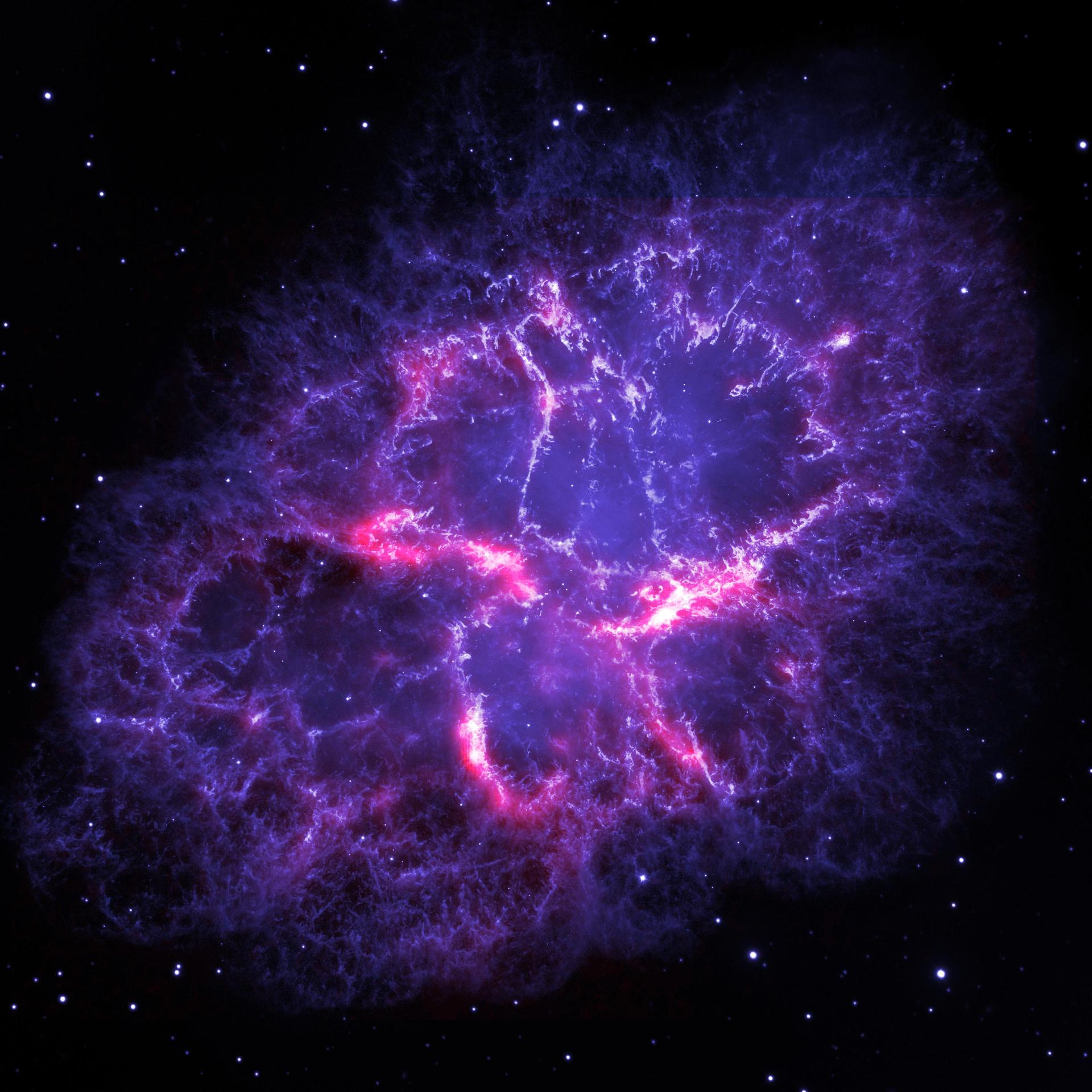
Crab Nebula (M1) — supernova remnant imaged by Herschel and Hubble Space Telescopes

Category: Books

Book excerpts and book-length works

Crab Nebula (M1), supernova remnant · ESA/Herschel/PACS; NASA, ESA & A. Loll/J. Hester (Arizona State Univ.) · NASA Image Library ↗

  • ASP PAPER 13

    AETHER SCIENCE PAPERS: NO. 13

    This paper was published in Physics Essays 4 pp.13-19 (1991)

    THE THEORY OF ANTIGRAVITY

    Copyright © Harold Aspden, 1991

    ABSTRACT

    This paper extends the principles of earlier gravitational theory by which the Constant of Gravitation G has been deduced in terms
    of an electrodynamically based graviton theory. Demonstrable
    anomalous gravitational effects reproducible in the laboratory,
    which reveal the prospect of anti-gravitational action, are
    discussed. It is shown that the theory does include features
    which can explain observed anti-gravitational effects. The
    action points to vacuum energy fluctuations arising from graviton
    decay and regeneration. Recently reported weight loss
    accompanying gyroscopic spin in a non-precessing mode is also
    explained.

    INTRODUCTION

    The recent media interest in anti-gravity devices and their
    public demonstration has presented a technological problem, which
    is complicated by the lack of interest by the theoretical
    physicist. Theory has not yet given us an accepted comprehensive
    understanding of the true nature of gravitational forces and
    particularly the field unification with electromagnetism. It is,
    therefore, rather bewildering to be confronted with the
    suggestion that there are any laboratory-verifiable anomalies
    of an anti-gravitational nature. This is even more disconcerting
    when we consider that our hopes for resolving the unification
    problem have come to rely on our imaginary probes into the events
    when the universe was first created.

    The immediate concern, however, is that posed by the weight loss
    of a flywheel spinning in vacuum about a vertical axis [1]. This
    was reported in Physical Review Letters and claims the
    extraordinary observation that the flywheel lost weight in a
    measure directly proportional to speed of rotation but only for
    rotation in one direction, clockwise as seen from above in a
    laboratory test performed in the northern hemisphere.

    The fact that this experiment was performed in a university
    laboratory in Japan reveals the concern on the broader issue of
    anti-gravitational effects of gyroscopes, but hitherto the claims
    of anti-gravitational effects have related essentially to
    gyroscopes which are force-precessed. By this is meant the
    action of causing a gyroscope to precess faster than arises from
    normal gravitational action on the flywheel.

    It is the object of this paper to discuss, in physical terms, why
    anti-gravitational effects can occur and then point to the
    experimental evidence in support. Claims that experiments can
    breach accepted principles of gravity or basic Newtonian
    mechanics tend to be discounted in the absence of theoretical
    support. Equally, theories of anti-gravity can justifiably be
    seen as wild speculation in the absence of experimental support.

    Apart from the latest Japanese data [1], the author is relying
    for such support on a report by a laboratory which has performed
    a test as part of a commercial investigation plus what he has
    seen demonstrated by those in possession of anti-gravitational
    gyroscopic devices.

    Whatever the viewpoint or bias of the reader who is well versed
    in gravitational theory, there is a need to come to terms with
    the phenomena which are now in evidence.

    THE HAYASAKA-TAKEUCHI EXPERIMENT

    It is assumed that the reader will not be disposed to accept
    anti-gravitational phenomena readily. Therefore, the claim that
    this experiment [1] reveals a speed-dependent weight reduction
    by a flywheel in spin must be examined with other force-producing
    agencies in mind.

    One which has apparently occurred to the authors of the
    experiment is that magnetic levitation effects, perhaps involving
    the geomagnetic field, are involved. They discount such action
    on the strength of having performed diagnostic tests involving
    inverting the flywheel and screening the geomagnetic field.
    Others have already expressed the opinion that experts on General
    Relativity will soon find a way of explaining the antigravity
    anomaly. That should, however, not deter us from considering an
    interpretation based on the more likely outcome, which is that
    the Theory of Relativity itself has been overtaken by physical
    realities which cannot be tamed by the abstract techniques of
    that theory.

    The Japanese paper seems to be a very authoritative account and
    so, subject to comments presented in the Appendix commentary, it
    must be presumed that the lift force which they measure as:

    2×10⁻⁵Mωr g.cm.s-2 ……….. (1)

    is genuine. Here M is the mass of the flywheel and r the mean
    radius of its mass elements. ω is the angular spin velocity of
    the flywheel in radians per second.

    We should take special note that the experiment was performed in
    a vacuum to eliminate aerodynamic lift action and it gave the
    most remarkable result that levitation force effects occurred
    only for clockwise flywheel rotation.

    The fact that the lift force depends upon direction of spin is
    a clear indicator of an asymmetry arising from charge
    displacement. The author’s theory of the vacuum field in terms
    of synchronous lattice electrodynamics [2] specifies that there
    is a preferred spin direction in the vacuum. An action conducive
    to vacuum spin will displace electric charge radially outwards
    or inwards according to the orientation of the spin axis relative
    to the preferred direction. However, such displacement must be
    balanced by charge displacement in matter and electrons can flow
    outwards in a conductive flywheel to sit just outside the vacuum
    region in spin, but positive ions cannot be so displaced.
    Accordingly, the coextensive rotation of the vacuum medium within
    a flywheel can only occur readily for one direction of spin, that
    which corresponds to the rotation of the sun and all the planets.

    Now, to make sense of this, it has to be understood the the
    vacuum is really a structured medium somewhat like a fluid
    crystal. Depending upon field energy criteria it develops
    structure centred on individual atomic nuclei and this structure
    can extend to interface boundaries located in the proximity of
    the outer electrons of the atom. At these boundaries whatever
    constitutes the structure can dissolve as part of a heavy lepton
    field and it is this heavy lepton form which can migrate so as
    to conserve momentum and thereby make the coupling between matter
    and the vacuum rather tenuous. It would seem that flywheel
    rotation one way can rapidly establish a spin motion of the
    vacuum structure which avoids the countermotion of the heavy
    leptons, whereas rotation in the opposite sense means that the
    heavy leptons are moving through the structure as part of a
    countermotion state. In the latter case they constitute pockets
    of space in which the vacuum structure has dissolved and this
    means that there is no gravity action associated with the portion
    of the flywheel occupying those pockets of space.

    To bring this seemingly speculative proposal to a conclusion, it
    seems best to derive the weight loss formula to show how it
    agrees with equation (1), the result obtained by Hayasaka and
    Takeuchi [1].

    The vacuum structure comprises virtual lattice particles of mass
    mo which does not increase relativistically because the particles
    are constrained in a synchronous harmonic system which assures
    energy exchange keeping the mass constant. The motion is a
    jitter motion which is dynamically balanced by gravitons relative
    to which the lattice moves at speed c. This results in the
    particles each motion relative to the inertial frame at speed c/2
    and so have a kinetic energy mo(c/2)2/2.

    Equipartition of energy by interaction of the lepton states means
    that this jitter energy becomes the kinetic energy of the free
    heavy lepton nucleated from such a lattice particle. Therefore,
    τ being the mass of this heavy lepton, this energy is τs2/2, where s is the speed of the heavy lepton. We can therefore deduce that:

    c/s = 2(τ/mo) …………… (2)

    If ωr is the speed of the spin motion in the flywheel at radius
    r and this is shared by vacuum structure in which the main mass
    of the flywheel is seated, the pockets of heavy leptons in this
    structure, assuming a uniform virtual mass density, must take up
    ωr/(ωr+s) of the space involved. In other words, this is the
    fractional loss of weight which we can expect. Assuming that
    fraction is small, it can be approximated as ωr/s and so we can
    write the weight loss as Mgωr/s, where M is the mass of the
    flywheel and g is the acceleration of gravity. From (2) we know
    s, so that the weight loss is:

    (2g/c)(τ/mo)1/2Mωr ………….. (3)

    Reference [3] shows how the following formula for the fine
    structure constant is deduced in terms of mo:

    hc/2πe2 = 108π(4mo)1/2 ………. (4)

    where mo is here in units of electron mass. With this value for
    the reciprocal of the fine structure constant as 137.036 we see
    that mo is 1/24.52. The mass of the heavy tau lepton in similar
    units is 3485 (corresponding to 1.781 GeV). Therefore, if the
    heavy leptons are exclusively of tau form, expression (3) has a
    coefficient found to be 1.92 x 10⁻⁵ in the units used in (1). This is in good accord with the measured value.

    We see from this that there is a case for arguing that weight
    involves something intermediating with a vacuum structure and
    that there can be weight loss if that structure is somehow
    dissolved or decoupled from the mass of the matter present. If
    the countermotion of heavy leptons can be avoided, as by
    developing the full vacuum spin condition for the opposite sense
    of flywheel motion, then there is no weight loss. However, even
    then there is an antigravitational phenomenon confronting us if
    the flywheel is forcibly caused to precess. Then that weight
    loss can be very substantial.

    The above-mentioned Japanese experiment was reported after this
    paper was first submitted. It is of such importance that
    extensive reference to it has been incorporated at the outset so
    that the reader can take, as a starting point, the test data
    showing that a flywheel loses weight and that this occurs without
    forced vibration effects. Apart from a special Appendix
    commentary dealing with reviewer criticism, the remainder of this
    paper assumes no knowledge of the Japanese flywheel experiment,
    as it was written prior to that disclosure.

    THE FUNDAMENTAL QUESTION

    At the very outset of this discussion it is necessary to
    distinguish between two schools of thought as to the action
    involved in anti-gravity. Most of those researching this field
    believe that mass retains its full and normal gravitational
    property, but that the anomalous levitation or propulsion effect
    comes from an out-of-balance force which somehow is developed by
    exploiting the absence of centrifugal effects when a spinning
    flywheel, offset from a separate axis of rotation, is caused to
    precess. Others, including this author, subscribe to the view
    that there is a loss of weight by the force-precessed mass in
    the flywheel and that the underlying energy action in the vacuum
    field plays a role in this enigmatic behaviour. The distinction
    is most important, because in the first case the action is a
    dynamic action akin to the effect of an electric or magnetic
    field that can act across empty space to produce forcedeveloping thrust. It should operate to produce horizontally
    directed thrusts or could act vertically to balance the downward
    force of gravity. In the second case there is something far more
    fundamental involved where levitation effects are in issue,
    because the suggestion is that the mass property and the weight
    property can become separated to cause mass to lose weight.

    The author believes that there could be a case for both of these
    anomalous effects to be present together. It is the possibility
    of this dual circumstance that compounds the mystery and has made
    it very difficult for scientists listening to the evidence to
    believe any of it on hearsay. Indeed, only those few scientists
    who have seen the demonstrations are inclined to believe that the
    phenomenon is real and even then some look for conventional
    answers they have yet to find. Certainly they are not prepared
    to listen to the somewhat naive theories being advanced by those
    whose primary claim is that they can demonstrate the
    pecularities of these machines.

    One clear way of distinguishing between the two effects is for
    those who assert that the observed levitation action is a
    controlled dynamic effect, not connected with weight loss, to
    demonstrate that they can produce an equal downward thrust merely
    by reversing the controlling force. The search for an
    anti-gravity machine able to levitate by some mysterious force
    field captures the imagination, whereas there is little interest
    in the equally revolutionary scientific accomplishment of causing
    a downward thrust which enhances the normal gravitational action.

    To proceed we explore first the dynamic case and then later the
    theoretical basis of the anti-gravity phenomenon on the
    assumption that an actual loss of weight is involved.

    THE ENIGMA OF ZERO CENTRIFUGAL FORCE

    We begin by considering a spinning top in precession on a smooth
    surface.

    An experiment demonstrated to the author by Professor Eric
    Laithwaite at the Imperial College of Science and Technology in
    London reveals that a flywheel spun on a shaft having a pointed
    end supported on a very smooth, frictionless surface can precess
    around the point of support without there being any lateral slip.
    It purports to show that somehow there is no centrifugal action
    attributable to the precessional motion communicated through to
    the point of support.

    The problem here is that the precessional velocity is normally
    quite small and so the centrifugal effects could only be of the
    order of 1% of the weight of the flywheel. Therefore this is not
    a convincing interpretation. More convincing is the showing by
    Professor Laithwaite that if, for example, a pencil is held
    upright and inserted in the path of the shaft of the precessing
    flywheel the arrest of the flywheel’s precessional motion imparts
    no force on the pencil. Here is the primary clue to the
    phenomenon by which a precessing gyroscope can be used to produce
    a propulsive force which appears to defy Newtonian law.

    The author offers the following argument to suggest how a
    propulsive device wholly contained in a closed compartment can
    develop a force without apparent reaction on structure outside
    the compartment.

    Suppose the mass of a flywheel describes a circle at a steady
    speed in a horizontal plane subject to a momentary state of rest
    after completing each half orbit. If it precesses under gravity
    over the first half of an orbit this motion arises from a
    reorientation of the conserved spin angular momentum of the
    flywheel. The gravitational drop in potential supplies the
    orbital kinetic energy and there is no impulsive reaction in the
    horizontal plane apart from the centrifugal force. Having
    completed half an orbit, suppose we then lift the flywheel very
    slightly into a non-precessing support position. This involves
    negligible effort because it is aided by the arrest of the
    orbital motion as the kinetic energy is returned to gravitational
    potential and angular momentum is conserved about the vertical
    axis as the flywheel spin is reorientated. Then for the next
    half orbit, with the flywheel fully supported, we drive it from
    rest and force it around the orbit at a steady speed until it is
    arrested after completing that half orbit. This latter phase
    involves a net balance of impulse forces and centrifugal forces.
    We are left with a forward propulsion of the vehicle attributable
    to the centrifugal action during the precessing phase and powered
    by sustaining the flywheel spin and the restoration of
    gravitational potential.

    In effect, therefore, whilst adhering to the principles governing
    inertia as expressed in Newton’s first and second laws, the
    principle that action balances reaction as required by the third
    law is challenged by this argument. In confronting and accepting
    or disposing of this proposition it seems best to appeal to the
    experiments which have raised the question. However, what we
    find here is that those who do the experiments, even in
    university laboratories, and find anomalies are ridiculed by
    those who rely on their theoretical training and decline to
    perform such experiments themselves.

    Although many of those experimenting in this field believe that
    a cyclic dynamic action such as that just discussed is the way
    forward in the effort to drive or levitate a vehicle by breaching
    Newtonian principles, there is the other possibility that weight
    can in fact be reduced with the right technique. This will now
    be considered. It is relevant because the author has witnessed
    a demonstration by Professor Laithwaite of the Imperial College
    of Science and Tchnology in London, which involved effortless
    lifting of a heavy flywheel in precession. There was no way in
    which this could have been possible unless the weight of the
    flywheel was virtually zero, because the supporting shaft itself
    was quite heavy.

    THE NATURE OF THE GRAVITY FORCE

    If a particle has mass and mass is acted upon by gravity, how can
    a ‘manipulated’ mass ever lose weight in a gravitational field
    that acts normally, without loss of weight, on an ‘unmanipulated’
    mass in the same position? The expression ‘manipulated’ applies
    to whatever we do to the particle to cause it to respond in the
    anomalous anti-gravitational manner.

    The answer to this question has to be that we have recited an
    impossibility. There is, on the evidence of observation of the
    phenomenon, something wrong with the way in which we have
    formulated the question. Let us therefore recite the preamble
    to the question a little differently.

    We now say ‘If a particle has mass and this mass affects the
    local field in such a way that something in that field, normally
    coupled to the mass, is acted upon by gravity….’. Clearly, we
    can now develop the argument, because we are bringing in the
    field and any distortion of the space-time lattice or structure
    that might be said to give rise to the effects we associate with
    gravitation.

    We do not, however, commit ourselves to the Einstein space-time
    doctrines. We go so far as to say that there is a local lattice
    in vacuum space which has an affinity to form a local structural
    association with the structured elementary atomic nuclei
    constituting the particle.

    Readers will now realize that this means that we do have an
    optional situation. Regard that lattice structure as like the
    crystalline form that can nucleate in a liquid crystal. The
    structure can be minimal in extent, broken into local minute
    crystal units each nucleated on a microscopic element of nuclear
    matter or it can spread until the boundaries of these units
    interface throughout the material system and so embrace also the
    relatively vast regions of empty space that intervenes between
    those atomic nuclei. The structure of each atom might well
    extend no further than the body of the nucleus or might reach
    some but not all of the satellite electrons.

    We take what has just been said as our working hypothesis which
    gives us a basis for distinguishing between the abnormal and the
    normal and guides us concerning the nature of the gravitational
    action.

    We now bring the theory along a track that has already been
    explored with some success in connection with the derivation of
    G, the universal Constant of Gravitation, as a function of the
    properties of so-called ‘gravitons’. The actors in this natural
    scenario are, therefore, the mass of the particles involved, the
    space lattices nucleated on those particles, the in-fill lattice
    of empty space, and the transient gravitons created from the
    vacuum background in the vicinity of the particles which decay
    as they transfer their energy and momentum to the lattice system.

    In a normal body at rest or one in a steady state of motion the
    action of gravitation proceeds by the creation of gravitons of
    energy Mc2 adjacent a mass M. These gravitons fall under their
    mutual gravitational action but are short lived. Upon decay,
    after falling a very minute distance possibly commensurate with
    the Compton wavelength of the electron, that is less than the
    atomic spacing in solid matter, their energy and momentum are
    absorbed back into the vacuum energy system and so forces are
    exerted on the space-time lattice. In the body under
    consideration this lattice extends a sufficient distance from
    each nucleating atom in the material of the body, really filling
    all intervening space in the body, so that all the gravitational
    force is absorbed by lattice physically locked on to the material
    of the body. In this roundabout way we can see how the mass of
    such a body ‘appears’ to be the seat of the gravitational force.

    The merit of this scenario, however, is that the gravitons are
    discrete quanta by which one can build a quantitative theory of
    gravitation and calculate G in terms of fundamental particle
    data. This has been the primary thrust of the author’s work on
    gravitation over many years. (References to be listed later.)
    The gravitons are created from energy borrowed from the vacuum
    state, as vacuum energy fluctuations which leave a virtual muon
    field in deficit. All this means is that we do not ‘see’ the
    gravitons as mass and only sense them by their gravitational
    action and by their indirect influence on the observed mass
    spectrum of fundamental particles normally produced under high
    energy conditions.

    The additional merit of this same scenario is that if we can
    cause the body to so move that its motion is not steady or not
    that of simple linear oscillation, we see scope for the lattices
    centred on each nucleus contracting to become more localized.
    This means that the graviton momentum is partly absorbed by the
    in-fill lattice, which might, for example, be coupled to the body
    Earth. In other words, we have with this theory the quite
    remarkable possibility that the weight of the body can be
    partially shifted to act directly on the Earth and across the
    intervening space in some unseen way. This would mean partial
    loss of weight by the body in so far as it is not considered as
    part of the body Earth itself. In other words the weight of the
    body has transferred to become part of that of the Earth.

    The effect of simple linear oscillation has been excluded because
    there is evidence to show that Maxwell’s equations involve
    lattice oscillations of this kind and that the vacuum lattice
    system can respond perfectly to all frequencies up to that at
    which electron-positron creation occurs. It is as if the lattice
    is tuned in respect of its linear motion to have, when displaced
    by an electric field, a restoring force rate that adjusts in
    compliance with the frequency to give perfect resonant response.
    Thus the linear oscillation or vibration of a coextensive body
    will not break down the lattice.

    The question then arises as to which kind of motion does break
    up the lattice units to cause their inward collapse to more
    confined form. To approach this we now consider two ways in
    which we can apply force to regulate the motion of a body. One
    way is to remove its supports to let the force of gravity drive
    the body. Another way is to apply mechanical force via the
    structure in which the body is mounted. We ignore electrical and
    magnetic forces, but assume that such forces, like mechanical
    forces, do act via the structure and so act directly on the
    matter constituting the body. In contrast, the gravitational
    force acts via the gravitons and their coupling with the matter
    constituting the body.

    There are therefore two basic types of force action. The
    gravitational force is a distributed force spread over the
    graviton population and so the lattice system as a whole is
    subjected to the driving action of this force. The lattice
    system is less likely to be ruptured by a distributed force
    spread throughout its structure than it is by force action
    communicated via the atomic nuclei on which the lattice is
    nucleated. Bear in mind that the lattice dimension of this
    space-time system is commensurate with the size of an atomic
    nucleus in that the nucleons tend to occupy lattice sites. Thus
    this dimension between lattice sites is hundreds of times smaller
    than the inter-atomic spacing of the substance. What this means
    is that the applied mechanical force which causes a kind of
    twisting or non-linear motion can rupture the lattice into small
    units, whereas the gravitational force tends to preserve the
    integrity of the larger lattice form, even though that
    gravitational force is causing the non-linear motion.

    As an aside it is noted that there is a mystery that cannot be
    resolved by aeronautical engineering experts familiar with winged
    flight. The bumble bee has long been recognized as defying what
    we understand from the physics or aerodynamics of the flight
    technique. Their wings do not flutter rapidly enough. This
    makes one wonder whether precessing flywheels are essential and
    whether that ‘twisting or nonlinear motion’ mentioned above as
    rupturing the vacuum lattice can be occurring within the body of
    the bumble bee as it agitates its wings.

    FORCED OR NATURAL PRECESSION

    Reverting to the flywheel problem, precession can be forced or
    natural, depending upon whether it is caused by applied forces
    or gravitation. The mechanical system in which this distinction
    of applied forces is exemplified is provided by the precessing
    gyroscope which is offset mounted. The toy gyroscope formed by
    a spinning flywheel on a shaft precessing about a central tower
    is the most familiar form of this system.

    The force couple provided by gravitation via the weight of the
    flywheel is the force causing the precession and this gives rise
    to what we term ‘natural’ precession. If, however, we apply a
    couple which tends to cause the shaft to move at a different
    angular speed we have a ‘forced’ precession driven by force
    applied in the direct mechanical sense. It is in this latter
    case that the flywheel can tend to lift in a way which does not
    transfer weight to the support. There is here the loss of weight
    which we have been discussing and it is readily seen that the
    hypothesis we have developed can explain this phenomenon.
    Conversely, the experimental observation of the phenomenon can
    be taken as support for the hypothesis and so the graviton theory
    on which it is based.

    A very important question we now face is that of whether such a
    device can ever lift more than the weight of the flywheel. On
    the argument used the answer to this would seem to be negative.
    However, here the graviton theory as developed in the earlier
    work of the author has something else to offer. It was part of
    that theory to regard the space-time lattice as being something
    truly physical rather than an embrionic geometrical notion. As
    such it was seen as comprising what can be said to be
    ‘sub-electrons’, electric charge in its most degenerate
    particulate form, set in a structured array in a uniform
    background of degenerate non-particulate continuum charge of
    opposite polarity. This means that the lattice itself has mass,
    and could develop its own graviton population and exhibit
    gravitational effects. However, such effects are not felt by
    interaction with matter, because the space-time lattice is
    universal and there is no way in which the repositioning of
    matter in space can alter the gravitational potential available
    for energy exchange with matter.

    The consequence of this proposition has far reaching
    implications. We assumed that the in-fill lattice in the case
    of the force-precessed gyroscope would be coupled to body Earth.
    Suppose, however, that this is incorrect and that the in-fill
    lattice is coupled with the Sun or even is free in the sense of
    being an absolute or preferred universal frame in its own right.
    Then it becomes possible for some of the weight of the lattice
    coextensive with the atomic nuclei to be transferred to an action
    in that frame. In other words, some of the local space-time
    lattice itself can lose weight in a sea of lattice which is
    subject to normal weight pressures. Given that the space-time
    lattice is a uniformly dense system, this can but mean that
    whatever is coupled to the local lattice units must experience
    a positive lift force. The flywheel of the force-precessed
    offset gyroscope can then lift more than its own normal weight.

    It follows that, if tests confirm this phenomenon, we have a way
    of measuring the mass properties of space-time itself and can see
    scope for the levitation of vehicles carrying a payload. Such
    are the horizons now ahead of us, bearing in mind the
    experimental facts discussed below.

    THE EXPERIMENTAL FACTS

    To the author, the most significant fact of experiment is
    presented to anyone who has witnessed Professor Eric Laithwaite
    lift that heavy spinning flywheel by applying a slight
    manipulating force to a supporting shaft. The end of the shaft
    remote from the flywheel is supported in the crook of his little
    finger on an outstretched arm. The lift force needed is said to
    be less than 2 lbs, whereas the wheel weighed 18 lbs and the
    supporting shaft weighed 6 lbs.

    Readers who have difficulty believing what has just been said
    should examine the photograph of this demonstration published at
    page 64 of reference [4].

    In this experiment there is no vibration and the evidence points
    to the wheel being able to lift more than its own weight.

    This phenomenon appears to have been shrugged off by most
    scientists who look to others with deeper knowledge of mechanics
    to give it formal explanation. Since there is no accepted theory
    for what Professor Laithwaite demonstrates, there has been a
    tendency to discredit what he has claimed. Yet, how can one
    discredit what is there to be seen? Those who have performed
    this simple test, either by lifting Professor Laithwaite’s own
    shaft and spinning flywheel or by lifting their own equivalent
    device, experience this loss of weight.

    Happily the pioneer spirit of Professor Laithwaite has captured
    the imagination of others who have built levitating machines and,
    it must be said, others have preceded Professor Laithwaite in
    such work. The phenomenon is one which persists, but Professor
    Laithwaite is the one who has been bold enough to minimize the
    mechanical elements involved to a shaft and a wheel and become
    an operating force-producing part of the machine himself. It is
    his test which this author sees as so far beyond dispute that the
    later machines become mere means for formal experimentation in
    an effort to develop the technology commercially.

    It is also this demonstration which shows that whatever energy
    is needed to lift the heavy flywheel by hand through a distance
    of some 1.5 metres does not come from the forces asserted
    manually.

    A machine test under controlled laboratory conditions with
    variable flywheel speed and measurement of both speed and input
    power is needed to trace what is happening in a physical sense.

    The machine which has captured media attention is that of
    Scotsman Sandy Kidd of Dundee, essentially because it was
    developed by commercial interests and subjected to independent
    precision laboratory tests to verify the positive lift force [5].
    This machine in full levitation has been recorded by Australian
    television interests and will be have been shown by an
    internationally distributed programme before this paper appears
    in print.

    Other machines operative at this time are those built by another
    Scotsman, Scott Strachan of Edinburgh, one of which was
    demonstrated at a symposium in Canada in June l988 [6]. It
    incorporated its own precision balance and operated under remote
    radio control to show hands-off lift action.

    Although government, academic and commercial interests as well
    as the media are now all showing interest in this phenomenon it
    remains to be seen how the scientific scene will develop. The
    progress will be slow, because none of those in authority have
    conceded acceptance of the anti-gravity phenomenon. What appears
    certain, however, is that anti-gravity has now a place in physics
    which extends beyond that mooted by Professor Sir Harrie Massey
    FRS when he wrote [7]:

    ‘ANTI-GRAVITY? One curious question arises. Particles and
    antiparticles are produced in pairs. How could matter and
    anti-matter ever separate? One possibility that cannot be ruled
    out at the present stage, is that of a repulsive force of gravity
    between matter and anti-matter. We cannot yet say whether a
    piece of matter exerts a gravitational attraction or repulsion
    on a piece of anti-matter – we do not know whether anti-protons
    tend to fall downwards or upwards! The nature of the force of
    gravity is still so obscure that no reliable answer can yet be
    given from theory and it will be some time before any
    experimental tests will be practicable.’

    One further aspect of anti-gravity phenomena is that known as the
    Hutchinson Effect. This peculiar phenomenon by which
    electromagnetic influences developed by a peculiar combination
    of electric power equipment, including Tesla coils, can cause
    blocks of wood or metal to lose weight has been captured by video
    camera [8]. To witness what is shown is quite disconcerting as
    it is quite incomprehensible in terms of accepted physics and yet
    one cannot just write it off as an unnatural phenomenon. Perhaps
    what is happening is that there are powerful low frequency
    electromagnetic field oscillations that are interfering in some
    way so as to set up electrical vibrations or displacements that
    are not confined to one steady direction. If this were to break
    up the lattice units and cause them to contract around their
    nucleating atoms in the block of wood or metal, then again we see
    basis for the anti-gravitational phenomenon revealing itself.

    It remains to summarize the key scientific papers and other
    references which the author has argued from in the above
    discussion. Concerning the possible imbalance of force in the
    interaction of matter, and particularly any breach of Newton’s
    Third Law of Motion, the author has written numerous papers on
    the electrodynamic law of interaction, see, for example,
    reference [9] and, of particular relevance to this anti-gravity
    topic, reference [10]. It is to be noted that the Lorentz force
    breaches Newton’s Third law, as is well known by experts on
    electromagnetism. Also, particle physicists well know that beta
    decay breaches the laws of linear and angular momentum
    conservation as well as the law of conservation of energy. This
    is why the enigmatic neutrino concept was invented, a
    hypothetical particle having no mass but all the necessary
    qualities needed to keep the balance in accord with Newtonian
    and/or Einsteinian philosophy. In this author’s opinion this was
    merely a way of embracing the vacuum properties, including
    aspects of vacuum energy fluctuations, into the mathematical
    logic of a form of physics that seeks to avoid reference to the
    aether.

    Concerning the author’s theory of gravitation, based on an aether
    model having the space lattice structure already mentioned, the
    book references are [11, 12, 13]. For scientific papers
    concerning the derivation of G and the graviton properties see
    references [14, 15, 16]. It is also to be noted that the same
    theory has addressed the issue of proton creation and yielded a
    precise theoretical value for the proton-electron mass ratio
    [17]. Concerning the tuned lattice response and conformity with
    Maxwell’s equations arising from a study of a non-dispersive
    vacuum property, a key reference is [18], but see also [19].
    Concerning earlier gyroscope experiments revealing anomalous
    propulsion results, there are many references, particularly in
    the patent literature. The most informative is that of Professor
    A. Di Bella of the Institute of Naval Architecture, University
    of Genoa, Italy [20] (see also the U.S. Patent [21]). The latter
    experiments, in common with many others, have been ignored
    because the general assumption is that the vibration involved
    interacts with non-linear frictional effects to produce a
    propulsive effect. For this reason it is imperative either to
    conduct precision integrated force measurement tests on devices
    which are immune from external friction but which may vibrate (as
    applies to the status of the Kidd or Strachan machines) or to
    focus on experiments which have no vibration at all, such as that
    of Professor Laithwaite described above. This, therefore, has
    been the basis on which the argument presented in this paper is
    founded.

    APPENDIX: RESPONSE TO REVIEWER COMMENT

    A referee report on this paper pointed out that it is ‘premised
    on the belief that the Hayasaka and Takeuchi experiment is
    correct’ and declared ‘In fact, all recent repetitions of the
    Japanese experiment with more precise equipment have shown that
    the original experiment was wrong’. The referee gave three
    references [22, 23, 24] relating to the authoritative tests
    performed to check the Japanese claims and observed that this
    author ‘is putting forward a theory to explain an effect which
    does not exist.’

    Now, this author is not aware of any admission by the Japanese
    rescinding what they claim, though certainly this author cannot
    vouch for their findings. However, thanks to the Editor of
    Physics Essays allowing response to the referee comment, it seems
    appropriate to ask the reader to consider the following points.

    First, when the author first took an interest in the gyroscope
    weight loss anomalies it was pointed out to him by expert
    aeronautical authority that flywheels spinning in air can
    experience a lift force that is arerodynamic in origin. This
    made the Japanese experiment all the more credible besides being
    rather unique, because in doing the tests in vacuo they had made
    absolutely sure that no such lift action could account for the
    anomaly they found.

    Second, the refuting experiments [22, 23, 24] were actually
    published in February and April 1990, within weeks of the
    publication of the report of the Japanese work and such urgent
    evaluation is an indication of the importance attached to the
    task of rejecting what had been claimed and also of the cursory
    nature of the tests. It meant, presumably, that in repeating the
    experiment none of the three research teams involved in
    discrediting the Japanese had gone to the trouble of building a
    system having essentially the same vacuum test facility.
    They were all content to rely on tests in air and that then
    destroys their right to challenge the Japanese findings. The
    Japenese would presumably not have bothered to use vacuum if what
    they were researching did in fact reveal itself in air.

    Thirdly, one must take note of the case put by Faller et al [22]
    in discussing why they did not use a vacuum. Their reason in
    their words is:

    “Since we know of no steady-state effect of internal air
    currents on the weight of a sealed system, we decided a simple
    O-ring seal on the cover of our gyro was sufficient.”

    They prejudged the nature of the weight loss by assuming it must
    relate to lift action due to air and decided that, because they
    were unaware of any anomaly that could depend upon steady-state
    air current effects, the presence of air was irrelevant in
    judging what would happen in a vacuum.

    They also stated:

    “In spite of the fact that they (Hayasaka and Takeuchi)
    observed similar effects for three different gyros, it is still
    very difficult to think of any fundamental reason for their
    observed effects.”

    Now, this author conceived this paper as a discussion of
    anti-gravitational phenomena which can occur in air but only
    with force-precessed gyroscopes. However, the circumstances of
    the Japanese experiment were special and were satisfied by
    non-precessing spin in vacuo. The author has derived a formula
    which fits what Hayasaka and Takeuchi found, not by reference to
    air currents, but by assuming that electric charge could be
    radially displaced within the flywheel, its polarity depending
    upon direction of rotation, so that electrons could escape from
    the substance of the flywheel but not the heavy positive ions.

    The reader must now take a position on the question of whether
    all physical action in air depends upon ‘air currents’ or whether
    certain electrical phenomena can occur in air, such as
    Maxwell-type electric charge displacement. Unless the critics
    have certain knowledge that the anti-gravitational action cannot
    depend upon the microscopic electrical nature of matter as
    opposed to the macroscopic mechanical properties of matter, then
    the issue is open. Can, for example, the positive and negative
    ions which neutralize the vacuum spin charge displacement in the
    theory presented in this paper have a mobility if comprised by
    air dragged around by the flywheel which they would not have if
    they were part of a solid flywheel? If the latter argument
    cannot be discounted, and it really cannot because air is fluid
    and its heavy ions can migrate, then that presence of air in
    those tests reported in references [22, 23, 24] can preclude the
    anti-gravitational actions of the flywheel.

    This author feels therefore that the tests discrediting the
    Japanese experiment are not conclusive and hopes that someone
    will go to the trouble of repeating the tests in the same vacuum
    conditions as used by the Japanese. If the Japanese tests are
    confirmed in the vacuum situation then it would be of interest
    to check what happens if the flywheel is of insulating dielectric
    material or of metal coated at its rim with such material.

    This paper was received by Physics Essays on 15 May 1989.

    REFERENCES

    [1] H. Hayasaka and S. Tackeuchi, Physical Review Letters,
    63, 2701 (1989).

    [2] H. Aspden, Hadronic Journal, 10, 185 (1987).

    [3] H. Aspden, Lett. Nuovo Cimento, 40, 53 (1984).

    [4] A. Jones, Electronics and Wireless World, 94, 64 (1987)

    [5] R. Thompson, ‘The Kidd Machine’, Observer Magazine, U.K.,
    pp. 28-31 (24 July 1988).

    [6] J. S. Strachan, ‘Demonstration of the Lift Properties of
    the Precessing Gyroscope’, (to be published in the
    Proceedings of P.A.C.E. Symposium, Hull, Quebec, June
    1988).

    [7] H. Massey, ‘The New Age in Physics’, (Elek, London),
    p. 150 (1966).

    [8] G. Hathaway, ‘The Hutchinson Effect’, (to be published
    in the Proceedings of P.A.C.E. Symposium, Hull, Quebec,
    June 1988).

    [9] H. Aspden, Physics Letters, 111A, 22 (1985).

    [10] H. Aspden, Electronics and Wireless World, 96, 29 (1989).

    [11] H. Aspden, ‘The Theory of Gravitation’, (Sabberton, P.O. Box
    35, Southampton, England) 1966.

    [12] H. Aspden, ‘Physics without Einstein’, (Sabberton, P.O. Box
    35, Southampton, England) 1969.

    [13] H. Aspden, ‘Physics Unified’, (Sabberton, P.O. Box 35,
    Southampton, England) 1980.

    [14] H. Aspden, Spec. Sc. Tech., 1, 59 (1978).

    [15] H. Aspden, Hadronic Journal, 9, 153 (1986).

    [16] H. Aspden, Physics Essays, 2, 173 (1989).

    [17] H. Aspden, Physics Essays, 1, 72 (1988).

    [18] H. Aspden, Electronics and Wireless World, 88, 37 (1982)

    [19] H. Aspden, Lett. Nuovo Cimento, 41, 252 (1984).

    [20] A. Di Bella, ‘On Propulsive Effects of a Rotating Mass’,
    Seventh Symposium on Naval Hydrodynamics (August 25-30,
    1968, Rome, Italy) DR-148 Office of Naval Research
    Department of the Navy pp. 1373-1396.

    [21] A. Di Bella, ‘Apparatus for Imparting Motion to a Body’,
    US Patent No. 3,404,854. (1968).

    [22] J. E. Faller, W. J. Hollander, P. G. Nelson and M. P.
    McHugh, Physical Review Letters, 64, 825 (1990).

    [23] T. J. Quinn and A. Picard, Nature, 343, 732 (1990).

    [24] J. M. Nitschke and P. A. Wilmarth, Physical Review Letters,
    64, 2115 (1990).


  • LECTURE NO. Vb

    PHYSICS OF CREATION: LECTURE NO. Vb

    11 KEY QUESTIONS ABOUT THE UNIVERSE

    Questions posed by the committee on the physics of the universe set up by the National Academy of Sciences

    Copyright, Harold Aspden, 2001

    In their search for answers to what they regard as the most fundamental questions concerning the nature of the universe, a panel of US physicists and astronomers plans to report towards the end of this year 2001 on how they “prioritize the questions” and make recommendations as to the funding needed to guide them in their search for answers. It is here submitted that one of those funding recommendations should be to procure for each panel member a copy of this author’s book “Aether Science Papers” for reasons which are explained below.

    *******************************************

    INTRODUCTION

    On January 18, 2001 the U.K. Institute of Physics alerted their members to a news item bearing the title: ’11 key questions about the universe’. Its internet reference is http://physicsweb.org/article/news/5/1/7. It said that the combined skills of particle physicists and astrophysicists would be needed to answer 11 fundamental questions identified in a report “From quarks to the cosmos” by the committee on the physics of the universe set up by the National Academy of Sciences in USA.

    The 11 questions were stated in the following order:
    * What is dark matter?
    * What are the masses of the neutrinos, and how have they shaped the evolution of the universe?
    * Are there additional spacetime dimensions?
    * What is the nature of the dark energy?
    * Are protons unstable?
    * How did the universe begin?
    * Did Einstein have the last word on gravity?
    * How do cosmic accelerators work and what are they accelerating?
    * Are there new states of matter at exceedingly high density and temperature?
    * Is a new theory of matter and light needed at the highest energies?
    * How were the elements from iron to uranium made?

    It seems that the committee is keen to bring physicists and astronomers together to tackle these questions, given “the enormous leaps in technology – including the exponential growth of computing speed” that have occurred over the last twenty years.

    Now, as someone who has been interested in physics at the fundamental level where it is concerned with the creation of matter and the key regulating features which govern the properties of matter, I find this list of questions rather misleading. Some questions (those concerning ‘dark’ matter and ‘dark’ energy) have no meaning given that other questions in the list remain unanswered. It seems that those compiling this list have chosen to ignore a very important question which they have not even mentioned. This is simply the question as to whether G, the constant of gravitation, is in fact the same on a universal scale, regardless of its range of action or the concentration of mass energy involved in the interaction. Nor do they include that very obvious question which surely warrants attention in their debate: “Is there an aether and, if so, how does it manifest itself?”

    I intend, in this Physics Lecture, to show that what I have already of published record provides specific answers to those questions on the list which really matter and I will deal with these first before commenting on the other questions in the above list of eleven. The first question I will address is the fifth in the list: “Are protons unstable?”.

    ARE PROTONS UNSTABLE?

    Atomic physicists have somehow come to live with the notion that atomic nuclei comprise a composition of protons and neutrons, accepting that all but the heaviest atoms are stable and that neutrons in their free state decay within a mean lifetime of the order of 1,000 seconds. Logically, given that a free proton seems to be stable, it having no measurable decay period, and given that a neutron is only marginally heavier than the proton and that its decay product is essentially a proton partnered by an electron, I interpret this as implying that the free neutron is really a proton having acquired a leptonic entourage. Leptonic forms, whether of the electron-positron variety or whether muons or taons, are part of the hidden underworld of space giving basis for quantum-electrodynamic activity. However, the point here is that the proton is the core constituent of the neutron. Consequently, matter which is wholly composed of atoms is more than 99% proton in form and, generally speaking, matter is stable, as are protons. The neutron does, in my opinion, not exist within the atomic nucleus. It is created only when a proton is forced out of the atomic nucleus along with that leptonic entourage just mentioned. That said, we can now examine the question: ‘Are protons unstable?’.

    Well, the simple answer is: “Yes, but the decay product is in fact the creation of a new proton!”. The reason is equally simple. There is an underlying energy field throughout space which sits in equilibrium with itself to form the sub-quantum underworld that we can only sense by its interplay with matter. The universe, meaning the matter of which it is formed, was created when that equilibrium was disturbed in some way. As just stated, that matter comprises, almost wholly, nothing other than protons and so we can be sure that the energy that was deployed in creating the material universe went into creating protons together with a relatively small amount of that energy being deployed into creating leptons of the electron family. There is then nothing more logical than for an event which somehow destroys the proton to shed the mass energy and so prime the local energy field locally, only to find that the influence which preserves energy equilibrium as between the quantum underworld and matter then recreates the proton and so deludes us into thinking that the proton is stable when, in fact, it is subject to the same decay processes as other elementary particle forms.

    The question must then be recast as: “What is the nature of that decay process?” The answer is of published record and the physics is the same as that involved in the theoretical derivation of the neutron lifetime. Indeed, it is the same physics that applies to the actual process by which the proton is created. That sea of energy in the quantum underworld involves the ongoing creation and annihilation of muon pairs and the probability of these merging in a certain way is what governs the creation of the proton and so its mass. Similarly the probability of this muonic field getting involved with the neutron and its leptonic entourage or with the proton itself determines the action which triggers decay.

    Now, of course, these are mere statements and it needs detailed analysis of the physics involved to give this quantitative support, and that is why one needs to refer to the first of the appended papers in my book “Aether Science Papers”, along with the supporting references. The paper, first published in 1986, is entitled: “The Theoretical Nature of the Neutron and the Deuteron”, but it further shows the theoretical derivation of the proton-electron mass ratio and the lifetime of the neutron, both in remarkable agreement with their experimentally measured values.

    In summary, those concerned with the question as to whether protons are stable should face up to the fact that the answer lies in explaining how the proton is created initially as this can explain why, in decaying, the energy shed is deployed in a regenerative process which creates a new proton virtually at the seat of demise of the original proton, so disguising the decay and leading us into thinking it is a stable particle form.

    HOW DID THE UNIVERSE BEGIN?

    This is the sixth question listed in the Academy of Sciences report. One may now well ask how the learned committee mustered to define and then answer such questions can themselves begin such a task. Certainly I, in spite of all my knowledge of physics, would not know how to set about this quest, given that one really needs to know first and with certainty what existed originally in the space now occupied by the universe we see around us.

    So I will assume that question can be worded rather differently. Remember that physics is about the order of things, compliance with laws of Nature and uniformity of action with an essential underlying connection between all the elements of the universe. In the absence of order there is no language by which one can express an answer to such a fundamental question as “How did the universe begin?”. So the word ‘ordered’ is implicit and the question is better expressed as “How did the ordered universe begin?”, a question which has the equally implicit answer “It came from a state of disorder, a condition in which energy is distributed throughout space, a state of chaos.”

    The answer we seek is that of explaining how order giving basis for the laws of physics was distilled, as it were, from a state of chaos. I cannot imagine how that panel of US physicists and astronomers can sit around a table and debate this problem, unless someone on that committee has already had a flash of inspiration of the kind I experienced in my emergence from my Ph.D. research concerning energy anomalies in ferromagnetism.

    Digressing for a moment, to explain this, take note that in that period, the early part of the 1950s, I did not accept that the conventional explanation of the ferromagnetic state gave a sufficient insight into the phenomenon. My research project was essentially an experimental pursuit and, although it was in no way part of my Ph.D. work, I spent many an evening doing some calculations on assumed atomic structures and the electric and electromagnetic interaction forces between atomic nuclei and electrons in orbit around those nuclei. What eventually emerged from this pursuit was, firstly, an insight into the law of electrodynamics effective between discrete electric charges in motion as opposed to the conventional version of the law which applies where at least one of the charge forms is smeared into an effective closed circuital current flow. Secondly, bear in mind that this electrodynamic law had been used to calculate the forces between iron atoms in the ferromagnetic state in order to establish the value of the mechanical stress condition associated with that ferromagnetic state. The analysis suggested that the criterion for ferromagnetism to exist was whether or not that stress was below the rupture strength of the material and whether or not the associated strain energy density was lower than or exceeded the magnetic energy density of the ferromagnetic state. However, the onward step from that analysis was the portrayal of an ordered system having electrons featuring in a cubic structure and which involved a synchrony of electron motion. From this came the inspiration that heralded a unified field theory.

    If space itself had an analogous form with its Maxwell displacement current properties seated in a cubic structure comprising some fundamental electric charge form, then my analysis had several important implications. These were:

    1. Vast regions of space filled with a chaotic energy system, on cooling through a certain temperature (by analogy the Curie temperature in iron) would develop order and crystallize into a domain pattern (by analogy with magnetic domains in iron).

    2. A state analogous to ferromagnetism would be set up within those domains, a state by which electrodynamic force action sets up forces of mutual attraction between the elements constituting that domain.

    3. The attraction forces set up within this space medium would actually be a manifestation of gravitation, from which one concludes that the onset of order in space as its energy form cooled through a critical temperature would switch the force of gravity on as an event accompanying the transition from disorder to order.

    4. The model developed in dealing with the ferromagnetic problem gave an insight into the structure adopted by the space medium, but for reasons involving energy potential and avoidance of a negative energy potential condition for space itself, the space structure had to be simple cubic rather than body-centred cubic as applies in iron.

    5. The resulting model of space, when analysed for its reaction in storing energy exhibited angular momentum properties with quantum features and gave basis for an understanding of the photon backed by rigorous derivation of the value of Planck’s constant, in its relationship to light speed and unitary electric charge theory. The fine-structure constant, a dimensionless quantity calculable from the geometry of the space structure, emerged and by its comparison with the experimental value provided the convincing validation of this theoretical analysis. I note that over the years which followed this effort of mine in the 1950s others were to outline a vague but somewhat similar scheme for what can only be described as the ‘crystalline aether’. In saying this I refer to a passage included at pp. 58 and 59 of my book ‘Aether Science Papers’ which I reproduce here:

    If you feel that the ‘aether’ is not something one should take seriously and prefer to read about ‘electroweak theory’ then, to ease your thoughts as you begin to read the first of the selected fourteen papers, I quote from the opening three paragraphs of my 1983 paper entitled ‘Planar Boundaries of the Space-Time Lattice’.

    ‘Modern physical theory is tending to regard the vacuum medium as having structure somewhat analogous to that of crystalline materials. Thus we see WEISSKOPF [1] discussing quantum electroweak dynamics and asserting that the Higgs field implies that the vacuum has a certain fixed direction in isospace, namely that of the spinor associated with the Higgs field. WEISSKOPF states that the situation is like that of a ferromagnet, in which the direction in real space is determined as long as the energy transfers are smaller than the Curie energy.

    This, of course, implies an ordered structure of the vacuum medium, a feature discussed at some length by REBBI [2] in an article entitled ‘The lattice theory of quark confinement’. REBBI refers to a 1974 proposal by WILSON that QCD (Quantum Chromodynamics) should be formulated on a cubic lattice, an array that divides space and time into discrete points, but is essentially an approximation to real space-time. The advantage is that this allows calculations to be made that would otherwise be impossible.

    This author, in collaboration with Dr. D. M. Eagles [3], has advocated the analysis of a vacuum structure and shown how a value of the fine-structure constant correct to about one part in a million can be determined by a cubic lattice model of the vacuum. Further research on this model has now shown the essential need for a particular boundary condition imposed upon a physical portrayal of the vacuum state expressed in terms of electrical charge. It is in view of the current interest in lattice theory as applied to the vacuum field system that it seems appropriate to draw attention to what has been, to the author at least, a rather elusive consideration.

    [1] V. C. WEISSKOPF: Physics Today, v. 34-11, p.69 (1981)
    [2] C. REBBI: Scientific American, v.248, p.36 (1983)
    [3] H. ASPDEN and D. M. EAGLES: Physics Letters A, v. 41, p.423 (1972).”

    This paper went on to explain why the storage of electric field energy in the vacuum (the aether) demands the presence of planar lattice boundaries, which implies a domain structure in space somewhat analogous to that found in ferromagnetic materials. The paper was written in 1983, a few weeks after I retired from my executive position with a multinational corporation to engage in a private research venture as a Visiting Senior Research Fellow at my local university.

    The paper reference is Lettere al Nuovo Cimento, 38 243-246 (1983).

    Reverting now to our original question, that of how the Universe began, the answer has emerged, in that the chaos of the prevailing surplus of energy permeating all space experienced a step transition as gravity came into being and caused that energy to cluster by forming stars. Each domain of space would nucleate its own star, owing to the gravity field being local to each such domain and there being domain boundaries with matter sitting on different sides of such boundaries not being subject to mutual gravitational attraction.

    That energy would create protons and electrons, an ionized plasma, and, in coalescing under the action of gravity as resisted by electrostatic forces, this would result in atoms forming an embrionic star in each domain, which star would have initially a positive electric charge. The reason for this is that the proton-proton gravitational attraction is so much stronger than the electron-electron attraction. That residual positive core charge of the star would cause it to spin by sharing angular momentum with the coextensive sphere of structured space. The physics justifying this had emerged from the analysis of the effects of that state of sychrony already mentioned. Then eventually, as the stars evolved from this primordial state and move in relation to the domain boundaries, they could cluster somewhat, with several stars coming to share the same domain, leaving many domains unoccupied. The result is a disjointed chain-like interaction in the mutual gravity pull between stars and the development of galactic groupings with anomalous gravitational properties owing to the range of gravitational action being bounded within each local domain.

    Suffice it, therefore, to say that the creation of the Universe as we know it began by the ‘switching-on’ of gravity and the key to understanding this is the unification of the phenomena of gravitation and electromagnetism, an insight into which comes from probing the mysteries of ferromagnetism.

    SEVEN CURIOUS QUESTIONS!

    Of the remaining questions there are but two that warrant special comment. The other seven are rather devious questions hardly of any significance. Consideration of those two questions will follow the observations now presented in this section.

    The second and the fourth questions, “What is dark matter?” and “What is the nature of the dark energy?” ask for answers to something undefinable. Because astrophysicists think that the force of gravity has no limitation on its range of action at constant G, they interpret certain observations of the motion of remote stellar matter as being attributable to mass they cannot see. Then, instead of posing the question: “What is wrong with our understanding of gravitation?”, they ask one another to explain the invisible that they call ‘dark matter’. Surely they need to put their efforts into solving the mystery of gravitation first by explaining what determines G and so seeing what factors are limiting.

    As I have indicated above the necessary theory exists and is of published record and I submit it is pertinent for me to ask the question: “Why has this theory been ignored?”.

    The ninth and tenth questions, “Are there new states of matter at exceedingly high density and temperature?” and “Is a new theory of matter and light needed at the highest energies?” are also bound up with the same problem concerning gravity. Presumably these questions concern the black hole hypothesis. If the force of gravitational attraction can bring protons so close together that the force transcends their electrostatic force of repulsion, then I can see why the questions are asked. However, I have always assumed that physicists expect one day to understand how electrical action and gravitation can be unified into a common theory, as by gravitation being a special case of the mutual force of attraction we know is effective between two electric charges of the same polarity moving along side-by-side. One abandons hope of discovering a unified field theory if gravitation is assumed to be so dominant a force that it can overwhelm electric action. The notion of the black hole is mere hypothesis based on unwarranted extrapolation of theory unbounded by the experimental limitations on which it is founded. So, again, I say that we must understand gravity and its link with electromagnetism and explain what determines G, as by deducing the value of G as a function of the electromagnetic charge and mass of the electron, before wandering into the field of wild hypothesis and asking if a new theory is needed to explain what cannot be seen inside a fictitous ‘black hole’.

    As to the eighth question: “How do cosmic accelerators work and what are they accelerating?”, well, if we cannot see something that is accelerating in the depths of outer space, there is no reason to pose the first part of this question and if we can see something then that has to be what is accelerating. So one can only assume that there is something to be seen in space that betrays acceleration without there being an obvious cause. Again, therefore, since something out there having mass and presumably radiating energy is moving at an accelerated rate, our attention is directed to gravitational force and induced electrical action.

    In considering this question I would urge that some consideration be given to what I have said above about space comprising domains separated by boundaries that confine normal gravitational interaction to matter sharing a common domain. I offer the thought that adjacent domains could be regions in which matter in one domain sits alongside antimatter in an adjacent domain, meaning a reversal of charge polarity. I base this on matching a pattern of historic reversals of the geomagnetic field with a pattern set by the cosmic motion of the solar system taking body Earth through such a system of space boundaries. Such events leave a geological trace of major upheavals, sometimes with extinctions of living species, the possible consequence of the Earth’s gravity adapting to a few minutes transit through the boundary between two space domains. One may even wonder if there is a kind of antigravitational action between adjacent matter sitting on either side of a space domain boundary.

    If you consider this you will see scope for a rather special circumstance when a star moving at its cosmic speed happens to approach such a space boundary at a very acute angle of incidence. The longer it takes to make the crossing, the greater the intrinsic forces tending to break the star into two. Maybe this is what we really see as a super nova, certainly an event in which cosmic accelerating forces are at work as anomalous gravitational action. Maybe also it is when a star crosses a space boundary that it sheds its planets and is active in creating heavier atoms, as I discuss further below in dealing with the last question.

    The third and seventh questions both pertain to the notions of Albert Einstein: “Are there additional spacetime dimensions?” and “Did Einstein have the last word on gravity?”

    The first of these questions leaves us in doubt in causing us to ask “Additional to what?” The word ‘spacetime’ is itself a presumptuous term if one is intent on engaging in a debate about the physics concerned with the nature of the universe. I am reminded by a conversation I once had at Cambridge with Dr. Sciama, the university don who supervised the Ph.D. research of Stephen Hawking. I was seeking to interest Dr. Sciama in my theory of the aether, stressing its quantum connection by its theoretical evaluation of the fine-structure constant and its relevance to gravitation. Nothing came from that conversation other than a comment which stands in my memory. Dr. Sciama said: “We all believe there is an aether but we never use that word; instead, we call it ‘spacetime’”. I may add that Dr. Sciama and I were both members of Trinity College, Cambridge and were awarded our Ph.D. degrees in the same year, 1954.

    The point I make here is that play on words as between ‘aether’ and ‘spacetime’. To me, the aether, as my name for what exists as the medium permeating all space, has but three mutually orthogonal linear space dimensions and has an intrinsic state of cyclical motion, a universal sychrony, that acts as a clock and so determines time. ‘Spacetime’, on the other hand is a word I associate with Einstein’s theory of relativity, a notion which allows an observer to distort his vision so as to see what he wants to see, namely physical phenomena occurring with the close confines of a laboratory local to that observer and seemingly having no dependence on motion through space.

    Most physicists regard ‘spacetime’ as having four dimensions, all mathematically dependent on length and time, but yet giving no picture by which ‘spacetime’ can be portrayed. So I even question the step from three to four space dimensions, without going beyond that in search of additional spacetime dimensions.

    In answering this third question in the list I see only a “No” and would urge those pondering on whether space has more than three dimensions to take stock of what can be explained by staying in a three-dimensional space, particular the phenomenon of gravitation.

    As to the seventh question as to whether Einstein had the last word on gravity, I suggest that physicists should look more carefully into the question whether gravity is concerned with a law of force or a phenomemon regulated by energy deployment. If a planet were to move in circular orbit about the Sun, keeping its orbital radius constant, then no energy is being exchanged as between gravitational potential and kinetic energy. A force of gravity does exist and it balances the opposed forces that arise inertially from accelerating the interacting bodies in circular orbit.

    However, if the planet describes an elliptical orbit, then in some small measure energy is exchanged cyclically as between kinetic energy and gravitational potential, the latter being a deficit energy state. Now whereas Einstein prescribed constraints by which the mass of the Sun distorted the orbital path which the planet must follow, there is cause to consider how the energy in transit between these two energy forms is accounted for in the analysis.

    Surely, physicists accept that force is not a primary factor in nature. A law of force is an artificial formulation usually related to steady-state conditions, meaning conditions in which energy in a particular form remains constant even though motion is involved. Newton’s law of gravitation is a law of force but the force arises because a certain amount of gravitational potential energy exists as a function of the separation distance between two interacting bodies. Since energy is conserved any change in that separation distance must deploy energy elsewhere, so changing the kinetic energies of the two bodies whilst some energy is in transit between the bodies and the region where that gravitational potential energy is seated. That energy in transit is ignored in deriving Newton’s law and was equally ignored by Einstein who preferred to postulate a force law based on Newton’s law but distorted by his notions of four-dimensional space as opposed to the familiar three dimensions recognized by Newton.

    So, no, Einstein did not have the last word on gravity! Einstein’s error needs correction, whereas Newton’s contribution, being an empirical law, needs adjustment to cater for the observed discrepancies, those of astronomers of the 19th century revealed primarily in the motion of planet Mercury.

    Do keep in mind here that, although light travels at the speed of light, given meaning because we see a source and the path followed by that light, gravitational potential energy has no single source as it comes from space in the near proximity of the interacting bodies. Although it flows to one or other of those bodies its path is by no means a straight track and the speed at which the energy seemingly travels, which no doubt is of the order of the limiting speed of light, will not have a mean value as high as it would if all the gravitational potential energy were sourced in one or other of the bodies and could flow directly between them along a straight line. In fact, the effective speed of the gravitational energy transfer will be somewhat lower than light speed. This must retard the action postulated by Newton’s law of force. Indeed, it will retard the radial oscillation frequency of the planet in orbit relative to the orbital frequency and result in what is observed, a progressive advance of the perihelion of what otherwise would be a simple truly elliptical orbit.

    All this was, of course, known long before Einstein came onto the scene, notably from the work of Paul Gerber [1898], but physicists did not put in the effort to do the calculations properly, given that the spatial distribution of gravitational potential energy has features which present a simple easily calculable energy distribution as a function of distance from either of the interacting bodies. It was left to await my contribution in convincing U.K. Institute of Physics referees that this was possible [1980] before the correction was recorded in a mainstream physics periodical. What emerged, expressed as a modified force law, was identical to that derived from Einstein’s General Theory of Relativity, but none of Einstein’s notions were needed. The problem was a straightforward energy calculation based on the assumption that the energy in transit could not contribute to the gravitational force.

    Note that the reason I used the words ‘seemingly’ and ‘effective’ in the above references to the speed of energy transfer takes account of the process by which an amount of energy released by matter at A is there absorbed into the omnipresent pool of aether energy and although it may appear to travel to a position B at very high speed, all we see is energy shed at B by the aether. An analogy is a drop of water fed into a pool at A followed by a wave ripple which spreads outwards but somehow sends signals by which the same amount of energy is returned to matter at B. The water does not travel at the wave speed, which in our aether energy scenario is the speed of light. The effective speed is further modified if the source A or destination B are not single points but have a field distribution such as applies to gravitational energy potential.

    So I claim that Einstein did not have the last word on gravity and point out further that if ‘last word’ criteria are under consideration, the last word on the subject surely must involve the ultimate unification of theory so long expected by the physics community. Gravity and electromagnetism must be linked by a unified theory and, further, the reason why G, the constant of gravitation, has a certain specific value must be explained and its value derived from pure theory. This is also of published record, one of the many references being the 1989 paper entitled ‘The Theory of the Gravitation Constant’ which is reproduced as the tenth appended paper in my 1996 book ‘Aether Science Papers’.

    The panel of US physicists and astronomers of the National Academy of Sciences in seeking an answer to the question “Did Einstein have the last word on gravity?” will surely find it worthwhile to take the above into account in their onward deliberations.

    At this point this exercise to review the seven lesser questions is complete, and we can now address the remaining two, these being a question concerning neutrinos and one asking how the elements from iron to uranium were made.

    THE ELUSIVE NEUTRINO

    In my opinion the neutrino concept is the work of a relativistic accountant who tries to balance his books by making a fictitous entry. He does not recognize the existence of the aether and so, when accounting for something where an energy transaction involves an energy transfer to or from the aether, he incorporates an entry under the heading ‘neutrinos’.

    That said, I have a mild curiosity when reading the question: “What are the masses of the neutrinos, and how have they shaped the evolution of the universe?”.

    The latter part of this question has already been answered by my references to the role played by the aether in creating protons and electrons which bring the universe as we know it into being. The first part of the question I cannot answer because I cannot compound, as it were, that accounting error by fiddling some numerical subterfuge that purports to be a mass quantity.

    So I leave the subject to await events, noting however, the web link offered by the U.K. Institute of Physics in drawing attention to the eleven questions, the link to ‘Super-Kamiokande finds neutrino mass’.

    If you pursue that link you will see how a few faint flashes of light in a tank containing 50,000 tons of ultrapure water 1000 meters below ground in Japan is said to reveal that the neutrino has a mass of 0.07 electron volts, but that budget cuts prevent completion of the experiments.

    So, you may ask how I react to this claim that 0.07 electron volts is the amount of energy representing the mass of a neutrino that I suspect does not even exist. Well, I can but say that this finding led me to ask what happens if a particle and its antiparticle are annihilated to transfer their energy to the aether and the particle pair is then recreated from aether energy at some other place, the kind of event we associate with quantum-electrodynamics.

    The point of interest to me is the energy 3kT/2 possessed by each particle of matter owing to its thermodynamic equilibrium with other nearby matter. Whatever the physical process which determines the fundamental mass-energy of the particles involved, I just cannot believe that Mother Nature takes account of the local temperature when she decides to reconstitute the particle pair in matter form. I suspect that they are delivered in their ‘birthday suits’, as it were, and have to rely on help from the existing material world to acquire heat and so warm to the ambient temperature T.

    In other words, the event I am discussing will shed an energy quantum 3kT and leave the recovery at particle recreation to a non-quantum process. I will then say no more, other than to point out that 3kT is, given that Boltzmann’s constant has the value 1.38×10⁻²³ joule/oK and that underground water tank used in the neutrino tests can only have a temperature T a little above 273 Kelvin. This gives 1.13×10⁻²⁰ joule, which, since 1 electron-volt is 1.6×10⁻¹⁹ joule, corresponds to 0.07 electron-volts, exactly the value reported by the Japanese tests!

    IRON TO URANIUM?

    The last of the eleven questions is “How were the elements from iron to uranium made?”. The simple answer to this question is to be found by piecing together what I have documented in my earlier writings, but I will present here a summary account. It simply depends upon the creation of matter, whether electrons or positrons or protons or antiprotons within the atoms already created, but as combined with an understanding of why new atomic matter created in this way is stable. The creation stage is a function of chance, a statistical activity spread over eons of time, but the real governing factor is the physics that determines the stability of what is created and it is the latter that poses the intellectual challenge.

    I have stated above that the energy shed from space (or rather the aether) creates protons as it seeks a state of energy equilibrium. The process also involves the creation of electrons and positrons but a residue of electrons survive to combine with those protons to form hydrogen.

    I have also stated that space domain boundaries may be regions here anti-gravitational effects can exist between matter on opposite sides of those boundaries. This is because domains define space regions in which there is a common electrical system, namely one where there are aether charges, all of the same electrical polarity, arrayed in an orderly cubic pattern by their mutual repulsion but set in a uniform continuum of opposite polarity charge. In a domain where those aether charges are of negative polarity, then the matter form comprises protons and electrons. However, in adjacent domains these polarities are reversed. In such domains energy shed by the aether creates antiprotons and positrons. This gives scope for a theory which suggests that a star traversing a domain boundary may become very active in generating heavier atoms as it experiences that transit.

    Note further that a planet such as Earth carried across such a boundary will find that all its electrical charge components reverse their electrical polarity. This being a relative condition, as between all matter on Earth, the physical effects will be the same as before after the transit is complete, except, however, that the Earth’s magnetic field will reverse in direction. This needs a little clarification because the notion that electrical polarities reverse on transit through a space domain boundary should not affect the physics of electrical action within each such domain region. The reason is that electrical polarity has meaning only in a relative sense and the measurement of polarity will involve a reference base which itself has undergone polarity inversion.

    Nevertheless, I claim that there will be a reversal of the Earth’s magnetic field upon transit through a space domain boundary, the reason being that the geomagnetic field derives its direction from the Earth rotating. If the aether coextensive with body Earth rotates in the same direction as the cyclical motion of the aether charges, the field has a certain direction, but if those aether charges spin in an opposite sense in the adjacent domains then a boundary traversal must be accompanied by a reversal of the geomagnetic field. Taken collectively the space domains must have an overall balance of angular momentum and, in electrical character, the space domains and anti-space domains must also balance.

    The principal feature which defines domain structure is, as within a non-polarized ferromagnet, an equality in the domain volumes having opposite orientations. Indeed, the electrical polarity feature can define a system having mutually parallel boundary but not one divided into cuboidal domains. The spin direction of the aether charges is in a sense the magnetic factor which accounts for the domain structure.

    See pp. 22-25 of ‘Aether Science Papers’ for enlightenment on this theme. The theory of how the Sun was created was developed hand-in-hand with the theory of the geomagnetic field in the very early stages of this author’s research and it was very rewarding to find that the Earth’s geomagnetic moment could be calculated by pure theory using the same foundations that were involved in deriving the fine-structure constant.

    In any event one can now see that our interest in how heavy atoms were created might well have to focus on the limited periods when stars make a transit through a space domain boundary. It is then that there is scope for antiprotons to be created and find their way into the stable matter form that we see as a heavy atom. This I need now to explain.

    Ignoring hydrogen and its isotopes deuterium and tritium, suppose that the atom comprises a positively charged nucleus plus an entourage of antiprotons. The reason I say this is because these antiprotons displace some of the negative aether charges that form the sub-structure of space of our local domain and so appear electrically neutral, though augmenting the mass of the atom in proton mass units. The positive nucleus is built from Z positrons which merge into a common body of charge Ze having the same charge volume as Z separate positrons. The system stays together as a stable atomic nucleus because there are ‘strings’ or ‘chains’ of electron-positron pairs forming links between charge sites in the space lattice structure and because each such chain includes a positive meson which, owing to its attachment to the antiproton, introduces a negative electric potential energy which more than compensates for the mass-energy of the meson and the rest of the electron-positron chain. This means that there is a bonding action effective because nucleons can combine to form units which have lower mass-energy than that of the two separate nucleons.

    So there is no problem in explaining how, given the existence of hydrogen, atoms can combine to build heavier atoms, at least over an initial range of build-up of Z. However, as Z increases further we find that the mass of that Ze core charge increases non-linearly with Z and, adding this core charge mass to the atomic mass, can overtake the mass reduction due to the binding links. Then the mass per nucleon increases and so gives rise to the question we are considering, namely how atoms of higher mass can form if the mass per nucleon increases. It cannot be by a kind of merger between two atoms. Indeed, for those higher mass atoms to form, that multipositron core charge Ze must build up progressively by the incidence of positron creation inside the space occupied by the nucleating core charge.

    Now, in writing this, I am conscious that here is something I spent a great deal of time researching many years ago, without properly documenting my findings and so I can but ask the reader to heed what I have said above and await my eventual web publication on this subject. It will be a Lecture in this series entitled: “IRON AND BEYOND: THE CREATION PROCESS”. Meanwhile, however, I have, in preparing this Lecture, decided to include in these web pages a copy of a privately published paper of mine dating from 1974. It is very relevant to the subject just discussed. See, THE CHAIN STRUCTURE OF THE NUCLEUS (not preserved).

    CONCLUSION

    In conclusion it can be said that the efforts of that National Academy of Sciences panel in seeking answers to their eleven questions can be greatly eased if they heed the message of this web page. It needs no major injection of funds to provide the answers they seek, because the task they face is really only an intellectual exercise given the experimental facts already known. Essentially, the task is a deciphering problem aimed at unlocking the code, the genetic code of Nature’s own kind of DNA, the aether, with the solution confirmed by deriving theoretically the specific values of the fundamental dimensionless physical constants. These are the fine-structure constant, the proton-electron mass ratio and the constant of gravitation as expressed as a function of the charge to mass ratio of the electron.

    In reviewing my theory one can work through the deciphering exercise to verify my findings and so become confident in the interpretation of the physics of the Universe that I have outlined above.

    However, human nature being what it is, what will no doubt emerge from the deliberations of that panel of wise US physicists and astronomers will be the promised priority listing of the questions, each coupled with a recommendation for funding a related project in search of the ever-elusive answers.

    I personally can but hope that what I have said here will dent their confidence just a little, enough that if the panel regard my endeavours as ill-founded one of their recommendations might be to commission some of their students to locate errors in my analysis.

    I can say that several years ago when I tried to interest a leading physics journal in publishing my findings concerning the precise theoretical evaluation of one of the basic constants, it was sent to a learned professor as referee, a professor who clearly did not wish to waste his time on a paper that preached heresey concerning the aether and real particles having physical as opposed to a mathematical form. What he did was ask one of his research students to comment on it. The student was interested and astounded and, after spending two days on it, could but confirm the result. It caused the professor in his referee capacity to report this to the Editor of the journal, being careful to avoid lending his authority as support for publication as he could not really spare the time it required, but giving the clear message that, much to his surprise, it could warrant the Editor approving publication. Why else would the Editor have copied me on that referee report? The Editor, however, declined to accept the paper for the reason that it was too far reaching and not presented in the context of mainstream thinking.

    Such is the world of physics!

    Readers interested in purchasing a copy of Aether Science Papers should refer to the publication details: ISBN 0 85056 0152. Readers may see the introductory text of the book, minus the 14 fully reprinted papers forming the appended major section, by using the link to: Aether Science Papers.

    ********

    H. Aspden
    February 12, 2001


    The author’s E-Mail address is:

  • Aether Science Papers (pp. 33-35)

    Aether Science Papers: Part I: The Creative Vacuum
    Pages 33-35

    Copyright © 1996 Harold Aspden


    UNIFICATION – THE TIME FACTOR

    Physicists versed in the theory of relativity use the expression ‘proper time’ to refer to what they see as the time rate in their own moving frames of reference. In relativity, time is something that moves ever onwards at different rates according to the perceptions of different observers having different states of uniform motion.

    By implication there is what we may term ‘improper time’ which one could say is that prevailing on a universal scale if we were to hold on to our intuitive sense of time as once accepted and relied upon by most scientists including Sir Isaac Newton.

    Now, there is no scope for unifying anything in physical theory unless one has common ground on which to build and the question of ‘time’ is intimately involved in the actions of gravitation and electromagnetism because these are both dynamic in nature.

    The equality of inertial and gravitational mass is not something to be described as a ‘principle’. If we do that we need to ask “Whose principle?” You reply: “Einstein, it is his ‘Principle of Equivalence’!” Well, really, are we supposed to believe that we experience gravitation because we are being accelerated in an expanding universe? If so, then that acceleration has to be at a different rate for different observers wherever they are in the universe, just as our ‘proper time’ has to be peculiar to each of us as individuals.

    Is it not better to examine the cause of that equivalence and see gravitation as evidencing the dynamic connection between two mass systems in a state of balance, one being the normal matter form and one being a `ghost-like’ something that belongs to the aether but is the gravity-producing agency?

    The proposition advanced here by the author is that the mass property of an element of matter as such is seated in its electric charge and that such charge is obliged by an ‘aetherial’ influence to conform to a jitter motion which puts it out-of-balance dynamically. That ‘aetherial’ ghost world, which we cannot see and which we only barely detect in its quantum interplay with matter, contrives to provide what we here term ‘gravitons’ which collectively have a local mass equal to that of matter present and which move in dynamic juxtaposition with the jitter so as to provide a balance.

    The electromagnetic reference frame is that in which the charge is seen to be at rest as far as the jitter motion is concerned, but yet there is always motion in the inertial frame. This essentially is the causal basis of the phenomenon underlying Heisenberg’s Principle of Uncertainty. So, you see, we can dispose of both Einstein’s Principle of Equivalence and Heisenberg’s Principle of Uncertainty by the simple analogy of a school child on a see-saw. The child goes up and down and one can never be sure exactly how far that child is above the ground, but we know that the body mass must be balanced by something on the other side of that see-saw. We may not believe in ghosts, but that something is not another child! It is an apparition in the aether, a reaction to the presence of that child’s action.

    The gravitons are created as needed. They are what may be termed ‘virtual leptons’ and, as already implied on page 11, one can show that tau particles play a role here. But they exist in measure related to the inertial mass and they share a synchronized motion in the electromagnetic reference frame solely associated with the jitter that we know features in quantum mechanics.

    Such effects therefore bring together quantum physics, gravitation and electrodynamics in a very direct way, but the action demands the dynamic balance of a quantum jitter motion, a feature which somehow, quite incredibly, eludes Einstein’s theory. The seat of that jitter and the dynamic reaction has to involve energy and action in something that exists in an environmental association with matter but is physically distinct and so we need that aetherial medium. Here again we are reminded that Einstein deliberately chose to reject the need for an aether and thereby failed to grasp its dynamic reality. In that he paid the heavy price of having to wander in a philosophical wilderness searching for his unified field theory. He was searching for a connection between the electrical and gravitational mass properties of matter after actually discarding the missing link, the aether itself.

    Einstein came close at one point during the early years of wave mechanics to seeing the connection with the Heisenberg jitter activity but he lacked the foresight to interpret his mathematics as representing a real aether and so missed seeing the need for dynamic balance.

    The acceptance of a coordinated state of jitter motion, which could not occur unless there is an instantaneous action-at-a-distance in the Coulomb sense, is essential to the understanding of the causal factors governing gravitation. It is this that gives the charges their rest mode in the electromagnetic frame, notwithstanding the jitter motion in the inertial frame. This leaves the electrodynamic action of the gravitons as the only related action subject to retardation effects, owing to propagation delays, but even here, exceptionally in the gravitational context, since the gravitons are in synchronized motion owing to their dynamic interaction with the charged matter, even the gravitational force is not subjected to retardation so far as it applies between charged matter at rest in the electromagnetic reference frame.

    In essence, therefore, this summary account is the basis of the unified field theory offered here by the author. It requires the existence of the energy-active aetherial medium which is our ‘Creative Vacuum’. It further requires that this medium, so far as it is coextensive with the range of gravitational action, is, in effect, a universal clock keeping everything in harmonious synchrony so as to share the same jitter frequency. This universal clock keeps what, in Einstein terminology, might be said to be ‘improper time’.

    In order then to explain why experiment suggests that atoms moving through the electromagnetic frame adapt to what is termed their ‘proper time’ we need to apply the above teachings to a free atom in motion through the electromagnetic reference frame.

    Note that the connection between electrodynamic interaction and gravitational interaction requires that the electrodynamic force acting between gravitons is directed along the line joining them. The gravity force between matter is, in fact, not a force set up directly between the charges in that matter but rather a force on their ‘field’, meaning the closely-associated gravitons.

    There is no use of the Lorentz force formulation in this analysis because the Lorentz force law is not sufficiently fundamental. As is shown in the papers referenced in this work, we can derive that law as a version of a generic formulation for restricted use in electric circuit theory, but a more fundamental generic force law is needed to explain gravitation. See particularly reference [1].

    Fortunately, there is a way of proving this, but first take note that we are to adopt the position that, for gravitons in motion in the electromagnetic reference frame but holding their relative positions unchanged, their electrodynamic interaction force is of the inverse-square of distance form and acts directly between the gravitons.

    An analogous condition electrodynamically is found in the case of a hydrogen atom in translational motion at speed u through the electromagnetic reference frame. It follows, therefore, that experimental tests on the spectral displacement of radiation from such an atom as a function of speed should confirm the hypothesis about this aspect of the electrodynamic force law.

    Note here that Einstein’s theory dodges the issue by always looking at the problem as if u is zero, and by translating the form of the problem on the assumption that there has been some kind of physical transformation, even one involving time passing at a different rate. This is where the `proper’ time versus `improper’ time aspect is introduced.

    Unfortunately, for those who adhere to Einstein’s principles, those transformations between frames of reference, when applied to the aether itself, actually smear vacuum charge as such, meaning the charge that sustains Maxwell’s displacement currents and participates in the quantum jitter motion. They make those currents appear as a series of continuous current filaments. This treats the vacuum medium as having the closed circuit properties which suit the Lorentz version of the electrodynamic force law. The problem treated by the Einstein technique then becomes a distortion of the truth.

    It is essential, therefore, to stay with the problem of the atom in motion at a translational velocity u and accept the complications of having to factor the actual electrodynamic action into the analysis, whilst working in the universal ‘improper’ time frame.

    The basic physics of the Bohr hydrogen atom suffice for this exercise but there is something new here that will surprise physicists. It will be presented below in the precise form of a paper submitted to Physics Letters. The letter of rejection is reproduced immediately following the paper, to show the reader the cursory editorial treatment administered. Then it is for the reader to judge whether the paper, which has bearing on the whole of the unified field theory discussed in this work, warrants such rejection.


  • ASP PAPER 6

    AETHER SCIENCE PAPERS: NO. 6

    This paper was published in the Hadronic Journal 11 pp. 307-313 (1988)

    INSTANTANEOUS ELECTRODYNAMIC POTENTIAL WITH RETARDED ENERGY TRANSFER

    Copyright © Harold Aspden, 1988

    ABSTRACT

    Relativistic electrodynamic (ED) derivations of the
    Lorentz force can be questioned if, as for the weak interaction,
    the hadron-hadron ED interaction differs from the lepton-lepton
    ED interaction. The argument raised by C. K. Whitney in a recent
    Hadronic Journal paper is here developed in a radically different
    way. By deriving the Neumann potential from the Coulomb law,
    assuming instantaneous action but retarded energy transfer in a
    zero-point energy background, it is shown that the hadron-hadron
    ED interaction should be anomalous. This is deemed to be
    relevant to the experimental issues raised by Whitney.

    INTRODUCTION

    In the theories of fundamental physics there is
    nothing more basic than the question of how two electric charges
    interact when in motion. This is something that ought to have
    been completely resolved when the properties of the electron were
    discovered. It is a phenomenon prevalent everywhere in the
    universe, reproducible in the laboratory, and yet we still have
    no certain knowledge of how two discrete charges interact. We
    do not even have an empirically-verified formulation for the ED
    force interaction at the particle-particle level, as opposed to
    the particle interaction with a closed current circuit.

    The question is first clouded by the problem of what is meant
    by ‘motion’, because motion is relative and has to be measured
    relative to some frame of reference, even if that is seated in
    one of the charges. It is no wonder, therefore, that the
    inconclusive struggles of the 19th century of pioneers such as
    Ampere, Weber, Helmholtz, Neumann, Clausius and Maxwell became
    clouded in even greater mystery when the Michelson-Morley
    experiment upset the classical picture of the aether reference
    frame. Today the Lorentz force, which is a contracted
    electrodynamic force law, is used in preference to those of
    Ampere and others and, relying on the Lorentz force formulation,
    Trouton and Noble [1] in 1903 performed an experiment aimed at
    detecting the earth’s motion through the aether. It gave a null,
    consistent with the null of the Michelson-Morley experiment, and
    immediately Lorentz [2] in 1904 presented his famous
    transformation theory. Then Einstein [3] in 1905 took up this
    electrodynamic problem in the context of relativistic distortion
    of reference frames.

    Lorentz and Einstein compounded the problem; they did not
    resolve it. The Trouton-Noble experiment ought really to have
    been seen as proving that the Lorentz force was not the true
    force representing the electrodynamic interaction of two discrete
    charges in motion. What was observed, namely that any force
    between parallel moving charges must act directly along the line
    joining the charges, was either a disproof of the Lorentz force
    law or evidence of no motion through the electromagnetic
    reference frame. Nor was it realized that the null of the
    Michelson-Morley experiment was attributable to a ‘drag’ of the
    standing wave energy in the optical intereference. Instead,
    scientists thought in terms of ‘aether drag’, meaning a drag of
    the applicable reference frame. When the latter notion could not
    be digested in a wholly satisfactory physical context, so the
    appeal of the mystique of Einstein’s theory came to the fore.
    This has left us with all the old uncertainties concerning the
    true law of electrodynamics.

    So far as this author is concerned, the whole fabric of the
    theory of relativity is of secondary importance and is indeed
    somewhat irrelevant if it cannot resolve the primary question
    concerning the electrodynamic interaction. However, owing to
    certain experimental advances in electrodynamics, particularly
    involving ions of hadronic form, it becomes opportune to raise
    the fundamental theoretical issues, even though this involves an
    open challenge to relativistic doctrine.

    HADRON ELECTRODYNAMICS

    It is realized that little can be
    achieved by theoretical formulations devoid of new experimental
    relevance. Relativity and quantum electrodynamics are too well
    entrenched in the world of theory. Accordingly, the interest has
    to centre on anomalies found in experiment and an approach which
    is relevant to those anomalies. With this and the classical idea
    of ‘vitreous’ and ‘resinous’ electricity in mind, we will seek
    to distinguish between the proton-proton ED interaction and the
    electron-electron ED interaction. The simple issue is whether
    the leptonic nature of the electron implies electron currents
    having characteristics differing from those set up by currents
    produced by the non-lepton such as the proton. If there is a
    discernable difference then we have reason to believe that
    Einstein’s theory is lacking so far as its relevance to
    electrodynamics is concerned.

    The classical notion of the two kinds of electricity
    constituting a current by their motion in opposite directions,
    an idea which had sound relevance to the form of electrodynamic
    law, antedates the experimental discovery of the electron.
    However, it fits quite remarkably well with the picture of
    current flow by an electron that interacts with a virtual
    electron-positron field. If the recurrent creation and
    anihilation of the charge pairs involves the primary electron in
    the annihilation process to leave a newly constituted electron
    in the forward field, then that is a current flow process. The
    current comprises the equal counterflow of opposite charges,
    exactly as was assumed in the classical Fechner hypothesis to
    advance our understanding of electrodynamic law.

    Given that a proton or other type of hadron could not engage
    in this pair creation activity in the field, we clearly have a
    means for testing the Fechner hypothesis. Do currents set up by
    protons and acting on other protons actually comply with the same
    electrodynamic laws as the electron-electron interaction? It is
    here that the recent paper by Whitney [4] opens the debate. She
    refers to the research of Professor Graneau, who has found
    evidence of anomalous electrodynamic forces some thousand times
    greater than expected from conventional theory. This research
    involves setting up current flow in liquids under circumstances
    where the charge is carried by ions and can be said to be seated
    in hadrons.

    From this there is purpose in our reconsidering some aspects
    of the basic theory of the electrodynamic interaction and this
    paper does that in a novel way. Whitney is quite justified in
    challenging the orthodox use of the Lienard-Wiechert potentials,
    and her onward research warrants close attention, but equally
    there is something to be gained from taking a very simple stance
    in the study of this problem.

    Before engaging in theoretical discussion it is appropriate
    to mention by way of record two experimental points. Firstly,
    dating from the 19th century, the experiments of Foppl [5]
    reported in 1886 and those of Nichols and Franklin [6] based on
    the unitary current carrier hypothesis gave null results. The
    latter tests were deemed to be ten million times more sensitive
    than needed to detect a state in which current in a moving wire
    is solely due to charge carriers of the same polarity. It is not
    understood why we have come to regard the electron as the sole
    carrier in motion in metal conductors in view of this
    experimental background. Secondly, in the light of the Graneau
    experiments on anomalous axial electrodynamic forces set up by
    ion flow in liquids, as referenced below, the author has
    performed an experiment aimed at detecting the force between two
    elementary portions of a current produced in a salt solution.
    However, the author found no discernable forces along the current
    axis. These latter experiments, reported in reference [7],
    differed from those of Graneau in that they involved steady-state
    current flow set up by a potential of a few volts, whereas
    Graneau used discharges powered by several kilovots and very much
    higher transient current pulses. The author has questioned some
    aspects of Graneau’s findings [8] owing to the problems of
    inductive EMF and its bearing upon the axial force but this does
    not detract from belief in the anomalous effects. Indeed, since
    reference [7] was published, the author has come to suspect that
    there could be a threshold effect when hadronic charges in an
    electrical discharge are driven by an electric potential of the
    order of 2 kilovolts. It is beyond the scope of this paper to
    justify this, but essentially there is reason for thinking that
    the energy available from such a voltage could free a hadron that
    is locked into the vacuum field structure of the author’s theory
    [9]. In effect, a hadron that is locked in a site in such a
    field structure is like an electron neutralizing a positive hole
    in the Dirac theory.

    RETARDED ENERGY TRANSFER

    As Whitney [4] notes, the belief that
    the electric field lines emanating from a charge in uniform
    motion move bodily with that charge with no distortion is
    compelling. It is consistent with Newtonian instantaneous
    action-at-a-distance. She argues, however, that the field lines
    are curved, bearing also in mind that there are relativistic
    problems with the Newtonian action-at-a-distance concept.

    In this paper we shall explore how far we can proceed by
    retaining that notion that the Coulomb action of electric charge
    is an instantaneous action. Firstly, as is now well known, there
    are indications from experiments to test quantum theory that
    interactions at superluminal speeds are a reality. We are not
    relying, therefore, on a Newtonian hypothesis. Secondly,
    action-at-a-distance is desirable as a means for understanding
    how forces can be in true balance, acting along the line drawn
    between the two charges. In this regard, Burniston Brown [10],
    in his criticisms of the theory of relativity has evolved a
    theory for what he terms ‘retarded action-at-a-distance’.

    Both Whitney and Burniston Brown realize that one cannot
    progress from the Coulomb law and its prospective instantaneous
    interaction to a law of electrodynamics without in some way
    introducing the speed parameter c. This implies retardation of
    some kind. Ignoring relativistic transformations and contraction
    of reference frames, one has then three choices. There is the
    retarded potential Lienard-Weichert route. There is the
    Burniston Brown proposition that the direct action force is
    subject to time delay. Alternatively, there is the following
    proposition that there is instantaneous interaction which can
    cause a charge to lose or acquire energy spontaneously, but by
    an exchange with the zero-point energy background, pending energy
    adjustments between the localities of the charges as the
    zero-point energy background recovers its equilibrium.

    The latter proposition lends itself to an extremely simple
    analysis having immediate relevance to the classical treatment
    of the subject.

    ANALYSIS OF THE TWO-CHARGE INTERACTION

    Firstly, we consider the mutual interaction of two charges as if they exist in isolation from the rest of the universe.

    By symmetry two such charges of equal unitary magnitude,
    whether of like or unlike polarity, will both absorb or emit
    energy quanta in equal amounts and simultaneously in their
    exchanges with the zero-point energy background. Such exchanges
    involve background radiation for which the speed c is the
    dominant factor in scaling the relationship between the energy
    transfer rate and the radiation momentum force produced. Let E
    denote the energy exchange at either of the charges e or e’,
    separated by the distance r.

    The forces acting on the charges can then be determined as the
    direct mutual and instantaneous Coulomb force ee’/r2 offset by
    the radiation reaction force (1/c)δE/δt. Now, we know that 2E
    is the background energy component that accompanies this
    interaction. It is energy which has been borrowed from or added
    to the radiation field, disturbing its equilibrium and from which
    it seeks to recover. Suppose that at e and e’ the energy E has
    been supplied to augment the kinetic energy of the charge. There
    is a deficit energy in the background centred on e and e’.
    Somewhere in the electric field system that sets up the Coulomb
    force there is energy that has been shed to the background owing
    to the change of the separation distance r. Now, rigorous
    analysis by the author [11] as to the disposition of that energy
    in the Coulomb field shows that, as viewed from either charge,
    there is no net Coulomb energy within the sphere bounded by the
    range r from either charge. It follows that any energy transfer
    as between that Coulomb field and the individual charge locations
    involves transfer over a mean distance equal to r. Radiation in
    the electromagnetic background field will traverse that distance
    in a time τ of r/c. Thus we can formulate the energy 2E in
    transit as:

    2E = τδP/δt ………….. (1)

    where P is the Coulomb potential ee’/r.

    It is now very important to realize that E is never negative,
    so a reduction in P has to be treated as a positive rate of
    change in computing E from equation (1). Similarly, all
    components of the rate of change of momentum of the energy E have
    to be assigned a direction that amounts to a reaction opposing
    the Coulomb force. Indeed, the radiation reaction arising from
    transverse relative motion has to be separated from the radiation
    reaction resulting from relative radial velocity in setting these
    directions. This explains why the sign in the next equation is
    positive rather than negative.

    The offset force or electrodynamic force acting on e or e’ is
    then determined as 1/2c times the time differential of
    (r/c)δP/δt. Since P is a simple function of r we then readily obtain:

    F = (1/2c2)[(ee’/r2)(δr/δt)2 + (ee’/r2)(δ2r/δt2)] ……… (2)

    This simplifies if we write the relative radial velocity δr/δt as u and the relative radial acceleration δ2r/δt2 as v2/r, where
    v is the relative transverse velocity. The result is:

    F = (ee’/2r2)(V/c)2 ………….. (3)

    where V is the overall relative velocity between e’ and e.

    Note that we are not considering inertial conditions. No mass
    is involved in this analysis. The analysis merely involves two
    charges moving at steady velocities. The variation of r can be
    regarded as by transient reference to a non-rotating frame
    centred on e and in which the velocity V of e’ is measured. In
    such a frame the line drawn from e to the position that e’
    occupied at a time prior by a short period t will have a constant
    length L for the transient moment of analysis. Let œ be the
    angle between v and L. Then:

    (r)2 = (L)2 + (Vt)2 – 2LVtcosφ …………. (4)

    with V and L constant. Upon differentiating twice with respect
    to time this reduces to an expression which justifies the step
    from equation (2) to equation (3).

    The expression in equation (3) corresponds to the force
    produced by the electrokinetic potential assumed by classical
    physicists as a basis for deriving the Neumann potential. So far
    as this author is aware, this electrokinetic potential term has
    never before been deduced directly from the Coulomb force.
    Hitherto, it has been introduced by assumption, owing to its
    analogy with kinetic energy of electromagnetic mass. It is
    believed, therefore, that the argument presented above is an
    important advance, especially in view of its intrinsic simplicity
    and its direct relevance and applicability to electromagnetic
    problems.

    By supposing that there is an electrodynamic frame of
    reference in which current elements comprise two charges +e and
    -e moving at velocities v/2 and –v/2, respectively, the
    interaction with a charge e’ moving at v’ will, from (3), cancel
    terms other than those in v.v’. The resultant force expression
    will be a scalar product of the two vectors v and v’, given by:

    F = -(ee’/r3)(v.v’)r …………. (5)

    Here r in the numerator has vector character to signify that
    the force acts in the direction of r.

    It is seen, therefore, that this simple argument about
    instantaneous Coulomb interaction with energy exchange involving
    the zero-point background radiation field has given us a definite
    electrodynamic force closely conforming with that derivable from
    the Neumann potential. However, the argument relies on at least
    one of the interacting charges satisfying the Fechner hypothesis
    and so being a lepton. Otherwise, the force is directly
    specified by equation (3).

    ANALYSIS OF THE MULTICHARGE INTERACTION

    To proceed from (5) to
    deduce the full electrodynamic law which includes the Lorentz
    force as a special case, we must now consider additional forces
    that stem from the extraneous mutual interactions set up by the
    presence of other nearby charges in motion. These can affect the
    symmetry of the primary interaction between two charges. In
    effect, the expression (5) when integrated for all interactions
    remains the basis for computing the net electromagnetic energy
    involved, but on an elemental basis it permitting superposition
    it needs supplementing by forces of a virtual nature in the sense
    that they do no work but yet redirect the action.

    In short, we will bring in the mutual induction effects to
    encompass Faraday’s induction within an overall force expression
    that includes the steady-state formulation of the Lorentz force.

    The analysis has been presented elsewhere [7], but in summary
    form it consists of saying that the full force expression for the
    electrodynamic action of e upon e’ includes the term (5) plus two
    other terms A and B. The term B arises from the fact that if e’
    loses or gains kinetic energy then it must be subject to a force
    component lying in the direction of v’. Should the vector r from e to e’ change, this means that work is done at the rate
    B(v’.r)/r. The problem then is that we have already said that
    no work other than that associated with (5) is involved. It
    follows therefore that there has to be a compensatory effect and
    hence the need for the A force component.

    There is nothing to be gained by writing A as -B as that
    denies the induction process that we know exists, so we look at
    the alternative. Suppose that the B force really does all the
    work and that it is the A force that balances the expression (5).
    Then the A force does work at the same rate but in the opposite
    sense in relation to the force in expression (5). For this to
    be so the force A must act in the direction v so as to form a
    vector quantity (v.v’)(v’.r) when resolved along v’. Evidently, A is of the form (v’.r)v. Then, to find B, we take note that A plus B can do no work collectively as r changes. When these two force components are resolved in the direction of r their sum is
    zero. It follows that if A is proportional to (v’.r)v and so has
    a resolved component proprtional to (v’.r)(v.r)/r, so B must be
    proportional to –(v.r)v’ to give the corresponding expression
    –(v.r)(v’.r)/r.

    By rigorous argument we are led therefore to a unique
    electrodynamic force law that is operative as an instantaneous
    interaction and has the form:

    F = (ee’/r3)[(v’.r)v – (v.r)v’ – (v.v’)r] ………. (6)

    The middle term in this expression is the induction term. It
    integrates to zero if the charge e is averaged around a closed
    circuit, because for every positive elemental component of (v.r)
    there is an equal negative component. Thus in the steady state
    action of a circuital current on an isolated charge e’ we are
    left with the two outer terms in (6). These contract into a
    single vector product term to give the Lorentz force.

    It is curious that Maxwell came very close to discovering this
    form of law as he presented one of the form in which the middle
    term is positive in his famous treatise. A reference of more
    convenient form, however, is the account by Whittaker [12], where
    vector expressions such as (6) are presented. Whittaker deduces
    the same law with the middle term positive, on the assumption
    that linear action must balance linear reaction, whereas an
    out-of-balance couple is permitted. What the classical
    theorists failed to realize in their empirical studies was the
    fact that the law is a component force law, meaning that e’ is
    subject to numerous other effects from similar charges e in the
    environment, effects which can include whatever charges exist as
    part of the vacuum state. This means that the force law could
    develop out-of-balance forces, as indeed, does the Lorentz force,
    but in a way that can account for energy transfer by induction.
    The Lorentz force excludes energy transfer by induction by
    restricting attention to the force component perpendicular to the
    motion of e’.

    GRAVITATION

    Although this paper has been written in the light
    of Whitney’s criticism of the retarded potential methods, it is
    opportune in that it connects with prior work concerning
    gravitation, already of record in the Hadronic Journal [13].

    The problem of gravitation, so far as unification with
    electrodynamic field theory is concerned, is the derivation of
    an inverse-square type of force law for actions between mass
    separated by a constant distance. The retardation effects are
    problematic if one tries to use retarded potential theory.
    Retardation does come into play in planetary motion around the
    sun, where the elliptical orbit involves continuous energy
    transfer between sun and planet. That accounts for the anomalous
    perihelion advance. However, so far as the basic action of
    gravitation is concerned, this arises, in the author’s theory,
    from a concerted synchronous cyclic motion of vacuum charges set
    up by the presence of matter in an oscillatory vacuum lattice.
    All such charge is moving mutually parallel at any instant.
    Therefore, the first two terms in the bracket in expression (6)
    cancel to leave expression (5). This is a true inverse square
    of distance law with instantaneous action. Hence the nature of
    the gravitational interaction is fully justified. The real issue
    of proving that this is a true explanation of gravitation
    concerns the derivation of the constant of gravitation G and it
    is this that is outlined in the reference [13].

    The author also points to the supporting evidence on the
    underlying gravitational theory presented in the recent Hadronic
    Journal paper [14] that discusses the missing atoms, technetium
    and promethium.

    PROTON ELECTRODYNAMICS

    The most important proposition in this
    paper is that emerging from the way in which the force
    corresponding to the Neumann potential has been deduced. The
    Fechner lepton hypothesis consideration was vital, but the
    essential point was that only one of the interacting charges had
    to be necessarily leptonic in form to deduce the Lorentz force
    law.

    This raises the issue of whether the hadron-hadron interaction
    satisfies expression (3) or the Lorentz force law. If a magnetic
    field produced by a proton current acts on protons in motion,
    will that proton be deflected according to the Lorentz force law?
    If not, then that might well afford evidence supporting the basic
    theory in this paper. Otherwise, to retain this theory, the
    proton must also migrate by involving proton-antiproton activity
    in its field, which is a proposition that will not be easy to
    entertain.

    The real question, therefore, is whether we have evidence of
    any anomalous effects when a self-contained circuit conveys
    current by protons or as hadronic matter in heavy ions. Protons
    moving along a plasma discharge and not having relative motion
    will not develop an electromagnetic mutual pinch, as do
    electrons. What is deemed to be a neutral plasma can therefore
    favour a transfer of current from the electrons to the protons.
    Now, anomalies of exactly this kind are reported by Sethian et
    al [15], where energy transfer from electron to proton occurs on
    a scale 1,000 times greater than normal theory predicts.

    Similarly, there are anomalous electrodynamic effects reported
    by Graneau [16, 17, 18] when strong electric currents are
    discharged through water. Undoubtedly, as Whitney [4] suggests,
    this research is relevant to a deeper understanding of
    electrodynamics along lines that break faith with the Lorentz
    law. However, a discussion of that lies outside the scope of
    this paper. From the viewpoint of a direct hadronic-type effect
    it is more pertinent to mention the Sherwin-Rawcliffe experiment,
    as reviewed by Phipps [19]. In this experiment atomic nuclei
    having a high degree of assymmetry in their proton charge
    distribution were accelerated to high speed to see if their
    intrinsic energy was a function of orientation relative to their
    direction of motion. Using the Lorentz force law, much as
    Trouton and Noble [1] did in their 1903 test with charged
    capacitors transported with the earth, the experiment should have
    given a very positive effect. A null in the Trouton-Noble
    experiment signified support for relativity and/or invalidation
    of the Lorentz force. However, a null in the Sherwin-Rawcliffe
    experiment is essentially a test of the Lorentz force, assuming
    our picture of the multiproton atom is correct. The experiment
    gave a very definite null, a result which is consistent with the
    force deduced in equation (3). There is no relative motion
    between the protons in this test.

    The conclusion from this argument is that we have good reason
    for suspecting that the electrodynamic hadron-hadron interaction
    breaches the Lorentz force law. The Lorentz force law as deduced
    from Einstein’s theory is unable to distinguish between the
    behaviour of hadrons and leptons. Hence there is something very
    interesting about hadrons in the electrodynamic context. The
    very roots of relativity theory can be challenged on this issue.
    Furthermore, in presenting the formal derivation of the basic
    expression that leads to the Neumann potential for leptonic
    interaction, the spin-off has been an insight into how the form
    of a law of gravitation can be reconciled with electrodynamic
    theory. The essential step is to break away from the use of
    Lienard-Weichert potentials and consider instantaneous actions
    that borrow energy from the background zero-point field.

    It has been suggested to the author that proton-proton
    scattering supports the view that there are electromagnetic
    interactions between protons. This is not the issue. The real
    question is whether the force law given by equation (3) applies
    or whether the Lorentz force law holds true for such
    proton-proton interactions. Inasmuch as we have no direct
    experimental evidence of any determination of the true law of
    electrodynamics, whether we think of collisions involving
    isolated protons or isolated electrons or both, the question is
    open. It is due time that it was resolved and a rigid adherence
    to the textbook treatment based on retarded potential theory can
    serve only to retard progress.

    A crucial question that experiment alone can help to resolve
    is the physical nature of the operative electromagnetic frame of
    reference. This may be the frame in which the lepton creation
    and annihilation occurs and so governing for the Lorentz force
    and the law of electrodynamics given by equation (5). The frame
    may also be adaptive in the sense that hadronic structures might
    locate and share the motion of their own frame in the above
    sense, whereas the underlying expression (3) applies more
    generally. This is why the author referred to the possibility
    of a hadron being freed from the vacuum flied lattice by a 2
    kilovolt potential. Conceivably both the Lorentz laws and
    expression (3) might apply to partial extents in certain
    situations. The latter concerns relative charge motion only and
    so has the universal context.

    Finally, it is appropriate to mention that recent detection
    of motion through the aether by Silvertooth [20, 21] as discussed
    by the author [22, 23] has bearing upon the electromagnetic energy
    transfer process. It is as if interfering waves brought into
    head-on collision from the same laser source deploy their energy
    to set up standing waves that transport the energy with the speed
    of the apparatus. This forces an in-phase modulation which in
    turn forces the counter-moving waves components to have a speed
    referenced on the apparatus. However, as Silvertooth finds, to
    the extent that energy is transported to the detector that scans
    linearly along the interfering beam path, the one way waves that
    are associated with this appear to travel as if referenced on a
    preferred frame, because they modulate the standing wave along
    that path. In effect, in this experiment which has sensed a 378
    km/s motion through a preferred frame, we have two frames of
    reference for electromagnetic action. One is that of the
    hadronic matter of the apparatus itself. The other is the
    absolute space frame. Conceivably, research will show that the
    force expression (3), though strictly relative in its velocity
    relationship will have some small related dependence upon this
    lightspeed isotropy issue via the term in c. Should the
    Silvertooth experiment be confirmed we will then realize that
    there is purpose in reverting to the electrodynamic scene as it
    stood when the Michelson-Morley experiment intruded. In a sense,
    this is what the author has done in presenting this paper.

    REFERENCES

    [1] F. T. Trouton and R. H. Noble, Proceedings of the Royal
    Society, 72, 132 (1903).

    [2] H. A. Lorentz, Proceedings of the Acadamy of Sciences of
    Amsterdam, 6, 809 (1904).

    [3] A. Einstein, Annalen der Physik, 17, 891 (1905).

    [4] C. K. Whitney, Hadronic Journal, 10, 91 (1987).

    [5] A. Foppl, Annalen der Physik, 27, 410 (1886).

    [6] E. L. Nichols and W. S. Franklin, Amer. Jour. Science, 37,
    103 (1889).

    [7] H. Aspden, ‘Steady State Electrodynamic Induction – a
    Feature of the General Law of Electrodynamics’, in ‘Progress in
    Space-Time Physics 1987’, Ed. J. P. Wesley, (Benjamin
    Wesley, Blumberg, West Germany), pp. 136-155 (1987).

    [8] H. Aspden, IEEE Trans. Plasma Science, PS-14, 282 (1986).

    [9] H. Aspden, ‘Physics Unified’, (Sabberton, Southampton,
    England), pp. 121-14 (1980).

    [10] G. Burniston Brown, ‘Retarded Action-at-a-Distance’, Cortney,
    Luton, England (1982).

    [11] H. Aspden, Lett. Nuovo Cimento, 25, 456 (1979)

    [12] E. T. Whittaker, ‘A History of Theories of Aether and
    Electricity: The Classical Theories’, (Nelson, London),
    pp. 85-87 (1951).

    [13] H. Aspden, Hadronic Journal, 9, 153 (1986).

    [14] H. Aspden, Hadronic Journal, 10, 167 (1987).

    [15] J. D. Sethian, D. A. Hammer and C. B. Wharton, Physical
    Review Letters, 40, 451 (1978).

    [16] P. Graneau, ‘Ampere-Neumann Electrodynamics of Metals’,
    (Hadronic Press, Nonantum, Mass.), pp. 165-176 (1985).

    [17] P. Graneau and P. N. Graneau, Applied Physics Letters, 46,
    468 (1985).

    [18] P. Graneau and P. N. Graneau, Nuovo Cimento, 7D, 31 (1986).

    [19] T. E. Phipps, ‘Heretical Verities: Mathematical Themes in
    Physical Description’, (Classical Non-Fiction Library,
    Urbana, Ill.), pp. 273-277 (1986).

    [20] E. W. Silvertooth, Nature, 322, 590 (1986).

    [21] E. W. Silvertooth, Speculations in Science and Technology,
    10, 3 (1987).

    [22] H. Aspden, Speculations in Science and Technology, 10, 9
    (1987).

    [23] H. Aspden, Physics Today, 41, 132 (March 1988).


  • INTRODUCTION: THE PHYSICS OF CREATION

    INTRODUCTION TO THE PHYSICS OF CREATION

    Copyright Harold Aspden, 2001

    This book is intended to be read by physicists and students of physics. It delves into the
    physics pertaining to the creation of the universe, by which I mean the fundamental particles
    which collectively constitute the material world we see around us here on Earth and also the
    substance we see in outer space, whether as planets, stars or the galaxies which they form.
    The reader will see that it is possible to explain how electrons and protons are created and
    how gravity plays its role in forming astronomical bodies. The reader will be shown how to
    calculate the value of the proton/electron mass ratio, a quantity which laboratory measurement
    has determined to part in ten million precision, the result being in full accord with the
    measured value.

    All this, however, depends upon first building an insight into the energy source from which our
    universe was created and upon solving that great mystery, the unification of the physics of the gravitational field and the physics of the electromagnetic field. As will be seen the solution
    allows us to derive the value of G, the constant of gravitation, in terms of three fundamental
    parameters, namely e, c and M, these being the charge of the proton e, the speed c at which
    electromagnetic disturbances propagate as waves in the vacuum and a mass M of a graviton
    which we can derive separately in terms of the mass of the proton.

    As to the source of that energy one must first be introduced to a topic that usually eludes
    mention in the teaching curriculum of modern physics, one which stems from the work of
    someone born in the 19th century, whose surname I offer here as a kind of puzzle to test your
    knowledge of physics, should you be an expert in that field. It is an eight-letter surname of the
    form E__ns___ . Although the work of this theoretician concerns fundamental physics as
    applied to space, reference to it is more likely to be found in the index of a textbook concerned
    with mathematics as applied to electric field phenomena.

    The physics of the medium which pervades space holds the secrets of that energy source from
    which the universe was created. It is a medium which, upon cooling by shedding energy
    deployed in matter creation, developed a state of order from a state of chaos and, by analogy
    with what we see as a ferromagnetic substance cools through its Curie temperature, that state
    of order brings about the phenomenon of gravitation just as that substance acquires a state of
    ferromagnetism below that critical temperature.

    So who is that theoretician who probed the space medium in search for evidence of that
    ‘ordered’ state? Well, I will tell you presently. Whoever could succeed in deciphering the
    structured form of that medium from the physical data available, was destined to solve the
    mystery that blocked access to Unified Field Theory. Einstein failed in that quest, and even
    though his name fits the puzzle just presented, I was not referring to Albert Einstein.

    Now, in case you are wondering whether you are about to be indoctrinated in science history
    by reference to a sterile maze of mathematical philosophy, let me bring you up-to-date by
    informing you about an amazing phenomenon just reported in Japan. It appears that Mother
    Nature has decided to tantalize us by posing a new mystery concerning energy inflow from the
    hidden space medium. I am writing these words on August 15 2001 and, although this book
    will not be completed for quite some time, I intend to put these words of Introduction on my
    internet web site www.aspden.org as soon as I have completed this text.

    As a subscriber to New Energy News I duly read, on page 5 of the August 2001 issue, the item
    by Bernd Nurnberger of Yokohama, Japan who drew attention to a report in a Japanese
    newspaper Asahi Shimbun dated 28 July 2001, which had the title: WARM AND
    ELEVATED VORTEX IN THE PACIFIC NEAR JAPAN
    . It read:

    During the past 7 months, scientists have been observing a 400 km diameter
    vortex in the Pacific where water is 2-3 degrees warmer and the surface is 18
    cm higher than normal. The vortex rotates clockwise at 1.8 km/h, moves West
    and has approached 100 km South of Okinawa, causing high tide 23 cm above
    normal. The vortex moved 150 km. Scientists have no explanation as to the
    cause of this phenomenon.

    According to the map inserted in the printed news page, the bubble has been
    tracked since January 3. It moved Northwest and on April 13 changed course
    to the West.

    Now, of course, it needs little imagination to appreciate that here is some very unusual
    evidence pointing to an enormous influx of heat energy. Water expands if heated over a range
    above 4o C and so an enormous slow whirling whirlpool in the sea where ambient temperature
    is well above this critical value will, of necessity, be elevated above normal owing to that
    expansion if its temperature is also above normal. That heat energy must have a source, but
    that newspaper account says that ‘scientists have no explanation for the phenomenon’.

    Well, in the pages which follow, you will see that an explanation is readily available if only one
    is willing to read what is of record in this author’s writings concerning that theoretician
    ‘E__ns___’.

    The subject is what the author has termed ‘vacuum spin’, but one needs first to establish that
    the vacuum has structure before one can meaningfully refer to it having a state of spin. Yes,
    the vacuum has structure, much as in a ferromagnetic substance there is a crystal structure
    defined by its cubic array of atoms and it has a magnetic domain structure on a much larger
    scale. Thus when a spherical expanse of vacuum or a vortex of that medium is set in a state of
    spin its components defining that structure are subjected to restraints by the action of the
    corresponding components of the enveloping vacuum. This restraint arises from electrostatic
    interaction forces that operate between those component charges to keep the quantum jitter
    motion of the vacuum medium in a state of synchronism with that enveloping vacuum
    regardless of its general rotation within that enveloping vacuum. The result is a radial electric
    displacement set up about the axis of spin. Conversely the setting up of such a radial electric
    displacement will produce aether rotation (that ‘vacuum spin’).

    This means that energy supplied to create that state of electric displacement is augmented by
    an equal amount of kinetic energy flowing in from the enveloping vacuum field so that, when
    that electric displacement is reduced, there is a surplus of energy that is left to generate heat.
    The energy inflow is a one-way process. Bearing in mind that sea water is electrically
    conductive owing to its salt content, a whirlpool in sea water will, by a discovery made long
    ago by Michael Faraday, induce an electric field radial from the axis of spin of the whirlpool
    owing to electrical induction by its rotation in the Earth’s magnetic field.

    The physics involved is quite fascinating and, indeed, since the phenomenon can be formulated
    in terms of known physical quantities, we can check that the theory can account for that ocean
    heating reported in that Japanese newspaper report. This analysis is presented in what will be
    Appendix I of this book on ‘The Physics of Creation’ and that Appendix is published along
    with this Introduction. It relies on a theoretical constant that can only be derived at the
    fundamental level from a full account of the structure of the vacuum medium, as shown in the
    onward chapters of Part II of this book. These are yet to be written, and so, in the meantime,
    the reader will find that Appendix I quotes the value of that constant by reference to the
    author’s earlier published work. However, that value can be derived independently from a
    theoretical analysis of the physics of the creation of the Sun and its planets as based on
    astronomical data, together with confirmatory corresponding analysis of the Earth-Moon
    system.

    The message to keep in mind here is that this new discovery of an anomalous energy source
    which can generate heat on a vast scale confirms that there is scope for extracting energy from
    the vacuum medium and gives us a direction in which to progress in our laboratory efforts to
    gain access to that energy resource as our hydrocarbon energy reserves dwindle away. The
    physics involved must therefore be taken seriously, which is why we need to delve a little into
    history and learn about the theoretical efforts of ‘E__ns___’.

    Inasmuch as I do want to hold the reader’s attention I believe it is important not to stray too
    far off the track of mainstream physics in these early pages and, to this end, I will introduce
    ‘E__ns__’ by reference to something published in the American Journal of Physics, a major
    scientific periodical for those who teach physics in schools and universities.

    I refer to an item ‘EARNSHAW’S THEOREM’ to be found at pages 199-200 of volume 55
    of that periodical as published in March 1987. Yes, ‘Earnshaw’ is that mystery surname and it
    is I who had occasion to write the published item just mentioned. I present its full text below:

    EARNSHAW’S THEOREM

    It was fascinating to see the interest aroused in “Thomson’s Problem” by A. A. Berezin [1]. I refer to the letter by N. Ashby and W.E. Brittin [2] in which they solicit ideas on the theme of
    stationary point charge configurations.

    About 20 years ago I tried to publish a paper on particle structure in terms of stable interaction
    of charge constituents. It was rejected because Earnshaw’s theorem said that no system of
    discrete electric charge could be held in stable equilibrium under the influence of their electric
    action alone. When I searched the literature for Earnshaw’s theorem I found a textbook
    reference by Jeans [3] but also an article entitled “Who was Earnshaw?” in the Americam
    Journal of Physics
    [4]. Its author W. T. Scott referred to it in a later book [5] and appears to
    have put his finger on the one point on which the theorem fails. He wrote:

    “In a region of continuous charge distribution, a maximum or minimum could
    exist, but a continuous distribution is an idealization. We have to consider each
    electron or proton as an isolated charge, so that pure electrostatic equilibrium
    is impossible.”

    The Reverend Samuel Earnshaw (1805-1888) had shown in 1839 at Cambridge in England
    that the aether could not constitute electric charges retained in relatively stable configuration,
    if the forces acting between them obeyed the conventional force law. More than a century
    later, Scott reminded us that, if electric charge permeates a uniform continuum of background
    charge, then an electrically structured aether was not precluded on Earnshaw’s theorem. It is
    only precluded because that would mean that the aether would have to be an “idealization”,
    something which I, at least, would see as a point in its favour.

    One can only speculate as to why Thomson had a problem. Thomson must have known
    about the Earnshaw theorem. However, be that as it may, readers of the American Journal
    of Physics
    interested in Berezin’s analysis are wasting their time unless they are prepared to
    believe that the vacuum does have an underlying charge continuum. This, in turn, means that
    its overall electric neutrality demands the presence of charges which could form into quasi-stable structures. This subject has been mentioned in a recent issue of Nature [6] because
    analysis of such structure could well explain the way in which the dimensionless fine-structure
    constant is physically determined.

    H. Aspden,
    Department of Electrical Engineering,
    University of Southampton,
    Southampton SO9 5NH, England.

    References

    [1] A. A. Berezin, Am. J. Phys., 53, 1037 (1985).
    [2] N. Ashby and W. F. Brittin, Am. J. Phys., 54, 776 (1986).
    [3] Sir James Jeans, The Mathematical Theory of Electricity and Magnetism (Cambridge U.
    P., Cambridge, 1925), 5th. Ed., p. 168.
    [4] W. T. Scott, Am. J. Phys., 27, 418 (1959).
    [5] W. T. Scott, The Physics of Electricity and Magnetism (Wiley, New York, 1966), p. 43.
    [6] H. Aspden, Nature, 319, 8 (1986).

    ***********

    I think it also appropriate to quote the text of Reference [6] just mentioned. It was an item of
    Correspondence published in Nature, v. 319, 2nd January 1986 at p. 8 and had the same title:

    EARNSHAW’S THEOREM

    This theorem is not often mentioned in scientific journals. It denies the possibility that an
    electric charge can be held stable solely under the electrostatic influence of other electric
    charge. It was used in a recent letter [Nature, 317, 208; 1985] to refute a case put earlier by
    Berezin [Nature, 315, 104; 1985]. It is as well to keep in mind that the Reverend Samuel
    Earnshaw developed his theorem with an eye to the constitution of the aether as a medium
    comprising a structured system of electric charges, separated by what, presumably, would be
    regarded as a truly void state of the vacuum.

    The theorem fails if the charges permeate a charge plenum or continuum having a charge
    density, because displacement can then be subject to a linear restoring force rate, owing to
    interaction with this continuum.

    We have now come to accept that the vacuum medium does have some rather special
    characteristics and a possible structure, so it is not unlikely that it comprises electric charges
    permeating a charge plenum, notwithstanding the Earnshaw theorem. If this is the case, then
    the theorem cannot even be applied without some reservation when considering the mutual
    stability of charge in matter. The support for the structured vacuum is enhanced by the
    theoretical derivation of the fine-structure constant in terms of the geometrical features of an
    electrical charge system neutralized by a charge continuum. A value of the fine-structure
    constant in matching accord with its measurement at the level of one part in ten million has
    recently been reported from such analysis [Phys. Lett., 110A, 113; 1985].

    *********

    That latter reference to Physics Letters was to a paper of which I was the author and, in this
    book, you will be shown how to calculate the value of that fine-structure constant, a quantity
    known to physicists by the formulation 2πe2/hc.

    The reader will now understand that this book will present an account of the physics
    governing the creation of the universe by exploring the mysterious aether that dominated the
    beliefs of physicists prior to the 20th century, but by following a path of exploration that had
    eluded detection by 19th century explorers. We will address the physics of quantum theory
    from its very foundations as seated in the jitter motion that gave basis for Heisenberg’s
    Principle of Uncertainty. The key we shall turn in the lock that hides the secret of the forces
    of creation is that flaw in Earnshaw’s Theorem, namely the need to recognize that the aether
    has a charge continuum as a background in which there is a structured array of aether charges
    in a state of mutual equilibrium but subjected to a common universal jitter motion.

    The journey ahead is long and systematic as we map the aether territory, stage by stage, and
    pause periodically to show how the aether intrudes into our real world, as by determining the
    physical constants we measure, be it Planck’s constant h as derived via that fine-structure
    constant just mentioned, the constant of gravity G, the proton-electron mass ratio, the
    anomalous magnetic moment of the electron, the mean lifetime of the mu-meson, even the
    Hubble constant, and so on.

    I can but hope that the reader will find all this of interest, though I must assume that the
    reader has a fair knowledge of basic physics and is willing to adapt to my use of units of
    measurement which are tending to become somewhat historic. I find it easier to formulate the
    physics of the aether using units which were contemporary with the 19th century belief that the
    aether does exist in reality. Given that the aether is the foundation for all physics, its basic
    units of electrical permittivity and magnetic permeability are, according to my early schooling,
    both themselves unity. I shall therefore in this book use the classical c.g.s. system of
    electromagnetic and electrostatic units.

    Though I do understand, from a professional electrical engineer’s viewpoint, that the use of
    4π can be a nuisance best avoided by adopting a more practical system of units, I confess
    some bewilderment at the adoption of such units by the physicist who, one the one hand,
    denies the existence of a real aether and, on the other hand, declares that in its non-existent
    state it has a permittivity expressed by the symbols λ/μoc2 and a magnetic permeability of μo,
    with magnetic permeability given by Tables of Physical Constants as 4π x 10-7 Henries per
    metre and permittivity given as 8.854187817 x 10⁻¹² Farads/metre. It makes no sense at all to
    say something does not exist and then find that it has to be accommodated in an enormously
    elaborate disguise that intrudes in physics formulae in so complicated a fashion!

    I shall now end this Introduction but I do wish to stress again that, much as I know many will
    share my interest in fathoming the secrets of creation of the physical universe, I suspect that
    there are many more who would hope to see something of greater importance emerge from
    one’s efforts to decipher Nature’s mysteries. My hope is that by this effort we will see a
    glimmer of a way in which to tap energy from the vast energy store of the aether itself and,
    with that in mind, having introduced the reader to the news about the anomalous heat
    condition of that whirlpool phenomenon in the Pacific, I invite the reader to read Appendix I
    next, before embarking on the chapter-by-chapter study of what I have to offer by this work.

    H. Aspden
    15 August 2001

  • Aether Science Papers (pp. 36-40)

    Aether Science Papers: Part I: The Creative Vacuum
    Pages 36-40

    Copyright © 1996 Harold Aspden


    PHYSICAL REASON

    As we have just seen, it is not a satisfactory argument to say that something can be explained in terms of a `principle’ that emerged from Einstein’s thoughts.

    Quoting from Professor A. M. Taylor’s Imagination and the Growth of Science (John Murray, 1966), this being the published version of the Tallman Lectures 1964-5 which he delivered at Bowdoin College, Brunswick, Maine, U.S.A.:

    “Einstein, as a schoolboy of sixteen, was struck by the electrodynamic paradox, and for ten years he puzzled over it.”

    The paradox concerned the breach of Newton’s third law: that action and reaction must always be equal and opposite. The action of a moving magnet on a stationary electric charge appeared to be different from the action of a moving electric charge on a stationary magnet. This is contrary to Newton’s third law. Hence the paradox.

    So, as Professor Taylor stated:

    “Einstein postulated that the phenomena of electromagnetism, as well as those of mechanics, possess no properties corresponding to the idea of absolute rest; from which it followed that the action of a moving magnet on a stationary electric charge is equal and opposite to the action of a moving electric charge on a stationary magnet. There is in fact no meaning in the words stationary and moving; one ought to say rather that action between a magnet and an electric charge depends only on their relative motion.”

    So we are told that, based on the experimental findings of the 19th century, certain conclusions were reached about how electric charges and magnets interact. These conclusions were ‘paradoxical’ and young Einstein worried about it for ten years from the age of sixteen and finally concluded that when we say a magnet is moving it is not really moving and when we say it is at rest it is not really at rest. He told us that we must look at the problem in just such a way as to avoid the paradox by, as it were, putting on special spectacles. These allowed us to see the situation from either perspective, that of the electric charge and that of the magnet and we could rely on the prescription of those spectacles to contrive to make sense of the paradoxical situation.

    Now, to me, this is not physics, but illusion. No 19th century physicist would ever say something is at rest or in motion without admitting a frame of reference. The question really at issue, so far as electricity and magnetism are concerned, is simply that of whether one needs to adopt, as that frame of reference, the aether through which body Earth moves in its motion with and around the sun.

    Whether or not there is a real aether filling all space is not something to be determined by Einstein pondering on the matter for ten years. The empirical properties of interacting electric charges and magnets are the facts from which to decipher the properties of the aether, because the aether is the ‘unknown’ parameter in the physical equations which apply. One can be sure that, if there is a paradox, it is not because Nature has a problem, but rather because some human intervention has led us astray in interpreting the evidence.

    Surely the so-called electrodynamic paradox is not to be regarded as the consequence of something akin to Fermat’s Last Theorem, where we found a problem to think about but could find no immediate solution. Indeed, on the basis of the Einstein philosophy, Fermat’s Last Theorem can be proved by virtue of a postulate that says the problem has no meaning and therefore can have no solution.

    To say there is no aether on the basis of the problems encountered by the Michelson-Morley experiment is a statement that the person reaching that conclusion has decided that the aether is like a single sheet of graph paper providing a fixed frame of reference on which one can plot the motion of all light waves whatever their source. The paradox posed by that experiment can then be dismissed by declaring, not that there is no aether, but that the analogy with the graph paper is incorrect. The only open question is that of determining the true nature of the aether and this author is not at all disposed to accepting that Einstein’s thoughts have rendered that problem meaningless.

    We will therefore now target Einstein’s interpretation of ‘time dilation’ for attack, to see how it can stand up to scrutiny on the basis of experimental facts.

    Suppose I am at rest on body Earth and I am looking at an atom moving in uniform translational motion, relative to me and past my field of view at a speed u. The atom is subjected to excitation and radiates photons of a certain frequency which I measure and take as the timing of an atomic clock.

    Apart from any doppler effects, Einstein’s theory tells me that that clock runs slower, so far as I can judge, owing to that motion at speed u. In other words, if I could jump into the atom and share its motion, so that I would then see the atom as at rest from my new perspective, it would beat to a faster time rhythm, even though there is no variation of clock rate as viewed from that Earth-based observation position.

    Well, this is a very curious clock because it seems able to send its time signals to Earth and somehow lose a few on the way! That is a paradox in itself, but those who advocate this philosophy approach the problem differently, by saying that the clock loses ‘time’, the faster it travels. They will even tell you that it has all been proved by transporting atomic clocks in jet aircraft and comparing their time with clocks on the ground.

    Those statements do not stand up to scrutiny, however, because we are concerned with non-accelerated motion and any clock transported by an aircraft is subjected to acceleration.

    So the experiment to take note of is the one in which atoms radiating photons are transported in a laboratory experiment at very high speed across one’s field of view, the atoms being part of a discharge through an evacuated tube.

    Einstein’s theory does not explain how an atomic clock works. It is Bohr’s theory of the hydrogen atom that provides the basic insight into how the atomic clock has a time rate. The photons emitted have a frequency determined by the energy released as its electrons change state.

    Now, when we first learn about Bohr’s theory, we are concerned with atoms which we see as being at rest. This means that the only significant forces acting between the atomic nucleus and the electrons are the electrostatic forces and the only significant energy involved is the related electric potential energy plus the kinetic energy of the electrons.

    The theory assures us that the electron suddenly drops from its excited state to one of lower potential and spontaneously there is emission of a photon having a very well defined frequency proportional to that energy.

    The timing of the clock must therefore be a function of how fast the energy can be wrapped up, as it were, in a quantum package and receive its ‘stamp’ of value, its frequency characteristic, before being dispatched at the speed of light. Neither Einstein nor Bohr were concerned with this exercise in logistics. It is like an artillery officer giving the order ‘fire’ and taking it for granted that his men have loaded the gun. That officer needs to know that the logistics are in place to assure that the shells of the right calibre are in position. Regarding the atom as such a gun, the photon energy to be shed is dispersed through space in the field enveloping the atom, but somehow the act comes together as if everything is instantaneous and the energy is duly dispatched by virtue of rules which we accept as being simply the facts of quantum theory.

    In a real world, someone needs to express an opinion on that logistics exercise and the opinion I offer is a simple one, namely that the interaction energy adjustments in what is termed the ‘Coulomb gauge’ do occur with an action that is virtually instantaneous. If Einstein’s followers say otherwise, then let them explain the logistics, as otherwise all they are firing from that ‘gun’ are a few words and mathematical symbols, but not energy.

    Accepting the proposition of ‘instantaneousness’, the question then of interest is that of understanding what happens if the atom is moving at that speed u when it sheds the photon. In theory this should introduce electrodynamic forces as between the charged atomic nucleus and the electrons and it should introduce electrodynamic field energy considerations, which are not subject to the instantaneous action but are affected by retardation at the speed of light. Even before we embark on the task of accounting for the effects of motion of the atom, we know, therefore, that we can be sure that the photon package will not be able to capture that electrodynamic energy fast enough to define sharp spectral lines. The clock frequency, however, must be affected by that motion but we confront a mystery in how to factor the electrodynamic effects into the analysis of the problem.

    Einstein’s theory gives an easy answer by saying that the atom itself is not moving anyway, so it emits the photons with the same timing that applies for the atom when presumed to be at rest. There are no electrodynamic problems to consider. The physical processes involved are pushed aside as if they do not exist. Instead, one takes the clock frequency and simply declares that `time’ itself is transformed as the photons are viewed by an outsider watching the atom move across his field of view.

    Now, I am not willing to accept that argument. It seems to me that, bearing in mind the photon is emitted spontaneously when the atom is ‘at rest’, it must be emitted spontaneously when the atom is ‘moving’ at speed u. This means that the electrodynamic energy component cannot contribute to the photon energy, but note, however, that the electromagnetic forces which determine the separation distance between the electrons and the nucleus do affect the electrostatic and related kinetic energies which do, in turn, govern the energy released and so the photon frequency.

    I expect, therefore, to be able to deduce the effect of motion on the atomic clock rate and the key question is how this compares with the result indicated by Einstein’s theory and how both stand up to test against what is observed by experiment.

    Note that we are here facing the simple issue of whether atomic clock motion supports so-called `time dilation’ or whether we are dealing with the loss of clock rate owing to physical reasons connected with the electrodynamics of the moving atom.

    At this stage I ask the reader to have the good sense to understand that, before one can say an atomic clock when in motion runs slow, solely because Einstein said time itself `dilates’, one should at least examine how the physics of the Bohr atom are affected by motion. I admit that I find it outrageous and beyond belief to see physics taught as if everything stems from Einstein’s way of looking at the world when our textbooks do not even explore the normal physics of the problem.

    This is all the more concerning when one sees that the alternative very logical physics treatment gives an atomic clock rate as a function of speed of the atom that is in full accord with experiment.

    More to the point, the physics involved provides answers helpful in resolving the problems of the Unified Field Theory, which defeated Einstein!

    The formal paper already mentioned will now be presented, followed by the text of the referee rejection.

    The expression β will be used to represent (1-u2/c2)1/2. The reader’s knowledge of the binomial theorem will be needed to compare the expansion of this expression as:

    1 – (1/2)(u/c)2 – (1/8)(u/c)4 – …

    with the difference of two energy expressions, one concerning electric energy potential and one concerning kinetic energy, being 2β2 and β5, respectively.

    These are therefore:

    2 – 3(u/c)2 + (3/4)(u/c)4 ….

    and:

    1 – (5/2)(u/c)2 + (15/8)(u/c)4 …..

    which differ by:

    1 – (1/2)(u/c)2 – (9/8)(u/c)4 …

    It follows that, for small values of u/c, the expression β is the same as that for (2β3 – β5), except for a term of the order (u/c)4.

    I am going to base my case on the fact that the time dilation formula as used by Einstein has not been tested to this level of accuracy by atomic clock experiments.

    For the benefit of readers who understand the theory of relativity, I point out also that the fact that fast moving cosmic mesons exhibit a longer life in proportion to 1/β has nothing to do with ‘time dilation’ and all to do with the enhancement of energy with speed. The added kinetic energy materializes as a statistical presence of mesonic particle pairs of opposite polarity and this adds mesons which can act in an ‘understudy’ capacity if the primary meson is hit by a decay influence. The decaying meson merely replaces one that is part of the pair-creation and annihilation system. This causes the mean lifetime of the meson, as measured, to be increased approximately in proportion to 1/β. For a detailed account of this process see particularly reference [32], but also reference [33] for onward experimental confirmation.

    We are here concerned, not with muons which have a decay lifetime, but with electrons which exhibit no such lifetime, except as part of their ability to tunnel through potential barriers, as they decay only to be promptly reincarnated in the same form in the near vicinity of their demise [38].

    In criticizing Einstein’s theory of relativity, I have no intention to allow its advocates to squirm out of the argument by trying to sidetrack from the main issue by appealing to other evidence about some other aspect of the theory. The immediate task at hand is the problem of the atomic clock and its relevance to the electrodynamic interaction between two discrete charges sharing a common component of motion at speed u. Einstein said that the clock would run slow as seen by an observer witnessing that motion. I say that it will operate at a lower frequency because of those electrodynamic forces and that its frequency will not be the same as that derived using Einstein’s time dilation formula.

    I further say that I am making this a point of issue because the correct understanding of the true nature of the law of electrodynamics is going to bring us to the point of success in unifying the gravitational and electromagnetic force. We shall see that the electrodynamic force between two charges moving together at the same velocity is a force acting directly along the line drawn between the two charges and not one of the form prescribed by Lorentz or Einstein.

    Next we come to the rejected paper in question, as submitted to Physics Letters. Note that the references in the paper are identified by a number sequence applicable only to the paper and do not relate to the main bibliography of this work.


  • ASP PAPER 7

    AETHER SCIENCE PAPERS: NO. 7

    This paper was published in the Hadronic Journal 11 pp. 169-176 (1988)

    THE THEORY OF THE PROTON CONSTANTS

    Copyright © Harold Aspden, 1988

    ABSTRACT

    The proton/electron mass ratio and the proton magnetic moment
    measured in nuclear magnetons have values now known to a very
    high degree of precision. The only theory of record that gives
    physical reasoning which can account for these dimensionless
    numerical ratios is one reported in Hadronic Journal in its
    extended application to the neutron and the deuteron. In view
    of the recent CODATA specification of the proton constants,
    which is of higher precision than was known when the proton
    theory was first published, it is appropriate to review that
    theory and present it in a simplified and updated form. It is
    found that the theory remains viable, nothwithstanding the
    stringent demands imposed by the measurement data.

    INTRODUCTION

    The proton is the most important charged particle in the
    universe, accounting for almost all of the mass of electrical
    matter. Yet, physicists accept that all that is known about the
    proton is the fact that it has a charge equal in magnitude but
    opposite in polarity to that of the electron, a mass that is
    1836.152701(37) times that of the electron, a magnetic moment in
    spin that is 2.791847386(63) times that expected from the
    classical theory of its response in orbital charge motion in a
    magnetic field. In addition there is some indication from
    experiment that it has a three-part composition.

    Surprisingly, all the interest centres on the latter aspect
    and the related quark theories in the context of what is known
    as ‘quantum chromodynamics’ (QCD) and little, if any, independent
    interest is shown in the direct physical justification for the
    numerical ratios, which are so clearly the personal ‘signature’
    of this fundamental particle guiding enquiry as to its nature.

    Equally surprising is the fact that those scientists engaged
    on precision measurement of particle properties can actually
    achieve such remarkable accuracy in a quest that surely has to
    be seen as probing the consistency and universality of the
    physical world. Something determines the ratio 1836.1527 and
    physics cannot claim to be on track until we determine a causal
    basis.

    The author has proposed such a theory [1] and has subsequently
    reported on developments [2] but this theory is seen as outside
    the mainstream interest, which wills that the answers must emerge
    from QCD. Accordingly, there is little that can be done but to
    wait for QCD to run its course, except to refine the presentation
    of the theory and test and update it as new precision
    measurements are reported. The recent CODATA revision [3] is an
    event bearing upon this task. The proton data are now so
    precise that some very fine features of the proton theory come
    under scrutiny. This paper reports on this examination and shows
    that the theory holds up well.

    It is stressed at the outset that the methods used by the
    author in this proton theory do not stand in isolation. They
    have connection with the whole spectrum of particle physics and
    the quantum properties of the vacuum field, as evidenced by the
    nature of the photon. To endorse this reference is made to
    several recent papers concerning hadron mass determination [4,
    5, 6]. It is the object of this paper to confine attention to the
    proton per se, though opportunity will be taken to develop the
    analysis that leads to the formulation and derivation of the
    fine-structure constant.

    THE PROTON MASS

    We will proceed directly to the calculation of the
    proton-electron mass ratio.

    The scenario under discussion is that of an extremely active
    field with surplus energy that could not be accommodated into a
    quiescent ‘equilibrium’ background of the vacuum state. The
    protons are stable and the creation process relates essentially
    to events in parts of the universe and at periods when the proton
    could be created. In quiescent space and matter as we know it
    locally we may suppose that there are processes occurring that
    involve Nature’s attempts to create new protons, but that these
    actions fail to reach the creation threshold. Obviously, in the
    high energy particle experiments conditions may be produced that
    result in transformations and could conceivably produce protons
    from particles of lower rest-mass energy, but pending such
    discoveries the interest centres on the process which could have
    been effective in the early period of creation of the universe.

    The key factor in this enquiry is the synthesis of the proton
    from the merging of n virtual muons, a virtual muon in this
    context being a feature of an active vacuum state in which pairs
    of virtual muons of opposite charges populate unit cells of space
    and are mutually annihilated and recreated at random positions
    at the Compton electron frequency.

    The virtual muon signifies an energy quantum that is slightly
    smaller than the mass-energy of the real muon. It is calculable
    from first principles in terms of the electron rest-mass energy,
    but before discussing the rigorous determination of this quantity
    we will proceed on the tentative basis that the virtual
    muon/electron mass ratio is approximately 206.333.

    The major step, outlined in reference [4], which accounts for
    proton creation is then the process described by the equation:

    nμ + (kμ:z)min = (P:kμ)min + z = P ……… (1)

    This equation declares that, if an even number k of virtual
    muons μ of both polarities come together to create a neutral
    complex, this complex can restructure in a minimal energy
    configuration in which a single charge (say -e) of energy kμ has
    close association with a single charge (+e) of energy z, such
    that z has a value corresponding to least energy of the total
    complex. Then, suppose enough (n) virtual muons impact this
    complex to drive out z and leave a residual complex in which a
    new positive charge of energy P is paired with kμ in a minimal
    energy configuration. The condition specified by the equation
    is that z can then merge with this complex to destroy itself and
    the kμ unit to leave P in isolation.

    The conditions just specified are somewhat unique, because the
    techniques used to formulate the energy of a charge pair complex
    are very precise. The energy of the complex (kμ:z) is simply the
    sum of kμ and z plus the negative potential of the Coulomb
    interaction between the charges nucleated by kμ and z. We use
    the classical J. J. Thomson formula for energy as 2e2/3a, where
    a is charge radius to find that two such charges of different
    energy in surface contact (touching radii) would have a mutual
    Coulomb potential of -3kμz/2(kμ+z). Adding kμ and z to obtain
    an overall energy expression and differentiating this energy to
    find its minimum as z varies and kμ is constant then leads to a
    minimal energy which can be verified as being (61/2-3/2)kμ,
    because z/kμ becomes (3/2)1/2 – l.

    On this basis equation (1) assumes the form:

    nμ + (61/2 – 3/2)kμ = (61/2 – 3/2)P + [(3/2)1/2 -l]kμ = P …… (2)

    It may be verified that there are integer solutions for n and
    k satisfying this double equation and that their minimal values
    are n = 7 and k = 2.

    This, in itself, is surprising and it makes the proton
    equation (1) rather special. It gives physical basis for the
    belief that a natural stable particle form P would be created if
    there were surplus energy in the virtual muon field. The
    particle would develop from a merging of 9 virtual muons and
    would have a rest mass-energy in electron units equal to the
    value of P given by equation (9), namely:

    P = [4 + 2(6)1/2]μ …………. (3)

    In order to determine P it is next necessary to establish how
    Nature decides the value of μ.

    THE VIRTUAL MUON

    It is inappropriate to think in terms of the mass of the
    virtual muon. The quantum involved is an energy of μ times the
    rest-mass energy of the electron, but, as the virtual muons
    define an inertial rest frame in the space field we shall now
    analyze, there is no reason for attributing a mass property and
    particularly a gravitational property to that hidden field which
    characterizes the space medium. The evidence that these virtual
    muons do exist in the vacuum field is really the success of
    theory which builds on that supposition. The virtual muon mass
    has to be a calculable quantity from the theory, since it cannot
    be directly measured and it would be inappropriate to assume that
    it is identical to the mass of the real muon. Indeed, the only
    reason for calling the virtual muon a ‘muon’ is that we know that
    P is approximately 1836 and equation (3) tells us that μ will be
    of the order of 206, which is close to the real muon/electron
    mass ratio.

    In spite of this it is convenient to think in terms of an
    energy density in the virtual muon field and use an equivalent
    mass density ρ, even though ρ could never be sensed as mass.
    This represents the statistical incidence of a virtual muon
    population in the equilibrium field of vacuum space. Take a
    characteristic cubic cell of such space of side d, corresponding
    to the presence of a virtual muon pair of notional mass 2μm,
    where m denotes electron rest mass. Then:

    ρ = 2μm/d3 …………… (4)

    Now, from the photon theory that will be summarized in a later
    section, it is known that:

    d = 108πa …………….. (5)

    where a is 2/3 times the classical electron radius e2/mc2. Therefore, the chance of there being one or more virtual muons within a sphere bounded by the radius a is calculable. Indeed, it is relevant on a cosmological scale to the determination of
    the Hubble constant [7]. However, our interest centres here on
    the ‘equilibrium’ condition which is that the density ρ assigns
    a notional mass m’ to a characteristic volume of space that we
    relate to a sphere of radius b:

    m’ = (4π/3)b3ρ …………. (6)

    An intuitive step that we now take assigns the electron charge
    e to this space quantum of notional mass m’ and identifies the
    electric energy of such a quantum with the energy represented by
    this mass term. The applicable formula relating the radius
    bounding charge and the energy is that already used for the
    electron, so that:

    m/m’ = b/a ……………… (7)

    By now writing N as (b/a)3 it is possible to combine equations (4) to (7) so as to eliminate all terms except N and μ. The
    resulting equation is:

    (N)4/3μ = 3(108π)3/8π ……… (8)

    To find N we next take the result already deduced. The
    threshold for proton creation depends upon 9 virtual muons
    merging in their statistical migration in the space region that
    they populate. Imagine that this process involves initial
    electron-positron creation governed by the threshold set by the
    value of N in the system just described. N is really the number
    of electron charge volumes that can be matched to the
    characteristic charge volume of the m’ quantum. Given the charge
    e of this quantum unit, the creation of charge pairs as electrons
    and positrons and the creation of a residual electron implies
    that N must be odd. Otherwise, charge parity would be violated.

    The condition for “equilibrium” space requires that N must be
    the odd number just below the threshold at which 9 virtual muons
    can initiate the proton creation process. Then there will be
    attempts at creation of protons in a space occupied by these
    below-threshold quanta m’ but the action will depend upon vacuum
    fluctuations which lead to instabilities and preclude excitation
    of stable proton states.

    Note that the proton equation (1) requires that μ should be
    the same for all 9 virtual muons involved in a successful
    transition to a proton.

    Before developing this theme further, we will first estimate
    μ by writing the approximate relationship:

    N = 9μ …………….. (9)

    Combining this with (8)leads to the approximation:

    (N)7/3 = (27/8π)(108π) ……… (10)

    from which N is approximately 1949. Remember then that N must
    be an odd integer, but equally we would like μ to be an odd
    integer if the virtual muons are to create electron-positron
    components in their attack on the m’ system. Equation (8) does
    not permit both N and μ to be integers and N has to be unique.
    Therefore, there is no alternative to accepting that the most
    expedient physical solution to the system requirements is that
    μ occurs as a mix of two types of virtual muon for which the μ
    values are adjacent odd integers. To satisfy (9) with N having
    a value near 1949 there must be a mix of μ = 205 and μ = 207 in
    the virtual muon population of the equilibrium space field.

    Then, bringing nine such virtual muons together, four of one
    polarity and five of opposite polarity, the latter being opposite
    to the charge polarity of the m’ quantum, we have a basis for
    initiating the process according to equation (1) and producing
    a proton plus an electron or an antiproton plus a positron.

    Considering the physical effects in the intense energy fields
    accompanying proton creation, one could argue that it is unlikely
    that the constants of physics as we now known them for
    equilibrium space could be affected. Thus, supposing that N has
    a certain value for equilibrium space, it would seem that N could
    be marginally different at times when space is violently
    disturbed. A spread of N values including those conducive to a
    process involving nine virtual muons of the same μ value could
    occur in such very energetic fields. This is the basis on which
    this argument now proceeds.

    The essential point, so far as the quantitative aspects of the
    theory are concerned, is that the lower μ value of 205 sets the
    threshold for the chaotic state permitting proton creation. The
    equilibrium space condition sets in when N is the odd number just
    below that of 9 times 205. It follows that N is uniquely
    determined as 1843.

    From equation (8) we then know the precise composition of the
    mix of the μ=205 and μ = 207 virtual muons, because the mean
    value of μ is shown to be 206.3329, meaning that there are very
    nearly two μ=207 virtual muons for every such muon with μ=205.

    THE PRECISE MASS OF THE PROTON

    It is now possible to deduce the precise mass of the proton,
    assuming that protons were created in a very energetic phase and
    that, as a stable particle family, the two types of proton that
    would be generated from the two virtual muon types would exchange
    energy to adjust to equal mass values. Thus the mean value of
    μ as given by equation (8) with N = 1843 is determining.

    The proton/electron mass ratio is rigorously formulated by
    combining equations (3) and (8) with N = 1843. Accordingly:

    P = [4 + 2(6)1/2][3/8π](108π)3(1843)-4/3 …. (11)

    which gives:

    P = 1836.152317 …………… (l2)

    To compare this with the measured value it is necessary to
    make allowance for the fact that the theory assigns a finite
    volume to the electron charge. If the quanta m’ have a charge
    -e then the remainder of a unit cell of the space field must have
    a distributed charge totalling +e, because the vacuum is
    electrically neutral overall. It follows that the motion of an
    electron is accompanied by the counter motion of a small amount
    of positive charge given by:

    δe = (4π/3)e/(108π)3 ………. (13)

    Therefore:

    δe/e = 1.07×10⁻⁷ …………… (14)

    In effect, the electron manifests an electrodynamic charge
    effect that is not the universal charge quantum e but is larger
    than this by 1.07 parts in ten million. It follows that a
    measurement of the proton/electron mass ratio that assumes that
    proton charge and electron charge are of equal magnitude will be
    in error by amounts of this order.

    This is a vital consideration because measurements now exceed
    this degree of precision. The proton itself is known to exhibit
    a finite form nucleated on more than one charge and attributed
    to a quark structure. The dimensions of this finite form are
    known to be of an order measured in fermi, which applies also to
    the charge volume assigned above to the electron by use of the
    radius a. Evidently the measured proton/electron mass ratio will
    be affected by both the finite form of the electron charge and
    that of the proton. Our theory estimates a few parts in ten
    million as the expected discrepancy between the true mass ratio
    as given by (l2) and the mass ratio expected from measurement.

    On this basis it is interesting to take the latest CODATA
    value for this measurement, namely 1836.152701(37) and compare
    it with the true mass ratio given by equation (12). The
    discrepancy is 2.09 parts in ten million, which allowing for the
    uncertainty in the measurement is equivalent to a δe/e effect of
    twice that given by equation (14).~

    The empirical indication is that the proton itself involves
    the finite volume of an electron-positron pair which
    underestimates the effective charge of the proton by 2.l4 parts
    in ten million in a measurement effectively referenced on a point
    electron charge. Alternatively, the proton has on average a
    single finite electron volume associated with it and, being
    positive, this means a reduced effective charge by one of the
    units under discussion, with the ratio measured against an
    electron which has its electric charge effectively increased by
    one such unit.

    The calculated estimate of the measured proton/electron mass
    ratio on this basis gives the value:

    P = 1836.152711 ……………. (15)

    Before commenting further on this, it is appropriate to look
    now at the other precision constant relating to the proton. This
    is its magnetic moment measured in nuclear magnetons.

    THE PROTON MAGNETIC MOMENT

    Here it is not proposed to give the full analysis of the
    formulation of the proton magnetic moment. It is based on
    similar principles to those outlined above and a summary analysis
    is presented in a reference of recent record [8]. Suffice it
    here to note that, consistent with the above principles, the
    proton is involved in a resonant interaction with the virtual
    muon population. This resonance is governed by the μ=205
    quantity for one third of any period of time and by the μ=207
    quantity for two thirds of the time. However, the prior
    reference did not develop that theme. It merely gave the two
    criteria for either one such resonance or the other and noted
    that some intermediate effect would probably apply in fact.

    The new CODATA value of the measured quantity is, however, so
    precise that it becomes necessary to take this argument to its
    limits and check the theory at its extreme prediction.

    The reason that very high precision is expected from the
    technique adopted is the success of related theory for the
    electron magnetic moment [9] which rivals quantum electrodynamics
    (QED) by giving what is a precise theoretical correlation, as
    judged against the CODATA value of the electron g-factor in
    relation to the fine-structure constant.

    The theory for the proton magnetic moment matches up to this
    test and has no rival theory in QED or QCD that can warrant
    comparison.

    The formula deduced in reference [8] has the form:

    γ = 2(l – 3r/4R) …………….. (16)

    where:

    R2 = (2r)2 + r2 – 2(2r)cosθ ……. (17)

    and θ is an angle of approximately 120 degrees determined in a
    resonant wave field centred on the proton by interactions
    involving the virtual-μ system. The angle θ complements two other angles φ and β summing to 180 degrees, where φ and β are related to the trigonometry of a triangle of sides R, 2r and r, so that:

    sinβ = 2sinφ ……………… (18)

    and 2φ is determined as the number X of such double triangles
    that represent a complete resonant wave pattern set up by making
    Y complete revolutions around the proton. This really says that:

    2φ = (Y/X)(360) ……………. (19)

    where φ is in degrees of angle.

    The optimum resonant states are determined when the Y/X values
    for each of the two μ-state resonances give very nearly the same
    value of γ. These are found to be Y/X=615/5765=123/1153 for
    the μ=205 state and 1035/9702=115/1078 for the μ=207 state.
    Note that 615=3(205) and 1035=5(207). Also 123 and 205 have
    the common prime factor 41, whereas 115 and 207 share the prime
    factor 23. The proton characteristic enters via the approximation of 5765 to π times 1836, the proton/electron mass ratio. By working through the equations just presented to determine γ for either resonance one can then obtain, for the μ=205 resonance:

    γ = 2.792845439 …………. (20)

    and, for the μ=207 resonance:

    γ = 2.792847883 …………. (21)

    The credibility of the theory depends, in the main, upon the
    degree of assurance that the Y/X ratios quoted are determined by
    optimum physically-resonant processes. The crux of the analysis
    is to find an X/Y ratio close to a value which makes θ equal to
    120 degrees. The ratio should be about 9.42. However, for
    resonance with the two muon states and near equality of the γ-values to assure minimum fluctuation during transitions, the reader can verify that the resonances specified are the only ones that can apply on optimum physical grounds.

    Since the above argument was developed for reference [8], the
    new CODATA measurements have appeared and γ is quoted to the
    number of digits given in (20) and (21) with a standard deviation
    of 63. It is therefore appropriate to extend the calculation by
    first allowing for the mix of interacting muon states in the 2
    to 1 ratio of μ=207 to μ=205. This gives a operative value
    of:

    γ = 2.792847068 …………… (22)

    Also, just as has been seen for the proton mass, this might
    be the true gyromagnetic factor but there could be some aspect
    of the measurement that causes the finite form of the electron
    to get involved. The actual measurement of γ is indirect and is
    a composite of three other measurements, one being the electron
    g-factor. The measurement of the spin magnetic moment ratio of
    electron and proton is involved, as is the connecting
    measurement, namely that of the proton-electron mass ratio.

    When we look at the empirical indications there is a case for
    allowing γ to be incremented by one unit of the factor of 1.07
    parts in ten million. This puts γ as deduced from the
    theoretical value as:

    γ = 2.792847367 …………….. (23)

    which compares with a CODATA measured value of 2.792847386(63).

    THE ELECTRON-POSITRON FIELD

    The determination of γ of the proton is based on a direct
    estimate of the proton-electron mass ratio. The double unit
    electron charge volume affecting this term equally affects the
    measurement of γ. The extreme accuracy of the computation of the
    electron g-factor shows that no such charge volume term has any
    net effect upon that measurement. This then requires the spin
    magnetic moment ratio of electron to proton to be subject to a
    single unit electron charge volume increment factor. This is a
    valid theoretical proposition because the electron is a discrete
    charge having the relevant volume and the proton component in
    spin will be the core proton component in which the mass is
    concentrated and which must have negligible charge volume.

    The clear indications are, therefore, that the proton in
    translational motion exhibits motion of a charge that has, on
    average, displaced the unit volume of the classical Thomson
    electron. For such a positive charge this reduces its effective
    charge by one unit, whereas that of the electron is effectively
    increased. Hence the double unit factor in the measured
    proton-electron mass ratio.

    The model of the proton which this conjures in the author’s
    mind is one of a concentrated single unit of charge which in
    translational motion depends upon association with an
    electron-positron field. To obtain the single unit electron
    charge volume, there then has to be a two state condition with
    energy conservation as the electron-positron pair cycles between
    mutual annihilation and recreation so as to spend effectively
    half the time in existence. Possibly the exchanges could involve
    the concentrated core of the proton and account for its
    quark-like properties. In the latter case, so far as the
    derivation of γ is concerned, this did not depend upon the
    particular mass or charge of the charge core involved. The ratio
    calculation is based on pure geometry of the cavity resonant
    field system. Hence the same factor applies to all the quarks
    in which the proton has a three-part quark composition.

    This, of course, is speculation and is a matter for further
    development. The extremely precise way in which the earlier
    analysis has led to the derivation of a γ value in perfect accord
    with the measured value is indicative that the fundamental
    resonance contemplated has a sound basis. Certainly, there is
    little scope left for developing the calculation further.

    THE PHOTON DATA

    Equation (5) needs to be justified to make the above analysis
    self-contained. This comes from a derivation of an expression
    involving Planck’s constant h in two separate ways based on the
    dynamics of a synchronous electrical lattice. The theory is of
    prior record [10] but see also [11]. The key steps in the
    analysis involve deducing the two-dimensional harmonic oscillator
    condition by which energy E stored is equal to angular momentum
    added H times the natural angular frequency ω=2πmc2/h of the system. Then a 3x3x3 cubic lattice group of the m’ quanta is
    taken as the basic spin unit. From considerations analogous to
    hydrodynamics the effective inertial mass of a sphere moving in
    a fluid having the same mass density is exactly half that of the
    quantum m’ involved. The spin unit has an angular momentum H
    when spinning at an angular speed of 2π(f/4), where f is the
    perturbation frequency resulting from the four corners of the
    cubic spin unit. The angular momentum of such a spin unit is 36d
    (m’/2) times its angular speed. Therefore:

    H = 9πd2m’f ………….. (24)

    Replacing H by the expression involving E:

    E = 18π2d2m’fmc2/h ……. (25)

    Now note that E is hf so that this equation gives:

    h2 = 18π2d2c2m’m …… (26)

    A corresponding equation is deduced from the natural frequency
    ω of the system by matching restoring force rate against the
    centrifugal effects of m’. Allowing for dynamic balance so that
    motion is about a radius x with displacement 2x:

    4π(e2/d3)(2x) = (m’/2)ω2x ……… (27)

    Substituting 2πmc2/h for ω then gives:

    h2 = (π/4)(d3c4/e2m2m’ ……… (28)

    Comparing (26) and (28):

    d = 72πe2/mc2 = 108πa ………. (29)

    which is the equation (5) that we sought to verify.

    Putting this value of d in equation (26) and using the Thonson electron formula gives:

    hc/2πe2 = 108π(2m’/m)1/2 ……….. (30)

    which, from our early derivation of m’/m via the N expression is
    108π(8/1843)1/6, or 137.0359148.

    The latest CODATA value of this constant is 137.0359895(61)
    and the extension of the theory to deduce this constant with
    equally high precision is a task to be covered elsewhere. It can
    be recorded here, however, that because the charges e associated
    with m’ are at rest in the electrodynamic reference frame, in
    that they define that frame, whereas the virtual muons defined
    the inertial frame, there is no charge volume effect modifying
    the value of the fine-structure constant deduced above. However,
    when the constant is measured by the behaviour of electrons the
    measured value overestimates e by two units of the 1.07 in ten
    million term. This means that the discrepancy we must explain
    is 7.59 parts in ten million. For reasons which will be
    discussed elsewhere [12] and which have already been outlined in
    a recent Hadronic Journal paper [13], the author sees this as
    corresponding to a discrepancy matching a term (v/c)2/2. Thus
    v, which represents cosmic motion through of the space field
    relative to a preferred frame, has a mean value of about 37O km/s
    subject to the uncertainty of the measurements involved
    (equivalent to about 10 km/s).

    One important point which will have occurred to the reader is
    the question of reconciling the mixed μ=205 and μ=207 with
    the actual measurement of the real muon/electron mass ratio.
    This has been done and is already of record [14, 15]. The real
    muon is a changing condition of a μ=205 and μ=207 system
    which involves an electron-positron field. Field cavity
    resonance gives a precise formula for the real muon/electron mass
    ratio (ignoring the electron charge volume factor introduced in
    this paper). The value obtained is 206.7683078, which compares
    with the CODATA value of 206.768262(30). The discrepancy happens
    to be 2.22 parts in ten million or within a few percent of two
    of the units discussed in this paper. However, until even more
    precise data is available or data available which might highlight
    differences as between negative and positive muons, there is
    little value in debating this subject. It is further noted that
    the theory as applied to the real muon affords a precise estimate
    of the muon lifetime [15] and also explains the muon g-factor
    [16].

    The above theory for the proton shows that there is very good
    reason for believing that a virtual muon population in an
    energetic space field accounts for the existence of the proton
    and causes surplus energy to materialize in the matter form seen
    in the hydrogen atom. This gives us a genuine reason for
    understanding why physics needs the muon. Hitherto, physicists
    have wondered where the muon fits into the general scheme. Note
    also that the tau lepton has a role in the gravitational
    interaction, as already reported [6].

    This paper has presented the author’s theory in a new context,
    showing that the proton creation process can, via the muon
    interaction, determine the 1843 parameter which is crucial to the
    determination of the m’/m quantity which fixes the precision
    value of the fine-structure constant. The author’s early theory
    [l] had approached this topic from the viewpoint of electric
    potential thresholds which, though still relevant, may have
    appeared arbitrary in the denial of negative potential sites for
    m’. The present paper therefore breaks new ground by providing
    a much more direct approach to the determination of m’/m, with
    consequent simplication and containment of the argument to
    physical events involving field structures associated with
    particle concentrations. Proton creation can, therefore, be
    explained without first developing what is, in effect, a new
    aether theory. Evenso, a full understanding of photon behaviour,
    especially in the light of the latest experimental developments
    in quantum mechanics does appear to lead inevitably to a revival
    of some modified form of aether theory with a preferred frame.

    It is concluded that the author’s proton theory remains
    viable in spite of the very stringent demands placed by the high
    precision measurements reported in the new CODATA values.

    REFERENCES

    [1] H. Aspden and D. M. Eagles, Physics Letters, 4lA, 423
    (1972).

    [2] H. Aspden, Lett. Nuovo Cimento, 38, 423 (1983).

    [3] CODATA Bulletin No. 63, November l986.

    [4] H. Aspden, Hadronic J., 9, 129 (1986).

    [5] H. Aspden, Hadronic J., 9, 137 (1986).

    [6] H. Aspden, Hadronic J., 9, 153 (1986).

    [7] H. Aspden, Lett. Nuovo Cimento, 41, 252 (1984).

    [8] H. Aspden, Spec. Sc. Tech., 9, 315 (1986).

    [9] H. Aspden, Physics Letters, 119, 109 (1986).

    [10] H. Aspden, ‘Physics without Einstein’, (Sabberton,
    Southampton, England) p. 120 (l969)

    [11] H. Aspden, Lett. Nuovo Cimento, 40, 53 (1984).

    [12] H. Aspden, ‘Tests of photon theory in terms of precision
    measurement’, Conference on Problems in Quantum Physics;
    Gdansk ’87, 21-25 September 1987. (Proceedings later published by World Scientific of Singapore, New Jersey and Hong Kong under title “Problems in quantum phgysics; Gdansk ’87”); see also shorter paper in “Sparawozdania Gdanskiego Towarzystwa Naukowego” (Transactions of Gdansk Scientific society) 14, 167-172 (1988).

    [13] H. Aspden, Hadronic J., 10, 187 (1988)

    [14] H. Aspden, Lett. Nuovo Cimento, 38, 342 (1983).

    [15] H. Aspden, ‘Physics Unified’, (Sabberton, Southampton,
    England), p. 146 (l980).

    [16] H. Aspden, Lett. Nuovo Cimento, 39, 271 (1984).


  • PWE CH1 EXIT

    END OF SECTION NOTE

    Follow this link to see an up-to-date author’s commentary on what you have just read in this Chapter 1

    Follow this link to proceed to Chapter 2.

    Follow this link to go back to Contents page.

  • Aether Science Papers (pp. 41-47)

    Editor’s analysis · 30 October 2026

    The Rydberg constant and time dilation

    The argument below gives R(v)/R(0) = (2 − β²)β³, which equals Einstein’s time-dilation factor β multiplied by (1 − v⁴/c⁴). The two agree to order (v/c)², so the experiments of 1995 could not tell them apart, as Aspden said. Fast-ion experiments now can: lithium ions at 34% of the speed of light match time dilation to ±2.3 parts in 10⁹ (Botermann et al. 2014), where this formula predicts a 2.6% shift. The earlier version in Physics Unified (1980) predicts 0.8%. Both are excluded. An aether theory need not fail this test: Lorentz’s aether electrodynamics gives time dilation exactly.

    Read the full analysis → · Paper index

    Aether Science Papers: Part I: The Creative Vacuum
    Pages 41-47

    Copyright © 1996 Harold Aspden


    ATOMIC SPECTRA AND THE MOVING ATOM

    Energy deployed in electrodynamic interactions is physically separate from the electric field and cannot be recovered fast enough to affect photon emission. An atom moving at speed u then has a spectral redshift proportional to 2β2-β3, where β is (1-u2/c2)1/2, identical to relativistic time dilation, apart from minor differences of order (u/c)4, but the latter put the relativistic interpretation in doubt.

    The Australian Defence Science and Technology Organisation based on a study by their Electronics and Surveillance Research Laboratory has recently issued a report [1*] which urges an aether-based treatment of space and time measurement.

    That report does not, however, contribute any new insight into the physical processes which regulate the time keeping of the atomic clock in motion through space. It assumes that clocks are slowed by the factor β of (1-u2/c2)1/2 and that the momentum of a particle of mass m takes the form mu/β, where u is the velocity of the clock in the aether frame. The argument then develops from these assumptions using non-relativistic doctrine.

    However, in the debate between relativity and aether, the fundamental question concerning the time-keeping of an atomic clock is not the issue of whether time itself is speed-dependent, since ‘time’ has no feature which can be said to have a speed, but the effect of motion on the clock ‘mechanism’. In the case of the atomic clock the issue is whether the electrodynamic interaction between the nucleus and the electrons in an atom is dependent upon the translational motion of the atom at that speed u relative to the aether or the observer at rest.

    There is the equally important question concerning how energy deployed in the field surrounding the atom can be collected in a package fast enough to be shed as a photon, which is the signature of the action we see as defining frequency and which we interpret as time. Note that a photon emitted by an atom changing between specific energy states can hardly be something that waits for the atom to recover its field energy and then stores the energy about to be released until it has all been collected and packaged for emission. That would need another secondary theory to determine the delay time, the storage mechanism and the nature of the ultimate trigger permitting its release. This confronts us with an impossible task, bearing in mind that the deployment of the atom’s field energy in its ground state is spread over an indefinite range and supposedly affected by field retardation in the ever-changing positions of the atomic electrons.

    The answer to the first question is that we do not know from our laboratory experiments on charge interactions how two discrete electric charges in motion relative to the laboratory frame interact in force terms, because all our experiments smear at least one of those motions into a circuital current form. As to the second question, the easiest answer, and the only logical answer for a physicist impressed by the sharpness of frequency of spectral lines, is to say that the motion-related distributed field energy just cannot be redeployed fast enough to affect the emitted photon. The energy component attributable to the electrodynamic interaction is not part of the photon emission. It must be energy that is lost by adding entropy to the field environment, the so-called ‘zero-point field’, but energy which no doubt can somehow be regenerated, repackaged and shed back to matter-form as part of a process of thermal equilibrium prevailing in atomic matter at a steady mean temperature.

    There are many researchers who are now looking to the aether as a way forward in explaining certain energy anomalies that are creeping into their experiments and this makes the issue raised by Edgar [1*] topical. The reason is that it seems that energy can become divorced from a specific atomic connection and stored in the aether pending gradual recovery from a quantum-electrodynamic field coupling between atomic electrons and the aether, and in this one sees a link with the problem of the atomic clock.

    The object here is to show that the above answer to the second question, when taken in conjunction with the facts of experiment concerning the atomic clock, can lead us towards an answer to the first question. It shows us how to avoid the problem of that ‘smearing’ action by verifying that the component electrodynamic force action between two charges as attributable to their translational motion at a common velocity u is, contrary to the Lorentz force law, at all times the same and is directed along a line drawn between the two charges.

    In atomic theory one of the primary inconsistencies is the notion of a quantized unit of angular momentum, having regard to the fact that mass can vary as a function of β. We find that electric charge is quantized and this would suggest quantization of magnetic moment rather than angular momentum. To bring reconciliation the logical step is to realise that the mass added by motion is seated in the materialization of a kind of ‘ghost’ particle system. This is that of the fleeting and transient statistical presence of pairs of oppositely charged leptons which can be said to have mass-energy accounting for the kinetic energy of the source charge.

    Separate from the kinetic energy of the individual charges, the electrodynamic action between charges in motion then becomes a collective action seated in a local reference frame defined by that ‘ghost’ world. It involves field energy which one could say is ‘mutual kinetic energy’ but which, unlike the kinetic energy of a discrete charge, cannot itself contribute to mass, because it has no overall motion relative to the governing frame and so cannot augment the lepton population.

    The Bohr theory of the atom affords the easiest presentation by which to bring these factors into perspective in determining how the translational motion of an atom might affect its spectral emission.

    The Bohr theory assumes a conserved angular momentum for the atomic electrons when there is no spectral emission or event affecting the energy state of the electron. In Newtonian mechanics a conserved angular momentum is the consequence of a centrally-directed force and energy conservation. It makes sense therefore to regard the atom as conforming with both the Bohr and Newtonian conditions between such events and to assume that the regulating quantization of charge velocity moment occurs as a kind of reset action at times of energy transition. Implicit in this is the underlying requirement of that centrally-directed force, by which any electrodynamic action between the atomic nucleus and an electron must act along the line joining those particles, as does the force of gravity.

    If these assumptions are correct, then we should be able to derive a satisfactory explanation for the observed electrodynamic redshift of the spectrum of the moving atom without making assumptions about time dilation.

    The magnetic field energy associated with the electrodynamic force cannot be recovered from the surrounding field fast enough to contribute to the frequency characteristic of an emitted photon. However, the related electrodynamic force action does prevail in the periods between such emission. The radius of the orbital component of electron motion in the atom is affected by that and so depends on the translational motion of the atom, with a consequent modification of the Coulomb interaction energy as between nucleus and electron.

    As is well known from the Bohr theory of the atom, the energy shed in emitting a photon is determined as the change of the Coulomb interaction energy as offset by half this amount owing to the corresponding change of the kinetic energy of the electron. If, however, the electrodynamic interaction causes the Coulomb attraction to be offset by a factor (u/c)2, then the force which determines the orbital radius of electron motion changes in proportion to β2. The result of this is to adjust the energy state governing the photon to relate to the Coulomb interaction energy as offset by a factor β2/2. However, note that the Rydberg constant, as derived by Bohr theory, is proportional to (Ze2)(Ze2me), where Z is atomic number, e electron charge and me electron mass. The first Ze2 term in brackets corresponds to the energy of the charge interaction but the second such term is really the result of calculating the electron’s distance from the atomic nucleus. This latter distance is changed in proportion to β2 owing to the electrodynamic forces and further in proportion to β owing to the centrifugal effect of the increase in mass me with speed u.

    The net result of these β2-dependent modifications is to change the Rydberg term in proportion to [2-β2](β3), which is 2β2-β5. This corresponds to a reduction of emission spectrum frequencies with increasing speed u of the atom.

    Now, when this is compared with the relativistic time dilation factor β we find that the differences only appear in the fourth and higher order terms in (u/c). These are too small, given the flow speeds of atoms used in experimental tests for the findings to be capable of interpretation as proof of the time dilation hypothesis. Such evidence of slight discrepancy, as has been reported for the relativistic formulation, gives support for this author’s proposition that aether-based electrodynamic principles offer the true explanation.

    Indeed, there is an underlying and compelling argument in favour of the interpretation based on the non-relativistic case, because if the u-dependence of the atom’s time keeping were based on the Lorentzian formulation of eletrodynamic force, which is consistent with relativistic formulation, the β2 term introduced above would become time-dependent during the period taken for the electrons to move around their orbits and its effective mean value would be much reduced. Yet, it is the assumption that the electrodynamic force between electron and atomic nucleus is a direct interaction force along the line joining them, as required for compliance with a gravitational action, and is constant for action between charges sharing a common motion component u, that results in a redshift in accordance with experimental observation.

    As the author has shown elsewhere, for example in reference [2*], the known empirical data governing electrodynamic action results in the relevant force law, because two interacting charges cannot develop a turning couple by their mutual interaction and because their interaction with ever-present charge activity in the background field environment can permit energy exchanges with that environment. Such energy exchanges are, in the general case, associated with out-of-balance linear force actions. The law derived by admitting such imbalance of action and reaction nevertheless assures full balance of action and reaction for the specific case where the two interacting charges have no relative motion.

    This is evident from reference [2*], where it is shown that, since the Neumann potential contains the total energy we associate with the electrodynamic interaction, any force component not represented by this potential must either do no work or do work in such a way that the relative velocity of the two charges is not affected. The Neumann potential component of the resulting force law has a symmetry owing to its (v.v’)r form by which the force acts along the charge separation vector r.

    It would seem, therefore, that when such electrodynamic force action is applied to the atom there is a strong case for regarding the spectral redshift from atoms in rapid translational motion transverse to the observer’s line of sight as being not an indication of relativistic time dilation but rather evidence contributing to the empirical data which determines the true law of electrodynamics. The form of law so determined is compatible with the action of gravitation and so this is a step forward in the quest to resolve the long-standing problem of unifying electrodynamics and gravitation. The so-called theory of ‘field unification’ may not, in the end, be a theory concerning ‘fields’ as such, but rather a theory in which energy and force are seen as separable from the ‘field’ at times when there is spontaneous release of energy quanta.

    The development of the theory of retardation governing actions between electric charge in relative motion and particularly the separation of the Coulomb action from the electrodynamic action has been addressed by this author in a recently published review paper [3*]. The detailed analysis and presentation in that paper are wholly consistent with the new theme presented above.

    Finally, it is noted that the assumption is often made that the enhanced lifetime of the mu-meson with speed is evidence of time dilation. This is not a valid assumption. As seen by an observer at rest in the lepton-pair creation frame which characterizes the applicable reference frame in electrodynamics, the mu-meson has a mass enhanced by speed and attributable to transient pair creation of mu-mesons. The chance of total decay of this mu-meson complex is reduced by the increase in the mu-meson population, the measure of chance and the overall mass incremented by speed being in inverse proportion. If mass increases in proportion to 1/β, so the lifetime of a lepton subject to natural decay is proportional also to 1/β, because the chance of decay has reduced in proportion to β.

    Since we have above seen the Lorentz force law come under challenge even though it is unaffected by transformation between inertial frames and this is generally seen as its supporting feature as based on relativity, a note is added below as an Appendix to justify this challenge.

    Appendix

    If the Lorentz force formula holds in one inertial frame it will, as Edgar [1*] shows, hold in all such frames, given the assumption that momentum is conserved as between lossless colliding particles. Implicit in this, however, is the assumption concerning momentum that we are dealing in mass only and this overlooks the fact that the Lorentz force is concerned with electric charge.

    Conservation of angular momentum about a centre of motion is solely a consequence of motion of mass under the action of a centrally-directed force, given that energy is conserved. When two electric charges come together in a collision they are subject to mutual force action before they collide and the electrodynamic component of this action is determined by energy which is a function of the square of their relative charge velocities, v’-v. This energy together with kinetic energy and electrostatic Coulomb interaction energy is conserved and one can adduce from this that, since the energy is the same before and after collision, but there has been a redeployment, the two mathematical solutions of (v’-v)2 apply to the two respective states. In other words, the relative velocity of the two charges after impact is -1 times the relative velocity before impact.

    In Newtonian mechanics, which do not concern electric charge, this circumstance of lossless collisions was derived as Newton’s Rule from the assumption of conservation of linear momentum. However, the physics is that of particles which are in their underlying structure nebulous entities of electric charge. By approaching the problem from the electrodynamic aspect one then sees how Newton’s Rule takes priority over the momentum conservation principle and in fact we can see that momentum is conserved solely because we have an electrodynamic action between two colliding particles and no net energy transfer to or from that two-particle system in the process.

    In the real world, however, there are numerous systems of charge in motion and there is inevitably an ongoing exchange of energy between those systems. The physics of the notional two-body problem do not govern the electrodynamic interactions of a system of electrical charge in motion. However, from the physics applicable to electrodynamic actions between two charges if generalized to permit energy exchanges with surrounding charges, one can derive the solutions to problems in mechanics relating to force action between two bodies, each comprising a neutral cluster of many charges.

    The heart of the problem which besets the Lorentz force law is that it does not, in the general case, satisfy Newton’s Third Law but it is accepted because it satisfies the transformation rules which suit relativistic doctrine. The electrodynamic law derived in reference [2*] gives results identical to those based on Lorentz law when applied to closed circuit interactions. Contrary to the Lorentz situation, it also gives the correct form of the law of gravity, even with the planetary perihelion refinements [4*], when applied to charge systems sharing a universal jitter motion, the causal physical basis of Heisenberg’s Principle of Uncertainty. The ‘universal’ factor is one for which a component of motion shared by all charge is a common velocity u, as used in the above analysis. The electrodynamic force of mutual attraction acting directly between the charges in the atom, has a gravitational counterpart for mutual actions between atoms, but in the latter case the charges involved are those of an overall-electrically-neutral virtual charge population that keeps the dynamic balance with that common jitter motion of matter.

    We need, therefore, to question the current acceptance of the time dilation hypothesis by reexamining the electrodynamic interactions within the atom.

    References

    [1*] R.S. Edgar, ‘Field Analysis and Potential Theory: Part 3’, DSTO Report RR-0017, Australian Government Defence Science and Technology Organisation, December 1994.
    [2*] H. Aspden, ‘A New Perspective on the Law of Electrodynamics’, Physics Letters, 111A, pp. 22-24 (1985).
    [3*] H. Aspden, ‘Retardation in the Coulomb Potential’, Physics Essays, 8, pp. 9-28 (1995).
    [4*] H. Aspden, ‘Physics Unified’, (1980), Chapter 2, Sabberton, P.O. Box 35, Southampton, England.


    In connection with the above paper the following referee statement was provided with the letter of rejection received from Physics Letters:

    “Manuscript Ho738:
    Atomic Spectra and the Moving Atom, by H. Aspden

    The paper is very nicely written but I do not think it is physics, more science fiction. The author is clearly very open minded about the foundations of his subject, being willing, apparently, to jettison relativity, quantum mechanics, even conventional classical electrodynamics. However, since these theories are accepted by almost everyone else, he must provide very strong arguments, which should be explicitly mathematical and include convincing detailed sample calculations, before a physics journal such as Physics Letters A should publish the ideas. I insist on the need for mathematical formulation of the ideas because it is all too easy to be carried away in a verbal phantasy which has only the lexicon of physics but none of its tight logical structure.”

    The accompanying letter on behalf of Physics Letters A was dated 26 September 1995 and signed by Professor P. R. Holland of the School of Interdisciplinary Sciences at the University of the West of England in Bristol. It read:

    “Please find enclosed the response from the referee(s) on your paper. We regret that on the basis of the referee’s report your paper is not suitable for publication in Physics Letters A. We must therefore unfortunately decline it. Thank you for submitting your work to our journal.”

    I note that I did enclose with the submitted paper copies of the two references to my prior published papers in Physics Letters and in Physics Essays that I identified in the submitted paper. Both had that ‘explicitly mathematical content’ and, indeed, I deem the analytical account presented in the submitted paper as being quite explicit in a mathematical sense, especially as the logic of the few equations used in the Bohr Theory of the Hydrogen atom is so elementary and so well known.

    So, there you have it! Physicists are so well satisfied with their theory of relativity and its ‘tight logical structure’ that they would rather stay looking for their Holy Grail, their hoped-for Unified Field Theory, without listening to someone who points his finger directly at the weakness in what they adopt as their logical picture of the moving atom. They have failed to see that the electrodynamic force as between two discrete charges in motion reveals itself very clearly in the radiation spectrum emitted by a moving hydrogen atom as having a form wholly consistent with that of the force of gravity in that it acts directly along the line drawn between the two charges. Yet, when this is drawn to their attention, by inferring that the spectral redshift is the signature of an electrodynamic effect, rather than being a ‘time dilation’ phenomenon, they choose to regard the argument and the evidence as ‘science fiction’.

    Can you wonder, therefore, why this author has now resorted to experimental investigation aimed at extracting energy from the aether that the learned professors of physics say is an illusion?


  • ASP PAPER 9

    AETHER SCIENCE PAPERS: NO. 9

    This paper was published in Physics Essays 1 pp.72-76 (1988)

    A THEORY OF PROTON CREATION

    Copyright © Harold Aspden, 1987

    ABSTRACT

    The hitherto unknown role of the muon in physics is now shown
    to be connected with the processes of proton creation in a
    primordial muon field. It is possible to deduce not only the
    mass of the proton in relation to that of the muon, but also the
    mass of the muon quantum which creates the proton. The advance
    reported depends upon the discovery of an equation which shows
    that the merger of a muon pair followed by energy minimization
    can serve to nucleate further particle synthesis by muon merger
    to give a unique particle some 8.8989795 times the mass of the
    muon quantum involved. This leads to the creation of a proton
    having a mass that is a little greater than 1836.152 times the
    electron mass, in good accord with the measured value.

    INTRODUCTION

    The primordial processes governing proton creation appear to
    involve a concentrated muon field and a critical threshold at
    which muons can combine with a degenerate electron state to form
    a proton and an electron.

    Contrary to the expectation that the mysteries of proton
    creation will be resolved by quantum chromodynamics, the
    indications from the simple theory outlined below are that the
    proton really owes its existence to the quantum electrodynamic
    features of a vacuum field in which muon activity is prevalent.

    Both the muon/electron mass ratio and the proton/electron mass
    ratio become calculable from this theory. Hitherto the role of
    the muon in physics has been a mystery. Now it seems that
    without the muon, the hydrogen atom as the form from which all
    matter in the universe is derived could not exist. Whatever
    hidden function the muon may now perform in quantum field theory,
    it seems that it has exercised a primary role in matter creation
    at a time when the field equilibrium now prevailing was precluded
    by excessive field energy concentration.

    THE ENERGY CORRELATION

    As the author reported in 1984 in Physics Today [1] there is
    a very simple energy correlation between the muon and the proton.
    This later led to an equation representing the proton creation
    process [2, 3] and now forms the basis of a self-contained theory
    which requires what may be termed the ‘equilibrium’ phase of a
    locally-concentrated muon field.

    The simple energy correlation formula recognizes that an
    energy quantum Q associated with the electric charge e suggests
    a bounding radius x containing that charge, where:

    Q = ke2/x ………………. (1)

    Here k is a constant and the equation applies to charges of
    different bounding radii nucleating energy quanta having
    different values.

    The energy correlation function concerns two such charges of
    opposite polarity necessarily separated by the sum of the their
    bounding radii. Thus two energy quanta P and Q would have a
    total energy P + Q less the Coulomb potential energy of the
    interaction between the charges, which gives us, from (1), the
    total energy expression:

    (P:Q) = P + Q – PQ/k(P+Q) ………………. (2)

    This extremely simple physical statement offers a very
    interesting and unique correlation between P and Q if it is
    assumed that P is constant and Q can adjust so that the total
    energy is at a minimum equilibrium value. Then we find that:

    Q/P + 1 = 1/(k)1/2 ……………….. (3)

    Applying this with the proton and muon in mind, suppose that
    two oppositely charged mouns come together to form an energy
    quantum Q nucleated by a charge -e with a separate energy quantum
    P taking up the balancing charge +e. Then if equation (3) has
    any relevance to this situation we can estimate the value of the
    constant k. The numerical connection is that:

    2(207)/(1836) ≈ (3/2)1/2 – 1 = 0.225 ………. (4)

    The question then is whether this result is just an
    interesting curiosity arising from a mere mathematical
    coincidence, that is one of the many traps by which Nature
    misleads us. However, bearing in mind that we have no accepted
    explanation for the quantities 1836 and 207 (the proton/electron
    and muon/electron mass ratios), this is a lead we cannot dismiss
    without further exploration.

    On this course, it is first noted that the k = 2/3 factor has
    a physical basis. It was used in classical physics in connection
    with an electron formula used by Abraham and also by J. J.
    Thomson. Their derivation of the expression has been rejected
    in the light of the theory of relativity, but evenso there is a
    pure electrostatic derivation that avoids the electromagnetic
    argument and so overcomes the relativistic objections [4].
    Accordingly, the k = 2/3 expression has a sound physical basis
    and is not arbitrary.

    The next very important question is that of explaining how the
    proton can be ‘created’ from the muon field, if it is Q that is
    the variable and P the constant in the derivation of equation
    (3). The solution of this problem baffled the author for more
    than ten years and the solution, as summarized in references [2,3], advances our argument in a very positive sense.

    THE PROTON EQUATION

    Suppose that the merger of a muon pair in the muon field
    operates to create a minimal energy complex (Q:E), where Q is the
    constant energy quantum nucleated by a charge -e and E is a
    variable quantum nucleated by +e. Some energy will be dissipated
    in this process, because the energy of (Q:E) in its minimal state
    is less than that of two muons.

    Now, given such a muon field containing neutral systems (Q:E)
    imagine that n other muons of mixed polarities are absorbed by
    the (Q:E) unit. Take n as odd and, as we are looking at proton
    creation, rather than antiproton creation, suppose that
    oppositely charged muon pairs are involved plus one positive
    muon. Now, suppose that the action separates E from Q and allows
    the creation of P in a (P:Q) complex with Q, subject to the
    condition that there is complete energy balance in this process.
    We have then a system which comprises three energy quanta
    nucleated by charge and could determine P if we know n. Note
    that we have not said that (P:Q) is in a minimal energy state,
    so P is not determined by Q from equation (3). However, the
    final step in the argument is to say that the whole energy of the
    (P:Q) and E system consolidates to form a single particle of
    positive charge which we say is the proton. Now, whether this
    final phase takes the form of a three-quark system or a single
    charge or retains the (P:Q) plus E configuration, or alternates
    between such different states, is irrelevant to our calculation
    of the proton energy quantum. The data just presented allows P
    and n to be uniquely determined.

    The process is represented as:

    nμ + (Q:E)min = (P:Q) + E = P …………. (5)

    As a conserved energy statement, this is the proton equation.
    To solve the equation we write Q as 2μ and note that, from the
    argument leading to (3) with k = 2/3:

    (Q:E)min = [(6)1/2 – 3/2]Q …………. (6)

    The form of this expression can be verified by combination of
    equations (2) and (3).

    In energy terms, the process of equation (5) becomes:

    nμ + 2[(6)1/2-3/2]μ = P + 2μ -3(2Pμ)/2(P+2μ) + 2[(3/2)1/2 – l]μ = P …. (7)

    First, we solve this, ignoring the part involving n. We find
    that:

    P/μ = 4 + 2(6)1/2 ………………. (8)

    This tells us that the proton rest-mass energy has to be
    8.8989795 times whatever the energy of the μ quantum is in the
    primordial muon field. However, more than this, there is
    something very special about the proton equation which makes the
    process of its creation unique. Note that in deriving equation
    (8) we have not used the fact that n is an odd integer.
    Obviously, one can imagine all kinds of reactions between muons
    in the muon field and can devise more elaborate processes which
    might involve multiple interactions between intermediate
    products, leading to numerous particle forms. Yet we know that
    the proton has a special characteristic by virtue of its
    exclusive existence as the positively charged elementary particle
    that is stable. Therefore, there is something else to consider
    and this appears to be the effect of n in equation (7). If, and
    only if, the energy of P matches exactly the quantity on the left
    hand side of the equation, with n odd, then we can have perfect
    energy balance in the creation process and so single out the
    proton for its unique role.

    Like the contracted Riemann tensor in General Relativity
    theory, the proton equation with its n term makes it the unique
    equation that can give physical account of the phenomenon under
    study. The reader may verify by inspection that when n is 7 the
    expression:

    n + 2[(6)1/2 – 3/2] = 4 + 2(6)1/2 …………… (9)

    thus conforming with the solution found for P/μ in equation (8).

    In other words, since the initial (Q:E) system requires two
    units of μ it takes nine units of μ to create a proton and the
    proton then has a rest-mass that is 8.8989795μ. However, the
    magic of the proton equation is the way in which it gives this
    unique result without generating surplus energy from the
    coalescence with the 7 muons fed into the mininal energy dimuon
    complex.

    THE MUON MASS

    The next ‘problem’ confronting our argument is that when we
    put the real muon mass into this expression, we get a
    proton/electron mass ratio that is too high. The ratio is 1840
    and not 1836. This would be near enough to gain an initial
    acceptance if it came by derivation from QCD theory, but we are
    following a independent avenue in physics and can still be
    suspected of exploiting mere numerical coincidences.
    Accordingly, more has to be offered.

    The route followed by the author has been to consider the
    possibility that the muon ought, ideally, to have a form that
    involves its energy equivalence to an odd number of electron or
    positron energy quanta. In effect, this says that if the proton
    can be created from 9 muons, maybe the muon could be created from
    207 electrons and positrons. An independent exploration on this
    theme went a little further by saying that if the primordial
    negative muon comprised a positively-charged energy quantum of
    207m units, where m denotes the electron unit, then in its stages
    of formation it could have two satellite electrons to make it
    negative overall. Then the negative Coulomb interaction energy,
    on the principles outlined above, could reduce the total energy
    from the resulting 209m units and hopefully lead to the observed
    quantity, which is, according to the latest CODATA values,
    206.768262(30).

    Following this theme and involving a resonant interaction, it
    has been shown elsewhere [5] that the calculated value of μreal, meaning the real muon sensed in particle experiments, is given by:

    μreal = 209 – (9/4)207/[207 + (3)1/2] ………… (10)

    This gives a mass in electron units of 206.7683, which fits well
    with that actually measured.

    Onward analysis of the resulting states of the real muon [6]
    gave reason for believing that the real muon involves active
    transitions between states in which it is effectively a 205m and
    207m system in a cyclic sequence, the average state giving the
    resulting mass calculated from equation (10).

    The relevance of this to the proton question is clear.
    Critics should not be misled by knowledge of the measured value
    of muon mass when looking at the primordial processes by which
    the proton formed from μ states. All we then need to know is
    that such μ states could be either μ = 205 or μ = 207 in units
    of electron rest-mass energy.

    THE THRESHOLD EXCITATION LEVEL
    We proceed now without even assuming that μ has such specific
    values. The assumption taken from the real muon analysis is that
    μ can be either of two adjacent odd numbers. Our task is to
    deduce these from first principles and determine their relative
    incidence to find a mean value μ that can be used to determine
    the equilibrium mass of the proton.

    The primordial muon field from which the protons emerged is
    assigned an effective energy density ρ such that:

    ρ = 2μm/d3 ………………. (11)

    where d is the side of the average space cube occupied on average
    by the random migration of the muon pairs in their repeated
    mutual annihilation and recreation activity.

    It is now supposed that when the proton is created from the
    merger of 9 muons the action comes together within a sphere of
    characteristic radius b. Take N as signifying the volume of this
    sphere of radius b and, with a denoting the characteristic radius
    bounding a normal electron charge, write:

    N = (b/a)3 ……………… (12)

    Guided by equation (1) regard this sphere as bounding what we
    may term a ‘degenerate’ electron state hidden in the vacuum field
    and having its effects screened by a neutralizing effect in the
    sub-quantum vacuum world. This allows us to suggest that an
    equilibrium state setting the threshold N occurs when the energy
    m’ associated with density ρ inside this sphere of radius b is
    related to the electron unit m in the ratio a/b:

    m’/m = a/b; m’ = (4/3πb3ρ

    From this, (11) and (12):

    (N)4/3μ = (3/8π)(d/a)3 …………. (13)

    N is odd and what this expression means is that the 9 muons
    will pool their energy to create N electrons and positrons which
    then condense back into the forms leading to the process given
    by equation (5). The object of this is to involve the
    controlling threshold parameter N as an adjustable characteristic
    somehow intrinsic to the field, but yet determined by the
    processes under study. Indeed, the theme we follow is that if N
    exceeds a certain value then the protons can be created, but if
    N equals or is just below that value then the proton creation
    process is halted.

    This proposal really amounts to the following proposition.
    Suppose that N has a value in the equilibrium field now existing
    and in which we do not see proton creation activity. Whatever
    the physical form of the N unit we can imagine that it involves
    something that is at zero or near zero potential in the
    equilibrium field. This N unit plays a basic role in determining
    certain fundamental physical constants, as we measure them today.
    Now, imagine that in the proton creation phase the field was
    violently disturbed by effects which developed extraneous
    potentials. The N unit could then find itself in a sub-zero
    potential state so far as its action in characterizing those
    physical constants is concerned, inasmuch as the extraneous
    potential would make up the potential difference. In other
    words, the physical constants could have been affected during the
    proton creation phase. However, the one lead we have is that N
    as it now applies to the equilibrium field is likely to have been
    marginally lower than that which permitted proton creation.

    This allows us to write the approximate formula:

    N ≈ 9μ ……………….. (14)

    From (13) and (14):

    (N)7/3 ≈ (27/8π)(d/a)3 ………… (15)

    If d/a can be determined, then N can be estimated and μ is
    then deduced so that P can be calculated.

    THE FINE-STRUCTURE CONSTANT

    To find d/a the muon field is imagined as having the
    characteristic of a linear oscillator resonating at the
    characteristic Compton frequency m/h associated with the
    electron. The space system bounded by the sphere of radius b
    will have an inertial mass determined by hydrodynamic principles
    as half the mass of the energy m’ bounded by the sphere. For a
    dynamically balanced oscillation of a juxtaposed system involving
    unit displacement from a centre of balance we can then write:

    8π(e2/d3) = (m’/2c2)(2πm/h)2 …………… (16)

    Replace m’/m by b/a or (N)-1/3 (using N here as that now
    applicable in the equilibrium field) and write m as 2e2/3a,
    according to equation (1) with k as 2/3, to obtain from (16):

    (hc/2πe2)2(N)1/3 = (d/a)3/54π …………… (17)

    We then see that without any knowledge of μ there are two
    equations (15) and (17) containing two unknowns N and d/a plus
    the fine-structure constant 2πe2/hc, which is known with high
    precision and which itself, as a dimensionless quantity, has no
    generally accepted explanation in physics.

    Merely for initial estimation purposes put hc/2πe2 as 137,
    which is approximately the measured value. Then equations (15)
    and (16) used to eliminate d/a give:

    2N ≈ (27)(137) ≈ 1849 ………….. (18)

    from which, using (14) μ is a little above 205.

    Quite remarkably, therefore, relying essentially on the
    natural property of field medium associated with electron
    characteristics we have been led to evaluate the approximate
    energy quantum of the muon state.

    THE PRECISE PROTON MASS

    The definitive value of N is then most likely to be 1843 as
    the odd number defining the threshold condition. This is just
    below the lowest possible m’ value permitting the union of 9
    muons having the low μ = 205 state, since 9 times 205 is 1845.
    This value of N determines d/a with precision in its relation to
    the fine-structure constant. From (13) and (17), therefore, we
    can eliminate d/a to obtain:

    μ = (81/4)(hc/2πe2)2/(1843) …………. (19)

    and:

    (d/a)3 = 54π(hc/2πe2)2(1843)1/3 ………… (20)

    To test the theory for the proton mass using equation (8),
    note that the measured value of hc/2πe is usually quoted as
    being between l37.0359 and l37.0360 and equations (8) and (l9)
    then tell us that P is between 1836.1519 and 1836.15460, whereas
    the latest 1986 CODATA value is 1836.152701(37).

    This is unquestionably an encouraging result, bearing in mind
    the very simple sequence of argument used and the fact that no
    quantities other that the fine-structure constant have been
    brought into the derivation.

    However, the theory does go further than this, provided that
    we are willing to probe the nature of the photon and accept an
    argument which leads to the derivation of d/a as 108π. This is
    something beyond the scope of this paper, but is of record
    elsewhere [7, 8]. Note then that equation (17) would lead to the
    formula:

    hc/2πe2 = 108π(8/1843)1/6 = 137.0359148 ……. (21)

    The author believes that this is the value of the
    fine-structure constant applicable in the true free space
    equilibrium field and that, even now, the field energy activity
    associated with the presence and motion of matter does have a
    minor effect on the factors determining the constants. However,
    using this result the value of P is found to be 1836.152317
    according to the theory and assuming that the proton is virtually
    a point charge system. In fact, its quark structure has a finite
    form and that could account for a correction of a few parts in
    ten million. Accordingly, it is submitted that the theory
    presented above gives a self-contained physical argument for
    interpreting the creation processes of the proton.

    Finally, it must be said that although the proton theory
    presented has been evolving for several years and has been
    touched upon in several published papers, the earliest being in
    1974 [9] and the principal one being the 1975 reference [10],
    this presentation is wholly original in deriving the proton mass
    by argument developed from the complete proton equation (5).
    This represents a breakthrough which should make the author’s
    methods much easier to understand. What has been avoided,
    compared with earlier treatment, is the tortuous analysis by
    which the m’ quanta were regarded as near to zero potential sites
    in a dynamic lattice. Such argument which concerned the photon
    involved notions alien to modern methods in quantum mechanics
    and, though the author still defends that case, that plus the
    non-adherence to QCD techniques, made it difficult to be led to
    the proton mass calculation. Hopefully, the new and direct
    account presented above will be more in tune with the receptivity
    of those interested in the subject.

    REFERENCES

    [1] H. Aspden, Physics Today, 37, p. 15 (November 1984).

    [2] H. Aspden, Hadronic Journal, 9, 129 (1986).

    [3] H. Aspden, Spec. Sc. Tech., 9, 315 (1986).

    [4] H. Aspden, Am. J. Phys., 53, 616 (1985).

    [5] H. Aspden, Lett. Nuovo Cimento, 38, 342 (1983).

    [6] H. Aspden, Lett. Nuovo Cimento, 39, 271 (1984).

    [7] H. Aspden & D. M. Eagles, Physics Letters, 41A, 423 (1972).

    [8] H. Aspden, Lett. Nuovo Cimento, 40, 53 (1984).

    [9] H. Aspden, ‘The Chain Structure of the Nucleus’, (Sabberton,
    Southampton), p. 17 (1974).

    [10] H. Aspden & D. M. Eagles, Il Nuovo Cimento, 30A, 235 (1975).