DR. ASPDEN’S BOOKS
LISTING
In the meantime readers may refer to the listing www.energyscience.co.uk/books.htm on the author’s related web site.
The Physics of the Aether — Research by Harold Aspden

Book excerpts and book-length works
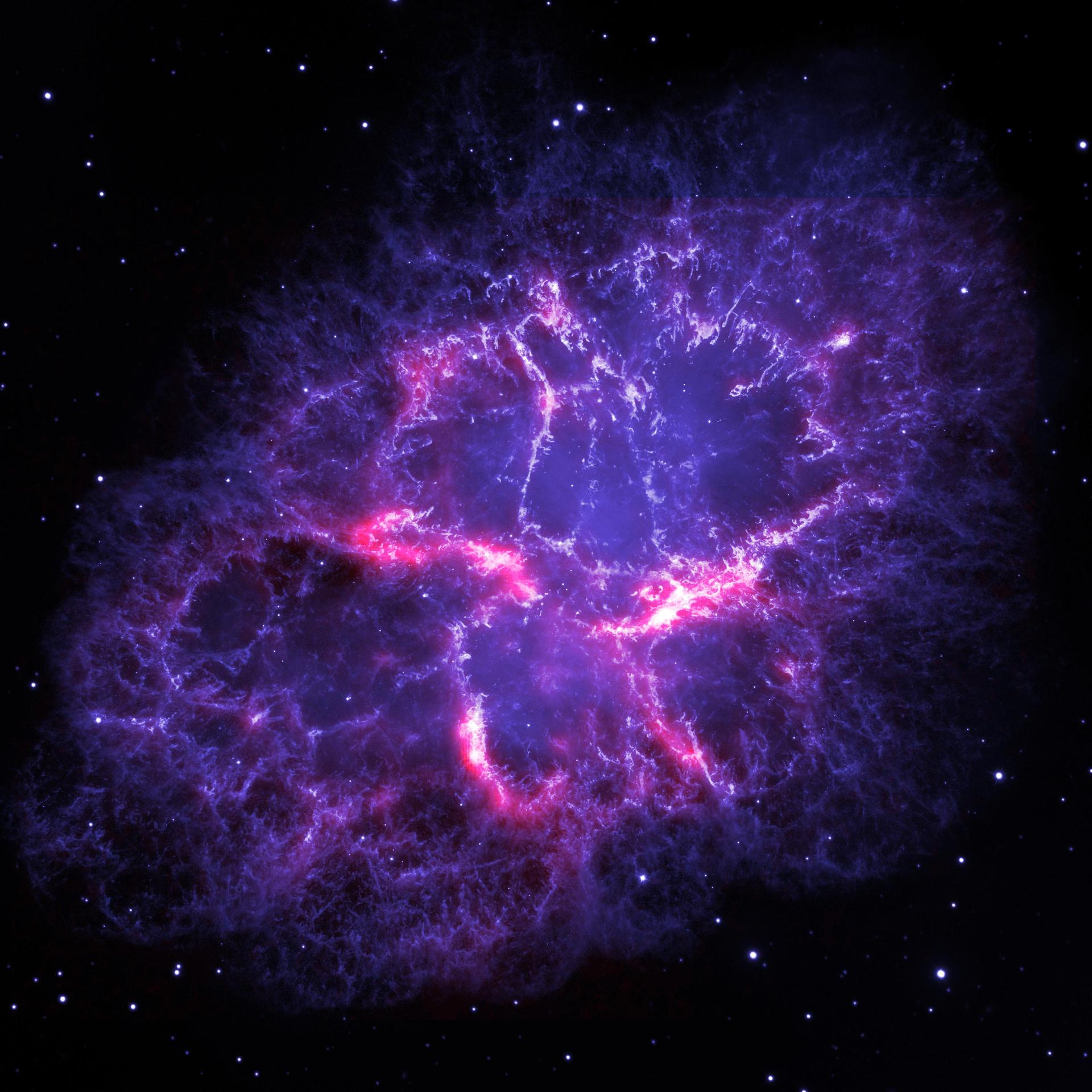
Crab Nebula (M1), supernova remnant · ESA/Herschel/PACS; NASA, ESA & A. Loll/J. Hester (Arizona State Univ.) · NASA Image Library ↗
In the meantime readers may refer to the listing www.energyscience.co.uk/books.htm on the author’s related web site.
Just in case, at this stage, you are asking yourself why, if what I am offering by my theory is so wonderful, the physics community has not responded in an enthusiastic way, I ought to offer you an explanation. It is because I did not sit in one of those academic compartments occupied by theoretical physicists who enjoy the benefit of state funding allocated to coordinated research within such compartmented peer groups.
There is a strong reaction aimed at repelling all who try to intrude into the private territory claimed by such groups. The weapons used are silent but effective. One’s original ideas are simply rejected under the cloak of referee anonymity or, if they do somehow penetrate into printed form in journals which are not deemed to be ‘mainstream’ they are just ignored. Indeed, papers in many non-mainstream journals are excluded from inclusion in the abstracted science literature and so avoid citation record: they are lost forever! There is one other weapon that is brandished in those rare instances where the intruder does penetrate the barriers, as by getting a point across in a Letter to the Editor which refers to the writings of those who have found favour. It is the weapon of public scorn and ridicule. Do you wish me to quote an example to support that assertion? Well, yes, I will even give you an example pertaining to that anomalous magnetic moment of the electron, my non-QED derivation of the g/2 factor.
I had drawn attention to this in a Letter to the Editor as published in American Journal of Physics, v. 54, p. 1064 (1986) and, some few months later, I found the following Letter to the Editor had appeared in July 1987 in volume 55 at pp. 584-585.
“PI IN THE SKY
H. Aspden’s [1] amusing “unbelievable” formula for g/2 reminds me of Ramanujan’s remarkable number:(2143/22)1/4 = 3.14159265258..(to be compared with π = 3.14159265358..)
The agreement with π is to 300 parts in a trillion, a factor 10 less spectacular than Aspden’s agreement with QED, but, like his, still well within the error of even the most careful measurements of the circumference and diameter of the very finest physical circles. Should one hope that a future theory will confirm that π is indeed equal to (2143/22)1/4 thereby freeing us from the need to compute higher and higher order terms in any of the many tedious series mathematicians have had to resort to in these unenlightened times? Ramanujan’s approximation to π offers a rather more transparent example of an unbelievable formula against which to assess the validity of one’s amazement at Aspden’s. Speaking for myself, I’m a little surprised. But not at all astonished.
[1] .. H. Aspden, Am. J. Phys. v. 54, p. 1064 (1987).
Aspden says there is a theoretical model behind his formula, but he invites the reader to consider the result in and of itself, ‘without further elaboration’ and it is in that spirit that I offer this reaction.”N. David Mermin
Department of Physics
Cornell University
Ithaca, NY 14853-2501
Now, it may be that David Mermin was simply seeking to amuse the many physicists in USA who would read this contribution. I had said, in effect: “Look, you are all told that QED gives wonderful quantitative results which can explain the anomalous properties of the electron with such remarkable precision that it convinces you to accept QED principle, but here is a very simple formula that serves the same purpose just as well and which is very simple and has an equally simple supportable physical basis.”
In the event, David Mermin had implied that I was merely ‘playing with numbers’, but he had seemingly not taken account of the fact that I had presented a formula which gave the same result as QED whatever the ultimate value of the fine-structure constant α. I gave a specific case, showing that the formula was the same as the QED result, even if α-1 were 200 rather than a little above 137. I hinted that I might have discovered by my wave-resonance derivation something bearing upon the identity or wave-particle duality that had come from the introduction of quantum theory into electromagnetic energy transfer processes.
I still do not see how this has any connection with the subject of Ramanujan’s formula for π, nor, I presume, had Ramanujan derived his formula from a genuine study of the geometric characteristics of a circle.
However, I cannot just point my finger at David Mermin and say that his ‘ridicule’ has destroyed interest in my own scientific proposition, because, since that formula of mine was published not one single enquiry has been addressed to me asking how I deduced the formula. David Mermin himself could have written to ask if, in fact, he really had doubts and was at all interested.
So you must draw your own conclusions. Do those, including perhaps your goodselves, who read about physics generally, really care enough to ask questions to find answers to doubts about what is being told, or are they (and you) merely living a passive role expecting others to select, inform and amuse?
Evidently, the world of physics does not conduct itself in the way those who feed it with public funding have a right to expect. It is a world which, so far as I can see, bestows its favours amongst its own members with no tolerance of any would-be intruder whose only motivation is to interest that community in something discovered outside its closed ranks.
If you, the reader, think I am merely exploiting one isolated example in referring to David Mermin, then do refer to pages 160 to 164 of B. W. Petley’s 1985 book ‘The Fundamental Physical Constants and the Frontier of Measurement’, as published in U.K. by Adam Hilger, the publishing house of the Institute of Physics.
He explains how “it is not too difficult to synthesize an eight digit decimal number by combinations of the integers 2, 3 and 5 with π” and he quotes a Physics Today article in 1971 by Roskies and Prosen and one in 1971 by Robertson in Physical Review Letters on the same point. The gist of this quotation concerned the efforts of record aimed at deriving theoretical values for that constant α-1 and also β, here used as the proton-electron mass ratio.
In the paragraph of Petley’s book just preceding those comments, Petley made the following statement:
“No doubt the theoretical attempts to calculate the value of α and β will continue – possibly with a Nobel prize winning success. Aspden and Eagles (1972) obtained:
α-1 = 108π(8/1843)1/6 “
This was a very curious observation, seemingly ambiguous in its context, given that the following paragraph harped back to the ‘numbers game’ of those who waste time trying to discredit genuine theoretical effort.
In Table 5.3 on page 161 of his book Petley had listed 6 theoretical expressions for α-1, dating from 1914 to 1972, including one by Eddington in 1930 giving 137 exactly. The sixth entry in the list was 137.035915, which was this author’s value. A seventh entry dated 1973 was the then measured value, stated as 137.03604(11). A separate listing gave three entries for β, the proton-mass ratio, dating from 1951 to 1969, but, sadly, it seems that Petley had not seen this author’s derivation [3] of the proton-electron mass ratio which was published in a mainstream physics periodical in 1975, as otherwise he would no doubt have included that also in his tabulation. That theoretical derivation of β was in full accord with the measured value, even though the latter was known to part per million precision and it was based on the same theoretical principles as applied to α-1. I may add here that, as you read through the fourteen papers which follow these remarks, you will be shown how these precise theoretical values for α-1 and β are derived.
Here, I mention further that Brian Petley was writing on the subject on which he was an expert, being a scientist with the National Physical Laboratory in England. I further note that my coauthor on the 1972 paper about the derivation of α-1 and also on the 1975 derivation of β was employed by the Australian CSIRO at their National Measurement Laboratory and, indeed, these two papers [2, 3] had been submitted for publication with the supporting approval of the Director of that Australian government laboratory.
So, I trust I will not be judged as being a little unreasonable in suggesting that all is not well in our scientific world. Certainly, there is no room for the free-thinking person who has ideas that differ from those prevailing within an institutional research project.
I hope that what has been outlined so far will serve as a good introduction to the more formal collection of published papers which follow. This introductory commentary has been given the title ‘The Creative Vacuum’, because that is what it concerns, the medium in which you, the reader, exist and came to exist as a consequence of Creation. I did not, in the spirit of David Mermin, name this work ‘Pi in the Sky’, because this is a serious endeavour, not intended to amuse or to mislead, but merely aimed at disclosing some simple solutions to a few of Nature’s scientific riddles.
These papers, as now reproduced in Part 2, are identically those as presented several years ago. They could be improved by reworking and inevitably there will be the few points that need further clarification and possibly some correction. With that in mind I will await events and see if publication of this work entices comments from readers. Hopefully, in a second edition version, if there is one, I can provide supplementary notes on such points.
One such note, directed to an important paper I have referenced but not included in the fourteen appended is needed here in connection with reference [42]. This is the paper, already mentioned, in which I derive the Hubble constant. In that paper I quoted incorrectly the value of the Thomson scattering cross-section of the electron and used that incorrect value to deduce the Hubble constant H. I find upon correction that H-1 would be 3,600 million years if I rely on the standard formula for the Thomson scattering cross-section. Referring to Fig. 1 of this text (page 51) and using the electron radius a of the Thomson electron as defining the obstructing cross-section, the value 21,600 million years would apply. However, if the intermediate field cavity radius shown in that figure is effective the obstructing area is enhanced threefold, making the Hubble time period 7,200 million years.
Cosmology today is confused as to the age of the universe based on the notion of an expanding universe. As the conflicting evidence points more and more to a non-expanding steady-state universe the theoretical approach I offer for the cosmological redshift should begin to command the attention of theoreticians, especially those who are inclined to be constructive in their criticism. I find, however, that critics usually prefer to be destructive, no doubt because that is a safer course when confronted with something potentially controversial.
It was in 1969 that I published my book ‘Physics without Einstein’. One reader wrote to say it was ‘too mathematical’, even though its formulations were quite simple. Influenced by that, I produced a book ‘Modern Aether Science’ in 1972, without including any mathematics. A reviewer, someone who had just authored his own book claiming that the universe expands and contracts in cycles, seized upon that non-mathematical aspect and declared that I, the author, was evidently lacking in mathematical skill! No doubt, the title of the book did not help. It seemed to classify it as something archaic and it was not shelved amongst physics books in some bookshops I visited. It did not sell, but yet its message is even more apt now than it was those 24 years ago. Its book jacket indicated that a further mathematical treatment would follow under the title ‘Aether Science Papers’, but I received no enquiries for that follow-on work and so exercised prudence and patiently struggled to get the occasional paper published in the science periodicals. This, I mention, only because I am now redeeming my ‘promise’ in naming this book ‘Aether Science Papers’. As will be seen, the papers which follow are mathematical.
I ought here to mention again the book ‘Physics Unified’ which I authored and published in 1980 to get my research to that date on record in a consolidated form. That book gives the formal ‘teaching’ background which introduces my theory. The fourteen selected papers which follow form a core but are supplemented by many earlier papers of record in the science literature, such as the 1972 paper about α-1 and the 1975 paper about β. It may, incidentally, come to be noticed from scanning though the titles of those papers, as listed separately on pp. 63-67, that I have shown how to calculate the lifetime of various particles but that the muon lifetime is not mentioned in the titles. The reason is that the muon mean lifetime was derived and published in Physics Unified using my theory and so I did not solicit its separate publication as a paper.
I cannot, therefore, resist the temptation to tell you that the ‘remarkable success’ of QED does not seem to extend to calculating the muon lifetime. The Bailin and Love book, which I mentioned on page 48, included a chapter on ‘Feynman Rules for Electroweak Theory’. In that chapter, under a subheading of ‘Test of Electroweak Theory’, it gave the not-impressive prediction of the mean lifetime of the muon as 2.90+/-2.61 microseconds. It compared this ‘test value’, as albeit subject to that overwhelming uncertainty, with the measured value of 2.197138+/-0.000065 microseconds. The theoretical value I derive on p. 146 of ‘Physics Unified’, using the same aether theory that gave α-1 and β, is 2.1973 microseconds, so I do not see the Feynman methods as being so wonderful.
If you, the reader, have been at all impressed by my very simple precise derivation of the anomalous magnetic moment of the electron without use of Feynman diagrams, then you will not be disappointed by what follows. If you remain unimpressed then the rest of this work will not prove of interest and I will not have succeeded in winning you over, but I have done my best and if you can do better in solving the physical riddles of Nature then may you have more success in your own efforts to get your findings accepted!
If you feel that the ‘aether’ is not something one should take seriously and prefer to read about ‘electroweak theory’ then, to ease your thoughts as you begin to read the first of the selected fourteen papers, I quote from the opening three paragraphs of my 1983 paper entitled ‘Planar Boundaries of the Space-Time Lattice’ [34].
‘Modern physical theory is tending to regard the vacuum medium as having structure somewhat analogous to that of crystalline materials. Thus we see WEISSKOPF [1] discussing quantum electroweak dynamics and asserting that the Higgs field implies that the vacuum has a certain fixed direction in isospace, namely that of the spinor associated with the Higgs field. WEISSKOPF states that the situation is like that of a ferromagnet, in which the direction in real space is determined as long as the energy transfers are smaller than the Curie energy.
This, of course, implies an ordered structure of the vacuum medium, a feature discussed at some length by REBBI [2] in an article entitled ‘The lattice theory of quark confinement’. REBBI refers to a 1974 proposal by WILSON that QCD (Quantum Chromodynamics) should be formulated on a cubic lattice, an array that divides space and time into discrete points, but is essentially an approximation to real space-time. The advantage is that this allows calculations to be made that would otherwise be impossible.
This author, in collaboration with Dr. D. M. Eagles [3], has advocated the analysis of a vacuum structure and shown how a value of the fine-structure constant correct to about one part in a million can be determined by a cubic lattice model of the vacuum. Further research on this model has now shown the essential need for a particular boundary condition imposed upon a physical portrayal of the vacuum state expressed in terms of electrical charge. It is in view of the current interest in lattice theory as applied to the vacuum field system that it seems appropriate to draw attention to what has been, to the author at least, a rather elusive consideration.
[1] V. C. WEISSKOPF: Physics Today, v. 34-11, p.69 (1981)
[2] C. REBBI: Scientific American, v.248, p.36 (1983)
[3] H. ASPDEN and D. M. EAGLES: Physics Letters A, v. 41, p.423 (1972).”
This paper went on to explain why the storage of electric field energy in the vacuum (the aether) demands the presence of planar lattice boundaries, which implies a domain structure in space somewhat analogous to that found in ferromagnetic materials. The paper was written in 1983, a few weeks after I retired from my executive position with a multinational corporation to engage in a private research venture as a Visiting Senior Research Fellow at my local university. Some 29 years earlier I had parted from my Ph.D. research on magnetism at Trinity College, Cambridge to take up a career in industry, but it was that academic research background concerning ferromagnetism and its domain structure that led me to conceive the need for an aether that was similarly structured.
The chronological development of the papers, as reproduced and as listed in the following pages, reflects that circumstance by which I spent those 29 years away from the academic world, whilst still developing a scientific theory of such wide scope. It may also explain why this effort has proved such a struggle, but, then again, it might further explain why there has been such fruitful progress, because there were no peer-constraints affecting project funding and suppressing originality.
The time has, however, come when, some 13 years on from retirement from the business world, this consolidated presentation of my theory is warranted.
In the analysis of the properties of the aether in Part I and Part IV of this book we have
seen that the aether has a mass density but has the curious property of interacting
gravitationally with matter in such a way that it exerts no gravitational force on that matter.
Its interaction with matter is betrayed by its related gravitational potential, a deficit energy
quantity distributed in the aether itself that manifests itself by a thermal vibration, the
energy shed becoming a kinetic energy state of the space medium itself. This, as we have
seen in Part IV accounts for a cosmic background temperature of some 2.7 K in the vicinity
of Earth.
A question also of primary interest is how matter, in moving through the aether, is affected
in an inertial sense by the presence of the aether. Here, as shown in Part III of this book, we
find that matter can drag aether structure so that one might expect its inertia to be affected.
The lattice-like array of nucleons in the atomic nuclei of atoms other than hydrogen has a
form corresponding with the configuration of charge elements forming the cubic structure
of the aether itself. This fact means that such atoms, in their collective motion as part of
material body, will progressively entrain crystalline forms of aether structure that are
carried along with the body. Provided that body is not accelerated or is accelerated only
very slowly, the extent of that aether structure adhering to the atoms will grow, so adding
to the body’s inertia. Eventually, the whole of the local aether lattice coextensive with the
body will share that motion.
However, as we have seen in Part II, there is dependence upon whether the body is moving
linearly or is itself rotating about an axis of spin. For linear motion the transport of aether
lattice is offset by a high speed counter-flow of aether particles through the lattice and this
means that there is no net change of linear momentum that can affect the inertia of the
material body. For rotation, that counter-flow would serve no purpose as there is no build-up of aether particles at collision boundaries. Therefore, one can see the case here for
saying that the body may acquire extra inertia governing its state of spin.
It should then be possible to detect this in the laboratory as a kind of inertial hysteresis
effect when rotors spin up to speed and then slow down but so far as this author is aware
no clear evidence of this is as yet available. Even so it is interesting to draw attention to
some laboratory evidence in this regard and I will here add reference to that in due course.
Note that a sudden change in the speed of a rotor will result in the aether lattice
coextensive with the physical size of an atomic nucleus breaking free from enveloping
aether lattice and itself rotating with the body through the enveloping aether that is left
spinning independently pending its slow down to release heat.
In extreme cases, such as body Earth, the steady rate of Earth rotation has resulted in the
aether lattice coextensive with Earth rotating with the same speed and about the same axis
as Earth, such aether spin extending to the heights of the ionosphere, even though air
molecules at those heights move through the aether at different speeds with very little
aether dragged along by their atomic nuclei.
This scenario is verified by analysis from which we deduce how the combined angular
momentum of aether spin and Earth spin was deployed when the Earth shed its satellite, the
Moon. A full account of this was presented in Chapter 8 of my book Physics Unified,
where it was shown that the dynamics of the Earth-Moon system implied that aether in spin
has a mass density of 248 gm/cc, whereas the Sun-planet system implied a similar such a
mass density of 257 gm/cc. The more rigorous fundamental analysis of the spin properties
of the aether indicated an actual mass density of 288 gm/cc and, with this in mind, we are
here now extending our concern to that 400 km diameter rotating body of sea water that
has been seen in the Pacific.
Regardless of the reason by which that large ocean whirlpool was initiated, the fact that it
has sustained its rotation for several months does suggest that the entrained aether spin has
been fully developed within that volume of water. Now, from the physics of aether spin,
we know that the setting up of an electric field radial from the spin axis will promote
electric displacement of the aether charge system by which energy is stored. This is a
displacement of aether charges which are forced to maintain synchronism with the universal
jitter of the quantum underworld and this action brings in from the enveloping aether an
equal amount of kinetic energy used to power that aether in spin.
Given this state of spin, the point of interest is that, if that radial electric field subsides to
shed its energy, the kinetic energy of that state of spin (the ocean whirlpool) will also be
shed in equal measure. Consider then the following scenario, assuming for the moment that
you can vary in a cyclical manner a magnetic field directed parallel with that spin axis. As
the magnetic field increases, so the whirlpool acts as an electrically conductive rotor, water
being electrically conductive owing to its salt content. By Faraday induction this sets up
that radial electric field drawing the necessary energy from the whirlpool motion. There is
an inflow of an equal amount of aether energy which is deployed into aether spin, thereby
augmenting the whirlpool energy of the combined ocean-aether system. Then, as the
magnetic field decreases, that electric field energy is shed by a kind of motor action which
feeds back into the whirlpool to sustain its rotation. Inevitably, however, and especially as
the cycle of magnetic field change is repeated, there will be a steady inflow of excess aether
energy which has to be dissipated in some way, obviously in generating heat.
We then have two questions to consider. Can we point to some action which might
account for the presence of a cyclically varying electric or magnetic field? Can we show
that the theory just present delivers numerical data which fits with what has been observed
in that Pacific ocean whirlpool?
As to the first question, one needs to understand that the process by which aether spin
induces electric charge displacement and vice versa is a function of the angle between the
space vector which defines the orientation of the axes about which the aether’s quantum
jitter motion defines its spin property.
It is important to keep in mind that there is a common spin vector direction shared by the
motion of all the aether particles within a space domain and, so far as our local space
domain is concerned, this vector is orientated parallel with the spin axis of the sun, that is at
right angles to the ecliptic, the sun’s apparent orbit. Earth spins about an axis that is
inclined at 23.5o to that spin vector, which is why we have our seasonal variations as Earth
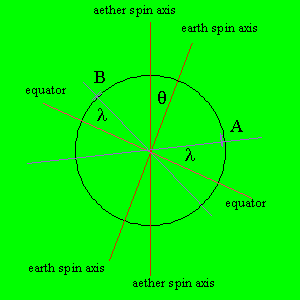
progresses in its annual orbit around the sun. This is depicted in Fig. A1 below, where that
spin vector direction is denoted as the ‘aether spin axis’, and the Earth spin axis is shown
inclined at an angle θ to that axis, this being the angle 23.5o.

Note then that we are considering the effects of a large 400 km diameter whirlpool in the
Pacific ocean 100 km south of Okinawa, that is at a latitude of 26o, which is the angle λ.
Therefore, depending on the time of day, that whirlpool will have itself a spin axis which
changes direction relative to the aether spin axis. It will range from the extreme depicted as
position A to the opposite extreme depicted as position B. As can then be seen from the
figure, the angle between the two vectors will vary between 90o minus λ plus θ and 90o minus θ minus λ. That is between 87.5o and 40.5o.
Note then that the rotation of aether entrained with the whirlpool
means that the aether lattice system is spinning at the steady angular speed of the whirlpool
and so the aether charges that form its lattice structure are subjected to a synchronizing
effect by which they are displaced very slightly radially with respect to the whirlpool spin
axis. However, this displacement is proportional to the cosine of the angle between that
spin axis and the aether spin axis, which means that the energy attributable to the induced
electric field displacement varies in proportion to the square of that cosine. This implies a
variation over a range of 0.00190 and 0.578. In turn, this means that much more than a half of the amount of electric energy stored at the maxima of that displacement condition plus a proportion of an equal amount of kinetic energy will be shed as heat from the aether every day owing to the process we are here discussing.
As to the second question, this is easily answered. Whatever the kinetic energy of the spin
of the whirlpool, the kinetic energy of the coextensive aether spin will be greater by the factor aether mass density divided by the mass density of sea water, that is nearly 300. This latter energy is energy supplied by the aether itself, this being sustained, so long as that whirlpool continues to spin, because the geomagnetic field is effective as a steady influence acting to maintain the related electric displacement. It is the aether kinetic energy of that whirlpool that is the source of the energy increase in the fluctuations in the electric displacement energy, and much of this energy is no doubt shed as heat in the decrease periods. This means that the likely amount of energy shed as heat per day will be 300 times the kinetic energy of that ocean whirlpool.
It was reported that scientists had been observing the phenomenon over a period of 7 months
so one must assume it formed some months earlier. The anomalous heat energy generated
over a period of 9-10 months, say, will, owing to the daily cycle, be nearly 300 times the
anomalous heat produced by one cycle of electric field change and the latter will be some
300 times the kinetic energy of the whirlpool. The latter is reported to have a speed of
0.180 km/h or 50 cm/s. If we estimate this as equivalent to 1,250 ergs of kinetic energy per
gm of water, the total heat energy produced in that 6 month period in the depths of that
large ocean whirlpool will be 300 x 300 x 1,250 ergs per gm of water (11.25 joules or 2.7
calories). This is enough to raise the water temperature by 2-3 degrees, the value reported as being observed.
Now, of course, this discussion of that mystery heating phenomenon in the Pacific Ocean
may seem rather bewildering, given the meagre information we have available, but do keep
in mind that I am in this book trying to relate the forces of creation, which apply to the
universe as a whole and our sun and Earth in particular, with fundamental particle creation
phenomena of the quantum underworld. Intermediate in scale between these extremes we
humans sit wondering whether we will one day be enlightened as to how we can ourselves
contrive to harness those forces of creation in our laboratories in the hope of satisfy our
future energy needs. To be shown, in effect, by Mother Nature herself something that
reveals heat creation as a staged demonstration in the sea of the Pacific Ocean, the source
of that heat being a mystery if it is not shed by the aether, is, to say the least, a wonderful
revelation. It is something we must not ignore and all I can say is that it has inspired me
and been a great encouragement in writing this book.
In summary, one must assume from this that the Pacific Ocean whirlpool heating anomaly is
a phenomenon which demonstrates that the aether can be a source of energy and the theory
just outlined can serve as a guide should we seek to exploit that resource to meet our
future energy needs. Of course, one would expect to discover more practical ways than
ocean heating, as I will outline when I come to write Part VI of this book. However, in the
meantime, given this topical, August 2001, review of what is a newly discovered
phenomenon, I can but convey this message of hope in my efforts to interest the reader in
my aether theory.
H. Aspden
16 August 2001.
The titles in the following listing are all currently available. They have all been published privately by Sabberton Publications, which Dr. Aspden set up in 1966 for the purpose of disseminating information concerning his research interests. Information concerning ordering procedure is provided below. It applies only if payment is made by bank checks drawn on a U.K. bank or a U.S. bank, or if payment is by International Money Order or Eurocheque in English pounds denomination. If payment is to be by credit card you should place your order through your local book store, quoting the ISBN number. Alternatively you may wish to use an on-line book ordering facility such as is provided by accessing www.waterstones.co.uk or www.bookpages.co.uk and entering the name of the author: Harold Aspden, or the relevant ISBN No. as your search query. Note that the prices quoted are in British pounds.
It is expressly noted that the object of these Web pages is not that of running a business to sell books as a profit venture. The object is to promote the new energy science involved and to secure recognition for Dr. Aspden’s research efforts. Some review information is of record elsewhere on this Web site. See Reviews.
ISBN 0 85056 0152 Paperback 30 cm x 21 cm. pp.168. Price $25 (surface mail) or $33 (airmail) or £15 for U.K. delivery. First published July, 1996.
In spite of its title, in the context of its academic significance, this book is of primary importance. Two-thirds of its pages comprise copies of 14 published papers which have appeared in scientific periodicals that are not readily available in many university libraries. This accounts for the large page format. Those papers provide self-contained treatments of the physics involved, for example, in understanding how to calculate G, the constant of gravitation, and the proton-electron mass ratio. Any university library that does not stock this book and any professor of theoretical physics who is unaware of its content is at a disadvantage as what is disclosed in these Web pages becomes better known.
The caption under the title of this work reads: “An insight into the creative vacuum and its hidden source of power, the scientific foundation for 21st Century energy technology.”
ISBN 0 85056 0039 Hardback 22 cm x 14 cm. pp.165. Price $25 (surface mail) or $30 (airmail) or £15 for U.K. delivery. ISBN 0 85056 0047 Paperback 22 cm x 14 cm. pp.165. Price $15 (surface mail) or $18 (airmail) or £10 for U.K. delivery. First published in 1972.
This book is deliberately non-mathematical. It was written to complement the authors earlier mathematical treatment as presented in ‘Physics without Einstein’, published in 1969 as SBN 85056 0012, now out of print. As stated on its back cover: “‘Modern Aether Science’ is an attack on those abstract philosophical dogma which are impeding the development of physics. Also the author records progress made in expanding the physics of the earlier book, particularly on the formation of the solar system, the stability and structure of the atomic nucleus, and the periodic reversals of the earth’s magnetism. It is shown that the aether has to be revived for complete understanding of physical science.” At the time this book was written, though it did explain how energy stored by the aether as a magnetic inductance phenomenon, and recovered, it did not venture into speculation about tapping aether energy for technological benefit, a possibility that was recognized only later.
ISBN 0 85056 0098 Hardback 22 cm x 14 cm. pp. 206. Price $25 (surface mail) or $30 (airmail) or £15 for U.K. delivery. ISBN 0 85056 0101. First published in 1980.
Title caption reads: “An account of the physics of microcosmic and cosmic phenomena incorporating the long-sought link between electromagnetism and Einstein’s law of gravitation.” This book was published at about the time the U.K. Institute of Physics published the author’s paper showing how Einstein’s law of gravitation could be derived without recourse to General Relativity Theory, simply by following Leon Brillouin’s suggestion of analysing how energy is deployed in the field medium intervening the interacting bodies.
The above $ prices are in U.S. dollars. Cheques drawn on a U.K. bank account to be made payable to ‘Sabberton Publications’. U.S. dollar checks drawn on U.S. bank account to be made payable to ‘Harold Aspden’. International Money Orders should be in U.K. pounds if made payable to ‘Sabberton Publications’. In Europe, Eurocheques are acceptable if written in U.K. currency (GBP) and made payable to ‘Sabberton Publications’. Use the E-Mail address haspden@iee.org for enquiries.
Mailing address for orders: SABBERTON PUBLICATIONS, P.O. Box 35, Southampton, SO16 7RB, England. Fax.: Int+44-1703-769-830.
Payment by VISA or MASTERCARD cannot be accepted but that possibility can be explored by accessing www.bookpages.co.uk and entering the name of the author: Harold Aspden, or the relevant ISBN No. as your search query.
These are research reports of a specialist nature which may be of interest to those active in probing the new energy physics discussed in the above books. Each is priced at £15 for delivery in U.K. or $25 for airmail delivery overseas.
This is a 41 pp. report by which the author introduces experimental evidence that offers promise in the quest to discover new ways by which to regenerate spent energy. It is shown how one can verify that there is more energy set up by a magnetic field traversing a pole gap than is supplied to the magnetizing winding. This implies that the quantum activity sustaining action in a ferromagnetic core can tap energy from the the thermodynamic state of the aether. There is an analogous way in which magnetism can be used, not to tap energy from the aether, but as a catalyst which converts heat in the body of the test apparatus into useful electrical form. This is a thermoelectric effect which seemingly defies the second law of thermodynamics and gives basis for the second experiment described. This report provides background for onward more specific reporting on the author’s experimental efforts in this series of Energy Science Reports. This Report No. 1 concerns the research status as at February 1994.
This is a 70 pp. report. It is is a documentary account relating to the Strachan-Aspden invention. This is a thermoelectric device of very unorthodox construction, mainly comprising a parallel plate capacitor assembled from a polymer dielectric film coated with very thin bimetallic layers of nickel and aluminium. Heat is applied so as to flow through those thin metal coatings in a direction transverse to the electrical oscillations set up in the capacitor. Without any input of electrical power the application of a temperature differential of only 20 degrees can promote oscillations which generate electricity which runs a small motor. A small cube of ice melting on one heat surface is sufficient to power the motor. The device operates in reverse, with input of electricity producing oscillations which can rapidly freeze water. The efficiency is so high that extensive research is warranted to understand fully the physics involved. However, although each device built functioned well for many successive demonstrations to potential sponsors, there was eventually a mysterious deterioration in performance with repeated testing. Strachan could not resolve this problem and the initial sponsorship support was withdrawn. In the event, this author (Aspden) has persevered and now believes that the deterioration is easily remedied. This Part I report is a full account of the research, including test data, to the time when the project was abandoned in 1994. Energy Science Report No. 3 is the Part II document which now (1997) discloses the cause of the deterioration and provides an update on the patent position. The remedy, however, is very simple and revival of the development activity is now justified in view of the potential importance of the subject invention to the refrigeration field as well as the efficient generation of electricity from low grade sources of heat. By this disclosure it is sought to encourage research on this project and the patents (there are three granted U.S. patents) are available for outright acquisition. This Report No. 2 was published on March 31st 1997.
This is a 39 page report. The subject of the report has already been introduced in describing the scope of Report No. 2. Neither Report No. 2 nor Report No. 3 is intended for general readers interested in Energy Science. Both reports are specifically intended as technical briefings for those expert in thermoelectrics and actively interested in new product development. The reports are aimed at encouraging R&D on a project which needs follow-through development, preferably by a corporate laboratory. Neither of the original inventors can take the invention further except by cooperation with others who assert their own initiatives. The first 16 pages of this Report No. 3 comprise a 1997 update suggesting the way forward for R&D. Pages 17-39 are simply research notes dating from the period 1994, outlining the research in prospect at that time. The 1994 status of the main project, as specifically related to the patented devices built by Scott Strachan, is essentially the subject of Report No. 2 . Such material as dates from 1994, though disclosed in confidence to sponsoring interests, is now made available in these 1997 publications of Reports Nos 2 and 3. Publication date March 31st 1997.
This is a 38 pp. report. There are many unanswered questions concerning possible experiments involving magnets as a means for adding power to an electric motor. Frank Potter had struggled to find someone of academic standing who could prove to his satisfaction that what he had in mind would not work. Contrary to orthodox opinion this author supported the Potter case. This report is a preliminary feasibility study based on theoretical analysis of the magnetic actions involved. Much of what is described in this text has bearing upon the experimental findings which are to be reported in later Energy Science Reports, notably in Report No. 7 and Report No. 9.
This is a 60 pp. report in which the author discusses the physics that bear upon the anomalous heat generation in electrolytic apparatus where heavy water is the electrolyte. Owing to the absence of neutrons as a product of a cold fusion reaction scientists have not been willing to accept that nuclear fusion can be involved. This report takes up that issue from a fundamental theoretical point of view by showing how Nature determines an equilibrium state of abundance as between the proton and deuteron composition of water. The conclusion is that the natural abundance ratio of the isotopic composition of hydrogen in water is physically determined by an ongoing transmutation activity. Cold nuclear fusion is therefore occurring continuously. Research students interested in nuclear physics should take note of what is presented in this report. It is of fundamental importance and contains material not disclosed elsewhere.
This is a 34 pp. report. Its purpose is to show that the true nature of inertia arises from a conservative energy property of each element of electric charge as it responds to the accelerating effects of other charge. Attention is drawn to a fundamental error in the conventional derivation of the Larmor formula for energy radiation, which fails to give proper account of interaction with the accelerating field. The report reproduces three of the author’s published papers, bringing together in this short monograph a summary analysis which explains the force of gravity and Nature’s way of creating the proton. This report is for the student of physics who seeks to understand inertia and to know what determines the actual values of the proton-electron mass ratio and G, the constant of gravitation.
This is a 37 pp. report. For the general reader interested in understanding why a magnetic reluctance motor might be designed to operate with over-unity performance Report No. 9 is the one to read. This Report No. 7 is simply a slightly edited copy of a research report describing the initial progress on a motor project funded by the U.K. Department of Trade and Industry, the object being to develop a new kind of motor which aimed at higher efficiency by adopting a construction which had regenerative features. The report is in two parts. The second part is the descriptive portion of a patent covering the structure and design principles of the motor and the first part presents the test results of the machine. This Report No. 7 was issued on March 31st 1997.
This is a 33 pp. report on the author’s interpretation of how the Correa over-unity plasma discharge energy generator really works. The invention is the subject of three quite remarkable, recently granted U.S. patents owned by Dr. Paulo Correa and Alexandra Correa. It is an invention which can have a dominant effect on future energy technology. The technology involves plasma discharge tubes of unusual design connected in an unusual circuit configuration. The tubes exhibit a negative resistance characteristic which is exploited to cause the d.c. input power to sustain oscillations in a closed circuit. The output load is in a shunt circuit connected across the tube terminals through a capacitor coupling, so drawing a.c. power from the tube. This output is rectified and it is found that the output power exceeds the input power by a significant factor. The purpose of this report is to describe the operating principles as interpreted by this author and explain the nature of the hidden energy source which accounts for this over-unity operation.
This is a 34 page report in which the author reveals another way in which to tap aether energy, one which may well replace main electrical power generating installations in the years ahead. The Report is in four parts. Part I outlines the design of a large scale motor such as might become a prime mover in a power generating plant or be used to power an ocean liner. Part II concerns the design features of a small prototype motor that can be assembled in a home workshop. Part III is an academic discourse aimed at educating students and even university professors of electrical engineering on some elementary, but unfamiliar principles of magnetism. Part IV discusses further the scope for research and commercialization. It is aimed at government officials and research directors in industry, with a view to urging action to exploit this new technology. The primary thrust of this Report is to show why over-unity operation of an electric motor, meaning one that can deliver more mechanical power output than is supplied as electrical power input is really possible. A motor tested by the author is described and illustrated. This Report summarizes some of the progress made in a research project funded by the U.K. Department of Trade and Industry aimed at improving the efficiency of a magnetic reluctance motor by tapping thermal energy in a regenerative magnetocaloric process. Report No. 7 provides more details of the experiments performed in the early phases of the project. This Report No. 9 was issued on November 6th 1996.
ISBN 0 85056 011 X
This is a 57 page report in which the author discusses a mysterious aspect of Energy Science concerned with the anomalous effects which electromagnetic fields can have upon our body cells. The main theme is the health hazard posed by using electric blankets and living too close to overhead electrical power lines. An explanation is given for the curious fact that cyclotron-like resonance, which transfers energy from weak pulsating fields into the ion-populated fluids in the human body, in countries powered at 50 Hz or 60 Hz. How can the body chemistry support a resonance phenomenon at either of these frequencies? You have the answer in this Report. The human body introduces something new to electrical science, a system in which electricity is conveyed by molecular ions rather than electrons. Energy anomalies arise when currents flow through liquids and also in cold cathode discharges through rarefied gas. This has bearing upon the subject of Report No. 8. However, as Report No. 10 shows, research on our body chemistry reveals a superconductive condition and such research may help to solve some of the basic questions of fundamental physics having a bearing upon the nature of gravitation. This Report No. 10, the last in this series, was issued on March 31st 1997.
Reference is made in the accompanying Web pages to earlier publications by H. Aspden. For example, the books ‘Physics without Einstein’, the first and second editions of ‘The Theory of Gravitation’, the later (1975) book ‘Gravitation’ and items other than those published as scientific papers. A few copies of some of these remain available, as well as reprints of several of the scientific papers abstracted in these Web pages. See listing in BIBLIOGRAPHIC section. So long as copies remain available, these can be supplied at minimal cost to cover postage to those who purchase (or have purchased) one of the above-listed books or Reports. However, preliminary E-Mail enquiry to ensure availability is requested. Only some 10 or so copies of the book ‘Physics without Einstein’ are now held by the author and will only be released in special circumstances, eg. as where requested for onward donation to a University Library (price U.S. $50 or U.K. £30). Those interested in the contents of ‘Physics without Einstein’ are recommended to wait to see reference to these items in the development of these Web pages.
Having shown the power of my theory and presented (as by the tenth appended paper) what has to be a convincing account of the true nature of gravitation, I remind readers of that riddle and the challenge I introduced at the outset of this work.
It will, I am sure, become possible to build the machine that can harness the force of gravity. One might hope to see a levitating machine operating with an energy input that is minute in relation to the power demands of 20th century aerospace technology. That objective is a little beyond my own horizon, even though I remind readers of my early reference on page 28 to John Davidson’s book The Secret of the Creative Vacuum.
It is not beyond my range of view to see in prospect the possibility of so enhancing the gravitational pull on the working core of a machine that the drop in consequential energy potential releases very substantial amounts of heat energy.
This could become a way of doing the work of the Maxwell Demon, namely the effortless pumping of energy from a cold to a hot environment. That would provide us with a pollution-free new source of power.
With that in mind I offer now another clue. It was noted that uranium was amongst the four metals that were candidates for use in exploring the supergravitational activity, but neodymium and samarium were more likely to be destined to be at the heart of that future technology. However, it will give confidence to the project if we can also understand why uranium is also so very special in this gravitational context.
The reason is similar to the dual influence applicable close to the atomic number Z=61 (promethium). There was a 5th harmonic resonance by the K-shell electrons coupled to the gravitational frequency (the Compton electron frequency). Also, as explained in the fourth of the appended papers, for corresponding orbital motion there was a strong perturbation because the orbiting electron sweeps close to the aether lattice charges at radius d
2 from the atomic nucleus centred at an aether lattice site, where d is the lattice spacing.
One needs now to imagine a gravitational resonance involving the electrons in the L or higher order atomic electron shells. Note that the harmonic pulsation frequency of the electrons, as set up in the electromagnetic reference frame, is the Compton electron frequency multiplied by the factor:
Here α is the fine structure constant (approximately 1/137), n is the Bohr quantum number of the electron, ε is 1 or 2 according to whether one electron is active or two in antiphase motion are active and γ is the order of the harmonic setting up the resonant condition. The latter condition is then given by resonant tuning giving a phase-lock condition in an atom for which Z has a value close to that given by:
From this, with n=2, the least value of γ corresponding to a value of Z in the range of stable atoms is then seen to be 9, with ε equal to 2, so determining Z as 91.
Now this is a quite remarkable circumstance, because it not only determines which harmonic is governing but it also replicates the situation we see for neodymium (Z=60), promethium (Z=61) and samarium (Z=62) by a new sequence. Thorium (Z=90), protactinium (Z=91) and uranium (Z=92) constitute a special group as well, with a very rare middle element. Unlike promethium, protactinium has a finite abundance, but it is virtually non-existent, being ten parts in a billion of the abundance values of its `next of kin’ thorium and uranium!
Surely this is evidence of a supergravitational influence acting upon the two atomic elements that are at the centre of each of these dual resonant situations.
I can also add the point that had I set 85 J/gm as the threshold level for the latent heat of fusion of metals with melting points in excess of 1,000oC, there is only one metal that would then have been added to Nd, Sm, Au and U in that introductory note on page 1. That metal is the one we see next to protactinium, thorium with a latent heat of fusion of 82.8 J/gm!
The latent heat of fusion of promethium Pm (Z=61) and protactinium Pa (Z=91) were not listed in my data source as having been measured. Promethium (3.7 year half-life) is a fission product of uranium. As to protactinium, even if the wisdom of nuclear experts favours attributing its scarcity to some quirk of radioactive decay, they must surely view the natural absence of promethium as a real mystery and give serious consideration to the supergravitational proposition offered here.
Hopefully these thoughts will cause scientists to realise that the gravitational theory I have developed gives a new direction for research aimed at harnessing the link indicated between gravity and these particular atomic elements. In the meantime, and even before that research prospect of technological benefit emerges on the near horizon, I do hope that common sense will prevail and scientists will have the wisdom to turn their attentions away from Einstein’s theoretical treatment of gravitation.
Leaving the gravitional challenge to the future, I now conclude this dissertation. I believe that enough has been presented in this work to put my discoveries on record for scrutiny by future generations.
The present generation of theoretical physicists has shown an unwillingness to pay attention to my findings and so they are best left to squander their time on their own devious attempts to interpret a universe of their own imagination. I was, by that anonymous referee quoted on pp. 46-47, accused of presenting phantasy and science fiction as physics and offering no tight logical mathematical structure.
You, the reader, if you have read what I have presented in this work, must now judge whether or not my `phantasy’ world has something to offer.
Meanwhile, I now look away from the ‘physicist’ who wears his fine and invisible garments woven from a ‘relativistic web’ over his ‘superstring’ vest. I appeal instead to that portion of the scientific community that sees technology as having the more prominent role in scientific endeavour and I ask that attention be paid to the role the aether can play in supplying the pollution-free power we need in the 21st century.
As readers will understand from the dates of the papers referenced and presented, virtually all of what has been described was completed more than six years ago. I could have produced this collection of papers then, but I have deemed it more important to divert my attentions to experimental projects. I shall now concentrate on writing about ‘Energy Science’ from a practical viewpoint and describing the results of my endeavours of the past six years on that task of extracting energy from the aether.
Being academically trained and well versed in conventional disciplines of physical science it has not been easy for me to overturn in my mind the dogma that block research interest in the latter field. Nor has it been easy to solve the riddle of gravitation but we have now the solution, thanks to overturning belief in erroneous dogma. Gravitation aside, the breakthrough factor in this work has been the new fundamental principles of electrodynamics which we can already see have practical application in the latest research on the generation of a new form of electrical power.
It came as a welcome surprise to see that Dr. Paulo Correa acknowledged the relevance of my work [1,34,112] in the U.S. patents [117,118] which describe the research findings on that new power generation project and I record here my appreciation for that recognition.
Undoubtedly the way forward is to show that we can tap energy from the aether even though this does mean overturning some of the accepted doctrines in physics. ‘Aether Science Papers’ may help to ease the bewilderment of the scientific community as the new technology emerges.
H. Aspden, PhD, BSc, FIEE, FIMechE, MInstP, C.Eng, C.Phys, Wh.Sc.
May 1996
The book will have six Parts, preceded by an Introduction and followed by an Appendix section. As it develops these items may appear in these web pages as normal html documents or as PDF documents which can be read using the Adobe Acrobat Reader. The Introduction, which has the PDF format, should be read first, including, via its end link, related Appendix I.
In a physics examination paper a student of the future may one day be asked to describe briefly the difference between Einstein’s explanation of the physical cause governing the force of gravity and that offered by Aspden’s Theory. PHYSICS NOTE No. 1 provides a model answer and you can hardly be surprised to read that Aspden’s theory is superior. You should, however, be impressed by the onward discussion which shows how G, the constant of gravitation, is deduced theoretically as part of a theory which unifies gravitation and electrodynamics, a quest which eluded Einstein’s lifelong efforts.
The study of atomic spectra reveals that atoms shed energy in quanta in measure related to wave frequency by a constant known as Planck’s constant h. Physicists make precision part-per-million measurements of a dimensionless quantity, the fine-structure constant, a mere number, which combines h with e and c, the unitary charge of the electron and the speed of light in vacuo. The greatest challenge in theoretical physics has to be the task of deciphering the mystery of what is hidden from us by this number. Yet no student physics textbook offers any answer, nor suggests that the task warrants attention. PHYSICS NOTE No. 2 explains why the Aspden Theory sits on secure foundation owing to the discovery of the secret governing the value of this ‘number’.
It is a fundamental truth in physics that energy related to the mutual electrodynamic interaction of moving electrical charges can be stored somehow in the medium we refer to as a ‘vacuum’. That ‘medium’ has to be real. Einstein’s Theory of Relativity requires this action to depend upon the motion being relative to a third party, the notional ‘observer’, rather than a frame of reference determined by that ‘vacuum medium’. This medium, the aether, is simply ignored. Instead space itself (whatever that is) is said to be ‘distorted’, curved by the presence of matter, so that the dynamics of linear motion in gravity-free three-space translate into curved motion along what are termed ‘geodesics’ in Einstein’s vision of a ‘four-space’ world, thereby accounting for the action we refer to as gravity. This is surely a distortion of the truth, a mere attempt to substitute an imaginary mathematical formulation for a real something that is a sea of energy action. See PHYSICS NOTE No. 3
How was the universe created? Here we reach a stage where this book ‘The Physics of Creation’ can probe the processes by which fundamental particles of matter are actually created. The picture of creation begins with the proton, the nucleus of the hydrogen atom, as the product of a steady-state ongoing equilibrium activity of a background aether which sheds its surplus energy to create matter. That activity feeds on energy shed by matter as radiation as part of an inevitable natural decay process. PHYSICS NOTE No. 4
Here we refute the false notion that the whole universe was created at a point and at an instant of time when God suddenly released the necessary vast amount of energy in a so-called ‘Big Bang’. Our argument is simple. All that is necessary is (a) an explanation of the spectral red shift of distant galaxies based on the truth that propagating electromagnetic waves produced by atoms in distant stars involve something that keeps the propagating waves dynamically balanced, that something necessarily depleting wave energy and so reducing wave frequency, and (b) an account of how order condensed from a state of chaos as the energy of the primordial aether sea settled in a compatible minimum energy pattern conducive to the onset of the phenomenon of gravitation. PHYSICS NOTE No. 5
In this last part of ‘The Physics of Creation’ we conclude by probing, as an academic exercise in physics, evidence bearing upon the possibility of actually tapping energy from the aether, as by replicating the physical process by which , albeit on a grand scale, the sun itself was created. PHYSICS NOTE No. 6
The titles in the following listing are all currently available. They have all been published privately by Sabberton Publications, which Dr. Aspden set up in 1966 for the purpose of disseminating information concerning his research interests. Information concerning ordering procedure is provided after the introducing the reports.
*
ENERGY SCIENCE REPORTS
These are research reports of a specialist nature which may be of interest to those active in probing the new energy physics discussed in Dr. Aspden’s books. Each is priced at £15 for delivery in U.K. or $25 U.S. for airmail delivery overseas.
No. 1: POWER FROM MAGNETISM: THREE EXPERIMENTS
ISBN 0 85056 017 9This is a 41 pp. report by which the author introduces experimental evidence that offers promise in the quest to discover new ways by which to regenerate spent energy. It is shown how one can verify that there is more energy set up by a magnetic field traversing a pole gap than is supplied to the magnetizing winding. This implies that the quantum activity sustaining action in a ferromagnetic core can tap energy from the the thermodynamic state of the aether. There is an analogous way in which magnetism can be used, not to tap energy from the aether, but as a catalyst which converts heat in the body of the test apparatus into useful electrical form. This is a thermoelectric effect which seemingly defies the second law of thermodynamics and gives basis for the second experiment described. This report provides background for onward more specific reporting on the author’s experimental efforts in this series of Energy Science Reports. This Report No. 1 concerns the research status as at February 1994.
No 2: POWER FROM ICE: THERMOELECTRICS: PART I
ISBN 0 85056 023 3This is a 70 pp. report. It is is a documentary account relating to the Strachan-Aspden invention. This is a thermoelectric device of very unorthodox construction, mainly comprising a parallel plate capacitor assembled from a polymer dielectric film coated with very thin bimetallic layers of nickel and aluminium. Heat is applied so as to flow through those thin metal coatings in a direction transverse to the electrical oscillations set up in the capacitor. Without any input of electrical power the application of a temperature differential of only 20 degrees can promote oscillations which generate electricity which runs a small motor. A small cube of ice melting on one heat surface is sufficient to power the motor. The device operates in reverse, with input of electricity producing oscillations which can rapidly freeze water. The efficiency is so high that extensive research is warranted to understand fully the physics involved. However, although each device built functioned well for many successive demonstrations to potential sponsors, there was eventually a mysterious deterioration in performance with repeated testing. Strachan could not resolve this problem and the initial sponsorship support was withdrawn. In the event, this author (Aspden) has persevered and now believes that the deterioration is easily remedied. This Part I report is a full account of the research, including test data, to the time when the project was abandoned in 1994. Energy Science Report No. 3 is the Part II document which now (1997) discloses the cause of the deterioration and provides an update on the patent position. The remedy, however, is very simple and revival of the development activity is now justified in view of the potential importance of the subject invention to the refrigeration field as well as the efficient generation of electricity from low grade sources of heat. By this disclosure it is sought to encourage research on this project and the patents (there are three granted U.S. patents) are available for outright acquisition. This Report No. 2 was published on March 31st 1997.
No. 3: POWER FROM ICE: THE THERMOELECTRIC GENERATOR
ISBN 0 85056 019 5This is a 39 page report. The subject of the report has already been introduced in describing the scope of Report No. 2. Neither Report No. 2 nor Report No. 3 is intended for general readers interested in Energy Science. Both reports are specifically intended as technical briefings for those expert in thermoelectrics and actively interested in new product development. The reports are aimed at encouraging R&D on a project which needs follow-through development, preferably by a corporate laboratory. Neither of the original inventors can take the invention further except by cooperation with others who assert their own initiatives. The first 16 pages of this Report No. 3 comprise a 1997 update suggesting the way forward for R&D. Pages 17-39 are simply research notes dating from the period 1994, outlining the research in prospect at that time. The 1994 status of the main project, as specifically related to the patented devices built by Scott Strachan, is essentially the subject of Report No. 2 . Such material as dates from 1994, though disclosed in confidence to sponsoring interests, is now made available in these 1997 publications of Reports Nos 2 and 3. Publication date March 31st 1997.
No. 4: POWER FROM MAGNETISM: THE POTTER DEBATE
ISBN 0 85056 020 9This is a 38 pp. report. There are many unanswered questions concerning possible experiments involving magnets as a means for adding power to an electric motor. Frank Potter had struggled to find someone of academic standing who could prove to his satisfaction that what he had in mind would not work. Contrary to orthodox opinion this author supported the Potter case. This report is a preliminary feasibility study based on theoretical analysis of the magnetic actions involved. Much of what is described in this text has bearing upon the experimental findings which are to be reported in later Energy Science Reports, notably in Report No. 7 and Report No. 9.
No. 5: POWER FROM WATER: COLD FUSION: PART I
ISBN 0 85056 021 7This is a 60 pp. report in which the author discusses the physics that bear upon the anomalous heat generation in electrolytic apparatus where heavy water is the electrolyte. Owing to the absence of neutrons as a product of a cold fusion reaction scientists have not been willing to accept that nuclear fusion can be involved. This report takes up that issue from a fundamental theoretical point of view by showing how Nature determines an equilibrium state of abundance as between the proton and deuteron composition of water. The conclusion is that the natural abundance ratio of the isotopic composition of hydrogen in water is physically determined by an ongoing transmutation activity. Cold nuclear fusion is therefore occurring continuously. Research students interested in nuclear physics should take note of what is presented in this report. It is of fundamental importance and contains material not disclosed elsewhere.
No. 6: POWER FROM SPACE: INERTIA AND GRAVITATION
ISBN 0 85056 022 5This is a 34 pp. report. Its purpose is to show that the true nature of inertia arises from a conservative energy property of each element of electric charge as it responds to the accelerating effects of other charge. Attention is drawn to a fundamental error in the conventional derivation of the Larmor formula for energy radiation, which fails to give proper account of interaction with the accelerating field. The report reproduces three of the author’s published papers, bringing together in this short monograph a summary analysis which explains the force of gravity and Nature’s way of creating the proton. This report is for the student of physics who seeks to understand inertia and to know what determines the actual values of the proton-electron mass ratio and G, the constant of gravitation.
No. 7: POWER FROM MAGNETISM: THE TRANSVERSE RELUCTANCE MOTOR
ISBN 0 85056 018 7This is a 37 pp. report. For the general reader interested in understanding why a magnetic reluctance motor might be designed to operate with over-unity performance Report No. 9 is the one to read. This Report No. 7 is simply a slightly edited copy of a research report describing the initial progress on a motor project funded by the U.K. Department of Trade and Industry, the object being to develop a new kind of motor which aimed at higher efficiency by adopting a construction which had regenerative features. The report is in two parts. The second part is the descriptive portion of a patent covering the structure and design principles of the motor and the first part presents the test results of the machine. This Report No. 7 was issued on March 31st 1997.
No. 8: POWER FROM SPACE: THE CORREA INVENTION
ISBN 0 85056 016 0This is a 33 pp. report on the author’s interpretation of how the Correa over-unity plasma discharge energy generator really works. The invention is the subject of three quite remarkable, recently granted U.S. patents owned by Dr. Paulo Correa and Alexandra Correa. It is an invention which can have a dominant effect on future energy technology. The technology involves plasma discharge tubes of unusual design connected in an unusual circuit configuration. The tubes exhibit a negative resistance characteristic which is exploited to cause the d.c. input power to sustain oscillations in a closed circuit. The output load is in a shunt circuit connected across the tube terminals through a capacitor coupling, so drawing a.c. power from the tube. This output is rectified and it is found that the output power exceeds the input power by a significant factor. The purpose of this report is to describe the operating principles as interpreted by this author and explain the nature of the hidden energy source which accounts for this over-unity operation.
No. 9: POWER FROM MAGNETISM: OVER-UNITY MOTOR DESIGN
ISBN 0 85056 024 1This is a 34 page report in which the author reveals another way in which to tap aether energy, one which may well replace main electrical power generating installations in the years ahead. The Report is in four parts. Part I outlines the design of a large scale motor such as might become a prime mover in a power generating plant or be used to power an ocean liner. Part II concerns the design features of a small prototype motor that can be assembled in a home workshop. Part III is an academic discourse aimed at educating students and even university professors of electrical engineering on some elementary, but unfamiliar principles of magnetism. Part IV discusses further the scope for research and commercialization. It is aimed at government officials and research directors in industry, with a view to urging action to exploit this new technology. The primary thrust of this Report is to show why over-unity operation of an electric motor, meaning one that can deliver more mechanical power output than is supplied as electrical power input is really possible. A motor tested by the author is described and illustrated. This Report summarizes some of the progress made in a research project funded by the U.K. Department of Trade and Industry aimed at improving the efficiency of a magnetic reluctance motor by tapping thermal energy in a regenerative magnetocaloric process. Report No. 7 provides more details of the experiments performed in the early phases of the project. This Report No. 9 was issued on November 6th 1996.
No. 10: CYCLOTRON RESONANCE IN HUMAN BODY CELLS
ISBN 0 85056 011 X
This is a 57 page report in which the author discusses a mysterious aspect of Energy Science concerned with the anomalous effects which electromagnetic fields can have upon our body cells. The main theme is the health hazard posed by using electric blankets and living too close to overhead electrical power lines. An explanation is given for the curious fact that cyclotron-like resonance, which transfers energy from weak pulsating fields into the ion-populated fluids in the human body, in countries powered at 50 Hz or 60 Hz. How can the body chemistry support a resonance phenomenon at either of these frequencies? You have the answer in this Report. The human body introduces something new to electrical science, a system in which electricity is conveyed by molecular ions rather than electrons. Energy anomalies arise when currents flow through liquids and also in cold cathode discharges through rarefied gas. This has bearing upon the subject of Report No. 8. However, as Report No. 10 shows, research on our body chemistry reveals a superconductive condition and such research may help to solve some of the basic questions of fundamental physics having a bearing upon the nature of gravitation. This Report No. 10, the last in this series, was issued on March 31st 1997.
It is expressly noted that the object of these Web pages is not that of running a business to sell publications as a profit venture. The object is to promote the new energy science involved and to secure recognition for Dr. Aspden’s research efforts.
Intending purchasers in North America or elsewhere may order copies of the above Reports through their normal book store suppliers quoting the relevant ISBN number. Also, the Reports are available, though not by use of credit card facilities, directly from the U.K. publisher ‘Sabberton Publications’.
This applies only if payment is made by bank checks drawn on a U.K. bank or a U.S. bank, or if payment is by International Money Order or Eurocheque in English pounds denomination. Note that the prices quoted are in English pounds or U.S. dollars. The author Dr. Aspden can supply the Reports directly to purchasers in USA for orders accompanied by a U.S. dollar ckeck made payable to ‘Harold Aspden’. Payments in English pounds should be to ‘Sabberton Publications’.
Mailing address for orders: SABBERTON PUBLICATIONS, P.O. Box 35, Southampton, SO16 7RB, England. Enquiries: E-Mail sabberton@energyscience.co.uk. Fax. Int+44-2380-769-830.
Papers by H. Aspden
[1] … ‘The Law of Electrodynamics’, Journal of the Franklin Institute, 287, 179-183 (1969).
[2] … [Jointly with D. M. Eagles], ‘Aether Theory and the Fine Structure Constant’, Physics Letters, 41A, 423-424 (1972).
[3] … [Jointly with D. M. Eagles] ‘Calculation of the Proton Mass in a Lattice Model for the Aether’, Il Nuovo Cimento, 30A, 235-238 (1975).
[4] … ‘The Fresnel Formula applied to Empty Space’, International Journal of Theoretical Physics, 15, 263-264 (1976).
[5] … ‘Inertia of a Non-radiating Particle’, International Journal of Theoretical Physics, 15 631-633 (1976).
[6] … ‘A New Approach to the Problem of the Anomalous Magnetic Moment of the Electron’, International Journal of Theoretical Physics, 16, 401-404 (1977).
[7] … ‘Electrodynamic Anomalies in Arc Discharge Phenomena’, IEEE Transactions on Plasma Science, PS-5, 159-163 (1977).
[8] … ‘Energy Correlation Formula Applied to Psi Particles’, Speculations in Science and Technology, 1, 59-63 (1978).
[9] … ‘Crystal Symmetry and Ferromagnetism’, Speculations in Science and Technology, 1, 281-288 (1978).
[10] .. ‘G Fluctuations and Planetary Orbits’, Catastrophist Geology, 3-2, 1-2 (December 1978).
[11] .. ‘Ion Accelerators and Energy Transfer Processes’, U.K. Patent Specification No. 2,002,953A (Published 28 February 1979).
[12] .. ‘The Spatial Energy Distribution for Coulomb Interaction’, Lettere al Nuovo Cimento, 25, 456-458 (1979).
[13] .. ‘Energy Correlation of Radiative Decays of Psi(3684)’, Lettere al Nuovo Cimento, 26, 257-260 (1979).
[14] .. [Jointly with D. M. Eagles], ‘The Spatial Distribution of the Interaction Contribution to the Magnetic-Field Energy Associated with Two Moving Charges’, Acta Physica Polonica, A57, 473-482 (1980).
[15] .. ‘The Inverse-Square Law of Force and its Spatial Energy Distribution’, J. Phys. A: Math. Gen. 13, 3649-3655 (1980).
[16] .. ‘Speculations in General Plus Some of My Own’, Speculations in Science and Technology, 3, 114-116 (1980).
[17] .. ‘UFOs and the Cosmic Connection’, Energy Unlimited, 8, 37-40 (1980).
[18] .. ‘A Theory of Neutron Lifetime’, Lettere al Nuovo Cimento, 31, 383-384 (1981).
[19] .. ‘Atmospheric Electric Field Induction’, Speculations in Science and Technology, 4, 314-316 (1981).’
[20] .. ‘The Anomalous Magnetic Moment of the Electron’, Lettere al Nuovo Cimento, 32, 114-116 (1981).
[21] .. ‘Electron Form and Anomalous Energy Radiation’, Lettere al Nuovo Cimento, 33, 213-216 (1982).
[22] .. ‘A Theory of Pion Lifetime’, Lettere al Nuovo Cimento, 33, 237-239 (1982).
[23] .. ‘The Correlation of the Anomalous g-Factors of the Electron and Muon’, Lettere al Nuovo Cimento, 33, 481-484 (1982).
[24] .. ‘Mirror Reflection Effects in Light Speed Anisotropy Tests’, Speculations in Science and Technology, 5, 421-431 (1982).
[25] .. ‘Charge Induction by Thermal Radiation’, Journal of Electrostatics, 13, 71-80 (1982).
[26] .. ‘The Aether – an Assessment’, Wireless World, 88, 37-39 (October 1982).
[27] .. ‘Relativity and Rotation’, Speculations in Science and Technology, 6, 199-202 (1983).
[28] .. ‘The Lamb Shift for a Cavity-Resonant Electron’, Lettere al Nuovo Cimento, 36, 364-368 (1983).
[29] .. ‘The Thunderball – an Electrostatic Phenomenon’, Institute of Physics Conference Series No. 66: Electrostatics 1983, pp. 179-184.
[30] .. ‘The Determination of Absolute Gravitational Potential’, Lettere al Nuovo Cimento, 37, 169-172 (1983).
[31] .. ‘The Nature of the Muon’, Lettere al Nuovo Cimento, 37, 210-214 (1983).
[32] .. ‘Theoretical Resonances for Particle-Antiparticle Collisions based on the Thomson Electron Model’, 37, 307-311 (1983).
[33] .. ‘Meson Lifetime Dilation as a Test for Special Relativity’, Lettere al Nuovo Cimento, 38 206-210 (1983).
[34] .. ‘Planar Boundaries of the Space-Time Lattice’, Lettere al Nuovo Cimento, 38, 243-246 (1983).
[35] .. ‘The Mass of the Muon’, Lettere al Nuovo Cimento, 38, 342-345 (1983).
[36] .. ‘The Assessment of a Theory for the Proton-Electron Mass Ratio’, Lettere al Nuovo Cimento, 38, 423-426 (1983).
[37] .. ‘The Scope for First-Order Tests of the Light Speed Anisotropy’, Lettere al Nuovo Cimento, 38, 568572 (1983).
[38] .. ‘The Finite Lifetime of the Electron’, Speculations in Science and Technology, 7, 3-6 (1984).
[39] .. ‘Electromagnetic Reaction Paradox’, Lettere al Nuovo Cimento, 39, 247-251 (1984).
[40] .. ‘The Muon g-Factor by Cavity Resonance Theory’, Lettere al Nuovo Cimento, 39, 271-275 (1984).
[41] .. ‘Boson Creation in a Sub-Quantum Lattice’, Lettere al Nuovo Cimento, 40, 53-57 (1984).
[42] .. ‘The Steady-State Free-Electron Population of Free Space’, Lettere al Nuovo Cimento, 41, 252-256 (1984).
[43] .. ‘Don’t Forget Thomson’, Physics Today, 15 (November 1984).
[44] .. ‘The Nature of the Pion’, Speculations in Science and Technology, 8, 235-239 (1985).
[45] .. ‘The Maxwell-Fechner Hypothesis as an Alternative to Einstein’s Theory, Speculations in Science and Technology, 8, 283-289 (1985).
[46] .. ‘Unification of Gravitational and Electrodynamic Potential based on Classical Action-at-a-Distance Theory’, Lettere al Nuovo Cimento, 44, 689-693 (1985)
[47] .. ‘The Paradox of Constant Planetary Mass as Evidence of a Leptonic Lattice-Structured Vacuum State’, Lettere al Nuovo Cimento, 44, 705-709 (1985).
[48] .. ‘The Exploding Wire Phenomenon’, Physics Letters, 107A, 238-240 (1985).
[49] .. ‘A New Perspective on the Law of Electrodynamics’, Physics Letters, 111A, 22-24 (1985).
[50] .. ‘Theoretical Evaluation of the Fine Structure Constant’, Physics Letters, 110A, 113-115 (1985).
[51] .. ‘The Proton Enigma’, American Journal of Physics, 53, 938 (1985).
[52] .. ‘More on Thomson’s Particles’, Americal Journal of Physics, 53, 616 (1985).
[53] .. ‘Weak Violation – a New Concept in Relativity?’, Nature, 318, 317-318 (1985).
[54] .. ‘Earnshaw’s Theorem’, Nature, 319, 8 (1986).
[55] .. ‘Anomalous Electrodynamic Explosions in Liquids’, IEEE Transactions on Plasma Science, PS-14, 282-285 (1986).
[56] .. ‘How to Test Special Relativity’, Nature, 321, 734 (1986).
[57] .. ‘Classical Relativity’, Nature, 320, 10 (1986).
[58] .. ‘Electron Self-Field Interaction and Internal Resonance, Physics Letters, 119A, 109-111 (1986).
[59] .. ‘The Mystery of Mercury’s Perihelion’, The Toth-Maatian Review, 5, 2475-2481 (1986).
[60] .. ‘Flat Space Gravitation’, Physics Education, 21, 261-262 (1986).
[61] .. ‘Fundamental Constants derived from Two-Dimensional Harmonic Oscillations in an Electrically Structured Vacuum’, Speculations in Science and Technology, 9 315-323 (1986).
[62] .. ‘The Theoretical Nature of the Neutron and the Deuteron’, Hadronic Journal, 9, 129-136 (1986).
[63] .. ‘Meson Production based on Thomson Energy Correlation’, Hadronic Journal, 9, 137-140 (1986).
[64] .. ‘An Empirical Approach to Meson Energy Correlation’, Hadronic Journal, 9, 153-157 (1986).
[65] .. ‘The Theoretical Nature of the Photon in a Lattice Vacuum’, pp. 345-359 in the Proceedings of the NATO Advanced Research Workshop on Quantum Violations: Bridgeport, Connecticut 23-27 June 1986, published by Plenum in NATO ASI Series B: Physics vol. 162.
[66] .. ‘A Causal Theory of Neutron Diffraction’, Physics Letters 119A, 105-108 (1986).
[67] .. ‘On the Creation of the Sun’, The Toth-Maatian Review, 5, 2609-2612 (1986).
[68] .. ‘The Case for the Sub-Electron’, The Toth-Maatian Review, 5, 2827-2833 (1987).
[69] .. ‘Ampere’s Law: Comments on a Discussion by Milnes’, The Toth-Maatian Review, 6, 2981-2984 (1987).
[70] .. ‘Derivation of the Electrodynamic Force Law’, The Toth-Maatian Review, 6, 2985-2987 (1987).
[71] .. ‘The Exploding Wire Phenomenon as an Inductive Effect’, Physics Letters, 120A, 80-82 (1987).
[72] .. ‘Earthquake-Related EM Disturbances’, Quarterly Journal of the Royal Astronomical Society, 28, 535-536 (1987).
[73] .. ‘A Note on the Silvertooth Experiment’, Speculations in Science and Technology, 10, 9-12 (1987).
[74] .. ‘Earnshaw’s Theorem’, American Journal of Physics, 55, 199 (March 1987).
[75] .. ‘The Physics of the Missing Atoms: Technetium and Promethium’, Hadronic Journal, 10, 167-172 (1987).
[76] .. ‘Synchronous Lattice Electrodynamics as an Alternative to Time Dilation’, Hadronic Journal, 10, 185-192 (1987).
[77] .. ‘Steady State Electrodynamic Induction – A Feature of the General Law of Electrodynamics’, Progress in Space-Time Physics 1987, Editor J. P. Wesley, Benjamin Wesley, Blumberg, Germany, pp. 137-155 (1987).
[78] .. ‘Tests of Photon Theory in Terms of Precision Measurement’, Problems in Quantum Physics; Gdansk ’87, (Conference Proceedings), Editors L. Kostro et al., World Scientific, New Jersey, pp. 353-373 (1987).
[79] .. ‘EM Wave Interference’, American Journal of Physics, 56, 103 (February 1988).
[80] .. ‘Ghost Mass and the Unseen Energy World as Revealed by the Anomalies of the Gyroscope’, The Toth-Maatian Review, 6, 165-3171 (1987).
[81] .. ‘Instantaneous Electrodynamic Potential with Retarded Energy Transfer’, Hadronic Journal, 11, 307-313 (1988).
[82] .. ‘The Theory of the Proton Constants’, Hadronic Journal, 11, 169-176 (1988).
[83] .. ‘A Theory of Proton Creation’, Physics Essays, 1, 72-76 (1988).
[84] .. ‘Do We Really Understand Magnetism?’, Magnets, 1, 19-24 (1988).
[85] .. ‘The Vacuum as our Future Source of Energy’, Magnets, 3(8), 15-18 (1988).
[86] .. ‘A Modern Test for the Ether?’, Physics Today, 41, p. 132 (March, 1988).
[87] .. ‘The Proton Factor and its Unknown Effects’, The Toth-Maatian Review, 7, 3725-3734 (October 1988).
[88] .. ‘Anti-Gravity Electronics’, Electronics & Wireless World, 29-31 (January 1989).
[89] .. ‘Extremely Low Frequency Electromagnetic Radiation and Biological Effects’, Speculations in Science and Technology, 12, 17-20 (1989).
[90] .. ‘Conservative Hadron Interactions Exemplified by the Creation of the Kaon’, Hadronic Journal, 12, 101-108 (1989).
[91] .. ‘The Theory of the Gravitation Constant’, Physics Essays, 2, 173-179 (1989).
[92] .. ‘A Theory of Pion Creation’, Physics Essays, 2, 360-367 (1989).
[93] .. ‘The Supergraviton and its Technological Connection’, Speculations in Science and Technology, 12, 179-186 (1989).
[94] .. ‘Standing Wave Interferometry’, Physics Essays, 3, 39-45 (1990).
[95] .. ‘The Harwen Energy Radiation Regenerator’, Speculations in Science and Technology, 13 295-299 (1990).
[96] .. ‘Maxwell’s Demon and the Second Law of Thermodynamics’, Nature, 347, 25 (1990).
[97] .. ‘Switched Reluctance Motor with Full A.C. Commutation’, U.S. Patent 4,975,608 (4th December 1990).
[98] .. ‘Thermal Power Device’, U.K. Patent Specification 2 239 490A (Published 3rd July 1991).
[99] .. ‘The Theory of Antigravity’, Physics Essays, 4, 13-19 (1991).
[100] . ‘Power Lines, Cancer and Cylotron Resonance’, Electronics World and Wireless World, pp. 774-775 (September 1991).
[101] . ‘Magnets and Gravity’, Magnets, 6(6), 16-22 (1992).
[102] . ‘Electricity without Magnetism’, Electronics World, 540-542 (1992).
[103] . ‘The Law of Perpetual Motion’, Physics Education, 28, 202-203 (1993).
[104] . ‘The First Law of Thermodynamics’, Physics Education, 28, 340-342 (1993).
[105] . ‘Retardation in the Coulomb Potential’, Physics Essays, 8, 19-28 (1995).
[106] . ‘Vacuum Spin as a New Energy Source’, Proceedings: International Symposium on New Energy, Denver, Colorado, April, 1996, pp. 1-19.
[107] . ‘The Theory of Gravitation’, pp. 48 (1960), Sabberton Publications, P.O. Box 35, Southampton SO16 7RB, England.
[108] . ‘The Theory of Gravitation’, 2nd Ed. pp. 132 (1966), Sabberton Publications, P.O. Box 35, Southampton SO16 7RB, England.
[109] . ‘Physics without Einstein’, pp. 224 (1969), Sabberton Publications, P.O. Box 35, Southampton SO16 7RB, England.
[110] . ‘Modern Aether Science’, pp. 165 (1972), Sabberton Publications, P.O. Box 35, Southampton SO16 7RB, England.
[111] . ‘Gravitation’, pp. 78 (1975), Sabberton Publications, P.O. Box 35, Southampton SO16 7RB, England.
[112] . ‘Physics Unified’, pp. 206 (1980), Sabberton Publications, P.O. Box 35, Southampton SO16 7RB, England.
[113] . ‘Space, Energy and Creation’, pp. 24 (1977), Sabberton Publications, P.O. Box 35, Southampton SO16 7RB, England.
[114] . Altschuler, M.D., Howe, L.L. & Hildner, E., ‘Is Ball Lightning a Nuclear Phenomenon?’, Nature, 228, 545 (1970).
[115] . Chukanov, K.B., ‘Final Quantum Revelation’, General Energy International, Salt Lake City, Utah, pp. 220-221 (1994). Samokhin, A., ‘Vacuum Energy – a Breakthrough?’, Press Release No. 03NTO-89071CM04, Novosti Press Agency, Moscow (1989).
[116] . Correa, P.N. & Correa, A.N., (1995), ‘Electromechanical Transduction of Plasma Pulses’, U.S. Patent No. 5,416,391.
[117] . Correa, P.N. & Correa, A.N., (1995), ‘Energy Conversion System’, U.S. Patent No. 5,449,989.
[118] . Correa, P.N. & Correa A.N., (1996), ‘Direct current Energized Pulse Generator Utilizing Autogeneous Cyclical Pulsed Abnormal Glow Discharges’, U.S. Patent No. 5,502,354.
[119] . Davidson, J., ‘The Secret of the Creative Vacuum’, pp. 429 (1989), C.W. Daniel & Co., Saffren Walden, England.
[120] . Kapitza, P.L., Reviews of Modern Physics, 51, 417 (1979).
[121] . Lambertson, W.A., ‘History and Status of the Win Process’, Proceedings of the International Symposium on New Energy, Denver, Colorado, May 12-15, 1994, pp. 283-288.
[122] . Pappas, P.T. & Vaughan, T., ‘Forces on a Stigma Antenna’, Physics Essays, 3, 211 (1990).
[123] . Veronnet, A., Comptes Rendus, 188, 1380-1381 (1929).
The book is presented Chapter by Chapter as a series of PDF documents which can be read using the Adobe Acrobat Reader. Press on the Chapter No. to access the relevant pages.
⬇ Download PDF: Energy Science: An Introductory Overview (2004)
Converted from the text of the PDF above; superscripts, italics and the author’s layout are kept, figures and tables are cut from its pages. [p. N] marks where each PDF page begins.
[p. 1]
© HAROLD ASPDEN, 2004
HAROLD ASPDEN
Energy Science Ltd P.O. Box 35 Southampton SO16 7RB England
The science literature dealing with the alternative energy sources needed once we confront depletion of conventional sources, and the escalating cost of power as that decline begins, includes a sector classified as ‘free energy’. This is a field of energy research which tends to be shunned by conventional science owing to it being seen as based on the belief that ‘perpetual motion’ is an impossibility. Surely, as every scientist knows, energy is conserved in physical processes and cannot be destroyed or created, that being a proposition accepted as the first law of thermodynamics. Yet there is activity in this ‘free energy’ pursuit that warrants attention, as do the fascinating stories about pioneers in this field who are no longer with us. However, it is not our purpose here to capture your imagination be retelling those stories. You can read about them elsewhere as in references [1 to 4]. Instead, under this heading ‘ENERGY SCIENCE’, but guided by those stories, we will here engage in exploratory detective work as we try to solve the secret of their underlying physical processes that allow energy to be tapped, as if from nowhere. The solution of the mystery is needed now so that we can choose the best route to follow in our immediate efforts. We do not have many years to waste, if we are to win in the game of survival as our oil and gas reserves are burned away and avoid the dangers associated with nuclear power. We cannot just hope for the miracle discovery of some as yet unconceived technological breakthrough. The answer has to be in whatever is already of record.
By the using the word ‘overview’ it is meant that we shall not here be indulging in a full and detailed in depth presentation for the physics student. That can follow in due course. Here the intention is to summarize the factors and steps involved so as to focus rapidly on the issues that come into play in delivering excess energy. The comments to be made are not arbitrary statements, but reasoned deductions, many of which are based on research recorded elsewhere.
Thus, and without further ado, this whole account is based on there being two complementary options as to the energy source involved, both satisfying that first law of thermodynamics. The less exciting option involves thermodynamics, a breach of the second law of thermodynamics possible where magnetism is involved. We can tap into waste heat of our immediate environment and generate useful electric power by deploying that heat energy.
Alternatively, there is the fascinating prospect that we can exploit an insight into the way Mother Nature supplied the energy needed to create our Sun and Earth, and accept that a real aether exists from which we can borrow energy to power our machines before returning it after use by heat radiation. This may seem to be a bold objective but, as already stated, the research involved is of record elsewhere [see later references] and, to put it bluntly, given that there is no rival theory that can match what is covered by this overview, one has no choice but to hope that our story here is correct.
The onward account comes under 16 headings, each relating to a different example of an energy-related anomaly that has no feasible explanation other than the one suggested by this
[p. 2]
author. Note that, concerning the description of the well known free energy experiments, the reader should refer to the appropriate references [1 to 4] already mentioned.
Coler had six bar magnets arranged in a loop with a small carefully-adjusted spacing between the adjacent end faces of the magnets. Each had a solenoidal winding and these were connected so as to set up some kind of interaction as between their magnetic flux pulsations that delivered output EMF via capacitors with a frequency in the 100 kHz region.
It is suggested that the relevant physical principles involved are those concerned with magnetostriction and the fact that magnetic permeability of iron changes according to internal strain, so that if there is a sustained longitudinal magnetostrictive oscillation of the bar magnets at that 100 kHz or so frequency the EMF induced in those solenoidal windings delivers the output power.
To understand the energy input source we need to understand the true nature of ferromagnetism. It involves electrons (the 3d state electrons in iron) adopting a coordinated orbital motion so as to produce a polarized magnetic state. Magnetic energy has negative potential as we know from the fact that energy in excess of the specific heat requirement has to be supplied (as heat) to destroy the ferromagnetic state upon upward transit through the Curie temperature. However, though this might suggest that all materials should exhibit magnetic polarization, this coordinated electron state involves an associated high stress and strain condition and that means mechanical stress energy. Iron, nickel and cobalt are three of the very few atoms for which the electron interplay (that of the 3d state electrons) can release more energy owing to the magnetized state than is needed to sustain the associated mechanical stress condition.
The implications of this are relevant to the discovery of Hans Coler. The magnets, when oscillating magnetostrictively at their resonant frequency, as determined by the elastic constants of the iron and as sustained by the superimposed magnetic field action produced by an oscillatory solenoidal current, will conserve mechanical oscillation energy whilst producing fluctuations of magnetic permeability, magnetic flux and negative potential energy of the magnetic state. The latter involves depletion of heat if electricity is drawn off as output. Therefore, the Coler’s magnets should cool as they deliver power to the output circuit.
Though this might suggest a power source operating on ambient heat it cannot be a feasible prospect for solving the world’s impending energy crisis and so we must look elsewhere.
For references to Coler’s invention see pp. 210-212 of ref. [4 ] and p. 221 of ref. [1].
(2) Bowman’s Permanent Magnet Machine
This is the best example of a perpetual motion machine. It is simple in construction and leaves no room for doubt as to its operability. Here it cannot be heat input that provides the motive power.
The machine uses rotors having axes of spin that are parallel. On these rotors there is an assembly of cylindrical Alnico magnets spaced around the rim, their axes being mutually parallel with the rotor axes. The arrangement is such that the magnets of one rotor come into end face to end face relationship with the magnets of another rotor as the rotors spin, meaning that their cyclical alignment causes an increase in their magnetic flux as they come into register followed by a decrease as they separate.
The magnets share the rotation speed of the rotors and so we know from the research of Michael Faraday that an EMF is set up in a radial direction between their axes and their outer cylindrical surfaces. Moreover, this EMF fluctuates owing to the encounters between magnets
[p. 3]
of adjacent rotors. Somehow this initiates inflow of angular momentum that sustains the rotor rotation and accounts for the perpetual motion property.
This is hardly likely to become a practical way of running the world’s power generating plants of the future, but it gives us insight into the mystery involved and can guide us forward in our onward search for that free energy source.
What have we done in operating such a machine? We have displaced electric charge radially within an electrically conducting medium, the metal of those Alnico magnets. Something within the space occupied by those magnets has reacted as a result and delivered angular momentum. That surely is a pointer to the aether, the medium of the quantum underworld, the medium that has the built-in intrinsic property of determining universally the quantum unit of angular momentum that is basic to the theory of the atom. It is that medium that regulates the orbital motion of electrons in atoms and determines the motion of those 3d state electrons in iron as mentioned above and so we are now looking at the aether as the energy source that powers Bowman’s perpetual motion machine.
See p. 27 of ref.[2] and p. of ref. [5].
A so-called homopolar magnet machine is a curious name for one which merely involves a large rotating magnet arranged to deliver electrical output by a current circuit including a radial path through the magnet itself or through a conductive disc rotating with it and linked by its magnetic flux, the input and output being via electrical brush contacts. Such machines have extremely low voltage output at high current and are not normally regarded as having anomalous energy properties. However, the researches of Bruce DePalma and Dr. Paramahamsa Tewari, amongst others, reveal the anomalous energy properties of homopolar machines. These two examples are discussed here because DePalma’s machine was tested by Dr. Robert Kincheloe, Professor Emeritus of Electrical Engineering at Stanford University who agreed there was evidence of excess energy, whereas Tewari’s machine had features which, owing to an a.c. aspect, promised better performance.
Quoting from Dr. Kincheloe’s report noted in DePalma’s paper at pp. 283-287 in ref. [6]: “During 1985, I was invited to test such a machine. While it did not perform as claimed, repeatable data showed anomalous results that did not seem to conform to traditional theory. In particular, under certain assumptions about internally generated output voltage, the increase in input power when power was extracted from the generator over that measured due to frictional losses with the generator unexcited seemed to be either about 13% or 20% of the maximum compound generated power, depending upon interpretation.”
DePalma then added that ‘after a thoroughgoing critique and examination of his data Kincheloe concludes:
“DePalma may have been right in that there is indeed a situation here whereby energy is being obtained from a previously unknown and unexplained source.”
So why are we not seeing these machines scaled up for use in generating electricity? Well, in my opinion it is because physicists in general do not believe this excess power generation to be possible and do not understand the mysterious energy source. DePalma did not produce a commercially viable product. In my opinion such excess energy as was produced on a sustained basis owed its existence to the erratic pulsations in the brush contact output which affected the field within the rotor. Moreover, apart from its very low voltage, very high d.c. current ouput,
[p. 4]
the machine would easily overheat and DePalma could not run the machine for prolonged periods.
One can say that it is unlikely that the cumbersome machine technology of the homopolar motor can ever serve as a future power source, but here you have that pointer to the aether underworld as the supplier of energy and angular momentum as a result of charge displacement from a central axis, but it has to be a pulsating charge displacement because with no pulsation you merely have the one-off start-up input of aether energy and no sustained energy inflow.
Here again we are told that magnets can seem to perform a magical trick or rather display a state of perpetual motion. Here the magnets are Alnico, meaning that, unlike ferrite magnets, they are a metal alloy that is electrically conductive. If they spin about their axes then they induce electric charge displacement, suggesting that charge of one polarity can be contained within an enclosing boundary surface to which charge of the opposite polarity has been displaced.
The key point of interest from the reports of Searl’s experiments is his use of a large central non-rotating magnet around the rim of which cylindrically shaped magnets held in contact with the central magnet by magnetic attraction were free to roll. What Searl discovered was that, once set rolling, those magnets kept on rolling!
The motion escalated and seemed to bring into play what can only be described as an anti-gravitational effect, which led Searl into a fantasy world of flight rather than the down to Earth task of generating power in a new way. Getting the aether to spin whilst enveloping the apparatus inducing that spin may well affect the gravitational properties of that apparatus, but that is not what we are considering here. Our focus is on the extraction of energy from the aether and if those rolling magnets really do speed up for no apparent reason and with no visible power input then the aether as an energy source is in evidence.
However, yet again, given that powerful magnets are needed, this is hardly likely to become part of the technology of our future power generation industry, but it provides a further clue to the mystery role of the aether underworld. Here there is no pulsation of the magnetic strength of the magnet but that motion is sustained. Somehow whatever it is that imports angular momentum is being replenished at a steady rate. So what is different here? One answer is that those rolling magnets are moving laterally with respect to their spin axes. The other is the presence of that central magnet.
Now for a little creative detective work. Just suppose that, because we have referred to the aether, one can picture a chunk of aether coextensive with a spinning magnet as reacting to develop its own state of spin. Can it be that that spinning aether unit, which itself may have become a kind of quasi-magnet, is pulled free from its host magnet to be held in place by that central magnet? If so then the onward motion of the rolling magnet to a new position would imply regeneration of more aether spin, perhaps consolidating into a larger aether spin form and precessing or reorientating its spin axis direction as the initial process centred on each individual magnet is repeated. This is effectively a pulsation that generates a steady inflow of aether angular momentum that sustains the motion. Indeed, according to Searl, what he witnessed was not just sustained motion but escalating motion, speed up with somewhat alarming consequences!
It is submitted from this that, guided by certain experiments involving spinning magnets, there is good reason to point the finger at the aether as a reacting source of energy, a source triggered by producing a concentration of electric charge of the same polarity so as to set up a
[p. 5]
radially-directed electric field in the vacuum medium, the aether. See pp. 200-216 of ref. [1] for an extensive description of Searl’s efforts.
This author has assembled a motor using disc-shaped ferrite magnets of the kind used in loudspeakers, mounted on a rotor shaft and interleaved with electrical sheet steel laminations each having eight poles. Here rotation causes the magnets to induce radial EMFs in those poled rotor laminations and the passage of those poles past the corresponding poles of a stator assembly causes flux pulsation. So we have the induction of a pulsating radial electric field in aether coextensive with the rotor assembly, a recipe according to what has been stated above for inflow of aether energy.
However, here again, this being an alternative version of a homopolar magnet machine, the thought of this ever being a way forward in meeting our future energy needs has been ruled out. However, the tests on this motor did give further insight into that interplay with the aether and the presence of an anomalous energy gain.
When the motor was first started, spinning at some 1500 rpm, it was noted that it reached that speed after switch-on in a period of 20-30 seconds. If it was then stopped and restarted, its speed-up time to that speed was some 5 seconds if no more that two or three minutes had passed since it had come to rest, but the longer the period waited before restart, the longer it took to reach 1500 rpm. It was as if there was something there having a weak inertial coupling with the rotor that was spinning separately and slowing down at a slower rate. Here was what seemed to be an aether phenomenon.
Before moving on from that research effort several tests were performed at different times of day and with different compass orientations of the rotor axis. The phenomenon varied with spin axis direction, suggesting that the quantum spin of the aether has a fixed orientation in space, a result consistent with the author’s theoretical expectations dating back to the late 1950 period. This phenomenon has been named ‘The Aspden Effect’ by Dr. Hal Fox, editor of the U.S. publication New Energy News, which is why that expression is used as the title to this section.
For a detailed report of the author’s tests on this machine (though not including that axial reorientation phenomenon) see ref. [7].
It is appropriate here to include mention of a phenomenon that has long puzzled physicists, namely what it is that sustains for a noticeable period the glowing state of a spherical cluster of ionized air produced on occasion as a by-product of a lightning discharge. The answer, quite obviously in view of the above commentary, is that the concentration of electric charge, as by the so-called electrodynamic pinch effect associated with a high current discharge, can induce a reacting aether spin which lasts for several seconds, sometimes minutes, after the lightning discharge has ended. That aether spin would form a sphere in which the aether’s own electric charge is displaced so as to have charge of one polarity in the body of the sphere and opposite polarity at the surface and, until it dissipates its energy in keeping coextensive air ionized, so we see what is known as a thunderball.
In this way the evidence mounts, the aether plays a role we cannot ignore in our search for a future energy source.
A paper on this by the author was published by the U.K. Institute of Physics, ref. [8].
[p. 6]
To add weight to the argument, there is now of record some very strong evidence concerning the role played by the aether in creating the Sun and then in sustaining its energy radiation. Given the size and mass of the Sun and our knowledge of Bohr’s theory of the hydrogen atom, one can work out that those atoms must be so close together as to have electrons of adjacent atoms banging into one another. This means ionization and energy radiation, but energy replenished once the electrons are recaptured by a free proton to reestablish the hydrogen atom. The process by which the energy is replenished has to be whatever it is that determines the quantized state of electron motion, and that can only be the quantum underworld of the aether itself. So the aether has to be a medium alive with energy owing to it comprising a system of its own electric charges in harmonious motion, a system which, when subjected to a radially directed electric field, will react in retaining the synchrony of that motion, by spinning as a coextensive bodily unit. Aether spin plus the quantum interplay with matter account for the energy inflow and angular momentum that is shed to matter by the aether. Cosmologists have puzzled for centuries over why the Sun and all the planets rotate about their axes in the same directional sense. They like to think that angular momentum is conserved, just as energy is conserved, but need to factor the aether into their equations to keep the books in balance!
Those who see hot nuclear fusion as the way forward on the energy front, believing this is also the Sun’s energy source, need to heed the message here presented.
Note that once an electron comes free from a hydrogen atom the proton is freed as well and so, since two protons have a mutual attraction by gravity that implies an acceleration rate 1836 times greater than that of the corresponding gravitational attraction of two electrons, the Sun must be positively charged body surrounding by a spherical boundary shell of electrons. Here you have the radial electric field needed to establish aether spin and import energy along with angular momentum.
This is fully described in ref. [9].
To add further weight to the aether theme under discussion, just accept for the sake of argument, that when a magnet spins it may be that the aether coextensive with that magnet also develops a spin as the induced displacement of electric charge in magnet and aether complement one another. It has been argued above by reference to the author’s motor research that aether spin can have a characteristic dependent upon orientation in space. The Earth is a magnetized body. It seems logical, it being so massive and it spinning at quite a steady rate for eons of time, that its aether would share the same spin velocity. However, that does not necessarily mean that the two spin axes have the same orientation. Earth and its aether being in effect two interacting magnets, it is conceivable that there could be precession of the Earth’s aether spin axis relative to the Earth’s proper axis. On that basis we have an explanation of why the North and South magnet poles precess around the Earth’s North and South poles and that yields further information about the aether properties. Our quest to tap aether energy depends upon our acceptance that the aether exists and then probing its properties to see how we can gain access to its store of energy. So, before coming back to bench-type experiments, let us just look at one more factor of relevance, the Earth’s electricity.
This subject is discussed in detail in ref. [10].
A sphere of aether that is spinning about an axis through its centre is a state in which aether charge of one polarity is displaced radially with respect to that axis relative to aether
[p. 7]
charge of the opposite polarity. So imagine the Earth as a sphere sitting within such an aether sphere with the Earth’s ionospheric regions corresponding to its spherical boundaries. Both spheres rotate in the same sense.
The uniformly distributed negative aether charge set up within such boundaries by displacement will, of course, be cancelled by the Earth itself shedding enough electrons to provide enough positive ions to neutralize the charge. Those electrons will have migrated to those ionospheric boundaries, where there will be a residual net positive aether charge equal to that of the electrons. Those electrons, as a concentrated spherical shell of charge, will share the Earth’s rotation and most of them will probably occupy aether sites vacated by displaced negative charge, though some, in repositioning between such sites, will be in transit and so seen as belonging to the ionospheric charge that we detect by its effect on radio waves. As to the residual positive aether charge associated with the spin-induced displacement, this will surely not be part of a sudden spherical boundary transition between spinning aether and enveloping non-spinning aether. Rather the boundary transition will be graded, with the mean effect that, on average, that residual positive aether charge will spin at half the speed of the main aether sphere. The net effect is to endow the rotating Earth-cum-aether combination with a magnetic moment attributable to a net negative charge. For the Earth’s east-west motion this will account for its North and South magnetic poles. Furthermore, this theory leads to a precise account qualitatively and quantitatively for the Earth’s measured magnetic moment, as shown elsewhere [10].
The physical picture thus portrayed tells us something else, namely that in the space between the Earth’s surface and ionosphere, our atmosphere, there should be a prevailing negative charge density, meaning that when we walk around in the fresh air of the countryside we are walking through aether that exhibits a net electrical charge density.
We can measure its presence because it sets up a vertical electric field of more than one hundred volts per metre and this also fits well with the value derived from the aether spin theory under discussion.
In addition this author has performed a laboratory experiment which proves that this aether charge density exists even in the empty space within an earthed Faraday cage, a feature which may help to unravel the mystery of why certain precision measurements of G, the constant of gravitation, at different laboratory locations give slightly different answers.
Here, therefore, is one further factor confirming the claim that setting up radial charge electric displacement can induce aether spin and the converse that aether spin induces radial charge displacement in coextensive electrical apparatus, thereby giving us scope to tap aether spin energy.
The author will report on this separately in the near future.
The research of Alexandra and Paulo Correa has revealed excess power generation based on setting up a plasma discharge in gas at low pressure. PAGD is an abbreviation for Pulsed Abnormal Glow Discharge. Where there is cold cathode operation, meaning no heat input to cause electron emission from the cathode, the ion flow through the tube involving positive ions. These capture electrons from the cathode and as neutral units, atoms or molecules, migrate back to the anode where the high voltage pulls electrons free to sustain the current flow around the part of the closed circuit path external to the tube. The result of this is a concentration of positive charge, thereby setting up a radial electric field, and, given appropriate power input conditions, producing pulsations, we comply with the recipe for inducing aether energy inflow.
[p. 8]
This particular research venture by the Correas was the first to recognize that this author’s theoretical insight into aether physics is relevant to their findings. Apart from the aether energy inflow there are anomalous aether forces at work which account for the excessive cathode reaction forces long recognized where cold cathode discharge tubes are involved. Electrodynamic action has a way of introducing such forces, attributable to imbalance of linear momentum, whereas electrostatic action can introduce imbalance of angular momentum, all based on aether reaction effects.
There is much of record concerning the Correa findings, including three U.S. Patents Nos. 5,416,391, 5,449,989 and 5,502, 354. See pp. 218-222 of Ref. [4] and also this author’s commentary in ref. [11].
Keeping in mind the proposition that the induction of a radial electric field as between a central cylindrical electrode and an enveloping cylindrical electrode can be a direct way of inducing aether spin, it will be understood why this author was particularly interested in the ‘free energy’ claims made on the basis of what was disclosed by Spence’s U.S. Patent No. 4,772,816.
See this author’s reference to this in ref. [11] and be aware that Spence later told an audience at a talk he gave on the occasion of a political party meeting in Salisbury in England that he had closed the loop and his device was self-generating and delivered electrical power on a scale that could soon become commercial.
We therefore look forward to hearing how the Spence project is developing.
There has been so much speculation about the ‘free energy’ aspect of the research efforts of Nikola Tesla that it is impossible to focus clearly on anything definite. He sought to tap into the radiant energy source of our electromagnetic environment. Had he built an enormous wireless system of antennas feeding energy into electromagnetic wave pulsations of the Earth’s atmosphere then maybe he would have proved there is a way of tapping aether energy. He envisaged this as a way of delivering electric power without reliance on transmission by overhead power lines or underground cables. You see, one can argue that electromagnetic waves need energy input to establish them in the first place but it could be that the energy is merely absorbed by the aether over a short range of propagation, whereas the waves, as an oscillatory disturbance of the electric field of the aether merely ripple the sea of energy possessed by the aether. On that basis I can see scope for an energy gain that taps into the quantum underworld of aether energy, which is why I was interested in the research findings of Dave Giesking reported elsewhere [12].
As to whether Tesla did succeed in devising an over-unity power generating device, one can but speculate about the reports of an automobile he built in his later years that ran without gasolene and was powered electrically. Certainly, however, one can be sure that such technology was based on high voltage operating oscillatory circuits involving capacitors and inductors.
Atmospheric electricity was the energy source he sought to exploit in his early research but he may have discovered that producing a high voltage in an enclosed apparatus such as could be housed in an automobile was a sufficient catalyst for tapping some of the energy of the omnipresent aether.
As Keith Tutt states at p. 23 of his book ‘The Search for Free Energy’ [4]: “In one of his famous lectures of 1892 he (Tesla) told an astounded audience:
[p. 9]
Ere many generations pass, our machinery will be driven by a power obtainable at any point in the universe …. Throughout space there is energy. Is this energy static or kinetic? If static, our hopes are in vain; if kinetic – and this we know it is, for certain – then it is a mere question of time when men will succeed in attaching their machinery to the very wheelwork of nature.”
(13) Dr. Henry Moray’s Capacitor Power Generator
Moving on to 1914, and quoting again from Keith Tutt’s book, I see that he opened his Chapter 3 entitled: ‘T. Henry Moray – Capturing the Energy of the Universe’ with the following quotation of that year’s date by Moray:
“It is the belief of the writer that all space is saturated with energies which are doubtless electrical in their ultimate energies or very closely allied to electrical action. The relation of matter to energy and energy to matter then becomes the potential of the universe, one continuous series of oscillations to and fro like a great pendulum across the universe.”
Here, hidden in these words, is a revelation that Moray could only have sensed but never explained. He had unknowingly referred to the universal rhythm of the quantum underworld of space, the aether with its cyclical motion at the frequency we associate with the name Compton, that at which the photon has energy equal to the rest-mass energy of the electron, the energy needed for electron creation.
However, the story of Moray is about his success in discovering how to power electrical appliances without any obvious source of power input other than an antenna strung between poles a few metres above ground.
I believe he needed the antenna input to provide a high enough voltage to prime his capacitors by a d.c. input which could not deliver a sustained inflow of energy, but by virtue of the electromagnetic fluctuations (noise) owing to atmospheric electrical effects, these were enough to trigger the oscillatory exchange of charge as between two capacitors. My guess is that these must have been of concentric electrode construction as otherwise there could be no radial oscillations of electric field in the coextensive aether region, the recipe for tapping aether energy. The reference to ‘Swedish stone’ in what has been written about Moray’s demonstrations points to a component serving as a rectifier in converting the high frequency output into d.c. which could power the light bulbs and electric iron, the proof that here was a viable power source at least on a domestic scale.
To generate kilowatts of power from apparatus of the size used in Moray’s demonstrations and by technology based on capacitors and inductors operating at what must have been a frequency of the order of 100 kHz implies scope for economic large scale exploitation, which is why this research of Moray in the early years of the 20th century is so important. If only he had disclosed every detail of what he had constructed! But, one wonders, did he really understand the underlying physics at work in what he had built?
Now it is as good as certain that Moray’s process of tapping energy from the aether is the secret also of the modern day apparatus hidden away in a reclusive community in Switzerland. What has been reported and demonstrated has all the necessary features, as I see it, in that there is a high voltage d.c. input provided by an influence machine (Wimshurst machine) of the kind I saw demonstrated in my youth in the physics laboratory of my school. The apparatus has two large Leyden jars (capacitors of concentric electrode construction) and the necessary inductors
[p. 10]
to exploit resonant oscillations in transferring charge between the two capacitors. Here again, however, I suspect that those who have built this apparatus as well as those who have visited Methernitha and witnessed its operation have no idea how the device taps actually draws energy from the aether. Understanding the theory of its operation, meaning an in-depth insight into the physics involved is essential if one is to see a way forward on the commercial front and convince those in authority who need to sponsor and fund such effort on a large scale.
As to that knowledge, here we need to recognize the link with the creative underworld of the aether, as brought to bear in forming our Sun, as described in my book: ‘The Physics of Creation’ [9]
(15) The Aspden Capacitor Project
It was early in 2002 that I was invited to be a speaker at an Energy Symposium in Berlin to be held in June. Having already reached the conclusion that it should be possible to draw energy from the aether by suitable interplay of two capacitors of concentric electrode construction I faced the choice of diverting my attentions into that experimental pursuit or simply publishing my ideas in the hope that others having the necessary facilities would engage in such effort. My primary aim was to consolidate my theoretical pursuit of aether science by writing a new book updating what I had published earlier and so, in 2003, a first and then a second edition of ‘The Physics of Creation’ duly appeared on my website www.aspden.org.
It made sense to file a patent application in U.K. before disclosing what I planned to say at the forthcoming event in Berlin and so that was duly filed at the U.K. Patent Office on March 3rd, 2002. I am writing this now owing to that Patent Application having just been published bearing the number GB 2390941, it being accessible via http://gb.espacenet.com. The presentation I made in Berlin has been of Internet record since 2002 and will not be repeated here. See Lecture No. 27 in the Energy science section of my website www.aspden.org.
One point, however, that I should add is that the basis of the invention recognizes that when a capacitor of cylindrical electrode construction is charged, its discharge returns the same net charge as was fed as input, but the voltage across the plates does not reduce as might be expected from standard theory. It is, at least so the theory based on aether involvement predicts, as if the capacitance during the discharge phase is somewhat higher owing to aether energy having been trapped and adding power to the discharge.
The cylindrical capacitor construction with well-spaced cylindrical electrodes to assure the spatial annular character needed to accommodate aether spin means using and a high voltage to provide an adequate level of energization and d.c. to avoid the high energy source itself delivering energy continuously. Two capacitors appropriately connected via inductors are then needed to encourage oscillation as the charge is exchanged cyclically between them and surplus energy as output can then be drawn inductively from the inductors.
It now remains to be seen whether what is here suggested will bear fruit in our free energy efforts, but at least I have presented the case as I see it, and so, until we know what emerges, I just now hope to be proved right.
The next and final note concerns an experimental anomaly I once encountered but never reported. I am still puzzling over it but suspect it has some bearing upon the free energy theme under discussion.
I assembled a switched reluctance motor having eight rotor poles interacting with eight stator poles, the latter having windings powered by a pulsed d.c. input controlled by a Hall
[p. 11]
sensor of rotor shaft position so as to run at a speed determined by the load and the voltage applied.
The special feature of this motor was that the poles of both rotor and stator were inclined to the radial direction at an angle of 45 degrees.
I just wanted to see if operation was more efficient according to whether rotation was clockwise or anticlockwise and so see if inclining the poles made any difference. The problem of fitting windings to the inclined stator poles meant that there was a price to pay design-wise because it limited the use of copper wire and meant higher resistance in the excitation circuit.
I confess that after building this machine the fitting of those stator windings was off-putting and I moved on to more interesting motor research pursuit at the time, but only after seeing how the inclined pole motor operated.
I then witnessed something I had not bargained for. I had reasoned before building it that it would run steadily in either direction once given a torque impulse in the chosen direction, and my hope was that it would run on the same load at the same speed with less power in one or other direction. So I was quite astounded when I switched it on and gave it a starting turn in the anticlockwise sense. The motor increased in speed and ran well for a few minutes as I was assessing operation before gearing up to make measurements, but then I sensed that it was beginning to slow down even though the d.c. input voltage was unchanged. The slowing down action even escalated to the point where the motor passed through a standstill and started to rotate clockwise. Not only did it change its spin direction but, once rotating clockwise, it gained speed rapidly, accelerating much faster than it had on start-up in the other direction, settling eventually at a much higher speed in that direction that it had reached earlier in the clockwise direction.
This was a repeatable performance and I even demonstrated it to a friend and later videotaped its operation for my private records. I admit being baffled by this. I had hoped it would function better spinning one way than the other but when it did I then wondered if I had introduced a bias by not setting the commutation control symmetrically, which is probably why I did not pursue the tests further. However, on reflection, since it did run steadily initially as input power matched the load, how is it that the machine rotor could then slow down, actually stop and then decide to rotate the other way? Something was introducing an element of inertia, a time-lag in the governing physics at work in the machine, but something that was saying to the machine at its moment of standstill: “Go clockwise!”. My thoughts then suggested two possibilities. The d.c. current input combined with the magnetic flux pulsations may have gradually introduced a polarizing bias in the magnetic state of the poles which may or may not have played a role. Yet this does not seem probable. Alternatively, in view of my awareness of the aether spin seemingly evident in the tests on the motor of quite different design (homopolar machine) mentioned above in note (5), I am now wondering if that same phenomenon was at work in the inclined-pole machine. At least, given aether spin building up and for some reason induced in a clockwise direction, this might explain why the machine, in coming to rest from its anticlockwise motion, had a hidden memory, an input that encouraged it to spin up in a clockwise sense.
I admit this is speculation at this stage as I have no firm theory for what I observed, but hopefully I shall one day find time to pursue this matter further. However, in ending on this final note, I stress that I do not regard motor technology as the best route forward in free energy research. The capacitor theme seems to me to be the best candidate. It has real promise in view of the pioneer research of Moray and those involved in the Methernitha venture.
[p. 12]
[1] John Davidson, ‘The Secret of the Creative Vacuum’, C.W. Daniel Co. Ltd (1989). [2] David Hatcher Childress, ‘The Free-Energy Device Handbook’, Adventures Unlimited Press (1994). [3] Jeane Manning, ‘The Coming Energy Revolution’, Avery Publishing Group (1996). [4] Keith Tutt, ‘The Search for Free Energy’, Simon & Schuster (2001). [5] Jim Kettner, Space Energy Journal, pp. 22-23, v. XIII, Issue IV (2003). [6] Bruce DePalma, Speculations in Science and Technology, pp. 283-287, v. 13, No. 4 (1990). [7] Harold Aspden, ‘Power from Magnetism: The Transverse Reluctance Motor’, Energy Science Report No. 7, Sabberton Publications, P.O. Box 35 Southampton SO16 7RB, England. [8] Harold Aspden, ‘The Thunderball – an Electrostatic Phenomenon’, Inst. Phys. Conf. Ser, No. 66: Session VI, Electrostatics 1983, Oxford, pp. 179-184 (1983). [9] Harold Aspden, ‘The Physics of Creation’, Book Section of www.aspden.org. [10] Harold Aspden, ‘Physics Unified’, Sabberton Publications, P.O. Box 35 Southampton SO16 7RB, England.. [11] Harold Aspden, ‘Power from Space: The Correa Invention’, Energy Science Report No. 8, Sabberton Publications, P.O. Box 35 Southampton SO16 7RB, England. [12] Dave Gieskieng, ‘An Antenna with Anomalous Radiation Properties’, Appendix to Lecture No. 10, Energy Science Section of www.aspden.org.
Note: References [7, 10 and 11] are all of full Internet record. See www.aspden.org.