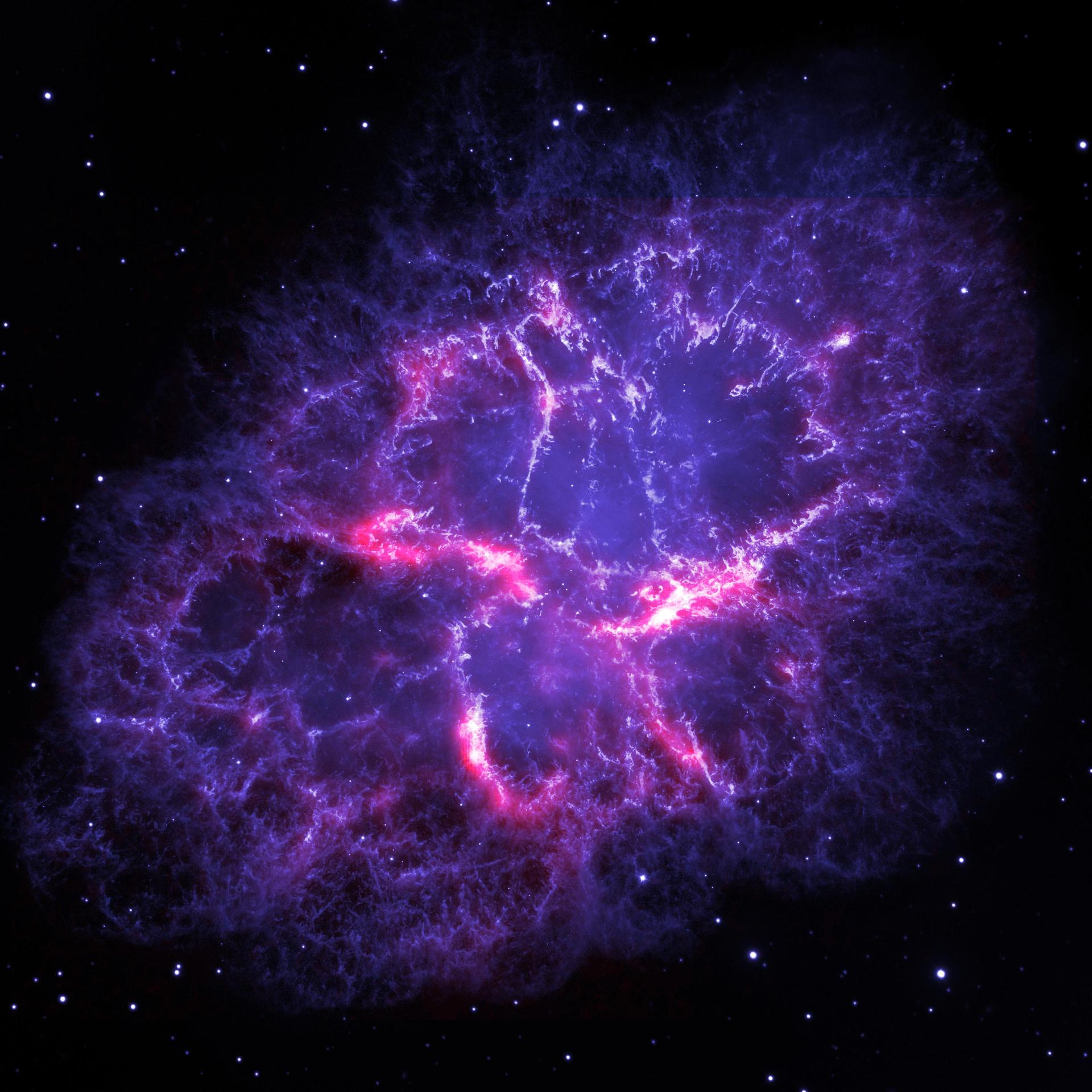
Crab Nebula (M1) — supernova remnant imaged by Herschel and Hubble Space Telescopes

Category: Books

Book excerpts and book-length works

Crab Nebula (M1), supernova remnant · ESA/Herschel/PACS; NASA, ESA & A. Loll/J. Hester (Arizona State Univ.) · NASA Image Library ↗

  • Aether Science Papers (Contents)

    AETHER SCIENCE PAPERS

    Preliminary Note

    The book ‘Aether Science Papers’ was published in 1996. For order information see Aether Science Papers. The 14 papers, reproduced in A4 page size from the scientific periodicals in which they were first published, constitute the main section of the book. The front section of the book is a 68 page commentary entitled ‘The Creative Vacuum’. In view of the importance of making scientists aware of this work, it has now been decided to publish these opening 68 pages here in these Web pages and to include the full text of the 14 papers in files having pdf format which can be inspected by Adobe Acrobat reader.


    Aether Science Papers: Part I: The Creative Vacuum

    Copyright © 1996 Harold Aspden


    CONTENTS

    Part 1 – The Creative Vacuum

    Announcement

    Gravitation – A New Riddle

    About the Title

    The Aetherial Role of Fermat’s Last Theorem

    Eddington’s Unification of the Constants

    The Challenge

    Introducing the Creative Vacuum

    Aether Power Generation

    Unification – The Time Factor

    Physical Reason

    Atomic Spectra and the Moving Atom

    An Excursion into Quantum Electrodynamics

    Some Critical Remarks

    Epilogue

    Bibliography


    Part 2 – Aether Science Papers

    Here there followed a list of the appended papers and their publication reference data.


    The back cover of the book presents the background to the work.


  • PHYSICS NO. Va

    THE PHYSICS OF CREATION: LECTURE NO. Va

    The Early Universe

    Copyright © Harold Aspden, 1999

    We know nothing whatsoever concerning the physical processes that created our universe.

    There are physicists who will tell you that everything emerged from a sudden event at a point in space at which all the substance that was to form the visible universe suddenly appeared as if from nowhere. This is the scenario of the ‘Big Bang’ hypothesis.

    There are theologians who will tell you that God created the universe and qualify that by implying it is blasphemous to delve further into the question by asking how God came into being.

    Then there are those who will just admit that the creation of the universe is destined to remain a mystery for all time, given that we can only describe what we think we understand, using terms which relate to what we experience here on Earth in our immediate local environment.

    The latter viewpoint seems to me to be the most appropriate as it allows one to define God in the role of Creator and say God is a ‘mystery’, without the implication that it is blasphemous to delve into the physics of Creation.

    As to the ‘Big Bang’ idea, that is a primary hypothesis dependent upon another secondary hypothesis. The latter is the assumption that it is possible for light, which exhibits a frequency measured in many trillions of trillions of oscillations every second to travel for distances exceeding:

    100,000,000,000,000,000,000,000 kilometres

    without losing its time-keeping at that ultra high frequency. What is so curious, indeed absurd, about this is that the primary hypothesis is founded on the conflicting observation that what we suspect are light emissions from remote galaxies of comparable frequencies traverse those large distances and reach us having lost frequency, the further their distance of travel.

    By assuming that there is no frequency loss and then noting that astronomical evidence indicates a frequency loss, the cosmologist contrives to fit the two together to deduce that the universe has been expanding from a point since it was created. It not being possible to extrapolate back to a time before that ‘point event’, at least without wandering into a world of make-belief, the cosmologist has settled for his notion of the ‘Big Bang’.

    Admittedly there is here the use of some limited knowledge of physics because it is known that propagated vibrations exhibit a lower frequency than that of their source, if that source is moving away from a receiver. This is the well-known Doppler Effect. So one can see how a cosmologist might be deceived into thinking that the Doppler Effect solves the dilemma by telling us that the universe is expanding relentlessly on an ongoing basis.

    A deeper knowledge of physics suggests another process, one that applies to a non-expanding universe. This involves us in understanding how an electromagnetic wave knows it has a certain frequency. Yes, we can sense that light reaching us has a certain frequency, because we can sample it in a consecutive inspection sequence, in effect timing its oscillatory ups and downs. However, if that wave has to travel over really vast distances through the space between the galaxies how is it that it can regulate itself so as to retain its frequency? Here, your physicist will tell you that the light is conveyed by photons, which are packets of energy, the energy quantum involved being related to frequency by something called Planck’s constant, a universal constant. So, provided that photon retains its energy intact, it will keep its frequency intact as well.

    The problem with this argument is that the photon is supposedly travelling at the speed of light, but that speed needs a reference frame and, to talk about the Doppler Effect as a reason for an apparent loss of frequency and not an actual loss of photon frequency, we need the keep that frame intact over the whole distance traversed by the photon. Yet physicists have abandoned their belief in an aether as a universal light reference frame, relying on experiments performed here on Earth in their laboratories. So the photon notion is hardly compatible with the expanding universe hypothesis.

    You must understand that it is standard practice in physics to switch between a photon theory and a wave theory of light propagation. If things do not add up right using photon theory then the physicist flips over to wave theory and vice versa.

    That brings us back to wave theory and the question of how an electromagnetic wave knows it has a certain frequency, one it can keep intact as it ripples through space shared by numerous other propagating waves in a sea of space rippled by electromagnetic waves emitted by every atom in the universe. There has to be an answer to this question. It is, however, one which eluded Clerk Maxwell. It is that every electromagnetic wave travels in company with a companion wave of the same frequency. They serve to assist in at least partially balancing one another dynamically in their oscillations lateral to the direction of propagation, but they have different displacement amplitudes in terms of both their electric and and their magnetic field properties. Analysis then shows that the wave frequency is coded into the relative strengths of those displacement amplitudes. As a result the wave in transit through space can be intercepted by quasi-material particles in its path and so shed energy in a way which progressively modifies that ratio of displacements, so affecting the coded data and reducing the wave frequency.

    Now, as I said, this is rather technical and is best studied by reference to the original papers describing the phenomenon. However, suffice it here to say that the quasi-material particles just mentioned are Nature’s ongoing attempts throughout all space to shed energy and create matter in the form of electrons and protons. The activity is governed by the equilibrium processes which keep the energy of matter, including its mass-energy, conserved throughout space. The analysis is confirmed by the theoretical derivation of the Hubble constant, the measure of that loss of frequency in relation to distance travelled by light from its source. However, it is asking too much that you, the reader, accept this at this point and so I will now discuss an alternative scenario, the one involved in the creation of stars, given that Nature has a way of creating protons and electrons everywhere throughout all space.

    I take as my starting point an analogy inspired by by efforts to explain some aspects of ferromagnetism during my years of research for my Ph.D. degree. My thesis subject was the effect of mechanical stress in electrical steels upon the magnetization process in those steels and in particular upon the anomalous magnetization losses known to occur with alternating magnetization. It was experimental research, but a diversion that fascinated was the seemingly time-wasting excercise of trying to calculate how mechanical strains and stress forces were set up as between atoms in the body-centred crystal structure of steel.

    I say it seemed to be a time-waster because I adopted as my model for the calculation the notion that the ferromagnetic state of iron was attributable to the synchronized orbital motion of a pair of electrons in each atom. That made the calculation feasible and gave higher internal stress than a model in which the electrons were seen only as closed circuit current flows, meaning that their electrodynamic effects on electrons in adjacent atoms were smeared as if due to a circle of current in the orbit position. Indeed, my calculations indicated that high stresses of the order of the rupture strength of steel could exist if the model I adopted had any merit.

    I knew, of course, that steel, and indeed nickel and cobalt had a high modulus of elasticity, besides high rupture strengths, and their adjacent position in the atomic table meant that they had similar 3d electron orbits. It then dawned on me that the state of ferromagnetism might be attributable to the fact that
    internal stress meant stored potential energy, whereas I new that in more advanced physics dealing with magnetism, magnetic energy could be regarded as ‘negative energy’ in a potential sense. Therefore I reasoned that the state of ferromagnetism might exist in steel, for example, when, and only when, the energy shed by the onset of the magnetic state was enough to overcome the consequent mechanical strain energy that resulted from that state.

    I eventually, some 12-13 years later, published this as a chapter of my book Physics without Einstein but to no avail, physicists were happy with their understanding of ferromagnetism though you would be hard put to it to find one that can explain the phenomenon to your satisfaction. You may hear some mutterings about ‘exchange forces’ but will not learn anything that can tell you as much as I have just outlined in the the brief account presented above.

    However, to come to the point of this commentary with the creation of the universe in mind, my theoretical analysis of the model of a structured lattice array of particles containing electric charges which move in sychrony to set up electrodynamic forces of mutual attraction, drew my attention to certain properties that connected with h, Planck’s quantum of action. This universal physical constant plays an important role in regulating energy quanta involved in electromagnetic radiation. Once I addressed the problem of electron ‘spin’ versus orbital electron motion and the anomalous gyromagnetic ratio evident in experiments on the reversal of polarization and the accompanying angular momentum in ferromagnetic rods, then I knew there had to be a real aether itself having structure. The model I had developed for the ferromagnetic condition in steel was applicable also to the aether itself!

    I soon found that I could evaluate Planck’s constant as a function of the speed of light and the electric charge of the electron. It was all wrapped up in the geometry of space, the cubic structure of charges spread throughout the aether but hidden from view by the very perfection of that structure. At least my account of that in my book Physics without Einstein generated some interest amongst physicists, notably by Dr. D M Eagles of the National Measurement Laboratory in Australia. See [1972a].

    More important, however, from the point of view of creation of the universe, I had a glimpse of the ‘promised land’ when I realized that the ferromagnetic analogy with aether goes much further. If a dispersed vapour of iron atoms cools there comes a point at which molten iron forms. Further cooling results in solidification as the iron segegrates into crystals. Even further cooling results in the state of ferromagnetism developing within those iron crystals. This happens at the Curie temperature as the state of magnetism releases energy, some of which feeds into elastic strain energy, but the rest of which converts directly into heat. The result is that we see a reduction in the specific heat of iron during the transition at the Curie temperature. It takes more heat input to raise temperature by 1 degree and, conversely, upon cooling the extra heat is released during that Curie temperature transition.

    Relevant also to our discussion here is the fact that, within those crystals of iron, magnetic domains form. These are regions to which the electrodynamic forces acting between the atoms are confined. They have planar boundaries.

    Now we come to the main analogy. Suppose we see space as a system of electric charges formed into a cubic structure and regard space devoid of matter simply as one very large single crystal. Suppose now that that crystal forms as regions throughout which protons and electrons are dispersed and as this plasma system cools through some critical temperature. Instead of saying that electrodynamic forces now come into play with the onset of order in forming that structure, we say that gravitational forces come into being. We are later going to declare that gravitation is an electrodynamic force and take our insight into that ferromagnetic model as a clue to solving the problem of the Unified Field Theory. However, our sights for the moment are on that magnetic domain structure. In our aether model we are looking instead at vast domains, each one of which would serve as a confinement range for gravitational action, just as the magnetism of a magnetic domain is confined by electrodynamic interplay to the planar boundaries of that domain.

    So the picture we form of Creation, as being the generation of stars, is an event when the chaos of the dispersed proton-electron plasma became subject to the onset of gravitation. What then happens is that, within a single space domain, the protons, which are positively charged, see one another as two interacting particles subject to gravitation. You can then work out that their mutual acceleration of gravity will be at a rate that is 1836 times greater than the corresponding mutual acceleration rate as between two electrons. The proton has 1836 times the mass of the electron.

    It follows that there will be a coming together of electrical charges with the protons dominant so that, before the plasma body thus formed condenses into hydrogen form it will possess a positive charge. Eventually the electrons left behind will converge onto that ball of plasma so formed and render it electrically neutral.

    [image not preserved: g827.gif]

    The star has formed! There is one star in each of the space domains. Even though the stars then move and, in traversing space, leave the space domain in which they are born, so as to cluster to form galaxies, they are only subject to gravitational action from matter which shares the same space domain. That then is our picture of Creation, but this is only a brief introduction to the story.

    The onward story concerns the discovery that the creation of a plasma ball that has a substantial net electric charge of one polaity will immediately, by its interaction with enveloping aether, cause a state of spin to develop. Stars spin. Body Earth spins. The Moon spins. Thunderballs, the product of lightning in which electrodynamic pinch effects create charge clusters, spin. Tornadoes, which nucleate on whirlwinds and develop even more spin energy owing to recurrent lightning discharges through their funnels, are related phenomena. It all comes down to understanding how anomalous spin effects arise by interaction in or with the aether and the real story of this begins by deciphering the spin properties of the photon. The story was told in Physics without Einstein and has been further reported in Physics Unified and elsewhere in these web pages.

    Indeed, albeit after a lapse of two years since this web page was written, the author, in reacting to something recently published (February 2001) by the U.K. Institute of Physics, has deemed it appropriate to enlarge on the above account in discussing the broader picture of this Creation of the Universe issue and that is the subect of the next lecture.

    As a final note, and concerning the reference to the theoretical evaluation of Hubble’s constant and the reason for space having domains with parallel planar boundaries see the author’s published papers
    [1984e] and [1983k].


  • PHYSICS NOTE NO. 1

    PHYSICS NOTE NO. 1

    SUMMARY THEME OF PART I OF THE PHYSICS OF CREATION

    Copyright © Harold Aspden, 2001

    GRAVITATION AS AN ELECTRODYNAMIC FORCE

    Understanding the true nature of gravitation and what determines the value of G, the Constant of Gravitation, is the essential starting point in any attempt to explain how the universe was created. It is the force that holds matter together on a grand scale whereas mutual electrical attraction between positive and negative electric charges holds the component particles of the atom together on a microscopic scale.

    It is an intuitive assumption in physics that the phenomenon of gravitation has more in common with magnetic attraction than with the electrostatic interaction force that acts between electric charges of opposite polarity. The reason is that mass as the seat of action of the force of gravitation does not exist in positive and negative units and in electrostatics like polarity charges invariably repel one another. Bearing in mind that like polarity charges in mutually-parallel side-by-side motion develop a force of attraction between them, an electrodynamic force which no doubt is the basis of the force of attraction found in magnetism, common sense tells us that our task in understanding gravitation has to focus on the subject of electrodynamics.

    Therefore, the topic one needs to address is the scope for analogy between the law of electrodynamics and the law of gravitation, otherwise known as the quest to discover a ‘Unified Field Theory’. Everything centres on finding a common thread between these two laws of force. This is the subject of Part I of this work ‘The Physics of Creation’.

    The theme develops essentially in accordance with the initial chapters of my book ‘Physics Unified’ and that suffices to provide an answer to the task: “Describe briefly the difference between Einstein’s explanation of the physical cause governing the force of gravity and that offered by Aspden’s Theory.”

    I record here the following answer by way of an introduction to Part I of this work:

    There are two very significant differences between Aspden’s theory of gravitation and Einstein’s method of accounting for gravity. Aspden retains the traditional Gallilean three-dimensioned space frame of reference and develops his theory of gravitational force action by simple analysis of energy deployment. Einstein, on the other hand, requires an imaginary four-dimensioned space frame of reference and develops his theory by resort to a complicated form of mathematics by analysis of field, as opposed to energy, criteria which imply that the space frame itself is actually distorted on a cosmic-ranging scale by the presence of matter. Aspden’s theory merely requires a locally-confined disturbance of the space frame of microscopic proportions. Both theories give the same law of gravitation governing the motion of planets around the sun, but Aspden’s theory is superior in that, by recognizing a role played by the physical underworld of quantum theory. He sees the force of gravity as being an electrodynamic interaction set up in a frame having motion relative to the electromagnetic reference frame shared by matter, the latter having the quantum jitter motion prescribed by Heisenberg as the basis for his Principle of Uncertainty. Thus Aspden provides the long-sought ‘Unified Field Theory’ which eluded Einstein. Furthermore, Aspden is able to derive the value of G, the constant of gravitation, in terms of other fundamental constants, including the electric charge of the electron. Aspden’s theory points to the existence of an underworld of energy activity in what we regard as empty space, an exotic leptonic underworld involving ongoing particle creation and decay, alive with muons and taons, the former dominating and so determining the inertial frame of reference, whereas the latter serve to provide dynamic balance for the quantum jitter motion of matter and, in so doing, provide the electrodynamic action we call ‘gravity’.”

    The Lectures relevant to this Part I of ‘The Physics of Creation’ will, when written, be listed for access here. In the meantime, the reader may find it of interest to inspect those Lectures which have been entered in the corresponding Physics Note 3 relating to Part III.


    Press ‘The Physics of Creation’ to return to its index page.
    Press to return to the main site index.

  • Aether Science Papers (Announcement)

    Aether Science Papers: Part I: The Creative Vacuum

    Copyright © 1996 Harold Aspden


    ANNOUNCEMENT

    Very soon now the world at large will need to face up to the discovery of new ways in which we can generate energy that has no pollution risk. The source of that energy is so abundant that future generations will only need to fear the hangover risks inherited from the passing of the nuclear age and our era of hydrocarbon combustion.

    The source of the energy that will power our future is not a new source. It is as old as Creation, because we will tap the energy that fills space. It was the shedding of some of that energy that gave birth to the particles of matter, protons and electrons, which combined to form the stellar universe.

    The secret giving us access to this sea of energy is connected with the problem that Einstein could never solve, the link between gravitation and magnetism. He could not solve it because he took the wrong direction in ‘time’. He obliterated ‘universal time’ by saying that the rate of time varies according to our own individual viewpoints and so deprived us of our direct vision of the common ‘clock’ which regulates everything, including gravitation.

    In fact, in space, there is electricity which we perceive, in its overall picture, as neutral and electrically balanced, but which is charged with life and motion. All that electricity is moving in a rhythmic dance, in unison, as if it were part of an enormous all-pervading clock mechanism which keeps perfect time on a universal scale. Using a term familiar to scientists the electric charge in motion in what we see as the vacuum is ‘phase-locked’. This is what gives basis to quantum theory and wave mechanics and what assures order, rather than chaos, order which involves a dynamic mass balancing act resulting in gravity and a regenerative process which can package energy spread throughout all space and deliver it to us on demand.

    It is this regenerative property which allows spent energy, energy wasted as heat by radiation dissipated into space, to be put into an orderly state out there, whether in near or outer space, and this sets up the mechanisms by which protons and electrons can be created. Those ‘mechanisms’ are those that we describe in physics in terms of quantum electrodynamics, but the essential point I wish to make in this ‘announcement’ is that the ‘phase-lock’ property of space is something we can exploit. When we contrive to set up an electric field within, and radial from, the axis of a cylindrical or spherical form, we find that the energy we supply is matched by an equal contribution from the aether filling that vacuum in space. We can use that energy!

    Part 1 of this work is a commentary and, when read by reference to Part 2, the collection of fourteen scientific papers appended, it introduces this story from the viewpoint of fundamental physics. Separately, by a series of ‘Energy Science Reports’, backed by a collection of patents, the story will be told from the practical viewpoint of the engineer and it will be the latter work which describes the technology which we now know can deliver power from that vacuum.


  • PHYSICS NO. Vc

    THE PHYSICS OF CREATION: LECTURE NO. Vc

    Quasars and Supermassive Black Holes

    Copyright © Harold Aspden, 2002

    INTRODUCTION

    This lecture is prompted by three factors (1) my having delivered a Lecture at the Binnotec 2nd Berlin Conference for Innovative Technologies on June 15th 2002, (2) my having read an article entitled ‘Supermassive Black Holes’ which has been published by the U.K. Institute of Physics in the June 2002 issue of Physics World and (3) my having received an E-Mail message dated June 29 2002 from a physicist at the Jet Propulsion Laboratory, Pasadena, California.

    In my Berlin lecture I gave account of why certain experiments of published record claiming to tap energy from what we now regard as the quantum underworld of the space in which we are immersed have common features which confirm the theory I have used to explain the physical basis of gravitation and the creation of matter, including the creation of stars and, indeed, the principal component of matter, namely the proton.

    In that Physics World article I was introduced to the notion that at the centre of some galaxies there are massive ‘black holes’, the most massive recorded to date being in the central galaxy in the Virgo cluster, M87, its mass being 3.5 billion solar masses. I could but wonder how any scientist could be so sure in making that kind of assertion. It is an assertion that is all the more perplexing, given that the article starts by a paragraph reading:

    “Of all the legacies of Einstein’s general theory of relativity, none is more fascinating than black holes. While we now almost take their existence for granted, for much of the 20th century black holes were viewed as mathematical curiosities with no counterparts in nature. Einstein himself never believed in black holes and wrote two papers in which he argued against their existence. Einstein’s resistance to the idea is understandable. Like most physicists of his day, he found it hard to believe that nature could permit the formation of objects as extreme as black holes. Indeed, the gravitational fields of black holes are strong enough to prevent light from escaping, and even distort space and the flow of time around them.”

    That Physics World article by Laura Ferrarese and David Merritt went on to declare that the existence of black holes is now acknowledged and that they exist on a scale far larger than anyone has anticipated. Then Ferrarese and Merritt drew one’s attention to another curious feature on the cosmological scene, the puzzle as to ‘Where have all the quasars gone?’. Under this heading they note that:

    “By studying the redshift of the light emitted by the quasars, astronomers found that the number density of quasars peaked when the universe was only about 2.5 billion years old and has been declining steadily ever since.”

    That is certainly an assertion that we surely must question, but, first, I will quote the text of the E-Mail message that I was pleased to receive from that Pasadena physicist. I have in the ‘Welcome to my Physics Website’ introduction stated that I invited feedback which can assist in clarifying and, where necessary, correcting my message in these LECTURES, and so it was even more heartening to receive that message which reads:

    “I have spent a good deal of the evening reading your lectures, and, to be perfectly candid, my main feeling is anxiety that you may pass away without having ALL of your works preserved for posterity (since, in part, you state that one of your books, on gravitation, is out-of-print). I was therefore wondering if a complete collection of your works is available and at what cost.

    I detect in your writing style a person who knows his subject, and, moreover, from my background in physics, I know that the issues you raise are, to say the least, profound (e.g., derivation of G and the fine structure constant from theory).

    I hope to hear from you soon.

    Yours truly, ….”

    Now the message of this LECTURE is to remind readers that, before they try to draw too many conclusions about what is said about gravitational phenomena in far off space, they should ask themselves how they can be so sure that G, the constant of gravitation, is the same in the region of a so-called ‘black hole’ as it is within our solar system. Until one understands the true cause of gravitation, as supported by a theoretical derivation of the value of G in terms of other physical parameters, one just cannot feel confident about extrapolating one’s findings here on Earth to situations where atomic forms of matter are deemed to be crushed out of existence by the force of gravity.

    Given that I claim to have derived G by pure theory, as well as the proton-electron mass ratio and the value of the fine structure constant, I feel in a position to offer here some constructive suggestions concerning the way in which we interpret observations pertaining to quasars and ‘black holes’.

    That introduces the subject of this Lecture.

    A SECOND INTRODUCTION
    Before I proceed with the task I have just set myself, it is appropriate to mention something I discussed in a Letter to the Editor of Physics Education, a scientific periodical published by the U.K. Institute of Physics. It was entitled ‘The First Law of Thermodynamics’ and it appeared at pp. 202-203 of vol. 28 (1993).

    I had reason refer to a book on cosmology (Novikov’s Evolution of the Universe published by Cambridge University Press in 1983.) and noted that in that book the author had posed the question: “Is the vacuum gravitating?”. My comment was: ‘One does not see the equally important question: “Does the vacuum have a temperature?” and I followed this by saying:

    “Yet, when we look into the space enveloping the Earth there is evidence of thermal equilibrium manifested by the 2.7 K radiation. For some reason this ‘heat energy’ is deemed to be a residue of the Big Bang scenario of the expanding universe.”

    I developed the argument in that Letter to the Editor by noting that Novikov had regarded the vacuum as permeated by virtual particles each having mass and, if that mass value was denoted m, one could formulate two equations that were equivalent to each other:

    φm + kT = 0
    φm + mv2/2 = 0

    Here k is Boltzmann’s constant, T is temperature and v is the speed of the thermal agitation of the virtual particle of mass m subjected to a gravitational potential φ which one assumes to arise from the sun and body Earth, for example, if we are looking at the vacuum in the near vicinity of Earth. I wrote kT rather than 3kT/2 because I had a reason, which I will not discuss here, for assigning only two degrees of freedom in this virtual vacuum particle situation.

    My point, of course, is that a gravitating aether must have a temperature and it was of interest to estimate the mass of that virtual vacuum particle, given that T has the value 2.7 K, it being the cosmic background radiation temperature in the vicinity of body Earth and given that the value of φ could be deemed to be that in the Earth’s upper atmosphere primarily attributable to the sun but augmented a little (about 7%) by the Earth itself.

    Here one must remember that gravitational potential is a negative energy quantity, it being a measure of the kinetic energy shed as matter coalesces under the force of gravity. For the vacuum (the aether medium) to elude detection as material bodies move about in space one must accept that its energy state is unaffected by that motion of a body of matter. This can only be if the negative gravitational energy potential of a virtual particle is exactly compensated by the thermal (kinetic) energy retained by the agitation of the particle.

    Hence I was able to deduce the value of m, given that one can calculate the gravitational energy potential effective from the sun and Earth, in our higher atmosphere where that cosmic background temperature has been measured. It was found to be approximately 0.04 times the mass of the electron.

    I had, more than thirty years previously, published a theory in which I had derived a theoretical formula for the fine structure constant, a very important fundamental dimensionless physical constant linked to the universal quantum of action we denoted by the symbol h and name after Max Planck. This formula also introduced the mass m of the virtual particle of the vacuum medium and so I already knew the value of that mass from first principle analysis. Accordingly, in that 1993 Letter to the Editor of Physics Education I added the following footnote:

    “It is beyond the scope of this commentary to show in detail how one can confirm this value m by an independent test, save to say that the vacuum has the ability to define the value of the fine structure constant in terms of the ratio of the mass m to the mass me of the electron:

    hc/2πe2 = (108π)(4m/me)1/2

    A derivation of the above is presented Lett. Nuovo Cimento 40 53-57 (1984). See also the derivation as equation (19) on p. 354 of Quantutm Uncertainties (Nato ASI Series B vol. 162, Plenum Press, 1986.)”

    As one can easily verify that formula does give that same 0.04 mass ratio and so I felt fairly confident about claiming that the vacuum itself does have a virtual particle composition with that mass property and so it must itself gravitate and it must have a background temperature that is a function of any matter present, particularly that concentrated in very large bodies within an appropriate range.

    Now, I know that there will be some readers of this who are astute enough to doubt what I say above because there are so many stars in the universe that, collectively, this could render the magnitude of the gravitional potential infinite in value everywhere in space, even if the mass density of the vacuum itself is zero. That assumes that gravity has an infinite range of action – the conventional assumption. It is an assumption which means that any attempt by nature to create a new particle anywhere in the universe will be thwarted by the need for gravitational interaction to release an infinite amount of energy as part of that event. Therefore the assumption just has to be wrong. The alternative is to accept that space is divided into domains, perhaps one for every star that exists, owing to the range of gravitational action being confined within the domain boundaries. So we need only to consider the gravitational potential of a local star in contemplating that release of energy. Some, influenced by the Mach Principle, might prefer the longer range action of gravity and deem the energy release to be a finite quantity exactly equal to the rest mass energy of the created particle, but I believe the local evidence of a 2.7 K cosmic background temperature confirms my proposition that the range is limited so that we only need to consider a local gravitational potential that arises from the matter in our solar system.

    This was why I included a passage I now quote from that same Physics Education Letter to the Editor, which reads:

    “Now, much as we think we know all there is to know about gravitation, we really have no adequate reason for believing that gravitation can act over a range exceeding a few hundred light years. Indeed, if gravitation has a limited range of action, this could explain why stars form in separate space domains rather than converging into one central core to set up a reversal of the Big Bang scenario. The gravitational coupling across a galaxy can be one that is a chain coupling linking stars that are separated by less than the critical range of action.”

    One still might then wonder about the gravitational effect of the mutual interaction of the mass of the vacuum particles, ignoring any interaction with bodies of matter. Here one’s intuition might suggest that, if gravitation arises from the distortion of the space medium by the presence of matter, then no matter present means no gravitational action with the vacuum medium when devoid of matter. That, however, is a style of reasoning which, though fairly common in theoretical physics, where, without deep understanding of causal factors, we accept ‘laws’ and ‘principles’ based on experience and no proof to the contrary.

    Accordingly, though I have no simple answer to offer, I will suggest that the aether is in a state of equilibrium with itself. If it has an internal gravitational action tending to pull it all together then it must also have a form of internal pressure tending to pull it apart. Its components, whether charge confined by the surface boundary of a vacuum particle or charge in a continuum form that provides electrostatic neutrality overall, neverthess must be subject to internal electrostatic pressure. Maybe that pressure simply balances the gravitational action, as otherwise the vacuum lacks equilibrium. Now even this argument is unsatisfactory, because it recognizes primary action of the vacuum medium attributable to gravity and one cannot then see why this should not be be felt by any matter present.

    I fall back, therefore, on the following argument. It is reasonable to assert that force action will not occur unless energy can deploy from one state to another. This is a chicken and egg argument where I say that the chicken (the energy) has to be able to move before it can lay the egg (the force). Much as we argue in dynamics that force times distance is energy, the truth is that energy that can vary as a function of distance is what imparts the action we call force. In this case we can have a chicken without an egg; we can have energy without a force. In the vacuum medium itself, given that energy density is held uniform through space by the equilibrium that prevails, there can be no gravitational force action asserted by the vacuum on itself or on matter present, the latter being able to move freely through the vacuum medium without suffering any energy problems.

    This does not preclude the action of matter on the vacuum medium in the sense that affects a vacuum particle to cause energy to deploy from one form to another in that medium but provided it stays at the seat of that vacuum particle. This is the significance of those two equations quoted from the Physics Education reference. The energy of that background temperature 2.7 K of the vacuum reflects the energy deficit of the gravitational potential.

    After these two rather lengthy Introductions we can now come to the primary subject of this Lecture, the topic of ‘Quasars and Supermassive Black Holes’.

    Please note before downloading that the five papers referenced next are in pdf format.

    THE 2.5 BILLION YEAR QUESTION!

    For a quick summary of my method of deriving G and the proton-electron mass ratio, I suggest the reader refers to two of my papers published in the scientific periodical Physics Essays, the full texts of both which are included on this website as:

    Concerning the derivation of G, you will find that, apart from first explaining how it really does have electrodynamic origins and so does arise from a Unified Field Theory, what is involved is the need to provide dynamic balance for the quantum jitter motion that gives basis for quantum theory. This dynamic balance is provided by a virtual particle form, leptons which, in performing this balancing act, one can refer to as ‘gravitons’. We have, therefore, a quantum theory of gravity and, on an almost universal scale, certainly in free space generally and here within our solar system, those gravitons have to serve two roles. One is a primary role, a kind of action for dealing with the gravitational action of bulk matter, where the action is measured in terms of discrete units of mass. The other is a secondary or supplemental role catering for the gravitational action of matter and of energy, present, for example, as electron-positron quantum electrodynamic lepton forms, even as minute mass quantities smaller in value than those discrete units. This requires the shared action of two graviton forms, one identified as a virtual tau particle (taon), the super-heavy electron, as it were, given that the muon is the heavy electron. The other is a lepton form which is an energy quantum about 45% greater than the taon, its energy quantum being 2.587 GeV.

    I may say here that, over the early years when I was developing this gravitational theory in the knowledge that the 2.587 GeV lepton must exist, I devoted considerable effort to fathoming the mysteries of elementary particle creation. I had not even contemplated bringing another lepton into the act. Indeed, the tau-particle had not even been discovered. But I knew that that 2.587 GeV energy quantum had to exist, it being the key to understanding gravity. It is a long story, as is evident from my papers in Hadronic Journal that are reproduced here on this website as:

    and

    Particle physicists, at least in Japan, did, it seems, in those early years, catch a glimpse of the particle in their research efforts, referring to it as the H-quantum, which is why I refer to it in my paper:

    The point of all this, so far as my present message is concerned, is that gravitation arises from a dynamic balance attributable to a heavy lepton form in the field medium. Also, I am mindful of the fact that I still have to convince the physics community that there is merit in the suggestion that gravitation is a property dependent upon heavy-lepton balance, rather than upon the vague notion of Einstein that space is curved in the presence of matter.

    That said, I now look to the problem of the quasar and its 2.5 billion year signature, as evidenced by redshift properties concentrated over a region for which the spectral frequencies are reduced by a factor averaging about one sixth. Now, of course, if one really cannot really believe the puzzling suggestion that quasars are a phenomenon of the past, an era going back some 2.5 billion years, then all one needs to do is to accept that what has been observed is simply that some stellar bodies in our universe (QSOs, quasar stellar objects), for some reason, happen to emit radiation over a spectrum having a lower frequency range.

    It was in 1977 that I first read the following words from a book published by Oxford University Press, The Structure of the Universe’ by J. Narlikar:

    “What keeps a QSO shining? Because of its star-like appearance it might be thought that nuclear reactions are mainly responsible. This, however, is not the case, and it is believed that gravitation plays a dominant role in determining the behaviour of a QSO; but the exact nature of the mechanism is not yet known.”

    Earlier, in a 1966 book The New Age in Physics by Sir Harrie Massey (publisher: Elek Books), I had read about the quasar known as 3C273 which was said to have a very large redshift (z) of 0.158 as if moving away from us at a speed of about one-sixth of the speed of light. There was reference also to another quasar 3C48 which had a redshift of 0.367. The discussion then proceeded to explain why, relating this redshift to distance, and observation of the angular separation of radio sources on either side of the optical emitting region, one could estimate that the radio emission takes place out to a distance of 150,000 light years. One then reads:

    “It follows that, whether the process responsible for the generation of the energy in a quasar arises from an explosion or an implosion (a sudden contraction) the radiation must have been emitted over a period greater than 150,000 years. This means a total energy output comparable with that of an intense radio-galactic source and a total mass in the core of at least one million times that of the sun.”

    So, some 36 years ago, cosmologists pondered on these ideas, and in Massey’s words asked themselves the questions: “Are we to regard quasars as coherent masses of matter of this enormous magnitude?” and “How can such masses accumulate and whence comes the fantastically great amount of energy which they radiate?”

    Well, I can but suggest that, in placing those quasars at such remote distances, they had been led astray. Massey ended that discourse with the words:

    “The problems presented in understanding the behaviour of radio-galaxies and especially of quasars are most challenging. A great deal of observational effort both, radio and optical, is being devoted to extending our knowledge of these mysterious objects. At the same time the subject is one which cannot fail to stimulate theoretical astrophysicist to new cosmical concepts.”

    Dare I say here that we do not need new cosmological concepts, but rather an old concept, namely that of the aether as adapted to quantum theory, with its fine-stucture properties and its jitter motion and its dynamic out-of-balance that requires those leptonic gravitons mentioned above?

    We know that gravitation can cause a redshift in the atomic spectrum. It is because gravitational potential acting in a region where energy is released by photon emission has priority in first extracting some of that energy to adjust that gravitational potential to cater for the loss of its gravitational action with the equivalent mass of the quantum of energy released. Keep in mind that gravitational potential is a negative quantity and so the loss of energy to feed electromagnetic radiation necessitates a commensurate but normally very small gain in the gravitational potential. The formula we use for this is such that the gravitational redshift at the surface of the sun involves a shift of wavelength that is very small, being 2.1 parts in one million. However, as we shall now see, we can contemplate something rather interesting, based on this author’s theory of gravitation.

    Suppose that, instead of the tau lepton serving as the primary graviton in the dynamic aether balance role, we have, for some reason, conditions in certain regions occupied by those quasars by which the more prevalent muon lepton assumes that role. Here it seems most unlikely that the equilibrium state which is established by the joint action of the tau lepton and 2.587 GeV lepton will be a factor. Instead, one can imagine that a simple single-lepton form provides the dynamic balance over a limited region of space centred on our quasar. Then, the muon being of larger physical form than the tau lepton, its electrodynamic effect in setting up the gravitational action will be very greatly enhanced.

    This can be understood by reference to the author’s above-mentioned paper on the theory of gravitation. As can then be seen, if a stellar core body involves muon leptons as gravitons, whereas its outer surface of radiating atoms lies in a normal region where the heavier lepton forms govern the gravitational action, the effective gravitational potential is enhanced by the fourth power of the inverse of the lepton mass ratio. Note then that the normal value of G for our situation here on Earth is governed by a factor of three times the fourth power of the inverse of the mass of the 2.587 GeV lepton. Therefore, for the pure muon graviton effect, in the situation mentioned, the effective value of G is increased by the factor (2587/105.6)4/3, 105.6 MeV being the mass-energy of the muon. This factor is 1.20×10⁵ and so a quasar having the mass and physical size of our sun, given this muon-based G value, should exhibit a very large redshift, without needing to be receding from us with an enormous speed or located out in space at an enormous distance.

    Having regard to the fact that quasar redshifts are measured more by reference to radio frequency radiation than optical radiation and, guided by the fact that the source of our sun’s radio radiation is in its chromosphere rather than its photosphere, the former having a larger radius, the sun’s redshift, were it a quasar, would be somewhat less than the above factor suggests. I see, from a Lick Observatory photograph of the solar corona reproduced as plate 7.5 at p.208 of Massey’s book, that the mean radius of the corona glow from the chromosphere is about 40% greater than the sun’s radius, that of its photosphere. This would imply that, if a body having the sun’s mass and form as typical were to be seated in a region of space where it acquired quasar gravitational properties, then its redshift (z) would be 2.1 divided by 1.4 and multiplied by 0.12, which is 0.18.

    Now, if a redshift of 0.18 is the norm for a body typified by the sun’s size and mass, given the muon graviton condition, this can but be seen as relevant to the observed norm for quasar redshift values. Indeed, it seems to offer a very satisfactory explanation as to why quasars ‘seem’ to have evolved and come into existence some 2.5 billion years ago. No longer can one really say, as I read on the first page of that June 2002 Physics World article by Ferrarese and Merritt, that:

    “The reason for this evolution remains one of the great unsolved mysteries of modern physics.

    In claiming here the possible solution to this great mystery I am merely pointing out that the astrophysical evidence that suggests the existence of bodies that have enormous masses, whether millions or billions of times the solar mass, might well be evidence of anomalies pertaining to the value of the constant of gravitation, G.

    However, I have now given myself a new problem, in that I have now to face the puzzle of how it can be that a muon graviton can, under exceptional circumstances, replace the role of the taon graviton and its partner, the 2.587 GeV graviton, of the theory of gravitation that I have nurtured for so many years.

    In thinking about this, even as I compile this LECTURE, I am influenced by the following words, also quoted from the first page of that Physics World article:

    “Quasi-stellar objects or quasars belong to a class of galaxies known as active galactic nuclei. What makes these galaxies ‘active’ is the emission of staggering amounts of energy from their cores. Moreover, the luminosities of active galactic nuclei fluctuate on very short time scales – within days or even minutes. This fluctuation and the finite velocity of light set an upper limit on the size of the emitting region. For this reason we know that the nuclei of some active galaxies are no larger than a few light-minutes across, making them at least 1 billion times smaller than the galaxy in which they sit. Astonomers were faced with a daunting task to explain how a luminosity hundreds of times that of an entire galaxy could be emitted from a volume billions of times smaller. Of all the proposed explanations, only one survived close scrutiny: the release of gravitational energy by matter falling topwards a black hole. Even using an energy source as efficient as gravity, the black holes in active galactic nuclei would need to be enormous – millions or even billions of times more massive than the Sun – in order to produce the luminosities of quasars. To distinguish these objects from the stellar-mass black holes left behind by supernova explosions, the term ‘supermassive black hole’ was coined.”

    I leave it to the reader to rethink the above argument on the assumption that, owing to the muon graviton presence, G might be 120,000 times greater in such an active galactic nucleus than it is here in our solar system. This would mean that the galaxy in question is then closer to us and at a distance of one part in 120,000 of that otherwise assumed. This is owing to the redshift being a gravitational shift rather than a Hubble time shift, and so that daunting task is completely eliminated and the notion of the ‘supermassive black hole’ can be dismissed as an absurd suggestion.

    Accordingly, one need not see the quasar as emitting ‘staggering amounts of energy’ as is suggested by the wise men of modern cosmology, but one must wonder why the quasar has a muon-graviton core system, whereas most stars, including our sun, have a different lepton-graviton environment.

    Quite evidently the realm of the quasar is a region of space where conditions preclude the existence of normal states of matter and where, for whatever reason, one can expect a high energy activity and so high temperature conditions. So what is my ‘new problem’? Well, this is why I added that Second Introduction above. It concerns the cosmic background and its temperature, the 2.7 K temperature evident from space probes in the vicinity of body Earth. In chapter 9 of my book Physics Unified I derived this temperature theoretically in terms of the thermal energy necessarily retained in reserve by each of the aether particles which form the basic fluid-crystal-like structure of that medium. I had shown that those particles had a small mass value which made them subject to gravitational action and so they must individually account for a measure of negative gravitational potential energy owing to the near presence of sun and Earth. I reasoned that the elusive nature of the aether precluded these two energy quantities, one negative and one positive, from betraying the existence of the aether, except in a subtle way. This meant that they had to compensate one another and so be of equal magnitude. From this, based on the use of Boltzmann’s constant k, I could equate the gravitational potential energy of each such aether particle to the thermal energy kT and so deduce T, the temperature of the cosmic background in our Earth locality. The theory gave 2.6 K as that temperature and, 2.7 K being the value measured, I deemed this to be close enough carry a ring of truth and duly put my findings on the scientific record. See also that Physics Education item I discussed in that Second Introduction.

    I could see that when matter was present as a tenuous gas or as stray molecules in space that temperature would incur some action in causing them to heat to that same temperature. This heat, being that of matter present, would then radiate energy into enveloping space where the aether would eventually merge it back into its general jitter motion, the motion which primes and also replenishes that cosmic background temperature state as necessary.

    In retrospect, I see that one could ask how such a phenomenon might affect laboratory experiments in which we cool matter to temperatures below that 2.7 K norm. Maybe, if one investigated with this theme in mind, and did find that some kind of anomalous transition in rate of heat transfer at this particular temperature, then this would add proof to my proposition. I can only hope that research might one day clarify this issue.

    Meanwhile, however, having mooted the possibilty that G could be increased by the factor 120,000 under certain circumstances where the muon graviton dominates the action, I now face the problem that, at distances from a quasar commensurate with the distance between sun and Earth, the cosmic background temperature could well be 120,000 times 2.7 K or over 300,000 K. Any matter there present would share that temperature and so radiate heat energy tapping, not energy sourced in the quasar itself, but aether energy drawn from its quantum jitter motion.

    This may explain why the subject of my Berlin Lecture, as mentioned in my opening remarks above, is linked in my mind with the topic here under discussion. The aether itself can be a source of energy we should be able to harness, and, though that Berlin Lecture was concerned with a method that applies in our cosmic environment, I cannot resist making the point that, on the grand scale where cosmic forces are at work in a somewhat different cosmic environment, as evidenced by a change in the value of G, the aether has also other ways of shedding energy from its vast reserves before eventually reabsorbing that energy to sustain its quantum jitter.

    So my message overall in this LECTURE is this: Do not be deceived by those who speculate about supermassive black holes which supposedly have masses measured in billions of solar masses. Those who speculate do not understand the physical basis of gravitation, as otherwise they would not dream of extrapolating the value G, as it applies within our cosmic locality, and extending it to a realm that one can only conjure in one’s imagination. Maybe there are clusters of stellar bodies seated at the centres of galaxies that are collectively very massive, whether measured in hundreds, thousands or even tens of thousand solar masses, but surely not billions.

    Furthermore, I repeat my assertion that cosmologists surely need to address the issue of how hydrogen atoms compressed into contact by the force of gravity, as in the sun, do not break up into electrons and protons. Once this begins to happen those free protons will see one another as attracted by mutual gravity action and become subject to a rate of acceleration that is 1836 times that of the corresponding interaction between two electrons. The net result is equilibrium as between gravitational attraction and electrostatic repulsion as the protons form a core of uniform positive charge density given by (G)1/2 times the mass density of a system of hydrogen atoms which their K-level electron shells just overlapping. This density is 1.4 gm/cc, the mean mass density of the sun.

    Why, I wonder, is this rather obvious issue just ignored by those who write on cosmological issues? Maybe the answer is linked to an overzealous theoretical venture into quantum physics. I read, on pp. 39-40 of Narlikar’s book, an account which declares that for stars of less 1.4 solar masses, there comes a time when all the nuclear fuel is exhausted. This means that the radiation pressure cannot withstand the gravitational forces and so the star contracts to such an extent that its density can become 170,000 metric tons per cubic metre. The star is supposed to become such that the electrons in it are quantum-nmechanically ‘degenerate’, whatever that means.

    Yet those protons are the ones bearing the gravitational pressure and they all have positive polarity! So surely they will bring into play a positive charge density which sets up a repulsive force that can arrest that compaction. Indeed, that electrostatic repulsion is so dominant that it will virtually preclude any compression beyond that 1.4 gm/cc value and in no way can one claim compression to levels at which can imagine the kind of physics that contemplates the creation of neutron stars or those mysterious ‘black holes’ that are said to be ‘supermassive’.

    Why, indeed, one may wonder, is gravity excluded from the quantum theory of degenerate matter and why is it that physicists can extrapolate a theme that applies to the confines of an atom and assume it applies generally to bulk matter? Here I have in mind the following statements in Narlikar’s book:

    “In a given system of electrons, the number of electrons occupying a given energy level is limited, because all such electrons must differ in other characteristics which specify the state, for example, the momentum and the spin. The permissible number increases with energy. In a highly compressed state of electrons (say with a density of 109 kg m-3) at low temperatures these energy levels tend to be all filled, and the matter is called degenerate. For such matter the pressure increases with density according to a fixed law. The pressure arises from the above-mentioned result that we cannot squeeze too many electrons of the same energy into a given region of space. The degenerate pressure therefore reflects the resistance provided by matter when an attempt is made to compress the matter beyond a permitted amount.”

    According to Narlikar this belief in the degenerate state of matter influences the ideas which cosmologists have about the evolution and decay of stars, but I have to say that I have trouble understanding how the physics of electron states pertaining to individual atoms has warranted such ideas as those just expressed. I believe that electrons do not obey man-made laws which say they have to avoid the same energy state in a so-called system other than that of a single atom. As I see it electrons in atoms have to avoid states of motion by which they act in concert with another electron to radiate energy. They could not retain their quantum status if they radiated energy. Note that a single electron moving in isolation does not shed energy as a function of its rate of acceleration. That, as I have explained in detail elsewhere The Exclusion Principle, is the causal factor accounting for its inertial mass property and, incidentally, the E=Mc2 formulation. However, a collective system of electrons can avoid such energy loss by radiation if the electrons are so deployed in different states of accelerated motion that their fields interact orthogonally or oscillate at different frequencies. This does give the pattern of segregated electron states that we find in atoms. In no way, however, can this non-radiation theme be extended to require that numerous electrons in a kind of free electron gas take up different energy states as a matter of principle justified by an arbirary ‘law’.

    The question I have raised in writing this Lecture remains open. I still need to address the issue of what may be the factors which determine whether, in a given region of space, a muon-graviton system will replace the normal graviton system which includes the tau-lepton. I can only hazard a guess at this stage, a guess guided by the thought that quasars are said to belong to a class of galaxies known as active galactic nuclei. Maybe, in having very little translational motion through space, they lack something, a kind of electrodynamic property, that facilitates equilibrium and onset of order in forming a stable graviton environment and so the muon has to stand in and serve as the dynamic balancing agent that compensates for the quantum jitter. I have, in my writings, contemplated the creation and deployment of muons within the vacuum to serve a role of balancing aether momentum attributable to the vacuum particle system moving as an electromagnetic reference frame. The faster the motion, the more likely it is that a more-energetic lepton form will assume this role and so a muon presence such as might be deployed into service as a graviton goes hand in hand with a lower translational speed of a stellar object. However, that is mere speculation on my part and, in developing my theory, I have always sought to have significant corroborating factors before inflicting my ideas on others. Accordingly, I now close the Lecture.

    Harold Aspden
    July 4, 2002


    The author’s E-Mail address is:
  • PHYSICS NOTE NO. 2

    PHYSICS NOTE NO. 2

    SUMMARY THEME OF PART II OF THE PHYSICS OF CREATION

    Copyright © Harold Aspden, 2001

    PHOTONS AND THE FINE STRUCTURE CONSTANT

    Part I of this work claimed the discovery of the truths underlying the nature of the force of gravity and may have implied that one can build a logical step-by-step picture of the underworld of space and so deduce how the dynamics of that system can set up interaction forces related to the mass properties of the interacting particles. That, however, was not the chronological order of progress concerning the development of this theory. One cannot just sit down and, as a mental exercise, devise an explanation for the force of gravity, nor indeed was there any experimental breakthrough on the gravity front that provided the necessary inspiration.

    The foundations for this work were laid by the author engaging in an experimental project as a research student working for a Ph.D. degree at Cambridge University. That project was in no way connected with any of the fascinating topics that come within the scope of physics. It was the more mundane pursuit of trying to discover why the magnetization losses in laminated steel cores excited at normal power frequency are so much greater than conventional eddy-current theory predicts. More electrical energy goes into heat that those who design power transformers expect by normal electrical principles based on the physical properties of the materials used.

    This research caused the author to focus as a peripheral interest on the question of how it was that a steady magnetic field applied to a metal test piece is not virtually completely compensated by the reaction of the numerous free conduction electrons present in metal.

    It was only after leaving Cambridge and becoming immersed in the real world of the electrical power industry that inspiration took a hold and pointed to the possibility that there was indeed a powerful magnetic field reaction set up in metal by those free conduction electrons, but, to the extent that
    this would offset the strength of the applied magnetic field, it would then weaken the reaction. Now, here, instead of just thinking of a magnetic ‘field’ as something set up by electric charge in motion, the relationship being direct and determined by empirical rules concerning units of measurement, I argued that Mother Nature might have her own way of controlling the reaction by optimizing at its maximum level the energy density of that reacting system, given that we feed energy into the so-called ‘field’ by the process of magnetization. Once I did this I immediately discovered that the optimum reaction would be one for which the energy stored in the reacting electron motion in the metal would have the the standard energy density that is prescribed in physics, but that the reaction field would halve the applied field. In other words, I had then to accept that an electric current really always develops twice the field action that we expect from standard physics teaching but that invariably there would be an associated reaction from the stored field energy system that halved the applied effect. Since 2 minus 1 is 1, this kept things in order. There was no need to upset standard physical principles, except, that is, for two rather far-reaching consequences.

    What pleased me most was that my ‘discovery’ had explained why it is that when a ferromagnetic cylindrical rod, mounted to pivot easily about its central axis, is subjected to a reversal of its magnetic polarization, the associated change of its angular momentum is half that expected from the change of its magnetic moment. In physics this is known as the ‘gyromagnetic ratio’ and physicists have dealt with the anomaly in a rather mystical way by appealing to what they refer to as the half-spin property of the electron.

    I was, therefore, beginning to trespass on holy ground, that of a world of physics that was seen as the realm of Nobel Laureate Paul Dirac, which seems to provide territory shared by both quantum theory and the theory of relativity. My university research had been on an energy problem in electrical engineering and here I was swimming in the waters reserved for the physicist.

    However, there was also the greater problem. The price I had to pay for accepting that a magnetic field is subject to what I now call a ‘half-field reaction’ effect, is clear once one considers the case of a magnetic field produced by an air-cored solenoid or one located in a vacuum. Space itself, or rather the aether, has to be the seat of electric charge in motion as the ‘half-field reaction’ has to be applicable on a universal scale.

    So, there you are, I had no option then. I could either let my discovery drown in a sea of nothingness and forget the gyromagnetic ratio problem and ignore how energy is really stored by a magnetic field, which I could never do, or I could turn my attentions wholeheartedly into a belief in the existence of a real aether medium. This meant, at least at the time, the mid 1950s, that I was committed to a belief that Einstein’s theory, which had cast the aether aside, was a misleading doctrine and that some new physics was needed to restore the aether as the foundation on which to build our understanding of the universe.

    Here then was the reason for my research that is described in Part II of ‘The Physics of Creation’.

    I had, in fact, an entry point, because I had struggled whilst still at Cambridge to build a better physics picture of the electrodynamic forces active between atoms in the structure of iron crystals, aiming to get a theoretical insight as to how mechanical strain in iron affects its magnetic polarization within the magnetic domains of the crystal. This involved a great deal of mathematical analysis as I tried to bring the Bohr magneton into the picture, where there was electrodynamic interaction merged with attendant electrostatic interactions as between electrons in the 3d shell of the atom moving in concert, that is in synchronous motion. The outcome of this effort is summarized in Chapter 3 of my book ‘Physics without Einstein’. However, the point I make here is that it was only when I switched my attention wholly to the aether theme that I saw that the methods of my analysis as used for the iron crystal in the context of ferromagnetism had a direct and simplified relevance when applied to the aether. If the aether had structure and contained electric charge that could be displaced in that structure whilst having also a quantized state of motion then the energy analysis would surely give me an insight into the properties of the aether, particularly as to the ratio of the radius r of the orbit of the quantized charge motion in relation to the aether lattice dimension d of the cubic structure assumed.

    I note that, rather curiously, the r/d factor of the aether turned out to be much the same as that found for iron in its ferromagnetic state, based on the quantized motion of the 3d electrons which are known to account for the magnetic polarization of iron. Indeed, as one can see from p. 48 of ‘Physics without Einstein’ it was suggested by Slater in 1930 that to be ferromagnetic a metal needed the r/d factor to be of the order of 0.3, it being 0.306 for iron.

    Rigorous energy analysis, given the aether model I adopted on the strength of careful logical argument, and using the tools of the day, a slide rule and six-figure logarithm tables, gave r/d for the aether as being 0.3029. So it was that, from the quantization picture defined by the Bohr theory of the atom, which gave the value of r as h/4πmc, m being the mass of the electron and h and c having their usual significance as Planck’s constant and the speed of light in vacuo, I could derive the spacing dimension of the structure of our aether. The resulting value sat well with the scale of atomic structure, meaning that I felt quite comfortable with the result and was not looking at an aether having dimensions on such a scale as to be irrelevant to a real physical world.

    It was then an easy step to move on to ask how a photon which played a role in the creation of an electron could have a quantum of angular momentum h/2π. It emerged that the photon had to be a 3x3x3 cubic array of the particles forming the lattice sites occupied by charge in the aether and so, very quickly, I was able to formulate the key equation of by whole theory, namely:

    hc/2πe2 = 144π(r/d)

    Physicists working in government laboratories that determine standards based on high precision measurement have established the value of the expression on the left hand side of the above equation to within one part in a million accuracy. The expression of the right hand side of the equation can be calculated by simple analysis of energy optimization in this author’s aether model, as will be shown in these web pages. There is agreement and so the theory is well supported. More than this, however, the 144π(r/d) term features in the formula for G, the constant of gravitation, derived from the same aether model and so, if one wishes, one can formulate G theoretically in terms of hc/2πe2 without needing to calculate r/d. Such is the strength of the theory.

    That, in summary, is what Part II of this work is all about. It is a formal analysis of the real aether medium aimed at providing the foundation on which the whole theory of ‘The Physics of Creation’ has been built. This foundation was the starting point. It opened the way forward, in that the numerical quantity defining a dimensionless physical constant had emerged so precisely and yet so easily without there being any incentive to decipher what that number meant. Although critics have suggested that I was merely playing with numbers, as if pushing buttons on a modern calculator can of itself serve as physics, that was not the way it was.

    It was not my desire to change the world of physics. I had a residual curiosity from my efforts at Cambridge to understand something anomalous concerning energy loss in magnetic materials but my curiosity had been aroused once I saw how physicists had taken a few wrong turns in interpreting certain phenomen. Their explanation of record on the free-electron diamagnetism theme borders on being hilarious. Their concept of the half-spin property of the electron defies all logic, if one seeks to picture the physics involved, and to dismiss the aether as non-existent because of an experiment performed using mirrors, the Michelson-Morley experiment, is somewhat ludicrous.

    On the latter point, given that we now know that a laser traps electromagnetic waves between mirrors to set up standing waves which carry energy along with the apparatus, ought one not to wonder how the Michelson-Morley experiment could claim to relate to the one-way free transit speed of light? Keep in mind here that the existence of standing waves and the way in which the wave nodes are dragged along by being locked on the mirror system had not been discovered at the time Michelson and Morley first performed their experiment.

    More to the point, the Trouton-Noble experiment (1903), a topic discussed in Part I of this work, was a factor in the scenario by which the aether was dismissed, but as we have seen its significance depended upon a certain law of electrodynamics that had not first been established for action between discrete charges in motion. The law was merely ‘inferred’ by combining assumptions with empirical fact relating ony to action that was part of a closed cicuital flow of current.

    So, you see, my interest in the aether is in the underlying physics and not in deciphering number relationships for their own sake. I do find great satisfaction in interpreting the physics that govern our universe and find it gratifying when the numbers come out right. I know that some physicists see beauty in mathematical equations according to their shape and symmetry and have little patience with numerical conclusions. However, having an academic background shaped by the electrical engineering mould, where experiments had to give the right numerical answers as dictated by theory, I can only assume that a theory is either totally wrong or at least partially wrong if it gives the wrong numerical answer when tested by experiment. Accordingly, I trust that here in this Part II, where the reader will see how the value of the fine-structure constant emerges from theoretical analysis, the result will be viewed in proper context, namely as an indication that the underlying aether theory portrayed is indeed a true representation of the real underworld of space.

    The Lectures relevant to this Part II of ‘The Physics of Creation’ will, when written, be listed for access here. In the meantime, the reader may find it of interest to inspect those Lectures which have been entered in the corresponding Physics Note 3 relating to Part III.


    Press ‘The Physics of Creation’ to return to its index page.
    Press to return to the main site index.

  • Aether Science Papers 0101

    Aether Science Papers: Part I: The Creative Vacuum
    Page 1

    Copyright © 1996 Harold Aspden


    GRAVITATION – A NEW RIDDLE

    The fourteen scientific papers just mentioned are presented unamended and in the form in which they were published in the periodicals, Hadronic Journal and Physics Essays. They provide a theoretical account which will show that the 20th century did yield a definitive answer to the riddle of gravitation, together with the long-sought Unified Field Theory.

    However we will enter the 21st century confronting a new riddle, that of devising a way in which to use this knowledge to build a machine able to control gravity in some way. That is a real challenge.

    The author may not live long enough to see the arrival of that technology, but wishes to go on record here for pointing researchers in one possible direction. The task is to devise a composite metal structure which, under appropriate field control, develops resonant gravitational interactions between its innermost atomic electrons and the gravity field. The resonance frequency is the Compton electron frequency and the technology will need to exploit a resonance, probably with the fifth harmonic frequency of electrons in the K shell of the atoms.

    As a clue take note that, if a metal were to have a propensity to be active in the supergravitational or antigravitational sense, it might have a smaller latent heat of fusion in relation to its melting point temperature than applies to normal metals. Then make a selection from known metal elements to determine which have a melting point above 1,000oC combined with a latent heat of fusion below 80 J/gm.

    You will find that there are four such elements, neodymium, samarium, gold and uranium. Neodymium and samarium sit either side of promethium in the periodic table, promethium being completely ‘missing’ from natural Earth crust abundance data, possibly owing to its abnormal supergravitational properties.

    I observe that an electron of atomic number 137 would have a first harmonic resonance with the gravity frequency, if it were to exist, but an atomic number Z of 61 (promethium) applies to the fifth harmonic and Z=79 (gold) applies to the third harmonic. The electrons in gold atoms, however, do not interact with the underlying quantum medium so as to produce a dominant harmonic perturbation, whereas those in promethium are strongly affected. The right combination of neodymium (Z=60) and samarium (Z=62), which form, incidentally, the most powerful magnets known, could, given a special field control, well develop powerful anomalous gravitational forces according to that governing control.

    Anyone interested in the prospect of such a technology should pay special attention to the theory disclosed in the fourth of the fourteen papers. Do not overlook the Epilogue added at the end of this commentary on page 60.


  • PHYSICS UNIFIED: CONTENTS

    PHYSICS UNIFIED

    An account of the physics of microscopic and cosmic phenomena incorporating the long-sought link between electromagnetism and Einstein’s law of gravitation.

    by

    Harold Aspden


    The items below are in pdf format.


  • PHYSICS NOTE NO. 3

    PHYSICS NOTE NO. 3

    SUMMARY THEME OF PART III OF THE PHYSICS OF CREATION

    Copyright © Harold Aspden, 2001

    RELATIVITY AS A DISTORTION OF THE TRUTH

    In my writings hitherto I have only been concerned with Einstein’s theory of Relativity to the extent that it stands in the way of acceptance of what I have discovered concerning the properties and role of the aether in regulating the physics of the quantum underworld, the creation of matter and the action of gravity. Here, however, in Part III of this work, at this intermediate stage before delving into the creation of the fundamental particles, I now think it necessary show why Einstein’s theory has nothing whatsoever to offer to our knowledge of physics.

    I find it reasonable to present my case in three ways, each the subject of its own LECTURE. It is for the reader to decide which to read first. A reader new to the subject of Einstein’s theory should read LECTURE IIIc first and a reader already familiar with the theory may find it more interesting to read LECTURE IIIa first and then progress to LECTURE IIIb.

    LECTURE IIIa dates from 1997 and was published on the author’s web site www.energyscience.co.uk as LECTURE No. 2. It was the first Part of an intended two-pronged attack on Einstein’s theory, but it is only now that I have got around to putting the second Part on record here on this new web site which is intended to segregate the author’s physics pursuits from technology.

    LECTURE IIIb is that second Part. It was written initially in 1993 at a time when the author had in mind writing a second edition version of his 1969 book ‘Physics without Einstein’. It is a direct attack on Einstein’s doctrines based on the up-to-date experimental evidence of that 1993 period.

    LECTURE IIIc is merely a review of the curious logic and style of presentation used by Einstein to explain his theory to a lay audience. It makes extensive reference to the fifteenth edition of the book ‘Relativity: The Special and General Theory’, authored by Einstein and published in 1961, the preface to that edition being dated June 9th, 1952. This book presumably represented Einstein’s final account of his own theory, the preface to the first edition of the book being dated 1916, and so dating from the time of his basic papers on the General Theory of Relativity.

    The book cover of this 164 page work declares that it presents “a clear explanation of the famous theory that brought about the atomic age”. So I take it that what I shall be quoting from its text will be meaningful and relevant to the topic we are here considering, namely ‘The Physics of Creation’.

    In this Physics Note I shall only make a few preliminary comments, leaving the bulk of what I have to say for inclusion in the three supporting LECTURES just mentioned that feature as part III of this work on ‘The Physics of Creation’.

    The word ‘aether’ does appear in the index of Einstein’s book. It is first referred to as ‘the hypothetical aether of space’ on page 52 where Einstein draws attention to the failure of attempts to detect the existence of ‘aetrher-drift at the Earth’s surface’ and points to Michelson’s ‘decisive’ method as being the ‘most notable of these attempts’. By page 142, towards the end of his book in Appendix V added in 1952, Einstein discusses, as a nineteenth century requirement, the need to ‘introduce a field, that could exist in “empty space” in the absence of ponderable matter.’ He goes on to explain how in the light of this this need ‘one felt compelled, even in space which had hitherto been regarded as empty, to assume everywhere the existence of a form of matter, which was called “aether”.

    His discourse over several pages then struggles to convey a message concerning the notion of space as something devoid of matter and matter as something extending everywhere into space by virtue of its ‘field’. By page 152 he concludes by saying:

    There is no such thing as an empty space, i.e. a space without field. Space-time does not claim existence on its own, but only as a structural quality of the field. Thus Descartes was not so far from the truthwhen he believed he must exclude the existence of an empty space. The notion indeed appears absurd, as long as physical reality is seen exclusively in ponderable bodies. It requires the idea of the field as the representative of reality, in combination with the general principle of relativity, to show the true kernel of Descartes’ idea; there exists no space “empty of field”.

    Quite clearly, therefore, Einstein is here declaring that all matter has a field system associated with it that extends into what we, in a popular sense, refer to as ‘space’, but if there is no matter present then space, as such, is empty and not occupied by what a nineteenth century physicist would term the ‘aether’.

    This, I feel, amounts to saying that the speed of light in a vacuum surrounding an element of matter is not governed by an ‘aether’ medium but depends instead upon the field system attributable to the presence of matter, and yet I hesitate in thinking this, because I have the impression also that Einstein’s theory requires the constant speed of light to be referenced somehow on the notional observer.

    However, it is not for me to try to make sense of Einstein’s ideas. I submit that that is a quite impossible task for anyone to undertake. My task is to show that our understanding of the physics governing our universe can best be based on the results of deciphering physical data gleaned by experiment and which lead to something different from what Einstein has suggested.

    The Lectures relevant to this Part III of ‘The Physics of Creation’ will, when written, be listed for access here. These are probably now complete:


    Press ‘The Physics of Creation’ to return to its index page.
    Press to return to the main site index.

  • AUTHOR’S COMMENTARY

    AUTHOR’S COMMENTARY

    UP-TO-DATE REMARKS ON CHAPTER 8

    [COSMIC THEORY]
    Copyright © Harold Aspden, 2002

    Given that the aether has been introduced to explain phenomena at the atomic and microscopic level the question of its role on a large scale comes into issue. Here, from the very early stage of development of this theory, I could see that one had only to ask the question of how a large sphere of aether set in rotation would respond given that sychronized co-ordination of its aether lattice particle motion to reveal a feature that proved its very existence. Hence this chapter 8 is important.

    A large sphere of aether, typically of the size of Earth, if rotating will develop a radial electric displacement about its spin axis. Conversely a radial electric field set up by a large spherical body of matter will induce spin in co-extensive aether. Thus one could explain how the Sun is created in a state of spin and why Earth has a magnetic field. In particular, without making further assumptions, the data already derived for the aether properties from analysis of the topics dealt with in previous chapters, notably chapter 6, could be applied here in chapter 8 to estimate the value of the geomagnetic moment. This result was a very convincing outcome of the theory. It had been the subject of chapter 5 in the 1960 booklet ‘The Theory of Gravitation’ and it meant that the theory could prevail over non-aetherial physical models. It has no rival in Einstein’s theory and little more need be said.


    This ends these chapter commentaries. The reader may now wish to return to the Contents page of ‘Physics without Einstein’.